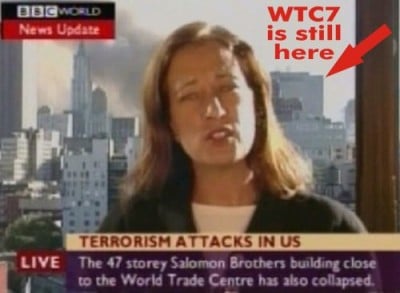
9/11 Truth: The Mysterious Collapse of WTC Seven
Why NIST’s Final 9/11 Report is Unscientific and False yea ,no shit !
[originally published in September 2009]
At 5:21 in the afternoon of 9/11, almost seven hours after the Twin
Towers had come down, Building 7 of the World Trade Center also came
down. The collapse of this building was from the beginning considered a
mystery. [1]
The same should have been true, to be sure, of the collapse of the
Twin Towers. But they had been hit by planes, which had ignited big
fires in them, and many people assumed this combination of causes to be
sufficient to explain why they came down.
But WTC 7 had not been hit by a plane, so it was apparently the first
steel-framed high-rise building in the known universe to have collapsed
because of fire alone. New York Times writer James Glanz quoted a
structural engineer as saying: “[W]ithin the structural engineering
community, [WTC 7] is considered to be much more important to understand
[than the Twin Towers],” because engineers had no answer to the
question, “why did 7 come down?” [2]
From a purely scientific perspective, of course, there would have
been an obvious answer. Scientists, presupposing the regularity of
nature, operate on the principle that like effects generally imply like
causes. Scientists are, therefore, loathe to posit unprecedented causes
for common phenomena. By 9/11, the collapse of steel-framed high-rises
had become a rather common phenomenon, which most Americans had seen on
television. And in every one of these cases, the building had been
brought down by explosives in the process known as controlled
demolition. From a scientific perspective, therefore, the obvious
assumption would have been that WTC 7 came down because explosives had
been used to remove its steel supports.
However, the public discussion of the destruction of the World Trade
Center did not occur in a scientific context, but in a highly charged
political context. America had just been attacked, it was almost
universally believed, by foreign terrorists who had flown hijacked
planes into the Twin Towers, and in response the Bush administration had
launched a “war on terror.” The idea that even one of the buildings had
been brought down by explosives would have implied that the attacks had
not been a surprise, so this idea could not be entertained by many
minds in private, let alone in public.
This meant that people had to believe, or at least pretend to
believe, that Building 7 had been brought down by fire, even though, as
Glanz wrote: “[E]xperts said no building like it, a modern,
steel-reinforced high-rise, had ever collapsed because of an
uncontrolled fire.” [3] And so, this building’s collapse had to be
considered a mystery – insofar as it was considered at all.
But this was not much. Although WTC 7 was a 47-story building, which
in most places would have been the tallest building in the city, if not
the state, it was dwarfed by the 110-story Twin Towers. It was also
dwarfed by them in the ensuing media coverage. And so, Glanz wrote, the
collapse of Building 7 was “a mystery that . . . would probably have
captured the attention of the city and the world,” if the Twin Towers
had not also come down. [4] As it was, however, the mystery of Building
7’s collapse was seldom discussed.
For those few people who were paying attention, the mysteriousness of
this collapse was not lessened by the first official report about it,
which was issued by FEMA in 2002. This report put forward what it called
its “best hypothesis” as to why the building collapsed, but then added
that this hypothesis had “only a low probability of occurrence.” [5]
This FEMA report, in fact, increased the mystery, thanks to an
appendix written by three professors at Worcester Polytechnic Institute.
This appendix reported that a piece of steel from WTC 7 had melted so
severely that it had gaping holes in it, making it look like a piece of
Swiss cheese. [6] James Glanz, pointing out that the fires in the
building could not have been hot enough to melt steel, referred to this
discovery as “the deepest mystery uncovered in the investigation.”[7]
The task of providing the definitive explanation of the collapse of
WTC 7 was given to NIST, the National Institute of Standards and
Technology. Although NIST had been expected to issue its report on this
building along with its report on the Twin Towers, which came out in
2005, it did not. NIST then continued to delay this report until August
of 2008, at which time it issued a Draft for Public Comment.
1. NIST’s Denial of Evidence for Explosives
At a press briefing, Shyam Sunder, NIST’s lead investigator, declared
that “the reason for the collapse of World Trade Center 7 is no longer a
mystery.” Also, announcing that NIST “did not find any evidence that
explosives were used to bring the building down,” [8] he said:
“[S]cience is really behind what we have said.” [9] In the remainder of
this lecture, I will show that both of those statements were false.
NIST and Scientific Fraud
With regard to the question of science: Far from being supported by
good science, NIST’s report repeatedly makes its case by resorting to
scientific fraud.
Before going into details, let me point out that, if NIST did engage
in fraudulent science, this would not be particularly surprising. NIST
is an agency of the US Department of Commerce. During the years it was
writing its World Trade Center reports, therefore, it was an agency of
the Bush-Cheney administration. In 2004, the Union of Concerned
Scientists put out a document charging this administration with
“distortion of scientific knowledge for partisan political ends.” By the
end of the Bush administration, this document had been signed by over
15,000 scientists, including 52 Nobel Laureates and 63 recipients of the
National Medal of Science. [10]
Moreover, a scientist who formerly worked for NIST has reported that
it has been “fully hijacked from the scientific into the political
realm,” with the result that scientists working for NIST “lost [their]
scientific independence, and became little more than ‘hired guns.’”11
Referring in particular to NIST’s work on the World Trade Center, he
said everything had to be approved by the Department of Commerce, the
National Security Agency, and the Office of Management and Budget—“an
arm of the Executive Office of the President,” which “had a policy
person specifically delegated to provide oversight on [NIST’s] work.”
[12]
One of the general principles of scientific work is that its
conclusions must not be dictated by nonscientific concerns – in other
words, by any concern other than that of discovering the truth. This
former NIST employee’s statement gives us reason to suspect that NIST,
while preparing its report on WTC 7, would have been functioning as a
political, not a scientific, agency. The amount of fraud in this report
suggests that this was indeed the case.
According to the National Science Foundation, the major types of
scientific fraud are fabrication, falsification, and plagiarism. There
is no sign that NIST is guilty of plagiarism, but it is certainly guilty
of fabrication, which can be defined as “making up results,” and
falsification, which means either “changing or omitting data.” [13]
The omission of evidence by NIST is so massive, in fact, that I treat
it as a distinct type of scientific fraud. As philosopher Alfred North
Whitehead said in his 1925 book, Science and the Modern World: “It is
easy enough to find a [self-consistent] theory . . . , provided that you
are content to disregard half your evidence.” The “moral temper
required for the pursuit of truth,” he added, includes “[a]n unflinching
determination to take the whole evidence into account.” [14]
NIST, however, seemed to manifest an unflinching determination to disregard half of the relevant evidence.
Physical Evidence of Explosives
Some of the evidence ignored by NIST is physical evidence that explosives were used to bring down WTC 7.
Swiss-Cheese Steel: I will begin with the piece of steel from WTC 7
that had been melted so severely that it looked like Swiss cheese.
Explaining why it called this “the deepest mystery uncovered in the
investigation,” James Glanz wrote: “The steel apparently melted away,
but no fire in any of the buildings was believed to be hot enough to
melt steel outright.” [15] Glanz’s statement was, in fact, quite an
understatement. The full truth is that the fires in the building could
not have brought the steel anywhere close to the temperature – about
1,482°C (2,700°F) – needed for it to melt. [16]
The professors who reported this piece of steel in the appendix to
the FEMA report said: “A detailed study into the mechanisms [that
caused] this phenomenon is needed.”[17] Arden Bement, who was the
director of NIST when it took on the WTC project, said that NIST’s
report would address “all major recommendations contained in the [FEMA]
report.” [18]
But when NIST issued its report on WTC 7, it did not mention this piece
of steel with the Swiss-cheese appearance. Indeed, NIST even claimed
that not a single piece of steel from WTC 7 had been recovered. [19]
This piece of steel, moreover, was only a small portion of the evidence, ignored by NIST, that steel had melted.
Particles of Metal in the Dust: The Deutsche Bank building, which was
right next to the Twin Towers, was heavily contaminated by dust
produced by their destruction. But Deutsche Bank’s insurance company
refused to pay for the clean-up, claiming that this dust had not
resulted from the destruction of the WTC. So Deutsche Bank hired the RJ
Lee Group to do a study, which showed that the dust in the Deutsche Bank
was WTC dust, which had a unique signature. Part of this signature was
“Spherical iron . . . particles.” [20] This meant, the RJ Lee Group
said, that iron had “melted during the WTC Event, producing spherical
metallic particles.” [21] The study even showed that, whereas iron
particles constitute only 0.04 percent of normal building dust, they
constituted almost 6 percent of WTC Dust – meaning almost 150 times as
much as normal. [22]
The RJ Lee study also found that temperatures had been reached “at
which lead would have undergone vaporization” [23] – meaning 1,749°C
(3,180°F). [24]
Another study was carried out by the US Geological Survey, the
purpose of which was to aid the “identification of WTC dust components.”
Besides also finding iron particles, the scientists involved in this
study found that molybdenum had been melted. This finding was especially
significant, because this metal does not melt until it reaches 2,623°C
(4,753°F). [25]
NIST, however, did not mention either of these studies, even though
the latter one was carried out by another US government agency.
NIST could not mention these studies because it was committed to the
theory that the WTC buildings were brought down by fire, while these
studies clearly showed that something other than fire was going on in
those buildings.
Nanothermite Residue: What was that? A report by several scientists,
including chemist Niels Harrit of the University of Copenhagen, showed
that the WTC dust contained unreacted nanothermite, which – unlike
ordinary thermite, which is an incendiary – is a high explosive. This
report by Harrit and his colleagues, who included Steven Jones and Kevin
Ryan, did not appear until 2009, [26] several months after the
publication of NIST’s final report in November 2008.
But NIST, as a matter of routine, should have tested the WTC dust for
residue of explosives, such as nanothermite. The Guide for Fire and
Explosion Investigations put out by the National Fire Protection
Association says that a search for evidence for explosives should be
undertaken whenever there has been “high-order damage.” Leaving no doubt
about the meaning of this term, the Guide says:
High-order damage is characterized by shattering of the
structure, producing small, pulverized debris. Walls, roofs, and
structural members are splintered or shattered, with the building
completely demolished. [27]
That description applied to the destruction of the Twin Towers and
WTC 7. The next sentence – “Debris is thrown great distances, possibly
hundreds of feet” – applied to the destruction of the Twin Towers, a
fact that NIST had to admit in order to explain how fires were started
in WTC 7. [28] So NIST should have looked for signs of explosives, such
as nanothermite.
But when asked whether it had, NIST said No. A reporter asked Michael
Newman, a NIST spokesman, about this failure, saying: “[W]hat about
that letter where NIST said it didn’t look for evidence of explosives?”
Newman replied: “Right, because there was no evidence of that.” “But,”
asked the reporter “how can you know there’s no evidence if you don’t
look for it first?” Newman replied: “If you’re looking for something
that isn’t there, you’re wasting your time . . . and the taxpayers’
money.” [29] (You couldn’t make this stuff up.)
When Shyam Sunder, who headed up NIST’s investigation of the WTC
buildings, gave his press conference in August of 2008 – at which he
announced that “the reason for the collapse of World Trade Center 7 is
no longer a mystery” – he began by saying:
Before I tell you what we found, I’d like to tell you
what we did not find. We did not find any evidence that explosives were
used to bring the building down. [30]
By making this point first, Sunder indicated that this was NIST’s
most important conclusion – just as it had been NIST’s most important
conclusion about the Twin Towers. However, although Sunder claimed that
this conclusion was based on good science, a conclusion has no
scientific validity if it can be reached only by ignoring half the
evidence.
Molten Metal: In addition to the ignored evidence already pointed
out, NIST also, in its investigation of the WTC, ignored reports that
the rubble contained lots of molten metal – which most people described
as molten steel. For example, firefighter Philip Ruvolo, speaking of the
Twin Towers, said: “You’d get down below and you’d see molten steel,
molten steel, running down the channel rails, like you’re in a foundry,
like lava.” [31]
Peter Tully, president of Tully Construction, which was involved in
the clean-up operation, said that he saw pools of “literally molten
steel.” [32]
However, when John Gross, one of the main authors of NIST’s reports,
was asked about the molten steel, he said to the questioner: I challenge
your “basic premise that there was a pool of molten steel,” adding: “I
know of absolutely no . . . eyewitness who has said so.”[33]
However, in addition to Ruvolo and Tully, the eyewitnesses who said so included:
• Leslie Robertson, a member of the engineering firm that designed the Twin Towers. [34]
• Dr. Ronald Burger of the National Center for Environmental Health. [35]
• Dr. Alison Geyh of The Johns Hopkins School of Public
Health, who headed up a scientific team that went to the site shortly
after 9/11 at the request of the National Institute of Environmental
Health Sciences. [36]
• Finally, the fact that “molten steel was also found at WTC
7” was added by Mark Loizeaux, president of Controlled Demolition,
Inc., which was involved in the clean-up. [37]
And yet John Gross suggested that no credible witnesses had reported molten steel. That appears to have been a gross lie.
Testimonial Evidence for Explosives
Besides ignoring physical evidence that explosives had been used, NIST also ignored testimonial evidence.
NIST’s Twin Towers Report: In its 2005 report on the Twin Towers,
NIST ignored dozens of testimonies provided by reporters, police
officers, and WTC employees, along with 118 testimonies provided by
members of the Fire Department of New York. [38] NIST even explicitly
denied the existence of these reports, saying that there “was no
evidence (collected by . . . the Fire Department of New York) of any
blast or explosions” that would have suggested that explosives were
going off. [39]
However, when a group of scholars including scientists and a lawyer
called NIST on this false statement, NIST refined its meaning, saying:
NIST reviewed all of the interviews conducted by the FDNY
of firefighters (500 interviews). . . . Taken as a whole, the
interviews did not support the contention that explosives played a role
in the collapse of the WTC Towers. [40]
So, although NIST had said in its report that there was no
testimonial evidence for explosives, it now seemed to be saying that,
because only 118 out of 500 reported explosions, the testimonies, “taken
as a whole,” do not support the idea that explosions were going off, so
that NIST had been justified in claiming that there was no testimonial
evidence to support the idea that explosives had been used.
Imagine an investigation of a murder on the streets of San Francisco.
Of the 100 people who were at the scene at the time, 25 of them
reported seeing Pete Smith shoot the victim. But the police release Pete
Smith, saying that, taken as a whole, the testimonies did not point to
his guilt. That would be NIST-style forensic science.
Reports from People Outside WTC 7: NIST continued this approach in
its WTC 7 report. There had been several credible reports of explosions.
A reporter for the New York Daily News, said:
[T]here was a rumble. The building’s top row of windows
popped out. Then all the windows on the thirty-ninth floor popped out.
Then the thirty-eighth floor. Pop! Pop! Pop! was all you heard until the
building sunk into a rising cloud of gray. [41]
NYPD officer Craig Bartmer said:
I was real close to Building 7 when it fell down. . . .
[A]ll of a sudden. . . I looked up, and . . . [t]he thing started
pealing in on itself. . . . I started running . . . and the whole time
you’re hearing “boom, boom, boom, boom, boom.” [42]
Reports from Hess and Jennings from Inside WTC 7: Besides ignoring
these and other reports of explosions made by people outside Building 7,
NIST distorted the testimony of two highly credible men who were
inside: Michael Hess, who was New York City’s corporation counsel, and
Barry Jennings, the deputy director of the Emergency Services Department
of the New York City Housing Authority.
Immediately after the North Tower was struck that morning, both men
followed the instruction that, whenever there was an emergency, they
were to meet Major Giuliani at his Emergency Management Center on the
23rd floor of Building 7. The North Tower was struck at 8:46, so they
would have arrived at about 9:00. They found, however, that everyone had
left. Calling to find out what they should do, Jennings was told to get
out of the building immediately. So, finding that the elevator would
not work (the electricity had evidently been knocked out at 9:03 by the
airplane strike on the South Tower), they started running down the
stairs. But when they got to the 6th floor, there was a huge explosion,
which blew the landing out from under them and blocked their path. They
went back up to the 8th floor, broke a window, and signaled for help.
Firemen came to rescue them, Jennings said, but then ran away. Coming
back after a while, the firemen again started to rescue them, but then
ran away again. They had to run away the first time, Jennings explained,
because of the collapse of the South Tower, which occurred at 9:59, and
the second time because of the North Tower collapse, which occurred at
10:28. On that basis, Jennings told Dylan Avery in an interview in 2007,
he knew that, when that big explosion occurred, “both buildings were
still standing.” Finally, when the firemen returned after the second
tower collapsed, Hess and Jennings were rescued.
This must have been sometime between 11:00 and 11:30, because at
11:57, Hess gave an on-the-street interview several blocks away.
Jennings also gave an on-the-street interview. Both men reported that
they had been trapped for some time – Hess specified “about an hour and a
half.”
This story obviously was very threatening to NIST. It was going to
claim that, when Building 7 came down at 5:21 that afternoon, it did so
solely because of fires. There were no explosives to help things along.
But here were two city officials reporting that a big explosion had
gone off pretty early in the morning, evidently before 9:30. In his
interview for Dylan Avery, moreover, Jennings said that the big
explosion that trapped them was simply the first of many. He also said
that when the firefighter took them down to the lobby, he saw that it
had been totally destroyed – it was, he said, “total ruins, total
ruins.” Jennings also that, when he and the firefighter were walking
through this lobby, they were “stepping over people.” [43]
Jennings’s testimony contradicted the official story, according to
which there were no explosions in WTC 7 and no one was killed in this
building. What would NIST do?
NIST’s Treatment of the Hess-Jennings Testimony: NIST simply ignored
Jennings’ report about the lobby and, with regard to the time that Hess
and Jennings got trapped, followed the line that had taken by Rudy
Giuliani in a 2002 book, according to which the event that Hess and
Jennings took to be an explosion within WTC 7 was simply the impact of
debris from the collapse of the North Tower.
But that collapse did not occur until 10:28, whereas the event
described by Hess and Jennings had occurred at least an hour earlier.
Also, Jennings said that the South Tower as well as the North Tower
was still standing when the event he called an explosion occurred, and
that is surely what he told NIST when it interviewed him (as well as
Hess) in the Spring of 2004.
Another problem was that Hess had said that they had been trapped for
“about an hour and a half.” If the event that trapped them did not
happen until almost 10:30, as NIST claims, then they would not have been
rescued before noon. And sure enough, in an Interim Report on WTC 7 put
out by NIST in 2004, it claimed that Hess and Jennings had been rescued
“[a]t 12:10 to 12:15 PM.” But that is clearly false, given the fact
that Hess was being interviewed several blocks away before noon. [44]
NIST would, of course, deny that it had distorted Jennings’
testimony. But when we sent a Freedom of Information Act request to NIST
to obtain a copy of the Hess and Jennings interviews, NIST declined on
the basis of a provision allowing for exemption from FOIA disclosure if
the information is “not directly related to the building failure.” [45]
NIST thereby suggested that a report of a massive explosion within the
building would be irrelevant to determining the cause of its failure.
Using such an obviously phony reason seemed to be NIST’s way of saying:
There’s no way we’re going to release those interviews.
The BBC Helps Out: In any case, NIST’s attempt to neutralize the
testimony of Barry Jennings was aided by the BBC, which interviewed
Jennings and then, obviously, changed the timeline, so that the
narrator, with her reassuring voice, could say:
“At 10:28, the North Tower collapses. . . . This time,
Tower 7 takes a direct hit from the collapsing building. . . . Early
evidence of explosives were just debris from a falling skyscraper.” [46]
Mike Rudin, who produced this BBC program, recently telephoned me to
discuss the possibility of interviewing me about my little book, Osama
bin Laden: Dead or Alive? [47] I told him that I had a book coming out
shortly about WTC 7 and that, after seeing it, he probably would not
want to interview me. When he asked why, I said because I pointed out
that he had obviously distorted the timeline of Jennings’s account. When
he denied this, I said, OK, show me the uncut, unedited interview. If
this interview had showed that Rudin had not distorted the timeline, I
would have told the world. Rudin, however, declined to allow me to see
the unedited interview. [48]
This BBC program had appeared in July of 2008. The first version of
NIST’s final report – its Draft for Public Comment – was to be released
at a press briefing on August 21, at which time Sunder would announce
that the mystery of the collapse of WTC 7 had been solved.
The Death of Barry Jennings: Two days prior to that, Barry Jennings
died – and died very mysteriously. No one has been willing to provide
any information as to how or why this 53-year-old man had died. Dylan
Avery, trying to find out something, hired a private investigator –
reputed to be one of the best in the state of New York – to find out
what she could. He used his credit card to pay her a considerable fee.
Within 24 hours, however, Avery received a message from her, saying:
Due to some of the information I have uncovered, I have
determined that this is a job for the police. I have refunded your
credit card. Please do not contact me again about this individual.
This is not the response one would expect, Avery observed, if she had
merely found that Jennings had passed away “innocently in a hospital.”
[49] The dedication page on my book says: “To the memory of Barry
Jennings, whose truth-telling may have cost him his life.”
Be that as it may, his death was very convenient for NIST, which now
did not need to fear that Jennings might hold his own press conference
to say that NIST had lied about his testimony.
The BBC Helps Out Again: The death of Jennings was also convenient
for the BBC, which could now put out a second version of its program on
WTC 7, this time including Michael Hess.
In the first version, the BBC had pretended that Jennings had been in
the building all by himself. Even though Jennings would say, “We did
this, and then We did that,” the BBC spoke only of Jennings, never
mentioning the fact that Hess was with him.
But in the new version, which was aired at the end of October 2008,
Hess was the star. While admitting that, back on 9/11, he had “assumed
that there had been an explosion in the basement,” he said: “I know now
this was caused by the northern half of Number 1 [the North Tower]
falling on the southern half of our building,” exactly what Giuliani had
said in his book. It is no surprise that Hess supported Giuliani’s
account, given the fact that since 2002 Hess has been Giuliani’s
business partner.
In spite of the fact that Hess could in no way be considered an
impartial witness, Mike Rudin portrayed him as such. On his BBC blog,
Rudin said that some “self-styled truthers” had charged that the BBC, in
presenting Barry Jennings’ testimony, had “misrepresented the
chronology.” But, Rudin said triumphantly, Michael Hess, “In his first
interview since 9/11 . . . confirms our timeline.”
But Hess’s account could be said to “confirm” the BBC timeline only
if it were a credible account. In my book, however, I show that it is
riddled with problems, so that anyone can easily see that he was lying.
[50]
2. NIST’s Own Theory of WTC 7’s Collapse
Thus far, I have spoken about the first half of my book, which deals
with NIST’s negative claim, namely, that it had found no evidence that
explosives were used to bring down WTC 7. NIST could make this argument,
I have pointed out, only by committing two kinds of scientific fraud:
Ignoring relevant evidence and falsifying evidence – in this case, the
testimony of Barry Jennings.
The second half of my book deals with NIST’s own theory as to how
fire brought the building down. To develop such a theory, NIST had to
falsify and fabricate data on a possibly unprecedented scale. And yet,
after all of that, it had to violate one of the basic principles of
science: Thou shalt not affirm miracles.
You perhaps know the cartoon about this. A physics professor has
filled several boards with mathematical equations, at the bottom of
which we read: “Then a miracle happens.” In science, you cannot appeal
to miracles, whether explicitly, or only implicitly – by implying that
some basic principle of physics has been violated. And yet that is what
NIST does.
Fabrication of Evidence
But before describing its miracle story, I will point out three
especially obvious examples of scientific fraud committed by NIST before
it resorted to this desperate expedient. These examples all involve
fabrication.
No Girder Shear Studs: NIST’s explanation as to how fire caused
Building 7 to collapse starts with thermal expansion, meaning that the
fire heated up the steel, thereby causing it to expand.
A steel beam on the 13th floor, NIST claims, caused a steel girder
attached to Column 79 to break loose. Having lost its support, Column 79
failed, and this failure started a chain reaction, in which all 82 of
the building’s steel columns failed. [51]
Without getting into the question of whether this is even remotely
plausible, let us just focus on the question: Why did that girder fail?
It failed, NIST said, because it was not connected to the floor slab with sheer studs. NIST wrote:
In WTC 7, no studs were installed on the girders.
Floor beams . . . had shear studs, but the girders that supported the floor beams did not have shear studs.
This point was crucial to NIST’s answer to a commonly asked question:
Why did fire cause WTC 7 to collapse, when fire had never before
brought down steel-framed high-rise buildings, some of which had had
much bigger and longer-lasting fires? NIST’s answer was: differences in
design.
One of those crucial differences, NIST stated repeatedly, was “the
absence of [girder] shear studs that would have provided lateral
restraint.”
But this was a fabrication on NIST’s part. How can we know this? All
we need to do is to look at NIST’s Interim Report on WTC 7, which it had
published back in 2004, before it had developed its theory of girder
failure.
This report stated that girders as well as the beams had been attached to the floor by means of shear studs. [52]
We have here as clear a case of fabrication as one will see, with
NIST simply making up a fact in order to meet the needs of its new
theory.
The Raging Fire on Floor 12 at 5:00 PM: NIST also contradicted its
“interim report” in telling a lie about the fire in the building. NIST
claims that there were very big, very hot fires covering much of the
north face of the 12th floor at 5:00 PM. This claim is essential to
NIST’s explanation as to why the building collapsed 21 minutes later.
However, if you look back at NIST’s interim report, published before it
had developed its theory, you will find this statement:
Around 4:45 PM, a photograph showed fires on Floors 7, 8, 9, and 11
near the middle of the north face; Floor 12 was burned out by this time.
Other photographs even show that the 12th floor fire had virtually
burned out by 4:00. And yet NIST now claims that fires were still going
strong at 5:00 PM. [53] We have here another clear case of fabrication.
Shear Stud Failure: A third case of fabrication involves shear studs
again – this time the shear studs that connected to the steel beams to
the floor slab.
NIST claims that, due to the failure of that crucial girder discussed
earlier, the floor beams were able to expand without constraint. But
each of these beams was connected to the floor slab by 28 high-strength
shear studs. These studs should have provided plenty of restraint.
They would have, except for the fact, NIST tells us, that they all broke.
Why did they break? Because of what NIST calls “differential thermal
expansion,” which is simply a technical way of saying that, in response
to the heat from the fires, the steel beams expanded more than the floor
slabs did.
But why would that have been the case? Steel and concrete have
virtually the same “coefficient of thermal expansion,” meaning that they
expand virtually the same amount in response to heat. If that were not
the case, reinforced concrete – that is, concrete reinforced with steel –
would break up when the weather got very hot or very cold. NIST itself
points out that “steel and concrete have similar coefficients of thermal
expansion.”
So why does NIST claim that the shear studs broke because of differential thermal expansion?
To understand this point, you need to understand that NIST’s theory
is an almost totally computer-based theory. NIST fed various variables
into a computer program, which then supposedly told it how WTC 7 would
have reacted to its fires. So, what did NIST feed into its computer that
caused it to say that the steel would have expanded so much more than
the concrete slab that all of the shear studs would have broken? The
answer is given in this bland statement:
No thermal expansion or material degradation was considered for the concrete slab, as the slab was not heated in this analysis.
When I first read this statement, I had to rub my eyes. Surely, I
thought, I have mis-read the statement, because a few pages earlier,
NIST had said: “differential thermal expansion occurred between the
steel floor beams and concrete slab when the composite floor was
subjected to fire.” The “composite floor,” by definition, is the steel
beams made composite with the floor slab by means of the shear studs. So
NIST had clearly said, in stating that the composite floor had been
subjected to fire, that both the steel beams and the concrete slab had
been heated.
But then in the eye-rubbing passage, NIST said: When doing its
computer simulation, it told the computer that only the steel beams had
been heated; the concrete floor slab was not. [54]
So of course the steel beams would have expanded, while the floor
slabs stayed stationary, thereby causing the sheer studs to break, after
which the steel beams could expand like crazy and bump into Column 79,
which then causes the whole building to come down.
A comic book version of the official story of 9/11 has been
published. [55] This was an exercise in redundancy, because the official
reports already are the comic book version of what happened on 9/11. In
any case, I come now to NIST’s miracle.
NIST’s Miracle
Members of the 9/11 Truth Movement had almost from the first been
pointing out that WTC 7 came down at the same rate as a free-falling
object, at least virtually so.
NIST’S Denial of Free Fall: In NIST’s Draft for Public Comment, it
denied this, saying that the time for the upper 18 floors to collapse
“was approximately 40 percent longer than the computed free fall time
and was consistent with physical principles.”
Implicit in this statement is that any assertion that the building
did come down in free fall would not be consistent with physical
principles – that is, the principles of physics.
Explaining why not, Shyam Sunder said at a technical briefing:
[A] free fall time would be [the fall time of] an object
that has no structural components below it. . . . [T]he . . . time that
it took . . . for those 17 floors to disappear [was roughly 40 percent
[longer than free fall]. And that is not at all unusual, because there
was structural resistance that was provided in this particular case. And
you had a sequence of structural failures that had to take place.
Everything was not instantaneous.
Chandler’s Challenge: However, high-school physics teacher David
Chandler challenged Sunder’s denial at this briefing, pointing that
Sunder’s 40 percent claim contradicts “a publicly visible, easily
measurable quantity.”
The following week, Chandler placed a video on the Internet showing
that, by measuring this publicly visible quantity, anyone knowing
elementary physics could see that “for about two and a half seconds. . .
, the acceleration of the building is indistinguishable from freefall.”
Finally, Chandler wrote a comment to NIST, saying: “Acknowledgment of
and accounting for an extended period of free fall in the collapse of
WTC 7 must be a priority if the NIST is to be taken seriously.”
NIST Admits Free Fall: Amazingly, NIST did acknowledge free fall in
its final report. It tried to disguise it, but the admission is there on
page 607. Dividing the building’s descent into three stages, it
describes the second phase as “a freefall descent over approximately
eight stories at gravitational acceleration for approximately 2.25
s[econds]. “Gravitational acceleration” is a synonym for free fall
acceleration.
So, after presenting 606 pages of descriptions, testimonies,
photographs, graphs, analyses, explanations, and mathematical formulae,
NIST on page 607 says, in effect: “Then a miracle happens.”
Why this would be a miracle was explained by Chandler, who said:
“Free fall can only be achieved if there is zero resistance to the
motion.”
The implication of Chandler’s remark is that, by the principles of
physics, the upper portion of Building 7 could have come down in free
fall only if something had removed all the steel and concrete in the
lower part of the building, which would have otherwise provided
resistance, and only explosives of some sort could have removed them.
If they had not been removed and the upper floors had come down in
free fall anyway, even for only a second or two, a miracle would have
happened.
That was what Sunder himself had explained the previous August,
saying that a free-falling object would be one “that has no structural
components below it” to offer resistance. Having stated in August that
free fall could not have happened, NIST also stated that it did not
happen, saying: “WTC 7 did not enter free fall.”
But then in November, while still defending the same theory, which
rules out explosives and thereby rules out free fall, NIST admitted
that, as an empirical fact, free fall happened. For a period of 2 and a
fourth seconds, NIST admitted, the descent of WTC 7 was characterized by
“gravitational acceleration (free fall).”
Knowing that it had thereby affirmed a miracle, meaning a violation
of a law of physics, NIST no longer claimed that its analysis was
consistent with the physical principles. In its Draft put out in August,
NIST had repeatedly said that its analysis of the collapse was
“consistent with physical principles.” One encountered this phrase time
and time again. In its final report, however, this phrase is no more to
be found.
NIST thereby admitted, for those with eyes to see, that its report on
WTC 7, by admitting free fall while continuing to deny that explosives
were used, is not consistent with the principles of physics. [56]
And yet the mainstream press will not report this admission. So the
press continues to support the notion that anyone who questions the
official reports on 9/11 is unfit for public service. [57]
Conclusion
The 9/11 Truth Movement has long considered the collapse of Building 7
to be the Achilles’ heel of the official story about 9/11 – the part of
this story that, by being most vulnerable, could be used to bring down
the whole body of lies.
My latest book, The Mysterious Collapse of World Trade Center 7: Why
the Final Official Report about 9/11 Is Unscientific and False, shows
that the official account of this building is indeed extremely
vulnerable to critique – so vulnerable that, to see the falsity of this
account, you need only to read NIST’s attempt to defend it, noting the
obvious lies in NIST’s report and its violations of basic principles of
physics.
I hope that my book will indeed help bring down that body of lies
that some of us call the Bush-Cheney conspiracy theory, according to
which al-Qaeda hijackers, by flying planes into two buildings of the
World Trade Center, brought down three of them – an obviously false
conspiracy theory that is still being used, among other things, to kill
women, children, and other innocent people in Afghanistan and Pakistan.
Notes
1. This is a
slightly revised version of a lecture presented at the 9/11 Film
Festival at Grand Lake Theater, Oakland, California, September 10, 2009.
It is based on David Ray Griffin, The Mysterious Collapse of World
Trade Center 7: Why the Final Official Report about 9/11 is Unscientific
and False (Northampton, Mass., Olive Branch [Interlink Books], 2009).
3. Ibid.
4. Ibid.
12. Ibid.
13. “What is Research Misconduct?” National Science Foundation, Office of Inspector General, New Research Misconduct Policies
(http://www.nsf.gov/oig/session.pdf). Although this document is undated, internal evidence suggests that it was written in 2001.
14. Alfred North Whitehead, Science and the Modern World (1925; New York: Free Press, 1967), 187.
15. Glanz and Lipton, “A Search for Clues in Towers’ Collapse.”
16. The
melting point of iron is 1,538°C (2,800°F). Steel, as an alloy, comes in
different grades, with a range of melting points, depending on the
percent of carbon (which lowers the melting point), from 1,371°C
(2,500°F) to 1,482°C (2,700° F); see “Melting Points of Metals”
(http://www.uniweld.com/catalog/alloys/alloys_melting.htm).
17. Barnett, Biederman, and Sisson, “Limited Metallurgical Examination,” C-13.
18. Dr.
Arden L. Bement, Jr., Testimony before the House Science Committee
Hearing on “The Investigation of the World Trade Center Collapse,” May
1, 2002 (http://911research.wtc7.net/cache/wtc/official/nist/bement.htm).
In the quoted statement, the name “FEMA” replaces “BPAT,” which is the
abbreviation for “Building Performance Assessment Team,” the name of the
ASCE team that prepared this report for FEMA.
22. RJ Lee Group, “WTC Dust Signature Study” (2003), 24.
23. Ibid., 21.
25. WebElements: The Periodic Table on the Web (http://www.webelements.com/molybdenum/physics.html). Although
the scientists involved with this USGS study discovered the molybdenum,
they did not mention it in their report. Knowledge of their discovery
was obtained only by means of a FOIA request. See The Mysterious
Collapse, 44-45.
26. Niels
H. Harrit, Jeffrey Farrer, Steven E. Jones, Kevin R. Ryan, Frank M.
Legge, Daniel Farnsworth, Gregg Roberts, James R. Gourley, and Bradley
R. Larsen, “Active Thermitic Material Observed in Dust from the 9/11
World Trade Center Catastrophe,” The Open Chemical Physics Journal,
2009/2: 7-31 (http://www.bentham.org/open/tocpj/openaccess2.htm).
28. See The Mysterious Collapse, 142-44.
30. Sunder, “Opening Statement.”
35. Quoted
in Francesca Lyman, “Messages in the Dust: What Are the Lessons of the
Environmental Health Response to the Terrorist Attacks of September 11?”
National Environmental Health Association, September 2003
(http://www.neha.org/9-11%20report/index-The.html).
37. Quoted in Bollyn, “Professor Says ‘Cutter Charges’ Brought Down WTC Buildings.”
41. This
statement (by Peter Demarco) is quoted in Chris Bull and Sam Erman,
eds., At Ground Zero: Young Reporters Who Were There Tell Their Stories
(New York: Thunder’s Mouth Press, 2002), 97.
43. For documentation of these points about the testimonies of Hess and Jennings, see The Mysterious Collapse, 84-92.
44. For
discussion and documentation of NIST’s treatment of the testimonies of
Hess and Jennings, see The Mysterious Collapse, 92-94.
45. Letter
of August 12, 2009, from Catherine S. Fletcher, Freedom of Information
Act Officer, NIST, to a FOIA request of August 8, 2009, from Ms. Susan
Peabody, for “[t]he complete texts of NIST’s 2004 interviews of Michael
Hess and Barry Jennings, which are cited in NIST NCSTAR 1-8… , 109,
n.380, as ‘WTC 7 Interviews 2041604 and 1041704.’”
46. For
discussion and documentation of the BBC’s treatment of Hess and Jennings
in the first version of its program, see The Mysterious Collapse,
95-99.
47. David Ray Griffin, Osama bin Laden: Dead or Alive? (Northampton: Olive Branch [Interlink Books], 2009).
48. Telephone conversation, September 1, 2001.
49. See The Mysterious Collapse, 98-99.
50. For
documentation and discussion of the second version of the BBC’s show,
including the problems in Hess’s testimony, see The Mysterious Collapse,
99-104.
51. See The Mysterious Collapse, 150-55.
52. For documentation and discussion of NIST’s claim about the lack of girder shear studs, see The Mysterious Collapse, 212-15.
53. See The Mysterious Collapse, 187-88.
54. For
discussion and documentation of this point about failed shear studs, see
The Mysterious Collapse, 217-21. As I point out in the book the
contradictions between NIST’s final report and its 2004 interim report,
involving the 4:45 fire and both claims about shear studs, were
discovered by Chris Sarns.
55. Sid Jacobson and Ernie Colón, The 9/11 Report: A Graphic Adaptation (New York: Hill and Wang, 2006).
56. For documentation and discussion of this point about free fall, see The Mysterious Collapse, 231-41.
57. I am
referring to the fact that Van Jones, who had been an Obama
administration advisor on “green jobs,” felt compelled to resign due to
the uproar evoked by the revelation that he had signed a petition
questioning the official account of 9/11. The view that this act made
him unworthy was perhaps articulated most clearly by Washington Post
columnist Charles Krauthammer. After dismissing as irrelevant the other
reasons that had been given for demanding Jones’s resignation,
Krauthammer wrote: “He’s gone for one reason and one reason only. You
can’t sign a petition demanding … investigations of the charge that the
Bush administration deliberately allowed Sept. 11, 2001 – i.e.,
collaborated in the worst massacre ever perpetrated on American soil –
and be permitted in polite society, let alone have a high-level job in
the White House. Unlike the other stuff … , this is no trivial matter.
It’s beyond radicalism, beyond partisanship. It takes us into the realm
of political psychosis, a malignant paranoia that, unlike the Marxist
posturing, is not amusing. It’s dangerous….You can no more have a
truther in the White House than you can have a Holocaust denier – a
person who creates a hallucinatory alternative reality in the service of
a fathomless malice” (Charles Krauthammer
, “The Van Jones Matter,”
Washington Post, September 11, 2009 http://www.washingtonpost.com/wpdyn/content/article/2009/09/10/AR2009091003408.html
The original source of this article is Gobal Research

 Posts
Posts