---BREAKAWAY CIVILIZATION ---ALTERNATIVE HISTORY---NEW BUSINESS MODELS--- ROCK & ROLL 'S STRANGE BEGINNINGS---SERIAL KILLERS---YEA AND THAT BAD WORD "CONSPIRACY"--- AMERICANS DON'T EXPLORE ANYTHING ANYMORE.WE JUST CONSUME AND DIE.---
Prostitutes
for the Presstitutes: SNOPES fact-checkers revealed to be actual
whores, fraudsters and deviant left-wing fetish bloggers
December 25th, 2016, by Mike Adams The
propagandizing “fact-checking” website SNOPES is being run by a
whore-digger who defrauded the publisher out of $98,000 to hire
prostitutes, say now-public divorce documents. One of the site’s
administrators is an “escort-porn star,” and a fact-checker at SNOPES
turns out to be a fetish sex blogger named “Vice Vixen domme,” explains
the UK Daily Mail.
The SNOPES organization, reports the paper, was founded through an
elaborate fraud scheme, and its CEO married an international escort
worker who traveled the globe to be banged by “VIP” clients who posted
glowing online reviews of why she’s such a good choice to be hired as a
“lover.” Facebook recently announced it would rely on SNOPES to “fact-check”
news articles to make sure Facebook operated with high integrity
standards and full transparency. In reality, the announcement was a
thinly-veiled attempt to censor independent journalism by labeling real news “fake news” with the help of all the left-wing (actual) whores and fraudsters at SNOPES. SNOPES
has frequently labeled truthful reporting on vaccines, GMOs and false
flag shootings to be “false” information, siding with liberals,
President Obama and the corporate establishment on nearly every topic.
While claiming it is an arbiter of truth, SNOPES really functions as
just another liberal propaganda mouthpiece, declaring left-wing
propaganda to be “truthful” while slamming anything that contradicts
liberal ideology or Big Government narratives. In this way, SNOPES
mirrors Politifact, which is also run by left-wing propagandists and mind manipulators. SNOPES, “claims to be one of the web’s ‘essential resources’ and
‘painstaking, scholarly and reliable'” says the Daily Mail, which goes
on to explain: It was founded by husband-and-wife Barbara and David Mikkelson,
who used a letterhead claiming they were a non-existent society to start
their research. Now they are divorced – with Barbara claiming in legal
documents he embezzled $98,000 of company money and spent it on ‘himself
and prostitutes’. Snopes.com founder David Mikkelson’s new wife Elyssa Young is
employed by the website as an administrator… she has worked as an escort
and porn actress and despite claims [that SNOPES] is non-political ran
as a Libertarian for Congress on a ‘Dump Bush’ platform. Its main ‘fact
checker’ is Kimberly LaCapria, whose blog ‘ViceVixen’ says she is in
touch with her ‘domme side’ and has posted on Snopes.com while smoking
pot. This montage shows the original SNOPES founders (bottom right) alongside the “Vice Vixen” escort-porn star now working there: “The CEO of Snopes.com, the fact-checking website that was recently
named as one of Facebook’s “fake news” arbiters, has been accused in
divorce proceedings of appropriating company funds which he allegedly
spent on expensive holidays and prostitutes,” reports Breitbart.com. The founders’ names are David Mikkelson and Barbara Mikkelson. Via Breitbart: Barbara has claimed that her former husband embezzled money from
the company. Court documents obtained by the Daily Mail state that
Barbara accused David of “raiding the corporate business Bardav bank
account for his personal use and attorney fees.” Barbara also claims
that David embezzled $98,000 over four years, which “he expended upon
himself and the prostitutes he hired.” Barbara claims that David spent
$10,000 from their business accounts between April and June of 2016 to
fund an expensive 24-day holiday for him and his “girlfriend.” Here’s a composite of online posts from Elyssa Young, the new bride
of David Mikkelson, who also ran an online escort posting. She’s now an administrator at SNOPES, which gives a whole new meaning of “prostitutes” aiding “presstitutes.”
Court documents: SNOPES CEO embezzled $98,000 to hire prostitutes
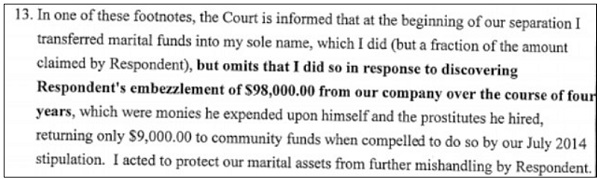
This divorce document states that SNOPES CEO David Mikkelson
embezzled money from the company to hire prostitutes. As shown in the
document below, courtesy of UK Daily Mail: …embezzlement of $98,000 from our company over the course of four
years, which were monies he expended upon himself and the prostitutes
he hired… In addition to marrying an escort service tease, David Mikkelson
thinks he should be paid $720,000 a year to run the SNOPES left-wing
propaganda website. Via the UK Daily Mail: David wanted his salary raised from $240,000 to $360,000 –
arguing that this would still put him below the ‘industry standards’ and
that he should be paid up to $720,000 a year. ‘As I said, based on industry standards and our revenues, my
salary should be about 2x to 3x what it is now,’ he wrote in an email to
Barbara in April 2016. ‘I’ll settle for $360K with the understanding
that it’s to be retroactive to the start of the year.’
Banging whores with “sweet liberal shill money”
“According to divorce papers, Snopes co-founder David Mikkelson
started taking all sorts of trips around the world to bang whores after
that sweet liberal shill money started rolling in,” reports Zero Hedge. “While engaging in this debauchery, Mikkelson wrote off just about
everything as a business expense, embezzling a reported $98,000. The
Snopes co-founder has since settled down and married a [NSFW] part time
porn actress, Snopes.com administrator (spicy!), and sex worker. As in,
she has a website devoted to being a whore.” Lying for the left also turns out to be incredibly profitable. “David
kept their joint baseball card collection, a savings account with $1.59
million balance, and other savings worth more than $300,000,” reports
the paper. Here’s a photo of the SNOPES founders posing as complete slobs with
their obese cat perched on a couch that looks ripped out of the 1970s.
David’s expression almost seems to say, “What I really wanted was some
VIP pu##y and all I got was this obese creature annoying the hell out of
me… plus a cat!”
SNOPES CEO marries a prostitute who has been banged by men from around the world… is that “diversity?”
SNOPES CEO Mikkelson’s new wife, Elyssa Young, has been banged by so
many other paying customers that you can actually find online reviews
for her “services.” This particular review states that she “travels overseas extensively” and is a great choice “if you seek a lover.” Hiring and marrying actual whores to “services” the presstitutes in
the fakestream media is all part of SNOPES’ “diversity” program,
according to the CEO. “Our editorial staff is drawn from diverse
backgrounds,” Mikkelson told the UK Daily Mail. If he means diversity in sexually transmitted diseases,
he’s probably right. Can you imagine the vast array of viral
populations festering in the crotches of these despicable
“fact-checking” sleazebags?
Another SNOPES fact-checker turns out to be a pot-smoking fetish gear sex blogger who thinks Republicans fear females
The bizarre, twisted “diversity” of SNOPES’ staff doesn’t end there. Another SNOPES “fact-checker” named Kim LaCapria is a fetish gear sex blogger, according to Breitbart.com: Writing under the pseudonym Vice Vixen, Snopes fact-checker Kim
LaCapria regularly wrote about sex and fetish gear on her own blog,
which was described as a lifestyle blog “with a specific focus on
naughtiness, sin, carnal pursuits, and general hedonism and bonne
vivante-ery.” LaCapria’s blog often featured reviews of sex toys. One
particular review reads, “If you are doing something to your fella, and
you apply this to the base of his cash-and-prizes while you carry on, he
will scream and perhaps cry.” On another blog, LaCapria once described
what she did on her day off, writing that she “played scrabble, smoked
pot, and posted to Snopes.” She then added, “That’s what I did on my day
‘on,’ too.” TruNews adds: Snopes “fact-checker” Kim LaCapria claimed on her personal blog
that she has “posted to Snopes” after smoking marijuana. As TheDC
previously revealed, LaCapria describes herself as “openly left-leaning”
and once claimed that Republicans fear “female agency.”
Official “fact-checkers” turn out to be steeped in debauchery, betrayal and deviant behavior
What’s astonishing in all this is how Facebook has already announced
it will rely on SNOPES to “fact-check” news articles. Because SNOPES has
long been run by left-leaning liberal propagandists, everyone knows
Facebook’s “fact-checking” is really just a new form of censorship to silence independent journalism. The fact that left-wing propagandists also happen to be actual
whores, and men who marry whores, and people who reportedly embezzle
money to hire whores is no surprise to anyone. The
political left has descended into cabal of liars, thieves, asshats and
intolerant, abusive hate-mongers who have been widely rejected by most
of civil society. Revelations about SNOPES only further confirm what
we’ve all known about the opinion leaders on the left for quite some
time: They’re mostly sick, twisted, mentally ill sociopaths
who have no ethics, no morals and no dedication to actual truth. They
lie when it’s convenient; they stab each other in the back (feel the
Bern!); they have weird sex fetishes (Bill Clinton’s numerous sex
assaults on women); they routinely cheat on each other (Bill Clinton is
not Chelsea Clinton’s father); and they LIE, LIE, LIE while proclaiming
that have a divine monopoly on “truth.” That Mark Zuckerberg would appoint these people to “fact-check”
Facebook news just makes Zuckerberg a sicko and a psycho. In doing so,
he’s in good company with other globalist psychopaths like Jeff Bezos, George Soros, Bill Gates and Ted Turner. Other small-time propagandists who operate with a similar degree of fraud and deception include: – Jimmy Wales, the founder of Wikipedia who launched the propaganda venture using money earned from being a porn king. – Jon Entine, a biotech industry propagandist who was exposed by Natural News for being a violent psychopath who physically attacked his wife in front of their own child. – James “the Amazing” Randi, who was caught on tape soliciting sex acts from young men. James Randi, in turn, leads to David Gorski, the discredited “skeptics” blogger and cancer surgeon who has been reported to the FBI for a series of allegations involving the same cancer center where now-imprisoned cancer surgeon Dr. Farid Fata committed widespread criminal fraud by falsely diagnosing patients with cancer so he could profit from “treating” them. All these people are leftists. What they have in
common is their complete abandonment of truth, ethics and morality in
their psychopathic quest for power. They are all willing to lie, cheat,
steal, defame, slander or, in some cases, even murder people in order to
get their way. Oh wait, let me guess: SNOPES is going to investigate these
accusations against SNOPES and proclaim that everything in this story is
false. Therefore, all criticism of SNOPES is “fake news” by definition,
because the authenticity of the monopolistic arbiter of news can never
be questioned, you see. The Ministry of Truth is alive and well in America, and it’s
run by deviants, traitors and whores. If you believe anything you read
on SNOPES, you’re a complete fool.
Ditch Facebook, Google, CNN and the WashingtonPost
~ 1000's since what the 1700's ? (the vaunted fbi/gov. keeps stats on every fucking thing but curiously ...not "missing" people in the "parks") the herd (that's u/me folks) is b'ing ...."hunted" folks & "somebody" in our "gov.' knows sum~thin ... but "they" aren't telling u or me !
When
18-year-old Joe Keller vanished from a dude ranch in Colorado's Rio
Grande National Forest, he joined the ranks of those missing on public
land. No official tally exists, but their numbers are growing. And when
an initial search turns up nothing, who'll keep looking?
July 23, 2015 was the eve of Joseph Lloyd Keller's
19th birthday. The Cleveland, Tennessee, native had been spending the
summer between his freshman and sophomore years at Cleveland State
Community College on a western road trip with buddies Collin Gwaltney
and Christian Fetzner in Gwaltney’s old Subaru. The boys had seen Las
Vegas, San Francisco, and the Grand Canyon before heading to Joe’s aunt
and uncle’s dude ranch, the Rainbow Trout Ranch, in the San Juan Mountains in southwestern Colorado.
The ranch is in Conejos County, which is bigger than Rhode Island,
with 8,000 residents and no stoplights. Sheep graze in the sunshine;
potatoes and barley are grown here and trucked north to Denver. Three
new marijuana dispensaries in the tiny town of Antonito lure New
Mexicans across the nearby state line. Conejos—Spanish for “rabbits”—is one of the poorest counties in
Colorado. It’s also a helluva place to get lost. While its eastern
plains stretch across the agricultural San Luis Valley, its western
third rises into the 1.8-million-acre Rio Grande National Forest, which
sprawls over parts of nine counties. Go missing out here and your fate
relies, in no small part, on which of those nine counties you were in
when you disappeared.
Map of Rio Grande National Forest and Rainbow Trout Ranch areas of Colorado. Illustration: Petra Zeiler
Joe, a competitive runner, open-water swimmer, and obstacle-course
racer, and Collin, a member of the varsity cross-country team at
Division I Tennessee Tech, had been running together often during their
trip. Neither was totally acclimatized to the altitude—the ranch sits
just below 9,000 feet. Joe was a bit slower than his friend. He suffered
from asthma as a three-year-old but had kicked it by age 12. The
workout would be routine: an hourlong run, likely along Forest Road 250,
which bisects the ranch and continues into the national forest,
following the Conejos River upstream. Joe left his phone and wallet at the ranch house. He wore only red
running shorts, blue trail shoes, and an Ironman watch. Shirtless, with
blond anime hair and ripped muscles, he looked more like a California
lifeguard than a Tennessee farm kid. 4:30 p.m. The friends started out together. Neither runner knew the
area, but old-timers will tell you that even a blind man could find his
way out of Conejos Canyon: on the south side, runner’s left, cattle
graze in open meadows along the river. On the north side, ponderosa
pines birthday-candle the steep tuff until they hit sheer basalt
cliffs, a massive canyon wall rising 2,000 feet above the gravel road
toward 11,210-foot Black Mountain. As the two young men jogged by the corral, one of the female
wranglers yelled, “Pick it up!” They smiled and Joe sprinted up the road
before the two settled into their respective paces, with Collin surging
ahead. The GPS track on Collin’s watch shows him turning right off Forest
Road 250 onto the ranch drive and snaking up behind the lodge, trying to
check out three geologic outcroppings—Faith, Hope, and Charity—that
loom over the ranch. But the run became a scramble, so he cut back down
toward the road and headed upriver. A fly-fisherman says he saw Collin
2.5 miles up the road but not Joe. Collin never encountered his friend;
he timed out his run at a pace that led to puking due to the altitude. No Joe. Collin moseyed back to the ranch house and waited. An hour later, he started to worry. When Joe didn’t show up to get ready for dinner, Collin and Christian
drove up the road, honking and waiting for Joe to come limping toward
the road like a lost steer. At 7:30, a small patrol of ranch hands hiked
up the rocks toward Faith, the closest formation. By 9:30 there were 35
people out looking. “If he was hurt, he would have heard us,” recalled
Joe’s uncle, David Van Berkum, 47. “He was either not conscious or not
there.”
“The first 24 hours are key,” says Robert Koester, a.k.a. Professor Rescue, author of the search and rescue guidebook Lost Person Behavior.
Koester was consulted on the Keller case and noted that, like most
missing runners, Joe wasn’t dressed for a night outside. Plus, he says,
it wouldn’t have been unusual for a young athlete like Joe to switch
from run to scramble mode. “Heading for higher ground is a known
strategy for a lost person,” he says. “Maybe you can get a better vista.
And based on his age, it might just have been a fun thing to do.” Around 10 p.m., the Van Berkums called the Conejos County Sheriff’s
Department, and sheriff Howard Galvez and two deputies showed up around
midnight. It was now Joe’s birthday. At this point, the effort was still
what pros call a hasty search—quick and dirty, focusing on the most
logical areas.
Joe Keller coaching at a Tennessee swimming championship in July 2015. Photo: Courtesy of the Keller Family
It was a warm night, and everyone still expected Joe to find his way
back at daybreak, wild story in tow. That morning, as ranch employees
and guests continued the search, Jane Van Berkum, 48, alerted Joe’s
parents—Zoe, 56, and Neal, 59. Zoe and Jane are sisters, originally from
Kenya; their family, British expats, left the country in the 1970s. It
took the Kellers and their 17-year-old daughter, Hannah, less than 24
hours to get to the ranch from Tennessee, flying into Albuquerque, New
Mexico, and renting a car for the three-and-a-half-hour drive north. The family arrived at 2 a.m. In the morning, at 6 a.m., the
professional search began: starting at what searchers call the point
last seen, the ranch’s big ponderosa pine gate, a deputy fire chief from
La Plata County named Roy Vreeland, 64, and his Belgian malinois scent
dog, Cayenne, picked up a direction of travel, which pointed up Forest
Road 250. More dogs arrived from Albuquerque—and identified different
directions of travel or none at all. Additional firefighters drove over
from La Plata County. Everyone on the ground—as is largely the case
with search and rescue—were volunteers. There was nothing to go on. In that first week, the search engaged
about 15 dogs and 200 people on foot, horseback, and ATV. An
infrared-equipped airplane from the Colorado Division of Fire Prevention and Control
flew over the area. Collin’s brother Tanner set up a GoFundMe site that
paid for a helicopter to search for five hours, and a volunteer flew
his fixed-wing aircraft in the canyon multiple times. A guy with a drone
buzzed the steep embankments along Highway 17, the closest paved road,
and the rock formation Faith, which has a cross on top. A $10,000 reward
was posted for information. How far could a shirtless kid in running
shoes get? But after several days, volunteers began going home, pulled by other
obligations. The few who remained did interviews, followed up on leads,
and worked teams and dogs. But the search was already winding down. “We
had a very limited number of people,” one volunteer told me. “That’s
fairly typical in Colorado. You put out calls and people say, ‘Well, if
he hasn’t been found in that time, I have to go to work.’ ” The absence of clues left a vacuum that quickly filled with anger,
resentment, false hopes, and conspiracy theories. A tourist with a
time-stamped receipt from a little gift shop in nearby Horca swore she
saw two men on the road but later changed her story. A psychic reached
out on Facebook to report a vision that Joe was west of Sedona, Arizona.
There was even a theory that he’d been kidnapped in order to have his
organs harvested and sold on the black market. “We feel like he’s not in
that area, he’s been taken from there,” Neal Keller would tell me
months later.
“I’m a scientist,” Koester says. “I’m fond of Occam’s razor.” That’s
the principle that the simplest explanation usually holds true. “You
could have a band of terrorists tie him to a tree and interrogate him.
Is it possible? Yes. Is it likely? No.” Joe Keller had just joined the foggy stratum of the hundreds or maybe
thousands of people who’ve gone missing on our federal public lands.
Thing is, nobody knows how many. The National Institute of Justice, the
research arm of the Department of Justice, calls unidentified remains
and missing persons “the nation’s silent mass disaster,” estimating that
on any given day there are between 80,000 and 90,000 people actively
listed with law enforcement as missing. The majority of those, of
course, disappear in populated areas. What I wanted to know was how many people are missing in our wild
places, the roughly 640 million acres of federal lands—including
national parks, national forests, and Bureau of Land Management
property. Cases like 51-year-old Dale Stehling, who, in 2013, vanished from a short petroglyph-viewing trail near the gift shop at Colorado’s Mesa Verde National Park. Morgan Heimer,
a 22-year-old rafting guide, who was wearing a professional-grade
personal flotation device when he disappeared in 2015 in Grand Canyon
National Park during a hike after setting up camp. Ohioan Kris Fowler,
who vanished from the Pacific Crest Trail last fall. At least two
people have recently gone missing outside the national forest where I
live in the Upper Peninsula of Michigan. There are scores more stories like this. The Department of the Interior knows how many wolves and grizzly
bears roam its wilds—can’t it keep track of visitors who disappear? But
the government does not actively aggregate such statistics. The
Department of Justice keeps a database, the National Missing and Unidentified Persons System,
but reporting missing persons is voluntary in all but ten states, and
law-enforcement and coroner participation is voluntary as well. So a lot
of the missing are also missing from the database. After the September 11 attacks, Interior tried to build its own
database to track law-enforcement actions across lands managed by the
National Park Service, Bureau of Land Management, U.S. Fish and Wildlife
Service, and Bureau of Indian Affairs. (The Forest Service is under the
Department of Agriculture.) The result, the Incident Management
Analysis and Reporting System, is a $50 million Database to Nowhere—last
year, only 14 percent of the several hundred reportable incidents were
entered into it. The system is so flawed that Fish and Wildlife has said
no thanks and refuses to use it. That leaves the only estimates to civilians and conspiracy theorists.
Aficionados of the vanished believe that at least 1,600 people, and
perhaps many times that number, remain missing on public lands under
circumstances that defy easy explanation.
Numbers aside, it matters tremendously where you happen to
disappear. If you vanish in a municipality, the local police department
is likely to look for you. The police can obtain assistance from the
county sheriff or, in other cases, state police or university law
enforcement. If foul play is suspected, your state’s bureau of
investigation can decide to get involved. Atop that is the FBI. With
the exception of the sheriff, however, these organizations don’t tend
to go rifling through the woods unless your case turns into a criminal
one. But all those bets are off when you disappear in the wild. While big
national parks like Yosemite operate almost as sovereign states, with
their own crack search and rescue teams, go missing in most western
states and, with the exception of New Mexico and Alaska, statutes that
date back to the Old West stipulate that you’re now the responsibility
of the county sheriff. “There are no federal standards for terrestrial search and rescue,”
Koester says. “Very few states have standards. A missing person is a
local problem. It’s a historical institution from when the sheriff was
the only organized government.” And when it comes to the locals riding
to your rescue, Koester says, “There’s a vast spectrum of capability.” Take Rio Grande National Forest: it has just one full-time law-enforcement officer, who wasn’t given clearance to talk to Outside.
Ranger Andrea Jones of the 377,314-acre Conejos Peak district, where
Joe disappeared, did lament to me that sometimes she discovers cases in
the weekly newspaper. “On occasions when we initially learn about a
search and rescue in the forest from the local media,” she explained,
“it’s difficult for us to properly engage, communicate, and offer
available knowledge or resources.” But wherever you are, once a search goes from rescue to recovery, most of those resources dry up. On August 4, 2015, after Joe had been missing for 13 days, Sheriff
Galvez pulled the plug on the official search. What had begun as a
barnyard musical was now a ghost story. The river—already dropping
quickly—had been searched and ruled out. Dog teams had scratched up
nothing. Abandoned cabins had been searched and searched again. “I
mean, we checked the pit toilets at the campgrounds—we did everything,”
Galvez said. “We even collected bear crap. We still have it in the
evidence freezer.” Galvez had been elected sheriff only nine months earlier, and while
he had years of law-enforcement experience, he had no background
leading search and rescue operations. One responder told me that by the
time he arrived on the second day of searching, tension was already
rising between Keller and Sheriff Galvez. Keller felt that Galvez wasn’t
doing enough; Galvez felt that Keller was in the way, barking orders
and criticizing his crew. When dogs and volunteers start to go back to their lives and the
aircraft return to the hangar, a missing-persons search can look eerily
quiet. “For a lost person, the response is limited to five days on
average,” Keller told me. “There needs to be a plan for applying
resources for a little bit longer.” The Keller family hired two private investigators, who turned up
nothing. Zoe Keller told me that it was a waste of $800 a day; one of
the investigators told me he’d never had a case with less to go on. The
reward was raised from $10,000 to $25,000 and then to $50,000, but as
David Van Berkum said, “There just isn’t a sniff of anything.”
Two weeks after Joe’s cold vanish, Alamosa County undersheriff Shawn
Woods, who had been called in to assist by the Colorado Bureau of
Investigation, told Keller about a tracker he knew named Alan Duffy. A
71-year-old surgical assistant, Duffy became interested in bloodhounds
when his 21-year-old brother, David, disappeared in the northern Sierra
Nevada in 1978; he was found dead of gunshot wounds six weeks later.
Duffy has since taken his dogs to search JonBenét Ramsey’s neighborhood
and to track stolen horses in Wyoming. Calling in Duffy was a wild card,
as are so many things in a case like this. On August 15, Duffy loaded three-year-old R.C.—named after Royal
Crown Cola, on account of his black and tan coat—into his Jeep and drove
300 miles from Broomfield, Colorado, to the Rainbow Trout Ranch. A
deputy gave him a scent item, one of Joe’s used sock liners. “That’s as
good as underwear,” Duffy said. Duffy will tell you that bloodhounds are out of fashion. “They fart
and they drool,” he said. They’re susceptible to disease, they die
young, and you can’t let them off a lead under any circumstances.
“Everybody wants a shepherd,” he says. But going old-school has its
advantages. “Who’s gonna find you? It’s not a shepherd. It’s not a
Mexican Chihuahua. It’s not a pig. You know how they say a great white
shark can smell a drop of blood in water five miles away? That’s a
bloodhound.” R.C.’s trigger word to sniff for a living person, as opposed to human
remains, is find. For search and rescue assignments, R.C. wears his
orange harness, with Duffy holding the lead. After four hours of
searching, Duffy switched R.C.’s harness to his black collar and told
him, “We’re gonna go gizmo,” the dog’s cue for cadaver mode. Four and a half miles up Forest Road 250, at Spectacle Lake—a murky
pond, really—R.C. circled, tugged at vegetation on the bank, bit at the
water, then jumped in and sat in the shallows. “He wouldn’t leave,”
Duffy said. Duffy wasn’t convinced, necessarily, that a body was in the lake, and
he explained that scent is drawn toward water and believed that there
was a corpse somewhere nearby. Rain or critters could have deposited
cadaver material in the lake, enough to set off alarms in R.C.’s snout.
But at four and a half miles from Joe’s point last seen, the lake was at
the far end of the ground game’s probabilities. Duffy offered up a few
more scenarios, some of which upset the Van Berkums—such as when he told
them that R.C. had picked up human-remains scents under buildings on
the ranch. But with few other sources of help, desperation had led to
Duffy. “At least he was trying,” Joe’s mom, Zoe, told me. “He could have
been right.” Continued searches in August turned up nothing. Neal Keller was
commuting back and forth between Tennessee and Conejos County, searching
every moment he could. In October 2015, when he and the sheriff were no
longer on speaking terms, he urged the county commissioners for more
help, including a dive team to search Spectacle Lake. “I, as the father
of a missing boy—my only son, actually—would like to have as much
resources as could possibly be made available,” he told the officials.
Keller was feeling the stress. He lost 15 pounds from hiking and
scrambling in the altitude. Just before Thanksgiving, he, David Van
Berkum, and a small posse spent two days searching the snow-covered
scree west of the ranch. It was the area that seemed most logical, but
it’s mean terrain. “We went in there because that area was likely the
least searched,” he told me. No Joe. Keller would have to spend the long
Colorado winter still not knowing. The canyon now belonged to the snowmobilers and coyotes. Next
season’s fly-fishers and ranch guests wouldn’t show up in any numbers
until the snow melted in spring. I first stepped through the missing-persons portal back in 1997,
when researching updates on Amy Wroe Bechtel, a runner who’d vanished in
the Wind River Range of Wyoming, where I lived. My intrigue only grew. I tend toward insomnia and the analog, and
each night in bed I listen with earbuds to Coast to Coast AM on a tiny
radio. The program, which explores all sorts of mysteries of the
paranormal, airs from 1 to 5 a.m. in my time zone. It’s syndicated on
over 600 stations and boasts nearly three million listeners each week.
Most of the time, the talk of space aliens and ghosts lulls me to sleep,
but not when my favorite guest, David Paulides, is at the mic. Paulides, an ex-cop from San Jose, California, is the founder of the North America Bigfoot Search.
His obsession shifted from Sasquatch to missing persons when, he says,
he was visited at his motel near an unnamed national park by two
out-of-uniform rangers who claimed that something strange was going on
with the number of people missing in America’s national parks. (He
wouldn’t tell me the place or even the year, “for fear the Park Service
will try to put the pieces together and ID them.”) So in 2011, Paulides
launched the CanAm Missing Project,
which catalogs cases of people who disappear—or are found—on wildlands
across North America under what he calls mysterious circumstances. He
has self-published six volumes in his popular Missing 411 series, most recently Missing 411 Hunters: Unexplained Disappearances. Paulides expects Missing 411: The Movie, a documentary codirected by his son, Ben, and featuring Survivorman Les Stroud, to be released this year. Last May, I met him at a pizza joint in downtown Golden. The gym-fit
Paulides, who moved from California to Colorado in part for the skiing,
is right out of central casting for a detective film.
David
Paulides—founder of the CanAm Missing Project and author of Missing 411
Hunters: Unexplained Disappearances—is committed to finding missing
persons. Photo: Courtesy of David Paulides
“I don’t put any theories in the books—I just connect facts,” he told
me. Under “unique factors of disappearances,” he lists such recurring
characteristics as dogs unable to track scents, the time (late afternoon
is a popular window to vanish), and that many victims are found with
clothing and footwear removed. Bodies are also discovered in previously
searched areas with odd frequency, sometimes right along the trail.
Children—and remains—are occasionally found improbable distances from
the point last seen, in improbable terrain. It’s tempting to dismiss Paulides as a crypto-kook—and some search
and rescue professionals do—but his books are extensively researched. On
a large map of North America on his office wall,
Paulides has identified 59 clusters of people missing on federal
wildlands in the U.S. and southern Canada. To qualify as a cluster,
there must be at least four cases; according to his pins, you want to
watch your step in Yosemite, Crater Lake, Yellowstone, Grand Canyon, and
Rocky Mountain National Parks. But then, it would seem you want to
watch your step everywhere in the wild. The map resembles a game of pin
the tail on the donkey at an amphetamine-fueled birthday party. Paulides has spent hundreds of hours writing letters and Freedom of
Information Act requests in an attempt to break through National Park
Service red tape. He believes the Park Service in particular knows exactly how many people are missing but won’t release the information
for fear that the sheer numbers—and the ways in which people went
missing—would shock the public so badly that visitor numbers would go
down. Paulides brought along a missing-persons activist named Heidi
Streetman, an affiliate faculty member at Denver’s Regis University who
teaches research methods. After reading the Missing 411 series, she
became frustrated that there was no searchable database for families of
the disappeared. In 2014, she floated a petition titled “Make the Department of the Interior Accountable for Persons Missing in Our National Parks and Forests.” It now has over 7,000 signers, with a goal of 10,000. Streetman, a spirited 56-year-old who spent her childhood camping all
over Colorado, is beset with the case of Dale Stehling, a 51-year-old
Texan who vanished on Mesa Verde’s Petroglyph Point Trail
on a 100-degree Sunday afternoon in June 2013. The trail is rated
moderate, but it was hot and Stehling didn’t have water. At the
petroglyphs, where he was last seen, there is an intersection with an
old access trail, where his wife, Denean, believes he may have left the
main trail. “If there was a way to get lost, Dale would find it,” she
says. But even if Stehling had taken the wrong, overgrown path, he surely
would have realized his mistake and backtracked. Maybe he collapsed in
the heat. But rangers searched that area extensively on foot, with dogs,
and in helicopters with firefighting crews. They sent climbers
rappelling down cliffy areas and collected a whole trunk’s worth of
knapsacks, cameras, purses, wallets, water bottles, and binoculars—none
of them Stehling’s. The park superintendent, Cliff Spencer,
a 32-year Park Service veteran, still holds search and rescue training
exercises in the area, just in case they come across a clue. “The thing
that gets me,” he told me, “is in all my years with the Park Service, I
don’t recall five cases like this.” It’s not likely that legislation would help the Stehling family, but
an amendment to an existing law recently made it easier for volunteer
search and rescue outfits to access federal wildlands with less red
tape. The issue of permit approval is largely one of liability
insurance, but the Good Samaritan Search and Recovery Act of 2013
expedited access for qualified volunteers to national parks and
forests, and now they can search within 48 hours of filing the
paperwork. More such laws would make things easier for experts like Michael Neiger,
63, a retired Michigan State Police detective who now specializes in
backcountry search and recovery. Neiger lauds Streetman’s database and
wants to take it further. He’d like to see a searchable resource that
gives volunteers like himself the same information that government
officials have—including case profiles, topo maps, dog tracks, and
weather.
On February 4, 2016, Keller went to Denver to attend a ceremony for the inaugural Colorado Missing Persons Day.
With families of the missing gathered around them, legislators passed
resolutions creating the annual event. Keller stood in the capitol,
listening as his son’s name was read aloud. It was one of 300. In late May 2016, I visited Conejos County. A month earlier, two
Antonito men had been reported overdue from a camping trip to Duck Lake,
less than three miles southwest of the Rainbow Trout Ranch, during a
spring storm that dumped two feet of wet snow. Teams were called in from
Mineral and Archuleta Counties, along with the Wolf Creek Ski Area
ski patrol, based 100 miles west on Highway 17. One of the men managed
to struggle back to Horca; the ski patrol eventually found the frozen
remains of the other. The search had also resumed for Joe. Earlier in May, more than 30
volunteers, including Keller, Collin, and 11 dogs from the nonprofit Colorado Forensic Canines,
had spent about a week crisscrossing Conejos Canyon. The mission was to
either find a needle in a haystack or to significantly reduce the
probability that the youth was in a 2.9-mile radius of the point last
seen. The search was organized by the Jon Francis Foundation,
a Minnesota nonprofit that, since 2007, has helped more than 40
families with loved ones missing on public land. It was created by David
Francis, a retired Naval Reserve captain, after his 24-year-old son,
Jon, disappeared in Idaho’s Custer County in 2006. Jon’s body was found
in a deep ravine the next year by paid members of the Sawtooth Mountain
Guides. “Custer County is the size of Connecticut,” Francis says. “The
search and rescue budget was $5,000. If you go missing in a poor county,
you’re gonna get a short, somewhat sloppy search. In my mind, that’s
the national disgrace. Everybody knows someone with cancer. But it’s a
minority who know someone gone missing.” The May search for Joe turned up no sign. But bushwacking off the
Duck Lake Trail, about three and a half miles southwest of the ranch,
Keller and Gwaltney came upon a sleeping bag, a cook pot, a tarp, and
some bug spray—the gear of the lost campers. One sunny afternoon, I went looking for Sheriff Galvez and found him
outside the Conejos County Jail, on the north side of Antonito,
directing inmates in orange jumpsuits as they planted flowers. He wore
jeans and a gray canvas shirt, with a pistol on his belt and reading
glasses propped on thick salt-and-pepper hair. It was clear that he’d
rather orchestrate landscaping details than talk with the press, but who
can blame him? The department has taken a beating on Facebook,
Websleuths.com, Dateline, and the Chattanooga Times Free Press. It would be one of our only conversations—as this article went to press, Galvez didn’t return repeated calls and e-mails from Outside. “It’s been a rough year and a half,” he told me. After the Keller
search and the hunt for the Duck Lake campers, he said, “I don’t agree
that I should be in charge of search and rescue on federal lands. I’m
thinking of going to the state senators and saying I’d like to be backed
out of that, because I don’t have a $90 million budget.” The starting
salary for his five deputies is $27,000. “It’d be more effective, I
think,” he said. “We’re a small department, a small community. I hear
stuff like, ‘I can’t go, my equipment broke down.’ ”
Frustration between Galvez and Keller had continued to roil. “We had
dogs, hikers, aircraft,” the sheriff said. “Horseback, drones, scent
dogs, cadaver dogs. We had so many resources, it was unreal. When
searchers took a break, he criticized all the resources. Cut everybody
down.” “This is an ongoing investigation for a missing person,” he
continued. “We have no evidence—he’s just missing. It looks more like
that than anything else. Over 18, you can run away all you want. If Joe
was to call us, show me some proof he’s OK, I’d close it up.” Before I left Conejos County, I took a run up Forest Road 250. I
parked at a turnout in front of a massive ponderosa pine with Joe’s
missing-person poster stapled to it, then jogged down to the point last
seen and tried to retrace his run. Based on the varying sniffer-dog
evidence, some figure that he ran up the road a ways, rounded the first
or second bend, then got into trouble. I slowly shuffled upriver. A
truck or SUV passed every three minutes or so. Locals told me that in
July, the traffic on Forest Road 250 is even heavier. Wouldn’t someone
have recalled seeing Joe if he’d stayed on the road? After my run, I
rinsed my face in Spectacle Lake; according to Duffy, R.C. could tell
him I’d been here.
San Juan Mountains Photo: Courtesy of Jason J. Hatfield
On Wednesday, July 6, John Rienstra, 54, a search and rescue hobbyist
and endurance runner—and a former offensive lineman for the Pittsburgh
Steelers—discovered Joe’s body in a boulder field below the cliff band. “I heard there had been a lot of searching for two and a half miles,”
Rienstra said. “I started looking for rapids, caves—cliffs, of
course—and right at two and half miles, there is a place to pull off the
road, and there were cliffs close by. It took me about an hour to get
up there to the base of the cliff, and I went left until I ran out of
room. Then I turned around and went back toward the ranch on the base of
the cliffs and found him.” The area was too rugged for horses or dog
teams. When the Colorado Bureau of Investigations came to retrieve the
remains, they packed horses in as far as they could, then had to reach
Keller on foot. Joe’s body was 1.7 miles as the crow flies from the ranch. Searchers
had been close. In November 2015, Keller and David Van Berkum had come
within several hundred yards. “I regret not searching there on the 25th
of July,” Keller told me. “That’s where I wish I’d started. What part of
here would take a life? It’s not the meadow on top; it’s the cliff.” “Hindsight is always 20/20,” Jane Van Berkum wrote me recently. “But
since there was a blanket of snow, I am not sure they would have found
him even if they had chosen to go higher. But it is painful to think
that they were that close.” Every day, she said, she and her husband had
searched for Joe as part of their ranch activities. “I have sat on the
cliffs many times since he went missing and scanned below over and over,
and I never saw him,” she said. “That tortures me.”
The preliminary cause of death, according to David Francis, was
“blunt force trauma to the head.” Jane told me he also suffered a broken
ankle. It appears that Joe scrambled up and then fell—perhaps the
lost-person behavior laid out by Professor Rescue, Robert Koester. Occam’s razor wasn’t as dull as it had seemed for most of a year. Still, Joe’s death remains a mystery to his mother. “The events do
not fit for a one-hour run before dinner,” Zoe says, “after they had
just driven 24 hours straight to get to Rainbow Trout Ranch.” The boys
hadn’t slept in over a day. Joe had just split wood with his uncle
David’s 75-year-old father, Doug Van Berkum. She can’t see her son
running up to the canyon rim—she insists that he did not like heights
and was not a climber. “There is something we still do not know about
what happened, is how I feel about it.” It’s hard to put your hunches and suspicions to rest. We’ll never
know for certain what happened to Joe Keller. We’ll know even less about
what happened to a lot of other people missing in the wild. One question I had early on was, Are you better or worse off going
missing in a national forest than from a Walmart parking lot? I thought I
knew the answer. You can see an aerial view of my firewood pile from
space on your smartphone. I thought that in the wild, someone would send
in the National Guard, the Army Rangers, the A-Team, and that they
wouldn’t rest until they found you. Now I’m not so sure.

 Posts
Posts