Wednesday, September 24, 2014

Monsanto’s “Secret Formula”: Dangerous Chemicals in Glyphosate Herbicide Slip Past EU Regulators Due to “Data Confidentiality”

Region:

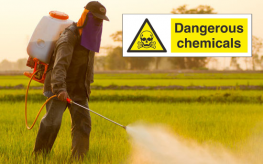
pesticides_mask_chemicals-263x164
The only Europeans to ban glyphosate (the main active ingredient in Monsanto’s herbicide roundUp) and its dangerous additions (surfactants) thus far are the Dutch, with Brazil and France to follow. Yet Germany, keeping their evidence of these toxic chemicals secret, pressures EU regulators to allow these unhealthy compounds to be sprayed liberally over the continent.
These surfactants, apparent in formulations called Rodeo, Accord, RoundUp, and RoundUp Pro, along with other glyphosate formulations, are extremely dangerous. Rodeo/RoundUp are aqueous solutions of the isopropyl amine salt of glyphosate and other chemical adjuvants.
The manufacturer [Monsanto, et. al.] recommends use of a nonionic surfactant with all applications to improve efficacy. Surfactant formulations that are used with Rodeo, aside form Monsanto’s formulations, include:
  • Agri-Dex (Setre Chemical Co.)
  • LI 700 (Loveland Industries, Inc.)
  • R-11 (Wilbur-Ellis Co.)
  • Latron AG-98 (Rohm and Haas Co.)
  • Latron AG-98 AG (Rohm and Haas Co.)
There has been a significant lack of toxicology studies on these chemical compounds, especially as a mixture, though glyphosate has likely been tested more than any other herbicide. One study; however found that:
“A major qualitative difference between the effect of glyphosate and glyphosate formulations on aquatic and terrestrial organisms concerns the surfactant used in Roundup. The surfactant is much more toxic than glyphosate to aquatic organisms. Unlike glyphosate, the surfactant is more toxic in alkaline water than in acidic water. Thus, the relative potency of the surfactant with respect to glyphosate is pH dependent. There is relatively little information regarding the toxicity of Roundup Pro to aquatic species. Nonetheless, the acute lethal potencies of Roundup and Roundup Pro are similar.”
The herbicide glyphosate has been deemed ‘safe.’ but based on what?
Glyphosate Isn’t So Safe
Pushing for glyphosate’s use, Germany has made a draft re-assessment report on glyphosate. It concludes that:
‘…the available data confirms the previous evaluation: Glyphosate does not show carcinogenic or mutagenic properties, has no toxic effect on fertility, reproduction or embryonal/fetal development in laboratory animals and is not considered to pose any risk to human health.’
But an investigation of their newly published report shows that glyphosate is not safe at all, and important omissions were made.
Though farmers and gardeners using glyphosate have seen it as a cost-effective way to control weeds, with sales reaching $5.46 billion in 2012 and expected to reach $8.79 billion by 2019, it is also heavily sold in other countries. In fact, glyphosate is now one of the most widely used herbicides in the world.
The important distinction to make, however, is that it isn’t glyphosate alone that is being sprayed on crops, though this has proven to be toxic in its own right. (Acute toxicity levels have been found in many places around the globe.) Additional chemicals (surfactants) are always added to glyphosate to make it ‘effective.’ The chemicals deemed ‘active’ in RoundUp formulations are tested, but its full formulations are not.
Most of us have or will ingest glyphosate in our lifetimes due to its prevalent use. It is so prevalent, in fact, that is is already being found in our blood, urine, and even breast milk. It is now sprayed over 80% of all crops in the U.S., leaving residue on many foods we purchase and eat. It goes without saying that RoundUp is also sprayed heavily on GM crops meant to be RoundUp ready – like soy, corn, etc.
Many of the crops grown in North and South America and exported to the EU for animal feed are also doused in glyphosate and its surfactants.
Dangers of Just One Surfactant - Polyethoxylated Tallow Amine
One surfactant in particular is drawing heavy criticism. POEA (polyethoxylated tallow amine) is likely very toxic to humans, animals and the environment. German authorities have taken their own protective action against this chemical, but the EU has failed to take any action whatsoever.
Martin Häusling, Member of the Greens / European Free Alliance Group says:
“Given the alarming results of independent studies, this is simply shocking. . .Even though I have been criticising The European Food and Safety Authority for many years because of its conflict of interest with the agricultural industry, it would be wrong to blame them alone. The national authorities play a big role in this process.”
Monsanto and Cheminova have tried dismissing the alarms sounding over POEA.
For over a decade, the German Federal Institute for Health Protection of Consumers and Veterinary Medicine (BgVV) has requested Member States in the European Union not to accept glyphosate products containing the surfactant based on high cytotoxicity of the compounds.
A 1999 report from Monsanto was submitted when glyphosate was up for re-approval by Germany:
“Accordingly, in the formulations for which toxicological data has been submitted as part of the joint dossier of Monsanto and Cheminova, surfactants of this type are not contained any more.”
No surprise, though – Agro-Chemical companies continue to manufacture and sell products containing POEA.
A spokesperson of Monsanto praised surfactants like POEA because “the amount of active ingredient needed per treated area can be reduced.”
He also stressed that “the development of new products requires several years of research and development and review by competent public authorities and Europe has some of the highest standards in the world.”
The high standards he speaks of are absent since there have been no independent studies on glyphosate and its surfactants since 1999 that claim it is ‘safe’.  In fact, a paper by J. M Brausch et al. in 2007 “found all POEA formulations to be extremely toxic”.
When German regulatory bodies requested more information on POEA, biotech gave them nothing, so they conducted their own studies after a German forestry worker developed a lung condition, and found that the “toxic inflammation of the lungs” was significantly different from a bacterial infection.
Since then, the German Federal Institute for Risk Assessment and other German safety authorities published their draft re-assessment report (RAR) on glyphosate and the representative formulation, in the process re-assessing hundreds of studies and public domain literature (as mentioned earlier).
And the Germany Environmental Agency (UBA) has included a chapter called ‘Further toxicological data for other potential co-formulants’ about the surfactant POEA to make sure all Member States of the EU are informed that nearly all toxicological endpoints investigated are clearly more toxic than glyphosate alone.
By the end of this year, all formulations containing POEA will have been removed from the German market. So why exactly has Germany now changed from banning glyphosate to simply ‘restricting’ its use?
German authorities have declined to release; however the list of companies that had to replace POEA, and what surfactants are now used instead, claiming this information is ‘industry protected’.
I guess the rest of us are meant to swallow POEA, along with glyphosate, and just wait and see what happens. What a farce!
Even Monsanto admits in one of their own patents:
“By exploiting a newly discovered synergistic interaction between two classes of surfactant applied together with the glyphosate, surprisingly enhanced herbicidal effectiveness is obtained by this method.”
The Monsanto formulations remain secret.
Due to ‘data confidentiality’ we are not allowed to know just how toxic these chemical combinations truly are. How can you regulate a pesticide/herbicide industry if the public and regulatory agencies don’t even know what is in the chemicals sprayed on our food?

HOW TO IDENTIFY CIA LIMITED HANG OUT OP ?
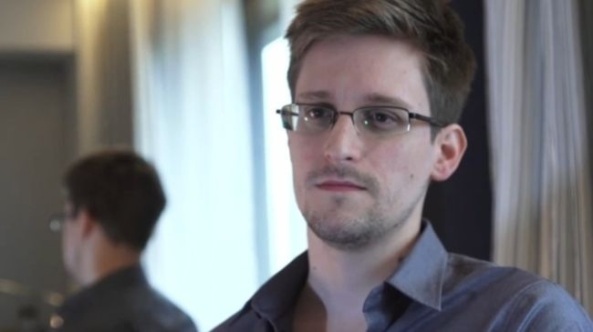
20130619-075507.jpg
By Webster Griffin TARPLEY, for PressTV
The operations of secret intelligence agencies aiming at the manipulation of public opinion generally involve a combination of cynical deception with the pathetic gullibility of the targeted populations.
There is ample reason to believe that the case of Edward Joseph Snowden fits into this pattern. We are likely dealing here with a limited hangout operation, in which carefully selected and falsified documents and other materials are deliberately revealed by an insider who pretends to be a fugitive rebelling against the excesses of some oppressive or dangerous government agency.
But the revelations turn out to have been prepared with a view to shaping the public consciousness in a way which is advantageous to the intelligence agency involved. At the same time, gullible young people can be duped into supporting a personality cult of the leaker, more commonly referred to as a “whistleblower.” A further variation on the theme can be the attempt of the sponsoring intelligence agency to introduce their chosen conduit, now posing as a defector, into the intelligence apparatus of a targeted foreign government. In this case, the leaker or whistleblower attains the status of a triple agent.
Any attempt to educate public opinion about the dynamics of limited hangout operations inevitably collides with the residue left in the minds of millions by recent successful examples of this technique. It will be hard for many to understand Snowden, precisely because they will insist on seeing him as the latest courageous example in a line of development which includes Daniel Ellsberg and Julian Assange, both still viewed by large swaths of naïve opinion as authentic challengers of oppressive government.
This is because the landmark limited hangout operation at the beginning of the current post-Cold War era was that of Daniel Ellsberg and the Pentagon papers, which laid the groundwork for the CIA’s Watergate attack on the Nixon administration, and more broadly, on the office of the presidency itself. More recently, we have had the case of Assange and Wikileaks. Using these two cases primarily, we can develop a simple typology of the limited hangout operation which can be of significant value to those striving to avoid the role of useful idiots amidst the current cascade of whistleblowers and limited hangout artists.
In this analysis, we should also recall that limited hangouts have been around for a very long time. In 1620 Fra Paolo Sarpi, the dominant figure of the Venetian intelligence establishment of his time, advised the Venetian senate that the best way to defeat anti-Venetian propaganda was indirectly. He recommended the method of saying something good about a person or institution while pretending to say something bad. An example might be criticizing a bloody dictator for beating his dog – the real dimensions of his crimes are thus totally underplayed.
Limited hangout artists are instant media darlings
The most obvious characteristic of the limited hangout operative is that he or she immediately becomes the darling of the controlled corporate media. In the case of Daniel Ellsberg, his doctored set of Pentagon papers were published by the New York Times, the Washington Post, the Boston Globe, and eventually by a consortium totaling seventeen corporate newspapers. These press organs successfully argued the case for publication all the way to the United States Supreme Court, where they prevailed against the Nixon administration.
Needless to say, surviving critics of the Warren Commission, and more recent veterans of the 9/11 truth movement, and know very well that this is emphatically not the treatment reserved for messengers whose revelations are genuinely unwelcome to the Wall Street centered US ruling class. These latter are more likely to be slandered, vilified and dragged through the mud, or, even more likely, passed over in complete silence and blacked out. In extreme cases, they can be kidnapped, renditioned or liquidated.

Cass Sunstein present at the creation of Wikileaks
But the revelations turn out to have been prepared with a view to shaping the public consciousness in a way which is advantageous to the intelligence agency involved. At the same time, gullible young people can be duped into supporting a personality cult of the leaker, more commonly referred to as a “whistleblower.” A further variation on the theme can be the attempt of the sponsoring intelligence agency to introduce their chosen conduit, now posing as a defector, into the intelligence apparatus of a targeted foreign government. In this case, the leaker or whistleblower attains the status of a triple agent.
Any attempt to educate public opinion about the dynamics of limited hangout operations inevitably collides with the residue left in the minds of millions by recent successful examples of this technique. It will be hard for many to understand Snowden, precisely because they will insist on seeing him as the latest courageous example in a line of development which includes Daniel Ellsberg and Julian Assange, both still viewed by large swaths of naïve opinion as authentic challengers of oppressive government.
This is because the landmark limited hangout operation at the beginning of the current post-Cold War era was that of Daniel Ellsberg and the Pentagon papers, which laid the groundwork for the CIA’s Watergate attack on the Nixon administration, and more broadly, on the office of the presidency itself. More recently, we have had the case of Assange and Wikileaks. Using these two cases primarily, we can develop a simple typology of the limited hangout operation which can be of significant value to those striving to avoid the role of useful idiots amidst the current cascade of whistleblowers and limited hangout artists.
In this analysis, we should also recall that limited hangouts have been around for a very long time. In 1620 Fra Paolo Sarpi, the dominant figure of the Venetian intelligence establishment of his time, advised the Venetian senate that the best way to defeat anti-Venetian propaganda was indirectly. He recommended the method of saying something good about a person or institution while pretending to say something bad. An example might be criticizing a bloody dictator for beating his dog – the real dimensions of his crimes are thus totally underplayed.
Limited hangout artists are instant media darlings
The most obvious characteristic of the limited hangout operative is that he or she immediately becomes the darling of the controlled corporate media. In the case of Daniel Ellsberg, his doctored set of Pentagon papers were published by the New York Times, the Washington Post, the Boston Globe, and eventually by a consortium totaling seventeen corporate newspapers. These press organs successfully argued the case for publication all the way to the United States Supreme Court, where they prevailed against the Nixon administration.
Needless to say, surviving critics of the Warren Commission, and more recent veterans of the 9/11 truth movement, and know very well that this is emphatically not the treatment reserved for messengers whose revelations are genuinely unwelcome to the Wall Street centered US ruling class. These latter are more likely to be slandered, vilified and dragged through the mud, or, even more likely, passed over in complete silence and blacked out. In extreme cases, they can be kidnapped, renditioned or liquidated.
Cass Sunstein present at the creation of Wikileaks
As for Assange and Wikileaks, the autumn 2010 document dump was farmed out in advance to five of the most prestigious press organs in the world, including the New York Times, the London Guardian, El Pais of Madrid, Der Spiegel of Hamburg, and Le Monde of Paris. This was the Assange media cartel, made up of papers previously specialized in discrediting 9/11 critics and doubters. But even before the document dumps had begun, Wikileaks had received a preemptive endorsement from none other than the notorious totalitarian Cass Sunstein, later an official of the Obama White House, and today married to Samantha Power, the author of the military coup that overthrew Mubarak and currently Obama’s pick for US ambassador to the United Nations. Sunstein is infamous for his thesis that government agencies should conduct covert operations using pseudo-independent agents of influence for the “cognitive infiltration of extremist groups” – meaning of those who reject in the establishment view of history and reality. Sunstein’s article entitled “Brave New WikiWorld” was published in the Washington Post of February 24, 2007, and touted the capabilities of Wikileaks for the destabilization of China. Perhaps the point of Ed Snowden’s presence in Hong Kong is to begin re-targeting these capabilities back towards the original anti-Chinese plan.
Snowden has already become a media celebrity of the first magnitude. His career was launched by the US left liberal Glenn Greenwald, now writing for the London Guardian, which expresses the viewpoints of the left wing of the British intelligence community. Thus, the current scandal is very much Made in England, and may benefit from inputs from the British GCHQ of Cheltenham, the Siamese twin of the NSA at Fort Meade, Maryland. During the days of his media debut, it was not uncommon to see a controlled press organ like CNN dedicating one third of every broadcast hour of air time to the birth, life, and miracles of Ed Snowden.
Another suspicious and tell-tale endorsement for Snowden comes from the former State Department public diplomacy asset Norman Solomon. Interviewed on RT, Solomon warmly embraced the Snowden Project and assured his viewers that the NSA material dished up by the Hong Kong defector used reliable and authentic. Solomon was notorious ten years ago as a determined enemy of 9/11 truth, acting as a border guard in favor of the Bush administration/neocon theory of terrorism.
Limited hangouts contain little that is new
Another important feature of the limited hangout operation if that the revelations often contain nothing new, but rather repackage old wine in new bottles. In the case of Ellsberg’s Pentagon Papers, very little was revealed which was not already well known to a reader of Le Monde or the dispatches of Agence France Presse. Only those whose understanding of world affairs had been filtered through the Associated Press, CBS News, the New York Times, and the Washington Post found any of Ellsberg’s material a surprise.
Of course, there was method in Ellsberg’s madness. The Pentagon papers allegedly derived from an internal review of the decision-making processes leading to the Vietnam War, conducted after 1967-68 under the supervision of Morton Halperin and Leslie Gelb. Ellsberg, then a young RAND Corporation analyst and militant warmonger, was associated with this work. Upon examination, we find that the Pentagon papers tend to cover up such CIA crimes as the mass murder mandated under Operation Phoenix, and the massive CIA drug running associated with the proprietary airline Air America. Rather, when atrocities are in question, the US Army generally receives the blame. Politicians in general, and President John F. Kennedy in particular, are portrayed in a sinister light – one might say demonized. No insights whatever into the Kennedy assassination are offered. This was a smelly concoction, and it was not altogether excluded that the radicalized elements of the Vietnam era might have carried the day in denouncing the entire package as a rather obvious fabrication. But a clique around Noam Chomsky and Howard Zinn loudly intervened to praise the quality of the exposé and to lionize Ellsberg personally as a new culture hero for the Silent Generation. From that moment on, the careers of Chomsky and Zinn soared. Pentagon papers skeptics, like the satirical comedian Mort Sahl, a supporter of the Jim Garrison investigation in New Orleans and a critic of the Warren Commission, faced the marginalization of their careers.
Notice also that the careers of Morton Halperin and Leslie Gelb positively thrived after they entrusted the Pentagon papers to Ellsberg, who revealed them. Ellsberg was put on trial in 1973, but all charges were dismissed after several months because of prosecutorial misconduct. Assange lived like a lord for many months in the palatial country house of an admirer in the East of England, and is now holed up in the Ecuadorian Embassy in London. He spent about 10 days in jail in December 2010.
Assange first won credibility for Wikileaks with some chum in the form of a shocking film showing a massacre perpetrated by US forces in Iraq with the aid of drones. The massacre itself and the number of victims were already well known, so Assange was adding only the graphic emotional impact of witnessing the atrocity firsthand.
Limited hangouts reveal nothing about big issues like JFK, 9/11
Over the past century, there are certain large-scale covert operations which cast a long historical shadow, determining to some extent the framework in which subsequent events occur. These include the Sarajevo assassinations of 1914, the assassination of Rasputin in late 1916, Mussolini’s 1922 march on Rome, Hitler’s seizure of power in 1933, the assassination of French Foreign Minister Barthou in 1934, the assassination of President Franklin D. Roosevelt in 1945, in 1963 Kennedy assassination, and 9/11. A common feature of the limited hangout operations is that they offer almost no insights into these landmark events.
In the Pentagon Papers, the Kennedy assassination is virtually a nonexistent event about which we learn nothing. As already noted, the principal supporters of Ellsberg were figures like Chomsky, whose hostility to JFK and profound disinterest in critiques of the Warren Commission were well-known. As for Assange, he rejects any further clarification of 9/11. In July 2010, Assange told Matthew Bell of the Belfast Telegraph: “I’m constantly annoyed that people are distracted by false conspiracies such as 9/11, when all around we provide evidence of real conspiracies, for war or mass financial fraud.” This is on top of Cass Sunstein’s demand for active covert measures to suppress and disrupt inquiries into operations like 9/11. Snowden’s key backers Glenn Greenwald and Norman Solomon have both compiled impressive records of evasion on 9/11 truth, with Greenwald specializing in the blowback theory.
The Damascus road conversions of limited hangout figures
Daniel Ellsberg started his career as a nuclear strategist of the Dr. Strangelove type working for the RAND Corporation. He worked in the Pentagon as an aide to US Secretary of Defense Robert McNamara. He then went to Vietnam, where he served as a State Department civilian assistant to CIA General Edward Lansdale. In 1967, he was back at RAND to begin the preparation of what would come to be known as the Pentagon papers. Ellsberg has claimed that his Damascus Road conversion from warmonger to peace angel occurred when he heard a speech from a prison-bound draft resister at Haverford College in August 1969. After a mental breakdown, Ellsberg began taking his classified documents to the office of Senator Edward Kennedy and ultimately to the New York Times. Persons who believe this fantastic story may be suffering from terminal gullibility.
In the case of Assange, it is harder to identify such a moment of conversion. Assange spent his childhood in the coils of MK Ultra, a complex of Anglo-American covert operations designed to investigate and implement mind control through the use of psychopharmaca and other means. Assange was a denizen of the Ann Hamilton-Byrne cult, in which little children that were subjected to aversive therapy involving LSD and other heavy-duty drugs. Assange spent his formative years as a wandering nomad with his mother incognito because of her involvement in a custody dispute. The deracinated Assange lived in 50 different towns and attended 37 different schools. By the age of 16, the young nihilist was active as a computer hacker using the screen name “Mendax,” meaning quite simply “The Liar.” (Assange’s clone Snowden uses the more marketable codename of “Verax,” the truth teller.) Some of Assange’s first targets were Nortel and US Air Force offices in the Pentagon. Assange’s chief mentor became John Young of Cryptome, who in 2007 denounced Wikileaks as a CIA front.
Snowden’s story, as widely reported, goes like this: he dropped out of high school and also dropped out of a community college, but reportedly was nevertheless later able to command a salary of between $120,000 and $200,000 per year; he claims this is because he is a computer wizard. He enlisted in the US Army in May 2004, and allegedly hoped to join the special forces and contribute to the fight for freedom in Iraq. He then worked as a low-level security guard for the National Security Agency, and then went on to computer security at the CIA, including a posting under diplomatic cover in Switzerland. He moved on to work as a private contractor for the NSA at a US military base in Japan. His last official job was for the NSA at the Kunia Regional SIGINT Operations Center in Hawaii. In May 2013, he is alleged to have been granted medical leave from the NSA in Hawaii to get treatment for epilepsy. He fled to Hong Kong, and made his revelations with the help of Greenwald and a documentary filmmaker Laura Poitras. Snowden voted for the nominally anti-war, ultra-austerity “libertarian” presidential candidate Ron Paul, and gave several hundred dollars to Paul’s campaign.
Snowden, like Ellsberg, thus started off as a warmonger but later became more concerned with the excesses of the Leviathan state. Like Assange, he was psychologically predisposed to the world of computers and cybernetics. The Damascus Road shift from militarist to civil libertarian remains unexplained and highly suspicious.
Snowden is also remarkable for the precision of his timing. His first revelations, open secrets though they were, came on June 5, precisely today when the rebel fortress of Qusayr was liberated by the Syrian army and Hezbollah. At this point, the British and French governments were screaming at Obama that it was high time to attack Syria. The appearance of Snowden’s somewhat faded material in the London Guardian was the trigger for a firestorm of criticism against the Obama regime by the feckless US left liberals, who were thus unwittingly greasing the skids for a US slide into a general war in the Middle East. More recently, Snowden came forward with allegations that the US and the British had eavesdropped on participants in the meeting of the G-20 nations held in Britain four years ago. This obviously put Obama on the defensive just as Cameron and Hollande were twisting his arm to start the Syrian adventure. By attacking the British GCHQ at Cheltenham, Britain’s equivalent to the NSA, perhaps Snowden was also seeking to obfuscate the obvious British sponsorship of his revelations.
Stories about Anglo Americans spying on high profile guests are as old as the hills, and have included a British frogman who attempted an underwater investigation of the Soviet cruiser that brought party leader N. S. Khrushchev for a visit in the 1950s. Snowden has also accused the NSA of hacking targets in China — again, surely no surprise to experienced observers, but guaranteed to increase Sino-American tensions. As time passes, Snowden may emerge as more and more of a provocateur between Washington and Beijing.
Limited hangouts prepare large covert operations
Although, as we have seen, limited hangouts rarely illuminate the landmark covert operations which attempt to define an age, limited hangouts themselves do represent the preparation for future covert operations.
In the case of the Pentagon papers, this and other leaks during the Indo-Pakistani Tilt crisis were cited by Henry Kissinger in his demand that President Richard Nixon take countermeasures to restore the integrity of state secrets. Nixon foolishly authorized the creation of a White House anti-leak operation known as the Plumbers. The intelligence community made sure that the Plumbers operation was staffed by their own provocateurs, people who never were loyal to Nixon but rather took their orders from Langley. Here we find the already infamous CIA agent Howard Hunt, the CIA communications expert James McCord, and the FBI operative G. Gordon Liddy. These provocateurs took special pains to get arrested during an otherwise pointless break-in at the headquarters of the Democratic National Committee in the summer of 1972. Nixon could easily have disavowed the Plumbers and thrown this gaggle of agent provocateurs to the wolves, but he instead launched a cover up. Bob Woodward of the Washington Post, equipped with a top secret security clearance from the Office of Naval Intelligence, then began publicizing the story. The rest is history, and the lasting heritage has been a permanent weakening of the office of the presidency and the strengthening of the worst oligarchical tendencies.
Assange’s Wikileaks document dump triggered numerous destabilizations and coups d’état across the globe. Not one US, British, or Israeli covert operation or politician was seriously damaged by this material. The list of those impacted instead bears a striking resemblance to the CIA enemies’ list: the largest group of targets were Arab leaders slated for immediate ouster in the wave of “Arab Spring.” Here we find Ben Ali of Tunisia, Qaddafi of Libya, Mubarak of Egypt, Saleh of Yemen, and Assad of Syria. The US wanted to replace Maliki with Allawi as prime minister of Iraq, so the former was targeted, as was the increasingly independent Karzai of Afghanistan. Perennial targets of the CIA included Rodriguez Kirchner of Argentina, Berlusconi of Italy, and Putin of Russia. Berlusconi soon fell victim to a coup organized through the European Central Bank, while his friend Putin was able to stave off a feeble attempt at color revolution in early 2012. Mildly satiric jabs at figures like Merkel of Germany and Sarkozy of France were included primarily as camouflage.
Assange thus had a hand in preparing one of the largest destabilization campaigns mounted by Anglo-American intelligence since 1968, or perhaps even 1848.
If the Snowden operation can help coerce the vacillating and reluctant Obama to attack Syria, our new autistic hero may claim credit for starting a general war in the Middle East, and perhaps even more. If Snowden can further poison relations between United States and China, the world historical significance of his provocations will be doubly assured. But none of this can occur unless he finds vast legions of eager dupes ready to fall for his act. We hope he won’t.
WT / HN

How To Get a Family of Four Prepped for The Coming Collapse – In The Quickest and Easiest Way Possible…   ~  but #1 is  ... INVEST in each other !  folks cuz either we all r going up together or we r going down together !!! :)r

M.D. Creekmore
September 16th, 2014
The Survivalist Blog

one-year-to-prepare
This article has been generously contributed to our community by M.D. Creekmore and The Survivalist Blog.
This morning as I was trying to catch up on my email (I get a massive amount of email each month, last month over 3,000), I opened a great one from John W. In a nutshell  John, is new toprepping and hasn’t really done anything prep-wise yet, but he has been thinking and making plans.
John said that he has his home on two acres paid-off, and that he has a job and works to support his wife and two children (one 6 and the other 9 years old). He said that he knows from all of the newsand the tell-tell signs that something big is coming, and that his main fear is a total economic collapse.
He said that he has $10,000 to spend on preps and that he wanted to be ready as quickly as possible, without all of the buying a can of food here and another can another day or a few extra cans each time he goes to the grocery store. He also insists on long-term storage foods, with a shelf-life of 25 years or more, because he doesn’t want to be bothered with all of the rotating and other stuff involved when stockpiling perishable foods.
John’s question to me was, if you had nothing prep-wise, and just starting out and wanted to be ready within the next month and with a budget of $10,000 what would you do and buy to be prepared as quickly as possible?
I’ll answer that question below.
One Year+ Food Storage for Four People 
IMG 10021 300x225 How To Get a Family of Four Prepped for The Coming Collapse   In The Quickest and Easiest Way Possible...
To start I would order the Augason Farms Deluxe 4-Person One Year Kit – the $3,999.99 might seem like a lot at first glance, but considering this package will provide 21,116 total servings and approximately 1,300 calories per day per person, with a 30 year self-life it’s really a pretty good bargain, especially for those wanting to get prepared NOW.
The Augason Farms products make up the bulk of my long-term food storage and I can attest to the quality and taste of their products, the Honey Coated Banana Slices are absolutely delicious!
I would then order four of the Survive2thrive 100% USDA Organic 40-day Nutrition Emergency Food Supply Buckets, then I would top it all of with eight gallon of cooking oil (store it frozen and it will last a long-time), 32 pounds of salt, yes, some salt is included with the Augason Farms Kit above, but salt is cheap and has so many uses you can’t have to much.
Add another 35 pounds of sugar, and an extra two buckets of Augason Farms Country Fresh 100% Real Instant Nonfat Dry Milk in the 14 pound buckets with a 20 year shelf-life. Then I would add an assortment of herbs and spices for cooking and about 10 pounds of assorted hard candies for threats for the kids (and yourself).
I would also add 12 large jars of peanut butter, 24 cans of SPAM and 12 canned hams.
If you drink coffee be sure to add that in the amounts you normally consume over a 12 month period. And don’t forget multivitamins and extra vitamin C.
Total cost around $5,500 dollars for a family of four.
Protection and Foraging
If I had no firearms now (get training) I would buy a Mossberg  500 Combo package and 100 rounds of 00 buckshot, 50 rifled slugs and 200 bird shot (preferably #6 shot), then I would buy a Ruger 10/22, 1,000 rounds of .22 ammo and five of the Ruger factory 25 round BX 25 magazines.
Total Cost around $750
Water Storage and Purification 
I would store as much tap-water as possible (limited by space) in every suitable (but free container – avoid the plastic jugs, they are weak and fall-apart after a few months) that I could find. Then I would order a Big Berkey Water Filter and a set of extra elements.
Total Cost Around $350
Food Production
John said that he had two acres of paid-off property, so I would find the best place (most level, sun exposure and best soil) and have the largest area that I could work tilled and add as much free organic matter that I could get, check with any local large production chicken, horse or dairy farmers in your area, most of the time they will give you all of the manure that you need if you’ll haul it away.
Spread this on your newly tilled garden plot and till again, now cover this all with about six inches of straw and throw some old lumber on top to keep the straw in place. Leave it to compost in the ground over the fall, winter and into spring. When it’s time to plant in late spring, till it all up (including the straw) again and plant.
If I did not already have gardening tools on hand, I would get a good quality shovelhoe, and a bow rakespading fork,  a big box of  Miracle-Gro all purpose plant food  and a copy of Gardening When it Counts.
Then I would build a small chicken coop from mostly scrounged building material and buy 8-10 six-month to one-year-old chickens or ducks. Then I would build rabbit hutches along one of the side walls of the coop and buy two does and one buck for breeding stock.
I would also plant fruit and nut trees everywhere that I have space on my property…
Total Cost Under $650
Power Production
I would order a  Renogy 200 watt solar panel kit, panel mount, and marine battery,  solar 11-in-1 battery charger, rechargeable batteries, and a gas powered portable generator. Then I would getfive-5 gallon fuel cans and fill with gasoline, add STA-BIL fuel stabilizer, then rotate every year.
Total Cost Around $800
Random Items 
Two hundred and sixty-five rolls of toilet paper, (more if you have room), 24 tubes of toothpaste, 48 toothbrushes, feminine hygiene products (ladies you know how much you’ll need for a year – I stay as far away as possible during that time), 24 bars of soap for bathing, 24 56 FL OZ bottles of dish-washing liquid, (can also be used for hand-washing of clothing.
good first-aid medical kit (get training if you need it and include any personal medications), download free copy Where There is no Doctor and Where There is no Dentist and print them to paper orjust buy copies from Amazon.com.
Then while on Amazon.com, I would order a Zoom Versa Stove, aKaito Voyager Pro KA600 Digital Solar/Dynamo AM/FM/LW/SW & NOAA Weather Emergency Radio and two sets of Motorola MR350R 35-Mile Range 22-Channel FRS/GMRS Two-Way Radiosfor family communications when separated from family members.
Cold weather sleeping bags for every family member.
Total Cost Around $900
Conclusion 
As you get more money put in a wood stove if possible, or at the least a propane wall heater and enough propane to last a winter. Having both a wood-stove and propane is a better and more flexible solution.
Then add a good handgun or two (I suggest a the Glock model 19 and a Browning Buckmark) extra magazines and ammo. Then look into buying a center-fire rifle, this can be something like an AR-15 or even a 30.30 lever action.
And get all of the training possible. Not only firearms training but, medical, auto mechanics canning, wood-shop, sewing etc. you can never know too much.
Add some non-hybrid garden seed.
So there you have it folks – how to get a family of four quickly prepped to survive for a period of one year or longer – in the easiest way possible… and at a total cost of under $10,000 (approximately)…

High Cost of Bad Journalism on Ukraine


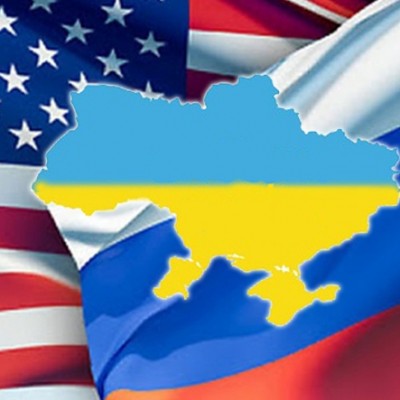
usa_russia_ukraine
The costs of the mainstream U.S. media’s wildly anti-Moscow bias in the Ukraine crisis are adding up, as the Obama administration has decided to react to alleged “Russian aggression” by investing as much as $1 trillion in modernizing the U.S. nuclear weapons arsenal.
On Monday, a typically slanted New York Times article justified these modernization plans by describing “Russia on the warpath” and adding: “Congress has expressed less interest in atomic reductions than looking tough in Washington’s escalating confrontation with Moscow.”
But the Ukraine crisis has been a textbook case of the U.S. mainstream media misreporting the facts of a foreign confrontation and then misinterpreting the meaning of the events, a classic case of “garbage in, garbage out.” The core of the false mainstream narrative is that Russian President Vladimir Putin instigated the crisis as an excuse to reclaim territory for the Russian Empire.
While that interpretation of events has been the cornerstone of Official Washington’s “group think,” the reality always was that Putin favored maintaining the status quo in Ukraine. He had no plans to “invade” Ukraine and was satisfied with the elected government of President Viktor Yanukovych. Indeed, when the crisis heated up last February, Putin was distracted by the Sochi Winter Olympics.
Rather than Putin’s “warmongering” – as the Times said in the lead-in to another Monday article – the evidence is clear that it was the United States and the European Union that initiated this confrontation in a bid to pull Ukraine out of Russia’s sphere of influence and into the West’s orbit.
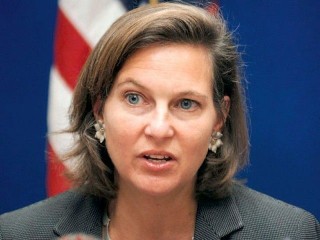
Assistant Secretary of State for European Affairs Victoria Nuland, who pushed for the Ukraine coup and helped pick the post-coup leaders.
Image: Assistant Secretary of State for European Affairs Victoria Nuland, who pushed for the Ukraine coup and helped pick the post-coup leaders.
This was a scheme long in the making, but the immediate framework for the crisis took shape a year ago when influential U.S. neocons set their sights on Ukraine and Putin after Putin helped defuse a crisis in Syria by persuading President Barack Obama to set aside plans to bomb Syrian government targets over a disputed Sarin gas attack and instead accept Syria’s willingness to surrender its entire chemical weapons arsenal.
But the neocons and their “liberal interventionist” allies had their hearts set on another “shock and awe” campaign with the goal of precipitating another “regime change” against a Middle East government disfavored by Israel. Putin also worked with Obama to resolve the dispute over Iran’s nuclear program, averting another neocon dream to “bomb, bomb, bomb Iran.”
The Despised Putin
So, Putin suddenly rose to the top of the neocons’ “enemies list” and some prominent neocons quickly detected his vulnerability in Ukraine, a historical route for western invasions of Russia and the scene of extraordinarily bloody fighting during World War II.
National Endowment for Democracy president Carl Gershman, one of the top neocon paymasters spreading around $100 million a year in U.S. taxpayers’ money, declared in late September 2013 that Ukraine represented “the biggest prize” but beyond that was an opportunity to put Putin “on the losing end not just in the near abroad but within Russia itself.”
The context for Gershman’s excitement was a European Union offer of an association agreement to Ukraine’s elected President Viktor Yanukovych, but it came with some nasty strings attached, an austerity plan demanded by the International Monetary Fund that would have made the hard lives of the average Ukrainian even harder.
That prompted Yanukovych to seek a better deal from Putin who offered $15 billion in aid without the IMF’s harsh terms. Yet, once Yanukovych rebuffed the EU plan, his government was targeted by a destabilization campaign that involved scores of political and media projects funded by Gershman’s NED and other U.S. agencies.
Assistant Secretary of State for European Affairs Victoria Nuland, a neocon holdover who had been an adviser to Vice President Dick Cheney, reminded a group of Ukrainian business leaders that the United States had invested $5 billion in their “European aspirations.” Nuland, wife of prominent neocon Robert Kagan, also showed up at the Maidan square in Kiev passing out cookies to protesters.
The Maidan protests, reflecting western Ukraine’s desire for closer ties to Europe, also were cheered on by neocon Sen. John McCain, who appeared on a podium with leaders of the far-right Svoboda party under a banner honoring Nazi collaborator Stepan Bandera. A year earlier, the European Parliament had identified Svoboda as professing “racist, anti-Semitic and xenophobic views [that] go against the EU’s fundamental values and principles.”
Yet, militants from Svoboda and the even more extreme Right Sektor were emerging as the muscle of the Maidan protests, seizing government buildings and hurling firebombs at police. A well-known Ukrainian neo-Nazi leader, Andriy Parubiy, became the commandant of the Maidan’s “self-defense” forces.
Behind the scenes, Assistant Secretary Nuland was deciding who would take over the Ukrainian government once Yanukovych was ousted. In an intercepted phone call with U.S. Ambassador Geoffrey Pyatt, Nuland crossed off some potential leaders and announced that “Yats” – or Arseniy Yatsenyuk – was her guy.
The Coup
On Feb. 20, as the neo-Nazi militias stepped up their attacks on police, a mysterious sniper opened fire on both protesters and police killing scores and bringing the political crisis to a boil. The U.S. news media blamed Yanukovych for the killings though he denied giving such an order and some evidence pointed toward a provocation from the far-right extremists.
As Estonia’s Foreign Minister Urmas Paet said in another intercepted phone call with EU foreign affairs chief Catherine Asthon, “there is a stronger and stronger understanding that behind snipers it was not Yanukovych, it was somebody from the new coalition.”
But the sniper shootings led Yanukovych to agree on Feb. 21 to a deal guaranteed by three European countries – France, Germany and Poland – that he would surrender much of his power and move up elections so he could be voted out of office. He also assented to U.S. demands that he pull back his police.
That last move, however, prompted the neo-Nazi militias to overrun the presidential buildings on Feb. 22 and force Yanukovych’s officials to flee for their lives. Then, rather than seeking to enforce the Feb. 21 agreement, the U.S. State Department promptly declared the coup regime “legitimate” and blamed everything on Yanukovych and Putin.
Nuland’s choice, Yatsenyuk, was made prime minister and the neo-Nazis were rewarded for their crucial role by receiving several ministries, including national security headed by Parubiy. The parliament also voted to ban Russian as an official language (though that was later rescinded), and the IMF austerity demands were pushed through by Yatsenyuk. Not surprisingly, ethnic Russians in the south and east, the base of Yanukovych’s support, began resisting what they regarded as the illegitimate coup regime.
To blame this crisis on Putin simply ignores the facts and defies logic. To presume that Putin instigated the ouster of Yanukovych in some convoluted scheme to seize territory requires you to believe that Putin got the EU to make its reckless association offer, organized the mass protests at the Maidan, convinced neo-Nazis from western Ukraine to throw firebombs at police, and manipulated Gershman, Nuland and McCain to coordinate with the coup-makers – all while appearing to support Yanukovych’s idea for new elections within Ukraine’s constitutional structure.
Though such a crazy conspiracy theory would make people in tinfoil hats blush, this certainty is at the heart of what every “smart” person in Official Washington believes. If you dared to suggest that Putin was actually distracted by the Sochi Olympics last February, was caught off guard by the events in Ukraine, and reacted to a Western-inspired crisis on his border (including his acceptance of Crimea’s request to be readmitted to Russia), you would be immediately dismissed as “a stooge of Moscow.”
Such is how mindless “group think” works in Washington. All the people who matter jump on the bandwagon and smirk at anyone who questions how wise it is to be rolling downhill in some disastrous direction.
But the pols and pundits who appear on U.S. television spouting the conventional wisdom are always the winners in this scenario. They get to look tough, standing up to villains like Yanukovych and Putin and siding with the saintly Maidan protesters. The neo-Nazi brown shirts are whited out of the picture and any Ukrainian who objected to the U.S.-backed coup regime finds a black hat firmly glued on his or her head.
For the neocons, there are both financial and ideological benefits. By shattering the fragile alliance that had evolved between Putin and Obama over Syria and Iran, the neocons seized greater control over U.S. policies in the Middle East and revived the prospects for violent “regime change.”
On a more mundane level – by stirring up a new Cold War – the neocons generate more U.S. government money for military contractors who bestow a portion on Washington think tanks that provide cushy jobs for neocons when they are out of government.
The Losers
The worst losers are the people of Ukraine, most tragically the ethnic Russians in eastern Ukraine, thousands of whom have died from a combination of heavy artillery fire by the Ukrainian army on residential areas followed by street fighting led by brutal neo-Nazi militias who were incorporated into Kiev’s battle plans. [See Consortiumnews.com’s “Ukraine’s ‘Romantic’ Neo-Nazi Storm Troopers.”]
The devastation of eastern Ukraine, which has driven an estimated one million Ukrainians out of their homes, has left parts of this industrial region in ruins. Of course, in the U.S. media version, it’s all Putin’s fault for deceiving these ethnic Russians with “propaganda” about neo-Nazis and then inducing these deluded individuals to resist the “legitimate” authorities in Kiev.
Notably, America’s righteous “responsibility to protect” crowd, which demanded that Obama begin airstrikes in Syria a year ago, swallowed its moral whistles when it came to the U.S.-backed Kiev regime butchering ethnic Russians in eastern Ukraine (or for that matter, when Israeli forces slaughtered Palestinians in Gaza).
However, beyond the death and destruction in eastern Ukraine, the meddling by Nuland, Gershman and others has pushed all of Ukraine toward financial catastrophe. As “The Business Insider” reported on Sept. 21, “Ukraine Is on the Brink of Total Economic Collapse.”
Author Walter Kurtz wrote: “Those who have spent any time in Ukraine during the winter know how harsh the weather can get. And at these [current] valuations, hryvnia [Ukraine’s currency] isn’t going to buy much heating fuel from abroad. …
“Inflation rate is running above 14% and will spike sharply from here in the next few months if the currency weakness persists. Real wages are collapsing. … Finally, Ukraine’s fiscal situation is unraveling.”
In other words, the already suffering Ukrainians from the west, east and center of the country can expect to suffer a great deal more. They have been made expendable pawns in a geopolitical chess game played by neocon masters and serving interests far from Lviv, Donetsk and Kiev.
But other victims from these latest machinations by the U.S. political/media elite will include the American taxpayers who will be expected to foot the bill for the new Cold War launched in reaction to Putin’s imaginary scheme to instigate the Ukraine crisis so he could reclaim territory of the Russian Empire.
As nutty as that conspiracy theory is, it is now one of the key reasons why the American people have to spend $1 trillion to modernize the nation’s nuclear arsenal, rather than scaling back the thousands of U.S. atomic weapons to around 900, as had been planned.
Or as one supposed expert, Gary Samore at Harvard, explained to the New York Times: “The most fundamental game changer is Putin’s invasion of Ukraine. That has made any measure to reduce the stockpile unilaterally politically impossible.”
Thus, you can see how hyperbolic journalism and self-interested punditry can end up costing the American taxpayers vast sums of money and contributing to a more dangerous world.