The Occult Roots of The Wizard of Oz
With its memorable story and its cast of colorful
characters, the Wizard of Oz quickly became an American classic. More
than a hundred years after the release of this book, kids everywhere are
still enchanted by Oz’s world of wonder. Few, however, recognize that,
under its deceptive simplicity, the story of the Wizard of Oz conceals
deep esoteric truths inspired by Theosophy. Here we’ll look at the
Wizard of Oz’s occult meaning and its author’s background.
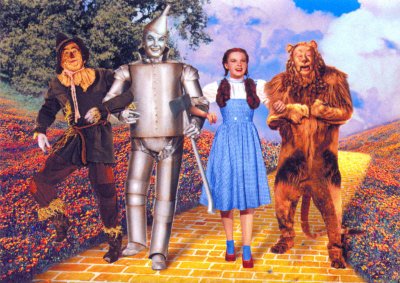
Although the Wizard of Oz is widely perceived as an innocent
children’s fairy tale, it is almost impossible not to attribute a
symbolic meaning to Dorothy’s quest. As in all great stories, the
characters and the symbols of the Wizard of Oz can be given a second
layer of interpretation, which may vary depending on the reader’s
perception. Many analyses appeared throughout the years describing the
story as an “atheist manifesto” while others saw it as a promotion of
populism. It is through an understanding of the author’s philosophical
bckground and beliefs, however, that the story’s true meaning can be
grasped.
L. Frank Baum, the author of the Wizard of Oz was a member of the
Theosophical Society, which is an organization based on occult research
and the comparative study of religions. Baum had a deep understanding of
Theosophy and, consciously or not, created an allegory of Theosophic
teachings when he wrote the Wizard of Oz.
What is Theosophy?
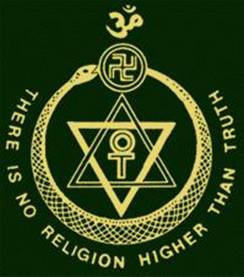
The Theosophical Society is an occult organization, mainly based on
the teachings of Helena P. Blavatsky, which seeks to extract the common
roots of all religions in order to form a universal doctrine.
“But it is perhaps desirable to state unequivocally
that the teachings, however fragmentary and incomplete, contained in
these volumes, belong neither to the Hindu, the Zoroastrian, the
Chaldean, nor the Egyptian religion,.neither to Buddhism, Islam, Judaism
nor Christianity exclusively. The Secret Doctrine is the essence of all
these. Sprung from it in their origins, the various religious schemes
are now made to merge back into their original element, out of which
every mystery and dogma has grown, developed, and become materialized.”
-H.P. Blavatsky, The Secret Doctrine
The three declared objects of the original Theosophical Society as
established by Blavatsky, Judge and Olcott (its founders) were as
follows:
“First — To form a nucleus of the Universal Brotherhood of Humanity, without distinction of race, creed, sex, caste, or color.
Second — To encourage the study of Comparative Religion, Philosophy, and Science.
Third — To investigate the unexplained laws of Nature and the powers latent in man.”
-The Theosophist, vol 75, No 6
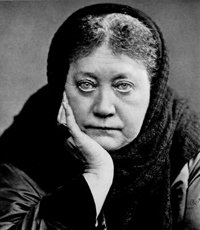
H.P. Blavatsky
The main tenets of Theosophy are thoroughly described in Blavatsky works
Isis Unveiled and
The Secret Doctrine.
At the core of Theosophical teachings are the same tenets found in many
other occult schools: the belief of the presence of a “divine spark”
within every person which, with the proper discipline and training, can
lead to spiritual illumination and a state of virtual godliness.
Another important principle found in Theosophy is reincarnation. It
is believed that the human soul, like all other things in the universe,
go through seven stages of development.
“Theosophical writings propose that human
civilizations, like all other parts of the universe, develop cyclically
through seven stages. Blavatsky posited that the whole humanity, and
indeed every reincarnating human monad, evolves through a series of
seven “Root Races”. Thus in the first age, humans were pure spirit; in
the second age, they were sexless beings inhabiting the now lost
continent of Hyperborea; in the third age the giant Lemurians were
informed by spiritual impulses endowing them with human consciousness
and sexual reproduction. Modern humans finally developed on the
continent of Atlantis. Since Atlantis was the nadir of the cycle, the
present fifth age is a time of reawakening humanity’s psychic gifts. The
term psychic here really means the realization of the permeability of
consciousness as it had not been known earlier in evolution, although
sensed by some more sensitive individuals of our species.”
The ultimate goal is of course to return to the state of divinity
from which we’ve emerged. The same tenets (with subtle variations) can
be found in other schools such as Rosicrucianism, Freemasonry and other
orders teachings the Mysteries.
L.Frank Baum, a Notable Theosophist
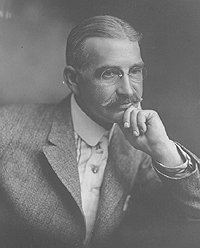
Before writing the Wizard of Oz (or even contemplating becoming a
children’s story author), Baum held many jobs – one of which was editor
of the
Aberdeen Saturday Pioneer. In 1890, Baum wrote a series
of articles introducing his readers to Theosophy, including his views on
Buddha, Mohammed, Confucius and Christ. At that time, he wasn’t a
member of the Theosophical Society but he already showed a deep
understanding of its philosophy. Here’s an excerpt of his “Editor’s
Musings”:
“Amongst various sects so numerous in America today
who find their fundamental basis in occultism, the Theosophist stands
pre-eminent both in intelligence and point of numbers. Theosophy is not a
religion. Its followers are simply “searchers after Truth”. The
Theosophists, in fact, are the dissatisfied with the world, dissenters
from all creeds. They owe their origin to the wise men of India, and are
numerous, not only in the far famed mystic East, but in England,
France, Germany and Russia. They admit the existence of a God – not
necessarily of a personal God. To them God is Nature and Nature is
God…But despite this, if Christianity is Truth, as our education has
taught us to believe, there can be no menace to it in Theosophy.”
-L. Frank Baum, Aberdeen Saturday Pioneer, January 25th 1890
In another of his “Editor’s Musings”, Baum discusses the use of
mystic symbolism in fiction, something he accomplished ten years later
with the Wizard of Oz:
“There is a strong tendency in modern novelists
towards introducing some vein of mysticism or occultism into their
writings. Books of this character are eagerly bought and read by the
people, both in Europe and America. It shows the innate longing in our
natures to unravel the mysterious: to seek some explanation, however
fictitious, of the unexplainable in nature and in our daily existence.
For, as we advance in education, our desire for knowledge increases, and
we are less satisfied to remain in ignorance of that mysterious
fountain-head from which emanates all that is sublime and grand and
incomprehensible in nature.”
At the end of this article, Baum goes into an all-out plead for more occultism in literature:
“The appetite of our age for occultism demands to be
satisfied, and while with the mediocrity of people will result in mere
sensationalism, it will lead in many to higher and nobler and bolder
thought; and who can tell what mysteries these braver and abler
intellects may unravel in future ages?”
-L. Frank Baum, Aberdeen Saturday Pioneer, February 22nd 1890
Two years after writing those articles, L. Frank Baum and his wife
Maud Gage joined the Theosophical Society in Chicago. The archives of
the Theosophical Society in Pasadena, California recorded the start of
their membership as September 4th, 1892. In 1890, the Wizard of Oz was
published. When asked about how Baum got his inspiration for the story,
he replied:
“It was pure inspiration…It came to me right out of
the blue. I think that sometimes the Great Author has a message to get
across and He has to use the instrument at hand. I happened to be that
medium, and I believe the magic key was given me to open the doors to
sympathy and understanding, joy, peace and happiness.”
-L. Frank Baum, cited by Hearn 73
The Wizard of Oz is much appreciated within the Theosophical Society. In 1986, The
American Theosophist magazine recognized Baum as a “notable Theosophist” who thoroughly represented the organization’s philosophy.
“Although readers have not looked at his fairy tales
for their Theosophical content, it is significant that Baum became a
famous writer of children’s books after he came into contact with
Theosophy. Theosophical ideas permeate his work and provided inspiration
for it. Indeed, The Wizard can be regarded as Theosophical allegory,
pervaded by Theosophical ideas from beginning to end. The story came to
Baum as an inspiration, and he accepted it with a certain awe as a gift
from outside, or perhaps from deep within, himself.”
-American Theosophist no 74, 1986
So what is the esoteric meaning of this children’s story, which came to Baum as a “divine inspiration”?
The Occult Meaning of The Wizard of Oz
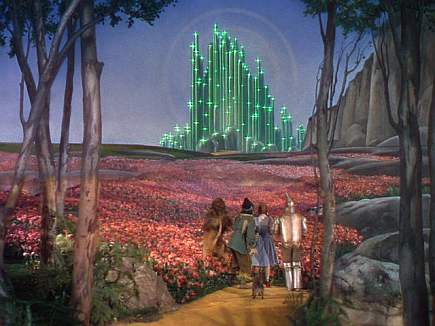
- Path to Illumination
If you’ve never read or watched The Wizard of Oz or need your memory refreshed, here’s a quick sum-up of the movie:
The film follows 12-year-old farmgirl Dorothy Gale (Judy
Garland) who lives on a Kansas farm with her Aunt Em and Uncle Henry,
but dreams of a better place “somewhere over the rainbow.” After being
struck unconscious during a tornado by a window which has come loose
from its frame, Dorothy dreams that she, her dog Toto and the farmhouse
are transported to the magical Land of Oz. There, the Good Witch of the
North, Glinda (Billie Burke), advises Dorothy to follow the yellow brick
road to the Emerald City and meet the Wizard of Oz, who can return her
to Kansas. During her journey, she meets a Scarecrow (Ray Bolger), a Tin
Man (Jack Haley) and a Cowardly Lion (Bert Lahr), who join her, hoping
to receive what they lack themselves (a brain, a heart and courage,
respectively). All of this is done while also trying to avoid the Wicked
Witch of the West (Margaret Hamilton) and her attempt to get her
sister’s ruby slippers from Dorothy, who received them from Glinda.
The said above, the entire story of the Wizard of Oz is an
allegorical tale of the soul’s path to illumination – the Yellow Brick
Road. In Buddhism (an important part of Theosophical teachings) the same
concept is referred to as the “Golden Path”.
The story starts with Dorothy Gale living in Kansas, which symbolizes
the material world, the physical plane where each one of us starts our
spiritual journey. Dorothy feels an urge to “go over the rainbow”, to
reach the ethereal realm and follow the path to illumination. She has
basically “passed the Nadir” by demonstrating the urge to seek a higher
truth.
Dorothy is then brought to Oz by a giant cyclone spiraling upward,
representing the cycles of karma, the cycle of errors and lessons
learned. It also represents the theosophical belief in reincarnation,
the round of physical births and deaths of a soul until it is fit to
become divine. It is also interesting to note that the Yellow Brick Road
of Oz begins as an outwardly expanding spiral. In occult symbolism,
this spiral represents the evolving self, the soul ascending from matter
into the spirit world.
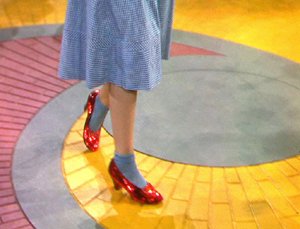
- The spiraly beginning of the spiritual path
Here’s an explanation of the spiral as an occult symbol:
“Spiral: The path of a point
(generally plane) which moves round an axis while continually
approaching it or receding from it; also often used for a helix, which
is generated by compounding a circular motion with one in a straight
line. The spiral form is an apt illustration of the course of evolution,
which brings motion round towards the same point, yet without
repetition.
The serpent, and the figures 8 and , denoting the ogdoad and
infinity, stand for spiral cyclic motion. The course of fohat in space
is spiral, and spirit descends into matter in spiral courses. Repeating
the process by which a helix is derived form a circle produces a vortex.
The complicated spirals of cosmic evolution bring the motion back to
the point from which it started at the birth of a great cosmic age.”
-The Encyclopedic Theosophical Glossary
Before undertaking her journey, Dorothy is given the “silver shoes”,
which represent the “silver cord” of Mystery Schools (Dorothy was
wearing ruby slippers in the movie due to a last minute change by the
director, who thought that the color ruby looked better against the
Yellow Brick Road). In occult schools, the silver cord is considered to
be the link between our material and spiritual selves.
“In Theosophy, one’s physical body and one’s Astral
body are connected through a “silver cord”, a mythical link inspired by a
passage in the Bible that speaks of a return from a spiritual quest.
‘Or ever the silver cord be loosed, says the book of Ecclesiastes, ‘then
shall the dust return to the earth as it was and the spirit shall
return unto God who gave it’.
In Frank Baum’s own writing, the silver cord of Astral travel
would inspire the silver shoes that bestow special powers upon the one
who wears them”
-Evan I. Schwartz, Finding OZ: How L.Frank Baum Discovered the Great American Story
During her journey along the Yellow Brick road, Dorothy encounters
Scarecrow, Tin Woodman and Cowardly Lion who are respectively searching
for a brain, a heart and courage. Those odd characters embody the
qualities needed by the initiates in order to complete their quest for
illumination. Baum was probably inspired by these words from Miss
Blavatsky:
“There is no danger that dauntless courage cannot
conquer, there is not trial that a spotless purity cannot pass through;
there is no difficulty a strong intellect cannot surmount”
- H.P. Blavatsky
After surmounting many obstacles, the party finally reaches Emerald city in order to meet The Wizard.
The Wizard
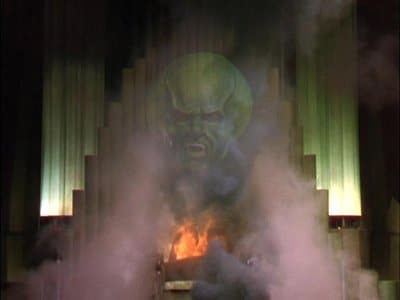
Surrounded by artifices and special effects, the Wizard comes across
as cruel, rude and unwise. The Wizard is in fact a stand-in for the
personal God of the Christians and the Jews, the oppressive figure used
by conventional religions to keep the masses in spiritual darkness:
Jehova or Yahwe. It is later discovered that the Wizard is a humbug, a
charlatan, who scares people into worshipping his Wizard. He surely
could not help the characters complete their quest. If you read
literature of Mystery schools, this point of view towards Christianity
is constantly expressed.
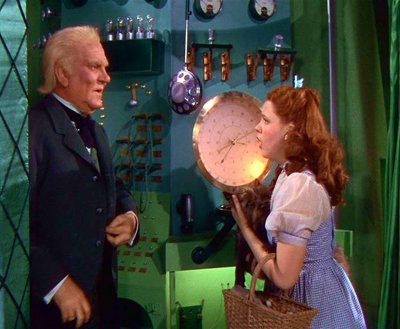
- Oh no you didn’t, Wizard
After all is said and done, the brains, the heart and the courage
needed to complete Dorothy, Scarecrow, Tinman and Lion’s quests were
found within each one of them. Mystery Schools have always taught their
students that one must rely on oneself to obtain salvation. Throughout
the story Dorothy’s dog Toto represents her “inner voice”; her
intuition. Here’s a description of Toto taken from the Theosophical
Society’s website:
“Toto represents the inner, intuitive, instinctual,
most animal-like part of us. Throughout the movie, Dorothy has
conversations with Toto, or her inner intuitive self. The lesson here is
to listen to the Toto within. In this movie, Toto was never wrong. When
he barks at the scarecrow, Dorothy tries to ignore him: “Don’t be
silly, Toto. Scarecrows don’t talk.” But scarecrows do talk in Oz. Toto
also barks at the little man behind the curtain. It is he who realizes
the Wizard is a fraud. At the Gale Farm and again at the castle, the
Witch tries to put Toto into a basket. What is shadow will try to block
or contain the intuitive. In both cases, Toto jumps out of the basket
and escapes. Our intuitive voice can be ignored, but not contained.
In the last scene, Toto chases after a cat, causing Dorothy to
chase after him and hence miss her balloon ride. This is what leads to
Dorothy’s ultimate transformation, to the discovery of her inner powers.
The balloon ride is representative of traditional religion, with a
skinny-legged wizard promising a trip to the Divine. Toto was right to
force Dorothy out of the balloon, otherwise she might never have found
her magic. This is a call for us to listen to our intuition, our gut
feelings, those momentary bits of imagination that appear seemingly out
of nowhere.”
As stated above, the fake Wizard invites Dorothy into his balloon to
go back to Kansas, her final destination. She however follows Toto (her
intuition) and gets out of the balloon, which represents the empty
promises of organized religions. This leads to her ultimate revelation
and, with the help of the Good Witch of the North (her divine guide),
she finally understands: everything she ever wanted could be found “in
her own backyard”.
In order to obtain illumination Dorothy had to vanquish the wicked
witches of the East and the West – who were forming an evil horizontal
axis: the material world. She was wise in listening to the advice of the
good witches of the North and South – the vertical axis: the spiritual
dimension.
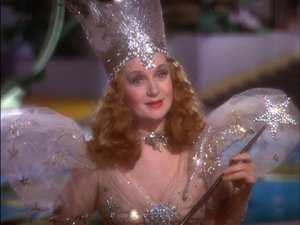
- The Good Witch of the North, representing Dorothy’s “divine spark”
At the end of the story, Dorothy wakes up in Kansas: she has
successfully combined her physical and spiritual life. She is now
comfortable being herself again and, despite her family not really
believing the details of her quest (the ignorant profane), she can
finally say “There is no place like home”.
The Wizard of Oz Used in Monarch Mind Control
Almost all documentation relating to the MK Ultra project and Mind
Control mention the importance of the Wizard of Oz. In the 1940′s, the
story was reportedly chosen by members of the US intelligence community
to provide a thematic foundation for their trauma-based mind control
program. The movie was edited and given a different meaning in order to
use it as a tool to reinforce the programming on the victims. Here are
some examples taken from Fritz Springmeier’s
Total Mind Control Slave:
- The close relationship between Dorothy and her dog is a very subtle
connection between the satanic cults use of animals (familiars). A
Monarch slave child will be allowed to bond with a pet. The child will
want to bond with a pet anyway because people are terrifying to it by
this point. Then the pet is killed to traumatize the child.
- Monarch slaves are taught to “follow the yellow brick road.” No
matter what fearful things lie ahead, the Monarch slave must follow the
Yellow Brick Road which is set out before them by their master.
- The rainbow–with its seven colors-has long had the occult significance of being a great spiritual, hypnotic device.
- Dorothy is looking for a place where there is no trouble, which is a
place “over the rainbow.” To escape pain, alters go over the rainbow. (This is a.k.a. in Alice In Wonderland Programming as “going through the looking glass”).
“Somewhere Over the Rainbow” is probably the most dissociative song
ever written and is often played in movies during violent or
traumatizing events (see the movie
Face-Off). The strange
effect produced, where the violence doesn’t seem real anymore, is
exactly how dissociation works on mind-control victims. We may also
speculate that the scene where Dorothy falls asleep in a poppy field is a
reference to the use of heroin to relax and manipulate the victims of
mind-control. Also consider the snow falling from the sky that awakens
Dorothy from her slumber. Could this be a reference to cocaine?
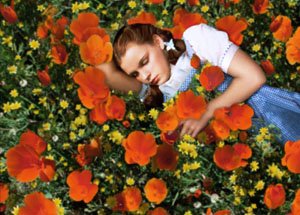
- Does this represent heroin?
In Conclusion
Allegorical stories transmitting spiritual truths have existed since
man’s beginnings. These simple yet extremely profound stories have been
found in all civilizations: Celtic, Indian, Persian, Aztec, Greek,
Egyptian and others. Consciously or not, Frank Baum created a classical
allegory which, in the same vein as Homer’s
Odyssey, entertains the masses and also contains mystical messages that can be understood by the “awakened”.
The Wizard of Oz’s great success confirms America’s (and the Western
world’s) real spiritual dogma. Written during the 1890′s, when most
Americans were conservative Christians, Baum’s story anticipated the
population’s progressive abandonment of traditional religions and the
embrace of a new form of spirituality. Today’s New Age movements are
gaining many adepts and, even if most of them are total shams, they all
claim to be inspired by Theosophy. Could such tales have contributed to
the spectacular decline of Christianity in the past decades while other
movements continue to gain momentum?

 Posts
Posts