Friday, October 26, 2012

The Rafael Resendez-Ramirez Case: A Review of the INS's Actions and the Operation of Its IDENT Automated Fingerprint Identification System (March, 2000)

USDOJ/OIG Special Report

The Rafael Resendez-Ramirez Case:
A Review of the INS's Actions and the Operation of
Its IDENT Automated Fingerprint Identification System
(March, 2000)


EXECUTIVE SUMMARY
  1. IntroductionThis investigation by the Department of Justice Office of the Inspector General (OIG) examined the Immigration and Naturalization Service’s (INS) actions with regard to Rafael Resendez-Ramirez (Resendez). He is a Mexican citizen who has an extensive criminal record and is alleged to have committed multiple murders in the United States.
    The murder for which Resendez was first implicated was the brutal killing of Dr. Claudia Benton in December 1998 near Houston. In January 1999, the local police obtained a warrant for Resendez’s arrest, and the local and state police mounted an extensive effort to find him. Among other measures, the police contacted INS investigators in Houston several times in early 1999 seeking assistance in the search for Resendez. In May 1999, Resendez was linked to three more murders in Texas and Kentucky, and a federal warrant was issued for his arrest. Resendez became known as “the railway killer” because he allegedly traveled around the United States by freight train and committed murders near railroad lines. In June 1999, the FBI formed a multi-agency task force in Houston to capture Resendez and also placed him on its list of “Ten Most Wanted Fugitives.”
    In mid-June 1999, a Border Patrol intelligence officer in Del Rio, Texas, thought it important to enroll Resendez into an INS database, called IDENT, to ensure that he would be detained if he were encountered by the Border Patrol or other INS personnel. IDENT is an automated fingerprint identification system, deployed by the INS in 1994, that allows INS employees to identify and track illegal aliens through electronic comparisons of their fingerprints.
    When reviewing IDENT records, the intelligence officer discovered that Resendez had been apprehended by the Border Patrol in Texas and New Mexico seven times in 1998 while crossing the border illegally, had been enrolled in IDENT each time, and had been “voluntarily returned” to Mexico each time without formal proceedings. Most surprisingly, IDENT showed that on June 1, 1999 – at the same time that state and federal warrants for Resendez were outstanding and law enforcement officers were searching for Resendez in connection with several murders – Border Patrol agents in Santa Teresa, New Mexico, had apprehended him crossing the border illegally, processed him in IDENT, and voluntarily returned him to Mexico the same day, unaware that he was wanted. Allegedly, Resendez quickly returned to the United States illegally and committed four more murders in June 1999. Eventually, on July 13, 1999, Resendez surrendered to U.S. and Texas law enforcement officers near El Paso, Texas.
    The revelation that Resendez had been in the INS’s custody and released generated sharp criticism. The media and members of Congress questioned how this happened and why the INS had voluntarily returned Resendez to Mexico despite his extensive criminal record and the outstanding warrants for his arrest. On a broader level, questions were raised as to whether IDENT was a fundamentally flawed system.
    On June 30, 1999, the Attorney General and the Commissioner of the INS asked the OIG to review the actions of the INS in connection with the Resendez case. Our investigation examined the actions of the Border Patrol agents who apprehended and processed Resendez in IDENT and voluntarily returned him to Mexico in 1998 and 1999. We interviewed these agents and many of their supervisors to determine what they did in each instance as well as to learn about the Border Patrol’s standard practices in such cases. We also examined the actions of INS investigators who were contacted by the law enforcement officers who were seeking to arrest Resendez. We interviewed these investigators and the local and state police who spoke with them. In addition, we interviewed many other INS employees involved with the Resendez case, including several INS intelligence officers who learned about the search for Resendez. We also interviewed FBI employees, Customs Service employees, and Assistant United States Attorneys who had information that was relevant to our inquiry.
    More broadly, to understand how IDENT operated in this case, we examined the design and implementation of IDENT, including the INS policy regarding when “lookouts” for aliens should be entered in IDENT. We analyzed how the lookout policy was distributed throughout the INS and whether the INS employees involved in the Resendez case should have known about it. Because we found a disturbing lack of knowledge among INS employees about IDENT and its procedures, we also examined how INS employees were trained on its use. In this inquiry, we interviewed managers at INS Headquarters who were responsible for the implementation and operation of IDENT, INS employees and contractors involved in training INS employees on IDENT, INS employees in the field offices involved in the Resendez matter, and Justice Management Division employees involved with reviewing the operation of IDENT.
    In total, we interviewed more than 130 individuals, many more than once. We also reviewed thousands of pages of documents from the INS and other agencies, including the INS’s “Alien File” (“A-file”) on Resendez; his records in IDENT and other INS and criminal databases; INS written policies and procedures regarding IDENT; INS records relating to the design and implementation of IDENT; INS records concerning IDENT training; and statistical information regarding IDENT usage and prosecutions of aliens for immigration-related offenses.
    This Executive Summary briefly describes the main findings and recommendations of our report. It does not include all or even most of the details and events that the report contains. We believe that the entire report should be read for a fuller and fairer understanding of the results of this investigation.
  2. The Background of IDENT and the Search for Resendez

    1. The IDENT SystemEach year, the INS apprehends approximately 1.5 million aliens attempting to enter the United States illegally or who are in the United States illegally. The majority of these apprehensions occur along the Southwest Border. Reliance on the names these apprehended aliens provide is problematic, since they may use aliases and often do not carry identification papers. A solution to this problem is to use “biometrics” – biological measurements unique to each individual such as fingerprints – to identify apprehended aliens.
      In 1989, the INS began developing such a biometric system, the automated fingerprint identification system that eventually became known as IDENT. When Congress first appropriated money for the system, it noted that the system was an attempt “to address the so-called revolving door phenomenon of illegal entry by aliens . . . to clearly define the problems of recidivism as well as to immediately identify those criminal aliens who should remain in the custody of the INS.” After several pilot studies, the INS began implementing IDENT in 1994, first along the Southwest Border and then at many Border Patrol Stations, INS District Offices, and ports of entry throughout the United States.
      The INS’s goal is to enroll virtually all apprehended aliens in IDENT. To enroll an alien in IDENT, an INS employee places the alien’s right and left index fingers on the IDENT fingerprint scanner, takes the alien’s photograph with the IDENT camera, and enters certain biographical information into the computer. IDENT then electronically compares the alien’s fingerprints to fingerprints in two IDENT databases: 1) a “lookout” database that contains fingerprints and photographs of approximately 400,000 aliens who have been previously deported by the INS or who have a significant criminal history; and 2) a “recidivist” database that contains fingerprints and photographs of over a million illegal aliens who have been apprehended by the INS and enrolled in IDENT since it was deployed.
      IDENT first compares the apprehended alien’s fingerprints against the records in the lookout database. If there is a potential match, IDENT presents on the computer screen the fingerprints and photograph of the potential match next to the fingerprints and photograph of the apprehended alien. IDENT next compares the apprehended alien’s fingerprints against the recidivist database and presents any potential matches. The INS employee is supposed to confirm or deny a potential match based on a visual comparison of the fingerprints and photographs. This entire process normally takes two minutes.
      Because of resource limitations, the Border Patrol does not detain or seek to prosecute all the aliens they apprehend for illegally entering the United States. Normally, if IDENT’s lookout database shows that the alien has been previously deported or has an extensive criminal record, the Border Patrol agent will detain and refer the alien for prosecution for “reentry after deportation” or “entry without inspection.” In addition, individual Border Patrol stations and sectors, in conjunction with local United States Attorneys’ Offices, set a “threshold” number of apprehensions for illegal entry after which the alien should be prosecuted for “entry without inspection,” even if the alien does not have a criminal record or has not been previously deported.
      When aliens are detained for prosecution or there are aggravating factors associated with their apprehension (such as persistent false statements, combativeness, indications that the alien has been previously incarcerated, or indications that the alien is a smuggler), Border Patrol agents should request a records check on the aliens in other INS and criminal databases. To do so, the Border Patrol agent normally must call the Border Patrol sector’s communications office, commonly known as the “radio room,” which has direct links to various INS and criminal databases. These include the FBI’s National Crime Information Center (NCIC) database, which contains criminal history information and outstanding warrants submitted by participating federal, state, and local law enforcement agencies on millions of individuals; INS databases containing records of prior INS contacts with the alien, such as deportations; and a Customs Service database (TECS) that is typically used by Customs and INS inspectors at ports of entry to check in-coming travelers. These additional database checks are requested for only a small fraction of the large number of aliens who the Border Patrol apprehends. If the alien is not going to be prosecuted, normally the Border Patrol agent will “voluntarily return” Mexican aliens across the border without formal proceedings. Mexican aliens who are apprehended near the border typically are returned within a short time after their apprehensions.
    2. Resendez’s Criminal History and Apprehensions by the INS

      1. Resendez’s Criminal History and Encounters with the INS Before 1998According to his birth certificate, Resendez was born on August 1, 1959, in Izucar de Matamoros, Puebla, Mexico. Records we obtained from the INS, the FBI, and state and local authorities show that Resendez has an extensive criminal record in the United States, beginning in 1976. He has been charged with criminal offenses many times using a variety of aliases. His record includes convictions in:


        • 1977 in Mississippi for destroying private property;

        • 1980 in Florida for burglary, aggravated assault, and grand theft auto;

        • 1986 in Texas for making a false representation of U.S. citizenship;

        • 1989 in Missouri for falsely representing to be a U.S. citizen; being a convicted felon in possession of a firearm; and reentry after deportation;

        • 1992 in New Mexico for burglary;

        • 1993 in Texas for evading arrest;

        • 1995 in California for trespassing; and

        • 1996 in Kentucky for trespassing.
        Resendez was also arrested for additional offenses. In some instances, these charges were not pursued because of more serious offenses in other jurisdictions; in other instances, we simply could not determine the outcome of the charges based on the available records.
        Significantly, in 1994 Resendez was arrested by the Albuquerque, New Mexico, police for driving a stolen vehicle and released on bond. He was later indicted for this offense. When he did not appear to face the charges, a bench warrant was issued for his arrest and the warrant was placed in the FBI’s NCIC database. This warrant remained outstanding until after Resendez’s surrender on July 13, 1999.
        For several of his convictions, Resendez received significant prison sentences. Typically, he did not serve the full sentence before being released from prison and voluntarily returned or deported to Mexico by the INS. The available records indicate that before 1998 the INS voluntarily returned Resendez to Mexico at least four times and formally deported him at least three other times. The records are not clear whether he was returned to Mexico on several other occasions after he was released from prison. However, it is clear that after each return to Mexico, he re-entered the United States illegally and continued his criminal activities.
      2. The INS Apprehensions and Voluntary Returns of Resendez in 1998 The earliest record in IDENT about an apprehension of Resendez by the Border Patrol is from January 1998. According to IDENT, the Border Patrol apprehended Resendez trying to enter the United States illegally from Mexico on the following seven occasions in 1998:


        1. January 5, 1998, by agents from the Del Rio, Texas, Border Patrol Station;

        2. January 7, 1998, by agents from the Uvalde, Texas, Border Patrol Station;

        3. January 8, 1998, by agents from the Del Rio, Texas, Border Patrol Station;

        4. April 17, 1998, by agents from the Santa Teresa, New Mexico, Border Patrol Station;

        5. April 21, 1998, by agents from the Uvalde, Texas, Border Patrol Station;

        6. April 22, 1998, by agents from the Del Rio, Texas, Border Patrol Station;

        7. November 3, 1998, by agents from the Santa Teresa, New Mexico, Border Patrol Station.
        Our full report provides the details of these seven apprehensions and describes the actions taken by these Border Patrol agents each time they apprehended Resendez. Because Resendez had not reached the threshold number of prior apprehensions for prosecution established in each of the stations where he was apprehended, he was not detained for prosecution. On each of these seven occasions, Border Patrol agents enrolled Resendez in IDENT and voluntarily returned him to Mexico. At the time they did so, none of the agents learned of Resendez’s extensive criminal record, his record of deportations, or any outstanding warrant for him before they returned him to Mexico. None of that information was in IDENT.


    3. The Investigation of Resendez for Murder

      1. The Murder of Dr. BentonOn December 16, 1998, Dr. Claudia Benton was murdered in her home in West University Place, a small town located within the Houston, Texas, city limits. She was stabbed, beaten, and sexually assaulted, and items were stolen from her home, including a Jeep that was recovered the next day in a motel parking lot near San Antonio, Texas. The police obtained fingerprints at Dr. Benton’s home and from the Jeep and submitted them to several state fingerprint identification databases for comparison. The fingerprints were determined to be Resendez’s. On January 5, 1999, local law enforcement authorities obtained a warrant for Resendez’s arrest and placed it in the FBI’s NCIC database.
      2. The Police Contact the INS about ResendezThe police mounted extensive efforts to find Resendez. Because they knew that Resendez was a Mexican citizen, in January 1999 the police attempted to place lookouts for him in case he was apprehended at the border. First, a Houston police analyst contacted an employee of the Customs Service and asked her to place a “border alert” in TECS, a Customs Service database that typically is used by Customs Service and INS inspectors at ports of entry to check in-coming travelers.
        Second, in January 1999 a West University Place police detective contacted a special agent in the INS’s Houston Investigations office about placing a “border lookout” for Resendez. That agent referred the detective to another Customs Service agent to place a lookout in TECS. The INS agent did not mention IDENT.
        Third, in January 1999 the West University Place police detective contacted the INS’s Houston District Investigations office again to obtain Resendez’s A-file and to seek more information on him. The detective’s inquiry was assigned to a second INS special agent in the Houston Investigations office. This INS special agent was told to provide the police with Resendez’s A-file and any other assistance necessary. In February 1999, police detectives met with this second INS special agent in the Houston INS District Office and reviewed Resendez’s A-file. The detectives mentioned their previous attempts to place a lookout for Resendez at the border. In response, the INS special agent did not mention IDENT. Rather, he called a friend at the Customs Service to try to confirm that a lookout for Resendez had been entered into TECS. The Customs Service employee told the OIG that his computer “crashed” when he tried to check whether there was a lookout for Resendez, and apparently no one followed up on whether the lookout for Resendez had been ever placed in the Customs Service database. In fact, during our review we found that no lookout for Resendez was entered into TECS until after he was placed on the FBI’s Most Wanted list in June 1999.
        Fourth, after the February 1999 meeting with the police detectives, the second INS special agent provided information about the Resendez case to the INS Houston District’s intelligence officer. The intelligence officer included information about Resendez in his “Weekly Intelligence Report,” a memorandum distributed within the INS Houston District Office and the INS Central Region. Two Central Region Intelligence Office employees read the information about Resendez in the report and offered to make an electronic wanted poster for Resendez to be distributed to INS Border Patrol stations and other INS offices, if the Houston intelligence officer provided a photograph of Resendez. The Houston intelligence officer told the OIG that in response he mailed Resendez’s photograph to the Central Region Intelligence employee; that employee told the OIG that he never received the photograph. No one ever followed up on the suggestion to make the electronic wanted posted and none was made.
        Fifth, in March 1999, a Texas Ranger who was assigned to aid the police investigation of Dr. Benton’s murder contacted a third INS special agent in the INS Houston Investigations office for information on Resendez. The Texas Ranger met with this special agent at the INS Houston District Office and copied Resendez’s A-file. A few days later, the Texas Ranger heard from a colleague that the INS had an “internal system” for putting “holds” on aliens. Although the Texas Ranger did not know the name of IDENT, he called the INS special agent who had given him the A-file and asked him to put an “internal hold” on Resendez in the internal INS system. The Texas Ranger said he understood that the INS special agent would do so. The Texas Ranger provided us the notes of his conversation with the INS special agent in which he asked for the internal hold to be placed. Yet, the INS special agent apparently did nothing in response to the request from the Texas Ranger.
      3. Resendez is Linked to More MurdersOn April 30, 1999, Norman and Karen Sirnic were murdered in their home in Weimar, Texas. They were beaten to death with a sledgehammer, and Mrs. Sirnic was sexually assaulted. Through DNA evidence, the Texas Rangers linked Resendez as the alleged murderer of Dr. Benton and Mr. and Mrs. Sirnic. In addition, an FBI “profiler” examining the murders of Dr. Benton and Mr. and Mrs. Sirnic linked these killings with the murder of Christopher Maier and the sexual assault of his companion, which had occurred in August 1997 near railroad tracks in Lexington, Kentucky.
        On May 27, 1999, the FBI obtained a federal warrant for Resendez, charging him with unlawful flight to avoid prosecution, and the FBI entered that warrant in NCIC.
      4. The Border Patrol Apprehends and Returns Resendez to Mexico on June 1, 1999On the evening of June 1, 1999, Resendez was apprehended by two Border Patrol agents from the Santa Teresa, New Mexico, Border Patrol Station. When a seismic sensor near the border about seven miles east of the station was activated, Border Patrol agents responded to the area and saw someone running into the brush. With the assistance of a Border Patrol helicopter, they apprehended Resendez hiding in the brush.
        The two Border Patrol agents who apprehended Resendez told the OIG that they noticed nothing unusual about him and described him as quiet, respectful, and unobtrusive. A third Border Patrol agent who processed Resendez at the station did not remember him. According to IDENT records, when Resendez was processed on June 1, 1999, IDENT presented five of his prior apprehensions in 1998 as possible matches. The enrolling agent “denied” each of the possible matches in IDENT. He told the OIG that he did not remember doing this. He said that if an alien had not reached the prosecution “threshold” established in the Santa Teresa Station and there were no unusual circumstances regarding the apprehension, he normally would neither confirm nor deny the match or even look at the photographs of the previous apprehensions. The agent also said he did not seek further records checks because Resendez had not reached the prosecution threshold in Santa Teresa. The agent did not know that Resendez was wanted in connection with several murders, had been previously deported three times by the INS, or had an extensive criminal record. Consequently, the Border Patrol voluntarily returned Resendez to Mexico shortly after his apprehension on June 1.
      5. The Discovery that the INS Had Apprehended and Released ResendezBecause of the concern that Resendez was a serial killer, on June 8, 1999, the FBI formed a multi-agency task force in Houston, Texas, to apprehend him. On June 9, in connection with the work of the task force, INS and FBI agents sent a notice about Resendez to Border Patrol checkpoints and ports of entry. The notice, which included a photograph of Resendez and information about his record and the murders he allegedly committed, asked Border Patrol agents to be on the alert for him. When the lead intelligence officer for the Del Rio Border Patrol Sector received the notice, he became concerned about the safety of any Border Patrol agents who might come in contact with Resendez. He therefore decided to enter a lookout for Resendez in IDENT. After talking with a number of INS employees about how to do this, he located a set of Resendez’s fingerprints and sent them to the INS’s Biometric Support Center (BSC) in Washington, D.C., the entity responsible for entering lookouts into the IDENT database. On June 23, the BSC entered a lookout for Resendez in IDENT.
        Also, in an effort to assist the FBI task force in finding Resendez, the lead Del Rio intelligence officer checked IDENT for any information on Resendez. He learned that IDENT contained information that Resendez had been apprehended seven times by the Border Patrol in 1998 as well as on June 1, 1999. The officer provided this information to the FBI task force and INS Headquarters. This revelation was eventually disclosed publicly and generated a firestorm of criticism about the INS’s actions.
        On July 13, 1999, Resendez crossed the border from Ciudad Juarez, Mexico, and surrendered to U.S. and Texas law enforcement officials at a port of entry near El Paso, Texas. Resendez was arrested, enrolled in IDENT, and taken before a state magistrate. He was then flown to Houston to await trial, first for the murder of Dr. Benton.


  3. OIG Analysis

    1. The Actions of the Border Patrol Agents Who Apprehended and Voluntarily Returned Resendez to Mexico in 1998 and 1999We concluded that the Border Patrol agents who apprehended Resendez and voluntarily returned him to Mexico each time, including the agents who returned him on June 1, 1999, did so in accord with standard Border Patrol practices. Resendez had not reached the “threshold” number of apprehensions established in any of the places he was apprehended in order for him to be detained and prosecuted for entry without inspection. In addition, IDENT did not contain any lookout for Resendez or other information that would have indicated to the Border Patrol agent that Resendez should be detained or prosecuted.
      However, during our interviews of the Border Patrol agents who apprehended and processed Resendez, they exhibited confusion about IDENT procedures. We also found that they made mistakes in how they processed Resendez in IDENT, including how they responded to possible matches for him. Although none of these mistakes affected the outcome in Resendez’s case (because Resendez had not reached the prosecution threshold in any place he was apprehended), these mistakes may have been important if a lookout for Resendez had been entered in IDENT, and similar mistakes could affect the outcome in other apprehensions.
    2. The Actions of INS Employees Who Learned About the Search for ResendezIn response to an OIG Inspection report on the operation of IDENT, in August 1998 the INS distributed an IDENT lookout and alert policy throughout the INS. Resendez clearly qualified under this policy for inclusion in the IDENT lookout database, since he had an extensive and serious criminal record, he had been previously deported by the INS several times, and by early 1999 he was wanted in connection with a brutal murder.
      Yet, none of the INS investigators who were contacted by the law enforcement officers seeking Resendez in early 1999 thought to have a lookout for him placed in IDENT. One investigator apparently did nothing and two other investigators referred the police to Customs Service employees to place a lookout for Resendez in TECS. Because TECS typically is used to check in-coming passengers at ports of entry, a lookout in TECS might have been useful if Resendez was apprehended attempting to enter the United States by presenting himself at a port of entry (and did not use a new alias). But many aliens attempting to enter the United States illegally do not present themselves at ports of entry. Resendez’s pattern of entry was like that of most illegal entrants along the Southwest Border – he attempted to cross the border in remote areas, between ports of entry. IDENT would have been useful if he were apprehended in that circumstance; TECS was not.
      During all of the contacts by the police with Houston INS investigators, none of them thought to enter a lookout for Resendez in IDENT in case he was apprehended by the Border Patrol attempting to cross the border illegally. No one even informed the police about IDENT or told them that IDENT could be checked to determine if, when, and where Resendez had been previously apprehended by the INS entering the United States illegally. The police told us that information in IDENT about Resendez’s border crossings would have been extremely useful to their investigation because it would have provided leads in their search.
      The INS intelligence officers in the Houston District Office and the INS Central Region who suggested distributing an electronic wanted poster for Resendez at the border also did not think of using IDENT. Moreover, no one followed through with the suggestion to distribute a wanted poster.
      We heard various explanations from these INS employees as to why they never used IDENT or mentioned it to the police who were seeking Resendez. Some said they knew about IDENT but thought it was the job of others to place a lookout in IDENT. Others said they did not understand IDENT or realize that a lookout could be placed for an alien who was not in custody. Several said they were not familiar with IDENT at all. Many said that they were not trained in IDENT or that their training did not cover the lookout portion of IDENT.
      We were troubled by these explanations. Essentially, most of these INS employees attributed their failure to use IDENT in the Resendez case to their lack of knowledge about the system. Yet, several had received training on IDENT and most acknowledged that they received the August 1998 memorandum about the lookout policy. Nevertheless, they still did not understand or use IDENT.
    3. Broader Problems with the INS’s Implementation and Use of IDENTWe also concluded that the problems we found in the Resendez case were indicative of, and partly caused by, larger problems in the INS’s design and implementation of IDENT. First, when IDENT was developed the INS decided to place lookouts in it on a “day-forward” basis. This diminished IDENT’s usefulness in identifying criminal aliens such as Resendez, who had many convictions and deportations before IDENT was implemented. In addition, IDENT was not, and is still not, linked with other INS or criminal databases.
      Second, the INS’s Office of Information Resources Management (OIRM), which developed and implemented IDENT, focused on IDENT usage by the Border Patrol. Although one of the stated missions of IDENT is to help the INS identify and apprehend criminal aliens, our review found that many INS employees viewed it primarily as a database to help the Border Patrol track repeat illegal border crossers, not a useful tool for other INS components.
      However, the Resendez case clearly demonstrates the potential value of IDENT to INS investigators. Placing criminal or wanted aliens in IDENT’s lookout database can help increase the chance that these aliens will be detained if they are encountered by the INS. IDENT also can assist investigators by providing information documenting an alien’s pattern of border crossings and location of recent apprehensions, which can provide leads for locating the alien. The INS’s Executive Associate Commissioner for Field Operations told us that he believed that all INS components involved with aliens should use IDENT. But we found that many INS program offices, including Investigations and Intelligence offices, failed to use it consistently or effectively.
      Third, we found that IDENT training, particularly outside the Border Patrol, was ineffective or non-existent. In the OIG’s 1998 Inspection report on IDENT, we noted problems with IDENT training and recommended that the INS develop and implement a strategy for sufficiently training INS personnel using IDENT. Unfortunately, the INS largely rejected this recommendation, claiming that its IDENT training was adequate and that INS personnel were “becoming more comfortable using IDENT in day-to-day operations.” As late as July 1999, the INS asserted that the OIG’s recommendation was based on an old review and that INS agents had a much greater awareness of the IDENT processes.
      But as we learned through our review of the Resendez case, the INS’s assessment was wrong and the INS had failed to effectively train its employees on IDENT. When we interviewed INS employees in various offices involved with the Resendez case, we found that their knowledge of IDENT was severely lacking. Many INS employees with whom we spoke, particularly those outside the Border Patrol, had little knowledge about IDENT. The training that was provided to employees outside the Border Patrol did not explain the benefit of IDENT to their work or how they could use IDENT to advance their mission. And no IDENT training was provided to INS Intelligence employees outside the Border Patrol. Even Border Patrol agents who regularly processed apprehended aliens had significant gaps in their knowledge about IDENT and its procedures.
      In particular, we found significant shortcomings in INS employees’ knowledge of and adherence to the procedures that had been distributed in August 1998 regarding the IDENT lookout policy. Although the INS disseminated this lookout policy widely and required certification that INS employees had read it, the INS did little to ensure that it was understood or followed. The INS provided no training on the lookout policy, and INS managers and supervisors simply assumed agents in the field would use the policy and have appropriate aliens entered into the lookout database.
      This assumption was misguided. We found a distinct and widespread lack of knowledge about the lookout policy among the Houston investigators we interviewed, many of whom acknowledged that they did not know about the lookout policy and did not use IDENT. Even in the Del Rio and El Paso Border Patrol Sectors, many agents exhibited a distinct lack of knowledge about the lookout policy. We also found that INS Detention and Deportation (D&D) offices that should have had lookouts entered for many aliens they processed were not aware of or were not following the IDENT lookout policy. Most important, although INS managers proclaimed that IDENT should be used by all enforcement components in the INS, no one was monitoring whether INS offices other than the Border Patrol were complying with IDENT procedures. These larger problems partly explain why the INS investigators and intelligence officers who were involved in the Resendez case never thought to use IDENT.
    4. Integration of IDENT with the FBI’s Automated Fingerprint Identification DatabaseSince approximately 1990, when the INS and the FBI began developing their own automated fingerprint identification systems, the two agencies have discussed integrating their systems. However, the INS had differing needs for its system and developed it faster than the FBI developed its own systems. The INS therefore deployed IDENT in 1994, while the FBI still was developing its Integrated Automated Fingerprint Identification System (IAFIS) and NCIC 2000. Although the INS and the FBI periodically discussed integration of their systems and the Department of Justice periodically examined the potential connection of the agencies’ systems, no agreement on integration was reached. As a result, when the FBI finally deployed IAFIS and NCIC 2000 in July 1999, these fingerprint systems were not linked with IDENT, and there were no plans to do so.
      It is important to keep in mind that the FBI’s automated fingerprint identification systems were not yet operational when the Resendez case unfolded. However, the Resendez case vividly illustrates the need for the integration of IDENT and IAFIS. The Resendez case has spurred the FBI and the INS, at the direction of Congress and under the guidance of the Department’s Justice Management Division (JMD), to develop an integration plan. The current plan, described in a March 1, 2000, report issued by JMD, proposes a “conceptual model” that would initially allow the fingerprints of apprehended aliens taken by the INS to be searched against a subset of the FBI’s Criminal Master File and eventually against the entire master file. The plan proposes that in fiscal year 2000 JMD, the FBI, and the INS would conduct three studies to help determine the feasibility of the plan. According to the March 1 report, the integration plan may not be implemented fully for five years.
      Based on our review, we believe that integrating IDENT with the FBI’s IAFIS is a critical step that should be accomplished as expeditiously as possible. We also believe that the Department of Justice must continue to provide leadership on this issue to ensure that any differences between the FBI and the INS about integration of their automated fingerprint identification systems are overcome and the plan implemented quickly.


  4. OIG RecommendationsAt the end of the report, we make 25 recommendations to address the systemic problems we found during our review. These recommendations fall into four areas: 1) improving the operation of IDENT; 2) improving training and education of INS employees about IDENT and its uses; 3) integrating IDENT with FBI and INS databases; and 4) miscellaneous recommendations to address other issues we found in this review.
    1) With regard to the operation of IDENT, our recommendations include:


    • The INS needs to improve the entry of records in IDENT’s lookout database to ensure that all aliens who fit within criteria of the IDENT lookout policy are in fact entered.

    • The processing of apprehended aliens in IDENT by INS agents needs to be improved, and the types of deficiencies we noted in how the Border Patrol agents enrolled Resendez should be corrected.

    • The INS should include compliance with IDENT policies as part of its internal office reviews, including reviews of INS program offices outside the Border Patrol.

    • The INS should assign one person or entity within INS the central responsibility for IDENT policies and for resolving IDENT issues that affect more than one INS component.
    2) With regard to improved training and education about IDENT, our recommendations include:


    • Contrary to the INS’s claims in response to our 1998 Inspection report, we found a widespread lack of knowledge throughout the INS about IDENT and its operation. This is particularly true in program offices outside the Border Patrol. We believe the INS should improve and expand IDENT training, and ensure that INS employees understand IDENT’s important concepts.

    • The INS should emphasize in its training the process for entering lookouts and alerts in IDENT, and what agents should do if they see them when processing aliens.

    • The INS should tailor IDENT training to the needs of different INS components. For example, training in Investigations, Detention and Deportation, or Intelligence offices should emphasize the standards and procedures for entering lookouts in IDENT and stress how IDENT can enable each component to perform its tasks more effectively.
    3) With regard to integrating IDENT with FBI and INS databases, our recommendations include:


    • IDENT should be integrated with the FBI’s IAFIS as soon as possible. Although improving IDENT may correct some of the problems we found in this review, the IDENT lookout database relies upon many INS employees to populate it with selected aliens, and IDENT’s lookout database will inevitably contain gaps. The FBI’s new system should be used to provide a check of all apprehended aliens for serious criminal records, prior orders of deportation, or outstanding arrest warrants.

    • The Department of Justice should designate one entity as ultimately responsible for the integration of IDENT with IAFIS. Whatever entity is given that responsibility, it should convene regular meetings, require status reports, and frequently consult with the various components involved to ensure that any obstacles to integration are overcome.

    • The INS should study the feasibility and costs and benefits of linking the information in IDENT to other INS text-based systems.
    4) Our miscellaneous recommendations include:


    • The INS should make a concerted effort to notify federal, state, and local law enforcement agencies of the existence and possible uses of IDENT to aid in the apprehension of dangerous and wanted criminal aliens.

    • We found wide differences among various jurisdictions as to the threshold number of apprehensions required before an alien is prosecuted for entry without inspection. We believe that the INS and the U.S. Attorneys’ Offices should consider lowering the high thresholds that exist in certain jurisdictions.

    • The wide inconsistencies in threshold levels also should be reviewed. We recommend that the Department of Justice, including the INS and the Executive Office for United States Attorneys, review these inconsistencies and determine whether more uniform policies on prosecution of immigration offenses should be encouraged.

  5. OIG ConclusionsThe Resendez case created enormous controversy and generated serious questions about the actions of the INS as well as the operation of IDENT. Our review determined that the Border Patrol agents who processed Resendez and returned him to Mexico did so in accord with standard Border Patrol practices. These agents were not apprised, through IDENT or otherwise, of Resendez’s extensive criminal record, his history of prior deportations by the INS, or the outstanding warrants for his arrest. Although we found that the Border Patrol agents made some mistakes in how they processed Resendez in IDENT, none of these mistakes affected their decisions to voluntarily return him to Mexico.
    Rather, the key individual failings we found was that the INS employees who were contacted early in 1999 by law enforcement officers seeking Resendez never thought to place a lookout for Resendez in IDENT, and they failed to even mention IDENT to the law enforcement officers. And the intelligence employees who considered distributing an electronic wanted poster for Resendez never followed through with that idea.
    Yet, through our interviews, we found that their failure to consider or use IDENT was largely the result of broader problems in the way that the INS implemented and monitored the system. We found that IDENT was predominantly viewed within the INS as a system for the Border Patrol to identify and track apprehended aliens, not a system that would identify criminal aliens who needed to be detained. INS components outside the Border Patrol, such as Investigations and Intelligence, did not consider IDENT to be useful in their work and did not use it regularly. The INS failed to ensure that its employees in components outside the Border Patrol understood IDENT policies, particularly the IDENT lookout policy, or used IDENT in their work. The INS also failed to provide adequate training in IDENT policies or to ensure that the training resulted in an adequate understanding and widespread use of IDENT throughout the INS.
    Despite all the failings in the INS’s implementation and use of IDENT, many INS employees told us that IDENT is a valuable system that should not be abandoned. They emphasized that before the implementation of IDENT it was impossible to identify or keep track of recidivist alien border crossers, and aliens who were repeatedly apprehended faced no risk of prosecution. Moreover, IDENT’s lookout database has resulted in some criminal aliens being detained and prosecuted. We also heard repeatedly from the law enforcement officers outside the INS to whom we spoke about IDENT that now that they know about the system, they think it can be a valuable tool for identifying and apprehending criminal aliens. We agree and believe that IDENT and its use should be improved rather than abandoned.
    We also concluded that the Department should aggressively and expeditiously pursue integration of IDENT with FBI’s IAFIS. In the interim, the INS should take specific measures, such as the ones we recommended, to improve the operation and usefulness of IDENT. While some of these measures may be expensive, we believe they are critical steps that could help prevent tragedies similar to the Resendez case.                               http://www.justice.gov/oig/special/0003/exec.htm

Henry Lee Lucas and Ottis Toole: Unsafe Under Any Conditions

Henry Lee Lucas and Ottis Toole:  Unsafe Under Any Conditions
Psychiatrists labeled Toole schizophrenic, psychopathic and retarded. Said one, "To him, life itself is so unmeaning, and the distinction between living and dead people so blurred, that killing is no more than swatting an annoying fly.... He trivializes the distinction between living and dead, believing himself to be dead. Retarded and illiterate, he has been out of control since early childhood. A severely drug-dependent individual, he is unsafe under any conditions outside of a secure prison, and perhaps unsafe there."
These men worked as a team from the time they met in 1976, and after they were caught and imprisoned, both confessed to an unbelievably high number of murders, and later Lucas recanted many of them. Then he said he'd been forced to recant.  Toole claimed to be a cannibal, but Lucas said that he'd abstained because he did not like the taste of barbecue sauce.Ottis Toole, in the words of his crime partner and lover Henry Lee Lucas, was one of "the worstest killers in the world." Alone and with Lucas, this killer drag queen restlessly roved all over this country robbing, raping, burning and killing, attacking America more like an epidemic plague than a human being. Estimated casualties vary from 50 to 500 victims. He has confessed to numerous cases, and many are considered closed, even though largely due to the economics of prosecuting a murder case, formal charges were never even brought.

It is impossible to consider this barrage of criminal acts without wondering what unleashed this extraordinary destruction. During three 3-hour sessions Tolle described an life story that to most people just doesn't seem real. It was as he were telling us about another form of life. We may vaguely sense this sort of thing is out there, but we don't want to get too close to it. Scuttling through the sludge in the bottom of the swamp, always searching for prey, these are the real Gators.

Ottis Toole was as rare a specimen as an albino alligator, and it is with that rare dangerousness in mind that I entered his world and explored his reality. It was with a great deal of emotional tension that he told me he was sitting at the bottom of his grave. "The sides just ain't caved in on me yet." And in a sense, he spent his entire life in a grave. At the bottom of the gene pool, to be born is to die.

Ottis Toole may be naive, and he may employ the provincial speech of the underclass, but in his own poignant way, he has succinctly summed up the crux of the problem he embodies, which is the failure of every human system to understand, support, and assist him from the time of his conception to the present. While we do not sympathize with his atrocious crimes, if we fail to account for the contributing factors, we will never be able to confront and eventually to change those elements of our society that allow this sort of virulent pathology to flourish unchecked.

While medical research has been conducted for years on the connection between brain dysfunction and criminal behavior, in Florida it has been systematically suppressed by a criminal justice system that sees such work as a threat to the established remedies relying on capital punishment. Florida executes more criminals than any state in the union, and fearfully prevents researchers from having access to the condemned. Hypocrisy and denial are strangling the South just as surely as the kudzu that blankets the fields and the moss that drapes the trees. Our story begins and ends in the Deep South, but its implications extend throughout the entire country.

This is characteristic of the denial underlying our response to all of society's rejects -- those who have fallen into the underclass in any way -- whether they be incarcerated, unemployed, abused, neglected, insane, physically or mentally infirm or defective, involved in prostitution, drugs, gambling or petty crime -- or merely of a less than desirable age, weight, nationality, sexual orientation, or complexion. The difficulties experienced by these elements of the population are not being addressed, and since they make up the majority not only of offenders, but of victims, the underlying dynamics that contribute to the unchecked proliferation of not only serial murder, but repeated crimes of every kind, are allowed to fulminate to the extent that the damage extends beyond that strata of throw-aways and write-offs, and impinges upon the lives of the happy, shiny people that expect to be protected and defended from such chaos.

Serial killers embody the most extreme forms of social pathology possible, and it is in the process of learning to understand these unfathomable creatures that we are compelled to discover disturbing truths about ourselves, the world we have created, and its inevitable strange fruit. While the disease of serial murder is not confined to the disadvantaged, Ottis Toole represents society's ultimate scapegoat, combining every possible deficit.
Ottis Toole on A Current Affair
Biological

One of Toole's defense attorneys once said facetiously, "The best way I can describe Ottis Toole is that he represents the lower end of the gene pool." While his dismissive comment was not intended to be taken literally, it was actually very descriptive of Toole's legacy.

Prenatal factors including poverty, alcoholism, and marginal nutrition, combined to give him little opportunity to maximize his genetic heritage, which was not overly predisposed towards success in the first place.

He has suffered frontal and limbic brain damage resulting in numerous seizures. His tendency to black out results in confusion about the details of his crimes. When asked about his crimes, he explained, "Well, some of them I don't even remember doing until it's been done, until the next day somebody says you done this, you done that, I don't really remember, you know. Cause I'm an epileptic, too, you see."

His self-awareness and memory were further impaired by years of consumption of commercial and bootleg liquor, along with an unrelenting barrage of street drugs, starting with his mother's "nerve pills." "Oh shoot," Ottis said, "I would take it all. Whatever I could get my hands on, is what I would take. Something to get me real high, you know."

The abuse of alcohol and drugs not only affected his psychology, it undermined whatever moral training he might have had. "Dope makes you wild... it really brings out the hate in you more, because you don't care who you would have to rob to get it. You'd probably rob your own mama to take her pocketbook." He would go so far as to blame his string of murders on drugs. "If I was in my right mind at the time, it wouldn't have never happened. I was on dope, strung out, just wild and crazy, you know?"

In prison, he was consistently medicated with Thorazine and Dilantin, given a regular balanced diet, and punished when he was caught with drugs or jailhouse brew. Though the rigid control of his environment provided some ballast for his fragile equilibrium, it was not enough to restore him to a soundness he had never known in the first place.

His life in prison was more stable and healthy than his life outside ever could have been, and while he realized he would probably die behind bars, he still dreamed of freedom. "They's always a chance, you don't never give up," he told me. "If you give up, you just as well go lay down and say shut the damn top on the coffin and smother me to death."


Psychological

Psychiatrists variously diagnosed Toole as schizophrenic and psychopathic. His IQ had been tested between 54 and 75, which is considered borderline retarded. Functionally illiterate, he dropped out of his special-education classes in the eighth grade. A court-ordered psychological report concluded in 1985, "He is a creature of impulse that seems incapable of premeditation. He has always acted instantly on impulse without the slightest sense of right or wrong at the time. Life itself, to him, is so unmeaning, and the distinction between living and dead people so blurred, that killing to him is no more than swatting an annoying fly is to normal people. A severely disturbed individual who is competent and sane in spite of his bizarre history, Ottis Toole seems incapable of premeditation or self-control. He trivialized the distinction between living and dead, believing himself to be dead. Retarded and illiterate, he has been out of control since early childhood. A severely drug-dependent individual, he is unsafe under any conditions outside of a secure prison, and perhaps unsafe there. He is neurologically damaged, definitely in the frontal area, and the psychological evaluation indicates other neurological deficits. He is a classic case of severely diminished capacity to control his impulses."

Sexual

As a child, Toole was dressed as a girl, and later he dressed as a woman and solicited sex as a prostitute. Although he was twice married briefly, he denied enjoying sex with women. "Tried 'em. Didn't like 'em."

He always considered himself homosexual. "Well, I was raped when I was a little kid. A real little kid about six years old. I told my mother about it, and she said he wouldn't do nothing like that, you know."

Since early childhood, he obtained sexual satisfaction from setting fires, which culminated in his conviction in 1983 of murder by arson. "I been doing fires since I was a little kid. See, the little fires don't excite me, you know. Only big fires excite me. Just like if an ugly woman don't look good to you, you don't get excited. You have to get a pretty woman to get excited. It's like the same way with fires, you know. The bigger the fires, the more I get excited."

The psychology of arson involves damage to the limbic brain resulting in a stimulation to the central nervous system which is felt in the genitals, resulting in a sexual interpretation of a phenomenon essentially arising from brain damage.

Social

Toole was a member of the lowest social stratum of the poorest part of the country. The South has always been widely known for its prejudice against blacks. Less recognized but as prevalent is the attitude that "poor white trash" are even lower than blacks; in the Deep South, white trash have always been considered the absolute dregs of society. While the precise meaning of the term "white trash" is debatable, most would agree with the definition similarly applied to pornography: "I know it when I see it." And few would quarrel with assigning that appellation to Ottis Toole's origins. Suffice it to say, there were few redeeming features in his social milieu.


Spiritual

If the Bible Belt had a buckle, it would be Ottis Toole's home town, Jacksonville, Florida. Entwined with the near-hypnotic hysteria of the holy-roller, hardshell Baptist is a neurologically-based hyper-religiosity that fuels the more extreme forms of fundamentalist Christianity.

Similar in style and intensity, but profoundly opposed in content and intent, is what Toole called "devil worship." "If you believe in God, you believe in the Devil," Ottis said. "If you believe in the Devil, you believe in God."

It is believed that the cannibalism Toole allegedly practiced was a perverse sacrament first learned at the altar of the devil-worshipping cult he was inducted into through his own family literally from the cradle.

The ritualistic symbolism of the satanic cult provides an emotional experience similar to that of the Christian church, without the spiritual and moral support. In place of the reinforcement of society's generally-accepted moral principles, the satanic cult provides the direct opposite: a libertine endorsement of unlimited sensuality, disorder, deception, high crimes and misdemeanors up to, including, and ultimately even surpassing murder.

Before we can understand the likes of Ottis Toole, it is truly necessary for us to examine ourselves, and to face the unpleasant evidence of the growing epidemic of the breakdown of our social fabric into the impersonal violence that is everywhere we look. In this sense, cases like these serve as evolutionary drivers, insofar as the challenge of coming to terms with them forces us to evolve into a higher consciousness of ourselves.                               http://www.whale.to/b/toole1.html

The Doomsday Project and Deep Events: JFK, Watergate, Iran-Contra, and 9/11 by Peter Dale Scott

The following is reproduced with permission of the author from its source at: http://japanfocus.org/-Peter_Dale-Scott/3650
Additional links and annotations provided by David Ratcliffe


The Doomsday Project and Deep Events: JFK, Watergate, Iran-Contra, and 9/11
by Peter Dale Scott
Presentation made by the author at the November 2011 COPA meeting in Dallas
The Asian-Pacific Journal Vol 9, Issue 47 No 2
21 November 2011

Original video presentation available here


Table Of Contents

I know the capacity that is there to make tyranny total in America, and we must see to it that this agency [the National Security Agency] and all agencies that possess this technology operate within the law and under proper supervision, so that we never cross over that abyss. That is the abyss from which there is no return."
—Senator Frank Church (1975)

I would like to discuss four major and badly understood events – the John F. Kennedy assassination, Watergate, Iran-Contra, and 9/11. I will analyze these deep events as part of a deeper political process linking them, a process that has helped build up repressive power in America at the expense of democracy.

In recent years I have been talking about a dark force behind these events – a force which, for want of a better term, I have clumsily called a “deep state,” operating both within and outside the public state. Today for the first time I want to identify part of that dark force, a part which has operated for five decades or more at the edge of the public state. This part of the dark force has a name not invented by me: the Doomsday Project, the Pentagon’s name for the emergency planning “to keep the White House and Pentagon running during and after a nuclear war or some other major crisis.”[1]

My point is a simple and important one: to show that the Doomsday Project of the 1980s, and the earlier emergency planning that developed into it, have played a role in the background of all the deep events I shall discuss.

More significantly, it has been a factor behind all three of the disturbing events that now threaten American democracy. The first of these three is what has been called the conversion of our economy into a plutonomy – with the increasing separation of America into two classes, into the haves and the have-nots, the one percent and the 99 percent. The second is America’s increasing militarization, and above all its inclination, which has become more and more routine and predictable, to wage or provoke wars in remote regions of the globe. It is clear that the operations of this American war machine have served the one percent.[2]

The third – my subject today – is the important and increasingly deleterious impact on American history of structural deep events: mysterious events, like the JFK assassination, the Watergate break-in, or 9/11, which violate the American social structure, have a major impact on American society, repeatedly involve law-breaking or violence, and in many cases proceed from an unknown dark force.

There are any number of analyses of America’s current breakdown in terms of income and wealth disparity, also in terms of America’s increasing militarization and belligerency. What I shall do today is I think new: to argue that both the income disparity – or what has been called our plutonomy – and the belligerency have been fostered significantly by deep events.

We must understand that the income disparity of America’s current economy was not the result of market forces working independently of political intervention. In large part it was generated by a systematic and deliberate ongoing political process dating from the anxieties of the very wealthy in the 1960s and 1970s that control of the country was slipping away from them.

This was the time when future Supreme Court Justice Lewis Powell, in a 1971 memorandum, warned that survival of the free enterprise system depended on “careful long-range planning and implementation” of a well-financed response to threats from the left.[3] This warning was answered by a sustained right-wing offensive, coordinated by think tanks and funded lavishly by a small group of family foundations.[4] We should recall that all this was in response to serious riots in Newark, Detroit, and elsewhere, and that increasing calls for a revolution were coming from the left (in Europe as well as America). I will focus today on the right’s response to that challenge, and on the role of deep events in enhancing their response.

What was important about the Powell memorandum was less the document itself than the fact that it was commissioned by the United States Chamber of Commerce, one of the most influential and least discussed lobbying groups in America. And the memorandum was only one of many signs of that developing class war in the 1970s, a larger process working both inside and outside government (including what Irving Kristol called an “intellectual counterrevolution”), which led directly to the so-called “Reagan Revolution.”[5]

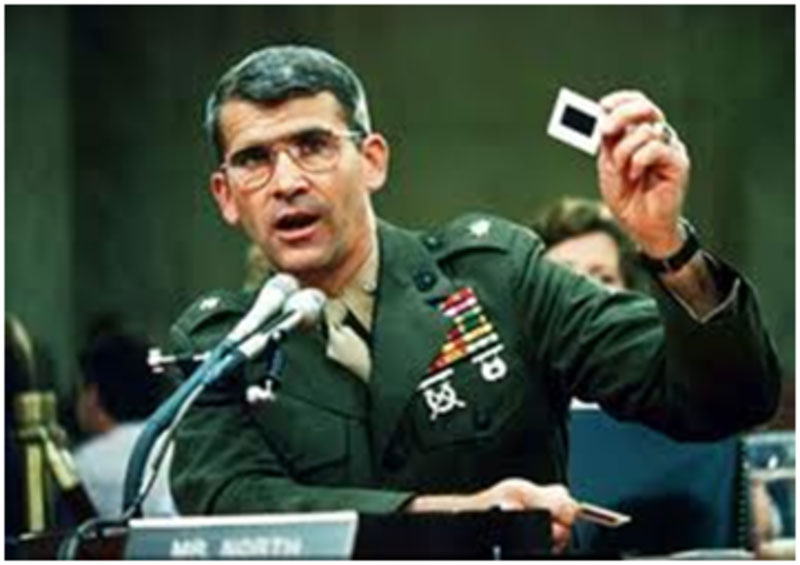
It is clear that this larger process has been carried on for almost five decades, pumping billions of right-wing dollars into the American political process. What I wish to show today is that deep events have also been integral to this right-wing effort, from the John F. Kennedy assassination in 1963 to 9/11. 9/11 resulted in the implementation of “Continuity of Government” (COG) plans (which in the Oliver North Iran Contra Hearings of 1987 were called plans for “the suspension of the U.S. constitution”). These COG plans, building on earlier COG planning, had been carefully developed since 1982 in the so-called Doomsday Project, by a secret group appointed by Reagan. The group was composed of both public and private figures, including Donald Rumsfeld and Dick Cheney.
   image: Ollie North testifying in IC Hearing
   Oliver North testifying in the Iran Contra Hearings

I shall try to show today that in this respect 9/11 was only the culmination of a sequence of deep events reaching back to the Kennedy assassination if not earlier, and that the germs of the Doomsday Project can be detected behind all of them.

More specifically, I shall try to demonstrate about these deep events that
  1. prior bureaucratic misbehavior by the CIA and similar agencies helped to make both the Kennedy assassination and 9/11 happen;

  2. the consequences of each deep event included an increase in top-down repressive power for these same agencies, at the expense of persuasive democratic power;[6]

  3. there are symptomatic overlaps in personnel between the perpetrators of each of these deep events and the next;

  4. one sees in each event the involvement of elements of the international drug traffic – suggesting that our current plutonomy is also to some degree a narconomy;

  5. in the background of each event (and playing an increasingly important role) one sees the Doomsday Project – the alternative emergency planning structure with its own communications network, operating as a shadow network outside of regular government channels.


Bureaucratic Misbehavior as a Factor Contributing
to both the JFK Assassination and 9/11

Both the JFK assassination and 9/11 were facilitated by the way the CIA and FBI manipulated their files about alleged perpetrators of each event (Lee Harvey Oswald in the case of what I shall call JFK, and the alleged hijackers Khalid al-Mihdhar and Nawaf al-Hazmi in the case of 9/11). Part of this facilitation was the decision on October 9, 1963 of an FBI agent, Marvin Gheesling, to remove Oswald from the FBI watch list for surveillance. This was shortly after Oswald’s arrest in New Orleans in August and his reported travel to Mexico in September. Obviously these developments should normally have made Oswald a candidate for increased surveillance.[7]

This misbehavior is paradigmatic of the behavior of other agencies, especially the CIA, in both JFK and 9/11. Indeed Gheesling’s behavior fits very neatly with the CIA’s culpable withholding from the FBI, in the same month of October, information that Oswald had allegedly met in Mexico City with a suspected KGB agent, Valeriy Kostikov.[8] This also helped ensure that Oswald would not be placed under surveillance. Indeed, former FBI Director Clarence Kelley in his memoir later complained that the CIA’s withholding of information was the major reason why Oswald was not put under surveillance on November 22, 1963.[9]

A more ominous provocation in 1963 was that of Army Intelligence, one unit of which in Dallas did not simply withhold information about Lee Harvey Oswald, but manufactured false intelligence that seemed designed to provoke retaliation against Cuba. I call such provocations phase-one stories, efforts to portray Oswald as a Communist conspirator (as opposed to the later phase-two stories, also false, portraying him as a disgruntled loner). A conspicuous example of such phase-one stories is a cable from the Fourth Army Command in Texas, reporting a tip from a Dallas policeman who was also in an Army Intelligence Reserve unit:
Assistant Chief Don Stringfellow, Intelligence Section, Dallas Police Department, notified 112th INTC [Intelligence] Group, this Headquarters, that information obtained from Oswald revealed he had defected to Cuba in 1959 and is a card-carrying member of Communist Party.”[10]
This cable was sent on November 22 directly to the U.S. Strike Command at Fort MacDill in Florida, the base poised for a possible retaliatory attack against Cuba.[11]

The cable was not an isolated aberration. It was supported by other false phase-one stories from Dallas about Oswald’s alleged rifle, and specifically by concatenated false translations of Marina Oswald’s testimony, to suggest that Oswald’s rifle in Dallas was one he had owned in Russia.[12]

These last false reports, apparently unrelated, can also be traced to officer Don Stringfellow’s 488th Army Intelligence Reserve unit.[13] The interpreter who first supplied the false translation of Marina’s words, Ilya Mamantov, was selected by a Dallas oilman, Jack Crichton, and Deputy Dallas Police Chief George Lumpkin.[14] Crichton and Lumpkin were also the Chief and the Deputy Chief of the 488th Army Intelligence Reserve unit.[15] Crichton was also an extreme right-winger in the community of Dallas oilmen: he was a trustee of the H.L. Hunt Foundation, and a member of the American Friends of the Katanga Freedom Fighters, a group organized to oppose Kennedy’s policies in the Congo.

We have to keep in mind that some of the Joint Chiefs were furious that the 1962 Missile Crisis had not led to an invasion of Cuba, and that, under new JCS Chairman Maxwell Taylor, the Joint Chiefs, in May 1963, still believed “that US military intervention in Cuba is necessary.”[16] This was six months after Kennedy, to resolve the Missile Crisis in October 1962, had given explicit (albeit highly qualified) assurances to Khrushchev, that the United States would not invade Cuba.[17] This did not stop the J-5 of the Joint Chiefs of Staff (the JCS Directorate of Plans and Policy) from producing a menu of “fabricated provocations to justify military intervention.”[18] (One proposed example of “fabricated provocations” envisioned “using MIG type aircraft flown by US pilots to … attack surface shipping or to attack US military.”)[19]

The deceptions about Oswald coming from Dallas were immediately post-assassination; thus they do not by themselves establish that the assassination itself was a provocation-deception plot. They do however reveal enough about the anti-Castro mindset of the 488th Army Intelligence Reserve unit in Dallas to confirm that it was remarkably similar to that of the J-5 the preceding May – the mindset that produced a menu of “fabricated provocations” to attack Cuba. (According to Crichton there were “about a hundred men in [the 488th Reserve unit] and about forty or fifty of them were from the Dallas Police Department.”)[20]

It can hardly be accidental that we see this bureaucratic misbehavior from the FBI, CIA, and military, the three agencies with which Kennedy had had serious disagreements in his truncated presidency.[21] Later in this paper I shall link Dallas oilman Jack Crichton to the 1963 emergency planning that became the Doomsday Project.


Analogous Bureaucratic Misbehavior in the Case of 9/11

Before 9/11 the CIA, in 2000-2001, again flagrantly withheld crucial evidence from the FBI: evidence that, if shared, would have led the FBI to surveil two of the alleged hijackers, Khalid al-Mihdhar and Nawaz al-Hazmi. This sustained withholding of evidence provoked an FBI agent to predict accurately in August, 2001, that “someday someone will die.”[22] After 9/11 another FBI agent said of the CIA: “They [CIA] didn’t want the bureau meddling in their business – that’s why they didn’t tell the FBI.... And that’s why September 11 happened. That is why it happened. . . . They have blood on their hands. They have three thousand deaths on their hands”[23] The CIA’s withholding of relevant evidence before 9/11 (which it was required by its own rules to supply) was matched in this case by the NSA.[24]

Without these withholdings, in other words, neither the Kennedy assassination nor 9/11 could have developed in the manner in which they did. As I wrote in American War Machine, it would appear that
Oswald (and later al-Mihdhar) had at some prior point been selected as designated subjects for an operation. This would not initially have been for the commission of a crime against the American polity: on the contrary, steps were probably taken to prepare Oswald in connection with an operation against Cuba and al-Mihdhar [I suspect] for an operation against al-Qaeda. But as [exploitable] legends began to accumulate about both figures, it became possible for some witting people to subvert the sanctioned operation into a plan for murder that would later be covered up. At this point Oswald (and by analogy al-Mihdhar) was no longer just a designated subject but also now a designated culprit.[25]
Kevin Fenton, in his exhaustive book Disconnecting the Dots, has since reached the same conclusion with respect to 9/11: “that, by the summer of 2001, the purpose of withholding the information had become to allow the attacks to go forward.”[26] He has also identified the person chiefly responsible for the misbehavior: CIA officer Richard Blee, Chief of the CIA’s Bin Laden Unit. Blee, while Clinton was still president, had been one of a faction inside CIA pressing for a more belligerent CIA involvement in Afghanistan, in conjunction with the Afghan Northern Alliance.[27] This then happened immediately after 9/11, and Blee himself was promoted, to become the new Chief of Station in Kabul.[28]


How CIA and NSA Withholding of Evidence in the Second
Tonkin Gulf Incident, Contributed to War with North Vietnam

I will spare you the details of this withholding, which can be found in my American War Machine, pp. 200-02. But Tonkin Gulf is similar to the Kennedy assassination and 9/11, in that manipulation of evidence helped lead America – in this case very swiftly – into war.

Historians such as Fredrik Logevall have agreed with the assessment of former undersecretary of state George Ball that the US destroyer mission in the Tonkin Gulf, which resulted in the Tonkin Gulf incidents, “was primarily for provocation.”[29] The planning for this provocative mission came from the J-5 of the Joint Chiefs of Staff, the same unit that in 1963 had reported concerning Cuba that, “the engineering of a series of provocations to justify military intervention is feasible.”[30]

The NSA and CIA suppression of the truth on August 4 was in the context of an existing high-level (but controversial) determination to attack North Vietnam. In this respect the Tonkin Gulf incident is remarkably similar to the suppression of the truth by CIA and NSA leading up to 9/11, when there was again a high-level (but controversial) determination to go to war.


Increases in Repressive Power After Deep Events

All of the deep events discussed above have contributed to the cumulative increase of Washington’s repressive powers. It is clear for example that the Warren Commission used the JFK assassination to increase CIA surveillance of Americans. As I wrote in Deep Politics, this was the result of
the Warren Commission’s controversial recommendations that the Secret Service’s domestic surveillance responsibilities be increased (WR 25-26). Somewhat illogically, the Warren Report concluded both that Oswald acted alone (WR 22), . . . and also that the Secret Service, FBI, CIA, should coordinate more closely the surveillance of organized groups (WR 463). In particular, it recommended that the Secret Service acquire a computerized data bank compatible with that already developed by the CIA.[31]
This pattern would repeat itself four years later with the assassination of Robert Kennedy. In the twenty-four hours between Bobby’s shooting and his death, Congress hurriedly passed a statute – drafted well in advance (like the Tonkin Gulf Resolution of 1964 and the Patriot Act of 2001) – that still further augmented the secret powers given to the Secret Service in the name of protecting presidential candidates.[32]

This was not a trivial or benign change: from this swiftly considered act, passed under Johnson, flowed some of the worst excesses of the Nixon presidency.[33]

The change also contributed to the chaos and violence at the Chicago Democratic Convention of 1968. Army intelligence surveillance agents, seconded to the Secret Service, were present both inside and outside the convention hall. Some of them equipped the so-called “Legion of Justice thugs whom the Chicago Red Squad turned loose on local anti-war groups.”[34]

In this way the extra secret powers conferred after the RFK assassination contributed to the disastrous turmoil in Chicago that effectively destroyed the old Democratic Party representing the labor unions: The three Democratic presidents elected since then have all been significantly more conservative.

Turning to Watergate and Iran-Contra, both of these events were on one level setbacks to the repressive powers exercised by Richard Nixon and the Reagan White House, not expansions of them. On the surface level this is true: both events resulted in legislative reforms that would appear to contradict my thesis of expanding repression.

We need to distinguish here, however, between the two years of the Watergate crisis, and the initial Watergate break-in. The Watergate crisis saw a president forced into resignation by a number of forces, involving both liberals and conservatives. But the key figures in the initial Watergate break-in itself – Hunt, McCord, G. Gordon Liddy, and their Cuban allies – were all far to the right of Nixon and Kissinger. And the end result of their machinations was not finalized until the so-called Halloween Massacre in 1975, when Kissinger was ousted as National Security Adviser and Vice-President Nelson Rockefeller was notified he would be dropped from the 1976 Republican ticket. This major shake-up was engineered by two other right-wingers: Donald Rumsfeld and Dick Cheney in the Gerald Ford White House.[35]

That day in 1975 saw the permanent defeat of the so-called Rockefeller or liberal faction within the Republican Party. It was replaced by the conservative Goldwater-Casey faction that would soon capture the nomination and the presidency for Ronald Reagan.[36] This little-noticed palace coup, along with other related intrigues in the mid-1970s, helped achieve the conversion of America from a welfare capitalist economy, with gradual reductions in income and wealth disparity, into a financialized plutonomy where these trends were reversed.[37]

Again in Iran-Contra we see a deeper accumulation of repressive power under the surface of liberal reforms. At the time not only the press but even academics like myself celebrated the termination of aid to the Nicaraguan Contras, and the victory there of the Contadora peace process. Not generally noticed at the time was the fact that, while Oliver North was removed from his role in the Doomsday Project, that project’s plans for surveillance, detention, and the militarization of the United States continued to grow after his departure.[38]

Also not noticed was the fact that the US Congress, while curtailing aid to one small drug-financed CIA proxy army, was simultaneously increasing US support to a much larger coalition of drug-financed proxy armies in Afghanistan.[39] While Iran-Contra exposed the $32 million which Saudi Arabia, at the urging of CIA Director William Casey, had supplied to the Contras, not a word was whispered about the $500 million or more that the Saudis, again at the urging of Casey, had supplied in the same period to the Afghan mujahedin.[40] In this sense the drama of Iran-Contra in Congress can be thought of as a misdirection play, directing public attention away from America’s much more intensive engagement in Afghanistan – a covert policy that has since evolved into America’s longest war.

We should expand our consciousness of Iran-Contra to think of it as Iran-Afghan-Contra. And if we do, we must acknowledge that in this complex and misunderstood deep event the CIA in Afghanistan exercised again the paramilitary capacity that Stansfield Turner had tried to terminate when he was CIA Director under Jimmy Carter. This was a victory in short for the faction of men like Richard Blee, the protector of al-Mihdhar as well as the advocate in 2000 for enhanced CIA paramilitary activity in Afghanistan.[41]


Personnel Overlaps Between the Successive Deep Events

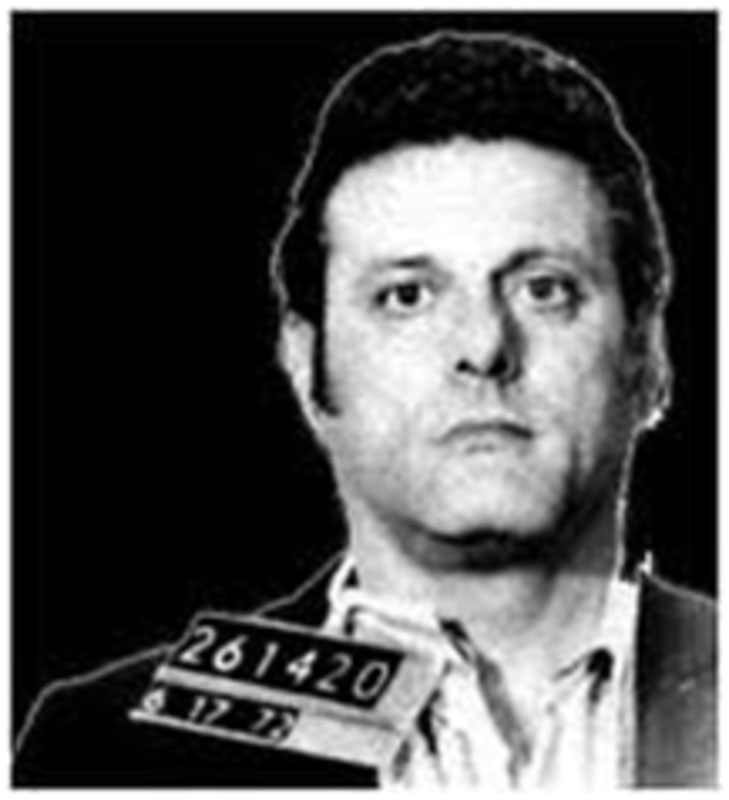
I will never forget the New York Times front-page story on June 18, 1972, the day after the Watergate break-in. There were photographs of the Watergate burglars, including one of Frank Sturgis alias Fiorini, whom I had already written about two years earlier in my unpublished book manuscript, “The Dallas Conspiracy” about the JFK assassination.
image: Frank Sturgis   
Frank Sturgis   

Sturgis was no nonentity: a former contract employee of the CIA, he was also well connected to the mob-linked former casino owners in Havana.[42] My early writings on the Kennedy case focused on the connections between Frank Sturgis and an anti-Castro Cuban training camp near New Orleans in which Oswald had shown an interest; also in Sturgis’ involvement in false “phase-one” stories portraying Oswald as part of a Communist Cuban conspiracy.[43]

In spreading these “phase-one” stories in 1963, Sturgis was joined by a number of Cubans who were part of the CIA-supported army in Central America of Manuel Artime. Artime’s base in Costa Rica was closed down in 1965, allegedly because of its involvement in drug trafficking.[44] In the 1980s some of these Cuban exiles later became involved in drug-financed support activities for the Contras.[45]

The political mentor of Artime’s MRR movement was future Watergate plotter Howard Hunt; and Artime in 1972 would pay for the bail of the Cuban Watergate burglars. The drug money-launderer Ramón Milián Rodríguez has claimed to have delivered $200,000 in cash from Artime to pay off some of the Cuban Watergate burglars; later, in support of the Contras, he managed two Costa Rican seafood companies, Frigorificos and Ocean Hunter, that laundered drug money.[46]

It is alleged that Hunt and McCord had both been involved with Artime’s invasion plans in 1963.[47] It was I believe no accident that the organization of Hunt’s protégé Artime became enmired in drug trafficking. Hunt, I have argued elsewhere, had been handling a U.S. drug connection since his 1950 post in Mexico City as OPC (Office of Policy Coordination) chief.[48]

But McCord not only had a past in the anti-Castro activities of 1963, he was also part of the nation’s emergency planning network that would later figure so prominently in the background of Iran-Contra and 9/11. McCord was a member of a small Air Force Reserve unit in Washington attached to the Office of Emergency Preparedness (OEP); assigned “to draw up lists of radicals and to develop contingency plans for censorship of the news media and U.S. mail in time of war.”[49] His unit was part of the Wartime Information Security Program (WISP), which had responsibility for activating “contingency plans for imposing censorship on the press, the mails and all telecommunications (including government communications) [and] preventive detention of civilian ‘security risks,’ who would be placed in military ‘camps.’”[50] In other words, these were the plans that became known in the 1980s as the Doomsday Project, the Continuity of Government planning on which Dick Cheney and Donald Rumsfeld worked together for twenty years before 9/11.


A Common Denominator for Structural Deep Events:
Project Doomsday and COG

McCord’s participation in an emergency planning system dealing with telecommunications suggests a common denominator in the backgrounds of almost all the deep events we are considering. Oliver North, the Reagan-Bush OEP point man on Iran-Contra planning, was also involved in such planning; and he had access to the nation’s top secret Doomsday communications network. North’s network, known as Flashboard, "excluded other bureaucrats with opposing viewpoints … [and] had its own special worldwide antiterrorist computer network, … by which members could communicate exclusively with each other and their collaborators abroad."[51]

Flashboard was used by North and his superiors for extremely sensitive operations which had to be concealed from other dubious or hostile parts of the Washington bureaucracy. These operations included the illegal shipments of arms to Iran, but also other activities, some still not known, perhaps even against Olof Palme’s Sweden.[52] Flashboard, America’s emergency network in the 1980s, was the name in 1984-86 of the full-fledged Continuity of Government (COG) emergency network which was secretly planned for twenty years, at a cost of billions, by a team including Cheney and Rumsfeld. On 9/11 the same network was activated anew by the two men who had planned it for so many years.[53]

But this Doomsday planning can be traced back to 1963, when Jack Crichton, head of the 488th Army Intelligence Reserve unit of Dallas, was part of it in his capacity as chief of intelligence for Dallas Civil Defense, which worked out of an underground Emergency Operating Center. As Russ Baker reports, “Because it was intended for ‘continuity of government’ operations during an attack, [the Center] was fully equipped with communications equipment.”[54] A speech given at the dedication of the Center in 1961 supplies further details:
This Emergency Operating Center [in Dallas] is part of the National Plan to link Federal, State and local government agencies in a communications network from which rescue operations can be directed in time of local or National emergency. It is a vital part of the National, State, and local Operational Survival Plan.[55]
Crichton, in other words, was also part of what became known in the 1980s as the Doomsday Project, like James McCord, Oliver North, Donald Rumsfeld, and Dick Cheney after him. But in 1988 its aim was significantly enlarged: no longer to prepare for an atomic attack, but now to plan for the effective suspension of the American constitution in the face of any emergency.[56] This change in 1988 allowed COG to be implemented in 2001. By this time the Doomsday Project had developed into what the Washington Post called “a shadow government that evolved based on long-standing ‘continuity of operations plans.’”[57]

   image: Burning Constitution
It is clear that the Office of Emergency Preparedness (OEP, known from 1961-1968 as the Office of Emergency Planning) supplies a common denominator for key personnel in virtually all of the structural events discussed here. This is a long way from establishing that the OEP itself (in addition to the individuals discussed here) was involved in generating any of these events. But I believe that the alternative communications network housed first in the OEP (later part of Project 908) played a significant role in at least three of them: the JFK assassination, Iran-Contra, and 9/11.

This is easiest to show in the case of 9/11, where it is conceded that the Continuity of Government (COG) plans of the Doomsday Project were implemented by Cheney on 9/11, apparently before the last of the four hijacked planes had crashed.[58] The 9/11 Commission could not locate records of the key decisions taken by Cheney on that day, suggesting that they may have taken place on the “secure phone “ in the tunnel leading to the presidential bunker – with such a high classification that the 9/11 Commission was never supplied the phone records.[59] Presumably this was a COG phone.

It is not clear whether the “secure phone” in the White House tunnel belonged to the Secret Service or (as one might expect) was part of the secure network of the White House Communications Agency (WHCA). If the latter, we’d have a striking link between 9/11 and the JFK assassination. The WHCA boasts on its Web site that the agency was “a key player in documenting the assassination of President Kennedy.”[60] However it is not clear for whom this documentation was conducted, for the WHCA logs and transcripts were in fact withheld from the Warren Commission.[61]

The Secret Service had installed a WHCA portable radio in the lead car of the presidential motorcade.[62] This in turn was in contact by police radio with the pilot car ahead of it, carrying DPD Deputy Chief Lumpkin of the 488th Army Intelligence Reserve unit.[63] Records of the WHCA communications from the motorcade never reached the Warren Commission, the House Committee on Assassinations, or the Assassination Records Review Board.[64] Thus we cannot tell if they would explain some of the anomalies on the two channels of the Dallas Police Department. They might for example have thrown light upon the unsourced call on the Dallas Police tapes for a suspect who had exactly the false height and weight recorded for Oswald in his FBI and CIA files.[65]

Today in 2011 we are still living under the State of Emergency proclaimed after 9/11 by President Bush. At least some COG provisions are still in effect, and were even augmented by Bush through Presidential Directive 51 of May 9, 2007. Commenting on PD-51, the Washington Post reported at that time,
After the 2001 attacks, Bush assigned about 100 senior civilian managers [including Cheney] to rotate secretly to [COG] locations outside of Washington for weeks or months at a time to ensure the nation’s survival, a shadow government that evolved based on long-standing “continuity of operations plans.”[66]
Presumably this “shadow government” finalized such long-standing COG projects as warrantless surveillance, in part through the Patriot Act, whose controversial provisions were already being implemented by Cheney and others well before the Bill reached Congress on October 12.[67] Other COG projects implemented included the militarization of domestic surveillance under NORTHCOM, and the Department of Homeland Security’s Project Endgame – a ten-year plan to expand detention camps at a cost of $400 million in fiscal year 2007 alone.[68]

I have, therefore, a recommendation for the Occupy movement, rightfully incensed as it is with the plutonomic excesses of Wall Street over the last three decades. It is to call for an end to the state of emergency, which has been in force since 2001, under which since 2008 a U.S. Army Brigade Combat Team has been stationed permanently in the United States, in part to be ready “to help with civil unrest and crowd control.”[69]

Democracy-lovers must work to prevent the political crisis now developing in America from being resolved by military intervention.

Let me say in conclusion that for a half century American politics have been constrained and deformed by the unresolved matter of the Kennedy assassination. According to a memo of November 25 1963, from Assistant Attorney General Nicholas Katzenbach, it was important then to persuade the public that “Oswald was the assassin,” and that “he did not have confederates.”[70] Obviously this priority became even more important after these questionable propositions were endorsed by the Warren Report, the U.S. establishment, and the mainstream press. It has remained an embarrassing priority ever since for all succeeding administrations, including the present one. There is for example an official in Obama’s State Department (Todd Leventhal), whose official job, until recently, included defense of the lone nut theory against so-called “conspiracy theorists”[71]

If Oswald was not a lone assassin, then it should not surprise us that there is continuity between those who falsified reports about Oswald in 1963, and those who distorted American politics in subsequent deep events beginning with Watergate. Since the deep event of 1963 the legitimacy of America’s political system has become vested in a lie – a lie which subsequent deep events have helped to protect.[72]


Peter Dale Scott, a former Canadian diplomat and English Professor at the University of California, Berkeley, is the author of Drugs Oil and War, The Road to 9/11, and The War Conspiracy: JFK, 9/11, and the Deep Politics of War. His most recent book is American War Machine: Deep Politics, the CIA Global Drug Connection and the Road to Afghanistan. His website, which contains a wealth of his writings, is here http://www.peterdalescott.net/q.html

Recommended citation: Peter Dale Scott, 'The Doomsday Project and Deep Events: JFK, Watergate, Iran-Contra, and 9/11,' The Asia-Pacific Journal Vol 9, Issue 47 No 2, November 21, 2011.


Articles on related subjects from The Asia-Pacific Journal
  • Peter Dale Scott, Norway’s Terror as Systemic Destabilization: Breivik, the Arms-for-Drugs Milieu, and Global Shadow Elites

  • Tim Shorrock, Reading the Egyptian Revolution Through the Lens of US Policy in South Korea Circa 1980: Revelations in US Declassified Documents

  • C. Douglas Lummis, The United States and Terror on the Tenth Anniversary of 9/11

  • Peter Dale Scott, Rape in Libya: America’s recent major wars have all been accompanied by memorable falsehoods

  • Peter Dale Scott, The Libyan War, American Power and the Decline of the Petrodollar System

  • Peter Dale Scott, Who are the Libyan Freedom Fighters and Their Patrons?

  • Herbert P. Bix, The Middle East Revolutions in Historical Perspective: Egypt, Occupied Palestine, and the United States


Notes


    §
  1. Tim Weiner, “The Pentagon’s Secret Stash,” Mother Jones Magazine Mar-Apr 1992, 26. [link to synopsis]

  2. §
  3. J.A. Myerson “War Is a Force That Pays the 1 Percent: Occupying American Foreign Policy,” Truthout, November 14, 2001, link. Cf. Peter Dale Scott, The Road to 9/11 (Berkeley: University of California Press, 2007), 6, etc. [See REVIEWS OF THE ROAD TO 9/11 from the author's website]

  4. §
  5. Scott, Road to 9/11, 22, 29, 98.

  6. §
  7. Scott, Road to 9/11, 22, 97.

  8. §
  9. Scott, Road to 9/11, 21, 51-52; Kristol as quoted in Lewis H. Lapham, “Tentacles of Rage: The Republican Propaganda Mill, a Brief History,” Harper’s Magazine, September 2004, 36.

  10. §
  11. E.g. Peter Dale Scott, American War Machine, 204-05.

  12. §
  13. Peter Dale Scott, The War Conspiracy, 354.

  14. §
  15. Peter Dale Scott, Deep Politics II, 30-33; Scott, The War Conspiracy, 387; Scott, American War Machine, 152.

  16. §
  17. Clarence M. Kelley, Kelley: The Story of an FBI Director (Kansas City, MO: Andrews, McMeel, and Parker, 1987), 268, quoted in Scott, The War Conspiracy (2008), 389.

  18. §
  19. Scott, Deep Politics, 275; Scott, Deep Politics II, 80, 129n; HSCA Critics Conference of 17 September 1977, 181, link. Stringfellow worked under Jack Revill in the Vice Squad of the DPD Special Services Bureau. As such he reported regularly to the FBI on such close Jack Ruby associates as James Herbert Dolan, a “known hoodlum and strong-arm man” on the FBI’s Top Criminal list for Dallas (Robert M. Barrett, FBI Report of February 2, 1963, NARA#124-90038-10026, 12 [Stringfellow]; cf. NARA#124-10212-10012, 4 [hoodlum], NARA#124-10195-10305, 9 [Top Criminal]). Cf. 14 WH 601-02 Ruby and Dolan]. Robert Barrett, who received Stringfellow’s reports to the FBI, had Ruby’s friend Dolan under close surveillance; he also took part in Oswald’s arrest at the Texas Theater, and claimed to have seen DPD Officer Westbrook with Oswald’s wallet at the site of the Tippit killing [Dale K. Myers, With Malice: Lee Harvey Oswald and the Murder of Officer J.D. Tippit (Milford, MI: Oak Cliff Press, 1998), 287-90]).

  20. §
  21. It was sent for information to Washington, which received it three days later (Scott, Deep Politics, 275; Scott, Deep Politics II, 80, 129n; Scott, War Conspiracy, 382).

  22. §
  23. Warren Commission Exhibit 1778, 23 WH 383. (Marina’s actual words, before mistranslation, were quite innocuous: “I cannot describe it [the gun] because a rifle to me like all rifles” (Warren Commission Exhibit 1778, 23 WH 383; discussion in Scott, Deep Politics, 168-72).

  24. §
  25. Stringfellow himself was the source of one other piece of false intelligence on November 22: that Oswald had confessed to the murders of both the president and Officer Tippit (Dallas FBI File DL 89-43-2381C; Paul L. Hoch, “The Final Investigation? The HSCA and Army Intelligence,” The Third Decade, 1, 5 [July 1985], 3),

  26. §
  27. 9 WH 106; Scott, Deep Politics, 275-76; Russ Baker, Family of Secrets, 119-22.

  28. §
  29. Rodney P. Carlisle and Dominic J. Monetta, Brandy: Our Man in Acapulco (Denton, TX: University of North Texas Press, 1999), 128.

  30. §
  31. Joint Chiefs of Staff, “Courses of Action Related to Cuba (Case II),” Report of the J-5 to the Joint Chiefs of Staff, 1 May 1963, NARA #202-10002-10018, 12. Cf. pp. 15-16: “The United States should intervene militarily in Cuba and could (a) engineer provocative incidents ostensibly perpetrated by the Castro regime to serve as the cause of invasion …”

  32. §
  33. Robert Dallek, An Unfinished Life, 568; James A. Nathan, The Cuban missile crisis revisited, 283; Waldron and Hartmann, Legacy of Secrecy, 9.

  34. §
  35. [Joint Chiefs of Staff, “Courses of Action Related to Cuba (Case II),” Report of the J-5 to the Joint Chiefs of Staff, 1 May 1963, NARA #202-10002-10018, 12.

  36. §
  37. “Courses of Action Related to Cuba (Case II),” NARA #202-10002-10018, 20. I see nothing in this document indicating that the President should be notified that these “fabricated provocations” were false. On the contrary, the document called for “compartmentation of participants” to insure that the true facts were not leaked (“Courses of Action Related to Cuba (Case II),” NARA #202-10002-10018, 19).

  38. §
  39. Quoted in Baker, Family of Secrets, 122. One of these, DPD Detective John Adamcik, was a member of the party which retrieved a blanket said to have contained Oswald’s rifle; and which the Warren Commission used to link Oswald to the famous Mannlicher Carcano. Adamcik was later present at Mamantov’s interview of Marina about the rifle, and corroborated Mamantov’s account of it to the Warren Commission. There is reason to believe that Mamantov’s translation of Marina’s testimony was inaccurate (Scott, Deep Politics, 268-70, 276).

  40. §
  41. See James Douglass, JFK and the Unspeakable (Maryknoll, NY: Orbis Books, 2008). [book review]

  42. §
  43. 9/11 Commission Report, 259, 271; Lawrence Wright, The Looming Tower: Al-Qaeda and the Road to 9/11 (New York: Knopf, 2006), 352-54 (FBI agent).

  44. §
  45. James Bamford, A Pretext for War: 9/11, Iraq, and the Abuse of America’s Intelligence Agencies (New York: Doubleday, 2004, 224. For a fuller account of the CIA’s withholding before 9/11, see Kevin Fenton, Disconnecting the Dots; Rory O’Connor and Ray Nowosielski, “Insiders Voice Doubts about CIA’s 9/11 Story,” Salon, October 14, 2011, link.

  46. §
  47. Fenton, Disconnecting the Dots, 7-12, 142-47, etc.

  48. §
  49. Scott, American War Machine, 203.

  50. §
  51. Fenton, Disconnecting the Dots, 371, cf. 95. Quite independently, Richard Clarke, the former White House Counterterrorism Chief on 9/11, has charged that "There was a high-level decision in the CIA ordering people not to share information" (Rory O’Connor and Ray Nowosielski, “Insiders Voice Doubts about CIA’s 9/11 Story,” Salon, October 14, 2011 link).

  52. §
  53. Coll, 467-69.

  54. §
  55. Fenton, Disconnecting the Dots, 107-08.

  56. §
  57. James Bamford, Body of Secrets, 201. Cf. Fredrik Logevall, Choosing War: The Lost Chance for Peace and the Escalation of War in Vietnam (Berkeley: University of California Press, 1999), 200, citing John Prados, The Hidden History of the Vietnam War (Chicago: Ivan R. Dee, 1995), 51.

  58. §
  59. “Courses of Action Related to Cuba (Case II),” Report of the J-5 to the Joint Chiefs of Staff, May 1, 1963, JCS 2304/189, NARA #202-10002-10018, link.

  60. §
  61. Peter Dale Scott, Deep Politics and the Death of JFK, 280. [book summary and a review]

  62. §
  63. Public Law 90-331 (18 U.S.C. 3056); discussion in Peter Dale Scott, Paul L. Hoch, and Russell Stetler, The Assassinations: Dallas and Beyond (New York: Random House, 1976), 443-46.

  64. §
  65. Army intelligence agents were seconded to the Secret Service, and at this time there was a great increase in their number. The Washington Star later explained that “the big build-up in [Army] information gathering … did not come until after the shooting of the Rev. Martin Luther King” (Washington Star, December 6, 1970; reprinted in Federal Data Banks Hearings, p. 1728).

  66. §
  67. George O’Toole, The Private Sector (New York: Norton, 1978), 145, quoted in Scott, Deep Politics and the Death of JFK, 278-79.

  68. §
  69. Scott, Road to 9/11, 52-53.

  70. §
  71. Scott, Road to 9/11, 53-54.

  72. §
  73. Scott, Road to 9/11, 50-64. ["Chapter Three, The Pivotal Presidency: Ford, Rumsfeld, and Cheney". The Epigraph at the chapter's beginning reads: "We had to struggle with the old enemies of peace – business and financial monopoly, speculation, reckless banking, class antagonism, sectionalism, war profiteering. They had begun to consider the Government of the United States as a mere appendage to their own affairs. We know now that Government by organized money is just as dangerous as Government by organized mob." President Franklin Roosevelt's Radio Address Unveiling Second Half of the New Deal, October 31, 1936]

  74. §
  75. Peter Dale Scott, “Northwards without North,” Social Justice (Summer 1989). Revised as “North, Iran-Contra, and the Doomsday Project: The Original Congressional Cover Up of Continuity-of-Government Planning,” Asia-Pacific Journal: Japan Focus, February 21, 2011.

  76. §
  77. Scott, Road to 9/11, 132.

  78. §
  79. Jonathan Marshall, Peter Dale Scott, and Jane Hunter, The Iran-Contra Connection, 13 (Contras) [online book copy]; Richard Coll, Ghost Wars, 93-102 (mujahedin).

  80. §
  81. Richard Coll, Ghost Wars, 457-59, 534-36,

  82. §
  83. According to testimony from CIA Deputy Director Vernon Walters, only “Hunt and McCord had ever been CIA full-time employees. The others [including Sturgis] were contract employees for a short duration or a longer duration” (Watergate Hearings, 3427). Cf. Marshall, Scott, and  Hunter, The Iran-Contra Connection, 45 (casino owners).

  84. §
  85. Peter Dale Scott, “From Dallas to Watergate,” Ramparts, December 1973; reprinted in Peter Dale Scott, Paul L. Hoch, and Russell Stetler, The Assassinations: Dallas and Beyond, 356, 363.

  86. §
  87. Peter Dale Scott, Crime and Cover-Up, 20.

  88. §
  89. Peter Dale Scott and Jonathan Marshall, Cocaine Politics, 25-32, etc. [book excerpts] [See Reviews of COCAINE POLITICS from the author's website]

  90. §
  91. Alexander Cockburn and Jeffrey St. Clair, Whiteout: The CIA, Drugs, and the Press [First Chapter] (London: Verso, 1998), 308-09; Martha Honey, Hostile Acts: U.S. Policy in Costa Rica in the 1980s (Gainesville, FL: University Press of Florida, 1994), 368 (Frigorificos).

  92. §
  93. Tad Szulc, Compulsive Spy: The Strange Career of E. Howard Hunt (New York: Viking, 1974), 96-97.

  94. §
  95. Scott, American War Machine, 51-54. Hunt helped put together what became the drug-linked World Anti-Communist League. Artime’s Costa Rica base was on land whose owners were part of the local WACL chapter (Scott and Marshall, Cocaine Politics, 87, 220).

  96. §
  97. Woodward and Bernstein, All the President’s Men (New York: Simon and Schuster, 1974), 23

  98. §
  99. Jim Hougan, Secret Agenda (New York: Random House, 1984), 16, citing Department of Defense Directive 5230.7, June 25, 1965, amended May 21, 1971. [See also: Jim Hougan: Secret Agenda thread on The Education Forum]

  100. §
  101. Peter Dale Scott, "North, Iran-Contra, and the Doomsday Project: The Original Congressional Cover Up of Continuity-of-Government Planning," Asia-Pacific Journal: Japan Focus, February 21, 2011. Cf. Peter Dale Scott, "Northwards Without North: Bush, Counterterrorism, and the Continuation of Secret Power." Social Justice (San Francisco), XVI, 2 (Summer 1989), 1-30; Peter Dale Scott, "The Terrorism Task Force." Covert Action Information Bulletin, 33 (Winter 1990), 12-15.

  102. §
  103. Peter Dale Scott and Jonathan Marshall, Cocaine Politics: Drugs, Armies, and the CIA in Central America (Berkeley: University of California Press, 1998), 140-41, 242 (Iran, etc.); Ola Tunander, The secret war against Sweden: US and British submarine deception in the 1980s, 309 (Sweden).

  104. §
  105. Scott, Road to 9/11, 183-87. [In Chapter 11, Parallel Structure and Plans for Continuity of Government, these pages form the section titled: "Cheney, Rumsfeld, and COG Planning in the 1980s". Significant footnote references from this section of pages includes:
  106. §
  107. Russ Baker, Family of Secrets, 121.

  108. §
  109. “Statement by Col. John W. Mayo, Chairman of City-County Civil Defense and Disaster Commission at the Dedication of the Emergency Operating Center at Fair Park,” May 24, 1961, link.

    Six linear inches of Civil Defense Administrative Files are preserved in the Dallas Municipal Archives; a Finding Guide is viewable online here. I hope an interested researcher may wish to consult them.

  110. §
  111. Scott, Road to 9/11, 183-87.

  112. §
  113. Washington Post, May 10, 2007. [“Bush orders contingency plans for attack on U.S.”]

  114. §
  115. 9/11 Report, 38, 326, 555n9; Peter Dale Scott, The Road to 9/11: Wealth, Empire, and the Future of America, 224.

  116. §
  117. Scott, Road to 9/11, 226-30. A footnote in the 9/11 Report (555n9) says:
    “The 9/11 crisis tested the U.S. government’s plans and capabilities to ensure the continuity of constitutional government and the continuity of government operations. We did not investigate this topic, except as needed to understand the activities and communications of key officials on 9/11. The Chair, Vice Chair, and senior staff were briefed on the general nature and implementation of these continuity plans.”
    The other footnotes confirm that no information from COG files was used to document the 9/11 report. At a minimum these files might resolve the mystery of the missing phone call which simultaneously authorized COG, and (in consequence) determined that Bush should continue to stay out of Washington. I suspect that they might tell us a great deal more.

  118. §
  119. “White House Communications Agency,” Signal Corps Regimental History, link.

  120. §
  121. The Warren Commission staff knew of the WHCA presence in Dallas from the Secret Service (17 WH 598, 619, 630, etc.).

  122. §
  123. Statement of Secret Service official Winston Lawson, 17 WH 630 (WHCA radio).

  124. §
  125. Pamela McElwain-Brown, “The Presidential Lincoln Continental SS-100-X,” Dealey Plaza Echo, Volume 3, Issue 2, 23, link (police radio); Scott, Deep Politics and the Death of JFK, 272-75 (Lumpkin).

  126. §
  127. In the 1990s the WHCA supplied statements to the ARRB concerning communications between Dallas and Washington on November 22 (NARA #172-10001-10002 to NARA #172-10000-10008). The Assassination Records Review Board also attempted to obtain from the WHCA the unedited original tapes of conversations from Air Force One on the return trip from Dallas, November 22, 1963. (Edited and condensed versions of these tapes had been available since the 1970s from the Lyndon Baines Johnson Library in Austin, Texas.) The attempt was unsuccessful: “The Review Board’s repeated written and oral inquiries of the White House Communications Agency did not bear fruit. The WHCA could not produce any records that illuminated the provenance of the edited tapes.” See Assassinations Records Review Board: Final Report, chapter 6, Part 1, 116, link. In November 2011 AP reported that Gen. Chester Clifton’s personal copy of the Air Force One recordings was being put up for sale, with an asking price of $500,000 (AP, November 15, 2011, link).

  128. §
  129. See Scott, War Conspiracy (2008), 347-48, 385-87.

  130. §
  131. Washington Post, May 10, 2007. [“Bush orders contingency plans for attack on U.S.”]

  132. §
  133. Dick Cheney, In My Time: A Personal and Political Memoir (New York: Threshold Editions, 2011), 348: “One of the first efforts we undertook after 9/11 to strengthen the country's defenses was securing passage of the Patriot Act, which the president signed into law on [sic] October 2001.” Cf. “The Patriot Act, which the president signed into law on October 2001,″ link; “Questions and Answers about Beginning of Domestic Spying Program; link.

  134. §
  135. Scott, Road to 9/11, 236-45; Peter Dale Scott, "Is the State of Emergency Superseding our Constitution? Continuity of Government Planning, War and American Society," November 28, 2010.

  136. §
  137. “Brigade homeland tours start Oct. 1,” Army Times, September 30, 2008, link. As part of the Army’s emergency plan GARDEN PLOT in the 1960s, there were until 1971 two brigades (4,800 troops) on permanent standby to quell unrest.

  138. §
  139. “Memorandum for Mr. Moyers” of November 25, 1963, FBI 62-109060, Section 18, p. 29, link. Cf. Nicholas Katzenbach, Some of It Was Fun (New York: W.W. Norton, 2008), 131-36.

  140. §
  141. Leventhal’s official title is (or was) “Chief of the Counter-Misinformation Team, U.S. Department of State” (link). In 2010 the U.S. State Department “launched an official bid to shoot down conspiracy theories…. The "Conspiracy Theories and Misinformation" page … insists that Lee Harvey Oswald killed John F Kennedy alone, and that the Pentagon was not hit by a cruise missile on 9/11” Daily Record [Scotland], August 2, 2010, (link). The site still exists here, (“Conspiracy theories exist in the realm of myth, where imaginations run wild, fears trump facts, and evidence is ignored.”) The site still attacks 9/11 theories, but a page on the Kennedy assassination has been suspended (link). Cf. Robin Ramsay, “Government vs Conspiracy Theorists: The official war on "sick think,” Fortean Times, April 2010, link; “The State Department vs 'Sick Think' The JFK assassination, 9/11, and the Tory MP spiked with LSD,” Fortean Times, July 2010, link; William Kelly, “Todd Leventhal: The Minister of Diz at Dealey Plaza,” CTKA, 2010, link.

  142. §
  143. For Nixon’s sensitivity concerning the Kennedy assassination, and the way this induced him into some of the intrigues known collectively as Watergate, see e.g. Scott, Hoch, and Stetler, The Assassinations, 374-78; Peter Dale Scott, Crime and Cover-up (Santa Barbara, CA: Open Archive Press, 1993), 33, 64-66.


Copyright © 2011 Peter Dale Scott
Reproduced with permission of the author.             http://www.ratical.org/ratville/JFK/DoomsdayProject.html