Monday, October 20, 2014

9/11 Insider Trading Revisited

There are a couple of unresolved issues when it comes to the terror attacks of September 11, 2001. Two of them: the informed trading on advance knowledge; and the astounding increase in currency in circulation a few weeks prior to 9/11.
By Lars Schall
The following article was published under the headline “9/11: Currency joins insider trades claims” here at Asia Times Online.
In March 2012, Asia Times Online published my report of a special investigation that took a critical look at the issue of informed trading prior to the September 11, 2001, terror attacks in the United States (see Insider trading 9/11 … the facts laid bare). I concluded at the time that there could be no dispute that speculative trade in put options – a contract in which the option purchaser bets that a stock will drop in value by a specified date – spiked in the days around 9/11 – even if the US Securities and Exchange Commission (SEC) and the 9/11 Commission will not say so. More than a few people must have had advance warning of the terror attacks, and they cashed in to the tune of millions of dollars.
Yet, the SEC concluded that this never happened. So I forwarded three weeks ago for this article the following inquiry to the SEC press department:
Dear Ladies and Gentlemen,
my name is Lars Schall, I am a financial journalist from Germany for Asia Times Online, Hong Kong. I write to you related to the findings of the 2002 Securities and Exchange Commission investigation of informed trading connected to the 9/11 terror attacks. The SEC review – entitled “Pre-September 11, 2001 Trading Review” – states,
“We have not developed any evidence that suggests that those who had advance knowledge of the attacks traded on the basis of that information. In every instance where we noticed unusual trading before the attack, we were able to determine, either through speaking directly with those responsible for the trading, or by reviewing trading records, that the trading was consistent with a legitimate trading strategy.”
However, there are three scientific papers that come to very different conclusions:
  • Allen M Poteshman: “Unusual Option Market Activity and the Terrorist Attacks of September 11, 2001″, published in The Journal of Business, University of Chicago Press, 2006, Vol 79, Edition 4, page 1703-1726.
  • Marc Chesney, Remo Crameri and Loriano Mancini: “Detecting Informed Trading Activities in the Option Markets”, University of Zurich, April 2010, online here.
  • Wing-Keung Wong, Howard E. Thompson und Kweehong Teh: “Was there Abnormal Trading in the S&P 500 Index Options Prior to the September 11 Attacks?”, published at Social Sciences Research Network, April 2010, see here.
Please let me summarize them for you just briefly.
In the first scientific study which had been carried out in 2006 regarding the put option trading around 9/11 related to the two airlines involved, United Airlines and American Airlines, US economist Allen M Poteshman from the University of Illinois at Urbana-Champaign came to this conclusion: “Examination of the option trading leading up to September 11 reveals that there was an unusually high level of put buying. This finding is consistent with informed investors having traded options in advance of the attacks.”
Another scientific study was conducted by the economists Wong Wing-Keung (Hong Kong Baptist University, HKBU), Kweehong Teh (National University of Singapore, NUS), and Howard E Thompson (University of Wisconsin), whose findings were published in April 2010 under the title “Was there Abnormal Trading in the S&P 500 Index Options Prior to the September 11 Attacks?” The authors looked at the Standard & Poor’s 500 Index (SPX Index Options), in particular with a focus on strategies emanating from a bear market.
Basically, Wong, Thompson and Teh came to the conclusion “that our findings show that there was a significant abnormal increase in the trading volume in the option market just before the 9-11 attacks in contrast with the absence of abnormal trading volume far before the attacks”.
More specifically, they stated, “Our findings from the out-of-the-money (OTM), at-the-money (ATM) and in-the-money (ITM) SPX index put options and ITM SPX index call options lead us to reject the null hypotheses that there was no abnormal trading in these contracts before September 11th.”
Instead, they found evidence for “abnormal trading volume in OTM, ATM and ITM SPX index put options” for September 2001, and also in “ITM-SPX index call options” for the same month. “In addition, we find that there was evidence of abnormal trading in the September 2001 OTM, ATM and ITM SPX index put options immediately after the 9-11 attacks and before the expiration date. This suggests that owning a put was a valuable investment and those who owned them could sell them for a considerable profit before the expiration date.”
From all of this, they took the position that whilst they couldn’t definitively prove that insiders were active in the market, “our results provide credible circumstantial evidence to support the insider trading claim”.
Moreover, the review of the SEC from 2002 states that the SEC looked at “broad and narrow indices”. However, as Prof Paul Zarembka from the State University of New York, who has specialized in econometrics, pointed out in an interview with me for Asia Times Online related to the study of abnormal trading in the S&P 500 index options prior to the 9/11 attacks:
“What is very interesting about their results is that the underlying reports that were made available to the 9/11 Commission (which we didn’t see until later) say that they could not examine the S&P 500 index options because trading in it is too extensive. Now why that becomes interesting is because the 9/11 Commission report had said that they made a wide-ranging study and they found no evidence of any sort of financial irregularities before 9/11, but also said the S&P 500 index options couldn’t even be investigated – so the commission is kind of contradicting itself.
“And more than that, when some did investigate the S&P 500 index options, they find out that in fact it did have abnormal trading before 9/11, with high probability.” (See: “Economists are scared” by Lars Schall, Asia Times Online, April 27, 2012.)
Different to the assessment of the SEC review of 2002 is also the scientific work that Chesney, Mancini and Crameri had published in April 2010 at the University of Zurich, “Detecting Informed Trading Activities in the option markets”. In the segment that is dedicated to the terror attacks of 9/11, the three authors come to the conclusion, that there had been notable insider trading shortly before the terrorist attacks on September 11 that was based on prior knowledge.
Without elaborating on the detailed explanation of the mathematical and statistical method which the scientific trio applied during the examination of the put option transactions on the CBOE for the period between 1996 and 2006, I summarize some of their significant conclusions.
“Companies like American Airlines, United Airlines, Boeing” – the latter company is a contractor of the two airlines as aircraft manufacturer – “and to a lesser extent, Delta Air Lines and KLM seem to have been targets for informed trading activities in the period leading up to the attacks. The number of new put options issued during that period is statistically high and the total gains realized by exercising these options amount to more than $16 million. These findings support the results by Poteshman (2006) who also reports unusual activities in the option market before the terrorist attacks.”
In the banking sector, Chesney, Crameri and Mancini found five informed trading activities in connection to 9/11. “For example the number of new put options with underlying stock in Bank of America, Citigroup, JP Morgan and Merrill Lynch issued in the days before the terrorist attacks was at an unusually high level. The realized gains from such trading strategies are around $11 million.”
In a new version of their study that was published on September 7, 2011, the authors stuck to their findings from April 2010. They added the emphasis that in no way the profits gained with the put options to which they point could have been achieved due to sheer fortunate coincidence, but that in fact they were based on prior knowledge which had been exploited.
My question: How does the SEC comment on these scientific studies and their findings that contradict the assertion of the SEC (and subsequently that of the 9/11 Commission) that no individuals used foreknowledge to profit from the 9/11 terrorist attacks?
Furthermore, may I ask you for information concerning your response to a Freedom of Information Act request regarding the pre-9/11 put options that was submitted by David Callahan, the executive editor at that time of SmartCEO. The SEC responded:
“This letter is in response to your request seeking access to and copies of the documentary evidence referred to in footnote 130 of Chapter 5 of the September 11 (9/11) Commission Report. (…) We have been advised that the potentially responsive records have been destroyed.”
My question: Why did the SEC destroy its records on the 9/11 insider trading issue?
Thank you for your attention! Kind regards, Lars Schall.
The response of the SEC to my inquiry was … well, to make a short story even shorter: there was none. Thus, the issue remains pretty much unresolved – and should be treated in the field of research as a dramatic gap in the official narrative of the event going forward.
Another field of 9/11 research that deserves more attention is the issue of an astounding increase in currency in circulation a few weeks prior to 9/11. Connected to this question is also the case of William Bergman, a former senior financial market analyst at the Federal Reserve. He explained to me in an interview that I had published in September 2012 what caught his eye in terms of the M1 money supply increase of the US dollar in July / August 2001:
“Specifically, the currency component of M1 caught my eye, because while working on a money laundering project in late 2003 I noticed an extraordinarily rapid increase in the data for July / August 2001. “The currency component of M1 is a measure of currency circulating outside of banks. … (T)he currency component of M1 is cash – Federal Reserve Notes – circulating outside of banks. It can go up because people withdraw cash out of their bank accounts. “As of late 2003, when I was working on this stuff at the Fed, from June to August 2001, this measure (in the non-seasonally adjusted data) posted the largest growth rate for a June to August 2001 since World War II. In the seasonally adjusted data (data adjusted for seasonal monthly trends), August 2001 was the third fastest growing single month in the 650-plus months since World War II, trailing only December 1999 (Y2K, along with other relevant things) and January 1991 (the onset of US military action in Iraq, as well as an important enforcement month in the BCCI money laundering scandal).
“It also seems curious that January 2000 turned up as the fourth fastest growing month, and November 1980 as the fifth fastest growing month, since World War II.”
LS: Did you ring the alarm?
WB: Well, not exactly. But I had also noticed that the Federal Reserve Board had issued a non-routine supervisory letter to the Reserve Banks on August 2, 2001, urging them to continue to scrutinize suspicious activity reports. This letter arrived during the surge in currency shipments related to the data above, as well as a spike upward in the number of suspicious activity reports being filed by depository institutions. Terrorism and its financing were not mentioned specifically in the letter, but they were known to be part of the realm of suspicious activity. In a draft primer I was writing on money laundering, I asked why the Board issued this letter, and was asked to answer the question. I called Board staff in a relevant area, asked if it was related to any intelligence warnings of a heightened risk of a terrorist attack, and was planning (in good conscience, not in a “gotcha” sort of way) to talk about the currency shipments and the need to investigate them for relationships to the events of 9/11.
LS: What happened to you afterwards? WB: The call was shorter than I expected. A week later my money laundering assignment was terminated, and I lost my credentials for access to confidential information. A month later my position in the bank was eliminated. LS: Thank you. On August 28, I wrote for this article the following media inquiry to Michelle Smith, a senior spokesperson for the Federal Reserve Board in Washington D.C.:
Dear Ms Smith, My name is Lars Schall, I am a financial journalist for Asia Times Online in Hong Kong. Related to an investigation that I am conducting I became aware of this anomaly in USD currency production in the summer of 2001. The graph shows the change over a ten-week period prior to 9/11 ($18 billion vs $8 billion):
Federal Reserve notes in circulation (aka US dollars); change over weeks preceding September 11, 2001.

(Blue, 2001; Red, 5-year average (196-2000)
May I ask you on behalf of the Federal Reserve for an official explanation, please? May I also ask you why William Bergman was fired as a Federal Reserve economist after he discovered this anomaly?
Kind regards, Lars Schall.
The response of the Federal Reserve in Washington DC equaled the Arabic number of zero.
On the same day I showed that graph also to Jack Gutt at the New York Federal Reserve’s press office in order to ask him afterwards: “May I ask you on behalf of the Federal Reserve (New York) for an official explanation, please? Apparently, most of this anomaly occurred at the NY Fed.”
The response of NY Fed was zero as well.
So I asked William Bergman, who is now the Director of Research at the Institute for Truth in Accounting, the following additional questions for this article:
LS: What is the official explanation for the staggering increase in USD currency in circulation stated by the Fed?
WB: I don’t believe there is any “official” explanation for the surge in currency in circulation in July/August 2001.
LS: Do you consider it as one possible alternative explanation that covert operations were on their way in the summer of 2001 on the ground in Af/Pak, where cash would rule the place going forward?
WB: Yes, I do. In light of the history of the actual use of currency in covert operations (such as those in Iran in 1953), evidence that currency was indeed used in operations in Central Asia soon after 9/11, a number of research sources suggesting operations like those were already possibly underway before 9/11, other research indicating US negotiations over energy issues in Afghanistan were breaking down in August 2001 (including reported military threats from the US), and recent statements by a Senate leader that raised questions whether cash support for Afghanistan President Hamid Karzai began before he became president (just a couple months or so after 9/11) – the possibility that cash was being used in military and/or covert operations already underway in Central Asia seems possible, and worth investigating.
LS: What could be other explanations?
WB: Other explanations could certainly include a blooming banking crisis in Argentina in 2001. But Argentina wasn’t just in a banking crisis, it was also in the middle of a political and money laundering crisis with possible links to the questions at hand. Accelerated shipments of currency to Argentina could have included shipments relating to parties of interest in an honest investigation of 9/11, and those Argentina shipments were certainly not all of the extraordinary $5+ billion increase in currency in circulation in July/August 2001.
Another possible explanation relates to recent developments in a FOIA [Freedom of Information Act] lawsuit in Florida, where the Broward Bulldog has sought records from the FBI relating to evidence of alleged 9/11 hijacker visits and other connections to a family that fled the US in late August 2001. Senator Robert Graham’s recent declaration in that lawsuit raises some rather harrowing questions. [1]
This case is valuable of its own accord, and also highlights a broader issue. Anyone with advance knowledge of the events of 9/11 could well have been concerned with not only exiting the US, but taking money with them as well. In a declared national emergency or time of war, assets can be frozen and seized in banks and other financial institutions. In fact, we did take some those actions after 9/11.
So there is an incentive to take assets out of places they are at risk of seizure, if you know something is coming. Following the money on that score could have helped us identify parties with advance knowledge of, if not responsibility for, the events of 9/11. But we don’t have evidence that any such investigation has taken place, either with respect to flight capital like this, or for any covert operation use of currency in Central Asia in July/August 2001.
LS: Thank you William Bergman.
Note:
1. See Bob Graham: FBI hindered Congress’s 9/11 inquiry, withheld reports about Sarasota Saudis, Broward Bulldog, June 5, 2013.
Lars Schall is a German financial journalist.
(Copyright 2013 Lars Schall) Published at ASIA TIMES ONLINE here on September 13, 2013.

SEC: Government Destroyed Documents Regarding Pre-9/11 Put Options

On September 19, 2001, CBS reported:
Sources tell CBS News that the afternoon before the attack, alarm bells were sounding over unusual trading in the U.S. stock options market.
An extraordinary number of trades were betting that American Airlines stock price would fall.
The trades are called “puts” and they involved at least 450,000 shares of American. But what raised the red flag is more than 80 percent of the orders were “puts”, far outnumbering “call” options, those betting the stock would rise.
Sources say they have never seen that kind of imbalance before, reports CBS News Correspondent Sharyl Attkisson. Normally the numbers are fairly even.
After the terrorist attacks, American Airline stock price did fall obviously by 39 percent, and according to sources, that translated into well over $5 million total profit for the person or persons who bet the stock would fall.
***
At least one Wall Street firm reported their suspicions about this activity to the SEC shortly after the attack.
The same thing happened with United Airlines on the Chicago Board Options Exchange four days before the attack. An extremely unbalanced number of trades betting United’s stock price would fall — also transformed into huge profits when it did after the hijackings.
“We can directly work backwards from a trade on the floor of the Chicago Board Options Exchange. The trader is linked to a brokerage firm. The brokerage firm received the order to buy that ‘put’ option from either someone within a brokerage firm speculating, or from one of the customers,” said Randall Dodd of the Economic Strategy Institute.
U.S. investigators want to know whether Osama bin Laden was the ultimate “inside trader” — profiting from a tragedy he’s suspected of masterminding to finance his operation. Authorities are also investigating possibly suspicious trading in Germany, Switzerland, Italy and Japan.
On September 29, 2001, the San Francisco Chronicle pointed out:
“Usually, if someone has a windfall like that, you take the money and run,” said the source, who spoke on condition of anonymity. “Whoever did this thought the exchange would not be closed for four days.
“This smells real bad.”
***
There was an unusually large jump in purchases of put options on the stocks of UAL Corp. and AMR Corp. in the three business days before the attack on major options exchanges in the United States. On one day, UAL put option purchases were 25 times greater than the year-to-date average. In the month before the attacks, short sales jumped by 40 percent for UAL and 20 percent for American.
***
Spokesmen for British securities regulators and the AXA Group also confirmed yesterday that investigations are continuing.
The source familiar with the United trades identified Deutsche Banc Alex. Brown, the American investment banking arm of German giant Deutsche Bank, as the investment bank used to purchase at least some of the options.
***
Last weekend, German central bank president Ernst Welteke said a study pointed to “terrorism insider trading” in those stocks.
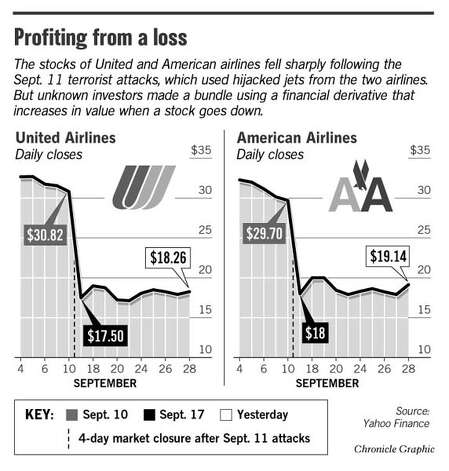
The Chronicle illustrated the story with the following chart:
http://ww1.hdnux.com/photos/10/41/66/2235784/7/628x471.jpg
On October 19, 2001, the Chronicle wrote:
On Oct. 2, Canadian securities officials confirmed that the SEC privately had asked North American investment firms to review their records for evidence of trading activity in the shares of 38 companies, suggesting that some buyers and sellers might have had advance knowledge of the attacks.
***FMR Corp. spokeswoman Anne Crowley, said her firm — which owns the giant Fidelity family of mutual funds in Boston — has already provided “account and transaction” information to investigators, and had no objection to the new procedures announced yesterday. Crowley declined to describe the nature of the information previously shared with the government.
So the effort to track down the source of the puts was certainly quite substantial.
What were the results and details of the investigation?
Apparently, we’ll never know.
Specifically, David Callahan – executive editor of SmartCEO – submitted a Freedom of Information Act request to the SEC regarding the pre-9/11 put options.
The SEC responded:
This letter is in response to your request seeking access to and copies of the documentary evidence referred to in footnote 130 of Chapter 5 of the September 11 (9/11) Commission Report.
***
We have been advised that the potentially responsive records have been destroyed.
If the SEC had responded by producing documents showing that the pre-9/11 put options had an innocent explanation (such as a hedge made by a smaller airline), that would be understandable.
If the SEC had responded by saying that the documents were classified as somehow protecting proprietary financial information, I wouldn’t like it, but I would at least understand the argument.
But destroyed? Why? (See Afterword for additional details.)
Not the First Time
This is not the first destruction of documentary evidence related to 9/11.
I wrotein March:
As I pointed out in 2007:
The 9/11 Commission Report was largely based on a third-hand account of what tortured detainees said, with two of the three parties in the communication being government employees.
The official 9/11 Commission Report states:
Chapters 5 and 7 rely heavily on information obtained from captured al Qaeda members. A number of these “detainees” have firsthand knowledge of the 9/11 plot. Assessing the truth of statements by these witnesses-sworn enemies of the United States-is challenging. Our access to them has been limited to the review of intelligence reports based on communications received from the locations where the actual interrogations take place. We submitted questions for use in the interrogations, but had no control over whether, when, or how questions of particular interest would be asked. Nor were we allowed to talk to the interrogators so that we could better judge the credibility of the detainees and clarify ambiguities in the reporting.
In other words, the 9/11 Commissioners were not allowed to speak with the detainees, or even their interrogators. Instead, they got their information third-hand.
The Commission didn’t really trust the interrogation testimony. For example, one of the primary architects of the 9/11 Commission Report, Ernest May, said in May 2005:
We never had full confidence in the interrogation reports as historical sources.
As I noted last May:
Newsweek is running an essay by [New York Times investigative reporter] Philip Shenon saying [that the 9/11 Commission Report was unreliable because most of the information was based on the statements of tortured detainees]:
The commission appears to have ignored obvious clues throughout 2003 and 2004 that its account of the 9/11 plot and Al Qaeda’s history relied heavily on information obtained from detainees who had been subjected to torture, or something not far from it.
The panel raised no public protest over the CIA’s interrogation methods, even though news reports at the time suggested how brutal those methods were. In fact, the commission demanded that the CIA carry out new rounds of interrogations in 2004 to get answers to its questions.
That has troubling implications for the credibility of the commission’s final report. In intelligence circles, testimony obtained through torture is typically discredited; research shows that people will say anything under threat of intense physical pain.
And yet it is a distinct possibility that Al Qaeda suspects who were the exclusive source of information for long passages of the commission’s report may have been subjected to “enhanced” interrogation techniques, or at least threatened with them, because of the 9/11 Commission….
Information from CIA interrogations of two of the three—KSM and Abu Zubaydah—is cited throughout two key chapters of the panel’s report focusing on the planning and execution of the attacks and on the history of Al Qaeda.
Footnotes in the panel’s report indicate when information was obtained from detainees interrogated by the CIA. An analysis by NBC News found that more than a quarter of the report’s footnotes—441 of some 1,700—referred to detainees who were subjected to the CIA’s “enhanced” interrogation program, including the trio who were waterboarded.
Commission members note that they repeatedly pressed the Bush White House and CIA for direct access to the detainees, but the administration refused. So the commission forwarded questions to the CIA, whose interrogators posed them on the panel’s behalf.
The commission’s report gave no hint that harsh interrogation methods were used in gathering information, stating that the panel had “no control” over how the CIA did its job; the authors also said they had attempted to corroborate the information “with documents and statements of others.”
But how could the commission corroborate information known only to a handful of people in a shadowy terrorist network, most of whom were either dead or still at large?
Former senator Bob Kerrey of Nebraska, a Democrat on the commission, told me last year he had long feared that the investigation depended too heavily on the accounts of Al Qaeda detainees who were physically coerced into talking ….
Kerrey said it might take “a permanent 9/11 commission” to end the remaining mysteries of September 11.
Abu Zubaida was well-known to the FBI as being literally crazy. The Washington Post quotes “FBI officials, including agents who questioned [alleged Al-Qaeda member Abu Zubaida] after his capture or reviewed documents seized from his home” as concluding that he was:
[L]argely a loudmouthed and mentally troubled hotelier whose credibility dropped as the CIA subjected him to a simulated drowning technique known as waterboarding and to other “enhanced interrogation” measures.
For example:
Retired FBI agent Daniel Coleman, who led an examination of documents after Abu Zubaida’s capture in early 2002 and worked on the case, said the CIA’s harsh tactics cast doubt on the credibility of Abu Zubaida’s information.
“I don’t have confidence in anything he says, because once you go down that road, everything you say is tainted,” Coleman said, referring to the harsh measures. “He was talking before they did that to him, but they didn’t believe him. The problem is they didn’t realize he didn’t know all that much.”
***
“They said, ‘You’ve got to be kidding me,’ ” said Coleman, recalling accounts from FBI employees who were there. ” ‘This guy’s a Muslim. That’s not going to win his confidence. Are you trying to get information out of him or just belittle him?’” Coleman helped lead the bureau’s efforts against Osama bin Laden for a decade, ending in 2004.
Coleman goes on to say:
Abu Zubaida … was a “safehouse keeper” with mental problems who claimed to know more about al-Qaeda and its inner workings than he really did.
***
Looking at other evidence, including a serious head injury that Abu Zubaida had suffered years earlier, Coleman and others at the FBI believed that he had severe mental problems that called his credibility into question. “They all knew he was crazy, and they knew he was always on the damn phone,” Coleman said, referring to al-Qaeda operatives. “You think they’re going to tell him anything?”
ACLU, FireDogLake’s Marcy Wheeler and RawStory broke the story yesterday that (quoting RawStory):
Senior Bush administration officials sternly cautioned the 9/11 Commission against probing too deeply into the terrorist attacks of September 11, 2001, according to a document recently obtained by the ACLU.
The notification came in a letter dated January 6, 2004, addressed by Attorney General John Ashcroft, Defense Secretary Donald H. Rumsfeld and CIA Director George J. Tenet. The ACLU described it as a fax sent by David Addington, then-counsel to former vice president Dick Cheney.
In the message, the officials denied the bipartisan commission’s request to question terrorist detainees, informing its two senior-most members that doing so would “cross” a “line” and obstruct the administration’s ability to protect the nation.
“In response to the Commission’s expansive requests for access to secrets, the executive branch has provided such access in full cooperation,” the letter read. “There is, however, a line that the Commission should not cross — the line separating the Commission’s proper inquiry into the September 11, 2001 attacks from interference with the Government’s ability to safeguard the national security, including protection of Americans from future terrorist attacks.”
***
“The Commission staff’s proposed participation in questioning of detainees would cross that line,” the letter continued. “As the officers of the United States responsible for the law enforcement, defense and intelligence functions of the Government, we urge your Commission not to further pursue the proposed request to participate in the questioning of detainees.”
Destruction of Evidence
The interrogators made videotapes of the interrogations. The 9/11 Commission asked for all tapes, but the CIA lied and said there weren’t any.
The CIA then destroyed the tapes.
Specifically, the New York Times confirms that the government swore that it had turned over all of the relevant material regarding the statements of the people being interrogated:
“The commission did formally request material of this kind from all relevant agencies, and the commission was assured that we had received all the material responsive to our request,” said Philip D. Zelikow, who served as executive director of the Sept. 11 commission ….
“No tapes were acknowledged or turned over, nor was the commission provided with any transcript prepared from recordings,” he said.
But is the destruction of the tapes — and hiding from the 9/11 Commission the fact that the tapes existed — a big deal? Yes, actually. As the Times goes on to state:
Daniel Marcus, a law professor at American University who served as general counsel for the Sept. 11 commissionand was involved in the discussions about interviews with Al Qaeda leaders, said he had heard nothing about any tapes being destroyed.If tapes were destroyed, he said, “it’s a big deal, it’s a very big deal,” because it could amount to obstruction of justice to withhold evidence being sought in criminal or fact-finding investigations.
Indeed, 9/11 Commission co-chairs Thomas Keane and Lee Hamilton wrote:
Those who knew about those videotapes — and did not tell us about them — obstructed our investigation.
The CIA also is refusing to release any transcripts from the interrogation sessions. As I wrote a year ago:
What does the fact that the CIA destroyed numerous videotapes of Guantanamo interrogations, but has 3,000 pages of transcripts from those tapes really mean?
Initially, it means that CIA’s claim that it destroyed the video tapes to protect the interrogators’ identity is false. Why? Well, the transcripts contain the identity of the interrogator. And the CIA is refusing to produce the transcripts.
Obviously, the CIA could have “blurred” the face of the interrogator and shifted his voice (like you’ve seen on investigative tv shows like 60 Minutes) to protect the interrogator’s identity. And since the CIA is not releasing the transcripts, it similarly could have refused to release the videos.
The fact that the CIA instead destroyed the videos shows that it has something to hide.
Trying to Create a False Linkage?
I have repeatedly pointed out that the top interrogation experts say that torture doesn’t work.
As I wrotelast May:
The fact that people were tortured in order to justify the Iraq war by making a false linkage between Iraq and 9/11 is gaining attention.
Many people are starting to understand that top Bush administration officials not only knowingly lied about a non-existent connection between Al Qaida and Iraq, but they pushed and insisted that interrogators use special torture methods aimed at extracting false confessions to attempt to create such a false linkage.
Indeed, the Senate Armed Services Committee found that the U.S. used torture techniques specifically aimed at extracting false confessions (and see this).
And as Paul Krugman wrote in the New York Times:
Let’s say this slowly: the Bush administration wanted to use 9/11 as a pretext to invade Iraq, even though Iraq had nothing to do with 9/11. So it tortured people to make them confess to the nonexistent link.
[A]ccording to NBC news:
  • Much of the 9/11 Commission Report was based upon the testimony of people who were tortured
  • At least four of the people whose interrogation figured in the 9/11 Commission Report have claimed that they told interrogators information as a way to stop being “tortured.”
  • One of the Commission’s main sources of information was tortured until he agreed to sign a confession that he was NOT EVEN ALLOWED TO READ
  • The 9/11 Commission itself doubted the accuracy of the torture confessions, and yet kept their doubts to themselves
In fact, the self-confessed “mastermind” of 9/11 also confessed to crimes which he could not have committed. He later said that he gave the interrogators a lot of false information – telling them what he thought they wanted to hear – in an attempt to stop the torture. We also know that he was heavily tortured specifically for the purpose of trying to obtain false information about 9/11 – specifically, that Iraq had something to do with it.
***
Remember, as discussed above, the torture techniques used by the Bush administration to try to link Iraq and 9/11 were specifically geared towards creating false confessions (they were techniques created by the communists to be used in show trials).
***
The above-linked NBC news report quotes a couple of legal experts to this effect:
Michael Ratner, president of the Center for Constitutional Rights, says he is “shocked” that the Commission never asked about extreme interrogation measures.
“If you’re sitting at the 9/11 Commission, with all the high-powered lawyers on the Commission and on the staff, first you ask what happened rather than guess,” said Ratner, whose center represents detainees at Guantanamo. “Most people look at the 9/11 Commission Report as a trusted historical document. If their conclusions were supported by information gained from torture, therefore their conclusions are suspect.“…
Karen Greenberg, director of the Center for Law and Security at New York University’s School of Law, put it this way: “[I]t should have relied on sources not tainted. It calls into question how we were willing to use these interrogations to construct the narrative.”
The interrogations were “used” to “construct the narrative” which the 9/11 Commission decided to use.
Remember (as explored in the book The Commission by respected journalist Philip Shenon), that the Executive Director of the 9/11 Commission was an administration insider whose area of expertise is the creation and maintenance of “public myths” thought to be true, even if not actually true. He wrote an outline of what he wanted the report to say very early in the process, controlled what the Commission did and did not analyze, then limited the scope of the Commission’s inquiry so that the overwhelming majority of questions about 9/11 remained unasked (see this article and this article).
***
As constitutional law expert Jonathan Turley stated:
[The 9/11 Commission] was a commission that was really made for Washington – a commission composed of political appointees of both parties that ran interference for those parties – a commission that insisted at the beginning it would not impose blame on individuals.
Other Obstructions of Justice
[Other examples of obstructions of justice include the following:]
  • The chairs of both the 9/11 Commission and the Joint Inquiry of the House and Senate Intelligence Committees into 9/11 said that government “minders” obstructed the investigation into 9/11 by intimidating witnesses
  • The 9/11 Commissioners concluded that officials from the Pentagon lied to the Commission, and considered recommending criminal charges for such false statements
  • Investigators for the Congressional Joint Inquiry discovered that an FBI informant had hosted and even rented a room to two hijackers in 2000 and that, when the Inquiry sought to interview the informant, the FBI refused outright, and then hid him in an unknown location, and that a high-level FBI official stated these blocking maneuvers were undertaken under orders from the White House. As the New York Times notes:
    Senator Bob Graham, the Florida Democrat who is a former chairman of the Senate Intelligence Committee, accused the White House on Tuesday of covering up evidence . . .* * *
    The accusation stems from the Federal Bureau of Investigation’s refusal to allow investigators for a Congressional inquiry and the independent Sept. 11 commission to interview an informant, Abdussattar Shaikh, who had been the landlord in San Diego of two Sept. 11 hijackers.
    In his book “Intelligence Matters,” Mr. Graham, the co-chairman of the Congressional inquiry with Representative Porter J. Goss, Republican of Florida, said an F.B.I. official wrote them in November 2002 and said “the administration would not sanction a staff interview with the source.” On Tuesday, Mr. Graham called the letter “a smoking gun” and said, “The reason for this cover-up goes right to the White House.”
We don’t need to even discuss conspiracy theories about what happened on 9/11 to be incredibly disturbed about what happened after: the government’s obstructions of justice.
Indeed, the 9/11 Commissioners themselvesare disturbed:
  • The Commission’s co-chairs said that the CIA (and likely the White House) “obstructed our investigation”
  • The Senior Counsel to the 9/11 Commission (John Farmer) – who led the 9/11 staff’s inquiry – saidAt some level of the government, at some point in time…there was an agreement not to tell the truth about what happened“. He also said “I was shocked at how different the truth was from the way it was described …. The tapes told a radically different story from what had been told to us and the public for two years…. This is not spin. This is not true.”
Afterword: Footnote 130 to chapter 5 of the official 9/11 Commission Report states:
Highly publicized allegations of insider trading in advance of 9/11 generally rest on reports of unusual pre-9/11 trading activity in companies whose stock plummeted after the attacks. Some unusual trading did in fact occur, but each such trade proved to have an innocuous explanation. For example, the volume of put options- investments that pay off only when a stock drops in price-surged in the parent companies of United Airlines on September 6 and American Airlines on September 10-highly suspicious trading on its face. Yet, further investigation has revealed that the trading had no connection with 9/11. A single U.S.-based institutional investor with no conceivable ties to al Qaeda purchased 95 percent of the UAL puts on September 6 as part of a trading strategy that also included buying 115,000 shares of American on September 10. Similarly, much of the seemingly suspicious trading in American on September 10 was traced to a specific U.S.-based options trading newsletter, faxed to its subscribers on Sunday, September 9, which recommended these trades. These examples typify the evidence examined by the investigation. The SEC and the FBI, aided by other agencies and the securities industry, devoted enormous resources to investigating this issue, including securing the cooperation of many foreign governments. These investigators have found that the apparently suspicious consistently proved innocuous. Joseph Cella interview (Sept. 16, 2003; May 7, 2004; May 10-11, 2004); FBI briefing (Aug. 15, 2003); SEC memo, Division of Enforcement to SEC Chair and Commissioners, “Pre-September 11, 2001 Trading Review,” May 15, 2002; Ken Breen interview (Apr. 23, 2004); Ed G. interview (Feb. 3, 2004).
Did the Commission have full access to information regarding put options? Was the Commission misled, as it was on other issues? Was evidence destroyed or fabricated? We will never know, as the underlying documents have – according to the SEC – been destroyed.
A Trillion Ways To Build a New Military Industrial Complex
Posted By Bob Hennelly On October 11, 2014  In Domestic,Fresh Takes,National Securityhttp://whowhatwhy.com/2014/10/11/a-trillion-ways-to-build-a-new-military-industrial-complex/
Nearly a trillion dollars have been invested in the Security-Industrial Complex, above. [1]
Nearly a trillion dollars have been invested in the Security-Industrial Complex, above.
Just when did the United States government start referring to the country as the “homeland?”
If you were to answer “after 9/11,” you would be wrong. That’s the surprise. What is not at all surprising is the exponential expansion of what some call the “security-industrial complex” since that day in September thirteen years ago.
What’s happening now—the government’s search for self-justifying excuses to claim broader powers against a menace it says is ubiquitous—is a cycle that’s been repeated since America launched its first “War on Drugs” in the 1930s.
Today’s on-going proliferation of the national security state has created a new profit center for a large number of American companies with deep ties to military and intelligence agencies. And as bureaucracies and profits have grown, personal liberties have suffered their biggest contraction in a century, thanks to the Patriot Act and other legislation designed to increase surveillance in the name of eternal vigilance.
1 [2]And here’s the irony: It all began before 9/11, with the kind of bipartisan commission usually convened to bury a hot-potato issue beneath a slurry of platitudes.
***
In 1998, President Bill Clinton tasked former Senators Gary Hart, a Colorado Democrat, and the late Warren Rudman, a New Hampshire Republican, to chair the U.S. Commission on National Security/21st Century [3]. The Commission panel was a cross-section of the military-industrial-media complex. Its members included Leslie Gelb, longtime New York Times correspondent and editor; Norman Augustine, former CEO of Lockheed-Martin; and Army General John Galvin.
Not If, but…  When
The panel gave its report and recommendations in January 2001. Both Senators Rudman and Hart concluded that it was not a matter of “if” the U.S. would suffer a mass-casualty terrorist strike but “when.”  Among the panel’s recommendations was the massive integration of all of the nation’s domestic security, disaster planning and recovery functions into one behemoth called the Department of Homeland Security (DHS).
After 9/11, President George W. Bush faithfully executed the Hart-Rudman blueprint and President Obama and the Congress have continued to commit hundreds of billions to it. And so it was that the envisioned “peace dividend” cutbacks—which the end of the Cold War was supposed to have brought to the defense budget (and the bottom line of defense contractors)— were buried for good.
Report on the Surveillance-Industrial Complex, which parallels the Security-Industrial Complex. [4]
Report on the Surveillance-Industrial Complex, which parallels the Security-Industrial Complex.
By 2011, according to Brown University’s Costs of War Project, the total cost for post-9/11 Homeland Security had already reached $649 billion [5] and annual spending since then is running at about $70 billion a year [6].
At that rate, the price tag for the entire post 9/11 Homeland Security domestic undertaking is only a year or two away from reaching a trillion dollars. So what’s the return been on that investment?
Spreading War and Terror
Indeed, and of supreme irony, the main effect of the War on Terror, as executed so far, has been  not to eliminate terror, but to spread it—and to generate a state of perpetual war.
Although the government swears it’s just airstrikes [7], the fact is that the U.S. is back in combat in Iraq. It took the so-called Islamic State of Iraq and Syria just a matter of months to undo years of American efforts to rebuild a nation the U.S. had previously destroyed.
President Obama, a civilian who like most presidents can’t be expected to know what to do in these situations, logically put the blame on the vaunted U.S. intelligence establishment [8] for both underestimating the formidable nature of the threat posed by ISIS and overestimating the Iraqi military’s ability to contain it.
Yes, that’s the same intelligence establishment that got WikiLeaked and Snowdened. The same cluster of agencies that the late New York Senator Daniel Patrick Moynihan angrily blamed for missing the implosion of the Soviet Union, as well as  both World Trade Center attacks. The very same subset of departments that’s claimed ever-increasing amounts of the public treasury even as Congress retrenched on food stamps and long-term unemployment benefits. The same intelligence establishment that insists on its right to monitor virtually all electronic communications here and abroad in the name of counter-terrorism.
3 [9]The post-9/11 incompetence of the nation’s security machinery has been highlighted by the Keystone Kops-style misadventures of the Secret Service that have put the President and his family repeatedly at risk.
This series of fiascoes [10] recently led to the sacrificial-lamb resignation of Secret Service Director Julia Pierson [11]—though so far, there is no indication of substantive changes. Perhaps the most egregious of these failures was Army veteran Omar Gonzalez’ sprint across the lawn and into the White House while carrying a knife. This breakdown of security at what may be the most closely guarded residence in the country harked back to the curiously lackadaisical approach of John F. Kennedy’s protection detail in Dallas [12].
The latest embarrassments reflect the increasing dysfunction at the Secret Service since the agency was transferred from the Treasury Department to DHS in 2003, according to author and investigative reporter Ronald Kessler. What happened, says Kessler, is that the agency became more politicized, more responsive to political operatives, and less attentive to its own security protocols and whistle-blowers within its ranks.
Julia Pierson [13]
Julia Pierson
“Agents and officers are afraid to voice their opinion and point out these very obvious problems because they will be punished,” Kessler said in a C-SPAN interview. “That’s how corrupt the agency is.”
When the agency came under DHS control, it “became political, more compliant, more subject to political pressures and that’s when this laxness and corner-cutting began,” Kessler added.
Supporters of the DHS counter that it has clearly succeeded in its primary mission of protecting “the homeland,” because the U.S. hasn’t experienced another terrorist attack on the scale of 9/11.
Yet these same supporters cite the April 2013 Boston Marathon bombing as proof that America needs still greater vigilance against terrorism at home. That’s despite the dozens of unanswered questions about what really happened in Boston, including serious ones about the FBI’s prior relationship with alleged bomber Tamerlan Tsarnaev [14].
All of this is somehow resolved in the paradoxical assertion —that DHS is a success, but that  more and more money and power is required to expand its reach and effectiveness.
The War on Whatever’s Handy at the Time
This particular mix of institutional self-congratulation and fear-mongering is not a new story in the United States. Against the backdrop of a newly identified menace to the American Way of Life, new laws are passed and a powerful new entity is added to the government’s law enforcement machinery, with dire effects on the civil liberties of ordinary Americans.
One instructive example comes from a subset of the history of the so-called War on Drugs, the campaign against marijuana.
That particular battle was conjured up in the 1930s to give the ranks of federal agents that had enforced Prohibition in the 1920s something to do after alcohol became legal again. The target became “pot,” which until 1937, was widely available as a patent medicine.
A clever bureaucrat named Harry Anslinger, commissioner of the Federal Bureau of Narcotics from 1930-1962, painted marijuana as the single greatest threat to U.S. values and morals. He did this through a publicity campaign abetted by a compliant media. Newspaper tycoon William Randolph Hearst and the FBI’s J. Edgar Hoover were among his strongest allies.
5 [15]When Communism became the common enemy in the 1950s, Anslinger declared marijuana and drug trafficking in general to be part of a global conspiracy [16] to advance the Reds’ goal of world domination. In a flight of self-serving rhetoric unconnected to any facts, he blamed “evil masterminds” in Communist China for seeking to hook America’s youth on debilitating substances. Subsequent historical research has thoroughly debunked Anslinger’s geo-political story line.
But the effect of Anslinger’s campaign, best exemplified by the baseless hysteria of the propaganda film-turned-cult classic “Reefer Madness,” [17] was felt for decades. The same sentiments fueled the creation of President Richard Nixon’s War on Drugs; in 1971 Nixon declared drug abuse “public enemy number one.”
6 [18]It took nearly 84 years before the federal government’s War on Drugs dogma loosened up enough to allow the legal sale of recreational marijuana [19], a demonstration of how bureaucratic inertia can prolong policies well past their expiration dates.
***
More and more people are realizing how badly the U.S. needs to critically re-evaluate the unchecked expansion of the War on Terror and its propagation of an all-encompassing surveillance state. But a veritable army of latter-day Harry Anslingers have a stake in preventing such a public discussion.
They’re the same officials who drafted and executed the Homeland Security strategy in the first place. Many have parlayed their government service into lucrative commercial enterprises and reputation-enhancing sidelines as TV talking heads, discussing national security issues on an endless round of Sunday morning news shows. There, they are mostly identified by their former titles—with no mention of their current involvement in the global counterterrorism industry.
Former DHS head Tom Ridge [20]
Former DHS head Tom Ridge
Examples include DHS’s first leader, former Pennsylvania Governor Tom Ridge. He formed Ridge Global [21] to offer multinational companies advice on risk management, energy consulting, trade and maritime management. Former Homeland Security Secretary Michael Chertoff now heads The Chertoff Group [22], which draws on a bench of former military and intelligence officials from the United States and Europe, such as General Michael Hayden, former Director of the Central Intelligence Agency.
In just its first year of business, the Chertoff Group helped facilitate $2.1 billion in deals [23] involving biometrics, personnel protection security training, cyber security and data analytics. And that’s just a tiny fraction of the money in play.
Eisenhower’s farewell warning [24]
Eisenhower’s farewell warning
Occasional voices of reason have been heard above the din of the fear-mongers. The House Committee on Homeland Security has raised a warning flag. It documented that DHS in its first five years racked up $15 billion in failed contracts—or about a third of its contracting budget. Among the committee’s list of costly fiascoes: a deeply flawed $25 billion makeover [25] of the Coast Guard’s aging fleet, and expensive airport and border screening technologies that failed to deliver [26] greater security.
General Michael V. Hayden, former director, NSA [27]
General Michael V. Hayden, former director, NSA
As recently as May, DHS Inspector General John Roth admitted in Congressional testimony that his agency was still coming up short when it came to contracting. He added that DHS continues “to struggle with acting as an integrated, single entity to accomplish its mission.” [28]
It’s been said that war is too important to be left to the generals. That certainly holds for the War on Terror. It also holds for the metastasizing security-industrial complex, whose evolving surveillance state promises real threats to the American way of life.

Photo Credits:
IMAGE: 3 Stooges [29]
IMAGE: Drinking Coffee [30]
IMAGE: Surveillance-Industrial (ACLU) [31]
IMAGE: Keystone Kops [32]
IMAGE: Julia Pierson [33]
IMAGE: Old Marijuana poster [34]
IMAGE: Reefer Madness [35]
IMAGE: Tom Ridge [36]
IMAGE: Eisenhower’s Farewell [37]
IMAGE: Michael Hayden [38]

WhoWhatWhy plans to continue doing this kind of groundbreaking original reporting. You can count on us. Can we count on you? What we do is only possible with your support. Please click here [39] to donate; it’s tax deductible. And it packs a punch.


Article printed from WhoWhatWhy: http://whowhatwhy.com
URL to article: http://whowhatwhy.com/2014/10/11/a-trillion-ways-to-build-a-new-military-industrial-complex/
URLs in this post:
[1] Image: http://whowhatwhy.com/wp-content/uploads/2014/10/Nearly-a-trillion-dollars-have-been-invested-in-the-Security-Industrial-Complex-above..jpg
[2] Image: http://whowhatwhy.com/wp-content/uploads/2014/10/11.jpg
[3] U.S. Commission on National Security/21st Century: http://www.cfr.org/homeland-security/national-security-21st-century-findings-hart-rudman-commission/p4049
[4] Image: http://whowhatwhy.com/wp-content/uploads/2014/10/Report-on-the-Surveillance-Industrial-Complex-which-parallels-the-Security-Industrial-Complex..jpg
[5] reached $649 billion: http://costsofwar.org/article/homeland-security-budget
[6] running at about $70 billion a year: http://www.cbo.gov/sites/default/files/cbofiles/attachments/09-27-HLS.pdf
[7] swears it’s just airstrikes: http://whowhatwhy.com/2014/08/09/context-iraq-just-the-tip-of-the-spear/
[8] blame on the vaunted U.S. intelligence establishment: http://thehill.com/policy/defense/219123-obama-intel-underestimated-isis
[9] Image: http://whowhatwhy.com/wp-content/uploads/2014/10/3.jpg
[10] series of fiascoes: http://whowhatwhy.com/2014/09/30/more-secret-service-bungling-by-the-day/
[11] resignation of Secret Service Director Julia Pierson: http://www.washingtonpost.com/politics/julia-pierson-resigns-as-secret-service-director/2014/10/01/ea39a396-499f-11e4-891d-713f052086a0_story.html
[12] lackadaisical approach of John F. Kennedy’s protection detail in Dallas: http://whowhatwhy.com/2012/04/30/a-closer-look-at-the-secret-service/
[13] Image: http://whowhatwhy.com/wp-content/uploads/2014/10/Julia-Pierson.jpg
[14] ones about the FBI’s prior relationship with alleged bomber Tamerlan Tsarnaev: http://whowhatwhy.com/2014/04/14/uss-boston-bombing-report-hints-even-darker-reality/
[15] Image: http://whowhatwhy.com/wp-content/uploads/2014/10/5.jpg
[16] declared marijuana and drug trafficking in general to be part of a global conspiracy: http://www.japanfocus.org/-Jonathan-Marshall/3997
[17] “Reefer Madness,”: http://www.imdb.com/title/tt0028346/
[18] Image: http://whowhatwhy.com/wp-content/uploads/2014/10/6.jpg
[19] allow the legal sale of recreational marijuana: http://www.rollingstone.com/politics/news/the-great-marijuana-experiment-a-tale-of-two-drug-wars-20140103
[20] Image: http://whowhatwhy.com/wp-content/uploads/2014/10/Former-DHS-head-Tom-Ridge.jpg
[21] Ridge Global: http://www.ridgeglobal.com
[22] The Chertoff Group: http://chertoffgroup.com/team.php
[23] Chertoff Group helped facilitate $2.1 billion in deals: http://www.chertoffgroup.com/press-releases-the-chertoff-group-marks-first-full-year-as-strategic-advisors-on-multiple-security-related-aquisitions-in-2010.php
[24] Image: http://whowhatwhy.com/wp-content/uploads/2014/10/Eisenhower’s-farewell-warning.jpg
[25] deeply flawed $25 billion makeover: http://www.defenseindustrydaily.com/us-coast-guards-deepwater-effort-hits-more-rough-sailing-02863/
[26] screening technologies that failed to deliver: http://www.washingtonpost.com/wp-dyn/content/article/2008/09/16/AR2008091603200.html
[27] Image: http://whowhatwhy.com/wp-content/uploads/2014/10/General-Michael-V.-Hayden-former-director-NSA.jpg
[28] “to struggle with acting as an integrated, single entity to accomplish its mission.”: http://docs.house.gov/meetings/HM/HM00/20140507/102186/HHRG-113-HM00-Wstate-RothJ-20140507.pdf
[29] IMAGE: 3 Stooges: http://www.cvtreasures.com/three-stooges-memorabilia-movie-posters-c-101_127_128/
[30] IMAGE: Drinking Coffee: http://www.abovetopsecret.com/forum/thread868900/pg3
[31] IMAGE: Surveillance-Industrial (ACLU): https://www.aclu.org/national-security/combatting-surveillance-industrial-complex
[32] IMAGE: Keystone Kops: http://www.imdb.com/title/tt0047794/
[33] IMAGE: Julia Pierson: http://www.veooz.com/news/MHX8jqj.html
[34] IMAGE: Old Marijuana poster: http://forums.cannabisculture.com/forums/index.php?/topic/184534-the-evils-of-marihuana-gov-anti-pot-posters/
[35] IMAGE: Reefer Madness: http://storyofaphoenix.wordpress.com/2013/11/06/reefer-madness-a-review/
[36] IMAGE: Tom Ridge: http://bigdanblogger.blogspot.com/2010/07/big-dans-big-news-july-31-2010.html
[37] IMAGE: Eisenhower’s Farewell: http://veracityvoice.com/?p=9372
[38] IMAGE: Michael Hayden: http://www.cleveland.com/nation/index.ssf/2009/01/cia_director_michael_hayden_sa.html
[39] click here: http://www.whowhatwhy.com/donate

Politics of Hemp

The Corporate Conspiracy that Killed Industrial Hemp 3-types-cannabis2


by Dr Stuart Jeanne Bramhall


The farm bill Obama signed in February 2014 included an amendment to legalize industrial hemp production for research purposes. The amendment allows State Agriculture Departments, colleges and universities to grow hemp (defined as the non-drug oilseed and fiber varieties of Cannabis) for academic or agricultural research purposes. However it only applies only to states where industrial hemp farming is already legal under state law.
As of September 15, 2014, nineteen states had passed laws to provide for hemp pilot studies and/or for production as described by the Farm Bill stipulations.
Six states (Colorado, Oregon, Washington, Vermont, Tennessee and South Carolina) have gone even further, with legislation nullifying the longstanding federal ban on hemp cultivation. All six states allow farmers to produce hemp for the commercial market.  A year ago, the Obama Justice Department quietly signaled that they wouldn’t prosecute marijuana use in states that had legalized the drug for recreational and/or medical use. Thus far the same hands-off policy seems to apply to states that have legalized hemp production.
The Fiber Modern Synthetics  Replaced
Hemp cultivation is big business. Even though it hasn’t been grown in the United States for decades, America is one of the fastest-growing hemp markets.  In 2011, the U.S. imported $11.5 million worth of legal hemp products (mainly from China), up from $1.4 million in 2000. With the recent anti-smoking movement and declining tobacco exports, hemp is high on the list replacement crops for tobacco farmers.
Industrial hemp is one of the most versatile plants known to man. Hemp fiber is used in the production of paper, textiles, rope, sails, clothing, plastics, insulation, dry wall, fiber board and other construction materials; while hempseed oil is used as a lubricant and base for paints and varnishes, as well as in cooking and beauty products.
Hemp: Proven Alternative to Petroleum-Based Synthetics
hemp
Hemp-based paper, textiles, rope, construction materials and plastics are the tried and true low tech alternative to modern synthetics that consume large quantities of fossil fuel during manufacture. Prior to the industrial revolution, the vast majority of textiles, clothing, canvas (the Dutch word for cannabis), rope and paper was made of hemp.
Before the invention of the cotton gin in the 1820s, 80% of the world’s textiles, fabrics, and clothing were made of hemp. During the nineteenth century, hemp was the main ingredient of 75% of the world’s paper. Until the US government passed a crippling hemp tax in 1937, most bank notes and archival papers were made of hemp (owing to its greater durability) and most paints and varnishes were made from hemp seed oil.
The Conspiracy to Kill Hemp Production

Hemp first began losing ground in 1850 to cheaper substitutes made of cotton, jute and sisal. Prior to 1917, hemp had to be processed by hand, involving huge labor costs incompatible with mass commercial production. After George W Schlicten automated hemp processing in 1917 with a new machine called the hemp decorticator, Henry Ford set up the first biomass fuel production plant in Iron Mountain Michigan. His intention was to run his Model T on hemp-based ethanol.
ford_quote_about_use_of_hemp_product_smart_marijuana_use
All this was happening at the precise moment that the munitions company DuPont was patenting synthetic fibers (nylon, rayon, Dacron, etc) and plastics derived from petroleum. Hemp posed a major threat to DuPont’s ability to market these synthetic fibers for fabrics, rope and other products because hemp was so cheap and readily available. The chemical giant also had a commercial interest in replacing hemp-based paper with paper produced from wood chips (they held the patent on the sulfates and sulfites used to produce paper pulp) and in replacing ethanol with gasoline as the major fuel source in automobiles (they held the patent on tetraethyl lead, which allowed gasoline to burn more smoothly in the internal combustion engine Ford designed to run on ethanol).
The main co-conspirators in the plot to kill hemp included DuPont, William Randolph Hearst (who owned a logging company and a paper manufacturing plant) and Andrew Mellon, president of Mellon Bank and DuPont’s major financier.
In 1930, Mellon, as US Secretary of the Treasury, created the Federal Bureau of Narcotics and appointed his nephew Henry Anslinger to run it. Between 1935 and 1937, Anslinger and a handful of DuPont’s cronies in Congress secretly wrote a bill to tax hemp production.
Meanwhile Anslinger and Hearst orchestrated a massive media campaign demonizing a dangerous new drug called marihuana that supposedly turned Mexicans and black jazz musicians into crazed killers. Anslinger and his cronies rushed through the Marihuana Tax Act of 1937 on a Friday afternoon before any lawmakers had a chance to read it. Only a handful realized the crippling effect the new law, which would also tax hemp, would have on the hemp industry.
In 1970 the 1937 Marihuana Tax Act was declared unconstitutional and replaced with the Controlled Substances Act. The latter official equated hemp with the drug marijuana (even though they come from very different plants*) and enacted an official prohibition against hemp cultivation.

*Industrial hemp (Cannabis sativa, variety sativa) is a tall, skinny plant with few major branches below the primary branches at the top. It has seven long thin leaflets and is grown in rows a foot apart. It produces good quality fiber and has a tetrahydrocannabinol (THC) concentration of 1% or less. Marijuana plants (Cannabis sativa, variety indica), in contrast, are short and bushy and must be spaced six feet apart for optimum growth. They have five leaflets, with three of them nearly twice the width of hemp leaflets. They produce negligible usable fiber and have a THC concentration of 4-20%. See image above.
photo credit: arbyreed via photopin cc