Wednesday, October 15, 2014

How to Build a 30-Day Emergency Food Supply…Fast  ~  INVEST in each other ,folks! we use 2 !!  ..soon ALL's we r gonna have is ...each other !!!  ...just an matter of ...time :) r


Freeze-dried-food
If you’ve been paying attention to the news lately, you may be feeling on edge.  You may feel as though time is running out for you to get your preparedness supplies in order. You may be new to prepping, and feeling like there’s too much to accomplish.  The stress in our country is at peak levels, as we watch the bumbling efforts of officials to contain the spread of Ebola, as the war drums beat louder, as riots break out again in an American city, as the economy freefalls, and as a terrorist group declares Jihad on anyone who doesn’t share their religious beliefs.
This feeling of urgency can make you feel hopeless and panicked, and that’s not productive.  There’s no time for a lack of productivity. It’s time to focus and create your food supply…fast. If an event occurs during which you are unable to leave your home, you want to make certain that you can do this without assistance. Such an event could be a mandatory quarantine, self-imposed isolation due to a pandemic, civil unrest in your town, martial law, or even a terrible storm that leaves you stranded, with no access to the store.
Generally I write about healthy food. I write about focusing on whole foods without additives, and I firmly believe that is the very best way to build your food supply.  I believe strongly in the value of a pantry that you will use day to day to nourish your family.  You can learn how to build a pantry like that in this article that recounts building our own food stockpile from the beginning, and the book The Pantry Primer: How to Build a One Year Food Supply in Three Months
However, if you do not have a food supply waiting in your pantry, now is the time to focus on creating an emergency stockpile quickly.  You can then add healthier options at your leisure. The quantities in this article are per person, so you’ll need to multiply this by the number of people in your home. You can order these items online and get them to your door within a couple of days.
Alternatively, you can shop around and try to find duplicates locally. You can also create a food plan, make a list, and go shopping, purchasing the highest quality items available, and repackaging them for longer shelf life.
However you opt to build your food supply, please don’t hesitate. If a worst case scenario occurred, the goal is to be able to feed your family for at least a month.

How much do you need?

There are a few different ways to calculate food storage, but I find breaking it down by serving size to be the most practical. Don’t rely on what a package calls a serving size – consider the appetites of your family. You might have a couple of big eaters and a couple of people with birdlike appetites. The lists below are based on serving sizes for an average adult.
Be sure to get a variety of different foods:
  • 3 protein servings
  • 5-8 fruits and vegetables
  • 5 starchy carbohydrates
On a 2000 calorie per day diet, strictly based on long-term storage food, the LDS (Church of the Latter Day Saints) says the average adult would need:
  • 5 pounds of beans
  • 25 pounds of grains
  • 5 pounds of sugars
  • 2 pounds of fats
  • 8 pounds of dairy
These are purely subjective numbers, however.  For example, if your family is gluten-free, you might eat more protein and produce than starchy carbs.  You must take into account your family’s health concerns, special needs, allergies, intolerances, likes, and dislikes.   These are simply guidelines. Try to stick as close to your normal eating habits as possible, to lessen the stress of an already highly-wrought situation.
It’s also important to consider cooking times. If you never ever cook from scratch, will you suddenly want to make pots of beans and homemade bread? If the power goes out, will you have a way that you’ll be able to cook these foods?

Create a stockpile with emergency food kits

If you’re trying to build a food supply quickly, consider ordering a kit with a month’s supply of meals in it.  These aren’t going to be the healthiest or tastiest meals, but they’ll stand between you and starvation.
You may look at the prices of these items and say, “Oh, I can’t afford this.” But you have to remember, this is enough food for an ENTIRE MONTH.  At $150, that means you’re spending only $3 per day on food.  It honestly doesn’t get much cheaper than that.  There’s a variety of price points below, with the pros and cons of each.
You’ll notice on the list of extras that I recommended a gentle laxative. Some people, when dependent solely upon MREs or dehydrated foods, become constipated.  I also recommended a high-quality multivitamin to help ensure you’re getting the nutrition you need.
augason
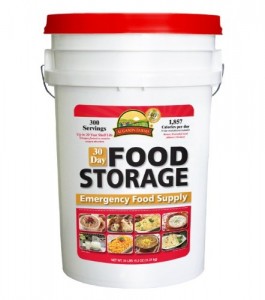
The Augason Farms 30 Day Food Emergency Disaster Bucket contains 90 meals for one person. That’s 3 meals a day for a month. The daily caloric allotment is about 1850 calories, and the meals are “just add water”, so to prepare them, you only need the ability to boil water – this could come in very handy during a grid-down situation. This is about $90, including the shipping. The kit contains:
  • Instant Potatoes (30 servings)
  • Macaroni & Cheese (30 servings)
  • Creamy Potato Soup (30 servings)
  • Cheesy Broccoli Rice (30 servings)
  • Creamy Chicken Rice (30 servings)
  • Hearty Vegetable Blend (30 servings)
  • Maple Brown Sugar Oatmeal (40 servings)
  • Morning Moo’s Low Fat Milk Alternative (80 servings)
chefs
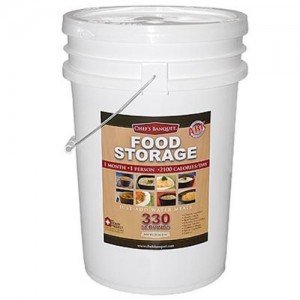
The Chef’s Banquet kit also contains 3 meals per day for a month.  It’s a little bit more expensive at $126, including shipping, but it doesn’t contain any High Fructose Corn Syrup or MSG, making it a higher quality choice. This is also a “just add water” menu, but there isn’t a lot of variety:
  • Oatmeal – 60 Servings
  • Hearty Potato Soup – 60 Servings
  • Chicken Vegetable Stew – 30 Servings
  • Mixed Vegetables – 30 Servings
  • Instant Potatoes – 60 Servings
  • Pasta – 30 Servings (includes 30 Servings of Cheddar Cheese Sauce)
  • Beef Flavored Vegetable Stew -
  • 30 Servings Cheddar Broccoli Rice – 30 Servings
relief
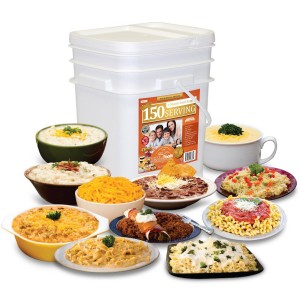
Relief Foods Premium 1 Month Emergency Food Supply  seems to offer the most bang for your buck. At $166, including shipping, this bucket contains 150 meals that are guaranteed to be GMO and MSG free. There’s more variety in this menu, but oddly, no breakfast-specific offerings. I wouldn’t be deterred by that, though, because breakfast is easily taken care of with powdered milk and dry cereal or oatmeal.
  • Italian Pasta Marinara -18 Servings
  • Rice Pilaf – 12 Servings
  • Pasta Alfredo – 18 Servings
  • Stroganoff – 12 Servings
  • Enchilada Beans and Rice – 12 Servings
  • Cheese and Broccoli Bake – 12 Servings
  • Macaroni & Cheese – 18 Servings
  • Classic Chili Mix – 12 Servings
  • Creamy Potato Soup – 12 Servings
  • Corn Chowder Soup – 12 Servings
  • Cheddar Broccoli Soup – 12 Servings
gf bucket
From the same company is the Relief Foods Gluten Free Emergency Food Supply Bucket .  This is certified to be free of gluten, MSG, and GMOs. It only contains 100 servings, some of which are not meals. This bucket costs $112, including shipping.
  • Enchilada Beans and Rice – 18 Servings
  • Cheese and Broccoli Bake – 12 Servings
  • Classic Chili Mix – 18 Servings
  • Creamy Potato Soup – 12 Servings
  • Corn Chowder Soup – 6 Servings
  • Cheddar Broccoli Soup – 6 Servings
  • Orange Drink Mix – 8 Servings
  • Powdered Milk – 8 Servings
  • Oatmeal with Brown Sugar – 12 Servings
29000_004354_p_348
If you happen to have an LDS cannery or self-reliance store in your area, you’ve got a great resource.  You can also order supplies online.  These #10 cans are sealed and will last for 10 years or longer.
A 28 pound starter kit contains wheat berries, oats, rice, beans, and flour for only $33.50.  The downside to this is that most of the foods require extensive cooking times and would make for quite bland eating if you relied solely on this.

Add some variety and nutrition

If it’s in the budget, adding some fruits, vegetables, desserts, and dry milk can go a long way towards fighting food fatigue.
Freeze Dried Vegetable Variety : 160 servings for $67
Lindon Farms Mixed Freeze Dried Fruits: 150 servings for $108
Emergency Food Supply Whey Milk: 250 servings for $75
Steel Cut Oats: 4 pound can for $16
Instant Vanilla Pudding: 68 oz. for $25
Alpine Aire Gourmet Reserves Apple Almond Crisp: 4 pound can for $23
Chocolate Fudge Brownie Mix: Just add water, 45 servings for $16
Organic Multi Vitamin: 60 tablets for $25
Nature’s Secret Soothing Coconut and Aloe Natural Laxative, 60 Count: 60 count for $15
Don’t forget to add an assortment of spices and condiments to make your emergency meals tastier.

You don’t have to be a prepper to build a 30-day food supply.

Up until recently, preppers have had something of a bad name in the media. However, as disasters strike America over and over, people are beginning to see the value in the way we do things. It’s been proven time and time again that when issues occur, you’re completely on your own. To learn more about basic preparedness, go HERE to learn how to get started.
Finally, if you want to learn more, here are some books and websites that can help you on your journey.
The Pantry Primer: How to Build a One Year Food Supply in Three Months
The Prepper’s Blueprint: The Step-By-Step Guide To Help You Through Any Disaster
The Prepper’s Cookbook: 300 Recipes to Turn Your Emergency Food into Nutritious, Delicious, Life-Saving Meals
Ebola Survival Handbook: A Collection of Tips, Strategies, and Supply Lists From Some of the World’s Best Preparedness Professionals
How to Be a Prepper… But Not One of Those Crazy Ones
Ready Nutrition
SHTFplan
Graywolf Survival
Underground Medic
Daisy Luther is a freelance writer and editor.  Her website, The Organic Prepper, offers information on healthy prepping, including premium nutritional choices, general wellness and non-tech solutions. You can follow Daisy on Facebook and Twitter, and you can email her at daisy@theorganicprepper.ca

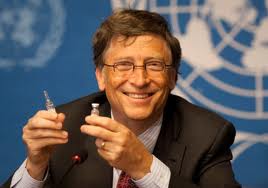
Will the Real Ebola Vaccine Stand Up? Exposing a Major Cover Up ~ hehe billy just wants 2 do gods work ...Oops ...it's that god that has an pitch fucking fork ! :o

The-CDC-NIH-Bill-Gates-Own-the-Patents-On-Existing-Ebola-Related-Vaccines-Mandatory-Vaccinations-Are-NearThe world is mired in the meaningless debate as to whether the “Ebola Outbreak” is a false flag attack. To review the tenets of this meaningless debate:
Bill Gates
Bill Gates
1) One theory states that the media and certain government sponsored agencies such as the CDC, NIH and the FDA are hyping the Ebola crisis to promote the roll-out of mandatory vaccines. This notion promotes the belief that Ebola will not impact that many people but the fear being promoted will drive people to help people like Bill Gates make a fortune from the inevitable vaccines. Is this theory correct? Well, yes and no. The ultimate goal of the globalist interests is indeed forced vaccinations. However, the false flag accusers cannot really deny that there are no Ebola cases because there are.
2) The second theory postulates that Ebola will serve as a depopulation instrument AND the elite (e.g. Bill Gates) will make money on the demise of much of humanity through the implementation of mandatory vaccines, while Ebola decimates the population claiming as many as a billion or so lives worldwide and millions within the United States.
Both theories are correct and both theories are incorrect. People are dying of Ebola. The ultimate question, along this line of thinking, is whether or not the death curve is going to dramatically spike. Both theories are correct in that the financial goal is mandatory vaccines.
However, which of these two positions is correct is totally a meaningless debate and therefore, serves as a distraction from the most important issue which has to do with the vaccines.  The answer to where the Ebola crisis is headed is contained within the handling of the differing vaccines.

Will the Real Vaccine Please Stand Up?

There are lat east two Ebola vaccines. One vaccine has been in development since 2004. The second vaccine, being developed by GSK, is presently in development and will be brought to market by January 2015.

Vaccine #1- GSK

To say that this vaccine is being brought to the public a little too fast would be the same as saying that Mt. St. Helens caused the earth to “shake a little bit”. The GSK vaccine will be completed from start to finish in 5 short months. Normal medical protocols dictated that this process should take from 3-5 to years. This vaccine is reckless and will endanger the public’s health upon its roll-out.

Vaccine #2- Crucell

What You Are Not Being Told: Fast facts From Crucell’s Website  
  • Crucell is developing an Ebola vaccine in collaboration with the Vaccine Research Center (VRC) of the NIH National Institute of Allergy and Infectious Diseases (NIAID). It has been shown to completely protect monkeys against the virus with a single dose of the vaccine.
  • Under the terms of the agreement with VRC, Crucell has an option for exclusive worldwide commercialization rights to the Ebola vaccine.
  • Crucell’s Ebola vaccine entered Phase I clinical trials in Q3 2006.  Two groups of 16 volunteers were enrolled and vaccinated. The study showed safety and immunogenicity at the doses evaluated.
  • In October 2008, Crucell secured a NIAID/NIH award to advance the development of Ebola and Marburg vaccines, with the ultimate aim of developing a multivalent filovirus vaccine.
  • The award provides funding of up to $30 million, with additional options, worth a further $40 million.
Not one word of this was reported in the mainstream media and now it is being covered up.
The above was a direct copy and paste from Crucell’s Website on September 17, 2014. In the same article that I published the following, I raised the question as to why the American public was not being informed of this development in which the vaccine had been tested on humans as far back as eight years ago. Within two days of publishing the data from Crucell’s website, this is what now appears off of the same link.

Not Found

The requested URL /R_and_D-Clinical_Development-Ebola_Vaccine was not found on this server.

Apache Server at www.crucell.com Port 80

My father used to have a saying “The more you stir “excrement” the more it starts to stink”! Those words never rang truer than they do with the weak attempt at a cover up of the existence of this data and then the subsequent cover up by taking down the site for all the obvious reasons.

The Anatomy of a Cover Up

As most Internet savvy people know, it is extremely difficult to cover up a web based story once it has been printed and recirculated thanks investigative tools such as the Wayback Machine. When the web page linking Crucell with the testing of an Ebola vaccine, on two sets of human volunteers, in 2006, was published by yours truly on September 17, 2014, the page was scrubbed after I exposed the existence of their vaccine. Why?
Crucell not only developed an Ebola vaccine and tested it eight years ago, they have been caught in perpetrating a cover up of their involvement in the development of an Ebola vaccine. Here is a snapshot of the Crucell scrubbed URL by the “Wayback Machine”.

“Fast facts”

  • Crucell is developing an Ebola vaccine in collaboration with the Vaccine Research Center (VRC) of the NIH National Institute of Allergy and Infectious Diseases (NIAID). It has been shown to completely protect monkeys against the virus with a single dose of the vaccine.
  • Under the terms of the agreement with VRC, Crucell has an option for exclusive worldwide commercialization rights to the Ebola vaccine.
  • Crucell’s Ebola vaccine entered Phase I clinical trials in Q3 2006.  Two groups of 16 volunteers were enrolled and vaccinated. The study showed safety and immunogenicity at the doses evaluated.
  • In October 2008, Crucell secured a NIAID/NIH award to advance the development of Ebola and Marburg vaccines, with the ultimate aim of developing a multivalent filovirus vaccine.
  • The award provides funding of up to $30 million, with additional options, worth a further $40 million.”
The Wayback link for what I published on September 17, 2014 is https://web.archive.org/web/20140912014134/http://www.crucell.com/R_and_D-Clinical_Development-Ebola_Vaccine
As readers can see, the date of the publication on the Wayback Machine is September 12, 2014.
SEP SEP OCT
Previous capture 12 Next capture
2013 2014 2015
29 captures
17 Oct 06 – 9 Oct 14
sparklines
CRUCELL HAS BEEN CAUGHT IN A COVER UP RELATED TO THE DEVELOPMENT OF ITS EBOLA VACCINE.

Crucell Clinical Trials Results Are Missing

Now, the $64 million dollar question as to why Crucell is engaged in a cover up. Not only is Crucell guilty of trying cover up the fact that they tested the Ebola vaccine eight years ago, there is yet another cover up.
The only research results that are available is what you see here on this site as a copy and paste from the Crucell website.
  • “Crucell’s Ebola vaccine entered Phase I clinical trials in Q3 2006.  Two groups of 16 volunteers were enrolled and vaccinated. The study showed safety and immunogenicity at the doses evaluated”.
I have looked far and wide for the results of this Phase 1 clinical trials in Q3 2006.  They are not in the public domain. I have never seen this before.  This speaks to the fact that the results are being covered up. In fact, I would hazard a guess that the results are classified by the Army. Crucell acknowledged the participation of the U.S. Army Medical Research Institute of Infectious Diseases (USAMRIID) in their work on the vaccine. These would be the boys from the infamous Ft. Detrick. Therefore, it is a not a stretch to believe that the clinical trial results are known and hidden. Further, if the Crucell Ebola vaccine was not effective, why go to the trouble of obscuring the results? I can only conclude that this vaccine is successful in mitigating the effects of Ebola, or at least, preventing the transmission.

Why Does the CDC Need a “Second” Vaccine?

If a vaccine was tested and showed promise in Phase 1 clinical trials, then why would it be necessary to rush a second vaccine to market with such rapidity that it could likely endanger the public? This makes no sense whatsoever, unless, this is a case of a “vaccine for thee but not for me”.
The rest of this analysis is speculation. However, it is speculation based upon the known facts and within the context of an already discovered cover up related to an Ebola vaccine.
It is difficult to imagine that the first vaccine, presumably successful, would be covered up from the view of the public if it were ever going to be used to combat Ebola. I believe that the first vaccine is only going to be used by the elite for their own safety reasons. The second, more hastily prepared vaccine is more likely the one that will be administered to the general public.  This gives rise to several questions that the public needs to be discussing with regard to the fact that the government has one vaccine with hidden results and another vaccine that was produced so quickly that nobody in their right mind should consider taking.
1. Is the second GSK vaccine an instrument of depopulation like we saw in the popular TNT TV show, The Last Ship?
2. Why would the clinical trial results of the Crucell vaccine be hidden to all medical researchers?
3. How do we know that the second vaccine will be safe and will there be and independent clinical evaluation of the second vaccine (i.e. peer reviewed examinations)? Or, are we just supposed to take the word of GSK and the CDC?

Conclusion

The country is mired in the debate as to how extensive the Ebola outbreak will become and if it is a false flag. This debate is a waste of time because it has already been decided. Yes, there is Ebola and some people have contracted Ebola. We just cannot be certain how far Ebola will be allowed to spread either by happenstance or by design. And yes, the goal of this crisis is clearly to vaccinate everyone and realize tremendous profits as evidenced by Bill Gates infusion of over $600 billion dollars into this process, donated to the Global Fund, which will be disseminating the vaccines of TB, HIV and Ebola. And if one looks at the recovered website of Crucell, these are the vaccines that they claimed to have been working on when their website was taken down after their work on an Ebola vaccine was exposed.
The real debate is not whether Ebola is a false flag even in this atmosphere of never letting a good crisis go to waste, but rather, why are there two vaccines and why is the existence of the first vaccine with its clinical trials being hidden?
Let me say it for you. It is hard not to imagine that one vaccine works and the other vaccine may mimic the problems of the H1N1 vaccine.  This is the direction that the Ebola debate should be taken.
Dave Hodges is the Editor and Host of The Common Sense Show.

The High Cost of Living in a Police State: US Officers Shielded from Justice

policestate
“It’s been over five months since the night a SWAT team broke into the house in which we were staying…We were staying with relatives and my whole family was sleeping in one room. My husband and I, our three daughters and our baby (nicknamed “Baby Bou Bou”) in his crib. Dressed like soldiers, they broke down the door. The SWAT officers tossed a flashbang grenade into the room. It landed in Baby Bou Bou’s crib, blowing a hole in his face and chest that took months to heal and covering his entire body with scars…
“Doctors tell us that my son will have to have double reconstructive surgeries twice a year, every year for the next 20 years… [I]n five short months our family has taken on nearly $900,000 in medical bills, some of which have now gone into collections… After initially offering to cover the medical expenses, the county has since refused to cover any of our medical costs, all of which would never have happened if the SWAT team hadn’t broken into the home.”—Alecia Phonesavanh
Who pays the price for the police shootings that leave unarmed citizens dead or injured, for the SWAT team raids that leave doors splintered, homes trashed, pets murdered, and family members traumatized and injured, if not dead?
I’m not just talking about the price that must be paid in hard-earned dollars, whether by taxpayers or the victims, in attempting to restore what was vandalized and broken by police. It’s also the things that can’t be so easily calculated to a decimal point: the broken bones that will never quite heal right, the children’s nightmares at night, the uneasy sleep, the broken family heirlooms, the loss of faith in a system that was supposed to serve and protect you, the grief for loved ones whose lives were cut short.
Baby Bou Bou may have survived the misdirected SWAT team raid that left him with a hole in his face and extensive scars on his body, but he will be the one to pay the price for the rest of his life for the SWAT team’s blunder in launching a flashbang grenade into his crib. And even though the SWAT team was wrong about the person they were after, even though they failed to find any drugs in the home they’d raided, and even though they may have regretted the fact that Baby Bou Bou got hurt, it will still be the Phonesavanh family who will pay and pay and pay for the endless surgeries every year to reconstruct their son’s face as he grows from toddler to boy to teenager to man. Already, they have racked up more than $900,000 in medical bills. Incredibly, government officials refused to cover the family’s medical expenses.
That is just one family’s experience, the price they must pay for living in a police state. Tally their pain, their loss and their medical bills, and add it to that of the hundreds of other families in cities and towns across the nation who are similarly reeling from the blows inflicted by the government’s standing armies, and you will find yourself reeling. For many of these individuals, there can never be any amount of reparation sufficient to make up for the lives lost or shattered.
As for those who do get “paid back,” at least in monetary terms for their heartache and loss, it’s the taxpayers who are footing the bill to the tune of millions of dollars. Incredibly, these cases hardly impact the police department’s budget. As journalist Aviva Shen points out, “individual officers are rarely held accountable for their abuses, either by the police department or in court… Internally, police departments rarely investigate complaints of misconduct, let alone punish the accused officers. Because cities insulate police officers and departments from the financial consequences for their actions, police on the street have little incentive to avoid unnecessary force, and their departments may not feel the need to crack down on repeat offenders. And so the bill for taxpayers keeps growing.”
For example, Baltimore taxpayers have paid roughly $5.7 million since 2011 over lawsuits stemming from police abuses, with an additional $5.8 million going towards legal fees. That’s money that could have been spent on a state-of-the-art recreation center or renovations at more than 30 playgrounds. As the Baltimore Sun reports: “Victims include a 15-year-old boy riding a dirt bike, a 26-year-old pregnant accountant who had witnessed a beating, a 50-year-old woman selling church raffle tickets, a 65-year-old church deacon rolling a cigarette and an 87-year-old grandmother aiding her wounded grandson… Officers have battered dozens of residents who suffered broken bones — jaws, noses, arms, legs, ankles — head trauma, organ failure, and even death, coming during questionable arrests. Some residents were beaten while handcuffed; others were thrown to the pavement.”
New York taxpayers have shelled out almost $1,130 per year per police officer (there are 34,500 officers in the NYPD) to address charges of misconduct. That translates to $38 million every year just to clean up after these so-called public servants. Over a 10-year-period, Oakland, Calif., taxpayers were made to cough up more than $57 million (curiously enough, the same amount as the city’s deficit back in 2011) in order to settle accounts with alleged victims of police abuse.
Chicago taxpayers were asked to pay out nearly $33 million on one day alone to victims of police misconduct, with one person slated to receive $22.5 million, potentially the largest single amount settled on any one victim. The City has paid more than half a billion dollars to victims over the course of a decade. The Chicago City Council actually had to borrow $100 million just to pay off lawsuits arising over police misconduct in 2013. The city’s payout for 2014 should be in the same ballpark, especially with cases pending such as the one involving the man who was reportedly sodomized by a police officer’s gun in order to force him to “cooperate.”
Over 78% of the funds paid out by Denver taxpayers over the course of a decade arose as a result of alleged abuse or excessive use of force by the Denver police and sheriff departments. Meanwhile, taxpayers in Ferguson, Missouri, are being asked to pay $40 million in compensation—more than the city’s entire budget—for police officers treating them “‘as if they were war combatants,’ using tactics like beating, rubber bullets, pepper spray, and stun grenades, while the plaintiffs were peacefully protesting, sitting in a McDonalds, and in one case walking down the street to visit relatives.”
That’s just a small sampling of the most egregious payouts, but just about every community—large and small—feels the pinch when it comes to compensating victims who have been subjected to deadly or excessive force by police. The ones who rarely ever feel the pinch are the officers accused or convicted of wrongdoing, “even if they are disciplined or terminated by their department, criminally prosecuted, or even imprisoned.”
Indeed, a study published in the NYU Law Review reveals that 99.8% of the monies paid in settlements and judgments in police misconduct cases never come out of the officers’ own pockets, even when state laws require them to be held liable. Moreover, these officers rarely ever have to pay for their own legal defense. As law professor Joanna C. Schwartz notes, police officers are more likely to be struck by lightning than be made financially liable for their actions.
Schwartz references a case in which three Denver police officers chased and then beat a 16-year-old boy, stomping “on the boy’s back while using a fence for leverage, breaking his ribs and causing him to suffer kidney damage and a lacerated liver.” The cost to Denver taxpayers to settle the lawsuit: $885,000. The amount the officers contributed: 0.
Kathryn Johnston, 92 years old, was shot and killed during a SWAT team raid that went awry. Attempting to cover their backs, the officers falsely claimed Johnston’s home was the site of a cocaine sale and went so far as to plant marijuana in the house to support their claim. The cost to Atlanta taxpayers to settle the lawsuit: $4.9 million. The amount the officers contributed: 0.
Meanwhile, in Albuquerque, a police officer was convicted of raping a woman in his police car, in addition to sexually assaulting four other women and girls, physically abusing two additional women, and kidnapping or falsely imprisoning five men and boys. The cost to the Albuquerque taxpayers to settle the lawsuit: $1,000,000. The amount the officer contributed: 0.
In its report on police brutality and accountability in the United States, Human Rights Watch notes that taxpayers actually pay three times for officers who repeatedly commit abuses: “once to cover their salaries while they commit abuses; next to pay settlements or civil jury awards against officers; and a third time through payments into police ‘defense’ funds provided by the cities.”
A large part of the problem can be chalked up to influential police unions and laws providing for qualified immunity, which invariably allow officers to walk away without paying a dime for their wrongdoing. Conveniently, those deciding whether a police officer should be immune from having to personally pay for misbehavior on the job all belong to the same system, all cronies with a vested interest in protecting the police and their infamous code of silence: city and county attorneys, police commissioners, city councils and judges.
In a nutshell, the U.S. Supreme Court’s reasoning when it comes to qualified immunity for government officials (not just police officers) is essentially that these officials might be too cautious in carrying out their duties if there was a risk that they might be held personally liable for wrongdoing on the job. Frankly, we’d be far better off if government officials operated under the constant fear that there would be ramifications for wrongdoing on the job. As it now stands, we’ve got way too many lawbreakers, scoundrels, cheats and thugs on the government’s payroll, (many of whom are actually elected to office).
So what’s the solution, if any, to a system so clearly rigged that it allows rogue cops who engage in excessive force to wreak havoc with no fear of financial consequences? As HRW concludes:
The excessive use of force by police officers, including unjustified shootings, severe beatings, fatal chokings, and rough treatment, persists because overwhelming barriers to accountability make it possible for officers who commit human rights violations to escape due punishment and often to repeat their offenses…. Officers with long records of abuse, policies that are overly vague, training that is substandard, and screening that is inadequate all create opportunities for abuse. Perhaps most important, and consistently lacking, is a system of oversight in which supervisors hold their charges accountable for mistreatment and are themselves reviewed and evaluated, in part, by how they deal with subordinate officers who commit human rights violations. Those who claim that each high-profile case of abuse by a “rogue” officer is an aberration are missing the point: problem officers frequently persist because the accountability systems are so seriously flawed.
Unfortunately, we’re so far gone as a nation in terms of cronyism, corruption and unequal justice that there’s little hope of reformation working from the top down. As I point out in A Government of Wolves: The Emerging American Police State, if any change is to be made, if any hope for accountability is to be realized it must begin, as always, at the local level, with local police departments and governing bodies, where the average citizen can still, with sufficient reinforcements, make his voice heard.
So the next time you hear of a police shooting in your town of an unarmed citizen, don’t just shrug helplessly and turn the page or switch the channel. Form a coalition of concerned citizens and call your prosecutor’s office, email the police department, speak out at your city council meeting, urge your local paper to cover the story from both sides, blog about it, stage a protest, demand transparency and accountability—whatever you do, make sure you send the message loud and clear that you do not want your taxpayer dollars supporting illegal and abusive behavior.
Constitutional attorney and author John W. Whitehead [send him mail] is founder and president of The Rutherford Institute. He is the author of A Government of Wolves: The Emerging American Police State and The Change Manifesto (Sourcebooks).

THE GMO SCRAPBOOK: PUSHBACK FROM FARMERS IN INDIA AGAINST GMOs GROWS

Recently I blogged about the fact that at an official level at least, India seems to have bitten into the GMO apple. More recently, the USA and India have concluded negotiations for joint space missions between the two countries, including some Martian efforts. From where I sit, this looks like more attempts by the West to attempt to pry India out of the BRICSA bloc, a point driven home by the fact that of all the BRICSA nations, India has been the most welcoming to GMO crops.
But there’s an ugly side to this story, one that gets little attention in the lamestream media of the West: Indian farmers have been committing suicide in their hundreds, as their nations agriculture is consolidated into the hands of agribusiness giants, and their small family farms disappear.
However, there is finally some hopeful signs of pushback:
GMO Agribusiness in India: Grassroots Action against Monsanto, Cargill, Sygenta
You’ll note that the article calls into question the corporately controlled spin being placed on the story of Indian farmer suicides:
A 2011 report published by the Center for Human Rights and Global Justice (CHRGJ) claimed the sale of expensive genetically modified seeds to rural Indian farmers was a key factor contributing to the growing suicide crisis. 
“Multinational agribusiness corporations took advantage of India’s new market globalization … by aggressively promoting the introduction of genetically modified seeds in Indian agriculture,” said the report.
But then counters by claiming:
But in 2008, the International Food Policy Research Institute, an alliance of 64 governments, private foundations, and international and regional organizations that aims to end hunger in the developing world, reached an entirely different conclusion. 
“It is not only inaccurate, but simply wrong to blame the use of Bt cotton as the primary cause of farmer suicides in India,” said the report, stating that the introduction of Bt cotton in India had actually been effective in producing higher yields and decreasing pesticide usage by nearly 40%.
The credibility and objectivity of the “International Food Policy Research Institute (IFPR),” particularly in regards to the use of Bt cotton in India, is compromised by the fact that its donors list is dominated by organizations of which Monsanto and other GMO purveyors fund directly.
For example, the “Better Cotton Initiative” which funds the IFPR is in turn backed by big-agri giant Cargill. Another IFPR donor is Crop Life International, which in turn is funded by BASF, Bayer, Dow AgroSciences, DuPont, Monsanto, Syngenta, and others. The laundering of big-agri cash and support through proxy organizations to conceal their involvement only further raises suspicion regarding the integrity and veracity of the IFPR’s contradictory report – a report that just so happens to define reality in terms that suits big business.” (All emphases in the original)
We’ve seen this behavior before, and it is a signal of the profound lack of any spiritual or human values in the agribusiness giants, for human lives and tragedies are being “explained”, or rather, explained away, in self-serving justifications for their narcissistic corporate sense of entitlement. On a lesser scale of importance, but important nonetheless, is once again this behavior is being used to corrupt science itself, to corrupt the truth itself, while spinning a web of unreality around the whole story.
That’s how toxic and poisonous the issue has become.
But India’s farmers have had enough, and are beginning to fight back against the monstrous practice of these corporations and their reckless assault on natural biodiversity, and the natural seeds that have been through careful agronomical practice, cultivated over centuries:
” The above mentioned farmers’ wishlist is just one of many direct actions being pursued by grassroots activists across India. The growing backlash against big-agri is what necessitates the elaborate and expensive deceptions Monsanto and others in big-agri have found themselves increasingly dependent on for increasingly tenuous results.
 “Events like New Delhi’s “National Seeds Festival” raise awareness of the already existent biodiversity found across India and facilitate networking between organic farmers. The Hindu reported in its article, “Sovereign seeds showcase unique biodiversity,” that:
The farmers announced the formation of a National Seed Savers Forum to strengthen conservation and breeding. They plan to impress upon the government the need to promote diversity conservation and prevent bio-piracy and corporate monopolisation.
“It also added:
‘Dr. Deb said indigenous farmers have paddy varieties that are rich in Vitamin B, but the government ignores them and goes for the GM Golden rice variety being developed by Monsanto. He lamented that nutritious foods, crops and millets are being allowed to disappear. 
“’We have displayed the richness of India’s biodiversity and seed sovereignty here in the city so that the urban class can appreciate what we have and understand what we stand to lose,” said Kavitha Kuruganti of the Alliance for Sustainable and Holistic Agriculture. “Millets,” she said, “were wiped out because the government is promoting cereals.” 
“Like elsewhere, organic farmers realize that the government has been, and most likely always will be bent to the will of both domestic and foreign corporate-financier special interests. Getting organized and engaging in increasing degrees of direct action is the only way to influence public perception and protect both their own livelihoods as well as the genetic heritage of their nation’s agricultural resources.”(Boldface emphasis added, all other emphases in the original)
In other words, farmers in India have started to utilize their freedoms to start their own seed banks of heirloom seeds. We can, of course, expect the inevitable corporate backlash against this, as they will seek laws making this either illegal, or through the imposition of fees, financially unprofitable. In doing so, they will only expose their own unjustified entitlement and corruption even more. With falling yields evident in GMO crops, increased use of pesticides to make them profitable, it is perhaps time to reexamine their whole track record of performance and more importantly, the mercentilist privileges that surround the purveyors of GMOs.
This comes at a time when the agribusiness sharks have begun to feed off each other, initiating lawsuits against each other… but that’s another story for another day.
For the moment, take note: India’s farmers are beginning to fight back. And for that, we can all be grateful.