Saturday, October 17, 2015

Monsanto to Cut 2,600 Jobs as GMO Seed Sales FallBueno, para aquellos que aún no entiendan bien quién era hitler, les ...

mosanto-hq-735-255-shadowIt’s not looking too good for everyone’s favorite GMO seed giant. With sales figures crashing down, Monsanto has announced a plan to cut 2,600 jobs in an effort to cut costs — about 11.6% of the workforce.
And this isn’t the first time Monsanto has experienced a serious slump in sales. Back in February of this year, I told you about the ‘beginning of the serious decline’ for both Monsanto and McDonald’s. It’s a notion that would be considered absolutely absurd not too long ago, really. McDonald’s and Monsanto were the two ‘juggernauts’ that everyone loved to hate, but felt powerless against.

They were ‘too big to fail,’ we thought. And perhaps the corporate executives thought so, too. The truth is, however, that both of these companies had decades to actually improve their practices and regain public opinion. Why didn’t McDonald’s stop using cheap fillers and toxic compounds in favor of something that’s at least somewhat higher quality? Monsanto could have actually done something about the numerous reports by mainstream media organizations that detailed Indian farmer suicides as a result of the company’s terrible farming contracts.
Better yet, maybe Monsanto’s deep ties with the US government shouldn’t have threatened ‘trade wars’ with nations that would dare to oppose their GMOs. It’s all in The Guardian report about the 2007 WikiLeaks revelations surrounding Monsanto. The U.S. State Department was apparently even paying for Monsanto’s marketing material overseas.
But back to Monsanto shedding cash. Here’s what Reuters had to report:
“Monsanto Co, one of the world’s largest seed and agrichemical companies, said on Wednesday that it was slashing 2,600 jobs and restructuring operations to cut costs in a slumping commodity market.
Sales of corn seeds and traits, Monsanto’s key products, fell 5 percent to $598 million in the quarter. And sales at the company’s agricultural productivity unit, which includes Roundup herbicide, dropped 12 percent to $1.1 billion.”
Unless Monsanto magically decides to turn around and clean up its act, or manages to buy up Syngenta and enter an entire new world of genetic modification, I expect to see similar headlines in the future.


Mars’ Moon Phobos May Be The Death Star

death-starThat’s no moon, that’s a space station!  Well Sir, you may just be right.  If you follow space news at all, you’re likely well aware of the Mars Madness that’s gripping the world of astrophysics and space exploration lately.  You can hardly throw a digital rock on the internet without hitting some story about Curiosity, NASA’s intrepid and reasonably well functioning Mars Rover; the main component of NASA’s Mars Science Laboratory mission (MSL).
Part of the fervour is aimed at Mars’ two little moons Diemos and Phobos, both of which were discovered by American astronomer Asaph Hall in 1877.  Since these two small satellites were first spotted, controversy has surrounded them.  There have been questions about their sudden appearance and their strange orbits for more than a century.
Phobos in particular has garnered a great deal of infamy and is the focus of a whopper of a conspiracy theory.  It’s hollow…and artificial.
This theory was first postulated by famous Soviet Astronomer and Astrophysicist Dr. Iosif Samuilovich Shklovsky, who calculated that Phobos orbit around Mars is not only faster than it should be, but is decaying.  From this Shklovsky concluded that Phobos is actually a mammoth spaceship.
marsPrior to Shklovsky’s observations, Russian Astronomer Dr. Cherman Struve made detailed and precise calculations about the orbits of both moons, but over the following decades, Shklovsky noticed that Phobos’ orbital velocity and position no longer matched Struve’s mathematical predictions.
Shklovsky theorised that Phobos was much, much lighter than previously thought, and was therefore subject to tidal forces on Mars, he concluded: “There’s only one way in which the requirements of coherence, constancy of shape of Phobos, and its extremely small average density can be reconciled. We must assume that Phobos is a hollow, empty body, resembling an empty tin can.”
This isn’t the only evidence though.  Questions about the sudden appearance of both moons in 1877 or so have been floated about the astrophysical community for 100 years.  Despite the fact that the capable technology and know-how were readily available many years prior to their discovery, and the fact that Mars has elicited a huge amount of interest for millennia, no one else had ever observed moons orbiting Mars.  This seems to support the idea that Phobos and possibly also Diemos are giant orbiting space craft.  Craft built by…who knows?
It doesn’t stop there though.  The ESA, or the European Space Agency, NASA’s European counterpart and the second largest space agency in the world have taken a surprising stance on this issue.  An ESA study abstract that appeared in
Graphic Illustration of Phobos' Interior
Graphic Illustration of Phobos’ Interior
the peer-reviewed Geophysical Research Letters (a semi-monthly scientific journal published by the American Geophysical Union) reveals that Phobos is not what many astrophysicists and astronomers have thought for years, a captured asteroidal satellite.[1]
“We report independent results from two subgroups of the Mars Express Radio Science (MaRS) team who independently analyzed Mars Express (MEX) radio tracking data for the purpose of determining consistently the gravitational attraction of the moon Phobos on the MEX spacecraft, and hence the mass of Phobos. New values for the gravitational parameter (GM=0.7127 ± 0.0021 x 10-³ km³/s²) and density of Phobos (1876 ± 20 kg/m³) provide meaningful new constraints on the corresponding range of the body’s porosity (30% ± 5%), provide a basis for improved interpretation of the internal structure. We conclude that the interior of Phobos likely contains large voids. When applied to various hypotheses bearing on the origin of Phobos, these results are inconsistent with the proposition that Phobos is a captured asteroid.”
This can only be interpreted one way, according to Casey Kazan[2], and that is that Phobos is an artificially constructed space ship that was built, obviously, by extraterrestrials.
“…the MARSIS radar reflections officially published on the official ESA Phobos website contained explicit scientific data, from multiple perspectives, which strongly “supported the idea that this is what radar echoes would look like, coming back from inside ‘a huge… geometric… hollow spaceship’.”
The Phobos Monolith
The Phobos Monolith
To top it all off, now there are claims, and photos, of a strange monolithic structure on the surface of Phobos.  According to famous Astronaut Edwin “Buzz” Aldrin in a C-SPAN interview from several years ago: “We should visit the moon of Mars. There is a monolith there, a very unusual structure on this little potatoes-shaped object that goes around Mars,”
As you might imagine, this theory hasn’t gone unnoticed by the sceptics, and Kazan has been accused of perpetuating a hoax originally perpetrated by Shklovsky, though many contend that Shklovsky’s original conclusions are valid and should be accepted.  Supporters often cite the many failed attempts at reconnaissance of Phobos and Diemos, what with the disappearance of two probes sent to survey the moons and the technical problems that have plagued other attempts.  Mainstream science however, is not in the mood for giant artificial moon/spaceship/space-station hijinks and to date the official story is that Phobos is composed of highly porous phyllosilicates.
The truth of the matter may never be known, at least until man sets foot on the Martian surface, but wild speculation aside, Mars Madness is bound to continue well into the future.
Express your opinion in the comment section below.


[1] Andert, T. P., P. Rosenblatt, M. Pätzold, B. Häusler, V. Dehant, G. L. Tyler, and J. C. Marty (2010),Precise mass determination and the nature of Phobos, Geophys. Res. Lett., 37, L09202, doi:10.1029/2009GL041829.
[2] Casey Kazan, “European Space Agency: Mars Moon Phobos ‘Artificial’”, http://realityzone-realityzone.blogspot.ca/2010/06/european-space-agency-mars-moon-phobos.html
facebook-profile-picture
Writer, Fortean, atheist, misanthrope…and lover of science and history. I also blog at: mysteriousuniverse.org and www.dailygrail.com

Monsanto’s Roundup Sales Plummeting, Driving Overall 12% Sales Decrease in Just 3 Months

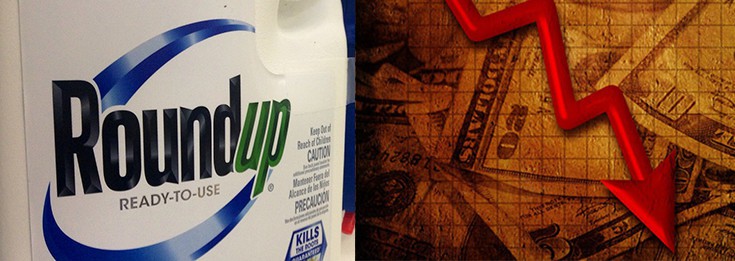
pesticides-roundup-money-profit-735-250Is this the beginning of the end for Monsanto? After reporting that the company is letting go of thousands of their workforce, the company is projecting not only weak sales of their GM corn, but also of one of their biggest, and now most controversial sellers – Roundup.
According to Reuters:
“Sales of corn seeds and traits, Monsanto’s key products, fell 5 percent to $598 million in the quarter. And sales at the company’s agricultural productivity unit, which includes Roundup herbicide, dropped 12 percent to $1.1 billion.”
Monsanto relies on its chemical herbicide sales for its shareholders, but since the World Health Organization’s IARC, and the state of California have announced that glyphosate, the main ingredient in Roundup, is probably carcinogenic, bans are cropping up all over the world. Even without formal bans, Swiss and German retail outlets are ditching Roundup due to customer concerns about the chemicals and their health.
The French minister has also asked retailers to stop selling Roundup. Lowe’s and Home Depot as well as other retailers in Europe have stopped selling Roundup, yet it is still sold in the US. Monsanto obviously can’t rely on American sales alone of its formerly best-selling chemical concoction to stay financially solvent.
Even when Monsanto was claiming that it was reducing the use of various herbicides to grow its GM seeds a few years back, Roundup sales were skyrocketing – but that doesn’t seem to be the case now.
Monsanto enjoyed some of its highest stock prices in 2008, but 2015 and 2016 aren’t looking as hot for Monsanto. Though I admit that Monsanto is still making TONS of money even with sales drops, a 12 percent decrease in sales in less than a quarter is terrible news for most companies. Monsanto will feel this pain as it becomes better known that its products are hazardous to the environment, the pollinators, our pets, and us. Maybe we can watch the biotech machine sputter out just as quickly as it rose to fame.