Monday, May 6, 2013

Just Like Iraq: U.S. Arms Butchers Who Use Chemical Weapons On Civilians … and Then Tries to Frame Someone Else

UN: Rebels – Not Syrian Government – Used Chemical Weapons          

UN investigator Carla Del Ponte said that there is strong evidence that the rebels used chemical weapons, but that there is not evidence that the government used such weapons:
This is not surprising.  Haaretz reported on March 24th, “Jihadists, not Assad, apparently behind reported chemical attack in Syria“.
The “rebels” in Syria that the U.S. has been arming and otherwise supporting are Al Qaeda and Muslim Brotherhood.
Unfortunately, history is repeating.
Specifically, the American government gave chemical weapons to Saddam Hussein … which he then used on Iran and on his own Kurdish population.
The American government attempted to blame Iran for the chemical weapons attack on Iraq’s Kurds … just as the U.S. is trying to blame the Syrian government for the attacks in Syria.
And see this.               

Serbs Accused Of Gassing Muslims -- Human-Rights Group Says U.S. Knew

WASHINGTON - Bosnian Serbs may have used chemical weapons against Muslims fleeing Srebrenica when the Serbs conquered the U.N. safe area in 1995, a leading human-rights group said yesterday.
A spokeswoman for Human Rights Watch said in congressional testimony the organization drew its conclusion based on its own investigation, a U.S. intelligence assessment, the fact that the Pentagon had conducted two investigations, and repeated hints from U.S. officials.
The Pentagon disputed the conclusion and challenged the group's credibility. "There is no evidence that any chemical weapons were used" by the Serbs against the Muslims, Col. Steve Campbell, a spokesman, told Newsday. He also said Human Rights Watch has "an agenda" and he could not understand why anyone would give them credibility.
Campbell said he was unaware of any investigation of the use of gas at Srebrenica.
Speaking before the House Foreign Affairs Subcommittee on Human Rights, Diane Paul said the Pentagon's first probe was in the summer of 1996 and was followed by a larger investigation. In late 1996, the U.S. intelligence community had information that chemical weapons "may have been used in Srebrenica," she said. Despite repeated requests, the Defense Department has refused to release the results of either probe, she said.
The weapon in question is thought to be BZ - a chemical-warfare agent that causes psychological and physical incapacitation - or a compound of BZ, she said. The gas was in the arsenal of the federal Yugoslav army before the breakup of the multiethnic Balkan state.
Human Rights Watch's statement came at the first congressional hearing on Srebrenica, the site of Europe's worst massacre since World War II, in which as many as 8,000 men and boys are presumed to have been killed. It was one of several disclosures that raised questions about the Pentagon's policy toward war crimes in the former Yugoslavia.
A Srebrenica survivor said the U.S. Army has daily dealings with Serb officials who either directed the killing or are familiar with it, but the U.S. military has refused to look into their past. Hasan Nuhanovic, 30, said the man who coordinated the executions was Dragomir Vlasic, the police chief in Zvornik, which, like Srebrenica, lies in the American zone.
He said he provided videotaped evidence documenting Vlasic's role to the U.S. military in Kalasija and to the international community's high representative, Carlos Westendorp, but neither would investigate. Last month, a Hague Tribunal investigator called on Vlasic, only to find he had gone into hiding.
Copyright (c) 1998 Seattle Times Company, All Rights Reserved.

Boston – Who did what to whom?

Amateur gun fight in Watertown – One brother armed – Zero tactics training – Standing in their own headlights

The postmortem of the Boston bombing begins – which includes identifying controlled deception and cover


   … by  Jim W. Dean, VT Editor        …with Press TV

  -  First published on May 3rd, 2013  -


Jahar planting his bomb behind the boy who was killed?
The smoke has cleared and the dust on the Boston bombing is finally beginning to settle a bit.
The frenzy on the Internet of everyone pouring over the huge number of images and appointing themselves instant photo analysts has cooled down somewhat, too.

But today we will drive the wooden stake through the heart of some of the god awful silly accusations that were made which has hurt the hunt for the truth.
We understand the public is hypersensitive about false flag attacks now. The 911 commission was considered a bad joke by a huge majority around the world, but that went nowhere.
The Bush administration and virtually all of America’s institutions acted like they did not care… the proof being that there was no major push for an under oath investigation. That was a huge mistake as it invited more attacks… and they came.
It’s good for people to be skeptical, but going too far plays into the hands of the bad guys as well meaning Internet sleuths can provide good cover for the professional deception crowd. This always takes the attention away from the most vulnerable areas any false flag perpetrators prefer to be ignored.
An experienced Intel analyst right off the bat is going to be hypersensitive about what is not being talked about and/or covered by media and investigators on the first day or two. That is where you start sniffing like a bird dog.
At Veterans Today we stuck our flag in the ground early on the bombing drill, once again, being conducted on the day of a major event. Yes it was in the morning, and in the vicinity of the start of the race while the bombing was at the end.
But this has happened so many times I think now that all live events that are going to have a Homeland Security drill should be canceled, or all those attending be made to sign a release waiver that they understand they might be blown up. After the first day media reports of the drill disappeared. Poof… and they were gone.
With that also went anomaly number two, the Craft security contractors who were so prominently visible at the finish line area with their silly hats and uniforms. The backpack fragment of the first bomb matched exactly one that was clearly photographed on an Israeli looking Craft contractor.
But… corporate media never mentioned a word about them, something that was an obvious and normal area of inquiry to even a rookie detective.
Tamerlan as a baby with mon and dad
That is a sign that the media was ‘waived off’ of the bombing drill and Craft presence on day one… a bad sign, but also a good one in that someone very high up wanted that shut down… and it was.
But there was more to it than was discussed on the Internet.
Security at these premiere events always goes to the top companies who have been around a long time with tons of experience.
The Olympics is a perfect example. It is the twelve days of Christmas for all the top security companies once every four years where all the best people are brought in.
But Craft Security broke that mold. They were young, with a dead founder shot here in Georgia just north of Atlanta a few months ago, and a working core of SEAL noncoms with no high-tech background. It would be impossible for such a company to get a gig like the Boston Marathon unless someone had ‘walked them in’ as it is called.
They were a front for somebody, most probably the usual, which was an Israeli partner, something set up during the Michael Chertoff days to hard wire Israeli espionage into learning where the holes in our defenses were.
Craft had state-of-the-art crowd surveillance equipment there, very very expensive. We saw it, but it had been withdrawn from the finish line target area, along with all their personnel, conveniently before the bombs went off.
We have time lapse video footage of them coming back but stopping at the finish line and calling in for instructions or permission to enter the bombing area… like maybe they were asking “Have they all gone off yet?”
The dome on the top of their unmarked van had a hyperspectral camera in it… space technology stuff. What it can do is classified. But there is one thing that it can’t pick up… and that has to do with how a tracking dog can follow a trail. It can’t pick up explosives in a pressure cooker if it has been prepared correctly.
Who told these totally untrained brothers to use the only delivery system that could defeat (and provide cover for the failure) a technology being use for the first time at an event like this? Do any of you think they were smart enough to figure that out on their own, or were just lucky?
Should everybody’s bags be checked, including all the security people?
The third anomaly for the day was the total absence of anyone asking why there were no bag searching procedures being carried out anywhere that we could see. That begs the question “Why have any security at all if you aren’t going to check the bomb bags?”
The fourth anomaly, which took several days to percolate up to the top was the sudden entry onto the scene publicly about pressure cooker bombs, like they were a standard. But there was a problem with that. They weren’t.
In Iraq and Afghanistan unexploded mortar and artillery shells were most commonly used where bigger is better. You can’t put one in a pressure cooker.
We asked around and people who should know, most of them had never heard of their being used much. But… it was presented to us in the early reports as a common terror tool, which it wasn’t.
We move on now to the most silly overreaction by the Internet sleuths, two stories in one actually. The photo of the man with his legs blown off being rolled away was up the morning after the bombing, on Info Wars… fast… almost too fast.
The story presented was that this poor man was a double amputee veteran, and ‘actor’ pretending to have had his legs blown off also came out fast. It had cover and deception all over it.
Numerous blogs and website pounded on it for days. It was a bogus story of course. While Paul Bauman was being photographed recovering with his family at this bedside his local history being covered in the local Boston news.
Despite this, the Internet sleuths were running wild with their ‘actors’ story as proof of a false flag, but one that was obviously going to be shot down in flames. This was a perfect example of cover and deception, a text book case.
Craft command vehicle with space technology hyperspectral camera under the dome on the back which sniffs molecules – which a kettle bomb can defeat
Next we have the NeoCon/Zionist Lobby diversion. They wanted to connect al-Qaeda to the bombing via Tamerlane’s trip home to Daghastan for terror training, and for those who would not buy that, tag the Russians for ‘not telling us more’ about Tamerlane. We have also shot this down in flames as these two were rank amateurs, and we have proof they were totally untrained.
One, they seem to have used fireworks powder, something that is hard to get in the New England states and of low explosive power. Any trained bomber would have bought a bag of fertilizer, a container of diesel fuel to make a slurry, with one other ingredient that I will not name, and for ten dollars could have take off the fronts of the buildings.
And second, we have a dead giveaway photo of the crazy tactical situation where Tamerlane decided to engage the pursuing cops. Rather than pull the van sideways across the street to provide more cover, and block the smaller car from having its tires shot out so they could escape, they just parked them on the right and left sides of the street.
They then took up a firing position in the front of the hijacked Mercedes SUV.
But they did something very stupid which is immortalized in the twitter photo taken from a resident shooting right down on them. The Brothers Tsarnaev left the headlights of the Mercedes on, then went and stood right in front of the car to have a night time shoot out. When I saw this photo (above at top) my first thought was, “Nobody could be this stupid… it’s impossible.”
This is Jeff Bauman with his legs blown off. It is not the vet double amuptee that idiots focused on because they wanted to. And this is not fake blood. You can ask Jeff Bauman because he can tell you who it belonged to. It was his.
There was a large segment of the Internet crowd that preferred the patsy theory where they had nothing to do with the bombing. The Mercedes carjacking victim, the luckiest person in all of Boston in this whole event, got Tamerlane’s confession. This Chinese guy was smart enough to figure out that the only reason Tamerlane told him was because he was planning to kill him. After all, he said he had just killed a cop.
The Internet sillies can claim all they want that the Chinese guy could be lying, but what would be his motive? He is thrilled to just be alive and wants no publicity, as would I.
And lastly, Tamerlane’s roommates are on record now for trying to hide the bomb-making materials they threw out and the FBI had to dig out of the landfill.
You can add to that Dzhokhar’s claiming his brother was the mastermind and one of the roommate’s admission that Dzhokhar told him a month ago that he knew how to make a bomb. So the case of the brothers taking an innocent stroll over to the Marathon finish line that Sunday has some major problems with it.
What do we think at VT… and our counter Intel sources? We suspect that the kids were being monitored by ‘another group’, and were allowed to walk the bombs in… by somebody knowing that there was no bag checking and Craft Security would do nothing.
This was done/allowed by someone who already had a good bit of experience doing such things. I will let you guess who that is, and you will probably be right.
_________________________________

Related Posts:

  • No Related Posts
Short URL: http://www.veteranstoday.com/?p=250861
The views expressed herein are the views of the author exclusively and not necessarily the views of VT or any other VT authors, affiliates, advertisers, sponsors or partners. Legal Notice

In America’s Backyard: China’s Rising Influence In Latin America

Source: WC
BEIJING - China is busy in America’s backyard.
Over the past five years, Chinese businesses have been expanding their footprint in Latin America in a number of ways, beginning with enhanced trade to ensure a steady supply of bulk commodities such as oil, copper and soybeans. At this year’s Boao Forum for Asia, for the first time a Latin American sub-forum was created that included the participation of several heads of state from the region.
Since 2011, China has overtaken the Netherlands to become Latin America’s second biggest investor behind the United States. China has signed a series of large cooperation agreements with Latin American countries in such fields as finance, resources and energy.
According to the latest statistics of the General Administration of Customs of China, Sino-Latin American trade grew in 2012 to a total of $261.2 billion, a year-on-year increase of 8.18%.
This trend risks undermining the position of the United States as Latin America’s single dominant trading partner. In 2011, the U.S.-Latin American trade volume was $351 billion.
Some prominent Chinese have condemned the United States’ high-profile Return to Asia strategy, with its intention of “containing China’s front door.” Shouldn’t the United States, which put forward the Monroe Doctrine two centuries ago, also question how China is quietly arriving in America’s backyard?
An American blind spot?
In their book America’s Blind Spot: Chavez, Oil, and U.S. Security, Andres Cala and Michael J. Economides avoid the usual patter of linking South America’s “China factor” with some sordid conspiracy theory. Instead, they investigate Latin America’s subtle choice between China and the United States, attributing Washington’s weakened influence in the region to its failure in foreign policy and economic development — while China rises on the back of globalization.
Since 1823, when America put forward the Monroe Doctrine and declared its sphere of influence to Europeans, it has maintained the unique position of the United States in the Americas.
Military intervention has always served as the most important tool for the United States. Especially after the start of the Cold War, in order to curb Communism from taking root in Latin America, the U.S. used military means largely without restraint.
After the collapse of the Soviet Union, the United States faced new external challenges such as the threat of global terrorism. Latin America’s strategic significance has quickly slipped to a secondary and more local ranking. The United States has shifted its focus in Latin America to specific issues such as illegal immigration and drug smuggling.
The “realism” that ran through America’s foreign policy during the Cold War has gradually transformed towards “idealism,” which in consequence weakens its influence in Latin America.
Under the doctrine of realism, America broke any illusion of moral constraint in its foreign interventions; the protection of American interests was its pragmatic principle. Washington didn’t care that some Latin American countries were dictatorial or that they violated human rights, as long as their leaders firmly stood on the side of the anti-Communist camp.
Since adopting idealism, America considers that whatever is best for itself is also best for the rest of the world. Its foreign policy is aimed at maintaining democracy, human rights and a free market economy around the world. America began to demand that its former dictatorial allies quit their attachment to power and carry out a transition to democracy. Since 1989, the U.S. has pushed Latin American countries — many facing a severe debt crisis — to accept the “Washington Consensus” oriented by market economy theory.
The ultimate goal set by this theory may not be a problem. However, it did not pull Latin America out of the quagmire of its “lost decade” of the 1980s. In the 1990s, Latin America suffered another severe economic downturn, which exacerbated the division between the rich and the poor — leading to serious social problems. The idealism exported by the United States intensified the existing contradictions in Latin American society, and eventually led to the downfall of most of the brutal totalitarian military governments.
China as a new favorite
Initially, China’s activities in Latin America were limited to the diplomatic level. By providing funds and assisting in infrastructure constructions, China managed to interrupt diplomatic ties between poor Latin countries and Taiwan. Since then, with China’s economic boom, the supply of energy and resources has gradually become a problem that plagues China — and its exchanges with Latin America thus are endowed with real substantive purpose.
Among the numerous needs of China, the demand for oil has always been the most powerful driving force. In the past 30 years, China has consumed one-third of the world’s new oil production and become the world’s second-largest oil importer. More than half of China’s oil demand depends on imports, which increases the instability of its energy security. Diversification is inevitable. In this context, Latin America and its huge reserves and production capacity naturally became a destination for China.
China must better protect its energy supply, and can’t just play the simple role of consumer. It must also help solidify the important links of the petroleum industry supply chain. Indeed, the China National Petroleum Corporation frequently appears in Latin American countries, and China’s investment and trade in the Latin American countries are also focused on its energy sector.
In the opinion of many European and American scholars, China’s current practice isn’t much different from that of Western colonizers of the last century. These scholars believe that China doesn’t care about local human rights or the state of democracy when dealing with countries. All China is interested in is establishing long-term, stable economic relations. This realistic path is exactly opposite to that of America’s newfound idealism. Thus China has become a close collaborator of certain Latin American countries, such as Venezuela, that are in sharp conflict with the United States.
The global financial crisis of 2008 was a chance for China to become an increasingly important player in Latin American. As Europe and the United States were caught in a financial quagmire, China, with nearly $3 trillion of foreign exchange reserves as backing, embarked on “funds-for-assets” transactions with Latin American countries.
So what does China want exactly in entering Latin American? Is it to obtain a stable supply of energy and resources, and thus inadvertently acquire political influence? Or the other way round?
Presumably most U.S. foreign policy-makers are well aware of the answer.
China’s involvement in the Latin American continent doesn’t constitute a threat to the United States, but brings benefits. It is precisely because China has reached “loans-for-oil” swap agreements with Venezuela, Brazil, Ecuador and other countries that it brings much-needed funds to these oil-producing countries in South America. Not only have these funds been used in the field of oil production, but they have also safeguarded the energy supply of the United States, as well as stabilized these countries’ livelihood — and to a certain extent reduced the impact of illegal immigration and the drug trade on the U.S.
For South America, China and the United States, this is not a zero-sum game, but a multiple choice of mutual benefits and synergies. Even if China has become the Latin American economy’s new upstart, it is still not in a position to challenge the strong and diverse influence that the United States has accumulated over two centuries in the region.
Read the article in the original language.

Deep Underground Military Base Intelligence Briefing

Deep Underground Military Base Intelligence Briefing – Intellihub.com Launches Intelligence Briefing Series

Intelligence Briefing

Denver’s International Airport
Completed in 2004, the massive, 1,200- by 240-foot facility features a striking “mountain range” canopy that utilizes Birdair’s innovative steel cable systems and durable PTFE Teflon-coated fabric membrane.
By Avalon & Shepard Ambellas 
Intellihub.com
May 1, 2013
Deep Underground Military Bases exist and have been the subject of Conspiracy Theorist for some time. Intellihub.com has extensively researched Deep Underground Military Bases, the technologies used to dig them and the players involved in this Highly Classified area of the Military Industrial Complex.
One of the most significant Underground Military Bases was built during the Cold War near Washington, DC. And still exists today – The Greenbrier, located just outside the town of White Sulphur Springs in Greenbrier County, West Virginia, United States. According to Wikipedia:
The Greenbrier is also the site of a massive underground bunker that was meant to serve as an emergency shelter for the United States Congress during the Cold War. It was code named “Project Greek Island” and Fritz Bugas was former on-site Superintendent.[5][6]
In the late 1950s, the U.S. government approached The Greenbrier for assistance in creating a secret emergency relocation center to house Congress in the aftermath of a nuclear holocaust. The classified, underground facility, named “Project Greek Island“,[14] was built at the same time as the West Virginia Wing, an above-ground addition to the hotel, from 1959 to 1962.
Although the bunker was kept stocked with supplies for 30 years, it was never actually used as an emergency location, even during the Cuban Missile Crisis. The bunker’s existence was not acknowledged until Ted Gup of the The Washington Post revealed it in a 1992 story; immediately after the Post story, the government decommissioned the bunker. The facility has since been renovated and is also used as a data storage facility for the private sector. It is featured as an attraction in which visitors can tour the now declassified facilities, known as The Bunker. Source: The_Greenbrier
The PBS documentary Race for the Superbomb features a tour of The Greenbriar Bunker (see Tour a Secret Government Bunker) and describes how the bunker was developed – in plain sight.
On December 12, 1958, at the height of the Cold War, an article in a West Virginia newspaper stated that the “Chesapeake and Ohio Railway announced plans today for the construction of an Exhibit Hall adjacent to the auditorium of the Greenbrier hotel. The cost of the project was not disclosed.” Little did readers of the newspaper article know that the announcement signaled the start of thirty-five years of deception and intrigue deep in the mountains of West Virginia.
One of the modern day Military Bases known to many is Mount Weather Emergency Operations Center which is a civilian command facility in Virginia, and is the center of operations for the Federal Emergency Management Agency (FEMA). Also known as the High Point Special Facility (HPSF), its preferred designation since 1991 is “SF”.[1] According to Wikipedia, the facility is a major relocation site for the highest level of civilian and military officials in case of national disaster, playing a major role in U.S. continuity of government (per the Continuity of Operations Plan).[2]
According to a letter to the editor of the The Washington Post after the September 11 attacks, most of the congressional leadership was evacuated to Mount Weather by helicopter.[7][12][13] Mount Weather is mentioned extensively in Milton William Cooper‘s 1991 book Behold A Pale Horse.
Source: Mount_Weather_Emergency_Operations_Center
Continuity of Government is the key to understanding the purpose and reason bases are in certain locations. Continuity of Government COG dates back to the Cold War and extends to the present day – including REX 84 which was initiated by President Ronald Reagan.
The Raven Rock Mountain Complex (RRMC) is a United States government facility on Raven Rock, a mountain in the U.S. state of Pennsylvania. It is located in Liberty Township, Adams County, about 14 km (8.7 mi) east of Waynesboro, Pennsylvania, and 10 km (6.2 mi) north-northeast of Camp David, Maryland. It is also called the Raven Rock Military Complex, or simply Site R. Other designations and nicknames include “The Rock”, NMCC-R (for National Military Command Center Reservation), ANMCC (for Alternate National Military Command Center), AJCC (for Alternate Joint Communications Center), “Backup Pentagon“, or “Site RT”; the latter refers to the vast array of communication towers and equipment atop the mountain. Colloquially, the facility is known as an “underground Pentagon”.[1]
Source: Raven_Rock_Mountain_Complex
Interestingly, according to Wikipedia, planning for the Raven Rock Mountain Complex site began in 1948. After the Soviet Union detonated its first nuclear weapon in 1949, a high priority was established for the Joint Command Post to be placed in a protected location near Washington, D.C., for swift relocation of the National Command Authorities and the Joint Communications Service.
One might be wondering how these Underground Bases are built. Essentially, the same technology used decades ago is still in use today, although it is far more advanced. The use of tunnel boring machines (TBM) are the primary means of tunneling and creating pathways to Deep Underground Military Bases. TBM technology is advanced to the point that miles of tunnel can be completed in days – although there are Classified Reports that speak of rock deflagration and lasers which can tunnel at extremely high rates.
In researching Deep Underground Military Bases, one comes across much information. Some might be considered plausible, some hard to believe, yet knowing that the US Government maintains one of the highest levels of Secrecy when it comes to Department of Defense matters, then the impossible might actually be possible. Occasionally one comes across unclassified documents  that help put pieces of the puzzle together – one such document covers Deep Underground Bases. Many bases are actually mentioned, including Denver International Airport, which is detailed in the following excerpt.
According to Phil Schneider who worked for 17 years (11 spent at Groom Lake) as a geologist, aerospace engineer, and structural engineer (with a Level 3 Security Clearance) for the US Government; as of 1995 there were 131 deep underground military bases (DUMBs) in the US(with 127 in the lower 48 states). He personally worked on 13 of them, including additions on to Groom Lake, S-2, and S-4. He said they have been building them day and night (producing 2 ayear), unceasingly, since the early 1940s, with some even in existence before that. The oldest bases are generally about 500 feet deep, and are mostly used for equipment storage. Schneider co-invented a method for shape-charge blasting, and laser rock deflagration (the rock literally melts and turns to powder) which allows them to make 7 miles of tunnel a day (28 feet in diameter).The late Thomas Edwin Castello, who worked within the underground ‘Dulce’ facility, suggested that the early experiments by Rand and Los Alamos labs in nuclear-powered ‘earth-boring’ technology had been taken to the extreme. In a letter dated Sept. 1990, he made mention of the nuclear boring mechanisms which can allegedly bore a tunnel through the earth at a rate of 5-10mph by cracking the surrounding rock, heating the rock and earth into a state of liquid incandescence using super-hot cones, pulsed lasers and other methods (see: U.S. Patent numbers 3,881,777; 3,885,832 and 3,693,731 for instance, via their Patent Search engine which can be easily accessed by doing a “web search” of the “United States Patent Office”), then pressing the liquid or molten rock into the peripheral cracks where the cold earth cools and solidifies it in a matter of minutes, leaving no leftover materials that would otherwise have to be removed from the tunnel, as in more traditional and expensive tunneling or mining operations. The September, 1983 (pg. 80) issue of Omni  Magazine, has a color drawing of “The Subterrene,” the Los Alamos nuclear-powered tunnel machine that burrows through the rock deep underground, by heating whatever stone it encounters into molten rock (magma), which then cools after the machine has moved on. The result is a tunnel with a smooth, glazed lining. According to Richard Sauder, PhD, author of the book Underground Bases and Tunnels: What Is the Government Trying To Hide, the nuclear Subterrene was developed at the Los Alamos National Laboratory, in New Mexico. A number of patents were filed by scientists at Los Alamos, and a few federal technical documents were written. The United States Atomic Energy Commission and the United States Energy Research and Development Administration took out Patents in the 1970s for nuclear Subterrenes. The first patent, in 1972 went to the U.S. Atomic Energy Commission. They work by melting their way through the rock and soil, actually vitrifying it as they go, and leaving a neat, solidly glass-lined tunnel behind them. The heat is supplied by a compact nuclear reactor that circulates liquid lithium from the reactor core to the tunnel face, where it melts the rock. In the process of melting the rock the lithium loses some of its heat. It is then (page 98) circulated back along the exterior of the tunneling machine to help cool the vitrified rock as the tunneling machine forces its way forward. The cooled lithium then circulates back to the reactor where the whole cycle starts over. In this way the nuclear Subterrene slices through the rock like a nuclear powered, 2,000° F earthworm, boring its way deep underground. They have an advantage over mechanical machines in that it produces no debris that must be disposed of by conveyors, trains, trucks, etc. This greatly simplifies tunneling, and makes tunnels very hard to detect, for the simple reason that there would not be the tell-tale dumps thatare associated with the conventional tunneling activities. The 1972 (September 26) US Patent (No. 3,693,731) states: “…debris may be disposed of as melted rock both as a lining for the hole and as a dispersal in cracks produced in the surrounding rock. The rock-melting drill is of a shape and is propelled under sufficient pressure to produce and extend cracks in solid rock radially around the bore by means of hydrostatic pressure developed in the molten rock ahead of the advancing rock drill penetrator. All melt not used in glass-lining the bore is forced into the cracks where it freezes and remains …”Three years later, there was another patent for– a tunneling machine for producing large tunnels in soft rock or wet, clayey, unconsolidated or bouldery earth by simultaneously detaching the tunnel core by thermal melting a boundary kerf into the tunnel face and forming a supporting excavation wall liner by deflecting the molten materials against the excavation walls to provide, when solidified, a continuous wall supporting liner, and detaching the tunnel face circumscribed by the kerf with powered mechanical earth detachment means and in which the heat requiredfor melting the kerf and liner material is provided by a compact nuclear reactor. This May 6, 1975 patent further specifies that the machine is intended to excavate tunnels up to40 feet in diameter or more. The kerf is the outside boundary of the tunnel wall that a boring machine gouges out as it bores through the ground or rock. So, in ordinary English, this machine will melt a circular boundary into the tunnel face. The melted rock will be forced to theoutside of the tunnel by the tunnel machine, where it will form a hard, glassy tunnel. And yet a third patent was issued to the United States Energy Research and Development Administration just 21 days later, on May 27, 1975 for a machine remarkably similar. The abstract describes– a tunneling machine for producing large tunnels in rock by progressive detachment of the tunnel core by thermally melting a boundary kerf into the tunnel face and simultaneously forming an initial tunnel wall support by deflecting the molten materials against the tunnel walls to provide, when solidified, a continuous liner; and fragmenting the tunnel core circumscribed by the kerf by thermal stress fracturing and in which the heat required for such operations is supplied by a compact nuclear reactor. This machine would also be capable of making a glass-lined tunnel of 40 feet in diameter or more. On the next 2 pages are pictures of tunneling machines that have been used to create the tunnels and underground areas that are part of the extensive subterranean military presence.
[…]
Not only did locals not want this airport built nor was it needed, but everything was done to make sure it was built despite that. Constructed in 1995, the government and politicians were persistent on building this airport in spite of it ending up way over budget. There were charges of corruption, and reports of constant construction company changes, and mass firings of teams once they had built a particular section, so that no one group had any idea what the blueprint of the airport was. There is a Deep Underground Military Base located underneath the Denver International Airport, which goes down at least 8 and possible 10 levels, and a 4.5square mile area. There are reports of electronic/magnetic vibrations which make some people sick and cause headaches in others. There are acres of fenced-in areas which have barbed wire pointing into the area as if to keep things in, and small concrete stacks that resemble mini-cooling towers rising out of the acres of nowhere to apparently vent underground levels.
There were reports of 5 buildings that were constructed and later buried, tram-like tunnels with sprinkler pipes overhead at intervals of 5-6 feet, a 40-foot shaft leading to a restricted area, several terraced areas that go down into the earth, and a restricted “bio-hazard” area. This is also a staging area for military vehicles and equipment to be used when martial law is announced. Then there are Masonic symbols, bizarre murals, and strange artwork (pictured below), as well as a time capsule– none of which is featured in the airport’s web site section detailing the unique artwork throughout the building.
Source: THE UNDERGROUND MILITARY BASES for 32542033 the Rivera Reports  page 97

Source & Research:
TBM/Tunneling Video
http://youtu.be/qx_EjMlLgqY
145,754 views
Uploaded on Dec 8, 2011
Herrenknecht tunneling video, demonstrating tunnel boring machine operation.

The Ultimate Congressional Hideaway
By Ted Gup
Sunday, May 31, 1992; Page W11
The Washington Post


Document 29: Greg Duckworth, Defense Advanced Research Projects Agency, Counter Underground Facilities, 2004. Unclassified.
Source: Defense Advanced Research Projects Agency.

This briefing identifies different varieties of underground facilities and assorted means for detecting them.

Disclaimer:
The views expressed in Intellihub.com articles are the sole responsibility of the author(s) and do not necessarily reflect those of the Intellihub.com. Intellihub.com will not be held responsible or liable for any inaccurate or incorrect statements contained in Intellihub.com articles. Intellihub.com reserves the right to remove articles from the website.

*****
Avalon is an Investigative Journalist and Strategist working for Intellihub.com


Disclaimer:

The views expressed in Intellihub.com articles are the sole responsibility of the author(s) and do not necessarily reflect those of the Intellihub.com. Intellihub.com will not be held responsible or liable for any inaccurate or incorrect statements contained in Intellihub.com articles. Intellihub.com reserves the right to remove articles from the website.
*****

Recovery?: One-In-Five Britons Borrow Money To Afford To Eat

Tyler Durden's picture


http://www.zerohedge.com/news/2013-05-05/recovery-one-five-britons-borrow-money-afford-eat

While GBP jumped and the world celebrated the UK's recent avoidance (for now) of a triple-dip recession (defined on GDP as opposed to reality), the situation in the island nation appears to be going from bad to worse. As Carney takes over the reigns of this once mighty nation he faces a country deeply divided. As the BBC reports, while London real estate prices smash old records, a stunning one-in-five households borrowed money or used savings to cover the costs of food in April. This is the equivalent of five million households unable to fund their food via income alone. Over 80% of these people are concerned about rising food prices (just as print-meister Carney is about to go 'Abe' on them) and almost 60% find it difficult to cope on their current incomes. The director of the consumer group 'Which?', noted that "many households are stretched to their financial breaking point," as "families face a cost of living crisis." While equity and real estate prices hit all-time highs, the opposition sums up the country's feeling, "this incompetent government needs to wake up to the human cost of their failed economic policies."
Over one-third of Britons "feel squeezed"...


Via BBC,
One in five UK households borrowed money or used savings to cover food costs in April, a Which? survey says.

It suggests the equivalent of five million households used credit cards, overdrafts or savings to buy food.

...

The figures come despite official statistics last week showing that personal insolvencies had dropped to their lowest levels in five years.

...

Results showed that of the households who resorted to using credit or savings to pay for food, most were low income families. Among this group:
  • Eight out of 10 (82%) worried about food prices
  • More than half (55%) said they were likely to cut back on food spending in the next few months
  • Nearly six out of 10 (57%) said they found it difficult to cope on their current income
  • A third (32%) borrowed money from friends and family in April

A typical weekly food bill averages about £76, Which? researchers said, up 4% on last year.

Of all the people polled, the research showed:
  • A quarter said they were living comfortably on their incomes
  • More than a third - 36% - felt their finances were under pressure
  • Almost one third - 31% - of those surveyed cut back spending on essentials last month, and they were most likely to be women aged between 30 and 49.
...

Mr Lloyd, Which? executive director, said: "Our tracker shows that many households are stretched to their financial breaking point, with rising food prices one of the top worries for squeezed consumers.

...

Mary Creagh, Labour's shadow environment secretary, said the UK was facing a "growing epidemic of hidden hunger".

"Families face a cost of living crisis and are being forced into debt or to use their savings simply to put food on the table.

"This incompetent government needs to wake up to the human cost of their failed economic policies and change course now," she added.
...

US suicide rates surge, surpass road fatalities

good news America  Nazi-pol-o-see ,Hellery Rodman-Hell-after yer -ass-inton , Herr Dr. No- Ding-ole -ling -yer =momma , Piles (pussy face) Mor-Guns  & the nit-wit BANNER crowd ! ... as of NOW  ALL  suicides ! in any manner  ... R banned effective  NOW !!! ... by executiveeee order #  blah,blah blah   um ah oh yea can't fer get D. Fuck-in-steen  another co-sign eeeeee    Banned  all suicides  yep  BANNED !  the crowd roars   chant-tingly down Cris Mad -thyou's  leg   ahhhhhhhhhhhh uhhhhhhh ummmmmm  ...the mad-si-uh is amongst us'ins

US suicide rates surge, surpass road fatalities

Published time: May 03, 2013 
AFP Photo / David Mcnew
More Americans now die of suicide than from car accidents, according to the Centers for Disease Control and Prevention, a disturbing statistic that some experts say points to the true depths of the US economic crisis.
From 1999 to 2010, the suicide rate among US citizens between the ages of 35 to 64 soared by about 30 per cent, to 17.6 deaths per 100,000 people, a jump from 13.7.

In 2010, there were 33,687 deaths from motor vehicle crashes and 38,364 suicides.

Although suicide has been traditionally viewed as a problem among the youth and elderly, the recent study, published in Friday’s issue of its Morbidity and Mortality Weekly Report, shows a marked rise in the number of suicides among middle-aged men and women.

The suicide rate for men aged 35–64 years jumped 27.3 per cent, from 21.5 to 27.3 per 100,000, while the rate for women increased 31.5 per cent, from 6.2 to 8.1.

Among the male population, the greatest increases were among those aged 50–54 years and 55–59 years, (49.4 per cent, from 20.6 to 30.7, and 47.8 per cent, from 20.3 to 30.0 respectively). Among females, suicide rates tended to increase with age. The largest percentage increase in suicide rate was observed among women aged 60–64 years (59.7 per cent, from 4.4 to 7.0).
AFP Photo / David Mcnew
Men were more likely to take their own lives than women. The suicide rate for middle-aged men was 27.3 deaths per 100,000, while for women it was 8.1 deaths per 100,000.
Suicide rates from 1999 to 2010 “increased significantly” across all four geographic areas and in 39 states. The state of Wyoming recorded the highest increase in suicides with a 78.8 per cent jump (31.1 per 100,000), while even the sunny state of Hawaii witnessed a 61.2 per cent increase (21.9 per 100,000).
As shocking as the newly released data on US suicide rates are, many believe the numbers are too low since many deaths are not treated as actual suicides.
“It’s vastly under-reported,” Julie Phillips, an associate professor of sociology at Rutgers University, told The New York Times. “We know we’re not counting all suicides.”

Baby Boomer crisis


CDC officials emphasized that the Baby Boomer generation is witnessing the highest increase in suicides (A Baby Boomer is a person who was born post-World War II, between the years 1946 and 1964, when the annual birthrate increased dramatically in the US).

“It is the Baby Boomer group where we see the highest rates of suicide,” CDC deputy director, Dr. Ileana Arias, told the New York Times. “There may be something about that group, and how they think about life issues and their life choices that may make a difference.”

The rise in suicides among this group may be connected with the recent downturn in the global economy and the challenges the Baby Boomer generation must now confront.

“The increase does coincide with a decrease in financial standing for a lot of families over the same time period,” Arias said.

In 2010, the first year of economic comeback following the 2009-2010 recession, 93 per cent of all pre-tax income gains went to the top 1 per cent of the American population, which in that year meant any household earning more than $358,000.

Is financial crisis spurring suicide?


Is the rash of suicides across a broad spectrum of the American population a direct result of the wealth hoarding by the top income earners in the United States?

In a letter to The Lancet medical journal, scientists from Britain, Hong Kong and United States said an analysis of data from Centers for Disease Control and Prevention indicated that while suicide rates increased slowly between 1999 and 2007, the rate of increase more than quadrupled from 2008 to 2010, Reuters reported.

"There is a clear need to implement policies to promote mental health resilience during the ongoing recession," said Aaron Reeves of Britain's University of Cambridge, who headed the research and submitted it in a letter to The Lancet.
AFP Photo / Getty Images / Spencer Platt
Reeves even suggested the Democrats and Republicans are partially to blame for not throwing a spotlight on the issue during the latest presidential campaign.
"In the run-up to the US presidential election, President Obama and Mitt Romney are debating how best to spur economic recovery, [but] missing from this discussion is consideration of how to protect Americans' health during these hard times," Reeves warned.
Meanwhile, preliminary research suggests that the risk for suicide will unlikely subside for future generations.
“The boomers had great expectations for what their life might look like, but I think perhaps it hasn’t panned out that way,” Phillips said.
“All these conditions the boomers are facing, future cohorts are going to be facing many of these conditions as well.” The study pointed to the increased usage of prescription painkillers, like oxycodone, which can be particularly deadly in large doses.
There was a significant jump in poisoning deaths, which include intentional overdoses of prescription medication. During the 10-year period, poisoning deaths were up 24 per cent over all, while death by suffocation, (including hangings) was up 81 per cent.
Robert Bridge is the author of the book, Midnight in the American Empire, which discusses the dangerous consequences of excessive corporate power in the United States.

11 Reasons Why The Federal Reserve Should Be Abolished

The Federal ReserveIf the American people truly understood how the Federal Reserve system works and what it has done to us, they would be screaming for it to be abolished immediately.  It is a system that was designed by international bankers for the benefit of international bankers, and it is systematically impoverishing the American people.  The Federal Reserve system is the primary reason why our currency has declined in value by well over 95 percent and our national debt has gotten more than 5000 times larger over the past 100 years.  The Fed creates our "booms" and our "busts", and they have done an absolutely miserable job of managing our economy.  But why do we need a bunch of unelected private bankers to manage our economy and print our money for us in the first place?  Wouldn't our economy function much more efficiently if we allowed the free market to set interest rates?  And according to Article I, Section 8 of the U.S. Constitution, the U.S. Congress is the one that is supposed to have the authority to "coin Money, regulate the Value thereof, and of foreign Coin, and fix the Standard of Weights and Measures".  So why is the Federal Reserve doing it?  Sadly, this is the way it works all over the globe today.  In fact, all 187 nations that belong to the IMF have a central bank.  But the truth is that there are much better alternatives.  We just need to get people educated.
The following are 11 reasons why the Federal Reserve should be abolished...
#1 The Greatest Period Of Economic Growth In The History Of The United States Happened When There Was No Central Bank
Did you know that the greatest period of economic growth in U.S. history was between the Civil War and 1913?  And guess what?  That was a period when there was no central bank in the United States at all.  The following is from Wikipedia...
The Gilded Age saw the greatest period of economic growth in American history. After the short-lived panic of 1873, the economy recovered with the advent of hard money policies and industrialization. From 1869 to 1879, the US economy grew at a rate of 6.8% for real GDP and 4.5% for real GDP per capita, despite the panic of 1873.  The economy repeated this period of growth in the 1880s, in which the wealth of the nation grew at an annual rate of 3.8%, while the GDP was also doubled.
So if our greatest period of economic prosperity was during a time when there was no Federal Reserve, then why shouldn't we try such a system again?
#2 The Federal Reserve Is Systematically Destroying The Value Of The U.S. Dollar
The United States never had a persistent, ongoing problem with inflation until the Federal Reserve was created in 1913.
If you do not believe this, just check out the inflation chart in this article.
The Federal Reserve systematically penalizes those that try to save their money.  Inflation is a tax, and the value of each one of our dollars goes down a little bit more every single day.
But over time, it really adds up.  In fact, the value of the U.S. dollar has fallen by 83 percent since 1970.
Anyone that goes to the grocery store on a regular basis knows how painful inflation can be.  The following is a list that shows how prices for many of the things that we buy on a regular basis absolutely skyrocketed between 2002 and 2012...
Eggs: 73%
Coffee: 90%
Peanut Butter: 40%
Milk: 26%
A Loaf Of White Bread: 39%
Spaghetti And Macaroni: 44%
Orange Juice: 46%
Red Delicious Apples: 43%
Beer: 25%
Wine: 60%
Electricity: 42%
Margarine: 143%
Tomatoes: 22%
Turkey: 56%
Ground Beef: 61%
Chocolate Chip Cookies: 39%
Gasoline: 158%
Even the price of water has absolutely soared in recent years.  According to USA Today, water bills have actually tripled over the past 12 years in some areas of the country.
So how can the Federal Reserve get away with claiming that we are in a "low inflation" environment?
Well, what Ben Bernanke never tells you is that the way that the government calculates inflation has changed more than 20 times since 1978.
The truth is that the real rate of inflation is somewhere between five and ten percent right now, but you will never hear about this on the mainstream news.
#3 The Federal Reserve Is A Perpetual Debt Machine
The Federal Reserve system was designed to be a trap.  The intent of the bankers was to trap the U.S. government in an endless debt spiral from which it could never possibly escape.
But most Americans don't understand this.  In fact, most Americans don't even understand where money comes from.
If you don't believe this, just go out on the street and ask regular people where money comes from.  The responses will be something like this...
"Duh - I don't know.  I've got to get home to watch American Idol."
This is why it is so important to get people educated.  I think that most Americans would be horrified to learn that the creation of more money in our system also involves the creation of more debt.
The following is a summary of money creation that comes from one of my previous articles...
When the U.S. government decides that it wants to spend another billion dollars that it does not have, it does not print up a billion dollars.
Rather, the U.S. government creates a bunch of U.S. Treasury bonds (debt) and takes them over to the Federal Reserve.
The Federal Reserve creates a billion dollars out of thin air and exchanges them for the U.S. Treasury bonds.
So what does the Federal Reserve do with those Treasury bonds?  I went on to explain what happens...
The U.S. Treasury bonds that the Federal Reserve receives in exchange for the money it has created out of nothing are auctioned off through the Federal Reserve system.
But wait.
There is a problem.
Because the U.S. government must pay interest on the Treasury bonds, the amount of debt that has been created by this transaction is greater than the amount of money that has been created.
So where will the U.S. government get the money to pay that debt?
Well, the theory is that we can get money to circulate through the economy really, really fast and tax it at a high enough rate that the government will be able to collect enough taxes to pay the debt.
But that never actually happens, does it?
And the creators of the Federal Reserve understood this as well.  They understood that the U.S. government would not have enough money to both run the government and service the national debt.  They knew that the U.S. government would have to keep borrowing even more money in an attempt to keep up with the game.
Men like Thomas Edison and Henry Ford could not understand why we would adopt such a foolish system.  For example, Thomas Edison was once quoted in the New York Times as saying the following...
That is to say, under the old way any time we wish to add to the national wealth we are compelled to add to the national debt.
Now, that is what Henry Ford wants to prevent. He thinks it is stupid, and so do I, that for the loan of $30,000,000 of their own money the people of the United States should be compelled to pay $66,000,000 — that is what it amounts to, with interest. People who will not turn a shovelful of dirt nor contribute a pound of material will collect more money from the United States than will the people who supply the material and do the work. That is the terrible thing about interest. In all our great bond issues the interest is always greater than the principal. All of the great public works cost more than twice the actual cost, on that account. Under the present system of doing business we simply add 120 to 150 per cent, to the stated cost.
But here is the point: If our nation can issue a dollar bond, it can issue a dollar bill. The element that makes the bond good makes the bill good.
Unfortunately, today most Americans don't even understand how the system works.  They just assume that we have the best system in the entire world.
Sadly, the reality is that the system is working just as the international bankers that designed it had hoped.  The United States has the largest national debt in the history of the world, and we are stealing more than 100 million dollars from our children and our grandchildren every single hour of every single day in a desperate attempt to keep the debt spiral going.
#4 The Federal Reserve Is A Centrally-Planned Financial System That Is The Antithesis Of What A Free Market System Should Be
Why do we need someone to centrally-plan our financial system?
Isn't that the kind of thing they do in communist China?
Why do we need someone to tell us what interest rates are going to be?
Why do we need someone to determine what "the target rate of inflation" should be?
If we actually had a free market system, the free market would be the one "managing" our economy.
But instead, we have become so accustomed to central planning that any alternatives seem to be absolutely unthinkable.
For example, CNBC cannot possibly imagine a world where the Fed (or some similar institution) was not running things...
But suppose the law were taken off the books? The Fed's job—in simple terms—is to manage the nation's money supply and achieve the sometimes-conflicting tasks of full employment, stable prices while fighting inflation or deflation.
How would the U.S. economy then function? Something has to take its place, right?
Global markets would also need some sort of economic direction from the U.S. The Fed manages the dollar — and as the world's leading currency, a void left by a Fed-less America could throw those markets into chaos with uncertainty about who's managing U.S. interest rates and the American economy.
I've got an idea - let's let the free market "manage" U.S. interest rates and the American economy.
I know, it's a crazy idea, but I have a sneaking suspicion that it just might work beautifully.
#5 The Federal Reserve Creates Bubbles And Busts
Do you remember the Dotcom bubble?
Or what about the housing bubble?
By dramatically distorting interest rates and financial behavior, the Federal Reserve creates economic bubbles and the corresponding economic busts.
And guess what?
Now it is happening again.
When will the American people decide that they have had enough?
If you can believe it, there have been 10 different economic recessions since 1950.  And of course the Federal Reserve even admits that it helped create the Great Depression of the 1930s.
Perhaps it is time to try something different.
#6 The Federal Reserve Is Privately Owned
It has been said that the Federal Reserve is about as "federal" as Federal Express is.
Most Americans still believe that the Federal Reserve is a "federal agency", but that is simply not true.  The following comes from factcheck.org...
The stockholders in the 12 regional Federal Reserve Banks are the privately owned banks that fall under the Federal Reserve System. These include all national banks (chartered by the federal government) and those state-chartered banks that wish to join and meet certain requirements. About 38 percent of the nation’s more than 8,000 banks are members of the system, and thus own the Fed banks.
And even the Federal Reserve itself has argued that it is "not an agency" of the federal government in court.
So why is there still so much confusion about this?
We should not be allowing a private entity that is owned and dominated by the banks to make decisions that dramatically affect the daily lives of all the rest of us.
#7 The Federal Reserve Greatly Favors The "Too Big To Fail" Banks
Since the Federal Reserve is owned by the banks, should we be surprised that it serves the interests of the banks?
In particular, the Fed has been extremely good to the "too big to fail" banks.
Over the past several decades, those banks have grown tremendously in both size and power.
Back in 1970, the five largest U.S. banks held 17 percent of all U.S. banking industry assets.
Today, the five largest U.S. banks hold 52 percent of all U.S. banking industry assets.
#8 The Federal Reserve Gives Secret Bailouts To Their Friends
The Federal Reserve is the only institution in America that can print money out of thin air and loan it to their friends any time they want to.
For example, did you know that the Federal Reserve made 16 trillion dollars in secret loans to their friends during the last financial crisis?
The following list is taken directly from page 131 of a GAO audit report, and it shows which banks received secret loans from the Fed...
Citigroup - $2.513 trillion
Morgan Stanley - $2.041 trillion
Merrill Lynch - $1.949 trillion
Bank of America - $1.344 trillion
Barclays PLC - $868 billion
Bear Sterns - $853 billion
Goldman Sachs - $814 billion
Royal Bank of Scotland - $541 billion
JP Morgan Chase - $391 billion
Deutsche Bank - $354 billion
UBS - $287 billion
Credit Suisse - $262 billion
Lehman Brothers - $183 billion
Bank of Scotland - $181 billion
BNP Paribas - $175 billion
Wells Fargo - $159 billion
Dexia - $159 billion
Wachovia - $142 billion
Dresdner Bank - $135 billion
Societe Generale - $124 billion
"All Other Borrowers" - $2.639 trillion
If you will notice, a number of the banks listed above are foreign banks.
Why is the Fed allowed to print money out of thin air and lend it to foreign banks?
#9 The Federal Reserve Is Paying Banks Not To Lend Money
Did you know that the Federal Reserve is actually paying U.S. banks not to lend money?
That doesn't make sense.  Our economy is based on credit, and small businesses desperately need loans in order to operate.
But the Fed has decided to pay banks not to risk their money.  Section 128 of the Emergency Economic Stabilization Act of 2008 allows the Federal Reserve to pay interest on "excess reserves" that U.S. banks park at the Fed.
So the big banks can just send their cash to the Fed and watch the money come rolling in risk-free.
As the chart below demonstrates, the banks have taken great advantage of this tremendous deal...
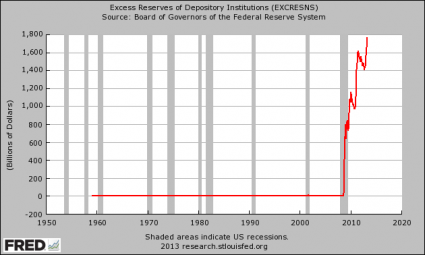
Excess Reserves Parked At The Federal Reserve
#10 The Federal Reserve Has An Astounding Track Record Of Failure
Over the past ten years, the Federal Reserve has been an abysmal failure when it comes to running the economy.
But despite a track record of failure that would make the Chicago Cubs look like a roaring success, Barack Obama actually decided to nominate Ben Bernanke for a second term as the Chairman of the Federal Reserve.
What a mistake.
Just check out some of the things that Bernanke said prior to the last financial crisis.  The following is an extended excerpt from an article that I published previously...
*****
In 2005, Bernanke said that we shouldn't worry because housing prices had never declined on a nationwide basis before and he said that he believed that the U.S. would continue to experience close to "full employment"....
"We’ve never had a decline in house prices on a nationwide basis. So, what I think what is more likely is that house prices will slow, maybe stabilize, might slow consumption spending a bit. I don’t think it’s gonna drive the economy too far from its full employment path, though."
In 2005, Bernanke also said that he believed that derivatives were perfectly safe and posed no danger to financial markets....
"With respect to their safety, derivatives, for the most part, are traded among very sophisticated financial institutions and individuals who have considerable incentive to understand them and to use them properly."
In 2006, Bernanke said that housing prices would probably keep rising....
"Housing markets are cooling a bit. Our expectation is that the decline in activity or the slowing in activity will be moderate, that house prices will probably continue to rise."
In 2007, Bernanke insisted that there was not a problem with subprime mortgages....
"At this juncture, however, the impact on the broader economy and financial markets of the problems in the subprime market seems likely to be contained. In particular, mortgages to prime borrowers and fixed-rate mortgages to all classes of borrowers continue to perform well, with low rates of delinquency."
In 2008, Bernanke said that a recession was not coming....
"The Federal Reserve is not currently forecasting a recession."
A few months before Fannie Mae and Freddie Mac collapsed, Bernanke insisted that they were totally secure....
"The GSEs are adequately capitalized. They are in no danger of failing."
*****
There are many, many more examples that could be listed, but hopefully you get the point.
And now it is happening again.  Bernanke is telling the American people that everything is going to be just fine and that no major problems are ahead.
Do you believe him this time?
#11 The Federal Reserve Is Unaccountable To The American People
What is the most important political issue to most Americans?
Survey after survey has shown that the American people care about the economy more than anything else.
So why do we allow an unelected, unaccountable entity that is privately-owned to make our economic decisions for us?
The Federal Reserve has become so powerful that it has been called "the fourth branch of government".  Every four years, presidential candidates argue about who will be best at managing the economy, but the truth is that it is the Fed that manages our economy.
We are told that the "independence" of the Federal Reserve is absolutely critical, but don't the American people deserve to have a say in the running of the economy?
Our system is broken.  It is a system that will continue to create more bubbles and more debt until the entire thing finally collapses for good.
Thomas Jefferson once stated that if he could add just one more amendment to the U.S. Constitution it would be a ban on all government borrowing....
I wish it were possible to obtain a single amendment to our Constitution. I would be willing to depend on that alone for the reduction of the administration of our government to the genuine principles of its Constitution; I mean an additional article, taking from the federal government the power of borrowing.
But instead of banning government borrowing, we have allowed ourselves to become enslaved to a system where government borrowing actually creates our money.
We do not need to have a central bank.  There are much better alternatives.  We just need to get people educated.
Please share this article with as many people as you possibly can.  These are things that every American should know about the Fed, and we need to educate the American people about the Federal Reserve while there is still time.
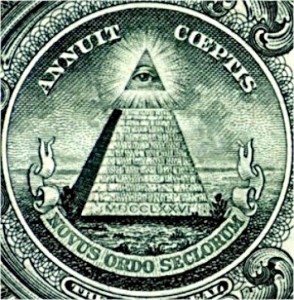
The Great Seal Of The United States - A Symbol Of Your Enslavement - Photo by Ipankonin
Be Sociable, Share!

A Look Back At The Stalkerish Past Of The Bush Dynasty's Future Star

So George P. Bush--son of Jeb and the political dynasty’s fourth generation standout--is making his Washington, D.C. debut this week. The 37-year-old lawyer is now running for Texas land commissioner, but his family reportedly expects bigger things from the telegenic offspring of the former Florida governor.
Which is as good an excuse as any to revisit a police report detailing George P.’s creepy, stalkerish behavior towards a former girlfriend.
Back when he was a Rice University student, Bush was investigated for burglary and criminal mischief related to a 4 AM visit to the Miami home of his ex, Cristina Cohen, and her parents.
A Miami-Dade Police Department report includes an account of the December 31, 1994 incident provided to cops by Murry Cohen, Cristina’s father.
According to Cohen, Bush--wearing black shorts and no shirt--arrived at the residence and “went to his daughter’s bedroom window,” pulled it open, and “pushed the screen inward.” As Bush was “climbing in the window,” Murry Cohen awoke and spotted the trespasser. A neighbor of the Cohens also spotted Bush trying to get into the residence and began to argue with him.
With his intrusion thwarted, Bush “backed out of the window.” Cohen reported seeing Bush then “jump into a vehicle and flee.” But he would not be gone for long.
Bush returned to the home 20 minutes later and drove his car through the Cohens’s yard, causing damage to about 80 feet of the lawn.
When police arrived at the residence, the Cohens identified Bush as the perpetrator. Cristina Cohen explained that she used to date Bush, but that they “have been separated for 1-1/2 years.” She added that Bush “has been a problem ever since they broke up.”
After the Cohens provided police with Bush’s home address, an officer went to the residence and “spoke to him and parents.” But since Murry Cohen did not want to press charges, Bush “was not arrested on the scene,” according to the police report.
When police checked back with Cohen several days later, he told a detective that he was not interested in pursuing charges against Bush, “and that he wanted the matter resolved.” Cohen then signed a non-prosecution form.
A month before his son attempted the illegal bedroom incursion, Jeb Bush lost the Florida governor’s race to incumbent Democrat Lawton Chiles (Bush won the governorship four years later, in 1998).
George P. Bush’s campaign web site describes him as “part of the next generation of Texas leaders…a successful businessman, philanthropist, civic leader and veteran dedicated to advancing conservative values.” The married Fort Worth resident and his wife are expecting their first child this summer.