Thursday, December 19, 2013

Who Knew What 50 Seconds Before The FOMC Release?

Tyler Durden's picture
http://www.zerohedge.com/news/2013-12-18/who-knew-what-50-seconds-fomc-release


Last time it was trading faster than the speed of light in gold and stocks. This time, 50 seconds before the FOMC statement was officially released to the great unwashed, Nanex notes that the market exploded with activity reaching levels higher than during the actual FOMC news release. As they show in the charts below, approximately $106 Million of SPY and 3,700 eMini Futures contracts traded in 1 second. Gold - while less voluminous - was just as berserko in the minutes and seconds leading up the news release. What is going on here?

See also this image of eMini liquidity during this time.


For clairfication, here is S&P 500 Futures price and volume... (1-second bars)


And Gold...


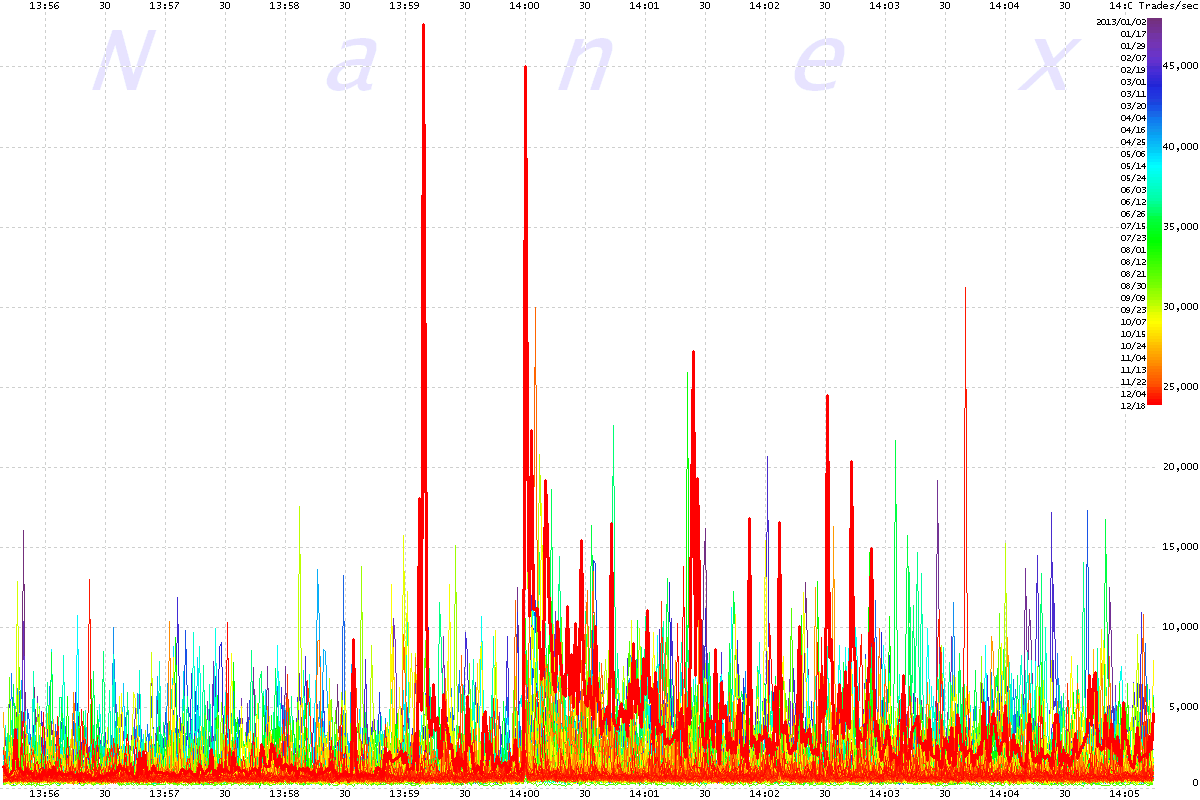
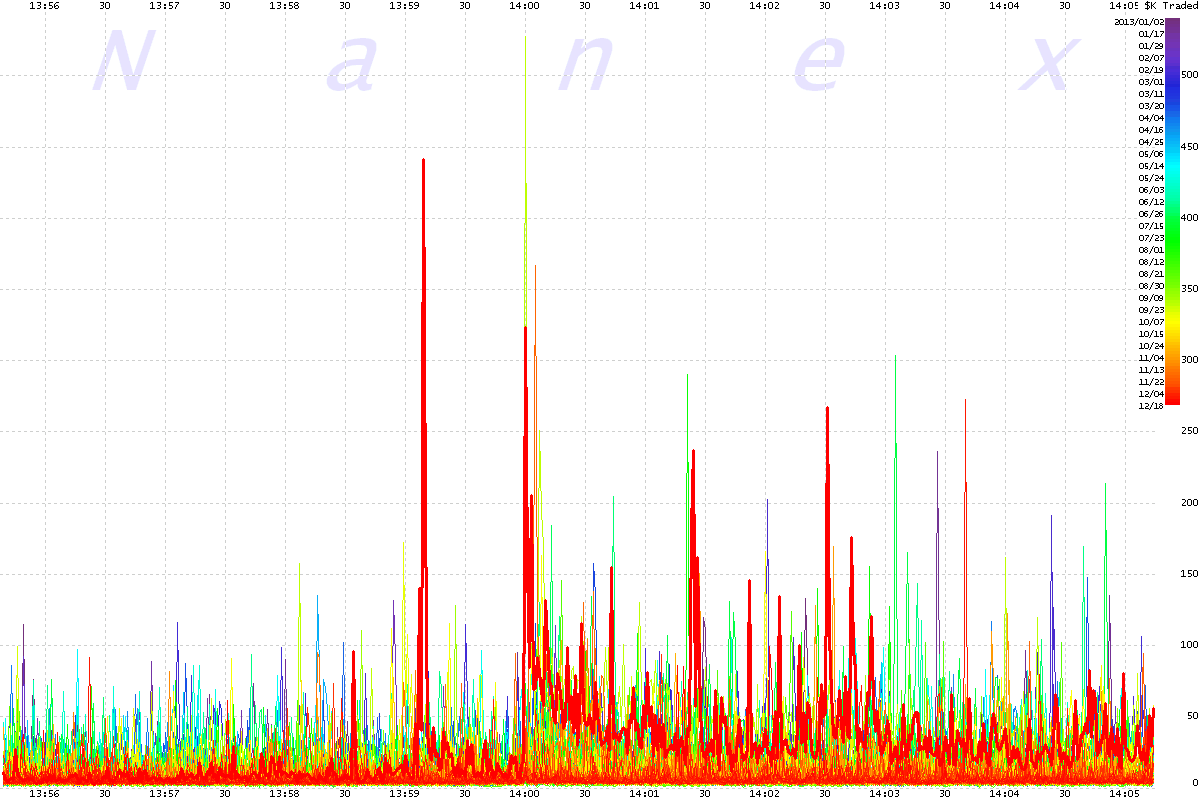
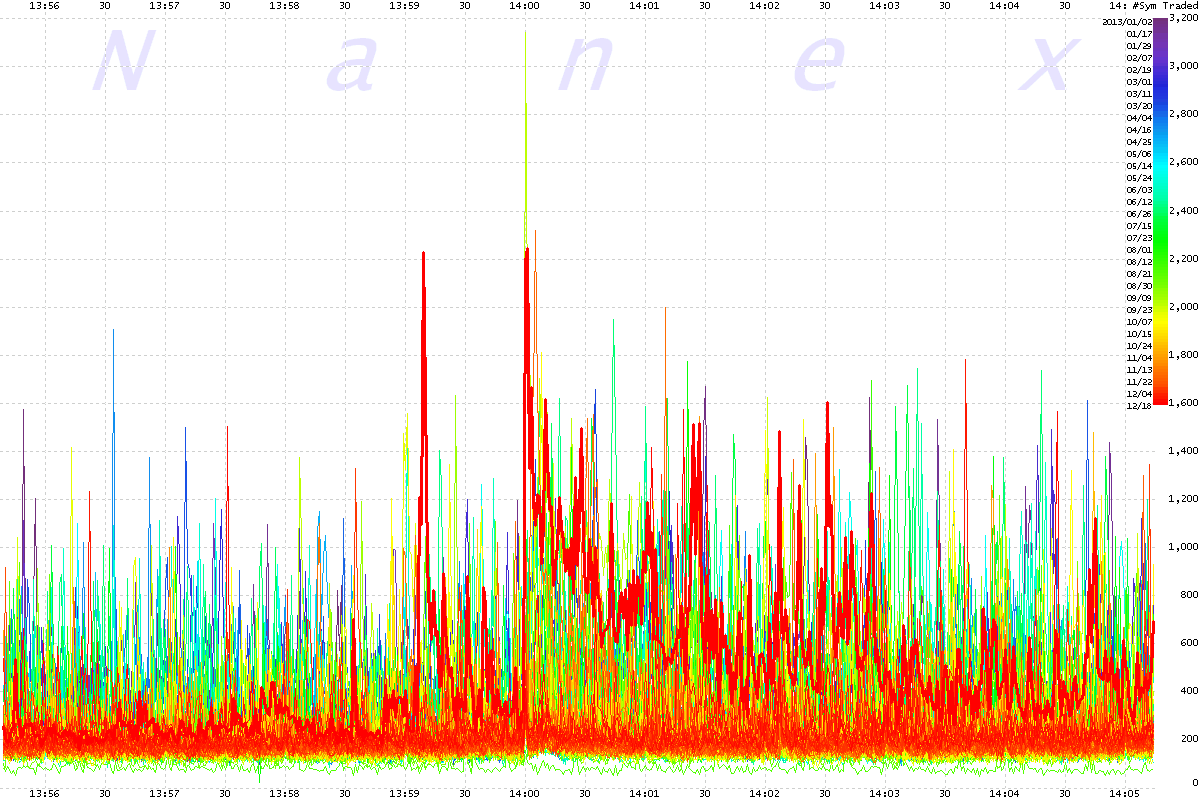
And Nanex shows the incredible surge in activity...
1. Trades per second in NMS Stocks and ETFs (2,200 of approximately 8000 symbols traded).
Note the peak occurred about 50 seconds before the FOMC announcement.


2. Dollars traded (thousands) per second in NMS Stocks and ETFs.
Note the peak occurred about 50 seconds before the FOMC announcement.


3. Symbols traded per second in NMS Stocks and ETFs.


Nanex Research
IS AMERICA IN THE GRIP OF COWARDICE?
 “If you will not fight for right when you can easily win without bloodshed; if you will not fight when your victory is sure and not too costly; you may come to the moment when you will have to fight with all the odds against you and only a precarious chance of survival. There may even be a worse case. You may have to fight when there is no hope of victory, because it is better to perish than to live as slaves."
By Ron Ewart
December 18, 2013
NewsWithViews.com /http://www.newswithviews.com/Ewart/ron132.htm
“There are those that recognize a wrong and act to right it. There are those who "see" the wrong, but do nothing. But unfortunately there are way too many of those who don’t "see" anything at all.” -Ron Ewart
If you were standing on the railroad tracks and you saw a train bearing down on you at high speed, what would you do? If your child was playing next to a cliff and you saw him chasing a ball towards the cliff, what would you do? If burglaries and thefts were rising in your neighborhood, what would you do? If bullies and thugs took over your town, what would you do? If a man confronted you on the street and demanded your money, what would you do? In most cases you would act swiftly to get out of the way, save your child, take action to stop the neighborhood crime, confront the bully and resist the robber from stealing your money ..... or would you?
What if your neighbor came over one day and said, I need more of your property and I am moving my fence twenty feet onto yours and I'm not going to pay you a dime, what would you do? If your boss said that he has established a new policy of welfare and has decided to take a percentage of YOUR paycheck (not his) and give it to the poor, what would you do? If you were part of an organization that existed on private donations and the board members decided that they were going to use fear, intimidation, threats, lies and propaganda to increase donations, what would you do? If you were a deacon of a church and you discovered that the other deacons were using parishioner money for their own use, or grossly wasting that money, what would you do? If the local school board decided that they were going to include in the curriculum for your children, a course on Earth's salvation that required teaching the kids that their parent's lifestyle was environmental heresy and should be condemned, what would you do?
In all of the above cases, a normal, reasonable and prudent person would set about to right the situation, one way or another and if necessary, he would enlist others to help him, because a normal, reasonable and prudent person has a sense of what is right and wrong. When they see a wrong, they try to right it, provided they have the courage to face those who desire to continue the wrong for their own benefit, or a hidden agenda.
The Revolutionary War righted a wrong and declared freedom in America. The War of 1812 was a continuation of the Revolutionary War and our winning it prevented America, once again, from falling under British rule. The Civil War righted an egregious wrong and ended black slavery ….. well sort of. The first and second World Wars righted international wrongs against human life, dignity and individual rights. These wrongs were righted by courageous leaders and individuals who knew that they might have to make the ultimate sacrifice to right those wrongs.
Today, we have a litany of wrongs that need to be righted, right here in America. We have government perpetrating on the people the same "wrongs" that we mentioned above, that a normal, reasonable and prudent person would take immediate action to right, when the wrong was recognized.
Why then would the normal, reasonable and prudent people of America turn their heads when their government commits the same wrongs as the neighbor, the bully, the boss, the board members, or the deacons, but on a much grander scale? Why indeed!
Americans, by the millions, are getting hammered by Obama Care through no fault of their own. Why do they take it? Why isn't there a massive uprising? Why aren't lawsuits flying all over the place? Why aren't the people demanding that heads roll with the large, unified voice of millions?
Our school children are being brainwashed and indoctrinated by a federal government-created curriculum (Common Core Standards, Race To the Top and No Child Left Behind programs) that emphasize socialism, collectivism and multi-culturalism. Why aren't the parents crying foul? Why don't they take over the local school boards and reverse this garbage? Why aren't they at the state legislatures creating all kinds of Hell? Do they just not care ..... or are they afraid?
Landowners are being treated like criminals and going to jail for minor code violations on THEIR property. They are forced to fight a tyrannical government, whether it be local, state, or federal, all on their own. They seldom win. But you never hear of these individual battles waged against an arrogant and abusive government, a government that has become the master instead of the servant, a government that blatantly ignores the constitutional limits on its power.
The IRS targets conservatives for political purposes and the president and congress promise a full and complete investigation. The FBI says they are investigating. Nothing happens. Why aren't the people, en masse, demanding answers and not taking a "we're-investigating" as the answer? Why aren't IRS officers, employees and agents being tried in court, fined and incarcerated for long periods for their known criminal acts? Why do Americans tolerate this injustice? Do we enjoy being slaves to the IRS? Have we all become cowards and unwilling to challenge tyranny when it arises?
Four of our diplomats are killed in Benghazi well over a year ago, due to government negligence and neglect. No one in government provided the necessary security, asked for by the diplomats. No one came to their rescue during the attack. No one is being held accountable for the criminal negligence that allowed the attack to happen. Congress is investigating. The Obama Administration is stonewalling and obstructing. Nothing is happening. No one is fired. No one is in jail. Where is the outcry for four dead brave Americans who paid the ultimate price because their government failed them? Have we lost our courage to right a wrong when we recognize it?
Then there are the Fast and Furious and the NSA scandals. In the Fast and Furious scandal, U. S. Attorney General Eric Holder, the top law enforcement officer of America, has been shielded by his boss, our liar-in-chief Barack Hussein Obama, who has declared executive privilege and won't release the documents that Congress has requested to find out who the Hell allowed Fast and Furious to happen in the first place. One of our brave border agents was killed by one of those guns in this gun- running scandal. Has anyone been fired? Has anyone gone to jail? Holder lied to Congress, which is a crime, but he gets off scot-free. The Congress seems to be powerless to stop him or put him in jail for this crime.
The NSA says it isn't spying on us, but it probably is, based on releases by ex-NSA staffer Edward Snowden, who now resides in Russia fearing for his life. Is he a patriot or a traitor? We don’t know. The public simply does not know the depths of NSA spying and how much data it is really collecting. NSA Chief James Clapper lied to Congress and that's a crime. But he is running around loose, free as a bird, telling the public that the NSA isn't really spying on us. Yeah, and President Obama says you can keep your doctor and your health care plan and health care costs are going to go down! Sure!
Why aren't Americans rising up by the millions to find out the truth? Once again, why haven't there been multiple lawsuits by harmed individuals over these egregious violations of our constitutional rights? There should be class action lawsuits exploding all over the place? Why aren't there?
Winston Churchill said at a time of great sacrifice and often quoted: “If you will not fight for right when you can easily win without bloodshed; if you will not fight when your victory is sure and not too costly; you may come to the moment when you will have to fight with all the odds against you and only a precarious chance of survival. There may even be a worse case. You may have to fight when there is no hope of victory, because it is better to perish than to live as slaves."
We do not believe that America is in the grips of cowardice because after all, we are Americans. We have a chance to right these wrongs peacefully, before the only action left to us is war. But do we have the will, the courage, the commitment and the resources to right these wrongs before war is our only option? Or, "Will we have to fight when there is no hope of victory, because it is better to perish than to live as slaves."
The abject failure of Obama Care has opened millions of eyes to the flawed policies of liberals and progressives that have foisted these policies upon all Americans, doing great harm. If we do not act on this knowledge with the courage of our convictions and quit trying to compromise our beliefs because liberals have more votes, then we will have let over 200 years of freedom slip through our fingers. Ladies and gentlemen, there are other ways to fight these criminals, than at the ballot box.
Future generations will damn us for our cowardice in the face of danger because they will say we knew and did nothing. They will ultimately pay the price in money and eventually in blood, if we let them down.
If the people are afraid, as so many Americans are, and let the bully (government) win, the bully will win all the time and the bully is winning and has been winning for over 100 years ..... not just for the 5 years under the Obama regime. It's the people that let the bully win, out of fear and cowardice. Unless the people stand up en masse, as we are "standing up" with our articles, there will be no restoration of freedom.

Let us all promise that in the year 2014 and from then on, courage will return to those who have allowed easy times and a chicken in every pot to cloud their vision about the huge price that was paid for their freedom and the price that now must be paid to reclaim it, because we chose to look the other way when tyranny raised its ugly head.
In closing, we want to wish each of our readers a very special Christmas holiday with friends and family, at a time of giving and love, as well as the religious celebration it was designed to be for 150 years.
This will be our last article for the year 2013. We will take up the torch of freedom starting on the first Sunday of January, 2014. In the interim, we encourage you to take the time to visit our two websites that are dedicated to the protection of our property rights (http://www.narlo.org) and to exposing the arrogance, fraud, abuse and corruption of the IRS (http://www.attackwatchspies.com). Each website contains a wealth of valuable information and not just for rural landowners, or disgruntled taxpayers.
In liberty, until Sunday, January 5, 2014 .....
© 2013 Ron Ewart All Rights Reserved

SST Australia: Signed, Sealed and Ready for Delivery

December 06, 2013
Advanced Space Surveillance Telescope (SST) readies for 9,000-mile journey to Western Australia to enable valuable monitoring of objects 22,000 miles above Earth  

DARPA Space Surveillance Telescope


As satellites become more common, they face growing risk of colliding with space debris and even each other. The U.S. Department of Defense has thus made space situational awareness a top priority to maintain communication, Earth observation and other critical capabilities upon which military, civilian and commercial functions rely. Traditional telescope technology, however, has difficulty finding and tracking small objects—such as debris and satellites—across wide tracks of sky, especially at the increasingly crowded geosynchronous orbits roughly 22,000 miles above the Earth’s surface.
To help overcome these challenges, DARPA has developed the Space Surveillance Telescope (SST). Through its unique combination of several novel technologies, the SST program seeks to enable much faster discovery and tracking of previously unseen, hard-to-find small objects in geosynchronous orbits. The SST will soon move from its current mountaintop location in New Mexico, where the system underwent operational testing and evaluation, to Australia, where it will provide key space situational awareness from the southern hemisphere—an area of the geosynchronous belt that is still largely unexplored.
U.S. Secretary of Defense Chuck Hagel and Australian Defense Minister David Johnston signed a Memorandum of Understanding on Nov. 20, 2013, in Washington, D.C., approving the relocation of the SST from White Sands Missile Range, N.M., to the Harold E. Holt Naval Communication Station in Exmouth, Western Australia. Under this agreement, the United States (through DARPA) is responsible for delivering the SST to Australia. The Australian government will build an enclosure for the telescope and operate it. The U.S. Air Force will own the telescope and the two countries will share operations and maintenance costs. The relocation process is planned to start next year and the telescope is expected to resume operations sometime in 2016.
“This is a significant initiative under the Australia-U.S. Space Situational Awareness Partnership, and will provide an important capability for both Australia and the U.S.,” Johnston said in an official statement.
“This telescope provides highly accurate detection, tracking, and identification of deep space objects, and will further strengthen our existing space cooperation,” Hagel said, according to a transcript from the U.S. State Department. “All of these steps are helping strengthen our alliance as we continue to work together to face the challenges and opportunities of this new century.”
From its new home, the Australian operators of the SST will feed the information the system captures into the Space Surveillance Network (SSN), a U.S. Air Force system charged with cataloguing and observing space objects to identify potential near-term collisions with space assets. The SSN is a global network of radar and optical telescopes that provide data to spacefaring countries around the world. The SST will also continue to provide NASA and the scientific community with surveillance data on transient events such as supernovae, as well as potentially hazardous near-earth asteroids.
Started in 2002, the SST achieved first light and acquired its first images in February 2011. DARPA and the Air Force have conducted numerous successful demonstrations of the system from 2011 to 2013. 
The SST offers unprecedented rapid search of small objects in space thanks to its innovative Mersenne-Schmidt design and its curved charge coupled device (CCD) imaging technology, the first of its kind. The combination also enables the SST to be much more compact than traditional ground-based telescopes of similar capability. The telescope’s mount uses advanced servo-control technology, making the SST one of the quickest and most agile telescopes of its size ever built.
The SST’s capabilities are equally impressive: It can search an area larger than the continental United States or Australia in seconds and survey the entire geosynchronous belt within its field of view multiple times in one night, an order of magnitude faster than traditional telescopes. Additionally, the SST is ten times more sensitive than current state-of-the-art systems, enabling it to find and track much smaller, dimmer and more transient objects than its predecessors can.
“The SST has moved space situational awareness from looking through a drinking straw to a windshield view, where we can see 10,000 objects the size of a softball at a time—any of which could put satellites at risk,” said Lt. Col. Travis Blake, DARPA program manager. “This program has already helped revolutionize ground-based space surveillance technology. From its new location, it could greatly expand the capability of the United States, Australia and other nations to keep their space assets safe.”
# # #
Associated images posted on www.darpa.mil and video posted at www.youtube.com/darpatv may be reused according to the terms of the DARPA User Agreement, available here: http://go.usa.gov/nYr.

Saudi-Sized Cracks in the 9/11 Wall of Silence

123
President Obama is apparently thinking about his presidential library. So now might be a good time to ponder whether anyone will want to visit it.
If he cared about revivifying his brief reputation as a good-guy outsider ready to shine light on the hidden recesses of our governing apparatus (remember his election-night victory speech that brought tears and rare hope to America?), Obama could certainly start at this late date by taking a stand for transparency.
Here’s how: Two Congressmen, a Democrat and a Republican, are asking Obama to declassify the congressional report on 9/11, which the Bush administration heavily redacted.
The two members of the House of Representatives have read the blacked-out portions, including 28 totally blank pages that deal largely with Saudi government ties to the alleged 9/11 hijackers.
This is apparently major connect-the-dots stuff—much more significant than what one may remember from Michael Moore’s film Fahrenheit 911, about Saudi royals and other Saudis studying and living in the US, who were allowed to go home without being interviewed in the aftermath of the attacks. This is about actual financial and logistical support of terrorism against the United States—by its ally, the Saudi government.
As a Hoover Institution media scholar wrote in the New York Post (normally no bastion of deep investigative inquiry):
The Saudis deny any role in 9/11, but the CIA in one memo reportedly found “incontrovertible evidence” that Saudi government officials — not just wealthy Saudi hardliners, but high-level diplomats and intelligence officers employed by the kingdom — helped the hijackers both financially and logistically. The intelligence files cited in the report directly implicate the Saudi embassy in Washington and consulate in Los Angeles in the attacks, making 9/11 not just an act of terrorism, but an act of war.
Congressmen “absolutely shocked”
The two outspoken Representatives, Walter Jones (R-NC) and Stephen Lynch (D-Mass) would be violating federal law if they offered any specifics about what they know, or even named any countries mentioned—but did say they were  “absolutely shocked” by revelations of foreign state involvement in the attacks. Now, they want a resolution requesting Obama declassify the entire document.
If the media were to do its job and create the kind of wall-to-wall coverage it bestows upon, say, inter-spousal murder trials, Obama might feel he had to release the full 9/11 report. He’d have to concede there is a public right to know, or at least explain in detail why he doesn’t think so. Either way, there would be major fireworks. But we’re not betting on either the president or the media doing the right thing.
Mainstream Media: out to lunch, so far
How much publicity is this enormously significant story getting? Very, very little. A search of the Nexis-Lexis database turned up just 13 articles or transcripts. One was a very short, cautious piece from the Boston Globe. One was a transcript of TV commentator Lou Dobbs on Fox News. All of the others were specialty or ideological publications or blogs—Investor’s Business Daily, the Blaze, Prairie Pundit, Right Wing News, etc. (CNN’s Piers Morgan did interview Rep. Lynch). Nothing showed up from the New York Times, Washington Post, Politico, MSNBC or the broadcast networks.
That’s a remarkable oversight, given that the media did cover similar concerns expressed by former senators Bob Kerrey and Bob Graham almost two years ago. In an affidavit for a lawsuit by the families of 9/11 victims, Graham, head of the joint 2002 congressional 9/11 inquiry, said, “I am convinced that there was a direct line between at least some of the terrorists who carried out the September 11th attacks and the government of Saudi Arabia.” Kerrey, who served on the non-congressional 9/11 Commission, said in his own affidavit, “Evidence relating to the plausible involvement of possible Saudi government agents in the September 11th attacks has never been fully pursued.”
But two House members, one a Democrat, one a Republican, explicitly calling for the President to make the full report available? That’s certainly news.
What Will Obama Do?
If President Obama does declassify the records, that would be surprising, if not outright shocking.
Although he has belatedly (and under heavy pressure from his base) begun to shift more toward at least the rhetoric of openness, Obama failed to stand up for release of still-classified documents related to the John F. Kennedy assassination (a half century after that tragedy), and he has presided over myriad actions that take us further than ever from transparency. Meanwhile, the media has all but abdicated its responsibility to hold the administration’s feet to the fire on these and related matters.
At WhoWhatWhy, we understand how hard it is to get this kind of material into the hands of the American people. Our groundbreaking reporting on ties between prominent and powerful Saudis and the men said to have been on the planes attacking on September 11 (via a house in Sarasota, Florida) was almost entirely ignored by the establishment media, including many so-called “alternative” and “progressive” outlets, though it has nonetheless spread widely thanks to the Internet and social media. Even the above-mentioned New York Post only now has acknowledged our reporting on the Saudi-Sarasota connection, without mentioning our name or linking to us.
No matter. The significance is that others have come forward to ask tough questions about the daunting reach and self-protective reflexes of our government’s ever-expanding “secret sector.” With a related meta-issue—NSA surveillance—odd bedfellows like “leftie” Glenn Greenwald and “rightie” Larry Klayman (with a Bush appointed judge ruling in his favor) are going at the surveillance state simultaneously, mightily aided by former intelligence analyst Edward Snowden.
Whatever one thinks of the 9/11 story—and one needn’t buy the more extreme theories to be open to examining new, documented facts—there’s clearly more to that trauma than we have been allowed to know; and we suspect there are many more establishment figures with a hunger for the truth. And once more “respectable” Washington insiders like House (and Senate) members start saying shocking things—well, that’s a man-bites-dog story few news organizations can turn down.
As for the executive branch, representatives of the State Department, Department of Justice and FBI have repeatedly denied knowing anything about the Saudi angle. If those documents are ever declassified, the denials themselves—and those issuing those denials—should also be news.

Globalization: The Fast Track To Nowhere

globe
Modern culture is an advocate of speed. From urban planning and transport systems, to the food industry and beyond, ‘fast living’ cuts deep and affects almost every aspect of life.
In terms of distances, things today are more spread out yet are more interconnected than in the past. This interconnectedness has had the effect of shrinking even the largest of distances and is ably assisted by digital communications technology and rapid transit systems. Airports and metro transport links are being extended or built, huge concrete flyovers cut through neighbourhoods and separate communities from one another and employment is being centralised in out of town business parks or city centre office blocks. Speed of communications and transport narrows the distances.
Encouraging further urban sprawl is of course highly profitable for the real estate, construction, automobile and various other industries (1). It is not that we need this type of urban planning and development, but powerful economic interests and their influence in/over governments dictate it’s the type we get.
Speed and high-energy living have become an essential fact of life. In the process, our communities have become disjointed and dispersed. We have sacrificed intimacy, friendship and neighbourliness for a more impersonal way of accelerated living. And the process continues as rural communities are uprooted and hundreds of millions are forced into cities of ever-increasing sizes to indulge in the fast life.   
In the virtual world, friends possibly half the world away are made and ‘defriended’ at the click of an icon. Likes and dislikes are but passing fads. Meaningful social activism has been trivialised and reduced to the almost meaningless clicking of an online petition. It’s more convenient and quicker than taking to the street. After the near destruction of working class movements in many countries, this is what ‘protest’ has too often become.
In the ‘real’ world, where ‘clicking’ just doesn’t cut it, how to physically move from A to B as quickly as possible dominates the modern mindset – how to get to work, the airport, to your kids’ schools, the hospital or the shopping mall, which are increasingly further away from home. Many now appear to spend half their lives in transit in order to do what was once achievable by foot or by bicycle.  
It’s all become a case of how to eat fast, live fast, consume fast, text message fast, Facebook fast and purchase fast. Speed is of the essence. And it seems that the faster we live, the greater our appetites have become. The mantra seems to be faster, quicker, better, more. In a quick-paced, use-and-throw world, speed is addictive.
But there is a heavy price to pay. We are using up the world’s resources at an ever greater pace: the materials to make the cell phone or flat screen TVs; the water to irrigate the massive amounts of grain and land required to feed the animals that end up on the dinner plate as the world increasingly turns towards diets that are more meat based; the oil that fuels the transport to get from here to there, to ship the food over huge distances, to fuel the type of petrochemical agriculture we have come to rely on, or the minerals which form a constituent part of the endless stream of consumer products on the shelves. Greed and the grab for resources not only fuels conflict, structural violence imposed on nations via Wall Street backed economic policies and death and war, but high energy, accelerated living takes a heavy toll on the environment and, if we are honest, on ourselves, in terms of our health and our relationships.
If the type of high energy living outlined above continues, we are heading for a crunching slowdown much sooner than we think. It will be catastrophic as current conflicts intensify and new ones emerge over diminishing resources, whether water, oil, minerals, fertile land or food.
The term ‘slow living’ was popularized when Carlo Petrini protested against the opening of a McDonald’s restaurant in Piazza di Spagna inRome in 1986. This reaction against fast food sparked the creation of the Slow Food movement. Over time, this developed into other areas, such as Cittaslow (Slow Cities), Slow Living, Slow Travel, and Slow Design.
What was Carlo Petrini actually originally arguing against? Fast food is food that is grown quickly, eaten quickly and prepared quickly. It is convenience food of dubious nutritional quality that fits in with the belief that the ‘good life’ equates with fast living. It is food that tends to rely on petrochemical pesticides, fertilizers and transport across huge distances.
Food that is chemically processed and which relies on hormones, steroids and other similar inputs in order to ‘speed things up’ in terms of crop or animal growth and delivery to plates that may be half a world away from where it is produced by agricultural workers who themselves are undernourished or malnourished (2). It is nature speeded up, but also nature that has been contaminated and distorted and pressed into the service of big oil and agribusiness interests.
On the other hand, slow food tends to imply food that is grown or produced locally and with minimal bio-chemical inputs. It tends to rest on the sourcing of local foods and centuries’ old traditions and ideally sold by neighbourhood farms and stores, not by giant monopolistic retailers that are integral to the fast food industry. Slow food also implies more nourishing and healthy food and agriculture that places less strain on water resources and soil to produce better yields (3) and which does not pollute either body or environment as a result of chemical residues (4) or uproot communities or destroy biodiversity (5).
Slow food is associated with lower energy inputs. It is less reliant on oil-based factory-processed fertilizers/pesticides and oil-based transportation across lengthy distances, not least because it is organically produced and locally sourced. In their ultimate forms, slow food and living slow can arguably best be achieved via decentralization and through communities that are more self-sustaining in terms of food production/consumption as well as in terms of other activities, including localized energy production via renewables or industrial outputs such as garment making or eco-friendly house building. In this respect, slow living extends to remaking the communities and relearning the crafts and artisan skills we have often lost or had stolen from us.
Ultimately, urban planning and the ‘local’ are key to living slow. No need for the automobile if work, school or healthcare facilities are close by. Less need for ugly flyovers or six lane highways that rip up communities in their path. Getting from A to B would not require a race against the clock on the highway that cuts through a series of localities that are never to be visited, never to be regarded as anything but an inconvenience to be passed through en route to big-mac nirvana, multiplex overload or shopping mall hedonism.
Instead, how about a leisurely, even enjoyable walk or cycle ride through an environment free from traffic pollution or noise, where the pedestrian is not regarded as an obstacle to be honked at with horn, where the cyclist is not a damned inconvenience to be driven off the road or where ‘neighbourhood’ has been stripped of its intimacy, of its local ‘mom and pop’ stores, of its local theatres?
Having jettisoned the slow life for a life of fast living, we are now encouraged to seek out the slow life, not least for example through tourism. The trouble is that with more and more people seeking out the slow life for two weeks of respite, destination slow suddenly became a complete mess. Instead of genteel locals, pristine forests and refreshing air, what you experience is sprawling hotel complexes, endless buses and taxis clogging up the place along with thousands of other tourists.
And the locals – they abandoned the slow life once mass tourism arrived and jumped on the bandwagon of fastness to rent out their rooms at inflated prices, to open restaurants serving fast food that caters to fast tourism. The slow mindset suddenly became abandoned in the quest to make a fast buck from the tourists, and before you knew it, six lane highways arrived, water was gobbled up by tourist complexes and urban sprawl sprawled even further across the once pristine hillsides or beaches.
But that’s what fast living or, to be precise, the system that creates it does. It corrupts and destroys most things that get in its way. It recasts everything in its own image. Even ‘slowness’ has become a bogus, debased commodity sold to the fast living, fast consuming masses.
What can we do on a practical level that does not result in the debasement of the slow life? Is living slow nothing more than the dreamers mandate for taking us all back a century or two?
For some advocates of slow living, it is about trying to live better in a fast world, perhaps making space to enjoy ‘quality time’. For others, however, it comprises a wide ranging cultural and economic revolution that challenges many of the notions that underpin current consumption patterns and ‘globalization’.
Loosely defined, slow living is nothing new. From Buddha to the social philosopher Ivan Illich in the 1960s and 70s, the philosophy has always been around in different guises and has been accorded many labels. Whether it is anti-globalization, environmentalism, post-modernism, the organic movement, ‘green’ energy, localization or decentralization, these concepts and the movements that sprang up around them have embraced some notion of slowness in one form or another.
In India, the Navdanya organization is wholeheartedly against the destruction of biodiversity and traditional farming practices and communities and presents a radical critique of consumerism, petro-chemical farming and Western agribusiness (6). The views of Vandana Shiva, Navdanya’s founder, are well documented. Shiva advocates a radical shift of course from the one the world (and India) is currently on. Navdanya has even opened a Slow Food Café in Delhi.
On a general level, again taken loosely, slow living might involve improving the quality of life by merely slowing down the pace of living. In urban planning, for example, it may mean pedestrianising urban spaces and restricting motorized traffic, especially car use. In many European cities cycling is encouraged by offering the public the free use of bicycles. Visit any Dutch city to see that cycling is a predominant mode of transport, which certainly makes a positive contribution to the easy going ambiance.
In the UK, in part as a response to traffic congestion and the negative impacts of motorized transport on communities, a movement emerged in the early nineties to ‘reclaim the streets’, to hand them back to local residents who felt a need to claim ownership of their communities and public spaces, which had essentially been hijacked by commuters or large corporations.
Living slow may entail slowing down in order to develop some kind of spiritual connection with one’s inner self. It might also involve opting for more environmentally friendly products while shopping, living in more eco-sensitive housing, developing small cottage industries or just generally leading a ‘greener’ lifestyle as a consumer.
But it’s no good adopting a piecemeal, watered-down approach. The root of the problem needs to be addressed. The slow life, whether slow food or slow urban environments, is impossible if we fail to realize that decisions about urban planning, economic activity, investment, products and services, etc, are made through the capture of governments, regulatory agencies and courts by corporations adamant on expanding and perpetuating their dominance (8,9).
In order to achieve any semblance of genuine, lasting change towards a better, slower world, we must eradicate the material conditions that produce and perpetuate class-based exploitation and divisions on an increasingly global level. These conditions stem from patterns of capital ownership and the consequent flow of wealth from bottom to top that occurs by various means of ‘accumulation by dispossession’ (corruption, tax evasion/avoidance, bail outs, ‘austerity’,  ‘free trade’ agreements, corporate taxpayer subsidies, capital market liberalization, etc).
What we need is proper democracy achieved through, for example, common ownership of banks and key industries and a commitment to ‘green’ policies and renewable energy. This entails challenging the oligarchs and their corporations that have colonized almost every aspect of modern living, from healthcare, urban planning, food and agriculture to education and development, in order to effect change that is beneficial to their interests and thereby enslaving us all in the process.
Take action and be informed:
Notes
1)      Vidyadhar Date, 13 December, 2013, Politicians And Bureaucrats Need To Learn Basics About Urban Transport, Countercurrents: http://www.countercurrents.org/date141213.htm
2)      Vandana Shiva, 28 August, 2012, Our Hunger Games, Common Dreams: https://www.commondreams.org/view/2012/08/28-1
3)      Arun Shrivastava, 24 March, 2012, India: Genetically Modified Seeds, Agricultural Productivity and Political Fraud, Global Research: http://www.globalresearch.ca/india-genetically-modified-seeds-agricultural-productivity-and-political-fraud/5328227
4)      Gautam Dheer, 3 Febrary, 2013, Punjab: Transformation of a food bowl into a cancer epicenter, Deccan Herald:http://www.deccanherald.com/content/309654/punjab-transformation-food-bowl-cancer.html
5)      Krishan Kir Chaudhary, July, 2012, Seed Sector in India, Ki Kisan Awaaz: http://www.kisankiawaaz.org/magazine_data/magazine_data_pdf/JULY_2012.pdf
6)      Navdanya, Food Sovereignty , Navdanya.com:http://www.navdanya.org/earth-democracy/food-sovereignty
7)      Corporate Europe Observatory, 23 October, 2013, Unhappy Meal: The European Food Safety Agency’s independence problem, CEO: http://corporateeurope.org/efsa/2013/10/unhappy-meal-european-food-safety-authoritys-independence-problem
8)      Corporate Europe Observatory, 17 December, 2013, Civil society groups say no to investor-state dispute settlement in EU-US trade deal, CEO: http://corporateeurope.org/trade/2013/12/civil-society-groups-say-no-investor-state-dispute-settlement-eu-us-trade-deal

Washington Has Discredited America. The “Obama Regime”, a Police State

usempire
Years ago when I described the George W. Bush regime as a police state, right-wing eyebrows were raised.  When I described the Obama regime as an even worse police state, liberals rolled their eyes.  Alas!  Now I am no longer controversial.  Everybody says it.
According to the UK newspaper, The Guardian, the Chancellor of Germany, Angela Merkel, had an angry exchange with Obama in which Merkel compared Obama’s National Security Agency (NSA) with the East German Communist Stasi, which spied on everyone through networks of informers.
http://www.theguardian.com/world/2013/dec/17/merkel-compares-nsa-stasi-obama  
Merkel grew up in Communist East Germany where she was spied upon by the Stasi, and now that she has risen to the highest political office in Europe’s most powerful state, she is spied upon by “freedom and democracy” America.
A former top NSA official, William Binney, declared that “We (the US) are now in a police state.”  The mass spying conducted by the Obama regime, Binney says “is a totalitarian process.”
http://www.washingtonsblog.com/2013/12/former-top-nsa-official-now-police-state.html  
Perhaps my best vindication, after all the hate mail from “super patriots,” who wear their ignorance on their sleeves, and Obama-worshipping liberals, whose gullibility is sickening, came from federal judge Richard Leon, who declared the Obama-sanctioned NSA  spying to be “almost Orwellian.”  As the American Civil Liberties Union realized, federal judge Leon’s decision vindicated Edward Snowden by ruling that the NSA spying is likely outside what the Constitution permits, “labeling it ‘Orwellian’–adding that James Madison would be ‘aghast.’”  
If only more Americans were aghast.  I sometimes wonder whether Americans like being spied upon, because it makes them feel important. “Look at me!  I’m so important that the government spends enough money to wipe out US poverty spying on me and my Facebook, et. al., friends. I bet they are spending one billion dollars just to know who I connected with today.  I hope it didn’t get lost in all the spam.”
Being spied upon is the latest craze of people devoid of any future but desperate for attention. 
Jason Ditz at the FBI spied-upon Antiwar.com says that Judge Leon’s ruling is a setback for Obama, who was going to restore justice and liberty but instead created the American Stasi Spy State.  Congress, of course, loves the spy state, because all the capitalist firms that make mega-millions or mega-billions from it generously finance congressional and senatorial campaigns for those who support the Stasi state. 
The romance that libertarians and “free market economists” have with capitalism, which buys compliance with its greed and cooperates with the Stasi state, is foolish.
Let’s move on.  It was only a few weeks ago that Obama and his Secretary of State John Kerry were on the verge of attacking Syria on the basis of faked evidence that Syria had crossed the “red line” and used weapons of mass destruction against the American organized, armed, and financed “rebels,” almost all of whom come from outside Syria.
Only the bought-and-paid-for-by-Washington French president made a show of believing a word or Washington’s lies against the Assad government in Syria.  The British Parliament, long a puppet of Washington, gave Obama the bird and voted down participating in another American war crime.  That left UK prime minister, David Cameron, hanging.  Where do the British get prime ministers like Cameron and Blair?
Washington’s plan for Syria, having lost the cover of its British puppet, received a fatal blow from Russian President Putin, who arranged for Syria’s chemical weapons to be delivered to foreign hands for destruction, thus putting an end to the controversy. 
In the meantime it became apparent that  the “Syrian rebellion” organized by Washington has been taken over by al-Qaeda, an organization allegedly responsible for 9/11. Even Washington was able to figure out that it didn’t make sense to put al-Qaeda in charge of Syria.  Now the headlines are: “West tells Syria rebels: Assad must stay.”
Meanwhile, Washington’s arrogance has managed to make an enemy of India. The TSA, a component of Homeland Security, subjected a female diplomat from India to multiple strip searches, cavity searches and ignored her protestations of consular immunity.
http://news.nationalpost.com/2013/12/18/devyani-khobragade-reveals-how-she-broke-down-after-stripping-and-cavity-searches-as-row-between-u-s-and-india-deepens/  
There was no justification whatever for this abuse of an Indian diplomat. To indicate its displeasure, the Indian government has removed barriers that prevent truck bombs from being driven into the US embassy.  
Washington has managed to recreate the arms race.  More profits for the military/security complex, and less security for the world. Provoked by Washington’s military aggressiveness, Russia has announces a $700 billion upgrade of its nuclear ballistic missiles. China’s leaders have also made it clear that China is not intimidated by Washington’s intrusion into China’s sphere of influence. China is developing weapon systems that make obsolete Washington’s large investment in surface fleets.
Recently, Pat Buchanan, Mr. Conservative himself, made a case that  Russia’s Putin better represents traditional American values than does the President of the United States. 
http://www.unz.com/pbuchanan/is-putin-one-of-us/
Buchanan has a point. It is Washington, not Moscow or Beijing, that threatens to bomb countries into the stone age, that forces down airplanes of heads of state and subjects them to searches, and that refuses to honor grants of political asylum.
Certainly, Washington’s claim to be “exceptional” and “indispensable” and, therefore, above law and morality contrasts unfavorably with Putin’s statement that “we do not infringe on anyone’s interests or try to teach anyone how to live.”
Washington’s arrogance has brought America disrepute.  What damage will Washington next inflict on us?

The Bill & Melinda Gates Foundation exposed

December 19, 2013

Source: Mother Jones

Bill & Melinda Gates

ExxonMobil, BP, Chevron, DynCorp, G4S, Walmart and McDonald’s are just a few of the companies that the mega ‘charity’ supports.
With an endowment larger than all but four of the world’s largest hedge funds, the Bill & Melinda Gates Foundation is easily one of the most powerful ‘charities’ in the world. According to its website, the organization ”works to help all people lead healthy, productive lives.”
So how do the investments of the foundation’s $36 billion investing arm, the Gates Foundation Trust, match up to its mission? We dug into the group’s recently released 2012 tax returns to find out.
Bill & Melinda Gates Foundation exposed
The Gates Foundation did not respond to requests for comment; however, its investment policy says the the trust’s managers “consider other issues beyond corporate profits, including the values that drive the foundation’s work.”
Bill & Melinda Gates Foundation exposed 1
Bill & Melinda Gates Foundation exposed
In its most recent annual report to investors, private prison company GEO group listed some risks to its bottom line, including “reductions in crime rates” that “could lead to reductions in arrests, convictions and sentences,” along with immigration reform and the decriminalization of drugs.
Military contractor DynCorp, meanwhile, has faced allegations of fraudmismanagement, and even slavery from the Middle East to Eastern Europe.
Bill & Melinda Gates Foundation exposed

‘Data brokers’ selling personal info of rape victims to marketers - report

December 19, 2013

Source: RT


AFP Photo / Jean-Sebastien Evrard
“Data brokers” track, categorize and sell personal health information for marketing use, a new US Senate report reveals. Data groupings include rape victims and HIV-positive individuals, those with depression and dementia, and womens’ gynecologist visits.
Hundreds of so-called “data brokers” in the US maintain databases made up of Americans’ sensitive health details. A report by the Senate Commerce Committee says the companies are legally allowed to withhold from individuals what data is collected, how one is categorized and who buys the information.
The report on the global multi-billion dollar industry was released Wednesday ahead of a committee hearing on such practices. Though the report does not detail wrongdoing, it does point out the reams of consumer data made available to marketers in the digital era. The information is used for targeted advertising across the web.
“Millions of consumers are now using computers, smart phones, and tablets to make purchases, plan trips, and research personal financial and health questions, among other activities,” the Senate report explains. “These digitally recorded decisions provide insights into the consumer’s habits, preferences, and financial and health status.”
During the Senate Commerce Committee hearing on Wednesday, privacy groups warned how far some companies have gone to amass and sell a person’s confidential information.
“There are consumer list brokers that sell lists of individually identifiable consumers grouped by characteristics. To our knowledge, it is not practically possible for an individual to find out if he or she is on these lists,” said Pam Dixon, executive director of the World Privacy Forum, in her testimony. “If a consumer learns that he or she is on a list, there is usually no way to get off the list.”
Dixon named one broker, MEDbase200, that has auctioned off lists of rape and domestic violence victims.
The committee found another, Epsilon, that offered at least one list of people who allegedly have medical conditions including anxiety, depression, diabetes, high blood pressure, insomnia, and osteoporosis.
An Epsilon spokesperson Diane Bruno told the Wall Street Journal many consumers report the information themselves on the company’s opinion-research website, and that Epsilon cooperated with the Senate committee. Yet she defended the shielding of lists from individuals.
“We also have to protect our business, and cannot release proprietary competitive information, or information that we’re prohibited from releasing based on contractual agreements with our clients.”
The report showed Equifax, one of the biggest consumer credit reporting agencies in the US, keeps a database that includes women’s visits to gynecologists within the last year.
The largest broker, Acxiom, allows consumers to view and amend the data gathered on them, yet the company does not allow anyone to see how information on them is being used.
The Senate report says the assembled information does not stop with personal health. People’s incomes, home loans and pets, for example, are used to put individuals into groups like “rural and barely making it” and “ethnic city strugglers.”
A great deal of the consumer data collected by the companies is inaccurate, according to reporting by the Wall Street Journal.
In some cases, compiled databases reveal contact information that is not allowed to be made public, the report found. “This is where lawmakers can work to remove unsafe, unfair, and overall just deplorable lists from circulation,” Dixon said during the hearing. “There is no good policy reason why unsafe or unfair lists should exist.”
A recent study by the Government Accountability Office found that federal law does not protect consumers’ right to know what is being collected or how the data is used.
The Fair Credit Reporting Act allows for consumers to correct any credit information an agency may provide to landlords, employers, banks and others. The Health Insurance Portability and Accountability Act bars health providers and insurance companies from offering patient information to outside entities. Yet that federal law does not cover data-mining brokers that sell health profiles. The Federal Trade Commission has called on brokers to be more transparent with the data.
“Current federal law does not fully address the use of new technologies, despite the fact that social media, web tracking, and mobile devices allow for faster, cheaper and more detailed data collection and sharing among resellers and private-sector entities,” the Senate report says, calling for more oversight of the industry.
The hearing’s revelations pertaining to MEDbase200, the company that collected information on victims of sexual assault and domestic violence, led to the company removing those lists from its website. A spokesperson for the company’s parent organization told the Wall Street Journal MEDbase200 did not intend to peddle any list entitled “rape sufferers” - which it was, at a price of $79 for 1,000 names - and that it was only a “hypothetical list of health conditions/ailments” created for internal use.
Upon questioning from the Wall Street Journal, MEDbase200 also nixed lists of HIV/AIDS patients and “peer pressure sufferers” that were for sale.

Report Suggests NSA Engaged In Financial Manipulation, Changing Money In Bank Accounts

from the that-would-be-big dept

Matt Blaze has been pointing out that when you read the new White House intelligence task force report and its recommendations on how to reform the NSA and the wider intelligence community, that there may be hints to other excesses not yet revealed by the Snowden documents. Trevor Timm may have spotted a big one. In the recommendation concerning increasing security in online communications, the second sub-point sticks out like a sore thumb:
If you can't read that, it says:
Governments should not use their offensive cyber capabilities to change the amounts held in financial accounts or otherwise manipulate the financial system.
While there have been plenty of reports about the US running hundreds of offensive cyberattacks on others, outside of things like Stuxnet, not many have been directly identified. And I'm unaware of any claims suggesting attempts to "manipulate the financial system" of any particular country and/or to "change the amounts held in financial accounts." It seems a bit odd to come out of the blue like that, and certainly suggests that this particular bullet point likely came as a result of a rather specific thing that came up during the task force's review.

So, now we wait for the inevitable news of what sort of financial shenanigans the NSA was up to.

The Soviet Union’s $1 Billion ‘Psychotronic’ Arms Race with the U.S.

December 16th, 2013 Via: Medium:
During the Cold War, the US and the Soviet Union battled on many fronts to demonstrate their superior technical and scientific achievements. Some of these battles are well known and well documented, such as the race to put a human in space and then on the Moon.
Others are much less well known. One of these battlefronts was in unconventional research—parapsychology (or psychotronics as the Soviets called it), mind control and remote influence and the such like. Some of the US work on these topics is now public and has famously become the basis for various books, TV documentaries and for the Hollywood film “The Men Who Stare at Goats”.
But much less is known about the Soviet equivalents. Today that changes thanks to the work of Serge Kernbach at the Research Center of Advanced Robotics and Environmental Science in Stuttgart, Germany. Kernbach provides an overview of Soviet efforts in unconventional research between 1917 and 2003 based on publications in Russian technical journals and recently declassified documents.
He shows how Soviet research evolved more or less independently of work in the western world but focused on many of the same unconventional themes as secret US programs. And he shows how the Soviets and the Americans used what little they knew of each other’s work to create a self-sustaining cycle of funding. This psychotronic arms race cost as much as $1 billion and only ended in the early 21st century when the funding bubble burst.

Over the years, the Soviets focused on a number of areas, many of which mirrored US efforts. For example, the US Project MKULTRA, was a 20-year CIA program that studied ways of manipulating people’s minds and altering their brain function.
The Soviets had a similar program. This included experiments in parapsychology, which the Soviets called psychotronics. The work built on a long-standing idea in Soviet science that the human brain could receive and transmit a certain kind of high frequency electromagnetic radiation and that this could influence other objects too.
Various researchers reported that this “human energy” could change the magnetisation of hydrogen nuclei and stimulate the immune systems of wheat, vine and even humans. They even developed a device called a “cerpan” that could generate and store this energy.
Like MKULTRA, this program also included a study of the effects of electromagnetic waves on humans and led to the development psychotronic weapons, which were intended to alter people’s minds.
Kernbach also describes significant Soviet research on non-local signal transmission based on the Aharonov-Bohm effect. This occurs when a charged particle is influenced by an electromagnetic field, even when it is confined to a region where the field strength is zero.
Soviet scientists appear to have called this effect “spin-torsion” and built a number of devices to exploit it. But just how successful this was isn’t clear and this line of work appears to have been killed off in 2003.
One thing that Kernbach’s analysis lacks is any detailed discussion of the results of these programs. Consequently, it’s hard to escape the sense that this research is steeped in jargon and pseudoscience
All this research required substantial investment, says Kernbach. Numbers are difficult to come by but he concludes that Soviet spending on unconventional research must have reached the equivalent of hundreds of millions of dollars and may have hit $1 billion.
It certainly matched US spending and on projects such as MKULTRA this was in the hundreds of millions. “Soviet and US costs are comparable at least on a level of separate programs,” he says.
Although Kernbach says much of this research was discontinued in 2003, it is not clear whether Russia (or the US) has ongoing programs in these areas. However, Kernbach says there are as many as 500 researchers in Russia that are still active in the field of psychotronics (as measured by the numbers still attending conferences on this topic).
What’s also clear is that a significant amount unconventional research is still classified in Russia. “For instance, documents on experiments performed in OGPU and NKVD—even 80 years after—still remain classified,” says Kernbach (OGPU was the secret police force of the Soviet Union between 1922 and 1934. It evolved into the NKVD, which included the organisation that later became the KGB.)
Paper: Unconventional Research in USSR and Russia: Short Overview by Serge Kernbach