Saturday, October 12, 2013

Is Outer Space the Sustainable Energy Solution?

sustainable moon2
Image Credit / True Activist
By: Amanda Froelich,
True Activist.
Sources of sustainable energy continue to be pursued with little to no avail; while well-thought out strategies are presented with good intention, it seems there’s always a fatal flaw that is uncovered. Solar power, hydro-power, nuclear, and wind power have all been dragged through the mud to some extent; ‘traditional nuclear fission is too risky, hydro-power dams disrupt the environment, the sun doesn’t penetrate through the clouds, and winds aren’t consistent’ are just a few of the arguments against the sustainability alternatives.
However, could the answer to achieving 100% pollution-free sustainable energy lie outside of the Earth’s atmosphere? The quest for extra-terrestrial sources of energy has brought to light many intriguing ideas (such as wind turbines on Mars), but one of the most realistic and best answers to solving the energy crisis relies in using helium-3, an Isotope of Helium, which is used to fuel the billions of stars in the universe.
One has to wonder how the sun burns in a void with no oxygen; the answer is that the reaction is different from combustion which takes place in Earth’s atmosphere. Instead, a reaction called nuclear fusion occurs where by the intense gravity forces four hydrogen atoms to fuse into one atom of helium. The resulted product weighs much less than the four hydrogen atoms, therefore the missing mass becomes a lot of energy. We observe this extra energy as light and heat, our sun. This phenomenon lends insight into why helium-3 could be an excellent source of energy on our planet.
As opposed to nuclear fission which splits an atom’s nucleus in half and poses potential risk due to radiation, nuclear fusion combines nuceli to produce energy. Nuclear fusion has already been tested with the hydrogen isotopes deuterium and tritium, but both reactions give off the majority of their heat as radioactive neutrons, a cause of safety and pollution concern. Helium-3, on the other hand, is perfectly safe, with no pollution or radioactive waste given off.
Helium-3 is an isotope of the element Helium; it has two protons but only one neutron. When it is heated to very high temperatures and combined with deuterium, the reactions releases incredible amounts of energy. In fact, just 2.2 pounds (1 kilo) of helium-3 combined with 1.5 pounds of deuterium produces 19 megawatt-years of energy. Roughly 25 pounds of the components could power the United States for an entire year.
The problem, however, lies in the sourcing of helium-3. While the United States is the largest supplier of Helium at 78% from what can be extracted from minerals and tapped gas deposits, the element only accounts for 0.00052% of the Earth’s atmosphere and therefore is not very abundant on this planet. Being the second lightest element and the second most abundant in the universe (24% of the cosmos), the solution is to look outside of our planetary borders.
The moon, for example, is estimated to contain over 1 million tons of Helium; the energy stored in that much Helium is 10 times the amount of energy you’d find in all of the fossil fuels on Earth. If one put a cash value on it, the helium-3 would be worth $4 billion a ton in terms of its energy equivalent in oil.
That said, the remaining issues rely in the practicality of extracting the Helium and fine-tuning the fusion process. Current fusion reactors have yet to achieve the sustained high temperatures needed to produce electricity, and helium-3 would require a lot of refining because it exists in such low concentrations in the soil. Another issue to consider is if the damage of emissions from rockets launched is worth the confiscating of Helium from the moon.
A large amount of risk is being invested to provide more energy, when perhaps the first goal should be to eradicate the excess usage caused by consumerist society and a lack of education. Regardless, if sustainable methods to extract and fuse the plentiful element are realized, the outlook for Earth’s sustainable future holds another alternative of hope.
Sources:
Artermis
How Stuff Works

Media admits: if Obamacare isn't fixed in one month, 'panic' will ensue

naturalnews.com

Originally published October 11 2013

Obamacare

Media admits: if Obamacare isn't fixed in one month, 'panic' will ensue

by Mike Adams, the Health Ranger, NaturalNews Editor

(NaturalNews) The mainstream media is reluctantly coming around to the reality that the Healthcare.gov Obamacare exchange is fatally broken. At the same time, the media is also pushing a new story that claims mid-November is the "new deadline" for fixing what they call "Obamacare glitches." See Reuters for an example.

The media is, of course, just as delusional about Obamacare as Obama worshippers themselves. Consider these three points:

1) The media is lying to you when they describe the problems with Healthcare.gov as "glitches." In reality, the website suffers from disastrously failed computer code, critically flawed architecture and an astonishing lack of quality control testing. These cannot be fixed with "patches" or "updates" as the media is pretending.

2) It is now abundantly clear from my code analysis of the client-side Javascript that Healthcare.gov needs to be scrapped and redesigned from the start. That is at least a three-year project. Fixing the current code would probably take 3 - 5 years. Yet the absolute hard deadline for all this working is less than 3 months away: January 1, 2014. There is zero chance it will be fully functioning by January 1, 2014.

3) As a result, the IRS will be fining Americans for not purchasing a mandatory insurance product which they are unable to purchase because the government-run exchange system is broken. This is, of course, the epitome of failed government, reaching Orwellian heights of absurdity.

People will "panic" if it's not fixed

Reuters quotes the chief executive of a health insurance provider saying, "As we get closer to January 1st, if in fact some of these glitches are not fixed, then I think people will become more and more concerned, and maybe panic about it."

This person, too, is delusional about the real status of the computer code underlying Healthcare.gov. He believes the site merely suffers from a few "glitches" which can be "patched" in a month or two. He does not grasp the reality of just how disastrously broken the Healthcare.gov code really is.

Nor does HHS secretary Kathleen Sebelius, who continues to defend Healthcare.gov, calling it "functional" and somehow claiming people are signing up through it even though the White House refuses to release any numbers of how many have actually been enrolled. That number is widely believed to be less than 10. (A few thousand have reportedly been signed up through state-run exchanges like the one in Kentucky, but Healthcare.gov, which powers 36 states, can't name a single person who has successfully signed up.)

Of course, I can't expect Kathleen Sebelius to understand computer code. She's not a programmer. Nor are mainstream media journalists. Nor are health insurance company executives. Because they have no training in large-scale IT projects, they have no qualifications to examine computer code and make a determination about its status. So they believe whatever the contract programmers tell them, and contract programmers are often wildly optimistic about the status of their own code, even when they're trying to tell the truth.

How IT (Information Technology) projects really get developed

It is not usual in the world of IT development for a project to take ten times longer than originally estimated. A team of programmers might tell you, "This will take a month!" but you find yourself still testing the code ten months later.

I grew up surrounded by PARS programmers who wrote the computer code running the airline reservation systems throughout the 1970's and 80's. PARS stands for Programmed Airline Reservation System, and it was up and running long before Windows, long before the Internet, and long before languages like C++ even existed.

The airline reservation systems installed at airports and travel agents, everywhere around the world, all talked to a central reservation system via direct communication lines that operated no faster than a 4800 baud modem. That central reservation system, although it was a multi-million-dollar computer system, was orders of magnitude less powerful than any off-the-shelf PC you might buy today. Yet it had to handle hundreds of real-time requests every second from all over the world: new seat reservations, cancellations, stand-by passenger fulfillment, air route schedule changes and more.

If the PARS system went down, the entire airline went down with it. You can't run an airline without a real-time reservation system. So airlines hired the best and brightest programmers in the world to design, build and maintain these systems. My dad, who also did R&D work for numerous companies (including Pfizer at one point), was one of the PARS programmers who helped keep airlines like TWA and Qantas Airlines (Australia) up and running.

These people wrote incredibly tight, intelligent computer code. They had to, as there was no room for "bloat" in the system. Any critical failure could bring down the entire airline and cost it millions of dollars every day in lost revenues. So PARS programmers became the best of the best. Many of them went on to design the real-time systems running American Express transactions, for example, or banking institution systems.

Every PARS programmer knows that the keys to a successful large-scale IT project include:

1) Fully understanding what the system is supposed to actually DO (i.e. what behavior should it produce?) when it is completed.

2) Creating the correct underlying data structure to support the desired functionality.

As a simple example, if you want the system to have a working search capability on a person's name, you would want to make sure the underlying database has the name fields indexed in the database. Otherwise, search functions could take 1,000 times longer than you want them to.

If you want a system that's going to handshake with remote databases and accomplish cross-database functions such as INSERT, UPDATE, DELETE (all common SQL functions), then you need to design a system from the start with the correct data types across all the databases that are going to handshake.

You also need to decide on a common data structure format for the handshaking. A common modern-day format is XML. Back in the days of PARS, they simply used byte offsets where they knew in advance that the customer name, for example, begins at byte position 64 and ends at byte position 96.

One of the problems with Healthcare.gov is that it must interface with legacy databases across the government, including social security, Medicare, veterans' records, etc., and then cross-reference that with banking system records, employer records and so on. This task necessarily means navigating hundreds of incompatible databases and trying to "normalize" data across them all for logical decision-making.

If you took the most experienced programmers in the world, even they would be hard-pressed to make such a structure actually work. Yet Healthcare.gov was obviously programmed by inexperienced developers -- people who utterly lack the needed experience to understand the structure, functional complexities, data translations and other challenges inherent to such a complex system. As a result, there is almost no possibility that they can ever make the system work as intended.

Now here's the really important point in all this:

When government IT projects go bad, how does government solve them? It throws more money at bad programmers and hopes for the best.

Throwing more good money at bad programmers doesn't result in clean code

Government is stupid. And when government finds itself far down the road of a disastrous project created by incompetent programmers, it always does the same thing: Throw more money at the problem and hope for a different outcome! (This is, of course, the definition of insanity.)

If IT problems could be solved by throwing money at them, then programmers would rule the world. But they can't. And there's an old joke every programmer knows which goes something like this:

What Management believes about programmers: If one woman can create one baby in nine months, then nine women can create one baby in ONE month!

The moral of the joke is that IT projects take a certain gestation amount of time regardless of how much money you throw at them. You can't cut R&D time in half by doubling the programmer staff. This is a truism about all IT projects, and it has stood the test of time over decades of project development.

This is why Healthcare.gov has zero chance of being fully functioning by January 1, 2014. The critical failures it is exhibiting are indicative of the kind of problems they will require YEARS to fix, not weeks. Even throwing a trillion dollars at the problem will not magically clean up the failed design and incomprehensible code that's now causing the site to crash when anyone tries to use it.

Obamacare must be scrapped

Every R&D project reaches a point of confusion beyond which it is actually cheaper and faster to scrap the whole thing and start over. It is my belief that the Obamacare system has already passed that point of no return, and that it would be faster and cheaper to scrap it and start over from scratch. The actual development life cycle on such a system should be something around five years if you really want to get it right.

Or, better yet, you could just scrap the whole failed Obamacare system and let people and companies buy their own health insurance without disastrous government interference.


All content posted on this site is commentary or opinion and is protected under Free Speech. Truth Publishing LLC takes sole responsibility for all content. Truth Publishing sells no hard products and earns no money from the recommendation of products. NaturalNews.com is presented for educational and commentary purposes only and should not be construed as professional advice from any licensed practitioner. Truth Publishing assumes no responsibility for the use or misuse of this material. For the full terms of usage of this material, visit www.NaturalNews.com/terms.shtml

U.S. Justice Department Opens Criminal Probe Into Currency Market Manipulation

Currency Markets Are Rigged

Currency markets are massively rigged.
Bloomberg reports today:
The U.S. Justice Department has opened a criminal investigation of possible manipulation of the $5.3 trillion-a-day foreign exchange market, a person familiar with the matter said.
The Federal Bureau of Investigation, which is also looking into alleged rigging of interest rates associated with the London interbank offered rate, or Libor, is in the early stages of its currency market probe, said the person, who asked not to be identified because the inquiry is confidential.
***
Swiss regulators last week said they were “coordinating closely with authorities in other countries as multiple banks around the world are potentially implicated.”
The U.S. investigation comes as the U.K. Financial Conduct Authority said in June it was reviewing potential manipulation of exchange rates.
***
Earlier this week, European Union antitrust regulators said they were examining the possible manipulation of currency rates by the financial industry, while Switzerland’s Financial Market Supervisory Authority, or Finma, and the nation’s competition commission said they were probing similar potential wrongdoing.
The U.S. Commodity Futures Trading Commission has also been reviewing possible currency market rigging, said a separate person with knowledge of the matter.
***
RBS, Deutsche Bank and Citigroup are among firms reviewing e-mails, instant messages and phone records of their foreign-exchange employees for evidence of potential manipulation, according to three people with knowledge of those probes.
(Don’t get too excited.  The Justice Department has announced it will go easy on big banks, and always settles prosecutions for pennies on the dollar … a form of stealth bailout.  It is also arguably one of the main causes of the double dip in housing.  Indeed, the government doesn’t even force the banks to admit any guilt as part of their settlements.)
It’s not just currency markets. As shown below, big banks have manipulated virtually every market – both in the financial sector and the real economy – and broken virtually every law on the books.

Interest Rates Are Manipulated

Interest rates are rigged:

Derivatives Are Manipulated

The big banks have long manipulated derivatives … a $1,200 Trillion Dollar market.
Indeed, many trillions of dollars of derivatives are being manipulated in the exact same same way that interest rates are fixed: through gamed self-reporting.

Oil Prices Are Manipulated

Oil prices are manipulated as well.

Gold and Silver Are Manipulated

The Guardian and Telegraph report that gold and silver prices are “fixed” in the same way as interest rates and derivatives – in daily conference calls by the powers-that-be.

Energy Markets Are Manipulated

The Federal Energy Regulatory Commission says that JP Morgan has massively manipulated energy markets in California and the Midwest, obtaining tens of millions of dollars in overpayments from grid operators between September 2010 and June 2011.

Commodities Are Manipulated

The big banks and government agencies have been conspiring to manipulate commodities prices for decades.
The big banks are taking over important aspects of the physical economy, including uranium mining, petroleum products, aluminum, ownership and operation of airports, toll roads, ports, and electricity.
And they are using these physical assets to massively manipulate commodities prices … scalping consumers of many billions of dollars each year.

Everything Can Be Manipulated through High-Frequency Trading

Traders with high-tech computers can manipulate stocks, bonds, options, currencies and commodities. And see this.

Manipulating Numerous Markets In Myriad Ways

The big banks and other giants manipulate numerous markets in myriad ways, for example:
  • Engaging in mafia-style big-rigging fraud against local governments. See this, this and this
  • Shaving money off of virtually every pension transaction they handled over the course of decades, stealing collectively billions of dollars from pensions worldwide. Details here, here, here, here, here, here, here, here, here, here, here and here
  • Pledging the same mortgage multiple times to different buyers. See this, this, this, this and this. This would be like selling your car, and collecting money from 10 different buyers for the same car
  • Pushing investments which they knew were terrible, and then betting against the same investments to make money for themselves. See this, this, this, this and this
  • Engaging in unlawful “Wash Trades” to manipulate asset prices. See this, this and this
  • Participating in various Ponzi schemes. See this, this and this
  • Bribing and bullying ratings agencies to inflate ratings on their risky investments

The Big Picture

The big picture is simple:
  • The big banks manipulate every market they touch
  • The government has given the banks huge subsidies … which they are using for speculation and other things which don’t help the economy. In other words, propping up the big banks by throwing money at them doesn’t help the economy
  • The big banks own the D.C. politicians … so Congress and the White House won’t do anything unless the people force change

The Fed Could Simply CANCEL $2 Trillion of Government Debt

Bipartisan Proposal Would Substantially Reduce Budget Crisis

Congressman Alan Grayson and former congressman Ron Paul are two of the fiercest warriors against an out-of-control Federal Reserve.
Paul has campaigned to dissolve the Fed for 35 years, and wrote an entire book called “End the Fed“. Grayson has  repeatedly slammed the Fed, and absolutely demolished itto its face.    Paul and Grayson also co-sponsored a bill to audit the Federal Reserve. (Their desire to rein in the Fed is supported by numerous top economists.)
So when the two of them support a Fed-related solution to the “government shutdown” crisis,  I listen.
Congressman Grayson writes:
A simple solution to the impasse is as follows: Federal Reserve Chairman Ben Bernanke should simply cancel the Treasury debt that it owns. The government can just forgive the government’s debt.
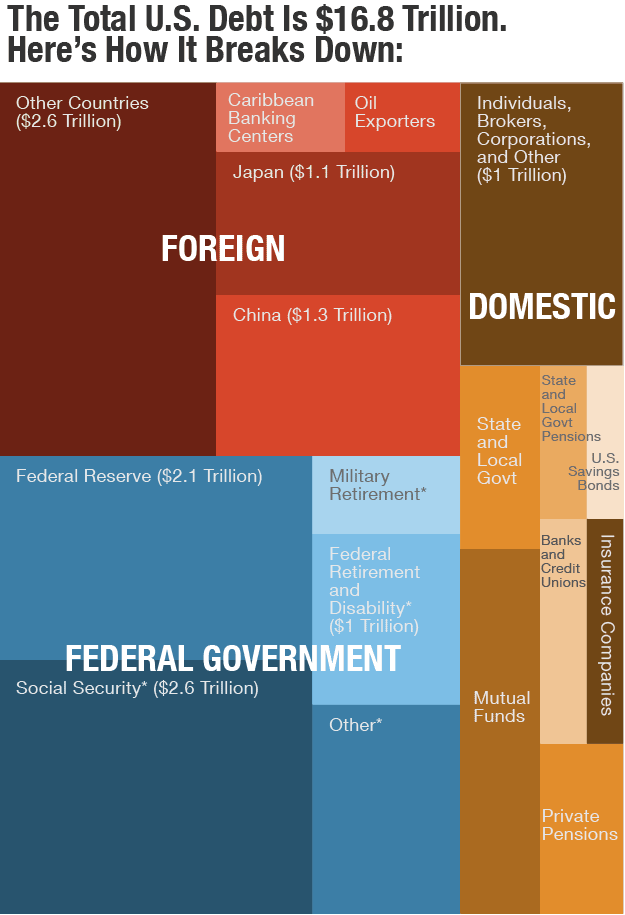
This wouldn’t solve the debt problem entirely. The Federal Reserve doesn’t own all U.S. government debt; it owns only roughly $2 trillion of it. (Well $2,076,927,000,000.00, as of last Wednesday, but who’s counting?)
NPR has a helpful graphic showing the various holders of U.S. government debt, including the Fed:
pm-gov_debt_v-624Source: NPR
Congressman Grayson continues:
Yet canceling this debt would give the government substantial room under the debt ceiling to manage its finances. It would end the debt ceiling standoff in Congress, and it would prevent a default.
The debt held on the balance sheet of the Federal Reserve can be canceled without any significant consequence, because it is a bookkeeping artifact corresponding to the money supply. In essence, the government owes this money to itself. If I owe money to myself, I can cancel that debt at will and without consequence, essentially taking it out of my left pocket and putting it in my right pocket.
Last year, the Federal Reserve declared a “profit” of roughly $91 billion, much of which came from interest payments from the U.S. Treasury. The Federal Reserve then quickly remitted nearly all of this profit right back to the U.S. Treasury.
The Federal Reserve does this every year. Reducing or eliminating this unearned “profit” actually will provide a more realistic view of federal finances.
Grayson gives credit to Paul for coming up with the idea:
I am a Democrat, and known as a progressive. But this idea was put forward a few years ago not by me, or by a member of my party, but by Republican Representative Ron Paul.
He thinks, as do I, that the Federal Reserve‘s dramatic expansion of its balance sheet is simply a way of financing the government by printing money. The Fed isn’t really “buying” Treasury bonds, it is just letting the government finance its deficit by adding to the money supply.
Indeed, Paul introduced a bill in 2011 which would have led to the cancellation of $1.6 trillion in federal debt held by the Fed.
Grayson continues:
While canceling the Treasury debt held on the Federal Reserve balance sheet might be considered unorthodox, it is no more unorthodox than the quantitative easing that has added much of this debt to the Fed’s balance sheet.
Indeed, quantitative easing – the radical program the Fed has engaged in for years, which doesn’t help the economy,   benefits the the super-elite and hurts the little guy, and more than offsets any savings from budget cuts in other areas – is largely performed through buying U.S. debt … $45 billion each month.
Grayson concludes:
In any event, preventing a financial meltdown, with its attendant risks of interest rate and price spikes as well as staggering employment losses, is certainly central to the Federal Reserve‘s mandate of ensuring price stability, maximum employment and moderate, long-term interest rates.
Bernanke could alleviate the debt ceiling crisis simply by canceling the debt held on the Fed’s balance sheet.
This may sound like a fringe idea. But the Financial Times noted in  an article last year entitled “Will central banks cancel government debt?”:
It is obvious that governments are struggling to find the correct balance between controlling public debt … and boosting the rate of economic growth. The former objective requires more budgetary tightening, while the latter requires the opposite. Is there any way around this? One radical option now being discussed is to cancel (or, in polite language, “restructure”) part of the government debt that has been acquired by the central banks as a consequence of quantitative easing (QE). After all, the government and the central bank are both firmly within the public sector, so a consolidated public sector balance sheet would net this debt out entirely.
***
Adair Turner, the chairman of the UK Financial Services Agency, and reportedly a candidate to become the next governor of the Bank of England, made a speech last week that said more unorthodox options, including “further integration of different aspects of policy”, might need to be considered in the UK. Two separate journalists (Robert Peston of the BBC and Simon Jenkins of The Guardian) said that Lord Turner’s “private view” is that some part of the Bank’s gilts holdings might be cancelled in order to boost the economy. Lord Turner distanced himself in public from this suggestion on Saturday. However, the notion will now be widely discussed.
***
Similar proposals have however been widely debated by economists in the past. This goes back at least as far as the works of Abba Lerner in the 1940s on “functional finance” and the role of fiat money. More recently, the Modern Monetary Theorists have reawakened Lerner’s ideas.

Solutions: Make Your Own Media

New Report Finds Obama’s Policies Threaten an Independent Press

Image
Rainey Reitman
Electronic Frontier Foundation

The Committee to Protect Journalists has released its first-ever special report on freedom of the press in the United States. For many years, CPJ has documented attacks on journalists in many countries around the world. The report focused on how policies and practices of the Obama administration disrupt relationships between journalists and government sources, allow officials to circumvent scrutiny by the press, and create a chilling environment for whistleblowers who might otherwise serve as journalistic sources. The report also discusses the ramifications of NSA surveillance, which leaves journalists and their sources reluctant to communicate electronically.

The report paints a picture of increasing press restrictions beginning just after 9/11 and culminating with the current administration, which is described as uniquely resistant to accountability to the press. Written by former executive editor of the Washington Post Leonard Downie Jr and CPJ’s Sara Rafsky, the report relied on information gathered through extensive interviews with dozens of members of the press. Individual journalists are cited throughout to provide candid insights into the daily experiences of journalists in the United States today.

In total, the report and the concomitant recommendations show that Obama Administration policies around classification, whistle-blower prosecution, and surveillance are threatening investigative journalism.

Among several issues the report surfaced, the authors heavily criticized Obama’s record on classification. They called on Obama to do more to correct the problems of overclassification, citing concerns raised by Senator Ron Wyden and transparency advocate Steven Aftergood. The report discussed how, despite Obama’s promises of embracing transparency when he first took office, Freedom of Information Act requests frequently were left unanswered, delayed, or denied.


The report also highlighted the bureaucratic bloat that stemmed from gross overclassification, noting:
By 2011, more than 4 million Americans had security clearances for access to classified information of one kind or another, according to a U. S. Intelligence Community report to Congress required by the 2010 Intelligence Authorization Act, and more and more information was being classified as secret. In that year alone, government employees made 92 million decisions to classify information—one measure of what [Harvard Law School professor Jack] Goldsmith called "massive, massive over-classification."
In addition, the report detailed the aggressive overprosecution of whistle-blowers under the Obama administration. The report noted that Obama’s administration had charged six government employees and two contractors—including Edward Snowden— with felony criminal prosecutions under the 1917 Espionage Act for leaking information to the press. This is more than all of such prosecutions in all previous U.S. administrations. The report discussed at length individual prosecutions as well the fact that government officials were fearful and reluctant to speak with the media.

There were also numerous examples of the government getting subpoenas to learn more about journalists communicating with sources.

CPJ also noted that extensive surveillance by the NSA, which has recently been confirmed and detailed by the Edward Snowden leaks, have "added to the fearful atmosphere surrounding contacts between American journalists and government sources." The NSA’s dragnet data collection programs left many journalists with doubts about their ability to protect their sources or conduct investigations. Washington Post national security reporter Dana Priest noted that, "People think they’re looking at reporters’ records. I’m writing fewer things in e-mail. I’m even afraid to tell officials what I want to talk about because it’s all going into one giant computer."

CPJ also released a series of recommendations to the Obama Administration, including a call to end the practice of bringing espionage charges against people who leak classified information to journalists and more transparency around the scope and nature of the National Security Agency and other surveillance activities as they are being applied to domestic and international journalists.

Overall, CPJ’s report describes a government actively avoiding accountability and transparency while enacting policies that undermine an independent media. The real victim of such policies is the general public, which relies on an informed media to hold government officials to account. We echo CPJ’s concerns and urge the administration to act swiftly to address the serious issues of press freedom that were outlined in the report.

Classified docs on "Nano Domestic Quell" DoD kill-switch program released by Dr. Bill Weld *DOWNLOAD LINK* | The Daily Sheeple

JFK: The Missing Shell Chicanery of Joseph Ball, Attorney at Law

by Larry Rivera (with Jim Fetzer)


“As with Watergate, numerous lawyers were involved with the Warren Commission; in neither case did these lawyers act as lawyers. Rather, they participated in a cover-up and acted as accessories in serious crimes.”–Howard Roffman, Presumed Guilty (1976)
If it is not an act of God, it is a conspiracy.” Jim Marrs (“The Real Deal”, 5/28/13)

Joseph Ball
Joseph Ball spanned most of the 20th century as one of the top lawyers in the country. He cut his teeth in the oil and gas industry in the 1920′s and was a member of the firm Ball, Hunt and Hart, from Long Beach and Santa Ana, California.
He also taught criminal law and procedure at the University of Southern California. At one point in his career he was offered, but turned down, a seat on the California Supreme Court.
Over the years, some of his clients included John D. Ehrlichman of Watergate fame, automaker John DeLorean, and Saudi financier Adnan Khashoggi. He died September 21, 2000.[1]
As Assistant Counsel, Joseph Ball was one of the most prolific Warren Commission lawyers, leading and taking more than 100 depositions, most of them in Dallas, Texas.[2] For all of his qualifications, distinctions and immaculate reputation, it seems Mr. Ball was seduced by the dark side – the cabal that assassinated John F. Kennedy November 22, 1963. It is time to put Joseph Ball’s Warren Commission activities in the proper perspective, as they lay bare by the record.

A Problem with the Evidence


One of the most fascinating aspects of the Warren Commission’s inquiry was concealing the fact that only two spent and one unspent shell casings were found at the alleged 6th floor “assassin’s lair”.  They were photographed by the DPD in Dallas and by the FBI.  Here, for example, is an FBI evidence photo showing two spent casings and one unspent cartridge:
FBI evidence photograph
Even more interesting, here is an evidence photo that appeared in Jesse Curry’s JFK ASSASSINATION FILES, which he published after leaving the DPD, where he was Chief of Police during the assassination and its aftermath:
Jesse Curry's JFK evidence photo
This photo is fascinating not only because it shows two spent cartridge casings (1) and one unspent cartridge (6) but because it also includes the paper bag (7) in which Lee Oswald is alleged to have brought the Mannlicher-Carcano into the TSBD. Anyone with experience with weapons knows that their parts are hard and unforgiving, where had this bag actually been used for that purpose, it would have been torn and oily, not clean and neat as though it had just come from a local “Five & Dime”.
Insofar as the alleged assassin was supposed to have fired three shots at his target, the Warren Commission had to figure out how to obfuscate and work around the evidence that contradicted its position, where Joseph Ball, Esq., would prove his value as an Assistant Counsel.  Here is the story of how it was done as another crucial ingredient in the plot to frame an innocent man for the death of the 35th president of the United States.

The “Empty Shell” Game, Part I

Joseph Ball took the testimony of Luke Mooney, the Dallas Police Department Sheriff who first found the shell casings on the sixth floor of the Texas School Book Depository, which supposedly came from Lee Oswald’s Mannlicher-Carcano.[3] In Bloody Treason, Noel Twyman[4] established how Ball orchestrated the scenario where two empty shells and one live round, which had been found by Mooney, and documented by the FBI, was sanitized to officially become three empty shells, presumably left behind by Oswald in the sniper’s nest, and which  would later become part of the official record [5].

Exhibit (1): From Mooney’s testimony:


Ball questioning Mooney for the WC
Ball converts two casings and a live round into three “empty shells”

Exhibit (2): From Bloody Treason, Noel Twyman:


“The answer was clear (a) the evidence of three empty cartridge cases was fabricated, and (b) deputy sheriff Luke Mooney was led into testifying that there were three empty cartridges when there were in fact only two. I wondered how an honorable man such as Joseph Ball could have gotten himself involved in such a transparent scheme.” [6]

Exhibit (3): Two spent, one unspent shell from CE 2003:


moz-screenshot-2


Exhibit (4): The live round does not come from an M-C:


moz-screenshot-3

Exhibit (5): Dougherty’s story comports with two spent shells:


moz-screenshot-4
From HAVE WE IGNORED THE KEY WITNESS TO THE DEPOSITORY SHOT OR SHOTS?
By Frank A. Cellura (2000)

Exhibit (6): Focusing on Exhibit 10-14 rather than 10-15:


“One more important note in Joseph Ball’s questioning of deputy sheriff Mooney, he focused on Exhibit 10-14 (CE-510). Why did he choose Exhibit 10-14 instead of Exhibit 10-15 (CE-512), both of which are in the commission Report? The answer could be that Joseph Ball knew that Exhibit 10-14 was authentic and he could not understand Exhibit 10-15, so he avoided attracting attention to it.”[7]
CE-512
CE716 (WC17H500) also shows the images that Twyman cited (CE510/512), but without the felt tip circles. Indeed, when we enlarge the images we confirm there is a problem with one of the “empty shell casings”, where it appears to be a live round. What Twyman and Cellura seem to have overlooked, however, is that the round is not for a Mannlicher Carcano. As far as calling Ball an “honorable man”, the rest of this article will show Twyman was being generous in his assessment of Ball.
Joseph Ball’s manipulation of Mooney’s testimony was only the beginning of his involvement with the empty shell game. As we move on, the stakes will move higher, and the shell game will rear its ugly head later, when we cover African American witnesses Harold Norman, Junior Jarman and Bonnie Ray Williams.

The “Empty Shell” Game, Part II


The presence of African American witnesses Bonnie Ray Williams, Harold Norman and James Jarman, who were photographed at the fifth floor windows by Tom Dillard right after the shots, has been examined at length CE 482by researchers and investigators.[8]They were brought to Washington on March 24, 1964, and were interviewed by Joseph Ball in the presence of John McCloy, Allen Dulles, Gerald Ford, and Earl Warren himself.[9] This should give the reader an idea of the importance of the testimony of these three gentlemen – and the degree of intimidation they must have been subjected to. Roy Truly accompanied the three to Washington for his first deposition as well.[10] All three of them had been thoroughly prepared and coached four days earlier (Friday, 3/20/64) in Dallas, when they did photo shoots, rehearsals, and re-creations with Joseph Ball on the 5th floor of the TSBD for the Commission.[11]
CE 488Of the three, Norman was the only one who said he heard the sound of a rifle bolt being operated in between shots, and the shells falling, after being ejected, onto the wooden floor right above the three men.
On November 26, 1963 Norman was interviewed by the FBI and made no mention about hearing shells and rifle action bolts.
Alas, by December 4th, he was brought in to swear an affidavit where he now stated he heard the above mentioned sounds.[12]This document was used later on to buttress his Secret Service Interview of 12/7/63.
Patricia Lambert wrote about Secret Service Report (SS491) in The Continuing Inquiry 10/22/77 Vol 2, No 3 :[13]
Norman’s allegation that he heard the shells hit the floor and the bolt action of the rifle surfaced in toto in SS491. Twelve days after the assassination and eight days after his interview by the FBI, Norman’s startling disclosure made its belated appearance. Norman’s sworn affidavit to the Secret Service states:
“I knew that the shots had come from directly above me, and I could hear the expended cartridges fall to the floor. I could also hear the bolt action of the rifle. I also saw some dust fall from the ceiling of the fifth floor and I felt sure that whoever had fired the shots was directly above me.[7]“
Missing entirely from this new version is the description of Norman putting his head out the window and looking up toward the roof, a gesture which was witnessed by at least four people. Norman permanently eliminated this event from this testimony at this point. Also, the particles of dirt, which he told the FBI fell outside the building and prevented him from seeing anything when he looked up, are changed in this version to “some dust.” This dust fell “from the ceiling” inside the building and the intended implication appears to be that it was dislodged by the shells hitting the floor of the sniper’s nest.
“This then is Norman’s new story. Not only are the sounds of the gunman added for the first time, but one part of his earlier statement to the FBI is excised and another part altered to accommodate the new information. This new story transformed Norman from an inconsequential witness to one of major importance who provided firsthand evidence linking the shots that were fired at 12:30 to the hulls that were found on the sixth floor 40 minutes later. This important information became the focus of his interview three months later before the Warren Commission.”
Jarman and Williams both “corroborated” that Norman said he heard these sounds but they did not hear anything themselves.[14]Once again, an accomplished professor of law and veteran attorney such as Joseph Ball, surely would have known both Jarman’s and William’s statements about Norman telling them about shells hitting the wooden floor above them would have been pure hearsay, and would have been objected by any competent opposing counsel. So why did he pursue this line of questioning and allow it to stand for the record?
CE-489
Ball shamelessly leads Williams’ hearsay and in the process allows Williams to declare Oswald the shooter! Law students should use this as an example of what NOT to do when taking depositions and testimonies, unless of course, you have an ulterior motive.
The onus of proof here obviously lies with Harold Norman. How could he specifically hear the shell casings hitting the floor, but he nor the others not hear the footsteps of a person running on the wooden floor right above him,[15]and which had empty spaces where flooring was in the process of being laid? Ball tried to sucker him into this and Norman refused to go along:[16]
Norman testimony
As pointed out above, the Warren Commission conducted a re-creation, placing Norman on the fifth floor and working a rifle bolt right above him and letting empty shells hit the floor. Obviously, the Warren Commissioners were not convinced with Harold Norman’s testimony,
Not satisfiedand they later made three different trips to Dallas to re-enact the shell game and find out for themselves if it was possible.[17] This illustrates how desperate they were to establish three shots, three shell casings and one patsy in a sling. Regrettably, and with Joseph Ball leading the way, three blue collar African Americans got caught in this intricate web of deception, having to go along with a very vital part of the Warren Commission’s railroad of Lee Oswald.
We close the shell game with this from Shirley Martin: [18]
Shirley Martin on the three boys

The Missing Shell Chicanery

The commission confronted a problem.  According to the account they were advancing, a lone gunman fired three shots from the 6th floor of the Texas School Book Depository, scoring two hits and one miss.  The first hit allegedly entered the base of the back of JFK’s neck, passed through without encountering any bony structures and exited his throat, then entered the back of Gov. John Connally, shattering a rib, exiting his chest and hitting his right wrist before lodging itself in his right thigh.
They hoped that Arlen Specter’s skillful interrogation with hypothetical questions–”If we assume that the bullet entered here (at the back of the neck) and passed through without hitting any bony structures,  would it be consistent with those assumptions to describe the wound here (at the front of his neck) as a wound of exit?”–without noticing the trajectory is not even anatomically possible.[19]
But only two spent shell casings and one unspent cartridge had been found at the alleged scene of the crime. If there were not three spent shell casings, then their case fell apart.  They counted on Joseph Ball to perpetrate the charade, first by a series of interrogatories with Deputy Sheriff Luke Mooney, which he performed by citing the shells as “A”, “B”, and “C”, where “A” and “B” were spent and “C” was unspent.  But by omitting that crucial point, he concluded by referring to “the empty shells ‘A’, ‘B’, and ‘C’”, instead of referring to “the empty shells ‘A’ and ‘B’ and the unspent shell ‘C’”.
Given that verbal sleight-of-hand, which obfuscated the facts that two spent and one unspent shells had been recorded in evidence photographs, including one by the FBI, and that the one unspent shell was not even a Mannlicher-Carnao bullet, it was not that difficult to arrange confirming evidence from three young black men, whose own testimony was sufficiently malleable or subject to manipulation to make the case the commission wanted to make–regardless of the quantity and quality of the evidence that contradicted it.
Larry Rivera, the son of a career military man who served as CID officer in the Army and a Certified Network Engineer, has made a lifelong study of the JFK assassination. He has given interviews on the assassination to Spanish media and has the most complete dossier on Billy Nolan Lovelady ever done.

References:

1. http://www.innsofcourt.org/Content/InnContent.aspx?Id=3114
2. JFK Assassination Debate, Mark Lane vs Joseph Ball (12/04/64) 2:04 YouTube. He also wrote Chapter 4 of The Warren Report which happens to be the most important chapter that railroads Lee Oswald.
3. WC3H281
4. Bloody Treason, Noel Twyman pgs 91-97
5. CE 510 & CE 512
6. OpCit pg 94
7. Ibid pg 97
8. The Continuing Inquiry Vol. V #7 2/21/81 pg 3
9. WC3H140
10. HSCA Norman interview by Day also WC3H140
11. CE482, CE490
12. CE493
13. SS491 (CD87 pages 775-797)
14. WC3H161 and WCH198 (Jarman and Williams)
15. The Continuing Inquiry, Vol. 7 (2/21/81), p. 3
16. WC3H191 How could Norman have heard spent shells and rifle bolt action over the report and reverberation of the shots themselves?
17. Warren Commission Report (1964), p. 71
18. Martin letter 1/25/67 (Item 03) From “The Weisberg Collection, Hood College, Frederick, MD,USA”
19. James Fetzer, “Reasoning about Assassinations” (2005-06)

Minister: Government Will Censor All 160 Russian ‘Pirate’ Sites

The Government of Russia has signaled it is about to take the broadest anti-piracy action seen anywhere on the planet. In response to dealing with the problematic issue of sending notices to take down individual infringing URLs, Russia’s communications minister says the country will order local Internet service providers to completely censor around 160 identified ‘pirate’ sites.
russsopaJust over two months ago Russia made some of its strongest steps yet against online piracy by introducing a formal system for rightsholders to have unauthorized content, or links to content, taken offline.
The system, dubbed Russia’s SOPA, forces sites to comply with copyright complaints in a swift manner or face their domains being added to a national blacklist. Being added to that register is a serious business, since all local ISPs are expected to blacklist corresponding IP addresses so that local Internet users cannot gain access.
Proposals put forward last month upped the ante again, with any service provider or search engine not blocking sites on the blacklist potentially facing fines of around $30,000.
But according to comments coming out of the Government yesterday, Russia appears to be taking its anti-piracy initiative to the next level and beyond, fully living up to its ‘SOPA’ billing.
Ministry of Communications deputy head Alexei Volin said that Russia now intends to compartmentalize sites that are dedicated to piracy. They will be treated completely differently from other sites, such as YouTube etc, who may have an infringement problem but respond to copyright holders positively.
“There are a conscientious and diligent owners of websites, to which some people upload illegal or dangerous content. When it comes to this sort of thing, we order blocks of URLs and individual pages,” Volin said.
“However, there are some specialized and entirely pornographic sites that are entirely blocked by IP address. The same principle will be observed in respect of torrents and sites engaged in outright piracy,” the minister added.
“We will not block them for some particular things, we’ll close them entirely by IP address,” Volin said.
According to the minister there are around 160 local sites, ten of them very popular, that are causing serious concerns for the entertainment industries. Dealing with these, he says, can be a positive for the economy.
“There are [around 8 million] people who pay money for the legal content that they get on the Internet. These are the users who are one of the growth drivers of the Internet economy,” Volin said, adding that even pirates will spend when the circumstances are right.
“People on the Internet are willing to pay, especially when the content is useful, available and at a fair price,” he concludes.
Right at this moment it is unclear how the system will be implemented and on what basis. Presumably some kind of ‘pirate’ list already exists but whether sites will be blocked without further discussion or will have to fall foul of future complaints is not known.
Whatever the outcome, sites like RuTracker.org will probably be a priority target, despite claims from the site’s operators that they comply with takedown requests.
The site has around 13.4 million registered users, 3.5 million of them active in the past year. It hosts close to 1.5 million torrent files and is currently the 14th most-popular site in Russia. It’s proven resilient so far and last month celebrated its 9th birthday, but only time will tell what the future holds.

COLLATERALIZING SPACE ENERGY: THE MOON AND HELIUM-3

October 12, 2013 By

Ms. M.W., a regular reader here, deserves kuddos for finding this article and bringing it to my attention, for it fits the hypothesis we have been exploring off-and-on here, namely, the hypothesis of the collateralization of space.
For those unfamiliar with my hypothesis in this respect, a brief review is necessary. I have speculated in Covert Wars and Breakaway Civilizations, that the various bearer bonds scandals that began with the arrest of two allegedly Japanese men at the Swiss-Italian border, near Chiasso, by the Italian financial police in 2009, exposed the tip of a very large and hidden system of finance, for these men were arrested carrying bearer bonds in $500,000,000 and $1,000,000,000 denominations. Further bearer bonds scandals in Spain, and again in Italy,  involved sums in the trillions of dollars, and “counterfeit” bearer bonds backed by gold. But in the Japanese scandal, the billion dollar bearer bonds – self-evidently faked – were in my opinion designed to send a message, for these bonds depicted President John F Kennedy on the obverse, and on the reverse, depicted the Apollo Moon missions’ LEM (Lunar excursion module), the space shuttle, and a picture of the Moon. This suggested to me that space had been the collateral of a vast hidden system of finance established as a top secret system of funding for covert activities and research by President Harry S. Truman in 1947, the same year as the UFO flaps, the celebrated Roswell incident, and the establishment of the American national security apparatus. None of these are – in this hypothetical scenario – disconnected, for in my estimation in was nothing less than the establishment of a hidden system of finance with a long term goal of the extension of human civilization, including commerce, into space, and space itself and the resources found there, functioned as the collateral for the financiers taking part in this vast system.
Now there is this intriguing bit of corroboration that collateralization may not be so wide of the mark, and it involves energy, the cornerstone of the current public system of finance in the West:
Is Outer Space the Sustainable Energy Solution?
The choice of wording in the title alone is highly suggestive of a connection to the western financial oligarchy, for “sustainability” and “sustainable growth” are two memes dear to the heart of the Anglosphere oligarchs. So consider this one crucial paragraph again:
“The moon, for example, is estimated to contain over 1 million tons of Helium; the energy stored in that much Helium is 10 times the amount of energy you’d find in all of the fossil fuels on Earth. If one put a cash value on it, the helium-3 would be worth $4 billion a ton in terms of its energy equivalent in oil.”
Would such a thing be a worthwhile resource and therefore of interest to the current financial-energy power structure? Yes. Would such a thing be one of the primary reasons motivating recent discussions of property law and space? Yes.
But there’s something else to notice here. $4,000,000,000/ton of Helium, times the estimated 1,ooo,ooo tons of helium on the Moon, would be worth a staggering $4,000,000,000,000,000, or four quadrillion dollars. That’s more than enough to cover the risks and trillions of dollars suggested as the amounts flowing in that hidden system of finance, and a significant dent, as well, in all those quadrillions of dollars in derivatives.  And that amount of energy is also suggestive that the financial leverage created in that hidden system of finance, a system to leverage the entire planet in a kind of “Kardashev financial scale”, may have been deliberately done in anticipation of such finds, and vast wealth, on our nearby celestial neighbors.
What emerges from all this is yet another little indicator that this hypothesis of a collateralization of space shortly after World War Two, in a hidden system of finance, may in fact be close to what actually happened, for like it or not, it certainly is being discussed openly now.

Read more: COLLATERALIZING SPACE ENERGY: THE MOON AND HELIUM-3

Illinois woman has reconstructive surgery after cop slams her face into concrete bench

how long America !       what "kind" of  "man"  does this shit ?    hey Illinois  ..you know who this piece of shit IS ???          Our  daddy's  knew what to do !            

Illinois woman has reconstructive surgery after cop slams her face into concrete bench

truther October 12, 2013
A Chicago mother of two has filed a lawsuit against the village of Skokie after she was forced to have reconstructive surgery because an officer shoved her face into a concrete bench.
At a press conference this week, Cassandra Feuerstein admitted that she voluntarily pulled over and fell asleep in her car because she realized she had too much to drink last March. Officers discovered her and booked her on DUI charges.
Illinois woman has reconstructive surgery after cop slams her face into concrete bench
“Apparently I was not looking into the camera the way the officer wanted me to,” Feuerstein explained to WBBM.
A complaint filed by the Skokie Police Department claimed that she had resisted Officer Michael Hart by placing her hands on the side of the door when he returned her to her cell. In video obtained by Feuerstein’s lawyer, Hart can be seen giving the woman a hard shove, sending her face first into a concrete bench on the other side of the cell.
Within minutes, blood pools around Feuerstein’s head as she lays on the floor.
She recalled that the incident “shattered my orbital bones, broke my orbital floor, both shattered and pushed in my cheek bone.”
Cook County prosecutors later dismissed charges that she had resisted police. Feuerstein’s lawsuit was seeking unspecified damages.
Watch this video from WBBM, broadcast Oct. 9, 2013.