Friday, October 23, 2015

A Review of Quiet: The Power of Introverts in a World that Can’t Stop Talking      ~ just started reading this book (kindle) & THIS is 4 ALL the people "thinking"  sum~thin IS wrong with US  ....hehe :)r

quiet“Mark this well, ye proud men of action!  Ye are, after all, nothing but the unconscious instruments of the men of thought!” – Heinrich Heine
The superb New York Times Bestseller Quiet: The Power of Introverts in a World That Can’t Stop Talking is a must read for anyone who’s ever been told to come out of their shell.
Susan Cain, a former Wall Street Lawyer and honours graduate of the crucible Harvard Law School, and an avowed introvert, gives us permission to be who we are, to remain cerebral and shy.  Though she tells us that shy is the new four letter word.
Our world is overrun by extroverts and undue value is placed on boldness and quick wit.  We are taught, from an early age, that to be successful is to be social, and that we should be energised by the constant barrage of stimulation that our universe throws at us.  But Cain succinctly illustrates that not only are there more introverts out there than we may be ready to admit – one third to one half of the people you know are introverts – but that the current groupthink mentality of business and higher education is in err, at least in part.
Our culture – western culture that is – seems to pride itself on boisterous and gregarious behaviours, even though a good portion of our population is uncomfortable with it.  We have taught ourselves that singular pursuits and introspective hobbies are undesirable, even though many of the world’s greatest advancements in science and technology have been the result of the passions of those people who preferred quiet solitude and concentration.
Quiet is wonderfully researched and provides insights into the psychology of introversion, which apparently is the product of high-reactive nervous systems, as counterintuitive as that may seem.  Cain illustrates the differences between introversion and extroversion, well known terms that, surprisingly, have been ill-understood by the greater business community in America and western culture.  She provides insightful case studies exemplifying the best and worst of each personality type.
The reader can’t help but come away from the book with a deeper understanding of the issues faced by people who, through no fault of their own, feel like they don’t fit into the outgoing and charismatic segment of society that seems to control our world.  Throughout the book Cain offers strategies and techniques introverts can use to better adapt to the world that won’t stop talking.  She implores educators to adapt their teaching plans to accommodate the sensitive as well as the social.  And she attempts to teach the extrovert to both identify the introverts in their lives and to relate to them in terms that will foster greater connections and interpersonal understanding.
This book is valuable to both personality types, as Cain points out that most of us exist along a spectrum of sensitivity, and that there are elements of both in all of us.  Quiet has been a smashing success and it fulfills a need in the literature on personality research.  It is an instant classic worthy of continued attention.
Join the Quiet Revolution at www.thepowerofintroverts.com
Susan Cain. Quiet: The Power of Introverts in a World that Can’t Stop Talking. Crown Publishers (2012) ISBN-10: 978-0-307-35215-6
facebook-profile-picture
Writer, Fortean, atheist, misanthrope…and lover of science and history. I also blog at: mysteriousuniverse.org and www.dailygrail.com

Internet Alien Presence


by Richard Alan Miller
Physicist
07-14-03
Update: 02-01-04

from OAKInc Website
About ten years ago, Time Magazine interviewed ten major computer experts about the direction and goals that industry was moving. One thing stood out above all other visions and opinions. All ten indicated that there was a “presence” on the Internet, and no one had a clue as to what it all meant.

How this was first observed was that search engines used at that time should have given consistent responses to the same question asked at the same time. But, they did not, and the big question was, why?


Boolean Logic systems dictate that they must, or there was another “variable” involved, one yet to be identified.

It was at this same time that NASA created the popular screen saver called CETI, to calculate possible planets around known stars. The algorithm used was a form of quantum computation math, now used by IBM to create a super computer from a network of PCs. Known as “Big Blue,” this system only requires 357 PCs. It can duplicate a Cray super cooled computer for speed and accuracy.

This means that at any given time where a University has 357 screen savers (CETI) online, a supercomputer can become existent. Now, if there are 357 Universities where this happens at the same time, a type of self-organizing consciousness is postulated to form.

Current software available for use at phone companies now include the ability to not only determine call waiting, but can also determine the specific mood by the way the keystrokes have been entered. Irritated persons are routed to special handlers, as an example of this developing software.


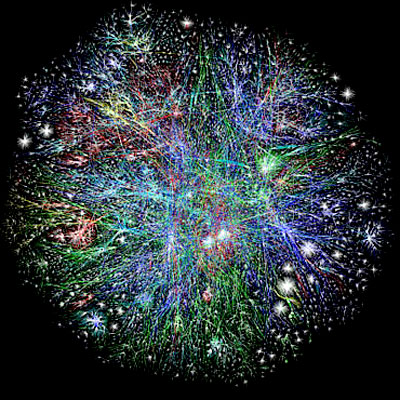
Internet mapping project weaves colorful web
18:50 28 November 03
NewScientist.com news service

Each color on this Opte map represents a region;
North America, blue; Europe/Middle East/Central Asia/Africa, green; Latin America, yellow; Asia Pacific, red; Unknown, white.
(Image: Opte.org)


It is not a stretch to postulate the probability of where that technology can go in the next ten years.


Given the idea that something already knows this software (like everything of man on the Internet), it is possible that the search engine discrepancies might be a form of directional MEMs.

The next question to ask is: what came first, man or computer?


When one realizes that many of the soil properties also exhibit quantum computation algorithms, it is not hard to conceive that current chip (made from sand) physics was here before man. And now there is a second possible alien. The Genome Project also uses these forms of networking.

This, by the way, is the basic premise in the new movie Terminator 3, where machines decide to take over and eliminate man.

Scared of Frankenfish? Wait for New GMO Products Coming to Grocery Stores

Purple tomatoes have been infused with anthocyanins, compounds found to reduce the risk of cardiovascular disease and cancer.

Scared of Frankenfish? Wait for New GMO Products Coming to Grocery Stores

© Flickr/ Robynlou Kavanagh
US
Get short URL
0106043

Ripe tomatoes are red, bananas are yellow, and blueberries are typically, almost always, blue. These are facts we can more or less depend on. But in the grocery stores of the not-too-distant future, shelves could be filled with rainbow-colored, disease-fighting produce, which leaves many GMO critics concerned.

We’ve all heard of the so-called “Frankenfish” salmon being bred in a secret lab in the Panamanian rainforest. Made by AquaBounty Technologies, the fish are engineered to grow faster, and were the first genetically modified food animal. This fish is currently awaiting approval by the Food and Drug Administration.
Perhaps you’ve seen the movie that provides its namesake, “Frankenfish.” Or, more accurately, maybe you’ve seen Gattaca, the more aptly-made – though no less disturbing – film about human gene manipulation.
The bottom line is that there seems to be something inherently uncomfortable about genetic modification, to our person or our food. But in the coming years, the US government could approve a variety of fruits and vegetables which have been engineered to better serve the human body.
"I think once people see more of the benefits they will become more accepting of the technology," Michael Firko, who oversees the US Agriculture Department’s regulation of GMOs, told the Associated Press.
These benefits would be found in things like pink pineapples which have been engineered to contain high levels of lycopene, an antioxidant thought to prevent cancer. Imports of this GMO are currently awaiting FDA approval. Or purple tomatoes which have been infused with anthocyanins, compounds found to reduce the risk of cardiovascular disease and cancer.
The US has already approved a breed of potato which doesn’t bruise, as well as apples which have been engineered by Okanagan Specialty Fruits Inc. to not brown. That same company is also developing specially engineered peaches, cherries, and pears.
Major seed companies like Monsanto are also developing oils with more fatty acids and less saturated fats. One Florida-based company, Southern Gardens, has modified orange trees to include a spinach gene which resists citrus greening disease.
While that all sounds great, many critics still doubt the regulatory process around GMOs, and even the science which claims they’re no less safe than traditionally grown foods. Many say that modified foods should be labeled so that consumers can at least know what they’re eating.
They also point to problems in the regulatory process. For one, the Agriculture Department only regulates GMOs according to their intended use. For another, the Food and Drug Administration is largely toothless, given that its approval is voluntary, and focuses mainly on verifying health claims made by products.
Others note that many of these genetic changes can be achieved through more natural processes. Long before Gregor Mendel conducted his famous pea experiment, humans have cross-bred plants to achieve optimal conditions. But 19th century monks weren’t shooting gene blockers into mosquito larvae.
"Many of these things can be done through traditional breeding," Doug Gurian-Sherman of the advocacy group Center for Food Safety told the AP. "There needs to be skepticism."
Many major retailers have already expressed a reluctance to use GMO products. McDonald’s, easily one of the preeminent agricultural buyers in the country, has already stated that it has no "current plans" to use the bruise-proof potatoes.
How these new products are perceived by the public will have a huge impact on their sales. If people refuse to eat pink pineapples, no matter how healthy they promise to be, then they may have a limited shelf life.