Tuesday, April 15, 2014

Goldman Sachs Steals Open Source, Jails Coder

14 April 2014. Part 2:
2014-0582.htm  Goldman Sachs Steals Open Source, Jails Coder 2  April 14, 2014
11 April 2014// http://cryptome.org/2014/04/goldman-sachs-code-thief.htm
Goldman Sachs Steals Open Source, Jails Coder
US master spy Clapper says spies steal open source, then immediately claims ownership and classifies it, and prosecutes if the material is disclosed, like Goldman Sachs.


Flash Boys: A Wall Street Revolt, Lewis, Michael. 2014. W. W. Norton & Company. pp. 141-149.
After a few months working on the forty-second floor at One New York Plaza, Serge came to the conclusion that the best thing they could do with Goldman’s high-frequency trading platform was to scrap it and build a new one from scratch. His bosses weren’t interested. “The business model of Goldman Sachs was, if there is an opportunity to make money right away, let’s do that,” he says. “But if there was something long-term, they weren’t that interested.” Something would change in the stock market— an exchange would introduce a new, complicated rule, for instance— and that change would create an immediate opportunity to make money. “They’d want to do it immediately,” says Serge. “But if you think about it, it’s just patching the existing system constantly. The existing code base becomes an elephant that’s difficult to maintain.”
That is how he spent the vast majority of his two years at Goldman, patching the elephant. For their patching material he and the other Goldman programmers resorted, every day, to open source software—software developed by collectives of programmers and made freely available on the Internet. The tools and components they used were not specifically designed for financial markets, but they could be adapted to repair Goldman’s plumbing. He discovered, to his surprise, that Goldman had a one-way relationship with open source. They took huge amounts of free software off the Web, but they did not return it after he had modified it, even when his modifications were very slight and of general, rather than financial, use. “Once I took some open source components, repackaged them to come up with a component that was not even used at Goldman Sachs,” he says. “It was basically a way to make two computers look like one, so if one went down the other could jump in and perform the task.” He’d created a neat way for one computer to behave as the stand-in for another. He described the pleasure of his innovation this way: “It created something out of chaos. When you create something out of chaos, essentially , you reduce the entropy in the world.” He went to his boss, a fellow named Adam Schlesinger, and asked if he could release it back into open source, as was his inclination. “He said it was now Goldman’s property,” recalls Serge. “He was quite tense.” Open source was an idea that depended on collaboration and sharing, and Serge had a long history of contributing to it. He didn’t fully understand how Goldman could think it was okay to benefit so greatly from the work of others and then behave so selfishly toward them. “You don’t create intellectual property,” he said. “You create a program that does something.” But from then on, on instructions from Adam Schlesinger, he treated everything on Goldman Sachs’s servers, even if it had just been transferred there from open source, as Goldman Sachs’s property . (Later, at his trial, his lawyer flashed two pages of computer code: the original, with its open source license on top, and a replica, with the open source license stripped off and replaced by the Goldman Sachs license.)
The funny thing was that Serge actually liked Adam Schles-inger, and most of the other people he worked with at Goldman. He liked less the environment the firm created for them to work in. “Everyone lived for the year-end number,” he said. “You get satisfied when the bonus is sizable and you get not satisfied when the number is not. Everything there is very possessive .” It made no sense to him the way people were paid individually for achievements that were essentially collective achievements. “It was quite competitive. Everyone’s trying to show how good their individual contribution to the team is. Because the team doesn’t get the bonus, the individual does.”
More to the point, he felt that the environment Goldman created for its employees did not encourage good programming, because good programming required collaboration. “Essentially there was very minimal connections between people,” he says. “In telecom you usually have some synergies between people. Meetings when people exchange ideas. They aren’t under stress in the same way. At Goldman it was always, ‘Some component is broken and we’re losing money because of it. Fix it now .’ ” The programmers assigned to fix the code sat in cubicles and hardly spoke to one another. “When two people wanted to talk they wouldn’t just do it out on the floor,” says Serge. “They would go to one of the offices around the floor and close the door. I never had that experience in telecom or academia.”
By the time the financial crisis hit, Serge had a reputation of which he himself was unaware: He was known to corporate recruiters outside Goldman as the best programmer in the firm. “ There were twenty guys on Wall Street who could do what Serge could do,” says a headhunter who recruits often for high-frequency trading firms. “And he was one of the best, if not the best.” Goldman also had a reputation in the market for programming talent— for keeping its programmers in the dark about their value to the firm’s trading activities. The programmer types were different from the trader types. The trader types were far more alive to the bigger picture, to their context. They knew their worth in the marketplace down to the last penny. They understood the connection between what they did and how much money was made , and they were good at exaggerating the importance of the link. Serge wasn’t like that. He was a little-picture person, a narrow problem solver. “I think he didn’t know his own value,” says the recruiter. “He compensated for being narrow by being good. He was that good.”
Given his character and his situation , it’s hardly surprising that the market kept finding Serge Aleynikov and telling him what he was worth, rather than the other way around. A few months into his new job, headhunters were calling him every other week. A year into his new job, he had an offer from UBS, the Swiss bank, and a promise to bump up his salary to $ 400,000 a year. Serge didn’t particularly want to leave Goldman Sachs just to go and work at another big Wall Street firm, and so when Goldman offered to match the offer, he stayed. But in early 2009 he had another call, with a very different kind of offer: to create a trading platform from scratch for a new hedge fund run by Misha Malyshev.
The prospect of creating a new platform, rather than constantly patching an old one, excited him. Plus Malyshev was willing to pay him more than a million dollars a year to do it, and he suggested that they might even open an office for Serge near his home in New Jersey. Serge accepted the job offer and then told Goldman he was leaving. “When I put in the resignation letter,” he said , “everyone comes to me one by one. The common perception was that if they had the right opportunity to quit Goldman they would do that in no time.” Several hinted to him how much they would like to join him at his new firm. His bosses asked him what they could do to persuade him to stay. “They were trying to pursue me into this monetary discussion,” says Serge. “I told them it wasn’t the money . It was the chance to build a new system from the ground up.” He missed his telecom work environment. “Whereas at IDT I was really seeing the results of my work , here you had this monstrous system and you are patching it right and left. No one is giving you the whole picture. I had a feeling no one at Goldman really knows how it works as a whole, and they are just uncomfortable admitting that.”
He agreed to hang around for six weeks and teach other Goldman people everything he knew, so that they could continue to find and fix the broken bands in their gigantic rubber ball. Four times in the course of that last month he mailed himself source code he was working on. The files contained a lot of open source code he had worked with, and modified, over the past two years, mingled with code that wasn’t open source but was obviously proprietary to Goldman Sachs. He hoped to disentangle one from the other in case he needed to remind himself how he had done what he had done with the open source code; he might need to do it again. He sent these files the same way he had sent himself files nearly every week since his first month on the job at Goldman. “No one had ever said a word to me about it,” he says. He pulled up his browser and typed into it the words : “free subversion repository.” Up popped a list of places that stored code for free and in a convenient fashion. He clicked the first link on the list. To find a place to send the code took about eight seconds . And then he did what he had always done since he’d first started programming computers: He deleted his bash history— the commands he had typed into his own Goldman computer keyboard. To access the computer, he was required to type his password . If he didn’t delete his bash history, his password would be there to see, for anyone who had access to the system.
It wasn’t an entirely innocent act. “I knew that they wouldn’t be happy about it,” he said, because he knew their attitude was that anything that happened to be on Goldman’s servers was the wholly owned property of Goldman Sachs— even when Serge himself had taken that code from open source . When asked how he felt when he did it, he says, “It felt like speeding. Speeding in the car.”
FOR MUCH OF the flight from Chicago he’d slept. Leaving the plane, he noticed three men in dark suits waiting in the alcove of the Jetway reserved for baby strollers and wheelchairs. They confirmed his identity, explained that they were from the FBI, handcuffed him, searched his pockets, removed his backpack, told him to remain calm, and then walled him off from the other passengers . This last act was no great feat. Serge was six feet tall but weighed roughly 140 pounds: To hide him you needed only to turn him sideways. He resisted none of these actions, but he was genuinely bewildered. The men in black refused to tell him his crime. He tried to guess it. His first guess was that they’d gotten him mixed up with some other Sergey Aleynikov. Next it occurred to him that his new employer, Misha Malyshev , then being sued by Citadel, might have done something shady. Wrong on both counts. It wasn’t until the plane had emptied and they’d escorted him into Newark Airport that they told him his crime: stealing computer code owned by Goldman Sachs.
The agent in charge of the case, Michael McSwain, was new to law enforcement. Oddly enough, he’d spent twelve years, until 2007, working as a currency trader on the Chicago Mercantile Exchange. He and others like him had been put out of business by Serge and people like him— or, more exactly, by the computers that had replaced the traders on the floors of every U.S. exchange. It wasn’t an accident that McSwain’s career on Wall Street ended the same year that Serge’s began.
McSwain marched Serge into a black town car and drove him to the FBI building in lower Manhattan. After making a show of stashing his gun , McSwain led him into a tiny interrogation room, handcuffed him to a rod on the wall, and , finally, read him his Miranda rights. Then he explained what he knew, or thought he knew: In April 2009 Serge had accepted a job at a new high-frequency trading shop, Teza Technologies, but had remained at Goldman for the next six weeks. Between early April and June 5, when Serge left Goldman for good, he sent himself, through the so-called subversion repository, 32 megabytes of source code from Goldman’s high-frequency stock trading system . McSwain clearly found it damning that the website Serge used was called a subversion repository, and that it was in Germany. He also seemed to think it significant that Serge had used a site not blocked by Goldman Sachs, even after Serge tried to explain to him that Goldman did not block any sites used by its programmers but merely blocked its employees from porn sites and social media sites and suchlike. Finally, the FBI agent wanted him to admit that he had erased his bash history. Serge tried to explain why he always erased his bash history, but McSwain had no interest in his story. “The way he did it seemed nefarious,” the FBI agent would later testify.
All of which was true, as far as it went, but, to Serge, that didn’t seem very far. “I thought it was like, crazy, really,” he says. “He was stringing these computer terms together in ways that made no sense. He didn’t seem to know anything about high-frequency trading or source code.” For instance, Serge had no idea where the subversion repository was physically located. It was just a place on the Internet used by developers to store the code they were working on. “The whole point of the Internet is to abstract the physical location of the server from its logical address,” he said. To Serge, McSwain sounded like a man repeating phrases that he’d heard from others but that to him actually meant nothing. “There is a game in Russia called Broken Phone,” he said— a variation on the American game Telephone . “It felt like he was playing that.”
What Serge did not yet know was that Goldman had discovered his downloads— of what appeared to be the code they used for their proprietary high-speed stock market trading— just a few days earlier, even though Serge had sent himself the first batch of code months ago. They’d called the FBI in haste and had put McSwain through what amounted to a crash course in high-frequency trading and computer programming. McSwain later conceded that he didn’t seek out independent expert advice to study the code Serge Aleynikov had taken, or seek to find out why he might have taken it. “I relied on statements from Goldman employees,” he said. He had no idea himself of the value of the stolen code (“ representatives from Goldman told me it was worth a lot of money”), or if any of it was actually all that special (“ representatives of Goldman Sachs told us there were trade secrets in the code”). The agent noted that the Goldman files were on both the personal computer and the thumb drive that he’d taken from Serge at Newark Airport, but he failed to note that the files remained unopened. (If they were so important, why hadn’t Serge looked at them in the month since he’d left Goldman?) The FBI’s investigation before the arrest consisted of Goldman explaining some extremely complicated stuff to McSwain that he admitted he did not fully understand —but trusted that Goldman did. Forty-eight hours after Goldman called the FBI, McSwain arrested Serge. Thus the only Goldman Sachs employee arrested by the FBI in the aftermath of a financial crisis Goldman had done so much to fuel was the employee Goldman asked the FBI to arrest.
On the night of his arrest, Serge waived his right to call a lawyer. He called his wife, told her what had happened, and said that a bunch of FBI agents were on the way to their home to seize their computers, and to please let them in, although they had no search warrant. Then he sat down and politely tried to clear up the confusion of this FBI agent who had arrested him without an arrest warrant. “How could he figure out if this was a theft if he didn’t understand what was taken?” he recalls having asked himself. What he’d done, in his view, was trivial; what he stood accused of— violating both the Economic Espionage Act and the National Stolen Property Act— did not sound trivial at all. Still, he thought that if the agent understood how computers and the high-frequency trading business actually worked, he’d apologize and drop the case. “The reason I was explaining it to him was to show that there was nothing there,” he said. “He was completely not interested in the content of what I am saying. He just kept saying to me, ‘If you tell me everything, I’ll talk to the judge and he’ll go easy on you.’ It appeared they had a very strong bias from the very beginning. They had goals they wanted to fulfill. One was to obtain an immediate confession.”
The chief obstacle to the FBI’s ability to extract his confession, oddly, wasn’t Serge’s willingness to provide it but its own agent’s ignorance of the behavior to which Serge was attempting to confess. “In the written statement he was making some very obvious mistakes, computer terms and so on,” recalled Serge. “I was saying, ‘You know, this is not correct.’ ” Serge patiently walked the agent through his actions. At 1: 43 in the morning on July 4, after five hours of discussion, McSwain sent a giddy one-line email to the U.S. Attorney’s office: “Holy crap he signed a confession.”
Two minutes later, he dispatched Serge to a cell in the Metropolitan Detention Center. The prosecutor, Assistant U.S. Attorney Joseph Facciponti, argued that Serge Aleynikov should be denied bail. The Russian computer programmer had in his possession computer code that could be used “to manipulate markets in unfair ways.” The confession Serge had signed, scarred by phrases crossed out and rewritten by the FBI agent, later would be presented by prosecutors to a jury as the work of a thief who was being cautious, even tricky, with his words. “That’s not what happened,” said Serge. “The document was being crafted by someone with no previous expertise in the matter.”
Sergey Aleynikov’s signed confession was the last anyone heard from him, at least directly. He declined to speak to reporters or testify at his trial. He had a halting manner , a funny accent, a beard, and a physique that looked as if it had been painted by El Greco: In a lineup of people chosen randomly from the streets, he was the guy most likely to be identified as the Russian spy, or a character from the original episodes of Star Trek. In technical discussions he had a tendency to speak with extreme precision, which was great when he was dealing with fellow experts but mind-numbing to a lay audience. In the court of U.S. public opinion, he wasn’t well suited to defend himself, and so, on the advice of his attorney, he didn’t. He kept his long silence even after he was sentenced, without the possibility of parole, to eight years in a federal prison.

Goldman Sachs Steals Open Source, Jails Coder 2

14 April 2014
Goldman Sachs Steals Open Source, Jails Coder 2
Part 1: // http://cryptome.org/2014/04/goldman-sachs-code-thief-02.htm
2014-0572.htm  Goldman Sachs Steals Open Source, Jails Coder April 11, 2014


Flash Boys: A Wall Street Revolt, Lewis, Michael. W. W. Norton & Company. (p. 245-260).
The jury in Sergey Aleynikov’s trial consisted mainly of high school graduates; all of the jurors lacked experience programming computers. “They would bring my computer into the courtroom,” recalled Serge incredulously. “They would pull out the hard drive and show it to the jury. As evidence!” Save for Misha Malyshev, Serge’s onetime employer, the people who took the stand had no credible knowledge of high-frequency trading: how the money got made, what sort of computer code was valuable, and so on. Malyshev testified as a witness for the prosecution that Goldman’s code was of no use whatsoever in the system he’d hired Serge to build— Goldman’s code was written in a different programming language, it was slow and clunky, it had been designed for a firm that was trading with its own customers, and Teza, Malyshev’s firm, didn’t have customers, and so on—but when he looked over, he saw that half the jury appeared to be sleeping. “If I were a juror, and I wasn’t a programmer,” said Serge, “it would be very difficult for me to understand why I did what I did.”
Goldman Sachs’s role in the trial was to make genuine understanding even more difficult. Its employees, on the witness stand, behaved more like salesmen for the prosecution than citizens of the state. “It’s not that they lied,” said Serge. “But they told things that were not in their expertise.” When his former boss, Adam Schlesinger, was asked about the code, he said that everything at Goldman was proprietary. “I wouldn’t say he lied, but he was talking about stuff that he did not understand, and so he was misunderstood,” said Serge.
Our system of justice is a poor tool for digging out a rich truth. What was really needed, it seemed to me, was for Serge Aleynikov to be forced to explain what he had done, and why, to people able to understand the explanation and judge it. Goldman Sachs had never asked him to explain himself, and the FBI had not sought help from anyone who actually knew anything at all about computers or the high-frequency trading business. And so over two nights, in a private room of a Wall Street restaurant, I convened a kind of second trial. To serve as both jury and prosecution, I invited half a dozen people intimately familiar with Goldman Sachs, high-frequency trading, and computer programming. All were authorities on our abstruse new stock market; several had written high-frequency code; one had actually developed software for Goldman’s high-frequency traders. All were men. They’d grown up in four different countries between them, but all now lived in the United States.
All of them worked on Wall Street, and so, to express themselves freely, they needed to remain anonymous. Among them were employees of IEX. All were naturally skeptical— of both Goldman Sachs and Serge Aleynikov. They assumed that if Serge had been sentenced to eight years in jail he must have done something wrong . They just hadn’t bothered to figure out what that was. All of them had followed the case in the newspapers and noted the shiver it had sent through the spines of Wall Street’s software developers. Until Serge was sent to jail for doing it, it was common practice for Wall Street programmers to take code they had worked on when they left for new jobs. “A guy got put in jail for taking something no one understood,” as one of Serge’s new jurors put it. “Every tech programmer out there got the message: Take code and you could go to jail. It was huge.” The arrest of Serge Aleynikov had also caused a lot of people, for the first time, to begin to use the phrase “high-frequency trading.” Another new juror, who in 2009 had worked for a big Wall Street bank , said, “When he was arrested, we had a meeting for all the electronic trading personnel, to talk about a one-pager they’d drafted to be discussed with their clients around this new topic called ‘high-frequency trading.’ ”
The restaurant was one of those old-school Wall Street places that charge you a thousand bucks for a private room and then more or less challenge you to eat your way back to even. Food and drink arrived in massive quantities : vast platters of lobster and crab, steaks the size of desktop computer screens, smoking mountains of potatoes and spinach. It was the sort of meal cooked decades ago, for traders who spent their days trusting their gut and their nights rewarding it; but this monstrous feast was now being served to a collection of weedy technologists, the people who controlled the machines that now controlled the markets, and who had, in the bargain, put the old school out of business. They sat around the table staring at the piles of food, like a conquering army of eunuchs who had stumbled into the harem of their enemy. At any rate, they made hardly a dent. Serge, for his part , ate so little, and with such disinterest, that I half expected him to lift off his chair and float up to the ceiling.
His new jurors began, interestingly, by asking him lots of personal questions. They wanted to figure out what kind of guy he was. They took an interest, for example, in his job-market history, and noted that his behavior was pretty consistently that of a geek who had more interest in his work than in the money the work generated. They established fairly quickly— how, I do not know— that he was not just smart but seriously gifted. “These guys are usually smart in one small area,” one of them later explained to me. “For a technologist to be so totally dominant in so many areas is just really, really unusual.”
They then began to probe his career at Goldman Sachs. They were surprised to learn that he had “super-user status” inside Goldman , which is to say he was one of a handful of people (roughly 35, in a firm that then had more than 31,000 employees) who could log onto the system as an administrator. Such privileged access would have enabled him, at any time, to buy a cheap USB flash drive, plug it into his terminal, and take all of Goldman’s computer code without anyone having any idea that he had done it. That fact alone didn’t prove anything to them. As one pointed out to Serge directly, lots of thieves are sloppy and careless; just because he was sloppy and careless didn’t mean he was not a thief. On the other hand, they all agreed, there wasn’t anything the least bit suspicious, much less nefarious, about the manner in which he had taken what he had taken. Using a subversion repository to store code and deleting one’s bash history were common practices. The latter made a great deal of sense if you typed your passwords into command lines. In short , Serge had not behaved like a man trying to cover his tracks. One of his new jurors stated the obvious: “If deleting the bash history was so clever and devious, why had Goldman ever found out he’d taken anything?”
To these new jurors , the story that the FBI found so unconvincing— that Serge had taken the files because he thought he might later like to parse the open source code contained within— made a lot of sense. As Goldman hadn’t permitted him to release his debugged or improved code back to the public— even though the original free license often stated that improvements must be publicly shared— the only way for him to get his hands on these files was to take the Goldman code. That he had also taken some code that wasn’t open source, which happened to be in the same files as the open source code, surprised no one. Grabbing a bunch of files that contained both open source and non– open source code was an efficient way for him to collect the open source code, even if the open source code was the only code that interested him. It would have made far less sense for him to hunt around the Internet for the open source code he wanted , as it was scattered all over cyberspace. It was also entirely plausible to them that Serge’s interest was confined to the open source code, because that was the general-purpose code that might be repurposed later. The Goldman proprietary code was written specifically for Goldman’s platform; it would have been of little use in any new system he wished to build. (The two small pieces of code Serge had sent into Teza’s computers before his arrest both came with open source licenses.) “Even if he had taken Goldman’s whole platform, it would have been faster and better for him to write the new platform himself,” said one juror.
Several times Serge surprised the jurors with his answers. They were all shocked, for instance, that from the day Serge first arrived at Goldman, he had been able to send Goldman’s source code to himself weekly, without anyone at Goldman saying a word to him about it. “At Citadel , if you stick a USB drive into your work station, someone is standing next to you within five minutes, asking you what the hell you are doing,” said a juror who had worked there. Most were surprised by how little Serge had taken in relation to the whole: eight megabytes, in a platform that consisted of nearly fifteen hundred megabytes of code. The most cynical among them were surprised mostly by what he had not taken.
“Did you take the strats?” asked one, referring to Goldman’s high-frequency trading strategies.
“No,” said Serge. That was one thing the prosecutors hadn’t accused him of.
“But that’s the secret sauce, if there is one,” said the juror. “If you’re going to take something, take the strats.”
“I wasn’t interested in the strats,” said Serge.
“But that’s like stealing the jewelry box without the jewels,” said another juror.
“You had super-user status!” said the first. “You could easily have taken the strats. Why didn’t you?”
“To me, the technology really is more interesting than the strats,” said Serge.
“You weren’t interested in how they made hundreds of millions of dollars?” asked someone else.
“Not really ,” said Serge. “It’s all one big gamble, one way or another.”
Because they had seen it before in other programmer types, they were not totally shocked by his indifference to Goldman’s trading, or by how far Goldman had kept him from the action. Talking to a programmer type about the trading business was a bit like talking to the house plumber at work in the basement about the card game the Mafia don was running upstairs. “He knew so little about the business context,” one of the jurors said, after attending both dinners. “You’d have to try to know as little as he did.” Another said, “He knew as much as they wanted him to know about how they made money, which was virtually nothing. He wasn’t there for very long. He came in with no context. And he spent all of his time troubleshooting.” Another said he had found Serge to be the epitome of the programmer whose value the big Wall Street banks tried to minimize— by using their skills without fully admitting them into the business. “You see two résumés from the banks,” he said. “You line them up on paper and say maybe there’s a ten percent difference between them. But one guy is getting paid three hundred grand and the other is getting one point five million. The difference is one guy has been given the big picture, and the other hasn’t.” Serge had never been shown the big picture. Still, it was obvious to the jurors —even if it wasn’t to Serge— why Goldman had hired him when it had. With the introduction of Reg NMS in 2007, the speed of any financial intermediary’s trading system became its most important attribute: the speed with which it took in market data and the speed with which it responded to that data. “Whether he knew it or not,” said one juror, “he was hired to build Goldman’s view of the market. No Reg NMS, no Serge in finance.”
At least some part of the reason he remained oblivious to the nature of Goldman Sachs’s trading business, all of the jurors noticed, was that his heart was elsewhere. “I think passion plays a big role,” said a juror who himself had spent his entire career writing code. “The moment he started talking about coding, his eyes lit up.” Another added, “The fact that he kept trying to work on open source shit even while he was at Goldman says something about the guy.”
They didn’t all agree that what Serge had taken had no value , either to him or to Goldman. But what value it might have had in creating a new system would have been trivial and indirect. “I can guarantee you this: He did not steal code to use it on some other system,” one said, and none of the others disagreed. For my part, I didn’t fully understand why some parts of Goldman’s system might not be useful in some other system. “Goldman’s code base is like buying a really old house,” one of the jurors explained. “And you take the trouble to soup it up. But it still has the problems of a really old house. Teza was going to build a new house, on new land. Why would you take one-hundred-year-old copper pipes and put them in my new house? It isn’t that they couldn’t be used; it’s that the amount of trouble involved in making it useful is ridiculous.” A third added, “It’s way easier to start from scratch.” Their conviction that Goldman’s code was not terribly useful outside of Goldman grew even stronger when they learned —later, as Serge failed to mention it at the dinners— that the new system Serge planned to create was to be written in a different computer language than the Goldman code.
The perplexing question, at least to me, was why Serge had taken anything. A full month after he’d left Goldman Sachs, he still had not touched the code he had taken. If the code was so unimportant to him that he didn’t bother to open it up and study it; if most of it was either so clunky or so peculiar to Goldman’s system that it was next to useless outside Goldman—why take it? Oddly, his jurors didn’t find this hard to understand. One put it this way: “If Person A steals a bike from Person B, then Person A is riding a bike to school, and Person B is walking . Person A is better off at the expense of Person B. That is clear-cut, and most people’s view of theft.
“In Serge’s case, think of being at a company for three years, and you carry a spiral notebook and write everything down. Everything about your meetings, your ideas, products, sales, client meetings—it’s all written down in that notebook. You leave for your new job and take the notebook with you—as most people do. The contents of your notebook relate to your history at the prior company but have very little relevance to your new job. You may never look at it again. Maybe there are some ideas, or templates, or thoughts you can draw on. But that notebook is related to your prior job , and you will start a new notebook at your new job which will make the old one irrelevant. . . . For programmers, their code is their spiral notebook. [It enables them] to remember what they worked on—but it has very little relevance to what they will build next. . . . He took a spiral notebook that had very little relevance outside of Goldman Sachs.”
To the well-informed jury, the real mystery wasn’t why Serge had done what he had done. It was why Goldman Sachs had done what it had done. Why on earth call the FBI? Why exploit the ignorance of both the general public and the legal system about complex financial matters to punish this one little guy? Why must the spider always eat the fly?
The financial insiders had many theories about this: that it was an accident; that Goldman had called the FBI in haste and then realized the truth, but lost control of the legal process; that in 2009 Goldman had been on hair-trigger alert to personnel losses in high-frequency trading , because they could see how much money would be made from it, and thought they could compete in the business. The jurors all had ideas about why what had happened had happened. One of the theories was more intriguing than the others. It had to do with the nature of a big Wall Street bank, and the way people who worked for it, at the intersection of technology and trading, got ahead. As one juror put it, “Every manager of a Wall Street tech group likes to have people believe that his guys are geniuses. Russians, whatever . His whole persona among his peers is that what he and his team do can’t be replicated. When people find out that ninety-five percent of their code is open source, it kills that perception. What the guy can’t say, when he gets told Serge has taken something, is ‘it doesn’t matter what he took because it’s worse than what they’ll create on their own.’ So when the security people come to him and tell him about the downloads, he can’t say, ‘No big deal.’ And he can’t say, ‘I don’t know what he took.’ ”
To put it another way: The process that ended with Serge Aleynikov sitting inside two holding facilities that housed dangerous offenders and then a federal prison may have started with the concern of some Goldman Sachs manager with his bonus. “Who is going to pull the fire alarm before they smell the fire?” asked the juror who had advanced this last theory. “It’s always the people who are politically motivated.” As he left dinner with Serge Aleynikov and walked down Wall Street, he thought about it some more. “I’m actually nauseous,” he said. “It makes me sick.”
THE MYSTERY THE jury of Sergey Aleynikov’s peers had more trouble solving was Serge himself. He appeared, and perhaps even was, completely at peace with the world. Had you lined up the people at those two Wall Street dinners and asked the American public to vote for the man who had just lost his marriage, his home, his job, his life savings, and his reputation, Serge would have come dead last. At one point, one of the people at the table stopped the conversation about computer code and asked, “Why aren’t you angry?” Serge just smiled back at him. “No, really,” said the juror. “How do you stay so calm? I’d be fucking going crazy.” Serge smiled again. “But what does craziness give you?” he said. “What does negative demeanor give you as a person? It doesn’t give you anything. You know that something happened. Your life happened to go in that particular route. If you know that you’re innocent, know it. But at the same time you know you are in trouble and this is how it’s going to be.” To which he added, “To some extent I’m glad this happened to me. I think it strengthened my understanding of what living is all about.” At the end of his trial, when the original jury returned with its guilty verdict, Serge had turned to his lawyer, Kevin Marino, and said, “You know, it did not turn out the way we had hoped. But I have to say , it was a pretty good experience.” It was as if he were standing outside himself and taking in the situation as an observer. “I’ve never seen anything like it,” said Marino.
In the comfort of the Wall Street cornucopia, that notion— that the hellish experience he’d been through had actually been good for him— was too weird to pursue, and the jurors had quickly returned to discussing computer code and high-frequency trading. But Serge actually believed what he had said. Before his arrest— before he lost much of what he thought important in his life— he went through his days and nights in a certain state of mind: a bit self-absorbed, prone to anxiety and worry about his status in the world. “When I was arrested , I couldn’t sleep,” he said. “When I saw articles in the newspaper, I would tremble at the fear of losing my reputation. Now I just smile. I no longer panic. Or have panic ideas that something could go wrong.” By the time he was first sent to jail, his wife had left him, taking their three young daughters with her. He had no money and no one to turn to. “He didn’t have very close friends,” his fellow Russian émigré Masha Leder recalled. “He never did. He’s not a people person. He didn’t even have anyone to be power of attorney.” Out of a sense of Russian solidarity, and out of pity, she took the job—which meant, among other things, frequent trips to visit Serge in prison. “Every time I would come to visit him in jail, I would leave energized by him,” she said. “He radiated so much energy and positive emotions that it was like therapy for me to visit him. His eyes opened to how the world really is. And he started talking to people. For the first time! He would say: People in jail have the best stories. He could have considered himself a tragedy. And he didn’t.”
By far the most difficult part of his experience was explaining what had happened to his children. When he was arrested, his daughters were five, three, and almost one. “I tried to put it in the most simple terms they would understand,” said Serge. “But the bottom line was I was apologizing for the fact that this had happened.” In jail he was allowed three hundred minutes a month on the phone— and for a long time the kids, when he called them , didn’t pick up on the other end.
The holding facility in which Serge spent his first four months was violent, and essentially nonverbal, but he didn’t find it hard to stay out of trouble there. He even found people he could talk to, and enjoy talking to. When they moved him to the minimum-security prison at Fort Dix, in New Jersey, he was still in a room crammed with hundreds of other roommates, but he now had space to work. He remained in some physical distress , mainly because he refused to eat meat. “His body, he had really bad times there,” said Masha Leder. “He lived on beans and rice. He was always hungry. I’d buy him these yogurts and he would gulp them down one after another.” His mind still worked fine, though, and a lifetime of programming in cube farms had left him with the ability to focus in prison conditions. A few months into Serge’s jail term, Masha Leder received a thick envelope from him. It contained roughly a hundred pages covered on both sides in Serge’s meticulous eight-point script . It was computer code— a solution to some high-frequency trading problem. Serge feared “He radiated so much energy and positive emotions that it was like therapy for me to visit him. His eyes opened to how the world really is. And he started talking to people. For the first time! He would say: People in jail have the best stories. He could have considered himself a tragedy. And he didn’t.” By far the most difficult part of his experience was explaining what had happened to his children. When he was arrested, his daughters were five, three, and almost one. “I tried to put it in the most simple terms they would understand,” said Serge. “But the bottom line was I was apologizing for the fact that this had happened.” In jail he was allowed three hundred minutes a month on the phone— and for a long time the kids, when he called them , didn’t pick up on the other end. The holding facility in which Serge spent his first four months was violent, and essentially nonverbal, but he didn’t find it hard to stay out of trouble there. He even found people he could talk to, and enjoy talking to. When they moved him to the minimum-security prison at Fort Dix, in New Jersey, he was still in a room crammed with hundreds of other roommates, but he now had space to work. He remained in some physical distress , mainly because he refused to eat meat. “His body, he had really bad times there,” said Masha Leder. “He lived on beans and rice. He was always hungry. I’d buy him these yogurts and he would gulp them down one after another.” His mind still worked fine, though, and a lifetime of programming in cube farms had left him with the ability to focus in prison conditions. A few months into Serge’s jail term, Masha Leder received a thick envelope from him. It contained roughly a hundred pages covered on both sides in Serge’s meticulous eight-point script . It was computer code— a solution to some high-frequency trading problem. Serge feared that if the prison guards found it, they wouldn’t understand it, decide that it was suspicious, and confiscate it.
A year after he’d been sent away, the appeal of Serge Aleynikov was finally heard, by the Second Circuit Court of Appeals. The judgment was swift, unlike anything his lawyer, Kevin Marino, had seen in his career. Marino was by then working gratis for a client who was dead broke. The very day he made his argument, the judges ordered Serge released, on the grounds that the laws he stood accused of breaking did not actually apply to his case. At six in the morning on February 17, 2012, Serge received an email from Kevin Marino saying that he was to be freed.
A few months later, Marino noticed that the government had failed to return Serge’s passport. Marino called and asked for it back. The passport never arrived; instead Serge, now staying with friends in New Jersey, was arrested again and taken to jail. Once again, he had no idea what he was being arrested for, but this time neither did the police. The New Jersey cops who picked him up didn’t know the charges, only that he should be held without bail, as he was deemed a flight risk. His lawyer was just as perplexed. “When I got the call,” said Marino, “I thought it might have something to do with Serge’s child support.” It didn’t. A few days later, Manhattan district attorney Cyrus Vance sent out a press release to announce that the State of New York was charging Serge Aleynikov with “accessing and duplicating a complex proprietary and highly confidential computer source code owned by Goldman Sachs .” The press release went on to say that “[ t] his code is so highly confidential that it is known in the industry as the firm’s ‘secret sauce,’ ” and thanked Goldman Sachs for its cooperation. The prosecutor assigned to the case, Joanne Li, claimed that Serge was a flight risk and needed to be re-jailed immediately—which was strange, because Serge had gone to and returned from Russia between the time of his first arrest and his first jailing. (It was Li who soon fled the case— to a job at Citigroup.)
Marino recognized the phrase “secret sauce.” It hadn’t come from “the industry” but from his opening statement in Serge’s first trial, when he mocked the prosecutors for treating Goldman’s code as if it were some “secret sauce.” Otherwise Serge’s re-arrest made no sense to him. To avoid double jeopardy, the Manhattan DA’s office had found new crimes with which to charge Serge for the same actions. But the sentencing guidelines for the new crimes meant that, even if he was convicted, it was very likely he wouldn’t have to return to jail. He’d already served time, for crimes the court ultimately determined he had not committed. Marino called Vance’s office. “They told me that they didn’t need him to be punished anymore, but they need him to be held accountable,” said Marino. “They want him to plead guilty and let him go on time served. I told them in the politest terms possible that they can go fuck themselves. They ruined his life.”
Oddly enough, they hadn’t. “Inside of me I was completely witnessing ,” said Serge, about the night of his re-arrest. “There was no fear, no panic, no negativity.” His children had reattached themselves to him, and he had a new world of people to whom he felt close. He thought he was living his life as well as it had ever been lived. He’d even started a memoir, to explain what had happened to anyone who might be interested. He began:
If the incarceration experience doesn’t break your spirit, it changes you in a way that you lose many fears. You begin to realize that your life is not ruled by your ego and ambition and that it can end any day at any time. So why worry? You learn that just like on the street, there is life in prison, and random people get there based on the jeopardy of the system. The prisons are filled by people who crossed the law, as well as by those who were incidentally and circumstantially picked and crushed by somebody else’s agenda. On the other hand, as a vivid benefit, you become very much independent of material property and learn to appreciate very simple pleasures in life such as the sunlight and morning breeze.

It’s Official – Russia Completely Bans GMOs

by .
Prime Minister Dmitry Medvedev recently announced that Russia will no longer import GMO products, stating that the nation has enough space, and enough resources to produce organic food.
If the Americans like to eat GMO products, let them eat it then. We don’t need to do that; we have enough space and opportunities to produce organic food.” – Medvedev
Russia has been considering joining the long list (and continually growing) of anti-GMO countries  for quite some time now. It does so after a group of Russian scientists urged the government to consider at least a 10-year moratorium on GMOs to thoroughly study their influence on human health.
“It is necessary to ban GMOs, to impose moratorium (on) it for 10 years. While GMOs will be prohibited, we can plan experiments, tests, or maybe even new methods of research could be developed. It has been proven that not only in Russia, but also in many other countries in the world, GMOs are dangerous. Methods of obtaining the GMOs are not perfect, therefore, at this stage, all GMOs are dangerous. Consumption and use of GMOs obtained in such way can lead to tumors, cancers and obesity among animals. Bio-technologies certainly should be developed, but GMOs should be stopped. We should stop it from spreading. ” – Irina Ermakova, VP of Russia’s National Association for Genetic Safety
(RIA Novosti/Ekaterina Shtukina)
A number of scientists worldwide have clearly outlined the potential dangers associated with consuming GMOs. I recently published an article titled “10 Scientific Studies Proving GMOs Can Be Harmful To Human Health,” you can read that in full here.  These are just a select few out of hundreds of studies that are now available in the public domain, it seems that they continue to surface year after year.
Russia completely banning GMOs, such a large, developed nation is a big step forward in creating more awareness with regards to GMOs. Ask yourself, why have so many nations banned GMOs and the pesticides that go with them? It’s because evidence points to the fact that they are not safe, they are young, and we just don’t know enough about them to safely consume them. They just aren’t necessary, so why produce them?
Within the past few years, awareness regarding GMOs has skyrocketed. Activism has played a large role in waking up a large portion of Earths population with regards to GMOs. People are starting to ask questions and seek answers. In doing so, we are all coming to the same conclusion as Russia recently came to.
In February, the State Duma introduced a bill banning the cultivation of GMO food products. President Putin ordered that Russian citizens be protected from GMOs.  The States Agricultural Committee has supported the ban recommendation  from the Russian parliament, and the resolution will come into full effect in July 2014.
This just goes to show what we can do when we come together and demand change and share information on a global scale. Change is happening, and we are waking up to new concepts of our reality every day. GMOs are only the beginning, we have many things to rid our planet of that do not resonate with us and are clearly unnecessary. We are all starting to see through the false justifications for the necessity of GMOs, no longer are we so easily persuaded, no longer do we believe everything we hear and everything we’re presented with. Lets keep it going!
For more CE articles on GMOs, click here.
For more CE articles on glyphosate, click here.
 Sources:
http://rt.com/news/russia-import-gmo-products-621/
http://rt.com/news/gmo-ban-russian-scientists-293/
http://www.gmo-free-regions.org/gmo-free-regions/russia/gmo-free-news-from-russia/news/en/28934.html

Sandy Hook Elementary School: closed in 2008, a stage in 2012

Sandy Hook Elementary School: closed in 2008, a stage in 2012

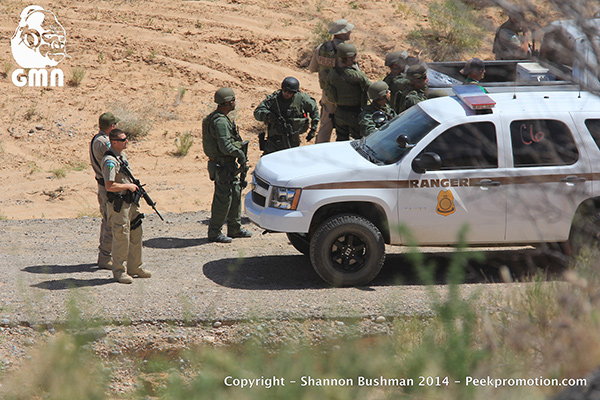
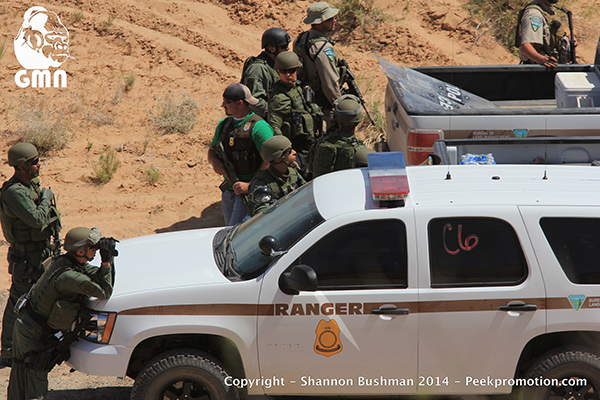
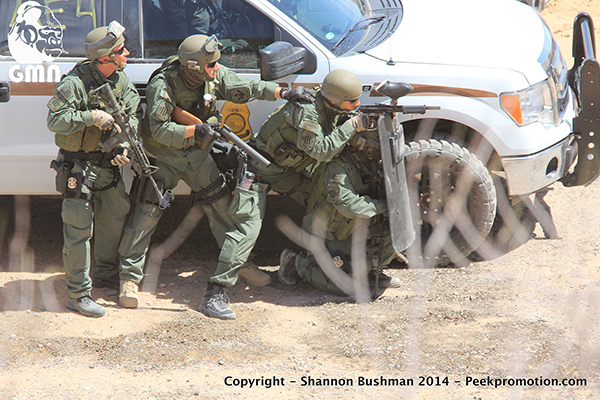
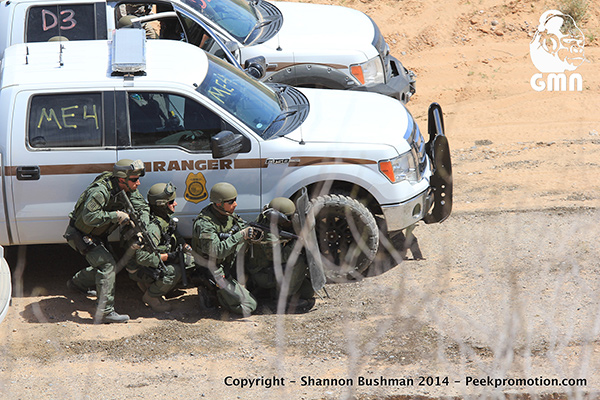
Bundy Ranch standoff pictures the mainstream media doesn't ever want you to see

naturalnews.com 

Originally published April 15 2014
news


by Mike Adams, the Health Ranger, NaturalNews Editor

(NaturalNews) The Bundy Ranch standoff is the true story of American history that the mainstream media doesn't want you to see. If such an event had happened in Ukraine, or Russia, or China, it would have received front-page coverage across the entire U.S. press. But because it took place within U.S. borders, there was a nationwide media blackout on the story, complete with orders that news outlets broadcast no pictures, no videos and no live reports from the scene.
Ever wonder what's so important about Bundy Ranch that the institutions of media and government have gone to extraordinary lengths to censor, including declaring a "no fly zone" over the airspace?

The answer to that question is found in the photos below, republished with permission from Guerilla Media Network whose founder, Pete Santilli, was one of the key persons on the ground urging peace and non-violence as evidenced in this secret recording released by Natural News.

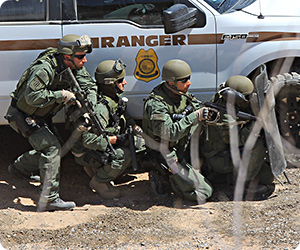
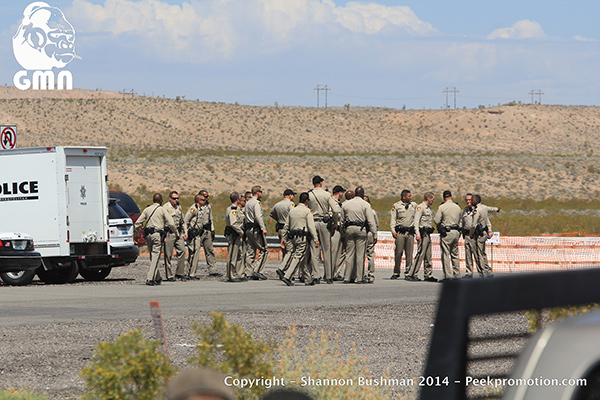
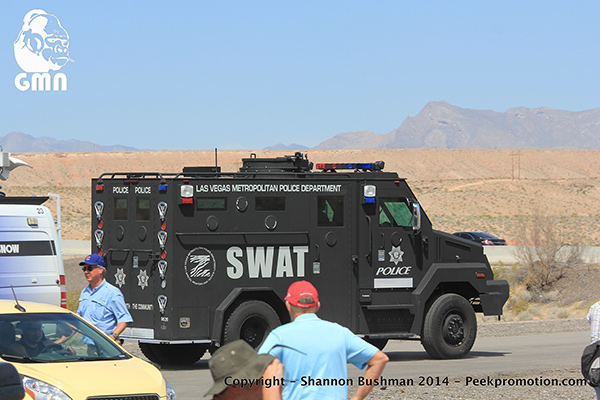
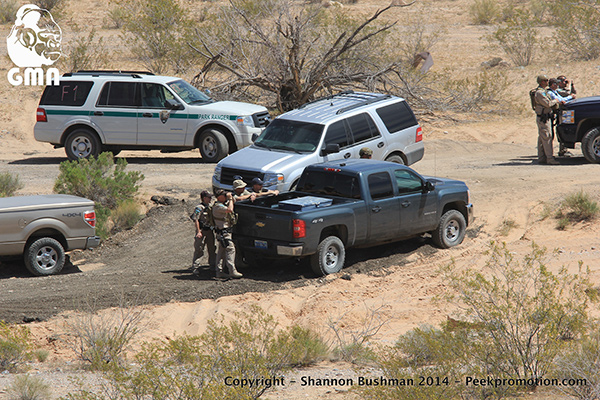
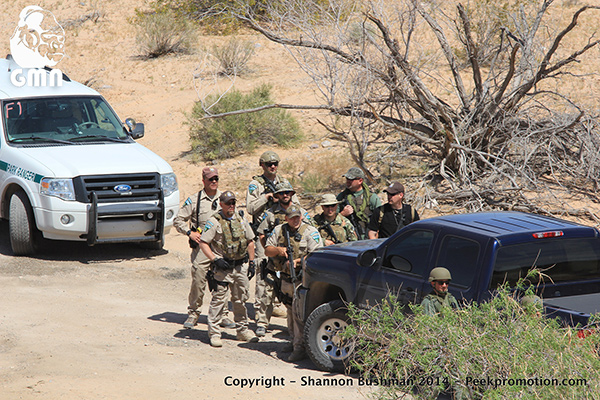
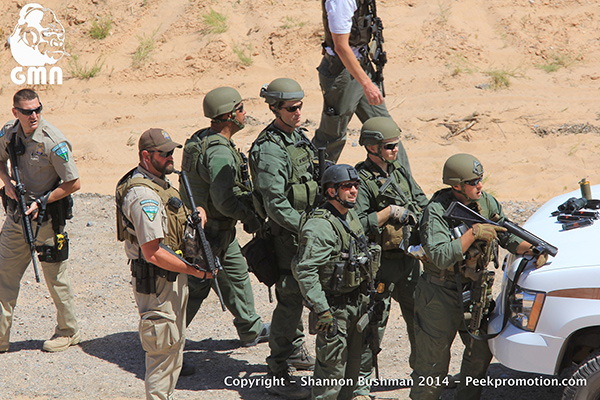
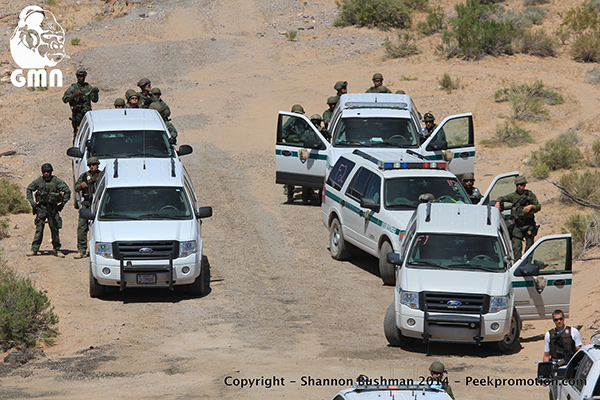
The federal government, on the other hand, brought hundreds of armed men, snipers, helicopters and even what the mainstream media would characterize as "assault rifles" to the scene -- all for what BLM claims was an effort to "save the desert tortoise!"

Permission was granted to Natural News to publish these photos, but I was instructed to relay the message that if any mainstream media sources which to use these photos, they must first contact GMN (press@gmn.is) for permissions and usage rights.

Now, behold the chapter of American history you were never supposed to know took place:


All content posted on this site is commentary or opinion and is protected under Free Speech. Truth Publishing LLC takes sole responsibility for all content. Truth Publishing sells no hard products and earns no money from the recommendation of products. NaturalNews.com is presented for educational and commentary purposes only and should not be construed as professional advice from any licensed practitioner. Truth Publishing assumes no responsibility for the use or misuse of this material. For the full terms of usage of this material, visit www.NaturalNews.com/terms.shtml

Bundy Ranch and the new rules of engagement: Send this analysis to your favorite fed


by Mike Adams, the Health Ranger, NaturalNews Editor

(NaturalNews) In the aftermath of round one of the Bundy Ranch armed siege by the U.S. government, I have decided to offer the federal government an intelligent analysis of the new rules of engagement. People like Daniel P. Love, Special Agent in Charge of BLM Region 3, desperately need to review and learn these rules. Other federal agents also need to understand the tectonic shift of power that has just taken place and how it will impact their operations from here forward.

Why am I doing this? Because the BLM, through its astounding incompetence and arrogance, very nearly initiated a massacre at Bundy Ranch which would have been disastrous for the BLM agents actively engaged there. The incident very nearly came to a shooting war, and it is the outdated, ill-informed government playbook that inflamed the situation and brought it to a flashpoint of violence. At every step, BLM escalated the situation beyond reason: who brings snipers to a tortoise dispute? Who unleashes attack dogs on unarmed pregnant women and cancer survivors? The BLM, that's who!

I know there remain many good agents in many different departments of the federal government. But there are also many incompetent agents who are still living in the 1990's and think they can run an armed ranch siege in 2014 the same way the ATF ran the Waco, Texas siege in 1993. But the rules have changed. As proof of that, consider the now-historical fact that BLM agents publicly surrendered and retreated from hundreds of armed citizens near Bunkerville, Nevada. How did this happen, exactly? To understand that, you must understand the new rules of engagement between the feds, the media and the citizens.

So if you have any friends who are feds in any department -- BLM, ATF, DEA, FBI, etc. -- make sure they get a copy of this article... and we all might spare ourselves some bloodshed in the near future.

Personal context: As far as my own background, I am a long-time supporter of local law enforcement, a fan of certain individuals within the FBI who are still part of "the good guys" pulling for America, and an outspoken critic of overzealous abuse of power in any agency, including the ATF, DEA and of course the BLM. My personal beliefs on current events can best be summarized by the words of Judge Andrew Napolitano in this video interview.


Old rules of engagement? Coercion, intimidation and overwhelming show of force

The reason BLM just got hoodwinked at Bundy Ranch was because they were playing by the old rules of engagement which are based on "might makes right." BLM foolishly thought that if they closed down the air space, threatened citizens with arrest, brought snipers to the scene and ordered the mainstream media to run a total blackout on the story, they would control the situation and easily be able to assert their will (which was to seize control of the land).

They were wrong. As we all now know, BLM Special Agent Daniel P. Love vastly over-estimated the strength of his position and wildly under-estimated the strength of his opposition. How did he make that mistake? He thought this was a war of kinetic action, but it was actually a war of information flow (more discussion below).

Federal agents are intentionally misinformed during their training

Much like Dan Love, most federal agents are still running on playbooks which are wildly outdated. Change is always slow to make its way into government training manuals, operational tactics and rules of engagement. Citizens, patriots and indy media journalists, on the other hand, are incredibly adaptable, technologically savvy and enjoy an ever-growing base of support which has only expanded due to the extreme abuses of liberty and freedom that have taken place under the Obama administration. The harder the feds push, the more they grow the popular resistance to coercion. Thus, the very application of the old rules of engagement automatically leads the feds to inevitable defeat in situations where federal rules conflict with core American values.

Feds are also wildly misinformed by their superiors about the truth of their opposition, and so they are handicapped from the start with disinfo that impedes their operational efficiency. Case in point: if you're a federal agent, nearly all the people who are described to you as "anti-government" are actually pro-Constitutional government people. They are not anarchists, and they are not irrational. They are opponents of criminal corruption and die-hard advocates of honest, limited government.

Most of what you are being told about these people is propaganda, not factual truth. As a result, when you think you are about to go toe-to-toe with what you've been taught are "low IQ, inbred anti-government extremists," the truth is that many of these people are actually far more cognitively accomplished than your own agents. For example, members of the Bundy family possess well-developed philosophical ideas about liberty, personal perseverance and spiritual courage. At the same time, most lower-tier federal agents have never spent any real time pondering ethics, values, courage or philosophy at all. Most federal agents, factually stated, are ignorant of the Bill of Rights and have almost no knowledge of the limitations of federal power. They are not taught, after all, to limit their reach but instead to find ways to work around such limitations and assert their power in any way possible. Such is the nature of every government agency and department. Most young men working as front-line agents in these departments have almost no knowledge of what they are truly facing.

Furthermore, federal agents are almost never instructed that their adversaries might be thoughtful, courageous, honorable people who primarily just want to be left alone. These people are also highly disciplined and principled. As the Bundy Ranch scenario clearly demonstrated, so-called "extremists" are willing and able to hold their fire and act with extraordinary self-discipline, even in the face of extreme escalations of violence perpetrated by government agents. Obviously, then, they are not extremists at all. What's extreme is the BLM's decision to bring snipers and government helicopters to a dispute they claim was about a desert tortoise.

Federal agents are almost never taught these truths about the everyday citizens they are facing in these scenarios. Instead, federal training programs go out of their way to vilify and smear rural white people as, for example, "low-IQ extremists" rather than the thoughtful, principled Americans they truly are. Just because somebody works on a ranch does not make them stupid. I own multiple John Deere tractors and raise chickens, yet my own cognitive function ranks in the top one-tenth of one percent of all Americans. Do not make the mistake of equating rural living with stupidity, and do not think that people only live on farms because they have no other choice. Many of us have gone to great lengths to deliberately pursue rural lifestyles because rural living is more in tune with our well-developed philosophies of happiness and purpose.

Background: The balance of power; weapons, information and decentralization

To understand the new rules of engagement, you need to understand how the American Revolution was won. And to understand that, you need to understand how the invention of interchangeable parts in firearms manufacturing allowed everyday men to attain fairly accurate rifles which could counter rifles held by centralized government personnel (in ANY government, not just the British government).

It was the proliferation of easy-to-make, easy-to-repair rifles -- along with barrel rifling advancements -- that allowed everyday people to rise up against government oppression and tyranny. This is how the United States of America came to be born, of course -- by taking a stand against the tyranny of the King of England. That's also why standing firm against tyranny is something that can never be taken out of the American spirit because it runs in our blood.

The ease of manufacturing and maintaining rifles shifted the balance of power from the hands of the few (government) to the hands of the many (Democracy). This is why the invention of the rifle unleashed a global wave of revolutions and revolt against centralized authority. Grassroots rifle manufacturing was, in fact, the first peer-to-peer offensive weapons manufacturing network of the modern world. If you don't understand this trend in history, you will never understand what's happening in America today.

Today, of course, government has far more advanced weapons than the common man. Government commands Hellfire missiles, Apache attack helicopters and even nuclear weapons. No common citizen's group possesses such weapons, and because of this, government believes it now controls the balance of power. But that's playing the old game from the 1700's. Today, what matters is not so much who has the better weapons, but who has the better ability to share information. Information warfare is the paradigm of 2014 and beyond, not kinetic warfare.

The Pentagon already understands this, of course, which is why journalists are strictly controlled ("embedded") when covering wars in the Middle East. The information war is far more important to shape and control than the kinetic war. Because it doesn't really matter where the bombs land as long as you control which VIDEOS of the bombs get broadcast. Guiding the news coverage is far more important than guiding the ordinance, in other words. (Oops! Did ya just blow up a civilian hospital? Don't worry, CNN will agree not to show it, aren't they awesome?)

Government can no longer control the narrative

Centralized government can no longer control the news narrative for events taking place on U.S. soil. What's happening today in information sharing now mirrors what took place over 200 years ago with rifle manufacturing sharing. When information can be passed from person to person, in a decentralized, peer-to-peer network with no central authority and no central point of control, facts, photos and videos easily bypass the usual firewalls government places upon mainstream media outlets. While it is exceedingly easy to control videos and photos in a foreign country, it is all but impossible to control such information when events are unfolding on U.S. soil (as they did near Bunkerville, Nevada).

The widespread ownership of video recording devices in 2014 mirrors the widespread ownership of rifles in 1775. Nearly every citizen today has a mobile phone recording device, and nearly everyone has an ability to post videos, photos, audio and tweets to the internet in near-real time. This is tactically equivalent to the ability of any citizen in 1775 to own and operate rifles capable of going head-to-head with the rifles carried by British soldiers who occupied the colonies of the Americas.

If you understand this concept of decentralized, readily-available technologies that shape the big trends of history, the you are ready to grasp the following NEW rules of engagement.

Rule #1) You no longer control the narrative

At Waco, Oklahoma City, Ruby Ridge and 9/11, the U.S. government wholly controlled the narrative. The centralized media institutions in place at the time exhibited total control over all media broadcasts in the nation. There was no social media. There was no Twitter. There was no Facebook. There were no blogs. Mainstream media's control over information was absolute, and therefore so was White House control over the mainstream media.

Today, the mass decentralization of news media is nearly complete. While centralized news sources may agree to be obedient and complicit in broadcasting propaganda (or running a media blackout on a particular story), citizens now have ready access to multiple vectors through which information can be accumulated or shared. As I have said here on Natural News, social media allows us to share the news faster than the government can cover it up.

Almost by definition, no centralized authority can exercise timely and effective control over organic, decentralized news sharing fueled by extreme curiosity, interest and sometimes outrage by the public. The very things that make Facebook addictive to many people -- the "wow" factor when learning new facts -- also make people want to share those facts with others. The structure of social media is viral by its very nature. This structure is the antithesis of centralized government control over narratives of unfolding news events.

Freedom of information, in other words, constantly counteracts the inherent desire of tyrants to oppress and control information. The very existence of electronic, decentralized media is anti-tyrannical by its very nature. The democratization of information automatically leads to the democratization of power, which is the exact opposite of what the U.S. government really wants. Remember: the U.S. government strongly supports freedom fighters in Kiev, but is terrified of freedom fighters in America. Ever wonder why?

Rule #2) Your mainstream media blackouts will backfire and make alternative media more popular than ever

During the Bundy Ranch affair, mainstream media was ordered by the White House to completely refrain from covering the story. This, again, is a laughable mistake from an old-school playbook.

While the White House thought that erecting a blackout across the mainstream media would cause the story to vanish from national consciousness, what actually took place was precisely the opposite: the story took off like wildfire across the 'net. But instead of Pulizer-prize-winning mainstream journalists going on scene and reporting live from Nevada, all the journalism glory went to citizen journalists like Pete Santilli and David Knight, both working for independent online media groups that can never be controlled by government authority.

At Bundy Ranch, the mainstream media blackout backfired, causing enormous rises in popularity for indy media and alternative media. I happen to know firsthand, for example, that one of my own stories on Bundy Ranch was read by over 3 million people. And that's small compared to a story by Kit Daniels of Infowars which went so viral that it became the single most-shared story of the year, across ALL media.

I also happen to know that indy video networks like Next News Network attracted hundreds of thousands of new subscribers. The mainstream media blackout, it turns out, was an incredible gift to alternative media which enjoyed unprecedented viewership, ad revenues, new subscribers and new fans. The mainstream media blackout was the best news of the year across alt. media. The White House, in other words, just added huge viewership numbers to the very same independent media groups it is constantly trying to discredit.

Rule #3) You can't stop the alternative media by stopping its leaders

The alternative media is a phenomenon of spontaneous, decentralized, peer-to-peer journalism. It's not based on specific individuals, because there is always upward pressure from others to take the place of any individuals are might be intimidated into silence. Even if top voices of alternative media were to die or disappear, they would be immediately replaced by others who are ready to assume their roles.

Online audiences easily transfer from one alternative media outlet to another. A single super-viral story, for example, can gain an alternative media person over half a million new followers. This is partly why attempts to suppress alternative media via individual character assassination are all but useless. Alternative media followers already know everything printed in the mainstream media is pure propaganda, so running a hit piece on an alt. media personality in the mainstream media accomplishes nothing.

Furthermore, there is no central authority over alternative media. Thus, there is no single point of control or influence over the network of peer-to-peer alt. media publishers and broadcasters. While the mainstream media can simply be ordered into total silence by the White House -- and this is exactly what happened with the Bundy Ranch story -- alt. media by definition adhere to no such obedience or demands.

Notice, too, that in this case of the Bundy Ranch, one of the top alt. media personalities, Alex Jones, was not even at the forefront of the effort: it was his reporters -- David Knight and Kit Daniels -- who broke the biggest stories. This is by design. Alex has always sought to encourage his reporters to rise up and cover the really big stories while establishing their own independent credibility as investigative journalists. Do not misinterpret this as a mistake; it is AJ's intention that his reporters pursue such paths. AJ has always had the intention that Infowars would continue on even if he were killed.

Rule #4) Escalations of coercion only encourage greater resistance

The single most important factor leading to the rise of the armed citizen's revolt at the Bundy Ranch was the Youtube video showing attack dogs unleashed by BLM agents against unarmed citizens. This video has now become legendary, having been viewed many millions of times in all its renditions and copies.

This video clearly and unambiguously shows a BLM agent giving multiple verbal and body language commands to an attack dog, directed against unarmed civilians. It was the widespread sharing of this video that led to the uprising which ultimately led to BLM surrendering to American patriots.

In realizing this, the natural tendency of government tyrants and oppressors is to say, "We'll just ban mobile devices or confiscate them all at gunpoint!" This is the same sort of abysmal thinking that led the BLM to somehow think erecting a "First Amendment Zone" would be acceptable to Americans. Apparently, the BLM believes the American people are so incredibly stupid that won't remember the First Amendment applied everywhere in America, not just some temporary zones defined by a delusional gang of armed tyrants. The very idea that BLM would even attempt to set up such an area of so utterly offensive and disrespectful to the spirit of America that I still shake my head in disbelief over the fact that they tried it.

Rule #5) You will only have the cooperation of the People by their choice, not by coercion

The final rule in all this is something most feds will never quite understand. In most cases, federal agents receive cooperation from citizens by choice, not by force. For example, I have voluntarily provided information to the U.S. Department of Justice on criminal scams taking place in the natural products industry. I do this by choice, not by force, because it is the right thing to do and because it serves the public interest.

When federal agents make requests upon American citizens, there is a moment in which those requests are parsed for congruency with a person's perceived understanding of both the law and moral justice. If a federal agent's request is in alignment with law and moral justice, it will likely be voluntarily followed. For example, I (lawfully) carry a concealed firearm every time I visit the Austin airport. If a crazy person goes nuts with a machete at the airport, and I find myself side by side with an armed federal agent, have no doubt I will voluntarily cooperate with federal law enforcement officers in a joint armed effort to halt the violence of the armed assailant and thereby protect innocent people. (And being Austin, Texas, the machete-wielder will likely find himself riddled with bullets because hundreds of honorable, armed citizens carry concealed weapons at the Austin airport every single day.)

On the other hand, if a federal agent approaches me and orders me to rob a bank for him, I will tell him no. Why? Surely the agent can claim he is "giving me a lawful order" and I therefore must obey under law, correct? Yet when that "lawful order" stands at odds with what I know to be morally right, I will choose not to obey that order, regardless of what excuse the agent invokes.

This is precisely what happened at Bundy Ranch. BLM showed up with "lawful orders" backed up by two different (federal) courts. But the People did not perceive those order as being morally justified. Therefore, they chose not to recognize those orders as being lawful. As was the case at Bundy Ranch, Americans can and do think for themselves in such scenarios, and at any moment, they may decide that YOUR actions as a federal agent are grossly unlawful, immoral or unconstitutional. If enough people arrive at the same conclusion, you will sooner or later find yourself surrounded and possibly arrested by the People at gunpoint.

This concept does not compute with many federal agents because they were not taught the real roots of power in a free society. They are taught that a law written on a piece of paper is an absolute, irrefutable power which can never be questioned by lowly "civilians." In reality, a law is nothing more than mutual consent of the governed. That consent, it turns out, can be invoked at any time if those who apply the law do so in a way that is egregious or unreasonable. All government power comes from the People, after all, and can therefore be revoked by the People if government becomes abusive or overreaching in its exercising of that power.

Laws mean nothing, after all, if they are not based on a sense of justice which can be recognized by the Common Man (or woman). The U.S. government, for example, once had laws on the books which said that blacks were not fully recognized as people. Such laws fly in the face of spiritual truth, and had I been an independent media reporter in the 1820's, I would have been aggressively arguing for equal rights among all people, regardless of their skin color (and I would have been aggressively attacked by the establishment for defending such a "crazy" idea, of course).

Those are the new rules of engagement. Please send this article to your favorite fed. The more of them who read this and understand it, the greater chance we all have for lasting peace and avoidance of bloodshed caused by an arrogant, out-of-control federal government that has lost its way.


Bundy Ranch: The Rules of Engagement have Changed


All content posted on this site is commentary or opinion and is protected under Free Speech. Truth Publishing LLC takes sole responsibility for all content. Truth Publishing sells no hard products and earns no money from the recommendation of products. NaturalNews.com is presented for educational and commentary purposes only and should not be construed as professional advice from any licensed practitioner. Truth Publishing assumes no responsibility for the use or misuse of this material. For the full terms of usage of this material, visit www.NaturalNews.com/terms.shtml
Does New Boston Bombing Report Hint at Hidden Global Intrigue?
Capture [1]

The US government’s latest report on the Boston Marathon bombing is so full of revealing information buried in plain sight, it seems as if an insider is imploring someone—anyone—to dig deeper. It reads like the work of an unhappy participant in a cover-up.
Properly contextualized, the particulars in the report point to:
•   A Boston FBI agent seemingly recruiting and acting as Tamerlan Tsarnaev’s control officer, interacting personally with him, preventing on multiple occasions serious investigations of Tsarnaev’s activities, and then pleading ignorance to investigators in the most ludicrously improbable manner.
•  The likelihood that the blame game between the US and Russia over who knew what, and when, regarding Tamerlan Tsarnaev and his activities, masks a deeper geopolitical game which may very well point to the sine qua non of most such struggles—the battle for the control of precious natural resources.
•   The sheer inability of well-meaning US government officials—who either may know or suspect that the “official” account of the Boston bombing, with the Tsarnaev brothers as lone wolf terrorists, is utterly false—to come out and state their true beliefs. The most recent report is an example of the necessity of reading between the lines.
***
The other day, we explained a key point [2] missing from most coverage of the Boston Bombing story: that the US government may have been in contact with the alleged bombers before the Russians ever warned about them.
Now, it seems, the plot thickens further. As the mass media predictably overwhelms the public with a fanciful scenario in which we all are “Boston Strong” and everything ends well, we believe the citizenry—and the victims of the bombing—deserve better. In our previous story, we were working from a leaked article about a forthcoming government report on the bombing—whose central message was that the bombing might have been prevented if only the Russians had not held back still more information beyond what they had provided to US intelligence. In other words, “Putin did it.”
Since then, the report itself has been released. It is the coordinated product of probes by Inspectors General from a number of intelligence agencies and other governmental entities. Actually, what’s been released is not the report itself—just an unclassified summary filled with redactions. Even so, it is enormously revealing, as much for what it does not say as for what it does.
***
Be advised that this is not a short read. Our take is an in-depth look at how the government loads the dice for its own purposes. As such, it is necessarily complicated, with layers of obfuscation that need to be peeled away. But if you want to get some inkling of what might actually lie behind the Boston Marathon Bombing, read on.
Let’s start by taking a look at the summary report [3].
On Page 1 you will find this paragraph:
In March 2011, the FBI received information from the FSB alleging that Tamerlan Tsarnaev and Zubeidat Tsarnaeva were adherents of radical Islam and that Tamerlan Tsarnaev was preparing to travel to Russia to join unspecified underground groups in Dagestan and Chechnya. The FBI-led Joint Terrorism Task Force in Boston (Boston JTTF) conducted an assessment of Tamerlan Tsarnaev to determine whether he posed a threat to national security and closed the assessment three months later having found no link or “nexus” to terrorism.
So, in March 2011, the FBI received information from the FSB (Russian internal security service, comparable to the FBI), warning about terrorist threats posed by the Tsarnaev family.
We have long been told that this Russian warning was the first time the Tsarnaevs were on the US government’s radar.
But wait. Go to Page 18 of the summary report, and take a close look at Section V, under a heading “INFORMATION OBTAINED OR FIRST ACCESSED AND REVIEWED AFTER THE BOMBINGS.”
That heading seems to suggest that what follows in Section V was unknown to American law enforcement prior to the bombings. The first item in the list–and the only one to be redacted—is of primary interest:
This information included certain [approximately two lines redacted] to show that Tsarnaev intended to pursue jihad…
After that paragraph comes a sub-section labeled JANUARY 2011 COMMUNICATIONS. The entirety of that section, including a lengthy footnote, has been redacted.
Reading a government report with redactions is like reading tea leaves in the bottom of a dirty cup. You can’t know for sure what’s been suppressed, but you can hazard some educated guesses about why certain material was deemed too dangerous for the public to know.
In this case, you have to ask: Why would the first item in Section V and the entire subsection labeled “January 2011 Communications” be suppressed. The answer may lie in a story that appeared in the New York Times last week. Based on a leak exclusive to the Times [4], the story quoted a “senior government official” who claimed that the Russians had withheld some key information when it informed the US about the Tsarnaevs’ jihadist leanings in March 2011—information that might have made the US government pay more attention to the Tsarnaevs, and so perhaps could have helped avert the Marathon bombing.
As we previously noted, much earlier, back in 2013, the New York Times reported another leak [5]. That leak asserted that US authorities had been in contact with the Tsarnaevs as early as January 2011. If true, this assertion would be enormously consequential, because it would mean the Tsarnaevs were known to US authorities two months before American intelligence learned from the Russians that the Tsarnaevs might be terrorists.
Capture [6]As far as we know, no one in the media ever followed up on this leaked assertion. When we queried the Times about it, the paper never replied. Nor has the Times ever published a correction. Now, it is possible that the official who provided the Times with that earlier leak was mistaken, or that the Times got the date or the facts wrong and did not want to admit its error in public.
But it’s hard not to see a link between that leaked assertion and the government’s redaction, in the just released summary, of the entire section labeled January 2011 Communications. What is in that section that’s so disturbing to the censors in the American intelligence community?
One possibility is that the US censors are not so concerned about the information in those “communications” as in the way that information was obtained.
Russia Eavesdropping on American Telephone Conversations?
If they are concerned about something relating to January communications captured by the Russians, it could be because the “communications” appear to have been phone conversations purportedly between Tamerlan and his mother, Zubeidat—both of whom were, in early 2011, living in the United States. (In the recent leak to the New York Times, the “senior US official” mentioned that the Russians had withheld certain information—specifically including that Tamerlan and his mother spoke of “jihad” in a telephone call.)
It would of course be news if the Russians were capturing domestic American telephone conversations, and if they were so interested in the Tsarnaevs that they launched a very risky and complicated operation to eavesdrop on that family’s communications within US borders.
This real possibility can be further contextualized. The Boston area has long been a hotbed for spy-vs-spy intrigue. With top military research going on at Cambridge-based MIT and other area institutions, that’s not surprising.
Consider that the Tsarnaevs lived in Cambridge—home to members of a ring of Russian spies [7] that was broken up shortly before the Tsarnaevs came under scrutiny. Remember that the US rolled up a spy ring [8] in June of 2010—after monitoring it for a decade, and that an exchange of prisoners quickly followed. An American mole inside Russian foreign intelligence, Col. Alexander Poteyev, who was back-channeling to American intelligence while simultaneously directing the stateside ring from Russia, fled to the US before the arrests. His role was obscured by American officials; and his identity was only revealed when a Russian court later found him guilty in absentia.
Few Americans remember Poteyev’s role, or any of the other more remarkable “details.” Indeed, US media coverage of the Russian spy ring story quickly focused on the sexiness of one of the characters, Anna Chapman, who returned to Russia as part of the exchange and became a lingerie model, corporate spokesperson, and national icon.
Anna Chapman on the cover of Russia’s Maxim [9]
Anna Chapman on the cover of Russia’s Maxim
However, US officials dismissed the ring itself as a “sleeper cell” that actually accomplished nothing. We wonder if this is true. Did the Russians really go to such enormous efforts over a decade and achieve nothing substantive? More on this in a moment, but for now, consider the notion of an active Russian spy ring in the Tsarnaevs’ Massachusetts backyard as a basis for further thinking.
Given the “shocking” exposure of the Russian ring, it is equally shocking to contemplate that, less than a year later, the Russians have gone from spying to “helping” the US—by notifying American intelligence of potential terrorists in our midst. Either that, or the Russians were notifying the US out of self-interest, to ensure that yet another anti-Russian terrorist did not succeed in jihad on Russia’s turf.
To us, frankly, neither explanation is wholly satisfying. It seems there is more going on.
Tamerlan Tsarnaev an “Asset”?
Was the US itself monitoring the Tsarnaevs at the same time the Russians were? Of even more interest, did US authorities, as Dzhokhar Tsarnaev’s defense suggests, seek to turn Tamerlan Tsarnaev into an asset?
The defense’s claim that the FBI tried—but failed—to get Tamerlan to work for the US is hard to accept, not because the FBI doesn’t regularly try to recruit immigrants like the Tsarnaevs through a carrot-and/or-stick approach, but because it’s hard to imagine the FBI failing in such an endeavor. The “failure” part of the defense claim seems like a concession to the likelihood that detailed information about FBI recruitment would not be admissible in such a case. Also, Dzhokhar Tsarnaev’s lead federal public defender is accomplished at getting her clients charges reduced—in this case, presumably to avoid the death penalty—not at exposing giant falsehoods perpetrated by her government.Capture [10]
If the defense is half-right—that the feds pushed Tamerlan Tsarnaev to become an operative—would they simply have accepted, willingly, if he said, “No, thanks”? Intelligence and security services don’t tend to take no for an answer, and traditionally have played very rough with those who decline. So it is unlikely that a foreign national like Tamerlan Tsarnaev—whose family arrived less than a year after 9/11 and who was given “derivative asylum status”—could simply decline to cooperate. (Family members, including Tamerlan, were later made Lawful Permanent Residents—with the hope of full citizenship. And as we shall see, the FBI agent whose job was to interact with Tamerlan Tsarnaev later said he had no objection when Tamerlan was being processed for citizenship, suggesting that he was not unhappy with Tamerlan in the least.)
For context on whether or not Tamerlan Tsarnaev may have agreed to cooperate, consider the FBI’s tactics with people from the Tsarnaevs’ extended circle who did not cooperate, as reported in this earlier piece [11] we did.
Moreover, one line in the summary report is telling:
The FBI-led Joint Terrorism Task Force in Boston (Boston JTTF) conducted an assessment of Tamerlan Tsarnaev to determine whether he posed a threat to national security and closed the assessment three months later having found no link or “nexus” to terrorism.
Surely if he were working for the US and involved with anti-Russian activities, he would rightfully be found to “have no link to…terrorism”—inasmuch as terrorism (so far as the FBI is concerned) would likely be defined as a threat only to US national security.
Also, as the report summary notes, the Russians repeatedly pinged the Americans, presumably because they saw no serious action taking place. They provided information to the FBI in March 2011, and similar material to the CIA in September. (The report states flatly, and without emphasis, that the FBI had failed to share intelligence with the CIA—a suspiciously common practice that dates back to the John F. Kennedy assassination if not earlier).
Did the Russians decide that FBI inaction meant the Bureau had recruited Tamerlan, and either had not notified the CIA or had not done so through official channels? In October, in any case, the CIA passed the Russian intelligence along to a range of agencies, including the Department of Homeland Security and the State Department. It also passed it along to the FBI, as if it did not know that the FBI itself already had the information from half a year earlier. Finally, the information was passed on to the National Counterterrorism Center, which put Tamerlan Tsarnaev on a terrorist watch list.
Incredibly, even after this, when Tamerlan traveled to Russia three months later, exactly as the Russians said he would, and while on that terror watch list, US authorities did nothing.
Here’s what the Report Summary says about cooperation:
This lead information was investigated by the FBI through the Boston JTTF. Representatives from the DHS, CIA, and other federal, state, and local agencies work directly with FBI-led JTTFs across the country, including in Boston.
Notice the waffling. The summary authors state a standard principle: FBI-led investigation units “work directly” with other federal and local agencies. They explicitly do not say that the FBI did so in this case. And how could they? Because the FBI clearly did not.
Mind you, this is WhoWhatWhy’s attempt at coherently and accurately summing up the content of the Summary Report. It is instructive that those who prepared the report did not feel the need to emphasize these rather glaring and seemingly deliberate “failures”—and instead basically give the FBI and US government a free pass for their cover-up.
From Russia…With Truth?
It’s also worth considering what the Russians themselves told a visiting Congressional delegation barely six weeks after the bombing, and what they showed them: the warning letter from Moscow. Keep in mind as you read the particulars [12], how much more forthcoming the Russians have been than their American counterparts. This is from an account by Rep. Bill Keating (D-MA) to the Washington Post:
Keating said the letter gave Tsarnaev’s date of birth, his cellphone number, information about his boxing career, weight and Golden Gloves matches. It talked about his wife and mother, giving the mother’s Skype number. The up-close look at Tsarnaev’s life raised questions, which went unanswered, about how the FSB had accumulated so much information about a family in Boston.
Rep. Bill Keating (D-MA) [13]
Rep. Bill Keating (D-MA)
So at least some members of Congress were deeply suspicious of our government and its awareness of Russian activities in the US (as well as Russian capabilities for spying on residents of the United States within our borders). However, in the Summary Report, what the Russians gave to the Americans has been pared down:
The Russian authorities provided personal information about both Tamerlan Tsarnaev and Zubeidat Tsarnaeva, including their telephone numbers and e-mail addresses, and requested that the FBI provide the FSB with specific information about them, including possible travel by Tsarnaev to Russia.
The Summary report leaves out the other details, but does include a caveat that somehow characterizes the material as less valuable (though both errors would normally be overcome by standard procedures):
Importantly, the memorandum included two incorrect dates of birth (October 21, 1987 or 1988) for Tamerlan Tsarnaev, and the English translation used by the FBI transliterated their last names as Tsarnayev and Tsarnayeva, respectively.
Only later do we read that an FBI agent had no difficulty resolving these issues.
Frustrated Inspectors General, Complying, but not Too Happily
The Inspectors General go on to say that, in considering whether information that existed prior to the bombings was at that time “available” to the U.S. government, the OIGs did look at the Russian information, but also “took into account the limited facts known to U.S. government agencies prior to the bombings and the extent of the government’s authority under prevailing legal standards to access that information.” [Italics added for emphasis]
So they began their inquiries with two predispositions: (1) that the government had very little information available on its own, and (2) that completely contrary to Edward Snowden’s revelations about NSA abuses, US agencies are scrupulously careful about how they collect private data on individuals.
The Inspectors General also made clear what side they were on, a bad thing for a justice system:
[T]he OIGs were mindful of the sensitive nature of the ongoing criminal investigations and prosecutions related to the bombings, and were careful to ensure that the review would not interfere with these activities. We carefully tailored our requests for information and interviews to focus on information available before the bombings and, where appropriate, coordinated with the U.S. Attorney’s Office conducting the prosecution of alleged bomber Dzhokhar Tsarnaev.
Presumably, a truly independent investigation would involve coordinating with anyone who had information to impart, including Dzhokhar’s defense.
In a rare outburst hinting at how they were hobbled, the OIG’s write:
As described in more detail in the classified report, the DOJ OIG’s access to certain information was significantly delayed at the outset of the review by disagreements with FBI officials over whether certain requests fell outside the scope of the review or could cause harm to the criminal investigation. Only after many months of discussions were these issues resolved, and time that otherwise could have been devoted to completing this review was instead spent on resolving these matters. [Italics added for emphasis]
And there’s this important note, at the beginning of a section called “CHRONOLOGY OF EVENTS”:
In this section, we summarize the chronology of events relating to the U.S. government’s knowledge of and interactions with Tamerlan Tsarnaev, members of his family, and other associates before the bombings. Many of the activities and events that occurred during the period discussed below cannot be included in this unclassified summary.
That’s just a sampling of the Inspector Generals’ cries of impotency. One of the three objectives stated by the Inspectors General in their summary is to determine “Whether there are weaknesses in protocols and procedures that impact the ability to detect potential threats to national security.” But if that was never the underlying game, then the Inspector Generals are victims in this as well. They hint as much:
Redactions in this document are the result of classification and sensitivity designations we received from agencies and departments that provided information to the OIGs for this review. As to several of these classification and sensitivity designations, the OIGs disagreed with the bases asserted. We are requesting that the relevant entities reconsider those designations so that we can unredact those portions and make this information available to the public.
Good luck with that.
FBI Special Agent Schlemiel [14]
As the report notes, an FBI counterterrorism officer
conducted database searches, reviewed references to Tsarnaev and his family in closed FBI counterterrorism cases, performed “drive-bys” of Tsarnaev’s residence, made an on-site visit to his former college, and interviewed Tsarnaev and his parents.
The question is obvious: Why no effort to monitor the Tsarnaevs’ covertly? What about, instead of warning them that they were under suspicion, keeping a close and quiet watch on them? Isn’t that how you would proceed if you wanted to find out what a suspected terrorist was up to?
Instead of raising this point, the OIG summary questions why the FBI did not make even more noise, including interviewing others who knew the family. Then it notes the FBI agent’s failure to query every database, but points out that such an additional effort would not likely have garnered much new information. And while acknowledging that the FBI failed to share information with other agencies, it gives the Bureau an out by lamely saying that if other agencies had known where to look it a shared database, they might have happened upon the information.
And If it’s Tuesday, This Must be Belgium [15].
One of the most interesting statements in the summary report is surely this:
The DOJ OIG also determined that the CT Agent did not attempt to elicit certain information during interviews of Tsarnaev and his parents, including information about Tsarnaev’s plans to travel to Russia, changes in lifestyle, or knowledge of and sympathy for militant separatists in Chechnya and Dagestan. The CT agent told the DOJ OIG that he did not know why he did not ask about plans to travel to Russia,
The rest of this paragraph is blacked out. In fact, that’s the first redaction you come to in the whole report. For some reason, the OIGs do not make more of this—though it demonstrates that the FBI counterterrorism officer failed to ask the questions that mattered most.
And when the CT officer’s supervisor told him to write to the Russians seeking more information, the FBI man included in his letter that Tamerlan, then in his mid-twenties, was a “former prosecutor.” (!)
When Opacity Is a Virtue
It is not hard to see how introducing a plethora of such small obfuscations into a “Summary Report” can keep even expert readers from focusing on the larger issues in play. And when the readers are less-than-expert representatives of the mass media, the tactic is even more effective. A review of articles about the report in major newspapers makes this abundantly clear.
The report concludes that a Customs and Border Patrol officer most likely notified the FBI when Tamerlan Tsarnaev traveled to Russia in 2012. The Customs officer also flagged Tamerlan so his record would be visible for his own colleagues when Tsarnaev re-entered the country.
For some reason, that notification was turned off before Tsarnaev returned. (This is not to be understated—Michael Springmann, a former US consul to Saudi Arabia, has repeatedly stated [16] that his efforts to prevent jihadists from traveling to America were somehow overridden at higher levels)
In Tamerlan Tsarnaev’s case, the Customs officer told IG investigators that he had most likely consulted with the FBI agent before Tsarnaev’s record was made invisible to Customs personnel. Because of this, Tsarnaev was not subjected to a so-called “secondary inspection” (an uncomfortable process which this reporter has been through in the past). The report does not properly underline this point about the disturbing failures to monitor Tsarnaev—indeed, the way the report is written makes it all too easy to gloss over such “details.”
FBI officials interviewed by the Inspectors General played good cop/bad cop with them. While the FBI counterterrorism officer’s superiors made clear that they would have ramped up activity and interest if they had learned of Tamerlan’s visit to Russia—including reopening their investigation of the man—the local Boston CT agent insisted he “would not have done anything differently.”
This kind of inconsistency makes it all but impossible to get to the bottom of things, and the IGs don’t seem to have tried hard.
Everything about this case suggests that we might want to learn more about the Boston FBI agent and his most unusual behavior. Was he wildly incompetent and reckless, or operating under some kind of instructions? Unfortunately, the names of such significant personnel are almost never made public.
Amazingly, after all this, and just months after Tamerlan’s return from Russia in 2012, Tamerlan applied for US citizenship. Even more striking, that same unidentified FBI agent who knew so much about Tamerlan nevertheless stated: “There is no national security concern related to [Tamerlan Tsarnaev] and nothing that I know of that should preclude issuance of whatever is being applied for.”
A US Citizenship and Immigration Services officer says he actually met with the FBI agent and told him that Tsarnaev was on track to be granted citizenship. Despite all that he knew, the FBI agent apparently had no objection.
In its conclusion, the Inspectors General write,
Based on all the information gathered during our coordinated review, we believe that the FBI, CIA, DHS and NCTC generally shared information and followed procedures appropriately. We identified a few areas where broader information sharing between agencies may have been required….
And, finally:
In light of our findings and conclusions summarized above, the participating OIGs found no basis to make broad recommendations for changes in information handling or sharing. We nonetheless identified some areas in which existing policies or practices could be clarified or improved.
Making Sense of It All
When your instincts tell you that a major effort is underway to make sure no one gets to the bottom of things, you’re inclined to look for larger explanations. To wit: Could some kind of larger geo-strategic battle relate to the Boston bombings, with the on-the-ground players mere pawns?
Capture [17]We’ll have more to say later about the larger circle of national-security-community figures that has surrounded Tamerlan and Dzhokhar Tsarnaev for years. But for now, we want to step back a little.
Given the tendency of spy services to play elaborate games with a long view, it is reasonable to wonder whether the Russians had more in mind than just being helpful when they notified the US that it ought to look at the Tsarnaevs.
Could the notice to the FBI have been a warning that the Russians knew the US was already in contact with the Tsarnaevs? Given the possibility that Tamerlan Tsarnaev was supposed to infiltrate anti-Russian jihadists, that essentially puts the two intelligence services on the same side in this matter. Or were the Russians worried that the Americans were playing a double game, seemingly hunting jihadists while simultaneously using those jihadists to put pressure on the Russians in their majority-Muslim, oil-bearing southern flank?
There is also the possibility that, as with the US mole in Russian intelligence, Colonel Potayev, both sides thought they were controlling the Tsarnaevs. This would have made them players in a still more dazzling game. Pull out your old spy novels for this one.
Consider, as one must, what would be worth such extraordinary measures? What would justify so many redactions in a Summary Report? What would compel a bunch of Inspectors General, purportedly responsible for getting to the bottom of things, to participate in a whitewash?
What else but an issue of “national security”?
And since, as we know, there were no actual terrorist attacks or credible near-attacks on US soil between 9/11 and the Marathon bombings more than a decade later, these “national security” concerns might logically relate to something else. We hate to sound like a broken record, but keeping the lights and computers on and the cars moving pretty well approximates national security these days. And we all know what powers the grid—and where the next big oil and gas hub is after the Middle East deposits are tapped out. It’s the Caucasus region [18], the southern portion of the old Soviet Union, which encompasses a bunch of places where the US and Russia have been duking it out in recent years, including notably, Georgia, South Ossetia, Abkhazia, Dagestan and Chechnya. The first three of these are loci of military operations which saw the US and Russia on opposite sides, and the last two are restive, heavy-Muslim-majority Russian Republics with which the Tsarnaevs are associated.
If all this sounds improbable, let’s focus for a moment on several seminal moments many of us have forgotten or never knew:
• 1992, when a group under George HW Bush, helmed variously by Dick Cheney and Paul Wolfowitz [19], decided that the end of the Soviet Union presented an opportunity for the US to seize permanent status as the world’s only superpower, with the right and expectation to intervene anywhere, globally, at will
• 2000, when members and confidants of that same group of neocons, now temporarily out of power, but operating via the Project for a New American Century [20], warned that the American public would never go along with such interventions “absent some catastrophic and catalyzing event—like a new Pearl Harbor.”
• 2001, when, according to former NATO Commander Gen. Wesley Clark, he was shown a Top Secret memo laying out seven countries the US was prepared to invade with 9/11 [21] as the justification. In an exclusive video interview with WhoWhatWhy [22], Gen. Clark expanded on that, emphasizing the role oil plays in US military policy.
It will take a lot more research to determine whether the story neither government is likely to tell is really about a titanic struggle for the earth’s wealth. But, given historical precedents, it would not be so far-fetched.
Indeed, it is only the official story of the Boston Marathon bombing which sounds far-fetched.
WhoWhatWhy plans to continue doing this kind of groundbreaking original reporting. You can count on us. Can we count on you? What we do is only possible with your support. Please click here [23] to donate; it’s tax deductible. And it packs a punch.

Article printed from WhoWhatWhy: http://whowhatwhy.com
URL to article: http://whowhatwhy.com/2014/04/14/uss-boston-bombing-report-hints-even-darker-reality/
URLs in this post:
[1] Image: http://whowhatwhy.com/wp-content/uploads/2014/04/Capture7.jpg
[2] explained a key point: http://whowhatwhy.com/2014/04/10/new-cover-boston-bombing-saga-blaming-moscow/
[3] the summary report: http://www.dni.gov/files/documents/ICIG_Forum_Boston_Marathon_Bombings_Review_-_Unclassifed_Summary.pdf
[4] leak exclusive to the Times: http://www.nytimes.com/2014/04/10/us/russia-failed-to-share-details-on-boston-marathon-bombing-suspect.html
[5] another leak: http://www.nytimes.com/2013/04/21/us/boston-marathon-bombings.html?pagewanted=all&_r=0
[6] Image: http://whowhatwhy.com/wp-content/uploads/2014/04/Capture8.jpg
[7] ring of Russian spies: http://boston.cbslocal.com/2011/10/31/fbi-releases-details-on-cambridge-russian-spies/
[8] rolled up a spy ring: http://abcnews.go.com/blogs/politics/2011/11/how-the-fbi-busted-anna-chapman-and-the-russian-spy-ring/
[9] Image: http://whowhatwhy.com/wp-content/uploads/2014/04/Capture9.jpg
[10] Image: http://whowhatwhy.com/wp-content/uploads/2014/04/Capture10.jpg
[11] this earlier piece: http://whowhatwhy.com/2013/10/29/feds-accused-of-harassing-boston-bomber-friends-and-friends-of-friends/
[12] the particulars: http://www.washingtonpost.com/world/europe/russia-calls-boston-bombings-preventablerussia-calls-boston-bombings-preventablerussia-calls-boston-bombings-preventable/2013/05/31/a48c7f3e-ca30-11e2-9245-773c0123c027_story.html
[13] Image: http://whowhatwhy.com/wp-content/uploads/2014/04/Capture11.jpg
[14] Schlemiel: http://www.merriam-webster.com/dictionary/schlemiel
[15] If it’s Tuesday, This Must be Belgium: http://goo.gl/AB78s
[16] repeatedly stated: http://whowhatwhy.com/2013/09/27/connecting-the-dots-on-us-failure-to-stop-saudi-hijackers/
[17] Image: http://whowhatwhy.com/wp-content/uploads/2014/04/Capture12.jpg
[18] Caucasus region: http://en.wikipedia.org/wiki/Caucasus
[19] Paul Wolfowitz: http://www.pbs.org/wgbh/pages/frontline/shows/iraq/etc/wolf.html
[20] Project for a New American Century: http://www.sourcewatch.org/index.php?title=Project_for_the_New_American_Century
[21] 9/11: http://airmail.calendar/2014-09-11%2012:00:00%20EDT
[22] exclusive video interview with WhoWhatWhy: http://whowhatwhy.com/2012/09/24/who-exclusive-gen-wesley-clark-on-oil-war-and-activism/
[23] click here: http://www.whowhatwhy.com/donate