Sunday, February 23, 2014

By Major Van Harl USAF Ret
You Cannot Fight Tyranny With A Sharp Stick
AmmoLand Gun News
AmmoLand Gun News
Wisconsin --(Ammoland.com)-  I have heard the line retold a number of ways but basically it was stated “God didn’t make all men equal—Mr. Colt did.”
Samuel Colt was the American gun designer who came up with a very successful multiple shot revolver. From his early ball and cap black powder handguns, to his world famous 1873 cartridge loading single action, to his modern double action revolvers he led the day for the common man to defend himself.
You did not have to be a mighty warrior with years of training in the close combat skills of using offensive and defensive cutting weapons such as swords, knives, bows & arrows and fighting axes. You did not have to be six foot four and bench press 400 pounds to defend your family and yourself. You could be Harvey Milktoast weighting in at 120 pounds soaking wet, but if you could hold a Colt handgun out in front of you and aim it correctly you, the weaker human, could best the trained killer who was trying to harm you.
And with a revolver that shot six rounds of evil DNA stopping lead bullets you could in fact deter more than one purveyor of harm.
Sam Colt also made women equal.
Nothing says and means “no” more positively without any misunderstanding of her intention to use self defense deadly force to a group of men who are planning to do bodily harm to a female, than a handgun pointed at them. As a round is dispatched to the leader of the group of men who falsely believe that potentially they will harm the “alleged weaker” female, her point is succinctly made that her possible victimhood will cost them dearly.

The Colonel and I are fans of the Walking Dead series and we just finished season one of the Vikings. One takes place in modern day Georgia, USA and the other in 740 AD Scandinavia. There is a never-ending and very graphic amount of hand-to-hand fighting and dying going on in both TV series. Of course in the Walking Dead they have firearms.
As the seasons go on the surviving cast members seem to acquire more and better firearms. You would think they could manage all the contacts with the “biter-zombies” from a safe distance, (since the biters move so slowly) but no. Our hero’s continual find themselves with only a knife or some kind of striking device or gardening tool fighting off “walkers” who want to have the living for breakfast.
In the Viking series obviously there are no firearms and the battle ax appears to be the favorite weapon of choice. Without firearms to stop a “walker” in today’s world you have to be close enough to smell the rotting flesh and the perpetual morning bad breath they always manifest as they attempt to chow-down on your still living body.
The Viking men and women in the series appear to be able to fight for hours in close quarters, killing enemy after enemy without getting tired. In the Walking Dead some of your favorite characters who have been on the show for multiple seasons wind up as lunch for a herd of “walkers” because they made the mistake of taking the fight to the “walkers” using their Swiss Army knife.
Of course immediately after the pocket knife wielding, now human sushi is freshly dined on, one of the heroes’s of the story uses a self loading, magazine feeded rifle to kill thirty “walkers” in seconds.
Modern firearms save the day, sort-of. I have knives and swords and clubs and fighting shovels and axes. Most were picked up at gun shows or garage sale over the past thirty years for very little money. They hang on a wall and are interesting conversation starters but in the back of my mind I know I am not going to run headlong in to a group of real world walker-type bad guys dispatching them, thereby saving the day. I am an old man and I am going to get real tired, real fast and perhaps real dead if I try to defend myself and my family with a short sword and a broad ax.
I will however strongly suggest that some of these anciently designed weapons should find a place in your battery of preparedness tools.
Rodger’s Rangers in the French and Indian War were taught to always keep their ax at the ready to finish off the enemy so as to not waste limited ammunition. In our modern world there is no substitute for a good working rifle and lots of ammo. A handgun and a sharpened fixed blade knife combination are second on the list.
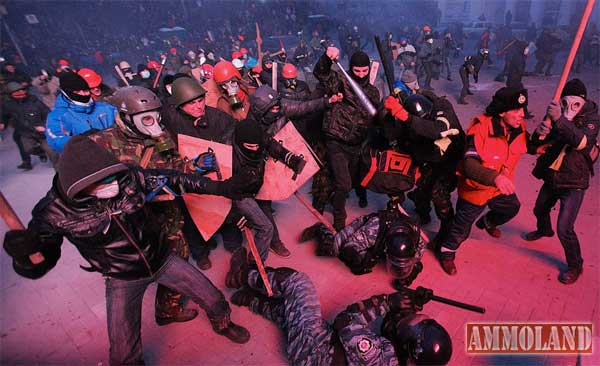
Your freedom and your life are not negotiable with evil. Our brothers and sisters in Ukraine are finding this out right now. You cannot fight tyranny with a sharp stick.
21 Feb 2014 / Major Van Harl USAF Ret. / vanharl@aol.com
About Major Van Harl USAF Ret.:Major Van E. Harl USAF Ret., a career Police Officer in the U.S. Air Force was born in Burlington, Iowa, USA, in 1955. He was the Deputy Chief of police at two Air Force Bases and the Commander of Law Enforcement Operations at another. He is a graduate of the U.S. Army Infantry School.  A retired Colorado Ranger and currently is an Auxiliary Police Officer with the Cudahy PD in Milwaukee County, WI.  His efforts now are directed at church campus safely and security training.  He believes “evil hates organization.”  vanharl@aol.com
Ammoland Click to read AmmoLand FTC Marital Disclosures Distributed to you by - AmmoLand.com – The Shooting Sports News source.
Update: USA Buys Enough Guns in 3 Months to Outfit the Entire Chinese and Indian Army
This time with hot links to data sources.
Federal NIC Instacheck Data

BATFE
BATFE
Washinton, DC - -(AmmoLand.com)- It seem that readers of our recent post about honest Americans buying enough guns to outfit the current active army’s of China and India have been having trouble finding the hard data and facts to substantiate this article.
Here is the link to the NICS: The National Instant Criminal Background Check System.
As reported earlier each of the last few months has been a record for firearm purchases or sales in the USA with a record 1,529,635 background checks being performed in March of 2009. Firearm Sales Continue to Climb in March 2009
Chinese and Indian Standing Army Numbers:
.

About:
NSSF, founded in 1961, is the trade association for the firearms, ammunition and recreational shooting sports industry. It promotes the safe ownership and responsible use of products its members make and sell. For more information, visit www.nssf.org.
About:
The National Instant Criminal Background Check System, or NICS, is all about saving lives and protecting people from harm—by not letting guns and explosives fall into the wrong hands. It also ensures the timely transfer of firearms to eligible gun buyers.
Mandated by the Brady Handgun Violence Prevention Act of 1993 and launched by the FBI on November 30, 1998, NICS is used by Federal Firearms Licensees (FFLs) to instantly determine whether a prospective buyer is eligible to buy firearms or explosives. Before ringing up the sale, cashiers call in a check to the FBI or to other designated agencies to ensure that each customer does not have a criminal record or isn’t otherwise ineligible to make a purchase. More than 100 million such checks have been made in the last decade, leading to more than 700,000 denials.
NICS is located at the FBI’s Criminal Justice Information Services Division in Clarksburg, West Virginia. It provides full service to FFLs in 30 states, five U.S. territories, and the District of Columbia. Upon completion of the required Bureau of Alcohol, Tobacco, Firearms and Explosives (ATF) Form 4473, FFLs contact the NICS Section via a toll-free telephone number or electronically on the Internet through the NICS E-Check System to request a background check with the descriptive information provided on the ATF Form 4473. NICS is customarily available 17 hours a day, seven days a week, including holidays (except for Christmas). See below for more facts and forms.
Ammoland Click to read AmmoLand FTC Marital Disclosures Distributed to you by - AmmoLand.com – The Shooting Sports News source.

Remembering Obama Signed Executive Order 13489 To Block His Records: Lakin ~ A Duty to Disobey All Unlawful Orders!

Honduras Did It, The United States People Will Too: Rush Limbaugh ~ Boot The Communist Impostor!
Last week, I entered Walter Reed Army Hospital to notify the Department of Defense that I would refuse to obey any orders from my commanding officers — including President Obama — until the president produces his original birth certificate. After nearly eighteen years of wearing the military uniform of the country I have proudly served, including overseas assignments in imminent danger/combat areas in Bosnia and Afghanistan, I felt compelled to take this step.

I made this decision from much deliberation, after lengthy consultations with many friends, family members, and colleagues, and I firmly believe that all servicemen and women, and the American public, have the right to know the truth about President Obama’s constitutional eligibility to serve as Commander-in-Chief.

As military officers, we all take a solemn oath upon commissioning into the Uniformed Services. In this oath, we swear to support and defend the Constitution of the United States against all enemies, foreign and domestic. Upholding the law is an essential part of our role as citizens; in the military, we are the ultimate protectors of that law. The Constitution is our social compact, which safeguards all of us and ensures the “equal rights” that we are entitled to as American citizens.

Since Nuremberg, My Lai, and even Abu Ghraib more recently, the military has been taught the hard lessons of following illegal orders. Any reasonable person looking critically at the information and evidence currently in the public domain about Obama’s birthplace would have questions about President Obama’s claim to be a natural born citizen. I made the decision to disobey all military orders, including my deployment order to Afghanistan, in pursuit of the truth of whether President Obama can legally occupy the high post that he holds today and which entitles him to send servicemembers into harm’s way.

The United States serves an example to the rest of the world of a stable, civilized, democratic government, where all men are equal under the law and the rule of law is cherished and obeyed. The U.S. military teaches and promotes the rule of law and civilian control of the military to many other nations and military forces around the world. Every soldier learns what constitutes a lawful order and is encouraged to stand up and object to unlawful orders. This is called the “duty to disobey.”

My deployment orders for a second tour in Afghanistan included a requirement to bring copies of my birth certificate. I would be glad to obey this order and provide a certified copy of my original birth certificate with common, standard identifiers, including the name of an attending physician and a hospital. Every day in transactions across the country, American citizens are required to prove their identity; standards for identification have become stricter since the terrorist attacks of 9/11.

Since fall 2008, I have been troubled by reports that the president’s original birth certificate remains concealed from public view along with other records which, if released, would quickly end questions surrounding his place of birth and “natural born” status. Many people mistook the online Certification of Live Birth for an original birth certificate. Until the summer of 2009, the Hawaiian Department of Homelands would not accept this Certification of Live Birth to determine native Hawaiian identity — the Department insisted upon also reviewing an original birth certificate.

Many do not understand that the online document was from 2007, generated by computer, laser-printed, and merely a certification that there is something on file which may or may not be sufficient proof of a birth in Hawaii. An original birth certificate could be the underlying document that presumably includes a hospital and attending physician’s or midwife’s name. Such a document should lay to rest the “natural born” dispute. This controversy was further escalated by media reports that gave two different hospital names for Obama’s birthplace — even today, the public does not know what doctor delivered the then-future president or which hospital was the site of his birth. No eyewitnesses have stepped forward to affirm that he was born in Hawaii in 1961. Under immigration laws in force at the time, if born in Kenya to a father who was not a U.S. citizen, Barack Obama had no right to American citizenship of any kind, and he could never qualify as “natural born.” This is why determining his actual birthplace is crucial.

In 2008, after pressure from news media, President Obama’s rival, candidate McCain, produced an original birth certificate from the Panama Canal Zone; a Senate Judiciary Committee hearing examined and affirmed his “natural born” status and constitutional eligibility to serve as president. The U.S. Senate was strangely silent about President Obama’s eligibility despite statements from Kenyan citizens that he was born there, evidently including his paternal grandmother and the Ambassador from Kenya to the U.S. during a November 2008 radio interview. Hawaiian state officials claim that they cannot release an original birth certificate without Obama’s consent, declaring that the public has no “tangible interest” in seeing this vital birth record.


I attempted without success through my chain of command for over a year to get answers to the questions surrounding the president’s eligibility. I was told that I have no standing to make this inquiry, and moreover, that no one in DoD could answer this question. I made inquiries, unsuccessfully, through my congressional delegation, which simply referred my questions back to DoD. No one I spoke to was able to offer any evidence that the president is “natural born.” The burden of proof, it seems, must rest with the White House– with president Obama himself, as these records are his, and he has chosen to conceal them at considerable legal expense. Remarkably, there is no enforcement mechanism for the Constitution’s Article II, Section 1 requirement that the president be a “natural born” citizen — voters have largely relied on an honor system and a free press to vet candidates for the highest political office in the nation.

While President Obama’s records remain hidden, public consternation is growing. The American people have the right to know that their president is constitutionally eligible to serve as Commander-in-Chief and thereby may lawfully direct servicemembers into harm’s way. I will be proud to deploy to Afghanistan to further serve my country and my fellow soldiers, but I should do so only with the knowledge that this important requirement of our Constitution is respected and obeyed. Those in uniform who continue to risk their lives and give the ultimate sacrifice to the service of our country deserve to know that they do so upholding their vows to the oath of office and to the Constitution.

Until an original birth certificate is brought forward that will validate the Commander-in-Chief’s constitutional eligibility and put to rest the reasonable questions surrounding it, I cannot in good conscience obey any of my military orders. Unless it is established (sufficient proof that should be easily within the president’s power to provide) that he is constitutionally eligible to serve as president and Commander-in-Chief, I and all other military officers are at risk of following illegal orders.

There is no legitimate privacy right to information necessary to prove that President Obama is legally eligible to serve as Commander-in-Chief.

I remain at risk of arrest and court-martial, but am mindful always that my oath of office is to the Constitution. It fills me with great sadness that on 31 March, I declined a direct order from my Medical Brigade Commander. This is a man I honor and wished to meet in order to thank him for his unquestionable valor and courage, and yet I could not obey his order. Now, he could order my arrest at any time.

I hope that President Obama will demonstrate his respect for the U.S. Constitution and release his original birth certificate. My bags are packed, and I look forward to joining my fellow soldiers in Afghanistan, but I will deploy only with the knowledge that I am following legal orders under a lawful Commander-in-Chief.

For those readers wanting to follow my ongoing story, the American Patriot Foundation has set up a legal defense fund to help me, and they tell me that they will be posting up-to-date information about my case. Their website is safeguardourconstitution.com.

Dr. Terrence Lakin is an active duty Lieutenant Colonel who serves as Chief of Primary Care at the Pentagon’s TRICARE health clinic; he has been selected for promotion to Colonel.
American Thinker

The military oath taken at time of induction reads:


“I,____________, do solemnly swear (or affirm) that I will support and defend the Constitution of the United States against all enemies, foreign and domestic; that I will bear true faith and allegiance to the same; and that I will obey the orders of the President of the United States and the orders of the officers appointed over me, according to the regulations and the Uniform Code of Military Justice. So help me God”
The Uniform Code of Military Justice (UCMJ) 809.ART.90 (20), makes it clear that military personnel need to obey the “lawful command of his superior officer,” 891.ART.91 (2), the “lawful order of a warrant officer”, 892.ART.92 (1) the “lawful general order”, 892.ART.92 (2) “lawful order”. In each case, military personnel have an obligation and a duty to only obey Lawful orders and indeed have an obligation to disobey Unlawful orders, including orders by the president that do not comply with the UCMJ. The moral and legal obligation is to the U.S. Constitution and not to those who would issue unlawful orders, especially if those orders are in direct violation of the Constitution and the UCMJ.
EXAMPLES!
During the Iran-Contra hearings of 1987, Senator Daniel Inouye of Hawaii, a decorated World War II veteran and hero, told Lt. Col. Oliver North that North was breaking his oath when he blindly followed the commands of Ronald Reagan. As Inouye stated, “The uniform code makes it abundantly clear that it must be the Lawful orders of a superior officer. In fact it says, ‘Members of the military have an obligation to disobey unlawful orders.’ This principle was considered so important that we-we, the government of the United States, proposed that it be internationally applied in the Nuremberg trials.” (Bill Moyers, “The Secret Government”, Seven Locks Press; also in the PBS 1987 documentary, “The Secret Government: The Constitution in Crisis”)
Senator Inouye was referring to the Nuremberg trials in the post WW II era, when the U.S. tried Nazi war criminals and did not allow them to use the reason or excuse that they were only “following orders” as a defense for their war crimes which resulted in the deaths of millions of innocent men, women, and children. “In 1953, the Department of Defense adopted the principles of the Nuremberg Code as official policy” of the United States. (Hasting Center Report, March-April 1991) Over the past year there have been literally thousands of articles written about the impact of the coming war with Iraq. Many are based on politics and the wisdom of engaging in an international war against a country that has not attacked the U.S. and the legality of engaging in what Bush and Rumsfield call “preemptive war.” World opinion at the highest levels, and among the general population, is that a U.S. first strike on Iraq would be wrong, both politically and morally. There is also considerable evidence that Bush’s plans are fundamentally illegal, from both an international and domestic perspective. If the war is indeed illegal, members of the armed forces have a legal and moral obligation to resist illegal orders, according to their oath of induction.
The evidence from an international perspective is overwhelming. The United States Constitution makes treaties that are signed by the government equivalent to the “law of the land” itself, Article VI, para. 2. Among the international laws and treaties that a U.S. pre-emptive attack on Iraq may violate are:
· The Hague Convention on Land Warfare of 1899, which was reaffirmed by the U.S. at the 1946 Nuremberg International Military Tribunals;
· Resolution on the Non-Use of Nuclear Weapons and Prevention of Nuclear War, adopted UN General Assembly, Dec 12, 1980;
· Convention on the Prevention and Punishment of the Crime of Genocide; December 9, 1948, Adopted by Resolution 260 (III) A of the UN General Assembly;
· Geneva Convention relative to the Protection of Civilian Persons in Time of War, Adopted on August 12, 1949 by the Diplomatic Conference for the Establishment of International Conventions for the Protection of Victims of War;
· Convention on the Prohibition of Military or any Other Hostile Use of Environmental Modification Techniques, 1108 U.N.T.S. 151, Oct. 5, 1978; · The Charter of the United Nations;
· The Nuremberg Principles, which define as a crime against peace, “planning, preparation, initiation or waging of a war of aggression, or a war in violation of international treaties, agreements, or assurances, or participation in a common plan or conspiracy for accomplishment of any of the forgoing.” (For many of these treaties and others, see the Yale Avalon project.   Also see a letter to Canadian soldiers sent by Hamilton Action for Social Change).   at )
As Hamilton Action for Social Change has noted “Under the Nuremberg Principles, you have an obligation NOT to follow the orders of leaders who are preparing crimes against peace and crimes against humanity. We are all bound by what U.S. Chief Prosecutor Robert K. Jackson declared in 1948: [T]he very essence of the [Nuremberg] Charter is that individuals have intentional duties which transcend the national obligations of obedience imposed by the individual state.” At the Tokyo War Crimes trial, it was further declared “[A]nyone with knowledge of illegal activity and an opportunity to do something about it is a potential criminal under international law unless the person takes affirmative measures to prevent commission of the crimes.” …

Lawrence Mosqueda, Ph.D
The Evergreen State College
Olympia, WA 98505
mosqueda evergreen.edu

There may well be some safety in numbers. Albert Einstein, the genius physicist, once stated that if 2% of the military refused to fight or participate, the wars could not continue. Time is short. Or if you are reading this after the hostilities have commenced, it is time to stop the madness and war crimes of The British Monarchy.

The first order of business Obama took care of on day one of his Presidency was to sign off on an Executive Order that states that only the records he chooses to be made public will be released. It appears that the issue of Obama being forced to produce a copy of his birth certificate may prove to be extremely difficult, if not impossible.

Executive Order 13489

Federal Register
Vol. 74, No. 15 Monday, January 26, 2009
Title 3— The President
Presidential Documents
VerDate Nov<24>2008
20:24 Jan 23, 2009
Jkt 217001
PO 00000 Frm 00003 Fmt 4705 Sfmt 4790 E:\FR\FM\26JAE0.SGM 26JAE0
Executive Order 13489 of January 21, 2009 Presidential Records
By the authority vested in me as President by the Constitution and the laws of the United States of America, and in order to establish policies and procedures governing the assertion of executive privilege by incumbent and former Presidents in connection with the release of Presidential records by the National Archives and Records Administration (NARA) pursuant to the Presidential Records Act of 1978, it is hereby ordered as follows:
Section 1. Definitions. For purposes of this order: (a) ‘‘Archivist’’ refers to the Archivist of the United States or his designee.
(b) ‘‘NARA’’ refers to the National Archives and Records Administration.
(c) ‘‘Presidential Records Act’’ refers to the Presidential Records Act, 44 U.S.C. 2201–2207.
(d) ‘‘NARA regulations’’ refers to the NARA regulations implementing the Presidential Records Act, 36 C.F.R. Part 1270.
(e) ‘‘Presidential records’’ refers to those documentary materials maintained by NARA pursuant to the Presidential Records Act, including Vice Presi- dential records.
(f) ‘‘Former President’’ refers to the former President during whose term or terms of office particular Presidential records were created.
(g) A ‘‘substantial question of executive privilege’’ exists if NARA’s disclo- sure of Presidential records might impair national security (including the conduct of foreign relations), law enforcement, or the deliberative processes of the executive branch.
(h) A ‘‘final court order’’ is a court order from which no appeal may be taken.
Sec. 2. Notice of Intent to Disclose Presidential Records. (a) When the Archivist provides notice to the incumbent and former Presidents of his intent to disclose Presidential records pursuant to section 1270.46 of the NARA regulations, the Archivist, using any guidelines provided by the in- cumbent and former Presidents, shall identify any specific materials, the disclosure of which he believes may raise a substantial question of executive privilege. However, nothing in this order is intended to affect the right of the incumbent or former Presidents to invoke executive privilege with respect to materials not identified by the Archivist. Copies of the notice for the incumbent President shall be delivered to the President (through the Counsel to the President) and the Attorney General (through the Assistant Attorney General for the Office of Legal Counsel). The copy of the notice for the former President shall be delivered to the former President or his designated representative.

(b) Upon the passage of 30 days after receipt by the incumbent and former Presidents of a notice of intent to disclose Presidential records, the Archivist may disclose the records covered by the notice, unless during that time period the Archivist has received a claim of executive privilege by the incumbent or former President or the Archivist has been instructed by the incumbent President or his designee to extend the time period for a time certain and with reason for the extension of time provided in the notice. If a shorter period of time is required under the circumstances
46694670
Federal Register/Vol. 74, No. 15/Monday, January 26, 2009/Presidential Documents
VerDate Nov<24>2008
20:24 Jan 23, 2009
Jkt 217001
PO 00000 Frm 00004 Fmt 4705 Sfmt 4790 E:\FR\FM\26JAE0.SGM 26JAE0
set forth in section 1270.44 of the NARA regulations, the Archivist shall so indicate in the notice. Sec. 3. Claim of Executive Privilege by Incumbent President. (a) Upon receipt of a notice of intent to disclose Presidential records, the Attorney General (directly or through the Assistant Attorney General for the Office of Legal Counsel) and the Counsel to the President shall review as they deem appro- priate the records covered by the notice and consult with each other, the Archivist, and such other executive agencies as they deem appropriate con- cerning whether invocation of executive privilege is justified.
(b) The Attorney General and the Counsel to the President, in the exercise of their discretion and after appropriate review and consultation under sub- section (a) of this section, may jointly determine that invocation of executive privilege is not justified. The Archivist shall be notified promptly of any such determination.
(c) If either the Attorney General or the Counsel to the President believes that the circumstances justify invocation of executive privilege, the issue shall be presented to the President by the Counsel to the President and the Attorney General.
(d) If the President decides to invoke executive privilege, the Counsel to the President shall notify the former President, the Archivist, and the Attorney General in writing of the claim of privilege and the specific Presi- dential records to which it relates. After receiving such notice, the Archivist shall not disclose the privileged records unless directed to do so by an incumbent President or by a final court order. Sec. 4. Claim of Executive Privilege by Former President. (a) Upon receipt of a claim of executive privilege by a living former President, the Archivist shall consult with the Attorney General (through the Assistant Attorney General for the Office of Legal Counsel), the Counsel to the President, and such other executive agencies as the Archivist deems appropriate con- cerning the Archivist’s determination as to whether to honor the former President’s claim of privilege or instead to disclose the Presidential records notwithstanding the claim of privilege. Any determination under section 3 of this order that executive privilege shall not be invoked by the incumbent President shall not prejudice the Archivist’s determination with respect to the former President’s claim of privilege.
(b) In making the determination referred to in subsection (a) of this section, the Archivist shall abide by any instructions given him by the incumbent President or his designee unless otherwise directed by a final court order. The Archivist shall notify the incumbent and former Presidents of his deter- mination at least 30 days prior to disclosure of the Presidential records, unless a shorter time period is required in the circumstances set forth in section 1270.44 of the NARA regulations. Copies of the notice for the incumbent President shall be delivered to the President (through the Counsel to the President) and the Attorney General (through the Assistant Attorney General for the Office of Legal Counsel). The copy of the notice for the former President shall be delivered to the former President or his designated representative. Sec. 5. General Provisions. (a) Nothing in this order shall be construed to impair or otherwise affect:
(i) authority granted by law to a department or agency, or the head thereof; or
(ii) functions of the Director of the Office of Management and Budget relating to budget, administrative, or legislative proposals. (b) This order shall be implemented consistent with applicable law and
subject to the availability of appropriations.
(c) This order is not intended to, and does not, create any right or benefit, substantive or procedural, enforceable at law or in equity by any party against the United States, its departments, agencies, or entities, its officers, employees, or agents, or any other person.
Federal Register/Vol. 74, No. 15/Monday, January 26, 2009/Presidential Documents 4671
Sec. 6. Revocation. Executive Order 13233 of November 1, 2001, is revoked.
THE WHITE HOUSE,
January 21, 2009.
[FR Doc. E9–1712 Filed 1–23–09; 8:45 am] Billing code 3195–W9–P
Obama Eligibility Case Before The Ninth Circuit Court: Barnett v. Obama NO. 09-56827

Plan to split California into six states gains ground

February 22, 2014 – Yahoo News
Plan to split California into six states gains ground
The Los Angeles skyline on August 21, 2013 in California (AFP Photo/Joe Klamar)
Los Angeles (United States) (AFP) – A plan to divide California into six separate US states is closer to making it on to a November ballot, with organizers gaining approval to collect signatures.
The seemingly far-fetched initiative, sponsored by Silicon Valley venture capitalist Tim Draper, claims “political representation of California’s diverse population and economies has rendered the state nearly ungovernable.”
And on Tuesday, the California Secretary of State’s office gave the movement a boost, saying that proponents “may begin collecting petition signatures.”
At least 807,615 voters — representing eight percent of the total ballots cast for governor in the 2010 election — will need to sign the petition by July 18 to make it on to the ballot.
The proposal aims to split the state — America’s most populous with around 38 million inhabitants — into “six smaller state governments, while preserving the historical boundaries of the various counties, cities and towns.”
In 2012, California was tied with Russia and Italy — all with a GDP of approximately $2.0 trillion — for eighth place in world GDP rankings, according to the Center for Continuing Study of the California Economy.
The proposal would create a state out of Silicon Valley, home to tech giants Google, Facebook and Apple. It would also create South California, which would include Hollywood and the US entertainment industry.
West California, Central California, North California, and Jefferson in the most northern part of the state, would also go it alone.
six-californias
According to the proposal, voters overwhelming approved dividing California in two in 1859, but Congress did not act due to the Civil War.
Draper, who has funded more than 400 companies including Skype and Baidu, is founder of venture capital firm Draper Fisher Jurvetson in Menlo Park, California.

Are the robots about to rise? Google’s new director of engineering thinks so…

February 23, 2014 – The Guardian
Robot from The Terminator
The Terminator films envisage a future in which robots have become sentient and are at war with humankind. Ray Kurzweil thinks that machines could become ‘conscious’ by 2029 but is optimistic about the implications for humans. Photograph: Solent News/Rex
It’s hard to know where to start with Ray Kurzweil. With the fact that he takes 150 pills a day and is intravenously injected on a weekly basis with a dizzying list of vitamins, dietary supplements, and substances that sound about as scientifically effective as face cream: coenzyme Q10, phosphatidycholine, glutathione?
With the fact that he believes that he has a good chance of living for ever? He just has to stay alive “long enough” to be around for when the great life-extending technologies kick in (he’s 66 and he believes that “some of the baby-boomers will make it through”). Or with the fact that he’s predicted that in 15 years’ time, computers are going to trump people. That they will be smarter than we are. Not just better at doing sums than us and knowing what the best route is to Basildon. They already do that. But that they will be able to understand what we say, learn from experience, crack jokes, tell stories, flirt. Ray Kurzweil believes that, by 2029, computers will be able to do all the things that humans do. Only better.
But then everyone’s allowed their theories. It’s just that Kurzweil’s theories have a habit of coming true. And, while he’s been a successful technologist and entrepreneur and invented devices that have changed our world – the first flatbed scanner, the first computer program that could recognise a typeface, the first text-to-speech synthesizer and dozens more – and has been an important and influential advocate of artificial intelligence and what it will mean, he has also always been a lone voice in, if not quite a wilderness, then in something other than the mainstream.
And now? Now, he works at Google. Ray Kurzweil who believes that we can live for ever and that computers will gain what looks like a lot likeconsciousness in a little over a decade is now Google’s director of engineering. The announcement of this, last year, was extraordinary enough. To people who work with tech or who are interested in tech and who are familiar with the idea that Kurzweil has popularised of “the singularity” – the moment in the future when men and machines will supposedly converge – and know him as either a brilliant maverick and visionary futurist, or a narcissistic crackpot obsessed with longevity, this was headline news in itself.
But it’s what came next that puts this into context. It’s since been revealed that Google has gone on an unprecedented shopping spree and is in the throes of assembling what looks like the greatest artificial intelligence laboratory on Earth; a laboratory designed to feast upon a resource of a kind that the world has never seen before: truly massive data. Our data. From the minutiae of our lives.
Google has bought almost every machine-learning and robotics company it can find, or at least, rates. It made headlines two months ago, when it bought Boston Dynamics, the firm that produces spectacular, terrifyingly life-like military robots, for an “undisclosed” but undoubtedly massive sum. It spent $3.2bn (£1.9bn) on smart thermostat maker Nest Labs. And this month, it bought the secretive and cutting-edge British artificial intelligence startup DeepMind for £242m.
And those are just the big deals. It also bought Bot & DollyMeka Robotics, Holomni, Redwood Robotics and Schaft, and another AI startup, DNNresearch. It hired Geoff Hinton, a British computer scientist who’s probably the world’s leading expert on neural networks. And it has embarked upon what one DeepMind investor told the technology publication Re/code two weeks ago was “a Manhattan project of AI”. If artificial intelligence was really possible, and if anybody could do it, he said, “this will be the team”. The future, in ways we can’t even begin to imagine, will be Google’s.
There are no “ifs” in Ray Kurzweil’s vocabulary, however, when I meet him in his new home – a high-rise luxury apartment block in downtown San Francisco that’s become an emblem for the city in this, its latest incarnation, the Age of Google. Kurzweil does not do ifs, or doubt, and he most especially doesn’t do self-doubt. Though he’s bemused about the fact that “for the first time in my life I have a job” and has moved from the east coast where his wife, Sonya, still lives, to take it.
Ray Kurzweil photographed in San Francisco last year.  Ray Kurzweil photographed in San Francisco last year. Photograph: Zackary Canepari/Panos PicturesBill Gates calls him “the best person I know at predicting the future of artificial intelligence”. He’s received 19 honorary doctorates, and he’s been widely recognised as a genius. But he’s the sort of genius, it turns out, who’s not very good at boiling a kettle. He offers me a cup of coffee and when I accept he heads into the kitchen to make it, filling a kettle with water, putting a teaspoon of instant coffee into a cup, and then moments later, pouring the unboiled water on top of it. He stirs the undissolving lumps and I wonder whether to say anything but instead let him add almond milk – not eating diary is just one of his multiple dietary rules – and politely say thank you as he hands it to me. It is, by quite some way, the worst cup of coffee I have ever tasted.
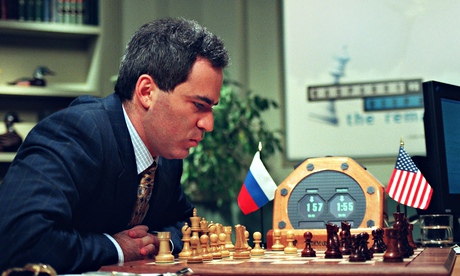
But then, he has other things on his mind. The future, for starters. And what it will look like. He’s been making predictions about the future for years, ever since he realised that one of the key things about inventing successful new products was inventing them at the right moment, and “so, as an engineer, I collected a lot of data”. In 1990, he predicted that a computer would defeat a world chess champion by 1998. In 1997, IBM’s Deep Blue defeated Garry Kasparov. He predicted the explosion of the world wide web at a time it was only being used by a few academics and he predicted dozens and dozens of other things that have largely come true, or that will soon, such as that by the year 2000, robotic leg prostheses would allow paraplegics to walk (the US military is currently trialling an “Iron Man” suit) and “cybernetic chauffeurs” would be able to drive cars (which Google has more or less cracked).
His critics point out that not all his predictions have exactly panned out (no US company has reached a market capitalisation of more than $1 trillion; “bioengineered treatments” have yet to cure cancer). But in any case, the predictions aren’t the meat of his work, just a byproduct. They’re based on his belief that technology progresses exponentially (as is also the case in Moore’s law, which sees computers’ performance doubling every two years). But then you just have to dig out an old mobile phone to understand that. The problem, he says, is that humans don’t think about the future that way. “Our intuition is linear.”
When Kurzweil first started talking about the “singularity”, a conceit he borrowed from the science-fiction writer Vernor Vinge, he was dismissed as a fantasist. He has been saying for years that he believes that the Turing test – the moment at which a computer will exhibit intelligent behaviour equivalent to, or indistinguishable from, that of a human – will be passed in 2029. The difference is that when he began saying it, the fax machine hadn’t been invented. But now, well… it’s another story.
“My book The Age of Spiritual Machines came out in 1999 and that we had a conference of AI experts at Stanford and we took a poll by hand about when you think the Turing test would be passed. The consensus was hundreds of years. And a pretty good contingent thought that it would never be done.
“And today, I’m pretty much at the median of what AI experts think and the public is kind of with them. Because the public has seen things like Siri [the iPhone's voice-recognition technology] where you talk to a computer, they’ve seen the Google self-driving cars. My views are not radical any more. I’ve actually stayed consistent. It’s the rest of the world that’s changing its view.”
And yet, we still haven’t quite managed to get to grips with what that means. The Spike Jonze film, Her, which is set in the near future and has Joaquin Phoenix falling in love with a computer operating system, is not so much fantasy, according to Kurzweil, as a slightly underambitious rendering of the brave new world we are about to enter. “A lot of the dramatic tension is provided by the fact that Theodore’s love interest does not have a body,” Kurzweil writes in a recent review of it. “But this is an unrealistic notion. It would be technically trivial in the future to provide her with a virtual visual presence to match her virtual auditory presence.”
But then he predicts that by 2045 computers will be a billion times more powerful than all of the human brains on Earth. And the characters’ creation of an avatar of a dead person based on their writings, in Jonze’s film, is an idea that he’s been banging on about for years. He’s gathered all of his father’s writings and ephemera in an archive and believes it will be possible to retro-engineer him at some point in the future.
So far, so sci-fi. Except that Kurzweil’s new home isn’t some futuristic MegaCorp intent on world domination. It’s not Skynet. Or, maybe it is, but we largely still think of it as that helpful search engine with the cool design. Kurzweil has worked with Google’s co-founder Larry Page on special projects over several years. “And I’d been having ongoing conversations with him about artificial intelligence and what Google is doing and what I was trying to do. And basically he said, ‘Do it here. We’ll give you the independence you’ve had with your own company, but you’ll have these Google-scale resources.’”
And it’s the Google-scale resources that are beyond anything the world has seen before. Such as the huge data sets that result from 1 billion people using Google ever single day. And the Google knowledge graph, which consists of 800m concepts and the billions of relationships between them. This is already a neural network, a massive, distributed global “brain”. Can it learn? Can it think? It’s what some of the smartest people on the planet are working on next.
Peter Norvig, Google’s research director, said recently that the company employs “less than 50% but certainly more than 5%” of the world’s leading experts on machine learning. And that was before it bought DeepMind which, it should be noted, agreed to the deal with the proviso that Google set up an ethics board to look at the question of what machine learning will actually mean when it’s in the hands of what has become the most powerful company on the planet. Of what machine learning might look like when the machines have learned to make their own decisions. Or gained, what we humans call, “consciousness”.
Garry Kasparov ponders a move against IBM's Deep Blue. Kurzweil predicted the computer's triumph.Garry Kasparov ponders a move against IBM’s Deep Blue. Ray Kurzweil predicted the computer’s triumph. Photograph: Stan Honda/AFP/Getty ImagesI first saw Boston Dynamics’ robots in action at a presentation at theSingularity University, the university that Ray Kurzweil co-founded and that Google helped fund and which is devoted to exploring exponential technologies. And it was the Singularity University’s own robotics faculty member Dan Barry who sounded a note of alarm about what the technology might mean: “I don’t see any end point here,” he said when talking about the use of military robots. “At some point humans aren’t going to be fast enough. So what you do is that you make them autonomous. And where does that end? Terminator?”

And the woman who headed the Defence Advanced Research Projects Agency (Darpa), the secretive US military agency that funded the development of BigDog? Regina Dugan. Guess where she works now?
Kurzweil’s job description consists of a one-line brief. “I don’t have a 20-page packet of instructions,” he says. “I have a one-sentence spec. Which is to help bring natural language understanding to Google. And how they do that is up to me.”
Language, he believes, is the key to everything. “And my project is ultimately to base search on really understanding what the language means. When you write an article you’re not creating an interesting collection of words. You have something to say and Google is devoted to intelligently organising and processing the world’s information. The message in your article is information, and the computers are not picking up on that. So we would like to actually have the computers read. We want them to read everything on the web and every page of every book, then be able to engage an intelligent dialogue with the user to be able to answer their questions.”
Google will know the answer to your question before you have asked it, he says. It will have read every email you’ve ever written, every document, every idle thought you’ve ever tapped into a search-engine box. It will know you better than your intimate partner does. Better, perhaps, than even yourself.
The most successful example of natural-language processing so far is IBM’s computer Watson, which in 2011 went on the US quiz showJeopardy and won. “And Jeopardy is a pretty broad task. It involves similes and jokes and riddles. For example, it was given “a long tiresome speech delivered by a frothy pie topping” in the rhyme category and quickly responded: “A meringue harangue.” Which is pretty clever: the humans didn’t get it. And what’s not generally appreciated is that Watson’s knowledge was not hand-coded by engineers. Watson got it by reading. Wikipedia – all of it.
Kurzweil says: “Computers are on the threshold of reading and understanding the semantic content of a language, but not quite at human levels. But since they can read a million times more material than humans they can make up for that with quantity. So IBM’s Watson is a pretty weak reader on each page, but it read the 200m pages of Wikipedia. And basically what I’m doing at Google is to try to go beyond what Watson could do. To do it at Google scale. Which is to say to have the computer read tens of billions of pages. Watson doesn’t understand the implications of what it’s reading. It’s doing a sort of pattern matching. It doesn’t understand that if John sold his red Volvo to Mary that involves a transaction or possession and ownership being transferred. It doesn’t understand that kind of information and so we are going to actually encode that, really try to teach it to understand the meaning of what these documents are saying.”
And once the computers can read their own instructions, well… gaining domination over the rest of the universe will surely be easy pickings. Though Kurzweil, being a techno-optimist, doesn’t worry about the prospect of being enslaved by a master race of newly liberated iPhones with ideas above their station. He believes technology will augment us. Make us better, smarter, fitter. That just as we’ve already outsourced our ability to remember telephone numbers to their electronic embrace, so we will welcome nanotechnologies that thin our blood and boost our brain cells. His mind-reading search engine will be a “cybernetic friend”. He is unimpressed by Google Glass because he doesn’t want any technological filter between us and reality. He just wants reality to be that much better.
“I thought about if I had all the money in the world, what would I want to do?” he says. “And I would want to do this. This project. This is not a new interest for me. This idea goes back 50 years. I’ve been thinking about artificial intelligence and how the brain works for 50 years.”
The evidence of those 50 years is dotted all around the apartment. He shows me a cartoon he came up with in the 60s which shows a brain in a vat. And there’s a still from a TV quiz show that he entered aged 17 with his first invention: he’d programmed a computer to compose original music. On his walls are paintings that were produced by a computer programmed to create its own original artworks. And scrapbooks that detail the histories of various relatives, the aunts and uncles who escaped from Nazi Germany on the Kindertransport, his great grandmother who set up what he says was Europe’s first school to provide higher education for girls.
Jeopardy is won my a machineKurzweil suggests that language is the key to teaching machines to think. He says his job is to ‘base search on really understanding what the language means’.The most successful example of natural-language processing to date is IBM’s computer Watson, which in 2011 went on the US quiz show Jeopardy and won (shown above). Photograph: APHis home is nothing if not eclectic. It’s a shiny apartment in a shiny apartment block with big glass windows and modern furnishings but it’s imbued with the sort of meaning and memories and resonances that, as yet, no machine can understand. His relatives escaped the Holocaust “because they used their minds. That’s actually the philosophy of my family. The power of human ideas. I remember my grandfather coming back from his first return visit to Europe. I was seven and he told me he’d been given the opportunity to handle – with his own hands – original documents by Leonardo da Vinci. He talked about it in very reverential terms, like these were sacred documents. But they weren’t handed down to us by God. They were created by a guy, a person. A single human had been very influential and had changed the world. The message was that human ideas changed the world. And that is the only thing that could change the world.”
On his fingers are two rings, one from the Massachusetts Institute of Technology, where he studied, and another that was created by a 3D printer, and on his wrist is a 30-year-old Mickey Mouse watch. “It’s very important to hold on to our whimsy,” he says when I ask him about it. Why? “I think it’s the highest level of our neocortex. Whimsy, humour…”
Even more engagingly, tapping away on a computer in the study next door I find Amy, his daughter. She’s a writer and a teacher and warm and open, and while Kurzweil goes off to have his photo taken, she tells me that her childhood was like “growing up in the future”.
Is that what it felt like? “I do feel little bit like the ideas I grew up hearing about are now ubiquitous… Everything is changing so quickly and it’s not something that people realise. When we were kids people used to talk about what they going to do when they were older, and they didn’t necessarily consider how many changes would happen, and how the world would be different, but that was at the back of my head.”
And what about her father’s idea of living for ever? What did she make of that? “What I think is interesting is that all kids think they are going to live for ever so actually it wasn’t that much of a disconnect for me. I think it made perfect sense. Now it makes less sense.”
Well, yes. But there’s not a scintilla of doubt in Kurzweil’s mind about this. My arguments slide off what looks like his carefully moisturised skin. “My health regime is a wake-up call to my baby-boomer peers,” he says. “Most of whom are accepting the normal cycle of life and accepting they are getting to the end of their productive years. That’s not my view. Now that health and medicine is in information technology it is going to expand exponentially. We will see very dramatic changes ahead. According to my model it’s only 10-15 years away from where we’ll be adding more than a year every year to life expectancy because of progress. It’s kind of a tipping point in longevity.”
He does, at moments like these, have something of a mad glint in his eye. Or at least the profound certitude of a fundamentalist cleric.Newsweek, a few years back, quoted an anonymous colleague claiming that, “Ray is going through the single most public midlife crisis that any male has ever gone through.” His evangelism (and commercial endorsement) of a whole lot of dietary supplements has more than a touch of the “Dr Gillian McKeith (PhD)” to it. And it’s hard not to ascribe a psychological aspect to this. He lost his adored father, a brilliant man, he says, a composer who had been largely unsuccessful and unrecognised in his lifetime, at the age of 22 to a massive heart attack. And a diagnosis of diabetes at the age of 35 led him to overhaul his diet.
But isn’t he simply refusing to accept, on an emotional level, that everyone gets older, everybody dies?
“I think that’s a great rationalisation because our immediate reaction to hearing someone has died is that it’s not a good thing. We’re sad. We consider it a tragedy. So for thousands of years, we did the next best thing which is to rationalise. ‘Oh that tragic thing? That’s really a good thing.’ One of the major goals of religion is to come up with some story that says death is really a good thing. It’s not. It’s a tragedy. And people think we’re talking about a 95-year-old living for hundreds of years. But that’s not what we’re talking about. We’re talking radical life extension, radical life enhancement.
“We are talking about making ourselves millions of times more intelligent and being able to have virtually reality environments which are as fantastic as our imagination.”
Although possibly this is what Kurzweil’s critics, such as the biologist PZ Myers, mean when they say that the problem with Kurzweil’s theories is that “it’s a very bizarre mixture of ideas that are solid and good with ideas that are crazy. It’s as if you took a lot of very good food and some dog excrement and blended it all up so that you can’t possibly figure out what’s good or bad.” Or Jaron Lanier, who calls him “a genius” but “a product of a narcissistic age”.
But then, it’s Kurzweil’s single-mindedness that’s been the foundation of his success, that made him his first fortune when he was still a teenager, and that shows no sign of letting up. Do you think he’ll live for ever, I ask Amy. “I hope so,” she says, which seems like a reasonable thing for an affectionate daughter to wish for. Still, I hope he does too. Because the future is almost here. And it looks like it’s going to be quite a ride.

D.C. Insider: There's a Shadow Govt. Running the Country, and It's Not Up for Re-Election

/ By Mike Lofgren

Power centers in DC and the corporate corridors of Manhattan and Silicon Valley are calling the shots.
Photo Credit: Shutterstock.com/Konstantin L
 
Rome lived upon its principal till ruin stared it in the face. Industry is the only true source of wealth, and there was no industry in Rome. By day the Ostia road was crowded with carts and muleteers, carrying to the great city the silks and spices of the East, the marble of Asia Minor, the timber of the Atlas, the grain of Africa and Egypt; and the carts brought out nothing but loads of dung. That was their return cargo.
"The Martyrdom of Man" by Winwood Reade (1871)

There is the visible government situated around the Mall in Washington, and then there is another, more shadowy, more indefinable government that is not explained in Civics 101 or observable to tourists at the White House or the Capitol. The former is traditional Washington partisan politics: the tip of the iceberg that a public watching C-SPAN sees daily and which is theoretically controllable via elections. The subsurface part of the iceberg I shall call the Deep State, which operates on its own compass heading regardless of who is formally in power. [1]
During the last five years, the news media have been flooded with pundits decrying the broken politics of Washington. The conventional wisdom has it that partisan gridlock and dysfunction have become the new normal. That is certainly the case, and I have been among the harshest critics of this development. But it is also imperative to acknowledge the limits of this critique as it applies to the American governmental system. On one level, the critique is self-evident: in the domain that the public can see, Congress is hopelessly deadlocked in the worst manner since the 1850s, the violently rancorous decade preceding the Civil War.
As I wrote in "The Party is Over," the present objective of congressional Republicans is to render the executive branch powerless, at least until a Republican president is elected (a goal which voter suppression laws in GOP-controlled states are clearly intended to accomplish). President Obama cannot enact his domestic policies and budgets; because of incessant GOP filibustering, not only could he not fill the large number of vacancies in the federal judiciary, he could not even get his most innocuous presidential appointees into office. Democrats controlling the Senate have responded by weakening the filibuster of nominations, but Republicans are sure to react with other parliamentary delaying tactics. This strategy amounts to congressional nullification of executive branch powers by a party that controls a majority in only one house of Congress.

Despite this apparent impotence, President Obama can liquidate American citizens without due processes, detain prisoners indefinitely without charge, conduct “dragnet” surveillance on the American people without judicial warrant and engage in unprecedented — at least since the McCarthy era — witch hunts against federal employees (the so-called “Insider Threat Program”). Within the United States, this power is characterized by massive displays of intimidating force by militarized federal, state and local law enforcement. Abroad, President Obama can start wars at will and engage in virtually any other activity whatever without so much as a by-your-leave from Congress, to include arranging the forced landing of a plane carrying a sovereign head of state over foreign territory. Despite their habitual cant about executive overreach by Obama, the would-be dictator, we have until recently heard very little from congressional Republicans about these actions — with the minor exception of a gadfly like Senator Rand Paul of Kentucky. Democrats, save for a few mavericks like Ron Wyden of Oregon, are not unduly troubled, either — even to the extent of permitting seemingly perjured congressional testimony under oath by executive branch officials on the subject of illegal surveillance.
These are not isolated instances of a contradiction; they have been so pervasive that they tend to be disregarded as background noise. During the time in 2011 when political warfare over the debt ceiling was beginning to paralyze the business of governance in Washington, the United States government somehow summoned the resources to overthrow Muammar Ghaddafi’s regime in Libya, and, when the instability created by that coup spilled over into Mali, provide overt and covert assistance to French intervention there. At a time when there was heated debate about continuing meat inspections and civilian air traffic control because of the budget crisis, our government was somehow able to commit $115 millionto keeping a civil war going in Syria and to pay at least £100m to the United Kingdom’s Government Communications Headquarters to buy influence over and access to that country’s intelligence. Since 2007, two bridges carrying interstate highways have collapsed due to inadequate maintenance of infrastructure, one killing thirteen people; during that same period of time, the government has spent $1.7 billion constructing a building in Utah that is the size of seventeen football fields. This mammoth structure is intended to allow the National Security Agency to store a yottabyte of information, the largest numerical designator computer scientists have. A yottabyte is equal to 500 quintillion pages of text. They need that much storage to archive every single electronic trace you make.
Yes, there is another government concealed behind the one that is visible at either end of Pennsylvania Avenue, a hybrid entity of public and private institutions ruling the country according to consistent patterns in season and out, connected to, but only intermittently controlled by, the visible state whose leaders we choose. My analysis of this phenomenon is not an exposé of a secret, conspiratorial cabal; the state within a state is hiding mostly in plain sight, and its operators mainly act in the light of day. Nor can it be accurately termed an “establishment.” All complex societies have an establishment, a social network committed to its own enrichment and perpetuation. In terms of its scope, financial resources and sheer global reach, the American hybrid state, the Deep State, is in a class by itself. That said, it is neither omniscient nor invincible. The institution is not so much sinister (although it has highly sinister aspects) as it is relentlessly well entrenched. Far from being invincible, its failures, such as those in Iraq, Afghanistan and Libya, are routine enough that it is only the Deep State’s protectiveness towards its higher-ranking personnel that allows them to escape the consequences of their frequent ineptitude. [2]
How did I come to write an analysis of the Deep State, and why am I equipped to write it? As a congressional staff member for 28 years specializing in national security and possessing a top secret security clearance, I was at least on the fringes of the world I am describing, if neither totally in it by virtue of full membership nor of it by psychological disposition. But like virtually every employed person, I became to some extent assimilated by the culture of the institution I worked for, and only by slow degrees, starting before the invasion of Iraq, did I begin fundamentally to question the reasons of state that motivate the people who are, to quote George W. Bush, “the deciders.”
Cultural assimilation is partly a matter of what psychologist Irving L. Janis called “groupthink,” the chameleon-like ability of people to adopt the views of their superiors and peers. This syndrome is endemic to Washington: the town is characterized by sudden fads, be it biennial budgeting, grand bargains, or invading countries. Then, after a while, all the town’s cool kids drop those ideas as if they were radioactive. As in the military, everybody has to get on board with the mission, and it is not a career-enhancing move to question the mission. The universe of people who will critically examine the goings-on at the institutions they work for is always going to be a small one. As Upton Sinclair said, “It is difficult to get a man to understand something when his salary depends upon his not understanding it.”
A more elusive aspect of cultural assimilation is the sheer dead weight of the ordinariness of it all once you have planted yourself in your office chair for the ten thousandth time. Your life is typically not some vignette from an Allen Drury novel about intrigue under the Capitol dome. Sitting and staring at the clock on the off-white office wall when it’s eleven in the evening and you are vowing never, ever to eat another piece of take-out pizza in your life is not an experience that summons the higher literary instincts of a would-be memoirist. After a while, a functionary of the state begins to hear things that, in another context, would be quite remarkable, or at least noteworthy, and yet they simply bounce off one’s consciousness like pebbles off steel plate: “You mean the number of terrorist groups we are fighting isclassified?” No wonder few people are whistleblowers, quite apart from the vicious retaliation whistleblowing often provokes: unless one is blessed with imagination and a fine sense of irony, it is easy to grow immune to the curiousness of one’s surroundings. To paraphrase the inimitable Donald Rumsfeld, I didn’t know all that I knew, at least until I had had a couple of years away from the government to reflect upon it.
The Deep State does not consist of the entire government. It is a hybrid of national security and law enforcement agencies: the Department of Defense, the Department of State, the Department of Homeland Security, the Central Intelligence Agency, and the Justice Department. We also include the Department of the Treasury because of its jurisdiction over financial flows, its enforcement of international sanctions, and its organic symbiosis with Wall Street. All these agencies are coordinated by the Executive Office of the President via the National Security Council. Certain key areas of the judiciary belong to the Deep State, like the Foreign Intelligence Surveillance Court, whose actions are mysterious even to most members of Congress. Also included are a handful of vital federal trial courts, such as the Eastern District of Virginia and the Southern District of Manhattan, where sensitive proceedings in national security cases are conducted. The final government component (and possibly last in precedence among the formal branches of government established by the Constitution) is a kind of rump Congress consisting of the congressional leadership and some (but not all) of the members of the defense and intelligence committees. The rest of Congress, normally so fractious and partisan, is mostly only intermittently aware of the Deep State and when required usually submits to a few well-chosen words from the State’s emissaries.
I saw this submissiveness on many occasions. One memorable incident was passage of the Foreign Intelligence Surveillance Amendments Act of 2008. This legislation retroactively legalized the Bush administration’s illegal and unconstitutional surveillance first revealed by The New York Times in 2005, and indemnified the telecommunications companies for their cooperation in these acts. The bill passed easily: all that was required was the invocation of the word “terrorism” and most members of Congress responded like iron filings obeying a magnet. One who responded in that fashion was Senator Barack Obama, soon to be coronated as the Democratic presidential nominee at the Democratic National Convention in Denver. He had already won the most delegates by campaigning to the left of his main opponent, Hillary Clinton, on the excesses of the war on terrorism and the erosion of constitutional liberties.
As the indemnification vote showed, the Deep State does not consist only of government agencies. What is euphemistically called private enterprise is an integral part of its operations. In a special series in The Washington Post called “Top Secret America,” Dana Priest and William K. Arkin described the scope of the privatized Deep State, and the degree to which it has metastasized after the September 11 attacks. There are now 854,000 contract personnel with top secret clearances — a number greater than that of top secret-cleared civilian employees of the government.While they work throughout the country and the world, their heavy concentration in and around the Washington suburbs is unmistakable: since 9/11, 33 facilities for top-secret intelligence have been built or are under construction. Combined, they occupy the floor space of almost three Pentagons — about 17 million square feet. Seventy percent of the intelligence community’s budget goes to paying contracts. And the membrane between government and industry is highly permeable: the Director of National Intelligence, James R. Clapper, is a former executive of Booz Allen, one of the government’s largest intelligence contractors. His predecessor as director, Admiral Mike McConnell, is the current vice chairman of the same company; Booz Allen is 99 percent dependent on government business. These contractors now set the political and social tone of Washington, just as they are increasingly setting the direction of the country, but they are doing it quietly, their doings unrecorded in the Congressional Record or the Federal Register, and are rarely subject to congressional hearings
Washington is the most important node of the Deep State that has taken over America, but it is not the only one. Invisible threads of money and ambition connect the town to other nodes. One is Wall Street, which supplies the cash that keeps the political machine quiescent and operating as a diversionary marionette theater. Should the politicians forget their lines and threaten the status quo, Wall Street floods the town with cash and lawyers to help the hired hands remember their own best interests. The executives of the financial giants even have de facto criminal immunity. On March 6, 2013, testifying before the Senate Judiciary Committee, Attorney General Eric Holder stated the following: “I am concerned that the size of some of these institutions becomes so large that it does become difficult for us to prosecute them when we are hit with indications that if you do prosecute, if you do bring a criminal charge, it will have a negative impact on the national economy, perhaps even the world economy.” This from the chief law enforcement officer of a justice system that has practically abolished the constitutional right to trial for poorer defendants charged with certain crimes. It is not too much to say that Wall Street may be the ultimate owner of the Deep State and its strategies, if for no other reason than that it has the money to reward government operatives with a second career that is lucrative beyond the dreams of avarice — certainly beyond the dreams of a government salaryman. [3]
The corridor between Manhattan and Washington is a well-trodden highway for the personalities we all got to know in the period since the massive deregulation of Wall Street: Robert Rubin, Lawrence Summers, Henry Paulson, Timothy Geithner and many others. Not all the traffic involves persons connected with the purely financial operations of the government: in 2013, General David Petraeus joined KKR (formerly Kohlberg Kravis Roberts) of 9 West 57 Street, New York, a private equity firm with $62.3 billion in assets. KKR specializes in management buyouts and leveraged finance; General Petraeus’s expertise in these areas is unclear; his ability to peddle influence, however, is a known and valued commodity. Unlike Cincinnatus, the military commanders of the Deep State do not take up the plow once they lay down the sword. He also obtained a sinecure as a non-resident senior fellow at the Belfer Center for Science and International Affairs at Harvard. The Ivy League is of course the preferred bleaching tub and charm school of the American oligarchy. [4]
Petraeus, and most of the avatars of the Deep State — the White House advisers who urged Obama not to impose compensation limits on Wall Street CEOs, the contractor-connected think tank experts who besought us to “stay the course” in Iraq, the economic gurus who perpetually demonstrate that globalization and deregulation are a blessing that makes us all better off in the long run — are careful to pretend that they have no ideology. Their preferred pose is that of the politically neutral technocrat offering well-considered advice based on profound expertise. That is nonsense. They are deeply dyed in the hue of the official ideology of the governing class, an ideology that is neither specifically Democrat nor Republican. Domestically, whatever they might privately believe about essentially diversionary social issues like abortion or gay marriage, they almost invariably believe in the “Washington Consensus:” financialization, outsourcing, privatization, deregulation and the commodification of labor. Internationally, they espouse twenty-first century American Exceptionalism: the right and duty of the United States to meddle in every region of the world, coercive diplomacy, boots on the ground, and the right to ignore painfully-won international norms of civilized behavior. To paraphrase what Sir John Harrington said over 400 years ago about treason, now that the ideology of the Deep State has prospered, none dare call it ideology. [5] That is why describing torture with the word torture on broadcast television is treated less as political heresy than as an inexcusable lapse of Washington etiquette: like smoking a cigarette on camera, these days it is simply “not done.”
After Edward Snowden’s revelations about the extent and depth of surveillance by the National Security Agency, it has become publicly evident that Silicon Valley is a vital node of the Deep State as well. Unlike military and intelligence contractors, Silicon Valley overwhelmingly sells to the private market; but its business is so important to the government that a strange relationship has emerged. While the government could simply dragoon the high technology companies to do the NSA’s bidding, it would prefer cooperation with so important an engine of the nation’s economy, perhaps with an implied quid pro quo. Perhaps this explains the extraordinary indulgence the government shows the Valley in intellectual property matters — if an American “jailbreaks” his smartphone (i.e., modifies it so that it can use another service provider than the one dictated by the manufacturer), he could receive a fine of up to $500,000 and several years in prison; so much for a citizen’s vaunted property rights to what he purchases. The libertarian pose of the Silicon Valley moguls, so carefully cultivated in their public relations, has always been a sham. Silicon Valley has long been tracking for commercial purposes the activities of every person who uses an electronic device; it is hardly surprising that the Deep State should emulate the Valley and do the same for its own purposes. Nor is it surprising that it should conscript the Valley’s assistance.
Still, despite the essential roles of Lower Manhattan and Silicon Valley, the center of gravity of the Deep State is firmly situated in and around the Beltway. The Deep State’s physical expansion and consolidation around the Beltway would seem to make a mockery of the frequent pronouncements that governance in Washington is dysfunctional and broken. That the secret and unaccountable Deep State floats freely above the gridlock between both ends of Pennsylvania Avenue is the paradox of American government in the twenty-first century: drone strikes, data mining, secret prisons and Panopticon-like control on the one hand; and on the other, the ordinary, visible parliamentary institutions of self-government declining to the status of a banana republic amid the gradual collapse of public infrastructure.
The results of this contradiction are not abstract, as a tour of the rotting, decaying, bankrupt cities of the American Midwest will attest. It is not even confined to those parts of the country left behind by a Washington Consensus that decreed the financialization and deindustrialization of the economy in the interests of efficiency and shareholder value. This paradox is evident even within the Beltway itself, the richest metropolitan area in the nation. Although demographers and urban researchers invariably count Washington as a “world city,” that is not always evident to those who live there. Virtually every time there is a severe summer thunderstorm, tens — or even hundreds — of thousands of residents lose power, often for many days. There are occasional water restrictions over wide areas because water mains, poorly constructed and inadequately maintained, have burst. [6] The Washington metropolitan area considers it a Herculean task just to build a rail link to its international airport — with luck it may be completed by 2018.
It is as if Hadrian’s Wall was still fully manned and the fortifications along the border with Germania were never stronger, even as the city of Rome disintegrated from within and the life-sustaining aqueducts leading down from the hills began to crumble. The governing classes of the Deep State may continue to deceive themselves with their dreams of Zeus-like omnipotence, but others disagree. A 2013 Pew Poll that interviewed 38,000 people around the world found that in 23 of 39 countries surveyed, a plurality of respondents said they believed China already had or would in the future replace the United States as the world’s top economic power.
The Deep State is the big story of our time; it is the red thread that runs through the war on terrorism, the financialization and deindustrialization of the American economy, the rise of a plutocratic social structure and political dysfunction. Washington is the headquarters of the Deep State, and its time in the sun as a rival to Rome, Constantinople, or London may be term-limited by its overweening sense of self-importance and its habit, as Winwood Reade said of Rome, to “lived upon its principal till ruin stared it in the face.” Living upon its principal in this case means that the Deep State has been extracting value from the American people in vampire-like fashion.
We are faced with two disagreeable implications. First, that the Deep State is so heavily entrenched, so well protected by surveillance, firepower, money and its ability to co-opt resistance that it is almost impervious to change. Second, that just as in so many previous empires, the Deep State is populated with those whose instinctive reaction to the failure of their policies is to double down on those very policies in the future. Iraq was a failure briefly camouflaged by the wholly propagandistic success of the so-called surge; this legerdemain allowed for the surge in Afghanistan, which equally came to naught. Undeterred by that failure, the functionaries of the Deep State plunged into Libya; the smoking rubble of the Benghazi consulate, rather than discouraging further misadventure, seemed merely to incite the itch to bomb Syria. Will the Deep State ride on the back of the American people from failure to failure until the country itself, despite its huge reserves of human and material capital, is slowly exhausted? The dusty road of empire is strewn with the bones of former great powers that exhausted themselves in like manner.
But there are signs of resistance to the Deep State and its demands. In the aftermath of the Snowden revelations, the House narrowly failed to pass an amendment that would have defunded the NSA’s warrantless collection of data from U.S. persons. Shortly thereafter, the president, advocating yet another military intervention in the Middle East, this time in Syria, met with such overwhelming congressional skepticism that he changed the subject by grasping at a diplomatic lifeline thrown to him by Vladimir Putin. [7]
Has the visible, constitutional state, the one envisaged by Madison and the other Founders, finally begun to reassert itself against the claims and usurpations of the Deep State? To some extent, perhaps. The unfolding revelations of the scope of the NSA’s warrantless surveillance have become so egregious that even institutional apologists, such as Senator Diane Feinstein, have begun to backpedal — if only rhetorically — from their kneejerk defense of the agency. As more people begin to waken from the fearful and suggestible state that 9/11 created in their minds, it is possible that the Deep State’s decade-old tactic of crying “terrorism!” every time it faces resistance is no longer eliciting the same Pavlovian response of meek obedience. And the American people, possibly even their legislators, are growing tired of endless quagmires in the Middle East.
But there is another more structural reason the Deep State may have peaked in the extent of its dominance. While it seems to float above the constitutional state, its essentially parasitic, extractive nature means that it is still tethered to the formal proceedings of governance. The Deep State thrives when there is tolerable functionality in the day-to-day operations of the federal government. As long as appropriations bills get passed on time, promotion lists get confirmed, black (i.e., secret) budgets get rubber stamped, special tax subsidies for certain corporations are approved without controversy, as long as too many awkward questions are not asked, the gears of the hybrid state will mesh noiselessly. But when one house of Congress is taken over by Tea Party wahhabites, life for the ruling class becomes more trying.
If there is anything the Deep State requires it is silent, uninterrupted cash flow and the confidence that things will go on as they have in the past. It is even willing to tolerate a degree of gridlock: partisan mudwrestling over cultural issues may be a useful distraction from its agenda. But recent Congressional antics involving sequestration, the government shutdown and the threat of default over the debt ceiling extension have been disrupting that equilibrium. And an extreme gridlock dynamic has developed between the two parties such that continuing some level of sequestration is politically the least bad option for both parties, albeit for different reasons. As much as many Republicans might want to give budget relief to the organs of national security, they cannot fully reverse sequestration without the Democrats demanding revenue increases. And Democrats wanting to spend more on domestic discretionary programs cannot void sequestration on either domestic or defense programs without Republicans insisting on entitlement cuts. So, for the foreseeable future, the Deep State must restrain its appetite for taxpayer dollars: limited deals may soften sequestration but it is unlikely agency requests will be fully funded anytime soon. Even Wall Street’s rentier operations have been affected: after helping finance the Tea Party to advance its own plutocratic ambitions, America’s Big Money is now regretting the Frankenstein’s monster it has created. Like children playing with dynamite, the Tea Party’s compulsion to drive the nation into credit default has alarmed the grownups commanding the heights of capital; the latter are now telling the politicians they thought they had hired to knock it off.
The House vote to defund the NSA’s illegal surveillance programs was equally illustrative of the disruptive nature of the Tea Party insurgency. Civil-liberties Democrats alone would never have come so close to victory; Tea Party stalwart Justin Amash (R-MI), who has also upset the business community for his debt-limit fundamentalism, was the lead Republican sponsor of the NSA amendment, and most of the Republicans who voted with him were aligned with the Tea Party.
The final factor is Silicon Valley. Owing to secrecy and obfuscation, it is hard to know how much of the NSA’s relationship with the Valley is based on voluntary cooperation, how much is legal compulsion through FISA warrants and how much is a matter of the NSA surreptitiously breaking into technology companies’ systems. Given the Valley’s public relations requirement to mollify its customers who have privacy concerns, it is difficult to take the tech firms’ libertarian protestations about government compromise of their systems at face value, especially since they engage in similar activity against their own customers for commercial purposes. That said, evidence is accumulating that Silicon Valley is losing billions in overseas business from companies, individuals and governments that want to maintain privacy. For high-tech entrepreneurs, the cash nexus is ultimately more compelling than the Deep State’s demand for patriotic cooperation. Even legal compulsion can be combatted: unlike the individual citizen, tech firms have deep pockets and batteries of lawyers with which to fight government diktat.
This pushback has gone so far that on Jan. 17, President Obama announced revisions to the NSA’s data collection programs, including withdrawing the NSA’s custody of a domestic telephone record database, expanding requirements for judicial warrants and ceasing to spy on (undefined) “friendly foreign leaders.” Critics have denounced the changes as a cosmetic public relations move, but they are still significant in that the clamor has gotten so loud that the president feels the political need to address it.
When the contradictions within a ruling ideology are pushed too far, factionalism appears and that ideology begins slowly to crumble. Corporate oligarchs like the Koch brothers are no longer entirely happy with the faux-populist political front group they helped fund and groom. Silicon Valley, for all the Ayn Rand-like tendencies of its major players, its off-shoring strategies and its further exacerbation of income inequality, is now lobbying Congress to restrain the NSA, a core component of the Deep State. Some tech firms are moving to encrypt their data. High-tech corporations and governments alike seek dominance over people though collection of personal data, but the corporations are jumping ship now that adverse public reaction to the NSA scandals threatens their profits.
The outcome of all these developments is uncertain. The Deep State, based on the twin pillars of national security imperative and corporate hegemony, has until recently seemed unshakable, and the latest events may only be a temporary perturbation in its trajectory. But history has a way of toppling the altars of the mighty. While the two great materialist and determinist ideologies of the twentieth century, Marxism and the Washington Consensus, successively decreed that the dictatorship of the proletariat and the dictatorship of the market were inevitable, the future is actually indeterminate. It may be that deep economic and social currents create the framework of history, but those currents can be channeled, eddied, or even reversed by circumstance, chance and human agency. We have only to reflect upon defunct glacial despotisms like the USSR or East Germany to realize that nothing is forever.
Throughout history, state systems with outsized pretensions to power have reacted to their environment in two ways. The first strategy, reflecting the ossification of its ruling elites, consists of repeating that nothing is wrong, that the status quo reflects the nation’s unique good fortune in being favored by God, and that those calling for change are merely subversive troublemakers. As the French Ancien Régime, the Romanov dynasty and the Habsburg emperors discovered, the strategy works splendidly for a while, particularly if one has a talent for dismissing unpleasant facts. The final results, however, are likely to be thoroughly disappointing.
The second strategy is one embraced to varying degrees and with differing goals by figures of such contrasting personalities as Mustafa Kemal Attatürk, Franklin D. Roosevelt, Charles de Gaulle and Deng Xiaoping. They were certainly not revolutionaries by temperament; if anything, their natures were conservative. But they understood that the political cultures in which they lived were fossilized and incapable of adapting to the times. In their drive to reform and modernize the political systems they inherited, their first obstacles to overcome were the outworn myths that encrusted the thinking of the elites of their time.
As the United States confronts its future after experiencing two failed wars, a precarious economy and $17 trillion in accumulated debt, the national punditry has split into two camps: the first, the declinists, sees a broken, dysfunctional political system incapable of reform and an economy soon to be overtaken by China. The other camp, the reformers, offers a profusion of nostrums to turn the nation around: public financing of elections to sever the artery of money between the corporate components of the Deep State and financially dependent elected officials; government “insourcing,” to reverse the tide of outsourcing of government functions and the conflicts of interest that it creates; a tax policy that values human labor over financial manipulation; and a trade policy that favors exporting manufactured goods over exporting investment capital.
All of that is necessary, but not sufficient. The Snowden revelations, the impact of which have been surprisingly strong; the derailed drive for military intervention in Syria; and a fractious Congress, whose dysfunctions have begun to be a serious inconvenience to the Deep State, show that there is now a deep but as yet inchoate hunger for change. What America lacks is a figure with the serene self-confidence to tell us that the twin idols of national security and corporate power are outworn dogmas that have nothing more to offer us. Thus disenthralled, the people themselves will unravel the Deep State with surprising speed.


[1] The term “Deep State” was coined in Turkey, and is said to be a system composed of high-level elements within the intelligence services, military, security, judiciary and organized crime. In British author John le Carré’s latest novel, "A Delicate Truth," a character describes the Deep State as “ … the ever-expanding circle of non-governmental insiders from banking, industry and commerce who were cleared for highly classified information denied to large swathes of Whitehall and Westminster.”  I use the term to mean a hybrid association of elements of government and parts of top-level finance and industry that is effectively able to govern the United States without reference to the consent of the governed as expressed through the formal political process.

[2] Twenty five years ago the sociologist Robert Nisbet described this phenomenon as “the attribute of No Fault. ... Presidents, secretaries and generals and admirals in America seemingly subscribe to the doctrine that no fault ever attaches to policy and operations. This No Fault conviction prevents them from taking too seriously such notorious foul-ups as Desert One, Grenada, Lebanon and now the Persian Gulf.” To his list we might add 9/11, Iraq, Afghanistan and Libya.

[3] The attitude of many members of Congress towards Wall Street was memorably expressed by Rep. Spencer Bachus (R-AL), the incoming chairman of the House Financial Services Committee, in 2010: “In Washington, the view is that the banks are to be regulated, and my view is that Washington and the regulators are there to serve the banks.”

[4] Beginning in 1988, every U.S. president has been a graduate of Harvard or Yale. Beginning in 2000, every losing presidential candidate has been a Harvard or Yale graduate, with the exception of John McCain in 2008.

[5] In recent months the American public has seen a vivid example of a Deep State operative marketing his ideology under the banner of pragmatism. Former Secretary of Defense Robert M. Gates — a one-time career CIA officer and deeply political Bush family retainer — has camouflaged his retrospective defense of military escalations that have brought us nothing but casualties and fiscal grief as the straight-from-the-shoulder memoir from a plain-spoken son of Kansas who disdains Washington and its politicians.

[6] Meanwhile, the U.S. government took the lead in restoring Baghdad’s sewer system at a cost of $7 billion.

[7] Obama’s abrupt about-face suggests he may have been skeptical of military intervention in Syria all along but only dropped that policy once Congress and Putin gave him the running room to do so. In 2009, he went ahead with the Afghanistan “surge” partly because General Petraeus’s public relations campaign and back-channel lobbying on the Hill for implementation of his pet military strategy pre-empted other options. These incidents raise the disturbing question of how much the democratically-elected president — any president — sets the policy of the national security state, and how much the policy is set for him by the professional operatives of that state who engineer faits accomplisthat force his hand.
Mike Lofgren is a former congressional staff member who served on both the House and Senate budget committees. His book about Congress, "The Party is Over: How Republicans Went Crazy, Democrats Became Useless, and the Middle Class Got Shafted," appeared in paperback on Aug. 27, 2013.