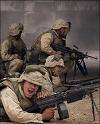
After an argument about a leave denied, Specialist Ivan Lopez
pulled out a .45-caliber Smith & Wesson handgun and began a shooting
spree at Fort Hood, America’s biggest stateside base, that left three
soldiers dead and 16 wounded. When he did so, he also pulled America’s
fading wars out of the closet. This time, a Fort Hood mass killing,
the second in
four and a half years, was committed by a man who was neither a
religious nor a political “extremist.” He seems to have been merely one
of America’s injured and troubled veterans who now number in the
hundreds of thousands.
Some 2.6 million men and women have been dispatched, often repeatedly, to the wars in Iraq and Afghanistan, and according to a
recent survey of
veterans of those wars conducted by the Washington Post and the Kaiser
Family Foundation, nearly one-third say that their mental health is
worse than it was before they left, and nearly half say the same of
their physical condition. Almost half say they give way to sudden
outbursts of anger. Only 12% of the surveyed veterans claim they are
now “better” mentally or physically than they were before they went to
war.
The media coverage that followed Lopez’s rampage was, of course, 24/7
and there was much discussion of PTSD, the all-purpose (if little
understood) label now used to explain just about anything unpleasant
that happens to or is caused by current or former military men and
women. Amid the barrage of coverage, however, something was missing:
evidence that has been in plain sight for years of how the violence of
America’s distant wars comes back to haunt the “homeland” as the troops
return. In that context, Lopez’s killings, while on a scale not often
matched, are one more marker on a bloody trail of death that leads from
Iraq and Afghanistan into the American heartland, to bases and backyards
nationwide. It’s a story with a body count that should not be ignored.
War Comes Home
During the last 12 years, many veterans who had grown “worse” while
at war could be found on and around bases here at home, waiting to be
deployed again, and sometimes doing serious damage to themselves and
others. The organization Iraq Veterans Against the War (
IVAW)
has campaigned for years for a soldier’s “right to heal” between
deployments. Next month it will release its own report on a common
practice at Fort Hood of sending damaged and heavily medicated soldiers
back to combat zones against both doctors’ orders and official base
regulations. Such soldiers can’t be expected to survive in great shape.
Immediately after the Lopez rampage, President Obama spoke of those
soldiers who have served multiple tours in the wars and “need to feel
safe” on their home base. But what the president
called
“that sense of safety… broken once again” at Fort Hood has, in fact,
already been shattered again and again on bases and in towns across
post-9/11 America — ever since misused, misled, and mistreated soldiers
began bringing war home with them.
Since 2002, soldiers and veterans have been committing murder
individually and in groups, killing wives, girlfriends, children, fellow
soldiers, friends, acquaintances, complete strangers, and — in
appalling numbers
— themselves. Most of these killings haven’t been on a mass scale, but
they add up, even if no one is doing the math. To date, they have never
been fully counted.
The first veterans of the war in Afghanistan returned to Fort Bragg,
North Carolina, in 2002. In quick succession, four of them
murdered their wives, after which three of the killers took their own lives. When a New York Times reporter
asked
a Special Forces officer to comment on these events, he replied:
“S.F.’s don’t like to talk about emotional stuff. We are Type A people
who just blow things like that off, like yesterday’s news.”
Indeed, much of the media and much of the country has done just
that. While individual murders committed by “our nation’s heroes” on
the “home front” have been reported by media close to the scene, most
such killings never make the national news, and many become invisible
even locally when reported only as routine murders with no mention of
the apparently insignificant fact that the killer was a veteran. Only
when these crimes cluster around a military base do diligent local
reporters seem to put the pieces of the bigger picture together.
By 2005, Fort Bragg had already counted its tenth such “domestic
violence” fatality, while on the West coast, the Seattle Weekly had
tallied the death toll among active-duty troops and veterans in western
Washington state at seven homicides and three suicides. “Five wives, a
girlfriend, and one child were slain; four other children lost one or
both parents to death or imprisonment. Three servicemen committed
suicide — two of them after killing their wife or girlfriend. Four
soldiers were sent to prison. One awaited trial.”
In January 2008, the New York Times tried for the first time to
tally
a nationwide count of such crimes. It found “121 cases in which
veterans of Iraq and Afghanistan committed a killing in this country, or
were charged with one, after their return from war.” It listed
headlines drawn from smaller local newspapers: Lakewood, Washington,
“Family Blames Iraq After Son Kills Wife”; Pierre, South Dakota,
“Soldier Charged With Murder Testifies About Postwar Stress”; Colorado
Springs, Colorado, “Iraq War Vets Suspected in Two Slayings, Crime
Ring.”
The Times found that about a third of the murder victims were wives,
girlfriends, children, or other relatives of the killer, but
significantly, a quarter of the victims were fellow soldiers. The rest
were acquaintances or strangers. At that time, three quarters of the
homicidal soldiers were still in the military. The number of killings
then represented a nearly 90% increase in homicides committed by active
duty personnel and veterans in the six years since the invasion of
Afghanistan in 2001. Yet after tracing this “cross-country trail of
death and heartbreak,” the Times noted that its research had probably
uncovered only “the minimum number of such cases.” One month later, it
found
“more than 150 cases of fatal domestic violence or [fatal] child abuse
in the United States involving service members and new veterans.”
More cases were already on the way. After the Fourth Brigade Combat
team of Fort Carson, Colorado, returned from Iraq later in 2008, nine of
its members
were charged
with homicide, while “charges of domestic violence, rape, and sexual
assault” at the base rose sharply. Three of the murder victims were
wives or girlfriends; four were fellow soldiers (all men); and two were
strangers, chosen at random.
Back at Fort Bragg and the nearby Marine base at Camp Lejeune, military men
murdered
four military women in a nine-month span between December 2007 and
September 2008. By that time, retired Army Colonel Ann Wright had
identified at least 15 highly suspicious deaths of women soldiers in the
war zones that had been officially termed “non-combat related” or
“suicide.” She
raised a question
that has never been answered: “Is there an Army cover-up of rape and
murder of women soldiers?” The murders that took place near (but not
on) Fort Bragg and Camp Lejeune, all investigated and prosecuted by
civilian authorities, raised another question: Were some soldiers
bringing home not only the generic violence of war, but also specific
crimes they had rehearsed abroad?
Stuck in Combat Mode
While this sort of post-combat-zone combat at home has rarely made it
into the national news, the killings haven’t stopped. They have, in
fact, continued, month by month, year after year, generally reported
only by local media. Many of the murders suggest that the killers still
felt as if they were on some kind of private mission in “enemy
territory,” and that they themselves were men who had, in distant combat
zones, gotten the hang of killing — and the habit. For example,
Benjamin Colton Barnes,
a 24-year-old Army veteran, went to a party in Seattle in 2012 and got
into a gunfight that left four people wounded. He then fled to Mount
Rainier National Park where he shot and killed a park ranger (the mother
of two small children) and fired on others before escaping into
snow-covered mountains where he drowned in a stream.
Barnes, an Iraq veteran, had reportedly experienced a rough
transition to stateside life, having been discharged from the Army in
2009 for misconduct after being arrested for drunk driving and carrying a
weapon. (He also threatened his wife with a knife.) He was one of more
than 20,000 troubled Army and Marine veterans the military
discarded between 2008 and 2012 with “other-than-honorable” discharges and no benefits, health care, or help.
Faced with the expensive prospect of providing long-term care for
these most fragile of veterans, the military chose instead to dump
them. Barnes was booted out of Joint Base Lewis-McChord near Tacoma,
Washington, which by 2010 had surpassed Fort Hood, Fort Bragg, and Fort
Carson in violence and suicide to become the military’s “
most troubled” home base.
Some homicidal soldiers work together, perhaps recreating at home
that famous fraternal feeling of the military “band of brothers.” In
2012, in Laredo, Texas, federal agents posing as leaders of a Mexican
drug cartel arrested Lieutenant Kevin Corley and Sergeant Samuel Walker —
both from Fort Carson’s notorious Fourth Brigade Combat team — and two
other soldiers in their private hit squad who had
offered
their services to kill members of rival cartels. “Wet work,” soldiers
call it, and they’re trained to do it so well that real Mexican drug
cartels have indeed been
hiring
ambitious vets from Fort Bliss, Texas, and probably other bases in the
borderlands, to take out selected Mexican and American targets at $5,000
a pop.
Such soldiers seem never to get out of combat mode. Boston
psychiatrist Jonathan Shay, well known for his work with troubled
veterans of the Vietnam War, points out that the skills drilled into the
combat soldier — cunning, deceit, strength, quickness, stealth, a
repertoire of killing techniques, and the suppression of compassion and
guilt — equip him perfectly for a life of crime. “I’ll put it as bluntly
as I can,” Shay writes in
Odysseus in America: Combat Trauma and the Trials of Homecoming,
“Combat service per se smooths the way into criminal careers afterward
in civilian life.” During the last decade, when the Pentagon relaxed
standards to fill the ranks, some enterprising members of at least
53 different American gangs jumpstarted their criminal careers by enlisting, training, and serving in war zones to perfect their specialized skill sets.
Some veterans have gone on to become domestic terrorists, like Desert Storm veteran
Timothy McVeigh, who killed 168 people in the Oklahoma federal building in 1995, or mass murderers like
Wade Michael Page,
the Army veteran and uber-racist who killed six worshippers at a Sikh
temple in Oak Creek, Wisconsin, in August 2012. Page had first been
introduced to the ideology of white supremacy at age 20, three years
after he joined the Army, when he fell in with a neo-Nazi hate group at
Fort Bragg. That was in 1995, the year three paratroopers from Fort
Bragg murdered two black local residents, a man and a woman, to earn
their neo-Nazi spider-web tattoos.
An unknown number of such killers just walk away, like Army Private
(and former West Point cadet) Isaac Aguigui, who was finally
convicted
last month in a Georgia criminal court of murdering his pregnant wife,
Sergeant Deirdre Wetzker Aguigui, an Army linguist, three years ago.
Although Deirdre Aguigui’s handcuffed body had revealed multiple blows
and signs of struggle, the military medical examiner failed to “detect
an anatomic cause of death” — a failure convenient for both the Army,
which didn’t have to investigate further, and Isaac Aguigui, who
collected a half-million dollars in military death benefits and life
insurance to finance a war of his own.
In 2012, Georgia authorities charged Aguigui and three combat
veterans from Fort Stewart with the execution-style murders of former
Private Michael Roark, 19, and his girlfriend Tiffany York, 17. The
trial in a civilian criminal court revealed that Aguigui (who was never
deployed) had assembled his own
private militia
of troubled combat vets called FEAR (Forever Enduring, Always Ready),
and was plotting to take over Fort Stewart by seizing the munitions
control point. Among his other plans for his force were killing unnamed
officials with car bombs, blowing up a fountain in Savannah, poisoning
the apple crop in Aguigui’s home state of Washington, and joining other
unspecified private militia groups around the country in a plot to
assassinate President Obama and take control of the United States
government. Last year, the Georgia court convicted Aguigui in the case
of the FEAR executions and sentenced him to life. Only then did a
civilian medical examiner determine that he had first murdered his wife.
The Rule of Law
The routine drills of basic training and the catastrophic events of
war damage many soldiers in ways that appear darkly ironic when they
return home to traumatize or kill their partners, their children, their
fellow soldiers, or random strangers in a town or on a base. But again
to get the stories we must rely upon scrupulous local journalists. The
Austin American-Statesman, for example,
reports
that, since 2003, in the area around Fort Hood in central Texas, nearly
10% of those involved in shooting incidents with the police were
military veterans or active-duty service members. In four separate
confrontations since last December, the police shot and killed two
recently returned veterans and wounded a third, while one police officer
was killed. A fourth veteran survived a shootout unscathed.
Such tragic encounters prompted state and city officials in Texas to
develop a special Veterans Tactical Response Program to train police in
handling troubled military types. Some of the standard techniques Texas
police use to intimidate and overcome suspects — shouting, throwing
“flashbangs” (grenades), or even firing warning shots — backfire when
the suspect is a veteran in crisis, armed, and highly trained in
reflexive fire. The average civilian lawman is no match for an angry
combat grunt from, as the president
put it
at Fort Hood, “the greatest Army that the world has ever known.” On
the other hand, a brain-injured vet who needs time to respond to orders
or reply to questions may get manhandled, flattened, tasered,
bludgeoned, or worse by overly aggressive police officers before he has
time to say a word.
Here’s another ironic twist. For the past decade, military recruiters
have made a big selling point of the “veterans preference” policy in
the hiring practices of civilian police departments. The prospect of a
lifetime career in law enforcement after a single tour of military duty
tempts many wavering teenagers to sign on the line. But the vets who are
finally discharged from service and don the uniform of a civilian
police department are no longer the boys who went away.
In Texas today, 37% of the police in Austin, the state capitol, are
ex-military, and in smaller cities and towns in the vicinity of Fort
Hood, that figure rises above the 50% mark. Everybody knows that
veterans need jobs, and in theory they might be very good at handling
troubled soldiers in crisis, but they come to the job already trained
for and very good at war. When they meet the next Ivan Lopez, they make
a potentially combustible combo.
Most of America’s military men and women don’t want to be
“stigmatized” by association with the violent soldiers mentioned here.
Neither do the ex-military personnel who now, as members of civilian
police forces, do periodic battle with violent vets in Texas and across
the country. The new Washington Post-Kaiser survey reveals that most
veterans are
proud
of their military service, if not altogether happy with their
homecoming. Almost half of them think that American civilians, like the
citizens of Iraq and Afghanistan, don’t genuinely “respect” them, and
more than half feel disconnected from American life. They believe they
have better moral and ethical values than their fellow citizens, a
virtue trumpeted by the Pentagon and presidents alike. Sixty percent
say they are more patriotic than civilians. Seventy percent say that
civilians fail absolutely to understand them. And almost 90% of
veterans say that in a heartbeat they would re-up to fight again.
Americans on the “home front” were never mobilized by their leaders
and they have generally not come to grips with the wars fought in their
name. Here, however, is another irony: neither, it turns out, have most
of America’s military men and women. Like their civilian counterparts,
many of whom are all too ready to deploy those soldiers again to
intervene in countries they can’t even
find on a map,
a significant number of veterans evidently have yet to unpack and
examine the wars they brought home in their baggage — and in too many
grim cases, they, their loved ones, their fellow soldiers, and sometimes
random strangers are paying the price.
Ann Jones, a TomDispatch regular, is the author of Kabul in Winter, among other books, and most recently They Were Soldiers: How the Wounded Return From America’s Wars — The Untold Story, a Dispatch Books project (Haymarket, 2013).

 Posts
Posts