Monday, June 3, 2013

New Filing Presents Evidence That John Steele Uploaded Videos To BitTorrent Himself

from the johnny-boy's-in-trouble dept

If you thought Graham Syfert was done with taking on John Steele and Prenda law with the closing of the Sunlust case in Florida, you'd be wrong. Today he's filed an incredible filing not just hitting back at Prenda in another case, First Time Videos vs. Paul Oppold, and asking for attorney's fees, but also including an affidavit from an actual expert (i.e., not a Prenda-style "forensic" expert) named Delvan Neville, who lays out in astounding detail how it's almost certain that John Steele himself uploaded the various videos to BitTorrent that were then used to sue various defendants for either "hacking" or copyright infringement. Oh, and in doing so, Steele appears to have made some choices that are pretty damning, including suggesting that he set up the file to effectively broadcast that it was free for the taking. In other words, there's an incredibly strong argument that the release of the file on BitTorrent was very authorized.

The work builds on some earlier research that Syfert has put out exploring how many of the Prenda-related films seemed to have been initially offered on The Pirate Bay via the same user: sharkmp4. For all the mocking that people have made concerning Prenda's "forensic" investigations into those they accuse of infringement (i.e., finding an IP address and not much else), Neville shows you how an actual investigation is done. You should read the whole thing for the layers upon layers of evidence that all seem to point the finger at John Steele.

Among other things, sharkmp4 seemed to be able to post these works on The Pirate Bay before the works were even mentioned anywhere else, and in at least one case, "sharkmp4" put a video up on The Pirate Bay three days before Prenda shell company Ingenuity 13 had even filed for the copyright. On top of that, the "forensics" company that Prenda uses -- which is supposedly run by Paul Hansmeier's brother Peter, but which had its domain registered and controlled by (you guessed it) John Steele -- apparently identified "infringements" almost immediately after the videos were placed on The Pirate Bay -- meaning they were likely looking for such infringement in conjunction with the upload.

At the end, however, Neville pulls together really damning evidence, tying together a website set up to distribute Ingenuity 13 porn films with the same exact IP address that was confirmed as being used by John Steele to log into his own GoDaddy account, highlighting how Steele -- or someone with access to his logins -- clearly has full access and control over Ingenuity 13 works. As you read through all of the evidence it appears highly likely that Steele is in control of Ingenuity 13, despite all his protests to the contrary.

As the filing notes:
Prenda Law's business structure is such that it is pirate, forensic pirate hunter, and attorney. It also appears that Prenda Law also wants to/has formed/is forming a corporate structure where it is: pornography producer, copyright holder, pornography pirate, forensic investigator, attorney firm, and debt collector. Other than the omission of appearing in the pornography themselves, this would represent an entire in-house copyright trolling monopoly- not designed to promote their own works for distribution and sale, but to induce infringement of their works and reap profits seen from mass anti-piracy litigation.
It remains to be seen if the court bothers to explore this, but I would imagine that it may be of interest in other Prenda and related cases.

This American Life Followup On Patents Reveals Intellectual Ventures Is Even Slimier Than Previously Believed

from the well-of-course-they-are dept

Nearly two years ago, This American Life did an incredible episode about patents and patent trolling, which really got the issue of patent trolling into the mainstream. At the center of that episode was an exploration into Intellectual Ventures, the world's largest, most obnoxious patent troll. The story revolved around one single patent (5,771,354), which Intellectual Ventures itself had held up as an example of how they were really just helping the poor, brilliant, lone inventor who was being ripped off. In that story, This American Life reporter/producer Alex Blumberg and NPR New reporter Laura Sydell tried to follow the story of that patent to exonerate Intellectual Ventures and show that, indeed, it was helping small inventors get their due. But the story turned out to not stand up to even the slightest amount of scrutiny. Because when they went in search of the inventor, Chris Crawford, he refused to respond to them, and then IV itself noted that it had "sold off" the patent and it was currently engaged in litigation. The entity doing the litigation was a company called Oasis Research, which had an empty office in Marshall, Texas with no employees, but had sued over a dozen internet companies for broadly doing online backup.

In a hilarious exchange with IV's Peter Detkin, the guy who coined the phrase patent troll but now likes to delude himself that he's not an executive at the world's largest troll, pretended that it was some sort of "ambush" when Blumberg simply asked him to explain when IV bought the patent from Crawford and then when and to whom they sold it, based on the data on the US Patent Office's own website. Hilariously, Detkin insisted that he hadn't looked at the USPTO website, so he didn't know what was going on.
Detkin: I won't be able to tell you, probably, from looking at this. I mean I'd have to talk to... I'm not even an expert in... You're looking at the USPTO website? I haven't looked at this particular website in a while. I don't know how it's organized....

Alex Blumberg, from TAL: Wait... are you telling me that you're the... (long pause)... you run a patent company and you were the head counsel at Intel in the patent department, and you don't know what the Patent Office website is... you don't know how to read this...?

Detkin: (Frustrated) Look, I can look at this if you want, but I haven't looked at this particular website and I don't now how it's organized, and I'm not exactly sure what it is you're trying to get at... and I'm happy to answer questions, but if you're going to cross-examine me on the record about a patent website, I don't quite think that's fair...
And then a PR person jumped in and tried to kill the interview. Later they went back, and Detkin "explained" the details, claiming that it had bought the patent from Crawford in 2007 and then sold it off to Oasis Research more recently. When Blumberg quizzed him about how the patent is now being used to shake down companies for money (exactly the kind of thing that led Detkin to coin the term patent troll), Detkin insisted that IV had nothing to do with the patent any more, and had no control over these third party entities once it sold off the patents. They then pointed out to him that in the legal documents, Oasis Research had listed Intellectual Ventures as having a financial interest in the outcome of the case, and he brushed it off as an aside -- basically saying "oh sure, perhaps we receive some royalty from future monetization." Specifically, he said "we get some percentage of the royalty stream down the road that is generated from the monetization of these assets."

Uh huh. So, This American Life has now done a follow up on that first episode, in which they finally get a bunch of answers that eluded them when the first episode aired -- and it's in part because two companies, out of 18 that were sued, fought Oasis Research and won by invalidating the patent. The other 16 likely settled, and hopefully are kicking themselves for giving in to a patent troll and paying the fees. The episode replays some clips from the original episode, including the interview with Detkin above, but what they revealed when all was said and done suggests, yet again, that Detkin was being less than forthright in that interview. The "ongoing royalty"? Apparently Intellectual Ventures got 90% of the net profit from the patent. 90%. That's not an ongoing royalty. That's basically someone who still owns the patent and is using a shell company to pretend that it's not involved in the "dirty business" of demanding exorbitant fees from companies who actually do something.

This American Life also estimates, based on how much Oasis Research demanded from Carbonite ($20 million), that Oasis probably got over $100 million in settlements from the companies that did settle. They also found out that IV paid back to Chris Crawford a nice chunk of change as well. They originally bought the patent for $12 million from him (via a series of shell companies), and then they paid him another 17.5% of any of the money that they collected.

And all this over a bogus patent. Not only was it bogus, but as later came out in court, Chris Crawford apparently filed for the patent by copying someone else's idea. The details are a bit involved, so it's worth listening to the whole thing, but the short version is that Carbonite and EMC tracked down Crawford's "boss" from way back when, and discovered that two other entrepreneurs had come up with the basic idea of backing up data via a network on computers, and they'd hired Crawford to help out. But what they discovered was they were unable to actually make the idea work, for a variety of reasons. They disbanded the company, but Crawford, who took notes at the meetings, later filed for a series of patents using the ideas from that company, and never bothered to tell the guys who were his "partners." Even though the other partners testified that the whole thing had been their idea in the first place, and not Crawford's, patent law is so stupid that Crawford still might have been able to keep the patents if he hadn't made one mistake. Among the piles upon piles of documents he filed with the patent, one of them mentioned one of the original entrepreneurs, and noted that it was that guy's idea.

In a hilarious bit of tape from the deposition of Chris Crawford, he tries to explain away the fact that he used an apostrophe "s" after the entrepreneur's name, to pretend that it had really been Crawford's idea, even though the notes clearly stated otherwise. He argued that he's not very good with grammar, so sometimes he uses an "'s" when he doesn't mean to. But that's even more nonsensical, because if was just a regular s, meaning plural, then the sentence wouldn't make any sense.

While that bit of evidence was damning enough to get the jury to knock out the patent, as the report notes, the jury still wouldn't accept the direct testimony of the other three partners in the business with Crawford, saying only that the patent (which is completely bogus in its own right) probably should have gone to the one guy who was named in Crawford's notes. If that doesn't show how bogus the patent system is, I'm not sure what else to show people at this point.

Remember a few months ago, when Intellectual Ventures said that there was nothing at all nefarious about their 2,000 or so shell companies? Perhaps they knew what was coming... which was a pretty clear expose of how Intellectual Ventures is very much the same sort of entity that Peter Detkin once claimed were hellbent on holding up innovation. Except, now he's profiting from it. Massively. While pretending not to.

It's clearly time to fix the patent system, and this is just yet another example of a bunch of lawyers shaking down companies that actually do stuff. This is just one little bogus patent, and yet it took $100 million or so from companies who actually innovate and build products that the market wants, and handed it over to lawyers like Peter Detkin to be used to buy up more such patents and sue more people. And this patent probably would have been used for even more similar efforts if Carbonite and EMC hadn't been able to find that one document and its rather important apostrophe s. These lawsuits and these kinds of battles are a massive shift of money from actual innovation... to lawyers and those who failed to build things that people wanted. It's an economic disaster.

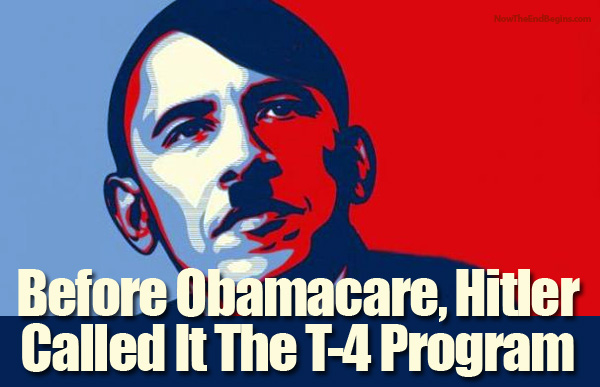
Obamacare Is Adolf Hitler’s ‘T-4 Program’ Revived

hitler-t-4-obamacare-nazi-socialist-barack-hussein-obama

Obamacare Is Adolf Hitler’s ‘T-4 Program’ Revived

This article was written while Obamacare was still a proposal, and not yet passed into law. Hitler was very smart, he knew that before he could get Germans to accept the concentration camps, he had to first get them to think of themselves as gods deciding who would live and who would die through the control of a national healthcare system. The creation of the T-4 Program, or the German Universal Healthcare System – did just that.
Obamacare is the revived version of the T-4 Program. Hitler would be very proud.
From EIR: In July of 1939, a conference of medical professionals was held in Berlin, Germany. Participating were the professors and chairmen of the departments of psychiatry of the leading universities and medical schools of Germany, many of them, the most respected professionals in their fields. The subject? What would be the criteria for determining what patients would be considered to have “lives unworthy to be lived,” and what was the most “practical and cheap” manner of removing them from being burdens on the health-care system—by death.
hitler-t-4-obamacare-nazi-socialist-barack-hussein-obama
Thus, the bureaucratic machine began to be cranked up for what is known as Adolf Hitler’s program of genocide through “euthanasia,” a program which killed hundreds of thousands of non-Jewish Germans, and eventually, millions of Jews and non-Germans as well.
That program, which had already begun years before, against concentration camp inmates and handicapped children, was officially put into effect in October 1939, when Hitler penned his own personal, and secret, authorization for the program, under the title, “The Destruction of Lives Unworthy of Life”:
Reichsleiter Bouhler and Dr. Brandt are charged with the responsibility for expanding the authority of physicians, to be designated by name, to the end that patients considered incurable according to the best available human judgment of their state of health, can be accorded a mercy death.
To carry out this program, Hitler and his fiendish Nazi associates would fully utilize the “professional” apparatus which had been put in place, as well as the popular, British-eugenics-spawned ideology which had been increasingly dominant in Germany since Hitler seized power with the aid of powerful British-Wall Street financiers. The killing would proceed with the utmost “cost-effectiveness” and professionalism, in order to save funds for the Nazi state’s preferred projects, and not waste them on “ineffective” medical treatments.
If that sounds familiar, it should. For the proposals which the Obama Administration has currently put on the table, follow them in virtual lockstep. First, the “experts” decide what is “effective” care, with “cost-effectiveness” foremost in mind, ruling out “inappropriate” treatments. These standards become the law, in terms of what medical care will be paid for. Then other experts efficiently implement those decisions, through the existing hospital apparatus.
The result, as in Nazi Germany, is that millions are, with the stroke of a pen, consigned to death.

The T4 Program

The T4 program, which was established following Hitler’s secret order, took its name from its Berlin office address, Tiergarten 4, which address housed the coordinating organization for the program, the Reich Work Group of Sanatoriums and Nursing Homes. In charge were Philip Bouhler, chief of the Chancellory, and Dr. Karl Brandt, Hitler’s personal physician and chief medical officer of the land.
Their first task was to devise the questionnaires which would be used to categorize the targetted institutionalized populations. Four categories were specified:
  1. Patients suffering from specified diseases who are not employable, or are employable only in simple mechanical work. These included schizophrenia, epilepsy, senile diseases, therapy-resistant paralysis, feeble-mindedness, and the like.
  2. Patients who have been continually institutionalized for at least five years.
  3. Patients who are criminally insane.
  4. Non-German patients.
While including these categorizations, the questionnaire overall gave the impression of a rather neutral statistical survey, which also delved into the patients’ biographies, their financial situations, and the like (Figure 1). It was accompanied by a questionnaire for the institution in which the patient was housed, which asked about staffing, beds available, and budgetary questions. A significant stress was also put on detailing the patients’ abilities to work.
The first questionnaires went out in October 1939, the month Hitler signed his order, to state hospitals and other public and private institutions where mental patients, epileptics, the mentally retarded, and other handicapped persons resided. The responsibility for filling them out, often in a very short period of time, fell on the physicians at those institutions.
The questionnaires were then sent to panels of three or four psychiatric experts, who indicated their opinion about whether the patient (whom they had never seen, much less examined, and whose medical history they were unfamiliar with) was to live or die. Each “expert” made his or her decision independently, and passed on the questionnaire to the next. The choice for the experts was effectively only one of two options: a plus sign in red, which meant death; or a dash in blue, which meant life. Occasionally, a psychiatrist would put a question mark in the space provided.
The questionnaires were then sent to a chief expert, who passed the final judgment. At this “higher” level, there was no alternative other than life or death. In fact, the “senior expert” was not bound by the recommended decisions. From his judgment, there was no appeal. From that point on, it was merely a matter of sending back the decision to the relevant institution, where the final dispensation of the patient was carried out, and, if so ordered, sending him or her to one of the designated “killing centers.”
These centers were supervised by medical personnel, who oversaw the killing, and were responsible for devising the fraudulent death certificates which were sent to the families of those who had been determined to have lives “not worthy to be lived.”

Councils of Experts

Shift now to today, where we are in the first phases of the Nazi euthanasia program (called “reform”) being promoted by the Obama Administration and its behavioral psychologist “experts.” It starts with the dictum that there are insufficient resources to provide medical care for all, especially those at the “end of life,” or not able to be “effectively” rehabilitated. In other words, the Nazi assumption that there are lives “not worthy to be lived.” At least according to the priorities for spending which the Administration has set—i.e., the banks must be saved first.
The second step is for the Administration to set up those “panels of experts” who will determine the criteria for who will get medical care, and who won’t. Already, the so-called Obama stimulus package has created one such panel, the Federal Coordinating Council for Comparative Effectiveness Research. This 15-member council is comprised of highly credentialed “experts,” many of them medical doctors, who are tasked with “coordinating research” on the relative values of treatments. While explicitly claiming that the Council will not directly pronounce judgments on treatments and payments, it is clear that the research that they are supervising is intended to do precisely that.
Particularly ominous is the fact that one of the Council’s members, Dr. Ezekiel Emanuel, is trained in “bioethics,” a discipline dedicated precisely to determining criteria for deciding who should live, and who should die. Crucially significant as well, is that Obama’s head of the Office of Management and Budget, Peter Orszag, has already set out his genocidal judgment that around 30% of current health-care services and procedures are unnecessary.
The model for their work, as reflected in statements by many of the relevant officials, is the British National Institute for Health and Clinical Excellence (NICE), the Orwellian-named agency which has central control over what medical care will be provided to British subjects within the British National Health Service. As the following article explains, NICE’s directives have systematically denied Britons quality care, on the basis of its being “too expensive,” and have singled out, especially, the elderly, for being undeserving of intensive medical care.
The Comparative Effectiveness Council is clearly only the beginning of the genocide—if this Nazi plan is not stopped cold. source – EIR

Exclusive: (AFRICOM) US Armed Forces Piloting Drones From Bases In Germany

Source: WC
MUNICH - The targeted killing of presumed terrorists by drones in Africa has been largely conducted from US military bases in Germany, an investigation by German TV channel ARD’s “Panorama” and the Süddeutsche Zeitung has revealed.
Particularly involved in running the drone missions are the Stuttgart-based US military high command for Africa (Africom) and the US Air Force’s Air Operations Center (AOC), located in Ramstein, in the state of Rheinland-Pfalz.
Ten deadly drone attacks killing up to 29 people have so far been carried out in Somalia by US forces. Most of those killed were believed to be members of the militant Al Shabab, which aims to create an Islamic state on the Horn of Africa.
Since 2011 an air mission control center in Ramstein has been guiding US Air Force attacks in Africa including Somalia. Up to 650 staff at the Ramstein control center monitor African air space, evaluate pictures taken by drone and satellite, and plan new missions. Without the special satellite relay station for unmanned flying objects in Ramstein the drone attacks in Africa “could not be carried out,” according to a US Air Force internal memo.
Documents make clear that there are plans to replace an old facility with a better, permanent one. U.S. Congress approved the equivalent of 8.4m euros for this in 2011. “Realizing this project will improve satellite communication with drones long-term,” says the document.
When asked, a US military spokesperson said that generally responsibility for all military operations in Africa — including the drone missions — lay with Africom in Stuttgart. An internal memo shows that Africom is seeking to hire “secret service analysts” whose task would be to “nominate” targets for drone missions in Africa.
According to Thilo Marauhn, a Giessen-based specialist in international law, the blatant involvement of Germany in a secret drone program poses a number of potentially troubling legal issues. “The killing of suspected individuals with the help of armed drones outside an armed conflict situation” could, Marauhn said — if Germany’s government knew about it but didn’t protest — constitute “being an accessory in an abuse of international law.”
When questioned a spokesperson for the German government stated that the government had “no knowledge” of the fact that drone attacks were planned or carried out by US armed forces in Germany.
German constitutional law forbids military deployment that runs counter to international law from within Germany’s territory. In the specific instance however, the spokesperson said, the federal government had “no frames of reference.”
According to secret services, a US drone attack carried out on Wednesday on the border between Afghanistan and Pakistan, killed the second in command of the Pakistani Taliban, Wali-ur Rehman.

South Korea joins Japanese ban on U.S. wheat imports after shocking GMO contamination announcement by USDA

naturalnews.com

Originally published June 2 2013wheat

South Korea joins Japanese ban on U.S. wheat imports after shocking GMO contamination announcement by USDA

by Mike Adams, the Health Ranger, NaturalNews Editor

(NaturalNews) News about the GMO contamination of U.S. wheat crops seems to be spreading faster than the GMOs themselves. On Friday, South Korea joined Japan in announcing a halt on imports of U.S. wheat due to the USDA's recent announcement that commercial wheat grown in the USA is contaminated with Monsanto's genetically engineered wheat.

Some Americans may still not realize this, but GMOs are outlawed or shunned nearly everywhere around the world. Only in the USA have GMOs managed to avoid being labeled or outlawed -- and that's primarily due to Monsanto's financial influence over lawmakers.

Monsanto shares plummeted 4 percent on Friday following the announcement by South Korea. This is completely in line with predictions made here at Natural News, where I said earlier in the week, before Japan and South Korea announced their wheat boycotts:

All wheat produced in the United States will now be heavily scrutinized -- and possibly even rejected -- by other nations that traditionally import U.S. wheat. This obviously has enormous economic implications for U.S. farmers and agriculture.

How much of the U.S. wheat supply is now contaminated with GMOs?

"...the mysterious appearance of the Monsanto wheat has raised questions about how the strain traveled there and whether it is lurking in the commercial wheat crop," reports the Washington Post.

WashPo goes on to report that Monsanto, "is still testing strains of gene-altered wheat in Hawaii and North Dakota."

In truth, nobody knows how much of the wheat is contaminated. Every more shockingly, food companies don't bother testing wheat for GMOs, either!

Until now, that is. All of a sudden, food importers all around the world are wondering whether they are inadvertently buying U.S. wheat that's contaminated with GMOs. Consumers, too, are asking the question, "Have I been eating GMO wheat without even knowing it?" These Monsanto wheat experiments, after all, have been taking place since 1998.

Is Monsanto lurking in your Wheaties?

U.S. farmers suddenly seeing the economic damage that Monsanto can do

The real issue in all this, however, is an economic issue. Suddenly U.S. farmers are seeing the kind of economic destruction that can be caused by Monsanto's genetic engineering experiments.

Thanks to Monsanto and the USDA -- which approved the open-field experiments -- every U.S. farmer who grows wheat is now at high risk of losing enormous sums of money on a food crop that's increasingly being rejected around the world. This means Monsanto is pushing U.S. farmers toward bankruptcy while harming America's exports and GDP. Monsanto has become a force of economic destruction in America.

Will Monsanto reimburse all these farmers who suffer an economic loss? Not without being sued, of course. Perhaps it's time for a nationwide class-action lawsuit against Monsanto, supported by all commercial farmers who hope to be able to protect their crops from market-crushing GMO contamination.

Nobody wants GMOs except Monsanto!

Consumers don't want GMOs, farmers don't want GMOs, foreign nations don't want GMOs and food companies don't want to deal with the hassle of GMOs either. The only entity that still wants GMO in America is the very company making money off GMO: Monsanto.


All content posted on this site is commentary or opinion and is protected under Free Speech. Truth Publishing LLC takes sole responsibility for all content. Truth Publishing sells no hard products and earns no money from the recommendation of products. NaturalNews.com is presented for educational and commentary purposes only and should not be construed as professional advice from any licensed practitioner. Truth Publishing assumes no responsibility for the use or misuse of this material. For the full terms of usage of this material, visit www.NaturalNews.com/terms.shtml

Wealth from Economic “Recovery” has gone to the Richest Americans


wealthy
A new study from the St. Louis Federal Reserve documents the vast disparity in the fortunes of American families since the financial crisis of 2007-08, with the bulk of the “recovery” in aggregate wealth going to the richest layers of the population.
The report, “After the Fall: Rebuilding Family Balance Sheets, Rebuilding the Economy,” found that “only about 45 percent of the average inflation-adjusted household wealth that was lost since the onset of the downturn in 2007 has been recovered.”
To support claims of economic recovery, the Obama administration and the political establishment as a whole have cited the fact that aggregate net worth at the end of last year had almost reached the level it was prior to the crash of 2009. While total net worth was estimated at $67.4 trillion in 2007, it reached $66.1 trillion at the end of 2012, recovering 91 percent of its losses.
However, this masks the enormous growth of inequality. Of the $14.7 trillion accrued since 2009, the majority, $9.1. trillion, “was due to higher stock-market wealth,” the majority of which is owned by the wealthiest families. With more than a touch of understatement, the report states: “Considering the uneven recovery of wealth across households, a conclusion that the financial damage of the crisis and recession largely has been repaired is not justified.”
The wealth of the rich has surpassed pre-recession highs, while that of the vast majority has stagnated. In other words, the net impact of the crisis has been an aggregate transfer of wealth from the poor to the rich.
This outcome is a direct product of the response of the American ruling class, led by the Obama administration, to the crisis. Trillions of dollars have been allocated to bail out the banks, and the US Federal Reserve pumps $85 billion into the financial markets every month to maintain the new asset bubble. At the same, wages have been driven down and social services slashed, while nothing has been done to help those most severely impacted by the crisis.
The St. Louis Fed noted that prior to the economic crash, US households had accumulated an average debt-to-income ratio of 133 percent, due in large part to soaring housing prices and predatory lending by the banks. In the wake of the crash, average household wealth fell 15 percent.
The impact of the crisis disproportionately affected low-income Americans, though the primary categories examined by the report are those of race, age and education level. The class impact—both of the crisis and of the subsequent “recovery”—finds distorted reflection in these alternate categories.
“Although many subgroups experienced large declines, the Fed’s survey suggests that families that were young, that had less than a college education and/or were members of a historically disadvantaged minority group… suffered particularly large wealth losses.”
These families are among “the most economically vulnerable groups because of the particular occupation and sectors in which they were overrepresented, such as low-wage service-sector jobs and construction.”
Youth were particularly hard hit. The report found that from 2007 to 2010, homeowners under 40 saw a staggering 44 percent wealth loss in their homes, with a disproportionate impact on minority youth, including Hispanic and African American youth.
For lower-income families, homes tend to be the primary asset. For African American or Hispanic homeowners under the age of 40 who had not received a high school diploma, 85 percent of all wealth in 2007 was tied to real estate. For both college graduates and high school graduates in this category, 70 percent of wealth was tied to homes.
The report states that chances for post-secondary success increase seven-fold for a youth who had personal savings, regardless of family income. Inversely, lifetime earning potential is also hindered by excessive amounts of debt. The Federal Reserve found that those with a four-year college education and overhanging student loans had a net worth of $186,000 less than their non-indebted peers.
A recent New York Federal Reserve study found that, for those who had student debt, the average level of debt for youth aged 25 had risen to $25,000. Nearly one in five young people were at least three months delinquent on payments.
A number of recent reports corroborate the St. Louis Fed’s findings. Last year, a US Federal Reserve study found that the global economic recession had set families back by nearly 20 years, erasing 39 percent of all household wealth between 2007 and 2010.
Another recent study, released by the University of California, found that since 2009 average real income for families had grown by only 1.7 percent. However, behind this 1.7 percent growth, the top one percent saw their incomes jump by over 11 percent, while the income of the bottom 99 percent declined by half a percentage point during the same period.
Nearly five years after the onset of the greatest financial crisis in a century, bankers and wealthy hedge fund managers have been supplied with access to virtually endless funds by the Obama administratio, while simultaneously declaring there is “no money” for basic social programs benefiting the working class.
The results, reflected in the St. Louis Fed report, are the outcome of this process.

Mark Levin Proves Obama's Intelligence

LMFAO  Democraps & Repugliscums  ...what's the difference between ???   LOL hehehe  awl fuck it ...listen :o      

Mark Levin Proves Obama's Intelligence


Mark Levin - Trying to Explain "Obamacare" / NAZI POLL~O~SEE aka We gotta pass this bill ..so we can read it :0


Mark Levin - Trying to Explain "Obamacare" 

War On Terror – Instrument To Implement A Socialist Dictatorship

truther June 3, 2013
Tony ElliottFreedomoutpost
The Federal government here in the US has become so corrupt that even they are having trouble with covering themselves, in all the lies they want us to believe.
Recently, giving a speech at Ohio State University, President Obama felt it necessary to address the issue of Tyranny in the US and to do his best to dispel the growing attitude across the country that we now have a Socialistic Dictatorship in Washington. However, while giving the speech he fails to admit to bringing Tyranny to us in the form of his countless Executive Orders which are so vast, they give him supreme power over all government branches as well as all aspects of civilian structure.
War On Terror - Instrument To Implement A Socialist Dictatorship
The transformation from a free country, governed according to the laws of the Constitution where the people were in charge to that of a Socialist Regime where government dictates laws and regulations basically began with the events of 9-11. Under the guise of keeping us safe, the Federal government has managed to remove every aspect of the American Constitution from Federal Law. The implementation of Socialism in the US has always been the primary goal and the War on Terror has just been the best way to get there.
There are many facts which clearly indicate that the government isn’t interested in the threat of Radical Islam or Terrorism in general and never was since the beginning.
Perhaps, the strongest indication is the fact that our border with Mexico was never closed at any time since 9-11. A government attacked by an organized Terrorist group in the fashion as we were led to believe on 9-11, would have immediately sealed the border and monitored all areas along it. Yet, this never happened once and no increased security along the border was ever implemented.
The Obama State Department announced in early 2012 that the War on Terror was officially over, citing that the Federal government no longer felt that Al Qaeda was a significant threat to the US at home or overseas. However, at the same time, the Obama Administration was seemingly concerned enough about Terrorism as of 12/11 that the President signed into law the National Defense Authorization Act which gives the US military the power to detain US citizens for indefinite periods, to literally shoot anyone who’s even suspected of anti-government activity or is uncooperative, and arrest those who have anti-government opinions such as speaking out against the Gestapo-like tactics used by the TSA each time anyone wishes to fly a commercial airline.
President Obama was also seemingly concerned enough about terrorism to use his executive powers to implement the National Defense Resources Preparedness Act into law, March 16, 2012, which gives him the right to seize control over all public and private entities in the country, literally when he deems to do so.
Such Socialist laws as the Patriot Act which give the Federal government the right to spy on its own citizens in the form of telephone taps, scrutinizing all bank accounts, the monitoring all internet usage by everyone, recording travel by all and produced the TSA is as alive today as it ever was, shortly after 9-11.
Other freedom killing bills such as SOPA (Stop Online Piracy Act), PIPA (Protect IP Act), ACTA (Anti Counterfeiting Trade Agreement), and CISPA (Cyber Intelligence Sharing and Protection Act) which have sprung up of late are all directed at spying on American citizens and keeping tabs on our personal lives. These laws have nothing to do with monitoring Terrorist activity but are meant focus on the American public.
Today, in every town and municipality in the US, there are cameras at every street corner and most are equipped with microphones while recording every conversation going on by anyone within range of them
President Obama has Drones flying in US skies to spy on American citizens and kill those whom they deem necessary.
American society today, gives new meaning to George Orwell’s book 1984 and even goes far beyond the book’s Big Brother scenario.
If the War on Terror is officially over as we are told it is, there shouldn’t be a need for any of this, but the Federal government’s desire to spy on us and know everything about our every move has drastically increased just since January of 2012. Thus, proving that it is the citizens of the US which the Federal Government is interested in and not international terrorists. We have become the enemies of the state in the eyes of the Federal Government.
The US Federal government fears its own citizens, because it is afraid that massive riots and civil unrest will erupt at any given time when the people realize they’ve been taken for idiots by their own government.
The proof that the government isn’t concerned with any outside threat and is only interested in the transformation from freedom to Tyranny is the fact that we have been supporting radical Islam and helping groups like the Muslim Brotherhood and Al Qaeda take over once friendly governments in the Middle East, such as Egypt, many surrounding countries and now Syria. This would not be happening if the US considered radical Islam an enemy.
What we are doing today, would be the same as the US sending money and arming the Nazis, as well as having a bombing campaign over the United Kingdom to soften them up for German occupancy during WWII.
Clearly, the US has been taken over in a silent Coup by Socialist Insurgents from within. These Socialists have no political ties but belong to both Republican and Democrat party’s.
The US government needs to be purged of its enemies within and Constitutional law restored.

Ethics: Obamacare Begins Rationing Pre-Existing Conditions

                hey America!  ..We  ALL  R gonna SEE what IS IN IT !!!    

Ethics: Obamacare Begins Rationing Pre-Existing Conditions

truther June 3, 2013 

John RisseladaFreedomoutpost
About a week before the end of my social work education I bore witness to a presentation on Obamacare. The social work professor giving the presentation was supposedly an expert in healthcare administration, Medicare and Medicaid. With these credentials I figured the least I could do was entertain his presentation and try to learn something. Unfortunately, it quickly progressed into one of those situations where just sitting back and keeping my mouth shut was not an option.
Ethics Obamacare Begins Rationing Pre-Existing Conditions
Instead of demonstrating an actual understanding of the law in and of itself; the professor went about in the usual liberally biased fashion and discredited capitalism, the constitution and our existing healthcare system. The best part however was the twenty minute cartoon describing how Obamacare would be paid for. This cartoon featured a little “Uncle Sam” character running around the country with a jar. What was he doing with the jar? Forcing money from other people’s pockets of course. While I was sitting there in utter amazement I realized that the other students didn’t quite grasp the point here. The professor was admitting that not only would you be forced to pay higher taxes to pay for the implementation of the law, but you would still have to purchase a plan through the health care exchanges. In other words, we are being double tapped. When challenging this professor on his assumptions of this lunacy producing actual results he responded by saying “All we can do is hope it works.” This is master’s level education at its finest folks, your tax dollars hard at work turning your kids’ brains into mush.
I found this to be a relevant start to this article because it directly relates to the events of today. Professor Munoz, this is for you sir.
The Government Accountability Office released a report today stating that the preexisting condition program which was an essential element of Obamacare has already begun rationing services because of budget constraints. New patients are literally being denied enrollment into the program because there simply isn’t enough money. Wow, with a 16.7 trillion dollar debt, who would have figured that? If this isn’t bad enough Health and Human Services is actually redirecting costs to people who have already been enrolled in the program. Unbelievable! This of course does little else but raise the costs for these people who have already been enrolled. If I remember correctly the very reason Obamacare was rushed into law (without having been read) was because of greedy insurance companies that deny people the care they need for preexisting conditions. Such is the way I suppose.
In what can best be described as typical liberal behavior, Louisiana state senator Karen Carter Peterson, who also serves as the Democrat committee chair played the race card on the senate floor. She must have been angry that Obamacare is once again proving to be nothing more than a bad train wreck because she said that anyone who opposes the healthcare law is doing so only because of their opposition to a black president. What an original statement, and one made with such sophistication that there is no way that white people could ever understand how racist we are for opposing such a well thought out plan. That reminds me of something. In a social work research class at Northeastern State University in Broken Arrow Oklahoma I was taught a little about research ethics. Did you know that it was ethical to lie in research when the subject revolves around racism? Notice I didn’t say unethical, I said ethical. The reason being is that only the educated researchers understand what constitutes racism and because we don’t it is o.k. to lie to make up the difference. Given the fact that we have been accused of racism for every word of dissatisfaction we have spoken against Obama I am sure you can see the relevance. I think the senator should realize that we are no longer going to play this game.
Over the past three years conservatives, along with the new surprise of being targeted by the IRS, have been the subject of a relentless assault of vicious attacks where we are accused of outright racism simply for observing the fatal flaws of Obamacare. As a student I was constantly referred to as a racist for questioning not only Obama but the growth and destructive nature of the welfare state. Liberals cannot and will not admit when they are wrong. This is why they resort to behavior that is best comparable to fifth graders. Through all of this it has been proven time and time again that the 2800 page health care law, that has morphed into 20,000 pages of regulations incidentally, is an abject failure that will cost billions if not trillions more to implement than originally projected. Now, as predicted, services are being rationed because of a lack of funds and in typical fashion we are being called racist for noticing. What is it going to take? For those of us who use our brain housing group it doesn’t take more than realizing the government has a 16.7 trillion dollar debt, so it cannot afford to implement Obamacare. We realize that the only place government gets its money is us, the taxpayer, and their appetite for our money is insatiable. What is it about this that liberals don’t see? Truthfully I can’t wait to see the shock on the blind supporters face as they slowly begin to realize it is unworkable and they have given away their decision making power to an unaccountable bureaucracy. Wait a minute, what am I thinking? It will be the republicans fault!
I’m afraid that it will take hitting absolute rock bottom for the ignorant to realize what it is they are surrendering and just who they are surrendering it to. You know that we are in serious trouble when people are willing to sacrifice something they don’t fully understand (constitutional liberty) for something they can only hope works. (Obamacare) Thank you college professors everywhere, for your unbiased objectivity.

The Government Wants A Backdoor Into Your Online Communications

May 22, 2013 | By Mark M. Jaycox and Seth Schoen

The Government Wants A Backdoor Into Your Online Communications

According to the New York Times, President Obama is "on the verge of backing" a proposal by the FBI to introduce legislation dramatically expanding the reach of the Communications Assistance for Law Enforcement Act, or CALEA. CALEA forces telephone companies to provide backdoors to the government so that it can spy on users after obtaining court approval, and was expanded in 2006 to reach Internet technologies like VoIP. The new proposal reportedly allows the FBI to listen in on any conversation online, regardless of the technology used, by mandating engineers build "backdoors" into communications software. We urge EFF supporters to tell the administration now to stop this proposal, provisionally called CALEA II.
The rumored proposal is a tremendous blow to security and privacy and is based on the FBI's complaint that it is "Going Dark," or unable to listen in on Internet users' communications. But the FBI has offered few concrete examples and no significant numbers of situations where it has been stymied by communications technology like encryption. To the contrary, with the growth of digital communications, the FBI has an unprecedented level of access to our communications and personal data; access which it regularly uses. In an age where the government claims to want to beef up Internet security, any backdoors into our communications makes our infrastructure weaker.
Backdoors also take away developers' right to innovate and users' right to protect their privacy and First Amendment-protected anonymity of speech with the technologies of their choice. The FBI's dream of an Internet where it can listen to anything, even with a court order, is wrong and inconsistent with our values. One should be able to have a private conversation online, just as one can have a private conversation in person.
The White House is currently debating whether or not to introduce the bill. Here's why it shouldn't:

There's Little Darkness: Few Investigations Have Been Thwarted

The starting point for new legislation should be a real, serious, and well-documented need. Despite the FBI's rhetoric, there are few concrete examples of the FBI's purported need to expand its already efficient all-seeing eye. Current law requires annual reporting by the Department of Justice (DOJ) regarding the use of the government's wiretapping powers; the report includes statistics on how often Federal law enforcement has been impeded in a court-authorized investigation by encryption or has been unable to access communications. These statistics show that this has happened only rarely. In its most recent report—from 2010—DOJ reported that encryption had only been encountered all of 12 times.
Did the encryption stop the investigation, or even prevent the wiretappers from figuring out what was being said? No. The report admits that in all of these instances, police were able to obtain the plain text of communications. Previous years' numbers are similar. Aside from government reports, in 2012 telecommunications companies also revealed that a very low percentage of law enforcement requests for user information were rejected. In AT&T's case, only 965 out of over 250,000 requests for user information were rejected. Overall, the available public statistics don't appear to support the FBI's claims about its inability to access communications.

Law Enforcement Already Has Unprecedented Access

Any requested expansion of FBI surveillance authority has to consider the overall ability of law enforcement to investigate crimes. What the FBI doesn't mention when pushing new backdoors into our communications is that now, due to the shift to digital communications, law enforcement has an unprecedented level of access to, and knowledge of, the public's communications, relationships, transactions, whereabouts, and movements. Law enforcement now can gain 24/7 monitoring of most people's movements using cell phone location data. But that's just the beginning. A glance at the Wall Street Journal's multi-year What They Know project shows some of the treasure troves of data that are being maintained about all of us. By accessing these databases and by using new electronic surveillance technologies law enforcement already has visibility into almost every aspect of our online and offline lives—capabilities beyond the wildest dreams of police officers just a few decades ago.
Indeed, former White House Chief Counselor for Privacy Peter Swire and Kenesa Ahmad argued persuasively in 2011 that, overall, "today [is] a golden age for surveillance"—regardless of whether law enforcement is assured of automatic access to each and every kind of communication, and regardless of whether individuals sometimes succeed in using privacy technologies to protect themselves against some kinds of surveillance.
First, there's information obtained from cell phones. In July 2012, the New York Times reported that federal, state, and local law enforcement officials had requested all kinds of cell phone data—including mappings of suspects’ locations—a staggering 1.3 million times in the previous year. Cell phone companies can create what amounts to detailed maps of our locations and turn them over to law enforcement. Even without asking for cell phone providers' direct assistance, law enforcement has considerable ability to use mobile devices to track us. Federal and state law enforcement have made extensive use of IMSI catchers (also popularly called “stingrays,” after the brand name of one such device). These devices can act as a fake cell phone tower, observing all devices in a certain area to find a cell phone's location in real-time, and perhaps even intercept phone calls and texts.
Laws compelling companies to divulge user information accompany these techniques. For instance, National Security Letters, served on communications service providers like phone companies and ISPs, allow the FBI to secretly demand stored data about ordinary Americans' private communications and Internet activity without any meaningful oversight or prior judicial review. And Section 215 of the PATRIOT Act allows for secret court orders to collect “tangible things” that could be relevant to a government investigation. The list of possible “tangible things” the government can obtain is seemingly limitless, and could include everything from driver’s license records to Internet browsing patterns. The FBI has even broken into individuals' computers to collect data from inside the computers themselves. More backdoors aren't needed.

Backdoors Make Us Weaker and More Vulnerable

CALEA II will force companies with messaging services—from Google to Twitter to video game developers—to insert backdoors into their platforms. But backdoors only make us weaker and more vulnerable. It's ironic that CALEA II may be proposed only months after Congress pushed “cybersecurity” legislation to protect our networks. The notion of mandating backdoors in software is the antithesis of online security, which is why some academics have called it a “ticking time bomb.”
A proposal to expand backdoors into communications software ensures that online hackers, communications company insiders, and nation-states have a direct entrance to attack—and steal from—companies and government agencies. In one notorious example, someone exploited backdoors in a Greek phone company's systems and recorded sensitive conversations involving the Prime Minister. Wiretapping backdoors even affect national security. In 2012, Wired revealed the NSA's discovery and concern that every telephone switch for sale to the Department of Defense had security vulnerabilities due to the legally-mandated wiretap implementation. If politicians are serious about online security, they will not make these security blunders even worse by bringing more sensitive communication technologies under CALEA's scope.
Just last week, an ad hoc group of twenty renowned computer security experts issued a report explaining their consensus that CALEA II proposals could seriously harm computer security. These experts said that a requirement to weaken security with deliberate backdoors “amounts to developing for our adversaries capabilities that they may not have the competence, access or resources to develop on their own.”
And now the Washington Post has reported that intruders, allegedly working on behalf of the Chinese government, broke into Google's existing surveillance systems. (In this case, the report says that the intruders learned who was targeted by these systems, rather than accessing the contents of the targets' accounts or communications—but it's easy to see that wiretap contents would ultimately represent an even bigger target, and a bigger prize. Even more exciting would be the prospect of remotely activating new wiretaps against victims of an intruder's choice.)

Internet Users Have the Right to Secure Communications

Expanding CALEA is not only a tremendous risk for our online security; it's a slap in the face of Internet users who want to protect themselves online by choosing privacy-protecting software to shield their communications. Ordinary individuals, businesses, and journalists want and often need state-of-the art software to protect their communications in an era of pervasive spying by commercial rivals, criminals, and governments around the world. The government's rhetoric takes us back to the early 1990s when US law enforcement spoke openly of banning secure encryption software to keep it out of the public's hands. EFF and others had to fight—including in the Federal courts—to establish the principle that publishing and using encryption tools is an essential matter of individual freedom and protected by the First Amendment.
Once those “crypto wars” were over, the US government seemed to accept the right of Americans to secure communications and abandon the idea of forcing innovators to dumb down these technologies. We turned our concerns to foreign governments, several of whom were trying to ban communications tools for being “too private.” (For instance, the Associated Press reported five countries threatened to ban BlackBerry services in 2010 because the services protected user privacy too well.) Americans, including the US State Department, began supporting the development and distribution of secure communications tools to foreign rights activists who need them. Now this battle may be coming home.
Even with these tools, most Americans can protect only a tiny fraction of the trail of data we leave behind electronically as we live our lives. But we still have the right to choose them and try our best to keep our private communications private.

CALEA Must Not Come Back

The government should place any proposal to expand CALEA on hold. There is little evidence the FBI is actually “going dark,” especially when balanced with all the new information they have access to about our communications. And backdoors make everyone weaker. In a time when “cybersecurity” is supposed to be a top priority in Washington, the FBI is pushing a scheme that directly undermines everyone's online security and interferes with both innovation and the freedom of users to choose the technologies that best protect them. Tell the White House now to stop the proposal in its tracks.

Gene Patenting Causes People to Be Company-Owned Intellectual Property

Mike Barrett
Activist Post

While science and technology continue to exceed new levels never before reached by humankind, the chance of the human race becoming more of a scientific research project increases along with it.

Over the past 30 years, over 40,000 patents were created and accepted on genes alone.

As these genes are acquired and patented, it is only a matter of time before large corporations will own patents on a large number of human genes and tissues.

Companies have been patenting genes for over 100 years.

As the patents continue to be created, so does the potential for a large amount of the human genetic coding to be owned by major corporations.

Interestingly enough, these companies simply copy and alter human genes and subsequently claim ownership.

According to the government, these gene patents are intellectual property to the companies who have created them. If in the future these patented genes are utilized in the creation of experimental animals or controversial hybrids, companies will essentially own a portion of the living creature itself.

Many people are worried about what this means for the future of mankind, long term and short term. This kind of practice is much more intrusive than influential on the human race. No one truly knows just how impactful gene patents will be on the population, or even how the possibility of negative outcomes can be properly dealt with.

Certainly not everyone supports the genetic modification of human food, let alone on the human race. We have already seen how genetic modification of the food supply can pose health hazards. In fact, GMO’s are seeing such opposition that GMO crops are continually being banned around the world in display of health freedom. People don’t want to be eating man-made genes anymore, and they certainly do not want living organisms to be made out of them.

In a recent phone interview with Harriet Washington, author of Deadly Monopolies: The Shocking Corporate Takeover of Life Itself-And the Consequences for Your Health and Our Medical Future, Harriett discusses the negative implications of corporate medical patents and what needs to be done to stop the research profits from ruining our health.
Brad Jacobson: The main piece of legislation that opened the door for corporations to begin patenting human life was the Bayh-Dole Act of 1980. Can you tell us how this law was sold to the American people?

Harriet Washington: Just to recap what the Bayh-Dole Act is, basically it was a law that permitted for the first time universities to legally transfer their patents to private corporations, to sell them, license them. That had been virtually prohibited in the past because most of these new inventions had been developed with tax dollars. And the thinking had been, “If you develop things with our tax dollars, then we shouldn’t allow them to go to private corporations who can establish a monopoly with their patents.”

It was sold to the American public primarily by [former Indiana Sen.] Birch Bayh, who of course partnered with [former Kansas Sen.] Bob Dole. But it was Birch Bayh who made the argument that we have all these patents lying around, no one’s doing anything with them. If we let corporations get them, then they’ll develop them into needed medications. So people were told this is the root to get the medications and treatments that we need.

However, what’s really interesting, though — I went behind the scenes and of course I saw that, rather than being any kind of groundswell of popular support, the law actually passed on the last hour of the last day of the last congressional session because of some good ol’ boy networking.

BJ: Also in 1980, the legal counterpart for this corporate opening came with the court decisionDiamond v. Chakrabarty, in which a scientist’s patenting of an oil-eating bacteria was contested. But how is this different than what had been patentable in the past?

HW: It’s certainly a good question because living things have been patented in the past. That’s a misconception people have. Louis Pasteur had patented a yeast. Takamine [Hideo] had patented adrenaline. Numerous living things had been patented before. However, there were often legal challenges by people who would say, “This patent is not really valid because you can’t patent a product of nature.”

So in 1980, when Ananda Chakrabarty, a researcher at General Electric, decided to try to patent some bacteria that he had intensively engineered to be able to “eat crude oil,” the U.S.] patent office said, “We’ll patent the process you use, but we’re not going to patent these bacteria. They’re living things and only inventions can be patented. We can’t patent products of nature.”

So Chakrabarty and General Electric sued and the patent office decided to defer to the Supreme Court. The Supreme Court decided that, yes, living things can be patented, which is interesting because Chakrabarty insisted he was shocked by the ruling. He said that he fully expected he had made his case, but he was surprised they decided to more broadly permit the patenting of living things.

But now it’s being applied to things where the contribution of the researcher is nowhere near so extensive. So, of course, genetic sequences found in our body are being patented. Medically important animals — like Harvard’s OncoMouse which is guaranteed to get cancer — are being patented. And so these products of nature, including products of our bodies, being patented has created huge problems for us.

BJ: In 1951, Henrietta Lacks, an African-American woman, was being treated for cervical cancer without success at John Hopkins University. Without Henrietta’s or her family’s knowledge, John Hopkins University researcher Dr. George Gey obtained a sample of her tumor from her doctors, which eventually led to his creation of an immortalized cell line used in the development of the polio vaccine as well as drugs for numerous other diseases. It also generated millions of dollars in profits around the world, yet the Lacks family was never compensated, nor did they even have health insurance at the time. How was this case a harbinger for what would follow in the context of patient rights in regard to medical patents?

HW: I actually met with the Lacks family in the mid-1990s. I wrote about her case and I think there are some things that have been promulgated that are not exactly true. It’s true the family didn’t have any health insurance and weren’t compensated. But they never evinced concern about being paid. I think that was a focus that had been imposed later by people who I think had the best intentions in the world. Some of the people who wrote about them were very concerned they weren’t paid.

But the Lacks family expressed consistently that their mother had been a medical benefactor and no one knew this. Her name had been changed in the accounts so that nobody knew who she was. They were very upset about the autonomy.

And they didn’t like having been lied to of course.

BJ: You mention in the book the paternalistic nature that Dr. Gey had taken. The excuse he’d used was that he changed her name to protect her, but they didn’t really accept that.

HW: Her husband thought they didn’t want the world to know that this is a black lady helping science. And that seemed to be the prevailing attitude in the family. They resented that.

BJ: What’s the positive impact, however, of this cell line having never been patented?

HW: So what happened to Henrietta Lacks was an abuse of her and her family. But the dissemination of her cells very cheaply, not free but very cheaply, made a lot of medical advances possible. The reason they weren’t patented was this was before 1980 and it wasn’t legally possible. It also wasn’t part of the medical culture then. Medicine was being practiced by people in university settings. They had different motivations, not money.

Now it’s impossible to speculate about exactly what would’ve happened. But had her cells been patentable, had this happened after 1980, there’s a good chance that certainly recognizing their value, Dr. Gey or John Hopkins or some other researcher would’ve taken a patent out on it and then they would’ve, as is usual, only licensed them to the researchers and universities that would have paid them a hefty fee. Or perhaps not licensed them at all.

Which means the polio vaccine probably would still be developed, but it might’ve cost a lot more money than it did. It might not have been available to everybody as it was. So those are the differences.

BJ: John Moore, a leukemia patient in the 1980s, first had his spleen removed in 1976. Unbeknownst to him, it would lead to the creation of a cell line estimated to be worth $3 million by the pharmaceutical company Sandoz. Moore sued his doctor who had removed the spleen after he discovered the doctor had filed for a patent on his cells and proteins that led to this lucrative cell line. Can you talk about the difference between what happened in the case and its impact?

HW: When John Moore was initially treated, the Chakrabarty law had not been decided yet. Bayh-Dole hadn’t been passed. So, as living things, his cells weren’t eligible for patenting either. However, once these rulings were passed, his doctor, Dr. David Golde, and the University of California, immediately responded by taking out a patent on his cells.

His doctor recognized that his spleen and his cells were medically important. He knew that, but it was before he could take a patent out on them. I’m sure at that point he never dreamed that in a few years he would be able to take this collection and sample of his cells and tissues — that he had assiduously kept alive and was researching — and take out a patent on them and control the profits from them.

So when the law was passed, Dr. Golde had already established a laboratory to do research on it. He and another researcher and the university owned the patent. Now they went to Sandoz and established a contract for $3 million — $3 million 1980 dollars. Then [Sandoz] could plan to acquire huge profits. Before that, Dr. Golde had been interested for the usual reasons. He would be able to hopefully develop some medically useful compounds and, more to the point, become famous and get some publications. Now, there was a great deal of money to be made.

BJ: You write that today, however, as opposed to the case of Henrietta Lacks and John Moore, it is normal tissues in large quantities that provides a lot of wealth for people who hold patents. So are you saying that everyone is now vulnerable to the same kind of appropriation as what happened to Lacks and Moore?

HW: Yes. Lacks and Moore’s vulnerability was a bit different, but it was the same principle. And today, we’re all vulnerable to that. We’re vulnerable because if we undergo surgery in certain hospitals, such as the Harvard University hospitals or Duke and a number of others, we are given a consent form to sign, which will give a private corporation, in many cases Ardais [Corp.], the rights to any tissues or cells taken from our body, often described in the consent form as “discarded and worthless.” But they’re not worthless or the corporation wouldn’t have bought them.


We will protect your privacy...guaranteed!


Also, in many cities in this country — in fact, in more than half the states — have something called medical examiners laws, or presumed consent law. These laws dictate that a medical examiner or coroner in these cities, when someone dies, can take any tissues from your body that could have some medical value. Then they’re transferred to a broker or two, who then eventually transfers them to surgeons or hospitals. At each step, there is a hefty fee paid. And then the institution pays a fee. So although it’s against the law technically to sell an organ or sell these tissues, from my point of view they are actually being sold.

And then of course medical research conducted by private corporations or in which private corporations pay medical institutions to conduct research according to the corporations’ dictate, which means they control it. So one thing they have begun doing is exploiting a 1996 law that governs medical research, which says that if you are in the United States and you’re the victim of a trauma — shot in the chest, a heart attack, hit by a car — medical research can be conducted on you without your permission.

I have spoken to research subjects who had no idea that they were used in medical research until a member of their family told them. We all expect that we’re going to be offered informed consent. In medical research, this is an exception.

BJ: Is there any legislation you know of today that is being introduced to address these issues?

HW: I know of no legislation that is being promoted or that even has been suggested. I think it’s because so few members of the public even know it’s going on. You can’t fight something if you don’t know it exists. And I find it really interesting that, although a few medical journals have called me and interviewed me about this, it’s not being published someplace where a great many people will read it.

I wrote an article for a magazine — and I’ll be prudent and I won’t name it — a popular magazine with a very large circulation. They said they loved the article, they’d love to publish it, right up to the moment where I got a phone call saying they were killing it and then they paid me for it anyway.

BJ: And what about the “consensual” situation, when a patient is made to sign a consent form right before going into surgery? That might be legal, but it’s also very misleading, no?

HW: That’s consensual. But the legality of doing this is actually kind of shadowy. I don’t think it’s been well established whether it’s legal or not to take somebody’s tissues in surgery without asking their permission first. So what happened is researchers and corporations had decided to cover themselves by getting people in this scenario to sign a consent form and the difficulty, as you suggested, is whether people really understand what they’re signing.

But the piece of paper, the consent form, is not informed consent. If you have a signed consent form in a file and you go to court, that’s not proof of informed consent. That’s only one piece of evidence to support your claim that you informed the person. Actual informed consent is an ongoing process between the researcher and the subject. You have to not only tell them all the information about the study, about what’s known about the consequences, but also if new information emerges you have to keep the person apprised of that. That’s informed consent.

What they’re doing is they’re having signed a consent form to try to prove that they’ve given these people informed consent. But the truth is, you know, if you’re a hospital patient and it’s six o’clock in the morning, and you’re still groggy from your sleeping medication from the night before, you’re woken, handed a sheet of forms to sign for surgery you presumably need and there are staff people standing around you…that’s not conducive to informed consent.

Most patients don’t read it, but that’s kind of logical. You know, you need this surgery. The last thing you want to do the second before you go under the knife is antagonize the people who are doing your surgery.
Source: AlterNet