
 Posts
Posts


Coup d’État in Disguise: Washington’s New World Order “Democratization” Template
The New Gladio In Action?

This article was first published by Global Research February 9, 2005.
Ukrainian Post Modern Coup completes testing of New Template
The U.S.
government and allied forces’ year-end installation of Victor Yushchenko
as President of Ukraine have completed the field-testing of the “Post
Modern Coup”. Employing and fine-tuning the same sophisticated
techniques used in Serbia in 2000 and Georgia in 2003 (and
unsuccessfully in Belarus in 2001), it is widely expected that the
United States will attempt to apply the same methods throughout the
former Soviet Union.
“We have to
confront those forces that are committed to reproduce a Georgian or
Ukrainian scenario,” Kyrgyz President Askar Akayev stated on December
26, the day of the coup, “we’ll not allow the import of Rose [Georgian]
and Orange [Ukrainian] revolutions in our country.” One day later, the
Kazakh government launched a criminal case against the Soros Foundation
for tax evasion, one of the coups’ financiers. And last spring, Uzbek
President Islam Karimov accused Soros of overseeing the revolution in
Georgia, and condemning his efforts to “fool and brainwash” young
intelligentsia in his own country, banned the group. The same networks
are also increasingly active in South America, Africa, and Asia. Top
targets include Venezuela, Mozambique, and Iran, among others.
The method
employed is usefully described by The Guardian’s Ian Traynor in a
November 26, 2004 article entitled “US campaign behind the turmoil in
Kiev,” during the first phase of the coup:
“With their websites and stickers, their pranks and slogans aimed at banishing widespread fear of a corrupt regime, the democracy guerrillas of the Ukrainian Pora youth movement have already notched up a famous victory – whatever the outcome of the dangerous stand-off in Kiev.[T]he campaign is an American creation, a sophisticated and brilliantly conceived exercise in western branding and mass marketing that, in four countries in four years, has been used to try to salvage rigged elections and topple unsavory regimes.Funded and organized by the US government, deploying US consultancies, pollsters, diplomats, the two big American parties and US non-government organizations, the campaign was first used in Europe in Belgrade in 2000 to beat Slobodan Milosevic at the ballot box.Richard Miles, the US ambassador in Belgrade, played a key role. And by last year, as US ambassador in Tbilisi, he repeated the trick in Georgia, coaching Mikhail Saakashvili in how to bring down Eduard Shevardnadze. Ten months after the success in Belgrade, the US ambassador in Minsk, Michael Kozak, a veteran of similar operations in central America, notably in Nicaragua, organized a near identical campaign to try to defeat the Belarus hardman, Alexander Lukashenko.The operation – engineering democracy through the ballot box and civil disobedience – is now so slick that the methods have matured into a template for winning other people’s elections”
Much of the coup
apparatus is the same that was used in the overthrow of President
Fernando Marcos of the Philippines in 1986, the Tiananmen Square
destabilization in 1989, and Vaclav Havel’s “Velvet revolution” in
Czechoslovakia in 1989.
As in these early operations, the National Endowment for Democracy (NED), and its primary arms, theNational Democratic Institute for International Affairs (NDI) and International Republican Institute (IRI),
played a central role. The NED was established by the Reagan
Administration in 1983, to do overtly, what the CIA had done covertly,
in the words of one its legislative drafters, Allen Weinstein.
The Cold War propaganda and operations center, Freedom House ,
now chaired by former CIA director James Woolsey, has also been
involved, as were billionaire George Soros’ foundations, whose donations
always dovetail those of the NED.
What is new about
the template bears on the use of the Internet (in particular chat
rooms, instant messaging, and blogsites) and cell phones (including
text-messaging), to rapidly steer angry and suggestible “Generation X”
youth into and out of mass demonstrations and the like — a capability
that only emerged in the mid-1990s.
“With the
crushing ubiquity of cell phones, satellite phones, PCs, modems and the
Internet,” Laura Rosen emphasized in Salon Magazine on February 3,
2001,”the information age is shifting the advantage from authoritarian
leaders to civic groups.”
She might have
mentioned the videogames that helped create the deranged mind-set of
these “civic groups.” The repeatedly emphasized role played by so-called
“Discoshaman” and his girlfriend “Tulipgirl,” in assisting the “Orange
Revolution” through their aptly named blogsite, “Le Sabot Post-Moderne,”
(www.postmodernclog.com ) is indicative of the technical and sociological components involved.
A Civilian Revolution in Military Affairs
The emphasis on
the use of new communication technologies to rapidly deploy small
groups, suggests we are seeing is civilian application of Secretary
Donald Rumsfeld’s “Revolution in Military Affairs” doctrine, which
depends on highly mobile small group deployments “enabled” by “real
time” intelligence and communications.
Squads of
soldiers taking over city blocks with the aid of “intelligence helmet”
video screens that give them an instantaneous overview of their
environment, constitute the military side. Bands of youth converging on
targeted intersections in constant dialogue on cell phones, constitute
the doctrine’s civilian application. This parallel should not be
surprising since the US military and National Security Agency subsidized
the development of the Internet, cellular phones, and software
platforms. From their inception, these technologies were studied and
experimented with in order to find the optimal use in a new kind of
warfare. The “revolution” in warfare that such new instruments permit
has been pushed to the extreme by several specialists in psychological
warfare. Although these military utopians have been working in high
places (for example the RAND) for a very long time, to a large extent
they only took over some of the most important command structures of the
US military apparatus with the victory of the “neo-conservatives” in
the Pentagon of Donald Rumsfeld.
The new techniques of warfare include the use of both lethal
(violent) and non lethal (non violent) tactics. Both ways are conducted
using the same philosophy, infrastructure, and modus operandi. It is
what is known as Cyberwar. For example, the tactic of swarming is
a fundamental element in both violent and non violent forms of warfare.
This new philosophy of war, which is supposed to replicate the strategy
of Genghis Khan as enhanced by modern technologies, is intended to aid both military and non-military assaults
against targeted states through what are, in effect, “high tech”
hordes. In that sense there is not difference, from the standpoint of
the plotters, between Iraq or Ukraine, if only that many think the
Ukraine-like coup is more effective and easier.
Indicative of the
common objective are the comments of the theoreticians of the post
modern coup, for example, Dr. Peter Ackerman, the author of “Strategic Nonviolent Conflict” (Praeger
1994). Writing in the “National Catholic Reporter” on April 26, 2002,
Dr. Ackerman offered the following corrective to Bush’s Axis of Evil
speech targeting Iraq, Iran, and North Korea, which he otherwise
approved: “It is not true that the only way to ‘take out’ such regimes is through U.S. military action.”
Speaking at the “Secretary’s Open Forum” at the State Department on June 29, 2004, in a speech entitled, “Between Hard and Soft Power: The Rise of Civilian-Based Struggle and Democratic Change, ”
Ackerman elaborated on the concept involved. He proposed that youth
movements, such as those used to bring down Serbia, could bring down
Iran and North Korea, and could have been used to bring down
Iraq–thereby accomplishing all of Bush’s objectives without relying on
military means. And he reported that he has been working with the top US
weapons designer, Lawrence Livermore Laboratories, on developing new
communications technologies that could be used in other youth movement
insurgencies. “There is no question that these technologies are
democratizing,” he stressed, in reference to their potential use in
bringing down China, “they enable decentralized activity. They create,
if you will, a digital concept of the right of assembly.”
Dr. Ackerman is the founding chairman of International Center on Nonviolent Conflicts in
Washington D.C, of which former US Air Force officer Jack DuVall is
President. Together with former CIA director James Woolsey, DuVall also
directs the Arlington Institute of Washington D.C., which was created by
former Chief of Naval Operations advisor John L. Peterson in 1989 ” to
help redefine the concept of national security in much larger,
comprehensive terms” it reports, through introducing “social value
shifts into the traditional national defense equation.”
“Swarming Adolescents” and “Rebellious hysteria”
As in the case of
the new communication technologies, the potential effectiveness of
angry youth in post modern coups has long been under study. As far back
as 1967, Dr. Fred Emery, then director of the Tavistock Institute, and
an expert on the “hypnotic effects” of television, specified that the
then new phenomenon of “swarming adolescents” found at rock concerts
could be effectively used to bring down the nation-state by the end of
the 1990s. This was particularly the case, as Dr. Emery reported in “The
next Thirty years: concepts, methods and anticipations,” in the group’s
“Human Relations,” because the phenomena was associated with
“rebellious hysteria.” The British Military created the Tavistock
Institute as its psychological warfare arm following World War I; it has
been the forerunner of such strategic planning ever since. Dr. Emery’s
concept saw immediate application in NATO’s use of “swarming
adolescents” in toppling French President Charles De Gaulle in 1967.
In November 1989,
Case Western Reserve in Cleveland, Ohio, under the aegis of that
university’s “Program for Social Innovations in Global Management,”
began a series of conferences to review progress towards that strategic
objective, which was reported on in “Human Relations” in
1991. There, Dr. Howard Perlmutter, a professor of “Social
Architecture” at the Wharton School, and a follower of Dr. Emery,
stressed that “rock video in Katmandu,” was an appropriate image of how
states with traditional cultures could be destabilized, thereby creating
the possibility of a “global civilization.” There are two requirements
for such a transformation, he added, “building internationally committed
networks of international and locally committed organizations,” and
“creating global events” through “the transformation of a local event
into one having virtually instantaneous international implications
through mass-media.” (Perlmutter on the origin of the concept of globalization : see quote.)
This brings us to
the final ingredient of these new coups–the deployment of polling
agencies’ “exit polls” broadcast on international television to give the
false (or sometimes accurate) impression of massive vote-fraud by the
ruling party, to put targeted states on the defensive. Polling
operations in the recent coups have been overseen by such outfits as Penn, Schoen and Berland ,
top advisors to Microsoft and Bill Clinton. Praising their role in
subverting Serbia, then Secretary of State Madeleine Albright (and later
on Chairman of NDI )
, in an October 2000 letter to the firm quoted on its website, stated:
“Your work with the National Democratic Institute and the Yugoslav
opposition contributed directly and decisively to the recent
breakthrough for democracy in that country…This may be one of the first
instances where polling has played such an important role in setting and
securing foreign policy objectives.” Penn, Schoen, together with the
OSCE, also ran the widely televised “exit poll” operations in the
Ukrainian elections.
In the aftermath
of such youth deployments and media operations, more traditional
elements come to the fore. That is, the forceful, if covert,
intervention by international institutions and governments threatening
the targeted regime, and using well placed operatives within the
targeted regime’s military and intelligence services to ensure no
countermeasures can be effectively deployed. Without these traditional
elements, of course, no post modern coup could ever work. Or, as Jack
DuVall put it in Jesse Walker’s “Carnavel and conspiracy in Ukraine,” in
Reason Online, November 30, 2004, “You can’t simply parachute Karl Rove
into a country and manufacture a revolution.”
Gladio and James Bond get a youth group
The creation and
deployment of coups of any kind requires agents on the ground. The main
handler of these coups on the “street side” has been the Albert Einstein Institution, which
was formed in 1983 as an offshoot of Harvard University under the
impetus of Dr. Gene Sharp, and which specializes in “non violence as a
form of warfare.” Dr. Sharp had been the executive secretary of A.J.
Muste, the famous U.S. Trotskyite labor organizer and peacenik. The
group is funded by Soros and the NED. Albert Einstein’s president is
Col. Robert Helvey, a former US Army officer with 30 years of experience
in South East Asia. He has served as the case officer for youth groups
active in the Balkans and Eastern Europe since at least 1999.
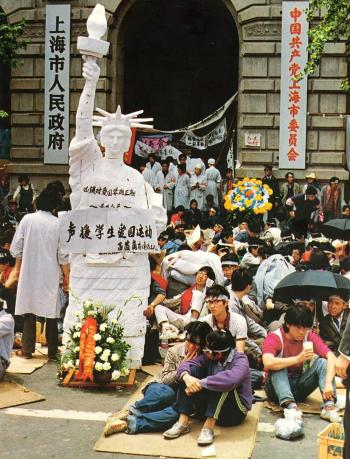
Photo right: May
19th. An effigy of the Statue of Liberty stands with the hunger strikers
in front of the Shanghai city government offices. (The Epoch Times, 64memo.com)
Col. Helvey
reports, in a January 29, 2001 interview with film producer Steve York
in Belgrade, that he first got involved in “strategic nonviolence” upon
seeing the failure of military approaches to toppling
dictators–especially in Myanmar, where he had been stationed as military
attaché–and seeing the potential of Sharp’s alternative approach.
According to B. Raman, the former director of India’s foreign
intelligence agency, RAW, in a December 2001 paper published by his
institute entitled, “The USA’s National Endowment For Democracy(NED):
An Update,” Helvey “was an officer of the Defence Intelligence Agency
of the Pentagon, who had served in Vietnam and, subsequently, as the US
Defence Attaché in Yangon, Myanmar (1983 to 85), during which he
clandestinely organized the Myanmarese students to work behind Aung San
Suu Kyi and in collaboration with Bo Mya’s Karen insurgent group….He
also trained in Hong Kong the student leaders from Beijing in mass
demonstration techniques which they were to subsequently use in the
Tiananmen Square incident of June, 1989″ and “is now believed to be
acting as an adviser to the Falun Gong, the religious sect of China, in
similar civil disobedience techniques.” Col. Helvey nominally retired
from the army in 1991, but had been working with Albert Einstein and
Soros long before then.
Reflecting Albert
Einstein’s patronage, one of its first books was Dr. Sharp’s “Making
Europe Unconquerable: The Potential of Civilian-Based Deterrence and
Defense,” published in 1985 with a forward by George Kennan, the famous
“Mr. X” 1940′s architect of the Cold War who was also a founder of the
CIA’s Operations division. There, Sharp reports that “civilian-based
defense” could counter the Soviet threat through its ability “to deter
and defeat attacks by making a society ungovernable by would be
oppressors” and “by maintaining a capacity for orderly self-rule even in
the face of extreme threats and actual aggression.” He illustrates its
feasibility by discussing the examples of the Algerian independence in
1961 and the Czechoslovakian resistance to Soviet invasion in 1968-9. In
his forward, Kennan praises Sharp for showing the “possibilities of
deterrence and resistance by civilians” as a “partial alternative to the
traditional, purely military concepts of national defense.” The book
was promptly translated into German, Norwegian, Italian, Danish, and
other NATO country languages. See the link to the Italian translation of
the book (Verso un’Europa Inconquistabile . 190 pp. 1989 Introduction by Gianfranco Pasquino) that
sports a series of fashionable sociologists and “politologists”
prefacing the book and calling for a civil resistance to a possible
Soviet invasion of Italy.
Such formulations
suggest that Albert Einstein activities were, ironically, coherent (or,
possibly updating) the infamous NATO’s “Gladio” stay-behind network,
whose purpose was to combat possible Soviet occupation through a panoply
of military and non military means. The investigations into Gladio, and
those following the 1978 assassination of former Prime Minister Aldo
Moro, also shed some light (immediately switched off) on a professional
apparatus of destabilization that had been invisible for several decades
to the public.
It is noteworthy
that the former deputy chief of intelligence for the US Army in Europe,
Major General Edward Atkeson, first “suggested the name ‘civilian based
defense’ to Sharp,” John M. Mecartney, Coordinator of the Nonviolent
Action for National Defense Institute, reports in his group’s CBD News and Opinion of March 1991.
By 1985, Gen. Atkeson, then retired from the US Army, was giving
seminars at Harvard entitled “Civilian-based Defense and the Art of
War. (http://www.wcfia.harvard.edu/ponsacs/seminars/TransformingStruggle/defense.htm#Art%20of%20War)
The Albert
Einstein Institution reports, in its “1994-99 Report on Activities,”
that Gen. Atkeson also served on Einstein’s advisory board in those
years. Following his posting as the head of US Army intelligence in
Europe, and possibly concurrently with his position at the Albert
Einstein Institution, the Washington based Center for Strategic and
International Studies (CSIS) reports that General Atkeson, who also
advised CSIS on “international security.” served as “national
intelligence officer for general purpose forces on the staff of the
director of Central Intelligence.” ( http://www.csis.org/experts/4atkeson.htm ).
A 1990 variant of Sharp’s book, “Civilian-Based Defense: A Post-Military Weapons System, ” the Albert Einstein Institution reports, “was used in 1991 and 1992 by
the new independent governments of Estonia, Latvia, and Lithuania in
planning their defense against Soviet efforts to regain control.”
As we shall see
below, with such backing, Col. Helvey and his colleagues have created a
series of youth movements including Otpor! in Serbia, Kmara! in Georgia,
Pora! in Ukraine, and the like, which are already virally replicating
other sects throughout the former Soviet Union, achieving in civilian
form what had not been possible militarily in the 1980s. The groups are
also spreading to Africa and South America.
And dope too?
Col. Helvey’s
long experience in Myanmar in training insurgent ethnic minorities in a
region that is the center of world opium production raises another
question of great bearing on “post modern coups.” That is: what is the
role of narcotic mafias in facilitating “regime change?” Law enforcement
agencies from many nations, including the United States, have long
reported that the Balkans is the major narcotics pipeline into Western
Europe. Ukraine is said to be a top conduit, as is Georgia. Kyrghyzstan,
now at the top of the hit list, is another opium conduit. And George
Soros “the Daddy Warbucks of drug legalization,” has been the top
“private” funder of all the Eastern European and Central Asian insurgent
groups, as well as those in Myamar. The spread of such mafias, is, of
course, one of the most efficient ways of infiltrating and corrupting
government agencies of targeted states.
Col. Helvey is
not the only operator with such a background. The head of the OSCE’s
vote monitoring operation in Ukraine, for example, Geert-Hinrich Ahrens,
was German Ambassador to Colombia in the late 1990s, when German secret
agent Werner Mauss was arrested for working closely with the
narco-terrorist ELN, whose bombings are financed by the cocaine trade.
Ahrens was also on the scene in Albania and Macedonia, when the
narcotics smuggling Kosovo Liberation Army (KLA) was created with US and
German patronage. And Michael Kozak, the US ambassador whose 2001
effort to overthrow Belarus’ Lukachenko failed, had been a top handler
of the cocaine-smuggling Contras.
The Serbian virus
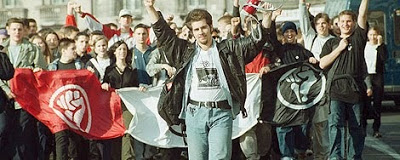 The
networks and methods used in the Serbian through Ukraine sequence were
first publicly revealed in a Washington Post article on Dec. 11, 2000 by
Michael Dobbs, entitled. “U.S. Advice Guided Milosevic Opposition Political Consultants Helped Yugoslav Opposition Topple Authoritarian Leader.” He reports that:
The
networks and methods used in the Serbian through Ukraine sequence were
first publicly revealed in a Washington Post article on Dec. 11, 2000 by
Michael Dobbs, entitled. “U.S. Advice Guided Milosevic Opposition Political Consultants Helped Yugoslav Opposition Topple Authoritarian Leader.” He reports that:U.S.-funded consultants played a crucial role behind the scenes in virtually every facet of the anti-Milosevic drive, running tracking polls, training thousands of opposition activists and helping to organize a vitally important parallel vote count. U.S. taxpayers paid for 5,000 cans of spray paint used by student activists to scrawl anti-Milosevic graffiti on walls across Serbia, and 2.5 million stickers with the slogan “He’s Finished,” which became the revolution’s catchphrase.Some Americans involved in the anti-Milosevic effort said they were aware of CIA activity at the fringes of the campaign, but had trouble finding out what the agency was up to. Whatever it was, they concluded it was not particularly effective. The lead role was taken by the State Department and the U.S. Agency for International Development, the government’s foreign assistance agency, which channeled the funds through commercial contractors and nonprofit groups such as NDI and its Republican counterpart, the International Republican Institute (IRI).While NDI worked closely with Serbian opposition parties, IRI focused its attention on Otpor, which served as the revolution’s ideological and organizational backbone. In March, IRI paid for two dozen Otpor leaders to attend a seminar on nonviolent resistance at the Hilton Hotel in Budapest, a few hundreds yards along the Danube from the NDI-favored Marriott.During the seminar, the Serbian students received training in such matters as how to organize a strike, how to communicate with symbols, how to overcome fear and how to undermine the authority of a dictatorial regime. The principal lecturer was retired U.S. Army Col. Robert Helvey, who has made a study of nonviolent resistance methods around the world, including those used in modern-day Burma and the civil rights struggle in the American South.Helvey, who served two tours in Vietnam, introduced the Otpor activists to the ideas of American theoretician Gene Sharp, whom he describes as “the Clausewitz of the nonviolence movement,” referring to the renowned Prussian military strategist.
Peter Ackerman,
the above-mentioned coup expert analyzed and popularized the methods
involved in a 2001 PBS documentary-series and book, “A Force More Powerful :
A Century of Nonviolent Conflict,” together with retired US Airforce
officer Jack DuVall. Focusing on youth organizing, they report:
After the NATO bombing, which had helped the regime suppress opposition, Otpor’s organizing took hold with a quiet vengeance. It was built in some places around clubhouses where young people could go and hang out, exercise, and party on the weekends, or more often it was run out of dining rooms and bedrooms in activists’ homes. These were “boys and girls 18 and 19 years old” who had lived “in absolute poverty compared to other teenagers around the world,” according to Stanko Lazendic, an Otpor activist in Novi Sad. “Otpor offered these kids a place to gather, a place where they could express their creative ideas.” In a word, it showed them how to empower themselves.Otpor’s leaders knew that they “couldn’t use force on someone who… had three times more force and weapons than we did,” in the words of Lazendic. “We knew what had happened in. Tiananmen, where the army plowed over students with tanks.” So violence wouldn’t work — and besides, it was the trademark of Milosevic, and Otpor had to stand for something different. Serbia “was a country in which violence was used too many times in daily politics,” noted Srdja Popovic, a 27 year-old who called himself Otpor’s “ideological commissar.” The young activists had to use nonviolent methods “to show how superior, how advanced, how civilized” they were.
This relatively
sophisticated knowledge of how to develop nonviolent power was not
intuitive. Miljenko Dereta, the director of a private group in Belgrade
called Civic Initiatives, got funding from Freedom House in the U.S. to print and distribute 5,000 copies of Gene Sharp’s book, From Dictatorship to Democracy: A Conceptual Framework for Liberation . Otpor got hold of Sharp’s main three-volume work, The Politics of Nonviolent Action,
freely adapting sections of it into a Serbian-language notebook they
dubbed the “Otpor User Manual.” Consciously using this “ideology of
nonviolent, individual resistance,” in Popovic’s words, activists also
received direct training from Col. Robert Helvey, a colleague of Sharp,
at the Budapest Hilton in March 2000.
Helvey emphasized
how to break the people’s habits of subservience to authority, and also
how to subvert: the regime’s “pillars of support,” including the police
and armed forces. Crucially, he warned them against “contaminants to a
nonviolent struggle,” especially violent action, which would deter
ordinary people from joining the movement: and alienate the
international community, from which material and financial assistance
could be drawn. As Popovic put it:
“Stay nonviolent and you will get the support of the third party.”
That support,
largely denied to the Serbian opposition before, now began to flow.
Otpor and other dissident groups received funding from the National
Endowment for Democracy, affiliated with the U.S. government, and Otpor
leaders sat down with Daniel Serwer, the program director for the
Balkans at the U.S. Institute for Peace, whose story of having been
tear-gassed during an anti-Vietnam War demonstration gave him special
credibility in their eyes. The International Republican Institute, also
financed by the U.S. government, channeled funding to the opposition and
met with Otpor leaders several times. The U.S. Agency for International
Development, the wellspring for most of this financing, was also the
source of money that went for materials like t-shirts and stickers.
No lack of opportunities for employment
In the aftermath
of the Serbian revolution, the National Endowment for Democracy, Albert
Einstein Institution, and related outfits helped establish several
Otpor-modeled youth groups in Eastern Europe, notably Zubr in Belarus in
January 2001; Kmara in Georgia, in April 2003; and Pora in Ukraine in
June 2004. Efforts to overthrow Belarus President Alexsander Luschenko
failed in 2001, while the US overthrow of Georgian President Eduard
Schevardnadze was successfully accomplished in 2003, using Kmara as part
of its operation.
Commenting on
that expansion, Albert Einstein staffer Chris Miller, in his report on a
2001 trip to Serbia found on the group’s website, reports:
Since the ousting of Milosevic, several members of Otpor have met with members of the Belarusian group Zubr (Bison). In following developments in Belarus since early this year, It is clear that Zubr was developed or at least conceptualized, using Otpor as a model. Also, [Albert Einstein's report] From Dictatorship to Democracy is available in English on the Zubr website at www.zubr-belarus.com Of course, success will not be achieved in Belarus or anywhere else, simply by mimicking the actions taken in Serbia. However the successful Serbian nonviolent struggle was highly influenced and aided by the availability of knowledge and information on strategic nonviolent struggle and both successful and unsuccessful past cases, which is transferable.Otpor focused on building their human resources, especially among youth. An Otpor training manual to “train future trainers” was developed, which contained excerpts from The Politics of Nonviolent Action, provided to Otpor by Robert Helvey during his workshop in Budapest for Serbs in early 2000. It may be applicable for other countries.And with funding provided by Freedom House and the US government, Otpor established the Center for Nonviolent Resistance, in Budapest, to train these groups. Describing the deployment of this youth movement, Ian Trainor, in the above cited Guardian November 2004 article, reports:In the centre of Belgrade, there is a dingy office staffed by computer-literate youngsters who call themselves the Centre for Non-violent Resistance. If you want to know how to beat a regime that controls the mass media, the judges, the courts, the security apparatus and the voting stations, the young Belgrade activists are for hire.They emerged from the anti-Milosevic student movement, Otpor, meaning resistance. The catchy, single-word branding is important. In Georgia last year, the parallel student movement was Khmara. In Belarus, it was Zubr. In Ukraine, it is Pora, meaning high time.Stickers, spray paint and websites are the young activists’ weapons. Irony and street comedy mocking the regime have been hugely successful in puncturing public fear and enraging the powerful.Last year, before becoming president in Georgia, the US-educated Mr Saakashvili travelled from Tbilisi to Belgrade to be coached in the techniques of mass defiance. In Belarus, the US embassy organised the dispatch of young opposition leaders to the Baltic, where they met up with Serbs travelling from Belgrade. In Serbia’s case, given the hostile environment in Belgrade, the Americans organised the overthrow from neighbouring Hungary – Budapest and Szeged.In recent weeks, several Serbs travelled to the Ukraine. Indeed, one of the leaders from Belgrade, Aleksandar Maric, was turned away at the border.The Democratic party’s National Democratic Institute, the Republican party’s International Republican Institute, the US State Department and USAID are the main agencies involved in these grassroots campaigns as well as the Freedom House NGO and billionaire George Soros’s Open Society Institute .
An Associated
Press article by Dusan Stojanovic, on November 2, 2004, entitled
“Serbia’s export: Peaceful Revolution,” elaborates:
Timeline“We knew there would be work for us after Milosevic,” said Danijela Nenadic, a program coordinator of the Belgrade-based Center for Nonviolent Resistance. The nongovernmental group emerged from Otpor, the pro-democracy movement that helped sweep Milosevic from power by organizing massive and colorful protests that drew crowds who never previously had the courage to oppose the former Yugoslav president. In Ukraine and Belarus, tens of thousands of people have been staging daily protests — carbon copies of the anti-Milosevic rallies — with “training” provided by the Serbian group.The group says it has “well-trained” followers in Ukraine and Belarus. In Georgia, Ukraine and Belarus, anti-government activists “saw what we did in Serbia and they contacted us for professional training,” group member Sinisa Sikman said. Last year, Otpor’s clenched fist was flying high on white flags again — this time in Georgia, when protesters stormed the parliament in an action that led to the toppling of Shevardnadze.Last month, Ukrainian border authorities denied entry to Alexandar Maric, a member of Otpor and an adviser with the U.S.-based democracy watchdog Freedom House. A Ukrainian student group called Pora was following the strategies of Otpor.James Woolsey’s Freedom House “expressed concern” over Maric’s deportation, in an October 14, 2004 release which reported that he was traveling to Ukraine as part of “an initiative run by Freedom House, the National Democratic Institute, and the International Republican Institute to promote civic participation and oversight during the 2004 presidential and 2006 parliamentary elections in Ukraine.” In a related statement, it added that it hoped the deportation was not a sign of the Ukrainian government’s “unwillingness to allow the free flow of information and learning across borders that is an integral and accepted part of programs to encourage democratic progress in diverse societies around the world.”
· Otpor! founded in Belgrade, Serbia in October 1998. Coup overthrows President Slobodan Milosevic on October 5, 2000. Subsequently forms Center for Nonviolent Resistence to spead !!! revolutions.
· Clinton Administration’s Community of Democracies launched in Warsaw, Poland, in June 2000.
· Zubr! founded in Minsk, Belarus, on January 14, 2001. Election-Coup efforts fail in September 9, 2001.
· Mjaft! founded in Tirana, Albania, on March 15, 2003.
· Kmara! founded in Tblisi, Georgia in April 2003. “Rose revolution” overthrows President Eduard Shevardnadze on November 23, 2003.
· Pora! founded in Kiev, Ukraine in June 2004. “Orange revolution” installs Victor Yushchenko into power on December 26, 2004.
· Kmara! overthrows Abashidze of Ajaria (western Georgian secessionist province) May 5, 2004


