Wednesday, December 18, 2013

This Secret Group Controls the World

Monday, December 16, 2013


This Secret Group Controls the World
By Jimmy Mengel, Outsider Club 
“Facts do not cease to exist because they are ignored.”  — Aldous Huxley
So who really controls the world?
The Illuminati? Freemasons? The Bilderberg Group?
Or are these all red herrings to distract your prying eyes from the real global elite? The answer, like most topics worth exploring, is not quite so simple. Have no doubt, there aresecretive global powers whose only goal is to keep and grow that power. But it really may not be as secretive as you’d think. And that’s what makes it even more nefarious…
But don’t take my word for it, we have both science and insider testimony to back it up…
We’re going to break this down into three categories: Financial, Political and Media. This is a harder task than you may imagine, since they all work in concert by design.

Financial Elite
Thanks to the science of complex system theory, the answer may actually be right in front of our faces.
This scientific process sheds light on the dark corners of bank control and international finance and pulls some of the major players out from the shadows.
And it goes back to the old credo: Just follow the money…
Systems theorist James B. Glattfelder did just that.
From a massive database of 37 million companies, Glattfelder pulled out the 43,060 transnational corporations (companies that operate in more than one country) that are all connected by their shareholders.
Digging further, he constructed a model that actually displays just how connected these companies are to one another through ownership of shares and their corresponding operating revenues.

The 1318 transnational corporations that form the core of the economy.
Superconnected companies are red, very connected companies are yellow. The size of the dot represents revenue.
I’ll openly admit that this graphic almost scared me off. Complex scientific theories are not my forte, and this looks like some sort of intergalactic snow globe.
But Glattfelder has done a remarkable job of boiling these connections down to the main actors — as well as pinpointing how much power they have over the global market. These “ownership networks” can reveal who the key players are, how they are organized, and exactly how interconnected these powers are.
From New Scientist:  Each of the 1318 had ties to two or more other companies, and on average they were connected to 20. What’s more, although they represented 20 per cent of global operating revenues, the 1318 appeared to collectively own through their shares the majority of the world’s large blue chip and manufacturing firms — the “real” economy — representing a further 60 per cent of global revenues.
When the team further untangled the web of ownership, it found much of it tracked back to a “super-entity” of 147 even more tightly knit companies — all of their ownership was held by other members of the super-entity — that controlled 40 per cent of the total wealth in the network.
According to his data, Glattfelder found that the top 730 shareholders control a whopping 80% of the entire revenue of transnational corporations.
And — surprise, surprise! — they are mostly financial institutions in the United States and the United Kingdom.
That is a huge amount of concentrated control in a small number of hands…
Here are the top ten transnational companies that hold the most control over the global economy (and if you are one of the millions that are convinced Big Banks run the world, you should get a creeping sense of validation from this list):
1) Barclays plc
2) Capital Group Companies Inc.
3) FMR Corporation
4) AXA
5) State Street Corporation
6) JPMorgan Chase & Co.
7) Legal & General Group plc
8) Vanguard Group Inc.
9) UBS AG
10) Merrill Lynch & Co Inc.
Some of the other usual suspects round out the top 25, including JP Morgan, UBS, Credit Suisse, and Goldman Sachs.
What you won’t find are ExxonMobil, Microsoft, or General Electric, which I found shocking. In fact, you have to scroll all the way down to China Petrochemical Group Company at number 50 to find a company that actually creates something.
The top 49 corporations are financial institutions, banks, and insurance companies — with the exception of Wal-Mart, which ranks at number 15…
The rest essentially just push money around to one another.
Here’s the interconnectedness of the top players in this international scheme:


Here’s a fun fact about the number one player, Barclays:
Barclays was a main player in the LIBOR manipulation scandal, and were found to have committed fraud and collusion with other interconnected big banks. They were fined $200 million by the Commodity Futures Trading Commission, $160 million by the United States Department of Justice and £59.5 million by the Financial Services Authority for “attempted manipulation” of the Libor and Euribor rates.
Despite their crimes, Barclays still paid $61,781,950 in bonuses earlier this year, including a whopping $27,371,750 to investment banking head Rich Ricci. And yes, that’s actually his real name…
These are the guys that run the world.
It’s essentially the “too big to fail” argument laid out in a scientific setting — only instead of just the U.S. banks, we’re talking about an international cabal of banks and financial institutions so intertwined that they pose a serious threat to global economics.
And instead of “too big to fail,” we’re looking at “too connected to fail”…
Glattfelder contends that “a high degree of interconnectivity can be bad for stability, because stress can spread through the system like an epidemic.”
Industrialist Henry Ford once quipped, “It is well enough that people of the nation do not understand our banking and money system, for if they did, I believe there would be a revolution before tomorrow morning.”
It’s one thing to have suspicions that someone is working behind the scenes to control the world’s money supply. It’s quite another to have scientific evidence that clearly supports it.
But these guys can only exist within a political system that supports their goals. And those political systems are pretty much operating in the open…
POLITCAL ELITE
For the sake of brevity, let’s cut right to the chase. Every major geopolitical decision of the last few decades has been run through one of these three organizations: the Trilateral Commission, the Council on Foreign Relations and the World Bank/International Monetary Fund (IMF).
The Trilateral Commission
In 1973, the infamous David Rockefeller created a group of the world’s power brokers to work together — outside of any official governmental or political allegiance — to bring about cooperation of North America, Western Europe and Japan.
They launched under the guise of working together to solve the world’s problems. A noble goal — but “problems” are very subjective.
Here’s the rundown of members:
The North American continent is represented by 120 members (20 Canadian, 13 Mexican and 87 U.S. citizens). The European group has reached its limit of 170 members from almost every country on the continent; the ceilings for individual countries are 20 for Germany, 18 for France, Italy and the United Kingdom, 12 for Spain and 1–6 for the rest. At first, Asia and Oceania were represented only by Japan. However, in 2000 the Japanese group of 85 members expanded itself, becoming the Pacific Asia group, composed of 117 members: 75 Japanese, 11 South Koreans, 7 Australian and New Zealand citizens, and 15 members from the ASEAN nations (Indonesia, Malaysia, Philippines, Singapore and Thailand). The Pacific Asia group also included 9 members from China, Hong Kong and Taiwan. Currently, the Trilateral Commission claims “more than 100″ Pacific Asian members.
It’s a global who’s-who of power brokers. And while the Trilateral Commission excludes anyone currently holding public office from membership, it serves as a revolving door of the rich and powerful from the financial, political and academic elite.
Most suspicions of the group began during the Jimmy Carter administration, when Carter — himself a member of the Trilateral Commission — made Zbigniew Brzezinski his National Security advisor. Brzezinski was the Trilateral Commission’s first executive director. Carter’s Vice President Walter Mondale was also a member.
And perhaps most importantly, Trilateral member Paul Volker served as Carter’s Chair of the Federal Reserve. He is still the North American Honorary Chairman.
Such a concentration of power in a U.S. president’s cabinet obviously made people nervous,
Notable recent additions include Austan Goolsbe — former chairman for Obama’s Council of Economic Advisors. I’d suggest you familiarize yourselves with the entire member list here.
You’ll be shocked at who else is part of this secretive organization.
Follow the Outsider Club  for Part II of this important subject.


One Bank to Rule Them All: World Bank Whistle-blower Reveals Bank Conspiracy
By Jimmy MengelOutsider Club  
If you had any doubt, we now have science and first-hand testimony to prove it.
Note: This is not some wild conspiracy theory. It’s systems theory, a serious scientific discipline, used by researcher James B. Gladfelder to prove that a small group of banks essentially control the world’s finances.
Gladfelder’s research proved that the top 730 shareholders control a whopping 80% of the entire revenue of transnational corporations.
But the truth is the global banking elite simply cannot maintain a stranglehold on the world’s power all by themselves. And so, while they run off with the money, their lackeys in the political sphere acts as gatekeepers.
Again, we’re not relying on labyrinthine explanations and vague fears of domination; we’re looking at the matter through scientific discipline and actual admissions from the power brokers themselves.
The fact is we simply cannot talk about global control without talking about the World Bank…
The World Bank represents 188 different countries from Albania to Zimbabwe. However, it is controlled by a small number of powerful countries, each with its own serious economic interests.
Since there is no voting for the leadership and chief economists at the bank, the United States and other large countries have complete control to appoint who they’d like to do their bidding — and they have appointed some highly questionable folks to run the behemoth:
Robert McNamara – JFK’s former secretary of defense and president of Ford Motor Company was chosen to lead the Bank in 1968, fresh off his disastrous handling of the Vietnam War.
Lewis T. Preston – a bank executive with J.P. Morgan. We all know J.P. Morgan doesn’t have the interest of the working poor at heart, as evidenced by years of abuse of regular folks, culminating in their record $13 billion fine this year.
Robert Zoellick – a bank executive with Goldman Sachs. Again, if the head of Goldman Sachs is at the helm, you know the bidding of the powerful will get its due… After all, you don’t earn a nickname like “The Great Vampire Squid” for your altruism.
Paul Wolfowitz – Much like McNamara, Wolfowitz was handed the reigns to the World Bank after helping orchestrate George Bush’s outrageous war on Iraq. While president of the Bank, he gave his girlfriend massive pay raises — more than double what she was entitled to! The fact that the head of the World Bank could engage in such petty corruption doesn’t bode well for the bank at large, considering the immense power they wield. Wolfowitz was eventually forced to resign.
Perhaps more alarmingly, the World Bank also receives complete immunity from any and all countries it does “business” with, so it cannot be held legally accountable for its actions.
The United States has complete veto power over the Bank’s actions as well, which it can use to block any action by the Bank that may threaten national interests — and the interests of the global financial powers that control them.
The World Bank’s stated purpose is to help poor and developing countries by providing loans.
The catch? To obtain one of these loans, you have to comply with the Bank’s draconian wish lists.
Examples of the conditions countries must meet to gain access to a loan include suppressing wages, cutting programs like education and health care, and easing limits on foreign investment.
How do the results stack up with its stated mission?
Not well. In fact, data shows most countries that have taken the World Bank’s money and agreed to its terms are no better off today then they were when they received their first loan — and many are actually worse off.
From the Heritage Foundation:
Of the 66 less-developed countries receiving money from the World Bank for more than 25 years (most for more than 30 years), 37 are no better off today than they were before they received such loans.
Of these 37 countries, most (20 in all) are actually poorer today than they were before receiving aid from the Bank.
Former less-developed countries that have prospered over the past 30 years did so by freeing up the productive forces of their economies. The best examples are Hong Kong and Singapore: Even though a country like Singapore received a small amount of money from the World Bank, the evidence shows that what most affected economic growth was not World Bank aid, but economic freedom.
What’s more, an ex-World Bank employee described something far more nefarious than ineptitude…
Karen Hudes watched first-hand as the World Bank manipulated and covered up corruption in its economic development projects.
It’s important to know Hudes wasn’t some disgruntled lackey; she served as Senior Counsel and worked for the bank for 20 years. During those two decades at the World Bank, Hudes saw systematic and widespread corruption.
“It’s a mafia,” she told the New American.
“These culprits that have grabbed all this economic power have succeeded in infiltrating both sides of the issue, so you will find people who are supposedly trying to fight corruption who are just there to spread disinformation and as a placeholder to trip up anybody who manages to get their act together. Those thugs think that if they can keep the world ignorant, they can bleed it longer.”
Hudes saw large-scale enrichment of the powerful, while the poor the Bank was supposed to be helping were getting stiffed.
“I realized we were now dealing with something known as state capture, which is where the institutions of government are co-opted by the group that’s corrupt,” she noted.
Hudes was eventually fired after she spoke out against the Bank’s attempt to cover up a botched bailout of a crooked bank in the Philippines.
Here are a few choice examples of what happens to the $2.5 billion in U.S. taxpayer money that is funneled into the World Bank each and every year, from the American Enterprise Institute:
38 countries have amassed $71 billion in unpayable multilateral loans, encouraged by the Bank’s self-serving projections of country growth, on which rich-country taxpayers must now make good.
Corruption has been exposed both within the World Bank and in its programs, and is now estimated at more than $100 billion.
Protest is rising among leading African scholars who seek to stop all aid because it serves only to entrench and enrich a series of corrupt elites. Massive anecdotal evidence of waste, ineptitude, and outright theft can no longer be ignored.
Not exactly the poverty-fighting superhero the institution makes itself out to be.
The World Bank works in conjunction with the International Monetary Fund, which operates in the same vein of enriching Wall Street and supporting dictators. We’ll pull the curtain back on the IMF next week.
See more from Jimmy Mengel at the Outsider Club

Jimmy is a managing editor for Outsider Club and the Investment Director of the personal finance advisory The Crow’s Nest. You may also know him as the architect behind the wildly popular finance and investing website Wealth Wire, where he’s brought readers the stories behind the mainstream financial news each and every day. For more on Jimmy, check out his editor’s page.
http://beforeitsnews.com/economy/2013/12/this-secret-group-controls-the-world-2579670.html?currentSplittedPage=0

Army intel wants to scan social media from 40 countries to search for dangerous trends

Source: DefSys
Army Intelligence and Security Command
The Army wants to be able to anonymously scan social media platforms and open-source information from up to 40 countries and in 66 languages, and perform big data analytics on huge data sets of the information in search of trends in political, military, economic and other areas. And it wants to be able to do it from a smartphone.
In a sources sought notice published at FedBizOpps.gov, the Army Intelligence and Security Command (INSCOM) said it “anticipates the need” for a non-attributable (anonymous) service that will collect and analyze the data, and allow INSCOM personnel to perform their own analyses using customized big data tools.
Intelligence agencies, like businesses and political campaigns, recognize the value of social media in track trends, public sentiment and the kind of emerging public uprisings that took place during the Arab Spring. Agencies from the Homeland Security Department to the Defense Advanced Research Projects Agency have looked to use social media analytics for signs of terrorism or as a conduit during emergencies. The challenges have included the size of the data and the fractured language used on the likes of Twitter and Facebook.
INSCOM’s notice said it’s looking for tool that can perform analytics on data from a changeable list of up to 40 countries and follow up to 10 analytical themes, including “political, military, economic, social, infrastructure, and information systems of foreign states,” as well as perform sentiment analysis and predictive analytics. The service should be available to INSCOM’s entire enterprise via smartphones or tablets, giving access to users anywhere in the field, the notice said.
Other features the Army is looking for include:
Automated reporting interfaces with additional focused-analytics as needed.
  • The ability to search foreign social media and open source information and conduct predictive analysis, sentiment analysis and deliver situational awareness.
  • Node clustering of big data utilizing a distributed, scalable and portable file-system and a software framework that allows for data-intensive applications.
  • A non-intrusive framework for processing parallelizable problems across huge datasets using a large number of clusters on all ingested data sources.

The NSA and Its Partners Are Getting Hit In Their Ability to Hire and Keep Personnel … and in their Pocketbooks

Economic Forces Fighting Back Against Mass Surveillance

It’s not only judges, presidents and congress members who are slamming the NSA.
It’s not only foreign leaders – or Internet standards institutions – who are distancing themselves from the U.S. due to mass surveillance.
The NSA and it’s partners are also getting hit where it hurts … in their ability to hire and keep personnel, and in the pocketbook:
Applications to work at the NSA are down by more than one third, and retention rates have also declined. This is a serious problem for an agency that, until now, has thrived because of an esprit de corps within the organization. Traditionally, when analysts joined the NSA, they joined for life. This is changing, and not for the better from the NSA’s perspective.
  • Mathematicians are calling for a boycott of the NSA (the NSA is the largest employer of mathematicians on the planet)
  • An IBM shareholder group – the Louisiana Sheriffs’ Pension & Relief Fund – has sued IBM for cooperating with the NSA … since that cooperation has destroyed IBM’s sales to China (as we noted in July, the failure of tech companies to disclose their participation in mass surveillance violates fair disclosure requirements … that is, the requirement to disclose “materially adverse information”  which could hurt a company’s value)
  • ATT and Verizon shareholders are exerting tremendous pressure to disclose the amount of information they’re sharing with the NSA
Militarization of the economy harms virtually all of the civilian sectors … just ask a Nobel economist.
An out-of-control NSA and spying complex is close to dealing a mortal blow to the America economy.
Can economic forces rein it in before it drags the civilian economy into another depression?

Eyewitness to Hitler Warns: “Keep Your Guns and Buy More Guns”

Kimberly Paxton
December 17th, 2013
The Daily Sheeple

Editor’s Note: The warning signs are everywhere. History has shown us exactly what happens to the citizenry of nations who are disarmed by their governments. The comparisons between Nazi-controlled Austria and a socialist-controlled America are frightening. But this time it’s different right? It could never happen in the Land of the Free…
Watch the speech, read every word and share with friends, family, and those who don’t know any better. 
hitler-gun-control-a
Delivered by The Daily Sheeple
When Katie Worthman was a little girl in Austria, she witnessed firsthand Adolph Hitler’s rise to power and the Soviet communist occupation that followed.  She also witnessed, for decades, the distortions of the media when it came to the reporting of the events.
From her eyewitness perspective, Worthman said that the whole thing didn’t happen overnight, in a brutal attack, like the media portrays it, but rather, it evolved into a dictatorship gradually, over a period of a few years.  Hitler didn’t come across as someone evil, to be feared, initially.  ”In the beginning, Hitler didn’t look like, or talk like a monster at all. He talked like an American politician.”
Here are some things that occurred in Austria, according to Worthman, that just might look familiar to Americans:
  • Hitler was elected with 98% of the vote.
  • Hitler destroyed the existing medical system when he brought a national healthcare plan into being.
  • First, people were forced to register their guns to cut down on crime.
  • Then they were forced to turn them in or risk capital punishment for keeping them.
Worthman’s eyewitness account is eerily reminiscent of what we can see going on in the United States today.
“In 1938, the media reported that Hitler rode into Austria with tanks and guns and took us over. Not true at all,” she says. “The Austrian people elected Hitler by 98% of the vote by means of the ballot box. Now you might ask how could a Christian nation… elect a monster like Hitler. The truth is at the beginning Hitler didn’t look like or talk like a monster at all. He talked like an American politician.<
“We also had gun registration. All the Austrian people… had guns. But the government said, ‘the guns are very dangerous. Children are playing with guns. Hunting accidents happen and we really have to have total controlled safety. And we had criminals again. And the only way that we can trace the criminal was by the serial number of the gun.’
“So we dutifully went to the police station and we registered our guns. Not long after they said, ‘No, it didn’t help. The only way that we won’t have accidents and crimes [is] you bring the guns to the police station and then we don’t have any crimes anymore and any accidents. And if you don’t do that: capital punishment.’
“So that’s what we did. So dictatorship didn’t happen overnight. It took five years. Gradually, little by little to escalate up to a dictatorship.
“When the people fear the government, that’s tyranny. But when the government fears the people… that’s liberty. Keep your guns. Keep your guns and buy more guns.”
Now 84, Katie Worthman is warning America, her adopted country, in the hopes that history does not repeat itself. Watch her powerful presentation below.  If you don’t want to go buy more ammo after that, then you aren’t paying attention.

Is Barack Obama Hitlers "SON"??? | The POWERFUL video will BLOW YOU AWAY!

Kimberly Paxton, a staff writer for the Daily Sheeple, is based out of upstate New York.
This content may be freely reproduced in full or in part in digital form with full attribution to the author and a link to www.TheDailySheeple.com.

hitler-gun-control-a

The Invasion Will Come From Within

let it come ! The GOOD People of America ..will stand up  !!   folks we've been bamboozeled  ,hooded winked into so many fucking WRONG fights  ?    but the American People will finally get to fight the RIGHT fight & clean "these" ass pipes OUT  of Our Country  !!!     ..we've been waiting  an long  time  fer it      ..time 2 make America what it ought 2 b

The Invasion Will Come From Within

Dave Hodges December 18, 2013 The Common Sense Show false flag goering
After the coming false flag, where will you go? It is clear that the powers that be will have ready-made facilities prepared for you are you at a nearby public venue. What if disaster strikes while the kids are in school and you are at work?What if it is an EMP attack that hits America and you cannot drive your car? Do you have a meet-up place if disaster strikes in the middle of the day? Do you have a bug out location stocked with supplies? Will you hunker down? Do you have food and water? Do you have a means to protect what you set aside? The next three parts of this series will address these issues.
The invasion will commence from within and will begin following a series of false flag attacks. 

An Ominous Sign

Earlier this week, a court ruled that the NSA’s spying on our phone calls was illegal and that Ed Snowden had been vindicated. Most people in the Patriot movement are championing this as a victory.  This would be a very naive viewpoint.
Congress and the President are completely under the control of the police state surveillance grid. The Federal government has made absolutely no move to counter the NSA and its highly illegal activities. And now we are supposed to believe that a judge has discovered his Constitutional conscience? Are we to believe that there is a judge that the NSA cannot get to? Is there really a judge who can’t be followed, his family intimidated or bribed? Really?
With the undertaking of any project, there is the informational gathering phase which is followed by the implementation of the action phase. I firmly believe that we are witnessing the implementation of the action phase. The NSA has all they need to create an enemies list. Who is a threat and who can be re-educated is known. Who lives and who will die has been determined by their spy grid matrix. The ruling by this judge is a deception designed to lull America into a further sense of complacency. The NSA already has what they need and the action phase will soon commence.

Is the Third Time Is a Charm?

Some people are having trouble believing that the relationship between Obama and the military is broken. Two hundred is the magic number. When a President fires over 200 senior command officers, there is something very seriously wrong. When 2-5 nukes go missing, there is something very seriously wrong. When a Senator (i.e. Lindsay Graham) announces that he is worried about a nuke going off in his home state, something is seriously wrong.
Obama has been thwarted in taking down the power grid. He has been thwarted in detonating nukes . And now, the tables have been turned, as the military holds 2-5 missing nukes at their disposal. Checkmate!
Will Obama attempt a false flag for the third time?
The military and Obama are embroiled in a game of chicken. Who will blink first? Meanwhile, many writers and talk show hosts are receiving multiple reports of foreign troops being sent to our country. The President has vacated the White House in favor of Hawaii for a long-term stay. Given the present climate, I would be nervous if I lived in the Washington DC area.

Gatlinburg

Is there a third attempted false flag in the offing? I think this is unquestionably the case. Not only do we have the Russians and Chinese to worry about, now I am receiving first hand reports of large numbers of Muslims appearing in communities where there is a large Russian contingent. Yesterday, I received two emails regarding this development in Gatlinburg, TN. One source is direct eyewitness to this fact. Interestingly, the Russians in Gatlinburg are notoriously stand-offish. However, this eyewitness says the Muslims and the Russians are interacting. The other email I received was a from a person living near the Canadian border who reports that her parents have seen pretty much the same thing in Gatlinburg.
It is interesting that the Gatlinburg area has had its nearby mountain trails and national parks closed to visitors. My mind immediately harkens back to the reports filed by Sherrie Wilcox, which she related on The Common Sense Show. Also, Sherrie has videos of Russian troops in DHS vehicles which are available at www.sherriequestioningall.com.  
Local residents in Gatlinburg have been reporting to me stories of strange helicopters landing on a golf course late at night. Russians who speak impeccable English, but refuse to interact with the locals. Gatlinburg resident, Dr. Susan Helman, has twice been a guest on The Common Sense Show, in which she has offered details of the Russian invasion of her community along with her personal sightings of the aforementioned helicopters.  Below is an example of the type of emails that I get from people in Gatlinburg.
“…My mother’s family live there (grandparents, aunts, uncles, cousins, etc) and have confirmed that the Russian soldiers arrived in droves over the last 3 years.  Also a large segment of the rural counties have seen the Russian mafia buy up land and homes.  I told a DEA agent about the Russian mafia scaring the locals about 5 years ago and they successfully had a couple drug raids. Tennessee is becoming more Muslim…”  

Let’s connect some dots here. Why are trails and roads leading from Gatlinburg into the Smoky Mountains being closed? Why are the national parks being closed? Why are Russians and now Muslims appearing in Gatlinburg in such large numbers? How do these facts correlate with each other?
Certainly, Muslimswould generally pose no threat. However, when they begin to appear in significant numbers where there are Russians in significant numbers, then we should all be paying attention. I think it is likely that this is a 5th column insurgent group. The closing down of vast wilderness areas in this proximity suggests to me that this is a staging area, a base of operations. It is a military foothold. Many in Gatlinburg feel the same way.
The fact that Sherrie Wilcox caught Russians in DHS vehicles is an important development as well. This is strongly suggestive of the fact that the lines for civil war are being drawn. Foreign troops plus DHS are one side and the US military, along with the American people are on the other side. Does it make any more sense to you as to why DHS purchased 2.2 billion rounds of ammo to go with their 2700 armored personnel carriers? Is this why much of our fighting force is in Afghanistan and Iraq and plans are being made to strand them there when the fighting begins here?

Similar Messages From Around the Country

Over the past several months, I have received messages from Alaska, California, Idaho and Oregon, from first hand witnesses of foreign troops on American soil.  The following is an example of emails that I have received from Alaska.
Dear Mr. Hodges,
I live in Ketchikan, Alaska. Since you ran your article on The Russians Are Coming, we have all been talking about Russian soldiers in our town in full military gear walking in groups of 5 or 6. There are Russian civilians that moved into the area here a few years ago. They are arrogant and don’t talk to anyone. But they speak perfect English when they have to talk. They get welfare cards and they are not even Americans. I have brought this subject up to our leaders and they do not want to talk about it. I have a friend who lives on the coast who ex-navy submarine sailor. He says he sees Russian subs now all the time off of the coast partially submerged. He said he never used to see them. I also know there is Russian military equipment in the native lands in No. Alaska. Do you think they are going to invade? Dave, do you know why they are here?…   

Here is another example of Russian troop sightings in the Victorville, CA. area, where I have had three people contact me with similar sightings.
…Do not use my name, but I have to tell you that when I was doing deliveries to a local base near Victorville, Cal, I have seen Russian soldiers training with soldiers wearing the UN blue helmets….I saw Russian tanks and other armored vehicles…

I have spoken with two members of the MSM media and they are frightened to death. They know they cannot report on these developments, but they know what is happening. We should all know what is happening. The sides for the coming civil war are being drawn.
In the next part of this series, I will be discussing how the other side will attempt to deal with our overwhelming numbers and how we will likely be drawn into our own demise.
Conn Carroll
Yesterday, Judge Brian Cogan of the United States District Court for the Eastern District of New York, not only struck down Obamacare's contraception mandate as applied to religious non-profit organizations, but also sent a strong signal that federal courts were losing patience with President Obama's many stitches of executive power.
Previous courts had ruled against President Obama's contraception mandate as applied to for-profit entities (see Sebelius v Hobby Lobby), but this was the first court to hold that participating in Obama's scheme to provide free birth control is a substantial burden on the free practice of religion (specifically the Catholic Archdiocese of New York and its affiliate organizations).
The contraception mandate "directly compels plaintiffs, through the threat of onerous penalties, to undertake actions that their religion forbids," Cogan wrote. "There is no way that a court can, or should, determine that a coerced violation of conscience is of insufficient quantum to merit constitutional protection."
Cogan forcefully rejected three key Obama defenses of the mandate. First, on the government's claim that there was a compelling interest in uniform enforcement of the contraception mandate, Cogan wrote:
Tens of millions of people are exempt from the Mandate, under exemptions for grandfathered health plans, small businesses, and “religious employers” like the Diocesan plaintiffs here. Millions of women thus will not receive contraceptive coverage without cost-sharing through the Mandate. Having granted so many exemptions already, the Government cannot show a compelling interest in denying one to these plaintiffs.
Second, the court also rejected Obama's last minute claim that Obamacare's contraception mandate, as implemented for religious organizations, did not, in fact, mandate contraception:
Here, the Government implicitly acknowledges that applying the Mandate to plaintiffs may in fact do nothing at all to expand contraceptive coverage, because plaintiffs’ TPAs aren’t actually required to do anything after receiving the self-certification. In other words, the Mandate forces plaintiffs to fill out a form which, though it violates their religious beliefs, may ultimately serve no purpose whatsoever. A law that is totally ineffective cannot serve a compelling interest.
(Emphasis added)
Finally, the court also rejected the government's argument that Obama's failure to convince Congress to "fix" Obamacare authorized him to enforce his contraception mandate in the manner he did:
Nor is the Mandate the least restrictive means by which the Government can improve public health and equalize women’s access to healthcare. ... The Government could provide the contraceptive services or insurance coverage directly to plaintiffs’ employees, or work with third parties – be it insurers, health care providers, drug manufacturers, or non-profits – to do so without requiring plaintiffs’ active participation.
...
The Government first argues that the alternatives above are infeasible because the defendants lack statutory authority to enact some of them. This argument makes no sense; in any challenge to the constitutionality of a federal law, the question is whether the federal government could adopt a less restrictive means, not any particular branch within it. It would set a dangerous precedent to hold that if the Executive Branch cannot act unilaterally, then there is no alternative solution. If defendants lack the required statutory authority, Congress may pass appropriate legislation.
(Emphasis added)
Considering how often Obama has justified his expansion of executive power on Congress' failure to do his bidding, yesterday's ruling was not only a huge victory for religious liberty, but a huge win for limited government in all spheres as well.

Former Top NSA Official: “We Are Now In A Police State”


Former Top NSA Official: “We Are Now In A Police State”


Surveillance 2010, artwork by Will Varner

32-year NSA Veteran Who Created Mass Surveillance System Says Government Use of Data Gathered Through Spying “Is a Totalitarian Process”

Bill Binney is the high-level NSA executive who created the agency’s mass surveillance program for digital information.  A 32-year NSA veteran widely regarded as a “legend” within the agency, Binney was the senior technical director within the agency and managed thousands of NSA employees.
Binney has been interviewed by virtually all of the mainstream media, including CBSABCCNNNew York TimesUSA TodayFox NewsPBS and many others.
Last year, Binney held his thumb and forefinger close together, and said:
We are, like, that far from a turnkey totalitarian state.
But today, Binney told Washington’s Blog that the U.S. has already become  a police state.
By way of background, the government is spying on virtually everything we do.
All of the information  gained by the NSA through spying is then shared with federal, state and local agencies, and they are using that information to prosecute petty crimes such as drugs and taxes. The agencies are instructed to intentionally “launder” the information gained through spying, i.e. to pretend that they got the information in a more legitimate way … and to hide that from defense attorneys and judges.
This is a bigger deal than you may realize, as legal experts say that there are so many federal and state laws in the United States, that no one can keep track of them all … and everyone violates laws every day without even knowing it.
The NSA also ships Americans’ most confidential, sensitive information to foreign countries like Israel(and here), the UK and other countries … so they can “unmask” the information and give it back to the NSA … or use it for their own purposes.
Binney told us today:
The main use of the collection from these [NSA spying] programs [is] for law enforcement. [See the 2 slides below].
These slides give the policy of the DOJ/FBI/DEA etc. on how to use the NSA data. In fact, they instruct that none of the NSA data is referred to in courts – cause it has been acquired without a warrant.
So, they have to do a “Parallel Construction” and not tell the courts or prosecution or defense the original data used to arrest people. This I call: a “planned programed perjury policy” directed by US law enforcement.
And, as the last line on one slide says, this also applies to “Foreign Counterparts.”
This is a total corruption of the justice system not only in our country but around the world. The source of the info is at the bottom of each slide. This is a totalitarian process – means we are now in a police state.
Here are the two slides which Binney pointed us to:
A slide from a presentation about a secretive information-sharing program run by the U.S. Drug Enforcement Administration's Special Operations Division (SOD) is seen in this undated photo (Reuters / John Shiffman)
(Source: Reuters via RT)
We asked Binney a follow-up question:
You say “this also applies to ‘Foreign Counterparts.’”  Does that mean that foreign agencies can also “launder” the info gained from NSA spying?  Or that data gained through foreign agencies’ spying can be “laundered” and used by U.S. agencies?
Binney responded:
For countries like the five eyes (US, Canada, UK, Australia, New Zealand) and probably some others it probably works both ways.  But for others that have relationships with FBI or DEA etc.,  they probably are given the data to used to arrest people but are not told the source or given copies of the data.
(See this for background on the five eyes.)
View past discussions between Washington’s Blog and Binney hereherehere and here.

What is the Uncanny Valley?

The Uncanny Valley in Computer Graphics
Ad
After Effects Templateswww.videoblocks.com/After_EffectsGet 100's of AE Templates For Free. Try 7 Days of Free Downloads Now!
A chart showing the uncanny valley as it relates to visual effects for film and games. We've included most notable attempts at photorealistic human rendering in film, and plotted roughly where they'd fall on Mori's emotional response curve.
Copyright © 2011 Masahiro Mori and Karl MacDorman
Although the concept of the uncanny valley originated in robotics, it has generated higher levels of serious consideration in the computer graphics industry. Despite being largely unsubstantiated by empirical evidence, the phenomenon is generally accepted in the public mind-space as it pertains to photorealistic human animation and rendering for film and games.
The term was created by Masahiro Mori in a 1970 article for Energy magazine to describe the emotional response curve experienced by humans observing lifelike non-human entities. Mori’s original hypothesis plotted emotional response (positive or negative) or familiarity against increasing levels of human likeness and more or less predicted the following:

As the appearance of a robot (or photorealistic 3D model in our case) is made more human, the observer’s emotional response will become increasingly positive until the likeness reaches a point where slight imperfections become emphasized and the emotional response turns overwhelmingly negative.
In other words, the more realistic a computer generated human looks, the easier it is for our brain (specifically, our facial recognition system) to spot its imperfections. There’s another part of Mori’s hypothesis:

As the appearance of the entity continues to become less distinguishable from a human being, the emotional response becomes positive once more and approaches human-to-human empathy levels.
The phenomenon is most easily represented in chart form. As you can see in the image above, emotional response becomes increasingly positive as human likeness increases, and then drops off sharply into the “uncanny valley,” as described in Mori’s first prediction. The second part of his hypothesis is shown at the far right of the diagram, where the emotional response curve begins to climb until it peaks when human likeness becomes 100 percent accurate.

How Does it Pertain to 3D Computer Graphics?

The uncanny valley phenomenon is an important consideration in the lives of concept artists, production designers, 3D modelers, animators, and render specialists. Over the course of the last decade, there have been numerous attempts at photorealistic human rendering, may of which have failed and ended up somewhere in the depths of the uncanny valley, and a few that have succeeded in climbing (at least partially) the far wall of the canyon.
Here's a small list of some notable films and games that have tried, and at least partially failed to depict near (or complete) human photorealism. The most famous example is probably Rob Zemeckis' The Polar Express, which received almost universal derision for being "creepy."
In our opinion, the worst offender by far is Pixar's 1988 short film, Tiny Toy, which is doubly uncanny because the subject in question is an infant. Of course, they can be forgiven for the fact that it was 1988, when computer graphics were in their — infancy.
The most common criticisms levied against these films include the following:
  • Hollow, lifeless eyes - This is most likely a result of inadequate motion tracking. A human eye is never stationary. Also difficult to nail down are the complex specular highlights and reflections on the cornea.

  • Waxy, zombie-like skin - With the advent of sub-surface scattering and normal mapping, many problems with skin rendering have been resolved. All living skin is somewhat translucent, and the lack of a good solution for simulating skin translucency plagued many early attempts at photorealism. Normal mapping has meant that modern skin shading-networks can include accurate textures down to the pore level.

  • Poor facial animation and lip synching - This issue is more common in games, but nothing deflates a render like improperly synched speech.

Can the Uncanny Valley Be Beaten?

In short, yes. There are two ways the uncanny valley phenomenon can (and has) been defeated:
  1. Cartoon realism - Animation studios learned long ago that the best way to beat the uncanny valley is to avoid it altogether. Instead of striving for complete photorealism, studios like Pixar, Dreamworks, and Disney have all developed their own unique flavor of cartoon-realism.

    Instead of designing realistic human characters, artists at animation studios typically stylize and exaggerate the features on a model that are most difficult to replicate, like eyes, hands, and lips. Animated films like Ratatouille, The Incredibles, and Cloudy With a Chance of Meatballs have lifelike, empathetic human characters that really look quite unrealistic. But they work.

  2. Innovation - The second way, plain and simple, is with brute-force technological innovation. In fact, with modern sculpting, texturing, and performance capture technology many of the initial boundaries toward complete photorealism have already been resolved. We still haven't seen a fully photo-real CG film that's completely avoided the uncanny valley, but we are at a point where successful human photorealism is possible.

    The Curious Case of Benjamin Button managed to traverse the uncanny valley and come out on the other side. The team used a fully computer generated head replacement for Brad Pitt in many shots that required drastic alterations to his appearance. The film was well recieved, the CG was hardly noticed, and the team won a Visual Effects Oscar for their staggering achievement.
Time will tell whether that success can be duplicated for an entire film. It'll probably take ambition on a level that hasn't been attempted since Final Fantasy, but we think it's just a matter of time.
New findings shed light on a century’s worth of bizarre explanations for the eerie feeling we get around lifelike robots.
© Sam Jinks, Karen Woodbury Gallery, Melbourne
A dead body appears in almost every way to be a normal human. But the pallid skin and empty eyes signal that the person-shaped form we are looking at is, in a way we can’t even fully grasp, strange and disturbing.
We feel a similar eeriness when interacting with robots and models that look almost human but fall short of convincing us because of subtle peculiarities in their features. Poor box office returns on computer-animated films like “The Polar Express” and “Beowulf” were blamed on moviegoers finding the not quite true-to-life characters unsettling.
Disturbing experiences that feel both familiar and strange are instances of the “uncanny,” an intuitive concept, yet one that has defied simple explanation for more than a century. Interest in the particular occurrences of the uncanny, in which humans are bothered by interaction with human-like models, began as a psychological curiosity. But as our ability to design artificial life has increased—along with our dependence on it—getting to the heart of why people respond negatively to realistic models of themselves has taken on a new importance. Attempts to understand the origins of this reaction, known since the 1970s as the “uncanny valley response,” have drawn on everything from repressed fears of castration to an evolutionary mechanism for mate selection, but there has been little empirical evidence to assess the validity of these ideas.
New findings published in PNAS this September are putting some long-overdue experimental rigor behind the uncanny valley. Last spring at Princeton’s Neuroscience Institute, Asif Ghazanfar developed a computer model of a macaque monkey designed to interact with real macaques. But the monkeys weren’t fooled. Further testing revealed that, much to Ghazanfar’s surprise, his model was eliciting an uncanny valley response from the monkeys. It was the first time scientists had ever observed such a response in a non-human species.
“By showing that monkeys can do it, several things become plausible,” Ghazanfar says. “One is that there is an evolutionary explanation for the uncanny valley and the other is that it is not something specific to our human, cultural experience.” These findings may for the first time allow scientists to go back through a century’s worth of peculiar ideas about the origins of the uncanny valley and begin putting them to the test.

An Eerie History

Sigmund Freud offered the first major attempt to explain our uncanny response toward life-like human models. With World War I still dragging on across Europe in 1918, Freud was having trouble finding article submissions for his psychoanalytic journal, Imago, and so decided to contribute something himself. The following year, he published a bizarre 40-page essay on an almost completely unknown concept in psychology. Freud’s subject was the “uncanny,” a term coined 13 years earlier by a little-known German doctor named Ernst Jentsch.
Titled “The Uncanny,” Freud’s essay is, in nearly every aspect, as strange as the phenomenon it struggles to understand. “There is a lot of contradictory information in there,” says Samuel Weber, a professor of philosophy and literature at the European Graduate School. “If you put it together you realize it doesn’t add up neatly to any unified position.”
For instance, Freud begins with a disclaimer that he hasn’t had an uncanny personal experience in so long that he must “awaken in [himself] the possibility of experiencing it,” implying that he either he wrote some 12,000 words about a psychological phenomenon he has no personal understanding of or he isn’t fully aware of his own familiarity with his subject. Weber sides with the latter interpretation. “It’s not a question of whether what he is doing is invalid, but whether there is more going on there than he wants to—or is able to—acknowledge,” he says.
Freud’s essay is, in nearly every aspect, as strange as the phenomenon it struggles to understand.

Indeed, Freud’s personal life often creeps into his examples of the uncanny. Such is the case as he explains that when he encounters a number—36 or 855, for instance—several times in the same day, he is overcome with an uncanny feeling. This is arguably one of the most universally shared uncanny experiences not involving an interaction with a human model. We are all intimately familiar with numbers, so when we encounter them in a strange context, we respond with a feeling of unease and suspicion.
What is telling about Freud’s use of this example is the number he chose to make his point: 62. According to his official biographer, Ernest Jones, Freud had written much of “The Uncanny” years before its publication but waited until he passed the age of 62 to complete it. Not coincidentally, Freud’s father was 62 when he died. Even while Freud denies any familiarity with the uncanny, he readily plucks examples from his personal life in order to illustrate it. The experience of writing “The Uncanny” must have been, for Freud, a rather uncanny one.
According to Freud, the phenomenon that would later be called the uncanny valley stems from a primitive attempt of humans to skirt death and secure our own immortality by creating copies of ourselves—such as wax figures and, later, life-like robots. He quotes his colleague Otto Rank in saying that this “doubling” behavior is “an energetic denial of the power of death” and suggests the idea of the immortal soul was the first double of the body. Our uncanny response follows from the fact that most of us no longer believe we can secure our own immortality by making copies of ourselves, but we haven’t yet shaken the primitive habit of trying to do so. The sad consequence of this is that, in Freud’s words, “The double reverses its aspect. From having been an assurance of immortality, it becomes the uncanny harbinger of death.” The copies we feel compelled to make only serve to remind us why we began making them in the first place: We are, inevitably, going to die.

The Valley of Death

For Ghazanfar, Freud’s explanation of the uncanny valley, steeped in psychoanalytic theory, is much too “human-specific.” Nevertheless, the connection Freud makes between death and the uncanny valley persists in one form or another to this day.
For the most part, Freud’s essay reads like one big Freudian slip, revealing its author’s own anxieties about reconciling the uncanny with psychoanalysis. But in a sense, it succeeds despite itself: Its failures serve to illustrate the difficult nature of the uncanny, which is arguably the reason that for decades few scholars made serious attempts to investigate its origins: “It’s hard to treat the uncanny in the regular objectifying manner of the sciences or the humanities because it manifests itself through an interaction of subject and object—of feeling and situation—and in a way that is the hardest thing to analyze,” Weber explains.
In 1970 the Japanese roboticist Masahiro Mori published a short paper in the journal Energy in which he tried his hand at explaining the uncanny response we have toward human models. In much the same way Ghazanfar would later observe the uncanny valley response in monkeys, Mori noticed that when robots look very similar to us—but not so similar that we consciously mistake them for humans—our comfort level around them drops considerably. He dubbed this drop, bukimi no tani, or the “uncanny valley.”
In his paper, also titled “The Uncanny Valley,” he recommends that roboticists avoid building robots so realistic that they risk falling into the valley, offering the example of hands on a Buddha statue as an alternative approach to robot design: “The hand has no finger print, and it assumes the natural color of wood,” he wrote. “But we feel it is beautiful and there is no sense of the uncanny.”
“When we die, we fall into the trough of the uncanny valley.”
— Masahiro Mori
In the West, there is often a Frankensteinian stigma attached to artificial intelligence, but Mori offered Japan a much different perspective. In The Buddha in the Robot: A Robot Engineer’s Thoughts on Science and Religion, published in 1974, he wrote, “I believe robots have the Buddha-nature within them—that is, the potential for attaining Buddhahood.” His ideas about religion and the uncanny valley have had a substantial influence on the development of Japanese robotics. “In Japan, there is a great sensitivity in the government for having people who are accepting of robotics and robots in general. Mori’s interpretation of the uncanny valley became a kind of dogma,” says Karl MacDorman, a roboticist at Indiana University. As a result, Japan spent the next few decades avoiding human-like robot designs.
While the purpose of Mori’s paper was to inform robot design, in a concluding paragraph he cannot resist offering his own theory about the origins of the uncanny valley. He writes: “When we die, we fall into the trough of the uncanny valley. Our body becomes cold, our color changes, and movement ceases.” Human models fall into the uncanny valley because they remind us of death. “It may be important to our self-preservation,” he concludes.
Mori, like Freud, linked the uncanny valley to a “human-specific” notion of death, and many have suggested that he had Freud in mind when he penned “The Uncanny Valley”—which is possible since Freud’s concept of the uncanny, unheimlich, was translated in Japanese as bukimi prior to the publication of Mori’s paper. But MacDorman, who co-authored the definitive English translation of “The Uncanny Valley,” has his doubts: “There is nothing wrong with connecting Mori’s ideas to Freud,” he says. “But I don’t think Mori was inspired by him.”
In 2005 Mori began to get entangled with his study of the uncanny in much the same way that Freud had. In a somewhat puzzling note he sent to robotics conference, Mori wrote, “A dead person’s face may indeed be uncanny…[but] dead persons are free from the troubles of life, and I think this is the reason why their faces look so calm and peaceful.” These words came 35 years after the original publication of “The Uncanny Valley” and appear to suggest that what one finds uncanny evolves over time. MacDorman speculates that, in Mori’s case, this might be attributed to his age or development as a Buddhist. Here Weber’s point again rings true: Understanding the uncanny is neither an entirely subjective nor objective endeavor. Study it long enough, and eventually it makes a study out of you.

Evolving a Theory

But all along Mori hasn’t seen our avoidance of death as a consequence of repressed emotions the way Freud did. Instead he has understood it to be a mechanism we developed to keep ourselves safe. Nearly every hypothesis since has had this flavor. It has been suggested, for instance, that we avoid almost human figures because their peculiarities make them look sick, and we have developed an evolutionary mechanism for steering clear of pathogens. Another theory posits that we avoid figures with features slightly off from our own because they appear to be less-than-ideal mating material.
Ghazanfar rejects all of these hypotheses. “What is really going on is much simpler,” he says. He believes the uncanny valley response occurs because an animal—human or nonhuman—is evolutionarily inclined to develop an expectation of what members of its species should look like, a supremely important skill, as it lets the animal know with whom it can and cannot interact.
It’s easy to come
up with new explanations, but hard to throw out the older ones.
In this sense, life-like robotic and computer-generated models occupy a weird middle ground in an animal’s mind: They are familiar enough for the animal to consider the possibility that they are of the same species, but strange enough that they don’t quite meet the expectation the animal has developed for members of its species. “Any face that violates that expectation is going to elicit the uncanny response,” Ghazanfar says.
There does appear to be some experimental evidence in support Ghazanfar’s theory. Studies with children have shown that at a very young age, babies do not react negatively to human-like robots. As children grow older, such robots become more bothersome. This, Ghazanfar suggests, might be an indicator that infants have not yet developed a narrow expectation for what a human should like. As of yet, however, he has not tested his theory explicitly. “It’s what I think, but the experiments with monkeys weren’t straightforward so I couldn’t address all those things,” he says, which puts him in much the same place as Freud, Mori, and others before him.
But even if Ghazanfar can prove that his theory is correct, it won’t necessarily disprove Freud or Mori. We just don’t know enough about the uncanny valley to be confident that it can be traced back to a single cause. And that’s always been one of the biggest difficulties studying the phenomenon: It’s easy to come up with new explanations, but hard to throw out the older ones. “Things can be uncanny because of perceptual mechanisms or more psychological mechanisms,” MacDorman says. “So I don’t think the uncanny valley is necessarily a kind of single phenomenon.”
The uncanny valley has shaped robotics design for the past 40 years in Japan. Computer generated characters in videogames and films are designed to avoid it. Yet a clear understanding of it—or even an agreed-upon definition—still escapes us. Ghazanfar hopes his research will help to address these questions someday soon, but for the time being we know little more for certain about its origins than we did when Ernst Jentsch first called our attention to it in 1906. Perhaps we should have heeded the German doctor’s cautionary clause as he began to broach the subject: “[If] one wants to come closer to the essence of the uncanny, it is better not to ask what it is…” http://seedmagazine.com/content/print/uncanny_valley/

Of Gollum and Wargs and Goblins, Oh My!

http://www.cgw.com/Publications/CGW/2013/Volume-36-Issue-2-Jan-Feb-2013-/Of-Gollum-and-Wargs-and-Goblins-Oh-My-.aspxBy: Barbara Robertson
Author JRR Tolkien filled his beloved fairy tale The Hobbit with memorable, mythical characters and creatures. Director Peter Jackson and the crew at Weta Digital, under the leadership of Senior Vi-sual Effects Supervisor Joe Letteri, gave those creatures life—in three-dimensional stereo on movie screens. Big. Small. Funny. Frightening. Some resemble animals. Others re-semble humans. And at least one, Gollum, is unforgettable.
In Peter Jackson’s The Hobbit: An Unexpected Journey, the first of a three-part series, all those characters and creatures are CG, created by artists at Weta Digital. Indeed, in many scenes, only the actors are real, and sometimes they are digital doubles. So many digital characters run, hop, gallop, fight, and they that the studio split the work of animating them.
Head of creatures, Simon Clutterbuck, ticks them off: Tree trolls, giant eagles, spiders, wolf-like Wargs, Gollum, a glimpse of the dragon Smaug, hundreds of goblins, Orcs, hedgehogs, rabbits, horses, elves, bats, birds, insects…. “There’s a lot,” he says. “I’ve lost track. We built a huge amount of stuff.”
Dave Clayton’s animation team focused on the goblins, trolls, stone giants, and eagles in sequences supervised by Jeff Capogreco (Gollum, trolls), Chris White (goblins, stone giants), and Kevin Smith (eagles).
Eric Reynolds’ team performed the Wargs, Orcs, dwarf doubles, eagles, spiders (which will appear in the second film), and the wizard Radagast’s rabbits, in sequences supervised by Matt Aitken (rabbits) and Smith (Wargs, Orcs, eagles). Visual effects supervisor Eric Saindon pro-vided overall guidance. All the animators worked with digital doubles.
Whether eventually made of stone, skin, or feathers, the characters all start as puppets cre-ated in the modeling department. Approximately 70 artists led by supervisor Marco Revelant sculpted some 1400 individual objects for the film, many of which were fully costumed digital doubles. Modelers at the studio work in Autodesk’s Mudbox, which originated at Weta Digi-tal, and Autodesk’s Maya. They create topology and extract displacement maps with Headus’s CySlice, and fashion costumes with Marvelous Designer from CLO Virtual Fashion.
Supporting and extending this software are proprietary tools and techniques for creating faces, muscles and skin, fur, feathers, and hair, and for quickly producing a variety of creatures from one framework. Weta Digital’s researchers and technical team developed software specifically for this film and updated tools and techniques used for previous films.

Gollum Anew

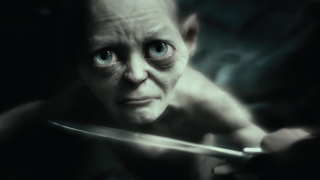
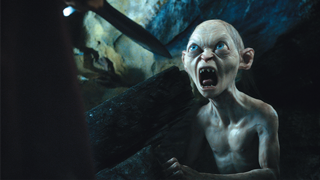
The character Gollum provides a good road map for describing how character creation and animation has evolved at Weta Digital. He appears in one sequence in the film, a sequence that many critics have called the best moment in the movie. Some lament that Andy Serkis, who plays the CG character, did not receive a best supporting actor nomination.
In the sequence, while trying to escape from the goblins, Bilbo [Martin Freeman] has stumbled and fallen into a cave. There, he finds Gollum’s “precious” ring, the powerful “One Ring” in The Lord of the Rings, although Bilbo doesn’t know this yet.
Before the ring, Gollum was Smeagol, a hobbit. Under the ring’s influence, he has become an emaciated, slimy creature who lives on cavefish and small goblins. His two personalities, past and present, are in constant conflict as we see in the sequence: Gollum threatens Bilbo— he would probably like to eat him. But, Bilbo intrigues the Smeagol side of the creature by suggesting a game of riddles. If Bilbo wins, Gollum will show him the way out of the cave. If Gollum wins, “We eats him,” the creature hisses at Bilbo.
Weta Digital created, and Serkis first performed, Gollum for the second and third films in The Lord of the Rings trilogy. At that time, Serkis performed the creature during filming on location, and then later, on a motion-capture stage, had to duplicate that performance. Now, for this film, the studio captured Serkis’s performance during filming using the same tools and techniques with which they had captured Serkis’s performance as Caesar in Rise of the Planet of the Apes.
“We wanted to capture every nuance Andy [Serkis] had,” Capogreco says. “The LED camera mounted on the front captured his face, and the remotely synced cameras tracked all his physical movements, his fingers, hands, feet. Literally every nuance. The animators then pushed Gollum’s face into contortions no human could quite do. They also worked on his eyes, to give them movement of some sort even when nothing else was moving. And, especially because of the stereo, they made sure Gollum’s toes were on the ground and his hands wrapped around the right things.”
Data captured from Serkis’s performance on set moved into Weta Digital’s motion-edit department. There, technical animators translated the clouds of data points into animation curves that move the digital puppet. “When all the individual controls on the puppet are mapped to corresponding bits of motion data, the puppet comes to life,” Capogreco says.
For the modelers, the challenge was creating a familiar face and body for fans of The Lord of the Rings trilogy, even though Gollum was 60 years younger and the artists could take advantage of improved technology and tools.
“It’s been a painstaking process,” Revelant says. “Ten years ago, we created Gollum using geometry and painted displacement maps. We reworked him completely, using real geometry rather than displacement. To do that, we looked at how he was then, rebuilt on top of that model, subdivided the geometry, and applied the displacement as geometry. For his face, we went from 5,000 polygons and displacement to 48,000 polygonal faces to give the animators more control. We wanted to bring him up to speed with our new, improved facial tools.”
Capogreco and Animation Director Dave Clayton started working on a test shot with Gollum in September 2011, and continued for another two or three months.
“When the first renders came out, we knew we needed to do some work on his facial rig and muscles,” Capogreco says. “Gollum set a huge benchmark 10 years ago, but we needed to bring him up to today’s standards and perhaps push past [that]. I also spent a good month or two with Joe [Letteri] looking at shots. We tried making him sweaty. We made his teeth grosser. Then we circled back, but not completely. In The Lord of the Rings, he had been tortured and beaten, and we didn’t want to make him that messed up. But, we poured in subtle details like age spots.”
To tweak the motion-captured data and add to Serkis’s performance, animators manipulate a simple puppet that has rigid pieces of geometry parented to the bones. “The animators get what most people think of as a previs puppet,” Clutterbuck says, “a simple puppet, not even skinned. We plug the output from animation, the curves, into our deformation system.”
The technical staff at Weta Digital had developed the deformation system to do highresolution muscle and skin simulations for Apes; particularly for Caesar, the chimpanzee star. The creatures group on Hobbit used an updated version of that system.
With rare exceptions, the crew doesn’t create rigs with skin clusters attached to joints. Instead, the creature group maps the animation curves onto a high-fidelity skeleton, builds and attaches muscles to these highly-detailed bones, adds a fat layer and skin, and runs the in-house finite-element simulation. The animation curves move the bones, and that movement triggers the muscle simulation. The muscles drive the fascia (the fat layer) and the skin, and thus, the simulation system deforms the shapes. Weta Digital’s Clutterbuck, James Jacobs, and Dr. Richard Dorling received scientific and engineering awards from the Academy for developing the “Tissue Physically-Based Character Simulation Framework” (see Here).
“People typically think of rigging as skin clusters and muscle primitives,” Clutterbuck says. “We don’t do that. We no longer have separate simulation and rigging groups. These days, everything—all the muscles, all the skin—is simulated. The muscles are elastic— big finite-element models with collision detection—so they tend to perform well, even when the animators go crazy. It’s a very anatomically- driven framework; very real world.”
Anatomically-driven even for such an odd, scrawny creature as Gollum. “You actually see finer details on Gollum than on the big, bulky guys, like the trolls, which have no muscle definition,” Capogreco says. “We made sure that when this little, skinny guy stretched his arms, the right muscles, the tendons in his neck, moved accordingly. He’s lean and cut, but underlying everything, you need muscles. He demonstrated some beautiful skin sliding and little subtle nuances. I think the biggest thing we improved upon, though, were his facial expressions to map Andy’s face onto Gollum. Andy really pushed himself.”
For faces, animators use a system based on blendshapes. The creature group then adds simulation elements on top. “The facial system is not broken down into types of expressions, just muscle groups,” Clayton says. “We can pull on certain muscle groups to get expressions, and it all combines nicely on the face. We could observe all of Andy’s details and replicate them.”
To give Gollum these extreme expressions and take advantage of the simulation tools, the crew rebuilt the facial puppet used a decade ago. The new system provided extra controls for additional detail, particularly around the creature’s cheeks, eyes, and lips, to take advantage of the fidelity now available in motion-captured data and to replicate Serkis’s performance.
“Ten years ago, the movement we could capture was more linear,” Capogreco says, “not as fluid. The capture is so much more advanced now. And, I think because of the technology and because he has gotten more comfortable with it, Andy [Serkis] knows we can capture a wider range of expressions and more subtlety. He gave the modelers and animators a run for their money. On one shot, we spent two or three weeks modeling corrective face shapes to capture what he was doing—closing his eyes, sputtering his lips.”
Animators also made sure Gollum’s big feet landed on the ground and didn’t go through the geometry. And, sometimes, they took Gollum beyond what Serkis’s supple face could do. “There’s one shot where Gollum realizes that Bilbo has the ring,” Capogreco says. “He turns around, shaking. He’s enraged. There was so much minute detail in Andy’s performance, but Peter wanted it amped up. He wanted to see the tension build in Gollum’s eyes and a shudder across his face. So that was hand animated.”
In the original version of Gollum, the crew had created his eyes using a sphere with textures and fake caustics. Later, for Planet of the Apes’ Caesar, they created eyes using a different method. “We give the eyes a lot of depth using a multitude of layers,” Capogreco says. “We layer together the major areas with the right shading.” For Gollum’s skin, Weta Digital’s Textures Supervisor and Creative Art Director Gino Acevedo, who was one of the painters for the first Gollum, led teams that used scans from various types of real-world skin to create the look of Gollum’s surface (see “Animation Evolution,” December 2011/January 2012).
“We have fine pore detail that wasn’t in the original Gollum,” Capogreco says. “And his shoulders by his neck almost look like turkey skin. Like a really senior person, but pushed beyond. There was a great deal of re-painting to add little moles and skin defects. And, we gave him peach fuzz. On some close-ups, you get kicks of hair on the tips of his ears.”
Gollum also got a haircut. “In the original version, his hair was down his back,” Capogreco says. “Now it’s to his shoulders.”
For the first Gollum, the hair team animated cloth strips to create his hair. For this film, his hair is dynamic; that is, simulation systems driven by animation curves move his hair. “We used a mix of tools for hair simulation,” Clutterbuck says. “We used an elastic rod system for the hedgehog spines and for the Warg fur because these big, crazy, dog-like things have hackles like furry manes. We also wrote tools in Maya that allowed us to represent hair as nCloth volumes or as individual strands. Then, we chuck everything into our in-house system called Barbershop, which allows us to plug in any dynamics we like.”

Wargs

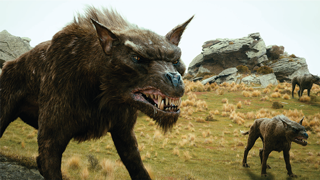
Barbershop had a particularly large role to play in creating the rough coat for the huge, wolflike creatures called Wargs, a more hyena-like version of which had appeared in The Two Towers, which was the second film in The Lord of the Rings trilogy. In Hobbit, the Wargs attack the dwarves in a fast-paced action sequence.
“Peter [Jackson] had an idea in his head for the Wargs in Rings, but he was never quite able to achieve it,” Saindon says. “Our technology for hair and fur wasn’t up to par at the time. We stepped it up a notch and got to the point where they are what Peter was thinking they should be: a combination of a wolf and a lion, with thick hair and a bit of a mane. Creepy, scary creatures with retro-reflective eyes.”
To help the groomers achieve the look Jackson wanted, the technical crew upgraded Barbershop, the hair and fur system used for Planet of the Apes. “Instead of the old-fashioned way of drawing curves and putting guide curves in the direction you want them to work, modelers have the ability to groom the curves,” Saindon explains. “They push the curves around with tools similar to blow-dryers, brushes, combs, and scissors, in the same way a hairdresser would work. Barbershop even has gel.”
As they had for Gollum and would for the digital doubles, other creatures, and animals, the animators created the performances using motion-captured data. For the Wargs, they captured data from Alsatian dogs brought into the studio for that purpose and from a dog that often visited the stage.
“We completely covered the dogs in Lycra suits to do the data capture,” Reynolds says. “We captured some nice motion, like how they turn and shift weight, that’s hard to do in keyframing, and we used a lot of it. When you have animators who need to perform 20 photoreal dogs in a scene, they instantly want to find some motion capture that would help.” Because the Wargs were five times larger than the dogs, the animators slowed down the captured motion data by 15 to 20 percent to add mass and weight, and had the Wargs turn more slowly. They also adjusted the postures in the data captured from dogs, which were uncomfortable wearing the Lycra suits.
“The tough thing with the Wargs was that there was always a heavy amount of keyframing rather than motion capture,” Reynolds says. “It didn’t help that most of our shots had 20 Wargs in them, and that every fourth Warg had an Orc rider. It was like a British foxhunting group, but with all Wargs rather than dogs and horses. The foreground ones would run to attack.”
The biggest Warg, a white creature that stands six feet tall at its head, carries the biggest Orc. Azog is a seven-foot-tall white Orc, and the main villain in the film.

Bipedal Dudes

On location, an actor in prosthetics played the Azog character, but later, Jackson wanted a different look, so the character became digital. “We painted out the first actor and replaced him,” Saindon says. “Azog’s performance is all based on motion capture that we did later on our motion-capture stage with another actor. The Orc is really creepy-looking, not quite human. He has no hair whatsoever. Big, sharp teeth. Spread-apart eyes set back in his head. Self-inflicted scarring that covers his body. Because he’s a white Orc, we played the subsurface scattering a little deeper than normal so he looks like maybe he’s underground a lot.”
Weta Digital built the bodies for bipedal characters, including the Orcs, digital doubles, goblins, and trolls in this film, from one template called “genman.” Genman is an ongoing project, a template for a male human, that the modelers and creature group base on data collected from a gymnastics instructor. Using realworld data from motion capture, various types of measurements, and scans, the crew builds and simulates the motion of bones, muscles, and fat, and validates the system they build digitally.
“We’ve done everything to this guy,” Clutterbuck says. “We’ve done full-body MRIs. We had his hands MRI’d in different poses to validate that our hand rigs match real-world poses. We’ve cyberscanned him, measured him, put him in a suit tailored for him and then taken the pattern apart to make sure our cloth simulation works. Genman is our template for bipedal dudes.”
To create a digital double, then, or a bipedal synthetic creature, the crew manipulates genman until it fits the required shape.
“For digital doubles, we have a model made with photo reference that has a polygonal skeleton modeled from a cyberscan,” Clutterbuck explains. “Not Maya joints. An actual anatomical skeleton. Using the outer skin and inner skeleton, we approximate the fit inside, warping everything, the way muscles attach to bones, the tendons, the entire setup. And, we do a bit of would be. Because we know genman works, we know we’ll be in a good ballpark whether we’re making Captain America or a dwarf. We don’t have to start from scratch. We get genman, do the warp, and we’re up and running.”
Because Weta Digital builds all creatures great and small with a muscle-simulation system, it also has a “genhorse,” created in collaboration with a nearby veterinary college, and a “gendog,” first created for the character Snowy in The Adventures of Tintin. “We didn’t do an MRI for the eagles,” Clutterbuck says, “but we found lots of repositories with CT and MRI data, and our system mapped almost one to one. We use MRI data as the basis for all muscles— real-world data that we can almost plug straight in.”

Gobs of Goblins

The generic templates help the crew more easily set up a creature. Other tools help them duplicate the result with variations. “We wrote new tools to populate the film with characters at the same quality as the ‘hero,’ ” Clutterbuck says. “Although we generated all the Orc and goblin variants from one ‘hero’ Orc and one ‘hero’ goblin, we don’t delineate between ‘hero’ and ‘background’ any more. We build one guy and use a tool set to create others procedurally. What’s cool about this is that if we change the ‘hero,’ the changes propagate out to all the others.”
The largest goblin and the one with the starring role was the toad-like but nine-foot-tall goblin king. “He had amazingly gross features, like massive wattles, that made him a lot of fun to work with and animate,” Clayton says. “We polished off the rough edges from the captured body movements and made him feel big and heavy, and we added extra ideas with keyframe animation to give him a stylized motion and identity.” Actor Barry Humphries provided the Great Goblin’s voice; Terry Notary, the motion-capture data.
Surrounding the Great Goblin, which was a unique model, is a horde of equally disgusting but smaller goblins that were surfaced, like the king, with pus and boils. To create these creatures, the crew produced 13 variants from one version fitted with a skeleton and muscles. “We do that with a script,” Clutterbuck says. “We transfer the basic setup to other characters of various sizes, and warp all the muscles and skin to fit. We don’t make 13 unique character rigs. In fact, when we make the ‘hero’ guy, we only make the right-hand side and then generate the left procedurally. We build an arm, a leg, and the right side, hook it up, and then asymmetrically warp the whole thing. There are 130 goblins in the film, and the whole build was run by two people.”
Similarly, the R&D department developed software for defining and creating a variety of rigged faces for characters built with a common topology.The FaceMixer program, developed by Alex Ma, Marco Barbati, and JP Lewis, improves upon simple blending techniques for crowd generation.(See Here)
“The system is like a mixer,” Revelant says. “You can specify a number of variations and it will automatically create that number of new characters. Or, you can drive the variations through sliders. For example, you can use 25 percent of the nose and the left eye of one, and 25 percent of the nose of another.”
This gave modelers the ability to design and create variations quickly. Even though the faces looked radically different, they all included complex facial rigs that incorporated 100 connected blendshapes or more. Some goblins, for example, have no nose or lips.
“Other systems based on blendshapes that work this way cut from one area of influence to another,” Revelant says. “But this system takes into account the surrounding area, so you never break the model. There is never an area of discontinuity. You end up with a new model, organically solved, with a new facial rig; it creates the complete blendshape tree.” And, because a hero character is the starting point for the variations, each variant has enough resolution in the body and face to step into a starring role.

Fat Trolls, Stone Giants

Facial animation, it turns out, was the biggest challenge for the three giant, flabby, CG trolls: William, Bert, and Tom, who appear in Hobbit. “Before now, they just grunted and roared,” Clayton says. “But, in Hobbit, they converse with one another, have arguments, and confront Bilbo. And, of course, there’s a big fight scene with the dwarves in which they roared and screamed, so we needed good facial animation with convincing dialog.”
Oddly, three of the actors who played the dwarves also doubled as the trolls, providing performances for the director and actors during the live-action shoot. “Parallel to that, on the motion-capture stage, Peter [Jackson] captured the trolls and recorded their voices,” Clayton says. “Peter went through the performances he liked and handed us the selects. I was able to use the motion they captured as the basis for their animation. The trolls are four meters high (approximately 13 feet), though, so we needed to add a lot of weight.”
The trolls were small, however, compared to the stone giants. In the film, the dwarves encounter the stone giants during a rainstorm while travelling through Misty Mountain. They emerge from what looked like a solid mountain and attack each other by throwing boulders, catching the unsuspecting dwarves in the middle.
“In a way, they were simple in terms of animation,” Clayton says of the giants. “They had no facial expressions, and they were slow. The challenge was to give something made of stone enough dynamic motion to make the sequence exciting but still make them feel heavy. We had to articulate the movement of their arms and shoulders without causing intersections.”

Eagles

Intersections were also a problem for the eagles, which, although large for their species, sit at the opposite end of any measurable scale from the stone giants. Heeding Gandalf’s call, the eagles fly into a sequence of approximately 120 shots to rescue Bilbo and the dwarves from an attack by the Orcs and Wargs; they snatch the wizard and his intrepid trekkers from trees they climbed to escape. Some eagles carry the rescued dwarves in their talons. Bilbo and Gandalf ride on the eagles’ backs as they swoop over the beautiful New Zealand landscape. Digital doubles and live-action actors filmed on a motion base helped the animators create the sequence.
Reference footage provided clues to the eagles’ performances, as did the eagles in the Rings trilogy. “Because the birds are so big, we had to make sure the poses were really strong,” Reynolds says. “The bigger challenge was the feathers, which are always a science experiment. The way they collide always affects us. We wanted to add a gentle flutter through the wings, and even in the main wing, the feathers bend a bit. So it doesn’t take much to end up with intersections. We animated the shapes and the flutter, and then the creature group simulated more flutter and ‘un-intersected’ everything.”
To bring the eagles up to date, the creatures group re-engineered the rig as well as the feathers. Although the 13 eagles were basically the same, the crew differentiated them with random feather colors and by changing the look of each eagle’s face.
Kevin Smith, who had worked on the eagle shots in Two Towers, supervised sequences with the eagles for The Hobbit. “We redid everything from The Lord of the Rings,” he says. “Chucked it out. They’re new from the ground up. For the feathers, we kind of based what we did on the falcon we created for Tintin. Previously, every feather on our birds was polygons with texture and opacity maps. This time, we grew each feather as physically correct as possible. We made the feathers with hair; they had a spine with hairs growing out the side.”
To groom the feathers, the creatures group used new, custom software called Plumage. “At render time, Plumage gives you any kind of features you want,” Smith says. “For far-away birds, we could use polygonal feathers if we saw no benefit in rendering a million hairs.”
The eagles were one of the few characters that didn’t start with motion-capture data; the sequence in which they soar was one of the last to wind its way through the pipeline. “It was a nice way to finish the animation on this movie,” Clayton says, “just before we had all these high-adrenaline shots when the dwarves are chased. And then these beautiful wide shots of the eagles. It was lots of fun to animate.”

Teasers

Animators also keyframed the performances of the rabbits, hedgehog, spiders, and the dragon Smaug, characters that played relatively minor roles in this film. The wizard Radagast [Sylvester McCoy] treats a sweet, but sick little hedgehog and cures the digital creature. Spiders climb over his house. And, the rabbits pull Radagast’s sled as he races across the country to draw the Wargs away from the dwarves.
“We had a slightly feral, giant Belgian rabbit that we used to model the look of our rabbits,” Aitken says. “We didn’t want them to look beautifully groomed or pampered. We wanted them to have a bit of character. We have great animation of them running, jumping, and pulling the sled, all keyframed. In the second film, the spiders will take over the forest, and the dwarves will have a big encounter with them. We’re paving the way for the detail that will be in films two and three.”
So, too, with the dragon Smaug, whose appearances bookend the first film. “In the animation takes, you could see Smaug clearly, but we used lighting, smoke from his breath, to tease out only parts of him. His tail snaking out through a destroyed façade, a foot here, a bit of belly there. We will probably do an extensive rebuild for film two.”
And again, no doubt for film three. The journey taken by scientists and artists at Weta Digital to make creatures that look and behave like those in the real world (whether the creatures are figments of someone’s imagination or not) is not unexpected.
Barbara Robertson is an award-winning writer and a contributing editor for Computer Graphics World. She can be reached at BarbaraRR@comcast.net.
http://www.cgw.com/Publications/CGW/2013/Volume-36-Issue-2-Jan-Feb-2013-/Of-Gollum-and-Wargs-and-Goblins-Oh-My-.aspx