
 Posts
Posts


Schools should teach pupils how to spot 'fake news'
|
Posted by Conspiracy Cafe on March 18, 2017 ~ hehe wakey wakey seepy heads |

By Sean Coughlan Education correspondent
18 March 2017
Young people need to be able to identify reliable information, says the OECD
Schools should teach young people about how to identify "fake news", says the Organisation for Economic Co-operation and Development's education director.
Andreas Schleicher is planning to include questions about such "global competencies" in the next round of the influential international Pisa tests.
He wants teenagers to look beyond the social media "echo chamber", where they might hear only views like their own.
Students need more places to "exchange ideas", says Mr Schleicher.
The OECD aims to develop global policies focused on improving economic and social well-being.
Its education chief says schools need to equip young people with the skills needed to navigate the digital world, with unreliable claims on social media and falsified news.
'Critical judgement'
"In the past, when you needed information, you went to an encyclopaedia... and you could trust that the information would be true," says Mr Schleicher,
But now he says young people go to Facebook or news websites and need to be able to evaluate what is reliable.
"Distinguishing what is true from what is not true is a critical judgement," says Mr Schleicher, who will be addressing the Global Education and Skills Forum in Dubai.
"Exposing fake news, being aware that there is something like fake news, that there is something that is not necessarily true, that you have to question, think critically - that's a very important task."
Mr Schleicher, who runs the international Pisa rankings, is going to introduce written tests in 2018 on global competency, which will assess how well young people are ready for a diverse and "interconnected world".
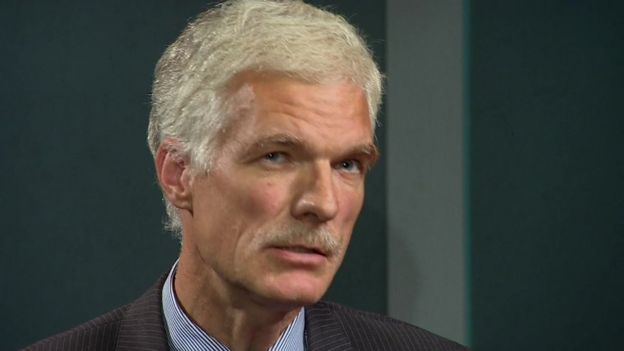
Andreas Schleicher says social media can encourage users to connect only with similar people
The tests currently assess teenagers' abilities in maths, science and reading - but the OECD is going to add this new measure of global competency.
"This assessment is about the capacity of young people to see the world through different perspectives, appreciate different ideas, be open to different cultures," he says.
"It is increasingly important for young people to engage with diversity, to be open to that, to draw value out of it, to see diversity not as a problem."
Mr Schleicher links this with young people from Europe going to the Middle East to fight for so-called Islamic State.
'Mono-cultures'
He says they want to turn "multi-religious, multi-ethnic" countries into "mono-cultures", which he says is "an outcome of the thinking that there is only one truth and there's only one way to live".
And he warns that social media can encourage people to "communicate and collaborate increasingly just with people who are similar".
"People are not prepared to see diversity as something positive, you see that level of disengagement," he says.
"I think that social media can reinforce that.
"The algorithms tend to relate people to people who are similar, rather than creating spaces for people to discuss debate and find common ground."
Against a backdrop of growing tensions around migration and national identity, Mr Schleicher says: "Europe has always been at its best when people were moving around, contrasting different ideas, different concepts.
"The Renaissance was a great example. There were different populations getting together. Open societies, diverse societies, were able to attract the best talent."
He forecast that the UK as an "open society" would do well on such "global competencies" - and highlighted that schools in the UK were much more successful at integrating migrants compared with France.
http://www.bbc.com/news/education-39272841
What they won't teach you is the western press is a propaganda organ of the power elite and what President Eisenhower called the military industrial complex. President Kennedy went further and make a speech on the ruthless conspiracy. He wanted to break up the CIA. They shot him.
BBC News uses 'Iraq photo to illustrate Syrian massacre'
Fake TV Images: BBC Admits “Switching Syria Footage” On Grounds of “Taste and Decency”
Look Who’s Really Behind the Mainstream Media
This should be the course material.
The most important thing my grandfather told me over and over in my youth was to think for yourself. NEVER LET ANYONE ELSE DO YOUR THINKING FOR YOU!
I would add especially a public school system.

Operation Mockingbird was allegedly a large-scale program of the United States Central Intelligence Agency (CIA) that, beginning in the early 1950s, attempted to manipulate news media for propaganda purposes, and funded student and cultural organizations and magazines as front organizations.
According to writer Deborah Davis, Mockingbird recruited leading American journalists into a propaganda network and oversaw the operations of front groups. CIA support of front groups was exposed after a 1967 Ramparts magazine article revealed that the National Student Association received funding from the CIA. Congressional investigations and reports in the 1970s also revealed Agency connections with journalists and civic groups. None of these reports, however, mentions an Operation Mockingbird controlling or supporting these activities.
A Project Mockingbird is mentioned in the CIA Family Jewels report, compiled in the mid-70s. According to the declassified version of the report released in 2007, Project Mockingbird involved wire-tapping of two American journalists for several months in the early 1960s.
History
The claim that CIA ran an "Operation Mockingbird" first appeared in Katharine the Great, a 1979 biography of Washington Post owner Katharine Graham, written by reporter Deborah Davis. According to Davis, Operation Mockingbird was established by Frank Wisner, director of the Office of Policy Coordination, a covert operations unit created by the U.S. National Security Council. Davis writes that Mockingbird was a response to the creation of a Communist front organization, the International Organization of Journalists, which "received money from Moscow and controlled reporters on every major newspaper in Europe, disseminating stories that promoted the Communist cause."
Wisner recruited Philip Graham from The Washington Post to run the projectwithin the industry. According to Davis, "By the early 1950s, Wisner 'owned' respected members of The New York Times, Newsweek, CBS and other communications vehicles."
In 1951, Allen W. Dulles persuaded Cord Meyer to join the CIA. According to Deborah Davis, Meyer became Mockingbird's "principal operative."
After 1953, the media network was overseen by CIA Director Allen Dulles, by which time Operation Mockingbird had major influence over 25 newspapers and wire agencies.The usual method was placing reports developed from intelligence provided by the CIA to cooperating or unwitting reporters. Those reports would be repeated or cited by the preceding reporters, which in turn would then be cited throughout the media wire services. These networks were run by people with well-known liberal but pro-American big business and anti-Soviet views, such as William S. Paley (CBS), Henry Luce (Time and Life Magazine), Arthur Hays Sulzberger (New York Times), Alfred Friendly (managing editor of the Washington Post), Jerry O'Leary (Washington Star), Hal Hendrix (Miami News), Barry Bingham, Sr. (Louisville Courier-Journal), James Copley (Copley News Services) and Joseph Harrison (Christian Science Monitor).
Congressional investigations
After the Watergate scandal in 1972–74, the U.S. Congress became concerned over possible presidential abuse of the CIA. This concern reached its height when reporter Seymour Hersh published an expose of CIA domestic surveillance in 1975.[6] Congress authorized a series of Congressional investigations into Agency activities from 1975 to 1976. A wide range of CIA operations were examined in these investigations, including CIA ties with journalists and numerous private voluntary organizations. None of the resulting reports, however, refer to an Operation Mockingbird.
The most extensive discussion of CIA relations with news media from these investigations is in the Church Committee's final report, published in April 1976. The report covered CIA ties with both foreign and domestic news media.
For foreign news media, the report concluded that:
The CIA currently maintains a network of several hundred foreign individuals around the world who provide intelligence for the CIA and at times attempt to influence opinion through the use of covert propaganda. These individuals provide the CIA with direct access to a large number of newspapers and periodicals, scores of press services and news agencies, radio and television stations, commercial book publishers, and other foreign media outlets.
For domestic media, the report states:
Approximately 50 of the [Agency] assets are individual American journalists or employees of U.S. media organizations. Of these, fewer than half are "accredited" by U.S. media organizations ... The remaining individuals are non-accredited freelance contributors and media representatives abroad ... More than a dozen United States news organizations and commercial publishing houses formerly provided cover for CIA agents abroad. A few of these organizations were unaware that they provided this cover.
CIA response
Prior to the release of the Church report, the CIA had already begun restricting its use of journalists. According to the report, former CIA director William Colby informed the committee that in 1973 he had issued instructions that "As a general policy, the Agency will not make any clandestine use of staff employees of U.S. publications which have a substantial impact or influence on public opinion."
In February 1976, Director George H. W. Bush announced an even more restrictive policy: "effective immediately, CIA will not enter into any paid or contractual relationship with any full-time or part-time news correspondent accredited by any U.S. news service, newspaper, periodical, radio or television network or station.
By the time the Church Committee Report was completed, all CIA contacts with accredited journalists had been dropped. The Committee noted, however, that "accredited correspondent” meant the ban was limited to individuals "formally authorized by contract or issuance of press credentials to represent themselves as correspondents" and that non-contract workers who did not receive press credentials, such as stringers or freelancers, were not included.
Other coverage
Journalist Carl Bernstein, writing in an October 1977 article in the magazine Rolling Stone, claims that the Church Committee report "covered up" CIA relations with news media, and names a number of journalists whom he says worked with the CIA. Like the Church Committee report, however, Bernstein does not refer to any Operation Mockingbird.
Project Mockingbird
In 2007 a CIA report was declassified that is titled the Family Jewels. Compiled by the CIA in 1973, it refers to a Project Mockingbird and describes a wiretap of journalists. The report was compiled at the request of then CIA director James Schlesinger, and was not declassified until 2007.
According to the report:
Project Mockingbird, a telephone intercept activity, was conducted between 12 March 1963 and 15 June 1963, and targeted two Washington based newsmen who, at the time, had been publishing news articles based on, and frequently quoting, classified materials of this Agency and others, including Top Secret and Special Intelligence.
The wiretap was authorized by CIA director John McCone, "in coordination with the Attorney General (Mr. Robert Kennedy), the Secretary of Defense (Mr. Robert McNamara), and the director of the Defense Intelligence Agency (Gen. Joseph Carroll)."
An internal CIA biography of McCone by CIA Chief Historian David Robarge, made public under an FOIA request, identified the two reporters as Robert Allen and Paul Scott. Their syndicated column, "The Allen-Scott Report," appeared in as many as three hundred papers at the height of its popularity.
https://en.wikipedia.org/wiki/Operation_Mockingbird


 WIRED
WIRED