---BREAKAWAY CIVILIZATION ---ALTERNATIVE HISTORY---NEW BUSINESS MODELS--- ROCK & ROLL 'S STRANGE BEGINNINGS---SERIAL KILLERS---YEA AND THAT BAD WORD "CONSPIRACY"--- AMERICANS DON'T EXPLORE ANYTHING ANYMORE.WE JUST CONSUME AND DIE.---
Ever since Edward Snowden’s
arrival in Moscow, the whistleblower has quite literally vanished. The
explanation for Snowden’s ‘dematerialization’ is rather simple: the
leaker never existed in the first place. American NSA created the
character of ‘Edward Snowden’ to distract the global audience from the
real problem behind his persona – the vast espionage operation the US
has been conducting for years. Given that George Lucas instructed the
NSA on how to create a simulacrum, Snowden might well be a hologram.
If one starts thinking about Snowden’s story
in retrospect, it actually becomes all too obvious. Ezra Klein of the
Washington Post suggests that from the very beginning, Mr Snowden’s life
seemed to follow the classic movie scenario of the
‘American-dream-gone-bad’. A high-school dropout, he became a lone
hacker who turned out to be so bright and talented that he finally
became an employee of a giant contractor to the CIA. He was a successful
young man with a beautiful model girlfriend who, in turn, was a
pole-dancing acrobat. The two lived in a cosy house in Hawaii and should
have been together ‘until death did them part’.
At some
point in his life, however, Mr Snowden has suddenly realized that his
life might not be as perfect as it seems, and this is where the real
thriller began. The young man decided that he cannot possibly live a
‘good life’ being aware that his country is spying on its own citizens.
As a result, the brave hacker made a decision to sacrifice his future to
expose the NSA’s most secretive program. Sounds like a great Spielberg
film, doesn’t it? In this sense, it is far from incidental that the
Financial Times claimed that “if Edward Snowden didn't exist, Hollywood would probably have invented him”.
But
even if one assumes that Snowden does exist, why would a successful
young man living on Hawaii with his perfect girlfriend ruin his life
like this? According to Ezra Klein, the answer is less philosophical
than it seems: he did this ‘heroic’ act because he isn’t real. The NSA
created ‘Edward Snowden’ to keep the NSA programs safe. The information
about American secret programs was leaking anyway – ever since 2010,
when WikiLeaks’ Julian Assange published US military and diplomatic
documents with assistance from his partners and US Army’s Bradley
Manning, American security agencies have no longer been safe from info
leaks.
As a result, the US government needed a
distraction – something connected to the NSA, so covering it would still
feel like covering the NSA story, but that would divert much of the
press from covering the actual programs. From this perspective the
character of ‘Edward Snowden’ was Obama’s diversionary tactic to get the
masses following a narrative, an ‘emotional arc’, and thus forget about
the essence of the problem.
And it worked. ‘It’s
alive’, probably uttered the American President when the US government
was actually able to divert attention and control the global debate on
American espionage by calling the imaginary Snowden a traitor ’engaged
in‘ espionage and fixating on the cat and mouse game. The media was a
vital component of this propaganda strategy. As the US authorities
feigned openness and called for justice enough, global mass media
covered it hence avoiding the implications of the leaks.
Indeed,
it is hard to find someone who had not heard of Edward Snowden. The
whole world knows what flight he was supposed to be on and which
countries he is considering as safe harbors. There will, presumably,
even be an eventual resolution to the Snowden story, such that those
following it feel they have a sense of closure and can move onto other
topics. By that time, the term “Stellarwind” will probably be already
forgotten by the general public.
For those still skeptical, ‘Edward Snowden’ might just be a high resolution hologram.Just as in Victor Pelevin's trippy, post-cyberpunk satire ‘Homo Zapiens’,
Edward Snowden is a holographic, a virtual puppet of the NSA. Word on
the street is that George Lucas had previously instructed his Industrial
Light and Magic to advise the NSA and CIA on how best to create a
digital simulacrum of a person. Lucas' best work in years.
Today is the Fourth of July. It is an American holiday of our Independence from Control of Britain.
It is actually a sad today, in my opinion. Why?
Our great country was formed by people who risked their lives and fought for Liberty and Justice and Freedom for ALL!
Think about what the fore fathers went through. Think about what the people went through during that time.
They were determined to have Freedom! They were determined to not be
controlled and made slaves of by the British. They envisioned a more
"Perfect Union" for All!
Many lost their lives to fight for our Freedoms. It is not the same as
what the military are doing now. Even though the government tries to
say all the wars are for "Our Freedoms and Democracy", we know it is for
their control of another country.
We have no right to celebrate the Fourth of July anymore! American's have lost their spirit. Americans have given up their Freedoms. Americans have given up their liberty. American's have given up their basic human rights to Privacy. Americans are about to give up their country.
The people from 1776 would be disgusted and appalled today at how
Americans have allowed the country they fought for go into an Orwellian
and Dictatorship type control. They would cry and wonder why the
Americans today have allowed the country to go the way it has.
Upside down flag, Country in Distress
Where is the American spirit today? Where is the real celebration of
the Fourth of July? Where is the spirit of Freedom and the most basic
human rights of Liberty?
How can Americans sit back and allow our constitutional rights be
shredded? We have no rights to privacy anymore, all due to the "War on
Terror."
I ask every American today to think back and imagine what it was like
for those who fought for this country to be a Free country. I ask every
American to embody the Spirit of the basis for this country and how we
were guaranteed basic human rights of Free Speech, Free from Oppressive
government control, and Rights to Privacy besides our Right to Bear
Arms!
I want Americans to reflect on what has happened to this country the
last few decades and how our "leaders" have taken down the road they
have.
I ask Americans to look at what other people are doing in other
countries and how they are standing up for their country and their
rights!
Where are Americans today? Where is the American Spirit?
Americans have no right to celebrate the Fourth of July today! They
don't have that right because the Fourth of July is about Freedom! We
no longer have those Freedoms due to American in action of standing for
what the original Fourth of July is about!
No man can be oppressed without his consent. No man can continue to
be a victim without his permission. It is a CHOICE to give up one's liberty
rather than to fight to preserve it. Each person on the planet is born with the
same right to Freedom, Liberty and the Pursuit of Happiness. When one person oppresses another, the victim
still has his rights. He is just choosing not to assert
them. So, WE STILL HAVE OUR RIGHT TO FREEDOM, LIBERTY AND
THE PURSUIT OF HAPPINESS. Rather, Americans have GIVEN UP their freedoms,
liberty and the right to pursue happiness to others who now control global
commerce and military militias. We still have our rights!We are not asserting them. We are choosing to
allow ourselves to be treated a certain way. It will continue to get worse
until we refuse to be oppressed, enslaved, controlled and
dominated.
Passing
an illegal law does not make the law legal. Any law that distorts or impedes
the Constitution is illegal. It is not illegal to resist an illegal "law". In
fact, the founding fathers wrote that it is a moral imperative to resist such a
force. Americans have chosen not to resist assaults on the Constitution.
I Beg Americans to have the FOURTH OF JULY SPIRIT! EMBODY THE FREEDOM AS WE ARE MEANT TO HAVE! EMBODY THE SPIRIT OF LIBERTY AS WE ARE MEANT TO HAVE! EMBODY IT EVERYDAY! NOT JUST TODAY! DO SOMETHING! DEMAND OUR RIGHTS TO BEAR ARMS, LIBERTY, FREEDOM, WITHOUT OPPRESSION! BECOME AS OUR FOREFATHERS WERE: DETERMINED TO HAVE A COUNTRY THAT IS FREE FOR ALL AND A MORE PERFECT UNION!
STAND UP FOR YOUR COUNTRY! OUR FOREFATHERS STOOD UP IT IS TIME WE DO TOO!
As if George Washington hasn’t been credited enough with
laying the foundation stones of the American republic, a new discovery
might put one more feather in his cap. Our leading Founding Father could
have been author of the country's name.
The identity of who coined the name “United States of America”
has eluded historians for years. Online sources vary greatly,
erroneously crediting Thomas Paine, Benjamin Franklin, Alexander
Hamilton, and others.
But a letter written by Washington’s
aide-de-camp on Jan. 2, 1776, discovered this past Memorial Day,
suggests that Washington might have been one of the first people – if
not the first person – to utter the words "United States of America."
Previously, William Safire and a bevy of Oxford and American researchers essentially concluded in 1998 that Thomas Jefferson
was the originator. Jefferson wrote “UNITED STATES OF AMERICA” in the
header of his “original Rough draught” of the Declaration of
Independence sometime on or after June 11, 1776. Then last summer, the
Monitor reported the discovery of an earlier citation in an anonymous
essay appearing in the Virginia Gazette, dated April 6, 1776.
This latest find comes in a letter that Stephen Moylan, Esq., wrote to Col. Joseph Reed from the Continental Army Headquarters in Cambridge, Mass., during the Siege of Boston.
The two men lived with Washington in Cambridge, with Reed serving as
Washington’s favorite military secretary and Moylan fulfilling the role
during Reed’s absence.
The letter touched on the colonies' desire
to enlist Europe's help in their revolution – most likely in procuring
much-needed armaments and gunpowder. The shortage of powder was so
desperate that, at one point, orders were issued to use wooden harpoons
instead of guns. Moylan wrote that he wished to carry the “full and
ample powers from the United States of America” to Europe to support the
revolutionary enterprise.
The
letter was written at a time when the American colonies were
increasingly taking on the trappings of a new, independent nation. As
historian Kevin Philips summarizes, “Despite lack of international legal
recognition, the Continental Congress functioned as a de facto war
government. By the end of 1775, the United Colonies had also created an
army (June 15), a navy (October 13), and even a marine corps (November
10).”
When Congress appointed Washington commander-in-chief and
dispatched him to Boston, Washington called his men “the Troops of the
United Provinces of North America.” Washington sought to turn these
troops into a fighting force capable of engaging the most powerful
military of the age, and at different times, Reed and Moylan worked side
by side with him, issuing orders, writing letters, and sitting in
council.
On Christmas Day 1775, just eight days before his "USA"
letter, Moylan inscribed on the flap of a document: “On the service of
the United Colonies.” Yet on Jan. 2 he wrote of the “full and ample
powers from the United States of America.”
What could have caused this shift?
There
are two significant events that occurred between Christmas Day 1775,
and Jan. 2, 1776, that could have precipitated the shift in tone.
The first was King George III's
speech to Parliament, which arrived in the hands of the Continental
Army on New Year’s Day. In it, George III condemns the rebellion in the
colonies, calling his American subjects “deluded” and their leaders
“traitorous.” He accuses the conspirators as having designs for an
“independent empire,” and lays out his plan to expand British land and
naval forces in America and seek the assistance of foreign steel to
crush the rebellion.
For many Americans, this was the last straw. It was their Rubicon – all-out war was now inevitable.
The
second event, also on New Year’s Day, was the unfurling of what is
known as the first flag of America, the Grand Union flag, which featured
13 characteristic red-and-white stripes with the British Union Jack in
the canton. The Grand Union flag was raised by Washington on Boston's
Prospect Hill in a ceremony to commemorate the inauguration of the
Continental Army of '76 – the reformed army that Washington had worked
tirelessly to build. It must have been a heady occasion, and perhaps the
phrase “United States of America” was sounded that day.
What is
known is that Washington understood and practiced the virtue of
restraint – he was careful and cautious. His political steps and
maneuvers were well thought out, and although notions of independence
were likely discussed frequently among the Founders, many of these men
were reticent to articulate as much in print. It was something you could
lose your head over.
Washington later said he had given up any
hope for peace by November 1775 after learning of the king’s
proclamation for suppressing rebellion. But the king’s latest speech
went even further and was actually inflammatory – so much so, the
continental soldiers burned it on arrival. For all intents and purposes,
the British king accused the Americans of already declaring
independence, as Moylan writes to Reed, “Look at the King’s speech – it
is enclosed in this, or in the General’s letter to you … – will they
[Congress] not declare what his Most Gracious Majesty insists on they
have already done?”
This letter from Washington to Reed mentioned
by Moylan oozes with subtlety and sarcasm. For the calculating
Washington, it suggests the veiled language of a man telling his most
trusted and perceptive aide that all-out war is coming and, perhaps,
that it could only lead to a declaration of independence, which happened
seven months later.
“We are at length favoured with a sight of
his Majesty’s most gracious speech. Breathing sentiments of tenderness
and compassion for his deluded American subjects; the echo has not yet
come to hand, but we know what it must be….”
In
Moylan's Jan. 2 letter, maybe "United States of America" was a slip of
the pen, so to speak – the idea of a new nation that, until then, could
only be whispered. Nevertheless, it is concrete evidence that the phrase
“United States of America” was written, and most likely spoken, in a
home in Cambridge converted to a war office at the dawning of America’s
revolutionary year. Whether Washington, Moylan, or even Reed should be
credited is somewhat beside the point. In many matters, all three spoke
with one voice – the voice of the commander-in-chief of what would
become the United States of America. http://news.yahoo.com/coined-united-states-america-mystery-might-intriguing-answer-181425206.html
Source: Atlantic Wire
The day after President Mohammed Morsi was forcibly removed from office by the military,
it appears Egypt’s new leaders are hunting for his Muslim Brotherhood
pals and arresting the Islamist political party’s top officials.
According to reports from Reuters, the Associated Press and the AFP,
Egyptian authorities issued arrest warrants for the Muslim
Brotherhood’s supreme leader Mohammed Badie, his first deputy Khairat
El-Shater, and around 200 other Brotherhood members on Thursday. The Associated Press reports Badie has already been detained in a coastal city close to the Libyan border and is now being flown back to Cairo.
Meanwhile, the newly deposed Morsi is still under house arrest at an
undisclosed location somewhere in Egypt just a year and a few days after
he became Egypt’s first democratically elected President. Reports of
his house arrest started trickling out Wednesday evening. At least a dozen of Morsi’s closest aides and advisors are also under house arrest.
Badie and Shater are wanted on charges they incited violence in front
of the Muslim Brotherhood’s headquarters in Mokattam, a neighborhood in
southern Cairo, on Sunday that left eight people dead. Badie and
Shafter are seen by opposition officials as the real brain trust behind
Morsi while he was in office. Badie was the original muslim Brotherhood
candidate before prior convictions forced him to resign and let Morsi
take his place. Regardless of the charges, some in Egypt don’t think
arresting top Brotherhood officials if the new government wants to avoid
inciting violence:
The arrests came at an off time considering, earlier Thursday
morning, Egypt swore in Adly Mansoor (pictured above) (who you can follow on Twitter here)
as the country’s new interim leader and he offered an olive branch to
the spurned religious group. “The Muslim Brotherhood group is part of
this people and are invited to participate in building the nation as
nobody will be excluded, and if they responded to the invitation, they
will be welcomed,” he said, according to the state newspaper.
Mansoor will replace Morsi with the help of a panel of technocrats
until a new election can be called. But the Muslim Brotherhood has
already rejected Mansoor’s invitation for cooperation. “We reject
participation in any work with the usurper authorities,” Sheikh Abdel
Rahman al-Barr said, via a statement on the group’s website, while
urging Brotherhood supporters to “stay peaceful” while rejecting the
country’s new leaders.
“Hagel and Dempsey were walking a fine line … expressing concern while attempting to avoid the impression that the U.S. was manipulating events behind the scenes.” (Military.com, July 3, 2013)
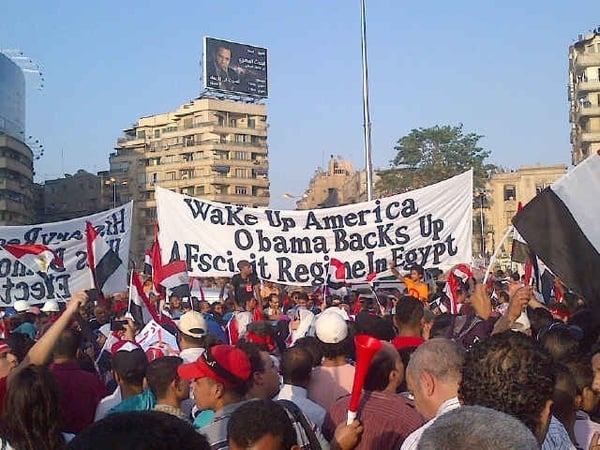
The protest movement is directed against the US and its proxy Muslim Brotherhood regime.
The Muslim Brotherhood had been spearheaded into the government with
the support of Washington as a “replacement” rather than an
“alternative” to Hosni Mubarak, who had faithfully obeyed the orders of
the Washington Consensus from the outset of his presidency.
While the Armed Forces have cracked down on the Muslim Brotherhood,
the Coup d’Etat is ultimately intended to manipulate the protest
movement and prevent the accession of a “real people’s government”. The
overthrow of President Mohamed Morsi by the Egyptian Armed forces was
not carried out against US interests, it was instigated to ensure
“continuity” on behalf of Washington.
“Demonstrators carried hand-made posters
denouncing Obama and his pro-Muslim Brotherhood Cairo Ambassador, Anne
Patterson.” (F. William Engdahl, Global Research, July 4, 2013). The Muslim Brotherhood and the CIA
Western intelligence agencies have a longstanding history of
collaboration with the Brotherhood. Britain’s support of the
Brotherhood instrumented through the British Secret Service dates back
to the 1940s. Starting in the 1950s, according to former intelligence
official William Baer, “The CIA [funneled] support to the Muslim
Brotherhood because of “the Brotherhood’s commendable capability to
overthrow Nasser.”1954-1970: CIA and the Muslim Brotherhood Ally to Oppose Egyptian President Nasser,
These covert links to the CIA were maintained throughout the government of Hosni Mubarak.
From the outset of the “Arab Spring”, the Obama administration’s
objective was to undermine secular governments in the Middle East and
North Africa and install a model “Islamic State”, which would serve US
geopolitical and corporate interests. “Strong Economic Medicine”
The protest movement against Mubarak in early 2011 was in response to
the devastating impacts of IMF reforms. Initiated at the height of the
Gulf War in early 1991, these reforms –which span over a period of
more than 20 years– have served to impoverish the Egyptian people, while
also “opening up” the Egyptian economy to the influx of “foreign
investors”.
The Nile Valley which was Egypt’s breadbasket for more than 3000
years was destroyed in favor of food imports from the US and the
European Union.
The resulting deregulation of food prices, sweeping privatization,
austerity measures had led to poverty and mass unemployment. In turn,
social programs collapsed, Egypt’s economy and financial system were
destabilized. Continuity
pertaining to neoliberal economic reform is central to US sponsored
regime change. Morsi’s accession to the presidency was conditional upon
his acceptance of IMF “economic medicine”.
In August 2012, IMF Managing Director Christine Lagarde stated candidly that “The IMF will accompany Egypt as it undertakes this challenging journey… It’s an Egyptian journey and the IMF is a partner in that journey.”
“We are impressed by the strategy that President Morsi
and Prime Minister Kandil have proposed during our meetings today,”
Lagarde said at a press conference attended jointly by Kandil. (IMF , August 22, 2012)
A new IMF package of (deadly) macro-economic reforms was launched
with a view to “managing Egypt’s political and economic transition”
(Ibid). The resulting IMF sponsored “transition” imposed by Egypt’s
external creditors has served to exacerbate rather than alleviate the
economic and social crisis.
Social conditions have deteriorated dramatically since the demise of
Hosni Mubarak. The mass protest movement against President Morsi was in
large part motivated by the fact that the Mubarak era macro-economic
reforms imposed by Washington and Wall Street continued to prevail,
leading to a further process of impoverishment. The Role of the Armed Forces: “Green Light” from the Pentagon?
The media has portrayed the Egyptian armed forces as broadly
“supportive” of the protest movement, without addressing the close
relationship between the leaders behind the military coup and their US
counterparts.
The fact that segments of the mass movement called for the armed forces to play a “supportive role”, is an obvious ploy:
This is the message that the armed forces received from
all over urban Egypt, its cities, and its villages; it (the military)
recognized the invitation, understood its intentions, appreciated its
necessity and got closer to the national scene hoping, willing and
abiding by all limits of duty, responsibility and honesty.
Known
and documented, the mass movement has been infiltrated. Sectors of the
opposition to the Muslim Brotherhood government are supported by the
National Endowment for Democracy (NED) and Freedom House. The Kifaya
civil society movement, is supported by the US based International Center for Non-Violent Conflict.
The role of the armed forces is not to protect a grassroots movement.
Quite the opposite: the objective is to manipulate the uprising and
quell dissent on behalf of Washington.
The objective of the military takeover is to ensure that the
downfall of the Muslim Brotherhood government does not result in a
political transition which undermines US control over the Egyptian State
and military.
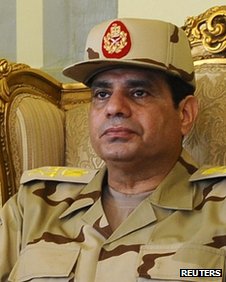
Let us be under no illusions.While there are important divisions within the military, Egypt’s top brass ultimately take their orders from the Pentagon. Defense Minister General Abdul Fatah Al-Sisi
(left), who instigated the Coup d’Etat directed against President Morsi
is a graduate of the US War College, Carlisle, Pennsylvania .
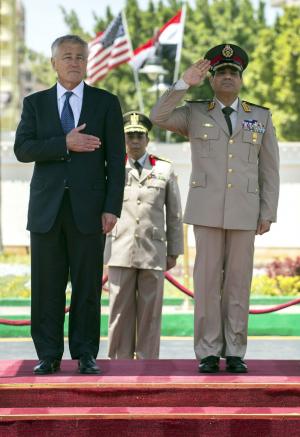
General Al Sisi was in permanent liaison by telephone with US Defense Secretary Chuck Hagel
(right together with Al Sisi) from the very outset of the protest
movement. Press reports confirm that he consulted him several times in
the days leading up to the Coup d’Etat. It is highly unlikely that
General Al Sisi would have acted without a ‘green light” from the
Pentagon.
Hagel
phoned al-Sisi last Thursday [June 30th] as the huge demonstrations
calling for Morsi’s ouster took on an increasingly anti-U.S. tone, and
spoke with him again on Tuesday [July 2] after al-Sisi delivered an
ultimatum warning that the military would act if Morsi failed to make
concessions. Military.com,
In turn General Martin Dempsey, chairman of the US Joint Chiefs of Staff, was in permanent contact with his counterpart General Sedki Sobhi, chief of staff of Egypt’s Supreme Council of the Armed Forces (SCAF):
Pentagon officials declined to give specifics on
the conversations between Hagel and al-Sisi, but chief Pentagon
spokesman George Little said that “US officials at all levels [of the
military] have made it clear that we support the democratic process
in Egypt and that we hope that this period of tension can be resolved
in a peaceful manner and that violence can be avoided. … (Military.com,
op cit, emphasis added)
According to Military.com, Hagel and Dempsey “were walking a fine line” … “expressing concern while attempting to avoid the impression that the U.S. was manipulating events behind the scenes.”
Egypt is the largest recipient of US military aid after Israel.
The Egyptian military is controlled by the Pentagon.
In the words of General Anthony Zinni, former Commander of US Central Command (CENTCOM):
“Egypt is the most important country in my area of responsibility because of the access it gives me to the region.”(emphasis added)
Orbiting about 250 miles (400-ish km) above our heads is one of
the most complex and expensive engineering projects that the human race
has ever put together: the International Space Station (ISS).
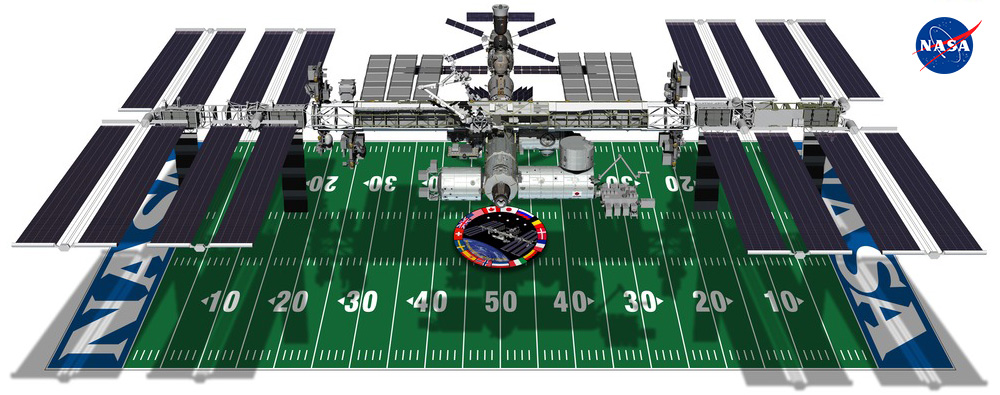
The station masses around 450 tons (400 metric tons) and is a bit
larger than an American football field. Its assembly required dozens and
dozens of launches by Russia and the US (including 37 space shuttle
flights), and it took astronauts and cosmonauts 155 spacewalks to get
the whole thing bolted together—2.5 times more spacewalks than had
previously occurred since the beginning of space flight.
Enlarge/ The International Space Station compared to the size of an American football field.
NASA
The ISS has taken 13 years and as much as $150 billion to build and
fly; to call it valuable real estate is an understatement. As we
Americans are relaxing for the Fourth of July and drinking beers or
lighting off fireworks, high above our heads, six human beings
are working in space. But the station isn't just sitting up there,
static and unmoving. The ISS' orbit decays due to atmospheric drag at
the rate of about two kilometers per year; it must periodically be
boosted in order to maintain its height. Moreover, the entire massive
structure is mobile—it can be rolled and pitched and yawed, or
even moved ("translated," in NASA parlance) in three dimensions to avoid
a potential collision with debris.
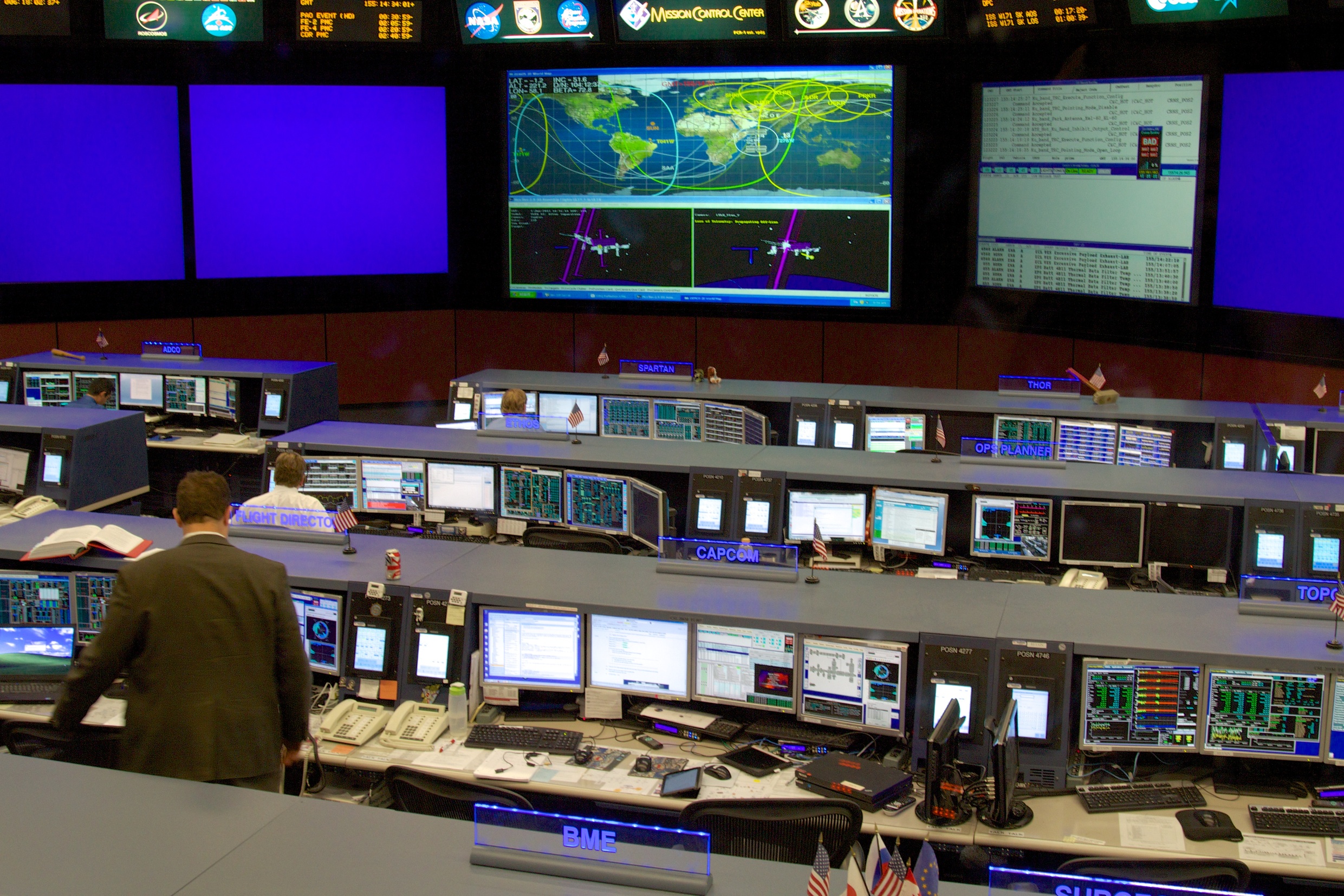
Enlarge/ The International Space Station Flight Control Room on the second floor of Building 30 at the Johnson Space Center.
Lee Hutchinson
Ars Senior Science Editor John Timmer wrote back in May about the
complex process behind moving unmanned satellites around in
orbit —specifically, what it took to move NASA's Fermi Gamma-ray
Space Telescope out of the way
of some debris in its orbital path. But the ISS isn't an unmanned
satellite; its mass is much larger. More importantly, it has six living,
breathing human beings on board. How does one move 400 tons of fragile
space station when there's an asteroid or something bearing down on it?
Ground control to Major Tom
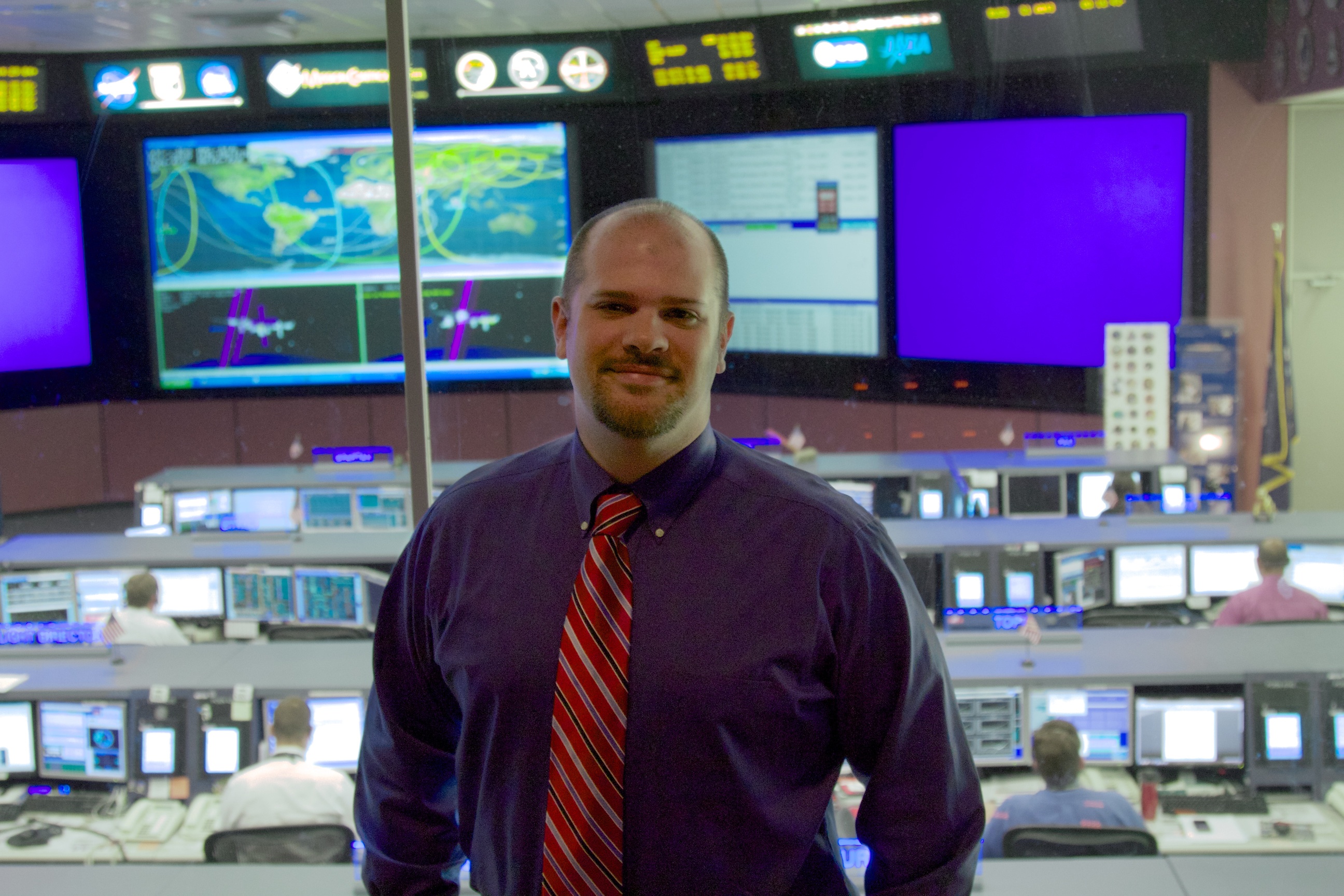
To find out how to throttle-jockey the ISS around in orbit, I took a
drive over to NASA's Johnson Space Center and met up with Josh Parris, a
NASA ISS flight controller. Parris is one of the people tasked with
manning a console in the ISS flight control room—or "Mission Control" as
it's more commonly known. His station name is TOPO—Trajectory
Operations Officer. As has been the case since the earliest days of
manned space flight, the ISS flight controllers are all highly skilled
individuals; Parris and his coworkers have all undergone years of
specialized training to reach the point where they are trusted with
"sitting a console."
"TOPO is in charge of maintaining the knowledge of where the space
station and visiting vehicles are, where they're going to be, and to
make sure they don't get hit by anything," he explained. There aren't a
lot of operational satellites at the ISS' normal flying altitude of
about 400 km, but there is a fair amount of debris circling the earth at
about the same height. There have been hundreds of potential
"conjunctions" in the last couple of years—that is, warnings by
ground-based radar sources about potential collisions between the
station and some debris. In 2013 alone, there have been 67 potential
conjunction notifications.
"What exactly makes up the debris?" I asked Parris. "Is it from the Chinese blowing up satellites?" "That's a big chunk of it," he confirmed. "Also, the collision
between the old Russian Kosmos satellite and the Iridium satellite is a
source of a lot of the debris we see. And that's just the stuff that's
made it down to our orbit; there's plenty of debris still above us, just
waiting to come down."
"Who tracks these things?" I asked. "Is there a big computer map like you see in the movies with fancy graphs and stuff?" "USSTRATCOM,
at Vandenberg Air Force Base," he replied. "They maintain a catalog of
all pieces of debris—all objects in space—and routinely, three times a
day, they screen the ISS trajectory versus that catalog. They're the
ones who notify us if there's a close approach."
A "close approach"? That sounds scary. I asked Parris to elaborate,
and he explained that there is an imaginary "pizza box"-shaped perimeter
around the International Space Station. This perimeter extends two
kilometers above and below the station and 25 kilometers "cross-track"
and "down-track" (track here refers to the orbital path the
station traces). If a piece of debris is expected to come anywhere
within that box, USSTRATCOM notifies NASA.
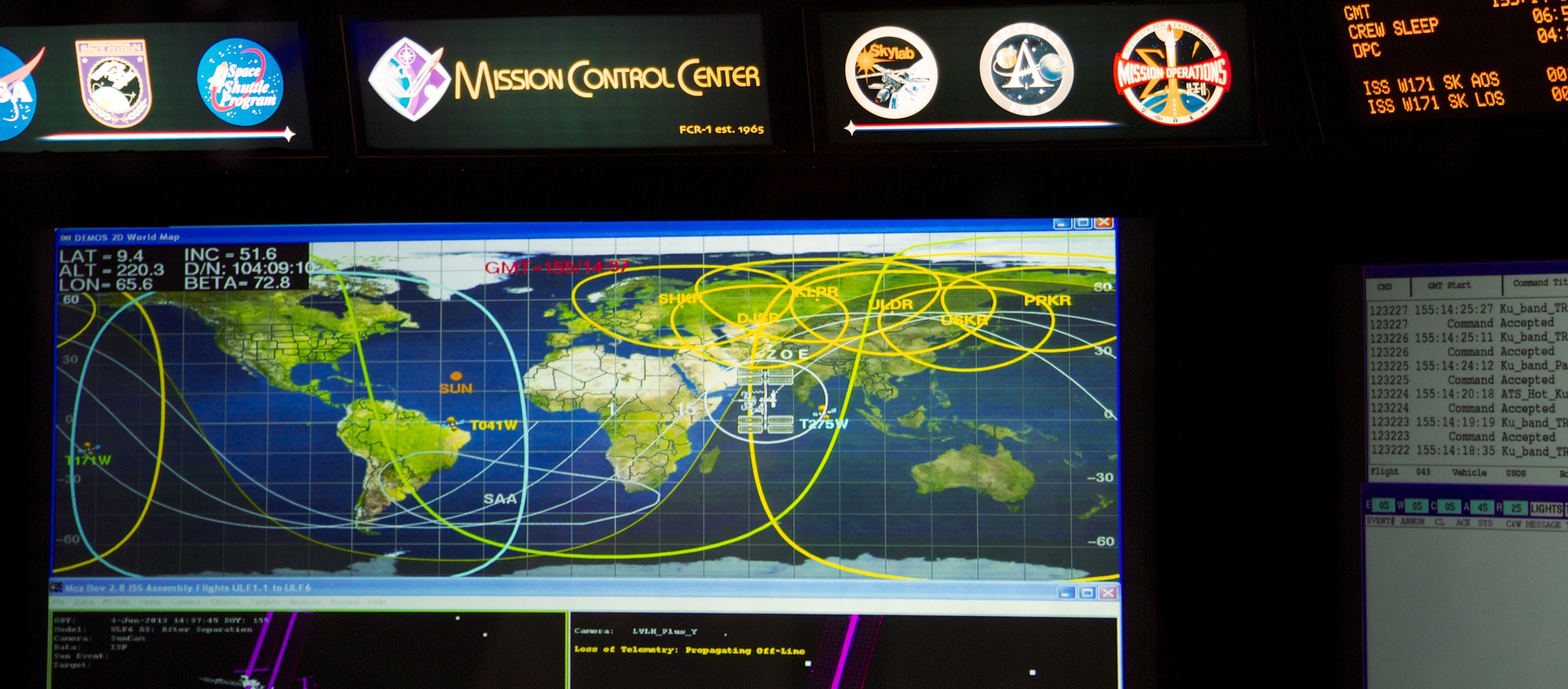
Enlarge/
The main display at the front of the FCR, showing the station's
position, orbital path, and the various ground stations with which it
can communicate.
Lee Hutchinson
The TOPO controller keeps track of everything inside that pizza
box-shaped perimeter, and they compute the probability of collision for
all of the objects that they're tracking. TOPO assigns cautionary
thresholds to each object depending on how likely a collision is. Any
object with between a 1-in-10,000 and 1-in-100,000 chance of colliding
with the station meets the "yellow" threshold. Flight rules say that the
station must be moved out of the way in response to a yellow threshold
object unless such a move results in a mission impact—"Like, if we do
the burn, we're going to miss an opportunity to launch a Soyuz, for
instance," explains Parris. "Do we delay the Soyuz, or do we do the
maneuver?" A "red" threshold is assigned to any collision with a
likelihood of between 1 (in other words, absolutely certain) and
1-in-10,000. Flight rules are more strict for maneuvers in response to
red threshold objects: the station is always moved for a red
threshold object, regardless of mission impact, unless a maneuver
represents more risk than not maneuvering (for example, if there's a
piece of equipment that's damaged on the ISS and a maneuver would
exacerbate that damage).
Thrusters and gyroscopes
The ISS, for all its size and apparent fragility, is actually pretty agile. It has four gyroscopes, called Control Momentum Gyros,
or CMGs, which allow it to change its attitude. These gyros fall under
the responsibility of the ADCO (Attitude Determination and Control
Officer) flight controller, with whom TOPO often works when figuring out
how to handle incoming debris.
Enlarge/ ADCO: the Attitude Determination and Control officer. Notice the baseball bat, for attitude adjustment.
Lee Hutchinson
Additionally, the station has several sets of thrusters that allow it to rotate and translate. The Zvezda service module is equipped with thrusters, and there are thrusters on docked vehicles like the Progress resupply craft and the ESA ATV that can
also be employed. Space shuttles could also be used when they were
still operational. For a typical debris avoidance maneuver, the station
will be subjected to delta V of between 0.5 and 1 meter per second.
One of the parameters TOPO keeps track of is the station's mass,
since the precise amount of thrust required to generate the required
delta V varies depending on the mass that must be moved. The ISS' mass
varies primarily when vehicles dock and undock. The level of delta V
generated during a typical avoidance maneuver isn't enough to disrupt
the routine of the crew—they're aware of when the maneuvers are
happening, but it's all controlled from the ground and they don't have
to do anything special. "They're not up there with joysticks zooming the
station around, are they?" I asked. "No," laughed Parris. "It's all
commanded from the ground." Listing image by Lee Hutchinson
Swinging into action
When a piece of debris meets the yellow or red thresholds, it becomes
time to take action. At 28.5 hours before the chunk of debris' closest
approach to the station, TOPO kicks off the debris avoidance maneuver
planning process. "Why 28.5 hours?" I asked. It seemed like an odd
number. "The Russian segment is the one who's going to be doing the
burn," explained Parris. "Due to the time change between Houston and
Moscow, that will allow enough time for their specialists to come in and
design—well, they call it a 'cyclogram,' which is the program that is
uplinked to the station that commands the vehicle to do the burn. That
also allows us more time to get more tracking on the debris."
TOPO works with his Russian ballistic counterparts to determine the parameters of the avoidance maneuver, including how much delta V
should be applied to the station. TOPO also coordinates back with
USSTRATCOM to ensure that the maneuver they're planning will get them
out of the way of the thing they're trying to avoid without
inadvertently pushing the ISS into the path of some other chunk
of debris. When the actual maneuvers occur, they are controlled by the
ISS' onboard computers and monitored from the ground. There isn't really
a way to grab a steering wheel and manually maneuver the ISS;
everything is done as a result of careful planning, and the firing of
the ISS' and docked vehicles' thrusters are always done through
automation and strictly to plan.
The worst case
If the complexity surrounding debris avoidance seems excessive, it's
important to remember that lives are at stake. "If we get hit by a
tracked object, it could be loss of vehicle," said Parris. "They're
moving at such great velocity, any impact of a tracked piece of debris
could be catastrophic." The threshold for a tracked piece of debris is
any object measuring more than about 10 cm. "Loss of vehicle" is exactly
what it sounds like; a sufficiently energetic debris strike could not
only destroy the station but cause the crew to perish as well.
Fortunately, Parris characterizes our knowledge of 10 cm-and-larger
pieces of debris in the ISS' orbital height as comprehensive. "And the
station has shields to protect against micrometeorites and stuff like
that," he elaborates. "But there is a gap between the size the shields
can deflect and the size we can track. There is a hole there, but we try
to mitigate that as best we can with help from the Air Force." Without trying to get too gloomy, I asked Parris what the "worst case
scenario" would be if NASA found the ISS facing an unexpected
conjunction. The people at USSTRATCOM almost always give NASA a
three-day warning on potential conjunctions, but very rarely things are
missed. "We can typically always find a clear path for something we know
about," explained Parris. But if a conjunction is spotted and NASA
doesn't have the 28.5 hour-window to jointly plan an avoidance maneuver
with Russia, they have a contingency to fall back on called a PDAM—a
Predetermined Debris Avoidance Maneuver. The PDAM is a 0.5
meter-per-second "canned" maneuver that can be executed very quickly to
push the ISS out of the way of the conjunction. If the PDAM can't be
executed—if, for example, it would push the ISS into the path of another
conjunction—the crew buttons up inside the docked Soyuz escape craft
and waits out the event, ready to evacuate if required. Since the ISS
was first manned, crews have had to shelter in the Soyuz three times.
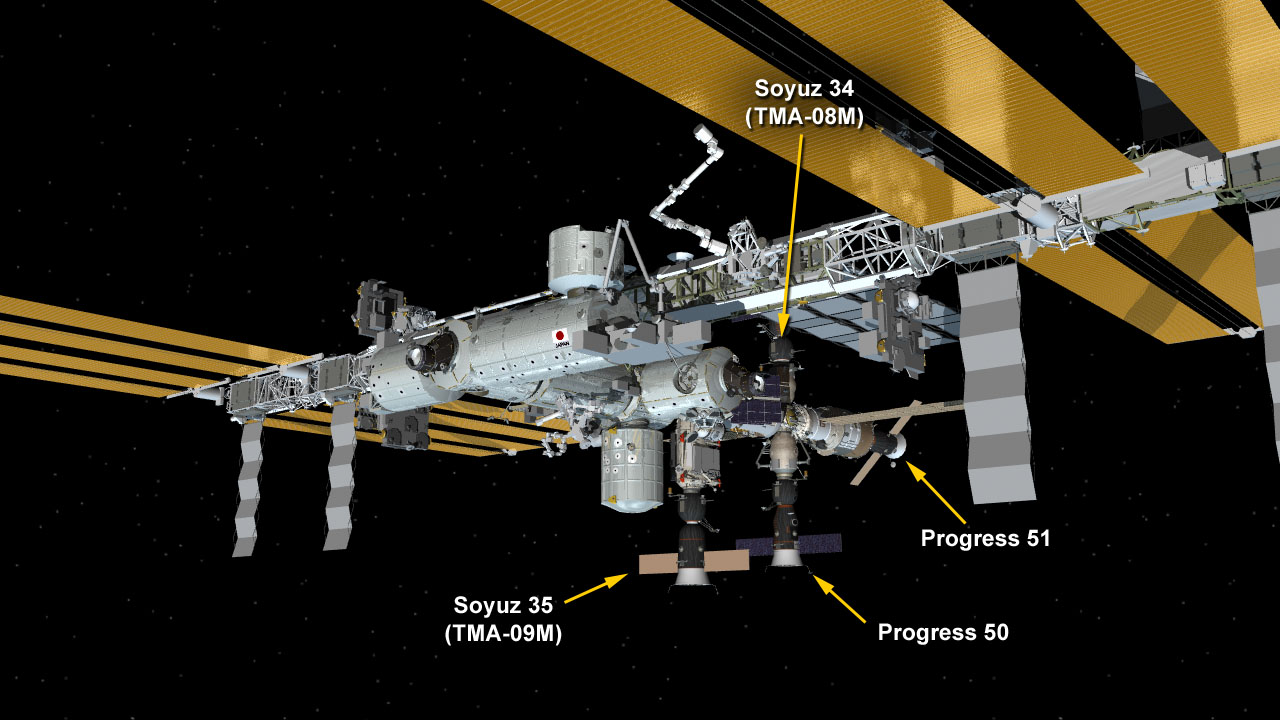
Enlarge/
The International Space Station's configuration as of May 2013, showing
the two docked Soyuz craft in which the crew would shelter in case of
an emergency. Also called out are the two Progress resupply vehicles.
NASA
In fact, the pre-planned PDAM maneuver was developed and implemented
in response to the last shelter event in the summer of 2011. NASA
received a late notification about a potential conjunction and it had no
choice but to have the crew enter the Soyuz craft; the debris ended up
missing the ISS by about 725 meters. The hope now is that the PDAM will
mitigate the need to shelter in the Soyuz from here on.
Day to day
When not actively figuring out where the station should be moving
itself to avoid chunks of Chinese satellites or perhaps an errant Fourth
of July firework, TOPO stays busy with a myriad of other tasks. "If
we're not tracking any debris—and I don't believe we are right now—we
have a set of tasks we do every day of the week. I mentioned that we
maintain the knowledge of where the ISS is, so we work with the
different flight control centers, specifically the flight dynamics
facility at Goddard." TOPO, explained Parris, keeps Goddard up to date on the ISS' position in orbit so that the various NASA TDRSS stations can keep their antennas pointed at it.
Unless they're actively planning a debris avoidance maneuver, TOPO's
role is relatively passive and consists mostly of monitoring. At the
TOPO console, Parris and the other TOPO controllers who man the station
work off of three primary screens. "The first monitor is our ground GPS.
The display on our very left—with the three columns—is the comparison
of our ground data versus the on-board telemetry," which TOPO uses to
compare where the ISS thinks it is versus where the ground tracking
stations think it is. The middle screen also tracks the station's
position. "The different charts show the delta between the different
sources on-board versus our ground model. They're typically in a
straight line."
On the right of the middle screen, behind the comparison charts, is a
"situational awareness" monitor that shows the status of the various
pieces of station hardware that TOPO uses. The right-hand screen
contains the software NASA uses to maintain the ground ephemeris.
"The top display is a list of vectors we have of the station, and the
bottom display is the actual catalog of all the ephemerides we have for
the station." Parris also pointed out that if TOPO were in the middle of
a conjunction operation, the displays would show a totally different
set of applications. The controller consoles are commodity hardware—PCs
running Linux (there are also Windows 7 PCs employed in the flight
control room, but the main controller displays are all Linux-powered).
This type of flexibility is a far cry from the old days, when each flight controller's station was hard-wired and reconfiguration took hours or days.
Finishing up
The ISS mission control room is on the second floor of JSC's Building
30, and it actually occupies space that was once used for one of the
two Apollo Mission Operations Control Rooms (the other room, on the
third floor, has been restored to close to its Apollo-era configuration
and can be seen by the public as part of the Space Center Houston
tour). I was able to spend several more minutes snapping pictures; a
couple of other flight controllers noticed me in the gallery and stuck
their heads in to say "Hi," including William Foster, who mans the
Ground Control console. While I snapped away, Parris resumed his place
at the TOPO console, monitoring the station as it zoomed through space
and keeping a watchful eye out for collisions. It's a job that never
ends—and one that requires constant vigilance.
On Sunday, June 23 the Syrian Roman Catholic Priest François Murad
was murdered in Gassanieh, in northern Syria, in the convent of the
[Custody of the Holy Land] where he had taken refuge. This is confirmed
by a statement of the Custos of the Holy Land sent to Fides Agency. The
circumstances of the death are not fully understood. According to local
sources, the monastery where Fr. Murad was staying was attacked by
militants linked to the [CIA American Backed Rebels] jihadi group Jabhat
al-Nusra.
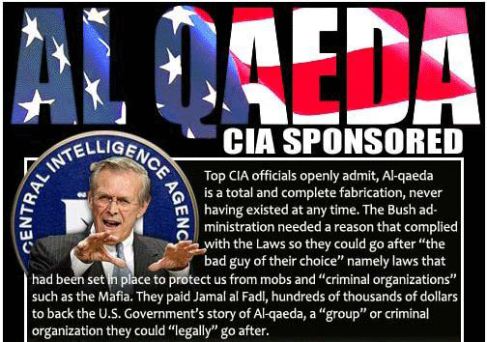
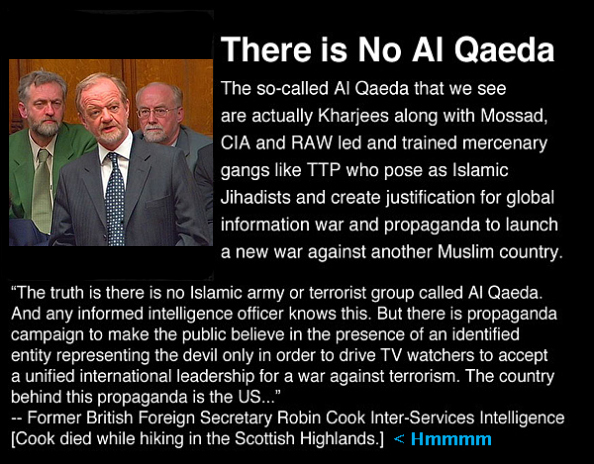
Last week [April 2013] the Al Nusra Front, the military
backbone of the US-sponsored Syrian opposition, openly swore its loyalty
to Al Qaeda.
Al Nusra leader Abu Mohammed al-Golani pledged allegiance to Al Qaeda
leader Ayman al-Zawahiri, the Egyptian-born cleric who served for many
years as Osama bin Laden’s second-in-command.WSWS
The Obama administration is directly aiding terrorists with its
decision to arm the rebels with heavy weaponry. Despite efforts to
differentiate between FSA militants and Al-Qaeda terrorists, the two
groups have clearly merged into a single force.
Father François, 49, had taken the first
steps in the religious life with the Franciscan Friars of the [Custody
of the Holy Land], and with them he continued to share close bonds of
spiritual friendship. After
being ordained a priest he had started the construction of a coenobitic
monastery dedicated to St. Simon Stylites in the village of Gassanieh.
After the start of the Civil War, the monastery of St. Simon had been
bombed and Fr. Murad had moved to the [convent of the Custody] for
safety reasons and to give support to the remaining few, along with
another religious and nuns of the Rosary.
“Let us pray,” writes the Custos of the Holy
Land Pierbattista Pizzaballa OFM ” so that this absurd and shameful war
ends soon and that the people of Syria can go back to living a normal
life.” Archbishop Jacques Behnan Hindo, titular of the Syrian Catholic
archeparchy in Hassaké-Nisibis reports to Fides: “The whole story of
Christians in the Middle East is marked and made fruitful by the blood
of the martyrs of many persecutions. Lately, father Murad sent me some
messages that clearly showed how conscious he was of living in a
dangerous situation, and offered his life for peace in Syria and around
the world.
After being downplayed for well over a year, the reality that Al-Qaeda terrorists are leading the other rebel groups in Syria, and that the Obama
administration is set to arm extremist radicals who will later pose a
direct threat to American national security, is now widely accepted.
Even the Mayor of London Boris Johnson broke ranks with British Prime Minister David Cameron earlier this week to warn that
there was no way to prevent such weapons reaching “Al-Qaeda-affiliated
thugs” and that western powers would be “pressing weapons into the hands
of maniacs”.
Council
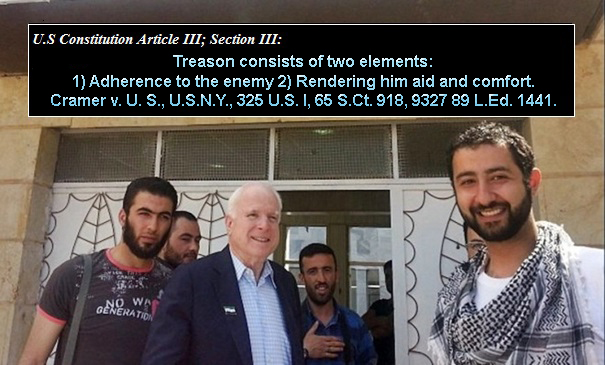
On Foreign Affair’s McCain ~ Fomenting War In Libya Through
‘humanitarian auspice’ to obtain in the end Libya Gold/Silver/&
Establish Rothschild Central Bank.

 Posts
Posts