Friday, May 15, 2015

FBI Spied On Activists Because Protecting Corporate Interests Is Roughly Equivalent To Ensuring National Security  ~ a "corporate" "person" IS more  important than ...an U.S. citizen ...hows that make u feel mr./mrs. america

from the our-disregarded-internal-policies-trump-your-First-Amendment-rights dept

That whole thing about the FBI not surveilling people based solely on First Amendment activity? The thing that's been in all the (FISA) papers (and agency policies)? Yeah, the FBI hasn't heard of it either.
The FBI breached its own internal rules when it spied on campaigners against the Keystone XL pipeline, failing to get approval before it cultivated informants and opened files on individuals protesting against the construction of the pipeline in Texas, documents reveal.
Internal agency documents show for the first time how FBI agents have been closely monitoring anti-Keystone activists, in violation of guidelines designed to prevent the agency from becoming unduly involved in sensitive political issues.
"Unduly involved" is right. First of all, a majority of what was monitored was First Amendment activity, something no federal intelligence or investigative agency is supposed to be doing. Certainly, there can be law enforcement monitoring of protests as they occur, but there's no provision in the law that allows the FBI to monitor people solely because of their activism.

Unless, of course, these activists are declared "extremists." Then all bets (and Constitutional protections) are off.
“Many of these extremists believe the debates over pollution, protection of wildlife, safety, and property rights have been overshadowed by the promise of jobs and cheaper oil prices,” the FBI document states.
"Extremists" are often mentioned in the same breath as "domestic terrorists," so with a little bit of rebranding, the FBI is now able to surveill people solely for their First Amendment-protected activities. That's handy and not totally unexpected, given the agency's long history of eyeballing activists who run contrary to its view on How Things Should Be. At one point, it was uppity blacks and encroaching homosexuals. Now, it's people who don't want an oil pipeline running through their neighborhoods.

And, even though we know the FBI has clearly taken a stance on controversial issues in the past and shaped its surveillance activities accordingly, it's rather jarring to see an investigative agency decide who's right and wrong by issuing a statement (wrapped in a self-justifying plan of action) on behalf of one side of the issue.
“The Keystone pipeline, as part of the oil and natural gas industry, is vital to the security and economy of the United States.”
Having decided that protecting corporate interests was roughly aligned with its "national security" purview, agents then routed around any internal controls that might have restricted its plans to break FBI policy.
[T]he partially redacted documents reveal the investigation into anti-Keystone activists occurred without prior approval of the top lawyer and senior agent in the Houston field office, a stipulation laid down in rules provided by the attorney general.
But, hey, no problem because the FBI totally fixed things in-house and in post.
Confronted by evidence contained in the cache of documents, the agency admitted that “FBI approval levels required by internal policy were not initially obtained” for the investigation, but said the failure was remedied and later reported internally.
The supposed extremists it monitored the longest were part of an organization known as the Tar Sands Blockade, a group committed to nonviolent protest. While minor crimes such as trespassing were committed by members of the group, nothing rose to the level of what one would normally associate with an FBI investigation. And it went on for 11 months after the "error" that allowed the investigation to exist in the first place was discovered.

Mike German, former FBI agent and fellow at the Brennan Center for Justice lays out the obvious problem with the FBI's behavior:
“It is clearly troubling that these documents suggest the FBI interprets its national security mandate as protecting private industry from political criticism,” he said.
That is troubling. Just as troubling is the agency's determination that the surveillance it never should have initiated resulted in no "adverse effects." But for who? Obviously, the FBI walked away from this with little more than another dent in its now-heavily damaged reputation. But what about those who were surveilled? Or those who might be in the future when they exercise their First Amendment rights? The FBI's self-assessment doesn't factor in these consequences and because it doesn't, it will likely make the same (intentional) "mistakes" in the future.

Jeb Bush, the Mexican Drug Cartel and “Free Trade”. The Bush Family and Organized Crime  ~ & you's kooky republipubes will "vote" this "crime" family or the other "crime"  family clin~ton"s  in hehe dummycocks ,republiipubes you's kooky fucks LOL :O  Oops


jebbush
Jeb Bush is a presidential candidate.
But Jeb is not only the brother of George W. and the son of George H. W. Bush.
Jeb Bush also had close personal ties to Raul Salinas de Gortiari, brother of Mexico’s former president Carlos Salinas de Gortiari. In the 1990s, Raul the “drug kingpin”, according to Switzerland’s  federal prosecutor Carla del Ponte, was one of the main figures of the Mexican Drug Cartel.  
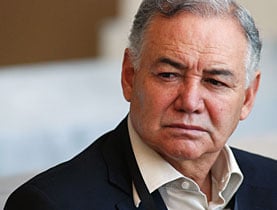
Jeb Bush  –before becoming Governor of the Sunshine State– was a close friend of Raul Salinas de Gortiari (image right):
“There has also been a great deal of speculation in Mexico about the exact nature of Raul Salinas’ close friendship with former President George Bush’s son, Jeb. It is well known here that for many years the two families spent vacations together — the Salinases at Jeb Bush’s home in Miami, the Bushes at Raul’s ranch, Las Mendocinas, under the volcano in Puebla.
There are many in Mexico who believe that the relationship became a back channel for delicate and crucial negotiations between the two governments, leading up to President Bush’s sponsorship of NAFTA.” (Prominent intellectual and former foreign Minister of Mexico Jorge G. Castañeda, The Los Angeles Times. and Houston Chronicle, 9 March 1995, emphasis added)
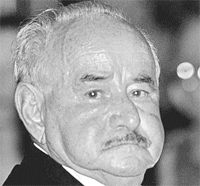
The personal relationship between the Bush and Salinas families was a matter of public record. Former President George H. W. Bush — when he worked in the oil business in Texas in the 1970s– had developed close personal ties with Carlos Salinas and his father, Raul Salinas Lozano. (left)
Raul Salinas Lozano was the family patriarch, father of Carlos and Raul Junior. According to the former private secretary to Raul Salinas Lozano (in as statement to US authorities):
“… Mr. Salinas Lozano was a leading figure in narcotics dealings that also involved his son, Raul Salinas de Gortiari, his son-in-law, Jose Francisco Ruiz Massieu, the No. 2 official in the governing Institutional Revolutionary Party, or PRI, and other leading politicians, according to the documents. Mr. Ruiz Massieu was assassinated in 1994.” (Dallas Morning News, 26 February 1997, emphasis added).
Former president George H. W. Bush and Raul Salinas Lozano were “intimo amigos”. According to former DEA official Michael Levine, the Mexican drug Cartel was a “family affair”. Both Carlos and Raul were prominent members of the Cartel. And this was known to then US Attorney General Edward Meese in 1987 one year prior to Carlos Salinas’ inauguration as the country’s president.
When Carlos Salinas was inaugurated as President, the entire Mexican State apparatus became criminalised with key government positions occupied by members of the Cartel. The Minister of Commerce in charge of trade negotiations leading up to the signing of NAFTA was Raul Salinas Lozano, father of Raul Junior the Drug kingpin and of Carlos the president.
And it is precisely during this period that the Salinas government launched a sweeping privatisation program under advice from the IMF.
The privatisation program subsequently evolved into a multibillion dollar money laundering operation. Narco-dollars were channelled towards the acquisition of State property and public utilities.
Richard Barnet of the Institute for Policy Studies, testified to the US Congress (April 14, 1994) that
“billions of dollars in state assets have gone to supporters and cronies” (Dallas Morning News, 11 August 1994).
These included the sale of Telefonos de Mexico, valued at $ 3.9 billion and purchased by a Salinas crony for $ 400 million.(Ibid).
Raul Salinas was behind the privatisation programme. He was known as ”El Señor 10 por Ciento” [Mr. 10 Percent] “for the slice of bid money he allegedly demanded in exchange for helping acquaintances acquire companies, concessions and contracts [under the IMF sponsored privatisation program"(The News, InfoLatina, .Mexico, October 10, 1997).
The North American Free Trade Agreement (NAFTA)
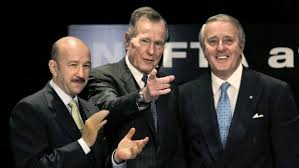
Raul Salinas de Gortiari is the brother of  former president Carlos Salinas de Gortiari, who signed the North American Free Trade Agreement (NAFTA) in December 1992 alongside US President George H. W. Bush and Canada's Prime Minister Brian Mulroney.(image left)
In a bitter irony, it was only after this historical event, that Carlos Salinas' family links to the drug trade through his brother Raul were revealed.
The George H. W. Bush Senior administration was fully aware of the links of the Salinas presidency to organized crime. Public opinion in the US and Canada was never informed so as not to jeopardize the signing of NAFTA:
"Other former officials say they were pressured to keep mum because Washington was obsessed with approving NAFTA".
"The intelligence on corruption, especially by drug traffickers, has always been there," said Phil Jordan, who headed DEA's Dallas office from 1984 to 1994. But "we were under instructions not to say anything negative about Mexico. It was a no-no since NAFTA was a hot political football." (Dallas Morning News, 26 February 1997)
In other words, at the time the NAFTA Agreement was signed, both Bush Senior and Mulroney were aware that one of the signatories of NAFTA, namely president Salinas de Gortiari  had links to the Mexican Drug Cartel.
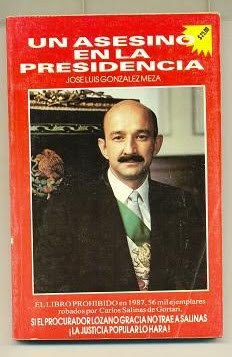
In 1995 in the wake of the scandal and the arrest of his brother Raul for murder, Carlos Salinas left Mexico to take up residence in Dublin. His alleged links to the Drug Cartel did not prevent him from being appointed to the Board of the Dow Jones Company on Wall Street, a position which he held until 1997:
Salinas, who left Mexico in March 1995 after his brother, Raul, was charged with masterminding the murder of a political opponent, has served on the company's board for two years. He was questioned last year in Dublin by a Mexican prosecutor investigating the murder in March 1994 of Luis Donaldo Colosio, who wanted to succeed Salinas as president. A Dow Jones spokesman last week denied that Salinas had been forced out of an election for the new board, which will take place at the company's annual meeting on April 16… Salinas, who negotiated Mexico's entry into the free trade agreement with the United States and Canada, was appointed to the board because of his international experience. He was unavailable for comment at his Dublin home last week." (Sunday Times, London, 30 March 1997).
Washington has consistently denied Carlos Salinas involvement. "it was his brother Raul", Carlos Salinas "did not know", the American media continued to uphold Salinas as a model statesman, architect of free trade in the Americas and a friend of the Bush family.
In October 1998, The Swiss government confirmed that the brother of the former Mexican president had deposited some 100 million in drug money in Swiss banks:
"They [Swiss authorities] are confiscating the money, which they believe was part of a much larger amount paid to Raul Salinas for helping Mexican and Colombian drugs cartels during his brother’s six-year term ending in 1994. Mr Salinas’ lawyers have maintained he was legally heading an investment fund for Mexican businessmen but the Swiss federal prosecutor, Carla del Ponte, described Salinas’ business dealings as unsound, incomprehensible and contrary to customary business usage. (BBC Report)
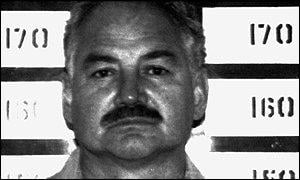
 A few months later in January 1999, after a four-year trial, Raúl Salinas de Gortari (left) was convicted of ordering the murder of his brother-in-law, Jose Francisco Ruiz Massieu:
“After [Carlos] Salinas left office in 1994, the Salinas family fell from grace in a swirl of drug-related corruption and crime scandals. Raúl was jailed and convicted on charges of money laundering and of masterminding the assassination of his brother-in-law; after spending 10 years in jail, Raúl was acquitted of both crimes.  …
With the scandal unraveling, Jeb’s friendship with Raúl did not go unnoticed. Jeb has never denied his friendship with Raúl, who [now] keeps a low profile in Mexico.
Kristy Campbell, spokesperson for Bush, did not respond a request for comment. The Salinas family’s demise caught the Bushes by surprise. “I have been very disappointed by the allegations about him and his family. I never had the slightest hint of information that President Salinas was anything but totally honest,” Bush senior  told me in the 1997 interview. (Dolia Estevez, Jeb Bush’s Mexican Connections, Forbes, April 7, 2015, emphasis added)
“The Salinas family’s demise caught the Bushes by surprise”? (Forbes, April 2015) The Bushes knew who they were all along.
Former DEA official Michael Levine confirmed that Carlos Salinas role in the Mexican drug cartel was known to US officials.
US President George H. W. Bush was  regularly briefed by officials from the Department of Justice, the CIA and the DEA.
Did Jeb Bush –who is now a candidate for the White House under a Republican ticket– know about Raul’s links to the Drug Cartel?.
Was the Bush family in any way complicit?
These are issues which must be addressed and debated by the American public across the land prior to the 2016 presidential primary elections.
According to Andres Openheimer writing in the Miami Herald (February 17 1997):
witnesses say former Mexican president Carlos Salinas de Gortiari, his imprisoned brother Raul and other members of country’s ruling elite met with drug lord Juan Garcia Abrego at a Salinas family ranch; Jeb Bush admits he met with Raul Salinas several times but has never done any business with him.”
US authorities waited until after Carlos Salinas finished his presidential term to arrest Mexican drug lord Juan Garcia Abrego, who was a close collaborator of the president’s brother Raul. In turn, Raul Salinas was an “intimo amigo” of Jeb Bush :
Juan Garcia Abrego, a fugitive on the FBI’s most-wanted list, was flown to Houston late Monday, following his arrest by Mexican police …  Garcia Abrego, the reputed head of Mexico’s second most powerful drug cartel, had eluded authorities on both sides of the border for years. His arrest is an enormous victory for the U.S. and Mexican governments. CNN, January 16, 2015
But there is more than meets the eye: while the Bushes and the Salinas have longstanding ties, Wall Street was also involved in the laundering of drug money:
A U.S. official said the Justice Department has made significant advances in its money-laundering investigation against Raul Salinas de Gortari and has identified several people who can testify that the former first brother received protection money from a major narcotics cartel.
If the U.S. were to indict Mr. Salinas, it could have implications for a Justice Department investigation into possible money laundering by Citibank, where Mr. Salinas had some of his accounts. Citibank, a unit of Citicorp , has denied wrongdoing. (WSW, April 23, 2015)
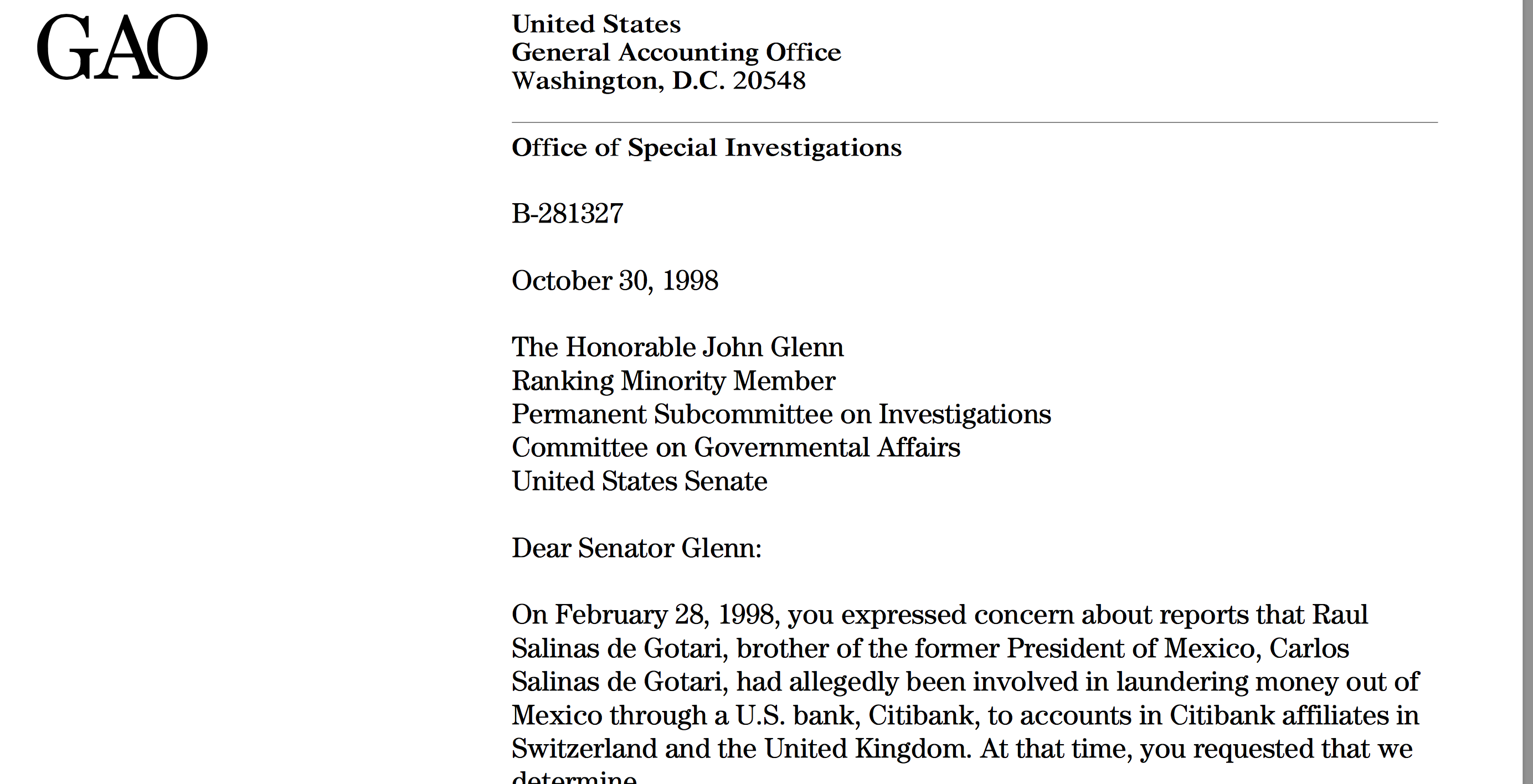
The involvement of Citbank in the money laundering operation is documented a Senate Committee on Governmental Affairs Report (US General Accounting Office  “Private Banking: Raul Salinas, Citibank, and Alleged Money Laundering” Washington, 1998).
.
The End Game
Raul Salinas de Gortiari was set free  in 2005. All charges were dropped.
The matter involving the Bushes and the Salinas has largely been forgotten.
Meanwhile, American political history has been rewritten…
Not to mention the 1992 “Free Trade” Agreement (NAFTA),  which was signed by a head of State with links to organized crime. Does that make it an illegal agreement? The legitimacy of NAFTA has so far not been the object of a legal procedure of judicial inquiry.
An “illegal NAFTA” sets the stage for the TPP and TTIP “agreements” negotiated behind closed doors.
All is well in the American Republic.
At least until the forthcoming 2016 presidential elections.

Five Major Banks to Plead Guilty to Rigging Currency Markets

 
big-banks
Five major international banks are expected to plead guilty as soon as next week to criminal charges in the US related to their deliberate manipulation of global foreign exchange markets, which allowed them to rake in billions of dollars at the expense of retirees, university endowments and municipalities.
Citigroup, JPMorgan Chase, Royal Bank of Scotland Group, Barclays and UBS are expected to plead guilty to felony fraud and antitrust charges. They will pay fines totaling several billions of dollars, according to bank and regulatory officials who spoke anonymously with the New York Times, Bloomberg and Reuters.
The effect of the guilty pleas will be essentially zero, beyond the immediate costs of the fines levied on the institutions. As the Times put it, “life will go on, probably without much of a hiccup.”
In the years since the financial crisis, federal regulators avoided bringing criminal charges against banks and their executives, opting instead for either cash settlements and so-called deferred-prosecution agreements, in which charges are delayed on the basis of the banks’ compliance with certain conditions.
In 2012, it became clear that major global banks, including UBS and Barclays, were systematically engaged in manipulating LIBOR (London Interbank Offered Rate), the benchmark global interest rate on the basis of which hundreds of trillions of dollars of financial contracts are valued.
In June of that year, Barclays was fined $200 million by the Commodity Futures Trading Commission and $160 million by the United States Department of Justice. This was followed by UBS’s agreement in December 2012 to pay regulators $1.5 billion in connection with the scandal and an agreement by Deutsche Bank in 2015 to pay $2.5 billion to regulators. Numerous other banks, including Citigroup and JPMorgan, were fined by European authorities.
UBS was offered a deferred-prosecution agreement in connection with the LIBOR scandal, but broke the terms of the agreement by manipulating the $5.3 trillion-a-day foreign exchange markets in the subsequent periods.
In late 2014, six banks—JPMorgan Chase, Citigroup, Bank of America, UBS, Royal Bank of Scotland and HSBC—agreed to pay $4.3 billion to federal regulators to settle civil charges.
The investigation charges also had a criminal component, which the Justice Department is now seeking to settle with guilty pleas from the banks. Unlike some previous cases, however, these guilty pleas are expected to come not merely from the subsidiaries of the banks, but from bank holding companies themselves.
Financial regulators have released voluminous records in connection with the foreign exchange scandal, showing how brazenly and openly bank traders discussed rigging currency rates, even as they knew their employers were being investigated for similar activities with regard to LIBOR.
Despite the unprecedented character of the pleas, the actual impact of the admissions of criminal wrongdoing by the banks is expected to be next to nothing.
As the Times reports,
“Behind the scenes in Washington, the banks’ lawyers are also seeking assurances from federal regulators—including the Securities and Exchange Commission and the Labor Department—that the banks will not be barred from certain business practices after the guilty pleas.”
In particular the banks are seeking waivers to retain their status as “well-known seasoned issuers,” allowing them to raise credit more easily, as well as the ability to operate mutual funds. The Times reports that “a majority of commissioners” of the SEC are in favor of granting such such waivers.
In fact, for the biggest corporations, being convicted of a felony is increasingly becoming legally irrelevant, and just one element of their normal operations. As the Times points out, the guilty pleas are merely “an exercise in stagecraft.”
One former Justice Department official told the Times that an “underlying assumption” of the Justice Department is that “the bank is not a criminal operation.” But the emergence of scandal after scandal, including the selling of toxic mortgage-backed securities that caused the financial crisis, the forging of foreclosure documents, widespread complicity in Bernard L. Madoff’s Ponzi scheme, money laundering, and tax evasion by Wall Street testifies to the fact that the banks are, in fact, criminal outfits.
Since taking office shortly after the onset of the financial crisis, the Obama administration has sought not to hold the banks to account and prevent criminal wrongdoing, but rather to conceal their crimes and, when this becomes impossible, to issue wrist-slap punishments that allow the banks to go on largely as before.
In these cases, the fines levied by financial regulators remain a cost of doing business, and pale in comparison with the billions of dollars made by the major banks every year through criminal activities.
The guiding principle of the Obama administration, in the words of former Attorney General Eric Holder, is that the giant banks are “too big to jail.” As the Times article explained, prosecutors are “mindful that too harsh a penalty could imperil banks that are at the heart of the global economy.”
In exchange for their services, top financial regulators are almost universally provided with high-paying positions in Wall Street after their stints with the government.
Most notably, Ben Bernanke, the former Federal Reserve chairman who funneled trillions of dollars in government funds to Wall Street, announced last month that he has been hired by Chicago-based hedge fund Citadel LLC. This followed the announcement in November 2013 that former Treasury Secretary Timothy Geithner joined the hedge fund Warburg Pincus.
To this day, not a single executive at any major bank has been criminally prosecuted for helping to cause the financial crisis, or any of the crimes that followed.

The Cultural Impact of James Bond

By: Jay Dyer
Ian Fleming’s James Bond is one of the most recognizable and successful characters in modern popular culture.  The novels have sold over 100 million copies, and the film franchise is the second most successful in history, having been recently displaced by the Harry Potter series.  For most readers and viewers, 007 is merely a Western pop icon. However, there is much more at work in the novels and films than appears on the surface.  In fact, there are deeper undercurrents, themes, symbols, and messages that operate as psychological warfare propaganda and an in-depth semiotic analysis of the novels and films yields an interpretation that confirms this thesis.  Much has been written on the subject of Ian Fleming’s James Bond. From Umberto Eco’s older essay “Narrative Structures in Fleming” to Christoph Linders’ modern collections The James Bond Phenomenon and Revisioning 007: James Bond and Casino Royale, there is a wealth of critical work on capitalist/consumerist, imperialist, gender, and racial analyses in the books and films.  In this wealth of criticism, key elements have been ignored that will here be explored.
—————————————————————————————–
     The James Bond Phenomenon: A Critical Reader features Tony Bennett and Janet Woolacott’s article “The Moments of Bond,” which chronicles the rise of the franchise in terms of marketing and sales as well as the zeitgeist of Western Imperial capitalism and the sixties sexual revolution that propelled Bond to international fame.  Michael Denning’s “Licensed to Look” analyzes the consumerism that fueled Fleming and Bond and the mythical qualities Bond embodies that form a potent combination with the espionage genre.  Denning focuses on “eye” imagery and its utilization by film media as a particularly potent manipulative semiotic device.[1]  Linder offers an overview of criminology and the “global conspiracy” evolution the franchise exemplifies concurrent with the socio-political threats of the respective decades of Bond releases.  Particular attention is given to the Cold War and Bond “saving Britain’s image.”[2]
Even still, from Skyfall, to the coming SPECTRE, 007 plays an important role in fiction, based on real geopolitical espionage.
Cultural impact studies have been done with James Chapman’s License to Thrill and Edward Comentale’s Ian Fleming and James Bond: The Cultural Politics of 007.  Chapman gives an analysis of different elements and themes in choice Bond installments, including the literary setting (detective novels) for Fleming’s early stories, the fact that Bond was first published in Playboy, comparisons of the early films with Alfred Hitchcock’s works, and the oft-repeated attempt to resurrect British Imperialism.  Chapman moves on to consider the reason for the franchise’s success, making no definitive statement about whether “Bondmania” is the result of the zeitgeist or the development and advancement of the film industry, or both.  “Bondmania” was well in place by 1964, and from there, Bond would dominate the sixties and make his way to American theaters, ultimately to become an international icon.  Chapman continues with analysis of the propaganda for imperialism and of Bond as the preeminent Cold Warrior.  Attention is largely given to Bond in comparison with other action films and heroes, but little attention is given to the deeper, mythical elements.   Inline image 1
Edward Comentale, Stephen Watt and Skip Willman’s Ian Fleming & James Bond: The Cultural Politics of 007 is a collection of articles similar to those of Linder.  Comentale’s article centers around the process of Bond in relation to the rise of corporatism and managerial control.  Bond is an example of modernity and, as such, simultaneously represents a rebellion against hierarchy, and the rise of a new, ensconced hierarchy that turns in on itself and eliminates the avant-garde nature of the early Bond.  The character of Bond becomes the corporate, company man. Comentale’s treatment also highlights the “Fleming Effect,” brought to light in the work of Kingsley Amis (The James Bond Dossier), which is Ian Fleming’s unique method of describing the fantastical in real terms.[3]
Bond has thus been explained from perspectives of imperialism, sexism, and racialism.  Toby Miller in his “James Bond’s Penis” argues that phallocentrism in Fleming functions as a form of propaganda in both book and film.  Joyce Goggin’s and Rene Glas’s “It Just Keeps Getting Bigger: James Bond and the Political Economy of Huge” treats the connection of Bond narratives and their constant presentation of largess and the ever-increasing capitalist consumerism and its obsession with largess. Linder’s “Why Size Matters” works from Slajov Zizek’s view of Blofeld, arguing forcefully that Bond is a representation of global capitalism as a force for the West’s ever-increasing expansionist attitude and wasteful consumption.  Blofeld and the Soviets are defective and thus economically useless, leading Bond and the West to become a force for modern global imperialism.[4] Even here there is still no analysis of the prevalent themes of eugenics, occultism, and phallic homosocial dominance and their interrelationships.[5]
Sexy Bond girls from "You Only Live Twice."
Sexy Bond girls from “You Only Live Twice.”
Claire Hines contributes to the same collection a comparison of Bond and Sean Connery with the rise of Playboy Magazine and the popularity of both concomitant with the hedonism of the sexual revolution, with Bond adopting a Hugh Hefner image.  At the same time, Playboy was printing Fleming’s stories.  Of particular relevance is Cynthia Baron’s essay “Doctor No: Bonding Britishness to Racial Sovereignty,” which correctly identifies examples of racial supremacy evident in the novels. Baron uses Dr. No as her exemplar, yet, as I will argue, she fails to recognize British eugenics as the real impetus, and she misses Live and Let Die as a more potent example of racial supremacy. Colleen Tremonte and Linda Racioppi analyze the use of Bond’s body and sexuality in “Body Politics and Casino Royale: Gender and (Inter)national Security” in Linder’s collection.  Tremonte and Racioppi correctly associate Bond’s own body as the incarnation of British national imperialism and its identification with the masculine and the identification of the feminine with the “object of desire.”[6]
In “James Bond, Cyborg Aristocrat,” Patrick O’Donnell surveys the interplay between Bond and technology, correctly describing him as more machine than human.  The ever-present technological gadgetry in Bond warns of the determinacy of the displacement of the human with the robotic.  This is useful insofar as Bond is presented as a machine beyond good and evil, which is the argument of Ishay Landa in “James Bond: A Nietzschean for the Cold War.”[7]  This appears contradictory, as Landa portrays Bond as an anti-elitist whose missions are represented as “good” British elitism which thwarts Blofeld’s evil Nieztscheanism.[8] However, Bond is beyond the common man’s binary moral schema, and formulates his own volitional will-to-power morality.  As Bond declares at the close of Casion Royale following upon the death of his love interest, Vesper Lynd: “Pass this on at once: 3030 was a double, working for Redland…..Yes dammit, I said ‘was.’  The bitch is dead now.”[9]
Aaron Jaffe discusses the marketing of brand names and the explosion of Bond memorabilia consumerism in “James Bond, Meta-Brand.”[10]  Product placement itself and advertising become intertwined with the film experience, which can relate directly to the use of psychological warfare and propaganda.  I will argue that along with such manipulation, the character of Bond himself becomes an advertisement for nostalgic British Imperialism.  This is effective in the Bond character because, as Drew Moniot argues, the novels and films are able to “dig deep into the sociological self-conscious of the audience….The screenwriters took every possible opportunity to mirror and satirize this nation’s [America] fears, misgivings, interests, pastimes, and values.”[11]  Moniot concludes the film formula “is cultural; it represents the way in which a culture has embodied both mythical archetypes and its own preoccupations in narrative form.”[12]
Political and espionage-focused analyses are available in Jeremy Black’s James Bond and Political Philosophy.  Black correctly identifies the eugenics theme present, for example in Goldfinger.  He writes:
Goldfinger was personally disordered, with a misproportioned body, not English, a “Balt” with possible Jewish blood, and psychologically warped—in part, Bond feels, due to his short man’s inferiority complex. “Napoleon had been short, and Hitler.  It was the short men that caused all the trouble in the world.”  Such characterization reflected both racialism and crude psychology.  Like much imaginative literature earlier in the century, Fleming had been influenced by the popularity of eugenic assumptions.  Ironically, in Live and Let Die, although the villain’s first name was Buonaparte, Mr. Big had “huge height and bulk.”[13]
Classical Manichaean dialectic, the nemesis Blofeld.
And later, the Zorin character from A View to Kill states: “In a variant of The Boys From Brazil, he was a product of Nazi eugenics, born in Germany as part of an attempt to create a race of superhumans.  This, at once, links him with Drax, another manipulator of genetics.”[14]  Black’s passing references deserve a more indepth treatment of eugenics in the Bond novels, and the connection with psychological warfare. MoonrakerOn Her Majesty’s Secret Service and Live and Let Die are of particular relevance for eugenic considerations.
From a literary perspective, when Fleming’s secret agent first appeared, he did not have a favorable critical appraisal. This changed when world-renowned literary critic, semiotician, and author Umberto Eco analyzed Fleming’s novels,[15] giving them attention in academic literary circles.  Eco’s analysis helped gain them literary respectability, at the same time hinting at deeper meanings and subtle clues about the Manichaean structures and other patterns they contain, such as the “purifying process” that Bond creates in saving the sexually deviant women, leading to a unification of opposites, yet which leaves the “race uncontaminated.”[16]    This is a crucial eugenics concept. Eco is presently one of the world’s foremost “Bondologists,” demonstrating the popularity of, and thus confirming, the tremendous possibility for utilizing Bond as imperial propaganda.  Prior to such attention, such usage would not originally have seemed possible.[17]
Although Fleming himself hinted at the reality of the Bond stories and these deeper connotations of mystical imperialism,[18] as the films were produced and became increasingly popular, the possibilities for the use of such imagery as propaganda mounted.  Jeremy Black cites the Soviet organ Pravda as a perfect example of the anti-Western view of Bond:
His [Bond’s] creator is Ian Fleming, who posed as The Times correspondent in Russia in 1939 but was in truth a spy for the capitalist nations.  Although he is now dead, James Bond cannot be allowed to die because he teaches those sent to kill in Vietnam, the Congo, and Dominican Republic and many other places.  It is no accident that the sham agents of Soviet couner-intelligence, represented in caricature form, invariably figure in the role of Bond’s opponents, because Bond kills right and left the men Fleming wanted to kill—Russians, Reds, and Yellows.  Bond is portrayed as a sort of white archangel, destroying the impure races.
The Bond cult started in 1963 when American leader John F. Kennedy, unsuspecting that some American hero with the right to kill would shoot him, too, declared that Fleming’s books were his bedside reading.  As if by a magic wand, everyting changed.  The mighty forces of reaction immediately gave the green light to Fleming.  And in James Bond he has created a symbol of the civilization which has used bombs to drown the voice of conscience.  The men and women who allow their talents to be used in the making of films about the exploits of this man are guilty of furthering the aims of the Western Capitalists.[19]
The Soviets were thus prompted by Bond to respond with their own psychological warfare propaganda and analysis in the KGB-run magazine Pravda.  They were also correct in noting the racial and imperial undertones in Bond, yet here fall short of detailing either eugenics, Freemasonry or phallocentrism and their interrelation as the undercurrents.
Fleming’s novels and their film counterparts (especially so) are produced with the intent of illustrating an overarching story of the continuance of the Anglo-Establishment’s mystical, destined world supremacy, even with the historic decline of the British Empire. The narratives include the propaganda tactic of displacement, where immoral acts done by one side are blamed upon the enemy.  This thesis will examine the symbolism of the novel and film versions of Casino Royale, Live and Let DieMoonraker, and On Her Majesty’s Secret Service for their usage of eugenics, occultism, and phallocentrism.  Since the novels are, in places, a bit different from the films, all four books and films will be analyzed, with an emphasis on Bond as the icon of propaganda.  These four have been chosen as the best examples of occult propaganda for this form of eugenicist imperialism.
Roger Moore as 007 in the 1979 film adaptation, Moonraker.
When the novels were adapted to screen, some details are altered for the purpose of historical relevance, and often these changes and details are significant.  The themes of mystical imperialism and Bond as the incarnate overman unify the entire narrative, but it is crucial to actually view the imagery in the films to understand the propaganda and its usage. “Mystical imperialism” is described by researchers Paul Fitzgerald and Elizabeth Gould as follows (citing the literary example of imperialism par excellance, Rudyard Kipling):
As the end of the nineteenth century approached, that [foreordained British] destinty seemed more and more to favor Britain’s ambitions to empire and and no one better than Rudyard Kipling would capture the longing for conquest and spiritual fulfillment divine right brought with it….On a mystical level, their quests [Peachey and Carnahan of The Man Who Would Be King] to be come kings of Kafiristan brought them into realms more in keeping with the spiritual goal of the British Empire to weave the light of heaven and the darkness of earth together through an earthly conquest.[20]
This mystical warfare between light and dark is mentioned by Eco in his essay as a Manichaean form of dialectical propaganda.[21]  Indeed, Fleming’s Bond novels share the same Freemasonic connections and symbols with those of Kipling.  Historian Niall Ferguson traces the British eugenics movement and its connections to the royal societies and Cecil Rhodes, with support from the Rothschilds, that served in part as the basis for the 19th century British Imperial motivation.[22]  Not only do Ian Fleming’s novels portray this model of white British racial supremacy, but there is evidence to suggest that Fleming himself was influenced by eugenics (as critic Jeremy Black claims above), given the presentation of Bond, as well as the contents of Fleming’s personal library which contained numerous well-known treatises on eugenics and racial supremacy.
Included in Fleming’s private collection are rare editions of the Comte de Gobineau’s four volume Essai sur l’inegalite des races humaines, an early eugenics work; Hitler’s Mein Kampf;  Sir Francis Galton’s Fingerprints, forming the basic outline of British eugenics; and Houston Stewart Chamberlain’s Master Race, devoted to Germanic racial supremacy.[23]  Evidence also suggests Fleming’s own special operations groups Assault Unit 30 and T-Force were very likely part of Operations PAPERCLIP and SURGEON, which led to the arrest and utilization of hundreds of Nazi scientists in the United States, England, and Russia, including the inventor of the V-2 rocket, Werner von Braun.[24]  This operation bears striking resemblances to Fleming’s 1955 novel Moonraker, which centers around former SS member Hugo Drax and secret rocket technology. While it is admittedly speculation based upon his personal collection and associations with PAPERCLIP, the tenor of the novels, and Live and Let Die in particular, demonstrate this racialist attitude.
Propaganda and psychological warfare using the arts are nothing more than the manipulation of symbols, and it is highly significant that Ian Fleming worked for years as the British Navy’s Political Warfare Executive, specializing in propanda, psychological warfare and rumors, becoming a “major force in British Intelligence.”[25] The film versions are crucial for semiotics due to the focus on the image of Bond, and that image’s promotion of a certain set of values for consumer consumption, as Michael Denning remarks in his “Licensed to Look: Jamed Bond and the Heroism of Consumption.”  However, to fill a gap in the available research, the thesis of this paper will be that Bond constitutes an iconic embodiment of the British establishment’s belief in its own destined supremacy.  From the time of Elizabeth I and her court astrologer, Dr. John Dee, the first “007,” to Cecil Rhodes and the Royal Society, the British Empire sought to fulfill the national myth of its own destined racial supremacy.[26]  Previous Bond research has not fully examined the philosophical implications of a national narrative that includes the idea of an alchemical, occult summation of a kind of Nietzschean overman, incarnate in the character of Fleming’s Bond.
Edmund Spenser’s Faerie Queen was written with the intention of exalting Britain as the legitimate successor to the previous world empires.[27]  Greece gave way to Rome, and Rome gave way to Britannia, according to the mythology of the Faerie Queen.  By the 1950s, the era of Fleming, a national hero archetype was needed to serve as a propagandist image of the belief in that perpetual dominance. Critics like Richard Carpenter and Drew Moniot have even comapred Bond to mythological characters like Hercules, with “M” functioing like the high deity and Q (of the Equipment Branch) being a version of Hephaestus.[28]  Bond researcher Philip Gardiner makes a host of claims about Fleming’s interests in the occult, arguing that there are patterns of alchemical and Masonic associations and references purposefully placed in the novels and films.  Gardiner is correct in tracing the lineage of 007 to John Dee[29] in The Bond Code: The Dark World of Ian Fleming and James Bond, and gives a masterful analysis of the occultism in Live and Let Die, but never connects these ideas to propaganda, race and eugenics.
Bond returns in the upcoming SPECTRE.
This occultic, British Imperial message that gradually emerges in the Fleming Bond novels and films.  Fleming himself must also be examined since his was  an upper class family where members worked in British Intelligence and propaganda.  Fleming married into the aristocracy,[30] all of which forms some basis for the character of Bond.[31]  Intelligence agencies have long used media and films for propaganda, from Operation MOCKINGBIRD, to the present day modus operandi of the Pentagon.[32]  The utilization of the Fleming franchise as propaganda was no different when Bond expanded to Hollywood.  I argue that themes such as Western capitalism, secret societies such as Freemasonry, alchemy, racism and eugenics, male social dominance and psychological warfare tactics of displacement (the tactic of blaming one’s own black operations on the enemy) are the crucial purposes and effects of the Bond stories themselves.  What emerges is a specific worldview of British Imperial supremacy with Bond as its alchemical summation—a veritable philosopher’s stone, completing the “great work” that Fleming and those in his aristocratic circles found so fascinating.[33]  MI6 historian and British Intelligence Specialist Dr. Stephen Dorrrill writes:
The modern conception of the world of the secret intelligence services and assassinations derives partly from the fictionalised activities of James Bond.  The licensed-to-kill operative is the model for the secret service agent of the public’s imagination.  While this is fantasy, the former naval Intelligence and one-time MI6 asset Ian Fleming based the plots and details for his 007 books on incidents in his own life and information he picked up during his career in the secret world.  However fantastic the story, there is always an element of truth in Bond.[34]
While it may seem highly speculative to deal with matters that are arguably “conspiratorial,” it should be remembered that the field of espionage is inetricably bound up in conspiracy, and this is no different for espionage fiction.[35]  As Fleming himself famously stated, “Everything I write has precedent in truth.”[36]
———————————————————————————————————-

[1]  Denning, “Licensed to Look: James Bond and the Heroism of Consumption,” in The James Bond Phenomenon: A Critical Reader, 70-73.
[2]    “Criminal Vision and the Ideology of Detection in Fleming’s 007 Series,” in The James Bond Phenomenon: A Critical Reader.
[3]    Comentale, Edward P.  “Fleming’s Company Man,” in Ian Fleming & James Bond: The Cultural Politics of 007 (Bloomington, IN: Indiana University Press, 2005), 19-21.
[4]    Linder, Christoph.  “Why Size Matters” in Ian Fleming and James Bond: The Cultural Politics of 007, 224-37.
[5]    The James Bond Phenomenon: A Critical Reader, 285-99.
[6]    193-4.
[7]    Questions Are Forever: James Bond and Philosophy.  Eds. James B. South and Jacob Held (Chicago, IL: Open Court Press, 2006), 79-93.
[8]    Ibid., 93.
[9]    Fleming, Ian. Casino Royale (New York: Pengiun, 1953), 144.
[10]  Ibid., 86-106.
[11]  Moniot, Drew.  “James Bond and America in the Sixties: An Investigation of the Formula Film in Popular Culture,” in Journal of the University Film Association, Vol. 28, No. 3 (Summer 1976), 27.
[12]  Ibid., 28.
[13]  Black, Jeremy.  The Politics of James Bond : From Fleming’s Novels to the Big Screen  (Nebraska: University of Nebraska Press, 2005), 37.
[14]  Ibid., 145.
[15]  Eco, Umberto. “Narrative Structures in Fleming” in The James Bond Phenomenon: A Critical Reader. Ed. Christoph Linder (Manchester, UK: Manchester University Press, 2009), 34-55.
[16]  Ibid., 44-5.
[17]  Scheibel, Will. “The History of Casino Royale on (and Off) Screen,” in Revisioning 007: James Bond and Casino Royale, Ed. Christoph Linder (New York: Wallflower Press, 2009), 15.
[18]  MacIntyre, Ben.  For Your Eyes Only: Ian Fleming and James Bond (New York: Bloomsbury Books, 2008), 62-7.
[19]  Black, Jeremy.  The Politics of James Bond (Nebraska: University of Nebraska Press, 2005), 82.
[20]  Paul Fitzgerald and Elizabeth Gould, Invisible History: Afghanistan’s Untold Story (San Francisco: City Lights Books, 2009), 37.
[21]  Eco, “Narrative Structures,” in The James Bond Phenomenon, 44-5.
[22]  Ferguson, Niall. Empire: The Rise and Demise of the British World Order and the Lessons for Global Power (New York: Basic Books, 2002), 185-220.
[23]  The Ian Fleming Collection of Indiana University. Web. March 5, 2012. <http://www.indiana.edu/~liblilly/etexts/fleming/>
[24]  Cabell, Craig.  Ian Fleming’s Secret War (Barnsley, England: Pen & Sword Military, 2008), 102-6.  Payne, Stewart “How Britain Put Nazis’ Top Men to Work” Telegraph.co.ukWeb. August 30, 2007. Retreived March 3, 2012. <http://www.telegraph.co.uk/news/uknews/1561660/How-Britain-put-Nazis-top-men-to-work.html>.  Matthijs, Herman “The Intelligence Life of Ian Fleming.” Web. July 7, 2010. Retreived March 3, 2012.  <http://www.cf2r.org/fr/notes-historiques/the-intelligence-life-of-ian-fleming.php>.
[25]  Cabell, Ian Fleming’s Secret War, 26-31.
[26]  Roberts, Brian.  Cecil Rhodes: Flawed Colossus (New York: W.W. Norton, 1987), 37-40, 55-7.  Quigley, Carroll.  Tragedy and Hope: A History of the World in Our Time (New York: MacMillan, 1966), 950-6.  Ferguson,  Empire: The Rise and Demise of the British World Order and the Lessons for Global Power, 185-91, 217-20.
[27]  Heale, Elizabeth.  The Faerie Queen: A Reader’s Guide (United Kingdom: Cambridge University Press, 1999), 12-13.
[28]  Moniot, “James Bond and the American Sixties,” 29.
[29]  See Yated, Frances.  The Rosicrucian Enlightenment (New York: Routledge, 1972), xii-xiii, 124-5, 134-5, 161-3, 256-61.  Hoffman, Michael.  Secret Societies and Psychological Warfare (Oregon: Independent Press, 2005), 119-120.
[30]  Lycett, Andrew.  Ian Fleming (London: Orion Books, 1995), 205.
[31]  MacIntyre, Ben. For Your Eyes Only: Ian Fleming and James Bond, 62-7.
[32]  Moniot, “James Bond and America in the Sixties,” 27.  Riffee, Mark.  “CIA Pitches Scripts to Hollywood.” Web. September 16, 2011. Wired Magazine. Retrieved October 21, 2011. <www.wired.com/dangerroom/2011/09/cia-pitches-hollywood/>.  Axe, David. “Pentagon, Hollywood Pair Up for Transformers Sequel.”  Web. December 29, 2008.  Wired Magazine.  Retreived October 21, 2011. <www.wired.com/dangerroom/2008/12/pentagon-holl-1/>.  “Pentagon Spending Billions on PR to Sway World Opinion.” Web. February 5, 2009. Associated Press.  Fox News. Retreived October 31, 2011.  <www.foxnews.com/politics/2009/02/05/pentagon-spending-billions-pr-sway-world-opinion/>
[33]  Gardiner, The Bond Code, 70-135.  Roob, Alexander.  Alchemy and Mysticism (London: Taschen, 2006), 111-113.
[34]  Dorrill, Stephen. MI6: Inside the Covert World of Her Majesty’s Secret Intelligence Service (New York: Simon & Schuster, 2000), 610.
[35]  Hitz, Frederick P.  The Great Game: The Myths and Reality of Espionage ((New York: Vintage Books, 2004).
[36]  MacIntyre, Ben. For Your Eyes Only: Ian Fleming and James Bond (New York: Bloomsbury Books, 2008), 62-7 and Sunday Times Online. Web. <http://www.timesplus.co.uk/tto/news/?login=false&url=http%3A%2F%2Fwww.thetimes.co.uk%2Ftto%2Farts%2Fvisualarts%2F%3Ftoken%3Dnull%26offset%3D0%26page%3D1>

THAT MONEY LAUNDERING THING: CHINESE OLIGARCHS AND SOME H.O.S.(HIGH OCTANE SPECULATION)

Sometimes scheduling blogs becomes a problem, because there's so much to talk about and ponder, that selecting things is difficult. Thus, sometimes I "carry" stories and articles that people send me into the next blogging period, and this is one such story, shared by Mr. S.D. I  share it here because it is more grist for the mill of speculation, but we'll get back to that. This story from Zero Hede, however, is worth pondering just on its own merits, without any wider scenarios;
How Chinese Oligarchs Used Fake Trade Invoices To Launder Almost $1 Trillion Globally
Now the point of the article is clear enough, but there's a few additional points to notice here:
"But I digress. This post is supposed to be about illicit Chinese funds and how it’s basically a total free for all. Much of this money has entered U.S. real estate, helping to price out American families who can barely afford rent at this point (see: 1 in 4 Renters Use Half Their Pay for Housing). I’ve focused on this issue often over the past couple of years. For example, in the post, Chinese Purchases of U.S. Real Estate Jump 72% as The Bank of China Facilitates Money Laundering, I wrote:
"American citizens already have a hard enough time affording a home. Squeezed out by financial oligarchs buying tens of thousands of properties for rental income, and faced with real wages that haven’t budged since the mid-1970s, the demographic of U.S. citizens that historically dominated the new home market has been forced to live in their parents’ basements. Just to kick em’ when they’re down, Americans now face the impossible task of competing with laundered Chinese money."
(All emphases by Zero Hedge)
And let's add this:
The vast majority of illicit financial outflows is due to trade misinvoicing.
Can you believe it’s not Bitcoin after all!
Save for a brief slowdown during the financial crisis, illicit financial flows have been allowed to grow unchecked over the past decade. In 2012, illicit outflows reached a staggering new peak of US$991 billion.
Read that twice, and then read it again. The banker bailouts bailed out the criminals and their criminal global financial system, which then ramped to new heights of corruption and fraud in the subsequent years.
Illicit financial flows from developing countries are facilitated and perpetuated primarily by opacity in the global financial system. This endemic issue is reflected in many well-known ways, such as the existence of tax havens and secrecy jurisdictions, anonymous companies and other legal entities, and innumerable techniques available to launder dirty money—for instance, through misinvoicing trade transactions (often called trade-based money laundering when used to move the proceeds of criminal activity).
(All emphases by Zero Hedge)
So what's the H.O.S. (High Octane Speculation) here? Most readers here are aware that over the years of researching the topic of hidden technological development, Nazi-Axis oligarchical survival, and so on, that I have developed the hypothesis that there exists not only an American "black budget" but also a much deeper, much more secret and hidden system of finance, one tightly interfaced with the criminal underground, drug trade, money laundering and so on. Additionally, former Assistant Secretary of Housing and Urban Dvelopment Catherine Austin Fitts has come to similar conclusions, but via a very different route, for whereas my route was from the technologies to the question of financing, hers was from the financing, and noticing vast amounts of money that were ismply disappearing or otherwise unaccounted for, to the question of what all that money was being used for, and came to the conclusion that it was for a technological development - a massive one.
What has struck both of us, and many others, was the global scale of this activity, and herewith comes the speculation. We have thus far been considering that this "hidden system of finance" and all that it implies - hidden bond markets, complicity of certain large prime banks in the scheme - has been largely an American activity, or rather, our focus has been on the American context. But as the Zero Hedge article points out, this activity is not confined to America. It is an international activity, one moreover that involves not only Chinese oligarchs, but an activity that is effectively funneling money back into the USA. In short, the world's liquid capital is being harvested - if I may use Secretary Fitts' term - in a vast global operation. Notably, the pattern here is condign to the pattern often referred to by Secretary Fitts: the conjunction of money laundering and real estate activity.
Thus, we come to a rather breathtaking hypothesis, for the global extent of this activity suggests that one might be looking at a system that has become a global system, and that the control of it might have been pried away from any strictly "American" breakaway group of interest. This is not - let me emphasize this point - simply the usual model of "the central bankers are behind it all in a grand scheme for Rothschild-Rockefeller-Zionist-Masonic" control. Indeed, if one recalls the history of this hidden system as I've attempted to reconstruct it, it was put into play as a means of financing human responses and research in response to the UFO issue, and hence, the real hidden players in this system were not the bankers, but behind them, the intelligence, military, and scientific bureaucrats.
Thus, what one might be looking at in the Zero Hedge article's statistics, are but the "bonus payments" being taken and mae to the participants in the system. It raises the very High Octane Speculative possiblity that the breakaway group this system has financed, has gone "international" and that the system itself is international in nature.
I have other suspicions along these lines, and in due time will share them, but for now, Zero Hedge may have come across something very significant. This is one to watch.