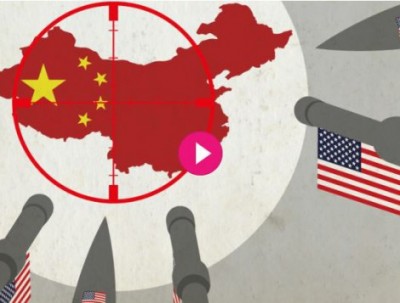
China’s Pivot to World Markets, Washington’s Pivot to World Wars…
And the Debacle of the Latin American Left ~ ALL over the World we (U.S) is bombing the shit out of EVERYTHING? & CHINA is BUILDING ...shit ...wonder how long the REST of the World is gonna put wit our(U.S.) ....shit
China
and the United States are moving in polar opposite directions: Beijing
is rapidly becoming the center of overseas investments in high tech
industries, including robotics, nuclear energy and advanced machinery
with collaboration from centers of technological excellence, like
Germany.
In
contrast, Washington is pursuing a predatory military pivot to the
least productive regions with collaboration from its most barbaric
allies, like Saudi Arabia.
China
is advancing to global economic superiority by borrowing and innovating
the most advance methods of production, while the US degrades and
debases its past immense productive achievements to promote wars of
destruction.
China’s
growing prominence is the result of a cumulative process that advanced
in a systematic way, combining step-by-step growth of productivity and
innovation with sudden jumps up the ladder of cutting edge technology.
China’s Stages of Growth and Success
China has moved from a country, highly dependent on foreign
investment in consumer industries for exports, to an economy, based on
joint public-private investments in higher value exports.
China’s early growth was based on cheap labor, low taxes and few
regulations on multi-national capital. Foreign capital and local
billionaires stimulated growth, based on high rates of profit. As the
economy grew, China’s economy shifted toward increasing its indigenous
technological expertise and demanding greater ‘local content’ for
manufactured goods.
By the beginning of the new millennium China was developing high-end
industries, based on local patents and engineering skills, channeling a
high percentage of investments into civilian infrastructure,
transportation and education.
Massive apprenticeship programs created a skilled labor force that
raised productive capacity. Massive enrollment in science, math,
computer science and engineering universities provided a large influx of
high-end innovators, many of whom had gained expertise in the advanced
technology of overseas competitors.
China’s strategy has been based on the practice of borrowing,
learning, upgrading and competing with the most advanced economics of
Europe and the US.
By the end of the last decade of the 20th century, China
was in a position to move overseas. The accumulation process provided
China with the financial resources to capture dynamic overseas
enterprises.
China was no longer confined to investing in overseas minerals and
agriculture in Third World countries. China is looking to conquer
high-end technological sectors in advanced economics.
By the second decade of the 21st century Chinese investors
moved into Germany, Europe’s most advanced industrial giant. During
the first 6 months of 2016 Chinese investors acquired 37 German
companies, compared with 39 in all of 2015. China’s total investments
in Germany for 2016 may double to over $22 billion dollars.
In 2016, China successfully bought out KOKA, Germany’s most innovative engineering company. China’s strategy is to gain superiority in the digital future of industry.
China is rapidly moving to automate its industries, with plans to double the robot density of the US by the year 2020.
Chinese and Austrian scientists successfully launched the first
quantum-enabled satellite communication system which is reportedly ‘hack
proof’, ensuring China’s communications security.
While China’s global
investments proceed to dominate world markets, the US, England and
Australia have been trying to impose investment barriers. By relying on
phony ‘security threats’, Britain’s Prime Minister Theresa May blocked a
multi-billion dollar Chinese investment-heavy nuclear plant (Hinckley
Point C). The pretext was the spurious claim that China would use its
stake to “engage in energy blackmail, threatening to turn off the power in the event of international crises”.
The US Committee on Foreign Investment has blocked several multi-billion dollar Chinese investments in high tech industries.
In August 2016 Australia blocked an $8 billion-dollar purchase of a
controlling stake in its biggest electricity distribution network on
specious claims of ‘national security’.
The Anglo-American and
German empires are on the defensive. They increasingly cannot compete
economically with China, even in defending their own innovative
industries.
In large part this is the result of their failed policies. Western
economic elite have increasingly relied on short-term speculation in
finance, real estate and insurance, while neglecting their industrial
base.
Led by the US, their reliance on military conquests (militaristic
empire-building) absorb public resources, while China has directed its
domestic resources toward innovative and advanced technology.
To counter China’s economic advance, the Obama regime has implemented a policy of building economic walls at home, trade restrictions abroad and military confrontation in the South China Seas – China’s strategic trade routes.
US officials have
ratcheted up their restrictions on Chinese investments in high tech US
enterprises including a $3.8 billion investment in Western Digital and
Philips attempt to sell its lighting business. The US blocked ‘Chen
China’s planned $44 billion takeover of Swiss chemical group ‘Syngenta’.
US officials are doing everything possible to stop innovative billion dollar deals that include China as a strategic partner.
Accompanying its domestic wall, the US has been mobilizing an overseas blockade of
China via its Trans-Pacific-Partnership, which proposes to exclude
Beijing from participating in the ‘free trade zone’ with a dozen North
America, Latin American and Asian members. Nevertheless, not a single
member-nation of the TPP has cut back its trade with China. On the
contrary, they are increasing ties with China – an eloquent comment on
Obama’s skill at ‘pivoting’.
While the ‘domestic economic wall’ has had some negative impacts on
particular Chinese investors, Washington has failed to dent China’s
exports to US markets. Washington’s failure to block China’s trade has
been even more damaging to Washington’s effort to encircle China in Asia
and Latin America, Oceana and Asia.
Australia, New Zealand, Peru, Chile, Taiwan, Cambodia and South Korea
depend on Chinese markets far more than on the US to survive and grow.
While Germany, faced with China’s dynamic growth, has chosen to
‘partner’ and share, up-scale productive investments, Washington has
opted to form military alliances to confront China.
The US bellicose military alliance with Japan has not intimidated China. Rather it has downgraded their domestic economies and economic influence in Asia.
Moreover, Washington’s “military pivot” has deepened and expanded
China’s strategic links to Russia’s energy sources and military
technology.
While the US spends hundreds
of billions in military alliances with the backward Baltic
client-regimes and the parasitical Middle Eastern states, (Saudi Arabia,
Israel), China accumulates strategic
expertise from its economic ties with Germany, resources from Russia
and market shares among Washington’s ‘partners’ in Asia and Latin
America.
There is no question that China, following the technological and
productive path of Germany, will win out over the US’s economic
isolationist and global militarist strategy.
If the US has failed to learn from the successful economic strategy
of China, the same failure can explain the demise of the progressive
regimes in Latin America.
China’s Success and the Latin American Retreat
After more than a decade of growth and stability, Latin America’s
progressive regimes have retreated and declined. Why has China
continued on the path of stability and growth while their Latin American
partners retreated and suffered defeats?
Brazil, Argentina, Venezuela, Uruguay, Paraguay, Bolivia and Ecuador,
for over a decade, served as Latin America’s center-left success
story. Their economies grew, social spending increased, poverty and
unemployment were reduced and worker incomes expanded.
Subsequently their economies went into crisis, social discontent grew and the center-left regimes fell.
In contrast to China, the Latin American center-left regimes did not diversify their economies: they remained heavily dependent on the commodity boom for growth and stability.
The Latin American elites borrowed and depended on foreign
investment, and financial capital, while China engaged in public
investments in industry, infrastructure, technology and education.
Latin American progressives joined with foreign capitalist and local
speculators in non-productive real estate speculation and consumption,
while China invested in innovative industries at home and abroad. While
China consolidated political rulership, the Latin American progressives
“allied” with strategic domestic and overseas multi-national
adversaries to ‘share power’, which were, in fact, eagerly prepared to
oust their “left” allies.
When the Latin commodity based economy collapsed, so did the
political links with their elite partners. In contrast, China’s
industries benefited from the lower global commodity prices, while Latin
America’s left suffered. Faced with widespread corruption, China
launched a major campaign purging over 200,000 officials. In Latin
America, the Left ignored corrupt officials, allowing the opposition to
exploit the scandals to oust center-left officials.
While Latin America imported machinery
and parts from the West; China bought the entire Western companies
producing the machines and their technology – and then implemented
Chinese technological improvements.
China successfully outgrew the crisis, defeated its adversaries and
proceeded to expand local consumption and stabilized rulership.
Latin America’s center-left suffered political defeats in Brazil,
Argentina and Paraguay, lost elections in Venezuela and Bolivia and
retreated in Uruguay.
Conclusion
China’s political economic model has outperformed the imperialist West and leftist Latin America. While the US has spent billions in the Middle East for wars on behalf of Israel, China has invested similar amounts in Germany for advanced technology, robotics and digital innovations.
While President Obama and Secretary of State Hillary Clinton’s “pivot to Asia” has been largely a wasteful military strategy to encircle and intimidate China, Beijing’s “pivot to markets” has successfully enhanced its
economic competitiveness. As a result, over the past decade, China’s
growth rate is three times that of the US; and in the next decade China
will double the US in ‘robotizing’ its productive economy.
The US ‘pivot to Asia’, with its heavy dependence on
military threats and intimidation has cost billions of dollars in lost
markets and investments. China’s ‘pivot to advanced technology’ demonstrates that the future lies in Asia not the West. China’s experience offers lessons for future Latin American leftist governments.
First and foremost, China emphasizes the necessity of balanced
economic growth, over and above short-term benefits resulting from
commodity booms and consumerist strategies.
Secondly, China demonstrates the importance of professional and
worker technical education for technological innovation, over and above
business school and non-productive ‘speculative’ education so heavily
emphasized in the US.
Thirdly, China balances
its social spending with investment in core productive activity;
competitiveness and social services are combined.
China’s enhanced growth
and social stability, its commitment to learning and surpassing advanced
economies has important limitations, especially in the areas of social
equality and popular power. Here China can learn from the experience of
Latin America’s Left. The social gains under Venezuela’s President
Chavez are worthy of study and emulation; the popular movements in
Bolivia, Ecuador and Argentina, which ousted neo-liberals from power,
could enhance efforts in China to overcome the business- state nexus of
pillage and capital flight.
China, despite its socio-political and economic limitations, has successfully resisted US military pressures and even ‘turned the tables’ by advancing on the West.
In the final analysis,
China’s model of growth and stability certainly offers an approach that
is far superior to the recent debacle of the Latin American Left and the
political chaos resulting from Washington’s quest for global military
supremacy.
The original source of this article is Global Research

 Posts
Posts