Sunday, June 7, 2015

Sentient World Simulation: Meet Your DoD Clone Corbett • 07/05/2012

by James Corbett BoilingFrogsPost.com
July 4, 2012

The NSA’s illegal warrantless wiretapping program. The building of the massive NSA data center in Utah to permanently store copies of all digital communication sent around the world. The UK government’s “Communications Data Bill” to monitor emails, instant messages and other personal information. What was dismissed as crazy conspiracy theory just over a decade ago has become, in this post-9/11 era, the all-too-familiar stuff of newspaper headlines and talking head reportage.
In fact, it was about a decade ago that the tactic of the intelligence agencies seemed to change. Instead of keeping their activities classified–referring to the NSA as “No Such Agency,” for example, or officially denying the existence of Echelon–the government increasingly began shoving this information in the public’s face.
Perhaps the scariest thing about something like the Total Information Awareness Office is not merely that it was proposed in the first place, or that it incorporated such blatantly creepy Orwellian imagery to convey its true nature and purpose, but that, as we sit here 10 years later, and as the core functions of the TIA office are now being openly performed by the NSA, DHS and other governmental agencies, people are now actively making excuses for this nightmarish police state.
“If you have nothing to hide then you have nothing to fear” has always been the rallying cry for those who are too afraid of questioning presumed governmental authority to speak out against the surveillance state and the implied assumption of guilt that goes along with it. With feigned bemusement these moral midgets inevitably ask “What’s so bad about the government spying on you, anyway?”
The answer, of course, is that the very question implies that the agencies tasked with carrying out this constant Big Brother surveillance are themselves above reproach, shining lights of moral rectitude who would never abuse this incredible power for nefarious ends. For the unimaginative out there, Hollywood yarns like “Enemy of the State” have provided fictional examples of what can go wrong if someone, somewhere, abuses this power of information and surveillance to target an innocent person in the wrong place at the wrong time.
To be sure, the power that these technologies give for agencies, or corrupt groups within those agencies, to destroy the lives of targeted individuals, is itself a fitting answer to the question of why government surveillance should be troubling to us. But beyond what can happen to specific, targeted individuals in such a scenario, however, is a much larger question: What if this data, our emails, our phone calls, our credit card transactions, our social media posts, our cell phone GPS logs, and all of the hundreds of other pieces of data that are admittedly being collected on us every day, were being fed into a database so gargantuan it contains a digital version of every single person on the planet? And what if that database were being used by the Department of Defense to war game various scenarios, from public reactions to natural disasters to the likelihood of civil unrest in the wake of a declaration of martial law?
Remarkably, this is precisely what is happening.
It is called the “Sentient World Simulation.” The program’s aim, according to its creator, is to be a “continuously running, continually updated mirror model of the real world that can be used to predict and evaluate future events and courses of action.” In practical terms that equates to a computer simulation of the planet complete with billions of “nodes” representing every person on the earth.
The project is based out of Purdue University in Indiana at the Synthetic Environment for Analysis and Simulations Laboaratory. It is led by Alok Chaturvedi, who in addition to heading up the Purdue lab also makes the project commercially available via his private company, Simulex, Inc. which boasts an array of government clients, including the Department of Defense and the Department of Justice, as well as private sector clients like Eli Lilly and Lockheed Martin.
Chatruvedi’s ambition is to create reliable forecasts of future world events based on imagined scenarios. In order to do this, the simulations “gobble up breaking news, census data, economic indicators, and climactic events in the real world, along with proprietary information such as military intelligence.” Although not explicitly stated, the very type of data on digital communications and transactions now being gobbled up by the NSA, DHS and other government agencies make ideal data for creating reliable models of every individuals’ habits, preferences and behaviors that could be used to fine-tune these simulations and give more reliable results. Using this data, the SEAS Laboratory and its Sentient World Simulation offshoot are able to create detailed, operable real-time simulations of at least 62 nations. “The Iraq and Afghanistan computer models,” according to a 2007 Register report on the project, “each has about five million individual nodes representing things such as hospitals, mosques, pipelines, and people.”
At the time of initial reports on the program five years ago, there were only 62 country-level simulations being run by the US Department of Defense. These simulations grouped humans into composites, with 100 individuals acting as a single node. But already at that time, the US Army had used the systems to create a one-to-one level simulation of potential Army recruits. The ultimate aim would be to archive enough data on each individual to be able to make a computer model of everyone on the planet, one that could be used to predict the behaviors and reactions of every single person in the event of various scenarios.
The program can be used to predict what would happen in the event of a large scale tsunami, for example, or how people would react during a bioterror attack. Businesses can use the models to predict how a new product would fare in the market, what kind of marketing plans would be most effective, or how best to streamline a company’s organization.
The original concept paper for the project was published in 2006 and in 2007 it was reported that both Homeland Security and the Defense Department were already using the system to simulate the American public’s reaction to various crises. In the intervening five years, however, there has been almost no coverage at all of the Sentient World Simulation or its progress in achieving a model of the earth.
There is a very good chance that these types of systems are, at least for the moment, pure quackery. Computers are only as valuable as their programming, after all, and the algorithms required to accurately predict responses in chaotic systems with multiple, dimly-understood variables is orders of magnitude beyond what is currently possible. Or is it? One of the great ironies of our time, as Glenn Greenwald goes on to point out in his speech on the surveillance state, is that although we live in a time when it is possible for nebulous government agencies to know every detail of your life, from what you ate for breakfast to where you shopped last night to who your friends are, we are also living in an age of unprecedented ignorance about what are our own governments are actually doing.
This is the heart of the matter. Somehow we are expected to go along with the sophomoric sophism that “If we have nothing to hide then we have nothing to fear,” yet at the same time we are asked to believe that the government must keep all manner of information secret from the public in order to carry out its work of “protecting” that public.
If the government has nothing to hide, then why doesn’t it release the notes, memoranda and findings of the 9/11 Commission in full and unredacted?
Why doesn’t it release the records of the JFK assassination investigation instead of arguing, as it is, that those records should once again be removed from a declassification review that is to take place in 2013, 50 years after the assassination itself took place?
Why doesn’t it release the full audit trail of what banks received the emergency TARP funds and in what amounts?
Is it because, after all, the government does have something to hide from the public that are its ostensible masters? Is it because the old maxim that “Knowledge is power” is more true than we could ever know, and that the government’s one-way insistence on transparency for the citizens and opacity for itself is a reflection of the power that it holds over us?
The Sentient World Simulation is just one example of one program run by one company for various governmental and Fortune 500 clients. But it is a significant peek behind the curtain at what those who are really running our society want: complete control over every facet of our lives achieved through a complete invasion of everything that was once referred to as “privacy.” To think that this is the only such program that exists, or even that we have any significant details about the ways that the SWS has already been used, would be hopelessly naive.
So where does this leave a public that is at such a disadvantage in this information warfare? A public that is effectively told that anything and everything they do, say or buy, can and will be catalogued by the a.i. control grid even as the details of that grid are to be kept from them? Unfortunately there is no easy way back from the precipice that we were ushered toward with the creation of the national security state and the passage of the National Security Act of 1947. Perhaps we have already stepped over that precipice and there is no going back in the current political paradigm. These are things for an informed, aware, knowledgeable citizenry to decide through a societal dialogue over the nature of and importance of “privacy.”
But without a general awareness that programs like the Sentient World Simulation even exist, what hope do we have in counteracting it?

MORE BANKER DEATHS: GILLIGAN AT AMERICAN EXPRESS, NOYCE AT GOLDMAN SACHS, AND THE REPEATING PATTERN

I cannot help but be suspicious any more on all the bankers and financiers dying, even if they do so due to "natural causes." Case in point here are the deaths, within this last week, of the President of American Express, and a key analyst for Goldman Sachs. Here are the stories:
Markets More: American Express Death American Express president Ed Gilligan has died
John Noyce, ‘Must Read’ Goldman Currency Analyst, Dies at 36
Now, so far, everything seems normal: Mr. Noyce had apparently been battling with cancer for some time, and Mr. Gilligan simply become "suddenly ill" on an airplane flight and expired. But again, these two unfortunate men appear to be part of that "pattern" that seems to be emerging with all the banker deaths. Here's the way Mr. Gilligan's death is being reported by Bloomberg:
He became seriously ill on a flight home to New York this morning, the statement said.
"This is deeply painful and frankly unimaginable for all of us who had the great fortune to work with Ed, and benefit from his insights, leadership and enthusiasm," CEO Ken Chenault said in the letter to employees.
"Our thoughts and prayers go out to his wife, Lisa, and their four children – Katie, Meaghan, Kevin and Shane. He was a proud husband and father, and his love for his family was evident in all that he did."
And then in American Express's own release:
His contributions have left an indelible imprint on practically every area of our business, from Commercial Card and Travel to International, Consumer, Small Business, Merchant Services, Network Services and, most recently, the group forging our digital partnerships and driving payment innovations. (Emphases added)
So where's the familiar pattern? Well, in Mr. Gilligan's case, it is (1) in his popularity with employees, colleagues, and family, a feature that seems to recur with each such death; and (2) he was involved in aspects of the financial sector having directly to do with computers, electronic payments and clearing, and, in his case, "forging digital partnerships", and driving "payment innovaitons," language that at least to this amateur's instincts sound all too like the formation of financial data cartels and trusts.
Then there is this about the unfortunate Mr. Noyce at Goldman Sachs:
"John Noyce, a technical analyst at Goldman Sachs Group Inc.’s London currency trading desk whose weekly report “The Charts That Matter Next Week” was widely followed, has died. He was 36.
He died on June 4 after a long battle with cancer, Goldman Sachs wrote in an internal memo signed by Isabelle Ealet, Pablo Salame and Ashok Varadhan, co-heads of its securities unit.
“He was well respected by market participants for his insightful analysis,” they wrote. “On the trading floor, he was a trusted colleague and friend -- demonstrated clearly by the overwhelming support he received from GS colleagues throughout his illness.”
And toward the end of the article, this tidbit is offered:
Noyce left Citigroup for New York-based Goldman Sachs in 2008, according to his employment history on the Financial Industry Regulatory Authority website. He joined Goldman Sachs as a vice president for European fixed income, currencies and commodities strategies, according to the company memo. (Emphasis added)
Again, one has the familiar pattern of (1) respected and liked by fellow colleagues and professionals, and (2) involvement in the sector of the business having to do with computers and electronic trading, and notably, in this case, with currencies and commodities strategies.
All we are told about the unfortunate Mr. Noyce is that he had been battling cancer "for a long time." We are told nothing about whatever illness Mr. Gilligan apparently died from, nor is there even any indication that an autopsy will be, or has been performed. But it's the consistency of the pattern that has emerged that disturbs, and the connections to those aspects of the financial sector that would put these men into the position of possibly being able to see, or observe, the signatures of untoward financial activity, including indicators of a hidden system interfaced with the public system of finance. At a certain point, financiers taking walks off of skyscraper rooftops, or out of ten story windows in Paris, or walking in front of a train, or drowning in lakes, or being shot as they're getting into their car, or dying in midair of "illnesses", or expiring from cancer, or murdered while taking a jog on a well-known public park... at a certain point, one must acknowledge that the likelihood of all of this just being "coincidence" isn't very high.  And then the real question becomes, which is no one within the mainstream lamestream media, or the alternative media, investigating it?
For my two cents' worth, I have suspected all along, and suspect now, that these individuals are being "suicided" because they have either uncovered something significant about the world financial system, something that few people in the public sector suspect, or they are being "suicided" as "precautionary" measures to protect some secret they themselves may not have understood fully that they knew.

9/11: An Occult Ritual?


 “… the picture that emerges is that of 9/11 as an ultra-powerful mind-control and propaganda weapon—a psychological warfare tool of enormous proportions—infused with techno-sorcery and deep-level occult programming. 9/11 was a global MegaRitual, – investigative researcher, S.K. Bain  https://infrakshun.wordpress.com/2015/05/04/911-an-occult-ritual-1/

If the reader has problems in accepting the certainty that the official narrative of 9/11 is bogus, then I recommend you don’t read further as it will either make you chuckle with derisive incredulity or make your head explode. Or both. You might say everything that has gone before in this blog has been a primer in order to ease the mind into accepting the following scenario as at least, a possibility. None of this stuff is easy to digest and I recommend reading the introduction to this blog and as much as you can of the first few series as you can before tackling the following pages. It hasn’t escaped my notice that if people are finding it challenging to process that elements within one’s government would willingly perpetrate vast a hoax and murder almost 3,000 people then they are not going to go the full nine yards in embracing the deeper dimension that it was another example of a Grand Mega-Ritual sacrifice for Saturn.

Out there right?
Padded_room
Our collective padded room (Source: creepypasta.wikia.com)
Well, you know what they say: truth can most certainly be stranger than fiction.  And the more layers you peel away the stranger it gets until you reach a state of “High strangeness”. That may leave you with the realisation that the inmates took over the asylum we call society a very long time ago. Welcome to the Real World as they also say…

With that little primer dispensed with, let’s move on.
The focus has been placed on occult Zionism due to it being, in my view, the most pervasive and influential arm of the 3EM and thus the cause of the majority of our religious and geopolitical conflicts, which of course impacts all our lives to a greater or lesser degree. We have also traced the extremism of Zio-Conservative foreign and domestic policy; US Zionist spy networks and the presence of a Zionist 5th column within successive US administrations. The dominance of Jewish persons within media, Hollywood, politics and socio-cultural discourse is extremely powerful. This does not mean that American-Jews are somehow all in cahoots with the Zionist Establishment but it does mean that the normal Jews and Jewish culture is used and exploited by psychopaths in a way that is intrinsically different to other forms of Establishment dynamics, as explored in previous posts.
That being so, it means that the occult aspects of 9/11 must be viewed along side the obvious Zionist manipulations throughout history and form an overall broader perspective. With such an enormously strong history of macrocosmic inversion across the whole history of our Empire builders we see the same “chosen people” rising to the surface and used expertly by Zionist handlers who embody the original sin of the Pharisees and Levite Priesthood. Their mind-set reoccurs again and again throughout history, flowing through streams of freemasonic lineage and religio-occult groupings. 9/11 may have been one vast ritual sacrifice sanctioned by the highest echelon Establishment occultists, signalling a crucial phase in the progression of pathocratic rulership.
If we have been reading with an open mind, it will have been obvious that the governments’ story of the 9/11 attacks is a conspiracy theory so silly as to insult the intelligence of anyone who is able to think critically. As illustrated in 9/11: The Point of No Return? our reaction to the attacks are as much about how we process reality as the veracity of what did or did not happen on that day. Perhaps it offers the opportunity for a  vast mirror of self-reflection regarding what we choose to believe about 9/11and the very nature of social systems in which we live and have our being. Our choices regarding 9/11 – assuming we give it any attention at all – will determine where we are on the arc of awakening; whether we choose the official theory or stand up for an independent investigation (however unlikely). But letting your own voice be heard IS vital. Whether we choose to remain silent or contribute to resisting lies, it is a descriptor of our worldview and thus offers an insight into the kind of person we are. And there lies both the opportunity – side by side with a tangible fear.

To explain: What if all the gaping holes in the official story were entirely purposeful, merely acting as a smokescreen for the true nature of the tragedy? When are persistent patterns of “coincidence” transformed into realisations that there are hidden layers at work beneath the facade? For some, that is not something to contemplate as it implies a whole world of change that is deeply uncomfortable. It is preferable to adhere to the official view (even some of the standard views within the 9/11 Movement) in order to maintain aligned beliefs which permit such a fraud to work in the first place.
If that becomes broken what else will have to be addressed deep within ourselves?

Unexpected change is very hard for most of us. It took me a very long time to embrace uncertainty and change, whatever the situation. I only managed to do it due to several major shocks to the system which shattered the false part of myself into little bits so that there was no way for me to carefully piece them together again. Thus a new self could be grown that was a little closer to the authenticity I wished to embody. In the same way, 9/11 is one big shock to the collective human system that will ultimately force us all to make a choice: to follow the Official Culture of normalised lies and by default support it, or join together with others – whatever their race or creed – and say: “No. This is not the kind of world I support and I will peacefully defend the human conscience any way I can.
twintowers4
© infrakshun
Before we continue to go deeper let’s review the 9/11 basics with a lengthy extract from journalist James Corbett at www.corbettreport.com. With some  wry humour he perfectly summarises the preposterous nature of the official story while providing a nice reminder of 9/11 events as a whole:
“On the morning of September 11, 2001, 19 men armed with box-cutters directed by a man on dialysis in a cave fortress halfway around the world using a satellite phone and a laptop directed the most sophisticated penetration of the most heavily-defended airspace in the world, overpowering the passengers and the military combat-trained pilots on 4 commercial aircraft before flying those planes wildly off course for over an hour without being molested by a single fighter interceptor.
These 19 hijackers, devout religious fundamentalists who liked to drink alcohol, snort cocaine, and live with pink-haired strippers, managed to knock down 3 buildings with 2 planes in New York, while in Washington a pilot who couldn’t handle a single engine Cessna was able to fly a 757 in an 8,000 foot descending 270 degree corskscrew turn to come exactly level with the ground, hitting the Pentagon in the budget analyst officewhere DoD staffers were working on the mystery of the 2.3 trillion dollars that Defense Secretary Donald Rumsfeld had announced “missing” from the Pentagon’s coffers in a press conference the day before, on September 10, 2001.
Luckily, the news anchors knew who did it within minutes, the pundits knew within hours, the Administration knew within the day, and the evidenceliterally fell into the FBI’s lap. But for some reason a bunch of crazy conspiracy theorists demanded an investigation into the greatest attack on American soil in history.
The investigation was delayed, underfunded, set up to fail, a conflict of interest and a cover up from start to finish. It was based on testimony extracted through torture, the records of which were destroyed. It failed to mention the existence of WTC7, Able Danger, Ptech, Sibel Edmonds, OBL and the CIA, and the drills of hijacked aircraft being flown into buildings that were being simulated at the precise same time that those events were actually happening. It was lied to by the Pentagon, the CIA, and the Bush Administration and as for Bush and Cheney…well, no one knows what they told it because they testified in secret, off the record, not under oath and behind closed doors. It didn’t bother to look at who funded the attacks because that question is of “little practical significance“. Still, the 9/11 Commission did brilliantly, answering all of the questions the public had (except most of the victims’ family members’ questions) and pinned blame on all the people responsible (although no one so much as lost their job), determining the attacks were “a failure of imagination” because “I don’t think anyone could envision flying airplanes into buildings” except the Pentagon and FEMA and NORAD and the NRO. The DIA destroyed 2.5 TB of data on Able Danger, but that’s OK because it probably wasn’t important.
The SEC destroyed their records on the investigation into the insider trading before the attacks, but that’s OK because destroying the records of the largest investigation in SEC history is just part of routine record keeping. NIST has classified the data that they used for their model of WTC7′s collapse, but that’s OK because knowing how they made their model of that collapse would “jeopardize public safety“. The FBI has argued that all material related to their investigation of 9/11 should be kept secret from the public, but that’s OK because the FBI probably has nothing to hide. This man never existed, nor is anything he had to say worthy of your attention, and if you say otherwise you are a paranoid conspiracy theorist and deserve to be shunned by all of humanity. […]
Osama Bin Laden lived in a cave fortress in the hills of Afghanistan, but somehow got away. Then he was hiding out in Tora Bora but somehow got away. Then he lived in Abbottabad for years, taunting the most comprehensive intelligence dragnet employing the most sophisticated technology in the history of the world for 10 years, releasing video after video with complete impunity (and getting younger and younger as he did so), before finally being found in a daring SEAL team raid which wasn’t recorded on video, in which he didn’t resist or use his wife as a human shield, and in which these crack special forces operatives panicked and killed this unarmed man, supposedly the best source of intelligence about those dastardly terrorists on the planet. Then they dumped his body in the ocean before telling anyone about it. Then a couple dozen of that team’s members died in a helicopter crash in Afghanistan.
This is the story of 9/11, brought to you by the media which told you the hard truths about JFK and incubator babies and mobile production facilities and the rescue of Jessica Lynch. If you have any questions about this story…you are a batshit, paranoid, tinfoil, dog-abusing baby-hater and will be reviled by everyone. If you love your country and/or freedom, happiness, rainbows, rock and roll, puppy dogs, apple pie and your grandma, you will never ever express doubts about any part of this story to anyone. Ever. [1]
So, what were the effects of this momentous event? Did it change your life in any tangible way? What’s certain is that the so-called attack on American soil on September 11th fundamentally altered our way of life for almost everyone on the globe whether we realise it or not. In subsequent years we have seen:
  • The elimination of habeas corpus, the Bill of Rights and the Fourth Amendment and the subsequent imposition of draconian laws. Similar clampdowns on the freedom of speech using the pretext of the War on Terror have also been enacted in Europe with humanitarian and civil liberties further eroded.
  • The militarisation of the police and the arrival of the police state and commensurate brutality.
  • The use and justification of torture.
  • The push for global resources under the pretext of humanitarian aid and the use of “coloured revolutions” for regime change. The wars in Iraq and Afghanistan, and invasions of Somalia, Libya, Yemen and Syria with state-sanctioned assassinations and an increase in boarder conflicts are all part of a long term Anglo-American-Israeli doctrine for “perpetual war.”
  • Asymmetric proxy wars fought through private armies or mercenaries.
  • The rise of the surveillance state and technocracy.
  • An exponential rise in state-sponsored terrorism from Al-Qaeda to ISIL.
  • Mass exodus of refugees fleeing the Western-backed terror groups and more pressure on immigration issues.
  • A rise in anti-Semitism and Islamophobia.
  • A massive increase in high level propaganda via outsourced consultancies, lobbyists, think-tanks and mainstream media.
  • The further domination of transnational corporations in banking, food, oil, agribusiness over government policy.
  • Huge increases in military spending from governments worldwide at the behest of arms manufacturers and banking cartels.
  • The discovery of banking and corporate fraud as a symptom of the mainstreaming of the underworld to “overworld” economy.
  • The highlighting of the core corruption, insider trading and manipulation of the world markets by Wall Street and the global banking cartels as a way of life.
  • A continuous net increase of wealth to the richest on the planet while those in poverty get still poorer. (And this leap in affluence and ownership for the ooooooo.1% of the planet has occurred in particular since the last economic crash of 2008).
  • A serious escalation of the threat of nuclear war by US-NATO as an attempt to globalise conflict into a World War III scenario.
I’m sure you can include many other sub-categories, all of which have been directly and indirectly made possible from the events of 9/11.
13009shroudedbodies
The shrouded bodies of Iraqi civilians killed during fighting between insurgents and American Marines in Haditha, on Nov. 12, 2005.
We have explored the roots of the religio-occult and mythological significance of Saturn-moon worship and its core links to the Establishment of today, most notably Hassidic sects within Judaism such as Chabad Lubavitch and elite Zionism. Clearly, they are not the only players. The fire-Prometheus-Lucifer-Sun cults upon which the Catholic Church is based is a far cry from Christ’s message. Militant Islam and Western intelligence’s fascist outpost of the Muslim Brotherhood are also represented. The structure and icons of all these religions and their off-shoots show the remnants of a Saturnine past and the consequent cover up of our true spiritual origins. What binds the 3EM together is occult Babylonianism – the root source of materialism, “temporal power” and the ceremonial psychopath’s heritage. That is the whole raison d’etre of the minority ruling elite. In order to maintain the illusion of the “intermediaries” of old: there must always be a suitable incentive for the masses to place their trust in the structures of authority otherwise there will be chaos and violent “anarchy”. Yet, spiritual nourishment and societal order does not come from the rules set down by ancient totalitarian priesthoods and Royal bloodlines of oligarchs and banking cartels. True anarchy shows us that hierarchical leaders are not needed though this does not exclude leadership and structure. Yet this is what they would have us believe – for their own survival. As the character of high chancellor Adam Sutler tell us in the film adaption of Alan Moore’s graphic novel: V for Vendetta:
“I want this country to realize that we stand on the edge of oblivion. I want everyone to remember why they need us!”
And ritual blood sacrifice drawn from the population is the much needed “energy” to maintain their parasitical and vampiric place within the biosphere of humanity and Earth. Thus, their essential nature – much like their ideologies – has to be camouflaged with masks of sanity which inevitably slip all the time. Nowhere do we find this more powerfully expressed than in the slow ponerisation of organised religion an materialist science, both two sides of a lost Truth: Religion as echoes of archetypal myths offering an emotional mystical connection to higher densities of Being and orthodox science as a pale reflection of an ancient techno-science of alchemy. Only by a marriage of both can we begin to remember our past. And remembrance and redemption of a once sacred spiritual science is firmly under lock and key of the Elite.
cloudkey1© infrakshun
Meantime, overt occultism becomes a  commonly accepted part of culture whether Wiccan or Freemasonry, Jewish Kabbalah or Theosophy they are the scraps from the global priesthood which serve to keep the mass mind occupied and “in the know.” The psychopath and his worldview is often: “… transformed into an angel of light” (2 Corinthians 11:14) and yet he is the personification and channel for Non-Being and darkness. Deception is only useful if it successfully substitutes art for artifice, truth for lies hierarchy and spiritual dogma for a living personal connection with Spirit.  And this is where the use of symbols, emblems, amulets, talismans, motifs and modern iconography comes in. These is the medium by which Brotherhood of “Saturn”, “Satan” and the “Serpent” telegraph phases of progression within occult theology and practice. Our culture is saturated in updated versions of ancient symbolism in much the same way as the supra-ancient six-pointed star as endless variations on that geometrical template has shown. After all, remember that part of the reason our paleolithic and neolithic ancestors  carved symbols into rock as way to interpret earth changes and the clash of the celestial Titans. They did so because it was both a creative imperative and a warning for future communities. This time the symbolism is displayed through corporatism, pop culture and ritual motifs and formulas plastered all over the events of 9/11 as echoes of those past epochs and as a game of numbers and messages by an elite that is impressed by its own deranged self-importance.

ptraglyphs
© infrakshun
Why is it that the occult psychopath is so enamoured of symbols and alchemical formulas? It is rather like the tripartite relationship of the key, the lock and the door. Symbols and their numerology were formulated by observing, attuning and communing with Nature where all knowledge lies (“as above, so below”.) Occult magicians are obsessed with deciphering the keys, finding the locks and opening the doors (portals) between different locations of reality where the “Gods” resided and that were perhaps naturally attuned through our bodies and minds – through our very DNA – during the Golden Age.
Like all things, symbols can be inverted and the destination and contact is somewhat different. And if one is interested observing the ancient power-sharing practice of Saturnine ritual sacrifice you can imagine what kind of invocations are necessary and by extension, what kind of demands need to be met with whomever they made “contact.” We might also say that “energy follows thought” and the application of primal energy such as sexual desire, a bio-chemical kundalini and the instinct of fear appear to have a strange power when married to the presence of blood sacrifice, a throw back to the dark magick of sacrifice which unlocked particular “powers.” In other words, it may not be simply symbolic but offers the use of codified information that quite literally allows the correct configuration of keys to access certain demonic archetypes built up over time. Whether or not this is true is a whole new line of research. Suffice to say, that this is a simple description of a more complex belief system which will assist us in understanding why 9/11 was a “key” event in occult ritualism and which unlocked much more than we may realise.
portal2
Magical symbolism and sacred geometry represents the belief that certain fundamental laws of the Universe can be unlocked. Perhaps they can…but be careful which door you open….© infrakshun
So, we might see “sacred geometry” and “words of power” as codified  rotes of information locked into the symbol rather like hieroglyphics of old and even modern day algebraic and trigonometric mathematics where one single equation can embody a raft of meanings.  We might even say that so much of our quantum technology can bundle information into a smaller and smaller “space” in much the same way a as an ancient symbol bundles concepts and laws which then need the right keys to unlock them, though beyond the usual laws of space-time. What better way to encrypt alchemical secrets and Universal laws of access through a series of interlocking shapes which both conceal and reveal to a suitably primed initiate?
Perhaps the Golden and Silver Ages of Humanity saw ancient science and technology far in advance to what we have today.The limitation of the five senses is transcended through the medium of the symbol and may hark back to a time when humanity used symbols much more than vocal language. And this does not mean all alchemical and magical symbolism is inherently evil (unless of course you are a religious evangelist) since benign Custodians of the past also used the language of symbols to protect spiritual knowledge.  21st Century occultism is merely a degenerate form of ancient science in this context, with institutionalised rituals offering a custodial role of knowledge transference to benefit only a psychopathic minority. And of course, symbols of power have built-in safeguards to lead dilettantes away from danger. In the same way that icons and geometric-mathematical shapes can act as keys to higher levels of awareness they are also believed to transmit or transduce “energies” or frequencies which have been built up over time in the same way that an electrical circuit can be charged and/or earthed by turning on the mains supply. And the quality of that flow depends on our depth of Being – or Non-being. This can be applied both metaphorically and for occultists most literally. Which is why there is a tradition of inscribing stones, floors and landmarks seen as power points with specific symbols which offer a particular purpose in terms of locking in ritual “spells” and/or releasing them at a certain juncture.
Orthodox Science is catching up with Esoteric science in the sense that the latter seeks to set down in writing certain psycho-spiritual treatises for the individual and group to attain liberation from matter i.e. by developing a REAL self, the growth of the soul, as opposed to an amalgamation of conditioning and survival instincts which keep us “asleep”. Science uses largely reductive methods to pick Nature apart in order to understand her and thereby improve our own lot – or the profit margins of the overshadowing sponsor. For most of science man is a machine and consciousness is a by-product of a neurological  Skinner box or the transhumanist avatar. Esoteric science and its knowledge is experiential and intuitive, practical and ideally, entirely objective in the correct setting. This can  only be proved by applying the knowledge it seems. Occult brotherhoods predicated on white, black, grey or  Satanic magick place ritual and invocation as a primary benchmark of control and is thus, ultimately inviting the same quality of control back into their lives. The Grand Magician cannot see past his own self-absorbed choices however. 
As occult beliefs play a huge part in the Three Establishment Order and its geo-political aspirations, we must therefore entertain the possibility that some form of occult psychological warfare reached its destructive apotheosis on the morning of September 11th 2001 and beyond. There is a certain music of chance which may exist in the events and occurrences in and around 9/11 expressed as a mathematical probability, interwoven with apparent signs and portents which, on their own, are nothing. However, taken together and with much of the information covered in this blog so far,  it becomes somewhat more compelling.
occultsymbols1
© infrakshun
In fact, for experts in the occult and politics – nothing happens by chance. Meaning can be seen in the most random events and symbolism ascribed to the seemingly mundane. Granted, if we are mystically-minded you can see almost anything you wish to see in the ocean of numbers and formulae which make up the “ethers” of our daily lives.
Regardless of whether we are atheist, agnostic or religious, occult belief exists in the world in a way that is largely hidden from ordinary people but nevertheless permeates almost every facet of society, from top to bottom. Now, whether occultism is founded on principles which have a ancient scientific basis is irrelevant. Maybe they do maybe they don’t. What is important is that many of the psychopathic insiders of our world do believe it and use forms of magick as a  primary tool in their operations. Accordingly, they affix meaning and power to astrology, cosmology, human psychology, sexuality, death and blood ritual. Symbolism, esoteric cycles and timing is a vital part of that grandiose game. What is beyond doubt is the power of the human mind to affect potent changes imbued by the strength of belief. Only when we discard the evidence of the occult and seek to trivialise its influence as a parlour game with silly costumes and lighted candles (though this exists as well) do we become prey to the same comfortable fantasies and illusions that prove so useful for those who corral and control.
What emerges in the 21st Century is the cool, calculating logic of machine-consciousness tied to technology and mapped to the esoteric science of ancient wisdom. We are talking about people who have such a different take on reality to our own that they effectively exist as a breakaway civilisation living apart in a material and perceptual sense. What if it were indeed true that the suppression of technology and ancient knowledge had been taking place for centuries? Do you think that such a possibility is rational or is it just an over active imagination? Judging from the way history has clearly shown us that the long-term hoarding and suppression of knowledge not only took place but is actively occurring today, it is a strong probability that the elite manifestation of wealth consolidation is a descriptor pointing to something much deeper. Namely, an esoteric knowledge linked to Earth Changes and celestial catastrophism and the pathological hubris that they can lie safely in their bunkers and ride out the storm. From the ashes they hope to rise phoenix-like from the ashes they have helped to create. Hence the importance of 9/11 as ritual ignition which aligns with the caricatures of religious fundamentalist eschatology and the promise of a New World.

If a collection of psychopathic cabals have technology and power to make fantasy and illusion appear real, at least for a while, and to wreak the destruction that they have, we could also posit the idea that there is the kind of knowledge and technology  which would appear as “magical” to us as a computer would have done to Medieval man. In this context, the occult symbolism may align to such a destructive technology/weaponry which blurs the boundary between mind and matter. In the hands of psychopaths we have seen the very gates of hell opened. And we may wonder indeed what we have allowed in. Exactly who these people are, is immaterial as we will only ever see the barest trace of their footprints by the light the moon, and their saturnine calling card is played out through Kabbalistic numerology and sacred geometry.
And what fun they have with the masses!
100_3301
© infrakshun
This, unfortunately is the literal gateway to host of other numerical matches, symbols and metaphors that pile up one after the other until finally, there is a coherent framework of occult meaning. Yet we cannot see the significance because most of us have not been educated to understand symbolism both in terms of the occult and the importance of our inner life in general. Therefore, as part of our cultural paradigm of Cartesian/Darwinian materialism we are educated to believe that such things cannot possibly play a part in our lives. When a practical, community-centered living and a healthy connection to nature and art was replaced by the “Age of Reason” and the onset of an extreme scientific rationalism. Though it helped to banish harmful superstitions this change in human focus eventually led to a pathological emphasis on materialism as the source of meaning. Over time we have been shaped into a techno-narcissistic culture bereft of the significance of ancient wisdom based on service; the oral tradition and relevance of dreams; the lost knowledge of social and community relationships which without using rose-coloured spectacles, nonetheless provided emotional nourishment and spiritual pragmatism. Carefully managed belief systems by perception management teams since the early part of the 20th Century have determined what we consider worthy for our attention without our even knowing that these thought streams our not our own. Cultural osmosis does the rest.
Whereas Freud embraced the nihilistic dead-end of psychoanalysis and its obsession with death and sex, Swiss psychologist Car Jung based much of his life’s work on the importance of the soul which be believed worked through the unconscious as dreams using the rich language of symbolic imagery. The loss of awareness concerning cultural motifs, archetypes and metaphor has left us at the mercy of those who have retained such knowledge having inverted it towards their own twisted visions. The occultists – black and white – had already been accessing these archetypes, elemental motifs and Gods and Goddesses in order to “create reality” according to their wishes for a very long time. Jung’s genius was to formalise some of the mechanisms and processes whilst offering some academic credence along the way.
Occult historian and symbologist Michael Tsarion suggests that we are suffering from “a chronic symbol illiteracy” largely drawn from the use of subliminal persuasion in media and advertising which he terms: “a psychic dictatorship.” He explains how our present culture uses: “… the deliberate and subversive manipulation and public purveyance of words, images, numbers, colors, rhythms, and symbols which are subsequently directed, via ubiquitous media oracles, toward the limbic areas of the human brain.” Tsarion believes that this is in part the cause of many physical and psychological disorders, especially in the young, bombarded as they are by: “elaborate and insidious cryptic language specifically designed to stimulate conflict between fantasy and reality” which over time, eventually undermines healthy drives and normal functioning of the human unit. As we have witnessed, the young are primary targets of exploitation at virtually every level of human endeavour. Hardly surprising then we have all been led down a singular path toward a very bleak future. As Tsarion explains:
The young are, by definition, closer to the creative force than the average adult. They are also more influenced by the limbic brain and, therefore, respond with greater zeal to the erotic and even perverse symbolic messages which have become increasingly pervasive in their life- and think-space. The invasive, clandestinely directed, content has been adroitly designed to bypass their moral conscience and rational filters. The results of this psychic dictatorship are devastating. […]
Subliminal messages permeate television programs, computer games, magazines, billboards, products, and musical productions. They are, however, not limited to the ambience of the young. They are just one of the weapons in the arsenal of psychopathic corporations whose entire modus operandi concerns profit and dehumanization. All that is truly aesthetic, traditional, cultural or substantial merely stands in the way of their monopolistic stratagems, their aggressive, relentless efforts at reducing the entire human race to a body of narcissistic, sense-infatuated, desensitized, amoral, immoral or actively criminal ‘smiling depressives.’” [2]
The author makes a point of describing the coordinators and designers of certain mass-appeal programmes such as MTV, Big Brother, X-Factor and others as the product of “technological witchdoctors and cyber-space sorcerers” using a variety of techniques: “… such as Tele-hypnosis, Metacontrast, Hemisync, Synaesthenia, and Embedding … with the same deadly effect as any past voodoo, sorcery, or telepathy.” [3] Let’s also remember the pernicious infection of Nazi ideology that was seeped in ritual symbolism and mind control which was able to entrain a whole population. The same principles have been in operation, most aggressively, since after the Second World War. It was not that the Anglo-American-Israeli Elite were new to such occult inversions but that they actively encouraged the Germanic revival precisely because they were historically its designated carriers, and cognizant of the power of symbols.
Nazi rally in the Cathedral of Light c. 1937
Nazi rally in the Cathedral of Light, c. 1937: “.I’m beginning to comprehend some of the reasons for Hitler’s success. He is restoring pageantry and color and mysticism to the drab lives of 20th century Germans.” – William L. Shirer| Source: Rare Historical Photos at: www.rarehistoricalphotos.com
Tribute in Light
“The ‘Tribute in Light’ memorial is in remembrance of the events of Sept. 11, 2001. (U.S. Air Force photo/Denise Gould) | The power of remembrance is fitting for all those who lost their lives during 9/11. But this commemoration may have occult significance for a minority who saw September 11th as a sacrificial ritual marking and the next phase in the “restoration” of a World State. (The lights also reinforce the numerology of 11, the sybolism of which we will explore later).
When advertisers, marketers and public relations are under the guiding hand of this oligarchical patronage then it is easy to understand why numbers and symbols play such an important role in societal programming. It is for this reason that signs and symbols which have become part of the collective unconscious and cultural fabric of everyday life can be flipped on their head and manipulated to produce a particular response.
As we have seen, the ubiquitous presence of freemasonic / Illuminist lore is founded on the magickal formulas of the Kabbalah which in turn, is drawn from the influence of Babylonian Talmudism from over two thousand years ago. It has since permeated both Jewish and Catholic traditions and the entertainment culture forming the basis of occult Magick across all Establishment lines. It is the esoteric language of the Elite which author Philip D. Collins believes can be deciphered provided we have a basic awareness of the language of signs, otherwise known as “semiotics”.
The study of esoteric signs falls into three categories which Collins outlines as:
Iconic: These signs normally resemble something else. They are approximations, facsimiles. Examples: statues, pictures.
Indexical: Like the index in the back of a book, these signs refer the percipient to something else. They are used to establish causal or physical relationships. Examples: Smoke is commonly an indexical sign for fire. A shadow is normally an indexical sign for a physical body in front of some light source.
Symbols: These signs express some convention and hold a shared meaning for those interpolated into the culture. These signs must be learned. Examples: Words, numbers, flags.
Complementing this is also “Intertextual reference” which denotes the creative “… correlation between more than one text, thus augmenting a sign’s meaning.”  [4]
Collins provides examples of many narratives within media and entertainment which: “‘… embody the paradigmatic character of the situation and images surrounding 9-11” where such “… synchronicities were consciously engineered by the entertainment industrial complex.” Intrinsic to certain films’ blatant and subtle imaging such as ‘America under attack’ meme in Pearl Harbour (2001); Independence Day (2001); along with the more esoteric examples such as 2001 A Space Odyssey (1969). Most of the literature and later films of H.G. Wells are all also examples of “paradigmatic templates” which were then promulgated vigorously by Establishment media organs in order to be “…instrumental in creating a cultural milieu that would be hospitable to future media manipulations. By the time of the WTC attacks, the collective subconscious of America was fertile with memes (contagious ideas) planted by [such films].[5]
In the same vain, Collins includes an example of intertextual referencing care of Zbigniew Brzezinski’s seminal book: The Grand Chessboard where the statesman delineated the geo-strategy by which America would attain global primacy and eventual one world government, best exemplified by this quotation: “Moreover, as America becomes an increasingly multi-cultural society, it may find it more difficult to fashion a consensus on foreign policy issues, exception the circumstance of a truly massive and widely perceived direct external threat.” [6]
911-wtc7-fema-august-1997-emergency-response-to-terrorism-self-study-manual-tile
US Department of Justice 1997 Emergency Response to Terrorism self study manual (1997)
illuminati-card-game-twin-towers-pentagon
“Illuminati” is a standalone card game made by Steve Jackson Games (SJG) in 1995 and inspired by the 1975 book, The Illuminatus! Trilogy, by Robert Anton Wilson and Robert Shea. (wikipedia)
We have looked at the idea of Hollywood engineering in ‘Official Culture: “Lights, Camera, Reaction!” From a variety of cultural sources ranging from films literature and US Department training manuals there are many examples of what amounts to intentional “psychic entraining” or on occasion, perhaps the innocent intuition of future events, which is much more common than we may think. Filmed in January 2000 and aired on US TV networks in April 3 2001, an episode of The Lone Gunman, [7] a spin off from the X-files series told of a plot to hijack planes and crash them into the World Trade Centre Here’s a short extract from the transcript: 
What is Scenario 1 2D? We know it’s a war-game scenario that it has to do with airline counterterrorism…. Why is it important enough to kill for?
Because it’s no longer a game.
But if some terrorist group wants to act out this scenario why target you for assassination?
Depends on who your terrorists are.
The men who conceived of it in the first place….. You’re saying our government plans to commit a terrorist act against a domestic airline —
There you go, indicting the entire government as usual. It’s a faction, a small faction.
For what possible gain?
The cold war’s over John but with no clear enemy to stockpile against, the arms market’s flat. But bring down a fully loaded 727 into the middle of New York City and you’ll find a dozen tin-pot dictators all over the world just clamoring to take responsibility and begging to be smart-bombed.
I can’t believe it.
This is about increasing arms sales.
An astonishingly accurate appraisal of the situation, I think you’ll agree. If the writers of the series dealing with consipracy plot-lines can predict such a thing one might ask why the US military-intelligence did not?
You can see James Corbett’s analysis of the actors and writers involved and how they handled such a highly accurate rendering of what took place just four and half months later. Innocent coincidence? Psychic “bleed-through”? Or just another one of those occasions where an insider has a little game with the public?
diehard1
“Diehard” (1988)
Two years before heralded the Die Hard film franchise which involved a very successful blend of high suspense, evil European terrorists and a very tall building. It was another case of intertextual and symbolic entrainment. There are also literal references to September 11th in the script itself all packaged up with flying, terrorists, towers and 9/11. It has been one of the most popular series of films ever made firmly implanting the idea of terrorists as independent external threats to government and law and order. The terrorist meme has been replayed in countless, films and T.V. shows ever since.
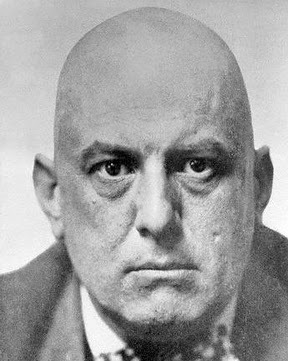
There are many more examples too numerous to mention here with shadow of Pentagon help looming large in the background. With the foundation of Kabbalah informing the present day occult which formed the basis of a heavily programmed symbolism in mass culture. The key protagonist and inspiration for this onslaught was provided by the occultist and British intelligence operative Aleister Crowley (1875-1947) who famously appointed himself as the “Great Beast.”
Crowley’s views meshed neatly with much of early Illuminism rode the resurgence in occult practice in the 19th and twentieth Centuries: depopulation, elitism, Sex Magick, ritual invocation all tied up with the same Weishauptian principles of Revolution. The masses were viewed by Crowley in much same way as any other members of the puppet Elite from Kissinger to Rockefeller, Prince Philip to Maurice Strong. He stated: “We should have no compunction in utilising the natural qualities of the bulk of mankind. We do not insist in trying to train sheep to hunt foxes or lecture on history; we look after their physical well-being and enjoy their wool and mutton. In this way, we shall have a contented class of slaves who accept the conditions of their existence as they really are and enjoy life with the quiet wisdom of the cattle.” [8]
aleister_crowley1
Aleister Crowley in 1912 and the doyen of Anglo-American occult
Once you have researched every aspect and nuance of the September 11th attacks for many years the feeling one derives from the theories, evidence, science (and endless noise) is that all of it is somehow designed to be suspicious. It is meant to be confusing, silly and almost satirical in its cruelty; placing clues and smokescreens to distract and mis-inform. Much of the official story is so obviously hackneyed in its planning where non-sequiturs and logical fallacies abound that the researcher is led to a mix of truth and lies in equal measure. It is a masterly exercise in the tradition of an occult trickster, worthy of Hermes himself and implies a keen understanding of crowd psychology and the internet society.
Journalist and historian Michael A. Hoffman II characterises the depth of the game to which we are, to a greater or lesser degree all unconscious participants in his seminal book Secret Societies and Psychological Warfare (1989) which, although written well before September 11th confirms: “… a physical, technological tyranny as well as a tyranny of the mind,” where: “The issue of controlling humanity with esoteric words and symbols encoded within a play, a media spectacular or a ritual is one of the most difficult for people to comprehend … Even as [we] dance… to the tune of the elite managers of human behavior, [we] scoff… with great derision at the idea of the existence and operation of a technology of mass mind control emanating from the media and government.” [9]
Hoffman is convinced that the power of ritual murder has enormous psychological repercussions upon a clueless populace wholly unaware that technology is now enmeshed with ritualistic programming via music, media, advertising and false-flag military operations equalling physical and psychic attack on a mass scale. He asserts that these “mega-rituals” are: “… not solely bound to the achievement of the immediate effects of the attack on the victim, but may in fact be a part of a larger, symbolic ritual magnified by the power of the electronic media, for the purpose of the alchemical processing of the subconscious Group Mind of the masses.” Hoffman tells us that “it is the subconscious that is being addressed in occult ritual, in a process CIA behavioural scientist Dr. Ewan Cameron termed, ‘psychic driving.’” [10] It is this process that by-passes critical thinking and making discussion on subjects such as the 9/11 attacks almost impossible in Official Culture.
It is clear that those whom Hoffman calls “The Black Arts adepts” and their involvement in the orchestration of 9/11 along occult lines are not mad. They are in fact: “a brilliantly orchestrated ritual whose ceremonial aspects were as precise and detailed as the internal workings of a clock.” [11] For occultists, the attentions to numbers and the creation of scared geometry are crucial to the success of any plan.


Notes

[1] ‘A 9/11 Conspiracy Theory’ By James Corbett (video) http://www.corbettreport.com/911-a-conspiracy-theory/
[2] ‘Symbolic Literacy’ by Michael Tsarion 2008 |www.taroscopes.com
[3] Ibid.
[4] ‘The Semiotic Deception of September 11th’ by Phillip D. Collins, December 31st, 2004. http://www.conspiracyarchive.com/
[5] Ibid.
[6] Ibid.
[7] The Lone Gunman (2001) ‘Did you Know?’ | http://www.imdb.com/title/tt0243069/trivia
[8]
pp. 199-200; The Law is For All: The Authorized Popular Commentary on Liber Al Vel Legis Sub Figura CCXX, The Book of Law. Phoenix Ariz. 1996; Quoted in ‘False flag Terror – the Occult Connection’ by William Ramsey from his book Prophet of Evil: Aleister Crowley, 9/11 and the New World Order.
[9] A. Hoffman II, Michael ; Secret Societies and Psychological Warfare 1989. July 2001.
[10] Ibid
[11] Ibid.

New Instruments of Surveillance and Social Control: Wireless Technologies which Target the Neuronal Functioning of the Brain

Global Research, March 09, 2008
New Instruments of Surveillance and Social Control: Wireless Technologies which Target the Neuronal Functioning of the Brain
Increasingly there are indications that the uses of wireless technologies have been developed to target an individual’s biological body, with specific focus upon the neuronal functioning of the brain. In this paper I examine how some of these uses have had detrimental effects, and what this implies for both present and upcoming developments for particular wireless/sensor technologies. I consider whether this is not shifting dangerously towards a psycho–civilised society, where greater emphasis is placed upon social control and pre–emptive strategies.

Introduction

The rate of technological innovation in some fields is developing exponentially with new advances in wireless sensor networks, ubiquitous and pervasive computing, motes, nodes, grids, and media platforms. Information flows are increasing not only in their quantity and density, but also in their immersive quality. The historical developments of information communication systems can be said to have traced a similar path to how nation states have organised their global power base and dominance. First, power over the land and dominance in waging war on one’s neighbours through ground battle, the domesticated horse and the infantry soldier. Second, domination of the seas and the strongest Navy gave advantage to sea–faring Empires, such as Portugal, Spain, and Britain. The end of naval dominance then gave rise to the advent of the railroad and the dynamic change in transport technology, both in routes and in speed. The transcontinental scope of the railroads finally gave out to air power, winning the World Wars through dominance in the skies. And now, finally, the ‘final frontier’ is space, for ‘the vast potential resource base of outer space is presumably so enormous, effectively inexhaustible, that any state that can control it will ultimately dominate the earth’ [1].
Likewise, modern communication technologies have moved from the land (the telegraph); to the sea (wireless radio; radar); back to land (cables; fibre optics); and to the intermediate land/air stage (masts/antenna); to the outer frontier of space (satellites); and finally now even beyond these frontiers towards a solar system Internet (Turner, 2007). Whoever controls these channels for communication can, in some degree, to be said to ‘dominate the earth’. And the possible uses of wireless communications for the dissemination, targeting, and receiving of clandestine ‘communications’ is an active industry.
The aim of this paper is to examine some of the examples and instances where the use of wireless technologies have been developed to target an individual’s biological body, with specific focus upon the neuronal functioning of the brain. I also show how some of these uses have had detrimental effects, and what this implies for both present and upcoming developments in particular wireless/sensor technologies. This paper shows that an upcoming area of importance is neurotechnology, a discipline that places brain functioning and knowledge of the human brain as primary. Technologies are now being researched and trialled that seek to penetrate and, to a degree, intervene in neural functioning. Whilst some have termed this positively as a coming ‘neural society’ (Lynch, 2004), I consider whether this is not shifting dangerously towards a psycho–civilised society, where greater emphasis is placed upon social control and pre–emptive strategies. I trace a timeline that follows developments from a historical context to the present; and finally to future scenarios and implications. It may be that the social pursuit of increasingly connective and immersive technologies has the potential to open up a Pandora’s box of problematics.
Opening Pandora’s box
The background to this narrative begins with the story of a true Pandora’s box — a U.S. project titled Project Pandora that was organized and administered by the psychology division of the psychiatry research section of Walter Reed Army Institute of Research (WRAIR). This project was set–up to specifically research programs on the health effects of microwave exposure following the ‘Moscow Embassy’ incident. From 1953 to 1976, the Soviets directed microwave radiation at the U.S. embassy in Moscow from the roof of an adjacent building. Whilst this clandestine microwave targeting was allegedly known for some time by U.S. officials, the event was not made public until 1976 when the U.S. State Department finally accused the Soviet Union of bombarding the U.S. embassy in Moscow with microwave radiation for illicit purposes. It was initially reported as a harmless procedure for charging Soviet spy–bugs: ‘Soviet antennas, which are beaming the waves in both to charge up the batteries of their listening devices and to jam embassy–based U.S. electronic monitoring of Russian communications’ (Time, 1976a; 1976b). However, the State Department soon indicated that, in addition to interference mechanisms, the microwave radiation could have serious adverse effects on the health of the occupants of the embassy (O’Connor, 1993). This was supported by Soviet data in which Soviet non–ionising electromagnetic energy (NIEM) ‘research literature reported adverse health effects in laboratory animals and in Soviet radar workers at levels well below the 10 mW/cm2 U.S. ANSI safety recommendations’ [2]. Despite this being below the U.S. recommended levels the Soviet standards excluded military personnel whilst the U.S. did not, according to the National Council on Radiation Protection and Measurements (NCRP), 1986 (O’Connor, 1993).
Soviet studies in the area of electromagnetic microwave radiation reported psychological symptoms in human subjects that included lethargy, lack of concentration, headaches, depression, and impotence [3]. O’Connor notes how the Soviet medical journals termed these collective symptoms microwave sickness whilst the U.S. literature referred to the symptoms as neurasthenia (1993). Time magazine reported in March 1976 that the State Department launched:
a medical investigation of the thousands of U.S. diplomats and their families who served in Moscow since the early 1960s. In the wake of the microwave disclosures, former embassy employees and their families have recalled suffering strange ailments during their tenure in Moscow, ranging from eye tics and headaches to heavy menstrual flows. Some point out that former Ambassadors to Moscow Charles Bohlen and Llewellyn Thompson both died of cancer, within the last two years one other Moscow diplomat died of cancer, and five women who lived there have undergone cancer–related mastectomies — although no medical authorities attribute these deaths and illnesses to radiation. (Time, 1976b)
U.S. officials and military, long before the public exposure, were aware and concerned about the consequences of microwave bombardment of civilian and military targets. In 1972 the U.S. Defense Intelligence Agency (DIA) released an internal report (later declassified through the Freedom Of Information Act [FOIA] Program [4]) that had been previously prepared by the U.S. Army Office of the Surgeon General Medical Intelligence Office titled ‘Controlled Offensive Behaviour — USSR’ (initially released in July 1972). The report states that
This report summarizes the information available on Soviet research on human vulnerability as it relates to incapacitating individuals or small groups. The information contained in this study is a review and evaluation of Soviet research in this field of revolutionary methods of influencing human behavior and is intended as an aid in the development of countermeasures for the protection of U.S. or allied personnel. Due to the nature of the Soviet research in the area of reorientation or incapacitation of human behavior, this report emphasises the individual as opposed to groups. (LaMothe, 1972)
It is interesting to note that the Report authors believed the Soviet research to be in the area of ‘reorientation’; suggesting that the U.S. were worried over concerns that the Soviets may be planning a mass zapping of U.S. citizens with the hope of ‘brainwashing’ them into a newly orientated ideological outlook. The 174–page Report is extensive, with much material extended upon various forms of beamed energies and wireless strategies. On the opening section on Electromagnetic Energy the report concludes that
Super–high frequency electromagnetic oscillations (SHF) may have potential use as a technique for altering human behavior. Soviet Union and other foreign literature sources contain over 500 studies devoted to the biological effect of SHF. Lethal and non–lethal aspects have been shown to exist. In certain non–lethal exposures, definite behavioural changes have occurred. [5]
During this time the U.S. establishment was not naïve to the potential of conducting neurological at–a–distance effects upon human behaviour.
In the 1970s José Manuel Rodríguez Delgado was a controversial figure in neuroscience; a professor of physiology at Yale University, he was an acclaimed neuroscientist. In 1970 “the New York Times Magazine hailed him in a cover story as the impassioned prophet of a new ‘psychocivilized society’ whose members would influence and alter their own mental functions” [6]. Yet two decades earlier, in 1952, Delgado co–authored the first peer–reviewed paper describing long–term implantation of electrodes in humans (Horgan, 2005). As an example of the achievement into wireless–neurological devices Delgado’s most famous experiment took place in 1963 at a bull–breeding ranch in Cordoba, Spain. Delgado implanted radio equipped electrodes, which he termed ‘stimoceivers’, into the brains of several ‘fighting’ bulls and stood in a bullring with one bull at a time and attempted to control the actions of the bull by pressing buttons on a handheld transmitter. In one instance Delgado was able to stop a charging bull in its tracks only a few feet away from him by the press of a button. The New York Times published a front page story on the event, “calling it ‘the most spectacular demonstration ever performed of the deliberate modification of animal behavior through external control of the brain’” [7]. In 1969 Delgado described wireless brain–behaviour modification and its implications in his book Physical Control of the Mind: Toward a Psychocivilized Society (1969). Delgado’s research during this time was supported not only by academic grants but also by the U.S. Office of Naval Research. This research is now over forty years old, and much has happened in the intervening four decades.
Technologies that can wirelessly transmit information from and to the body is an area of research that has attracted various interested parties post–World War II. Such energy–information distribution and targeting within the electromagnetic spectrum can variously be used for medical, industrial, military, and telecommunications purposes. I now turn to examine some of the military–industrial research and uses of wireless technologies. 
Beams, firewalls and brain scanning: Inside the military–industrial complex
Researcher Igor Smirnov of the Russian Academy of Sciences is by all accounts an odd person, referred to by a Newsweek article as ‘A Subliminal Dr. Strangelove’ (Elliott and Barry, 1994). Smirnov was apparently contacted by the FBI during the Davidian sect siege in Waco, Texas in 1993. Experts from the FBI Counter–Terrorism Center met with Smirnov in Arlington, Virginia to discuss ways of affecting the behaviour of Davidian sect leader David Koresh. Smirnov’s plan was to send subliminal messages through the phone lines during negotiations; and for targeting David Koresh the plan was to use the voice of Charlton Heston to subliminally play God (Elliott and Barry, 1994). Smirnov’s strategies, whilst sounding eccentric, are closely tied with military research into behaviour modification via wireless transmissions. Smirnov’s laboratory in Moscow is named the Institute of Psycho–Correction and using electroencephalograph scanning (EEG) he measures brain waves which he then computes to create a map of various human impulses–brain waves correlation. This data can then be used for experimenting upon affecting brain–body modification at–a–distance. Asked in a 2004 interview whether it was possible to defeat terrorism Smirnov replied that
Only informational war is capable of defeating terrorism completely. And we possess this weapon. Peoples’ actions can in fact be controlled by unnoticed acoustic influence. Look — it’s easy. All I have to do is record my voice, apply special coding, which converts my voice to mere noise and afterwards, all we have to do is record some music on top of that. The words are indistinguishable to your conscious; however, your unconscious can hear them clearly. If we were to play this music over and over again on the radio for instance, people will soon start developing paranoia. This is the simplest weapon. (Pravda, 2004)
Smirnov’s capabilities were demonstrated to U.S. observers as far back as 1991 when infra–sound — a very low frequency transmission — was shown to be able to transmit acoustic messages via bone conduction [8].
Military strategist Timothy Thomas examined these implications in his paper ‘The Mind Has No Firewall’ in which he states that ‘We are on the threshold of an era in which these data processors of the human body may be manipulated or debilitated. Examples of unplanned attacks on the body’s data–processing capability are well–documented’ [9]. He references a Russian military article on the same subject which declared that “‘humanity stands on the brink of a psychotronic war’ with the mind and body as the focus” [10]. The context here is that the human body is a complex communication system that is constantly receiving signal inputs, both external and internal. Thus,
The “data” the body receives from external sources — such as electromagnetic, vortex, or acoustic energy waves — or creates through its own electrical or chemical stimuli can be manipulated or changed just as the data (information) in any hardware system can be altered. [11]
Military thinking in this area is beginning to shift towards a systemic viewpoint which considers the human as an open system rather than as a closed, bounded system.
In this new systemic approach the human communicates with, and can be communicated by, the environment through information flows and communications media. By this understanding military thinking has begun to openly declare that ‘one’s physical environment, whether through electromagnetic, gravitational, acoustic, or other effects, can cause a change in the psycho–physiological condition of an organism’ [12]. Simpson’s investigations into the sociological discipline of communication research, which crystallised in the U.S. in the early 1950s, shows that it was financed and mentored by governmental psychological warfare programs:
Government psychological warfare programs helped shape mass communication research into a distinct scholarly field, strongly influencing the choice of leaders and determining which of the competing scientific paradigms of communication would be funded, elaborated, and encouraged to prosper. [13]
Dominance over the airwaves, and the capability to exert coercive control over information communications is a vital area in military planning. Documented and declassified evidence shows that what may have begun as a program in standardized propaganda and psychological warfare has now developed into research on wireless information targeting and ‘psychocivilized’ control practices. To this effect the term ‘psycho–terrorism’ was coined by Anisimov of the Moscow Anti–Psychotronic Center and Anisimov admits to testing such devices as are said to ‘take away a part of the information which is stored in a man’s brain. It is sent to a computer, which reworks it to the level needed for those who need to control the man, and the modified information is then reinserted into the brain’ [14]. In such cases there is concern that the ‘mind has no firewall’ and may be vulnerable to accidental, unwanted and/or rogue interventions. Thomas’s paper concludes by stating that ‘In reality, the game is about protecting or affecting signals, waves, and impulses that can influence the data–processing elements of systems, computers, or people. We are potentially the biggest victims of information warfare, because we have neglected to protect ourselves’ [15].
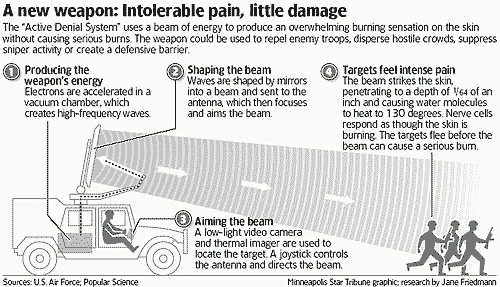
The Air Force Research Laboratory (AFRL) brief on this subject titled ‘Controlled Effects’ also noted the power to use the electromagnetic spectrum for wirelessly interfering into human subjects’ thinking and behaviour. By this stage the strategy had been dubbed ‘non–lethal weapons’, as explored more fully in the work of non–lethal defence at Los Alamos by retired Army Colonel John B. Alexander (Alexander, 1999). The AFRL report states that
the panel investigated the potential for using electromagnetic and other nonconventional force capabilities to achieve strategic, tactical, lethal, and nonlethal force projection … . For the Controlled Personnel Effects capability, the S&T panel explored the potential for targeting individuals with nonlethal force, from a militarily useful range, to make selected adversaries think or act according to our needs. (AFRL, 2004)
These theories and concerns to affect command and control at–a–distance were echoing the conclusions from a much larger and significant military report that was published and made available in 1996 titled ‘New World Vistas’. ‘New World Vistas’ was a major undertaking by the U.S. Air Force Scientific Advisory Board to examine future developments in weapons, and totalled 14 volumes of studies. The fifteenth ‘ancillary’ volume concluded by putting forth some potential developments for a possible future man–machine integration. In a section dealing with ‘Biological Process Control’ the Report states that
One can envision the development of electromagnetic energy sources, the output of which can be pulsed, shaped, and focused, that can couple with the human body in a fashion that will allow one to prevent voluntary muscular movements, control emotions (and thus actions), produce sleep, transmit suggestions, interfere with both short–term and long–term memory, produce an experience set, and delete an experience set. (USAF Scientific Advisory Board, 1995)
In military–speak the term ‘experience set’ implies a person’s stored memories and life experiences; thus suggesting that such a technology could delete and then replace a person’s memories, or ‘experience set’. Research and development along these lines have so far materialised a technology dubbed by the military as active denial system (ADS).
The Active Denial System is a non–lethal, directed–energy weapon system recently unveiled by the U.S. military and which directs, or pulses, electromagnetic radiation at a frequency of 95 Gigahertz (GHz) towards the target subjects. The radiated beam of millimetre–wave energy can travel over a range of 500m and heats the water molecules in the epidermis skin up to 54C (130F) (BBC, 2007). The result can be an intensely painful burning sensation. Such a system was designed for such uses as crowd control. A fully operational and mounted system was demonstrated to journalists by U.S. military personnel at Moody Air Force Base, Georgia, on 24 January 2007. A Reuters correspondent who volunteered to be shot with the beam during the demonstration described it as ‘similar to a blast from a very hot oven — too painful to bear without diving for cover’ (BBC, 2007). The diagram below illustrates the active denial system (ADS).
Figure 1: The active denial system (ADS). Figure 1: The active denial system (ADS).
Source: http://www.specialsol.com/electr5.gif.
These technologies show uses of wireless–to–body communication and directed energy weapons for possible military attack or defence purposes. Another area for research and development is in both military and industrial uses for operator enhancement.
Real–time brain scanning of pilots and similar operators under stress is an increasingly active area for research involving military and industrial partnerships. Since the early 1990s research has been made into detecting and interpreting brain and body signals, especially brainwaves, for computerized monitoring of pilots. This information can be used to measure pilot fatigue and to compensate for this with increased automation of the airplane in order to avoid pilot error. Initially this was conducted by measuring the pilot’s brain waves through unobtrusive sponge sensors in the flight helmet:
By measuring the amplitude of the brain waves generated, fatigue of the pilot can be recognized. By increasing the brightness of the instrumental panel lights, the amplitude of the brain waves can be returned to their normal height, thus compensating for fatigue. To get the “evoked response” from the pilot’s brain, the instrument panel lights could be made to flash so fast that the pilot would not be aware of the flashes. [16]
Researchers have said that the brain can ‘register’ up to 145 flickers per second, which can then be followed up by beaming a near infrared light into the subject’s eye, causing a spot of light to be reflected off the cornea in order to track eye movement and measure the degree of pilot concentration. This type of research, which is still ongoing, has been referred to by at least one current R&D laboratory as ‘Real–Time EEG for Operator State’ [17]. Brain monitoring of people in situations where fatigue could be fatal now involves real–time analysis and observation of motorists. A technology now being considered is one called ‘Sensation’.

This technology is non–intrusive and includes a small camera that monitors a driver’s eye movements, looking out for repeated blinking, which can be evidence of tiredness. To compliment this the driver’s seat is also lined with a material which monitors changes in body temperature. The steering wheel too checks for handling pressure. Finally, other sensors, if needed, can be fitted to the finger and ear to send out measurements of pressure to indicate fatigue and levels of concentration. The driver is now wirelessly monitored, both by camera and wireless sensors, to create a more extensive immersive driving experience (Millward, 2006).
This research and these innovations indicate that a shift is occurring in how the human is enmeshed into an increasingly information saturated environment. These developments recognise that the human body is itself becoming the most capable data–processing subject. The rest of this paper explores how these trends to envelop the body–brain into an environment of information flows are being developed into social and commercial applications.
Emotional gaming and dangerous intentions: Inside the social–civil sphere
The use of EEG brain scanning has now moved into the gaming industry with up–to–date developments in sensory gaming. Recently Emotiv publicly released information on their upcoming ‘Project Epoc’, a developmental technology that interprets electrical signals emitted by the brain and converts them into actions on a computer. In this way the user/gamer is able to direct actions via their thoughts in the online environment. Below are pictures of two prototypes which the company expects to market some time in 2008 [18].
head gear head gear
The company Web site claims that they provide the ultimate human–computer interface and that they are pioneers in brain computer interface technology. In their press release of 7 March 2007 they state that
Emotiv has created the first brain computer interface technology that can detect and process both human conscious thoughts and non–conscious emotions. The technology, which comprises a headset and a suite of applications, allows computers to differentiate between particular thoughts such as lifting an object or rotating it; detect and mimic a user’s expressions, such as a smile or wink; and respond to emotions such as excitement or calmness. [19]
In the same press release the company foresees in the future that ‘Emotiv’s technology has the potential to be applied to numerous industries, including interactive television, accessibility design, market research, medicine, and security’ [20]. A similar corporate gaming company, NeuroSky, claims to have gone even further than Emotiv and reduced ‘the brainwave pickup to the minimum specification imaginable — a single electrode. Existing versions of this electrode are small enough to fit into a mobile phone and … they will soon be shrunk to the size of a thumbnail, enabling people to wear them without noticing’ (Economist, 2007). The company Web site claims its ‘bio sensor and signal processing system for the consumer market’ will unlock ‘worlds of new applications such as consumer electronics, health, wellness, education and training’ [21].
Clearly there is a potential commercial market envisioned here for wireless–brain technology that goes beyond the sphere of gaming. Somewhat on the extreme to this, wireless acoustic transmissions have now been developed to ‘stop’ people from over–gaming; in other words, as a treatment for gaming addiction. In highly technologised Asian countries such as South Korea teenagers are spending an unhealthy amount of time at their computers in gaming environments. There have even been instances where gamers have died after extensively long sessions in front of a computer without a break, such as in MMORPGs (Massive Multiplayer Online Role–Playing Game). South Korean company Xtive, established in 2005, spent a year of research to develop a system of acoustic sound waves that act as subliminal transmissions during the gaming experience:
We incorporated messages into an acoustic sound wave telling gamers to stop playing. The messages are told 10,000 to 20,000 times per second … . Game users can’t recognize the sounds. But their subconscious is aware of them and the chances are high they will quit playing … . Game companies can install a system, which delivers the inaudible sounds after it recognizes a young user has kept playing after a preset period of time. (Tae–gyu, 2007)
This emphasises that research into techno–information flows are increasingly being developed that wirelessly interact with a person as a biological construct, utilising the already present bio–neural functioning. And this is a trend that is attracting more corporate players wishing to enter the field.
Gaming giant Sony Corporation has submitted and been granted a patent on a device for transmitting sensory data directly into the human brain. Sony’s patent describes the device as firing “pulses of ultrasound at the head to modify firing patterns in targeted parts of the brain, creating ‘sensory experiences’ ranging from moving images to tastes and sounds” (Hogan and Fox, 2005). This is based upon a technique known as transcranial magnetic stimulation that activates the nerves by using rapidly changing magnetic fields to induce currents in brain tissue. The patent also claims that this technology could give blind or deaf people the chance to see or hear. Niels Birbaumer, a neuroscientist at the University of Tübingen in Germany who has himself developed similar devices, examined the Sony patent and commented that ‘I looked at it and found it plausible’ (Hogan and Fox, 2005). Since Sony’s initial patent application in 2000 (granted in March 2003), a series of further patents have been applied for. However, this line of research is not totally new.
For several years there has been research conducted into decoding thoughts from the brain for sending signals to an external device such as manipulating cursors on a screen, which has been developed for disabled people, as in the case of Matthew Nagle (Pollack, 2006). In recent years several other companies have emerged claiming to offer brain–computer wireless interaction for either gaming purposes or for various health impairment benefits. One example is S.M.A.R.T. BrainGames, a company based in California that offers EEG caps designed to treat people with attention deficit and hyperactivity disorder. The company claims to offer superior neurofeedback technology at what it calls ‘affordable prices’ [22]. The body–brain is increasingly shifting towards becoming a biologically–enhanced data processor for wireless reception and transmission. Computer software giant Microsoft is aware of this and already ahead of the game.
In 2004 Microsoft was awarded U.S. Patent 6,754,472, titled ‘Method and apparatus for transmitting power and data using the human body’ [23]. In this patent Microsoft is granted exclusive rights to a technology that uses the electrical capacity of the human body to act as a computer network (Adam, 2004). Microsoft envisages ‘using the human skin’s conductive properties to link a host of electronic devices around the body, from pagers and personal data assistants (PDA) to mobile phones and microphones, although the company is uncharacteristically coy about exactly what it may have in mind’ (Adam, 2004). This supports what Bill Gates himself has said about the computer finally disappearing into the environment and the world around us (Gibson, 2005). This may be the ultimate wireless network, using the complete skin of the body, from fingers to toes, receiving and transmitting flows of information. The patent also proposes that an area of skin could even act as a keypad making a person capable of typing by tapping on their arm (Adam, 2004).
This is a powerful example of how technologies and technological thinking is shifting away from external hardware devices towards using the natural bio-properties of the human body for integration into a global informational environment. As way of some examples, here are just two from many of the patents filed that claim to develop wireless transmission technologies: patents 4,395,600 and 5,507,291. Patent No. 4,395,600 is titled ‘Auditory subliminal message system and method’ and is geared towards subliminal messaging to influence consumer shoppers:
Ambient audio signals from the customer shopping area within a store are sensed and fed to a signal processing circuit that produces a control signal which varies with variations in the amplitude of the sensed audio signals. A control circuit adjusts the amplitude of an auditory subliminal anti–shoplifting message to increase with increasing amplitudes of sensed audio signals and decrease with decreasing amplitudes of sensed audio signals. This amplitude controlled subliminal message may be mixed with background music and transmitted to the shopping area. [24]
In a similar manner for affecting an individual’s mental state is patent no. 5,507,291 — ‘Method and an associated apparatus for remotely determining information as to person’s emotional state’ — which comes very close to what has been discussed on military uses of information warfare:
In a method for remotely determining information relating to a person’s emotional state, a waveform energy having a predetermined frequency and a predetermined intensity is generated and wirelessly transmitted towards a remotely located subject. Waveform energy emitted from the subject is detected and automatically analyzed to derive information relating to the individual’s emotional state. [25]
In this scenario information flows are two-way with the body-brain emitting as well as receiving. Yet with the human body–brain becoming a site for data transfer and reception, there are concerns that it is increasingly becoming a target for various corporate interests. And not only corporate interests are involved in these developments, however, for there are also recent innovative technologies in this area that offer serious implications for social privacy and liberty at a state level.
At first the idea sounds like nothing more than science fiction. Indeed, it even appeared as a central feature in the film ‘Minority Report’. This is the notion of pre–cognition: to be able to know a person’s actions before those actions are committed. Yet now a team of neuroscientists have developed a technique that can scan a brain and learn from the patterns of neuronal activity what a person is thinking or intending to do. This research is the culmination of recent studies where brain imaging has been used to identify particular brain patterns pertaining to such behaviour as violence, lying, and racial prejudice (Sample, 2007). To achieve this the team ‘used high–resolution brain scans to identify patterns of activity before translating them into meaningful thoughts, revealing what a person planned to do in the near future’ (Sample, 2007). This is the first acknowledged instance of having the technical capacity to judge whether people have the intention to commit a criminal act regardless of actual hard physical evidence of the crime. According to Prof Haynes: ‘We see the danger that this might become compulsory one day, but we have to be aware that if we prohibit it, we are also denying people who aren’t going to commit any crime the possibility of proving their innocence’ (Sample, 2007). Since this technology is so new there are no current ethical or moral debates on this issue and the implications for its civil use are worrying. If developed these ‘techniques may eventually have wide–ranging implications for everything from criminal interrogations to airline security checks. And that alarms some ethicists who fear the technology could one day be abused by authorities, marketers or employers’ (Cheng, 2007).
A hypothetical situation in the future might place these scanning devices within regular x–ray scanning machines at airports. On passing through to the passenger lounge all travellers will be scanned not only for potentially dangerous physical objects but also for dangerous intentions. Yet who has not had a ‘dangerous intention’? Or rather, to quote a more familiar phrase: ‘He who is without sin among you, let him be the first to throw a stone’ [26]. In this manner all travellers will have to safeguard their thoughts at all times; who is to know whether such scanning devices are embedded into the walls of the airport lounge and corridors? Or in the toilets; on board the airplane? This uncertain and somewhat dystopian scenario is one that could shift technologised states into psycho–civilised societies where thoughts and intentions become part of terrorist discourse. This could be seen as an extreme case of convergence between the social compromises required to facilitate efficient physical–digital infrastructures and the need for securitised mobilities (Wood and Graham, 2006). It also resembles the extremity of constructing an all–inclusive technological web of complex information flows that bypasses traditional forms of interface.
This sees a shift away from earlier prototypes of the hardware–heavy cyborg, such as the early ‘wearcam’ work of Steve Mann [27], towards people actively engaging with their informational environments both in terms of security and surveillance. In some ways these developments have contributed to a rise in acts of self–surveillance, or sousveillance.

(In)Securities, self–sensoring and sousveillance: Inside the social panopticon

Fears over security and safety have reached new levels in the opening decade of the twenty–first century. It is, in all respects, a post–millennium state of insecurity. The older and more familiar paradigms of warfare and security were based upon binaries (e.g., Democracy vs. Communism; friend vs. foe). To some degree this binary distinction is still maintained and played out in media and cultural discourse as Freedom vs. Anti–Freedom, or West vs. Islam. Yet upon deeper scrutiny this manifests as an asymmetrical arrangement: order/authority vs. guerrilla non–compliance. A terror suspect can therefore no longer be easily identified as ‘the enemy’ which requires that all civilians be categorised in a state of ‘potential terrorist’. This is especially so since the notion of ‘home–grown terrorist’ is playing out the role of insurgency and resistance from within. This subtle shift in categorisation has seen a parallel move in the increase of the militarization of the civil sphere. By this I argue that civil space is increasingly becoming a ‘censor/sensored zone’ where security issues — surveillance, tracking, identification — are played out.
This zone, which mobile bodies pass through and negotiate, is characterised by a pervasive field of information, code, and signifiers that increasingly constructs the ‘social’. Such a coded environment has the potential to be extremely intrusive and goes beyond the normal ken of so–called civil liberties. Under the sway of a post September 11 scenario and amid an orchestrated ‘war on terror’ many of these intrusive technologies are in rapid development, so much so that the U.K. Government’s Information Commissioner himself states that we live in a surveillance society (Information Commissioner, 2006) [28]. These systems of tracking and tracing surveillance involve step changes that are taking place gradually in many industrialised societies, especially in the U.S. and the U.K. [29].
Developments in sensor technologies and ubiquitous computing often focus on the interfaces between person and environment such that interconnectivity is likely to become more pervasive, intrusive, and ‘everywhere’. In a seminal essay from 1996 computer engineers Mark Weiser and John Seely Brown coined the term ‘ubiquitous computing’ and envisioned the ‘social impact of imbedded computers may be analogous to … electricity, which surges invisibly through the walls of every home, office, and car’ (Weiser and Brown, 1996). True to form, within a decade from this pronouncement computing interfaces developed from fixed locations of access to increased wireless connectivity. And it is predicted to become ever more ubiquitous in a manner that will dissolve connectivity into embedded environments (Greenfield, 2006). Greenfield considers this to be, in one form or another, an inevitability, and refers to this ubiquitous computing (ubicomp) paradigm as ‘everyware’: “Everyware is information processing embedded in the objects and surfaces of everyday life … the extension of information–sensing, –processing, and –networking capabilities to entire classes of things we‘ve never before thought of as ‘technology’” [30]. This in turn is likely to trigger the ‘always–on’ surveillance of people in both public life and in private affairs. This inevitably blurs the boundaries between what is external and what is internal, and leads to forms of surveillance that turn inwards and emanates from the ‘self’ — an idea somewhat akin to that of sousveillance.
Sousveillance was coined by Mann (1998) who describes it as form of ‘reflectionism’ or as a ‘watchful vigilance from underneath’, which is a form of inverse surveillance. Yet it more than inverses the notion; it embellishes it with a self–reflective responsibility. For Mann, reflectionism “holds up the mirror and asks the question: ‘Do you like what you see?’” (Mann, et al., 2003). Also, in this form, it requires that surveillance is enacted as a form of self–control, as self–maintenance. It is the discipline of being inwardly secure; firstly vigilant towards the self; secondly towards other people/selves. This form of discipline seems to suggest that there is little room for negligence when watchfulness is the order of the day. Yet it also prompts the ‘user’ of sousveillance to be active and participate in the surrounding environment. Sousveillance, whilst it can encourage social responsibility, also suggests the need for the person to be guarded against unwanted intrusions and possible violations.
Mann went on to transmit, in the mid ’90s, his daily life experiences for others to experience and interact with. This created opportunities for establishing a sousveillance network between Mann and his ‘readers’, or rather social network. This participatory/social panopticon into human–environment interactions was a forerunner to how ‘wearable computing’ might one day emerge as a form of modern ‘intelligent image processing’ (Mann, 2002). Mann’s performance constructs a lived experience where the observation, recording, and dissemination of civic events have shifted towards a social panopticon, infiltrating daily physical encounters. It is a communal watchfulness of civil responsibility merged with a technical mandate for collective commentary, social analysis, and security of the self. It is also an enactment of performance ethnography, at the same time playful with notions of socialisation and breaching norms (Mann, et al., 2003).
However, the question this raises, I argue, is whether social domains might not be in danger of becoming over–sensory realms, and what may emerge as the most convenient and/or efficient strategy for coping with this. Stross’s (2002) essay ‘The Panopticon Singularity’ considers this trend in a dystopian fashion as ‘the emergence of a situation in which human behaviour is deterministically governed by processes outside human control’. Stross argues, reminiscent of Foucault, that while the effectiveness of societal surveillance is dependent on the number of people involved ‘systems of mechanised surveillance may well increase in efficiency as a power function of the number of deployed monitoring points’ (Stross, 2002). In other words, as more people join the social panopticon, or sousveillant society, this will have a knock–on effect that encourages more people to join the securitisation of the self, rather than being left vulnerable and un–sensored.
There is no denying that such panopticon devices are proliferating — they are carried around with us, increasingly as our own willing appendages. The debates at present are largely centred on surveillance, as state practices of pervasive and ubiquitous top–down monitoring of civil space, rather than forms of self–monitoring, as in sousveillance. Perhaps the next step will be further towards practices of immersive surveillance and control, as indicated in this paper as a psycho–civilized society.
The current surge in research and development of wireless sensor networks is likely to have a significant future impact upon not only how the human body is configured in terms of medical applications but, perhaps more importantly, how the human is cognitively configured in terms of the information–rich environment. One of the scenarios of ubiquitous, pervasive computing is to embed the environment with non–invasive informational systems that merge physical–digital infrastructures. Already much of our atmosphere is saturated with informational flows in various spectrum bandwidths — we are constantly walking through TV programs, mobile phone conversations, and even military broadcasts. Yet we are not decoding these transmissions. The transformation that these various scenarios in this paper suggest is that the human body is becoming re–configured — or re–wired — into a biological antenna. Not only will this greatly facilitate our access onto the Net but will also re–form the human presence, or identity, into a coded wavelength. A wavelength that is more readily readable to various technologies. This may seem far–fetched yet such a future may not be a far leap away.

Conclusion: The future a quantum leap too far?

Socio–technical evolutionary trends predict a future that is wholly immersed in and conversant with an integral informational–digitised environment. Informational flows are envisioned to go beyond the bits and bytes of present computing into the qubits (quantum bits) and subatomic circuitry of quantum computing (Schwartz, et al., 2006). Researchers into quantum computing are working with subatomic spins for exponential and staggering computational capacity. A possible future may look a little like this:
Inside the hatband is Sharon’s communication center and intelligent assistant, which has scanned and sorted the 500,000 e–mails she received overnight. By the time she reaches the car, it has beamed the 10 most urgent ones and her travel schedule to her visual cortex. The text scrolls down in the bottom of her field of vision … . At the airport there is no ticket check–in or security line. Sharon simply walks through the revolving door, which scans her for dangerous items, picks up her identity, confirms her reservation, and delivers her gate number, all in the space of a second. (Schwartz, et al., 2006)
Perhaps the most common prediction prevalent amongst computer engineers is that computers — pervasive and non–perceptible — will be seeded and woven throughout the environment. They will be painted onto walls, on furniture and objects, inside the body, ‘communicating with one another constantly and requiring no more power than that which they can glean from radio frequencies in the air’ (Schwartz, et al., 2006). Quantum researcher and physicist Stuart Wolf anticipates that the next two decades will usher in a type of communications he calls ‘network–enabled telepathy’. Despite the fanciful name the method basically involves wearable devices (such as a ‘quantum headband’) sharing identity and downloaded information with others in the person’s social network; and all driven by the power of thought alone. However, as Wolf points out, ‘it will probably take a new generation raised to think of quantum headbands as normal for its potential to be truly realized’ (Schwartz, et al., 2006). Yet Wolf isn’t alone in his thinking.
Princeton physicist Freeman Dyson has speculated upon the possibility of what he calls radioneurology. Radioneurology refers to a hypothetical future technology of observing neural processes inside a brain by means of locally deployed radio transmitters (Dyson, 1997). For this to be feasible, speculates Dyson, requires a technology to allow for the building and deployment of small transmitters inside a living brain similar to integrated circuit technology on a silicon chip:
We know that high–frequency electromagnetic signals can be propagated through brain tissue for distances of the order of centimeters. We know that microscopic generators and receivers of electromagnetic radiation are possible. We know that modern digital data–handling technology is capable of recording and analyzing the signals emerging from millions of tiny transmitters simultaneaously. All that is lacking in order to transform these possibilities into an effective observational tool is the neurological equivalent of integrated–circuit technology. [31]
Given these speculations, and what has been discussed in this paper, it is likely that the major technology for the future is neurotechnology. The information age that emerged out of post–war technologies, and which has guided most of the technologies of the early twenty–first century, has made it possible to collect, utilize, and transfer information/data at unparalleled speeds. Communication, information, and data have been flowing at exponential rates. However, they are yet to merge into a systemic environment.
Neurotechnologies are set to change this with the rise of ‘nanobiochips’ and brain imaging and scanning technologies that will eventually lower the cost of neurological techniques and analysis as well as making the procedures efficient and profitable. Neurotechnologies, combined with wireless sensors, may possibly usher in a communications revolution greater than that caused by the arrival of the transistor and the microchip. Zack Lynch, executive director of the Neurotechnology Industry Organization (NIO), writes that ‘When data from advanced biochips and brain imaging are combined they will accelerate the development of neurotechnology, the set of tools that can influence the human central nervous system, especially the brain’ (Lynch, 2004). Although neurotechnologies are likely to be put to therapeutic and medical uses, such as for improving emotional stability and mental clarity, they also open opportunities for intrusive strategies of control and manipulation.
Part of this paper has been focused on the dangers of an increasingly wireless world. These dangers may include the potential for invasive technologies, based upon transmitted/received signals and wavelengths, to shift social order towards a psycho–civilized society. By psycho–civilised I mean a society that manages and controls social behaviour predominantly through non–obvious methods of psychological manipulations, yet at a level far beyond that of the ‘normalised’ social manipulations of propaganda and social institutions. What I refer to are the technologised methods of psychological interference and privacy intrusions in the manner of creating a docile and constrained society. And here this brings us back to the problematics involved in opening a Pandora’s box.
In this paper I have asked whether innovations in wireless and neuro–technologies are not in danger of shifting human behaviour towards a psycho–civilised society, where greater emphasis is placed upon forms of social control and pre–emptive strategies. What are the moral and ethical implications of using wireless scanning surveillance technologies for evaluating pre–emptive behaviour based on thoughts and intentions alone? Is this not a dangerous path towards psycho–terrorising the social public? As Thomas (1998) reminds us, the mind has no firewall, and is thus vulnerable to viruses, Trojan horses, and spam. It is also vulnerable to hackers, cyber–terrorists, and state surveillance. Whilst this may sound a little too far out, they are reasonable questions to ask if technologies are racing ahead of us in order to better get into our heads.
Becoming wireless also means becoming increasingly immersed within an information–saturated environment. From the evidence of present trends and developments it seems likely that a greater systemic interconnectedness and interdependence is being formed between human–object–environment facilitated through and by information flows. This may herald the coming of a ‘wonderful wireless world’, yet it may also signal unforeseen dangers in protection, privacy, and security of the human biological body within these new relationships. It is the suggestion of this paper that such issues and concerns need to become more public, visible, and open; the very opposite of these technologies. End of article
Kingsley Dennis is a Research Associate in the Centre for Mobilities Research (CeMoRe) based at the Sociology Department at Lancaster University, U.K. His doctoral work focused on complexity theory and information communication technologies. Post–doctoral research now involves examining physical–digital convergences and how these might impact upon social processes. He is concerned with the digital rendition of identity and the implications of surveillance technologies.
Web:
http://www.kingsleydennis.com
Blog: http://www.new-mobilities.co.uk
E–mail: Kingsley [at] kingsleydennis [dot] co [dot] uk

Notes

1. Dolman, 2002, p. 41.
2. O’Connor, 1993, p. 35.
3. Ibid.
4. See http://www.dia.mil/publicaffairs
/Foia/foia.htm
for list of declassified reports, accessed 11 November 2007.
5. LaMothe, 1972, p. 18.
6. Horgan, 2005, p. 67.
7. Horgan, 2005, p. 70.
8. Thomas, 1998, p. 84.
9. Ibid.
10. Ibid.
11. Thomas, 1998, p. 85.
12. Thomas, 1998, p. 86.
13. Simpson, 1994, p. 3.
14. Thomas, 1998, p. 87.
15. Thomas, 1998, p. 89.
16. Welsh, 1998, p. 37.
17. Part of ongoing research at the QinetiQ Group — see http://www.qinetiq.com/.
18. See http://crunchgear.com/2007/03/08/
emotiv-project-epoc-sensory-gaming-for-the-masses/
, accessed 15 January 2008.
19. http://emotiv.com/3_0/pr/pr022607a.htm, accessed 5 November 2007.
20. http://emotiv.com/3_0/pr/pr022607a.htm, accessed 5 November 2007.
21. See http://www.neurosky.com/, accessed 5 November 2007.
22. http://www.smartbraingames.com/, accessed 5 November 2007.
23. For patent, see http://www.google.com/patents?vid=USPAT6754472&id=30YSAAAAEBAJ&dq=6,754,472.
24. See Google patents http://www.google.com/patents?vid=USPAT4395600&id=V_ItAAAAEBAJ&dq=4,395,600.
25. See Google patents http://www.google.com/patents?vid=USPAT5507291&id=940lAAAAEBAJ&dq=5,507,291.
26. John 8:1–9.
27. See http://wearcam.org/mann.html, accessed 17 January 2008.
28. See also BBC Report — http://news.bbc.co.uk/
1/hi/uk/6108496.stm
, accessed 5 November 2007. For general information see the journal Surveillance and Society, at http://www.surveillance-and-society.org/index.htm, accessed 5 November 2007.
29. There are up to 4.2m CCTV cameras in Britain — about one for every 14 people — more than other industrialised Western states.
30. Greenfield, 2006, p. 18.
31. Dyson, 1997, pp. 133–134.

References

D. Adam, 2004. “Computerising the body: Microsoft wins patent to exploit network potential of skin,” The Guardian (6 July),
 at http://www.guardian.co.uk/science/
2004/jul/06/sciencenews.microsoft
, accessed 10 February 2008.
J. Alexander, 1999. Future war: Non–lethal weapons in modern warfare. London: Saint Martin’s Press.
BBC, 2007. “U.S. military unveils heat–ray gun,” at
http://news.bbc.co.uk/1/hi/world/
americas/6297149.stm
, accessed 26 January 2007.
M. Cheng, 2007. “Scientists claim first in using brain scans to predict intentions,” North West Florida Daily News (5 March); also at
http://www.cbsnews.com/stories/2007/03/05/
ap/tech/mainD8NM0O8G0.shtml
, accessed 10 February 2008.
J. Delgado, 1969. Physical control of the mind: Toward a psychocivilized society. New York: Harper & Row.
E.C. Dolman, 2002. Astropolitik: Classical geopolitics in the Space Age. London: Frank Cass.
F.J. Dyson, 1997. Imagined worlds. Cambridge, Mass: Harvard University Press.
Economist, 2007. “Mind games: Brain–controlled games and other devices should soon be on sale,” Economist (15 March), and at http://www.economist.com/
science/displaystory.cfm?story_id=8847846
, accessed 10 February 2008.
D. Elliott and J. Barry, 1994. “A subliminal Dr. Strangelove,” Newsweek (22 August), p. 57.
O. Gibson, 2005. “Gates unveils his vision of a future made of silicon,” Guardian (28 October), and at http://www.guardian.co.uk/media/
2005/oct/28/newmedia.microsoft
, accessed 10 February 2008.
A. Greenfield, 2006. Everyware: The dawning age of ubiquitous computing. Berkeley, Calif.: New Riders.
J. Hogan and B. Fox, 2005. “Sony patent takes first step towards real–life Matrix,” New Scientist, issue 2494 (7 April), p. 10, and at http://www.newscientist.com/
article.ns?id=mg18624944.600
, accessed 10 February 2008.
J. Horgan, 2005. “The forgotten era of brain chips,” Scientific American (October), and at http://www.sciam.com/article.cfm?chanID=sa006&colID
=1&articleID=000876CF-CC6F-1331-841D83414B7FFE9F0
, accessed 10 February 2008.
John D LaMothe, 1972. Controlled offensive behavior — USSR (U). Washington, D.C.: U.S. Defense Intelligence Agency.
Z. Lynch, 2004. “Neurotechnology and society (2010–2060),” at http://lifeboat.com/ex/neurotechnology.and.society, accessed 9 March 2007.
S Mann, 2002. Intelligent image processing. New York: Wiley.
S. Mann, 1998. “‘Reflectionism’ and ‘diffusionism’: New tactics for deconstructing the video surveillance superhighway,” Leonardo, volume 31, number 2 (April), pp. 93–102, and at http://wearcam.org/leonardo/reflectionism.htm,
accessed 10 February 2008.
S. Mann, J. Nolan, and B. Wellman, 2003. “Sousveillance: Inventing and using wearable computing devices for data collection in surveillance environments,” Surveillance & Society, volume 1, number 3, pp. 331–355, and at
http://www.surveillance-and-society.org/articles1(3)/
sousveillance.pdf
,accessed 16 January 2008.
D. Millward, 2006. “Gadget will stop drivers falling asleep at the wheel,” Telegraph (7 April), and at http://www.telegraph.co.uk/news/main.jhtml?xml=/news/
2006/04/07/ndrive07.xml&sSheet=/
news/2006/04/07/ixhome.html
, accessed 10 February 2008.
M.E. O’Connor, 1993. “Psychological studies in nonionizing electromagnetic energy research,” Journal of General Psychology, volume 120, number 1, pp. 33–47.
A. Pollack, 2006. “Paralyzed man uses thoughts to move a cursor,” New York Times (13 July), and at http://www.nytimes.com/
2006/07/13/science/13brain.html?_r=1&oref=slogin
, accessed 10 February 2008.
Pravda, 2004. “Mind control: The Zombie Effect,” at
 http://english.pravda.ru/science
/19/94/379/14567_.html
, accessed 21 January 2007.
I. Sample, 2007. “The brain scan that can read people’s intentions,” Guardian (9 February), and at http://www.guardian.co.uk/science
/2007/feb/09/neuroscience.ethicsofscience
, accessed 10 February 2008.
P. Schwartz, C. Taylor, and R. Koselka, 2006. “Quantum leap: Brain prosthetics. Telepathy. Punctual flights. A futurist’s vision of where quantum computers will take us,” Fortune, volume 154, number 3 (7 August), and at
http://money.cnn.com/2006/07/26/
magazines/fortune/futureoftech_quantum.
fortune/index.htm
, accessed 10 February 2008.
C. Simpson, 1994. Science of coercion: Communication research and psychological warfare, 1945–1960. Oxford: Oxford University Press.
C. Stross, 2002. “The panopticon singularity,”
at http://www.antipope.org/charlie/
rant/panopticon-essay.html
, accessed 16 March 2007.
K. Tae–gyu, 2007. “Acoustic wave prevents game addiction,” Korea Times, http://times.hankooki.com/lpage/
200703/kt2007031220190210160.htm
, accessed 16 March 2007.
T.L. Thomas, 1998. “The mind has no firewall,” Parameters (Spring), pp. 84–92, and at http://www.carlisle.army.mil/usawc/
Parameters/98spring/thomas.htm
, accessed 10 February 2008.
Time, 1976b. “The microwave furor,” Time, volume 107, number 12 (22 March), p. 15, and at http://www.time.com/time/magazine/
article/0,9171,911755,00.html
, accessed 10 February 2008.
Time, 1976a. “Moscow microwaves,” Time, volume 107, number 18 (23 February), and at http://www.time.com/time/magazine/
article/0,9171,918076,00.html
, accessed 10 February 2008.
A. Turner, 2007. “Inter–planetary Internet expands to Mars and beyond,” at http://www.itwire.com.au/content/view/9802/1066/, accessed 12 March 2007.
U.K. Information Commissioner, 2006. A Report on the Surveillance Society. London: Surveillance Network, at http://www.ico.gov.uk/upload/documents/library/
data_protection/practical_application/
surveillance_society_full_report_2006.pdf
, accessed 10 February 2008.
U.S. Air Force. Research Laboratory (AFRL), 2004. “Controlled effects (Air Force Research Laboratory long–term challenges),” at http://www.afrlhorizons.com/
Briefs/Jun04/DE0401.html
, accessed 27 January 2007.
U.S. Air Force. Scientific Advisory Board, 1995. New world vistas: Air and space power for the 21st century. Washington, D.C.?: The Board.
M. Weiser and J.S. Brown, 1996. “The coming age of calm technology,” at http://www.ubiq.com/hypertext/weiser/
acmfuture2endnote.htm
, accessed 16 January 2008.
C. Welsh, 1998. “The 1950s secret discovery of the code of the brain,” at http://www.bibliotecapleyades.net/
ciencia/ciencia_secretdiscovery_codebrain.htm
, accessed 10 February 2008.
D.M. Wood and S. Graham, 2006. “Permeable boundaries in the software–sorted society: Surveillance and differentiations of mobility,” In: M. Sheller and J. Urry (editors). Mobile technologies of the city. London: Routledge, pp. 177–191.