Monday, February 18, 2013

Supreme Court Set To Hear Case On Whether Or Not Planting Legally Purchased Seeds Infringe On Monsanto Patent

from the please-get-this-right dept

The Supreme Court will be hearing a big patent case tomorrow. We wrote about it back in 2011 when the federal circuit appeals court (CAFC) put forth an absolutely horrible ruling basically saying that a farmer who legally purchased "community seeds" that included (legally) some Monsanto "Roundup Ready" seeds, violated Monsanto's patent. The case is a bit complex, but I'll just rerun my summary from back then:
The farmer, Vernan Bowman, bought official Monsanto seeds and planted his crops. Yet, Monsanto has rules that say you can't re-use "Roundup Ready" seeds, but you can apparently sell "second-generation" seeds to grain elevators for use as "commodity seeds," and doesn't require that there be any restriction on the sale. Bowman later bought a bunch of such "commodity seeds," which included some Roundup Ready seeds, and some that weren't. Bowman was able to determine which of the plants came from Roundup Ready seeds... and then saved those seeds for replanting. Monsanto claimed this was infringement, even though the seeds were legally sold to the grain elevator and then from the elevator to Bowman without restrictions. On top of that, while Bowman had signed an agreement for his original seeds, he did not with this batch (and, indeed, even Monsanto admits he didn't break the user agreement -- just patent infringement for using the seeds).
As we noted at the time, this seemed to be a clear case of patent "exhaustion," which the Supreme Court has supported in the past. Under patent exhaustion, once you sell a "licensed" offering, reselling it further down the supply chain does not infringe on the patent, since the initial purchase was authorized and the patent holder's rights over that specific product have been "exhausted." CAFC said exhaustion didn't apply here because the seeds are "new." That seems like a very troubling interpretation, and hopefully the Supreme Court (yet again) smacks a bad CAFC patent ruling down.

Lots of big farms have come out in support of Monsanto and, tragically, so has the federal government (pdf). Believe it or not, the Business Software Alliance (mostly a Microsoft front) has also sided with Monsanto (pdf), ridiculously arguing that a ruling against Monsanto could "facilitate software piracy on a broad scale." That makes no sense, especially since software "piracy" is a copyright issue, not a patent issue. However, they're arguing that people will interpret this to mean that "temporary additional copies" of software (i.e., in RAM) and somehow that leads to piracy. Having read the brief a few times, they never really explain how they make that leap in logic, but they sure do bring up the totally debunked bogus stats about how copyright infringement is costing the industry "billions."

The case really is ridiculous on many levels, but seeing how much firepower has come out in support of Monsanto (basically tons of big companies, lawyers groups and the US government) you can see that a lot of people have a lot of money tied up in keeping this broken system in place. Hopefully the Supreme Court sees through all of that and realizes that this entire case is ridiculous.

Alien abductions linked to disappearing workforce?


700_caca95c5de87163f12e038d05eb7b555
With over 8 million people mysteriously disappearing from the US workforce during President Barack Obama’s first term, experts are working on a number of theories to explain this riddle, the most commonly mentioned reason being alien abductions occurring throughout the US on an extraordinarily massive scale.
According to a recent Bureau of Labor Statistics report, the number of people disappearing from the US workforce rose from 80.5 million when the president took office in 2009 to the current 89 million, while unemployment has remained steady near 8-9%. In other words, 8.5 million people have simply vanished in a way that can’t be explained by the usual retirement or disability trends.
“Since we can’t blame it on the economy, the only conceivable explanation is that someone is taking people out of the labor market by force,” said Malcolm Lenivie, noted economist for the DC-based Center for Keynesian Economics. “The President has spent $6 trillion in stimulus packages and all our studies indicate that his plan is working, so something else must be at play.”
Early theories included abductions by Mexican drug cartels, but leading security experts agree that it would be impossible to move eight million people across the US border undetected.
“Our border is extremely secure,” said border security analyst Jared Contrabandzis of the American Progressive Initiative, a non-partisan think tank. “No one can cross our southern border in any direction without our knowledge. The Border Patrol catches them all and reports them to the authorities – everybody knows that.”
Sources say the President is taking this matter very seriously and is putting pressure on the Pentagon to investigate the possibility of alien abductions and to find a way to stop the disappearance of the American labor force.
Insiders in Washington speculate that if top brass in the US Air Force do not take immediate action, President Obama will likely fire a number of generals and reorganize the command structure.
“The President will not let this crisis go to waste,” said Lenivie, adding that heads will roll all over Washington until one of these theories can be substantiated. “We know for sure the problem is not caused by the economy, since all of our numbers indicate that recovery is well on its way. It isn’t just around the corner, it is here.”
The White House is ordering the Air Force to review surveillance footage from radar stations throughout the world for evidence of alien aircraft, as intelligence satellites are being re-tasked from areas like the Middle East and China to scour the continental US for possible stashes of missing workers.
“All those people must go back to work,” Lenivie said. “They are tax payers, and we need them to be productive in order to keep our economy moving forward and our debt payments current.”
( via communities.washingtontimes.com )

US government bans “conspiracy theorizing”


700_417957bab44cf61c353a77053910c95b
The FBI warned that sovereign citizens commit murder and physical assault; threaten judges, law enforcement professionals and government personnel; impersonate police officers and diplomats; and engineer various white-collar scams, including mortgage fraud and so-called “redemption” schemes.
The new online working group will be chaired by the national security staff at the White House with input from specialists in countering what the Obama administration calls violent extremism.
Also included in the group, according to a White House release, will be “Internet safety experts, and civil liberties and privacy practitioners from across the United States Government.”
The new group says its initial focus will be on raising awareness about the threat and “providing communities with practical information and tools for staying safe online.”
The working group says it will coordinate with the technology industry to “consider policies, technologies, and tools that can help counter violent extremism online” while being careful not to interfere with “lawful Internet use or the privacy and civil liberties of individual users.”
Today, Obama is reportedly poised to issue an executive order aimed at thwarting cyber attacks against critical infrastructure.
The Hill reported the executive order would establish a voluntary program in which companies operating critical infrastructure would elect to meet cybersecurity best practices and standards crafted, in part, by the government.
Because of the troubling ideology of some Obama officials, the question arises as to exactly which citizens are considered threats by the government.
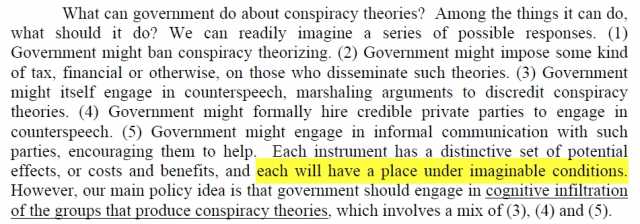
WND broke the story about a lengthy academic paper by President Obama’s so-called regulatory czar, Cass Sunstein, suggesting the government should “infiltrate” social network websites, chat rooms and message boards. Sunstein stepped down last year.
Such “cognitive infiltration,” Sunstein argued, should be used to enforce a U.S. government ban on “conspiracy theorizing.” Among the beliefs Sunstein classified as a “conspiracy theory” is that global-warming advocacy is a fraud.
Last year, Reuters revealed that a government document indicates the U.S. Department of Homeland Security’s command center routinely monitors dozens of popular websites, including Facebook, Twitter, Hulu, WikiLeaks and news sites such as the Huffington Post and Drudge Report.
Reuters reported that a “privacy compliance review” issued by DHS in November 2012 confirms that since at least June 2010, the department’s national operations center has been operating a “Social Networking/Media Capability” which involves regular monitoring of “publicly available online forums, blogs, public websites and message boards.”
The government document states that such monitoring is meant to “collect information used in providing situational awareness and establishing a common operating picture” to help manage national or international emergency events.
Last year, Attorney General Eric Holder signed new guidelines that relaxed restrictions on how counterterrorism analysts may retrieve, store and search information about Americans gathered by government agencies for purposes other than national security threats.
The new guidelines allow the government’s National Counterterrorism Center to keep Internet data collected on private citizens for up to five years instead of 18 months.
With additional research by Joshua Klein.
( via wnd.com )


Feds buying enough bullets for '24-year war'

Radio host warns: DHS preparing for prolonged riots in U.S.

http://www.wnd.com/2013/02/feds-buying-enough-bullets-for-24-year-war/

Federal, non-military agencies, noted radio host Mark Levin last week, have purchased enough ammunition recently to not only shoot every American five times, but also engage in a prolonged, domestic war.
The numbers are based on recent reports that put the total federal ammunition buy in the last 10 months at approaching two billion rounds.
“To provide some perspective,” Levin noted, “experts estimate that at the peak of the Iraq war American troops were firing around 5.5 million rounds per month. At that rate, the [Department of Homeland Security] is armed now for a 24-year Iraq war. A 24-year Iraq war!”
What do federal agencies need with all that ammunition?
The government’s only official explanation for the massive ammo buy is that law enforcement agents in the respective agencies need the bullets for “mandatory quarterly firearms qualifications and other training sessions.”
The staggering number and lack of details in the official explanation, however, has led to rampant speculation, including concerns the DHS is arming itself to fight off insurrection among Americans.
“I’m going to tell you what I think is going on,” Levin offered. “I don’t think domestic insurrection. Law enforcement and national security agencies, they play out multiple scenarios. … I’ll tell you what I think they’re simulating: the collapse of our financial system, the collapse of our society and the potential for widespread violence, looting, killing in the streets, because that’s what happens when an economy collapses.
“I suspect that just in case our fiscal situation, our monetary situation, collapses, and following it the civil society collapses, that is the rule of law, they want to be prepared,” Levin said. “I know why the government’s arming up: It’s not because there’s going to be an insurrection; it’s because our society is unraveling.”
Audio of Levin’s discussion on the ammunition buy can be heard below:
As WND reported, even major gun-rights organizations like the National Rifle Association have attempted to tamp down worries over the amount of ammunition, suggesting the number of bullets bought, spread out over five years and across all the federal agencies with armed agents – considering the number of rounds needed for training, qualification and service bags – isn’t exorbitant.
At the same time, however, others have wondered if billions of bullets isn’t too many to equip the sheer number of federal agents, what does that say about the number of federal agents?
“It’s not the number of bullets we need to worry about,” Jeff Knox, director of The Firearms Coalition, told WND, “but the number of feds with guns it takes to use those bullets.”
“There are currently more than 70 different federal law enforcement agencies employing over 120,000 officers with arrest and firearms authority, according to Bureau of Justice Statistics data for 2008,” explained Knox in a recent WND column. “That’s an increase of nearly 30 percent between 2004 and 2008. If the trends have continued upward at a relatively steady rate, that would put the total number of federal law enforcement officers at somewhere between 135,000 and 145,000.
“That’s a pretty staggering number,” Knox continued, “especially when you consider that there are only an estimated 765,000 state and local law enforcement officers. That means that about one in seven law enforcement officers in the country works directly for the federal government, not a local jurisdiction.”
For years, WND has been at the forefront of reporting the growth in federal police power being dispersed across dozens of government agencies:
  • In 1997, WND blew the lid off 60,000 federal agents enforcing over 3,000 criminal laws, a report that prompted Larry Pratt of Gun Owners of America to remark, “Good grief, that’s a standing army. … It’s outrageous.”
  • Also in 1997, as part of a ongoing series on the militarization of the federal government, WND reported on the armed, “environment crime” cops employed by the Environmental Protection Agency and a federal law enforcement program that had trained 325,000 prospective federal police since 1970.
  • WND also reported on thousands of armed officers in the Inspectors’ General office and a gun-drawn raid on a local flood control center to haul off 40 boxes of … paperwork.
  • WND further reported on a plan by then Delaware Sen. Joe Biden to hire hundreds of armed Hong Kong policemen into dozens of U.S. federal agencies to counter Asian organized crime in America.
  • In 1999, WND CEO Joseph Farah warned there were more than 80,000 armed federal law enforcement agents, constituting “the virtual standing army over which the founding fathers had
    nightmares.” Today, that number has nearly doubled.
  • Also in 1999 WND reported plans made for the Federal Emergency Management Agency, or FEMA, to use military and police forces to deal with Y2K.
  • In 2000, Farah discussed a Justice Department report on the growth of federal police agents under President Clinton, something Farah labeled “the biggest arms buildup in the history of the
    federal government – and it’s not taking place in the Defense Department.”
  • A 2001 report warned of a persistent campaign by the Department of the Interior, this time following 9/11, to gain police powers for its agents.
  • In 2008, WND reported on proposed rules to expand the military’s use inside U.S. borders to prevent “environmental damage” or respond to “special events” and to establish policies for “military support for civilian law enforcement.”
  • Most recently, WND reported that while local police have found themselves short of necessary ammunition, the federal government has been stockpiling billions of rounds for its non-military, non-FBI law enforcement officers.
Knox conceded in his column that good arguments can be made for the existence of a dedicated border guard and federal agencies to protect high-ranking officials, protect the federal currency and coordinate enforcement of laws regarding interstate commerce, and so forth.
“But bureaucrats who inspect the records of retailers and manufacturers have no business carrying guns and badges,” Knox opined, “nor do those who investigate white-collar crime for the Small Business Administration and the Department of Education.”
Chris Knox, director of communications for The Firearms Coalition, told WND legitimate concerns about a police state stem from “a set of three intertwined problems,” namely, “militarization of local police, federalization of law enforcement (including local cops getting goodies from federal forfeiture actions) and the expansion of federal law enforcement, where nearly every agency has its own armed service, not just the Drug Enforcement Agency, but administrative agencies like the Department of Education.”
Give all those federal cops two billion bullets, Jeff Knox says, and now there’s cause for concern.
Read more at http://www.wnd.com/2013/02/feds-buying-enough-bullets-for-24-year-war/#h2UUcAaGRdlQWX7I.99

Carnival Cruise Lines president urges Triumph passengers to 'stop being so negative' about their 'unforgettable' cruise experience

naturalnews.com

Originally published February 15 2013

Carnival Cruise Lines president urges Triumph passengers to 'stop being so negative' about their 'unforgettable' cruise experience

by Mike Adams, the Health Ranger, NaturalNews Editor

(NaturalNews) (Satire) Carnival Cruise Lines needs to learn a lesson in public relations from the White House. First of all, never admit to any wrongdoing, even if the people you represent are knee-deep in s#!t. Cruise line customers, much like voters, are simply not qualified to understand what they are experiencing. They are obviously leaping to pessimistic conclusions about the reality around them.

"Stop being so negative," urged Carnival Cruise Lines president Janus Jacobson. "People need to focus on the positive, and the cruise experience will be more rewarding."

She then went on to explain that "you create your own reality" and that the only reason passengers were covered in s#!t is because "they brought that on board with them like baggage." It's the Law of Attraction, right? Thus, it's all the passengers' fault.

Jacobson went on to explain away specific concerns that have been brought to her attention by sickened passengers who described barely surviving in "vile" conditions:

• Those plastic bags handed out to passengers to defecate into are actually a new "green technology" known as "recycled food reclamation receptacles."

• The mattresses strewn across the decks in a shantytown arrangement aren't any sort of negative vacation experience; it's actually all part of a new feature called "ocean-side camping."

• Passengers aren't actually knee-deep in s#!t. Instead, they are enjoying yet another new feature of Carnival Cruise Lines called "composting at sea" where passengers get to see their own feces turned into compost to grow salad greens served on the next Carnival cruise!

• The lack of food on the cruise is part of Carnival's new "surprise weight loss experience" designed to reverse the 10 - 15 pounds customers usually gain on a cruise.

• The smell of smoke in the rooms, caused by the engine catching fire and burning up, was actually just an "delightful aroma of roasted coffee" that Carnival says was really coming out of the kitchen, not the engine room.

• The lack of electricity and air conditioning is part of Carnival's new age "sweat lodge cleansing experience," complete with vomiting and near-death experiences, both of which are designed to induce "spiritual visions" and turn you into a master of enlightenment.

As the Triumph docked this evening, Carnival Cruise Lines CEO Janus Jacobson declared victory for the passengers, saying, "This is the first cruise ever offered in which passengers actually lost weight rather than gaining it. People who want to lose weight will now be lining up to join our next cruise, featuring an all-you-can-eat parasite cleanse buffet with roasted black walnut hulls and castor oil."

See, there's nothing so bad that it can't be explained away using the same logic that the federal government uses to report unemployment numbers or inflation. Heck, passengers should be thanking Carnival Cruise Lines for delivering such an unforgettable Gulf of Mexico cleansing experience!


All content posted on this site is commentary or opinion and is protected under Free Speech. Truth Publishing LLC takes sole responsibility for all content. Truth Publishing sells no hard products and earns no money from the recommendation of products. NaturalNews.com is presented for educational and commentary purposes only and should not be construed as professional advice from any licensed practitioner. Truth Publishing assumes no responsibility for the use or misuse of this material. For the full terms of usage of this material, visit www.NaturalNews.com/terms.shtml

Federal law: Every living American can be arrested right now for felony possession of drugs made in their own brains

naturalnews.com printable article

Originally published February 18 2013

Federal law: Every living American can be arrested right now for felony possession of drugs made in their own brains

by Mike Adams, the Health Ranger, NaturalNews Editor

(NaturalNews) If you are reading this, you are guilty of felony possession of a Schedule I controlled substance.

This is not a joke.

You, like everyone else who is alive and breathing, can be arrested right now by the U.S. federal government, charged with felony possession, then proven "guilty" of that possession because you do possess a Schedule I substance in your own brain.

What substance is that? Dimethyltryptamine, or DMT, sometimes called the "spirit molecule" because of its ability to allow humans to transcend states of consciousness.

U.S. federal code, defines Schedule I drugs as: "Unless specifically excepted or unless listed in another schedule, any material, compound, mixture, or preparation, which contains any quantity of the following hallucinogenic substances:"

(1) 3,4-methylenedioxy amphetamine.
(2) 5-methoxy-3,4-methylenedioxy amphetamine.
(3) 3,4,5-trimethoxy amphetamine.
(4) Bufotenine.
(5) Diethyltryptamine.
(6) Dimethyltryptamine. (DMT)
(7) 4-methyl-2,5-diamethoxyamphetamine.
(8) Ibogaine.
(9) Lysergic acid diethylamide.
(10) Marihuana.
(11) Mescaline.
(12) Peyote.
(13) N-ethyl-3-piperidyl benzilate.
(14) N-methyl-3-piperidyl benzilate.
(15) Psilocybin.
(16) Psilocyn.
(17) Tetrahydrocannabinols.

You are a criminal drug manufacturer

What's the big deal about this, you say? Well, for starters, DMT is manufactured inside your own brain. As explained by Scientific American:

DMT is the only psychedelic known to occur naturally in the human body. In 1972, the Nobel laureate Julius Axelrod of the National Institutes of Health discovered DMT in human brain tissue.

Under existing federal law, you not only possess a Schedule I controlled substance, you manufacture it!

Thus, under existing federal law, you can be arrested at any time and charged with felony drug possession.

But wait, it gets even crazier

It turns out you not only manufacture DMT in your brain, by the way. You also cultivate this illegal drug in your own yard. Yep, DMT is also found in blades of grass, meaning that when you water your law, you are actively cultivating an entire yard of a Schedule I controlled substance.

If you think the government arresting people for growing home gardens on their lawn is bad, just wait until the DEA starts conducting armed drug raids on homeowners with nice lawns. "Freeze! You're under arrest for felony drug possession!" "But I was just mowing my lawn..." "You mean your DMT FACTORY, slave scum?"

DMT, a neurochemical similar to serotonin, is also manufactured in the brains of cats and other animals. This means that if you breed cats and sell them, you are a drug dealer under U.S. law.

Why this matters

All chemicals in existence are made of the same stuff: elements like hydrogen, oxygen, carbon, nitrogen and so on.

Drug control laws state that a certain arrangement of these elements into a molecule makes that molecule criminal. An "illegal" molecule, however, may have all the same elements of a "legal" molecule, just strung together in a different pattern.

Here's the molecular map of a "legal" serotonin molecule:


And here's the molecular map of a "criminal" DMT molecule:


Note that both molecules are very similar and actually made of the same basic stuff (elements). The only thing different is the arrangement of the molecular bonds.

When a government outlaws certain molecules, it is essentially criminalizing the order and arrangement of elements which are, by themselves, completely legal.

This brings up a very important legal argument: Can anyone really criminalize the arrangement of elements which are individually considered perfectly legal? In other words, if nitrogen, hydrogen and carbon are considered legal, how can it be criminal to merely arrange them in certain formations?

Patents on molecules

In addition to the legal issues state above, intellectual property (patent) laws state that certain arrangements of elements are the monopoly property of corporations such as drug companies. Under patent laws, arranging nitrogen, hydrogen, carbon and other elements into particular structures makes you a thief!

But philosophically, what have you stolen? Nothing! The elements already exist, and all possible combinations of all elements already exist as probabilities or permutations. To arrange elements in specific ways cannot possibly be "stealing" something, as these are the fundamental building blocks of the universe brought into existence by the Creator for the very purpose of making something.

Governments criminalize fundamental functions of life

Both of these ideas -- that arrangements of elements can be made criminal or be granted monopoly protection -- are absurd. Elements are the building blocks of matter, and the rearrangement of those elements is absolutely essential to all life. In fact, the very foundation of biological life is the continuous rearrangement of elements through digestion, cellular metabolism, tissue repair and even cognition.

The human body creates elements that the U.S. government says are "criminal." (DMT, for example.) The human body also creates chemical structures that the U.S. patent office claims are the monopoly property of corporations (gene patenting, for example).

These are both earmarks of a suffocatingly un-free society that has managed to criminalize and control the very building blocks of all matter in the known universe. In a truly free society, no molecules should ever be criminalized or monopolized. The very idea of patenting genes or molecules is, well, patently absurd. The idea that a plant or a substance can be "criminal" in nature -- even when it comes straight from nature -- is certifiably insane.

Government's laws on drugs are artificial constructs... delusional boundaries put in place by delusional, power-hungry bureaucrats who are ultimately trying to separate humanity from its true nature. In the universe as we know it, there is no universal law "criminalizing" certain arrangements of molecules. That is purely an artificial human construct.

But why, you ask, are such criminalization constructs put into place?

The answer, for DMT at least, is because DMT is the one molecule that allows human consciousness to transcend the mundane and experience a vastly greater experience of reality. Or at least that's what I'm told. I've never ingested DMT or any other illegal drug, but reports on DMT from those who have experienced it are mind-boggling.

To learn more, you really need to watch this film called The Spirit Molecule, featuring Joe Rogan, Graham Hancock, Dr. Christian Meuli and others:
www.thespiritmolecule.com

The (really) shocking conclusion to all this

This is not the place to lay out the full story on DMT, but based on my own academic research on this subject, I believe DMT has been made illegal in order to suppress human consciousness.

You know how there's a lot of talk about humanity having a "mass awakening" and maturing to a new consciousness? DMT seems to be the molecule that can initiate that. And so it is suppressed for the same reason fluoride is added to the water: to numb your mind and keep you stupid.

Think about it: Why is a molecule that can expand consciousness such a threat to the government that it must criminalize that molecule and imprison those who attempt to produce it, possess it or use it?

Here are some interesting resources to check out in your search for answers to this question:

DMT: The Spirit Molecule (the book)
http://www.amazon.com/DMT-Molecule-Revolutionary-Near-Death-Experienc...

DMT research volunteers:
http://www.youtube.com/watch?v=vAMnBuZdYjs

Joe Rogan talks about DMT: (video, explicit)
http://www.youtube.com/watch?v=7ZXIGxF_ASA

Terence McKenna interview on DMT (compilation video):
http://www.youtube.com/watch?v=eSsG2sDL1Gg


All content posted on this site is commentary or opinion and is protected under Free Speech. Truth Publishing LLC takes sole responsibility for all content. Truth Publishing sells no hard products and earns no money from the recommendation of products. NaturalNews.com is presented for educational and commentary purposes only and should not be construed as professional advice from any licensed practitioner. Truth Publishing assumes no responsibility for the use or misuse of this material. For the full terms of usage of this material, visit www.NaturalNews.com/terms.shtml

Envisioning the urban skyscraper of 2050

A high-rise for a warming and overpopulated Earth.

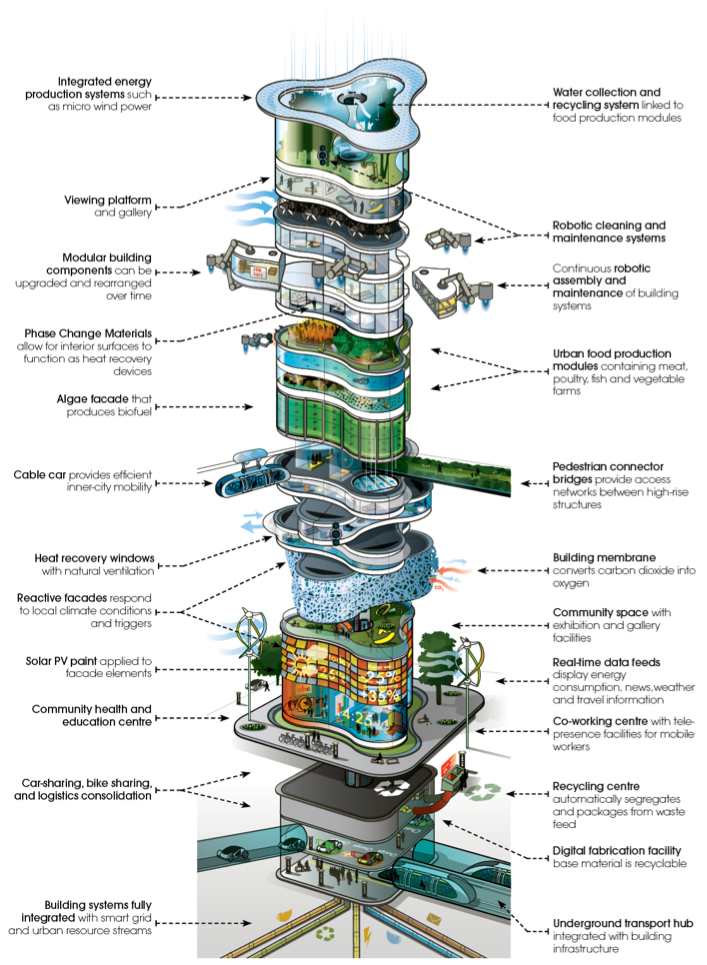
Cable cars, algae bio-fuel cells, and urban agriculture are sandwiched into just a small slice of Arup's future skyscraper.
The urban buildings of the near-future will be tall, smart, adaptable, responsive, honest, modular, recyclable, clean, and deeply embedded into the systems of their host cities, if an imaginative vision from Arup's Foresight team is anything to judge by. In its evocatively titled It's Alive, Arup (the firm responsible for the structural design of the iconic Sydney Opera House) asks if we can imagine the urban building of the future while simultaneously presenting its take on the matter. The report contains plenty of ideas, albeit briefly stated, so I thought it would be fun to identify some of today's science and technology that has made it into Arup's skyscraper of tomorrow and discuss whether Arup's vision is more grounded in fact or fiction.
Enlarge / Arup's urban building of 2050

It was the best of times, it was the worst of times

Arup's future-scraper is the product of its time; a time 37 years from now that will suck and be awesome in approximately equal measures. Why suck? Because 37 years will see us through to the year 2050, and Arup shares (or perhaps borrows) the OECD's troubling forecast of a warming, overpopulated Earth hungry for, yet deficient in, essential resources. According to this narrative, there will be 9 billion people, with 6.3 billion living in towns and cities.
The good news is that we'll still have iPhones—or their future-proxies, at least. Arup describes the denizens of our future cities as "net-native adults" who have grown up with smart cities, smart clothes, and smart objects. The Internet of Things will be ubiquitous, Arup suggests; presumably to the point that it has been abbreviated simply to "things," the "Internet of" having been long since forgotten.
The specific technology that Arup predicts will make up our buildings varies from the likely (or even current) to the speculative, the specific to the vague. Let's start with the obvious.

The big picture: Tall and modular

The aesthetic merits of tall buildings can be debated, but if humanity is set to grow and become increasingly urbanized, cities either have to grow upward our outward. There are arguments that the former is the more environmentally sound approach, not least because urban sprawl is prevented, and existing infrastructure can be reused (or, if necessary, upgraded). Where green belt policy is in effect, building outward may not even be an option, which comes with consequences. In 2005, the Government of Ontario passed legislation to designate a green belt around Toronto and the Golden Horseshoe. As of September 2012, Toronto had 147 tall buildings under construction. Toronto is an extreme case by North American standards, but even so, Arup's prediction that the buildings of the near-future will be tall appears sound, perhaps a no-brainer.
But modular skyscrapers? Rob Hunt's illustration of Arup's future-scraper is pleasingly reminiscent of the futuristic visions of the 1970s depicting inter-stellar space hulks and off-world colonies (c.f. Donald E. Davis' painting of the interior of a Stanford torus). It shows a skyscraper composed of modular pods that can be replaced as the requirements of use change. "In this emerging age, with significant developments in construction—prefabricated and modular systems are moved and assembled by robots that work seamlessly together to install, detect, repair and upgrades components of the building system," Arup writes. A new start-up fails? No problem. The building's army of robotic workers can replace its office and all its prefabricated fixtures, with a new one tailored to the needs of the next (or instead with a pizzeria, tropical garden, or small suite of studio apartments).
Today, modular buildings are more likely to be kit houses, with components selected to meet the needs of the user. Modular buildings of any scale are few. Raines Court in London, built in 2003, is a residential block of 53 flats. Each was factory-built, complete with kitchens and bathrooms, plumbing and electrics. The first phase saw 29 units put together and connected in a mere five days. However, the developer has said that until such modules are mass-produced, modular construction is "no cheaper" than traditional construction methods, which puts us firmly into vicious circle territory. Nevertheless, a large modular residential building at 335 East 27th Street in Manhattan is on the cards. "My Micro NY," the winner of Mayor Bloomberg's adAPT NYC competition, will be assembled from 55 locally built "micro-units" of between 250 and 370 square feet.
Prefabrication of tall buildings is increasingly common, however. Notionally a step back from full modular building, prefabrication is allowing construction of large buildings in record time. In November, a ten-story residential block, Instacon, was built in two days in the Punjab. The rapid-building efforts of China's Broad Group, who built a 15-story hotel in six days and a 30-story hotel in 15, are attracting inevitable attention, though these efforts would be eclipsed, at least as a spectacle, if its plans to build the world's tallest skyscraper in 90 days are successful. These record times are massaged slightly: they tend not to include groundwork or time spent in the factory.
It seems likely that the urban buildings of 2050 will be prefabricated, but whether modular construction takes over is anyone's guess. A modular future might well result in skyscrapers looking very much more alike. A more likely bet is that future skyscrapers will go up in the proverbial blink of an eye.
Which is to say nothing of the robots. The odd window-cleaning robot and quad-rotor automatons that can build rudimentary walls aside, we are still in the early days of robot construction workers, let alone automatons that can reconfigure skyscrapers on a whim. Research at Cornell has brought about a robot which can navigate a simple truss structure, adding and removing components as it goes. But if robots are to revolutionize construction, perhaps they will first do so in quiet, inconspicuous ways, such as laying out and marking ground more quickly and accurately. But who knows? Perhaps the International Association for Automation and Robotics in Construction (IAARC) will amaze us any day now.

Wired for… everything

Arup's future-scraper, we're told, will be deeply embedded into the infrastructure of the city. Nowhere is this more apparent than in transportation, with buildings themselves becoming transportation hubs. Trains arrive via futuristic underground tube systems, and… hang on. If you work in a building directly above a metro station you will understand the advantages of such proximity (even if you do have to walk outside for a few yards.) "Integration," then, is really just a blurring of the boundaries between the station and building. It's already happened, to varying degrees, at buildings like Canary Wharf and The Shard in London, Nagoya Station in Japan, the MetLife Building (above Grand Central Terminal) in New York, and the CitiGroup Center in Chicago.
Arup's illustrations also depict underground parking and incoming pedestrian bridges at a high level. The former is not unusual (overlooking the fact that the cars also arrive by underground tube), and the latter is by no means unheard of. The skybridge connects the 41st and 42nd stories of the Petronas Towers in Kuala Lumpur. Perhaps more tantalizing to those of us that work in the upper stories of high-rise buildings is the prospect of arriving to work via gondola cable car, which Arup's illustration shows coming into its skyscraper about half way up. And yet cities are increasingly looking to gondola lifts, if for sight-seers as much as commuters. A Guardian report last November listed Algiers, Barcelona, Bolzano, Koblenz, New York, Oporto, Portland, and Rio as cities with gondola cable cars. However, for a cable car integrated into a high-rise, you may have to travel to Singapore, judging by this YouTube video.
A bridge here and a cable car there may demonstrate that the technological capability of this part of Arup's vision already exists, but Arup is imagining that by 2050 these systems could be much more widely adopted and deeply embedded in our cities. That may be, though one shouldn't overlook the sterling work undertaken by the humble elevator, which surely isn't going to disappear completely by 2050.
Of course this rich interconnectedness is not limited to transport. Buildings will have the obligatory connections to the smart grid, water, fuel, waste, and anything else that will be deliverable or discardable by subterranean tube and pipe by then.

More than a front

Things take a turn for the high tech when it comes to the building's facades. "This exterior membrane provides opportunities for everything from integrated communication networks, to food and energy production," Arup writes.
The document singles out photovoltaic paint as its solar technology of choice. Coincidentally, spray-on plastic photovoltaic cells were in the news only last week, though they're far from a new idea. Why stop at paint, though? Photovoltaic glass (also in the news last week, also not such a new thing) could potentially be integrated into the windows. The amount of solar research happening is dizzying, with numerous developments reported every week. Predicting which will make it out of the lab and into the market is a daunting prospect, though the steady march of solar technology overall seems inexorable. Perhaps by 2050 the cost of solar paint, solar tiles, and solar windows will have fallen to the point that they're commercially viable while allowing for the fact that all these skyscrapers will inevitably cast shadows on each other.
Arup also refers to "nanoparticle treatments applied to facade systems that have the capacity to neutralize airborne pollutants, capture CO2, and clean the air around each structure." Again, it's already possible to embed the photocatalyst titanium oxide into concrete, surface tiles or windows. When exposed to UV light, titanium dioxide can break down atmospheric pollutants. Where the words "self-cleaning" appear, titanium dioxide tends to follow.
And apparently these multifunctional facades will convert carbon dioxide into oxygen, presumably sequestering the carbon while they're at it. Given that photosynthesis makes a fairly good fist of this already, a green wall might be a logical starting point. Hardly a new idea (effectively constituting about one seventh of the Wonders of the Ancient World), the practice of covering walls in plants is as popular today as it's ever been. Yet Arup's illustration describes this material as a membrane, showing no apparent plant life at all. Perhaps Arup is thinking more along the lines of Eco-cement, which absorbs CO2 as it sets. Preferable would be a material embedded with artificial photosynthesizers that continues to capture carbon through the life of the building. Suffice it to say that carbon capture, like solar power, is the subject of much research, and it's far from ludicrous to assume that the buildings of the future will make more of an effort than they do today.
Arup also describes "heat recovery windows" that allow air in while capturing heat before it escapes. Such technology exists but could do with some slimming down. If our taste for wall-to-wall glazing is to continue (as Arup appears to think it will), then the thermal performance of glass will surely have to improve considerably in a resource-poor future.
When it comes to the building's outer walls, Arup has drawn inspiration from a variety of current research and technology and imagined the implications for the future. Building facades is already the focus of progress in the construction industry, and it seems as safe a bet as any that this will continue.

Smart, clean, honest

Enlarge / Interaction between plant roots and soil produces a small amount of energy. The same principle could be used in algae biofuel cells.
Arup thinks that the skyscrapers of the future could routinely produce more energy and other resources than they consume. We've already mentioned photovoltaic paint, but Arup also envisages algae biofuel cells integrated into the building. Rather than simply farming algae and converting it into biofuel for combustion, the word "cells" implies a more nuanced process. In November, researchers at Wageningen University found they were able to generate 0.4W per square meter of marshland from microbial fuel cells (MFCs), which obtained energy from the interaction of plant roots and soil bacteria. In 2009, Penn State conducted research that found algae could "in principle, be used as a renewable source of electricity production in MFCs."
The inclusion of wind turbines into the design would be predictable, were it not for the fact that these are to produce drinking water rather than energy. A company called Eole Water claims it can do just that. Arup also says that downdraft winds could be harnessed to generate power, so it arguably missed a trick in not making its future-scraper cylindrical, assuming the idea behind the Downdraft Tower has legs. Meanwhile, the presence of floors devoted to food production suggests, alas, that we're not into Star Trek Replicator territory by then, though token farm floors many be less likely to come to pass.
Buildings that are claimed to produce as much or more energy than they occur with increasing frequency, but it's one thing to claim this for a building and quite another to do and prove it. The idea that buildings could report their net resource consumption or production has been knocking about since at least 2007. The suggestion is still that outward-facing displays at ground level will show this real-time information to passers-by.
Honest Buildings is a website where a database of the world's building's is gradually being built. Among the information that can be added are the estimated energy consumption (baseline and peak), greenhouse gas emissions, etc. Much more in the spirit of Arup's vision, though, is support for the Lucid Building Dashboard, an informational hub that can gather and report live information on a building's consumption and output. Building managers need only to plug their dashboard ID into Honest Buildings, and suddenly the site becomes a hive of live energy reporting for buildings all over the world. Of course this will require building managers to actually do that, which, until such a time as everyone is itching to show off about how much energy their buildings don't consume, may require some form of legislative stick. This would remove the need to actually walk past the building to check out its energy consumption.
Needless to say that the buildings of the future will have sensors up to (and including) its eyeballs, allowing it to intelligently match or adapt lighting, temperature and what have you for efficiency and/or comfort. Arup is on safe ground here, one feels.

Where do I park my jet pack?

Arup has clearly looked to the innovations of today in order to produce a vision of the urban building of 2050. But it's no less imaginative, and all the more plausible, for having done so. The mishmash of technologies that has gone into the vision will have been scraped from the memories and consciousness of the Foresight Design Team, just as the examples I've called upon have been scraped from mine (and Google, obviously). Doubtless other things will have occurred to you.
And really, that's about it… give or take some graphene.

Dutch Parliament Member Fined For Hacking; He Says He Was Just Exposing Security Flaw

yea right !                 

Dutch Parliament Member Fined For Hacking; He Says He Was Just Exposing Security Flaw

from the ethical-hacking-or-not dept

A few folks sent over this story of Dutch Member of Parliament (MP) Henk Krol being fined about $1,000 for "hacking." He claims that he was just exposing poor security on the part of a Dutch medical laboratory called "Diagnostics for You," which he felt was especially important since there are stricter privacy rules for medical info. Of course, "hacking" is used loosely here: basically, a patient overheard an employee at Diagnostics for You reveal the system password while he was in the lobby, and that patient passed the password along to Krol. So, the "flaw" could be as simple as a stupid employee revealing their password out loud (though, you could argue that a system like that should require two-factor authentication or some other more advanced security than a simple password).

Either way, the court recognized that Krol's intentions may have been in the right place, but faulted him for viewing and printing "more files than necessary" to make his point -- and also for going to the press with his findings at around the same time he notified the laboratory. The court said simply finding the flaw and even downloading some records to prove it to the lab would have been fine, but that he went too far (even if he carefully redacted personal info). And then going to the press immediately when the problem seemed to be more a case of a bad employee revealing their password, just seemed like too much. As the court noted: "the problem was not so acute that immediate use of media was necessary."

Of course, this kind of thing is often a struggle when it comes to security hacking. Different people have different opinions on whether or not it's appropriate to go to the press, and also how much information to access. But it seems to be handled on a case by case basis, rather than with clear rules. There are some norms among security researchers -- and that tends to include giving a company some period of time to fix things -- but this remains an area of the law that is sometimes a bit fuzzy. You want companies to respond quickly to security flaws, and sometimes going to the press ensures getting a real response faster. But, it also seems less likely to cause significant damage if you contact them first.

Perhaps MP Krol can now try to pass some legislation with standards on how to handle security breaches found without having them turn into legal cases against the researchers.

A country remains in shock as hero Pistorius charged with murder

By Alex Eliseev, Special to SI.com
Oscar Pistorius became a national hero in South Africa for overcome the loss off two legs to excel on the track, but a murder charge has shocked the nation.
Oscar Pistorius became a national hero in South Africa after overcoming the loss of two legs to excel on the track, but a murder charge has shocked the nation.
Getty Images
JOHANNESBURG, South Africa -- As a 130,000-ton asteroid hurtled silently through the dark sea of space last week, teasing earth by slipping past its satellites, a fiery news meteor smashed into the heart of South Africa.
Unlike the lump of rock spotted by astronomers in Spain a year ago, the story of Oscar Pistorius came without warning, burning through the atmosphere in the dead of night and exploding over the country's capital city.
The dust storm of confusion it kicked up is beginning to settle, but the shock waves are still reverberating around the globe. South Africa -- a nation obsessed with sport and heroes, and especially sporting heroes -- is reeling.
The man known as the "blade runner" is due to return to court on Tuesday for what is expected to be the start of his bail application. The preliminary hearing is likely to reveal -- through statements, witnesses or both -- a great deal about the police's case and why they believe the death of Pistorius' model girlfriend, Reeva Steenkamp, was premeditated murder and not, as Pistorius' family describe it "a terrible, terrible tragedy".
We may also learn what the double-amputee sprinter plans to offer as his defense. With little doubt over who pulled the trigger, his options are limited and the only real question that remains is: why? What happened behind the closed doors of Pistorius' Pretoria mansion in the early hours of Thursday morning? How is it possible that a man honored by Time magazine as the very "definition of global inspiration" has plummeted, like a comet, into a courtroom, to stand there as a broken, weeping man accused of murder?
Fragments of the truth are beginning to come out, but a great deal has already been pieced together by journalists and through official police statements. When news of the murder first broke, it appeared Pistorius had told police he mistook his 29-year-old girlfriend for an intruder and shot his 9-mm firearm to protect himself. In a country plagued by crime (15 000 murders, 17,000 violent house robberies and nearly a quarter of a million burglaries in a single year), this sparked a debate about gun ownership and the terrible fear people carry with them each day and sleep with each night.
The "mistaken identity" version was easy to swallow. South Africans spend millions of Rands each year to hire private security companies and to build walls, electric fences and burglar bars. In 2004, one of the country's retired rugby stars, Rudi Visagie, mistook his teenage daughter for a thief and shot her dead in his yard. She was sneaking out to surprise her boyfriend on his birthday. Listeners called into radio shows to share their experiences, one man having jumped out of bed to attack a shadow which turned out to be his wife. There was also a lot of debate about whether new gun laws, introduced almost a decade ago, have helped bring down the crime rate.
But within hours of the shooting, police gathered anxious journalists outside Pistorius' home and provided details which would swing the story in a completely different direction, turning down the volume on the self-defense theories. According to police, there was no forced entry into the plush (and extremely well protected) Silverwoods estate where Pistorius lives, nor into his home. In other words, there is no evidence to suggest an intruder had broken in and the only two people inside were Pistorius and Steenkamp. While this doesn't mean Pistorius couldn't have thought he was under attack, the new information packed a punch.
Police also revealed that witnesses had heard a commotion -- screaming or shouting -- shortly before the gunshots rang out. It appears neighbors called for help shortly after. Journalists were also told that other incidents of a "domestic nature" had been reported involving Pistorius. It's not clear whether this was a reference to an incident in 2009, when Pistorius was briefly detained by police for assaulting a woman at his house (a case that was later dropped). At the time, he claimed she picked a fight with his then-girlfriend and was injured when a wooden beam fell on her leg.
Most importantly, police made it immediately clear they were planning to oppose any bail application and were taking Pistorius for a blood test at a local hospital, presumably to test for alcohol, drugs or steroids.
Suddenly, with the dots connected, it was easy to see that detectives didn't believe the shooting was an accident. Why else would they fight to keep Pistorius, a man who's name is known in every corner of the globe, behind bars?
The impromptu police briefing sent shock waves across South Africa. In the period of a few minutes, Pistorius went from being a victim to an alleged villain. Charged with a murder in a country so desperately sick and tired of violence against women and children.
*****
Just six months earlier, Pistorius was a national hero. The "fastest man on no legs" sprinted his way into the history books by sharing a track with the world's fastest runners. He became the first disabled athlete to qualify for the able-bodied Olympics in London, overcoming scientific scrutiny and using lawyers to dismantle a ban which, for a while, looked set to shatter his dreams. He silenced his critics and ran. He didn't win, but he didn't have to.
While he graced the covers of magazines, flashed his smile and scooped up sponsorship deals worth millions, South Africa watched with pride. He was Springbok captain Francois Pienaar, raising the 1995 World Cup rugby trophy. He was Chad le Clos, the boyish swimmer who -- in the same London Olympics -- defeated Michael Phelps, arguably the greatest Olympian of alltime. He was golfing legend Gary Player at the Masters; he was cricketer Hashim Amla becoming the first South African to score a triple century in England; he was iconic footballer Lucas Radebe captaining the national squad and being signed up to play at Leeds United. He was all of these great sportsmen and more.
Pistorius was, as one local writer put it "our good thing". He was Charlize Theron making it in Hollywood; township-born R&B star Lira having her "Marilyn moment" while singing for U.S. President Barack Obama; war photographer Joao Silva surviving a land mine in Afghanistan and returning to the field.
In a country haunted by a dark past and tangled up in identity issues, Pistorius transcended all racial boundaries. His triumph over his disability made him a hero in the eyes of all South Africans, black or white, rich or poor, able or disabled. Here was a man with no legs playing rugby, cricket and water polo.
And so, it was all the more shocking when details of the shooting began to emerge. By last Friday it came out that Steenkamp had been shot four times, through a bathroom door (where she allegedly locked herself in). One of the bullets apparently struck her in the head. Blood spatter patterns further showed that she either ran or was carried down the stairs while still alive. None of this has been officially confirmed by police and is yet to be tested in court, but it was reported by several South African media organizations.
Later, the City Press newspaper would reveal that a bloodied cricket bat was at the center of the investigation. The respected publication also claimed that -- according to their sources -- Steenkamp's skull was "crushed". It also reported that Pistorius had called his father for help at 3:20 that morning.
Pistorius' so-called "dark side" began to shift into focus. An alleged history of anger, jealousy and bullying. A speedboat he crashed in 2009, amidst claims he had been drinking. His fast cars and motorbikes and the "wrong crowd" he found himself in. Fights over girlfriends (threatening to break a man's legs). A 2012 Daily Mail article which claimed he kept a machine gun by the window; The New York Times piece which called him "more than a little crazy"; the reporter he took to a shooting range. There were also questions of whether he should have been allowed to own a gun.
*****
When looked at collectively, these incidents paint a picture of an embattled or controversial celebrity. But in reality, Pistorius' life in South Africa didn't play out on the front pages of tabloids and these incidents were scattered over time and dwarfed by his success. No one was waiting for something terrible to happen. His private affairs were known to those close to him but never translated into major scandals in the media. At the time of the shooting, he stared down from massive street billboards across Johannesburg as the temporary face of one of the country's biggest television channels. The advertising campaign was carefully timed to coincide with the Oscars.
By all accounts, his relationship with Steenkamp was a healthy one still in a honeymoon phase. The couple had been dating for a few months and appeared to be happy. Steenkamp was a former FHM model who was about to break through as a contestant on a celebrity reality show called Tropika Island of Treasure. The tragedy of her death and her shattered family were, at least at first, eclipsed by the storm around her superstar boyfriend.
Journalist Hagen Engler knew Steenkamp and, following her death, wrote that she was a woman who was "going places". "She was amazing. Charismatic, vivacious, intelligent, hilarious as well as beautiful, with a deep, masculine voice, permanent smile lines around the corners of her lips and a naughty sparkle in her eye," he recalled.
Her family described her as a "pure soul", a woman who's goal was to become famous. Steenkamp will be laid to rest in the next few days in her home town of Port Elizabeth. The TV show she featured in has been broadcast, with a special tribute to her and, as the producer said, the echo of her laughter in every one of her scenes.
Steenkamp's last tweets were about Valentine's day, sharing gift ideas and declaring that it should be a "day of love for everyone". Her present to Pistorius was reportedly a framed photograph of the couple.
As new, grim details about the shooting began to surface, the 26-year-old Pistorius made his first court appearance at a Pretoria magistrate's court last Friday. He was charged with a single count of murder -- a crime that carries a life sentence in one of the world's toughest prisons. The prosecutor assigned to his case is advocate Gerrie Nel, known for being a legal bulldog and internationally recognized for convicting South Africa's former police chief -- and Interpol president -- Jackie Selebi for corruption. Regardless of what lawyers, forensic experts and spin doctors Pistorius brings into the ring, a worthy opponent is now waiting in the other corner.
Shortly before midday on Friday, Pistorius walked into a packed courtroom wearing a dark suit. He cut a lonely figure in the dock, his anguish visible through a twitch in his face, a jaw clenched shut and a spasming muscle in his neck. He wept into his palms. His family members reached out to touch him, to comfort him. Nel announced that the state has set out to prove a case of "premeditated murder".
Court was adjourned for three days to give the athlete time to prepare. If Nel and his team get their way, the onus will fall on Pistorius to prove why he should be granted bail. He'll have to present to court what's known as "exceptional circumstances" which warrant his release. Factors like his health, the interest of justice, the strength of the state's case and whether the suspect is a flight-risk will come into play. Given the number of cases being heard in South Africa's courts, a trial of this magnitude will take months, if not a year or more, to get underway. It won't be easy for Pistorius to get bail, but it won't be impossible. Strict conditions may be set (reporting to a police station, declaring any travel, surrendering passports or even house arrest) but there is more than enough precedent for him not to be kept in jail.
If Pistorius claims to have shot at what he believed was a stranger or an intruder, he'll need to be absolutely certain the forensics back him up. If not, the scientific evidence could destroy his case and sink his defense. This would amount to a scenario where his version is tested against a careful forensic reconstruction of the scene. A man's word seldom wins over hard, cold scientific facts.
If he puts up a psychological defense, he can be sure that any experts he calls will be met with the country's best police psychologists. In fact, the Investigative Psychology Unit -- which deals with serial murders and psychologically motivated crimes -- has been involved from Day 1. Already, Pistorius' lawyers have said he's in an "extremely traumatized state of mind". At the weekend his family issued a second statement, saying they were "devastated", while the blade runner remains "numb with shock and grief".
South African courts are unpredictable. and the country is a complicated place. A place where a national police chief went to jail for his links to the underworld; a president has stood trial for rape; a cricket captain blamed the devil for accepting match-fixing bribes; and a minister used public funds to visit a girlfriend in a foreign jail. It's a country where, last year, policemen (under the control of a government that freed the nation from the oppressive Apartheid regime) gunned down striking miners by the dozen in what became known as the "Marikana bloodbath" and beat a protester to death in Ficksburg for demanding basic services. It's a land where truth really is stranger than fiction and the forces of light and dark are often blurred or twisted. There's also a shortage of leaders and heroes. Our greatest icon, Nelson Mandela, is held onto dearly, guarded as a national treasure, pulled out from much-deserved retirement. Each time Mandela has a health scare -- which is not unusual for a man of 94 -- the entire nation goes into paralysis.
And so, even despite having a thick skin, when another success story is suffocated and a hero falls, we hurt. The world watches with curiosity, but South Africa rides the emotional roller coaster.
I still can't shake the image of one of the talk show hosts at my radio station on Friday. As I walked past the sound-proof glass of his studio, with the "on-air" light shining green, I caught him in a brief, private moment. He was about to talk to a reporter who was covering the Pistorius case. With his earphones around his neck, the presenter was pinching the bridge of his nose to relieve the pressure. His eyes were like clenched fists. The blood was hot under his skin.
Before going on air, he had told me a story of how he first interviewed Pistorius as a teenager with braces and bad skin. How he messed up the pronunciation of the at-the-time unknown athlete's name and had to be corrected. How, for the rest of their friendship, Pistorius refused to call him by his first name and teased him by sticking to the surname and throwing a "mister" in front of it. He told me about the joy he felt while covering the London Paralympics last year (six months ago) watching the same kid obliterate his competitors. I could see how difficult it was for him to digest the murder allegations. How personal it was. And I sensed that it was the same for many South Africans.
However this story ends, the crater it leaves will be a deep one.
Alex Eliseev is a South African writer and senior reporter at Eyewitness News.

Read More: http://sportsillustrated.cnn.com/more/news/20130218/oscar-pistorius/#ixzz2LI9T2cpw

I'll Pay You to Read My Book


Nobody reads big factual books anymore. Who has time? With a lot of effort you can get folks to buy big factual books, but they don't usually read them. They sit on the "to read" shelf once they get home. Or pile up in the inbox on an ebook reader. I know. As an author I know how many of my purchased books are unread. But while it is nice that people buy books, I feel a failure as an author if the bought (or borrowed) books are not read.
A couple of years ago I had an idea for increasing readership of books. I'll pay you to read my book! I had a clever way to use ebook readers to accomplish this. I mentioned the system to many book lovers and authors, and one of them whom made his living patenting ideas suggest my idea was patentable.
I took some initial steps in that direction, but realized very quickly that getting a patent is just like getting a child - you now have to tend it, protect it, feed it, and develop it. It did not solve anything; it only created new things to solve. I have too many other things to do than babysit or try to peddle a patent, so I am publishing the idea here. It may be that this idea is not patentable at all, or even already patented (I never got that far to look), or maybe it is a lousy idea that can't be implemented. In any case, here it is.
I think it's a great idea. I'd like to have this option as a reader, as well as an author and publisher. I hope someone does this.
Pay To Read

A MODEL FOR PAYING READERS TO READ BOOKS
By Kevin Kelly
June 1, 2012             http://www.kk.org/thetechnium/
Proposal for a patent: The idea is to pay people to read a book.
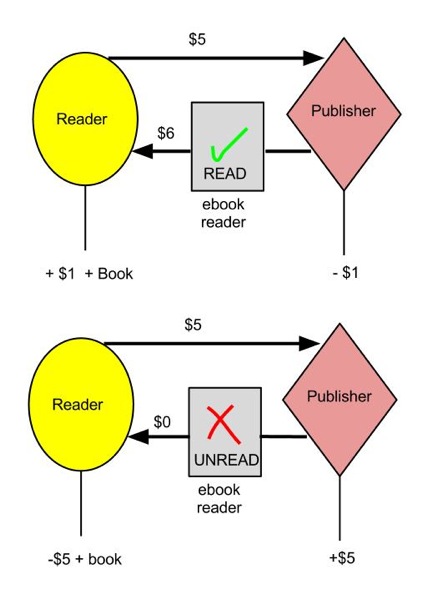
Readers would purchase an e-book for a fixed amount, say $5. They would use an e-book reader to read the digital book. The e-book reader would contain software that would track their reading usage – how long it took on average to turn a page; how often they highlighted a passage; how many pages activated at one sitting, etc. Amazon Kindles today already track bookmark usage patterns which they relay back to Amazon on via its wireless Whispernet. Using a database of known reading patterns from verified readers the software would compare a purchaser’s reading behavior to these known reading patterns and establish whether or not a purchaser is really reading the book. If the behavior patterns exceeded the threshold level – say 95% of pages turned at the right speed -- then the e-book device would initiate a predetermined payment to the purchaser.
If a reader is given credit for reading the book, then he/she would earn more than they paid for the book. For example, if they paid $5 for the ebook, they would get back $6, thus earning $1 for reading the book. Not only did the book not cost them anything, but they made money reading the book. If they read it.
The Publisher would pay the difference from the potentially greater sales revenue this arrangement would induce. Greater numbers of readers would purchase the book initially in the hope and expectation that they would finish the book and be reimbursed greater than the amount they paid. In their mind, entering into a purchase is an “easy buy” because they calculate “it will cost them nothing.” Or maybe even make them money.
However the likelier outcome is that while many more customers buy the book, fewer actually read it completely. This follows the known pattern that most bought books are not read. So the actual payout for success will likely be less than the actual gain in sales, resulting in a net gain to the Publisher for this deal. So if, for example, the Publisher sold 10 books that were unread for every 1 book that was read, the revenue would be $50-$6 = $44. If this offer increased ordinary sales by for example 40%, there would be a net increase in revenue from $35 to $44 or $9, or 25% additional profit for this model.
There is satisfaction for both parties in either outcome. If the purchaser buys the book, but does not read it in full, he/she paid the acceptable price, and still owns the book. The Publisher keeps the full amount. If the purchaser finishes reading the book, they still have the book, but also earned money doing so. The publisher loses only a small amount on the sale, which can be offset from greater sales to others.
The payout ratio can be adjusted depending on the price of the ebook, or the category of content. This mechanism requires no new hardware than what exists today, and better hardware in the future – such as eye tracking technology -- will only make it more practical to evaluate whether someone has read a book. This can be accomplished primarily in software. Of course, it should be an opt in choice, and engaged with a purchaser’s permission only.

Zhongdian-snow.jpg

Shangri-La is the official name of a small Chinese town in a mountainous valley on the edge of the Tibetan plateau. Formerly called Zhongdian, the town was renamed Shangri-La by local businessmen with the blessings of the national government in order to spur tourism. Who would not want to visit Shangri-La? I’ve been twice, and sorry to say, it is no Shangri-La. But on my last visit there a pristine 6-inch layer of snow in April covered the normally dusty and dilapidated old town, and in this clean robe it actually looked picturesque.
ShangrilaMan.jpg
Old guy on the main street of Shangri-La.
For hundreds of years this frontier town has been an overnight stop for travelers along the winding road from the agriculturally rich highlands of Yunnan to the dry wind-swept lands of Tibet. The shops along the main street of Shangri-La today sell an exotic assortment of household goods to a steady stream of Tibetan and minority farmers trudging in from the countryside. A hundred one-room shops along a drab main street offer sturdy leather boots, brightly woven carpets, farm hardware, rugged horse blankets, hot water thermos bottles, solar battery rechargers, cheap iron tools, and fancy striped fabrics and ribbons. Mixed among this traditional ware were dozens of shops that sold nothing but DVDs for thousands of movies. A few of the shops had a greater selection of movies for sale or rent than your local Blockbuster. Some of the thousands were Hollywood hits, some were Hong Kong kungfu episodes, or Korean series, but most were Chinese-made films. Almost all of the discs were cheap (less than $3) pirated copies. The new digital “freeconomy” where copies flow without payment is not just a trait of cosmopolitan cities; information wants to be free even in the most remote parts of the globe.
I was in China, in part, to answer this simple question: how does the China film industry continue to produce films in a land where everything seems to be pirated? If no one is paying the filmmakers, how (why) do they keep producing films? But my question was not just about China. The three largest film industries in the world are India, Nigeria and China. Nigeria cranks out some 2,000 films a year (Nollywood), India produces about 1,000 a year (Bollywood) and China less than 500. Together they produce four times as many films per year as Hollywood. Yet each of these countries is a haven, even a synonym, for rampant piracy. How do post-copyright economics work? How do you keep producing more movies than Hollywood with no copyright protection for your efforts?
This question was pertinent because the rampant piracy in the movie cultures of India, China and Nigeria seemed to signal a future for Hollywood. Here in the West we seem to be headed to YouTubeland were all movies are free. In other words we are speeding towards the copyright-free zones represented by China, India and Nigeria today. If so, do those movie industries operating smack in the middle of the cheap, ubiquitous copies flooding these countries have any lessons to teach Hollywood on how to survive?
The answers uncovered by my research surprised me. My first surprise was the discovery that in each of these famously pirate-laden countries, piracy is not really rampant – at least not in the way it is usually portrayed by copyright police. Piracy of imported (i.e., Hollywood) films is rife, but locally produced films are pirated to a lesser degree. The reasons are complex and subtle.
nollywood.jpg
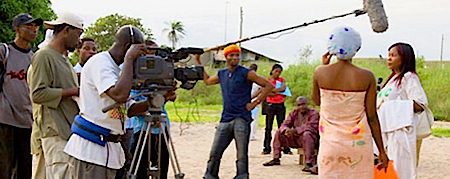
Most Nollywood films are completed in two weeks.
The first consideration is quality. Nigerian films are a unique blend of a soap-opera and a Bollywood musical; there’s a bunch of talking then a bunch of dancing. To call some of the Nigerian films low-budget would be to insult low-budget films. Many of the thousands of Nigerian movies are more like no-budget films. But even big-budget Bollywood films are cheap compared to Hollywood, so the total revenue needed to sustain their production is much smaller than Hollywood blockbusters. Naturally the smaller the costs, the less needed to recoup the expenses. For some films even a trickle of revenues may be enough.
nollywood-posters-street-051208-40200767.jpg
Posters on the Lagos street (via Esquire)
But more importantly, low quality is not just a trait of illegal stuff. In Nigeria, particularly in the poorer north, a vast network of small-time reproduction centers serve up copies of films for an audience of many millions. Originally an underground network of copy centers replicated VHS tapes; now the network pumps out optical disks. In the former days of VHS tape copies, the official versions had much better printed covers. These readable and brightly colored covers were their chief selling point, and printing the covers was the bottleneck at which the film industry exerted their policing. But these days in Nigeria, as in the rest of the developing world, movie disks are usually VCDs (video CDs) rather than DVDs. Although lower in resolution, VCDs are easier to duplicate, with cheaper blanks, and in a quality that is “good enough” on a cheap TV screen. These copies are rented out for a few cents from small dusty shacks. But often the cheap VCDs which rent for pennies are “legitimate” – duplicated under an arrangement with the movie producer. The filmmakers and the duplicators have cleverly reduced the price of legitimate discs near to the price of pirated disks. In fact the same operators will usually duplicate both. Since the legitimate disks aren’t that much more expensive than illicit ones, distributors have less incentive to bother with lower-quality pirated versions.
34441211.jpg
In addition the financing of films in Nigeria is closely aligned with the underground economy. Investing in a film is considered a smart way to launder money. Accounting practices are weak, transparency low, and if you are a thug with a lot of cash “to invest” you get to hang around movie stars by bankrolling a film. In short the distinction between black market disks and official disks generated with black market money is slim.
Nigerian filmmakers look to two other sources of revenue for their trickle of money: theaters and TV. Theaters in Nigeria offer a very precious commodity for very cheap ticket: air conditioning for several hours. The longer the film the better the deal. Theaters also offer a superior visual experience to watching a tape of VCD on an old television. You might actually be able to read the subtitles, or hear the background sounds. The full theatrical experience of a projected film is simply not copyable by a cheap optical disk. So box office sales remain the major revenue support for a film. As Nigeria’s nascent TV industry grows, its appetite for content means there is additional revenues for broadcasting films on either airways or cable systems.
bollywood.jpg
Bollywood wall poster in Rajastan (via Meanest Indian)
Bollywood is likewise supported by air-conditioning. Few Indians have aircon in their homes, fewer own air-conditioned cars. Mid-afternoon in the summer you really don’t want to be anywhere else except in a cool theater for several hours – which is why Bollywood films can go on forever. You can sell a lot of movie tickets this way, even though someone could get the same movie for almost free as a DVD on the steaming hot, dusty street one block away.
Like Nigeria, India has a similar mixture of piracy and legitimacy in its film industry. Bollywood and mafia money are famously intertwined. In terms of money laundering, tax-avoidance, and covert money flows, the entire film industry is a gray market. The behind-the-scenes people making illegal copies of films also make the legal copies. And prices for legit and pirated versions are almost at parity.
So why even bother with pirated movies? Because India has had a very draconian censorship policy for official studio films. Their famous “no kissing” rule is but one example. This censorship has pushed niche films to the underground where they are served by the piracy network. If you want something independent, racy, out of the ordinary, or simply not in the mainstream, you are forced to patronize the pirates. This includes the filmmakers as well as the audience. If you produce an avant-garde film how else to get it seen? Cheap duplication on the street is the way a filmmaker will get his art out, further blurring the distinction between legit and illegal. As in Nigeria, this convergence means the purchase price of an official VCD may not be much more than a pirated version, about US$3. In effect Indian filmmakers see these low disc prices as advertising to lure the masses into cool theaters to see the latest releases on the glorious big screen. The hi-touch factor of the theaters is the reward for paying, and the pirated versions are the tax or costs for getting attention.
China also has a censorship problem. Big budget films are subsidized by the government, and live off theatrical release. In fact getting screen time in theaters is heavily politicized. Independent films can’t get booked in the limited number of theaters, so they get to their audience on optical disks. And if a viewer wants to watch a film not produced by state-sponsored studios they have to find one on the streets. As in India and Nigeria, the price of legitimate copies are close to pirated, so for consumers there is no difference between the two. You can rent a copy of either type for about 25 cents a night.
The third leg supporting indigenous film industries in lands without copyright enforcement is television. Particularly cable television. Television is a beast that must be fed every hour of the day, and the industry insiders I spoke to in India, China, and Nigeria all saw a television spot as a legitimate destination for independent artists. The sums paid for work appearing on cable TV were not large, but they were something. Because television runs on attention and is supported by ads, the issues of piracy are sidestepped. For some producers pirated discs on the street create an audience, which might translate into a call to run their work on TV, or else prompt an invitation to produce something new.
Where indigenous filmmakers feel the sting of piracy is not within their own countries but in the very active export market. Nigerian films are watched throughout African and in the Nigerian diaspora; likewise Indian films are early sought out throughout South Asia and the Mid-East and in deep Indian communities in the West. Chinese films are watched in East Asia. Most of this market is served by pirated editions, depriving the filmmakers of potential international income. In this way these ethnic film industries share the same woes as Hollywood. But in their home turf, where the success of a film really lies, piracy is a different animal than the specter predicted by Hollywood.
Back on the gritty streets in Shangri-La I went looking for that utopian dream: a DVD of a first run movie for a dollar. That dream was too optimistic, even for Shangri-La, but I did find a copy of the latest Harry Potter movie (with Chinese subtitles) for $3, and upon close inspection it sure looked like a legit version. Clean design, Chinese style, crisp printing on the box, no typos, official looking holograph seal, etc. It was most probably illegal, but who knows? It would take a lot of research to determine its true origins, and for most consumers, like me, a moot question since every DVD vendor in town seemed to have the same inventory of mixed goods, all priced about the same.
What do these gray zones have to teach us? I think the emerging pattern is clear. If you are a producer of films in the future you will:
1) Price your copies near the cost of pirated copies. Maybe 99 cents, like iTunes. Even decent pirated copies are not free; there is some cost to maintain integrity, authenticity, or accessibility to the work.
2) Milk the uncopyable experience of a theater for all that it is worth, using the ubiquitous cheap copies as advertising. In the west, where air-conditioning is not enough to bring people to the theater, Hollywood will turn to convincing 3D projection, state-of-the-art sound, and other immersive sensations as the reward for paying. Theaters become hi-tech showcases always trying to stay one step ahead of ambitious homeowners in offering ultimate viewing experiences, and in turn manufacturing films to be primarily viewed this way.
3) Films, even fine-art films, will migrate to channels were these films are viewed with advertisements and commercials. Like the infinite channels promised for cable TV, the internet is already delivering ad-supported free copies of films.
Producing movies in a copyright free environment is theoretically impossible. The economics don’t make sense. But in the digital era, there are many things that are impossible in theory but possible in practice – such as Wikipedia, Flickr, and PatientsLikeMe. Add to this list: filmmaking to an audience of pirates. Contrary to expectations and lamentations, widespread piracy does not kill commercial filmmaking. Existence proof: the largest movie industries on the planet. What they are doing today, we’ll be doing tomorrow. Those far-away lands that ignore copy-right laws are rehearsing our future.