Saturday, April 9, 2016


New Norwegian Study Accuses Monsanto Of Falsely Claiming GMOs Are Safe

by Arjun Waliah   http://www.collective-evolution.com/2016/04/09/new-norwegian-study-accuses-monsanto-of-falsely-claiming-gmos-are-safe/
NORWAY
**Check out this recent podcast with Rachel Parent who recently attended the annual Monsanto shareholders meeting.
International findings on the safety of Genetically Modified Organisms are rarely reported on in Western mainstream media. Despite fierce resistance to GMOs in other countries, North Americans are just now starting to learn that GMOs are unsafe for human consumption, and that they pose significant environmental risks, too.
This is precisely why dozens upon dozens of countries around the world have completely banned GMOs from being imported or grown in their country. While major Western government health organizations say the science is clear on their safety, multiple governments, researchers, and scientific publications around the world beg to differ.
The Norwegian government, via The Norwegian Biotechnology Advisory Board (NBAB), is one such group. Commissioned by the Norwegian Environment Agency late last year to develop a guidance document in line with the Norwegian Gene Technology Act, their aim was to assess the sustainability of genetically modified (GM) herbicide-tolerant (HT) plants.
The report examines a dossier that was submitted to the Brazilian government by Monsanto, and it outlined how the research was flawed and lacking a tremendous amount of data. The study also pointed out a myriad of other concerns with regards to GMO Intacta Roundup Ready 2 Pro soybeans, finally concluding that the science behind the cultivation of this crop is simply inadequate. The report highlights a range of methodological weaknesses as well as the problem of incomplete information, research, and science on Genetically Modified Crops. This is something various other countries and scientists around the world have already suggested before.
The fact that long-term effects require long-term studies may seem obvious, but it’s apparently beyond the comprehension of GMO regulators worldwide, none of whom require tests of longer than 90 days in rats (about 7 years in human terms). It’s a case of “don’t look, don’t see”. (source)
You can read the full report here.
Norway is one of many countries in Europe to ban genetically modified products and to choose not to produce them. In fact, they are one of the most restrictive importers of GM products, with several EU-approved GMOs being strictly illegal in the country. (source)
The global resistance against Genetically Modified Crops is growing at an exponential rate. A few years ago, you were almost ridiculed for suggesting that GM foods could be hazardous, but now scientists and researchers are presenting information that has 19 new countries joining an already long list of nations to completely ban, or at least place severe restrictions on, GMOs  — and the pesticides that go with them. You can read more about that here.
What does this mean for the political relations between countries refusing GMOs and North America? It’s difficult to say, but a set of Wikileaks cables reveal that the State Department was lobbying all over the world for Monsanto and other major biotech corporations. They also reveal that American diplomats requested funding to send biotech lobbyists to meet with politicians and agricultural officials in “target countries.” These included countries in Africa, Latin America, and Europe.
One of the most revealing cables is from 2007. It looks at French efforts to ban a Monsanto GM corn variety. HERE is a cable that shows Craig Stapleton, former ambassador to France under the Bush administration, asking Washington to punish the EU countries that did not support the use of GM crops:
Moving to retaliation will make clear that the current path has real costs to EU interests and could help strengthen European pro-biotech voices. . . .
Country team Paris recommends that we calibrate a target retaliation list that causes some pain across the EU since this is a collective responsibility, but that also focuses in part on the worst culprits.   (source)
This is basically pressuring and threatening countries to accept the import of North American genetically modified products.

More On GMOs & Why More Countries Are Refusing Them

The main concerns over GMOs are related to human and environmental health. Alongside all of these troubles (according to Reuters), some countries simply want to take time to do proper research — flying in the face of the World Health Organisation’s (WHO) decree that GMOs are completely safe:
As part of the process, they portrayed the various concerns as merely the ignorant opinions of misinformed individuals – and derided them as not only unscientific, but anti-science. They then set to work to convince the public and government officials, through the dissemination of false information, that there was an overwhelming expert consensus, based on solid evidence, that GMOs were safe.
Jane Goodall  (source)
There is plenty of research to oppose that assertion, such as one study published in the journal Evironmental Sciences Europe. The WHO has never cited any long term studies that prove the safety of GMOs. When a study was finally conducted, it found severe liver and kidney damage, as well as hormonal disturbances, in rats fed GM maize in conjunction with low levels of Roundup — levels that were below those permitted in most drinking water across Europe. The rats also developed large cancer tumours. (source)
Other studies have found instances of adverse microscopic and molecular effects of some GM foods in different organs or tissues. They also determined that no standardized methods to evaluate the safety of GM foods have been established. Many studies have emphasized that more scientific effort is needed in order to build confidence in the evaluation and acceptance of GM foods.(source)(source)
Studies have also linked GMO animal feed to severe stomach inflammation and enlarged uteri in pigs. (source)
Here’s what Irina Ermakova, VP of Russia’s National Association for Genetic Safety, said last year when Russia was mulling over the decision to ban GMOs:
It is necessary to ban GMO, to impose moratorium [on it] for 10 years. While GMO will be prohibited, we can plan experiments, tests, or maybe even new methods of research could be developed. . . . It has been proved that not only in Russia, but also in many other countries in the world, GMO is dangerous. Methods of obtaining the GMO are not perfect, therefore, at this stage, all GMOs are dangerous. . . . Consumption and use of GMOs obtained in such way can lead to tumors, cancers and obesity among animals. . . . Biotechnologies certainly should be developed, but GMO should be stopped. [We] should stop it from spreading.  (source)
Keep in mind that we are talking about GM crops which are sprayed with billions of pounds of toxic chemicals every year. These chemicals have been linked to a number of diseases, ranging from autism and Alzheimer’s disease to cancer and more.
“Children today are sicker than they were a generation ago. From childhood cancers to autism, birth defects and asthma, a wide range of childhood diseases and disorders are on the rise. Our assessment of the latest science leaves little room for doubt; pesticides are one key driver of this sobering trend.” – October 2012 report by Pesticide Action Network North America (PANNA) (source)(source)
The list goes on and on. I recommend the below book if you want to learn more about this issue.

Excellent Book Recommendation To Learn The Truth About GMOs

“Altered Genes, Twisted Truth will stand as a landmark. It should be required reading in every university biology course.” – Joseph Cummins, Ph.D., Professor Emeritus of Genetics, Western University, London, Ontario (source)
This incisive and insightful book is truly outstanding. Not only is it well-reasoned and scientifically solid, it’s a pleasure to read – and a must-read. Through its masterful marshalling of facts, it dispels the cloud of disinformation that has misled people into believing that GE foods have been adequately tested and don’t entail abnormal risk.” –David Schubert, Ph.D. molecular biologist and Head of Cellular Neurobiology, Salk Institute for Biological Studies (source)

Global Climate Change: Agriculture on the Brink

Region:
Theme:
In-depth Report:
farm_crops_735_350
When it comes to farming, global temperature increases spurred by anthropogenic climate disruption (ACD) are bad news. Higher temperatures mean more droughts, wildfires, soil depletion and seasonal changes that, in general, have deleterious impacts on growing food.
The Intergovernmental Panel on Climate Change’s (IPCC) worst-case prediction by 2100 is a 4 degree Celsius increase in global temperatures.
“When I look at what the models predicted for a [4 degree Celsius] world, I see very little rain over vast swaths of populations,” Dr. Ira Leifer, an atmospheric and marine scientist at the University of California, Santa Barbara, told Truthout.
Leifer’s concerns are dire, not only in terms of the changing rainfall patterns predicted by the IPCC, but also regarding the rainfall patterns that are already occurring across the globe.
“If Spain becomes like Algeria, where do all the Spaniards get the water to survive?” he asked.
“We have parts of the world which have high populations, which have high rainfall and crops that exist there, and when that rainfall and those crops go away and the country starts looking more like some of North Africa, what keeps the people alive?”
The warning signs are already abundant.
A group affiliated with the UN recently released a report showing how without dramatic international intervention, the ongoing decline of pollinating species around the world poses a dire threat to the global food supply. This is because increasing numbers of pollinating species, including butterflies and bees, are going extinct.
Another recent study showed that lack of food production, again caused by ACD, will likely cause at least half a million deaths by 2050.
Truthout spoke with scientists and farmers alike about the subject, and their outlook for the future of farming on the scale necessary to continue apace with feeding an ever-increasing global population is not good.

(Photo: Nico Koch)
Disproportionate Impact
“The farm is a very small proportion of the economy in the US and other developed countries, but it has a disproportionate impact on global change,” Professor Michael Bomford, a Ph.D. in plant and soil sciences and a fellow of the Post Carbon Institute, told Truthout.
For years, Bomford has been worried about how our dependence upon oil to feed ourselves on a global scale has been causing soil degradation and depletion, as well as driving up food prices over the long run.
“Clearing land for farming releases carbon into the atmosphere and that contributes to climate change,” he explained.
“Then by farming it, using cultivation causes soil to be lost in wind and erosion, and that topsoil took thousands of years to form. One extreme weather event can cause us to lose thousands of years of soil.”
Industrial-scale farming, upon which the massive global population – already 7.3 billion and growing by a million people every four and half days — relies on and impacts soil through the use of nitrogen fertilizers, which are energy intensive to produce and which deplete carbon in the soil.
“This erodes the soil’s ability to hold nutrients, and starts a positive feedback loop,” added Professor Bomford. “A lot of our soils now rely on irrigation rather than rainfall, which depletes groundwater reserves.”
Studies already show that ACD will likely reduce crop yieldscreate a malnutrition crisis and make large portions of the globe inhospitable to core food crops like bananas and maize.
ACD impacts in Mongolia are already annihilating the pastures that nomadic herders rely upon for their survival, and millions of animals are likely to die from starvation in the coming months because of pasture depletion.
“The weather has become very unpredictable, and that’s the real problem,” Wendy Johnston with Oakwyn Farms in Athens, West Virginia, told Truthout.
For years, ACD has been causing farming to become far more challenging for her, and she is worried about how much worse things will likely become.
She, like many other farmers around the world, are also worried about lack of water.
More than 300 million people in sub-Saharan Africa already lack access to clean drinking water. It is estimated that by 2020, that number could easily double.
In 2011, the UN’s Food and Agriculture Organisation (FAO) warned of “potentially catastrophic” impacts on food production from ACD impacts that are increasingly hitting the developing world.
The report warned that food production systems and the ecosystems they depend on are highly sensitive to climate variability and change, and also noted that poor people are particularly vulnerable in countries that rely on food imports, although ACD-fuelled extreme weather events are already driving up food costs around the globe, including in developed countries like the US.
“The Pattern We’re Already Seeing”
Dr. Leifer’s forecasts of once-fertile farmland going dry are, unfortunately, already coming to pass.
Kevin Trenberth, a senior scientist at the US National Center for Atmospheric Research in Boulder, Colorado, says it is high time to emphasize the link between extreme weather and the global climate in which it develops.
“The environment in which all storms form has changed owing to human activities,” Dr. Trenberth said. He noted that, in particular, conditions are more moist and warm than they were even three decades ago.
“We have this extra water vapor lurking around waiting for storms to develop, and then there is more moisture as well as heat that is available for these storms [to form]. The models suggest it is going to get drier in the subtropics, wetter in the monsoon trough and wetter at higher latitudes,”
Trenberth explained. “This is the pattern we’re already seeing.”
Beyond the problems caused by shifting weather patterns and extreme weather events, an over-reliance on non-renewable energy (both oil and gas, as well as petroleum product use in fertilizers) is also a factor contributing to the impending food crises.
William Ryerson, founder and president of the Population Media Center and Chair and CEO of the Population Institute, is also very concerned about fertilizers’ impact on soil. He has questioned how, in the long run, this will impact agriculture.
“The world’s agricultural systems rely substantially on increasing use of fertilizers,” Ryerson told Truthout. “But now, the world’s farmers are witnessing signs of a declining response curve, where the use of additional fertilizer yields little additional food product.”
According to Ryerson and many farmers Truthout has spoken with, fertilizers and intensive crop planting lower the quality of soil. These factors will increasingly limit the possibilities of raising food production substantially and will, at a minimum, boost relative food prices and cause hunger for increasing numbers of people around the world.
Carbon stored in soil allows the soil to hold nutrients and water, and losing soil contributes to climate change. Plus, Bomford is worried about other contributing factors to climate change borne from the use of chemical fertilizers.
“Agriculture produces methane and nitrous oxides, like with animal agriculture that contributes to climate change, and these have a much greater effect on climate change than CO2,” he said.
Shifting Weather Means Less Food
Farmers like Wendy Johnston are acutely in touch with the shifting weather patterns due to climate change.
“We really don’t have spring anymore,” she said of West Virginia where she lives. Johnston explained that abrupt temperature shifts that are becoming increasingly common across the US are extremely disruptive for agriculture, which cannot survive huge, sudden shifts.
“I remember as a child, there was a gradual change from winter to summer,” she said, “But I don’t think we’re seeing that now.”
The price we’re paying is already clear.
recent report for the Montana Farmers Union showed that agricultural losses as a result of ACD in that state could total $736 million annually, and will likely worsen with time.
Ryerson emphasizes that these weather trends are already causing massive food shortages, and will continue to do so.
“Because of industrialization and sprawl leading to loss of agricultural land, population growth and the demand for more meat instead of grain as incomes rise, China is projected to need to import 240 million tons of food annually by the year 2030,”
he said.
Projections also indicate that India, which is currently a food exporter, will need to import at least an additional 30 million tons a year by 2030. However, where that food will come from is unclear.
“Yet, total world agricultural trade is currently just [approximately] 200 million tons of grain or grain equivalent, and that amount is decreasing as the exporting countries consume more and more of their own food products,”
said Ryerson.
Meanwhile, increasing demand for food imports by growing economies like China’s will almost certainly drive up the price of food in the coming decades, which, according to Ryerson, “virtually ensures that more people elsewhere will suffer from starvation.”
According to Ryerson, this predicament is then exacerbated by the fact there are 225,000 additional people at the world’s dinner table each day that were not there the day before.
“In just one year, the equivalent of an entire population of Egypt is added to the world’s population,” he said. “Driving up demand for food in the face of severe limitations on agricultural capacity.”
Shifting weather patterns mean less drinking water, as well as less irrigation for farming.
Additionally, as the world continues to heat up, glaciers and snow cover are continuing to decline. This reduces water availability in countries supplied by melt water from snowpack and glaciers, so lack of drinking water and irrigation will be a problem in parts of the globe such as South America and Asia, even though these regions may not technically be in a drought.
Some regions, of course, are already in drought, thanks to ACD. Australia is a prime example. That continent is already getting hotter and drier. By 2030, there are forecast to be 20 percent more droughts, and it’s estimated that by 2050, the annual flow into the Murray-Darling basin will fall by up to a quarter. This basin takes up much of southeastern Australia and provides 85 percent of the water that is used for irrigation nationally.
Meanwhile, counties like India, Bangladesh, Burma and other poor countries are going to be heavily impacted by increasing floods.
Yet, given that most of us in the so-called developed world do not grow our own food, most people remain unaware of this growing global crisis.
Johnston believes people who do not grow their own food can’t realize when certain crops should or should not be available.
“Things people expect at certain times are no longer there much of the time now,” she said,
“There isn’t squash available now like there used to be. Usually in June [there are] lots of lettuce, greens, peas and squashes, but because of changing weather patterns the squash will now be late, and the heat caused us to replant the greens and lettuces, which will now be late as well.”
Increasingly, farmers — and all of us who depend on them — will be facing the fact that food scarcity is becoming the new normal.
Copyright, Truthout. Reprinted with permission.
Dahr Jamail, a Truthout staff reporter, is the author of The Will to Resist: Soldiers Who Refuse to Fight in Iraq and Afghanistan, (Haymarket Books, 2009), and Beyond the Green Zone: Dispatches From an Unembedded Journalist in Occupied Iraq, (Haymarket Books, 2007). Jamail reported from Iraq for more than a year, as well as from Lebanon, Syria, Jordan and Turkey over the last ten years, and has won the Martha Gellhorn Award for Investigative Journalism, among other awards.
His third book, The Mass Destruction of Iraq: Why It Is Happening, and Who Is Responsible, co-written with William Rivers Pitt, is available now on Amazon. He lives and works in Washington State.

Higher Education Is Morally and Financially Bankrupt

A system that piles debt on students in exchange for a marginal or even zero-return on their investment is morally and financially bankrupt.
Every once in a while you run across an insider's narrative of a corrupt, morally bankrupt sector that absolutely nails the sector's terminal rot. Here is that nails-it narrative for higher education: Pass, Fail: An inside look at the retail scam known as the modern university.
Here are excerpts of the article, which was published in Canada but is equally applicable to higher education in the U.S.:
A university degree, after all, is a credential crucial for economic success. At least, that’s what we’re told. But as with all such credentials—those sought for the ends they promise rather than the knowledge they represent—the trick is to get them cheaply, quickly, and with as little effort as possible. My students’ disaffection is the real face of this ambition.
I teach mostly bored youth who find themselves doing something they neither value nor desire—and, in some cases, are simply not equipped for—in order to achieve an outcome they are repeatedly warned is essential to their survival. What a dreadful trap.
One in particular matches perfectly with the type of change I’ve observed on my watch: the eradication of content from the classroom.
All efforts to create the illusion of academic content are acceptable so long as they are entertaining, and successful participation requires no real effort and no real accountability.
Remove your professor hat for a moment and students will speak frankly. They will tell you that they don’t read because they don’t have to. They can get an A without ever opening a book.
But don’t worry—you won’t go bust because of this failure, not in the modern university. So long as your class is popular and fun, you’ll be favoured by the administration and probably receive a teaching award. This, even though your students will leave your class in worse condition than they entered it, because you will have pandered to their basest inclinations while leaving their real intellectual and moral needs unmet.
There is no clearer example of administrators’ contempt for faculty. But there is also no clearer example of their contempt for students.
As money is siphoned from academic programs through attrition, it is channelled into a host of middle-management positions.
From 1979 to 2014, central administration and staff ballooned by three and a half times, while the size of the faculty merely doubled.
Parents, students, and governments keep supplying them with capital, assuming there will be a genuine return on investment. But since the institution no longer produces anything, no such return is forthcoming.
Spending on the student services sector in Canadian universities increased an incredible six-fold between 1979 and 2014.
The student services cabal is no longer there to support faculty in their work of educating students “but to compete with them to define the student experience.”
Insiders are quiet after they read this, because they know it's true.
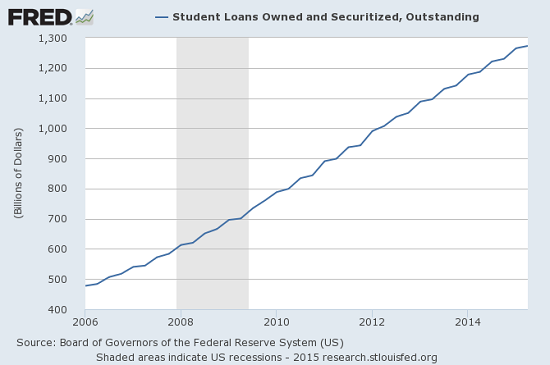
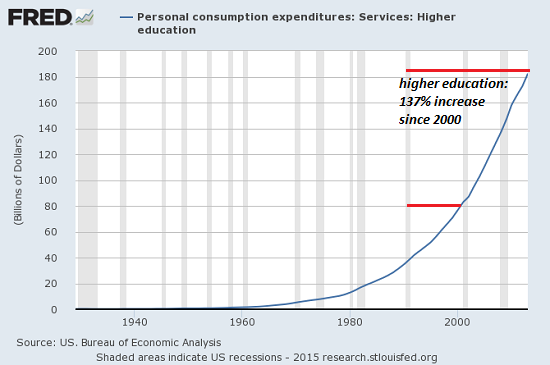
The financial burden created by the higher education cartel is immense and expanding:
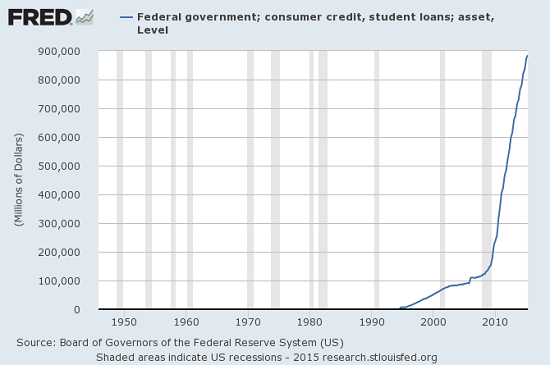
To mask the enormity of the sums squandered on "education" that has little measurable results, the federal government has purchased most of the debt:
No inflation here--just a 137% increase in 15 years:
A system that piles debt on students in exchange for a marginal or even zero-return on their investment is morally and financially bankrupt.             http://charleshughsmith.blogspot.com/2016/03/higher-education-is-morally-and.html

AUSTRALIAN EDUCATOR: COMPUTERS IN THE CLASSROOM A SCANDALOUS WASTE  ~hehe it seems like the REST of the World  IS starting ta fi~gure out ...    ALL "our" ed ~U ~K ~shone  is ...shit !!!   HUH

4.5/5 (8) It's been a while since I've ranted and raved about the deplorable state of education in the USSA and its subservient allies, so I am going to have to do so today, thanks to an article shared by Ms. D.O.  In this case, my rant is really someone else's rant, and his rant came from Australia, which like many other countries in the west, as been suffering the American disease: standardized tests without end, corporate favoritism for the corporations providing the tests and "texts", and a war on the student-teacher-parent relationship, i.e., a war on the human element.
Computers in class ‘a scandalous waste’: Sydney Grammar head
Here's the core of the argument, and I'm conflating several paragraphs together so that you can see that the same in is happening in Australia as is happening in the USSA, for those lucky enough to be able to afford sending their children to such schools:
The headmaster of Sydney Grammar School, John Vallance, yesterday described the billions of dollars spent on computers in Australian schools over the past seven years as a “scandalous waste of money’’.
“I’ve seen so many schools with limited budgets spending a disproportionate amount of their money on technology that doesn’t really bring any measurable, or non-measurable, benefits,’’ he said.
“Schools have spent hundreds and hundreds of millions of dollars­ on interactive whiteboards, digital projectors, and now they’re all being jettisoned.’’
Sydney Grammar has banned students from bringing laptops to school, even in the senior years, and requires them to handwrite assignments and essays until Year 10. Its old-school policy bucks the prevailing trend in most Aus­tralian high schools, and many primary schools, to require parents­ to purchase laptops for use in the classroom.
Dr Vallance said the Rudd-­Gillard government’s $2.4 billion Digital Education Revolution, which used taxpayer funds to buy laptops for high school students, was money wasted. “It didn’t really do anything except enrich Microsoft and Hewlett-Packard and Apple,’’ he said. “They’ve got very powerful lobby influence in the educational community.’’
Sydney Grammar students have access to computers in the school computer lab, and use laptops at home.
But Dr Vallance regards­ laptops as a distraction in the classroom. “We see teaching as fundamentally a social activity,’’ he said. “It’s about interaction ­between people, about discussion, about conversation.
...
Academically, Sydney Grammar rates among Australia’s top-performing schools, and is frequented by the sons of Sydney’s business and political elite. Almost one in five of its Year 12 graduates placed in the top 1 per cent of Australian students for Australian Tertiary Admission Rank university entry scores last year.
The school’s alumni includes three prime ministers — Malcolm Turnbull, who attended on a scholarship, Edmund Barton and William McMahon — as well as bush poet Banjo Paterson and business chief David Gonski, the architect of a needs-based funding model to help disadvantaged students.
The private boys’ school, which charges fees of $32,644 a year, routinely tops the league tables in the national literacy and numeracy tests.
Dr Vallance said he preferred to spend on teaching staff than on technology.
And there you have it: the elite of Australia prefer to send thier children to a school where (1) teaching and not standardized tests are the priority, (2) the human element of teaching is recognized to be the primary instrument for handing down the core of knowledge from one generation to another, (3) the financial priorities are on the hiring of good teachers...and..
...on and on we could go. And Dr. Vallance is right, entirely right: the only thing that "No Child Left Behind" and "common Core" have done is to enrich Pearson, Mr. Gates & Co, Et Al.. at the trough of public financing, while the products they have peddled have resulted in a generation that cannot write anything close to legible penmanship, that cannot think, doesn't even know how to do research in a good old fashioned card catalogue, and indeed, doesn't even realize that not all facts and books have been digitized (and doesn't realize there's a reason for that), all being taught by teachers many of whom are mediocrities because they spend more time in education and pedagogy classes than in classes dealing with the subjects they want to teach, the effect of which is to choke and strangle out any last vestige of genuine joy, inspiration and desire to learn that subject.  The mind-numbing quackery of ":educational methods" and "educational psychology" must consume most of their college time - not physics, mathematics, literature, art, music, geography, history - otherwise they are simply not "equipped" for "the modern classroom"
Now... I have a "modest proposal" on what to do with all the Doctors of Edubabble, all the certification advocates, all the teachers (they're not professors) of edublither in the classrooms of departments of "education". Since we're witnessing a flood of refugees into Europe, I advocate that we not ship these people back to their originating countries. We simply force them to take 16 years of American schooling.
At the end of this process, they will niether be able to read, write either English or Arabic or any other language legibly, they will not be able to read in any language, they will be unable to think, they will be colossally narcissistic (as any other products of our system are), and therefore too busy and selfish to be jihadists, Then, with luck, we can persuade Mr. Gates and the Pearson corporation to insist on standardized tests in the Islamic world,  and the crisis is solved. In a generation, we can ship all of our Doctors of Edublither over there, while we rebuild the actual traditions of teaching and professorship over here.