Tuesday, July 16, 2013

Human evolution: the next stages

these kooks are 'tinkering' with Our DNA ..you know mixing & matching with 'other' ???  & wanna CALL it evil~lution   LOL go up North (you know Pole)  & ask the good herr dr. frankenstein  ..how's that "monster"  working out fer ya  LOL  you goofy fucks  or how about that Park (Jur~ass~ic )  ya know wit ALL the cute lil lizards LMMFAO  just don't stick yer hand in the cage  :O               we got 'these'  edu~ain't~ed  ass pipes ..thinking they are lil gods  "crea~ain't~in  monsters  & when 'their'  monster fucks em up the ass  .....'they'   start believing in God   Oops  didn't see that coming           Dude ?            

This is What Happens When You F*** a Stranger in the A** Scene - The Big Lebowski Movie (1998) - HD


Human evolution: the next stages

What will become of humans as we evolve under the selective pressures of our modern lives and technology? If we adapt to some of the more bizarre elements of the present, humans could undergo some surreal changes
Evolution illustration
Evolution could take some interesting turns if modern factors persist long enough. Photograph: Philipp Kammerer/Alamy
There have been a number of speculations lately concerning the eventual form humankind will take, particularly with regards to the role technology plays in our lives and how this could reshape our physical and mental selves.
Susan Greenfield recently released her first novel 2121, set in some dystopian future where all her predictions about the perils of technology have come true. I've not read it because I've still got some rusty nails that haven't been shoved into the soles of my feet, but reviews have not been kind.
Providing a polar opposite view to Greenfield's scaremongering is The Transhumanist Reader; a new book that contains a collection of essays and philosophies on transhumanism, a movement that argues that enhancement of the human condition via technology is good, even essential, perhaps inevitable? I'll hopefully review it once I've finished it, but it's an interesting position.
There was also a Daily Mail piece about how humans will eventually evolve beaks. Because why not?
Evolution is obviously a complex process. But it's also a slow process. This means you can make claims about it and by the time it progresses to the point where you're proved right or wrong, you'll be long dead so it won't matter.
So, in order to not miss a potential bandwagon, what could humans end up being like if current cultural trends and features remain relatively constant over the next few million years? Here are some possibilities.

Colour-changing skin

Chameleon The ability to change skin colour would be advantageous, and not just for fancy dress. Photograph: Dan Kitwood/Getty Images Much like the chameleon, humans could eventually acquire the ability to consciously alter the colour of their skin. Maybe via chromatophores, or perhaps a more technical method will be found. Either way, there are numerous benefits that could lead to evolution making this the norm. Individuals who can change their skin colour would confuse prejudices based on race, which would be a depressingly useful advantage. In addition, the false tan/body whitening market is presently quite a profitable one. Many people aspire to change their default skin tone, so the ability to alter it at will would be highly sought after, resulting in more mating opportunities. The sometimes unsettling orange skin tones worn by some also suggest that the ability to change skin beyond the "natural" tones would be a positive. Being able to either visually blend in or stand out at will would be a potent advantage in modern society, one that evolutionary pressures could make more common.

Selective hearing

Large Hearing Aid Humans could evolve the ability to select what they're listening to, without the need for cumbersome apparatus or dapper suits. Photograph: John Franklin/BIPs/Getty Images Humans already have the ability to direct their attention to specific things that they are hearing. This is known as "the cocktail party effect", named for the scenario where it is particularly noticeable. When at a cocktail party, surrounded by conversations, it is possible to "focus" on a specific conversation that catches your attention for whatever reason, despite there being several others going on and all reaching your ear. The human ear has no physical mechanism for this; it's all done in the brain. But over time, this ability could become more important and advantageous. Given how the internet and mainstream media has seemingly given every person the impression that they should air their opinion, no matter how ill informed, on any subject they wish, the ability to more effectively control the things you listen to will become beneficial. Rather than diverting attention to more relevant inputs, humans could develop the ability to actively "tune out" things they don't want to hear, like closing your eyes to block an unpleasant sight.
Granted, people will end up less informed overall, but they'll be less stressed and angry in general, resulting in health benefits, longer lives and more pleasant demeanours, and thus making mating more likely. And so, the genes are favoured and spread.

Tentacles

Common octopus Humans may end up evolving to look like this, only with more of a Justin Bieber hair style. Illustration: Dave King/Getty Images/Dorling Kindersley Computer technology is becoming more and more commonplace in our daily lives (in the west at least). The most typical means of interfacing with this technology is via keyboard or touchscreen. Our human hands are impressively dextrous and capable of numerous fine movements. But with the increasing need to use technical interfaces, our priorities are changing. Evolution could push us towards developing digits that are more flexible than at present, taking a form that retains precision but loses rigidity, to give us a wider range and speed when typing or touchscreening, but retaining physical characteristics that make touchscreen use feasible. Our fingers could end up more like tentacles, perhaps like those on a sea anemone.
Why stop at the fingers? Although there will be limited practical reasons to develop tentacles instead of limbs, a major factor in evolution is sexual selection. If Susan Greenfield is right and constant exposure to online porn is desensitising us to sexual stimuli, alternative methods of arousal may be required. With the rise of tentacle erotica, that may be one possible outcome.
Speaking of flexibility...

Flexible skeletons

yoga More flexible skeletons would mean postures like this would become the equivalent of 'sitting down'. Photograph: Rex Features Much like the shark and similar fish, human beings could evolve to have a lot more cartilage in their skeletons. An increasingly health-and-safety conscious world where people are prepared to sue for even the most trivial injury means the danger of forceful impact is reducing, and as such rigid and inflexible bones won't be as essential to humans. It could also be argued that ergonomics is more of a concern than ever. A more flexible skeleton would obviously be of benefit as a result, especially during the birthing process, but this will only be relevant if those with a cartilage skeleton are able to attract mates. This will be more likely if the increasing enthusiasm for dance groups and the like continues. Those with cartilaginous skeletons would be able to perform moves beyond those of their more rigid counterparts, ensuring a presence on numerous TV talent shows and a resulting wide choice of potential mates.
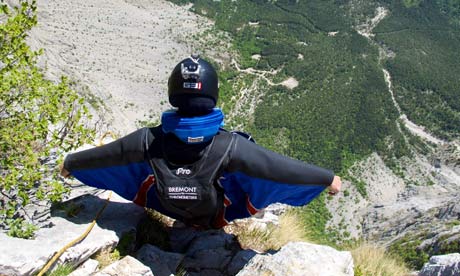
Wings

wingsuit basejumper Humans may eventually evolve wings, meaning some extreme sports would end up being considered rather mundane. Photograph: Getty Images I once spoke with someone who said he didn't believe in evolution. When asked why, his main argument was that people don't have wings. While this is definitely the case, I asked how this relates to evolution. His response was that "evolution is survival of the fittest, and wings are the best". So there's that. I don't know how much research this person had done to arrive at this conclusion, so I'm putting it here just in case. Even if it is based on some half-baked observations and a very limited understanding of how evolution works, it'll fit right in.

Lead Cop Told FBI Zimmerman Was Not A Racist

Federal civil rights probe faces significant hurdle

George Zimmerman bleeding

View Document

Serino FBI Report

  • Serino FBI Report
    Serino FBI Report
JULY 14--As the Department of Justice resumes its review of the Trayvon Martin killing to determine whether criminal civil rights charges should be filed against George Zimmerman, the federal probe could be hampered by the observations of the state’s lead investigator that the fatal shooting was not based on Martin’s skin color, nor was Zimmerman considered to be a racist.
In an interview last year with two FBI agents, Chris Serino, the Sanford Police Department detective who headed the shooting probe, said that he believed that “Zimmerman’s actions were not based on Martin’s skin color.” Rather, Serino told the agents, the deadly confrontation was triggered by the 17-year-old Martin’s “attire, the total circumstances of the encounter and the previous burglary suspects in the community.”
Serino (seen above testifying at the Zimmerman trial) was interviewed at the outset of the federal review of the February 2012 shooting. That investigation was shelved to allow Florida state prosecutors to pursue a second-degree murder case against Zimmerman, who was acquitted Saturday evening by a Florida jury.
In the wake of that “not guilty” verdict, the Justice Department today announced that federal investigators were resuming their review, and that "experienced federal prosecutors will determine whether the evidence reveals a prosecutable violation."
As detailed in an FBI interview report, Serino described Zimmerman to agents as “overzealous and as having a ‘little hero complex,’ but not as a racist.” Serino noted that he had interviewed Zimmerman on numerous occasions and “feels like he knows him fairly well,” reported FBI agents Elizabeth Alexander and Matthew Oliver.
Referring to the “faulty conclusion” Zimmerman drew about the unarmed Martin, Serino said that local street gang members--known in the community as “Goons”--“typically dressed in black and wore hoodies.” Serino added that he believed “when Zimmerman saw Martin in a hoody, Zimmerman took it upon himself to view Martin as acting suspicious.”
Serino also told the FBI that he did not think Zimmerman wanted to be a police officer “because cops have a bad reputation and are bullies, but he wants to be a judge.” He also described Zimmerman as a “soft guy.” (2 pages)

Egyptian Army’s Training and Firepower Overwhelmingly U.S.-Supplied

Source: IPS
When the dust settles from the ongoing deadly confrontations between the Egyptian armed forces and thousands of Islamist protesters in the streets of Cairo and Alexandria, the eventual winner will be the United States – specifically U.S.-made weapons systems in the hands of the country’s 440,000-strong military.
At last count, over 50 demonstrators were killed and more than 400 wounded in the military rampage Monday as the political crisis in Egypt spun out of control.
With massive firepower at its command, the Egyptian security forces are armed with a wide range of mostly U.S-supplied weapons, ranging from fighter planes, combat helicopters, warships and missiles to riot-controlled equipment such as armoured personnel carriers, recoilless rifles, sub-machine guns, rubber bullets, handguns and tear gas grenades.
Virtually all of these weapons have been provided under non-repayable, outright U.S. military grants ever since Egypt signed the U.S.-brokered Camp David Peace Treaty with Israel back in September 1978.
As the second largest recipient of U.S. aid after Israel, Egypt receives about 1.5 billion dollars in both military and economic aid annually, of which 1.3 billion dollars is earmarked for the armed forces.
Nicole Auger, a military analyst covering the Middle East and Africa at Forecast International, a leader in defence market intelligence and industry forecasting, told IPS the United States is “the overwhelming (arms) supplier to Egypt”.
She said about 35 percent of the 1.3 billion dollars in annual U.S. Foreign Military Financing (FMF) grants is utilised each year for the purchase of new U.S. weapons systems.
Of the balance, about 30 percent is earmarked for the purchase and maintenance of U.S. equipment (including the procurement of ammunition for that equipment), with 20 percent covering the ongoing costs of programmes being implemented, and 15 percent being used to supplement and upgrade equipment currently in service.
Egypt is also eligible to receive surplus U.S. equipment under the Excess Defense Articles (EDA) programme, mostly on a cost-free basis, she pointed out.
Additionally, Egypt receives grants under the International Military Education and Training (IMET) programme, amounting to about 1.3 million to about 1.9 million dollars annually, plus about 250 million dollars annually in economic aid.
According to figures released by the Congressional Research Service (CRS), Egypt received about 11.8 billion dollars worth of weapons from the United States during 2004-2011, followed by 900 million dollars each in arms from China and Russia, and 700 million dollars in arms from Europe.
Although for all intents and purposes, the upheaval in Egypt has been described as a military coup, the administration of President Barack Obama has shied away from that categorisation, arguing the military takeover was triggered by civilian demands.
In an op-ed published in the New York Times Monday, Khaled M. Abou El Fadl, a law professor at the University of California, wrote: “By stepping in to remove an unpopular president, the Egyptian army re-affirmed a despotic tradition in the Middle East: army officers decide what the country needs, and they always know best.”
Under current U.S. legislation, it is mandatory for the United States to cut off aid to any country where the military takes power and ousts a democratically elected government – as happened in previous years in Fiji, Cote d’Ivoire and the Central African Republic, among others.
After country-wide elections, Mohammed Morsi of the Muslim Brotherhood was sworn in as the country’s first democratically-elected president in June 2012.
But so far, the White House has refused to cut off aid to Egypt, hoping to use it as leverage to restore civilian rule.
White House spokesman Jay Carney told reporters Monday, “We are going to examine this and monitor this, and take the time necessary in making the determination in a manner that’s consistent with our policy objectives and our national security interests.
“But we do not believe that it is in our interests to make a precipitous decision or determination to change our assistance programme right away,” he said.
Still, there are several U.S. legislators, including Senators John McCain (Republican of Arizona), Patrick Leahy (Democrat of Vermont), and Carl Levin (Democrat of Michigan and chairman of the Armed Services Committee) who have called for a suspension of U.S. aid to Egypt until the restoration of democracy.
Prior to the Camp David peace treaty, Egypt was a long-time recipient of Soviet weaponry under a Treaty of Friendship and Cooperation with Moscow. The Aswan Dam, a major economic showpiece, was built with financial assistance from the then Soviet Union.
But with the Camp David accords, Egypt switched its political and military loyalties from the Soviet Union to the United States.
Still, Egypt remains in the process of steadily weaning itself off former Soviet legacy hardware; prior to 1978, the Egyptian Army was largely equipped with Soviet weaponry.

The Submarine Race in the Malaccan Strait

Source: Diplomat
Along with the Strait of Hormuz in the Persian Gulf near Iran and Oman, the Strait of Malacca is the world’s most important shipping chokepoint.
Linking the Indian Ocean to the South China Sea and Pacific Ocean, the Malacca Strait is by far the shortest maritime route connecting Persian Gulf energy producers to their largest consumers in countries like China, Japan, and South Korea.
50,000 merchant ships carrying 40 percent of all world trade pass through the 900-km long (550 miles) strait each year. It’s particularly strategic for regional energy supplies. According to the U.S. government’s Energy Information Agency (EIA), in 1993 about 7 million barrels per day (bbl/d) of oil and petroleum products—at the time about 20 percent of global seaborne traded oil— transited the Strait of Malacca. By 2011, this number had risen to 15 million bbl/d or 33 percent of all seaborne traded oil.
Northeast Asia’s dependence on oil coming through the strait is remarkable. Japan relies on the Malaccan Strait for about 90 percent of its oil imports. As recently as 2010, China relied on the strait for some 80 percent of its imported oil. Little wonder then that former President Hu Jintao famously referred to China’s Malacca Dilemma.
Three nations—Singapore, Malaysia, and Indonesia— sit atop the Malaccan Strait, which is just 1.7 miles (2.7 km) wide at its narrowest point. While foreign navies like the United States have traditionally operated in the area, and China’s navy has increasingly taken a strong interest in doing so, the naval forces of these littoral states should not be overlooked.
Indeed, taking stock of their strategic location, all three countries have acquired submarine forces, with Indonesia in particular possessing considerable subsurface ambitions for the future.
The Republic of Singapore’s Navy (RSN) has one of the most formidable submarine forces in the region, commissioning its sixth vessel in May. All six of the vessels were purchased from Sweden in two different batches.
Four of Singapore’s submarines are of the Challenger-class variant. Purchased from Sweden in the 1990s and delivered between 1995-1997, the Challenger-class submarines displace 12,000 tons when submerged and can travel about 20 knots underwater. Each unit has 6 torpedo tubes and carries about 10 of Sweden’s Type 613 torpedoes and 4 of Sweden’s Type 431 torpedoes.
With these submarines ageing, Singapore again turned to Sweden for its underwater capabilities, agreeing to purchase two Archer-class submarines in 2005.The Archer-class vessels are highly upgraded versions of the Västergötland Class diesel-electric submarines Sweden has long operated. Notably, the Archer-class vessels have air independent propulsion (AIP) systems, allowing them to operate quietly and remain submerged for weeks. They also have 9 torpedo tubes and carry 12 Black Shark heavy torpedoes, 6 type 431/451 light torpedoes, as well as mines.
Singapore’s traditional rival, Malaysia, has an enormous coastline and is also located along the strategic Strait of Malacca. These factors led the Royal Malaysian Navy (RMN) to determine in 2002 that it would need a small submarine force to patrol its waters.
“We have such a large body of water to police. We need submarines because it is a force multiplier. They can appear anywhere and because they are stealth, they are hard to detect. That makes our deterrent value much higher,” Malaysian Defense Minister Najib Razak explained at the time.
Towards that end, Malaysia turned to France to service its underwater needs, agreeing to purchase two Scorpene-class submarines (the same kind India is now buying from France) and a refitted French submarine for training purchases. The deal was worth 1.035 billion euro at the time, which is today around US$1.3 billion. Both of the Scorpene-class vessels were commissioned in 2009. Malaysia’s version of the submarines does not include AIP but they do have the ability to launch EXOCET SM39 anti-ship missiles with a range of 50 km while submerged.
Malaysia’s decision to acquire the Scorpene-class submarines has heightened Indonesia’s insecurity, causing it to reexamine its own submarine fleet.
As the world’s largest archipelagic country, Indonesia has coastlines stretching 108,000 km and claims an exclusive economic zone (EEZ) of around 5.8 million square km. It also sits along at least three major maritime shipping lanes, the Malacca, Sunda and Lombok Straits.
Not surprisingly, then, Indonesia’s Navy, Tentara Nasional Indonesia-Angkatan Laut (TNI–AL), has long seen it fit to operate an underwater force. Since the early 1980s, TNI-AL has operated two submarines, the KRI Cakra and KRI Nenggala, which are U-209/1300 submarines acquired from Germany. Called Cakra-class submarines in Indonesia, both vessels were refitted extensively by a South Korean company in the last decade, which resulted in the modernization of their “propulsions systems, detection and navigation systems, and new fire control and combat systems,” according to Nuclear Threat Initiative.
More importantly, Indonesia has signaled it has ambitious plans to expand its underwater fleet, with naval officials at times suggesting the country would like to ultimately acquire between 14 and 18 submarines. Indonesia’s Defense Strategic Plan of 2024 called for TNI-AL to acquire at least ten submarines by that time, although many believe financial constraints will make this goal unattainable.
These great ambitions are partly driven by history, Koh Swee Lean Collin, an Associate Research Fellow at the RSIS Military Studies Program, tells The Diplomat.
“During its ‘golden age’ in the 1960s, the TNI-AL had up to 12 Soviet-built submarines of the ‘Whiskey class.’” Colin explains, while noting that financial constraints may limit the navy to eight vessels for now.
Nonetheless, Indonesia is pushing ahead with this slightly pared back goal.
After entertaining bids from Russian, Turkish and French companies, among others, in December 2011 Indonesia ultimately decided to purchase 3 new submarines from South Korea’s Daewoo Shipbuilding and Marine Engineering, the company that refitted the TNI-AL’s existing submarine fleet. The submarines are reportedly of the Type-209/1400 diesel-electric variant, and have been described by Indonesian officials as similar to Malaysia’s Scorpene-class. The contract was worth US$1.1 billion, the submarines expected to be delivered between 2015-2018.
Under the terms of the contract, the third submarine will be built in Indonesia, reflecting Indonesia’s goal of acquiring the capability to produce submarines indigenously. Indeed, just last month Defense Minister Purnomo Yusgiantoro reaffirmed that the country is building the necessary infrastructure to produce submarines domestically.
Indonesia also recently completed a new military base on Palu Bay, which will serve as the country’s submarine base. The base took two years to build and cost US$717,000, according to Jakarta Post. The newspaper also said that Palu Bay is “10 kilometers wide and its coastline stretches for 68 kilometers while its depth reaches 400 meters.”
Collin, the researcher at RSIS, explains it this way:
“The primary reasons for selecting Palu have surely got to do with geography. It’s located first of all astride the Strait of Makassar and the Palu Bay is a narrow, deep inlet (reportedly 400m) which provides maximum security for the submarine force in terms of concealment and defense against attacks. Besides its sitting astride the strategic waterway, Palu offers direct access northwards into the Sulawesi Sea, where Indonesia still has outstanding dispute with Malaysia over the Ambalat offshore oil block.”
Overall, Collin describes the purpose of Indonesia’s submarine fleet as one of deterrence in peacetime, and sea-control or at least sea-denial in times of war.
“Submarines certainly form a major facet of the whole game plan” of Indonesia’s Navy, he says. “Their role is intended largely in peacetime to constitute a ‘fleet-in-being’ deterrent to any potential foe. In wartime, due to the multiplicity of possible sea approaches the adversary may undertake, it is necessary to carry out effective sea denial using submarines, by focusing them on the strategic SLOCs of the highest priority.”
Owing to its geography, “Palu base certainly serves as a ‘force multiplier’ in this respect,” Collin adds.

Okay: Now Do You Realize Why CISPA's Granting Of Broad Immunity For Companies Sharing Data With The Feds Is An Issue?

Okay: Now Do You Realize Why CISPA's Granting Of Broad Immunity For Companies Sharing Data With The Feds Is An Issue?

EFF Files Massive Lawsuit Over NSA Surveillance: Gun Rights, Civil Liberties Groups, Religious Groups Team Up

EFF Files Massive Lawsuit Over NSA Surveillance: Gun Rights, Civil Liberties Groups, Religious Groups Team Up

Napolitano Leaving DHS Under Cloud of Suspicion

Monday, July 15, 2013 16:04

jntnpltngnHomeland Security Secretary Janet Napolitano suddenly announced last week that she was resigning her position at the embattled agency in order to take a $750,000-a-year job as president of the University of California system. This will more than triple her salary, which was $200,000 at DHS.
The timing of her resignation is highly unusual for a member of the president’s cabinet. Most cabinet members who leave after a president’s first term don’t wait an extra six months into the second term. Many believe she abruptly left DHS because of some sordid dealings that are about to be discovered. Her tenure at DHS has been characterized by back-to-back lawsuits and multiple controversies regarding the agencies DHS oversees, which include the TSA, ICE, U.S. Customs and Border Protection, U.S. Citizen and Immigration Services and FEMA.
Napolitano was known in Arizona for her backroom deals and ruthless targeting of conservatives, a pattern she continued as DHS chief. In 2009, she issued a DHS report entitled, “Rightwing [sic] Extremism: Current Economic and Political Climate Fueling Resurgence in Radicalization and Recruitment.” In it, conservatives who prefer local government over federal government, Christians who believe in the “end times,” and single-issue groups, such as groups that oppose abortion and illegal immigration, are singled out and compared to dangerous insurgents, who have “the potential to turn violent.” People concerned about the Second Amendment have “the potential to facilitate criminal activity and violence.” Conservatives are compared to dangerous extremists like the late Timothy McVeigh, who bombed the Oklahoma IRS building. It is claimed in the memo that these types of conservatives have formed their political views because they are racist against blacks and Obama. At the end, readers are urged to report these kinds of people to DHS.
Napolitano was tapped by former President Bill Clinton for U.S. attorney after she came to public prominence as an attorney representing Anita Hill against Clarence Thomas at his judicial confirmation hearings, where Hill accused the married Thomas of sexually harassing her. In his book, The Real Anita Hill, David Brock documented how Napolitano put a witness on the stand who wasn’t corroborating Hill’s version of the facts, so Napolitano took her off the stand and had her return and claim amnesia. After leaving the U.S. attorney’s office, Napolitano became state attorney general, where her only memorable accomplishment was banning Christmas decorations from the public areas of the office, which received national attention and protest.
Next, as governor of Arizona, she stacked the courts with far left liberals, guaranteeing the outcome of many lawsuits and prosecutions for years down the road. Unlike her moderate Republican predecessors, who appointed a few judges from the Democrat Party, Napolitano appointed almost no Republicans to the bench, and her Democrat appointments have almost all been far left Democrats.
As DHS chief, Napolitano failed to secure the borders. During her tenure, DHSimplemented a widespread policy of allowing department lawyers to selectively determine which illegal immigrants to pursue for deportation, and which to let go. ICE agents accused her in a lawsuit of failing to properly enforce immigration law over it. Napolitano also enacted a Dream Act-style policy giving young illegal immigrants a reprieve.
Arrests of illegal immigrants went up under Napolitano, evidence that more were sneaking across the border. Arrests increased by 13 percent between April 2009 and 2010, according to figures released by Customs and Border Protection. Rep. Jason Chaffetz, R-Utah, criticized Napolitano for not releasing numbers while claiming the border was more secure. “There is no statistic, metric or evidence that the border is more secure than ever. I went out there for a couple days and found multiple spots where you can see trails of people coming in. They were still apprehending massive amounts of drugs out there, this is a very porous border,” he said.
Nonetheless, Napolitano declared with a straight face in March of 2011 that our border “is better now than it ever has been” and violence has not spilled into the United States.
This comes as no surprise to Arizonans, who saw Napolitano veto seven bills as governor aimed at curbing illegal immigration. Known for once saying, “You show me a 50 foot fence, I’ll show you a 51 foot ladder,” she maintained her opposition to border fences while at DHS.
Her record on terrorism at DHS has been dismal, as the Boston Marathon Bombers were able to kill three people and injure 264 more during her tenure. Many at DHS believe that Napolitano “checked out” on the agency ever since herstunning comment regarding a terrorist with a bomb aboard a plane in December 2009, where she asserted, “the system worked.” Investigations later revealed gaps in the vetting of airline passengers and security screening overseas. Napolitano also came under criticism for referring to the attempted bombing in Times Square as merely a “one-off.”
In July 2012, a lawsuit was filed by an ICE employee against Napolitano, alleging discrimination against male staffers within DHS. The suit asserted that two of Napolitano’s top female staffers mistreated male employees, and that promotions were given to women who were friends of Napolitano. Furthermore, the suit alleged, when a complaint was filed with the EEOC, Napolitano launched a series of investigations against the whistleblower. One of the top female staffers eventually resigned, and nothing else appears to have been done.
Napolitano spent more time during her tenure at DHS targeting innocent U.S. citizens than protecting Americans from threats, earning her the nickname “Big Sis” from the Drudge Report. DHS started buying up hundreds of millions of rounds of ammunition, making ammunition scarce for Second Amendment-supporting gun owners. DHS claimed it was for ordinary target shooting practice, but much of the ammo consisted of hollow points, ammo that is generally reserved for lethal use since it is more expensive and destructive.
She implemented invasive body scans at airports under the Transportation Security Agency, which she forced to retract in May after public outrage. In March, it was discovered that DHS was collecting the private phone and internet records of Americans from telecommunication companies without their knowledge.
Sen. Jeff Sessions, R-Ala. sums up Napolitano’s record at DHS the best, “Secretary Napolitano’s tenure at the Department of Homeland Security was defined by a consistent disrespect for the rule of law,” he said in a statement.
Napolitano is a poor choice to lead the University of California system, a position usually filled by an academic, not a highly partisan politician. Of course, the left preserves a revolving door for its elites between academia and politics. Napolitano has no advanced degree other than a law degree. One of the California regents, Sherry Lansing, slipped up and admitted, “some may consider her to be an unconventional choice.”
While many are pleased she will no longer be able to run rampant at DHS, or come back to Arizona, some in California aren’t happy about her moving there. “University of California students can look forward to the same authoritarian management style Secretary Napolitano brought to the Department of Homeland Security, hardly a bastion of free speech and open government,” said Rep. Doug LaMalfa, a California Republican. “While I am pleased to see her leave Homeland Security, Napolitano’s views are entirely incompatible with the UC system’s history of civil liberties and the decision to appoint her is perplexing.”
Napolitano is an extremist zealot who will stop at nothing to achieve her progressive agenda and stamp out conservatism. The California university system has undergone $1 billion in cuts over the past five years, resulting in tuition hikes, class shortages, furlough days and hiring freezes. Putting someone as disastrous as Napolitano in charge of a system on the verge of collapse should ensure its destruction, or at least turn it into something so politically correct that people make fun of it, such as what has happened to Wellesley College. The University of California school system should be very, very afraid.
The post Napolitano Leaving DHS Under Cloud of Suspicion appeared first on Tea Party Tribune.


Source: http://www.teapartytribune.com/2013/07/15/napolitano-leaving-dhs-under-cloud-of-suspicion/

7 Months Of Warrantless 'Just Metadata' Paints A Clear Picture Of Your Personal Life

7 Months Of Warrantless 'Just Metadata' Paints A Clear Picture Of Your Personal Life

Either The Solicitor General Lied To The Supreme Court, Or Senator Feinstein Lied To The Public About Warrantless Wiretapping

Either The Solicitor General Lied To The Supreme Court, Or Senator Feinstein Lied To The Public About Warrantless Wiretapping

Documents Obtained by Judicial Watch Detail Role of Justice Department in Organizing Trayvon Martin Protests.


Documents Obtained by Judicial Watch Detail Role of Justice Department in Organizing Trayvon Martin Protests.

Document: DOJ Community Relations Service was deployed to Sanford, FL, “to provide technical assistance for the preparation of possible marches and rallies related to the fatal shooting of a 17-year-old African American male.” 
(Washington, DC) – Judicial Watch announced today that it has obtained documents in response to local, state, and federal records requests revealing that a little-known unit of the Department of Justice (DOJ), the Community Relations Service (CRS), was deployed to Sanford, FL, following the Trayvon Martin shooting to help organize and manage rallies and protests against George Zimmerman.
JW filed a Freedom of Information Act (FOIA) request with the DOJ on April 24, 2012; 125 pages were received on May 30, 2012. JW administratively appealed the request on June 5, 2012, and received 222 pages more on March 6, 2013. According to the documents:
  • March 25 – 27, 2012, CRS spent $674.14 upon being “deployed to Sanford, FL, to work marches, demonstrations, and rallies related to the shooting and death of an African-American teen by a neighborhood watch captain.”
  • March 25 – 28, 2012, CRS spent $1,142.84 “in Sanford, FL to work marches, demonstrations, and rallies related to the shooting and death of an African-American teen by a neighborhood watch captain.
  • *March 30 – April 1, 2012, CRS spent $892.55 in Sanford, FL “to provide support for protest deployment in Florida.”
* Correction to bulleted point number three: “to provide interregional support for protest deployment in Florida.” Correction required due to unintentional copywriting error.
  • March 30 – April 1, 2012, CRS spent an additional $751.60 in Sanford, FL “to provide technical assistance to the City of Sanford, event organizers, and law enforcement agencies for the march and rally on March 31.”
  • April 3 – 12, 2012, CRS spent $1,307.40 in Sanford, FL “to provide technical assistance, conciliation, and onsite mediation during demonstrations planned in Sanford.”
  • April 11 – 12, 2012, CRS spent $552.35 in Sanford, FL “to provide technical assistance for the preparation of possible marches and rallies related to the fatal shooting of a 17 year old African American male.”
From a Florida Sunshine Law request filed on April 23, 2012, JW received thousands of pages of emails on April 27, 2012, in which was found an email by Miami-Dade County Community Relations Board Program Officer Amy Carswell from April 16, 2012: “Congratulations to our partners, Thomas Battles, Regional Director, and Mildred De Robles, Miami-Dade Coordinator and their co-workers at the U.S. Department of Justice Community Relations Service for their outstanding and ongoing efforts to reduce tensions and build bridges of understanding and respect in Sanford, Florida” following a news article in the Orlando Sentinel about the secretive “peacekeepers.”
In reply to that message, Battles said: “Thank you Partner. You did lots of stuff behind the scene to make Miami a success. We will continue to work together.” He signed the email simply Tommy.
Carswell responded: “That’s why we make the big bucks.”
Set up under the Civil Rights Act of 1964, the DOJ’s CRS, the employees of which are required by law to “conduct their activities in confidence,” reportedly has greatly expanded its role under President Barack Obama. Though the agency claims to use “impartial mediation practices and conflict resolution procedures,” press reports along with the documents obtained by Judicial Watch suggest that the unit deployed to Sanford, FL, took an active role in working with those demanding the prosecution of Zimmerman.
On April 15, 2012, during the height of the protests, the Orlando Sentinel reported, “They [the CRS] helped set up a meeting between the local NAACP and elected officials that led to the temporary resignation of police Chief Bill Lee according to Turner Clayton, Seminole County chapter president of the National Association for the Advancement of Colored People.” The paper quoted the Rev. Valarie Houston, pastor of Allen Chapel AME Church, a focal point for protestors, as saying “They were there for us,” after a March 20 meeting with CRS agents.
Separately, in response to a Florida Sunshine Law request to the City of Sanford, Judicial Watch also obtained an audio recording of a “community meeting” held at Second Shiloh Missionary Baptist Church in Sanford on April 19, 2012. The meeting, which led to the ouster of Sanford’s Police Chief Bill Lee, was scheduled after a group of college students calling themselves the “Dream Defenders” barricaded the entrance to the police department demanding Lee be fired.  According to the Orlando Sentinel, DOJ employees with the CRS had arranged a 40-mile police escort for the students from Daytona Beach to Sanford.

These documents detail the extraordinary intervention by the Justice Department in the pressure campaign leading to the prosecution of George Zimmerman,” said Judicial Watch President Tom Fitton. “My guess is that most Americans would rightly object to taxpayers paying government employees to help organize racially-charged demonstrations.”

There are Over 50,000 SWAT Team Raids Annually in America

Yesterday, Salon published a fantastic interview with Radley Balko, author of a new book, Rise of the Warrior Cop. The interview focused on the fact that the number of SWAT team raids has soared from a few hundred annually in the 1970′s to more than 50,000 per year by 2005. To make matters worse, most of these raids are focused on non-violent crimes.  Radley identifies three main forces behind this disturbing trend. The “war on drugs,” the national overreaction to 9/11, and the creation and massive funding behind the Department of Homeland Security. Moreover, once these SWAT teams are in place, the individual police departments feel pressured to use them in order to justify their existence. More from Salon:
Radley Balko’s new book, “Rise of the Warrior Cop,” details how America’s police forces have grown to look and behave more like soldiers than neighborly Officer Krupkes walking the beat. This new breed of police, frequently equipped with military weapons and decked out in enough armor to satisfy a storm trooper, are redefining law enforcement.
Since 9/11, the newly formed Department of Homeland Security has distributed billions in grants, enabling even some small town police departments to buy armored personnel carriers and field their own SWAT teams.
Once you have a SWAT team the only thing to do is kick some ass. There are more than 100 SWAT team raids every day in this country. They’re not chasing murderers or terrorists. For the most part they go after nonviolent offenders like drug dealers and even small time gamblers. As you’d expect when there is too much adrenaline and too much weaponry, there have been some tragedies.
Balko talked to Salon about the decline of community policing, the warrior cop mentality, why so many dogs get killed by police. This interview has been edited for length and clarity.
There are several levels of militarization. The rise of SWAT teams nationwide, the number of annual SWAT deployments in the U.S., has gone from a few hundred in the ’70s, to 30,000 per year in the early ’80s, to 50,000 in 2005. That’s 100, 150 times a day in this country you have these heavily armed police teams breaking into homes, and the vast majority of times it’s to enforce laws against consensual crimes.

Before 9/11, what do you see as the main drivers of the equipment aspect of this phenomenon?
The drug war, unquestionably. The drug war is what got us to a crisis point and Sept. 11 just kind of blew it out of the water. A Pentagon program hit its record in 2011 by giving away about $500 million of equipment. [Department of Homeland Security] grants in the last 10 years have given away $35 billion. DHS has accelerated the trend.
When talking about police recruitment videos, Radley states:
A disturbingly high percentage of them are [police] kicking down doors and siccing dogs on people and coming out of helicopters to heavy metal music or some kind of high-intensity music and that’s the very first step in the process in staffing a police department. You’re appealing to young people who are attracted to jobs that allow them to basically kick ass and take names and there’s no appeal to the [other] aspects of policing. If that’s your recruitment message, you’re sending a pretty strong message from the very start about what you think the proper relationship between police and the community ought to be.
At the same time, though, police unions are some of the few unions in this country that are still powerful. That in part goes back to the fact that no politician really wants to look anti-police officer, and so the unions have negotiated in a lot of states the Police Officer Bill of Rights, which give rights to cops above and beyond what regular citizens get when they’re accused of a crime.
Sounds like they got the same deal as Wall Street.
You say in the book that it’s not an anti-cop book. Is there a way for good cops to fight this culture in an effective way?
It’s difficult. I tell a couple stories in the book of cops who try to turn in other cops for this conduct, and usually they end up being the ones disciplined.
What sort of solutions do you see? What can be done?
At the local level, I think people could pressure local officials to rein in SWAT teams, and have them only used in the emergency situations and stop sending them on drug raids.
You can do an open record collection of the police department to find out how many times the SWAT teams had been out, for what reasons, and what the result was. Most times you’re going to find it was sent out, let’s say 200 times in the last year, and you’re going to find that maybe 40 of those cases are over criminal charges. Those are good numbers to put out, and just to spark a debate on whether this is an appropriate use of this sort of force.
I think all these raids should be videotaped and should all be subject to open record requests.
Great insight and suggestions on a topic we all need to pay a lot more attention to.
Full article here.
In Liberty,
Mike                            http://libertyblitzkrieg.com/2013/07/14/there-are-over-50000-swat-team-raids-annually-in-america/

Alex Rodriguez Desperately Trying To Retire To Save $114 Million Contract

Random Celebrity Article By on June 27, 2013

Ever since Alex Rodriguez underwent surgery in January to repair torn cartilage in his left hip, the third baseman has been locked in a tense cold war with New York Yankees senior management over the future of his baseball career. This week, that cold war went nuclear in a very bitter and very public way. The 38 year old Rodriguez, who performed so atrociously last season that he was actually benched in the playoffs, is still technically owed $114 million on his contract regardless of injury or performance. For the most part, baseball contracts are 100% guaranteed, but that guarantee goes away in the case of drug related suspensions. And it just so happens that A-Rod is one of 20 players who Major League Baseball is imminently looking to suspend as part of an ongoing performance enhancing drug scandal. These circumstances have set up a race in which A-Rod is desperately trying to use a unique contract loophole to retire before the suspension comes down and collect his full $114 million. Meanwhile, The Yankees are desperately trying to keep him on the injured list so he can't retire before the suspension takes place and voids his contract.
Alex Rodriguez Races To Retire
On Tuesday, Alex Rodriguez sent out what seems like a totally innocent tweet: "Visit from Dr. Kelly over the weekend, who gave me the best news – the green light to play games again!" A few minutes later, Yankees General Manager responded over twitter by saying "Alex should just shut the fuck up."
Why did that seemingly innocent and upbeat tweet illicit such an angry reaction from A-Rod's boss? You'd think the team's General Manager/Senior Vice President would be happy to hear their star third baseman is returning to play. Well, as we mentioned earlier, the Yankees have not exactly been pleased with A-Rod's performance lately. During last year's post season, Rodriguez went 0 for 18 against right handed pitchers and was eventually benched. That meant The Yankees were coughing up $130,000 per game for A-Rod to sit in the dugout. Furthermore, A-Rod made more money riding the bench in a few days, than his replacement made all year. Amazingly, in the 2012-2013 season, A-Rod is single handedly making more than the entire Houston Astros organization, and he's still on the disabled list! So you can understand how The Yankees might be interested in kicking A-Rod, and his league leading $30 million per year salary, to the curb. But, as we mentioned, because baseball contracts are guaranteed, The Yankees are on the hook for his full salary regardless of how poorly he plays.
Alex Rodriguez Strike Out
Alex Rodriguez Striking Out
In January Alex went under the knife to repair torn cartilage in his left hip. Doctors said he would be out for at least six months, perhaps longer. On June 5, Major League Baseball announces that they were seeking to suspend 20 players, including A-Rod, as part of an ongoing performance enhancing drug (steroid) scandal involving a South Florida medical clinic called Biogenesis. MLB was able to make that announcement after forcing the clinic's founder Tony Bosch to testify against all the players who had visited Biogenesis for banned substances. The commissioner's office is reportedly seeking a 100 game suspension for all the players involved, and could potentially seek lifetime bans.
This is where things get tricky for both The Yankees and A-Rod. Thanks to a loophole in the MLB players association contract, if Rodriguez is cleared to play for even one game before the suspension, he can suit up and technically retire as soon as the game is over. If that happens, when the suspensions come down, A-Rod won't be affected because he technically won't be an active player anymore. You can't suspend someone from something they no longer do. This is exactly why Alex is rushing to get approval from the Yankees doctors to suit up for a game. Even if he rides the bench, as long as he sits in the dugout wearing a uniform for one regular season game, he can immediately retire when the last strike is called. Under current union rules, if A-Rod claims he is physically unable to perform anymore, he can retire and retain 100% of that $114 million contract. In other words, he would be paid an average of $22 million per year for the next five years to sit on a beach. On the other hand, if The Yankees are able to keep A-Rod on the disabled list until the suspensions come down, the entire $114 million contract could be completely voided.
A-Rod Benched
Riding The Bench
At this point you might be thinking "what about contract insurance?" That's another sticky situation. Under normal circumstances, if a player is forced to retire, an insurance policy will cover some part of their remaining contract. The Yankees are believed to have insurance on 80% of A-Rod's contract. But there's just one problem. A-Rod's insurance policy only kicks in if he's injured for an entire season. He's only been injured for about half the season at this point, so if Rodriguez successfully "retires" some time soon, The Yankees could be on the hook for the full amount without any insurance assistance.
In conclusion, this is obviously a very complicated situation that involves a lot of moving pieces and agendas. But stay tuned to the news in the next few days and weeks because you might see A-Rod return to a Yankees uniform for the shortest season of all time. With $114 million on the line, both sides are gonna go down swinging.

How Walt Disney's Housekeeper Secretly Died A Multi-Millionaire

Random Celebrity Article By on July 1, 2013
On June 10th 1994, a group of friends and family gathered at a lawyer's office in Santa Monica, California to read the last will and testament of 79 year old Thelma Pearl Howard. Thelma had died quietly in a nursing home just a few weeks earlier just 16 days shy of her 80th birthday. From the outside, Thelma Howard had lived a very modest life. Her most notable achievement was working as Walt Disney's personal housekeeper for more than thirty years. She cooked all of Walt's meals and helped raise his two young daughters. For this service she was paid a modest annual salary, perhaps slightly more than the average housekeeper because her boss was so wealthy and famous. So, you can imagine the utter shock when Thelma's lawyer announced that she had in fact controlled a multi-million dollar stock portfolio and was leaving the half of her impressive net worth to charity. How exactly did a lowly housekeeper end up dying with millions of dollars in the bank? The story is truly heartwarming and inspirational.
Walt Disney's Millionaire Housekeeper
Thelma Pearl Howard was born in June of 1915 to a family of very poor farmers in Southwick, Idaho. Thelma was the second of five children. Her childhood was filled with pain starting at the age of six when her mother tragically died during child birth. Two more siblings died unexpectedly before she reached the age of 18. Thelma briefly moved to Spokane, Washington to attend college but was forced to drop out before completing a full year of classes because she couldn't afford the tuition anymore. After Spokane, Thelma moved to Los Angeles where she held down three jobs to make ends meet. She poured drinks at a soda fountain, cleaned houses and worked part time as a secretary.
In 1951, at the age of 36, Thelma landed a dream job when she was hired as a live-in housekeeper at Walt Disney's sprawling estate in Holmby Hills, California. One can only imagine the culture shock Thelma must have felt coming from such humble beginnings then moving into an 8 bedroom 17 bathroom, 3.6 acre mansion that was listed in October 2012 for $90 million. The Disney mansion's pool house was bigger than her family's entire home back in Idaho. Needless to say, Thelma never dreamed of living in a house that featured a putting green, tennis court, swimming pool, library, gym and much more.
Walt Disney Holmby Hills Mansion
Walt Disney's Mansion
Up until Thelma, Walt Disney could not find a housekeeper that clicked with his family. The previous housekeeper was a fine cook but did not get along with his two young daughters. In fact, tensions were so high that the previous housekeeper actually banned the children from ever setting foot in the kitchen. She also forced the girls to stay in their rooms while she cleaned the house. Thelma was the exact opposite. She adored the two young girls and loved having their company while she prepared amazing three course dinners every night. While Thelma cooked, Diane and Sharon Disney would sit at the kitchen counter and marvel at the meals that were magically being whipped together. In addition to three course feasts, Thelma knew to keep the fridge stocked with Walt's favorite snack, hot dogs, which he apparently scarfed down every night before dinner. In contrast to their previous housekeeper, Thelma was warm and loving and eventually became part of the Disney family. Walt even went so far as to describe Thelma as "the real life Mary Poppins".
Throughout the thirty years that Thelma worked for the Disney family, she was paid a little more than the average housekeeper's salary. She was also given free room and board which made her paycheck go a long way, but would never make her "rich". On the other hand, working for Walt Disney presented Thelma with a very unique perk. Every Christmas and birthday, Walt gave Thelma shares of Disney stock as a bonus. As the Disney empire expanded, the number of shares she received grew. Because Thelma respected Walt so much, she never sold a single share in her entire lifetime and even used some of her own money to buy more on the side.
Real Life Mary Poppins
Over the years, Thelma's stock portfolio slowly ballooned. A few shares became a hundred. A hundred became a thousand. A thousand became ten thousand and so on. When Thelma first began receiving the shares, owning Disney stock wasn't particularly exciting. Then, between 1945 and 1965, the company exploded into the cultural phenomenon the world knows and loves today. Disneyland opened in July 1955 and was an immediate success. Then Disney studios went on a creative tear churning out a series of classic films like "Lady and the Tramp" (1955), "Sleeping Beauty" (1959), "One Hundred and One Dalmatians" (1961) and "Mary Poppins" (1964). Mary Poppins earned $30 million at the box office, more than any other movie in 1964, and with re-releases would go on to earn the inflation adjusted equivalent of $375 million. As the company grew, so did its stock price. Thanks to those annual gifts and a number of stock splits, by the time Thelma died in 1994 she had amassed an astonishing 193,000 shares of Disney which at the time were worth $9.5 million!
Thelma retired in 1981 and spent the next decade living a quiet life in a humble two bedroom bungalow until her failing health forced her to move into an equally modest nursing home. After she died, a small group of friends and family were called to hear the reading of her will. Those who were present could not believe their ears when the lawyer explained that not only did Thelma die a multi-millionaire, but she earmarked half of her fortune to establish a charitable foundation. Thelma left the other half to her adult son who was developmentally disabled and living in a full time care facility in Long Beach. Over the next 20 years, the Thelma Pearl Howard Foundation donated millions of dollars to dozens of charities. Her foundation is especially active in supporting charities that focus on disadvantaged children and arts education. Having had a difficult childhood herself, Thelma thought it was especially important that she do her part to help other at risk kids.
And there's one final mystery. If Thelma's original shares were never sold and are still being held in trust today, they would have tripled from 193,000 shares to 579,000 thanks to a 3-1 split that occurred in June 1998. If this scenario is true, at Disney's most recent closing price of $64 Thelma's 579,000 shares would be worth a staggering $37 million today! Not bad for a poor housekeeper from Idaho.
walt-quote

http://www.celebritynetworth.com/articles/entertainment-articles/how-walt-disneys-30-year-housekeeper-died-a-multi-millionaire/

The $200 Million Reason Henry Paulson Became Treasury Secretary

wanna know why 'they' want to 'serve' the People !!!                      

The $200 Million Reason Henry Paulson Became Treasury Secretary

Random Celebrity Article By on July 15, 2013
20 "Big Lebowski" Facts That Will Make You Love This Movie Even More
On May 30th, 2006, George W. Bush nominated Henry Paulson to succeed John Snow as the 74th Secretary of the Treasury for the United States. The nomination alone was quite an honor for Paulson, but there were two catches: First, Paulson had to step down from his position as CEO of Goldman Sachs and be confirmed by the United States Senate. Next, assuming he was confirmed, Paulson would be required by law to liquidate his entire portfolio of stocks prior to officially taking office. For the average person, this second catch probably wouldn't be a huge deal. For Henry Paulson however, that meant he would be forced to sell off his entire 1% stake in Goldman Sachs in the middle of one of the hottest stock market rallies in recent history. He also would have to be willing to take a paycut from $40 million per year to around $183 thousand. Why on earth would he agree to do all this?
Henry Paulson
Henry Paulson's $200 Million Deal
Before becoming Treasury Secretary, Henry Paulson spent 32 years climbing the ranks of Goldman Sachs. He joined the bank's Chicago office in 1974, where he analyzed large mid western companies. He made partner eight years later, at the age of 36. Between 1983 and 1988 he steadily rose to the point where he was managing director of the entire Chicago operation. Next he made the jump to the company's world headquarters in New York City. Henry served as Chief Operating Officer for four years before being named Chairman and CEO.
While serving as CEO, Paulson's annual salary typically ranged from a low of $16 million to an all time high of $40 million. He was also given extremely generous stock option grants every year. As Treasury Secretary, Henry would be entitled to an annual salary of $183,500 and obviously the US government doesn't offer stock options. So, why on earth would someone be willing to take such a massive cut in salary and perks? Especially one that required you to liquidate your entire stock portfolio in the middle of one of the hottest market rallies of the last 20 years?
The US government requires a handful its most senior leaders to liquidate all of their stock holdings prior to taking office in order to remove any potential conflicts of interest. We can't have the President or the Treasury Secretary or the Secretary of State help certain industries because he or she stands to make a huge personal gain from a policy decision. Anyone who falls into this category must liquidate their holdings and place them into a blind trust while they serve in office. To soften that blow, the US Government has created a very special tax loophole…
Henry Paulson and GW Bush
In 1989, the government created a one-time loophole for a handful of high level positions that would help attract highly talented professionals away from the private sector. This loophole gives the candidate the ability to liquidate his or her entire portfolio without paying a dime in capital gains taxes. For someone like Henry Paulson, whose entire $500 million portfolio would have otherwise been subject to full taxation, that represented a very attractive opportunity. This is the only reason someone would agree to forfeit a glamorous $40 million a year job in order to make $183,000. Past public servants who took the government up on this loophole include Donald Rumsfeld and Colin Powell. The loophole only applies for people in the Executive Branch. That means President, Vice President and cabinet Secretaries. Senators and congressman do not qualify. Candidates either need to apply to qualify with the I.R.S. after the fact, or Congress will require the liquidation in advance for certain people and postions. Clearly Henry Paulson's ownership of 1% of the world's largest investment bank would represent a clear conflict of interest as Secretary of Treasury, so qualification was a no-brainer.
In July 2006, Henry Paulson liquidated 3.23 million shares of Goldman, roughly 1% of the entire company, in a one time public sale. Goldman's $152 share price left Paulson with a tax free gain of $491 million. Let that sink in. $491 million free an clear. Without this loophole, had Henry sold his shares at the exact same price and time, he would have been liable for more than $200 million worth of state and Federal capital gains taxes.
$500 Million Tax Free
This obviously sounds amazing in hindsight, but there was definitely a time where Paulson deeply regretted selling his shares and becoming Treasury Secretary. In the year and a half directly after becoming Treasury Secretary, the stock market (and Goldman Sachs in particular) went on an massive tear. Between his first day in office, July 10, 2006 and October 26, 2007, the share price of Goldman rose from $152 to $236. Had Henry stayed CEO, not only would he have continued to earn $40+ million per year in salary, his 1% stake in the company would have become worth $755 million! In reality $755 million after taxes would still have been less than the $500 million he was sitting on, but it still did not feel good at the time. Who knew how much higher Goldman was going to climb? Could his stake had grown to be worth $1 billion? $2 billion? More?
In retrospect, Paulson's timing was accidentally amazing. Sure there was a brief period where Goldman shares soared, but within a year the entire financial industry had collapsed and the world economy entered the biggest downturn since the Great Depression. Goldman shares peaked in October 2007 at $236. Just thirteen months later, after the collapse of Lehman Brothers and Bear Stearns, Goldman shares slid 77.5% to an all time low of $53.31. Had Henry stayed CEO through that entire roller coaster ride, his 1% stake would be worth just $170 million, roughly $100 million after taxes. And had Paulson stayed at Goldman, it's very unlikely he would have ever sold any of his shares. It is highly probable that his 1% stake would have grown from $500 million to nearly $800 million before watching it tailspin to $170 million. Depending on how you look at it, Henry Paulson saved anywhere between $200 and $400 million by becoming Secretary of Treasury. Not bad for a government job!                                   dude pic http://www.buzzfeed.com/erinlarosa/20-big-lebowski-facts-that-will-make-you-love-this-movie-eve

Why Doesn’t the Government Use Its Mass Surveillance to Bust the Big Criminals … the Banksters?

If the Government Is Going to Spy … Why Doesn’t It Do Something Useful?

The big banks have committed massive crimes and manipulated virtually every market.
The failure to prosecute fraud is preventing a sustainable economic recovery.
As such, prosecuting Wall Street fraud is arguably an issue of national security.
The government is collecting everything … and spying on just about everything we do.  So why can’t it gather info on the crimes of the big banks … so we can prosecute them?
You might assume that spying is only used to stop terrorism.
But the government has – in fact – often invoked national security powers in regards to the financial system.  For example, Business Week reported on May 23, 2006:
President George W. Bush has bestowed on his intelligence czar, John Negroponte, broad authority, in the name of national security, to excuse publicly traded companies from their usual accounting and securities-disclosure obligations.
Reuters noted in 2010:
U.S. securities regulators originally treated the New York Federal Reserve’s bid to keep secret many of the details of the American International Group bailout like a request to protect matters of national security, according to emails obtained by Reuters.
This is especially true given that some of the biggest banks have been caught actively assisting terrorists.
Unfortunately, spying is being used to crush dissent … and specifically to protect the banks and target those who are trying to hold the banks accountable.

People and Media Upset over a Not Guilty Verdict.... But NOT over the Government Spying on everything they do against our Constitution???!!!

http://sherriequestioningall.blogspot.com/2013/07/people-and-media-upset-over-not-guilty.html

I have to highlight something very glaringly obvious....

People are so upset in some arenas about Zimmerman's Not guilty verdict and are protesting and blocking the highways.  The media is so beside themselves over it and the celebrities and famous personalities are all over twitter about it.......

Yet...... WHAT ABOUT OUR ORWELLIAN GOVERNMENT???!!!  What about NSA spying on everything we do?  What about how all Androids have a NSA backdoor code?  What about Bill Gates and Microsoft providing the Government all encryption codes for their software to spy on our computers?   What about drones spying on us through the air?  What about the lawlessness of the government who has shredded every constitutional Amendment we have?  What about our Bill of Rights?

SERIOUSLY!!????   Where are people's brains these days?

Why aren't people realizing the purposable division and hate being created by the media and government?

Why haven't people taken to the streets over that?

I noticed the police are allowing the spur of the moment protest on the streets of various cities around the country for the "Trayvon" cause.  Yet, if people did spur of the moment protest against the government... they would be put in jail and the protest would be stopped due to "Not having a permit to protest."

Where is the justice..... where are people for STANDING UP FOR THE COUNTRY and What is Right?  Standing UP for TRUTH and Stopping the Orwellian society that is being created?

Look at how they are persecuting Snowden, when he has had the guts to STAND UP for ALL OF US!   Where are the People.... protesting for Snowden to be allowed to travel to a country for safe haven?   Where is the support for Snowden on the streets for telling the Truth?

Is it because the media is not flaming the emotions and in fact are trying to put out any fires of support for Snowden?

Don't people then realize how the media is nothing but Propaganda for the government and those who control?

I wrote about how Shocked I have been at the media and their coverage of the Zimmerman Not Guilty Verdict and how literally Appalling the overt race baiting is from them.

Where are emotions for Truth and our Rights?

Don't you think that something that affects all of us and everyone in the world is more important that one person who was defending himself against an attack?

So where are the Protests for our Rights and our Freedoms?  That not important enough?