Monday, September 16, 2013

Former Presidents Warn About the “Invisible Government” Running the United States

truther September 15, 2013 
Ross Pittman
Those who do not learn from history are doomed to repeat it.”- George Santayana
Past presidents of the United States and other high profile political leaders have repeatedly issued warnings over the last 214 years that the U.S. government is under the control of an “invisible government owing no allegiance and acknowledging no responsibility to the people.”
Former Presidents Warn About the “Invisible Government” Running the United States
According to six of our former presidents, one vice-president,  and a myriad of other high profile political leaders, an invisible government that is “incredibly evil in intent” has been in control of the U.S. government “ever since the days of Andrew Jackson” (since at least 1836).  They “virtually run the United States government for their own selfish purposes. They practically control both parties… It operates under cover of a self-created screen [and] seizes our executive officers, legislative bodies, schools, courts, newspapers and every agency created for the public protection.”
As a result, “we have come to be one of the worst ruled, one of the most completely controlled and dominated, governments in the civilized world—no longer a government by free opinion, no longer a government by conviction and the vote of the majority, but a government by the opinion and the duress of small groups of dominant men.”
The sources for the above quotes (and more) are listed below. All of the quotes in this article have been verified as authentic and have associated links to the source materials.  Also included below are statements made by David Rockefeller, Sr, former director of the Council on Foreign Relations (CFR), and Federal Reserve Chairman’s Alan Greenspan and Ben Bernanke that appear to confirm some of the warnings.

Warnings About the Invisible Government Running the U.S.

The warnings listed below, which appear in chronological order, began with our first president – George Washington. The last president to speak out was JFK, who was assassinated. Read what they and other political leaders have said about the invisible government.
George Washington wrote that the Illuminati want to separate the People from their Government
“It was not my intention to doubt that, the Doctrines of the Illuminati, and principles of Jacobinism had not spread in the United States. On the contrary, no one is more truly satisfied of this fact than I am. The idea that I meant to convey, was, that I did not believe that the Lodges of Free Masons in this Country had, as Societies, endeavoured to propagate the diabolical tenets of the first, or pernicious principles of the latter (if they are susceptible of seperation). That Individuals of them may… actually had a seperation [sic] of the People from their Government in view, is too evident to be questioned.” – George Washington, 1st President of the United States (1789–1797), from a letter that Washington wrote on October 24, 1798, which can be found in the Library of Congress.  For an analysis of Washington’s warning, see the article “Library of Congress: George Washington Warns of Illuminati
“I sincerely believe, with you, that banking establishments are more dangerous than standing armies.” —Thomas Jefferson, 3rd President of the United States (1801–1809) and principal author of the United States Declaration of Independence (1776), in a letter written to John Taylor on May 28, 1816
“A power has risen up in the government greater than the people themselves, consisting of many and various powerful interests, combined in one mass, and held together by the cohesive power of the vast surplus in banks.” – John C. Calhoun, Vice President (1825-1832) and U.S. Senator, from a speech given on May 27, 1836
Note that it appears that Washington’s and Jefferson’s concerns regarding bankers and separation of the people from the government was realized by 1836.  This fact was confirmed in a letter written by FDR in 1933 (see below) in which he wrote that “a financial element in the large centers has owned the government ever since the days of Andrew Jackson.”  Jackson was the seventh president of the United States (1829-1937).  Calhoun served as Jackson’s vice-president from 1829-1832.
“Behind the ostensible government sits enthroned an invisible government owing no allegiance and acknowledging no responsibility to the people.  To destroy this invisible government, to befoul the unholy alliance between corrupt business and corrupt politics is the first task of the statesmanship of the day.”— Theodore Roosevelt, 26th President of the United States, Theodore Roosevelt, An Autobiography, 1913 (Appendix B)
A great industrial nation is controlled by its system of credit. Our system of credit is privately concentrated. The growth of the nation, therefore, and all our activities are in the hands of a few men… [W]e have come to be one of the worst ruled, one of the most completely controlled and dominated, governments in the civilized worldno longer a government by free opinion, no longer a government by conviction and the vote of the majority, but a government by the opinion and the duress of small groups of dominant men.” – Woodrow Wilson, 28th President of the United States, The New Freedom, 1913
“Since I entered politics, I have chiefly had men’s views confided to me privately. Some of the biggest men in the United States, in the field of commerce and manufacture, are afraid of something.  They know that there is a power somewhere so organized, so subtle, so watchful, so interlocked, so complete, so pervasive, that they had better not speak above their breath when they speak in condemnation of it.” – Woodrow Wilson, 28th President of the United States, The New Freedom, 1913
“The real menace of our Republic is the invisible government, which like a giant octopus sprawls its slimy legs over our cities, states and nation… The little coterie of powerful international bankers virtually run the United States government for their own selfish purposes. They practically control both parties, … and control the majority of the newspapers and magazines in this country. They use the columns of these papers to club into submission or drive out of office public officials who refuse to do the bidding of the powerful corrupt cliques which compose the invisible government. It operates under cover of a self-created screen [and] seizes our executive officers, legislative bodies, schools, courts, newspapers and every agency created for the public protection.”  - New York City Mayor John F. Hylan, New York Times, March 26, 1922
“Mr. Chairman, we have in this country one of the most corrupt institutions the world has ever known. I refer to the Federal Reserve Board and the Federal Reserve Banks. The Federal Reserve Board, a Government board, has cheated the Government of the United States and the people of the United States out of enough money to pay the national debt…Mr. Chairman, when the Federal Reserve act was passed, the people of the United States did not perceive that a world system was being set up here… and thatthis country was to supply financial power to an international superstate — a superstate controlled by international bankers and international industrialists acting together toenslave the world for their own pleasure.” – Congressman Louis T. McFadden, from a speech delivered to the House of Representatives on June 10, 1932
“The real truth of the matter is, as you and I know, that a financial element in the large centers has owned the government ever since the days of Andrew Jackson.” — Franklin Delano Roosevelt, 32nd President of the United States (1933–1945), in a letter to Colonel Edward M House dated November 21, 1933, as quoted in F.D.R.: His Personal Letters, 1928-1945.
“Today the path to total dictatorship in the U.S. can be laid by strictly legal means… We have a well-organized political-action group in this country, determined to destroy our Constitution and establish a one-party state… It operates secretly, silently, continuously to transform our Government… This ruthless power-seeking elite is a disease of our century… This group…is answerable neither to the President, the Congress, nor the courts. It is practically irremovable.” – Senator William Jenner, 1954 speech
“The individual is handicapped by coming face-to-face with a conspiracy so monstrous he cannot believe it exists. The American mind simply has not come to a realization of the evil which has been introduced into our midst. It rejects even the assumption that human creatures could espouse a philosophy which must ultimately destroy all that is good and decent.”  —J. Edgar Hoover, The Elks Magazine, 1956
The very word “secrecy” is repugnant in a free and open society; and we are as a people inherently and historically opposed to secret societies, to secret oaths and to secret proceedings… Our way of life is under attack. Those who make themselves our enemy are advancing around the globe… no war ever posed a greater threat to our security. If you are awaiting a finding of “clear and present danger,” then I can only saythat the danger has never been more clear and its presence has never been more imminent… For we are opposed around the world by a monolithic and ruthless conspiracy that relies primarily on covert means for expanding its sphere of influence–on infiltration instead of invasion, on subversion instead of elections, on intimidation instead of free choice, on guerrillas by night instead of armies by day.It is a system which has conscripted vast human and material resources into the building of a tightly knit, highly efficient machine that combines military, diplomatic, intelligence, economic, scientific and political operations. Its preparations are concealed, not published. Its mistakes are buried, not headlined. Its dissenters are silenced, not praised. No expenditure is questioned, no rumor is printed, no secret is revealed.” — John F Kennedy, 35th President of the United States, from a speech delivered to the American Newspaper Publishers Association on April 27, 1961 and known as the “Secret Society” speech (click here for full transcript and audio).
The Rockefellers and their allies have, for at least fifty years, been carefully following a plan to use their economic power to gain political control of first America, and then the rest of the world.  Do I mean conspiracy? Yes, I do. I am convinced there is such a plot, international in scope, generations old in planning, and incredibly evil in intent.” Congressman Larry P. McDonald, November 1975, from the introduction to a book titled The Rockefeller File.
There exists a shadowy government with its own Air Force, its own Navy, its own fundraising mechanism, and the ability to pursue its own ideas of national interest, free from all checks and balances, and free from the law itself.” – Daniel K. Inouye, US Senator from Hawaii, testimony at the Iran Contra Hearings, 1986

The Federal Reserve

A power has risen up in the government greater than the people themselves…” – John C. Calhoun
… owing no allegiance and acknowledging no responsibility to the people.” – Theodore Roosevelt
“… one of the most corrupt institutions the world has ever known. I refer to the Federal Reserve Board and the Federal Reserve Bank.“  – Louis T. McFadden
In an interview with Jim Lehrer that was aired on PBS’ News Hour on September 18, 2007 that you can watch on YouTube, formal Federal Reserve Chairman Alan Greenspan said, essentially, that the Federal Reserve was above the law and that no agency of government can overrule their actions:
Jim Lehrer: “What is the proper relationship, what should be the proper relationship between a chairman of the Fed and a president of the United States?”
Alan Greenspan: “Well, first of all, the Federal Reserve is an independent agency, and that means, basically, that there is no other agency of government which can overrule actions that we take. So long as that is in place and there is no evidence that the administration or the Congress or anybody else is requesting that we do things other than what we think is the appropriate thing, then what the relationships are don’t frankly matter.
The fact that the Fed is above the law was demonstrated by current Fed chairman, Ben Bernanke, during his appearance before Congress on March 4, 2009 (as shown in this video). Senator Bernie Sanders asked Bernanke about $2.2 trillion in American tax dollars that was lent out by Federal Reserve. Bernanke refused to provide an answer:
Senator Sanders: “Will you tell the American people to whom you lent $2.2 trillion of their dollars? … Can you tell us who they are?”
Bernanke: “No”

David Rockefeller and the Council on Foreign Relations (CFR)

We have a well-organized political-action group in this country, determined to destroy our Constitution and establish a one-party state…” – William Jenner
The Rockefellers and their allies have, for at least fifty years, been carefully following a plan to use their economic power to gain political control of first America, and then the rest of the world.” – Larry P. McDonald
In 1921 the stockholders of the Federal Reserve financed an organization called the “Council on Foreign Relations” (CFR).  A full discussion on the CFR is beyond the scope of this article.  Suffice it to say that the CFR likely plays a prominent role in the invisible government that we have been warned about. The CFR is alleged to be the arm of the Ruling Elite in the United States. Most influential politicians, academics and media personalities are members. The CFR uses its influence to push their New World Order agenda on the American people.
David Rockefeller, Sr is the current patriarch of the Rockefeller family. He is the only surviving grandchild of oil tycoon John D. Rockefeller, founder of Standard Oil.  Rockefeller began a lifelong association with the CFR when he joined as a director in 1949.  In Rockefeller’s 2002 autobiography “Memoirs” he wrote:
“For more than a century ideological extremists at either end of the political spectrum have seized upon well-publicized incidents such as my encounter with Castro to attack the Rockefeller family for the inordinate influence they claim we wield over American political and economic institutions. Some even believe we are part of a secret cabal working against the best interests of the United States, characterizing my family and me as internationalists and of conspiring with others around the world to build a more integrated global political and economic structure — one world, if you will. If that’s the charge, I stand guilty, and I am proud of it.”
James Warburg, son of CFR [Council on Foreign Relations] founder Paul Warburg, delivered blunt testimony before the Senate Foreign Relations Committee on February 17, 1950:
“We shall have world government, whether or not we like it. The question is only whether world government will be achieved by consent or by conquest.”

Cognitive Dissonance

The American mind simply has not come to a realization of the evil which has been introduced into our midst. It rejects even the assumption that human creatures could espouse a philosophy which must ultimately destroy all that is good and decent.”  —J. Edgar Hoover
Because of a deep rooted beliefs that the U.S. government is “for the people” and the protector of the free world, many will reject the notion of an evil shadow government.  When our beliefs are challenged or when two beliefs are inconsistent, cognitive dissonance is created. It’s human nature to try to hold our beliefs in harmony with our world view and avoid disharmony (or dissonance).
For those of you who having difficulty believing the information presented in this article, I fully  understand.  For the first 57 years of my life, I would not have believed in the possibility that a shadow government could exist.  Three years ago my world view changed. While on vacation in Mount Shasta, I came across a book titled “Global Conspiracy” that seemed strangely out of place in a metaphysical book store.  I had never heard of the author before – some guy named David Icke.  I scanned through the book and frankly didn’t believe 99% of what I read.  But, I saw one thing that caught my attention in that I knew that I could easily verify Icke’s assertion.  I did my own research and turned out what Icke had stated was true.  That led me down a rabbit hole and many, many hundreds of hours of independent research.
So, keep an open mind, do your own research, and use discernment.   Beware that there is a ton of disinformation on the internet, much of which is intentionally placed to confuse the public.  At a CFR meeting on geoengineering (see the article “Millions Spent to Confuse Public About Geoengineering“),  M. Granger Morgan stated (it’s captured on video for you to see and hear for yourself):
First of all, of course, there is a lot of money getting spent to make sure that a very substantial portion of the public stays totally confused about this. And, I mean, it’s been really quite pernicious. But there’s been literally tens of millions of dollars spent on every little thing that comes along that might, you know, relate to some uncertainty.

What Can We Do?

Never doubt that a small group of thoughtful, committed citizens can change the world. Indeed, it is the only thing that ever has.” – Margaret Mead
In addition to doing your own research, please spread the word, and get involved. The Thrive Solutions Hub is an excellent place to join with others who are taking positive action steps expose corruption and to create a world in which we can all thrive. You can watch the full Thrive movie on YouTube here.
About the Author
Ross Pittman is the Editor of ConsciousLife News, where this article was originally featured.
This article is offered under Creative Commons license. It’s okay to republish it anywhere as long as attribution bio is included and all links remain intact.

Fatal crypto flaw in some government-certified smartcards makes forgery a snap

With government certifications this broken, the NSA may not need backdoors.

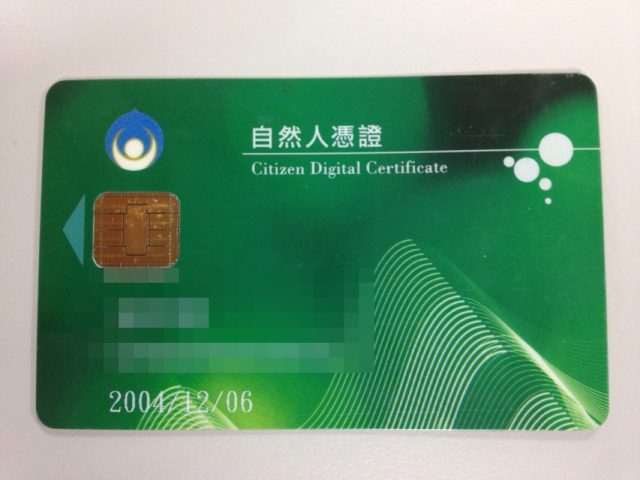
As many of 10,000 of these smartcards may provide little or no cryptographic protection despite receiving two internationally recognized certifications.
Raising troubling questions about the reliability of government-mandated cryptography certifications used around the world, scientists have unearthed flaws in Taiwan's secure digital ID system that allow attackers to impersonate some citizens who rely on it to pay taxes, register cars, and file immigration papers.
The crippling weaknesses uncovered in the Taiwanese Citizen Digital Certificate program cast doubt that certifications designed to ensure cryptographic protections used by governments and other sensitive organizations can't be circumvented by adversaries, the scientists reported in a research paper scheduled to be presented later this year at the Asiacrypt 2013 conference in Bangalore, India. The flaws may highlight shortcomings in similar cryptographic systems used by other governments around the world since the vulnerable smartcards used in the Taiwanese program passed the FIPS 140-2 Level 2 and the Common Criteria standards. The certifications, managed by the National Institute of Standards and Technology (NIST) and its counterparts all over the world, impose a rigid set of requirements on all cryptographic hardware and software used by a raft of government agencies and contractors.

“Trivially broken keys”

The team of scientists uncovered what their paper called a "fatal flaw" in the hardware random number generator (RNG) used to ensure the numbers that form the raw materials of crypto keys aren't based on discernible patterns. Randomness is a crucial ingredient in ensuring adversaries can't break the cryptographic keys underpinning the smartcards issued to Taiwanese citizens.
Out of slightly more than 2 million 1024-bit RSA keys the researchers examined, an astonishing 184 keys were generated so poorly they could be broken in a matter of hours using known mathematical methods and standard computers to find the large prime numbers at their core. Had the keys been created correctly, breaking them so quickly would have required a large supercomputer or botnet. That even such a small percentage of keys were found to be so easily broken underscores the fragility of cryptographic protections millions of people increasingly rely on to shield their most intimate secrets and business-sensitive secrets.
"The findings are certainly significant for the citizens who have been issued flawed cards, since any attacker could impersonate them online, the research team wrote in an e-mail to Ars. "More broadly, our research should give pause to any of the many countries that are rolling out this kind of national public key infrastructure. These smart cards were certified to respected international standards of security, and errors led to them generating trivially broken cryptographic keys. If a technologically advanced government trying to follow best practices still has problems, who can get this right?"

Stacking the deck

The research is being published two weeks after documents leaked by former National Security Agency (NSA) contractor Edward Snowden outlined the covert hand intelligence agents have played in deliberately weakening international encryption standards. As a result, the NSA and its counterparts in the UK can most likely bypass many of the encryption technologies used on the Internet. Cryptographers involved in, and independent of, the research agreed that the weaknesses exposed in the paper were almost certainly the result of human error, rather than deliberate sabotage. They based that assessment on the observation that the predictable patterns caused by the malfunctioning PRNG were so easy to spot.
"Some of the primes discovered in this work are so obviously non-random that, if they were the result of deliberate weaknesses, then I'd be asking for my money back from my three-letter agency," Kenneth G. Paterson, a Royal Holloway scientist who has seen the paper, told Ars. "Because they would clearly not have been doing a very good job in hiding their footprints."
Still, the fact that Taiwan's extremely weak RNGs passed stringent validation processes is troubling. An RNG that picks prime numbers in predictable ways is in some ways the cryptographic equivalent of a blackjack croupier who arranges a deck of cards so they're dealt in a way that puts the gambler at a disadvantage. Properly implemented RNGs, to extend the metaphor, are akin to a relief dealer who thoroughly shuffles the deck, an act that in theory results in the strong likelihood the cards never have and never again will be arranged in that exact same order.
Enlarge / A slide from a recent presentation detailing the 119 primes shared among 103 of the weak cards used in Taiwan's Citizen Digital Certificate program.
There's no way to rule out the possibility that the NSA, or intelligence agencies from other nation states, didn't already know about the vulnerability in Taiwan's crypto program or about programs in other countries that may suffer from similar weaknesses. The inability of the certifications to spot the fatally flawed RNGs suggests the standards offer far less protection than many may think against subtle flaws that either were intentionally engineered by intelligence agencies or were exploited after being discovered by them.
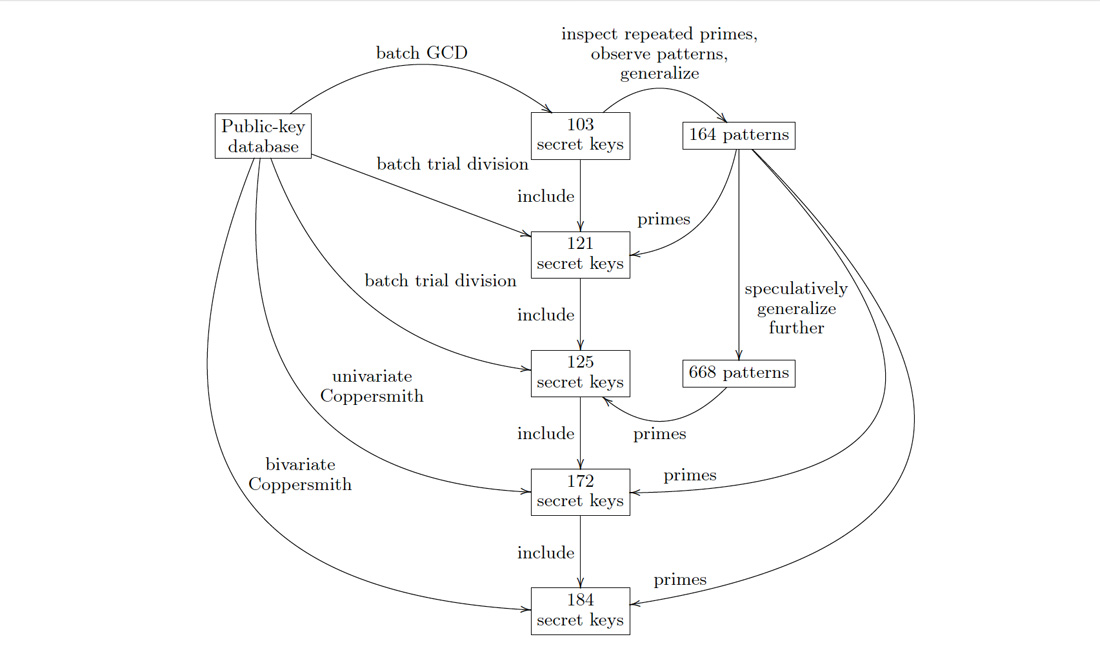
The researchers began their project by examining almost 2.2 million of the Taiwanese digital certificates secured with 1024-bit keys (newer cards have 2048-bit RSA keys). By scanning for pairs of distinct numbers that shared a common mathematical divisor, they quickly identified 103 keys that shared prime numbers.
A little more than 100 keys that shared primes out of a pool of 2 million makes for an infinitesimally small percentage, but in the eye of a trained cryptographer, it flags a fatal error. When generating a 1024-bit RSA key, there are an almost incomprehensible 2502 prime numbers that can be picked to form its mathematical DNA, Mark Burnett, an IT security analyst and author, estimates. That's many orders of magnitude more than the 2266 atoms in the known universe. If all these primes are properly mixed up and evenly distributed in a large digital pot—as is supposed to happen when being processed by a correctly functioning RNG—no two primes should ever be picked twice. By definition a prime is a number greater than one that has no positive divisors other than 1 and itself.
Enlarge / A summary of the data flow leading to successful factorizations of the Digital Citizen Card used in Taiwan.
Bernstein, et al.
And yet, 103 of the keys flagged by the researchers factored into 119 primes. The anomaly was the first unambiguous sign that something horribly wrong had gone on during the key-generation process for the Taiwanese smartcards. But it wasn't the only indication of severe problems. The researchers sifted through the shared primes and noticed visible patterns of non-randomness that allowed them to factor an additional 81 keys, even though they didn't share primes. Once the primes are discovered, the underlying key is completely compromised. Anyone with knowledge of the primes can impersonate the legitimate card holder by forging the person's digital signature, reading their encrypted messages, and accessing any other privileges and capabilities afforded by the card.
The researchers said they informed officials in Taiwan's government of the problems and were told that as many as 10,000 cards might suffer similar weaknesses. The estimate, the researchers told Ars, were based on internal records from the Ministry of Interior Certificate Authority and Chunghwa Telecom, Taiwan's official digital certificate authority and the smartcard manufacturer, respectively.
"The government claims that they will track down and replace all the flawed cards but hasn't done so at the time of writing," the researchers told Ars. "So everybody with an RSA-1024 card could have a weak one." The newer RSA 2048-bit cards they examined didn't suffer from the same weaknesses, although they didn't rule out the possibility those cards contain more subtle flaws that make them just as vulnerable.

Not the first time

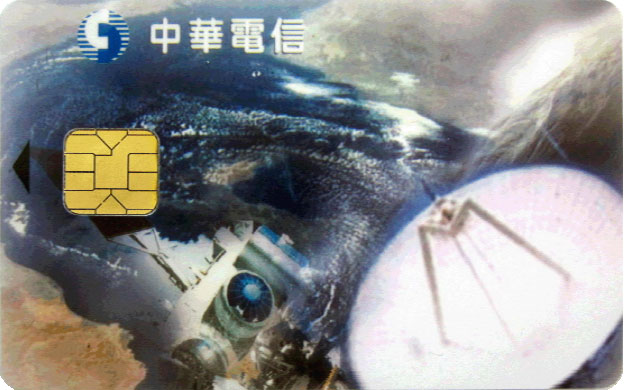
Enlarge / One of the affected smartcards, from Chunghwa Telecom Co., Ltd.
NIST
The discovery has roots in research published last year that made another astonishing discovery: four of every 1,000 1024-bit keys found on the Internet provided no cryptographic security at all. The reason: as with Taiwan's Citizen Digital Certificate keys, the almost 27,000 cryptographically worthless keys they found shared primes with at least one other key. One of the research teams that discovered the keys later released a detailed analysis of what went wrong. Since almost all the keys were from "self-signed" certificates used to protect routers and other devices, the researchers speculated the hardware lacked the robust RNGs found in more advanced platforms and applications. Two of the three mathematical techniques used to factor the keys in the Taiwanese smartcards are well-known and unsophisticated. They are trial division and use of things like the Binary Greatest Common Divisory Algorithm for finding greatest common divisors. A third technique know as Coppersmith's attack is significantly more advanced, and the researchers said it represents the first recorded time it has been used to break a cryptographic system.
All three techniques can be carried out on unsophisticated computers to factor weak keys in a matter of hours. Using the same methods and hardware to factor 1024-bit keys that are generated properly would "not have found those primes within the expected lifetime of the universe," the researchers said. (Other, more sophisticated algorithms, when carried out on supercomputers, represent a much bigger threat to 1024-bit keys.)
"Our results make it pretty clear that the more computational effort we expend, the more keys we were able to factor," the researchers wrote. "We did enough computation to illustrate the danger, but a motivated attacker could easily go further."
As crucial as random number generation (RNG) is to cryptographic security, the task remains maddeningly difficult to do. It requires a computer to carry out what scientists call non-deterministic behavior, which typically causes malfunctions in most other contexts. Frequently, extremely subtle bugs can cause RNGs, assumed to be robust, to produce highly predictable output. One example was an almost catastrophic vulnerability in the Debian distribution of Linux. The overlooked bug caused vulnerable machines to generate dangerously weak cryptographic keys for more than 20 months before it was diagnosed and fixed in mid 2008.
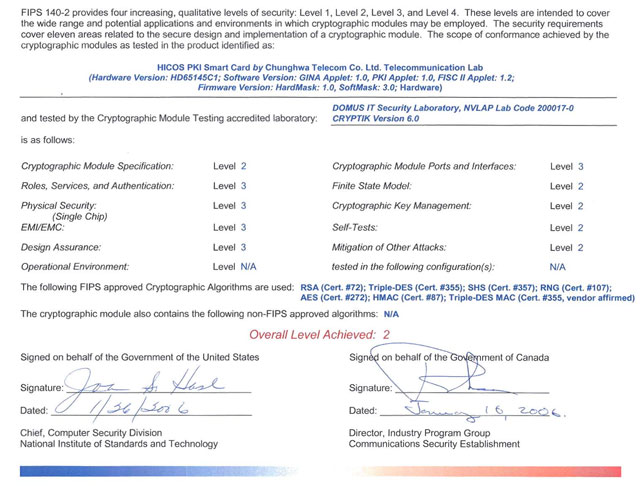
The FIPS 140-2 Validation Certificate for one of the affected smartcards.
NIST
To prevent these common mistakes, standards bodies sponsored by governments around the world have created a set of rigid criteria cryptographic systems must pass to receive certifications that can be trusted. The certifications are often a condition of a hardware or software platform being adopted or purchased by the government agency or contractor.
But despite passing both the FIPS 140-2 Level 2 and Common Criteria standards, the RNG process used to generate the weak cards clearly didn't meet their mandated requirements. FIPS 140, for instance, specifies that output of a hardware RNG on the processor of the smartcard must (a) be fed through tests to check whether it's random and unbiased, and only then can the output (b) be used as a seed for a so-called deterministic random bit generator, which in many settings is referred to as a pseudo RNG. The hardware RNG was provided by the AE45C1, a CPU manufactured by Renesas that sits on top of the smartcard. The deterministic random bit generator was driven by the smartcard firmware provided by Chunghwa Telecom.
"It's pretty clear that neither step happened in this case," the researchers told Ars. "Even without performing step (a), step (b) should have made the keys appear individually random, even if they were not. Instead, the factored keys contained long strings of 0 bits or periodic bit patterns that suggest that step (b) was skipped, and what we see is the direct unwhitened output from the malfunctioning hardware."
The seven researchers are Daniel J. Bernstein, Yun-An Chang, Chen-Mou Cheng, Li-Ping Chou, Nadia Heninger, Tanja Lange, and Nicko van Someren. More information about them and their findings is available here. The failure has implications not only for the citizens of Taiwan but for internationally certified cryptographic technologies everywhere.
"It is a common practice to advertise chips as certified if they get certification on some part of it, but the certification actually means very little," the researchers told Ars. "The whole system is broken. "Two certifications didn't stop the bad hardware RNG on the card; how can we trust them to find more sophisticated flaws such as intentional back doors?"

Box aims for NSA-resistant cloud security with customers holding the keys

Cloud storage that really can't be tapped by the government is a rare thing.

After eight years of existence, file sharing service Box has built a huge user base—claiming 180,000 businesses, including 97 percent of the Fortune 500—by offering cloud storage and collaboration tools with top-notch security and regulatory compliance.
But while Box may be resistant to most criminal hackers, like most cloud storage companies, it must provide the government with customer data when it is forced to. For the vast majority of Box customers, that isn't likely to change. However, the company is developing a system for the most security-conscious customers in which even Box management would not be able to decrypt user data—making it resistant to requests from the National Security Agency.
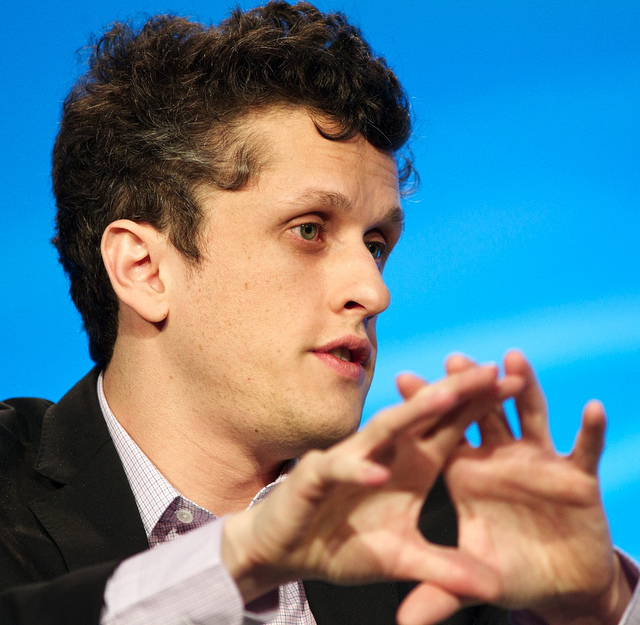
Box co-founder and CEO Aaron Levie spoke with Ars last week to promote the launch of a new collaboration tool called Box Notes and answered our questions about Box's encryption model.
Enlarge / Aaron Levie.
While a service like SpiderOak says it provides total secrecy by making data inaccessible to its employees without the customer's password, Box's collaboration tools would be difficult to implement in a model that puts customers in complete control of their data.
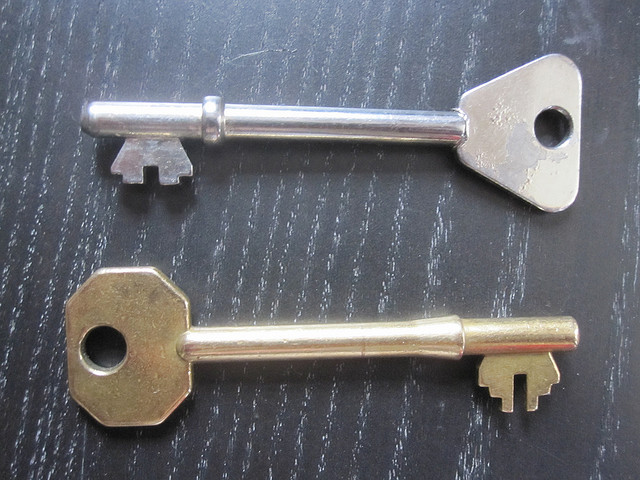
"From an architectural standpoint, we are certainly more like a Google or Microsoft in that we are encrypting all the data on both transit and storage, but we obviously have to manage the encryption key because as a collaborative application we have to broker that exchange between multiple users," Levie told Ars. "To make it a seamless experience, it requires us to have those keys."
Avoiding the appearance of selling customers out to the government is an important business concern. Forrester analyst James Staten has argued that US IT firms could lose $180 billion in business over the next few years because of the NSA spying scandal. The label "NSA-proof" may not be achievable by any cloud service, though there are technological steps companies can take to gain users' trust.
Box security chief Justin Somaini recently told VentureBeat that the company would never install a backdoor for the government to take customer data. That doesn't mean it never hands files to the government when it's forced to. "If there is a data request by the government, that's something we generally comply with," Levie told Ars.
Box's security model—featuring armed guards protecting data centers, SSL encryption in transit, 256-bit AES encryption at rest, and compliance with HIPAA and other regulatory standards—is still good enough to cover about 95 percent of companies' security requirements, Levie noted. "But some businesses are either so regulated or so sensitive that we want to make sure we're able to work with them as well," he said.

“More than conceptual”

That's why Box is working on a new idea: letting customers themselves hold the encryption keys. "We are exploring ways that in the future our customer would be responsible for its keys, and that's something we may make available to some of the largest organizations," Levie said.
This is "more than conceptual," he said, when asked if it's just an idea or something actively being developed. He didn't provide any timeline, saying, "There's so much potential for unforeseen stuff" and that "the strategic roadmap is always very dynamic." Nonetheless, "it's something we are actively pushing on."
Box's name hasn't been paired with the NSA in nearly as many news articles as Google or Microsoft, perhaps because of its small size relative to those companies and because its enterprise customers don't tend to be the focus of many terrorism-related inquiries. But there have been requests from some customers to manage their own keys.
"We have [gotten requests]," Levie said. "We've worked pretty closely with a bunch of large enterprises to understand what their [needs are]. This has been going on for over a year. It's obviously increased in conversation in the past couple of months."
It will be difficult to keep Box's collaborative focus when the customer controls its own keys, Levie said. For example, customers today could use local encryption before uploading data to Box if they were willing to deal with some extra annoyances.
"Technically, if you gave the encryption key to your collaborators, you could absolutely encrypt data before it goes to Box and then your collaborator could decrypt that data as they download it," Levie said. "We would then never have the unencrypted data in the process. The challenge, of course, is most average business people and enterprises are not going to go through that experience because our differentiation as a company is to take security and combine it with a very simple user experience around working with information."
Levie acknowledged that "it remains to be seen" if Box can solve all the different security demands businesses make while still providing good collaboration tools. But he thinks Box can come up with something "that makes people very comfortable."
"We are not stubbornly resisting technological solutions to this problem," he said. "We are evaluating every possible way that we can make our customers feel great about the privacy and security of their data, because this is our key differentiator as a company."
If you're expecting NSA-resistant cloud technology to be rolled out to home users or even small businesses, think again. "It's really only going to be aimed at the most conservative and most regulated businesses," Levie said. "This is not something we think we're going to introduce to our entire network. And so it's very, very early in that sense."

Box takes small step into Google and Microsoft territory

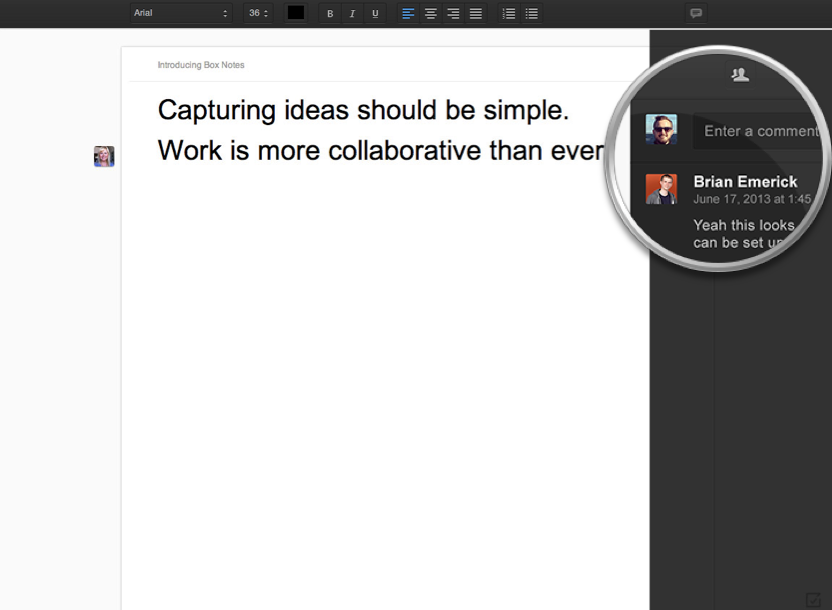
Enlarge / Box Notes.
Box
As mentioned earlier, Box today is unveiling Box Notes, the company's first stab at a content creation application. Box already integrates with Microsoft Office, Google Docs, and other platforms to let users edit files in their native applications and store them in Box.
Levie said he doesn't want to recreate a full office suite, noting that trying to replace every little feature of Microsoft Office is a losing proposition. Notes, however, will let Box create a new way for people to share work and ideas without being limited by the sharing capabilities of other vendors' tools.
Box Notes is going into a limited, private beta before hitting general availability at the end of this year or beginning of next year. Run in a Web browser, it looks a bit like Evernote or the Google Docs word processor, letting people edit simultaneously. A "note head" feature puts people's faces on the document like "chat heads" do with Facebook. Other features in the beta include commenting, an in-line toolbar, and annotations for leaving edits or hyperlinks to other Box content.
Mobile apps for iOS and Android are in the works. Other planned capabilities include embedding images, video, and audio into notes, version history, and offline editing using HTML5 caching.
Box Notes will be free to all customers, whether they use the free storage tier or have a paid business subscription. Access to the beta can be requested at www.box.com/notes.
E-mailing documents is still the mode of collaboration for many big companies, Levie noted. Small teams might be using Google Docs, but there are still a lot of users within Box's existing customer base that don't use anything like Box Notes, he said.
"We're not really going after the existing Google Docs base and trying to migrate everybody and say that 'this is a better solution for them,'" he said. "We're trying to create a solution that solves our customers' problems."
Box will continue supporting integration with Google Docs, which offers collaboration across a wider set of document types. Users can create a new Google Doc from within the Box Web app. "When the file is opened and is in the process of being edited, it does live in Google—which is how we're able to use Google's document creation tools—but as soon as the file is closed, it gets deleted from the user's Google account and once again lives exclusively inside of Box," a company spokesperson explained.
Box has a similar setup for Microsoft Office but only for the desktop applications. Levie would like to integrate with Office Web Apps, but Microsoft hasn't made that possible, he said. "We think the right solution technologically is a Word document in Box should be opened in Microsoft Web Office. And that depends on the APIs they make available. We want the file format to be coupled with the originating application, so you have the highest-fidelity experience," he said. "We would love to let people open their content in any third-party application, but we are to some extent dependent on and paralyzed by availability of those APIs."
Security and regulatory compliance will remain important selling points for Box as it expands the types of content it hosts for customers. The company puts its money where its mouth is, running almost entirely on cloud services.
"At Box we run on 15 or 20 different cloud solutions," Levie said. "We have maybe a couple of servers that only manage an internal network."
Levie's Twitter feed could be described as "Confucius for tech startup CEOs" with statements like, "Make sure you know the moments when the customer will change for you and the moments when you should change for the customer."
He talks pretty much the same way in person: "In our world, technology is moving to the background, information is moving to the foreground," he said. "We're going to need a new set of tools that power those experiences around information."

Trading bots create extreme events faster than humans can react

Our algorithms now show collective behavior that we do not control.

High-frequency trading is the practice where automated systems search for minor differences in price of stocks that can be exploited for small financial gains. Executed often enough and with a high enough investment, they can lead to serious profits for the investment firms that have the wherewithal to run these systems. The systems trade with minimal human supervision, however, and have been blamed for a number of unusually violent swings that have taken place in the stock market.
A new paper has gone searching through historic trading for these sorts of glitches and ended up finding a lot of them—over 18,000—all of which took place too fast for human intervention to have driven them. When they generated a mathematical model of this trading, they found that they showed indications of many traders executing a similar strategy, exactly as you'd expect from automated trading systems. The rise in this style of trading appears to be an emergent property of computerized trading, and it seems to have reached an inflection point near the start of the financial crisis.
The primary victims of these glitches? The stocks of the investment banks themselves.
The primary feature of these systems is speed, since the market conditions they seek to take advantage of are ephemeral. The authors of the new paper (a mix of academics and private sector employees) note that a new fiber optic cable is being laid across the Atlantic just to shave five milliseconds off the network transit times. Some companies are offering processors customized to execute trades even faster. This all ensures that the trading bots are acting far too fast to have direct human supervision. Fully attentive individuals will, at best, take close to a full second before they can react to changing circumstances.
To identify activities that might be triggered by automated systems, the authors defined something called an ultrafast extreme event (UEE). These are cases where a stock price moved at least 10 consecutive times in the same direction, all within 1,500 milliseconds. The total magnitude of these mini-crashes and rises had to be at least 0.8 percent. That may not seem like much, but it represents over 30 standard deviations from the normal run of trading.
Searching through the data, the authors found over 18,500 of these UEEs. As the authors narrowed the time window to below one second (the limit of human reaction time), the number of spikes and crashes increases rapidly, indicating that the behavior is likely to be triggered by something that can act faster—the automated systems. As a result, the paper's title makes reference to a "new machine ecology" represented by the behavior they trigger in the stock market.
The first UEEs in the data set appeared in late 2006, and they grew rapidly and steadily from there. Right as the financial crisis started in 2008, however, they experienced a very significant growth spurt. The other notable thing linking them to the financial crisis is that the 10 stocks that experienced the most UEEs were all banks, including some that would later go bankrupt or be sold.
The authors next built a mathematical model in which a large number of traders were able to employ an equally large number of trading strategies. As they steadily decreased the number of strategies, their market model showed a threshold effect—events like UEEs appeared suddenly once the threshold was crossed. They also referenced a separate paper where another team showed a similar threshold appearing as the reaction times of computerized traders dropped below one second.
Overall, the authors make a pretty compelling case that fast trading systems, coupled to a limited number of trading strategies, have caused a fundamental change in the behavior of the stock market. This shift leads to sudden changes in the value of stocks that aren't linked to any underlying financial factors. (In most cases, the change seems to be transient, and stocks return to their former value rapidly.) What's not at all clear is what triggers these UEEs, and whether changes in market regulations or trading strategies could eliminate them.
Nature Scientific Reports, 2013. DOI: 10.1038/srep02627  (About DOIs).