---BREAKAWAY CIVILIZATION ---ALTERNATIVE HISTORY---NEW BUSINESS MODELS--- ROCK & ROLL 'S STRANGE BEGINNINGS---SERIAL KILLERS---YEA AND THAT BAD WORD "CONSPIRACY"--- AMERICANS DON'T EXPLORE ANYTHING ANYMORE.WE JUST CONSUME AND DIE.---
A man was treated like a terrorist for not being able to raise his right arm in a ful-body scanner.
It turns out, this man was a wounded war veteran, and he could not raise his right arm because it was severely injured.
The man was Cpl. Nathan Kemnitz, and he was awarded a Purple Heart in
2004 after he almost died from a roadside bomb in Iraq. He recently
traveled to Sacramento, California to accept another award — veteran of
the year for his district.
Even though the entire trip should have been celebratory, it was far
from that. At Sacramento International Airport, he was not able to get
through the security line because he was unable to life his right arm
above his head. This led to security workers subjecting him to extreme
screenings. He was also forced to take off his uniform.
Get instant updates. Follow us today!
Kemnitz said, “At some places I’m treated like royalty and at some like a terrorist. There’s got to be something in the middle.”
The incident involved a TSA officer asking Kemnitz to raise his arms
above his head for a full-body scanner. Kemnitz, who cannot physically
do this, refused. “My right arm doesn’t work. It’s a lot of hassle for
me to do that,” he said.
It was then that Kemnitz was severely violated.
TSA agents went so far as to prod him all over his body. As they
searched under the metals on his body, they ran their hands under his
waistband and searched his shoes for explosives.
He was also asked to remove his dress blouse because he was “wearing too much metal.” Instead of being treated like the hero he is, Kemnitz was severely embarrassed and violated.
Patricia Martin was Kemnitz’s traveling partner. She thought the
entire incident was incredibly troubling, and took photos as it was
happening. “What does the uniform and heroism represent if our own
citizens – in this case employees of the TSA and security personnel –
have no regard for them?” Martin said.
Ross Feinstein, a spokesman for the TSA, released a statement on the
incident: “Our intent is to treat all injured service members and
veterans with the dignity they deserve, As always, all passengers with
disabilities and medical conditions are eligible for screening
procedures sensitive to their particular disability, medical condition
or other unique medical circumstance. Transportation Security Officers
have to resolve any anomaly detected at the checkpoint.”
“As is standard procedure for all passengers, if travelers alarm when
passing through a metal detector or an advanced imaging technology
(AIT) unit, additional screening is required in order to resolve that
anomaly.”
But the TSA agents at Sacramento International did not follow the
rules. The TSA recently instated new rules relating to veterans. Injured
troops are no longer required to move their shoes, jackets, or hats to
get through security.
Kermitz said the thing that bothered him the most was the “rudeness”
and “unapologetic” attitude he got from the TSA agent at Sacramento
International.
This entire incident makes me sick. Cpl. Nathan Kemnitz is a hero,
and ought to be treated like one. It’s about time we stop violating the
rights of those who fought so hard for the freedoms we enjoy each day.
The government can’t say exactly how much it
reimburses telecoms for surveillance activity, but AT&T estimated it
received $24 million in reimbursements between 2007 and 2011, while
Verizon’s estimate was between $3 million and $5 million.
The amount charged varies by company and by surveillance
service being requested — wiretapping costs more than accessing email
records, for example.
Some argue there is a balance to be struck between the
companies charging the government for this information, which takes time
and resources to collect, and ensuring it doesn’t become a profit
driver for them.
Ultimately, it is tax payer dollars that the government is using to pay the fees for this surveillance info.
WASHINGTON (TheBlaze/AP) — How
much are your private conversations worth to the government? Turns out,
it can be a lot, depending on the technology.
In the era of intense government
surveillance and secret court orders, a murky multimillion-dollar market
has emerged. Paid for by U.S. tax dollars, but with little public
scrutiny, surveillance fees charged in secret by technology and phone
companies can vary wildly.
AT&T, for example, imposes a $325
“activation fee” for each wiretap and $10 a day to maintain it. Smaller
carriers Cricket and U.S. Cellular charge only about $250 per wiretap.
But snoop on a Verizon customer? That costs the government $775 for the
first month and $500 each month after that, according to industry
disclosures made last year to Rep. Edward Markey, D-Mass.
Meanwhile, email records like those
amassed by the National Security Agency through a program revealed by
former NSA systems analyst Edward Snowden probably were collected for
free or very cheaply. Facebook says it doesn’t charge the government for
access. And while Microsoft, Yahoo and Google won’t say how much they
charge, the American Civil Liberties Union found that email records can
be turned over for as little as $25.
In
this June 21, 2013 file photo, a banner supporting Edward Snowden, a
former CIA employee who leaked top-secret documents about sweeping U.S.
surveillance programs, is displayed at Central, Hong Kong’s business
district. (Photo: AP/Kin Cheung, File)
Watch AP’s report on the cost of surveillance:
Industry says it doesn’t profit from
the hundreds of thousands of government eavesdropping requests it
receives each year, and civil liberties groups want businesses to
charge. They worry that government surveillance will become too cheap as
companies automate their responses. And if companies gave away customer
records for free, wouldn’t that encourage uncalled-for surveillance?
But privacy advocates also want
companies to be upfront about what they charge and alert customers after
an investigation has concluded that their communications were
monitored.
“What we don’t want is surveillance to
become a profit center,” said Christopher Soghoian, the ACLU’s
principal technologist. But “it’s always better to charge $1. It creates
friction, and it creates transparency” because it generates a paper
trail that can be tracked.
Telecom
network cables are pictured in Paris, on June 30, 2013. The European
Union angrily demanded answers from the United States over allegations
Washington had bugged its offices, the latest spying claim attributed to
fugitive leaker Edward Snowden. German weekly Der Spiegel said its
report, which detailed covert surveillance by the US National Security
Agency (NSA) on EU diplomatic missions, was based on confidential
documents, some of which it had been able to consult via Snowden.
(Photo: THOMAS COEX/AFP/Getty Images)
Regardless of price, the surveillance
business is growing. The U.S. government long has enjoyed access to
phone networks and high-speed Internet traffic under the U.S.
Communications Assistance for Law Enforcement Act to catch suspected
criminals and terrorists. More recently, the FBI has pushed technology
companies like Google and Skype to guarantee access to real-time
communications on their services. And, as shown by recent disclosures
about the NSA’s surveillance practices, the U.S. intelligence community
has an intense interest in analyzing data and content that flow through
American technology companies to gather foreign intelligence.
The FBI said it could not say how much
it spends on industry reimbursements because payments are made through a
variety of programs, field offices and case funds. In an emailed
statement, the agency said when charges are questionable, it requests an
explanation and tries to work with the carrier to understand its cost
structure.
Technology companies have been a focus
of law enforcement and the intelligence community since 1994, when
Congress allotted $500 million to reimburse phone companies to retrofit
their equipment to accommodate wiretaps on the new digital networks.
But as the number of law enforcement
requests for data grew and carriers upgraded their technology, the cost
of accommodating government surveillance requests increased. AT&T,
for example, said it devotes roughly 100 employees to review each
request and hand over data. Likewise, Verizon said its team of 70
employees works around the clock, seven days a week to handle the
quarter-million requests it gets each year.
Daniel
Bryant, center, joins a small group at Klyde Warren Park to protest the
National Security Agency’s surveillance program Thursday, July 4, 2013
during a “Restore the Fourth” rally in Dallas. (Photo: AP/The Dallas
Morning News, Rex C. Curry)
To discourage gratuitous requests and
to prevent losing money, industry turned to a section of federal law
that allows companies to be reimbursed for the cost of “searching for,
assembling, reproducing and otherwise providing” communications content
or records on behalf of the government. The costs must be “reasonably
necessary” and “mutually agreed” upon with the government.
From there, phone companies developed
detailed fee schedules and began billing law enforcement much as they do
customers. In its letter to Markey, AT&T estimated that it
collected $24 million in government reimbursements between 2007 and
2011. Verizon, which had the highest fees but says it doesn’t charge in
every case, reported a similar amount, collecting between $3 million and
$5 million a year during the same period.
Companies also began to automate their
systems to make it easier. The ACLU’s Soghoian found in 2009 that
Sprint had created a website allowing law enforcement to track the
location data of its wireless customers for only $30 a month to
accommodate the approximately 8 million requests it received in one
year.
Most companies agree not to charge in
emergency cases like tracking an abducted child. They aren’t allowed to
charge for phone logs that reveal who called a line and how long they
talked – such as the documents the Justice Department obtained about
phones at The Associated Press during a leaks investigation – because
that information is easily generated from automated billing systems.
Still, the fees can add up quickly.
The average wiretap is estimated to cost $50,000, a figure that includes
reimbursements as well as other operational costs. One narcotics case
in New York in 2011 cost the government $2.9 million alone.
The system is not a true market-based
solution, said Al Gidari, a partner at the law firm Perkins Coie who
represents technology and telecommunications companies on privacy and
security issues. If the FBI or NSA needs data, those agencies would pay
whatever it takes. But Gidari said it’s likely that phone and technology
companies undercharge because they don’t want to risk being accused of
making a false claim against the government, which carries stiff
penalties.
Online companies in particular tend to
undercharge because they don’t have established accounting systems, and
hiring staff to track costs is more expensive than not charging the
government at all, he said.
“Government doesn’t have the manpower
to wade through irrelevant material any more than providers have the
bandwidth to bury them in records,” Gidari said. “In reality, there is a
pretty good equilibrium and balance, with the exception of phone
records,” which are free.
Not everyone agrees.
In 2009, then-New York criminal
prosecutor John Prather sued several major telecommunications carriers
in federal court in Northern California in 2009, including AT&T,
Verizon and Sprint, for overcharging federal and state police agencies.
In his complaint, Prather said phone companies have the technical
ability to turn on a switch, duplicate call information and pass it
along to law enforcement with little effort. Instead, Prather says his
staff, while he was working as a city prosecutor, would receive
convoluted bills with extraneous fees. The case is pending.
“They were monstrously more than what
the telecoms could ever hope to charge for similar services in an open,
competitive market, and the costs charged to the governments by telecoms
did not represent reasonable prices as defined in the code of federal
regulations,” the lawsuit said.
The phone companies have asked the
judge to dismiss the case. Prather’s lawsuit claims whistle-blower
status. If he wins, he stands to collect a percentage – estimated
anywhere from 12 percent to 25 percent – of the money recovered from the
companies.
Explaining the rationale behind Manchester City's decisions
After parting with Robert Mancini, Manchester City appointed Chilean Manuel Pellegrini to manager.
AFP/Getty Images
There is a willful Luddism about English football and, at times, it's
infuriating. When Manchester City sacked Robert Mancini toward the end
of last season, it released a statement that, slightly foolishly,
contained the word "holistic." It's a term not often used in football,
one that carries a whiff of patchouli, of blissed out gurus and robed
believers, an image wholly at odds with gritty, industrial Manchester.
And so it was derided.
Once again, City became a source of fun, and Mancini, the football man,
was seen as having been treated unfairly. The battle lines may not have
quite been distinct, but they were clearly there: Mancini, one of ours,
against them, the coalition of Spanish technocrats and Abu Dhabi
businessmen who run City; an underlying narrative that was further
amplified when Manuel Pellegrini, a Chilean with no previous experience
in any European country other than Spain, was appointed to manager.
Mancini pursued the line in an interview with Corriere dello Sport
last week. "[Ferran] Soriano?" he sneered. "For him I was too big
within the club. A manager in full control, loved by the fans still
today. He judged a person and a context without knowing anything about
the people he should have dealt with. I never thought of him as an
interesting person from a football perspective. We never spoke the same
language. And I'm not talking about Italian, Spanish or English. His
past at Barcelona? I think he was coming from an airline. I've been in
football since I was 13 and I had never heard anything about Soriano. He
arrived in England with his manager role and I saw that he loves to
speak, to get media exposure."
It's true that Mancini remains hugely popular among fans, who took out an ad in Gazzetta dello Sport to thank him for his time at the club, repaying a similar ad Mancini had placed in the Manchester Evening News
thanking them. But Mancini's personal jibes against Soriano simply make
no sense. Yes, Soriano did join City after three years at Spanair, but
before that he had spent five years as vice president of Barcelona. He
may be a professional manager rather than a football man in the sense of
somebody who has spent their life in the game -- something else
guaranteed to raise suspicions -- but his experience cannot be doubted.
As for the allegation that Soriano loves media exposure, it's simply
nonsense: until Mancini was sacked, Soriano didn't give a single
on-the-record interview or press conference.
There is another narrative at work here, one that works for Mancini and
against Soriano. Football is a profoundly conservative sport. In
Britain, there is a general nostalgia for the football of the 1960s and
'70s, when personality managers first began to come to the forefront:
Bill Shankly, Brian Clough, Don Revie, Malcolm Allison and Tommy
Docherty. They were tough, quotable, fascinating men, each with their
own individual quirks. They had grown up watching the game, then playing
the game, then managing in the game and talking about the game; they
were of the game in the same way fans and the vast majority of
journalists are. They ran every aspect of their clubs and, vitally,
decided on transfer policy: it was something Shankly insisted on when he
took the Liverpool job in 1958.
That approach is no longer possible, at least not at the top level.
Clubs are too big for one man to run, so more and more there is the need
for a chief executive, a director of football and a manager, who is
essentially a head coach. It's a logical division of labor. Why would a
man who is good at organizing players on a pitch and arranging their
training be expected to be good at balancing a budget or sorting out
promotional activities? Still, that division means that a number of key
decisions over issues such as transfers are now made by people who
aren't football men -- people who speak the jargon of the pinstripe
rather than the pitch, people like Soriano.
Yet is running a football club on "holistic" grounds really such a bad
thing? I bumped into Soriano at a book awards presentation in Milan in
March. He admitted that City had got its transfer policy wrong last
season, that it had made the squad bigger but not necessarily better. He
said the club would offload players this summer and make "three or
four" top signings. Picking up Jesus Navas, a lightning-fast option on
the right, and Fernandinho, a quick, versatile and intelligent holder
with a fine range of passing and a ferocious long shot, fits that model,
answering specific needs within the squad.
Soriano also gave me a copy of his book, Goal: The Ball Doesn't Go In By Chance.
In it, he never uses the word "holistic," but he does discuss "virtuous
circles" and how each part of the club -- the team, the coaching staff,
marketing, p.r. and youth development -- should work together. The
academy, as it did at Barcelona, should play to the same style as the
first team with a clear route of development. Soriano also wrote about
how a manger must become a guide for his players, a father figure who
can nurture them. Mancini, notably, seems to have been unpopular with
both players and staff. At the very least, Mancini regularly became
embroiled in rows or fights, something that goes against Soriano's
stated desire for harmony. And he almost never picked players from the
youth team, even to take up places on the bench.
It was a combination of these factors and Mancini's awful record in the
Champions League -- something that was true during his time at Inter as
well -- that prompted his downfall. The move to appoint Pellegrini as
his replacement is a risk, of course, and there must be concerns as to
whether, even in an increasingly global football market, a 59-year-old
can adapt to the English game. The mockery that he has never won a
trophy in Europe, though, is misplaced: Pellegrini did take little
Villarreal to the semifinal of the Champions League and managed a
then-record number of points with Real Madrid in near-impossible
circumstances. Never before has a side finishing second gathered 96
points, and rarely before has a manager found the president and the
media so determinedly against him. Pellegrini then took Malaga to within
seconds of the Champions League semifinal despite the sudden cuts in
funding last summer.
And of course, he did win trophies in South America, where he spent the
first 16 years of his managerial career: the Copa Chile, an Ecuadorean
title and two Argentinian titles (with different sides) as well as an
Interamericana with Universidad Catolica and a Mercosur with San
Lorenzo. Soriano and the director of football,Txiki Begiristain, have
more experience in the Spanish market than the English one, so it's
understandable that they should turn to somebody who impressed them
there.
The Pellegrini appointment may be a success or failure, but it is one
that has logic behind it. And so too, given Soriano's approach, does the
dismissal of Mancini. Pellegrini may not work, but that does not
necessarily invalidate the rationale behind Manchester City's decision.
This is football's new age.
Earlier today,
Apple lost a major case when District Judge Denise Cote ruled that the
company led a conspiracy to raise e-book prices above those charged by
Amazon. Cote's 160-page ruling, released this morning, offered some
intricate detail on just how that conspiracy worked.
Cote described how Apple struck agreements with each of the five
publisher defendants—who settled the case before trial—in order to push
e-book rates higher than Amazon's. The negotiations happened in the
seven weeks leading up to the January 27, 2010 announcement of the iPad.
Publishers told Apple they were unhappy with Amazon's standard price
of $9.99. Although they received the full wholesale value of each book
sold by Amazon, publishers didn't want $9.99 to catch on as the new
default price for e-books, especially since this was so much lower than
hardcovers. One strategy they used to keep revenues up was to delay the
release of e-book versions of new books, but Apple told publishers it
opposed this tactic in its then-forthcoming e-books store. HarperCollins
wanted to flat-out charge as much as $18 or $20 for e-books, but Apple
Senior VP Eddy Cue also made it clear that this was unrealistic. Apple
was more amenable, however, when HarperCollins suggested using an
"agency model" instead of the wholesale model used by Amazon.
With a wholesale model, Apple would purchase e-books and resell them
at a price of its choosing, whereas with an agency model "a publisher
sets the retail price and the retailer sells the e-book as its agent."
Apple would become the agent selling the books, taking a 30 percent
commission on each sale, just as it does with its App Store.
But Apple did not want to open an e-book store at all unless it was
profitable, Cote wrote, and in order to make it work, the company had to
deal with Amazon. Apple had even considered proposing a partnership
with Amazon, "with iTunes acting as 'an e-book reseller exclusive to
Amazon and Amazon becom[ing] an audio/video iTunes reseller exclusive to
Apple,'" Cote wrote.
"Apple realized, however, that in handing over pricing decisions to
the Publishers, it needed to restrain their desire to raise e-book
prices sky high," Cote wrote. "It decided to require retail prices to be
restrained by pricing tiers with caps. While Apple was willing to raise
e-book prices by as much as 50 percent over Amazon’s $9.99, it did not
want to be embarrassed by what it considered unrealistically high
prices."
Most Favored Nations
The agency model (along with publisher-set but capped prices of
$12.99 to $14.99) made it profitable enough for Apple to open its own
e-book store—so long as Amazon's prices went up, too. Apple thus devised
a Most Favored Nation (MFN) clause in its contracts with publishers
which "guaranteed that the e-books in Apple’s e-bookstore would be sold
for the lowest retail price available in the marketplace," Cote
wrote. For the publishers to charge up to $14.99 for e-books on Apple's
iBooks store, they had to raise prices on Amazon's Kindle store as well
by collectively forcing Amazon to accept the agency model.
The MFN approach "eliminated any risk that Apple would ever have to
compete on price when selling e-books, while as a practical matter
forcing the Publishers to adopt the agency model across the board," the
judge wrote.
Amazon, which had nearly 90 percent of the e-book market, resisted
the publishers' demands to move to abandon the wholesale model. (Amazon
apparently wanted to subsidize content prices, in part, so that it could
move e-reader hardware and spur the adoption of e-books by mainstream
users.) It retaliated against the demand by removing the "buy" button on
Amazon's site for Macmillan books after Macmillan proposed a new agency
model deal. Amazon also offered authors a “new 70 percent royalty
option” for e-books with a list price “between $2.99 and $9.99,"
eliminating the middleman and giving authors higher profits.
Amazon could not stand firm for long, however, because the publishers all
insisted on new terms more favorable to them. "Attempting to leverage
its Apple negotiations to get a better deal with Amazon, HarperCollins
included a proposed retail price for the majority of titles at either
$12.99 or $14.99, but a commission of just 5 percent for Amazon," the
judge's decision states. "HarperCollins then leveled its threat to
Amazon. If Amazon declined its offer, HarperCollins would delay for six
months the release of any e-book sold on a wholesale basis." Others
publishers made similar proposals, but all insisted on agency.
Amazon Kindle Content VP Russell Grandinetti testified at trial that
“[i]f it had been only Macmillan demanding agency, we would not have
negotiated an agency contract with them. But having heard the same
demand for agency terms coming from all the publishers in such close
proximity... we really had no choice but to negotiate the best agency
contracts we could with these five publishers.”
In Cote's view, this was nothing less than a concerted effort to
raise prices—a conspiracy. She summarized Apple's responsibility for the
whole situation this way:
A chief stumbling block to raising e-book prices was the
Publishers’ fear that Amazon would retaliate against any Publisher who
pressured it to raise prices. Each of them could also expect to lose
substantial sales if they unilaterally raised the prices of their own
e-books and none of their competitors followed suit. This is where
Apple’s participation in the conspiracy proved essential. It assured
each Publisher Defendant that it would only move forward if a critical
mass of the major publishing houses agreed to its agency terms. It
promised each Publisher Defendant that it was getting identical terms in
its Agreement in every material way. It kept each Publisher Defendant
apprised of how many others had agreed to execute Apple’s Agreements. As
Cue acknowledged at trial, “I just wanted to assure them that they
weren’t going to be alone, so that I would take the fear awa[y] of the
Amazon retribution that they were all afraid of.” As a result, the
Publisher Defendants understood that each of them shared the same set of
risks and rewards.
Why publishers accepted less money from Apple
Somewhat counterintuitively, the agency agreements actually lowered
the amount of money each publisher received per book. While wholesale
agreements gave publishers about 50 percent of the hardcover list price
on e-book sales, Apple's agency deals provided 70 percent of the final
e-book retail price. This ended up being a significant cut in real
dollars.
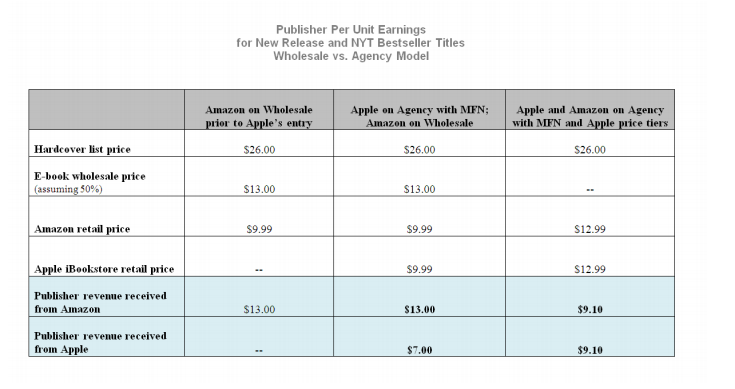
Cote explains:
[A] Publisher might receive $13 on a wholesale basis for
an e-book sold by Amazon for $9.99, but (because of the MFN) only $7
from Apple so long as Amazon was still selling that e-book for $9.99.
Even if Apple and Amazon were on the same agency arrangement with a
Publisher, and that Publisher were able to move the retail price of the
e-book to the top of the Apple price tier and sell it for $12.99, the
Publisher would still receive less revenue under the agency model: $9.10
instead of the $13.00 in revenue under the wholesale model.
This chart from Cote's ruling illustrates the pricing and payment breakdowns:
Agreeing to agency models still suited the publishers' long-term
interests because they wanted to "shift their industry to higher e-book
prices to protect the prices of their physical books and the brick and
mortar stores that sold those physical books," Cote wrote, adding that
"[t]o change the price of e-books across the industry ... the Publishers
would have to raise Amazon’s prices."
Random House, the largest publisher, resisted Apple's call to adopt
the agency model in 2010. But the company capitulated a year later in
order to get its books on the iPad.
"Apple decided to pressure Random House to join the iBookstore," Cote
wrote. "As Cue wrote to Apple CEO Tim Cook, 'When we get Random House,
it will be over for everyone.' Apple had its opportunity in the Fall of
2010, when Random House submitted some e-book apps to Apple’s App Store.
Cue advised Random House that Apple was only interested in doing 'an
overall deal' with Random House. By December, they had begun
negotiations, and Random House executed an agency agreement with Apple
in mid-January 2011. In an e-mail to [Steve] Jobs, Cue attributed Random
House’s capitulation in part to 'the fact that I prevented an app from
Random House from going live in the app store this week.'"
The switch to an agency model also impacted Google, which had plans for an Android e-book store of its own.
"Before January 2010, Google understood from its discussions with the
Publisher Defendants that the parties would use the wholesale model to
sell digital books. But, in January 2010, each of the Publisher
Defendants did an about-face and suddenly advised Google that they were
switching to an agency model and would no longer be offering books under
wholesale terms," Cote wrote. "Google, like Amazon, would have
preferred to use the wholesale model and set the retail prices for its
e-books, but the Publisher Defendants refused to allow it that option."
Steve Jobs’ role in the conspiracy
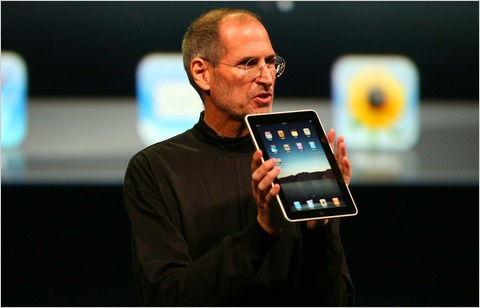
When Steve Jobs announced the iPad in January 2010, he demonstrated purchasing a book from the iBookstore. Cote writes:
When asked by a reporter later that day why people would
pay $14.99 in the iBookstore to purchase an e-book that was selling at
Amazon for $9.99, Jobs told a reporter, “Well, that won’t be the case.”
When the reporter sought to clarify, “You mean you won’t be $14.99 or
they won’t be $9.99?” Jobs paused, and with a knowing nod responded,
“The price will be the same” and explained that “Publishers are actually
withholding their books from Amazon because they are not happy.”
With that statement, Jobs acknowledged his understanding that the
Publisher Defendants would now wrest control of pricing from Amazon and
raise e-book prices, and that Apple would not have to face any
competition from Amazon on price.
The import of Jobs’s statement was obvious. On January 29, the
General Counsel of S&S [Simon & Schuster] wrote to [Simon &
Schuster CEO Carolyn] Reidy that she “cannot believe that Jobs made the
statement” and considered it “[i]ncredibly stupid.”
Justice officials prosecuting the e-book case pointed to e-mails from
Jobs demonstrating his role in pressuring the publishers. "Compelling
evidence of Apple’s participation in the conspiracy came from the words
uttered by Steve Jobs, Apple’s founder, CEO, and visionary," Cote wrote,
then brought out the puns. "Apple has struggled mightily to reinterpret
Jobs’s statements in a way that will eliminate their bite. Its efforts
have proven fruitless."
Cote references e-mails Jobs sent to James Murdoch of News Corp.,
owner of HarperCollins. While Apple's agency model would pay publishers
less per book than HarperCollins received from Amazon, Jobs told Murdoch
that the anticipated iPad sales would make the model more than worth
it. "We will sell more of our new devices than all of the Kindles ever
sold during the first few weeks they are on sale," Jobs wrote. "If you
stick with just Amazon, B&N, Sony, etc., you will likely be sitting
on the sidelines of the mainstream e-book revolution."
Jobs urged Murdoch to "throw in with apple and see if we can all make
a go of this to create a real mainstream e-books market at $12.99 and
$14.99." The only other alternatives, Jobs wrote, were to "Keep going
with Amazon at $9.99" or to "Hold back your books from Amazon," which
would lead to piracy.
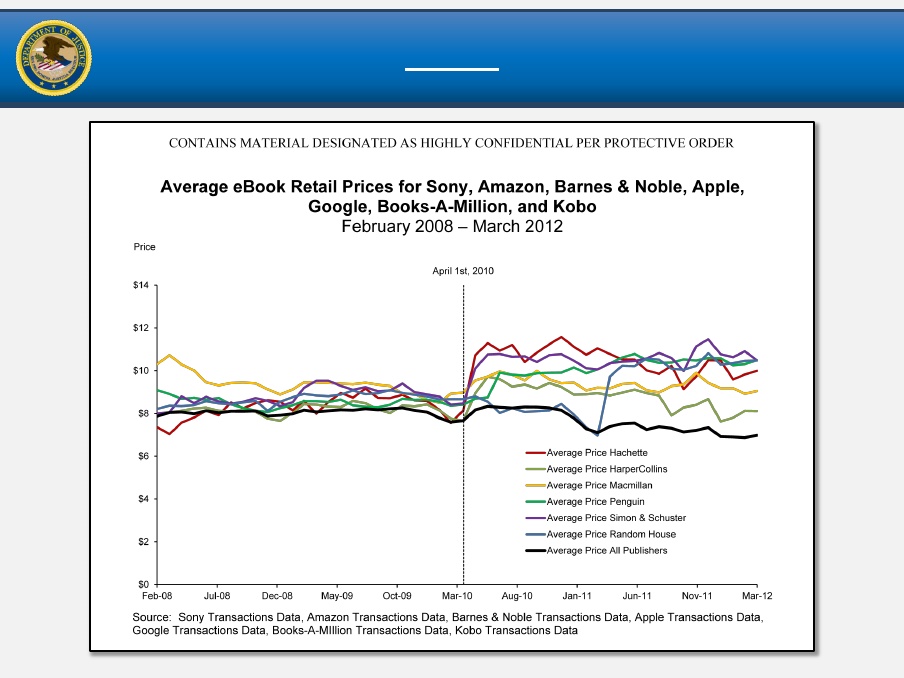
Enlarge/
A graph created by the US Department of Justice to show how e-book
prices rose following the introduction of Apple's iBookstore.
In its opening statement, Apple identified five "essential links" the
plaintiffs had to establish to prove Apple led the conspiracy. These
links, Cote wrote, were that the publishers signed Apple’s agency
agreements with an MFN and price caps, that the MFN sharpened the
publishers' incentives to demand agency agreements from Amazon, that the
agency demands convinced Amazon of the futility of resistance, that
Amazon agreed to agency deals in circumstances in which it would not
have if not for the Apple MFN, and that publishers raised prices to the
price caps as per the agreements with Apple.
"All of the 'links' that Apple identified in its opening statement
were established at trial, and Apple did not argue otherwise in its
summation," Cote wrote. "Apple similarly abandoned by summation its
theory that Apple was unaware that the Publisher Defendants would use
their new pricing authority to raise e-book prices; over the course of
the trial, Apple’s witnesses admitted that they expected the Publisher
Defendants to raise their e-book prices to Apple’s price caps."
DOJ Antitrust Division Chief Bill Baer applauded Cote's decision. “As
the department’s litigation team established at trial, Apple executives
hoped to ensure that its e-book business would be free from retail
price competition, causing consumers throughout the country to pay
higher prices for many e-books," Baer wrote. "The evidence showed that
the prices of the conspiring publishers’ e-books increased by an average
of 18 percent as a result of the collusive effort led by Apple.
Companies cannot ignore the antitrust laws when they believe it is in
their economic self-interest to do so. This decision by the court is a
critical step in undoing the harm caused by Apple’s illegal actions."
As we noted in our earlier story,
Apple already said it plans to appeal. "Apple did not conspire to fix
e-book pricing," the company said. "When we introduced the iBookstore in
2010, we gave customers more choice, injecting much needed innovation
and competition into the market, breaking Amazon's monopolistic grip on
the publishing industry. We've done nothing wrong."
This is a good write up but I still can't say I understand this case.
The accusation is collusion.
Five publishers, which are supposed to be in competition with each
other, instead agreed to raise prices in unison so customers would have
no choice but to pay the extra five bucks a book, no matter what store
they went to or what publisher they decided to buy from. They behaved as
a cartel, with Apple as the ringleader.
The Lone Ranger’s story builds a literal bridge from past to present to understand our real-world US oligarchs’ lies and false flag attacks to take land and resources. Plot:
The movie opens with a 1933 view of the construction of a bridge: the Golden Gate. Bridges connect one area to another, but only for those who wish to make the connection. A
young boy receives a story from an aged Native American; I don’t know
about you, but that boy would be just a few years older than my own
father.
The antagonists in the story are connected by birth: two brothers.
One brother orders the Texas Rangers for law enforcement and is a
railroad baron; the other brother is an openly sadistic criminal who
enjoys murder and eating human flesh. They pretend to be enemies and
unknown to each other, but always are working together.
The criminal brother stages false flag attacks on ranches to blame
Native Americans. The white collar criminal brother marshals the
military to attack, kill, and drive Native Americans off the land.
The goal of the two brothers, from their introduction together as
young men, is to take silver off the land for their personal wealth.
One bro is a psychopath
in political and economic power who conducts press conferences and
orders the military. The other bro is the terrorist who “justifies” the
psychopath’s policies. They only pretend to be enemies, but use each other’s roles to further their mutual policy agenda and wealth.
Our real-world US oligarchs in government, money, and media
continue to lie and stage false flag attacks to war-steal land and
resources. They, too, pretend that “terrorists” are enemies rather than
their own creations to justify their wars and looting. From history to
the present:
All over the internet we often see examples of the wonders that can be done with Photoshop and a little artistic talent. It’s enough to make you wonder what the limits of this photo processing software are.
The zebra and lego brick-hidingTwitterexperimenters at Japanese website Omocoro believe they have found the ultimate test of Photoshop’s abilities. In
this challenge they dare a Photoshop professional to turn one of their
writers, named “Mankind’s All-time Foulest Beast”, into the epitome of
female beauty using his software.
One day in July…
Good evening ladies and gentlemen. I’m your host Yoppy. Tonight we
will be pitting the forces of nature against the might of human
technology in the ultimate showdown. Tonight we will answer the question
if Photoshop can transform even the ugliest lump of human flesh into a
beauty envied by all.
Who will win?
Rules
- We give a professional Photoshop artist original photos of Mankind’s All-Time Foulest Beast. - The artist may use the full potential of his technology to improve a photo. - The artist wins if he creates an amazing beauty with one of the photos! The beast wins if it cannot be done.
Representing humanity, Rikkue is a rare specimen. He was once
examined by a team of American genetic engineers who determined him to
be “the worst possible alignment of double helixes in the history of mankind.”
The exact way that his protein strands came to produce this mess
baffles science to this day but stands as a testament to the ugly power
of nature.
Packaging Photo Doctoring Master – DJ Lonely House Wife
A professional Photoshop artist who works brushing up adult video
covers as well as idol photo shoots. A man who spends day in and day out
beautifying images of women, he feels confident he can make a beauty
out of the beast. He’s so good we didn’t even pixelate his face. That’s
just how he rolls.
Before the contest gets underway, we have the ceremonial exchanging
of business cards to each competitor. This tradition dates back to an
infamous jellybean counting challenge issued by Keisuke Okada to Hideki
Tojo in 1943. That contest ended in a draw and claimed the lives of
eight people.
Alright, it looks like the challengers are ready. Let’s see who comes out on top!
The beast circles the room locking eyes with his rival. He then trips
over his own feet and begins flopping around on the ground for a while.
He then gradually regains his balance while wheezing hard and pulls out
a gown and wig.
The artist simply watches with a steely glare as the beast cautiously begins to disrobe. “This is going to be a lot different from idols…” he thought.
Finally, as his eyes followed along the beast’s hair-matted legs he saw his challenge in all its hideous glory.
Not only was the face hideous, but there was so much of it to deal
with. The poor wig could do little to obscure. The artist sized the
beast up for a moment, then confidently said, “I know what needs to be
done.” However, in his heart he knew his chances weren’t good. Still, he
had to. Winning this contest was a matter of pride and that is
something neither of these men – the guy who makes porn cases nor the
hideous freak of nature – could afford to lose.
This is the photo of the beast that the artist decided to work with.
It presented considerable hurdles such as the thick layer of arm hair,
face stubble, and lazy eye salvaged only by the fact the other eye is
lazy too.
Can anything on this nightmare of aesthetics truly be made into something of beauty?
The artist sprung to his machine and began working on the image.
Giving us a glimpse into his work the artist explains, “see this nose hair? It’s got to go. And with Photoshop it’s no problem.”
And instantly the beast’s thick tentacle-like nose hair was annihilated.
“Also, I’m getting rid of all these pores around his eyes. Boom! Gone.”
The beast watched on anxiously, as the artist swiftly eliminated defect after defect.
If this continues he may become the beautiful woman he always feared to be.
“I’m done…” proclaimed the artist mustering up the last of his
stamina. His face was contorted into a grimace as we rushed to see the
results…
Dejectedly the artist broke down, “I’m sorry. It’s a total loss. My job is to modify people but still keep their humanity. I tried so hard to find and exaggerate his beautiful features, but there were none. I mean, I might as well have just drawn a CGI woman over top of his ugly mug…”
He then explained all the work he put into the alteration. First he
cleaned up the imperfections and reshaped the beasts face into more
pleasing proportions. He then filled in the beast’s tooth gaps and
cleaned off the coffee and nicotine stains.
It was then that the artist found something nice about the beast. He had a pleasant looking crease on his upper left eye lid.
Granted, it was only the one eye, but it was something he could work
with. By unslanting the eyes and adding more definition he created a
perfect eye. He then copied it and pasted it over the right eye with the
appropriate size adjustments.
The artist then tried lightening the beast’s complexion, only to find
that a widespread rash became more visible. By the time he finished
painting and stamping the hell out of the rash, very little of the
beast’s humanity remained.
He didn’t have the heart to continue with the arms so he just cropped
them out and called it a day after six hours of intensive work.
Actually, the artist first choice was to use this photo below. The
face was mercifully obscured meaning he could just reshape the body and
get rid of the hair.
However, the beast’s arm and leg hair was so densely arranged, the artist couldn’t find a single patch of clean skin to copy and paste. “All I needed was a small beautiful spot, but there was nothing!” The artists hands were shaking now.
Of course this means the winner is…
The BEAST!
As this historic match comes to a close we learn that despite all of
Photoshop’s advancements and features it still can’t match the sheer
force of nature and all its cruel humor when allowing something like
Rikkue, Mankind’s All-time Foulest Beast, be born. If you think you can
Photoshop something beautiful and human-looking out of the beast, get
in touch with Omocoro. They’re looking for future rematches. Source: Omocoro
UPDATE: Defender of Photoshop’s power: Michelle Niellose, proves that “anything is possible if you work at it.” (michelleniellose.com or on facebook)
“1 in 4 Youths with Assault Injury Owns a Gun”? Really?
There’s a report circulating around the internet about
correlations between assault victims and gun ownership among those who
make emergency room visits, and it seems that the authors of those
articles are jumping to some startling conclusions without actually
reading and understanding the source report (available here). So let’s take a peek at what’s being written compared to what the report actually says . . .
First things first, a word about the way the study was run. This study is the result of observation of a single emergency room in a high crime area of Michigan (Flint). Let me repeat that. This study was based on observations of a single hospital in a high crime area.
That alone should set off alarm bells for anyone trying to apply this
data anywhere outside of Flint. Also, while the sample size of 689
patients may seem large to the non-stats-minded individuals, keep in
mind that our own survey here at TTAG has already had over 1,000 responses in less than 24 hours. And I’m still not happy with the sample size.
Also raising red flags: the study considers anyone 24 years old and under to be a “youth.” This is in line with previous propaganda pieces by the NY Times in
which they included older “kids” in order to pad their stats. As we
noted in that article, it’s not the actual “children” (under 18) that
are being involved in firearms related homicides, but by associating the
word “children” with the 19- to 24-year-olds, it creates the desired
emotional response for their deaths that the study is looking to
generate. It’s trying to make you think that 12 year olds are running
around with AR-15s and being assaulted on a regular basis, which is not
the case at all even according to this biased study.
So, what do the results say?
Among assault-injured youth, 23.1% (n = 159) reported
firearm possession (Table 1) in the past 6 months. Among those with
firearms, 41.5% (n = 66) reported carrying outside the home in the past 6
months. Of participants with firearms, 67.3% were seen for peer related
violence and 14.5% for intimate partner–related violence; 3.4% reported
threatening someone with a firearm during the altercation that prompted
the visit. Of those with firearms, 4 (2.5%) reported an ED mental
health visit within the past year.
So, for the given population (which, again, is very small), the
conclusion is that 1 in 4 victims of assault own guns. What about their
age, though?
Of those with firearms, 14.5% (n = 23) were younger than 18 and 32.1% (n = 51) have children.
Aha. So, it’s NOT the younger assault victims that are owning guns.
In fact, of the 689 survey participants, only 23 were gun-toting minors
(read: gang members). So the title being used for these articles, that 1
in 4 “youths” in the ER for assault have guns, would be inaccurate. If I
weren’t trying to tone back the rhetoric a bit, I might even go so far
as to call it yellow journalism.
The study then goes on to use these ~150 gun owning ER denizens to paint all gun owners in a poor light.
Participants with firearms noted more overall violent
experiences in the previous 6 months (Table 1). They were also noted to
have higher rates of group fighting (44.0% vs 25.3%, P , .001) and gang
membership (9.4% vs 0.9%, P , .001), although only 2.9% (n = 20) of the
overall sample (n = 689) endorsed gang membership. Participants with
firearms were also more likely the victim or the aggressor in
firearm-related violence in the past 6 months (Table 1).
[...]
Past 6-month binge drinking and illicit drug use were positively associated with firearm possession.
Notice how, even though these responses are the extreme minority
(less than 10%), they are presented as if they are the prevailing
opinion among the surveyed gun owners? By specifically calling them out
in their negative connotation the study appears to be trying to get the
reader to come away with the impression that the minority opinion is the
true opinion, and by extension all gun owners are drunk and
belligerent.
The study also fell into the same old bias, re-labeling
semi-automatic weapons as machine guns. Or, at the very least, putting
them in the same category.
Among the assault-injured youth in our sample (Table 2),
respondents were noted to possess high levels of rapid fire weapons with
17.6% (n = 28) of youth noting ownership of automatic or semiautomatic
weapons [...]. Of these youth with automatic/semiautomatic weapons,
32.1% (n = 9) endorsed the view that “revenge was a good thing,” 14.3%
(n = 4) reported that they carried a gun “to scare someone” or “to get
back at someone,” and 1 of these participants had a mental health visit
within the past year at the site ED.
So, by extension, all semi-auto firearm owners are lunatics out for
revenge, looking to use their guns to scare people, and mentally ill.
Even though the numbers indicate the exact opposite (that people with
those opinions are in the clear minority) by presenting it in this light
the study seems to be trying to condition the reader to believe the
stated opinions and ignore the numbers.
For anyone who passed high school statistics and possesses half a
brain, the immediate response to reading the study’s protocols would be
to chunk it in the trash. It’s about as useful as a critical review to Max Reger.
And yet, because it appears to paint gun owners in a negative light,
the usual suspects will be jumping all over it. Nevermind that it
actually shows that, even among those who steal guns in a high crime
area, they still abhor revenge and violence, because of the way the
report was worded it will be presented as further evidence of the
malevolence of gun owners.
If only there was a way to reach through the internet and apply a dope smack to deserving journalists . . ./http://www.thetruthaboutguns.com/2013/07/foghorn/1-in-4-youths-with-assault-injury-owns-a-gun-really/#more-241335
Source: ISN
According to Robert Valencia, China is vying for greater economic
influence in Latin America, to include possibly constructing and
operating an alternative ‘Panama Canal’ through Nicaragua. One
unanticipated consequence of this burgeoning US-China rivalry, Valencia
observes, is that it might push Latin American countries closer
together.
By Robert Valencia for World Policy Institute
During the first weekend of June, U.S. President Barack Obama and Chinese President Xi Jinping met in California to discuss cyber espionage and
territorial claims in the Pacific Rim. While tension on these topics
has hogged the headlines, the fight for influence in another area could
be even more important—Latin America. Other emerging markets in Africa,
where China has an overwhelming influence due to foreign direct
investment in mining and oil, also offer economic opportunities, but
Latin America has an abundance of natural resources, greater purchasing
power, and geographic proximity to the United States, which has long
considered Latin America as its “backyard.”
The key question now is will Latin American countries lean more
toward China or the United States, or will it find a way to balance the
two against each other? Right now, Latin American countries are
increasingly confident thanks to burgeoning economic and political
integration by way of trading blocs, and they’re demanding to be treated
as an equal player.
As a sign of its growing importance, China and the United States have
courted Latin America more than usual. In May, President Barack Obama
visited Mexico and Costa Rica while Vice President Joe Biden visited
Colombia, Brazil, and Trinidad and Tobago. Shortly after these trips,
President Xi went to Mexico and Costa Rica to foster economic
cooperation.
China’s active involvement in Latin American geopolitics can be
traced back to 2009. Chinalco, China’s largest mining company, signed a
$2.2 billion deal with Peru to build the Toromocho mine and a $70
million wharf in the Callao port. Since then, Peru has sent 18.3 percent
of its exports to China, making China Peru’s largest trading partner.
China’s imports to Peru, however, rank second with 13.7 percent of the
market while the United States holds first place with 24.5 percent.
China has the upper hand with the Latin American leftist countries in
terms of infrastructure and technology. In 2009, Chinese telephone
manufacturer ZTE played an instrumental role in assembling the first
mobile phone in Venezuela known as “El Vergatario” (Venezuela slang for
optimal). Former President Hugo Chávez introduced this new phone to
low-income families making it the world’s cheapest phone ($6.99 for a
handset). Additionally, China landed rail construction projects in
Argentina and Venezuela and has become a major buyer of farm products
and metal in South America. Between 2011 and 2012, China purchased
nearly 58.02 million tons of soy from Argentina, up from 52 million in
2011 and 2010.
China has also maintained an active market with Brazil. Chinese oil
company Sinopec and China Development Bank offered Brazilian oil company
Petrobras a $10 billion loan in 2009 in return for hundreds of
thousands of barrels per day. In 2011, three Chinese metal companies
purchased Brazilian mining company Companhia Brasileira de Metalurgia e
Mineracao.
China’s boldest move in the region is the possible construction of a massive canal in Nicaragua. Nicaraguan
President Daniel Ortega pushed the National Assembly to approve the
multi-billion dollar plan in June. The Nicaraguan canal would have a
larger draft, length, and depth than the Panama and Suez canals, and the
enactment granted a Hong Kong-based company permission to build and
control the canal for nearly 100 years. The approval of this plan,
however, raised the ire of environmentalists and neighboring Colombia,
which recently lost 70,000 square kilometers of its Caribbean maritime
territory to Nicaragua before the International Court of Justice (ICJ).
Last May, Colombian diplomat Noemi Sanin claimed that China had
influenced ICJ’s decision. According to Sanin, Chinese justice Xue
Hanqin knew beforehand about Nicaragua’s intention to grant the canal
construction to China since Xue was a colleague of Carlos Arguello, a
role-player in the maritime case. There is no evidence for this, but it
shows Colombia’s anxiety of China’s growing clout in the region and how
it can upset balances of power.
The United States hasn’t lost Latin America, and is unlikely to lose
it completely. It is still the region’s top trade partner. The United
States has recently signed free-trade agreements with Colombia and
Panama, and maintains other trade agreements with Peru, Chile, and
Mexico. Central American and several Caribbean countries rely upon U.S.
military cooperation in an attempt to curtail drug trade. Nevertheless,
the post 9/11 years severely eroded U.S.-Latin American relations as the
Bush administration focused heavily on the war on terror, often
ignoring issues in Latin America.
China and the United States are also encountering a more confident
and more unified Latin America. It is a region that has sought autonomy
in its own affairs by way of rising blocs such as the Community of Latin
American and Caribbean States, MERCOSUR, and the Bolivarian Alliance
for the Americas (ALBA), among others. Brazil, Latin America’s largest
economy, also seeks a prominent role the region with large investments
in research and development and the introduction of social programs to
revamp the middle class. Brazil has jumped into the global economic
debates, calling out China, the United States, and other industrialized
countries over the so-called “currency wars.” In 2010, Brazilian Finance
Minister Guido Mantega criticized these nations for policies that
weakened exchange rates that in turn affected the real currency value
and Brazilian exports. Since then, Brazil has pursued a more significant
role among the world’s 20 most advanced countries known as the G-20.
Both the United States and China use infrastructure investment,
diplomacy, and trade as leverage, but Latin America wants to be seen as a
socioeconomic partner, not a subordinate. The Pacific Alliance, for
example, hopes to become a powerful bloc that can stand up to the
world’s two super powers. Comprised of Colombia, Peru, Chile, Costa
Rica, Mexico, and possibly soon Panama, the Pacific Alliance is a new
economic bloc that seeks economic integration oriented toward
Asia-Pacific markets. Additionally, the Pacific Alliance can become a
springboard for other Latin American nations with a Pacific shore to
join the Trans-Pacific Partnership (TPP), a proposed free-trade
agreement among Asia-Pacific, Mexico, Peru, Chile, Canada, and the
United States. Being part of the Pacific Alliance is significant,
because for countries like Costa Rica, it would otherwise be an unlikely
candidate for the TPP. Taken together, the Pacific Alliance’s GDP
totals $3 trillion, making it easier to integrate itself to the TPP and
for it to fight for better terms. The United States will still hold the
lion’s share of the TPP with an economy that hovers around $13
trillion—but an alliance worth $3 trillion will give it more leverage
than it would otherwise have. The battle for influence in Latin America
may have the effect of pushing the countries closer together, allowing
them to stand up to both the United States and China.
For additional reading on this topic please see: The Dragon in the Backyard: US Visions of China’s Relations toward Latin America Fuelling the Dragon: Natural Resources and China’s Development Journal of Politics in Latin America, Vol.4, No. 3

 Posts
Posts


 Kemnitz said, “At some places I’m treated like royalty and at some like a terrorist. There’s got to be something in the middle.”