This article attempts a brief historical description of the
emergence of the New World Order (NWO) based on neoliberal
globalization, in the last thirty or so years ago. The Transnational
Elite is defined in this context as a network of interconnected elites
controlling each major field of social life (economic, social,
ideological and so on) and its function is similar to that of the
national elite in the pre-globalization era of nation-states. It is
shown that a transnational market economy needed its own transnational
political and economic elites to control it in exactly the same way as
when the market economy was mainly “national,” when the role of
enforcing the market rules was assigned to the “nation state” ― through
its monopoly of violence ― and the political and economic elites
controlling it. The conclusion drawn is that, contrary to the systemic
propaganda, the conception of the Transnational Elite (as well as the
NWO itself) has nothing to do with “conspiracies” of any kind.
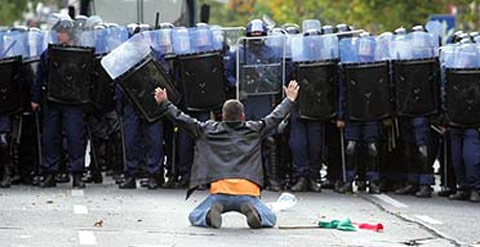
Last weekend thousands of European citizens across Europe took part
in demonstrations against the New World Order (NWO) of neoliberal
globalization and the Transnational Elite (TE) ― mainly the
transnational elites’ network based in the G7 countries ― which runs it.
The reason was the latest TE plan for a transatlantic trade deal
called “Transatlantic Trade and Investment Partnership” (TTIP).
[1] Negotiations
for this new agreement are in fact well advanced and have taken place
between representatives of the political and economic elites of USA and
EU. A similar agreement called the Trans-Pacific Partnership (TTP) is
being negotiated between nations of the Pacific Rim (Canada, the US,
Japan, Australia, New Zealand, Chile, Vietnam, Peru, Mexico, Singapore,
South Korea, Malaysia, Taiwan and Brunei).
One could immediately notice that both Russia and China are
deliberately excluded from these negotiations, which instead take place
exclusively among members of the TE, and those fully integrated into the
NWO as associate or subordinate members of it. As I tried to show in a
previous
Pravda article, Russia is not fully integrated into the NWO,
[2] despite
recently joining the World Trade Organization, whose aim is to fully
integrate into the New Order of neoliberal globalization as many
countries of the world as possible, provided they would agree to fully
open and liberalize their markets for commodities, so that Transnational
Corporations (TNCs) do not have any tariff or other barriers
restricting their activities.
However, despite the fact that the World Trade Organization was
highly successful in opening and liberalizing goods markets, it was not
so successful in opening services markets given that many countries
still try to protect basic needs services like Health, Education,
Transportation and Communications, which are still characterised as
social services and are not therefore left free to become easy prey for
the TNCs and their profit making activities. This is unlike the US case,
where meeting these basic needs depends on market forces (i.e. on how
thick the citizen’s wallet is), rather than on collective social
decisions taken democratically. On top of this, the World Trade
Organization was not particularly successful in opening and liberalizing
some production sectors in the “South” (e.g. the agriculture sector),
which are still the main production sectors (at least in terms of
providing employment) to many of those countries. As an expert on the
field stressed:
“To put it mildly, the World Trade Organization has not
proven terribly popular. In fact, the organization has mainly been used
as a vehicle to force open vulnerable economies and make the rich richer
and the poor poorer around the world. Thus, unsurprisingly, talks on
further liberalization measures within the World Trade Organizations’
global framework have stalled. (…) Hence, the confusingly abbreviated
TTIP and TTP, which are being negotiated by more exclusive sets of
countries whose leaders happen to (mainly) agree that it would be a good
idea to go much further down the trade liberalization rabbit hole than
even the hugely unpopular World Trade Organization has. One of the most
concerning ways they want to do this is by seeking to institutionalize
what is known as investor-state dispute settlement (ISDS) within the
agreements’ framework.”[3]
So, these agreements are in fact part of the same process that began
with the emergence of the NWO following the mass expansion of TNCs in
the last thirty years or so ― which is a new phenomenon in the history
of the capitalist market economy ― and the parallel collapse of the
USSR and the soviet bloc in general. As a result of the mass expansion
of TNCs, which, by 2009, numbered more than 80,000, accounting for about
two-thirds of world trade, several experts on the field talk today
about a hyper globalization. As a
New Scientist study has
shown, today, just 1,318 core TNCs, through interlocking ownerships, own
80% of global revenues and 147 companies out of them (i.e. less than 1
per cent of the network) form a “super entity,” controlling 40 per cent
of the wealth of the entire network!
[4] This
vast expansion of TNCs would have been impossible without open and
liberalized markets for commodities and capital, which have been
established all over the world in the last thirty years or so by
governments of every persuasion: Christian democrats, social democrats,
liberals and any combination between them. This was not the result of
some conspiracy by ‘bad’ economists and politicians, exploiting any kind
of crisis, as some best-seller conspiracy theorists suggest.
[5] Instead,
this was just the inevitable effect, which followed the collapse of the
social-democratic model that was based on national markets, and which
was not compatible anymore with the growing internationalization of the
market economy. In other words, governments in the new framework had to
follow neoliberal policies to make their economies competitive and
capable of continued growth and the expansion of the consumer society.
However, the creation of an internationalized market economy
necessitated some sort of international economic and political
“regulation.” When the market economy was mainly “national,” the role of
enforcing the market rules was assigned to the “nation-state” ― through
its monopoly of violence ― and the political and economic elites
controlling it. This included the old national empires, like the British
colonial empire, which in effect had its own internal market for trade
and capital investment. However, a transnational economy needs its own
transnational political and economic elites to control it. Although the
state monopoly of violence still remains in the present
internationalized market economy, it is now supplemented by a
transnational form of violence, which is enforced not just by one state ―
even if this happens to be the last “empire” in the classical sense of
the word (USA) ― but by the main military powers in the G7 i.e. France,
UK, US (the “FUKUS” powers). Therefore, even though economic power is
spread today among a few hundred TNCs, which originated, mainly, in the
G7 countries (i.e. FUKUS plus Germany, Japan, Canada and Italy), the
USA, due to its unambiguous military supremacy, has a de facto leading
position ― but it is not the Emperor. In other words, the NWO is an
“Empire,” in the sense of a unipolar world, but without an Emperor ―
unless we consider as “emperor” the entire TE.
In this framework, we may define the “transnational elite” as the
elite that draws its power (economic, political or generally social
power) by operating at the transnational level ― a fact which implies
that it does not express, solely or even primarily, the interests of a
particular state. It consists of a network of interconnected elites
controlling each major field of social life (economic, political,
ideological and so on). Therefore, the following elites constitute the
major components of the transnational elite:
- The transnational economic elites in charge of economic
globalization, which control the main TNCs (corporate directors,
executive managers, major shareholders of the main TNCs), as well as the
directorates of the main international economic organizations (IMF,
World Bank, OECD and so on);
- The transnational political elites in charge of political
globalization, which control the distinctly politico-military dimension
of the NWO and consist of globalizing bureaucrats and professional
politicians functioning either within major international organizations
or in the state machines of the major market economies (principally the
G7 countries);
- The transnational propaganda elites in charge of promoting the
ideology of the New World Order, through their control of transnational
mass media (e.g. CNN, BBC and the likes), as well as the elites involved
in implementing this ideology in dealing with the protection of human
rights etc. (leading cadres of international NGOs financed by the
transnational economic elites, like Human Rights Watch, Amnesty
International, etc.). Transnational media and international NGOs, as
well as the so-called “social media” of the Internet (blogs, facebook,
twitter etc) have played a crucial role in the manufacturing of “news”
(and of the legitimacy of “insurgents”), let alone in supporting the
propaganda about the supposed progressive role of criminal organizations
like NATO. It is now known, for instance, that DARPA ― the Pentagon-run
Defence Advanced Research Projects Agency ― has in one way or another
funded several studies recently that set out to explore the fact that
social networking sites, as well as users of Twitter, Pinterest,
Kickstarter etc. (as well as its Social Media in Strategic
Communications, or SMISC, program), have as a general goal the pure
manipulation of social data information, so that the TE’s line is
filtered through them. As its goal is described: “Through the
program, DARPA seeks to develop tools to support the efforts of human
operators to counter misinformation or deception campaigns with truthful
information.”[6]
- The transnational academic elites, namely the prominent systemic
academics in various transnational organizations (foundations,
institutes, think tanks and the likes) in charge of creating/improving
the ideology of the NWO and globalization, “scientifically” justifying
the need for globalization, as well as disorienting people on the real
causes of the present multi-dimensional crisis.
- The transnational cultural elites, namely the film industry (mainly
controlled by the Transnational and Zionist elites that control the
dominant Hollywood industry) which plays a crucial role in propagating
the values of globalization and the “normal” way of living (which “by
coincidence” happens to be the one consistent with the bourgeois way of
life and values!), the music industry (particularly the pop industry
which is also controlled by TNCs) and so on.
Needless to add that the globalization process run by the TE has
already led to an unprecedented concentration of wealth and income and
as the just published Credit Swisse report shows, the richest 1 percent
on the planet now own 48.2 percent of the world’s wealth, up from 46
percent last year, whereas the bottom half of the global population own
less than 1 percent of the total wealth!
[7]
The twofold aims of the TE since the rise of the NWO have been:
First, to expand globalization into countries which have not yet lost
all national and economic sovereignty within the globalization process,
mainly Russia and also countries still controlled by governments that
came to power through national liberation movements (Syria and Iran,
following the destruction by the same TE of countries like Iraq and
Libya) or, alternatively through socialist movements (Cuba, Venezuela
and others). The means used to achieve this aim were either economic
violence, as e.g. with respect to the EU peripheral countries, or
physical violence, exercised directly by the TE or its proxies (as e.g.
in the Middle East), or some combination of the two forms of violence.
Second, to deepen the globalization process into areas not yet
covered by the World Trade Organization rounds and particularly the
movement of capital, whose complete freedom to move, up to now, has only
been secured within the EU and NAFTA and as regards to other countries
mainly through bilateral agreements. The new agreements (TTIP and
TTP) propose clauses that will create universal mechanisms to settle
disputes between TNCs and states. Thus, unlike individual deals on
developing specific natural resources, the TTIP and TTP cover a wide
range of what are considered to be investments in the states. Therefore,
as the same expert points out “incorporating these clauses would mean
that if a country later makes a law that contravenes the terms of the
TTIP or TTP, for example, in the interests of protecting public health,
that a company that suffers damages (for example, because they have been
making a product that contravenes the new rule) can sue the state for
compliance with the treaty, bypassing the normal court system. In other
words, foreign companies are placed above the law of the host State
through these agreements.”
[8] Thus,
TNCs with a stake in the UK health service, for instance, could sue the
government if it decided to pursue a program of nationalization. No
wonder that Unite’s (a major British Trade Union) Assistant General
Secretary Gail Cartmail urged congress delegates in the last TUC
conference to oppose the TTIP and rally support amongst people in the UK
to demand Prime Minister David Cameron keep Britain’s health services
out of the TTIP agreement. As it was reported at the time:
“It is clear this government thought they could do
this deal in secret ― a deal that would mean the irreversible sell-off
of our NHS to America,” Cartmail said. “Wall Street financiers
like Blackrock and Invesco are already heavily invested in the NHS ―
over 70 percent of new contracts are now in private hands. Over £11
billion of our money in the hands of casino capitalists,” she added.[9]
It is not therefore surprising that some of the campaigners against
TTIP worry that once this agreement is converted into EU law and then
finds its way to domestic parliaments (as it is well known at least 75%
of each EU country’s legislation originates in the EU Commission) then
it could open the way to privatize any social service still available,
following the onslaught of the NWO of neoliberal globalization and the
mass neoliberal legislation adopted in the last 30 years by both
conservative, Christian Democratic and social democratic parties in
power. Environmentalists are also concerned that the dispute settlement
procedure could well be used by TNCs to block moves to protect the
environment. The conduct of the negotiations is also contentious.
Campaigners say they are secretive and undemocratic, as of course it
should be expected as they are, in fact, (despite formalities) carried
out between unelected US and EU bureaucrats, who owe their posts to the
transnational political and economic elites, and representatives of
TNCs.
The effects of globalization particularly as far as the continuous
squeezing of employees’ real incomes is concerned (in the context of
liberalizing labor markets, so that they could become more competitive),
are being realized now widely by many people all over the world. The
present “job miracle,” for instance, in Britain (which is characterized
as “the job creation capital of the western economies”), hides the fact
that “unemployment is low largely because British workers have been
willing to stomach the biggest real-terms pay cut since the Victorian
era”
[10] ― all this as a result of globalization. It is not therefore surprising that even the conservative London
Times had to admit this fact in explaining the reasons why the nationalist Right under Nigel Farage’s UKIP is rising rapidly:
“The surge in support for UKIP is not simply a protest
vote. The party has a constituency among those left behind by
globalisation… the globalisation of the economy has produced losers as
well as winners. As a rule the winners are among the better off and the
losers among the least affluent.”[11]
The same process is repeated almost everywhere in Europe with people
(and particularly working class people) turning to the nationalist Right
not because they suddenly became “nationalists” let alone “fascists”
(as the “Left” accuses them) but simply because the present degenerate
Left does not wish to lead the struggle against globalization, while, at
the same time, the popular strata have realised that national and
economic sovereignty is incompatible with globalization. The strong
patriotic movement in Russia encompassing all those opposing the
integration of Russia into the NWO, i.e. from nationalists up to
communists and from Christian orthodox to secularists, is just such a
movement.
The typical reaction of the ideological organs of the TE, either in
the media or in universities, think tanks, NGOs and the like, is to
attack this rapidly rising global movement against the NWO of neoliberal
globalization with two parallel aims:
a) to slander as “fascist” such popular movements against globalization[12] (while
looking the other way concerning the actions of the real fascists in
Ukraine whom it used as its main organs for its “coup from below”)[13] and;
b) to try to marginalize or even defame as conspiracy theorists every
writer who does not toe the TE’s line on globalization, while, at the
same time directly or indirectly promoting liberal or even Marxist
“Left” authors and publications, who ignore globalization and the TE and
prefer to talk about today’s reality in terms of completely outdated
theories of the past two centuries, developed well before the emergence
of globalization. Clearly, this Palaeolithic Marxist Left (apart from
some enlightened Marxists who attempted ― in a genuine Marxist fashion ―
to use the classical Marxist tools to develop new theories for today’s
reality[14]) is today politically and ideologically dead.
Neil Clark, aptly described the systematic effort by the TE organs to
describe any effective critique of present reality like the above as a
“conspiracy theory”:
“The labelling of people as ‘conspiracy theorists’ by
gatekeepers in the West has nothing to do with how much evidence there
is to support a claim or the quality of that evidence, but is a
political call, based on who the conspiracy theory concerns and who is
making it. Establishment gatekeepers are not objective judges, but are
heavily biased and label any idea they don’t like as a ‘conspiracy
theory’. Labelling someone a ‘conspiracy theorist’ is their standard way
of declaring that person to be ‘off-limits’, i.e. he/she is an
unreliable source and a ‘crank’. It’s a way that dissent and debate is
stifled in what appear to be free, democratic societies ― and how people
who challenge the dominant establishment narrative are deliberately
marginalized.”[15]
Thus a common slander against the conception of the TE I gave above
is that it implies the presence of a well organized international elite
which decides for the planet’ s future in a way that “History is written
on the basis of the commands of this elite which represents the ‘New
World Order’.”
[16] Of
course, as I have consistently stressed, History is always a creation,
something that rules out both any kind of conspiracies and,
alternatively, any “objective” laws determining its outcome. Naturally,
this does not mean that the elites do not plot. The example of the TE
conspiracy about the supposed weapons of mass destruction in order to
dismantle the Iraqi Ba’athist regime is particularly topical. Yet,
whether a conspiracy will succeed or not always depends on the outcome
of the social struggle.
As I attempted to show elsewhere,
[17] in
describing the process leading to the NWO, the new form of
internationalized market economy that has been established in the last
thirty years or so represents a structural change, a move to a new form
of modernity, i.e., a move from statist to neoliberal modernity, rather
than a change in economic policy and an ideology, as the reformist Left
argues. In this sense, today’s globalisation is indeed a new phenomenon,
although it is the outcome of the interaction of the social struggle
with the dynamics of the market economy, which was established two
centuries ago and has led to the marketization process, i.e. to the
process of minimising social controls on the markets and particularly
those aiming to the protection of labour and the environment that were
coming inevitably into conflict with economic “efficiency” and
profitability. The emergence and rapid expansion of multinational
corporations (a new phenomenon in the history of the capitalist market
economy), has initially led to an informal opening and liberalisation of
markets that was later institutionalised by Thatcherism and
Reaganomics. It was this development that, together with the change in
the subjective conditions, i.e., the decay of the labour and socialist
movements in the aftermath of de-industrialisation in the West,
signalled the collapse of social democracy and the rise of neoliberal
globalization.
[4] Andy Coghlan and Debora MacKenzie, “Revealed – the capitalist network that runs the world”, New Scientist Magazine, issue 2835 (24/10/2011).
[5] Naomi Klein, The Shock Doctrine (Penguin, 2007)
[8] Roslyn Fuller, Pyrrhic victory for whistleblowers on Transatlantic Trade Agreement, op.cit
[10] Ed Conway, “The UK is paying the price of its jobs miracle,” The Times (14/10/2014).
[11] Editorial, “The People’s Revolt”, The Times (11/10/2014).
[14] see e.g. Leslie Sklair, The Transnational Capitalist Class (Oxford: Blackwell, 2001).
[16] see e.g. a collective work on “The conspiratorial discourse in the Greek political system”, University of Thessaloniki, 2010.

 Posts
Posts