Wednesday, March 27, 2013

Internet Under Attack: World's Largest DDoS Attack Almost Broke The Internet

from the the-hidden-war dept

We've known for a while that there are a number of people out there who really dislike Spamhaus, one of the more well known providers of a blacklist of spam IP addresses. For what it's worth, there are times when it feels like Spamhaus may go overboard in declaring an IP or range of IP addresses as spammers. And, to some extent, because of that, it seems like some who use the Spamhaus list rely on it a bit too strongly. That said, Spamhaus is doing important work in helping to stop the internet from being overrun with spam, and that's a good thing. But sometimes those who it pisses off aren't particularly nice people. Last week, Spamhaus added hosting company Cyberbunker to its spamlist. Someone didn't like that very much, and thus began a very big DDoS attack using open DNS recursors. Spamhaus went to Cloudflare, who was able to mitigate the worst of the attack.

But... that just lead to round two, in which whoever was behind the DDoS went much, much bigger attacking a bunch of the providers who provide Cloudflare with its bandwidth. Basically, it was massive firepower directed at some key points on the internet. And it was a pretty big deal. Cloudflare's blog post stays away from getting too expressive about the whole thing, but just the fact that they note the attack came close to "breaking" the internet should get you to wake up.
Tier 1 networks don't buy bandwidth from anyone, so the majority of the weight of the attack ended up being carried by them. While we don't have direct visibility into the traffic loads they saw, we have been told by one major Tier 1 provider that they saw more than 300Gbps of attack traffic related to this attack. That would make this attack one of the largest ever reported.

The challenge with attacks at this scale is they risk overwhelming the systems that link together the Internet itself. The largest routers that you can buy have, at most, 100Gbps ports. It is possible to bond more than one of these ports together to create capacity that is greater than 100Gbps however, at some point, there are limits to how much these routers can handle. If that limit is exceeded then the network becomes congested and slows down.

Over the last few days, as these attacks have increased, we've seen congestion across several major Tier 1s, primarily in Europe where most of the attacks were concentrated, that would have affected hundreds of millions of people even as they surfed sites unrelated to Spamhaus or CloudFlare. If the Internet felt a bit more sluggish for you over the last few days in Europe, this may be part of the reason why.
The attackers say they're protesting Spamhaus acting as the internet's police:
Questioned about the attacks, Sven Olaf Kamphuis, an Internet activist who said he was a spokesman for the attackers, said in an online message that, "We are aware that this is one of the largest DDoS attacks the world had publicly seen." Mr. Kamphuis said Cyberbunker was retaliating against Spamhaus for "abusing their influence."

"Nobody ever deputized Spamhaus to determine what goes and does not go on the Internet," Mr. Kamphuis said. "They worked themselves into that position by pretending to fight spam."
Of course, all of this has exposed clearly a big vulnerability in the setup of the internet, and suggest that slowing down the internet on a large scale is entirely possible. But it's also made security folks that much more aware of how urgent it is to fix the a key vulnerability that made this possible: the fact that there are so many open DNS resolvers out there, that can be used to launch massive DDoS attacks. Because of that, security folks are rushing around to see if they can convince people to close as many of the approximately 21.7 million open resolvers out there:
While lists of open recursors have been passed around on network security lists for the last few years, on Monday the full extent of the problem was, for the first time, made public. The Open Resolver Project made available the full list of the 21.7 million open resolvers online in an effort to shut them down.

We'd debated doing the same thing ourselves for some time but worried about the collateral damage of what would happen if such a list fell into the hands of the bad guys. The last five days have made clear that the bad guys have the list of open resolvers and they are getting increasingly brazen in the attacks they are willing to launch. We are in full support of the Open Resolver Project and believe it is incumbent on all network providers to work with their customers to close any open resolvers running on their networks.
Basically, over the last week or so, there's been a war going on, concerning parts of the core of the internet, and while it might not have impacted you yet (or, maybe it did), it's likely that the next round will be even bigger. In the meantime, the race is on to shut down open resolvers to try to keep the internet working, and hopefully to cut down on the power of such attacks.

Intellectual Ventures Ramping Up Lawsuits

from the a-troll's-gotta-troll dept

For many years, even as people correctly noted that Intellectual Ventures was perhaps the world's biggest patent trolling operation, the company insisted that it shouldn't be called a troll, in part because it hadn't actually sued anyone. That was misleading for a variety of reasons, with the biggest one being the war chest behind IV and the implicit threat of lawsuits certainly got plenty of companies to cough up huge sums to avoid them. While IV has ridiculously strict nondisclosure agreements, various leaks have suggested companies often pay hundreds of millions of dollars to Intellectual Ventures... for nothing. All they really get is a promise not to be sued and the potential to dip into IV's big database of mostly useless patents, which the paying companies can then use to sue others. Overall, Intellectual Ventures admits that it has brought in over $2 billion dollars directly from licensing and another $5 billion in "investments" -- some of which came from companies "buying in." What a racket, huh?

Back in 2010, the company finally filed its first lawsuits. Since then it's continued filing lawsuits on an irregular basis. 2011 was a big year, with sudden bursts of lawsuits in July, September and October. 2012 had fewer lawsuits, and just small blasts in February and May. However, it looks like IV may be ramping up with the lawsuits again. IV filed one in January (against Motorola), three in February (one against Windstream and a few small telcos, one against CenturyLink, Qwest, Embarq, Savvis & CenturyTel, and one against AT&T and various subsidiaries). However, in the last week or so, it's filed three more lawsuits. First against Symantec, then against Toshiba, and the latest against Canon and Ricoh.

The latest one claims that Canon and Ricoh -- two companies, I should remind you, who actually produce printers and actually add value to the world by making products -- are apparently violating some IV patents which have to do with printing. They claim that Canon (whom they've sued before) infringes on nine patents and Ricoh infringes on seven.

So, let's ask a simple question: what has Intellectual Ventures contributed to the world of printing?

We'll wait.

Okay, it was a trick question: the answer is absolutely nothing. No printer company in the world has relied on some great breakthrough from Intellectual Ventures, nor have they relied on the insight gleaned from a crappy patent that IV bought at some point. No, printer companies have built and innovated based on their experience in the marketplace selling printers. Intellectual Ventures is simply trolling and taking away from actual innovators.

In a truly sickening blog post, Intellectual Ventures' "Chief Litigation Counsel" Melissa Finnocchio tosses out IV's standard "defense" of its indefensible activities:
Since our founding, IV has efficiently and effectively identified strong patents covering significant and relevant inventions, purchased those patents, and marketed and licensed them to companies who need them. A properly functioning patent system is the foundation of IV's business model, along with the sensible notion that a fair price must be paid for use of a patented invention.
Almost nothing in that paragraph is accurate. IV started out by buying up patents, en masse, from various universities' "tech transfer offices" after those universities spent big time setting up those offices, thinking it would bring in lots of cash. Then no one wanted those patents (at least not at the ridiculous prices offered) and for nearly every single university tech transfer office they suddenly became seen as a cost center, rather than a profit center as planned. Enter IV with a giant war chest, agreeing to buy up tons of crappy patents that no one else valued or wanted, on the cheap, and suddenly tech transfer offices can aggregate a bunch of patents and show some money coming in. IV has never, ever been about "identifying strong patents." It has always been about finding enough patents they can use to pressure companies into giving them money. IV's entire business model, from the beginning was built on exploiting a clearly broken patent system by a group of folks who had a history with the system.

As for a "fair price," a fair price is what someone in the market is willing to pay for a product. Not what IV gets by bullying companies. IV has tens of thousands of patents. We've yet to find a single one that was a key breakthrough which companies relied on to move innovation forward. Because they don't have any such patents.
Patent infringement, however, continues to be a problem and the patent system cannot work as intended if infringement goes unchecked. When sophisticated companies turn a blind eye to infringement, we are forced to take action to safeguard the value of our patents and to protect the interests of our investors and customers. Infringers need to pay for the inventions they are using. An issued patent provides rights to the patent owner and when these rights are ignored, it impairs the incentives that spur invention and poses a real threat to innovation
That entire paragraph might make sense if the patents in question were (a) unique, clearly defined and definitive breakthroughs and (b) were the main reason why other companies produced the products they did. However, since (as far as we can tell) every single situation in which IV has sued a company has been because of independent invention by actual practitioners in the field doing what the market asks for, and the patent in question has nothing to do with the actual innovation, it's not just wrong to suggest that "infringers need to pay," it's a gleeful cheering on of a shakedown.

Finally, the idea that when patent owners don't sue it somehow "impairs the incentives that spur invention and pose a real threat to innovation" has simply no basis in any reality-based discussion. The problem with the patent system today is the fact that broad and vague patents are being asserted against obvious innovations in the market place. That is putting a massive tollbooth on innovation.
We enter into litigation after careful deliberation and a thorough analysis of the patents we own and the products we believe to be infringing. The actions we take to protect our rights are with established, patent savvy technology companies – not start-ups – and we have reached settlements for significant amounts. In other words, our patent portfolios are being recognized for their validity and relevance to current industries and key technologies.

IV does not enter litigation lightly, and our actions are not frivolous. Asserting our rights is something IV, and any patent owner must do, when their patents are being used without license.
Shorter version of this paragraph: look we only shakedown big companies with big bank accounts. The fact that some of them are willing to pay does not mean the patents are recognized for their "validity." It means that big companies can do the math on the cost of fighting IV in court, and recognize it's cheaper to pay up than deal with the mess. IV may not enter into litigation lightly, but it's abusing the system, taking billions of dollars out of actual innovation and is the perfect example of everything that's wrong with the patent system.

The Global Elite Are Very Clearly Telling Us That They Plan To Raid Our Bank Accounts

The Global Elite Are Very Clearly Telling Us That They Plan To Raid All Of Our Bank AccountsDon't be surprised when the global elite confiscate money from your bank account one day.  They are already very clearly telling you that they are going to do it.  Dutch Finance Minister Jeroen Dijsselbloem is the president of the Eurogroup - an organization of eurozone finance ministers that was instrumental in putting together the Cyprus "deal" - and he has said publicly that what has just happened in Cyprus will serve as a blueprint for future bank bailouts.  What that means is that when the chips are down, they are going to come after YOUR money.  So why should anyone put a large amount of money in the bank at this point?  Perhaps you can make one or two percent on your money if you shop around for a really good deal, but there is also a chance that 40 percent (or more) of your money will be confiscated if the bank fails.  And considering the fact that there are vast numbers of banks all over the United States and Europe that are teetering on the verge of insolvency, why would anyone want to take such a risk?  What the global elite have done is that they have messed around with the fundamental trust that people have in the banking system.  In order for any financial system to work, people must have faith in the safety and security of that financial system.  People put their money in the bank because they think that it will be safe there.  If you take away that feeling of safety, you jeopardize the entire system.
So exactly how did the big banks in Cyprus get into so much trouble?  Well, they have been doing exactly what hundreds of other large banks all over the U.S. and Europe have been doing.  They have been gambling with our money.  In particular, the big banks in Cyprus made huge bets on Greek sovereign debt which ended up failing.
But what happened in Cyprus is just the tip of the iceberg.  All over the planet major financial institutions are being incredibly reckless with client money.  They are leveraged to the hilt and they have transformed the global financial system into a gigantic casino.
If they win on their bets, they become fabulously wealthy.
If they lose on their bets, they know that the politicians won't let the banks fail.  They know that they will get bailed out one way or another.
And who pays?
We do.
Either our tax dollars are used to fund a government-sponsored bailout, or as we have just witnessed in Cyprus, money is directly confiscated from our bank accounts.
And then the game begins again.
People need to understand that the precedent that has just been set in Cyprus is a game changer.
The next time that a major bank fails in Greece or Italy or Spain (or in the United States for that matter), the precedent that has been set in Cyprus will be looked to as a "template" for how to handle the situation.
Eurogroup president Jeroen Dijsselbloem has even publicly admitted that what just happened in Cyprus will serve as a model for future bank bailouts.  Just check out what he said a few days ago...
"If there is a risk in a bank, our first question should be 'Okay, what are you in the bank going to do about that? What can you do to recapitalise yourself?'. If the bank can't do it, then we'll talk to the shareholders and the bondholders, we'll ask them to contribute in recapitalising the bank, and if necessary the uninsured deposit holders"
Dijsselbloem insists that this will cause people "to think about the risks" before they put their money somewhere...
"It will force all financial institutions, as well as investors, to think about the risks they are taking on because they will now have to realise that it may also hurt them. The risks might come towards them."
Well, as depositors in Cyprus just found out, there is a risk that you could lose 40 percent (and that is the best case scenario) of your money if you put it in the bank.
Why would anyone want to take that risk - especially in a nation that is already experiencing very serious financial troubles such as Greece, Italy or Spain?
As if that was not enough, Dijsselbloem later went in front of the Dutch parliament and publicly defended a wealth tax like the one that was just imposed in Cyprus.
Dijsselbloem is being widely criticized, and rightfully so.  But at least he is being more honest that many other politicians.  His predecessor as the head of the Eurogroup, Jean-Claude Juncker, once said that "you have to lie" to the people in order to keep the financial markets calm...
Mr. Dijsselbloem's style contrasts with that of his predecessor, Jean-Claude Juncker, Luxembourg's prime minister, who spoke in a low mumble at news conferences and was expert at sidestepping questions. Mr. Juncker once even advocated lying as a way to prevent financial markets from panicking—as they did Monday after Mr. Dijsselbloem's comments.
"When it becomes serious, you have to lie," Mr. Juncker said in April 2011. "If you have pre-indicated possible decisions, you are feeding speculation in the financial markets."
But Dijsselbloem is certainly not the only one among the global elite that is admitting what is coming next.  Just check out what Joerg Kraemer, the chief economist at Commerzbank, recently told Handelsblatt about what he believes should be done in Italy...
"A tax rate of 15 percent on financial assets would probably be enough to push the Italian government debt to below the critical level of 100 percent of gross domestic product"
Yikes!
And as I wrote about the other day, the Finance Minister of New Zealand is proposing that bank account holders in his nation should be required to "take a haircut" if any banks in his nation fail.
They are telling us what they plan to do.
They are telling us that they plan to raid all of our bank accounts when the global financial system fails.
And calling it a "haircut" does not change the fact of what it really is.  The truth is that when they confiscate money from our bank accounts it is outright theft.  Just check out what the Daily Mail had to say about the situation in Cyprus...
People who rob old ladies in the street, or hold up security vans, are branded as thieves. Yet when Germany presides over a heist of billions of pounds from private savers’ Cyprus bank accounts, to ‘save the euro’ for the hundredth time, this is claimed as high statesmanship.
It is nothing of the sort. The deal to secure a €10 billion German bailout of the bankrupt Mediterranean island is one of the nastiest and most immoral political acts of modern times. 
It has struck fear into the hearts of hundreds of millions of European citizens, because it establishes a dire precedent.
And when you cause paralysis in the banking system, a once thriving economy can freeze up almost overnight.  The following is an excerpt from a report from someone that is actually living over in Cyprus...
As it stands now, nowhere in Cyprus accepts credit or debit cards anymore for fear of not being paid, it is CASH ONLY. Businesses have stopped functioning because they cannot pay employees OR pay for the stock they receive because the banks are closed. If the banks remain closed, the economy will be destroyed and STOP COMPLETELY. Looting, robberies and theft are already on the rise. If the banks open now, there will be a massive run on the bank, and the banks will FAIL loosing all of its deposits, also causing an economic crash. TONIGHT there are demonstrations at most street corners and especially at the parliament building (just 2 miles from me).
Many are thinking that the ECB and EU are allowing Cyprus to fail as a test ground for new financial standards.
Just wanted all you guys to know the real story of whats going on here. Prayers are appreciated (although this is very interesting to watch) many of my local friends have lots of money in the banks.
Would similar things happen in the United States if there was a major banking crisis someday?
That is something to think about.
In any event, the problems in the rest of Europe continue to get even worse...
-The stock market in Greece is crashing.  It is down by more than 10 percent over the past two days.
-The stock markets in Italy and Spain are experiencing huge declines as well.  Banking stocks are being hit particularly hard.
-The Bank of Spain says that the Spanish economy will sink even deeper into recession this year.
-The latest numbers from the Spanish government show that Spain's debt problem is rapidly getting worse...
"The central government’s interest bill surged 15 percent last year to 26 billion euros, while tax receipts slumped 21 percent. The cost of servicing debt represented 30 percent of the taxes collected at the end of December, up from 20 percent a year earlier."
-The euro took quite a tumble on Thursday and the euro will likely continue to decline steadily in the weeks and months to come.
For a very long time I have been warning that the next major wave of the economic collapse is going to originate in Europe.
Hopefully people are starting to see what I am talking about.
As this point, the major banks in Europe are leveraged about 26 to 1, and that is close to the kind of leverage that Lehman Brothers had when it finally collapsed.  As a whole, European banks are drowning in debt, they are taking risks that are almost incomprehensible and now faith in those banks has been greatly undermined by what has happened in Cyprus.
Anyone that cannot see a crisis coming in Europe simply does not understand the financial world.  A moment of reckoning is rapidly approaching for Europe.  The following is from a recent article by Graham Summers...
At the end of the day, the reason Europe hasn’t been fixed is because CAPITAL SIMPLY ISN’T THERE. Europe and its alleged backstops are out of money. This includes Germany, the ECB and the mega-bailout funds such as the ESM.
Germany has already committed to bailouts that equal 5% of its GDP. The single largest transfer payment ever made by one country to another was the Marshall Plan in which the US transferred an amount equal to 5% of its GDP. Germany WILL NOT exceed this. So don’t count on more money from Germany.
The ECB is chock full of garbage debts which have been pledged as collateral for loans. If anyone of significance defaults in Europe, the ECB is insolvent. Sure it can print more money, but once the BIG collateral call hits, money printing is useless because the amount of money the ECB would have to print would implode the system.
And then of course there are the mega bailout funds such as the ESM. The only problem here is that Spain and Italy make up 30% of the ESM's supposed “funding.” That’s right, nearly one third of the mega-bailout fund’s capital will come from countries that are bankrupt themselves.
What could go wrong?
Right now, close to half of all money that is on deposit at banks in Europe is uninsured.  As people move that uninsured money out of the banks, the amount of money that will be required to "fix the banks" will go up even higher.
It would be wise to try to avoid the big banks at this point - especially those with very large exposure to derivatives.  Any financial institution that uses customer money to make reckless bets is not to be trusted.
If you can find a small local bank or credit union to do business with you will probably be better off.
And don't think that this kind of thing can never happen in the United States.
One of the key players that was pushing the idea of a "wealth tax" in Cyprus was the IMF.  And everyone knows that the IMF is heavily dominated by the United States.  In fact, the headquarters of the IMF is located right in the heart of Washington D.C. not too far from the White House.  When I worked in D.C. I would walk by the IMF headquarters quite a bit.
So if the United States thought that confiscating money from bank accounts was a great idea in Cyprus, why wouldn't they implement such a thing here under similar circumstances?
The global elite are telling us what they plan to do, and the game has dramatically changed.
Move your money while you still can.
Unfortunately, it is already too late for the people of Cyprus.
Dutch Finance Minister Jeroen Dijsselbloem is the president of the Eurogroup
Be Sociable, Share!

Guccifer Emails Link Tony Blair to Top-Secret Bohemian Grove Gathering

Bohemian-Grove (Copy)Attending the elusive Bohemian Grove retreat should be a priority for former UK Prime Minister Tony Blair, News Corp executive Andrew Knight allegedly writes in an email to US Gen. Colin Powell obtained by RT.
RT
March 27, 2013
The mysterious computer hacker known only as Guccifer has once again supplied RT with a trove of presumed personal emails in which the private correspondence between some of the world’s most influential men is put under the looking glass. The hacker’s target is once again former Secretary of State Colin Powell, and this time the discourse dives into a topic rarely discussed: the annual summer retreat at California’s Bohemian Grove.
Guccifer has previously taken credit for hacking Gen. Powell’s Facebook, compromising what are believed to be sensitive emails sent to former-President George W. Bush and even uncovering emails about last year’s Benghazi, Libya terrorist attack allegedly sent to former Secretary of State Hillary Clinton. In the latest leaked emails sent to RT, Guccifer showcases a number of emails reportedly sent to Colin Powell’s AOL account during the last few years.
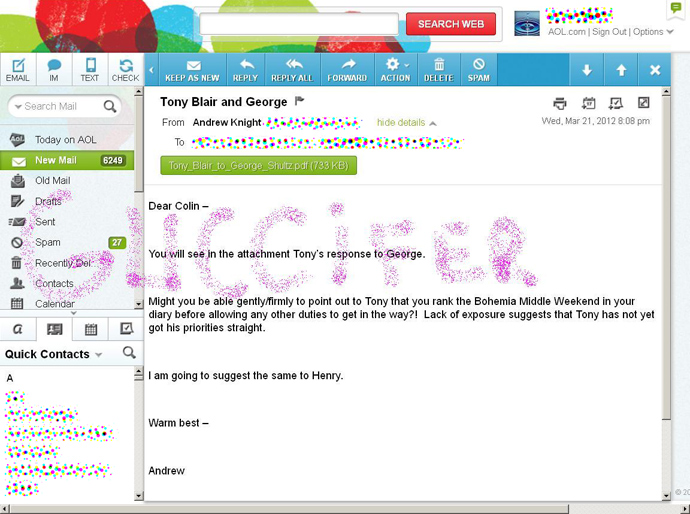
The few dozen emails forwarded to RT offer what appears on the surface to be little insight into Gen. Powell’s personal habits, but one email in particular referenced enough other well-known individuals that it couldn’t help but raise a red flag: in correspondence dated March 21, 2012, Knight asks Gen. Powell to have a few words with Mr. Blair about preparing for that year’s Bohemian Grove retreat, an annual gathering of the rich and powerful that has stayed so elusive for decades that countless documentaries and books have been written about the event — and journalists like Vanity Fair’s Alex Shoumatoff has even been arrested trying to infiltrate it.
According to the Sonoma County Free Press, the membership list of Bohemian Grove has included every Republican US president since 1923, as well as titans of the defense sector, banking tycoons and the CEOs of some of the largest corporations in the world. Spy Magazine linked the guest list with millionaires and billionaires from the likes of IBM and Bank of America, as well as leading politicians from Washington and abroad. And when Spy’s Philip Weiss snuck into the grove in 1989, he confirmed that attendees congregate at a shrine to an owl described as “40-foot-tall, moss-covered statue of stone and steel.”
Weiss adds that during the event’s middle weekend — the busiest session of the two-week gathering — he saw roughly 2,200 guests, all male, on the camp ground. Just last year, though, Powell was asked to ensure that Blair made it for that portion of the festivities.
“Might you be able gently/firmly to point out to Tony that you rank the Bohemia Middle Weekend in your diary before allowing any other duties to get in the way?!” writes Knight, a journalist who currently serves as a director of billionaire Rupert Murdoch’s multinational News Corp, in the latest leaked emails. “Lack of exposure suggests that Tony has not yet got his priorities straight.”
Also included in the email is a PDF attachment — unavailable to RT’s reporters — said to include a response of sorts from Mr. Blair to George Shultz, a longtime member of Washington’s elite that worked as secretary of state underneath US Pres. Ronald Reagan in the late 1980s while Gen. Powell held the position of national security advisor. In his own right, Shultz has been associated with the secretive Bohemian Grove group for decades.
In the leaked emails, Knight says to Powell, “I’m going to suggest the same to Henry,” likely implying that the journalist was determined to make sure Mr. Kissinger — who served as secretary of state under Pres. Nixon and Ford, and before that was national security advisor himself — was preparing to attend last year’s event.
Several sources online tie Powell, Shultz, Knight and Kissinger to Bohemian Grove, but Blair has only been long rumored to be an attendee at the annual soiree. In 2006, Blair did visit San Francisco, California — less than 100 miles away from the Grove’s gated campsite—where he dined with Shultz.
“There was speculation that Mr. Blair might even have been a guest at the male-only event, following in the footsteps of John Major and Prince Philip,” the UK’s Daily Mail reported at the time. “As it is, the Shultz party was said to have been littered with guests who had left the Grove in order to meet Mr. Blair.”
The San Francisco Chronicle also reported that summer that Prime Minister Blair was rumored to be attending the festivities, which have long become a topic of debate and discussion of conspiracy theorists, largely due to the sheer elusiveness of an event that attracts high-profile men of power with a strict embargo on admitting the media.
“Less than a mile from us there are millionaires, billionaires, people who control the world, control the central banks, build nuclear weapons. This is their summer playground,” Sonoma State University sociology professor Peter Phillips told RT in 2011. “We know for sure that Richard Nixon and Ronald Reagan sat down and had conversation about who was going to run for president when and they made a deal.” The Washington Post has even reported that a planning meeting for the Manhattan Project occurred at the grove in 1942, leading eventually to the creation of the atom bomb.
Since the list of attendees is kept under lock and key, only a confirmation from Powell or Blair themselves could verify whether or not the four star general did in fact convince the prime minister to attend last year’s event.
In his email to RT, Guccifer signed with the signature, “illuminati free world.”

Osama Bin Laden Death Myth Continues to Crumble as Seal Team Six Speaks Out

On May 2nd, 2011 President Barack Obama declared America’s greatest enemy, Osama Bin Laden,  dead after a Seal Team Six raid in the Pakistani town of Abbottabad. Almost immediately signs of deception began to show in the continuous saga to capture the man accused of being responsible for the 9/11 attacks.
WASHINGTON - U.S. President Barack Obama waves to visitors as he walks towards the Marine One for a departure at the South Lawn of the White House May 6, 2011 in Washington, DC. Obama was heading to Indianapolis to speak on a cleaner, safer, and more secure energy future, and to Fort Campbell, Kentucky to meet with the Navy SEAL team that executed the killing mission of Osama Bin Laden.  (Photo by Alex Wong/Getty Images)
WASHINGTON – U.S. President Barack Obama waves to visitors as he walks towards the Marine One for a departure at the South Lawn of the White House May 6, 2011 in Washington, DC. Obama was heading to Indianapolis to speak on a cleaner, safer, and more secure energy future, and to Fort Campbell, Kentucky to meet with the Navy SEAL team that executed the killing mission of Osama Bin Laden. (Photo by Alex Wong/Getty Images)
by Derrick Broze
Intellihub.com

March 27, 2013
In February Esquire magazine released an interview with a member of Seal Team 6 going by the alias, The Shooter. The Shooter claims to be the one who pulled the trigger and killed OBL. He told Esquire that he found Bin Laden in his room standing with “a gun in reach” and proceeded to shoot the purported Al-Qaeda leader twice in the head.
This was not the first account of the night raid on the Bin Laden compound. Mark Bissonette, wrtiting under the name Mark Owen, claimed to be the one to have pulled the trigger. In his book, No Easy Day, Bissonette tells a story that conflicts with The Shooters’ story.
 According to CNN another member of Seal Team 6 has come out to speak on the issue.
“Another member of the secretive SEAL Team 6, which executed the bin Laden raid, tells CNN the story of the Shooter as presented in Esquire is false. According to this serving SEAL Team 6 operator, the story is “complete B-S.”
They go on to say, “SEAL Team 6 operators are now in “serious lockdown” when it comes to “talking to anybody” about the bin Laden raid and say they have been frustrated to see what they consider to be the inaccurate story in Esquire receive considerable play without a response.”
 At present we are given 3 different interpretations of the events of that night. Is it possible all 3 could be false? Is it possible that who ever was killed that night was not Osama Bin Laden?
As early as 2001 we find reports of Bin Laden’s death. He had many kidney problems and was on a mobile dialysis machine.  On December 26, 2001,we find a Fox News report on the Pakistan Observer story that the Taliban had officially pronounced Osama Bin Laden dead earlier that month. The report goes on to say:
“He suffered serious complications and died a natural, quiet death. He was buried in Tora Bora, a funeral attended by 30 Al Qaeda fighters, close members of his family and friends from the Taliban. By the Wahhabi tradition, no mark was left on the grave.”
Other reports have surfaced over the years claiming Bin Laden to be dead as many as nine times. If Bin Laden was already dead, why pursue him and Al-Qaeda? The leader himself never claimed responsibility for the 9/11 attacks. In fact he vehemently denied being involved.
On September 28th, 2001 he released a statement saying, “I have already said I am not involved. As a Muslim, I try my best to avoid telling a lie. I had no knowledge… nor do I consider the killing of innocent women, children and other humans as an appreciable act.”
The Corbett Report lists a number of proclamations from government officials and researchers around the world claiming Bin Laden to be deceased prior to the official claims made by the United States government.
“On January 18, 2002, Pakistani President Pervez Musharraf announced quite bluntly: “I think now, frankly, he is dead.”
On July 17, 2002, the then-head of counterterrorism at the FBI, Dale Watson, told a conference of law enforcement officials that “I personally think he [Bin Laden] is probably not with us anymore,” before carefully adding that “I have no evidence to support that.””
 Former U.S. foreign intelligence officer Angelo M. Codevilla, a professor of international relations at Boston University, stated: ‘All the evidence suggests Elvis Presley is more alive today than Osama Bin Laden.’
 So if Osama Bin Laden never claimed responsibility for the attacks on 9/11/01 and likely died shortly after those tragic events, what in the world was the Seal Team Six chasing? Since Bin Laden was “buried at sea” with no autopsy being done it seems the best place to ask would be the team themselves. Unfortunately, several accidents have killed members of the elite team since that fateful night.
 In August 2011  22 Navy SEALs, some of whom belonged to Team 6, died after their helicopter was shot down by a rocket propelled grenade in Afghanistan. 28 year old SEAL Nicolas Checque died from a gunshot wound to head reported to have happened during the rescue of an American doctor.
Well why not ask the neighbors in Pakistan who were present during the raid?              
With a number of stories surfacing, a multitude of reports on Bin Laden being dead for some time now, and a tight lipped administration, it is very difficult to discern what exactly happened.
Was the whole Seal Team Six raid a hoax designed to boost support for Obama and further cement the myth of Osama Bin Laden? When looking at Mark Bissonette’s book we see that it  was apparently not vetted by the White House, the CIA, or the FBI. Does this represent a more true account of what actually took place? Or is this just another smoke screen?
WideShut speculates:
“Unlike Bradley Manning who is still rotting in a military cell somewhere for leaking classified military intel exposing America’s war crimes in Iraq, SEAL Team Six member “Owen” has in no way been punished for the tell all tale. Perhaps it’s a tall-tale used to legitimize the phony operation and to placate those who found the official story unbelievable, by offering an apparent truer account. A classic limited hangout. Even the most gullible among us must have a hard time believing they actually murdered the world’s most notorious terrorist, buried him at sea without any sailors present, and without having the body independently verified.”
With movies such a ZeroDarkThirty continuing to push the official line on OBL is it any wonder Americans have never heard this news? Check out these movie goers as they are informed on the topics.         
As the corporate controlled media attempts to get their story right those who are vigilant researchers can decide for themselves. Is there more to the story of the Seal Team 6 raids and OBL legend? Are we fighting a War on Terror based around lies?  Day by day we get closer to the truth and the empire of lies continues to crumble. Remain diligent and strive on towards freedom.

Sources:
^http://www.cnn.com/2013/03/26/world/bergen-who-killed-bin-laden/index.html
^http://www.foxnews.com/story/0,2933,41576,00.html
^http://www.dailymail.co.uk/news/article-1212851/Has-Osama-Bin-Laden-dead-seven-years–U-S-Britain-covering-continue-war-terror.html
^http://www.corbettreport.com/osama-bin-laden-pronounced-dead-for-the-ninth-time/
^http://wideshut.co.uk/another-seal-team-six-member-dead/
*****
Derrick Broze is a founding member of The Houston Free Thinkers. He writes for IntelliHub.com a popular independent news website. He can be heard on Orion Talk Radio, Local Live Houston and the upcoming Unbound Radio. Find his workatwww.theconsciousresistance.com and www.thehoustonfreethinkers.com

Patents

Patents

 In Defense of Innovation
The patent system is broken.
Patents may have been created to help encourage innovation, but instead they regularly hinder it. The US Patent Office, overwhelmed and underfunded, issues questionable patents every day. “Patent trolls” buy too many of these patents and then misuse the patent system to shake down companies big and small. Others still use patents to limit competition and impede access to new knowledge, tools, or other innovations.
It’s no wonder that small businesses and individual inventors find it almost impossible to make the patent system work in their favor, often leaving them without any defense against competitors with giant patent arsenals and litigation budgets.
Link to our infographic illustrating the pitfalls of the patent system
Below, we explain these problems in more detail, and why we believe it’s time to start over. Patents are supposed to help encourage the development and sharing of new technologies. In the coming months, we will be rolling out a set of new tools and techniques that we believe can help shift the patent system in the right direction.
EFF has always stood up for the freedom to tinker and the right to innovate. It’s time the patent system did the same. That's why EFF is launching a new campaign around patents—Patent Fail: In Defense of Innovation. Check back here for updates.
The Patent Office Can’t Stop the Flood of Bad Patents
The U.S. Patent Office, tasked with making sure patents are only granted to genuine inventions, is failing in this essential task. The result: a flood of bad patents on so-called inventions that are unoriginal, vague, overbroad, and/or so unclear that bad actors can easily use them to threaten all kinds of innovators. This is particularly true with software patents where inventions can be as abstract as a single-click to purchase a book or the idea of sorting your friends on Facebook into groups.
As we showcased in our Patent Busting Project, patents have been issued to basic technologies like:
  • Sending and receiving of streaming audio and video over the Internet
  • All VoIP systems
  • Real-time, multiple-player games 
  • Using a network to look up barcodes
Each of these serves as a cornerstone for a wide range of different technologies, and their overbroad claims, can easily be used to threaten the healthy competition we rely on to spur companies and technologists to experiment and out-innovate one other.
Some bad patents—like a patent on hyperlinks—have been struck down or narrowed, yet the process of fighting a bad patent is expensive and can take years. Many small business owners and innovators can’t afford a lengthy legal battle in the courts or at the Patent Office.
This leaves us with an untold number of bad patents, many of which represent 20 years of troublesome lawsuits, licensing fees, and stifled innovation. The people who most benefit from a system like this are patent attorneys, not inventors.
Patent Trolls Prey on a Broken System
Patent trolls have made the patent problem much worse. Patent trolls, entities that do not create, invent, or sell anything useful, instead acquire patents solely to threaten folks who might be using technologies related to the patents. Faced with the prospect of expensive litigation, the victims—including small businesses, independent developers, and nonprofits—are forced to pay exorbitant licensing fees rather than battle the issue in court.
We saw a striking example of this in 2011, when patent troll Lodsys launched an aggressive campaign against scores of app developers. Lodsys, a company devoted to acquiring patents and then threatening entrepreneurs who allegedly may infringe those patents (usually unknowingly), sent letters to many app developers accusing them of infringing patents dating back to the early 1990s. Those patents allegedly cover the in-app purchasing and upgrade functionality that companies like Apple and Google provide to developers as part of their operating system. Lodsys is the last in a long line of owners of the patents, far removed from—and likely providing little or no revenue to—their original inventor. Rather than fostering new inventions, patent trolls like Lodsys make a business out of aggressive lawsuits targeting developers.
Unfortunately, in the worst instances, small companies that can’t afford excessive licensing fees or a lengthy court battle just go out of business. But even those companies who can afford to take a license are faced with a pernicious tax on innovation.
Patents Put Pressure On Small Businesses, Nonprofits, and Independent Innovators
Faced with competitors eager to deploy giant patent arsenals as competitive weapons and patent trolls whose entire business model depends on extracting settlements, many small businesses feel obliged to fight back by amassing a few patents of their own—whether or not they really need the protection of a limited monopoly. In either event, it can cost between $5,000 and $20,000 per patent to obtain that protection, and take months or even years before an application is approved. And, obtaining a patent is far from a consumer-friendly process; a small business almost always has to hire a patent attorney to file the necessary paperwork if they hope to successfully receive a patent.
Having obtained the patent, however, a small business may be hard-pressed to assert or defend it in court. Patent litigation is an arduous, expensive process. Threatened by a troll or a competitor with a bigger budget, a business may be left with little choice but to pay out a licensing fee.
Ultimately, money spent to pursue unnecessary patents, and/or manage improper patent lawsuits amounts to a tax on companies, inventors and the economy. That money would be better spent on the valuable work of creating, producing, distributing, and promoting real innovations.
Innovators Are Already Abandoning the System 
Given all of these problems, it’s not surprising that many of today’s inventors are choosing to opt-out of the patent system. Software developers have led the way: indeed, many in the Free and Open Source Software (FOSS) movement argue forcefully that software patents should be abolished. FOSS developers are creating new software (and often giving it away for free) without trying to slap on legal protections for their work or stop others from using it and innovating on top of it.
While compelling, there are risks to this strong approach. Every piece of software released to the world without legal protections may leave open a door for someone else to attempt to patent the same technology (and may leave its creators more open to legal threats without a patent to wield defensively). Such a scenario may result in years wasted in litigation and the existence of a patent used as a sword to scare away further innovators
We Need a Real Solution
The system of patents as it currently stands, especially in the world of software, is unsustainable. We need a patent system that actually fosters innovation—or at least, one that gets out of the way. That's why EFF has launched Defend Innovation. This campaign suggests 7 proposals to address the most egregious problems with the software patent system and solicits the opinions of Interenet users for their thoughts about software patents and ideas for addressing the problem. Please visit the site and share your thoughts.

Shockingly Unshocking: 'Cybersecurity' FUD Has Been Big Big Business For Contractors

from the well,-look-at-that dept

Back when this hype about "cybersecurity" and "cyberwar" first started to hit the mainstream (early on, "cyberwar" was more common, but lately people focus on "cybersecurity"), we had an article which suggested that much of this really seemed to be about scaring up a panic for the sake of throwing money at defense contractors who wanted to charge crazy huge sums for "helping" with cybersecurity. And, as we noted, that push was leading to hundreds of millions of dollars in government contracts. It appears that, with cybersecurity FUD only getting bigger and bigger, the folks who are making out like bandits are all those defense contractors who are jumping in to fan the flames of FUD... and then taking our taxpayer money to "fix" the problem.

In that link above, they talk about Lockheed and Raytheon signing agreements with Homeland Security in which they get to "help" the government out by scanning email and other info collected by the NSA.
Under the program, critical infrastructure companies will pay the providers, which will use the classified information to block attacks before they reach the customers. The classified information involves suspect Web addresses, strings of characters, email sender names and the like.
None of this necessarily means that online attacks aren't a real threat... but I'd feel a lot more comfortable about where things were heading if there weren't a whole bunch of defense contractors gleefully rubbing their hands together as they scoop up more and more contracts while the FUD keeps spreading.

Defense Companies Cash in on Gov't Hyped 'Cyber-Security' Threat

Contractors predict "dozens" of private companies will soon have access to personal cyber data

- Lauren McCauley, staff writer
Amidst the daily hype over the increased threat of cyber attacks and enhanced need for internet security, private defense companies are cashing in on the new stream of defense dollars and trove of "classified" personal cyber data.
In the past two weeks, defense giants Raytheon and Lockheed Martin have signed contracts with Homeland Security's new cyber program.(Photo via American Board for Certification in Homeland Security) On Tuesday, the nation's top intelligence officials, testifying before the Senate Intelligence Committee, said that—for the first time—the threat of "computer-launched foreign assaults on U.S. infrastructure" outranked terrorism as the greatest worldwide threat.
As FireDogLake's DS Wright said, "now that the government has decided to stimulate the cybersecurity market Washington’s perennial parasites want a piece of the action."
Bloomberg News reports that within the past two weeks security contractors Lockheed Martin and Raytheon have signed an agreement under the Department of Homeland Security’s Enhanced Cybersecurity Services program providing new revenue streams and, more notably, unparalleled access to personal information classified as "U.S. government data."
Under President Barack Obama’s Feb. 12 cybersecurity executive order, DHS is now authorized to provide these contractors with "intelligence" gathered from commercial service providers, including personal internet records and email content. Bloomberg reports, "Obama and U.S. officials have said sharing classified threat data with companies is essential to help prevent cyber-attacks that could cause deaths or economic disruption."
According to their reporting, private contractors are heralding the dispersion of personal data under the protective umbrella of "security":
There could eventually be dozens of commercial service providers from a variety of industries, Bruce McConnell, cybersecurity counselor at the Homeland Security Department, said in an interview. “I think you will see other companies get into this business,” he said. [...]
The broader dissemination of cyber-threat data “in a controlled fashion is a good thing” and can “help assure that more companies have access to information for protecting their systems,” said Jessica Herrera-Flanigan, a partner with Monument Policy Group, a lobbying firm, and former Democratic staff director of the House Homeland Security Committee.
In addition to Raytheon and Lockheed, telecommunication companies CenturyLink and AT&T have also signed on as approved providers.
This news comes as the controversial Cyber Intelligence Sharing and Protection Act (CISPA) appears before Congress in three separate hearings this week about the Act and computer and network security, in general.
Civil liberties advocates are calling on their representatives to oppose the legislation, citing gross privacy violations and concerns over the "liberal" sharing of "very sensitive and personal information" between the government and private contractors.
_____________________

Stubborn Facts: The Gun Industry Employs Twice as Many Americans as GM (and That’s Just the Beginning)

will say again & again ! ...you cannot REASON with nit-wit banners !!!  &  lib KOOKS ?  & pretty much the "choosers" :o  you know the 1's  u cannot get 2 admit "they"  R glad "their" momma  was PRO 4 them !!!

Stubborn Facts: The Gun Industry Employs Twice as Many Americans as GM (and That’s Just the Beginning)

This article is part of a series on Guns in America that explores the use of firearms in our country and the debate over gun control. This is an editorially independent series sponsored by Tactical Firearms Training Secrets.
Guns are big business in America – so big, in fact, that despite making vastly more firearms than any other nation, the U.S. also is the largest importer of handguns, rifles and shotguns.
Demand is so high, that on top of the 6.54 million pistols, revolvers, rifles, shotguns and other firearms made in America in 2011, an additional 3.25 million were brought in from other countries, according to records of the U.S. Bureau of Alcohol, Tobacco, Firearms and Explosives. Domestic production grew by 1 million guns from the 2010 volume and imports increased by half a million.
U.S. Gun Industry Adds $33 Billion to Economy and Employs More Than 220,000 Americans
Source: ATF
All told, the firearms industry contributes more than $33 billion to the U.S. economy and supports about 220,000 jobs, according to the National Shooting Sports Foundation. That’s more than double the North American payrolls of General Motors, which President Barack Obama called “a pillar of our economy” when he explained the decision to provide more taxpayer aid to help save the car maker in 2009.
Unlike GM, which employs 101,000 people in North America and 213,000 worldwide, the gun business is divided up among thousands of little companies with just a few big, recognizable brands like Ruger, Smith & Wesson and Remington. Big or small, companies making and selling firearms and ammunition provide jobs in every state. (Click here for a snapshot of the top U.S. gunmakers.)
In Idaho, for example, Republican Gov. Butch Otter considers the firearms business “an important piece of the economy” in his state, which is home to one of the largest U.S. ammunition manufacturers — ATK Sporting — and has been attracting gun-related businesses away from other states that have enacted stricter gun controls or raised corporate taxes. Idaho’s firearms businesses generate $512.7 million in revenue and provide 3,116 jobs in the state, according to the NSSF.
“Our idea of gun control in Idaho is to use two hands,” Otter joked during an interview with TheBlaze. “The gun industry doesn’t need to be afraid of Idaho.”
Still, politicians in states such as New York, which recently passed what Democratic Gov. Andrew Cuomo called “the toughest gun laws in the nation,” often make a distinction between support for gun control and opposition to firearms businesses and gun owners.
Cuomo has said he doesn’t think New York’s new laws will have a “significant impact” on Remington Arms, which was founded in Ilion, New York, and he has stated several times that the gun control measures he signed into law this year are “not about hunters, sportsmen or legal owners who use their guns appropriately.”
The NSSF estimates that New York-based firearms businesses contribute more than $1.2 billion to the economy and employ almost 8,000 New Yorkers — jobs the state has fought to protect with $5.5 million in subsidies and grants since 2007, according to the Maine Center for Public Interest Reporting. Those subsidies were approved prior to Cuomo taking office last year.
As other states consider following New York’s lead on gun control and the U.S. Congress debates stricter federal measures  following the Sandy Hook Elementary School massacre in Newtown, Connecticut, the desire to prevent such tragedies will have to be weighed against the popularity of firearms among Americans and the potential impact on an industry that has been growing steadily, even through the recent recession.

Creating Jobs

The number of employees in the gun industry grew by more than 10% from 2008 to 2010, adding about 17,000 jobs, according to the NSSF. During the same period, the overall number of Americans with jobs declined roughly 6%.
The economic value created by the firearms industry also is increasing steadily, from $19.2 billion in 2008 to $27.6 billion in 2010 and reaching a record $33 billion last year, according to NSSF calculations based on wages and salaries.
Federal and state governments also benefit directly from the $5 billion in tax revenues the industry provides, including $2.54 billion in business taxes and $460 million in excise taxes to the federal government, plus $2.1 million in state business taxes, according to the NSSF.
The following chart shows the 10 states with the most jobs and revenue from the firearms industry:

ECONOMIC CONTRIBUTION OF ARMS & AMMUNITION INDUSTRIES, 2011

State Jobs
Avg Wages Total Wages  Output  Fed Excise Tax


California 24,022 $51,134 $1,228,358,565 $3,798,233,534 $58,216,101
Texas 13,163 $47,381 $623,664,039 $2,213,737,414 $33,930,289
Connecticut 8,275 $65,592 $542,772,009 $1,819,043,262 $27,880,752
Massachusetts 8,399 $62,679 $526,456,218 $1,702,731,196 $26,098,019
Florida 11,952 $39,278 $469,551,480 $1,440,228,643 $22,074,603
New York 7,758 $58,118 $450,863,820 $1,266,684,251 $19,414,661
Oregon 7,825 $44,725 $349,977,078 $1,176,871,073 $18,038,081
New Hampshire 5,932 $54,927 $325,850,776 $1,151,014,666 $17,641,776
Illinois 6,746 $52,905 $356,893,951 $1,108,844,816 $16,995,432
Pennsylvania 7,353 $46,624 $342,844,737 $1,089,080,524 $16,692,502
Source: NSSF

The economic value calculated by the NSSF doesn’t include sales of hunting and shooting accessories. A separate analysis by Congressional Sportsmen’s Foundation found that America’s 37.4 million hunters and fishers spent $90 billion in 2011 on equipment ranging from boats and bait to guns and land for their sport of choice. Hunters and other sportsmen also have provided nearly $1 billion in tax revenue that supports federal wildlife conservation programs.
Private citizens are the driving force behind the booming gun business, with 47% of American adults confirming in an October 2011 survey that they have a gun in their home or elsewhere on their property — the highest level in two decades, according  Gallup.
Interest in hunting and shooting sports is growing, especially among younger generations, according to the National Shooting Sports Foundation, which estimates that sales of firearms and ammunition for hunting and shooting sports rose to a record $6 billion last year.
While dwarfed by mega-companies like ExxonMobil, which generated more than $450 billion in revenue last year, the sporting firearms industry’s revenue is on par with other members of the Fortune 500, including Hershey, Ryder and Avis. In terms of employment, the firearms industry would rank 21st on the Fortune 500 list, one notch ahead of GM, if all the independent gun-related businesses were rolled up into one.
When looking just at the businesses tracked by the ATF, America’s gun industry includes 5,441 firearms makers, 1,895 manufacturers of ammunition, 48,676 dealers, 7,075 pawn brokers, 59,227 collectors and 811 importers. Just looking at the dealers, firearms outlets outnumber car dealerships almost 3 to 1 and outnumber Starbucks stores by more than 4 to 1.

Small, Independent Businesses

The far-flung nature of the gun industry obscures the role the industry plays in the economy, said Jake McGuigan, the director of government relations for the National Shooting Sports Foundation.
“There are a lot of smaller manufacturers that support a very large base of suppliers,” McGuigan said. “These kinds of small, independent businesses are really the backbone of the U.S. economy, not the GMs, Wal-Marts and other big businesses.”
The relatively small-scale operations in the U.S. firearms industry are also highly sensitive to the regulatory and economic landscape, as well as pressure from their loyal customers who tend to be extremely opposed to increased gun control measures, McGuigan added.
A 2011 ATF report noted that the number of federally licensed firearms businesses dropped by more than half from “a high of more than 286,000 in April 1993 to a low of 102,020 in March 2000, likely due in part to the increase in license fees and requirements to comply with state and local law implemented in 1993 and 1994.”
The decrease occurred after the U.S. Congress passed the Violent Crime Control and Law Enforcement Act of 1994 – the so-called federal assault weapons ban. Gun dealers saw the biggest declines, falling to 48,676 by 2011 after peaking at 248,155 in 1992, according to the ATF. Licensed ammunition manufacturers also started disappearing after 1994, with 1,895 in 2011 compared with 6,068 in 1994 and a peak of 13,318 in 1983, ATF records from 1975-2011 show.
U.S. Gun Industry Adds $33 Billion to Economy and Employs More Than 220,000 Americans
Tanya Miller was married in January 2013 at a shooting range. Photo Credit: AP.
Through it all, however, the number of firearms manufacturers kept growing, reflecting the strength of consumer demand.  After expanding by a hundred or more businesses each year for most of the past three decades, the number of licensed firearms manufacturers shot up in recent years to 5,441 in 2011 from 2,959 in 2009 and 2,144 in 2004, when the federal assault weapons ban expired.

Most Guns Made in U.S. Are Sold in U.S.

The disproportionate domestic demand for guns is another key difference between the firearms industry and many other American manufacturers.
Comparing again with GM, the carmaker sells only about 30% of its vehicles in the United States, while just about every gun made by a U.S. company is sold in America. Of the 6.54 million guns made in 2011 (up from 5.5 million in 2010), and only 296,888 were sold in export markets (up from 241,977 in 2010), ATF records show.
In all, almost 9.4 million new guns were sold in America in 2011 when domestic and imported firearms are combined, an increase from 8 million in 2010. After adding in resales of guns made in prior years, which the Small Arms Survey estimated at 1.5 million for 2010, the total number of guns sold in a given year gets close to 11 million.
The 25-year survey estimated that 2,228 U.S. companies produced more than 106 million firearms from 1986-2010.
U.S. Gun Industry Adds $33 Billion to Economy and Employs More Than 220,000 Americans
Source: ATF

Other highlights from the Small Arms Survey’s findings include:
  • From 1980 to 2010 the industry went through severe business cycles, with reported production levels both declining and rising by 50 per cent within very short time periods, possibly posing severe challenges to the management of firearms firms.
  • The majority of producers are relatively small in scale, with only a small percentage of firms—between 1.3 and 7.5 per cent, depending on firearms category—producing more than 100,000 weapons per year.
  • Production of firearms for domestic, non-military use is highly cyclical, particularly for the pistol segment of the market, having oscillated between 3 million and 5.5 million firearms per year since 1980.
  • The composition of the firearms supply sources has changed markedly. In 1989 about 80% of firearms came from domestic sources; this figure fell steadily to between 55% and 65% in the late 2000s.

Foreign Threats

While the domestic firearms industry regained some ground lost to foreign competitors in recent years, the volume of imported firearms remains near record levels, led by Brazil with 846,610 firearms sold in the U.S. in 2011, followed by Austria (522,638), Germany (313,528), Italy (254,901) and Russia (216,293), according to ATF records.
Foreign-made firearms captured more than 40% of new firearms sales in 2009, though the market share slipped back to 34% in 2011 as domestic production ramped up.
When domestic and imported firearms are combined, the supply of guns available for sale in the U.S. rose to a ratio of 2.7 new firearms for every 100 people, compared with 2.7 firearms per 100 people in 2008 and 2.3 guns per 100 people in 1989, according to the Small Arms Survey. When all of the roughly 270 million existing guns are included, the ratio is closer to 90 firearms for every person in America.
The kind of demand from the general populace to support sales at those levels — along with the jobs, revenue and taxes generated by the firearms industry — suggest to firearms advocates like Idaho’s Gov. Otter that the push for new gun control laws won’t destroy the firearms industry.
“I think it’s here to stay,” Otter said.
Here are the other pieces in our ongoing Guns in America series (running every Tuesday) sponsored by Tactical Firearms Training Secrets: