Welcome to the fourth installment in my examination of the final two films written by famed scribe
Paddy Chayefsky. In the first two installments of the series (which can be read
here and
here) I broke down the underlining high weirdness in the film
Network, with a special emphasis on the disembodied voice
Howard Beale
(the mad prophet of the airwaves) claims to have heard one night.
Essentially I argued that this voice was an aspect of a transformation
Beale's consciousness is undergoing, a transformation that has granted
him illumination and madness simultaneously.
 |
| Howard Beale |
In the
third installment of this series I began to examine Chayefsky's final film,
Altered States, easily one of the most mindbending examinations of
altered consciousness that Hollywood has ever dared give big bucks too. The peculiar views concerning mental illness presented in both films (
Altered States's lead character, Edward Jessup [
William Hurt], becomes interested in medically induced altered states of consciousness after his work with
schizophrenics
leaves him pondering whether their hallucinations are glimpses into a
different type of reality) was addressed in that installment as well as
the highly symbolic and
synchronicistic nature of the names of the film's major characters.
For this installment I'd like to begin breaking down
Altered States's
twilight language-laden
plot line but before doing so a bit more background in the film is
needed to put it into perspective. As many fans are undoubtedly aware,
Altered States
(both the novel Chayefsky originally wrote as well as the film) was
chiefly inspired by the peculiar experiments of psychonaut
John C. Lilly. Lilly is chiefly remembered in this day and age for his incredible work with dolphins (which inspired another film,
Day of the Dolphins), but he was also one of the first scientists to seriously investigate
sensory deprivation and, eventually,
entheogens. Such research inevitably brought him to the attention of the
US intelligence community, which pursued a vast array of fringe sciences at the onset of the
Cold War, a prospect Lilly would try to disassociate himself from professionally time and again.
"In 1954 Lilly began trying to isolate the operations of the brain,
free of outside stimulation, through sensory deprivation. He worked in
an office next to Dr. Maitland Baldwin, who the following year agreed to
perform terminal sensory deprivation experiments for ARTICHOKE's Morse
Allen but who never told Lilly he was working in the field. While
Baldwin experimented with his sensory-deprivation 'box,' Lilly invented a
special 'tank.' Subjects floated in a tank of body-temperature water,
wearing a face mask that provided are but cut off sight and
sound. Inevitably, intelligence officials swooped down on Lily again,
interested in the use of his tank as an interrogation tool. Could
involuntary subjects be placed in the tank and broken down to the point
where their belief systems or personalities could be altered?
"It was central to Lilly's ethic that he himself be the first subject of
any experiment, and, in the case of the consciousness-exploring tank
work, he and one colleague were the only ones. Lilly realized
that the intelligence agencies were not interested in sensory
deprivation because of its positive benefits, and he finally concluded
that it was impossible for him to work at the National Institute of
Health without compromising his principles. He quit in 1958.
"Contrary to most people's intuitive expectations, Lilly found sensory
deprivation to be a profoundly integrating experience for himself
personally. He considered himself to be a scientist who subjectively
explored the far wanderings of the brain. In a series of private
experiments, he pushed himself into the complete unknown by injecting
pure Sandoz LSD into his thigh before climbing into the
sensory-deprivation tank. When the counterculture sprang up, Lilly
became something of a cult figure, with his unique approach to
scientific inquiry --though he was considered more of an outcast by many
in the professional research community.
"For most of the outside world, Lilly became famous with the release of the popular film, The Day of the Dolphin,
which the filmmaker acknowledge was based on Lilly's work with dolphins
after he left NIH. Actor George C. Scott portrayed a scientist who,
like Lilly, loved dolphins, did pioneering experiments on their
intelligence, and tried to find ways to communicate with them. In the
movie, Scott became dismayed when the government pounced on his
breakthrough in talking to dolphins and turned it immediately to the
service of war. In real life, Lilly was similarly dismayed when Navy and
CIA scientist trained dolphins for special warfare in the waters of
Vietnam."
(The Search for the "Manchurian Candidate", John Marks, pgs. 152-153)
 |
| Lilly |
By the 1970s Lilly had also become involved with the peculiar crowd that had gathered around the notorious medical and
parapsychological researcher (and some time US intelligence asset)
Andrija Puharich, groundbreaking physicist
Jack Sarfatti, and legendary stage magician
Uri Geller (among others). While this group, which included virtually every major psychonaut from the
counterculture
as well as a host of other rogue scientists and artists, has rarely
been addressed in mainstream histories they would have a shocking
degree of influence on popular culture for decades to come. Apparently
one of the chief bonds many members of this clique shared was a belief
that they had been contacted by some type of nonhuman intelligence.
"In the 1970s, however, when Sarfatti was still developing the theories
that would later make him famous in the world of physics, he was
hanging out with Puharich, Uri Geller, and other notables in the
hothouse atmosphere of radical thinking about science, communication,
information, and psychic phenomena. Sarfatti claims to have introduced
Geller to Jacques Vallee --the French UFO researcher of Passport to Magonia fame --and both to Steven Spielberg. Spielberg would later produce Close Encounters of the Third Kind,
using Vallee as a technical adviser... This same nexus of Puharich and
Sarfatti is said to have influenced Gene Roddenberry in his
development of the Star Trek television series. And behind all
of this is the hugely influential figure of Ira Einhorn, usually
referred to as 'the Unicorn' after the translation of his surname into
English.
"For a while, Einhorn served as Sarfatti's literary agent (as he did with Puharich to get Beyond Telepathy
reprinted). Einhorn was active in New Age pursuits, a kind of P. T.
Barnum of hippiedom, making connections and networking, bringing
together people he felt should be brought together to create a kind of
explosion of new thinking that cut across traditional disciplinary
lines. So you had filmmakers talking this physicist, psychics talking to
soldiers, and spies talking everybody. Seminars were held, books and
papers published. People like science-fiction author Philip K. Dick (who
was discovered by Hollywood in the 1990s, unfortunately after his death) and Robert Anton Wilson could be found in kaffeklatsch
with Timothy Leary, John Lilly, Saul Paul Sirag, and assorted G-men.
There was a sense among these people that an event of momentous
importance to the planet was imminent, and that they were in the
forefront of whatever it was going to be.
"Many of them had already had paranormal contacts of some sort (a list
that includes Sarfatti, Wilson, Dick, Geller, Puharich, and many, many
others) and were certain that these contacts signaled the beginning of a
more overt presence by these beings. These were people with government
grants and contracts at the highest levels of the US military... And not
only the US military. The Soviets were also involved, if only the
peripherally. And much of this was going on relatively un-noticed by the
American people at large. Although they had seen Uri Geller bend spoons
on national television, and had read the stories and novels by Dick and
Robert Anton Wilson, for instance, they had no idea that all this
activity was being produced by a loosely-organized group of
intellectuals operating half-in, half-out of the mainstream... And
half-in, half-out of the US government."
(Sinister Forces Book III, Peter Levenda, pgs. 245-246)
 |
| Puharich (top) with the Pope and Sarfatti (bottom) |
Lilly also claimed to have experienced some type of paranormal contact, apparently.
"In his book on the Israeli psychic Uri Geller, Dr. Andrija Puharich, a
neurologist of some professional reputation which he is presumably not
eager to destroy by going out on a limb, asserts that both he and Geller
have frequently received communications from extraterrestrials...
"Dr. John Lilly, internationally known psychoanalyst, neuro-anatomist,
cyberneticist, mathematician and delphinologist, gently hints that he
has also received such communications. Academia, relieved that Dr. Lilly
is only hinting and not saying it outright, happily ignores the
potential breakthrough."
(Cosmic Trigger Volume I, Robert Anton Wilson, pg. 79)
This is probably more interesting in the context of the film
Network rather than
Altered States
as the disembodied voice that speak to Howard Beale is so central to
the plot line of that film. Was this encounter, which echoes some of the
metaphysical trappings of the day (as noted in
part two of this series), based upon the claims made by some individuals affiliated with the Puharich group?
It's certainly a compelling possibility but I've been unable to
determine when exactly Chayefsky began delving into this type of high
weirdness. He likely began working on the original novel version of
Altered States
sometime around 1976, a point when this loose confederation of
intellectuals was still very much in contact with one another.
I've been unable to find anything indicating that Chayefsky had any
association with anyone in this network other than Lilly (though
Steven Spielberg was reportedly approached to direct
Altered States at one point, an allegation I've been unable to confirm) though it's interesting to note that director
Ken Russell went on to direct a TV movie in 1996 called
Mindbender
that was based on the life of Uri Geller and reportedly depicted the
efforts of an American scientist (likely based upon Puharich) to bring
the famed Israeli psychic over to the United States. Unfortunately,
there is very little information available on this film on the net and
I've been unable to track a copy down.
Altered States certainly incorporated more than a few theories
that this network had explored, however, and there are several parts
of the film that seem to have been inspired partly upon real-life
experiences of several of the above-mentioned figures. This will of
course be addressed in much greater depth later on as we come to such
points. Those curious about the Puharich group are advised to check out
my article on
The Nine as well as an
excellent resent piece Christopher Knowles has written on said group and topic. Two installments (which can be found
here and
here) in
my series concerning the US Intelligence community's involvement with
the UFO crowd also address the Puharich network at length.
But anyway, let us start in on the film.
Altered States opens just as Jessup has begun to experiment with a university
isolation tank with the assistance of his good friend, Arthur Rosenberg (
Bob Balaban). The
opening sequence depicts Jessup suspended in such a tank while
voiceover narration (Arthur) recounts his discovery of the device and
his initial venture into it in April of 1967. From there the film moves
into its opening credit sequence, which features the much celebrated
"sliding" opening titles.
 |
| Arthur |
When the film picks up again Jessup is emerging from the isolation tank
and already buzzing on about the possibilities. As he and Arthur depart
from the facility he discusses the lack of quality research into altered
states, dismissing the bulk of it as "radical hip stuff." He then goes
on to name drop three researchers who impressed him: Tart, Ornstein and
Deikman.
These are most likely references to
Charles Tart,
Robert Ornstein and
Arthur Deikman.
All three men are either psychiatrists or psychologists who delved into
both altered states of consciousness as well as alternative religions.
Tart studied the works of
Gurdjieff as well as
Buddhism and Eastern techniques of mediation. Ornstein heavily incorporated the
Sufism of
Idries Shah into his
counterculture-era work. Deikman also studied under Shah as well trying out the zen mediation of
Suzuki Roshi. Both Tart and Deikman also become involved in the
Human Potential Movement, Tart with the
Institute of Noetic Science and
Monroe Institute (he also seemingly had some type of involvement in
SRI's legendary
remote viewing experiments, a topic I wrote much more on
here) while Deikman studied at
Esalen
during the 1960s. While I've been unable to confirm if Tart, Ornstein
or Deikman were involved in the Puharich network it would hardly be
beyond the realm of possibility, Tart being an especially likely
associate of said network. But I digress --Back to the film.
 |
| Tart (top), Ornstein (middle) and Deikman (bottom) |
Things really get going when the action moves to a party at the
Rosenberg residence amongst academics. The festivities are in full 1960s
glory (the
Summer of Love was just beginning to unfold in April of 1967, after all) with the
Doors' "
Light My Fire" (a most appropriate selection considering the Doors took their name from
Huxley's
The Doors of Perception ,
one of the first serious works on entheogens) playing in the background
while Arthur and several other academics discuss Jessup and his
flakiness amongst puffs off a joint. One particular individual
involved in the rotation is Emily (
Blair Brown), the woman Jessup will ultimately marry, who listens in with stoned fascination.
 |
| Emily with party favorite |
The doorbell rings and Mrs. Rosenberg opens it as Emily looks on. This
leads to the film's first striking use of hallways, in this case
framing Jessup, from the point of view of Emily, against a backdrop of
white from which his distorted figure emerges. It gives the effect of
Jessup stepping in from another world. Conversely Emily looks, from
Jessup's point of view, like an almost angelic figure against the
backdrop of a stain windowpane featuring a peculiar design I cannot
quite make out.
Director Ken Russell continues to use hallways, doorways and other
entranceways as a visual cues throughout the film for when significant
moments are upon us. This is a most apt visual for such things
symbolically represent the threshold between the known and unknown.
"Gateways symbolize the scene of passing from one state to another, from
one world to another, from the known to the unknown, from light to
darkness. Doors open upon the mysterious, but they have a dynamic
psychological quality for they not only indicate a threshold but invite
us to cross it. It is an invitation to a voyage into the unknown.
"The passage to which they invite us is more often than not, in the
symbolic sense of the term, a passage from the ream of the profane
to that of the sacred."
(Dictionary of Symbols, Jean Chevalier & Alain Gheerbrant, pg. 422)
And indeed, the relationship between Emily and Jessup takes them to the
edge of the sacred and the profane with the line frequently being
blurred between the two.
The relationship that will develop from this first meeting between
Emily and Edward Jessup is crucial to the film's broader story arc on
multiple levels. Initially it is a surreal, dreamlike encounter in
which both characters develop an immediate rapport for one another as
the movie drifts out of the fog. By the early evening they've already
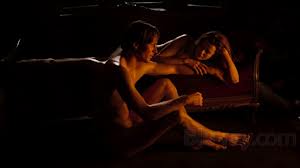
departed back to her apartment where they engage in what is nearly
transcendental sex for Edward upon the sofa. Jessup tells her of
religious imagery that enters into his mind as the act reached its
conclusion and goes on to recount the visions he had as a child
of angels, saints, and so forth. He then confesses to her that the
visions stopped after his father's death from a protracted struggle with
cancer when Edward was 16, an event he has not divulged to anyone for
many years.
Jessup's discovery of the isolation tank and his chance encounter with
Emily start him upon a journey that will not be completed until several
years later and which will bring all those around him to the very
extremes of human consciousness. Thus, the quasi-mystical trappings of
Jessup's first meeting with Emily are most justified and are even
reminiscent of one of the most curious occult episodes of the 20th
century:
Jack Parsons' first encounter with
Marjorie Cameron.
 |
| Parsons |
While I'm sure many of you are aware of this episode here is a brief run
down for the uninitiated: Parsons was a brilliant rocket scientist and
co-founder of the
Jet Propulsion Laboratory in the 1940s. He was also an occult adept involved in
Aleister Crowley's
Ordo Templi Orientis and regularly corresponded with the Great Beast. Sometime around 1945 he also became involved with
L. Ron Hubbard (yes, the future founder of the
Church of Scientology),
a relationship he would live to regret. But before their falling
out Parsons and Hubbard performed a bizarre, Crowley-derived ritual
known as the
Babalon Working.
"Parsons began his magical operation. Known as the Babalon Working, its
aim was to attract the Southern Californian equivalent of the Great
Whore of Babalon. His main weapon was the OTO VII Degree rite, usually
practiced alone. But in this case, Parsons asked Hubbard to assist as
scryer, rather in the manner of Dee and Kelley. With Prokofiev's Violin Concerto
hammering in the background, Parsons worked himself into a magical
state, while Hubbard described what was taking place on the astral
plane, going through a repertoire of talismans, amulets, sigils and
signs, and rituals like the Invocation of the Bornless One, and the
Banishing Ritual of the Pentagram.
"Not much happened. A windstorm kicked up. A table lamp mysteriously
smashed in the night. A strange phantom figure attacked L. Ron. There
were raps and a weird metallic, insect-like voice. Then she appeared.
"When the two magicians returned from a mysterious interlude in the
Mojave Desert... Marjorie Cameron had descended on Parsons' bohemian
household. His Scarlet Woman was willing -- impatient even -- to throw
herself into the magical and sexual workings Parsons had in mind. She
had fiery red hair, slant green eyes, was talented and intelligent; but
it was her obstinate and perverse character that convinced Parsons his
had magic worked. He wrote to his magical father telling him so. Crowley
replied that he was particularly interested in what he had to say about
his 'elemental'..."
(Turn Off Your Mind, Gary Lachman, pgs. 227-228)
 |
| Marjorie Cameron |
I know linking the first encounter between Jessup and Emily to the
Parsons/Cameron episode is a bit of a stretch but its at least possible
Chayefsky was aware of this bizarre incident. Certainly several
individuals involved with the above-mentioned Puharich/Geller network
were aware of it (
Robert Anton Wilson briefly describes it in his 1977 work
Cosmic Trigger Volume I: Final Secrets of the Illuminati,
for instance) while Cameron herself had become a very minor
counterculture icon after her involvement with Parsons and later film
work (including an appearance in legendary occult director
Kenneth Anger's
Inauguration of the Pleasure Dome).
Beyond this, the circumstances of both meetings are somewhat similar.
Parsons first encountered Cameron after performing a transcendental
magical working while Jessup meets Emily at a party after his first
experience in an isolation tank and his decision to begin experimenting
with it. And Emily is certainly a visual
Scarlet Woman,
with fiery red hair of her own (though her eyes do not appear to be
green in this film). Indeed, red hair in and of itself is symbolically
loaded on several levels, but especially because of its association with
the mythological Scarlet Woman. I've been unable to determine whether
or not the Emily character was described as having red hair in the novel
but it certainly seems like a deliberate choice in the film version.
Sex between Jessup and Emily at times takes on aspects of a religious
encounter, at least for Jessup (Emily describes it as "being harpooned
by some raging monk in the act of receiving God"), which is certainly
in keeping with the ritualistic sexual acts Parsons embarked upon with
Cameron.
Finally, the encounter with Emily (as well as the isolation tank) seems
to awaken Jessup's slumbering spirituality. His first sexual
encounter with Emily stirs memories of his religious visions as a child
as well as a confession of their connection to his father's death. And
shortly after his relationship with Emily begins Jessup has one of
what will be several highly allegorical hallucinations in an
isolation tank. But not only is this particular hallucination laden with
religious symbolism, but it also seems to allude to both Jessup's past
and future.
 |
| the beginning of the hallucination |
It begins with what are presumably images of Jessup's father and his
death from cancer. Jessup is seen dropping a Bible, then a piece of
cloth with the face of Jesus on it falls from the face of Jessup's
father and bursts into flames. A flaming cross then appears before the
chest of Jessup's father as he sits upon his hospital bed.
From there Jessup himself is depicted with the head of a seven-eyed
lamb, crucified upon a cross. The lamb has of course long been
associated with Christ himself in Christian symbolism while the
seven-eyed lamb head Jessup adopts during this hallucination is taken
directly from the
Book of Revelations.
In general, the number seven is highly significant in Christian
mythology, but especially concerning the highly allegorical Book of
Revelations.
"By Sumerian times seven (with some of its multiples) had become a
sacred number and it was certainly the darling child of Biblical
numerology. Since it corresponded to the number of the planets, it
always characterized perfection... if not the godhead itself. The week
comprises seven days in memory of the length of Creation... If the
Passover feast of unleavened bread lasted seven days..., this was
undoubtedly because the Exodus itself is regarded as a new creation and
one which brought salvation.
"Zechariah... speaks of the seven eyes of God. Then there are the
groups of seven in the Book of Revelation. The seven lamps which are the
seven spirits of God signify the spirit of God in its fullness...; the
seven letters to the seven churches signify the Church as a whole; and
there are the seven trumpets, cups and so on. All these herald the final
accomplishment of God's will in the world.
"This is why seven is also the devil's number, since Satan, 'the ape of
God,' always strives to imitate God -- hence the beast with seven
heads... However, the visionary of Patmos more usually kept half seven,
three and a half, for the powers of evil, thereby showing that the
designs of the Evil One were doomed to failure...
"Seven is the key to St. John's Gospel -- seven weeks, seven miracles,
seven references to Christ as 'I am.' Seven recurs forty times in the
Book of Revelation in groups of seven: Seals, trumpets, cups, visions
and so on. The book is composed in series of seven. The number also
denotes the fullness of a period of time, such as Creation in Genesis;
the ending of a period of time, and era or a phase; the plenitude of
the graces given to the church by the Holy Spirit."
(Dictionary of Symbols, Jean Chevalier & Alain Gheerbrant, pg. 862)
 |
| the seven-eyed lamb (top) and Jessup with its head( bottom), crucified |
Seven is also the number of years that will pass before Jessup will
begin his experiments concerning consciousness again after his marriage
to Emily and tenure at
Harvard
consumes nearly a decade of his life. At the time of this hallucination
Emily has not yet asked Jessup to marry her, though the visions allude
to this as well as Jessup's eventual ventures into Mexico in search of
the First Self (the entrance shape of the cave in which Jessup
participates in a shamanistic entheogen ritual with a native tribe is
first shown in this hallucination and will continue to appear to Jessup
throughout the movie).
 |
| the cave, the entrance of which first appears in he first depicted hallucination of Jessup's |
Jessup also witnesses an actual seven-eyed lamb have it's throat slit
with a sacrificial knife, its blood spilling upon what appears to be
some type of holy book depicting the lambed-head Jessup upon his cross
and a seven-eyed lamb head above it. I interrupt this as Jessup's
sacrifice of his old self in search of the First Soul. Later on he
witnesses a red dot that a shaman later describes as the first step
"into the void." From there the above-mentioned cave image appears.
Finally Jessup witnesses himself sans the lamb head violently engaged in
coitus (rape?) with Emily, who lays spread-eagle upon what appears to
be an altar. I suppose this is a reflection upon both the ritual and
suffering their marriage bring.

This hallucination is clearly still on Jessup's mind when he encounters
Emily shortly thereafter. Jessup is in the midst of his research
concerning schizophrenics. Emily has just been accepted onto the faculty
of Harvard, a post Jessup to will soon hold. She asks him for marriage,
a proposition Jessup tries half-heartedly to talk her out of. He drifts
into some ramblings about the possibilities that schizophrenia
is simply an attempt to transform the self (some such as
Peter Levenda
have argued that forms of insanity such as schizophrenia are the result
of failed attempts at a shamanistic transformation not unlike the one
Jessup is beginning to go through) before accepting Emily's proposal,
perhaps due to a subconscious realization that she is the only thing
that will ultimately spare him from the fate of his subjects.
After Jessup accepts Emily's marriage proposal the film flashes forward
seven years, when Arthur and his family have once again encountered
Jessup and Emily in San Francisco. It is soon revealed that Jessup has
asked Emily for a divorce. When Arthur asks him about this Jessup
bemoans the politics of academia, his lack of legitimate research and
ultimately sums up his relationship to Emily as thus:
"Emily's quite content to go on with this life. She insists she's in
love with me - whatever that is. What she means is she prefers the
senseless pain we inflict on each other to the pain we would otherwise
inflict on ourselves. But I'm not afraid of that solitary pain. In fact,
if I don't strip myself of all this clatter and clutter and ridiculous
ritual, I shall go out of my fucking mind."
In other words, the journey that he began seven years ago will not leave
him be until he has finished it. With out realizing it, Jessup has
already signed up for the second leg of this journey: a trip to Mexico
to observer an ancient shamanistic vision quest performed by the
fictional Hinchi tribe. In the fifth installment in this series I shall
pick with Jessup's Mexican expedition. Stay tuned.

 Posts
Posts








 USA Today – by Brad Heath


