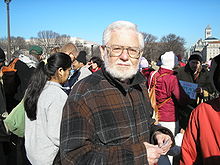
In the course of his professional life in the world of national
security Edward Snowden must have gone through numerous probing
interviews, lie detector examinations, and exceedingly detailed
background checks, as well as filling out endless forms carefully
designed to catch any kind of falsehood or inconsistency. The
Washington Post
(June 10) reported that “several officials said the CIA will now
undoubtedly begin reviewing the process by which Snowden may have been
hired, seeking to determine whether there were any missed signs that he
might one day betray national secrets.”
Yes, there was a sign they missed – Edward Snowden had something inside him shaped like a conscience, just waiting for a cause.
It was the same with me. I went to work at the State Department,
planning to become a Foreign Service Officer, with the best – the most
patriotic – of intentions, going to do my best to slay the beast of the
International Communist Conspiracy. But then the horror, on a daily
basis, of what the United States was doing to the people of Vietnam was
brought home to me in every form of media; it was making me sick at
heart. My conscience had found its cause, and nothing that I could have
been asked in a pre-employment interview would have alerted my
interrogators of the possible danger I posed because I didn’t know of
the danger myself. No questioning of my friends and relatives could have
turned up the slightest hint of the radical anti-war activist I was to
become. My friends and relatives were to be as surprised as I was to be.
There was simply no way for the State Department security office to
know that I should not be hired and given a Secret Clearance.
1
So what is a poor National Security State to do? Well, they might
consider behaving themselves. Stop doing all the terrible things that
grieve people like me and Edward Snowden and Bradley Manning and so many
others. Stop the bombings, the invasions, the endless wars, the
torture, the sanctions, the overthrows, the support of dictatorships,
the unmitigated support of Israel; stop all the things that make the
United States so hated, that create all the anti-American terrorists,
that compel the National Security State – in pure self defense – to spy
on the entire world.
Eavesdropping on the planet
The above is the title of an essay that I wrote in 2000 that appeared as a chapter in my book
Rogue State: A Guide to the World’s Only Superpower. Here are some excerpts that may help to put the current revelations surrounding Edward Snowden into perspective …
Can people in the 21st century imagine a greater invasion of privacy
on all of earth, in all of history? If so, they merely have to wait for
technology to catch up with their imagination.
Like a mammoth vacuum cleaner in the sky, the National Security
Agency (NSA) sucks it all up: home phone, office phone, cellular phone,
email, fax, telex … satellite transmissions, fiber-optic communications
traffic, microwave links … voice, text, images … captured by satellites
continuously orbiting the earth, then processed by high-powered
computers … if it runs on electromagnetic energy, NSA is there, with
high high tech. Twenty-four hours a day. Perhaps billions of messages
sucked up each day. No one escapes. Not presidents, prime ministers, the
UN Secretary-General, the pope, the Queen of England, embassies,
transnational corporation CEOs, friend, foe, your Aunt Lena … if God has
a phone, it’s being monitored … maybe your dog isn’t being tapped. The
oceans will not protect you. American submarines have been attaching
tapping pods to deep underwater cables for decades.
Under a system codenamed ECHELON, launched in the 1970s, the NSA and
its junior partners in Britain, Australia, New Zealand, and Canada
operate a network of massive, highly automated interception stations,
covering the globe amongst them. Any of the partners can ask any of the
others to intercept its own domestic communications. It can then
truthfully say it does not spy on its own citizens.
Apart from specifically-targeted individuals and institutions, the
ECHELON system works by indiscriminately intercepting huge quantities of
communications and using computers to identify and extract messages of
interest from the mass of unwanted ones. Every intercepted message – all
the embassy cables, the business deals, the sex talk, the birthday
greetings – is searched for keywords, which could be anything the
searchers think might be of interest. All it takes to flag a
communication is for one of the parties to use a couple or so of the key
words in the ECHELON “dictionary” – “He lives in a lovely old
white house on
Bush Street, right near me. I can
shoot
over there in two minutes.” Within limitations, computers can “listen”
to telephone calls and recognize when keywords are spoken. Those calls
are extracted and recorded separately, to be listened to in full by
humans. The list of specific targets at any given time is undoubtedly
wide ranging, at one point including the likes of Amnesty International
and Christian Aid.
ECHELON is carried out without official acknowledgment of its
existence, let alone any democratic oversight or public or legislative
debate as to whether it serves a decent purpose. The extensiveness of
the ECHELON global network is a product of decades of intense Cold War
activity. Yet with the end of the Cold War, its budget – far from being
greatly reduced – was increased, and the network has grown in both power
and reach; yet another piece of evidence that the Cold War was not a
battle against something called “the international communist
conspiracy”.
The European Parliament in the late 1990s began to wake up to this
intrusion into the continent’s affairs. The parliament’s Civil Liberties
Committee commissioned a report, which appeared in 1998 and recommended
a variety of measures for dealing with the increasing power of the
technologies of surveillance. It bluntly advised: “The European
Parliament should reject proposals from the United States for making
private messages via the global communications network [Internet]
accessible to US intelligence agencies.” The report denounced Britain’s
role as a double-agent, spying on its own European partners.
Despite these concerns the US has continued to expand ECHELON
surveillance in Europe, partly because of heightened interest in
commercial espionage – to uncover industrial information that would
provide American corporations with an advantage over foreign rivals.
German security experts discovered several years ago that ECHELON was
engaged in heavy commercial spying in Europe. Victims included such
German firms as the wind generator manufacturer Enercon. In 1998,
Enercon developed what it thought was a secret invention, enabling it to
generate electricity from wind power at a far cheaper rate than before.
However, when the company tried to market its invention in the United
States, it was confronted by its American rival, Kenetech, which
announced that it had already patented a near-identical development.
Kenetech then brought a court order against Enercon to ban the sale of
its equipment in the US. In a rare public disclosure, an NSA employee,
who refused to be named, agreed to appear in silhouette on German
television to reveal how he had stolen Enercon’s secrets by tapping the
telephone and computer link lines that ran between Enercon’s research
laboratory and its production unit some 12 miles away. Detailed plans of
the company’s invention were then passed on to Kenetech.
In 1994, Thomson S.A., located in Paris, and Airbus Industrie, based
in Blagnac Cedex, France, also lost lucrative contracts, snatched away
by American rivals aided by information covertly collected by NSA and
CIA. The same agencies also eavesdropped on Japanese representatives
during negotiations with the United States in 1995 over auto parts
trade.
German industry has complained that it is in a particularly
vulnerable position because the government forbids its security services
from conducting similar industrial espionage. “German politicians still
support the rather naive idea that political allies should not spy on
each other’s businesses. The Americans and the British do not have such
illusions,” said journalist Udo Ulfkotte, a specialist in European
industrial espionage, in 1999.
That same year, Germany demanded that the United States recall three
CIA operatives for their activities in Germany involving economic
espionage. The news report stated that the Germans “have long been
suspicious of the eavesdropping capabilities of the enormous U.S. radar
and communications complex at Bad Aibling, near Munich”, which is in
fact an NSA intercept station. “The Americans tell us it is used solely
to monitor communications by potential enemies, but how can we be
entirely sure that they are not picking up pieces of information that we
think should remain completely secret?” asked a senior German official.
Japanese officials most likely have been told a similar story by
Washington about the more than a dozen signals intelligence bases which
Japan has allowed to be located on its territory.
In their quest to gain access to more and more private information,
the NSA, the FBI, and other components of the US national security
establishment have been engaged for years in a campaign to require
American telecommunications manufacturers and carriers to design their
equipment and networks to optimize the authorities’ wiretapping ability.
Some industry insiders say they believe that some US machines approved
for export contain NSA “back doors” (also called “trap doors”).
The United States has been trying to persuade European Union
countries as well to allow it “back-door” access to encryption programs,
claiming that this was to serve the needs of law-enforcement agencies.
However, a report released by the European Parliament in May 1999
asserted that Washington’s plans for controlling encryption software in
Europe had nothing to do with law enforcement and everything to do with
US industrial espionage. The NSA has also dispatched FBI agents on
break-in missions to snatch code books from foreign facilities in the
United States, and CIA officers to recruit foreign communications clerks
abroad and buy their code secrets, according to veteran intelligence
officials.
For decades, beginning in the 1950s, the Swiss company Crypto AG sold
the world’s most sophisticated and secure encryption technology. The
firm staked its reputation and the security concerns of its clients on
its neutrality in the Cold War or any other war. The purchasing nations,
some 120 of them – including prime US intelligence targets such as
Iran, Iraq, Libya and Yugoslavia – confident that their communications
were protected, sent messages from their capitals to their embassies,
military missions, trade offices, and espionage dens around the world,
via telex, radio, and fax. And all the while, because of a secret
agreement between the company and NSA, these governments might as well
have been hand delivering the messages to Washington, uncoded. For their
Crypto AG machines had been rigged before being sold to them, so that
when they used them the random encryption key could be automatically and
clandestinely transmitted along with the enciphered message. NSA
analysts could read the messages as easily as they could the morning
newspaper.
In 1986, because of US public statements concerning the La Belle
disco bombing in West Berlin, the Libyans began to suspect that
something was rotten with Crypto AG’s machines and switched to another
Swiss firm, Gretag Data Systems AG. But it appears that NSA had that
base covered as well. In 1992, after a series of suspicious
circumstances over the previous few years, Iran came to a conclusion
similar to Libya’s, and arrested a Crypto AG employee who was in Iran on
a business trip. He was eventually ransomed, but the incident became
well known and the scam began to unravel in earnest.
In September 1999 it was revealed that NSA had arranged with
Microsoft to insert special “keys” into Windows software, in all
versions from 95-OSR2 onwards. An American computer scientist, Andrew
Fernandez of Cryptonym in North Carolina, had disassembled parts of the
Windows instruction code and found the smoking gun – Microsoft’s
developers had failed to remove the debugging symbols used to test this
software before they released it. Inside the code were the labels for
two keys. One was called “KEY”. The other was called “NSAKEY”. Fernandez
presented his finding at a conference at which some Windows developers
were also in attendance. The developers did not deny that the NSA key
was built into their software, but they refused to talk about what the
key did, or why it had been put there without users’ knowledge.
Fernandez says that NSA’s “back door” in the world’s most commonly used
operating system makes it “orders of magnitude easier for the US
government to access your computer.”
In February 2000, it was disclosed that the Strategic Affairs
Delegation (DAS), the intelligence arm of the French Defense Ministry,
had prepared a report in 1999 which also asserted that NSA had helped to
install secret programs in Microsoft software. According to the DAS
report, “it would seem that the creation of Microsoft was largely
supported, not least financially, by the NSA, and that IBM was made to
accept the [Microsoft] MS-DOS operating system by the same
administration.” The report stated that there had been a “strong
suspicion of a lack of security fed by insistent rumors about the
existence of spy programs on Microsoft, and by the presence of NSA
personnel in Bill Gates’ development teams.” The Pentagon, said the
report, was Microsoft’s biggest client in the world.
Recent years have seen disclosures that in the countdown to their
invasion of Iraq in 2003, the United States had listened in on UN
Secretary-General Kofi Annan, UN weapons inspectors in Iraq, and all the
members of the UN Security Council during a period when they were
deliberating about what action to take in Iraq.
It’s as if the American national security establishment feels that it has an
inalienable right
to listen in; as if there had been a constitutional amendment,
applicable to the entire world, stating that “Congress shall make no law
abridging the freedom of the government to intercept the personal
communications of anyone.” And the Fourth Amendment had been changed to
read: “Persons shall be secure in their persons, houses, papers, and
effects, against unreasonable searches and seizures, except in cases of
national security, real or alleged.”
2
The leading whistleblower of all time: Philip Agee
Before there was Edward Snowden, William Binney and Thomas Drake …
before there was Bradley Manning, Sibel Edmonds and Jesselyn Radack …
there was Philip Agee. What Agee revealed is still the most startling
and important information about US foreign policy that any American
government whistleblower has ever revealed.
Philip Agee spent 12 years (1957-69) as a CIA case officer, most of it in Latin America. His first book,
Inside the Company: CIA Diary,
published in 1974 – a pioneering work on the Agency’s methods and their
devastating consequences – appeared in about 30 languages around the
world and was a best seller in many countries; it included a 23-page
appendix with the names of hundreds of undercover Agency operatives and
organizations.
Under CIA manipulation, direction and, usually, their payroll, were
past and present presidents of Mexico, Colombia, Uruguay, and Costa
Rica, “our minister of labor”, “our vice-president”, “my police”,
journalists, labor leaders, student leaders, diplomats, and many others.
If the Agency wished to disseminate anti-communist propaganda, cause
dissension in leftist ranks, or have Communist embassy personnel
expelled, it need only prepare some phoney documents, present them to
the appropriate government ministers and journalists, and – presto! –
instant scandal.
Agee’s goal in naming all these individuals, quite simply, was to
make it as difficult as he could for the CIA to continue doing its dirty
work.
A common Agency tactic was writing editorials and phoney news stories
to be knowingly published by Latin American media with no indication of
the CIA authorship or CIA payment to the media. The propaganda value of
such a “news” item might be multiplied by being picked up by other CIA
stations in Latin America who would disseminate it through a CIA-owned
news agency or a CIA-owned radio station. Some of these stories made
their way back to the United States to be read or heard by unknowing
North Americans.
Wooing the working class came in for special treatment. Labor
organizations by the dozen, sometimes hardly more than names on
stationery, were created, altered, combined, liquidated, and new ones
created again, in an almost frenzied attempt to find the right
combination to compete with existing left-oriented unions and take
national leadership away from them.
In 1975 these revelations were new and shocking; for many readers it
was the first hint that American foreign policy was not quite what their
high-school textbooks had told them nor what the
New York Times had reported.
“As complete an account of spy work as is likely to be published
anywhere, an authentic account of how an ordinary American or British
‘case officer’ operates … All of it … presented with deadly accuracy,”
wrote Miles Copeland, a former CIA station chief, and ardent foe of
Agee. (There’s no former CIA officer more hated by members of the
intelligence establishment than Agee; no one’s even close; due in part
to his traveling to Cuba and having long-term contact with Cuban
intelligence.)
In contrast to Agee, WikiLeaks withheld the names of hundreds of
informants from the nearly 400,000 Iraq war documents it released.
In 1969, Agee resigned from the CIA (and colleagues who “long ago ceased to believe in what they are doing”).
While on the run from the CIA as he was writing
Inside the Company
– at times literally running for his life – Agee was expelled from, or
refused admittance to, Italy, Britain, France, West Germany, the
Netherlands, and Norway. (West Germany eventually gave him asylum
because his wife was a leading ballerina in the country.) Agee’s account
of his period on the run can be found detailed in his book
On the Run (1987). It’s an exciting read.
Notes
- To read about my State Department and other adventures, see my book West-Bloc Dissident: A Cold war Memoir (2002) ↩
- See Rogue State: A Guide to the World’s Only Superpower, chapter 21, for the notes for the above. ↩

 Posts
Posts








 New
studies in cell research are bringing up some alarming new questions
concerning GMOs, and one of them in particular makes liver failure or
cancer seem like child’s play compared to the garish possibilities that
arise when we start to look at how genetically modified foods likely affect our DNA.
New
studies in cell research are bringing up some alarming new questions
concerning GMOs, and one of them in particular makes liver failure or
cancer seem like child’s play compared to the garish possibilities that
arise when we start to look at how genetically modified foods likely affect our DNA.