http://www.wired.com/threatlevel/2012/10/ff-kim-dotcom/all/
Inside the Mansion—and Mind— of Kim Dotcom, the Most Wanted Man on the Net

Photo: Wilk
Please Choose One of the Following Statements:
-
A. Kim Dotcom is not a pirate.
He’s a hero. The savior of my online liberties. A visionary digital
entrepreneur. His company Megaupload was a legitimate data-storage
business used by hundreds of millions of individuals and by employees of
NASA, US Central Command, even the FBI. The raid on his New Zealand
home was excessive and illegal—shock-and-awe bullshit. Hollywood is
terrified by the digital future, and an innocent paid the price. Kim is a
martyr. But Kim will triumph.
You’d like him, he’s cool.
-
B. Kim Dotcom is a pirate.
A megalomaniacal gangsta clown. An opportunistic and calculating career
criminal. His Megaupload enterprise willfully made hundreds of millions
of dollars off stolen movies, songs, videogames, books, and software.
And, oh yeah, he couldn’t be more obnoxious about it.
He wanted Wired to write a nice story about him, so he
manipulated its writer by providing exclusive access, and even a few
tears, in hopes of a puff piece. But Kim is a criminal. He knows he’s a
criminal. Like any pirate, the only freedoms he really cares about are
the ones he can exploit to make himself rich. The rest is all PR.
If you think he’s cool, you don’t know him.
-
C. Kim Dotcom is rich enough to work however and wherever he wants. And what he wants is to work from bed.
His bed of choice is a remarkable piece of custom Swedish
craftsmanship made by a company called Hästens. Each one takes some 160
hours to produce and is signed by a master bed-maker who lays out the
most perfect matrix of horsehair, cotton, flax, and wool. Price after
custom framing: $103,000. Kim has three such beds in his New Zealand
mansion, one of which faces a series of monitors and hard drives and
piles of wires and is flanked on either side by lamps that look like,
and may well be, chromed AK-47s. This is Kim’s “work bed” and serves as
his office. It was here that he returned in the early morning of January
20, 2012, after a long night spent on his music album, one of his many
side projects.
Kim had spent the previous seven hours down the road at Roundhead
Studios, laying down beats with songwriter Mario “Tex” James and Black
Eyed Peas producer Printz Board in a studio owned by Crowded House
frontman Neil Finn. They finished around 4:30 am, and Kim slid into the
backseat of his Mercedes S-Class for the ride back to his mansion. Soon
after leaving the parking lot, Kim noticed headlights behind them. He
said to his driver, “I think we’re being followed.”
They pulled into Kim’s rented palace around dawn. His wife and
children were long asleep in another wing. Kim walked to his upstairs
chambers, showered and changed into his customary all-black sleeping
costume, grabbed his customary chilled Fiji water from the upstairs
fridge, and settled before the monitors of his work bed. Then he heard
the noise.
A low, wavering bass, it seemed to be coming from outside. Kim
couldn’t tell—the cavernous stone labyrinth of rooms swallowed and
scattered sound, and the thick velvet blackout curtains blocked out
everything else. Kim guessed it was his helicopter. He didn’t bother
with details, he had a staff for that, but he did know that VIPs from
the entertainment world were expected in from LA in celebration of his
38th birthday. Maybe they’d arrived early and Roy, his pilot, had been
dispatched to meet them. A moment later the helicopter theory was
confirmed by the sound of rocks from the limestone drive raining against
the windows. Fucking Roy! He’d been told not to land too near—the
thought was interrupted by a boom, echoing and close.
This noise was coming from the other side of his office door. It was
heavy hardwood several inches thick, secured by stout metal bolts in the
stone casement. Kim struggled to his feet as the door shook and heaved
on its hinges. Someone or something was trying to break through. Now Kim
heard other noises, shouts and bangs and the unmistakable stomping of
boots on stairs. Intruders were in the house. Kim Dotcom realized he was
under attack.
Across an ocean, hours before Operation Takedown
began, the US Department of Justice had already tipped off a select
group of journalists about the raid’s planned highlights. If you know
nothing else about Kim Dotcom, about the federal case against him and
his former online business, Megaupload, you’ve probably heard about the
raid. The story played out like a Hollywood blockbuster. And it was a
great story.
The scene: New Zealand. Lush and Green and Freaking Far Away. It’s
the Canada of Australia, Wales in a Hawaiian shirt, a Xanadu habitat for
Hobbit and emu.
And harbor home to the villain: Kim Dotcom, né Kim Schmitz, aka Tim
Vestor, Kim Tim Jim Vestor, Kimble, and Dr. Evil. A classic comic book
baddie millionaire, an ex-con expatriate German ex-hacker lording over
his own personal Pirate Bay just 30 minutes north of Auckland. Kim
Dotcom was presented as a big, bad man, larger-than-life, larger than
his 6′ 7″, perhaps 350-pound frame. We saw him posed with guns and
yachts and fancy cars. We watched him drive his nitrox-fueled Mega
Mercedes in road rallies and on golf courses, throwing fake gang signs
at rap moguls and porn stars, making it rain with $175 million in
illicit dotcom booty.
His alleged 50-petabyte pirate ship was Megaupload.com, a massive
vessel carrying, at its peak, 50 million passengers a day, a full 4
percent of global Internet traffic. Megaupload was a free online storage
locker, a cloud warehouse for files too bulky for email. It generated
an estimated $25 million a year in revenue from ads and brought in
another $150 million through its paid, faster, unlimited Premium
service.
Kim, they say, was like Jabba the Hutt, running a bazaar of copyright criminality with impunity from his Kiwi Tatooine.
The DOJ maintains that the legitimate storage business was only a
front, like a Mafia pork store; the real money was made out back, where
Megaupload was a mega-swapmeet for some $500 million worth of pirated
material, including movies, TV shows, music, books, videogames, and
software. Kim, they contend, was the Jabba the Hutt-like presence
running this grand bazaar of copyright criminality with impunity from
his Kiwi Tatooine, protected by laser break beams and guards and guns,
CCTV and infrared and even escape pods—including a helicopter and
high-performance sports cars. The FBI also believed Kim possessed a
special portable device that would wipe his servers all across the
globe, destroying the evidence. They called this his doomsday button.
Operation Takedown was carried out by armed New Zealand special
police and monitored by the FBI via video link. Descriptions of the raid
varied from one news outlet to another, but most included the cops’
dramatic helicopter arrival on the expansive Dotcom Mansion lawn and
their struggles with a security system fit for a Mafia don.
We read that police were forced to cut their way into Dotcom’s panic
room, where they found him cowering near a sawed-off shotgun. That same
day, similar raids were under way in eight other countries where
Megaupload had servers or offices.
This was justice on an epically entertaining scale, topped by a final
cherry of schadenfreude: the rich fat bad man humbled and humiliated,
the boastful pirate king brought down. He was cuffed and put in jail,
his booty seized, his business scuttled upon the reefs of
anti-racketeering laws. If all went as planned, he and his six generals
would be extradited to the US to face a Virginia judge and up to 55
years each in prison. The message was, if it could happen to him, it
could happen to anyone. Look upon these works, ye BitTorrenters of Dark
Knight trilogies, sneak thieves of 50 Cent, and despair in your pirate
bays. Justice was served, the end, roll credits. Yes, it was a great
story.
The only problem was, it wasn’t quite true.

At its peak, Kim Dotcom’s company Megaupload carried 4 percent of all Internet traffic. Photo: Wilk
Kim Dotcom’s head of security is waiting for me at
the Auckland airport on a gray day last July. Wayne Tempero is easy to
spot. Amid the limo drivers and families with Mylar balloons is one
deadly serious shave-headed New Zealander with a lantern jaw—a tattooed
wall of muscle wearing a tight black hoodie. Before working “close
protection” for the most famous man in New Zealand, Tempero had
protected other big faces and names, from David Beckham to the royal
family of Brunei. He specializes in military hand-to-hand combat and
looks like a very nice person who’d be very handy with a knife.
The car is waiting just outside. Not the Lamborghini or pink Series
62 Cadillac or any of the three retrofitted Mercedes CLK DTMs with
extra-wide seats—the cops had impounded those. This is just a modest
black Mercedes G55 AMG Kompressor with the license plate
kimcom.
“I think I was followed on my way here,” Tempero says. In fact,
everyone in Kim’s entourage assumes everything is monitored, including
all their communications. Tempero is the one facing gun charges after
the raid—the shotguns were registered in his name—and he doesn’t need
any more problems with the police. “Maybe we’re all a little paranoid
these days,” he says with a grin as he edges up to the speed limit for
the drive.
The Dotcom Mansion is impossible to miss, mostly because of the chromed industrial-park letters spelling out
dotcom mansion
across the gatehouse in blue backlighting. It’s said to be the island
nation’s most expensive home, located in the lush hills of the town of
Coatesville. The limestone drive winds up to a $24 million suburban
castle with ponds, a tennis court, several pools, a Vegas-style
stairstep fountain, and a hedgerow labyrinth. The surrounding 60 acres
of lawn are manicured and impossibly steep.
Until just two months ago, Kim couldn’t live in his own home, as a
condition of his house arrest following a month of jail time. For three
months he was confined to the guesthouse, a prison of black lacquer and
black leather, black Versace tables and wall-sized LCD flatscreens. The
walls are adorned with poster-sized photographs of Kim and his beautiful
24-year-old wife, Mona, but mostly just Kim: Kim in front of a
helicopter, Kim on the bow of a luxury yacht, Kim reeling in a great
fish or in front of a European castle holding a shotgun and a limp duck,
or straddling a mountaintop, eyes pinned on the distant future. The
effect is more Kim Jong-Il than Kim Dotcom. Dotcom—or the iconic
character of Dotcom—is everywhere here, but most of the 53 members of
the household staff that once maintained the larger estate are gone with
his seized fortune.
Outside the windows there are no humans to be seen or things to do.
The grounds are gray and cold, winter in the southern hemisphere. The
perimeter fences warn of electrocution. Closed-circuit cameras take in
every angle from stations in the trees and rooftops, sending flickering
images to the panels monitored by the skeleton staff still manning the
distant guardhouses. My suspicion of surveillance by the FBI or New
Zealand antiterror forces—or perhaps even by the millionaire former
hacker himself—prevents me from logging onto Kim’s wireless network or
even making a phone call. I feel like I’ve been kidnapped and held as a
“guest” by a Bond villain. A Bond villain who is asleep. In fact,
Tempero tells me, the boss had just gone to bed shortly before I arrived
at dawn. There’s no telling when he’ll be awake.
Kim has surrounded himself with luxury, but what he prizes above all
other indulgences is pure, deep sleep. He simply doesn’t always like to
get up in the morning, and he doesn’t always like going to bed at night,
and—here’s the kicker—he doesn’t have to. The sun is up or down—who
cares? The clock is numbers in a circle, duodecimal nonsense. It is a
guilt machine, a metronome for the normal lives of normal people. But it
is always dark somewhere. And it is always night in the Dotcom Mansion.
Great black curtains shut out the light, thick stone walls block the
sound. The $103,000 horsehair Hästens bed is waiting. In his sleeping
chamber there are no electronic things, no humming or beeping devices,
no leaking of LED, no sigh of capacitor or fan. For sleep of the finest
quality, for epicurean, luxury slumber, total silence is required and
enforced.
The gardeners do not mow, the cleaners do not clean. The cooks chop
quietly in other wings, the nannies tend the children in another house.
When he sleeps the mansion holds its breath. Kim can’t provide a
schedule. He doesn’t have to. It’s his house.
When Kim sleeps, he is flying. He’s not sweating, he doesn’t have
health problems, bad knees, or a bad back. He’s not on trial or fighting
for recognition. He’s not a kid afraid of his father coming home or
more afraid that he won’t. He’s not being extradited to a place where
jailers mark day from night with a light switch. When Kim sleeps, he is
free.
“I usually just watch his Twitter,” Tempero says. “That’s really the only way to know when the boss is up.”
It’s late afternoon before Kim’s tweets start pouring forth. He
tweets a lot, announcing updates on the coming court hearings, plugging
his new pop single—a catchy duet with his wife called “Precious”—and a
music video featuring home footage of the five Dotcom kids, including
hospital shots of the arrival of his new twins only five months before.
Other messages in the stream address Julian Assange or Internet freedoms
or the tyranny of the FBI. A few minutes later, Tempero is at my door.
The boss is up.

The $24 million Dotcom Mansion is surrounded by 60 acres of lawn and a hedgerow labyrinth.
Photo: Wilk
I find Kim behind the wheel of his golf cart,
layered in his usual uniform of black vest over diaphanous black shirt
and three-quarter-length pants, a black scarf and heavy black leather
ball cap. He is a large man and fills most of the front seat. Despite
his blue-tinted Cartier sunglasses, his eyes squint against the
sunlight. Spotting me, he motors over and extends a fist bump.
“Wow, you look like a Viking,” he says, meaning probably that I’m
blond and tall like him. His English is precise and tinged with a
German-Finnish accent. “Cool!” Then he zips away on a golf cart that has
been hacked to top 30 mph.
I follow along the limestone trail to what Kim calls his hill, where he can soak in a few minutes of precious winter sun.
At this time of year Kim and family would usually be based out of
their floor-wide residence in the Grand Hyatt Hong Kong, or on a rented
yacht off the shores of Monaco or St. Tropez. The raid has enforced a
Hotel California-style house arrest: stuck in a mansion on an island
paradise, but still stuck.
“We will win the extradition trial eventually,” Kim says. “But what’s
the point of that?” They’d still be stuck in New Zealand or vulnerable
in any country with an extradition treaty with the US. The only real
victory would be to face the charges in the States and win. But so far,
the US Department of Justice has refused to allow them to use frozen
Megaupload assets to relocate to the US and to pay lawyers. Their legal
bills are already in the millions of dollars and rising.
But Kim has reason to hope that his adopted home might aid his cause.
In a few days he will be in court for a much-expected showdown with
prosecutors about the excesses of the raid on his home. It’s a sideshow
ahead of the extradition hearing in March—but a sideshow that might
determine Kim’s fate.
Kiwis still recall with pride their government barring American
nuclear-powered warships from their harbors. Kim is not a New Zealand
citizen, but many here took the FBI-instigated raid on his home quite
personally, as a COPS-style American invasion.
In recent weeks, New Zealand Crown judges have pushed back against
the DOJ, ruling that the search warrant on Kim and the removal of his
personal hard drives under the guidance of the FBI were illegal. Still,
the jeopardy is daunting—up to 55 years in jail for alleged crimes
including conspiracy to commit copyright infringement, money laundering,
and racketeering. “They’re treating us like a Mafia, man!” Kim says.
“It’s unbelievable. It’s only because they cannot extradite us to the US
just for copyright violation. If they treat us as some sort of
international criminal conspiracy, they can.”
The “us” Kim is referring to are his six codefendants, his partners
in Megaupload. Andrus Nomm, a resident of both Turkey and Estonia, was
captured in Holland; Sven Echternach escaped to his home in Germany
(which does not extradite its citizens); and Julius Bencko of Slovakia
remains at large. The other three were, like Kim, nabbed in New Zealand.
Two now arrive atop Kim’s hill in golf carts, young men in jeans and
untucked oxford shirts.
First Bram van der Kolk, who oversaw programming for the Mega
websites and at 30 looks something like a Dutch Matt Damon. Then Finn
Batato, Megaupload’s chief marketing officer. Batato is a 39-year-old
half-Palestinian, half-German from Munich, a mellow chain-smoking
playboy with a taste for wine and watches. And finally, snaking up the
hill on an all-terrain Segway, is Mathias Ortmann, Megaupload’s chief
technical officer, cofounder, and director, the Spock to Kim’s Teutonic
Kirk, and the 25 percent to Kim’s 68 percent ownership of Megaupload.
Ortmann is a 40-year-old German ex-hacker and looks like it, with a dark
V-neck over his thin frame and square glasses.
“He’s a genius, you know,” Batato says, lighting a cigarette. “Not
because he speaks four languages, but an Einstein-type genius.”
Ortmann looks up from his iPhone and blinks.
“Mathias, please, at least admit that—it’s true.”
Ortmann just looks back at his screen, setting up a Skype call with his girlfriend back home in Germany.
“Please, tell the world,” Batato says to me, “these are normal people
here.” Usually he would be in Europe, perhaps in the south of France,
drinking Opus. Instead he is stuck in winter, facing jail, borrowing
cigarette money, and living with van der Kolk. Batato is worried folks
back home might think he is some kind of gangster.
“I mean, look at us,” van der Kolk says. He’s not some mafia pirate.
He’s a programming nerd with a Filipino ex-model wife and a 3-year-old
son. “It’s bullshit. We seem to be an easy target with this lifestyle.
But driving around with license plates that say ‘mafia’ and stuff—it’s
just our kind of humor.”
In the distance, Tempero appears in a golf cart. He works his way up
the steep hill and hands a fresh bottle of Fiji water to Kim.
“Everything good, boss?”
“Yeah,” Kim says, wringing the cap off the bottle. The guys watch him
as the dying sun signals the end of another day in their life in this
island paradise. Their Elba.
At this point, all that stands between them and their fate are legal
teams and Kim himself. Sure, the DOJ case cites a handful of seized
emails that sound damning, but it was Kim who got them here. Dotcom has
compared himself to Bill Gates, Steve Jobs, Julian Assange, and Martin
Luther King Jr. He was the team’s visionary. Now he’ll need to think his
team out of this jam. Kim promises he will. He has a plan.
And something even bigger and better in the works. More Mega than
Megaupload. A technology nobody can touch. One that will change the
world. They’ll beat the Department of Justice, humiliate them. And then,
Kim promises, they shall have their vengeance.
The sun sets early in winter. The men file back down
the hill to the warmth of Kim’s house-sized kitchen beside a 16-foot
saltwater fish tank. A young Filipino maid brings Kim a fresh facecloth
and water. Batato leaves for his usual spot on the back porch, to smoke
and brood. The rest of the men stare silently into their iPhones,
studying news blogs for hints of their fate.
Lately the news has been about donations Dotcom made to a New Zealand
parliamentarian named John Banks—the deciding vote in the prime
minister’s majority. When cornered, Banks insisted he didn’t remember
the source of the donations or the ride in Kim’s helicopter or other
allegations that might get him indicted. There have been calls for his
resignation or impeachment.
“What do you think, Mathias?” Kim asks. “Should I give them an interview about the donations?”
“Did you tell the truth, the whole truth, and nothing but?”
“Yes.”
“Well then, go ahead,” Mathias says. “But I think it’s a sideshow.”
“But it would be interesting, no?”
“What, toppling a government?”
“Yes.”
“Let’s focus on toppling the bigger government.”
That government, of course, would be the United States. Kim and his
associates are convinced that their company was targeted by the Obama
administration for political rather than legal reasons. So, while 28
lawyers for Megaupload fight those charges around the world, Kim is
taking on the Obama administration as well.
He’s starting with the music video of his single “Mr. President” and an online drive to collect promises not to reelect him.
Social media is new for Kim, but he already has more than 130,000
followers on Twitter and after only a few days has reached Facebook’s
5,000-friend limit. “Oh it’s stupid,” he says. “The interface is
terrible. I’m bombed with news from people I don’t know—why does anyone
put up with it?”
Kim is soliciting real friends too, inviting startled admirers to
“swim at Kim’s” events at his pool and hosting Apple cofounder Steve
Wozniak only a few weeks earlier in a show of Electronic Freedom
solidarity. He’s reframing the issue: It’s not the DOJ versus Dotcom,
it’s Hollywood versus Silicon Valley.
Kim invites admirers to events at his pool, and even hosted Apple cofounder Steve Wozniak.
Kim maintains that the real issue is a lack of understanding of the
Internet. He was simply operating a hard-disc drive in virtual space.
There’s no arguing that Megaupload wasn’t a legitimate cyberlocker,
storing data for millions of individuals. Megaupload server logs show
addresses that trace back to Fortune 100 companies and governments
around the world. It’s also obvious that Megaupload was one of many
Internet sites that stored, and profited from, copyright-infringing
material. The only question is whether Kim and company bear criminal
responsibility for that duality.
The law addressing this balance between the rights of copyright
holders and Internet service providers was signed by President Clinton
in 1998. The Digital Millennium Copyright Act provides ISPs with “safe
harbor” from liability, so long as the provider doesn’t know for certain
which, if any, of its stored material is copyright-infringing and
“expeditiously” removes infringing material following a takedown notice.
The act was tested in June of 2010, when a US district court ruled
that YouTube was protected by safe harbor against a $1 billion suit by
Viacom; Google employees simply could not be expected to make tough, and
often impossible, calls as to which clips of, say, Jersey Shore, had
been uploaded without permission.
The DMCA was intended to clear up the gray areas of Internet law. But
by making ignorance of its own business a cloud storage provider’s only
defense, the law created a brand-new gray area, leaving in place an
Internet where piracy was blatant big business. The world still hadn’t
worked out how to have data storage that was both private and policed.
Lawmakers attempted to tackle that issue this year with the antipiracy
SOPA/PIPA measures, but millions of Internet freedom advocates shouted
it down and on January 20 the legislation died; Kim was raided that same
week. “The US showed the world they don’t need SOPA or a trial to
control the Internet,” Kim says. “They did it with guns.”
The DOJ claims Megaupload was anything but ignorant of the pirated
material on its site. In fact, the indictment claims, Megaupload’s
generals engaged in illegal file-sharing themselves, encouraged it with
an incentive program that paid cash for popular content, and were slow
and selective in complying with takedown notices, only pulling
infringing content and dropping the incentive program when the company
was at the peak of its power. Megaupload counters that policing the
billions of files on its service would be both impossible and a
violation of their customers’ privacy, that they did their best to
comply with takedown notices as the law required, and that they had
reasonable expectations of the same DMCA safe harbor afforded to
YouTube.
But unlike the Viacom versus YouTube case, the charges against
Megaupload are not civil but criminal; the key players aren’t being
sued, they’re facing jail. Not for the first time, Kim finds himself
embroiled in a criminal case based on uncertain tech precedent. Does
safe harbor even apply in a criminal case? It’s not clear that a
criminal statute against second-party copyright violation even exists.
Welcome to the grayest gray zone on the Internet.
At the heart of the DOJ’s case is the concept of “willfulness.” It’s a
question of whether the Megaupload boys knew they were criminals. And
for that reason, much of the focus has been on the character of Kim
Dotcom himself.
Dotcom does have several criminal convictions in Germany, a history
of working at the edges of the technologically possible and legally
permissible, and a bad-boy reputation. What’s less clear is whether this
patchwork description makes Dotcom a Don Corleone or a Da Vinci.
“They probably thought, this guy’s fucking crazy and illegal, and we
will find so much shit on him once we open it up,” Kim says. “They
thought I was an easy target. They thought I was a joke. But they
underestimated me, man. Everything they’re saying about me is 10 years
old. What they didn’t know is, I’m the cleanest guy out there.”
Dotcom wipes the sweat from his forehead and refolds his black
facecloth. “That’s the funny part of all this,” he says. “Everyone
thinks they know me. But nobody really knows me at all.”
Kim was 19 the first time he was sent to jail. The
charge was “handling stolen goods,” but it wasn’t as simple as that; the
German court simply didn’t have a word for this new crime of hacking.
Growing up in the northern German city of Kiel with his mother and
alcoholic father, Kim was in trouble before he even discovered
computers. As he sits with me at the table long after the maids have
cleared the plates and his wife and business partners have gone to bed,
Kim speaks haltingly of a childhood “filled with fear” and a father who
would beat his mother while drunk or dangle young Kim over the balcony,
Michael Jackson-style. “I wanted to be the one who would fix
everything,” Kim says. “I thought if I tried hard enough, I could
reengineer my father or, later, convince my mother to get back with
him.” His stratagems didn’t work, but the trauma imprinted on his
personality. “I had all the fear I could handle by the time I was 6,”
Kim says. “It made me strong.”
The kid who emerged from this childhood was smart and willful,
unafraid of adults and unimpressed with their authority. He didn’t have
much interest in their schools either, the arbitrary courses or the
magic supposedly conferred by a degree. Kim preferred to sleep late and
skip class;
his inattentiveness got him sent from high school back to middle
school. He says his difficult behavior landed him in a psychiatrist’s
office. The man gave him some tests; Kim stole the doctor’s wallet and
took his friends out for ice cream.
He was around 11 when he saw his first Commodore C-16 in a shop
window, running a demo of some pixelated game. He hectored his mother
until she finally bought it for him. It sat on his desk, a puzzle asking
for his solution in BASIC, interesting in a way school never could be. A
friend in school had a tool called ICE on a floppy disk. It allowed him
to make copies of games, simply by removing a line of code.
Nobody called that piracy. The point was unfettered access. The point
was the possible. One of Kim’s schoolmates had described an online
Shangri-La called X.25—basically a pre-Internet closed network. Kim
bought himself a 2400-baud modem, the kind where you stick a phone
handset into a rubber coupler. “I was in my new world.” He didn’t want
to be anywhere else.
“X.25 was quite hard to get into—you needed the code—but once you got
in, the people there were very open about how to hack various things,
sharing access numbers, speaking freely.” Kim sat silently lurking,
absorbing the information. But before long he started his own attacks.
One of the recurring hacks was a backdoor attack on corporate PBX
systems—a company’s internal phone and data exchange. “Back then, there
really was no concept of a system administrator,” he says. “Very few
admins even knew how to change the default passwords. It never occurred
to them that a kid might try to break in. It was like moving to some
little Swedish village with no locks on the doors. You got in, became a
super-user, and basically owned the network. It was a bonanza.”
Most of the early PBXs were across the ocean, in Manhattan’s 212 area
code, and required an expensive long-distance call. Luckily Kim had
access to a hacker BBS forum for exchanging stolen calling-card numbers
too.
He loved crawling through a new company’s data, paying special
attention to outgoing modem calls, which would lead him to even more
PBXs. Kim wrote a little script and set it running at night, dialing up
numbers, jiggling the knobs of the back doors; the next day he’d have
access to 800 accounts, complete with usernames and passwords. He was
building an army. “You find this world as a teenager, 14, 15 years old?
You don’t even think about going to school now, man. Who gives a shit
about that?” Kim just wanted to stay inside, controlling a virtual world
as he’d never been able to control his own. His exploits made him seem
dangerous and cool to his friends, a hero. And the hacker scene fed
perfectly into his sense of the world as being us-versus-them.
The scam that got him arrested focused on the pay-by-the-minute phone
chat lines popular in the early ’90s. These were the German equivalent
of 1-900 party lines that the phone company charged as a long-distance
call, usually at around $1.20 a minute. The operator of the line
received a percentage from the local telecom, about 15 cents a minute
per caller; the more callers, the more money the party line owner made.
So Kim set up his own party line in the Netherland Antilles. Then he
generated massive caller traffic using stolen calling-card numbers from
the hacker bulletin boards.
“It worked really well,” Kim says. He says he made more than 75,000
Deutschmarks (or about $195,000 today)—”which at the time was a huge
amount of money, because I was a kid. I wanted to buy more modems for my
BBS, a better computer—nice stuff to advance my capacity.”
In 1993, three years into the scam, Kim got caught. He was arrested
and spent four weeks in jail as a juvenile. Kim says he was “scared to
shit” in jail but found it interesting too. “I had all these visitors,
grown-ups from MCI and AT&T, coming just to talk to me.” He was
shocked that these so-called experts from major corporations had no idea
how a PBX operated, much less how it could be hacked. “It was like I
was speaking Chinese,” Kim says. “It was unbelievable.” It was also a
potential business.
He partnered with fellow hacker and coding genius Mathias Ortmann to
form Data Protect, one of the world’s first whitehat consultancies,
charging hundreds of dollars an hour to tell businesses how to protect
against people like themselves. Their former colleagues in the hacker
community thought of them as traitors. Kim and Ortmann thought they were
growing up.
The German media quickly discovered the teenage wunderkind, and Kim
discovered he enjoyed the spotlight. “The hacker was the new magician,”
Kim remembers. “They treated you like you must be a fucking genius, man.
But all I did, I scanned message boards. I got passwords. Any monkey
could do that. There was nothing genius about it. But you get addicted
to the headlines, people saying nice things, telling you you’re smart.”
The gun was loaded: Kim had the needs of an outsider and the cred of a
rock star. He had contempt for the system and the tools to beat it. He
felt powerful and reckless and was being told he was smarter than the
rest of the world. He was in his early twenties and getting paid, buying
expensive custom cars and fine suits, renting yachts, throwing money
around nightclubs, swaggering. Growing up he’d never felt particularly
special. Now he had girls. He had a posse. He was featured in German
magazine spreads.
By 1997 Kim took it upon himself to make his own headlines, launching
a website about his life and philosophy. He called it Kimble.org, for
his hacker name, Kimble—as in The Fugitive’s Richard Kimble. Kim liked
that his real name was inside it, and he identified with the movie about
a good guy misunderstood and persecuted.
A decade before Facebook made online oversharing the norm, Kim used
Kimble .org to showcase his life. It was also one of the first websites
to incorporate Flash. “The Internet was just ugly fonts with underlined
blue links,” Kim says. “People would come to my site, see it moving and
animated and colorful, and think—what is this? They’d never seen
anything like it.”
There were videos of Kim, photos of Kim. Kim as an icon of success, an inspiration.Kim with women. Kim on a mountaintop.
Kim in a black suit. Kim in a white suit. Kim on a jet. He rounded
out the site with motivational lists like “10 Rules of Success.”
“This wasn’t a normal jail. I’ve got mosquitoes eating me, the food comes in a bucket.”
“People thought I started the site to promote my ego,” Kim says. “But
it was to motivate people.” He knows it sounds silly, but that’s what
he was, or wanted to be anyway—a motivational figure, a Gates, a Jobs, a
Branson, Tony Robbins, and Donald Trump. The photos and videos, the
posing and bragging and clowning—these were a clarion call for nerd
confidence, an enticement to take a risk and achieve. As he was doing.
By 2000, Kim had sold most of his stake in Data Protect and started a
private capital investment fund. He had particular interest in a
company called LetsBuyIt .com—a sort of proto-Groupon, 10 years too
early. Kim invested in shares of the company, believing that he could
simplify its interface and make it a success. Then he announced his plan
to raise another $50 million to fund it. The company stock jumped 220
percent, and Kim sold some shares at a profit.
“I was chilling in Bangkok when I heard the news,” he says. He was
being accused of insider trading. He says he didn’t consider acting on
his own plans to be insider trading and was committed to the company;
apparently, the securities regulators were less sure. The story of yet
another crazy caper by the flamboyant Kim Schmitz created a media
frenzy, and a German TV station sent a team to interview the famous
genius in his presidential suite at the Bangkok Grand Hyatt. “I was
really angry and a little cocky,” Kim concedes. “I told them that if
this is how Germany treats their entrepreneurs, I don’t know if I ever
want to be in Germany again. And that was a mistake.”
German television replayed the images of the rich young troublemaker
talking smack from a luxury suite in Thailand, acting like he was beyond
the reach of German laws. A German prosecutor set out to prove him
wrong and asked for Kim’s arrest; the German embassy in Bangkok revoked
his passport. Now Kim was in Thailand as an illegal alien. Thai police
cuffed him in his suite and led him to an immigration prison. “This
wasn’t a normal jail,” Kim says. “This was fucking crazy. I’m wearing a
custom suit. I’m thrown into a place, 18 guys sleeping on a concrete
floor, everyone in sweaty shirts, it’s 40 degrees Celsius and smells
like shit. I’ve got mosquitoes eating me, the food comes in a bucket.”
Kim’s lawyer told him he could fight in court and win—he’d be out in a
month. Kim hoped he was kidding. Germany was offering a two-day travel
document if he’d agree to come home. Kim said, “Let’s go.” He was
escorted onto a plane by two German policemen. The press were waiting.
This was big news in Germany—the biggest insider trader in history,
accused of violating a law that was only a few years old. “The headlines
all said something about me being fat, ‘the downfall of the loudmouth,’
like that,” Kim says. “My lifestyle and Kimble.org had painted a target
on my back.” They called him a megalomaniac, a swindler, the “hacker
king.”
Kim was considered a flight risk and spent five months in jail before
being offered probation and a small fine if he’d plead guilty. “I was
just tired,” Kim says. “I knew I was finished in Germany anyway.” And he
knew Kimble.org was finished as well—there was no chance of his being
an inspiration to anyone now. “So I took the deal. And there’s nothing I
regret more. Because if I hadn’t pled, I wouldn’t have had that ‘career
criminal’ label. And I wouldn’t be here today.”
There is only one area in which Kim embraces an
illicit identity: He has a rabid need for speed. He doesn’t drink or do
drugs, but he drives unapologetically fast. Driving is his vice, an
addiction to the rush of velocity and control of a graceful machine. Kim
says that before he left Germany he tried to set a record for points
against his license, “speeding past red-light cameras, flashing
thumbs-up, getting off the exit, and doing it again.” In road rallies,
he’s been known to bump cars or use the sidewalk to take the lead. His
style is described by some as fearless, by others as reckless, and by
all his competitors as truly good.
Beginning in 2001 he and his computerized Mercedes “megaCar” were a
regular in the Gumball 3000 rally, a quasi-legal rich man’s Cannonball
Run. Videos from the time show an outrageous Kim, often in the company
of scantily clad women and sometimes sporting a replica Nazi helmet and
the trophy. In 2004 he wanted to start his own rally, at a more
mega-ultimate level.
“The Ultimate Rally was supposed to be Gumball on steroids,” Kim
says. He’d host it somewhere like North Korea and attract professional
drivers from Formula One with a million dollars cash awaiting the
winner. Kim saw a business based on video rights, films, and
sponsorship.
Kim and his new partner, Bram van der Kolk, drummed up interest by
sending out videos of Kim’s racing exploits, often by email. The problem
was, the video attachments were too big, and the emails kept bouncing.
Clearly, there had to be a better way to share large files online.
They called their solution Megaupload. The charges against the
company describe their technology concisely: “Once that user has
selected a file on their computer and clicks the ‘upload’ button,
Megaupload.com reproduces the file on at least one computer server it
controls and provides the uploading user with a unique Uniform Resource
Locator (‘URL’) link that allows anyone with the link to download the
file.”
“It was a little idea,” Kim says. “At that point we honestly never expected to do anything more with it.”
At first Kim used Megaupload to generate buzz around the Ultimate
Rally, offering $5,000 for the best street-racing videos. “All of a
sudden you have all these car people uploading videos and linking to
them to share with friends,” Kim says. Soon they were pushing the limits
of their servers.
This had potential beyond racing videos, he began to realize. File
sizes were getting bigger; HD had gone mainstream. The future was
obvious. He never would have seen it if he was still in Germany, if his
old business hadn’t been destroyed. The cloud was the future. “I
decided, fuck Ultimate Rally,” Kim says. From then on, he would be all
Megaupload. But he would no longer be Kim Schmitz.
Schmitz was his father’s name. The last time he’d seen the man, he
was being interviewed by a German television station. He seemed to be
living in a garden shed, weathered and ravaged by drink. He told the
interviewers that his hotshot son never came to see him. “How could they
let him just say that, man?” Kim asks. He looks away. “It wasn’t
right.” Kim got some letters after that but never responded. “I don’t
know, maybe he’s dead now,” he says, blinking hard.
Kim had left that world behind. His new business was a fresh start that promised to rebrand him as a dotcom giant.
Why shouldn’t the world know him as a giant Dotcom? A URL was just a
location, a phone number was too. But what was a name? He was honestly
surprised nobody had thought of doing it sooner.
As Dotcom, his name was his website, his presence, business, and
legacy. How stupid and inefficient to be Kim Schmitz of Megaupload whom
you could find online at Kimble.org—what a mouthful, what a bulging
pocket of tiny keys. Who listens that long? But “Dotcom”—it was the
Megakey. The rights to the Kim.com domain cost a small fortune, but it
was worth it. It would pick up where Kimble.org had left off, a source
of worldwide inspiration. You might laugh when he compared himself to
the great innovators, but once Kim revolutionized the way we bought and
shared and thought and knew, Kim.com would be the stuff of legend.
Kimble.org had made him a joke. But with Kim.com, Kim could still be a
hero. All he needed now was a mega-success story.
The idea was simple, and the team was small. Ortmann
and van der Kolk alone controlled access to the servers. To generate
buzz and draw advertisers, they needed volume, high traffic. To build
it, they offered cash rewards to anyone who uploaded popular content.
Megaupload users had quickly graduated from sharing racing videos to
sharing everything else—including porn and copyright-infringing
material. Kim says they realized early on that their service was being
used that way and looked at what they needed to do to deal with it.
According to their lawyers, Kim says, the answer was simple: Take it
down when asked. Kim says they did; the indictment from the Department
of Justice says they did so only on a “selective basis.”
Kim says they did their best to comply with the law, better than
most, even putting the power to take infringing material off their
servers directly into the hands of the studios themselves. “All the
major studios had direct access,” he says. “Nobody else did that.” He
says they believed they had done enough. They never imagined they were
risking jail time.
The truth was that by 2010, Kim and his partners had more to lose
than ever. Kim had met a young woman named Mona Verga in the
Philippines; they’d married and started a family. Kim said he chose New
Zealand because it was clean and green and the most likely to survive an
uncertain future. It was an ideal place from which to run a legal and
successful Internet company with more than 100 employees.
It’s the legality of that success that will play out in the court
system. The DOJ cites several Megaupload emails as evidence of criminal
“willfulness” (van der Kolk: “We have a funny business … modern-day
pirates :).” Ortmann: “We’re not pirates, we’re just providing shipping
services to pirates :).”). Kim says the FBI can’t take a joke and points
to the 45,000 seized emails they didn’t cite. “They’ve read our
internal correspondence,” Kim says. “They know we were good corporate
citizens.”
Certainly the Megaupload technology itself wasn’t criminal—depending
on how it was used, the service had the power to connect pirates with
illegal downloaders or major artists directly with a major audience.
With the site attracting some 4.9 billion annual visits by 2011, Kim was
charging premium ad rates and making legit deals for the backing of
premium stars like Kanye West, will.i.am, Jamie Foxx, Sean “Diddy”
Combs, Alicia Keys, and Chris Brown. It was all leading up to the launch
of a service called Megabox, which would allow musical artists to make
money from ads attached to free downloads of their songs. Free downloads
with permission wasn’t piracy, it was a new media model that would kill
the incentive for most illegal downloaders and get everyone paid. He
had a similar product ready for Hollywood movies and TV shows. Dotcom
was ready to go super-mega. But by that point, though he didn’t yet know
it, it was too late.
On January 5, 2012, a federal grand jury filed its sealed 72-page
indictment of Megaupload, based on a two-year FBI-led investigation. A
few days later, members of the FBI contacted officers from the New
Zealand fraud and antiterror forces and began planning what they then
called Operation Debut.
By January 18, two American special agents and an assistant US
attorney were in New Zealand. On the 19th, a local constable was sent
into the Dotcom Mansion with a camera pen to secretly record the layout
and security features. The next day, two sections of New Zealand’s
Special Tactics Group and four sections of the elite antiterror Armed
Offenders Squad were mobilized to Coatesville. Operation Takedown was a
go.
Rich men hire security for the same reason that
banks do; they’re where the money is. Robbery, gang attack, and
kidnapping were always within the range of possibility for Kim’s family.
They had never imagined a raid by a tactical antiterror team.
The morning of the raid, Kim heard the noises and, remembering
Tempero’s security protocol, reached for the panic button at the side of
his work bed. It looked like a Jeopardy buzzer in black lacquer,
protected from accidental activation by a clear, hinged safety. Kim
pressed the button, sending a security SMS alert across the compound.
The door behind him was cracking now. Kim moved away from it, heading
toward a hub for the staircase and various wings. Ahead lay a
supersized bathroom and the blue-lit atrium of a one-lane, 30-meter
swimming pool. Towels for both were stored in a closet. The shelving hid
a secret door to a hidden staircase.
This was what Tempero called the Red Room. It was a simple carpeted
attic following the curved roofline. Kim went to the far end and placed
himself behind a pillar. He heard crashes and booms and shouts filtering
through the corridors and up the stairs. One was the word “Police!”
Kim knew what was happening then. He could stop. He could head down
the stairs, emerge into the noisy scene. But that seemed unsafe. He
wasn’t going to pop out and surprise them. He’d follow the protocol.
News reports would later claim that he was found hiding near, or even
clutching, a sawed-off shotgun. There was, in fact, a shotgun stored
there, but in a safe on the opposite end, about 30 feet away. And Kim
wasn’t hidden—his frame was easily visible behind the pillar—but at
least his head was protected. He’d wait there.
Kim waited for what felt like a long time. The noises grew louder.
Within minutes of the tactical team’s arrival, dozens more men arrived
in a second helicopter and several black-windowed vans, fanning across
the gated suburb in the dawn light. A small army was combing the
property now.
But the police were having a rather difficult time locating Kim. They
knew there was a safe room—somewhere. But they didn’t know exactly
where the door was located. So the special forces men zeroed in on a
dumbwaiter.
Gonglike booms echoed through the mansion as the police labored
against the metal doors with sledgehammers. Finally a member of the
house staff opened the dumbwaiter from the kitchen. Kim wasn’t inside.
The elite antiterror squad was losing a game of hide-and-seek against a
giant computer nerd. The man supposedly armed with the doomsday button
had been missing for a full 10 minutes.
Tempero had heard the commotion when the first helicopter landed. He
headed outside and was met by a guy in black tactical gear who put a gun
in his face. “That’s good as gold, mate,” he said, and got on the
ground. He was still there when the police came back to question him.
Tempero was worried for his boss. He showed them the hidden Red Room
door. It was still unlocked.
Kim says he was kneed in the ribs, punched in the face, and his hand
was stepped on until his nails bled. (Police dispute this.) He was then
laid out and briefly cuffed before being led back to the main stairwell.
When he passed the windows, Kim finally grasped the full scale of the
operation.
Cops were everywhere. In uniform, out of uniform, some with body
armor, most with Bushmaster rifles or tactical semiautomatics. They had a
dog unit and guys on the roof with binoculars. There were so many
people involved in the raid that the cops had brought in chemical
toilets and a craft services truck. Kim couldn’t believe it. Guys were
hanging around, having coffee and sandwiches, high-fiving.
Gonglike booms echoed through the mansion as the police labored with sledgehammers.
The impound inventory would read like a
Robb Report shopping
list, including 15 Mercedes worth hundreds of thousands of dollars, two
Mini Coopers, a ’57 El Dorado, the pink Series 62 Cadillac convertible,
a Lamborghini LM002, a Rolls-Royce Phantom Drophead Coupe, Harley and
Von Dutch Kustom motorcycles, eight TVs, and works of art of obvious
value—including a towering Planet Hollywood-style statue of the
Predator.
But the real prize would be the cash—millions from more than 50 bank
accounts around the world. If the Mega-Conspirators were going to defend
themselves against the might of the US legal system, they’d have to do
it on credit.
Police led Kim to the lawn, where most of the household was gathered.
“I was so worried about Mona—she was pregnant with the twins. I kept
asking where she was, where the kids were.” Kim couldn’t see the kids,
but he saw Ortmann. He and Batato had flown in for the birthday Kim
shared with his son, Kimmo. It promised to be an epic event, complete
with A-list entertainers from the US. The bouncy castle hadn’t even been
blown up yet.
The police found Batato by the back of the house with his laptop; he
was still in his robe. Ortmann was in bed when the tactical team burst
in. He looked freaked out and shattered. He wasn’t the sort who
pretended at the gangsta stuff. He didn’t even play shooter videogames.
Kim asked a police officer, “What are the charges?” He imagined that,
with more than 50 staff members from around the world, maybe one of
them was mixed up in something.
The answer surprised him: “Copyright infringement.”
As the cops led him to a police van, Kim passed Mona. She seemed
frightened. “All this for copyright?” he said to her. “Bullshit.”
In the police van, Kim was given a copy of the charges. He saw the
copyright infringement and, more surprisingly, conspiracy to commit
money laundering. The first charge on the list he didn’t understand.
“Racketeering?” he asked an officer.
“That’s a criminal organization charge, like Mafia,” came the reply.
That didn’t sound right. Kim had a license plate that said
mafia—but then he had ones that said
god and
police and
evil
too, and they didn’t accuse him of being those. There had been some
sort of mistake. They’d spent a lot of money and time to understand
every facet of the business—including the DMCA. “That’s why we bothered
putting servers in Virginia,” Batato says. “To be protected by safe
harbor.” They were prepared for all sorts of claims in civil court. But
they’d never prepared for criminal charges, or jail.
The Megaupload boys were brought down the road to the North Shore
Policing Centre for processing, then driven to the Mount Eden
Corrections Facility. It was nearly dark by the time they entered the
induction unit. Kim’s cell had a concrete-block bed with a 3-inch
mattress. “Which, for me, with my weight, it’s nothing,” he says. Within
a few days he was immobilized with back spasms. They gave him ibuprofen
and a wheelchair and put him on suicide watch. “The shrink had talked
to me. He asked, did I feel like killing myself, and I said no. I
didn’t, you know?” Kim says. “But they put me on the watch list anyway,
so they could come back to my cell every two hours, see if I moved.”
The Mega crew were all on the same cell block. During open cell
hours, they could sit together and pore over the indictment. The more
Kim read, the more bullshit it appeared.
They’d win, Kim promised. Then they’d get their lawyers to recoup
every penny taken from them, every penny of lost revenue, and even more
for pain and suffering. He told Ortmann, “I’m going to name my boat
Paid For by the FBI.”
The Americans were the enemy here. Hollywood had backed Obama; maybe
the mega-takedown was mega-payback. Trying to make a difference in the
election would be part of their comeback, but as hackers they needed
something bigger. Hollywood hadn’t taken the hand Kim had offered them.
Now he would offer something else.
Hollywood had busted them as pirates on the grounds that they were
aware of and responsible for what their Megaupload customers uploaded
and downloaded. But what if they created a cloud storage locker that
nobody—including themselves—could look into? That would be the ultimate
safe harbor. And it would entirely change the conversation about data
policing.
Once again, jail forced Kim to think creatively. He sat with Ortmann, van der Kolk,
and Batato in a cell; they puzzled over the problem, building a
new technology from scratch in their heads. The idea was simple: One
click and a file would be encrypted and uploaded. Only the uploader had
the key to unlock the file. If the uploader shared the key, that was his
business. Because the data was encrypted, you couldn’t search it. Even
if you raided the servers, they’d be meaningless without the key.
Welcome to the newest gray gray area on the planet.
They called it Mega.
Like Megaupload, it would combine off-the-shelf technologies into a
user-friendly app. It might not enrich them quite as much as Megaupload
had, but they still believed that corporate subscriptions would make it a
profitable business. More important, it promised to offer Internet
citizens an unprecedented level of private data-sharing while sparing
the provider most legal headaches and liabilities. In other words, Mega
was beyond takedown.
Kim had been worried about Ortmann. He’d seemed so fragile when he
entered jail; now he seemed energized by the challenge. The tough talk
wound up all the Mega boys, and Kim was genuinely enthusiastic about
their new project. But privately he feared that the larger dream was
dead. He might become a dotcom millionaire again. But he’d never be a
dotcom hero.
As I wait for Kim on my seventh day at the estate,
Saturday morning becomes afternoon becomes evening, and frost reglazes
the sweeping lawn. Finally, there is a tweet, then a text. “Come.” It’s
9:45 at night and Kim is having breakfast.
When I arrive in the kitchen, one of the Filipinas has laid out
waffles, pancakes, fruit, sliced bologna of various types, as well as
pickles, fruit juice, and a glass of Fiji water, which she refills from
tiny plastic bottles.
“I’m going to give all this food up soon,” Kim promises, smearing
steak tartare across another hunk of bread. “Either I lose 30 kilos or I
lose the case.” This was Kim the motivator, imagining himself
transformed for his American debut in a tailored black suit. It was a
nice image, like being dressed well for your own funeral.
Kim is a large man, but tonight he seems as vulnerable as a child
beyond rest. He’s in a reflective mood and wants to talk, long into the
night. He remembers so clearly how difficult it was to rise again after
his takedown in Germany, the effort it had taken to emerge with a new
dotcom business and a new Dotcom name. Megaupload was to be a dynasty
for Kim Dotcom’s children to build on; Kim.com would provide the legacy
of Kim Dotcom himself. He’d rekindle the ashes of Kimble.org to debut a
site that revealed Kim as a self-made Ozymandias of a digital empire, an
inspirational builder of worlds. After years of work, his mega-monument
was nearly complete.
“But what sort of inspiration could I be now?” Kim asks. He will win the case against him and get his money back too. And then?
His wife is young and beautiful. “And me?” Kim says. I’m …” He
gestures to himself. If the case drags on, if they are stuck for years
in this dull empty mansion, Kim worries about the strain on his
marriage. He isn’t so keen on his prospects either.
He’s 38 years old. His kneecaps are shot, his back is in spasm, and
he’s perhaps 150 pounds overweight. He’s exhausted. It would take a
decade to build another empire with the next Big Idea. He doesn’t think
he has it in him.
“But the mistake I made in Germany was, I gave up,” Kim says. It cost
him his name. He wouldn’t make that mistake again. There would be no
plea deals. He’ll stand and fight the DOJ. Even if it costs him
everything.
It is 5:30 in the morning, and Kim Dotcom is just getting started.
Kim sleeps through the next day, resting up for
three days of hearings. By midday Monday I find him at breakfast already
on his new health regimen—500 milligrams of vitamin C, fruits and
berries, eggs and yogurt. His wife sits next to him looking calm and
radiant, her long dark hair freshly washed. “OK,” Kim says. He slips on
the blue-tinted Cartiers and a scarf laid out for him on the counter.
“Let’s kick some ass.”
The courthouse is a simple brick civic building near the park.
There’s a metal detector nobody is much bothering with and a few TV
crews waiting with fuzzy microphones. Mona and Kim file into the benches
with his American lawyer, Ira Rothken, and codefendants Ortmann,
Batato, and van der Kolk. Tempero and another security man wait
protectively behind them.
Kim takes the stand, telling the story of the raid. “Our beautiful
home was turned into a haunted house,” he says. Across the courtroom,
reporters bend to their notebooks. That sets the tone. “I want to go
again!” Kim says during a recess. He balls his fists like a kid at an
amusement park. “That was so much fucking fun!” Over the next two days
the raid will be dissected in detail, and judge Helen Winkelmann will
interrupt the officers frequently. In New Zealand, police usually don’t
even carry guns; the raid was viewed as an unprecedented use of armed
antiterror forces on a civilian home, based on a faulty search warrant
and misleading intelligence. On the stand, the head of New Zealand’s
anti-organized crime agency is asked whether the Dotcom Mansion was
being monitored by any other agencies not yet disclosed to the public.
He answers no. Unfortunately, that wasn’t quite true.
In fact, the compound had been under surveillance for weeks by New
Zealand’s spy agency. What exactly they tapped—email, phone calls, text
messages—remains a secret, but there is no gray area in the law. The
Government Communications Security Bureau is forbidden from spying on
legal residents. In the coming weeks, Kim Dotcom will become the center
of New Zealand’s own Watergate. Even New Zealand’s prime minister will
issue Kim Dotcom a flat-out apology.
This court will eventually give Kim some of his money back—$4.8
million for his legal defense and living expenses. But before that
decision can be rendered, there is evidence to go through. Some video. A
bailiff dims the lights and starts showing footage.
It’s from one of the police helicopters, a beauty shot at dawn on
January 20. We rise over the green New Zealand hills, over power lines,
over a last hill, and, as police chatter comes crackling across the
microphones, we see the Dotcom Mansion, a regal white U against the
green lawn, where the helicopter lands, and we see the legs of armed
men, running to the front door before the helicopter lifts again to
circle.
“The media will be presented with a copy of this recording,” the
judge promises. But how, she wonders, will they be able to distribute
multiple copies at once, so that each TV station and paper has an
identical copy at the same time?
Across the courtroom, the Megaupload boys begin to giggle.
Charles Graeber (
charlesgraeber.com)
is the author of The
Good Nurse: America’s Most Prolific Serial Killer, the Hospitals That
Allowed Him to Thrive, and the Detectives Who Brought Him to Justice,
which will be published in March by Twelve Books.

 Posts
Posts


 McCartney and Ono (Lester Cohen/WireImage/Getty Images)If
John Lennon’s widow sounds a little less conciliatory and political
about this than she has lately, that’s because this is the still
slightly bristling Yoko Ono of 1987, who has come to us in a time
machine to offer some thoughts less filtered by the passage of time. Her
lengthy take on the breakup is a big chunk of a previously unpublished
conversation with record industry mogul Joe Smith, which has just been made available as an audio file by the Library of Congress.
McCartney and Ono (Lester Cohen/WireImage/Getty Images)If
John Lennon’s widow sounds a little less conciliatory and political
about this than she has lately, that’s because this is the still
slightly bristling Yoko Ono of 1987, who has come to us in a time
machine to offer some thoughts less filtered by the passage of time. Her
lengthy take on the breakup is a big chunk of a previously unpublished
conversation with record industry mogul Joe Smith, which has just been made available as an audio file by the Library of Congress. Yoko, John, and PaulOno sounds like she considers herself Lennon’s second wife—with the Beatles, not Cynthia Lennon, as the spouse she replaced.
 John and YokoReplacing the other three lads in Lennon’s heart and mind was a trickier task than she’d imagined.
 Former Capitol/EMI president (and interviewer) Joe SmithSmith, the former president of Capitol/EMI, conducted interviews with hundreds of top artists for his 1988 book Off the Record: An Oral History of Popular Music. This year, he donated unedited versions of those quarter-century-old recordings to the Library of Congress. At their website,
you can listen to his conversations with musicians including McCartney,
Harrison, Bob Dylan, Paul Simon, Little Richard, Elton John, Ray
Charles, Woody Herman, Barbra Streisand, Billy Joel, B.B. King, Sting,
David Bowie, and about 200 others.
Former Capitol/EMI president (and interviewer) Joe SmithSmith, the former president of Capitol/EMI, conducted interviews with hundreds of top artists for his 1988 book Off the Record: An Oral History of Popular Music. This year, he donated unedited versions of those quarter-century-old recordings to the Library of Congress. At their website,
you can listen to his conversations with musicians including McCartney,
Harrison, Bob Dylan, Paul Simon, Little Richard, Elton John, Ray
Charles, Woody Herman, Barbra Streisand, Billy Joel, B.B. King, Sting,
David Bowie, and about 200 others. McCartney and Ono (Lester Cohen/WireImage/Getty Images)If
John Lennon’s widow sounds a little less conciliatory and political
about this than she has lately, that’s because this is the still
slightly bristling Yoko Ono of 1987, who has come to us in a time
machine to offer some thoughts less filtered by the passage of time. Her
lengthy take on the breakup is a big chunk of a previously unpublished
conversation with record industry mogul Joe Smith, which has just been made available as an audio file by the Library of Congress.
McCartney and Ono (Lester Cohen/WireImage/Getty Images)If
John Lennon’s widow sounds a little less conciliatory and political
about this than she has lately, that’s because this is the still
slightly bristling Yoko Ono of 1987, who has come to us in a time
machine to offer some thoughts less filtered by the passage of time. Her
lengthy take on the breakup is a big chunk of a previously unpublished
conversation with record industry mogul Joe Smith, which has just been made available as an audio file by the Library of Congress.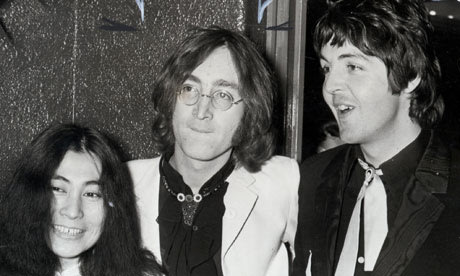 Yoko, John, and PaulOno sounds like she considers herself Lennon’s second wife—with the Beatles, not Cynthia Lennon, as the spouse she replaced.
 John and YokoReplacing the other three lads in Lennon’s heart and mind was a trickier task than she’d imagined.
 Former Capitol/EMI president (and interviewer) Joe SmithSmith, the former president of Capitol/EMI, conducted interviews with hundreds of top artists for his 1988 book Off the Record: An Oral History of Popular Music. This year, he donated unedited versions of those quarter-century-old recordings to the Library of Congress. At their website,
you can listen to his conversations with musicians including McCartney,
Harrison, Bob Dylan, Paul Simon, Little Richard, Elton John, Ray
Charles, Woody Herman, Barbra Streisand, Billy Joel, B.B. King, Sting,
David Bowie, and about 200 others.
Former Capitol/EMI president (and interviewer) Joe SmithSmith, the former president of Capitol/EMI, conducted interviews with hundreds of top artists for his 1988 book Off the Record: An Oral History of Popular Music. This year, he donated unedited versions of those quarter-century-old recordings to the Library of Congress. At their website,
you can listen to his conversations with musicians including McCartney,
Harrison, Bob Dylan, Paul Simon, Little Richard, Elton John, Ray
Charles, Woody Herman, Barbra Streisand, Billy Joel, B.B. King, Sting,
David Bowie, and about 200 others.


 By Michael, on December 28th, 2012


