Tuesday, October 29, 2013

Urge Overkill - Girl You'll Be a Woman Soon

Urge Overkill - Girl You'll Be a Woman Soon

The Pentagon Jedi master vs. the budget sequester

Source: Trentonian
From his office deep inside the Pentagon, Yoda has outlasted the Cold War, countless military conflicts and 10 presidential elections. But can he survive the sequester?
Yoda is the reverential nickname for Andrew Marshall, a legendary if mysterious figure in national security circles. A bald, enigmatic 92-year-old strategic guru, he resembles the Jedi master of “Star Wars” fame in more ways than one.
Since the Nixon administration, Marshall has directed the Pentagon’s secretive and obliquely named internal think tank, the Office of Net Assessment, which contemplates military strategy decades into the future. Over his long career, he has foretold the economic collapse of the Soviet Union, the rise of China and the spread of robotic warfare.
Today, confronting a budget crunch, Pentagon leaders are contemplating whether Marshall and his think tank have outlived their usefulness, or need to be reined in. The Office of Net Assessment costs taxpayers only about $10 million a year — pocket change in the $525 billion annual defense budget, but enough to face fresh scrutiny at a time of cutbacks.
Few places, however, are tougher to scrutinize. Many of Marshall’s studies and reports are classified. And he has to share them with only one man: the secretary of defense. Which reports actually get read, and which ones end up in history’s top-secret dustbin, is everybody else’s guess.
“There’s no real way to weigh it or figure out how much he pays” consultants for the reports, said a former senior defense official who spoke on the condition of anonymity to talk candidly about the Office of Net Assessment. “You can’t quite tell what the nation is getting out of it.”
Even so, the mere suggestion that the Pentagon might force its nonagenarian futurist to retire has sparked a backlash among Marshall’s heavyweight corps of supporters.
Several members of Congress, from both parties, have dashed off letters to Defense Secretary Chuck Hagel in protest. Former Pentagon chief Donald Rumsfeld tweeted that it would be a “serious mistake” to close the Office of Net Assessment and praised Marshall for being at the “forefront of strategy & transformation” for 40 years.
Others described Marshall’s intellect in Einsteinian terms. “Mr. Marshall’s brain is highly networked,” said John Arquilla, a professor at the Naval Postgraduate School in Monterey, Calif., who has known him for decades. He praised Marshall’s “mental suppleness” and said advanced age had not slowed him down.
“His mind is as sharp as ever,” Arquilla said. “He’s gotten not just a second wind but a third wind in recent years.”
Marshall has also demonstrated exceptional political acumen, hanging on to his job under 13 defense secretaries. He has nurtured generations of national security thinkers and helped find them jobs on Capitol Hill, in academia, at private think tanks and in other parts of the government. The last time the Pentagon tried to close his office, almost two decades ago, his acolytes saved it with a furious lobbying effort.
Sensitive to Marshall’s iconic status, Pentagon officials are treading carefully this time around; they declined to elaborate publicly on the futurist’s future.
“The Department of Defense is currently assessing our missions, structure and programs in light of an evolving set of strategic challenges, as well as a constrained fiscal environment,” Lt. Col. Damien Pickart, a Pentagon spokesman, said in an emailed statement. “It would be premature to comment on pre-decisional issues.”
Another defense official, speaking on the condition of anonymity to discuss internal deliberations, said Hagel thinks that the Office of Net Assessment should be reorganized and that it “can be strengthened potentially by realigning it so that it remains close to him and his senior team.”
Marshall declined an interview request placed through a Pentagon spokesman. He shuns public appearances, doesn’t testify before Congress and permits himself to be quoted only on rare occasions.
Colleagues say he has always projected an inscrutable mystique. He generally keeps his thoughts to himself at conferences and meetings but can command attention just by twitching an eyebrow.
Although he is little known among Americans, Marshall enjoys an outsize reputation in Moscow and Beijing, where Russian and Chinese strategists have long admired his ideas, even if their countries were in the strategic crosshairs.
“Our great hero was Andy Marshall in the Pentagon,” Gen. Chen Zhou of the People’s Liberation Army said in an interview last year with the Economist. “We translated every word he wrote.”
Marshall’s national security career began in 1949, the same year that Mao Zedong proclaimed the creation of the People’s Republic of China.
As a 28-year-old economist with a master’s degree, Marshall joined the Rand Corp., a nonprofit think tank that had just been created to perform research for the government. He burrowed into analyses of Soviet military programs, nuclear targeting and organizational behavior theory.
After a stint at the White House, Marshall was brought to the Pentagon in 1973 by then-Defense Secretary James Schlesinger to found the Office of Net Assessment. He concentrated on nuclear strategy and specialized in forecasting apocalyptic scenarios, some seemingly lifted from the satirical film “Dr. Strangelove.”
“We tend to look at not very happy futures,” he once told The Washington Post in an interview.
He also became a leading proponent of a theory known as the “revolution in military affairs,” which posits that the history of warfare has been marked by several brief but transformative bursts in technology and organizational strategy, from the chariot to the German blitzkrieg to the atomic bomb.
Such thinking has led Marshall to argue that some foundational weapons of the armed services — the tank, the aircraft carrier and short-range fighter jets — are doomed to obsolescence because of advances in missile technology. That has made him an unbeloved figure among some U.S. generals and admirals, who view him as an unrealistic radical and a threat to conventional military strategy.
For the past two decades, Marshall’s office has gamed out scenarios for war with China.
Critics say he has exaggerated that and other threats as justification for fatter defense budgets. But fans say the Pentagon needs more long-range, out-of-the-box thinking, not less.
“We think that office provides incredible value to the country at a time when we need strategy more than ever,” said Rep. Randy Forbes, R-Va., a member of the House Armed Services Committee who helped sponsor a $10 million earmark last year for the Office of Net Assessment, nearly doubling its annual budget.
Forbes said that the office needs to be kept insulated from bureaucratic and political pressures and that it would fill an important niche long after Marshall steps down, whenever that might be.
“Obviously, I have enormous respect for Mr. Marshall,” Forbes said. “But this office is not just Andy Marshall. This office has spawned a number of great thinkers and ideas.”
The Office of Net Assessment contracts out much of its research to private think tanks. It recently commissioned a study titled “The Future of Africa” from Booz Allen Hamilton for $105,633, federal contracting records show.
A primary recipient of Marshall’s grant money is the Center for Strategic and Budgetary Assessments in Washington. The defense think tank, headed by retired Army Lt. Col. Andrew Krepinevich, a longtime Marshall disciple, generally receives about $2.75 million to $3 million a year.
The former senior defense official said the Office of Net Assessment pursues some worthwhile lines of study but suggested that more oversight and accountability are needed. “How much money should we be dishing out to outside parties to restate again and again?” he said.
At the same time, the former official said Marshall is so well entrenched politically that it doesn’t make sense for the Pentagon to try to change his ways or force him out before he is ready to go.
“Everybody is worried about the perception that they would go against this legendary icon who brought down the Soviet Union single-handedly,” the former official said. “It’s not even worth it to challenge that narrative at this point.”

Mike Rogers Says NSA Told Congress About Spying On Foreign Leaders; Cuts Off Rep. Who Say That's Not True

from the incredible dept

The House Intelligence Committee, led by chief NSA apologist Rep. Mike Rogers, held yet another hearing about the NSA scandal on Tuesday, with an official focus on "potential changes to the Foreign Intelligence Surveillance Act," but that was barely discussed at all. Instead, the panel, made up of Director of National Intelligence James Clapper, NSA boss Keith Alexander, Deputy Attorney General James Cole and number 2 guy at NSA Chris Inglis, mostly focused on defending the NSA, especially in light of the recent headlines concerning spying on foreign leaders. Rogers focused on tossing out a bunch of softball questions to the panel to get them to say that they had clearly informed the House Intelligence Committee about spying on foreign leaders. After the softballs were hit back, Rogers would add a stage-whispered "Hmm," followed by an angry attack on reporters for buying into the story that the NSA hadn't informed Congress.

Of course, given that Rogers' counterpart in the Senate, Dianne Feinstein, claims that she wasn't informed, this seems a bit strange. But it got even stranger when various other committee members, including Rep. Jan Schakowsky and Rep. Adam Schiff made it clear that they had no idea this was going, despite being on the committee.

That resulted in an incredible exchange, in which Rogers attacked others on the Committee, suggesting that they should just shut up if they're going to say they weren't informed -- hinting that some Committee members "do more work than others." Schiff, quite reasonably, appeared to take offense to this, and challenged Rogers, asking for more details as to when and how the Committee was told about spying on foreign leaders. Rogers without actually answering the question kept "warning" other members not to say something about this. Schiff broke in again (with Rogers trying to stop him from talking) to ask if the Committee was directly informed about this or if it was just a giant data dump of information that he would have had to go through carefully to find out who they were spying on. Rogers again refused to answer the question, and again hinted that those who put in the "effort" would have known about this -- and then flat out cut off Schiff and handed the floor to Rep. Michele Bachmann, who went back to tossing softballs (sample question: "Do you think Snowden is a traitor?").

In the end, Rogers weak attempt to continue to defend the NSA here made it pretty clear, once again, that the claims that he has not adequately informed others in Congress of what's going on are quite accurate.

IsoHunt Resurrected Less Than Two Weeks After $110 Million MPAA Deal

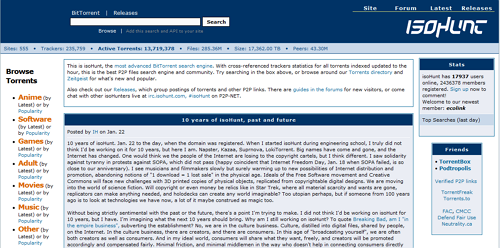
BitTorrent indexing site isoHunt, that was forced to shut down earlier this month after a claimed $110m settlement deal with the MPAA, has this morning been resurrected. Speaking with TorrentFreak, the team behind the recreation of one of the world’s largest torrent sites says the aim was to give isoHunt refugees access to their much-loved database of torrents wrapped up in a familiar interface.
Earlier this month some pretty surprising news hit the file-sharing scene. After many years battling aggressively with the MPAA, Canadian BitTorrent site isoHunt suddenly agreed to a settlement with the MPAA.
The amount that owner Gary Fung would have to pay to the MPAA was publicized at $110 million, a somewhat scary quantity of money by anyone’s standards. Of course, Fung doesn’t have that kind of money and wouldn’t pay it freely to the MPAA even if he did. The amount was put out there to act as a deterrent to those who might think of opening a similar site in future, the metaphorical head-on-a-pike if you will.
But despite the scary messages and veiled threats, just days after the settlement was announced a group calling themselves the ArchiveTeam told TorrentFreak that they intended to save isoHunt’s torrent files, to save them for future generations. They had a big job ahead and a deadline of October 23 looming, the date that Fung had agreed to close down isoHunt.
Things wouldn’t pan out as planned. After hearing of the backup plan Fung pulled the plug days early, thwarting the ArchiveTeam’s attempts at preserving history.
However, in the background another project was already underway to breathe new life into isoHunt even after it had been shot and buried by the MPAA. Today isoHunt.to was launched, a site that looks identical to its now-dead namesake.
isoHunt
Speaking with TorrentFreak the team behind the project, who have no connections to the ArchiveTeam, say that preserving a cultural icon is their main aim.
“IsoHunt has been a great part of the torrent world for more than a decade. It’s a big loss to everyone who used it over the years. Media corporations don’t like innovative or competition and isoHunt’s fate is one of the examples of how they deal with it,” our sources explain.
“IsoHunt can definitely be called a file-sharing icon. People got used to it and they don’t want to simply let it go. We want those people to feel like being at home while visiting isohunt.to. The main goal is to restore the website with torrents and provide users with the same familiar interface.”
While there is still work to be done and bugs to be ironed out, things are well underway. The interface is completely familiar, with categories to browse on the left hand side as usual. Torrent pages appear as they previously did although the ‘time added’ box appears to show when the torrent was added to the new isoHunt site, not when it was added to the original isoHunt.
At the moment some of the community-driven modules of the site such as the forum and user profiles are unavailable and due to their nature it seems unlikely that they will return. User torrent comments are also absent but it at least seems possible that these might be recovered in a future update. Additionally, brand new torrents are also being added to the site so its usefulness will not only be limited to preserving the past.
With the original isoHunt gone there is no simple way of comparing the new isoHunt’s database with the old one but the team behind the resurrection inform TorrentFreak that so far around 75% of isoHunt’s torrent database has been restored.
“Only time will tell whether users like the site or not. If they like the idea and keep coming back we’ll be happy to develop the project even further,” the team conclude.

Sniff 'n the tears - Driver's seat (full song H.Q.)


Uploaded on Oct 10, 2011
Sniff 'n the tears - Driver's seat
Full song with video re-editing
Enjoy H.Q. sound.

Behind the Bush – Jack Heart – Part II

Behind the Bush: Aleister Crowley, Yeats, the Anti Christ & Armageddon

by Jack Heart – Part 2


The authorized version of history is designed to keep you stupid. It starts in ancient Greece with “The Father of Lies” Herodotus and ends with that vile convicted criminal Dr. Zahi Hawass making it up as he goes along on your television.
The whole concoction is now a metaphorical desperate man clinging to a tree. A tsunami of reality borne on an untamed cyber sea is crashing down upon him.
1
A hundred feet beneath the waves of Japans Ryukyu Islands lay a step pyramid carved into solid stone. All who have dived on it know it is an artificial structure.
Yet those who have never dived on it claim it must be a natural formation because it would have to have been constructed at least twelve thousand years ago, before the glaciers melted and at a time when “there were only hunter gatherers that lived in caves and were incapable of building anything.”
Nothing could be further from the truth. Let us begin in the “New World” where they have horded “their gold.”
2
Academia claims this “is a natural formation.” Incompetence? I think not more like the blatant application of the Asch Paradigm.
3
High in the Andean mountains lays Tiahuanaco where diorite blocks some weighing in excess of 400 tons, are precisely cut and fitted like the pieces in a LEGO Erector Set. Diorite is even harder than granite and impossible to work with even now.
The blocks typically weighing in at between 100 to 150 tons were quarried on the opposite shore of the lake, ten miles away. The primitive building techniques of the Inca are easily distinguished from the original edifice which has been torn apart by some unknown cataclysmic energy.
Some of the original structures were buried in up to six feet of sediment. The altitude is over 12,000 feet and rain is practically unheard of in the area falling at the rate of less than nine inches a year.
The overhead soil erosion which would be necessary to cause the kind of emersion in the soil that Tiahuanaco was found in is physically impossible. Sea horses which are only found in salt water are unaccountably found in the fresh water of Lake Titicaca. It has recently been discovered that the ruins extend into and under the water of the lake.
4
5
Diorite blocks cut with precision beyond even the finest craftsman of today.
The method by which the original blocks were fitted together
 6
A hundred years ago Professor Arthur Posnansky made an intensive fifty year study of the ruins. In his 4 volume work titled Tiahuanaco, The cradle of American Man, first published in 1945. He presents archeoastrology evidence why the Kalasasaya temple in Tiahuanaco must be at least 15,000 years old.
Unearthed at the site was a 7 foot tall idol of an ancient Andean God that the Inca now call Viracocha. Serpents are depicted ascending each side of the statue.  The academic dissembling of exactly who or what Viracocha originally was is mind numbing and that is exactly the way they want it.
But one thing is certain. Viracocha was a serpent God, a sun God.  He is always depicted with a radiant head and serpents prominently displayed even in sites as old as Tiahuanaco.
7Viracocha, over the Gateway of the Sun at Tiahuanaco, clutching a serpent in each hand.
8
They say a picture is worth a thousand words.
A few hundred miles to the northwest of Tiahuanaco sits Ollantaytambo allegedly built by the Incas in the Fifteenth century. Ollantaytambo is nothing if not a stone indictment of academia for its role as a willing accomplice in the subjugation of the human race.
The Inca’s primitive technique of stacking much smaller and ill fitted rocks can be easily discerned from the perfectly formed and fitted Andesite, boulders, an extremely hard igneous rock, that constitute the foundations of the ruins.
9
Observe the pebbles stacked at the top and in the background.
10
Nobody is that stupid. They are deliberately lying! It is common practice to build upon the ruins of ancient cities. Mexico City is built atop Tenochtitlán Rome is built atop Rome. Nietzsche said beware the fish eyed scholar. Hitler knew just what to do with him.
An objective examination reveals the original, and much older, constructions at Ollantaytambo were destroyed by cataclysmic energy just like Tiahuanaco.
 11
Ollantaytambo is called The temple of the Condor because of a natural wedge shaped stone that has been fashioned into a makeshift sacrificial alter by adding a carved stone condor head to drink the blood of victims as it runs down into a well below the beak.
The Condor is the largest vulture in the world. Academic hacks will tell you that the Condor is the symbol of the Inca sky God but common sense should tell you that the vulture is the symbol of death.
All through the Andes great blocks of extremely hard stone have been worked with a craftsmanship that defies explanation even using the cutting methods employed by modern craftsman.
The truth is that the “Incan Empire” never really even existed. They were nothing but a bunch of half naked savages squatting on land that was not and still is not there’s. A hand full of Spanish warriors walked right through them.
The gold that “Francisco Pizarro took from them” was not theirs anyway. He was sent there to requisition both the real estate and everything on it by their masters and the Inca royalty knew it, as they still do today. The same scenario took place with the Aztec. But none of you will ever meet an Inca princess, let alone get her to hint at the truth to you, so let me go on with my story and prove it to you.
To their great credit the Inca are not liars like academia. They have been telling anyone who would listen from the start that they built none of these things. In Inca legend Ollantaytambo was founded by a brother and sister sent by the Sun God. They had in their possession a golden wedge which was able to burrow into the ground of its own accord and somehow enable the siblings to build the city.
In Isaiah 13, 12, the twenty-first century addition of the King James Bible, Yahweh launches into one of his endless tirades bellowing “I will make a man more rare than fine gold; even a man more than the golden wedge of Ophir.” In The Talmud,  Tractate Gittin Folio 68, Solomon enlists the help of the prince of Demons Asmodeus to find the Shamir which Moses brought out of Egypt. The Shamir had the ability to split rocks.
In the Bible Solomon had an alliance with king Hiram of the ancient Phoenician seaport of Tyre. The King constructed a fleet for Solomon so that he could sail to the mysterious lands of Ophir where he extracted huge quantities of gold. The gold made Solomon the richest King on earth. The ships plied the earth and once every 3 years brought Solomon copious amounts of wealth from all the far flung corners of the world.
Aside from the first temple Solomon is also credited with building another temple in Lebanon where the mysterious Temple of Baalbek now marks the veil of history that has been erected and tended to by academia.
12
Lebanon’s Baalbek; another inconvenient site for academia’s talking chimps.
By their own traditions Jews have always been Magi who command demons through the power of their demon God. In the Testament of Solomon, supposedly a firsthand account, Solomon used a ring engraved with Gods “secret” name to command the demons to build the first temple.
Even in the oldest of their Talmudic traditions Shir Hashirim Rabba 1:5 which scholars can date back almost to the time when Moses and the Sanhedrin of criminally insane Qabalists looted Egypt. It says “everyone helped in the construction of this Temple – even the spirits, the hobgoblins, the angels.”
But let’s go back to the New World, or shall I call it Ophir? Let’s see exactly where it was that the wandering Jew was wandering.
It was first mentioned in De mirabilibus auscultationibus,  a collection of natural history facts attributed to Aristotle, that the Carthaginians were building colonies in a land beyond the pillar of Hercules. A land that had navigable rivers and since there are no islands with navigable rivers in the Atlantic the author could have only been referring to America. Didorus Siculus or Didorus of Sicily next gives vivid details of its discovery and colonization by the Phoenicians in his massive 40 volume work Bibliotheca historica.
What should be taken into account but never is because of academic dissembling is that the Jews were a force to be reckoned with in the ancient world. Rome’s first order of business, in order to become an empire, was to sack the Jewish outpost on Rome’s own doorstep; Carthage.
This was only achieved after the Punic Wars; blood soaked conflicts which lasted almost a hundred years. Perhaps a million maybe more died in this conflict. Carthage inflicted 80,000 deaths upon Rome’s legions in the battle of Cannes alone.
Because the Romans knew how dangerous Jews are being founded by Jews themselves, as you shall see if you read on, they slaughtered every man, woman and child in the city when they finally did sack Carthage. The Jew never gives up, ever, that’s what it means to be a Jew.
The Western world was now at war with the Jewish world. The two empires sat across from each other like WWI soldiers occupying opposing trenches. The dye had been cast. Three desperate wars for survival would ensue lasting over twenty years.
The Mithridatic Wars would only be concluded when Rome under Pompey the Great defeated the forces of the Armenian Empire under Mithridates VI also known as Mithridates the Great or the Poison King because of his penchant for drinking poison to toughen himself up.
The homicidal Jew king fled with the remnants of his army to the furthest corner of what was left of his empire in what is now called Georgia. Where, after personally murdering his own son the king of Scythia for what he perceived as disloyalty, he committed suicide.
Now Rome was free to attack the heart of the malignancy. They did so by occupying Jerusalem the same year the Mithridatic Wars were concluded; 63 BCE. What followed was two hundred years of practically unremitting bloodshed.
Josephus, who is one of the few historians who can be trusted, where they didn’t redact his work to include Jesus, says 1,100,000 Jews alone were killed in the first uprising. With legion upon legion slaughtered. Masada, whose defenders committed suicide rather than give up, was the closing battle.
It was no aberration. Jews always fought till they were utterly annihilated with the women and children fighting in the streets of Jerusalem right alongside their men. The festivities were not just confined to the land. The Jews had their own navy which according to Josephus controlled the sea off the coasts of Syria, Phoenicia and Egypt, hardly the simple goat herders of Hollywood history and the religion the Jews concocted for their slaves; Christianity.
There were two more major uprising with innumerable small ones between. Finally culminating with Bar-Kochba rebellion from 132 –135. There were 580,000 Jews killed in that one according to Cassius Dio. He tells us many Romans also “perished.”  Rome was victorious but by then the Jew had infected her with his homogenized religion for “goyim;” Mithraism.
They would tweak it a bit, probably laughing when they cast a Jewish carpenter in the role of Sol Invictus, then rename it Christianity. For now on the Pontifex Maximus would wear a Yarmulke and the western world would serve its Jewish masters only challenged once in over 1700 years by Hitler and the NAZI’s.
A child could see the resemblance of the Step Pyramids built in America to the Ziggurat’s built in the Mesopotamian valley. There is a vast preponderance of archeological evidence attesting to a Semitic presence in the New World right up until the time when European colonization seemed to cast an unwanted light upon it.
Yet the Davenport tablets, Dighton Rock, and Grave Creek Stone have all been attacked with what can only be described as a zeal born of panicked desperation. Leading this kamikaze attack is the Smithsonian Institute and the monkeys on Wikipedia that are trained to serve the ancient Jewish agenda of deception. They even have names for the orders of demons who help them to do this; Chaigidiel those who obstruct and Satharial those who conceal God.
Whenever a Semitic artifact is found in America the academic hacks will invariably clamor in unison that it is most certainly a hoax because there is no supporting evidence of a Semitic presence in western hemisphere prior to Columbus. Yet Salvatore Michael Trento of the Middletown Archeological Research Center, an organization composed of many practicing geologists and anthropologists, spent years cataloguing and researching these enigmas. He is adamant about his conclusions that “they were built and inscribed by Celtic and Phoenician Old World Traders.”
Coins that were found in Kentucky and Missouri in 1932, 1952, and 1967 commemorating the Bar-Kochba rebellion and dated from 132 –135 AD have been ignored or dismissed as frauds. The explanation for this one is so absurd that it’s actually worth noting. The coins were minted, distributed by Sunday school teachers as a reward for good attendance then lost and found by sharp eyed observers. They admit its conjecture and they don’t know who minted the perfect replicas and what Sunday school teacher handed them out. But again it must be because they say it must be.
The Newark Holy Stones are arbitrarily dismissed, even though many scholars have attested to their authenticity, because their discoverer David Wyrick expressed a belief that the lost tribes of Israel settled in America. Only the Mormons are allowed to say things like that because as we shall see they are a renegade branch of Masonic Judaism themselves.
The Smithsonian has been destroying evidence of Jewish occupation of pre Columbian America for years and laws such as The Native American Graves Protection and Repatriation Act have been passed to stop them. But there is a smoking gun in this case that not even Wikipedia can gloss over.  It is a documented fact that nine museum certified Egyptian mummy’s dating from between 1070 B.C. to 395 A.D. tested positive for nicotine and cocaine, substances only found in the New World. These were rigorous scientific studies conducted by German scientists under Svetla Balabanova in the early nineties.
Academia, this time led by Oxford, openly expressed apoplexy. When they could not explain the mummy’s condition without admitting contact between the pre-Columbian Old and New Worlds the mummy’s were sequestered in the vaults of the Munich museum. When she attempted to conduct her own independent analysis the Keeper of Egyptology at the Manchester Museum in England, Professor Rosalie David Obe, renowned author and the world’s foremost expert on mummification, was refused access to them “on grounds of religious respect.”
The Bat Creek Stone was excavated in 1889 from an undisturbed burial mound in Eastern Tennessee by the Smithsonian’s own mound survey project. Cyrus Thomas the director of the project whined to anyone who would listen that the curious inscription on the stone was “beyond question letters of the Cherokee alphabet.” In the 1960’s scholars, Henriette Mertz and Corey Ayoob, noticed a little discrepancy: Thomas had been reading the stone upside down. When properly orientated the only thing that is “beyond question” is that the inscription is ancient Semitic.
Semitic languages scholar Cyrus Gordon later confirmed that it is from the first or second century A.D. Gordon translated the inscription as reading LYHWD, or “for Judea.” He noted that the broken letter on the far left is consistent with Mem, in which case the word would read LYHWD[M], or “for the Judeans.”
Subsequent carbon dating of surrounding biological matter yielded dates from 200 to 750CE it should be noted that Cyrus Thomas said of the Davenport tablets that they were “anomalous waifs,” that had absolutely no supporting or contextual evidence to aide in their authenticity.
The Los Lunas Decalogue Stone besides serving as evidence for pre-Columbian occupation of the Americas by the Jews also serves as a warning for Zombie archeologists contemplating a resurrection. The boulder which sits on the side of Hidden Mountain in New Mexico not far from Chaco Canyon, which is very important as we shall see, bares an ancient Hebrew inscription of the 10 commandments. Discovered in 1933 by one of their own; Professor Frank Hibben an archaeologist from the University of New Mexico.
Hibben’s held degrees from both Yale and Harvard but saw his distinguished career systematically dismantled and his credibility constantly questioned. The chimps of academia made it a point to dig up half of Alaska’s tidal zones in a relentless effort to discredit some of his findings at Cook Inlet. Hibben it turns out had misidentified the strata in which he had unearthed evidence contradicting America’s inhabitance before academia’s cherished bench mark of Clovis Spear Points.
Clovis Culture is archeologically identified by the presence of Clovis Spear Points. According to academia’s chimps man migrated from Siberia across the frozen straights of the Bearing Sea some 14,000 years ago into the “New World.”  He then fanned out across the Western Hemisphere settling from north to south. Academia insists this format must be followed by anyone looking to make a dime in the field. Yet repeatedly verified carbon dates for the Pedra Furada sites in Brazil show people in South America some 45,000 – 60,000 years ago.
No one has ever even found a Clovis Spear Point in Siberia or anywhere else in Asia. The points actually appear to be a slight modification of the 30,000 year old Solutrean Spearpoint from Europe. “Clovis spear points” only appear in America some 13,000 years ago and then disappear a few thousand years later along with much of the fauna in the Western Hemisphere.
Little is known about the past of the enigmatic Yuchi tribe of the Southeastern United States except that they were once a large and very powerful tribe who frequently acted as high priests for surrounding tribes. They call themselves children of the sun and were decimated by the neighboring Cherokee in 1714. The Cherokee were instigated and armed by Whites. The Yuchi’s appearance and language was and is, respectively, like no other tribe in the southeast. They are thought to be responsible for the mysterious serpentine mounds that dot the area.
The snake swallowing the cosmic egg is the most ancient and hollowed of all symbols representing the inevitable final victory of Lucifer over the demiurge, a restoration of what was before the demiurge was created by the Goddess in error.
The Feast of Succot has been observed in Judaism since the first days of Solomon’s Temple. It is observed in the harvest season of fall, on the 15th day of the seventh month of the Jewish calendar. It is celebrated for eight days during which the celebrants live in booths, covered with branches, leaves, and fronds while they meditate on the ancient patriarchs.
The Yuchis celebrate a harvest festival which is identical to the Feast of Succot. Every year on the fifteenth day of the harvest month they live in booths with roofs open to the sky, covered with branches, leaves and foliage. During this festival they dance around a fire and call upon the name of God. Dr. Cyrus H. Gordon who translated the Bat Creek stone was convinced after sitting in on the Indians festival that they were celebrating the Feast of Succot. He exclaimed to a friend sitting next to him “They are speaking the Hebrew names for God!”
The Yuchi language is extraordinarily complicated and difficult to learn. Incredibly enough the dinosaur or great lizard figures prominently in Yuchi stories and ceremonies as does the snake. The word for dinosaur consists of no less than five morphemes; sothl’an ahsh’ee chahthlah’a meaning respectively lizard, face, orifice, red, and big. The word for snake spirit is Shawano.
______________________________
Citations
(Authors note – this is by no means all the sources used in writing this 9  piece essay just the ones I hardily endorse. There are many links that will take you to other sources and some are taken from oral traditions, books that are not supposed to even be in print and things I have seen with my own eyes. Put your faith in nothing except your weapons of war. Check everything I’ve written. Only fools and Christians believe in things that cannot be proved. Crowley teaches his followers to be skeptical of everything. When someone asks you to believe what cannot be proved they are wasting your time. And time is the most precious thing you have.)
Cantrell, Dr.Lana Corrine. The Greatest Story Never Told: A Scientific Inquiry Into the Evidence of the Fall of Man from a Higher Civilization in Antiquity. 1988.
Cannibalism and the Anasazi
THE DISCOVERY OF AMERICA – A Goverment conspiracy? – The truth on Columbus (1/2)
http://two-movies.com/watch_movie/Holy_Grail_in_America
http://www.saudades.org/ccolumbusvoyage.html
Crowley, Aleister. The Moonchild. New York Beach Maine: Samuel Weiser , 1929 . 322 . Print.
Crowley, Aleister. The Confessions of Aleister Crowley: An Autohagiography. Penguin, 1989. Print.
Crowley, Aleister. The Book of Thoth: A Short Essay on the Tarot of the Egyptians, Being the Equinox Volume III No. . Samuel Weiser, Inc, 2011. Print.
Crowley, Aleister. The Book of Lies. Samuel Weiser, June 1, 1986. Print.
Crowley, Aleister. Book of the Law. Red Wheel; Reissue edition, 2011. Print.
Dialogues of Plato . http://www.sacred-texts.com/cla/plato/
Duff, Godon. “Gordon Duff Interview, 3 Hour Marathon (video).” Veterans Today . n. page. Print. http://www.veteranstoday.com/2012/12/09/gordon-duff-interview-3-hour-marathon-video/
Fetzer, Jim. “Did George H.W. Bush Coordinate a JFK Hit Team?.” Veterans Today. n. page. Web. 17 Oct. 2013. http://www.veteranstoday.com/2013/03/30/did-george-h-w-bush-coordinate-a-jfk-hit-team/
Forbidden Archeology http://www.youtube.com/watch?v=6oGqPc6poS4&feature=relmfu
Garver, Will L.. “Brother of the Third Degree.” Trans. Array Sacred Texts. 1894. Web. 16 Oct. 2013. http://www.sacred-texts.com/sro/botd/index.htm
Hall, Manly. THE SECRET TEACHINGS OF ALL AGES. 1928. Web. 17 Oct. 2013. http://www.sacred-texts.com/eso/sta/index.htm
Hall, Manley. Freemasonry of the Ancient Egyptians. Philosophical Research Society, 1982. Print.
Indians in the Americas: the untold story By William Marder
Jung C G. The Psychology of the Transference 2nd . ed .16. Princeton NJ: Bollington Foundation,1966 199.Print
Jung C G Mysterium Coniunctionis . 2ed ed. 16 . Princeton NJ: Bollington Series, 1974 . 697 . Print
Marvin Harris, Cannibals and Kings: The Origin of Cultures, Glasgow, 1978, pp. 110-124
MATHERS, S. L. MACGREGOR. KABBALA DENUDATA:THE KABBALAH UNVEILED. Sacred Texts, 1912. Web. 17 Oct. 2013. http://sacred-texts.com/jud/tku/index.htm
The Nag Hammadi Library. . http://gnosis.org/naghamm/nhl.html
Nietzsche, Friedrich. “The AntiChrist .” Trans. Array Full and Free Nietzsche Portal. 1895. Web. 16 Oct. 2013. http://www.lexido.com/EBOOK_TEXTS/THE_ANTICHRIST_.aspx?S=1
Nietzsche, Friedrich. “Thus Spake Zarathustra.”1893. http://www.fordham.edu/halsall/mod/1891nietzsche-zara.asp
F.Peat, David . Superstrings and the Search for the Theory of Everything. McGraw-Hill, 1989. 256 . Print.
Richard L. Thompson, Michael A Cremo. “ Forbidden Archeology: The Hidden History of the Human Race Hardcover. Bhaktivedanta Book Trust, 1994.
Regardie , Israel. A Garden of Pomegranates: Skrying on the Tree of Life . Llewellyn Publications, October 8, 1995. Print.
Regardie, Israel . Complete Golden Dawn System of Magic. 1984. The Original Falcon Press 2nd edition (August 20, 2011). Print.
Westcott, Wm. Wynn. SEPHER YETZIRAH. 1887. Print. http://wolf.mind.net/library/ancient/qabala/sephir.htm
Who Really Discovered America
Yeats, WB. Rosa Alchemica. The literature network . 1913 . Web. 1 Dec 2009   
Yeats, Michael Robartes and the Dancer. Poets Corner .1921 . Web . Dec2009

How Americans Die

via Matthew Isabel\\http://motherboard.vice.com/blog/how-americans-die
Is it seasonal vibes? Is it because death is having a moment? Whatever it is, this new mortality-rate geographic is as grim as it is fascinating.
The visualization comes by way of New York City based software developer Matthew Isabel, a former Microsoft project manager who pulled numbers from the CDC's 2013 National Vital Statistics Report. The full CDC analysis (pdf), which is definitely worth a look, plumbs the depths of mortality in 2010. That's the most recent year for which we have comprehensive domestic death data, which Isabel adjusted for age and to reflect rates per 100,000 citizens.
Think of it as the broad post-mortem on a range of factors—deaths, death rates, life expectancy, infant mortality, and trends by selected characteritics like age, sex, Hispanic origin, state residence, and cause of death—that the CDC gleaned from death notices "completed by funeral directors, attending physicians, medical examiners, and coroners." From cancer to stroke, diabetes to influenza, alcohol to HIV, and beyond, memento mori hasn't ever looked this neat, tidy even, or been so easy to stomach.
You have to be careful to not extrapolate too much from this sort of thing. But Isabel's visualization—call it the Great American Death Map—does nevertheless bring a number of morbid realities into sharp relief.
Mississippi is the death capitol of the US. With an "overall" mortality rate of 962, the Magnolia State also holds the unsavory distinction of being the country's heart-related death capitol (251). Hawaii (589.6) is the least death-y state (the most alive?) in the union.
Suicide outranks both gun-related deaths and murder. What the CDC calls "intentional self-harm" sits at a nationwide ("overall") rate of 12. That's just on the heels of the combined nationwide rate of firearm injury and homicide (10 and 5, respectively).
Here's where it gets interesting. The US suicide capitol (22.8) likewise boasts the highest rate (20.4) of firearm-related deaths: Welcome to Alaska, the Final Frontier. And you'll maybe never guess which state enjoys the lowest rate of suicide. It's New York (7.7), home to what the World Health Organization says are some of the safest streets in the world, or at least in New York City. On that note...
The bloodiest roads are in Wyoming. Maybe it's all those two-lane highways? Or a Big Truck culture that still flouts open-container laws.
Drug-related deaths are higher than alcohol. Again, we have to be careful here. A considerable percentage of drug deaths come at the hands of legal prescription medications, not controlled substances like heroin or cocaine or, God forbid, the Devil's cabbage. But nevertheless, there it is: Drugs - 12.9, Alcohol - 8.
Is it all a bit dark? Absolutely. But in a moment of peak visualization, with today's web cluttered with infographics whose crispy presentations can't hide the fact that they don't say much of anything, that they're not adding anything of value to the discussion, mortality may breathe new life into making sense of publicly-available data.
To hear Isabel tell it, death datasets make for provocative visualizations that are actually, you know, instructive slash revealing: they "generally have a nice plus in that they can be conveyed both spatially and chronologically in ways an audience can quickly grasp," Isabel writes.
Which certainly never killed anyone.

Psychiatrist Lester Grinspoon Smoked Weed with Carl Sagan—A Lot

Via ASA.
Dr. Lester Grinspoon's interest in marijuana dates back to 1967, the year he decided to research the subject sufficiently enough to convince his best friend—who just happened to be Carl Sagan—and a few other associates to stop smoking the stuff. While the internationally renowned astronomer never publicly acknowledged his use of cannabis, the bestselling author and host of "Cosmos" did partake frequently and enthusiastically in private, invariably encouraging his straight-laced companion Lester to join in.
Instead, Dr. Grinspoon began to visit the Harvard Medical School library, prepared to spend as much time as necessary putting together a well-referenced argument against grass, one that would demonstrate a medical and scientific basis for the plant's prohibition. Instead of finding the hard data he'd expected, however, Grinspoon had an epiphany—he'd been brainwashed about marijuana, as had just about every other citizen in the United States.

Dr. Lester Grinspoon on Medical Marijuana

Four years later, despite facing pressure at Harvard not to touch the subject, Grinspoon published Marihuana Reconsidered (1971) to document his findings. The bestselling book described, among other things, a decades-long government propaganda campaign undertaken to keep marijuana illegal at all costs.
In addition to an authoritative, scientific refutation of the many myths then commonly accepted about cannabis, the book included an essay from a man in his mid-30s identified only as Mr. X. Writing under a pseudonym, Carl Sagan explained that his support for ending marijuana prohibition was not just political, but also deeply personal:
I do not consider myself a religious person in the usual sense, but there is a religious aspect to some highs. The heightened sensitivity in all areas gives me a feeling of communion with my surroundings, both animate and inanimate. Sometimes a kind of existential perception of the absurd comes over me and I see with awful certainty the hypocrises and posturing of myself and my fellow men. And at other times, there is a different sense of the absurd, a playful and whimsical awareness. Both of these senses of the absurd can be communicated, and some of the most rewarding highs I’ve had have been in sharing talk and perceptions and humor. Cannabis brings us an awareness that we spend a lifetime being trained to overlook and forget and put out of our minds.
Sagan also praised marijuana as a means of cerebral expansion. He described making a breakthrough in understanding “the origins and invalidities of racism in terms of gaussian distribution curves” while “taking a shower with my wife while high.” He then vigorously defended the validity of such pot-fueled epiphanies:
There is a myth about such highs: the user has an illusion of great insight, but it does not survive scrutiny in the morning. I am convinced that this is an error, and that the devastating insights achieved when high are real insights; the main problem is putting these insights in a form acceptable to the quite different self that we are when we’re down the next day. Some of the hardest work I’ve ever done has been to put such insights down on tape or in writing. The problem is that ten even more interesting ideas or images have to be lost in the effort of recording one.
Toward the end of his life, without disclosing his own use, Sagan started advocating for medical marijuana. Three years after Sagan's death, Dr. Grinspoon decided to posthumously reveal the identity of Mr. X in interviews with William Poundstone for the latter's Carl Sagan: A Life in the Cosmos (1999). Grinspoon's decision was based on the world famous scientist's oft expressed wish to aid the movement to end marijuana prohibition.
Grinspoon, meanwhile, has dedicated much of his life and work as a physician, professor, author, advocate, and activist to investigating cannabis's amazing medical properties, and fighting for the kind of historic marijuana legalization that's currently taking root in Colorado and Washington. He spoke with me from his home in Massachusetts.
MOTHERBOARD: Do you remember the first time you met Carl Sagan?
Grinspoon: I sure do. I had a professor at Harvard Medical School who lived alone in a big house with his own chef. He was kind of an intellectual lighthouse—very actively involved in liberal, progressive political movements. And his Friday night dinners were legendary. Usually a group of about 30 people representing not just the medical school, but all the different departments at Harvard.
At one of these dinners in 1965, we got into discussing the Vietnam War, which was beginning to escalate. Well, everybody at this big party supported US involvement, except for Carl Sagan and myself. Pretty soon, Carl and I were virtually backed into a corner. So afterward, we introduced ourselves and in a very short time became close friends, which we remained until the day he died. I was best man at his wedding.
Carl, by the way, stayed extremely active in opposing the war. He possibly didn't get tenure at Harvard because of his outspokenness.

A simple request. Via Neverco.
When did you discover that he enjoyed smoking pot?
My wife Betsy and I went to a party with Carl not long after we met, and it quickly became clear that marijuana was a regular feature of social life within his little circle in Cambridge.
As a physician, I saw all that smoking going on, and I was really concerned about it. I suffered from a kind of arrogance that sometimes afflicts physicians. Doctors are supposed to automatically be experts on drugs, and so I found myself spieling off the stuff that the government was saying, telling this wonderful group of people that I was concerned about marijuana's detrimental effect on their health. Because I truly believed pot was a very harmful drug.
I actually succeeded in getting two or three of them to at least temporarily reconsider. But whenever I'd say as much to Carl, he'd wave the joint in front of me, and reply, “Oh Lester, have a puff, it's not going to hurt you a bit and you'll love it.”

Doctors are supposed to automatically be experts on drugs, and so I found myself spieling off the stuff that the government was saying... But whenever I'd say as much to Carl, he'd wave the joint in front of me, and reply, “Oh Lester, have a puff, it's not going to hurt you a bit and you'll love it.”

Did he have a scientific basis for thinking marijuana was relatively safe?
No, he was just instinctually distrustful of the government's claims when compared to his own observations.
How did he react when you wrote a book proving him right?
Carl and I used to review each other's manuscripts before they were published. When he read Marihuana Reconsidered, he said, “That's a wonderful book, but you made one big mistake. You said in the last chapter that marijuana prohibition will end within ten years. But it's going to be gone in two years. It just can't survive any longer than that!”
Was he high when he made that prediction?
I don't think so [laughs]. Anyway, he stuck with that time table for awhile. We actually discussed it once, many years later, when I began to fear that I'd never see legalization in my own lifetime.
How long did it take him to get you to try cannabis for yourself?
As I researched and wrote about marijuana, I knew I wanted to have this experience, but I also knew that if the book was successful, I'd be called upon to appear before committees and testify in court, and I didn't want to compromise my position. In other words, I didn't want this to become a N-of-1 study. I wanted to be as objective as possible. So I waited.
Then, about a year and a half after the book came out, I had to testify before a state senate committee in Massachusetts. And one of the senators, who was clearly hostile to my position, asked, “Have you, Dr. Grinspoon, ever used marijuana yourself?” To which, without planning it, I replied, “Senator, I'll be glad to answer that question if you can tell me whether if I answer in the affirmative, that would make me a more or less credible witness.”
Well, the senator stood up on the dais, pointed an accusing finger at me and declared, “Sir, you are being impertinent.” Then he stormed off. So I went home to my wife and said, “Betsy, the time has come. We're going to smoke.”
Ever since Marihuana Reconsidered came out people had been asking me: “Wait, you wrote a book about marijuana and you've never tried it?” And I'd reply, “Well, I wrote a book about schizophrenia too, and I haven't tried that!”
But then that very night, we went to a party and smoked until everyone else in the circle, including Carl, waved it off. They were all apparently stoned, while Betsy and I felt nothing. At which point, I began to get very anxious—could I have written a book about a grand placebo?
When I got home, I couldn't sleep. Betsy had to remind me that my own research revealed many people don't get high the first time they smoke. Carl, in his Mr. X essay, said he'd had to try something like six times to experience a high.

We went to a party and smoked until everyone else in the circle, including Carl, waved it off. They were all apparently stoned, while Betsy and I felt nothing. At which point, I began to get very anxious—could I have written a book about a grand placebo?

So the next weekend we smoked again, and it still didn't work. But then the third time, I remember after the joint Betsy and I were standing around with another couple in the kitchen, eating a napoleon—the four of us passing it around. And you know that viscous material between the layers? It kept sliding back and forth threatening to fall on the floor. We were having a hilarious time!
So Betsy asked, “Where did you get this napoleon, it's unbelievably good. We've never had anything like it.” And when they named the bakery, we were surprised to discover we'd eaten their napoleons before!
Meanwhile, Sergeant Peppers Lonely Hearts Club Band was on the hi-fi, a record I'd actually heard before many times. My son David would put it on and say, “Dad, you ought to get your head out of the Baroque and listen to the Beatles.” But I didn't see the appeal. Until that night, under the influence of marijuana, when I heard the Beatles for the first time. And it was like an auditory implosion. I couldn't believe it.
What was Carl Sagan like when high?
He was the same wonderful person, only definitely more relaxed. He had a great sense of humor, which really came out. He loved to smoke a joint before we went out to dinner, to stimulate his appetite. And he was always eloquent—could speak spontaneously like no other person I've ever known. We always had fun when we got stoned, and we had such wonderful discussions. It was exciting to smoke with Carl.
He was also the hardest working individual I've ever met. When people try to say that marijuana will make you less productive, or lazy, and so forth, I always think of him. He was constantly working, in a sense. Using marijuana as a creative stimulant. He felt he got more ideas while stoned, and also understood that you have to reevaluate them when you're not stoned. I observed him using that method a lot.
One time, Carl and his wife were visiting us on Cape Cod. I was taking their son out fishing, and Carl wanted to stay behind and walk around a lonely beach at low tide. Well, I could see from the boat that he was having a smoke, and then he just started pacing along talking into his brand new voice recorder. Before that, he used to jot a note on the back of an envelope. Anything to get his stoned thoughts down, so he could review them at a later time.

Sagan chats with two Centers for Disease Control employees, 1988, via Wikimedia Commons. 
That he found cannabis so very useful in his work was really a lesson to me. In time, I learned to use it the same way. Especially when I could get my hands on the good stuff.
I would get these gifts of marijuana occasionally from California, always completely anonymously. Some kind souls would put a dozen joints or a baggie of weed in a small cardboard box, then stuff it with newspaper and add a stone to give it weight. One night my wife and I were going to meet Carl and his wife for dinner, and I brought along two joints of some brand new stuff I'd gotten called sinsemillia. Well, Carl just loved it.
At the end of the night, he knew I'd brought two joints and we'd only smoked one of them, so he said, “Lester, I hate to do this, but could I ask you to give me that second joint? I have to finish writing a chapter tomorrow, and I'd love to have that.”
So naturally I gave it to him. That was the moment I began to realize that in addition to medicine and recreation, cannabis can benefit people through enhancement of certain human potentials.
Was all this pot smoking sort of an open secret?
Not at all. This was a very small group of people. Carl would never light up unless he knew everybody in the room.
As much as he loved marijuana, he was always very concerned about people finding out. For instance, one of the early pieces I wrote on the subject appeared in The New York Times Magazine, and in it I said something to the effect, “People have the idea that only these hirsute young hippie kids use marijuana, but in fact a lot of ordinary and even extraordinary people smoke it, including professionals.” Then I mentioned doctors, lawyers, etc. Well, in that list I included astronomers. And when that came out, it was the only time Carl ever expressed any anger towards me. Because he thought mentioning astronomers would give him away based on our friendship.
Another time, we went on a cruise to the South Pacific to see Halley's Comet. I smuggled about an ounce of marijuana on board, and we had a wonderful time. Carl had the top cabin on the ship, including a deck where we could sit and smoke and talk and eat—for hours on end—while watching the beautiful cloud formations over the Pacific.
When the cruise was over, we still had some marijuana left. I didn't want to go through Customs with it, so I told Carl that I was going to toss it down a companionway I had noticed was marked “Crew Only,” trusting that it would be enjoyed among the mates. But he asked me not to, because we might somehow be found out. So we weighed the baggie down with one of those old glass ashtrays, and tossed it overboard.
I hated to let this precious stuff go down to the bottom of the sea, and didn't really see how we could ever have gotten caught passing it along, but I had to respect Carl's objection. Really, it was very important that he not get in trouble. He was testifying before NASA and Congressional committees all the time. In fact, I miss him so much right now not just personally, but also because I'm so worried about global climate change, and I think, “Boy, if Carl were around, this would be his issue. He could get people together and help them understand what a tremendous threat we face.”
How did the bud in the 1970s compare to what's around now?
Oh, well, the stuff that's available now—we'd have loved to have some of that way back when. Carl especially would have enjoyed Dr. Grinspoon, the strain named after me, because it's a very heady high (25 percent THC). Which is just the kind he liked.
I could talk to our mutual friends at WAMM about naming a strain in his honor...
I think there's nothing he'd love more.
***
After consultation with Valerie Corral of the Wo/men's Alliance for Medical Marijuana in Santa Cruz, California, the groundbreaking, “gold-standard” collective will soon offer a new strain—Cosmos—named in honor of Carl Sagan. It's an appropriately spacey sativa variety offering strong cerebral effects and serious appetite stimulation.
Follow David at @pot_handbook
More weed:
Motherboard TV: High Country (Read Part I and II)
The Confusing Science of Stoned Driving
Heroin, Cocaine, and Weed Are Stronger, Cheaper, and Easier to Get Than Ever Before
Is Weed Getting Too Good?
Finally: Weed Goes to Space

Something Is Killing Life All Over The Pacific Ocean – Could It Be Fukushima?

Michael Snyder
Activist Post

Why is there so much death and disease among sea life living near the west coast of North America right now? Could the hundreds of tons of highly radioactive water that are being released into the Pacific Ocean from Fukushima every single day have anything to do with it?

When I wrote my last article about Fukushima, I got a lot of heat for being “alarmist” and for supposedly “scaring” people unnecessarily.  I didn’t think that an article about Fukushima would touch such a nerve, but apparently there are some people out there that really do not want anyone writing about this stuff.

Right now, massive numbers of fish and sea creatures are dying in the Pacific Ocean. In addition, independent tests have shown that significant levels of cesium-137 are in a very high percentage of the fish that are being caught in the Pacific and sold in North America. Could this have anything to do with the fact that the largest nuclear disaster in the history of mankind has been constantly releasing enormous amounts of radioactive material into the Pacific Ocean for more than two years?  I don’t know about you, but to me this seems to be a question that is worth asking.

Since I wrote my last article, major news outlets have reported that large numbers of sea stars living off of the west coast of North America appear to be "melting"…
Divers were out in Puget Sound waters Saturday to see if they can help solve a mystery. Scientists are trying to figure out what’s causing one species of starfish to die in parts of Puget Sound and the waters off of Canada.
Seattle Aquarium biologists Jeff Christiansen and Joel Hollander suited up in scuba gear in their search for answers.  “We’re going to look for both healthy and potentially diseased sea stars,” Christiansen explained. “We’ve got some sea stars that look like they’re melting on the bottom.”
The same thing is happening in the waters near Canada and nobody’s sure why.
If scientists don’t know why this is happening, perhaps there is an unusual explanation for this phenomenon.


Could it be Fukushima?

The following is what one invertebrate expert quoted by National Geographic says is happening to the starfish…
[The starfish] seem to waste away, ‘deflate’ a little, and then just … disintegrate. The arms just detach, and the central disc falls apart. It seems to happen rapidly, and not just dead animals undergoing decomposition, as I observed single arms clinging to the rock faces, tube feet still moving, with the skin split, gills flapping in the current. I’ve seen single animals in the past looking like this, and the first dive this morning I thought it might be crabbers chopping them up and tossing them off the rocks. Then we did our second dive in an area closed to fishing, and in absolutely amazing numbers. The bottom from about 20 to 50 feet [6 to 15 meters] was absolutely littered with arms, oral discs, tube feet, gonads and gills … it was kind of creepy.
That certainly does not sound normal to me.

Shouldn’t we be trying to figure out why this is happening?

Something is also causing a huge spike in the death rate for killer whales living off of the coast of British Columbia
A Vancouver Aquarium researcher is sounding the alarm over “puzzling” changes he’s observed in the killer whale pods that live off the southern British Columbia coast. 
Dr. Lance Barrett-Lennard says he fears changes in the ocean environment are prompting odd behaviour and an unusually high mortality rate.
Barrett-Lennard says the southern resident orca pod, which is found in the Salish Sea between Vancouver Island and the B.C. mainland, has lost seven matriarchs over the past two years, and he’s noticed a lack of vocalizations from the normally chatty mammals.
Once again, scientists do not know why this is happening.

Could it be Fukushima?

I am just asking the question.

Clearly something unusual is happening to the Pacific. The following is what one Australian discovered as he journeyed across the Pacific Ocean recently…
The next leg of the long voyage was from Osaka to San Francisco and for most of that trip the desolation was tinged with nauseous horror and a degree of fear.
“After we left Japan, it felt as if the ocean itself was dead,” Macfadyen said.
“We hardly saw any living things. We saw one whale, sort of rolling helplessly on the surface with what looked like a big tumour on its head. It was pretty sickening.
“I’ve done a lot of miles on the ocean in my life and I’m used to seeing turtles, dolphins, sharks and big flurries of feeding birds. But this time, for 3000 nautical miles there was nothing alive to be seen.”
In place of the missing life was garbage in astounding volumes.
“Part of it was the aftermath of the tsunami that hit Japan a couple of years ago. The wave came in over the land, picked up an unbelievable load of stuff and carried it out to sea. And it’s still out there, everywhere you look.”
What would cause the Pacific Ocean to be “dead”?

Could it be Fukushima?

When you consider the evidence presented above along with all of the other things that we have learned in recent months, it becomes more than just a little bit alarming.

The following are some more examples of sea life dying off in the Pacific from my recent article entitled "28 Signs That The West Coast Is Being Absolutely Fried With Nuclear Radiation From Fukushima"…

-Polar bears, seals and walruses along the Alaska coastline are suffering from fur loss and open sores
Wildlife experts are studying whether fur loss and open sores detected in nine polar bears in recent weeks is widespread and related to similar incidents among seals and walruses.
The bears were among 33 spotted near Barrow, Alaska, during routine survey work along the Arctic coastline. Tests showed they had “alopecia, or loss of fur, and other skin lesions,” the U.S. Geological Survey said in a statement.
-There is an epidemic of sea lion deaths along the California coastline…
At island rookeries off the Southern California coast, 45 percent of the pups born in June have died, said Sharon Melin, a wildlife biologist for the National Marine Fisheries Service based in Seattle. Normally, less than one-third of the pups would die.  It’s gotten so bad in the past two weeks that the National Oceanic and Atmospheric Administration declared an “unusual mortality event.”
-Along the Pacific coast of Canada and the Alaska coastline, the population of sockeye salmon is at a historic low.  Many are blaming Fukushima.

-Something is causing fish all along the west coast of Canada to bleed from their gills, bellies and eyeballs.

-Experts have found very high levels of cesium-137 in plankton living in the waters of the Pacific Ocean between Hawaii and the west coast.

-One test in California found that 15 out of 15 bluefin tuna were contaminated with radiation from Fukushima.

-Back in 2012, the Vancouver Sun reported that cesium-137 was being found in a very high percentage of the fish that Japan was selling to Canada…

• 73 percent of mackerel tested
• 91 percent of the halibut
• 92 percent of the sardines
• 93 percent of the tuna and eel
• 94 percent of the cod and anchovies
• 100 percent of the carp, seaweed, shark and monkfish
Is it really so unreasonable to wonder if Fukushima could be causing all of this?

And the total amount of nuclear material in the Pacific Ocean is constantly increasing.  According to the New York Times, the latest releases from Fukushima contain “much more contaminated water than before”, and the flow of contaminated water will not stop until 2015 at the earliest…
The latest releases appear to be carrying much more contaminated water than before into the Pacific. And that flow may not slow until at least 2015, when an ice wall around the damaged reactors is supposed to be completed.
And that same article explained that cesium-137 is entering the Pacific at a rate that is “about three times as high” as last year…
The magnitude of the recent spike in radiation, and the amounts of groundwater involved, have led Michio Aoyama, an oceanographer at a government research institute who is considered an authority on radiation in the sea, to conclude that radioactive cesium 137 may now be leaking into the Pacific at a rate of about 30 billion becquerels per year, or about three times as high as last year. He estimates that strontium 90 may be entering the Pacific at a similar rate.
Right now, approximately 300 tons of contaminated water is pouring into the Pacific Ocean from Fukushima every 24 hours.

But apparently we are not supposed to ask any questions about this and we are just supposed to blindly accept that this is not having any significant impact on our environment even though sea life in the Pacific appears to be dying in unprecedented numbers.

I don’t know about you, but I really think that the people of the world deserve to know the truth about what is happening out there.

About the author: Michael T. Snyder is a former Washington D.C. attorney who now publishes The Truth. His new thriller entitled “The Beginning Of The End” is now available on Amazon.com.