Wednesday, April 24, 2013

Web censorship: the net is closing in

truther April 24, 2013 http://www.pakalertpress.com/2013/04/24/web-censorship-the-net-is-closing-in/
Across the globe governments are monitoring and censoring access to the web. And if we’re not careful millions more people could find the internet fractured, fragmented and controlled by the state
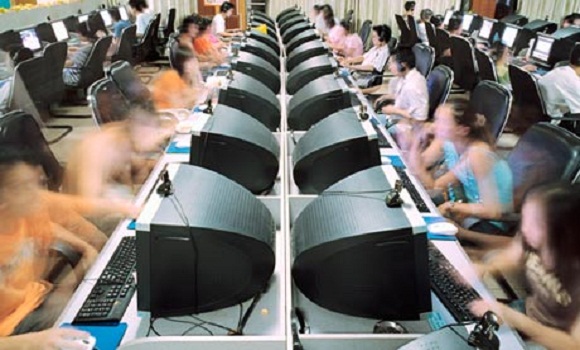
Web censorship the net is closing in
Every state in the world has its own laws, cultural norms and accepted behaviours. As billions of people come online in the next decade, many will discover a newfound independence that will test these boundaries. Each state will attempt to regulate the internet, and shape it in its own image.
The majority of the world’s internet users encounter some form of censorship – also known by the euphemism “filtering” – but what that actually looks like depends on a country’s policies and its technological infrastructure. Not all or even most of that filtering is political censorship; progressive countries routinely block a modest number of sites, such as those featuring child pornography.
In some countries, there are several entry points for internet connectivity, and a handful of private telecommunications companies control them (with some regulation). In others, there is only one entry point, a nationalised internet service provider (ISP), through which all traffic flows. Filtering is relatively easy in the latter case, and more difficult in the former.
When technologists began to notice states regulating and projecting influence online, some warned against a “Balkanisation of the internet”, whereby national filtering and other restrictions would transform what was once the global internet into a connected series of nation-state networks. The web would fracture and fragment, and soon there would be a “Russian internet” and an “American internet” and so on, all coexisting and sometimes overlapping but, in important ways, separate. Information would largely flow within countries but not across them, due to filtering, language or even just user preference. The process would at first be barely perceptible to users, but it would fossilise over time and ultimately remake the internet.
It’s very likely that some version of the above scenario will occur, but the degree to which it does will greatly be determined by what happens in the next decade with newly connected states – which path they choose, whom they emulate and work together with.
The first stage of the process, aggressive and distinctive filtering, is under way. China is the world’s most active and enthusiastic filterer of information. Entire platforms that are hugely popular elsewhere in the world – Facebook, Tumblr, Twitter – are blocked by the Chinese government.
On the Chinese internet, you would be unable to find information about politically sensitive topics such as the Tiananmen Square protests, embarrassing information about the Chinese political leadership, the Tibetan rights movement and the Dalai Lama, or content related to human rights, political reform or sovereignty issues.
To the average Chinese user, this censorship is seamless – without prior knowledge of events or ideas, it would appear that they never existed.
China’s leadership doesn’t hesitate to defend its policies. In a white paper released in 2010, the government calls the internet “a crystallisation of human wisdom” but states that China’s “laws and regulations clearly prohibit the spread of information that contains contents subverting state power, undermining national unity [or] infringing upon national honour and interests.”
The next stage for many states will be collective editing, states forming communities of interest to edit the web together, based on shared values or geopolitics. For larger states, collaborations will legitimise their filtering efforts and deflect some unwanted attention (the “look, others are doing it too” excuse). For smaller states, alliances along these lines will be a low-cost way to curry favour with bigger players and gain technical skills that they might lack at home.
Collective editing may start with basic cultural agreements and shared antipathies among states, such as what religious minorities they dislike, how they view other parts of the world or what their cultural perspective is on historical figures such as Vladimir Lenin, Mao Zedong or Mustafa Kemal Atatürk.
Larger states are less likely to band together than smaller ones – they already have the technical capabilities – so it will be a fleet of smaller states, pooling their resources, that will find this method useful. If some member countries in the Commonwealth of Independent States (CIS), an association of former Soviet states, became fed up with Moscow’s insistence on standardising the Russian language across the region, they could join together to censor all Russian-language content from their national internets and thus limit their citizens’ exposure to Russia.
Ideology and religious morals are likely to be the strongest drivers of these collaborations. Imagine if a group of deeply conservative Sunni-majority countries – say, Saudi Arabia, Yemen, Algeria and Mauritania – formed an online alliance and decided to build a “Sunni web”. While technically this Sunni web would still be part of the larger internet, it would become the main source of information, news, history and activity for citizens living in these countries. For years, the development and spread of the internet was highly determined by its English-only language standard, but the continued implementation of internationalised domain names (IDN), which allow people to use and access domain names written in non-Roman alphabet characters, is changing this. The creation of a Sunni web – indeed, all nationalised internets – becomes more likely if its users can access a version of the internet in their own language and script.
Within the Sunni web, the internet could be sharia-complicit: e-commerce and e-banking would look different, since no one would be allowed to charge interest; religious police might monitor online speech, working together with domestic law enforcement to report violations; websites with gay or lesbian content would be uniformly blocked; women’s movements online might somehow be curtailed; and ethnic and religious minority groups might find themselves closely monitored, restricted or even excluded. In this scenario, how possible it would be for a local tech-savvy citizen to circumvent this internet and reach the global world wide web depends on which country he lived in: Mauritania might not have the desire or capacity to stop him, but Saudi Arabia probably would. If the Mauritanian government became concerned that its users were bypassing the Sunni web, on the other hand, surely one of its new digital partners could help it build higher fences.
There will be some instances where autocratic and democratic nations edit the web together. Such a collaboration will typically happen when a weaker democracy is in a neighbourhood of stronger autocratic states that coerce it to make the same geopolitical compromises online that it makes in the physical world.
For example, Mongolia is a young democracy with an open internet, sandwiched between Russia and China – two large countries with their own unique and restrictive internet policies. The former Mongolian prime minister Sukhbaatar Batbold explained to us that he wants Mongolia, like any country, to have its own identity. This means, he said, it must have good relations with its neighbours to keep them from meddling in Mongolian affairs.
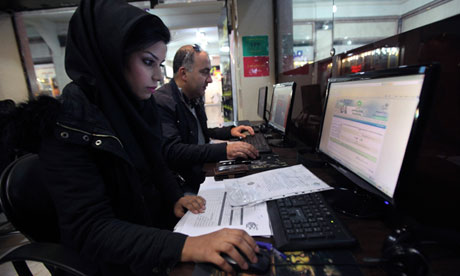
Iranian internet cafe People use the internet in Tehran, Iran, where the government has spoken of creating its own ‘halal internet’. Photograph: Vahid Salemi/AP
A neutral stance of noninterference is more easily sustainable in the physical world. Virtual space significantly complicates this model. People sympathetic to opposition groups and ethnic minorities within China and Russia would look at Mongolia as an excellent place to congregate. Supporters of the Uighurs, Tibetans or Chechen rebels might seek to use Mongolia’s internet space as a base from which to mobilise, to wage online campaigns and build virtual movements. If that happened, the Mongolian government would no doubt feel the pressure from China and Russia, not just diplomatically but because its national infrastructure is not built to withstand a cyber assault from either neighbour. Seeking to please its neighbours and preserve its own physical and virtual sovereignty, Mongolia might find it necessary to abide by a Chinese or Russian mandate and filter internet content associated with hot-button issues.
What started as the world wide web will begin to look more like the world itself, full of internal divisions and divergent interests. Some form of visa requirement will emerge on the internet. This could be done quickly and electronically, as a method to contain the flow of information in both directions, requiring that users register and agree to certain conditions to access a country’s internet. Citizen engagement, international business operations and investigative reporting will all be seriously affected. This, along with internal restrictions of the internet, suggests a 21st-century equivalent of Japan’s famous sakoku (“locked country”) policy of near-total isolation enacted in the 17th century.
Some states may implement visa requirements as both a monitoring tool for international visitors and as a revenue-generating exercise – a small fee would be charged upon entering a country’s virtual space, even more if one’s online activities violated the terms of the visa. Virtual visas would appear in response to security threats related to cyber attacks; if your IP address (the unique number associated with each device on the internet) came from a blacklisted country, you would encounter heightened monitoring.
Under conditions like these, the world will see its first Internet asylum seeker. A dissident who can’t live freely under an autocratic Internet and is refused access to other states’ Internets will choose to seek physical asylum in another country to gain virtual freedom on its Internet. There could be a form of interim virtual asylum, where the host country would share sophisticated proxy and circumvention tools that would allow the dissident to connect outside.
Virtual asylum will not work, however, if the ultimate escalation occurs: the creation of an alternative domain name system (DNS), or even aggressive and ubiquitous tampering with it to advance state interests. Today, the internet as we know it uses the DNS to match computers and devices to relevant data sources, translating IP addresses (numbers) into readable names, with .edu, .com, .net suffixes, and vice versa. No government has yet achieved an alternative system, but if one succeeded in doing so, it would effectively unplug its population from the global internet and instead offer only a closed, national intranet. In technical terms, this would entail creating a censored gateway between a given country and the rest of the world, so that a human proxy could facilitate external data transmissions when absolutely necessary – for matters involving state resources, for instance.
It’s the most extreme version of what technologists call a walled garden. On the internet, a walled garden refers to a browsing environment that controls a user’s access to information and services online. (This concept is not limited to discussions of censorship; AOL and CompuServe, internet giants for a time, both started as walled gardens.) For the full effect of disconnection, the government would also instruct the routers to fail to advertise the IP addresses of websites – unlike DNS names, IP addresses are immutably tied to the sites themselves – which would have the effect of putting those websites on a very distant island, utterly unreachable. Whatever content existed on this national network would circulate only internally, trapped like a cluster of bubbles in a computer screen saver, and any attempts to reach users on this network from the outside would meet a hard stop. With the flip of a switch, an entire country would simply disappear from the internet.
This is not as crazy as it sounds. It was first reported in 2011 that the Iranian government’s plan to build a “halal internet” was under way, and the regime’s December 2012 launch of Mehr, its own version of YouTube with “government-approved videos“, demonstrated that it was serious about the project. Details of the plan remained hazy but, according to Iranian government officials, in the first phase the national “clean” internet would exist in tandem with the global internet for Iranians (heavily censored as it is), then it would come to replace the global internet altogether. The government and affiliated institutions would provide the content for the national intranet, either gathering it from the global web and scrubbing it, or creating it manually. All activity on the network would be closely monitored. Iran’s head of economic affairs told the country’s state-run news agency that they hoped their halal internet would come to replace the web in other Muslim countries, too – at least those with Farsi speakers. Pakistan has pledged to build something similar.
It is possible that Iran’s threat is merely a hoax. How exactly the state intends to proceed with this project is unclear both technically and politically. How would it avoid enraging the sizable chunk of its population that has access to the internet? Some believe it would be impossible to fully disconnect Iran from the global internet because of its broad economic reliance on external connections. Others speculate that, if it wasn’t able to build an alternative root system, Iran could pioneer a dual-internet model that other repressive states would want to follow. Whichever route Iran chooses, if it is successful in this endeavour, its halal internet would surpass the “great firewall of China” as the single most extreme version of information censorship in history. It would change the internet as we know it.
http://www.guardian.co.uk/

Child Hunger Is Exploding In Greece – And 14 Signs That It Is Starting To Happen In America Too

ChildThe world is heading into a horrific economic nightmare, and an inordinate amount of the suffering is going to fall on innocent children.  If you want to get an idea of what America is going to look like in the not too distant future, just check out what is happening in Greece.  At this point, Greece is experiencing a full-blown economic depression.  As I have written about previously, the unemployment rate in Greece has now risen to 27 percent, which is much higher than the peak unemployment rate that the U.S. economy experienced during the Great Depression of the 1930s.  And as you will read about below, child hunger is absolutely exploding in Greece right now.  Some families are literally trying to survive on pasta and ketchup.  But don't think for a moment that it can't happen here.  Sadly, the truth is that child hunger is already rising very rapidly in our poverty-stricken cities.  Never before have we had so many Americans unable to take care of themselves.  Food stamp enrollment and child homelessness have soared to brand new all-time records, and there are actually thousands of Americans that are so poor that they live in tunnels underneath our cities.  But for millions of other Americans, the suffering is not quite so dramatic.  Instead, they just watch their hopes and their dreams slowly slip away as they struggle to find a way to make it from month to month.  There are millions of parents that lead lives that are filled with constant stress and anxiety as they try to figure out how to provide the basics for their children.  How do you tell a child that you can't give them any dinner even though you have been trying as hard as you can?  What many families go through on a regular basis is absolutely heartbreaking.  Unfortunately, more poor families slip through the cracks with each passing day, and these are supposedly times in which we are experiencing an "economic recovery".  So what are things going to look like when the next major economic downturn strikes?
A recent New York Times article detailed the horrifying child hunger that we are witnessing in Greece right now.  At some schools there are reports of children actually begging for food from their classmates...
As an elementary school principal, Leonidas Nikas is used to seeing children play, laugh and dream about the future. But recently he has seen something altogether different, something he thought was impossible in Greece: children picking through school trash cans for food; needy youngsters asking playmates for leftovers; and an 11-year-old boy, Pantelis Petrakis, bent over with hunger pains.
“He had eaten almost nothing at home,” Mr. Nikas said, sitting in his cramped school office near the port of Piraeus, a working-class suburb of Athens, as the sound of a jump rope skittered across the playground. He confronted Pantelis’s parents, who were ashamed and embarrassed but admitted that they had not been able to find work for months. Their savings were gone, and they were living on rations of pasta and ketchup.
Could you imagine that happening to your children or your grandchildren?
Don't think that it can't happen.  Just a few years ago the Greek middle class was vibrant and thriving.
And we are starting to see hunger explode in other European countries as well.  For example, in the UK the number of people receiving emergency food rations has increased by 170 percent over the past year.
This is one of the reasons why I get upset when people say that "things are getting better".  Yes, the stock market has been setting record highs lately, but things are most definitely not getting better.
Even during this false bubble of debt-fueled economic stability that we are enjoying right now, we continue to see hunger and poverty rise dramatically in America.
Since Barack Obama has been president, the number of Americans on food stamps has grown from 32 million to more than 47 million.
Will we all be on food stamps eventually?
Will we all become dependent on the government for our survival at some point?
According to the Boston Herald, even Tamerlan Tsarnaev was receiving government welfare benefits...
Marathon bombings mastermind Tamerlan Tsarnaev was living on taxpayer-funded state welfare benefits even as he was delving deep into the world of radical anti-American Islamism, the Herald has learned.
State officials confirmed last night that Tsarnaev, slain in a raging gun battle with police last Friday, was receiving benefits along with his wife, Katherine Russell Tsarnaev, and their 3-year-old daughter. The state’s Executive Office of Health and Human Services said those benefits ended in 2012 when the couple stopped meeting income eligibility limits.
Isn't that crazy?
And yes, there are some people out there that are abusing the system.  In fact, the cost of food stamp fraud has risen sharply to approximately $750 million in recent years.
But most of the people on these programs really need the help.  Thanks to our incredibly foolish economic policies, there are not enough good jobs for everyone and there never will be again.  The percentage of Americans that are unable to take care of themselves is going to continue to rise, and the suffering that we are witnessing right now is going to get much, much worse.
Not that things aren't really, really bad already.  Here are some signs that child hunger in America has already started to explode...
#1 Today, approximately 17 million children in the United States are facing food insecurity.  In other words, that means that "one in four children in the country is living without consistent access to enough nutritious food to live a healthy life."
#2 We are told that we live in the "wealthiest nation" on the planet, and yet more than one out of every four children in the United States is enrolled in the food stamp program.
#3 The average food stamp benefit breaks down to approximately $4 per person per day.
#4 It is being projected that approximately 50 percent of all U.S. children will be on food stamps before they reach the age of 18.
#5 It may be hard to believe, but approximately 57 percent of all children in the United States are currently living in homes that are either considered to be either "low income" or impoverished.
#6 The number of children living on $2.00 a day or less in the United States has grown to 2.8 million.  That number has increased by 130 percent since 1996.
#7 According to Feeding America, "households with children reported food insecurity at a significantly higher rate than those without children, 20.6 percent compared to 12.2 percent".
#8 According to a Feeding America hunger study, more than 37 million Americans are now being served by food pantries and soup kitchens.
#9 For the first time ever, more than a million public school students in the United States are homeless.  That number has risen by 57 percent since the 2006-2007 school year.
#10 Approximately 20 million U.S. children rely on school meal programs to keep from going hungry.
#11 One university study estimates that child poverty costs the U.S. economy 500 billion dollars each year.
#12 In Miami, 45 percent of all children are living in poverty.
#13 In Cleveland, more than 50 percent of all children are living in poverty.
#14 According to a recently released report, 60 percent of all children in the city of Detroit are living in poverty.
For many more facts about the dramatic explosion of poverty in this country, please see my previous article entitled "21 Statistics About The Explosive Growth Of Poverty In America That Everyone Should Know".
Unfortunately, most of the time statistics don't really tell the whole story.  Numbers alone cannot really communicate the soul-crushing despair that millions of American families are enduring on a daily basis at this point.
How can numbers communicate the pain that a child feels when her grandmother does not eat because there is not enough food for everyone in the family?  But this is what some families in America actually go through because there is not enough money...
Vanyshia tells about the sacrifices her Grandmother makes so that she and her siblings can eat. “Sometimes my Grandma can’t even eat because she has to feed me and my brother and sister. Sometimes I don’t eat as much as I want to because I leave some for my Grandma because I don’t want her to sit there and starve. Sometimes she doesn’t have enough money to buy food, so she has to go to the bank and borrow money. It makes me feel sad. I don’t want her to be hungry. I just feel sad sometimes,” says Vanyshia.
Things can be particularly tough when you are a single parent.  The BBC recently profiled a single mother that is struggling to raise two young children in Iowa...
"We don't get three meals a day like breakfast, lunch and then dinner," says Kaylie. "When I feel hungry I feel sad and droopy."
Kaylie and Tyler live with their mother Barbara, who used to work in a factory. After losing her job, she was entitled to unemployment benefit and food stamps - this comes to $1,480 (£974) a month.
But they were no longer able to afford to live in their house, which along with bills cost $1,326 (£873) a month, leaving little for food or petrol.
Kaylie supplemented their income by collecting cans along the railway track near their old home - earning between two and five cents per can.
For more examples like this one, I encourage everyone to go watch a recent BBC documentary entitled "America's Poor Kids" that you can see right here.
I wonder why we don't see more stuff like this on the mainstream news in this country?
Could it be that the mainstream media does not want to admit how bad things have really gotten?
All of this is also a reminder that we need to be generous to those in need.  Times are going to get much, much harder than this, and we are all going to need one another.
So do you have any stories of poverty or child hunger from your area of the country to share?  Please feel free to share your thoughts by posting a comment below...
Child Hunger
Be Sociable, Share!

Was Boston Bomber “Radicalized” at a U.S. Sponsored Counterterrorism Workshop

Promoting "Instability and Extremism in Southern Regions of Russia"

russia2

Who Radicalized the Boston Bomber?

Just as the U.S. supported Bin Laden and the precursor of Al Qaeda in order to fight the Soviets, the U.S. has supported Chechen terrorists in order to fight Russia.
Today, Russian newspaper Izvestia alleges that the older Boston Tamarlan bombing brother attended a workshop – sponsored by an American organization – on destabilizing the Russian satellite states:
At the disposal of “Izvestia” has documents Counterintelligence Department Ministry of Internal Affairs of Georgia, confirming that the Georgian organization “Fund of Caucasus” [here's their website], which cooperates with the U.S. non-profit organization “Jamestown” (the board of directors of NGOs previously entered one of the ideologists of U.S. foreign policy, Zbigniew Brzezinski), was engaged in recruiting residents North Caucasus to work in the interests of the United States and Georgia.
According to the reports of Colonel Chief Directorate Counterintelligence Department Ministry of Internal Affairs of Georgia Gregory Chanturia to the Minister of Internal Affairs Irakli Garibashvili, “Caucasian fund” in cooperation with the Foundation “Jamestown” in the summer of 2012 conducted workshops and seminars for young people of the Caucasus, including its Russian part. Some of them attended Tsarnaev Tamerlane, who was in Russia from January to July 2012.
“Caucasian fund” writes Tchanturia was established November 7, 2008, just after the Georgian-Ossetian conflict, “to control the processes taking place in the North Caucasus region.” Accordingly, the Department of the Interior Ministry counterintelligence case was brought intelligence operations called “DTV”. Main purpose is to recruit young people and intellectuals of the North Caucasus to enhance instability and extremism in the southern regions of Russia.
***
In addition, Colonel counterintelligence Tbilisi reports that security forces in Chechnya through Georgia “Caucasian fund” and fund “Jamestown” are sympathetic to the Georgian people, who are invited to various events in the republic under the innocent pretexts. In these seminars, the Russians are recruiting and preparing acts of terrorism.
***
Director General of the National Strategy Council Valery Hamsters argues that exaggerated the force of external enemy in Georgia may be beneficial to the management of the North Caucasian republics. [In other words, they are creating a strategy of tension.]
- I think the danger is exaggerated Georgian factor – the expert believes. – Personally, I have no doubt that Georgia only deals with the introduction of its spies and recruit Russian citizens.
***
Jamestown Foundation has repeatedly demonstrated its interest in Georgia and the state of affairs in Russia’s North Caucasus. In 2007, the Foundation held a seminar “The Future of Ingushetia,” which was attended by former fighters of Aslan Maskhadov.
***
The Russian Foreign Ministry has repeatedly responded to the ongoing policy of the fund, handing over a protest note to U.S. in Moscow.
Izvestia – being a Russian state-run newspaper – obviously has an axe to grind, and is biased against Georgian interests. However, the Russian government contracted the U.S. multiple times to warn them about Tamerlan Tsarnaev … who was on a U.S. watch list for terrorism.
The sponsor of the seminar – the Jamestown Foundation – was founded with help from CIA director William Casey, has extensive links to U.S. intelligence and defense agencies, and is closely connected with key Neocons.

FBI denied permission to spy on hacker through his webcam

Feds provide "little or no explanation of how Target Computer will be found."

Sorry FBI, you can't randomly hijack someone's webcam.
A federal magistrate judge has denied (PDF) a request from the FBI to install sophisticated surveillance software to track someone suspected of attempting to conduct a “sizeable wire transfer from [John Doe’s] local bank [in Texas] to a foreign bank account.”
Back in March 2013, the FBI asked the judge to grant a month-long “Rule 41 search and seizure warrant” of a suspect’s computer “at premises unknown” as a way to find out more about this possible violations of “federal bank fraud, identity theft and computer security laws.”
In an unusually-public order published this week, Judge Stephen Smith slapped down the FBI on the grounds that the warrant request was overbroad and too invasive. In it, he gives a unique insight as to the government’s capabilities for sophisticated digital surveillance on potential targets. According to the judge’s description of the spyware, it sounds very similar to the RAT software that many miscreants use to spy on other Internet users without their knowledge. (Ars editor Nate Anderson detailed the practice last month.)
According to the 13-page order, the FBI wanted to “surreptitiously install data extraction software on the Target Computer. Once installed, the software has the capacity to search the computer’s hard drive, random access memory, and other storage media; to activate the computer’s built-in camera; to generate latitude and longitude coordinates for the computer’s location; and to transit the extracted data to FBI agents within the district.”
Neither an FBI spokesperson, nor Craig M. Feazel—who represents the FBI in this case and is an assistant United States Attorney—responded to Ars’ request for comment. Many civil libertarians, though, have raised serious questions as to what the government is up to.
“Hacking should be something that is the last resort, not the first option,” Chris Soghoian, principal technologist at the ACLU's Speech Privacy and Technology Project, told Ars. “No one knows anything about [how the FBI’s software works]. We know from a [Freedom of Information Act request] that there was a [Computer and Internet Protocol Address Verifier software], but this seems to be much more sophisticated. This sounds like the kind of [spyware] stuff that Gamma or Finfisher is selling. As a general rule, we don’t think law enforcement should be in the hacking business. It’s sexy, but it’s terrifying.”
Soghoian also recalled that Germany’s own (and similar) “federal trojan” program has been revealed to have notable security flaws by the famed hacker group, the Chaos Computer Club.

"Little or no explanation"

According to the judge’s order (PDF), the FBI has no idea where the suspect actually is, but noted that the “IP address of the computer accessing Doe’s account resolves to a foreign country.”
While IP addresses can certainly be easily spoofed, assuming the suspect actually is outside the United States, that raises significant questions as to the appropriate use of such a warrant. The judge agreed, noting that the “government’s application does not satisfy any [existing territorial limits].”
Further, the judge cited the government’s failure to meet the Fourth Amendment’s requirement of “place to be searched, and the persons or things to be seized.”
The Government’s application contains little or no explanation of how the Target Computer will be found. Presumably, the Government would contact the Target Computer via the counterfeit e-mail address, on the assumption that only the actual culprits would have access to that e-mail account. Even if this assumption proved correct, it would not necessarily mean that the government has made contact with the end-point Target Computer at which the culprits are sitting. It is not unusual for those engaged in illegal computer activity to “spoof” Internet Protocol addresses as a way of disguising their actual online presence; in such a case the Government’s search might be routed through one or more “innocent” computers on its way to the Target Computer. The Government’s application offers nothing but indirect and conclusory assurance that its search technique will avoid infecting innocent computers or devices.
The judge also berated the government for its failure to explain how precisely it would target the suspect’s computer, the suspect, and no one else.
What if the Target Computer is located in a public library, an Internet café, or a workplace accessible to others? What if the computer is used by family or friends uninvolved in the illegal scheme? What if the counterfeit e-mail address is used for legitimate reasons by others unconnected to the criminal conspiracy? What if the e-mail address is accessed by more than one computer, or by a cell phone and other digital devices? There may well be sufficient answers to these questions, but the Government’s application does not supply them.

Yeah, that Judge Smith

What’s also notable about this case, according to legal experts, is that it was issued by a Texas federal judge notorious for his outspoken views on making government surveillance more transparent. As we reported last year, Judge Smith estimated that tens of thousands of secret surveillance orders are issued by his fellow judges each year.
“This is the first time I've seen a public denial; the government has been very secretive about this surveillance tool and there hasn't been much litigation about it that I'm aware of,” Hanni Fakhoury, an attorney with the Electronic Frontier Foundation, told Ars. “I'm not surprised it came from Judge Smith. He's very outspoken on surveillance issues. His order finding cell site records protected by the Fourth Amendment is on appeal to the 5th Circuit (EFF argued the case). And he's issued orders denying requests for tower dump and a stingray before too.”

Fifth Amendment shields child porn suspect from decrypting hard drives

Judge says forcing man to unlock files would amount to self-incrimination.

A federal judge refused to compel a Wisconsin suspect to decrypt the contents of several hard drives because doing so would violate the man's Fifth Amendment right against self-incrimination. Judge William E. Callahan's Friday ruling ultimately labeled the issue a "close call."
Courts have wrestled with how to apply the Fifth Amendment to encrypted hard drives for several years. According to past rulings, forcing a defendant to decrypt a hard drive isn't necessarily self-incriminating, but forcing a defendant to decrypt a hard drive can amount to self-incrimination if the government can't otherwise show that the defendant has the password for the drive. In that case, forced decryption amounts to a forced confession that the defendant owns the drive.
For example, in one case a border patrol agent viewed incriminating files on a suspect's laptop during a border crossing. But the official then closed the laptop, causing the portion of the hard drive containing the files to be encrypted automatically and deprive investigators of access. The court ruled that because the government already knew the files existed and the suspect had access to them, compelling their decryption didn't force the suspect to implicitly admit the laptop was his.
The circumstances of the Wisconsin case were different. While police officers did find logs on the suspect's PC suggesting that incriminating files had been saved to an encrypted drive, the suspect had multiple encrypted hard drives in his apartment, and the government had no way of proving which specific hard drives, if any, contained the incriminating files in question. In theory, a guest might have used the man's computer to download the files and store them on a hard drive he didn't own. Or the hard drives containing the files might not be among the ones the police seized.
"Feldman’s act of production, which would necessarily require his using a password of some type to decrypt the storage device, would be tantamount to telling the government something it does not already know with 'reasonably particularity'—namely, that Feldman has personal access to and control over the encrypted storage devices," Judge Callahan wrote. "Accordingly, in my opinion, Fifth Amendment protection is available to Feldman. Stated another way, ordering Feldman to decrypt the storage devices would be in violation of his Fifth Amendment right against compelled self-incrimination."

McAfee Patents Technology to Detect and Block Pirated Content

Security software company McAfee has patented a new technology that aims to prevent the public from accessing pirated movies and music online. The system, which expands the SiteAdvisor tool, can detect and block pirated material from any website and present users with authorized and legal alternatives. McAfee says the technology will help steer consumers to authorized services and thereby prevent costly lawsuits.
mcafeeFor years copyright holders have urged search engines and Internet providers to make it harder for users to access infringing content online.
Thus far these efforts have been in vain, but anti-virus vendor McAfee has now presented a technology that will please rightholders. A new patent published by the California-based company describes a system that can prevent users from accessing pirate content.
Titled “Detect and prevent illegal consumption of content on the internet,” the patent covers a blocklist-type system that can either warn consumers, completely block access to web pages, or offer purchasing advice.
The flow-chart below shows the various steps involved.

Pirate or not?
mcafee-block
According to McAfee there are many reasons for consumers and corporations to be concerned with the downloading of illegal content, ranging from legal risks to malware and virus threats.
“One major reason for concern is possible violation of an Intellectual Property right and the potential cost ramifications associated with such a violation,” the company explains.
“A second major concern could relate to potential threats cause by some unauthorized distributions. For example, it is not uncommon for an unauthorized distribution of material on the Internet to include malicious material.”
McAfee presents their solution as an extension to its widely used SiteAdvisor tool, targeted at both individual consumers and business clients. Threats can be detected in search engines where pirate results get a warning label, but also on social networks including Facebook.

Piracy indicator in Google
macafee-search
In addition to blocking access to pirated content the technology also has the capability to point users to legal alternative sources for the same, or similar content.
“By informing a user of illegal sources and possible alternatives, a user can obtain the desired electronic distribution without violating an author’s intellectual property rights,” McAfee writes.
Those who click on a pirate link will be pointed to a new screen where users can learn more about the warning. Depending on how the software is set up users may then take the risk and click through to the site. This is similar to how Google, Firefox and other online services already respond to links pointing to malware threats.

Piracy indicator in Google
sure
By preventing people from inadvertently visiting pirate websites, McAfee hopes that the technology will educate consumers on how to make the right choices when looking for entertainment online.
Whether there are any concrete plans to roll out the system is unknown at this point. The most likely option is that it will be added to McAfee’s existing security products.
If so, we can expect copyright holders to push for a wide adoption of the software.

THIS ONE IS TOO BIZARRE: THE MARATHON BOMBING AND ISRAELI POLICE


This one is so bizarre any way one approaches it, that it’s not even funny. Indeed, I don’t even know where to begin. That something is rotten in the Commonwealth of Massachusetts concerning the Boston marathon bombing seems evident to most thinking people, listening to the media report now this, now that “fact”.  We have been witness to the almost pathological glee of certain talk show hosts, itching to blame it on the “radical right” (meaning all the “gun-toatin’ Republicans and militia people and yellow-dog Democrats in the “red” states”), two poison letters, one to a senator, another to the president, may make it possible for the story to evolve along whatever the most convenient path the “story” (still in progress) needs to take.
Well, we can fairly guess the direction “they” want it to take if we turn to this story (again, coming from RT):
Israeli police head to US to aid in Boston Marathon bombing investigation
Now, if you’re like me, you’re probably wondering, “What the (O*&*#&^*!^%@!@Q!?”
First off, after all the security cameras, patriot acts, Heimatsicherheitsdienst, TSA, electronic eavesdropping and all the other wonderful “security” we’re getting for the increasingly high taxes our misrepresentative bilk from us, how did this even happen? Secondly, why hasn’t senator Feinstein spackled on some make-up and demanded Federal background checks on people buying pressure cookers, nails, ball bearings, bb’s, and so on? I mean, if we’re to be logically consistent…oh yea, I forgot, it’s not about the constitution, it’s about using opportunity for increasing your power. Sorry Diane, now I understand.
But now, thirdly, after all the money we lavish on the alphabet soup agencies – CIA, NSA, FBI, DIA, ONI and all the others – how and why in the same of sense do we need help from anyone.
And fourthly, if we call on people to “help” us if we suspect this is terrorism, why not the Russians? (They have some experience with it as I recall). Oops. I forgot. You cannot trust the Ruskies. Well, why not the British? They have bomb experts and bomb-sniffing dogs too. But, well, you know the British, they take any such opportunity to spy on everyone else. Besides, we spy on everyone else so much better. Well, the Germans then? they have bomb experts and dogs too… but they probably wouldn’t come even if we did invite them, which we won’t, because then they’ll say “Sure. Give us our gold first.”
So why of all people Israel? Why do we need any help at all? What, in the final analysis, has all the money for security given us? Has it made us “safer”? No. Did the security cameras and bomb sniffing dogs stop it? No. Did the eavesdropping and spying? No.
But hey, it sure made a big dent in the Bill of Rights and the Constitution.

Read more: THIS ONE IS TOO BIZARRE: THE MARATHON BOMBING AND ISRAELI POLICE
- Giza Death Star Community

Israeli police head to US to aid in Boston Marathon bombing investigation

Published time: April 17, 2013 16:11
The head of the Israel Police, Major General Yohanan Danino (AFP Photo / Jack Guez)
The investigation into Monday’s deadly bombing at the Boston Marathon has officially gone international: law enforcement officials from Israel have been sent to the United States to assist in the probe.
Israel Police Chief Yohanan Danino says he has dispatched officials to Boston, Massachusetts, where they will meet with Federal Bureau of Investigation agents and other authorities, the Times of Israel Reports.
Citing an earlier report published by the newspaper Maariv, Times of Israel writes that Danino has dispatched police officers to participate in discussions that “will center on the Boston Marathon bombings and deepening professional cooperation between the law enforcement agencies of both countries.”
The paper reports that Israeli law enforcement planned the trip before the deadly pair of bombings on Monday that has so far claimed three lives, but the discussions will now shift focus in order to see how help from abroad can expand the investigation.
In an address made Tuesday, Israel President Shimon Peres said that tragedies such as this week’s incident in Boston, sadly, bring people together from across the world.
“When it comes to events like this, all of us are one family. We feel a part of the people who paid such a high price. God bless them,” Peres said. “Today the real problem is terror, and terror is not an extension of policy: Their policy is terror, their policy is to threaten. Terrorists divide people, they kill innocent people.”
Around 20 hours after two bombs detonated near the finish line of the annual race, United States President Barack Obama went on record to condemn the tragedy as a terrorist attack.

“This was a heinous and cowardly act,” said Obama from the White House, “and given what we now know the FBI is investigating it as an act of terrorism.”
But even as officials come to assist from as far away as Israel, authorities are still in the dark as far as finding any leads in the case. Pres. Obama has directed the FBI and US Department of Homeland Security to assist in the investigation, but no agencies have identified suspects or motives at this time.
Pres. Obama has also said that his administration has been directed to implement “appropriate security measures to protect the American people,” but details as to what that could mean remain scarce. Meanwhile, at least one leading lawmaker is asking for the US to respond to the terrorist attack by increasing the scope of the ever-expanding surveillance program already growing across the United States.
“I do think we need more cameras,” Rep. Peter King (R-New York) told MSNBC after Monday’s attacks. “We have to stay ahead of the terrorists and I do know in New York, the Manhattan Security Initiative, which is based on cameras, the outstanding work that results from that.  So yes, I do favor more cameras.  They're a great law enforcement device.  And again, it keeps us ahead of the terrorists, who are constantly trying to kill us.”
New York Mayor Michael Bloomberg has also confirmed that he has dispatched law enforcement officers from the Big Apple to assist in the investigation by meeting with agents at a Boston fusion center, one of the DHS-funded data facilities that collects surveillance camera footage and other evidence in order to analyze events like Monday’s attack.
“We are certainly engaged in the information flow with the FBI through our Joint Terrorism Task Force. We have two New York City police officers, police sergeants, who are in the Boston Regional Intelligence Center,” Bloomberg said on Tuesday. “They’re up there, they’ve been up there since last evening.”
But in a study conducted last year by the Senate’s bipartisan Permanent Subcommittee on Investigations, lawmakers found that those fusion centers have been more or less unhelpful in assisting with terrorism probes.
The Department of Homeland Security’s work with state and local fusion centers, the subcommittee wrote, “has not produced useful intelligence to support federal counterterrorism efforts.” Instead, they added, so-called “intelligence” shared between facilities consisted of tidbits of shoddy quality that was often outdated and “sometimes endangering [to] citizen‘s civil liberties and Privacy Act protections.”
“More often than not,” the panel added, information collected and shared at DHS fusion centers was “unrelated to terrorism.”

After $200M patent settlement with Microsoft, VirnetX sues for more

Microsoft gets sued by a patent holder with a track record of big wins.

A patent-holding company that already won a $200 million patent settlement from Microsoft in 2010 is going after the software giant again. Yesterday, VirnetX filed suit in the East Texas judicial district that it favors, seeking another patent win against Redmond.
This new lawsuit lawsuit (PDF) asserts six patents that are alleged to cover Skype (which Microsoft purchased in 2011) as well as Microsoft products that may integrate Skype, like Lync, Microsoft's instant-messaging platform. The suit says the infringement is willful because Microsoft should have known about these patents due to VirnetX's earlier lawsuit and the license agreement it ultimately struck.
A March 2010 jury trial against Microsoft resulted in a $105.7 million verdict, and VirnetX was asking for an injunction as well. Two months after the verdict, Microsoft settled the litigation for $200 million. But VirnetX now notes that the license "was explicitly limited in scope, and Microsoft is not licensed to practice VirnetX's technology in certain excluded ways, particularly across non-Windows platforms."
VirnetX gets all its income from licensing patents. So although it talks about offering services, the company generally meets the standard of do-nothing patent-holding companies often called "patent trolls." The publicly traded company has 14 employees, and its corporate headquarters is a suite in a small office building in Zephyr Cove, Nevada, which it leases for $5 per month.
The company is experiencing an up-and-down year in the courts so far. In November, it won a $368 million verdict against Apple—and then immediately filed another lawsuit against Apple. That case has resulted in Apple changing how iOS devices use VPN. In a more recent case against Cisco, VirnetX lost, and its stock has gone down nearly 50 percent since then.

Analysis: U.S. arms sales to Asia set to boom on Pacific “pivot”

Source: REUTERS
U.S. sales of warplanes, anti-missile systems and other costly weapons to China’s and North Korea’s neighbors appear set for significant growth amid regional security jitters.
Strengthening treaty allies and other security partners is central to the White House’s “pivot” toward a Pacific region jolted by maritime territorial disputes in China’s case, and missile and nuclear programs, in North Korea’s.
The pivot “will result in growing opportunities for our industry to help equip our friends,” said Fred Downey, vice president for national security at the Aerospace Industries Association, a trade group that includes top U.S. arms makers.
Demand for big-ticket U.S. weapons is expected to stay strong for at least the next few years, the trade group said in a 2012 year-end review and forecast released in December.
Fears resulting from China’s growing military spending should lead to enough U.S. sales in South and East Asia to more than offset a slowdown in European arms-buying, according to the forecast.
The trade group, whose members include Pentagon suppliers Lockheed Martin Corp, Boeing Co and Northrop Grumman Corp, did not put numbers to its 2013 forecast. Nor did the Pentagon’s Defense Security Cooperation Agency, which has overseen a boom in worldwide deals under President Barack Obama.
The security agency, in response to a Reuters request, said sales agreements with countries in the U.S. Pacific Command’s area of activity rose to $13.7 billion in fiscal 2012, up 5.4 percent from a year before. Such pacts represent orders for future delivery.
In 2012 there were about 65 notifications to Congress of proposed government-brokered foreign military sales with a combined potential value of more than $63 billion. In addition, the State Department office that regulates direct commercial sales was on track to receive more than 85,000 license requests in 2012, a new record.
Overall, the United States reached arms transfer agreements in 2011 totaling $66.3 billion, or nearly 78 percent of all such worldwide pacts, according to the nonpartisan Congressional Research Service. The 2011 total was swollen by a record $33.4 billion deal with Saudi Arabia. India ranked second with $6.9 billion in such agreements.
Rupert Hammond-Chambers, who consults for U.S. arms makers through BowerGroupAsia, an advisory with 10 offices in the region, predicted Southeast Asian defense budgets would expand steadily as a hedge against Chinese assertiveness in disputes in the South China and East China seas.
DECEMBER ELECTION
December’s election of conservative, pro-American leaders in Japan and South Korea could further fuel sales, demonstrating U.S. solidarity with allies and partners.
The Obama administration says arms sales are an increasingly critical and cost-efficient arrow in its quiver to defend U.S. worldwide interests.
Such transfers reinforce diplomatic ties and promote long-term partnerships. They also are prized by Washington because they make it easier to fight side by side in places like Afghanistan and help allies do more for their own defense.
“This potentially reduces the burden that falls on our shoulders,” Andrew Shapiro, the State Department’s top official for partner strengthening, said in a December 5 speech.
The Pentagon is aiming to boost intelligence, surveillance and reconnaissance capabilities in the Asia-Pacific along with the introduction of more unmanned systems.
Such dispersed capabilities would help avert accidents and misunderstandings while fostering cooperation, Navy Admiral Samuel Locklear, the Hawaii-based commander of U.S. forces in the Pacific, told a forum in Washington.
Contractors such as Lockheed, Boeing, Northrop and Raytheon Co expect regional demand for their products and services to help them offset Pentagon belt-tightening forced by U.S. deficit-trimming measures.
These four companies are best-placed to benefit because of their work with satellites, radar, tracking stations and missile interceptors, said Richard Whittington, an aerospace and defense research analyst at Drexel Hamilton, a broker-dealer.
GLOBAL HAWK
In a move that could fuel a new market of its own, the administration in December formally proposed a $1.2 billion sale of Northrop Grumman’s high-flying RQ-4 “Global Hawk” spy drones and related gear to South Korea.
The Global Hawk carries cloud-piercing Raytheon sensors to scan large areas for enemy forces by day or night. It would boost Seoul’s ability to monitor North Korea.
Seoul had shown interest in the Global Hawk system for more than four years. The White House delayed proposing it until now, partly for fear of stirring a regional arms-race dynamic.
A Global Hawk purchase by Seoul would mark its first sale in the Asia-Pacific. Australia, Japan and Singapore each have shown interest as well, according to Northrop Grumman.
The notice of the possible South Korean purchase came less than two weeks after North Korea, on December 12, advanced its missile program with a long-range rocket launch that put a satellite in space, in defiance of U.N. resolutions. The North is banned from testing missile or nuclear technology under sanctions imposed after its 2006 and 2009 nuclear weapons tests.
Japan has emerged as the most important U.S. partner in crafting a layered shield against ballistic missiles of all ranges and in all phases of flight.
The administration told Congress two days before Pyongyang’s rocket launch that Tokyo was seeking a potential $421 million “Aegis” system upgrade for a pair of guided-missile destroyers to better defend against ballistic missile attacks.
Japan also has agreed to host a second land-based X-Band radar station – a possible prelude to purchase of Lockheed’s Terminal High Altitude Area Defense system, designed to intercept enemy missiles inside the atmosphere and in space.
F-35 JOINT STRIKE FIGHTER
The highest-profile U.S. offering now is Lockheed Martin’s radar-evading F-35 Joint Strike Fighter aircraft, whose three variants make up the Pentagon’s costliest arms program.
Japan already has selected the F-35 to replace aging F-4s as its next mainstay fighter, a deal valued at more than $5 billion. The F-35 is being considered by Singapore and South Korea, which is also weighing rival bids from the Eurofighter Typhoon and Boeing’s F-15 Silent Eagle. The Korean competition is for a 60-plane order valued at more than $7 billion.
U.S. arms sales to India, now at a cumulative $8 billion from near zero in 2008, are expected to keep on booming. India plans to spend about $100 billion over the next decade to upgrade its arsenal, partly as a counter to China. India and China fought a brief, high-altitude border war in 1962.
RETROFITTING TAIWAN
Taiwan, meanwhile, is retrofitting all of its 145 existing F-16A/B fighters with cutting-edge radar capabilities, advanced electronic warfare suites and other upgrades. Lockheed Martin received a $1.85 billion contract to start the work.
The White House is also mulling options to help plug a growing shortfall in Taiwan’s fighter aircraft versus Beijing’s forces, including a possible sale of advanced F-16C/D models long sought by Taipei.
Army Major General Sampson Lee, who heads the military mission of the Taipei Economic and Cultural Representative Office in Washington, said Taiwan would seek to go on buying defensive systems to meet “persistent military threats.”
China deems self-ruled Taiwan a breakaway province subject to a return to the fold, by force if necessary. The United States is committed under a 1979 law to supply Taiwan the arms it needs to maintain a “sufficient self-defense capability.”
Locklear, of the U.S. Pacific Command, said central to his part of the “rebalance” to the Pacific will be to modernize and strengthen U.S. treaty alliances with Australia, Japan, South Korea, the Philippines and Thailand – work that he said has already begun in earnest.
(Reporting By Jim Wolf; Editing by Ros Krasny and Steve Orlofsky)

China Deploys Carrier Killer Missile Near Taiwan

Source: NewsInvestor
Asian Security: As Korea festers, our friends in Beijing have deployed near Taiwan a powerful missile designed to take out U.S. aircraft carriers as Beijing strengthens its ability to prevent U.S. forces from aiding Taiwan.
When North Korea announced the 1953 Armistice was considered null and void and threatened renewed missile tests, the U.S. rushed naval assets to the region, including two destroyers equipped with the Aegis anti-missile defense system. We presumably would do so if things heated up between Beijing and its claimed “lost province,” Taiwan.
That option became increasingly problematical when news of China’s deployment of an anti-ship ballistic missile near Taiwan came in written testimony by the Pentagon’s head of intelligence, Lt. Gen. Michael Flynn, delivered to a Senate committee on Thursday.
The missile, designated the DF-21D, is one of a “growing number of conventionally armed” new weapons China is deploying to the region, adding to more than 1,200 short-range missiles opposite the island democracy, Flynn, the Defense Intelligence Agency director, told the Senate Armed Services Committee.
The Dong Feng-21D is intended to give China “the capability to attack large ships, particularly aircraft carriers, in the western Pacific,” the Pentagon’s 2012 China report said. The report cites estimates that the missile’s range exceeds 930 miles (1,500 kilometers).
The land-based missile is designed to target and track aircraft carrier groups with the help of satellites, unmanned aerial vehicles and over-the-horizon radar. Launched into space, the DF21D re-enters the atmosphere, maneuvering at 10 times the speed of sound towards its target.
Critics argue that this move only shows the vulnerability and obsolescence of the aircraft carrier in the missile era while others say our missile defense capabilities can handle the new threat. Certainly these floating air bases are no more vulnerable than fixed bases that cannot be moved to where they might be needed.
As its military, its economy and its ambitions grow, so too has Chinese assertiveness about control of the Yellow Sea, the South China Sea, and the larger East China Sea. Chinese military doctrine refers to establishing dominance over what it calls the “first island chain,” which encompasses the East China Sea.
Beijing has also long declared the South China Sea to be its territorial waters and has laid claim to two disputed island chains, the Paracel Islands about 200 miles from the coast of Vietnam, and the Spratly Islands in the southeastern part of the South China Sea.
Defense analysts have called the weapon a “game-changer,” as have we. It’s one that could force U.S. carrier battle groups to keep their distance and away from areas of Chinese interest or territorial claims.
A recent article posted on Xinhuanet, the website of China’s official news agency, paints a graphic picture of the sinking of the carrier George Washington in a scenario where it is dispatched to defend Taiwan.
The article describes three Dong Feng salvos, the first piercing the hull, starting fires, and shutting down flight operations.
The second salvo would knock out the ship’s propulsion and the third would “send the George Washington to the bottom of the sea.”
This brings into play a possible nightmare scenario of renewed hostilities on the Korean peninsula, including missile attacks on U.S. and Japanese targets, during which China decides to press its grievance over Taiwan. The potential of the DF-21D in the mix gives defense planners nightmares.
Since World War II, every president alerted to a crisis has asked the same question: Where are the carriers?
These floating air bases the size of small towns are visible signs of American power — that we mean business — and are able to project that power deep within a potential enemy’s territory.
Where are the carriers? Right now, amidst budget cuts and a rapidly growing Chinese military and naval presence, they are in Beijing’s crosshairs.

America The Fallen: 24 Signs That Our Once Proud Cities Are Turning Into Poverty-Stricken Hellholes

Hellholes - Photo by LyzadangerWhat is happening to you America?  Once upon a time, the United States was a place where free enterprise thrived and the greatest cities that the world had ever seen sprouted up from coast to coast.  Good jobs were plentiful and a manufacturing boom helped fuel the rise of the largest and most vibrant middle class in the history of the planet.  Cities such as Detroit, Chicago, Milwaukee, Cleveland, Philadelphia and Baltimore were all teeming with economic activity and the rest of the globe looked on our economic miracle with a mixture of wonder and envy.  But now look at us.  Our once proud cities are being transformed into poverty-stricken hellholes.  Did you know that the city of Detroit once actually had the highest per-capita income in the United States?  Looking at Detroit today, it is hard to imagine that it was once one of the most prosperous cities in the world.  In fact, as you will read about later in this article, tourists now travel to Detroit from all over the globe just to see the ruins of Detroit.  Sadly, the exact same thing that is happening to Detroit is happening to cities all over America.  Detroit is just ahead of the curve.  We are in the midst of a long-term economic collapse that is eating away at us like cancer, and things are going to get a lot worse than this.  So if you still live in a prosperous area of the country, don't laugh at what is happening to others.  What is happening to them will be coming to your area soon enough.
The following are 24 signs that our once proud cities are turning into poverty-stricken hellholes...
#1 According to the New York Times, there are now approximately 70,000 abandoned buildings in Detroit.
#2 At this point, approximately one-third of Detroit's 140 square miles is either vacant or derelict.
#3 Back during the housing bubble, an acre of land in downtown Phoenix, Arizona sold for about $90 a square foot.  Today, an acre in downtown Phoenix sells for about $9 a square foot.
#4 The city of Chicago is so strapped for cash that it is planning to close 54 public schools.  It is being estimated that Chicago schools will run a budget deficit of about a billion dollars in 2013.
#5 The city of Baltimore is already facing unfunded liabilities of more than 3.2 billion dollars, but the city government continues to pile up more debt as if it was going out of style.
#6 Today, the murder rate in East St. Louis is 17 times higher than the national average.
#7 According to USA Today, the "share of jobs located in or near a downtown declined in 91 of the nation's 100 largest metropolitan areas" between 2000 and 2010.
#8 Between December 2000 and December 2010, 48 percent of the manufacturing jobs in the state of Michigan were lost.
#9 There are more than 85,000 streetlights in Detroit, but thieves have stripped so much copper wiring out of the lights that more than half of them are not working.
#10 The unemployment rate in El Centro, California is 24.2 percent, and the unemployment rate in Yuma, Arizona is an astounding 25.6 percent.
#11 It has been estimated that there are more than 1,000 homeless people living in the massive network of flood tunnels under the city of Las Vegas.
#12 Violent crime in the city of Oakland increased by 23 percent during 2012.
#13 If you can believe it, more than 11,000 homes, cars and businesses were burglarized in Oakland during 2012.  That breaks down to approximately 33 burglaries a day.
#14 As I have written about previously, there are only about 200 police officers assigned to Chicago's Gang Enforcement Unit to handle the estimated 100,000 gang members living in the city.
#15 The number of murders in Chicago last year was roughly equivalent to the number of murders in the entire country of Japan during 2012.
#16 The murder rate in Flint, Michigan is higher than the murder rate in Baghdad.
#17 If New Orleans was considered to be a separate nation, it would have the 2nd highest murder rate on the entire planet.
#18 According to the Justice Department’s National Drug Intelligence Center,  Mexican drug cartels were actively operating in 50 different U.S. cities in 2006.  By 2010, that number had skyrocketed to 1,286.
#19 Back in 2007, the number of New York City residents on food stamps was about 1 million.  It is now being projected that the number of New York City residents on food stamps will pass the 2 million mark this summer.
#20 The number of homeless people sleeping in the homeless shelters of New York City has increased by a whopping 19 percent over the past year.
#21 As I noted yesterday, approximately one out of every three children in the United States currently lives in a home without a father.
#22 In Miami, 45 percent of the children are living in poverty.
#23 In Cleveland, more than 50 percent of the children are living in poverty.
#24 According to a recently released report, 60 percent of all children in the city of Detroit are living in poverty.
As I mentioned at the top of this article, the decline of the city of Detroit has become so famous that it has actually become a tourist attraction.  The following is a short excerpt from an article in the New York Times...
But in Detroit, the tours go on, in an unofficial capacity. One afternoon at the ruins of the 3.5-million-square-foot Packard Plant, I ran into a family from Paris. The daughter said she read about the building in Lonely Planet; her father had a camcorder hanging around his neck. Another time, while conducting my own tour for a guest, a group of German college students drove up. When queried as to the appeal of Detroit, one of them gleefully exclaimed, “I came to see the end of the world!”
For much more on the shocking decline of one of America's greatest cities, please see my previous article entitled "Bankrupt, Decaying And Nearly Dead: 24 Facts About The City Of Detroit That Will Shock You".
So are there any areas of the country that are still thriving?
Well, yes, there are a few.  In particular, those areas that are sitting on top of energy resources tend to be doing quite well for now.
One example is Texas.  In recent years people have been absolutely flocking to the state.  There are lots of energy jobs, the cost of living is low and there is no state income tax.
But overall, things are really tough out there.  Over the past decade America has lost millions of good jobs to offshoring, advancements in technology and a declining economy.
Last year, the United States had a trade deficit with the rest of the world of more than half a trillion dollars.  Overall, the U.S. has run a trade deficit with the rest of the world of more than 8 trillion dollars since 1975.
All of that money could have gone to U.S. businesses and U.S. workers.  In turn, taxes would have been paid on all of that income which could have helped keep our cities great.
But instead, our politicians have stood idly by as we have lost tens of thousands of businesses and millions of jobs.  If you can believe it, more than 56,000 manufacturing facilities have closed down permanently in the United States since 2001.
We have allowed our economic infrastructure to be absolutely gutted, and so we should not be surprised that our once proud cities are turning into poverty-stricken hellholes.
And this is just the beginning.  The next wave of the economic collapse is rapidly approaching, and when it strikes unemployment in this country will eventually rise to a level that is more than double what it is now.
When that happens, I wouldn't want to be anywhere near our rotting, decaying cities.
Railroad In Milwaukee
Be Sociable, Share!