Voodoo Science: The Myth of Vaccine Efficacy
The two pillars upon which the entire edifice of vaccinology rest
are that vaccines are safe and effective. We are told by our medical
and federal authorities, physicians, pharmacists and health care
practitioners that vaccines work by stimulating the body’s immune system
to create specific antibodies. These antibodies in turn will protect us
from the infectious disease specific to a given vaccine.
This central premise is virtually never challenged. Hundreds
of millions of Americans simply accept that all vaccines are
scientifically proven to confer immunity against disease. In a previous
article, Uncovering the Cover-Up: Scientific Analysis of the
Vaccine-Autism Connection, Deeply Flawed US Vaccine Policies, we
examined the myths about vaccine safety and presented the actual science
demonstrating vaccines’ toxic ingredients and adverse neurological
effects. This report investigates the medical industry’s claims that
vaccines are effective. Moreover, the independent research presented for
each major vaccine raises serious questions that challenge the concept
of antibody generation as a reliable factor to assure viral and
bacterial immunity.
Measuring Vaccine Efficacy: Junk Science at its Worst
Every flu season, millions of Americans visit their physician’s
office or local pharmacy to receive a flu shot. Recipients are given one
of a handful of influenza vaccines on the market. The same vaccine will
be injected into a 14 pound infant, teenage athletes weighing 200
pounds, and frail, immunocompromised elderly patients. Regardless of
age, weight, medical history, previous compromised immune system and any
other health factor, they are all given the same exact chemical
cocktail. Furthermore, we are told to accept that this one-size-fits-all
approach will predictably result in the production of a number of
protective antibodies that will ward off a flu infection.
Once the flu season concludes, vaccinated persons who made it through
the season without contracting a diagnosed flu infection are
categorized by our health officials as having been successfully
immunized. And these statistics then stand as living proof of the
vaccine’s efficacy. Meanwhile, very little if any attention is paid to
the numerous other factors that have been shown to influence immunity,
including, quality of diet, additional nutrient profile, vitamin D, A
and C status, exercise, stress management, exposure to environmental
toxins, sleep patterns and biochemical and genetic makeup.
A person who chooses to be vaccinated and follows a healthy lifestyle
by eating a balanced wholesome diet, minimizing environmental toxins,
engaging in regular exercise and practicing de-stress techniques is far
less likely to fall sick. It is therefore impossible and completely
unscientific to make any absolute claims that vaccines are the sole
protective cause for not contracting an infectious illness. On the other
hand, an unvaccinated individual who eats the standard American diet,
suffers from multiple nutrient deficiencies, and leads a sedentary,
high-stress lifestyle, has a higher risk of developing a significantly
compromised immune system condition. If such a person comes down with an
illness, how can it be blamed on the absence of a vaccine and not the
unhealthy lifestyle?
When assessing the impact of vaccines, removing the body’s many other
biomolecular principles and functions from the equation is completely
unscientific, The claim that a vaccine can prevent disease without
looking at many other critical health factors in a person’s life is
contrary to a scientific gold standard for assessing health and illness.
It is no different than if a person took vitamin C and subsequently
didn’t come down with a cold, that it was exclusively the vitamin C
intake that deserves all the credit also being unscientific.
There is very strong evidence suggesting that all clinical trials
carried out by vaccine manufacturers fall short of demonstrating vaccine
efficacy accurately. And when they are shown to be efficacious, it is
frequently in the short term and offer only partial protection.
According to an article in the peer-reviewed The Journal of Infectious
Diseases, the only way to evaluate vaccines is to scrutinize the
epidemiological data obtained from real-life conditions. In other words,
researchers simply cannot — or will not — adequately test a vaccine’s
effectiveness and immunogenicity prior to its release onto an
unsuspecting public. (1)
Based upon our research a study has yet to be undertaken that
evaluates the long-term progress of both fully vaccinated and
unvaccinated children of comparable biochemistries, ages, and
lifestyles. Since immunity hinges on more than vaccination status, it
stands to reason that the only way to make a fair determination about
the effectiveness of the current vaccine schedule would be to carry out
such an analysis using gold standard scientific methodology and
protocol. Why has this never been done? To understand this unanswered
question we must look back at vaccinology’s history and the scientific
evidence that would implicate our national vaccine campaign as a
dangerous and deceptive experiment upon the public.
The Polio Vaccine Nightmare
Almost everyone now believes that vaccines were
responsible for the eradication of certain major epidemics in the US and
around the world. However, this belief is largely propaganda overcoming
fact. The story of Jonas Salk’s polio vaccine is an example of how some
vaccines not only fail to save lives but actually infect the patients
with the very disease they are supposed to protect against.
The polio vaccine is recognized as the fastest approved drug in FDA
history. In 1955, it only took two hours of review before its approval,
licensure to be quickly released to the public. Owing to the fact that
no significant research could ever have been carried out on the vaccine
in such a short span of time, the vaccine was quickly administered
without proper federal review. Known as the Cutter Incident, after the
vaccine’s manufacturer Cutter Laboratories, within days of vaccination,
40,000 children became infected with polio, 200 with severe paralysis
and ten deaths. Shortly thereafter the vaccine was quickly withdrawn
from circulation and abandoned. (2)
The CDC’s website still promulgates a blatant untruth that the Salk
vaccine was a miracle in public health policy. To the contrary,
officials at the National Institutes of Health were convinced that the
vaccine was contributing to a rise in polio and paralysis cases in the
1950s. In 1957 Edward McBean documented in his book The Poisoned Needle that government officials stated the vaccine was “worthless as a preventive and dangerous to take.” (3)
Some US states, such as Idaho where several people died after
receiving the Salk vaccine, wanted to hold the vaccine makers legally
liable. Dr. Salk himself testified in 1976 that his live virus vaccine,
which continued to be distributed in the US until 2000, was the
“principal if not sole cause” of all polio cases in the US since 1961.
However, after much lobbying and political leveraging, the
pharmaceutical industry pressured the US Public Health Service to
proclaim the vaccine safe. (4)
Although this occurred in the 1950s, this same private industry game
plan to coerce and through the use of lobbyists, consultants, current
and former government employees, to influence government health agencies
to do their bidding. Today, US authorities proudly claim the US is
polio-free. Medical authorities and the advocates of mass vaccination
rely upon the polio vaccine as an example of a vaccine that eradicated a
virus and as proof of the unfounded “herd immune theory”. Dr. Suzanne
Humphries, a board certified nephrologist who has spent more than 10,000
hours researching the safety and efficacy of vaccines has documented
thoroughly that polio’s disappearance was actually a game of smoke and
mirrors. In her research, she has shown how the alleged eradication of
polio coincided with the rise of “new” and strikingly similar ailments
which have been classified as variations of a condition known as Acute
Flaccid Paralysis. (5) Thanks to Dr. Humphries detailed study of the
data, it’s not difficult to connect the dots and see that the reported
decline in cases of polio over the years has more to do with calling the
disease by different names rather than eradicating it.
Another layer of treachery in the history of the polio vaccine is the
story of Dr. Maurice Hilleman, a pioneer in the field of vaccine
research at Merck in the 1950s who developed over 40 vaccines, including
5 of the 14 immunizations routinely given to children and adults today.
He is considered the father of American vaccinology. In a candid
interview, Dr. Hilleman explained that monkey DNA was used in some of
the vaccines he developed, and it was impossible to screen out all the
viruses carried by the monkeys. He discovered that the new Sabin polio
vaccine contained Simian Virus 40 (SV40), a DNA virus shown to be
carcinogenic. During vaccine trials in hamsters, SV40 was shown to cause
tumors. Hilleman said, “we knew it was in our seed stock from making
vaccines…it was good science at the time because that was what you did.
You didn’t worry about these wild viruses.” (6) The precise number of
Americans exposed to vaccines contaminated with SV40 remains unknown,
but estimates are as high as 100 million. As of 2001, Neil Miller, a
vaccine research journalist, counted 62 peer-reviewed studies confirming
the presence of SV40 in a variety of human tissues and different
carcinomas. (7)
The Decline of Epidemic Diseases: Getting to the Truth
What has contributed historically to the decline of scourges like
smallpox, polio, tetanus, measles, and diphtheria? Although many
attribute the decreased incidence of these diseases to the introduction
of vaccines, a look at the epidemiological data indicates that many, if
not most, infectious diseases started declining noticeably prior to the
introduction of their vaccines due to significant improvements in the
way we live. Sanitation, proper sewage disposal, clean water, improved
nutrition, indoor plumbing, less-crowded living conditions, elimination
of child labor and better hygiene were the real reasons that infectious
rates waned. For example, polio declined in the US in the 1920s from
7,229 cases in 1921 to 3,826 cases in 1951. By the time the vaccine
became widespread in 1961, the number of cases was already down to
1,076. (8)
There is no scientifically sound evidence that mass inoculation can
be credited with eliminating any infectious disease. Furthermore, if
vaccination is responsible for the disappearance of these diseases in
the US, why did they simultaneously disappear in Europe prior to mass
vaccinations?
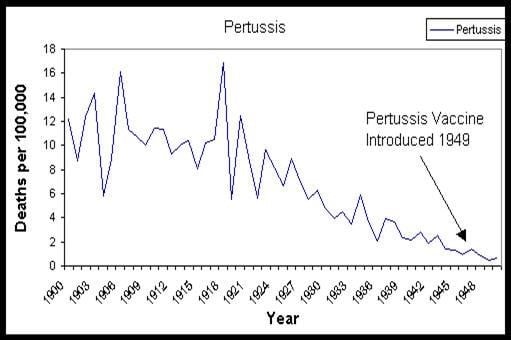
The following graphs show that large drops in disease death rates
occurred long before vaccines were introduced. From 1900 to 1963, when
the measles vaccine was introduced, death rates from measles had
declined from 13.3 per 100,000 to 0.2 per 100,000 – a 98% decrease. From
1900 to 1949, death rates from whooping cough declined from 12.2 per
100,000 to 0.5 per 100,000 – a 96% decrease. From 1900 to 1949, death
rates from diphtheria declined from 40.3 per 100,000 to 0.4 per 100,000 –
a 99% decrease. These graphs demonstrate clear and major changes in the
severity of diseases well before any vaccines were introduced. (9)
Figure 1. Death rates from Measles
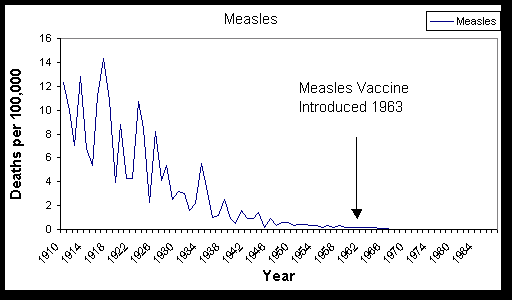 Figure 2. Death rates from Diphtheria
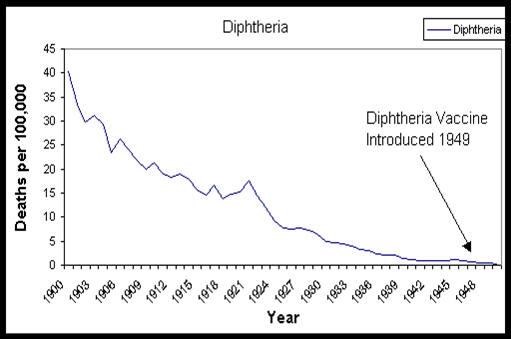 Figure 3. Death rates from Pertussis
 The data suggest that public health interventions, such measures as
improved hygiene, infected being being isolated are more effective and
less expensive interventions to contain epidemics of respiratory
viruses, with estimates of effect ranging from 55% to 91%. (10)Although
strong evidence supports good hygiene as a central factor of disease
prevention, the press rarely recommends measures people can adopt to
best protect themselves against viral or bacterial disease, aside from
vaccination.
Deconstructing the Science of Antibodies
The manufacturing methodology in vaccine development involves taking a
disease agent and rendering it gradually weaker so that the body’s own
immune response is triggered and antibodies are generated (referred to
as humoral immunity). However, the body’s immune system is far greater
than that targeted by a vaccine. In addition to humoral immunity, there
is also cell-mediated immunity. Cell-mediated immunity activates
macrophages, natural killer cells, antigen-specific cytotoxic
T-lymphocytes, and the release of various cytokines in response to a
viral antigen.
Current vaccine science lacks a way to stimulate the entire immune
response instead of just a portion of it. Normal exposure to
disease-causing agents always begins in the nasal, ear, throat, and
respiratory passages–less so through injection. Once primary immunity
has been established by infection, the antibody response follows. This
allows the immune system to grow stronger and to bestow natural and
permanent immunity to an ever-increasing number of pathogens. Vaccines
injected into the body bypass cell-mediated immunity and overstimulate
humoral immunity. This confuses normal immune response maturation and
skews the functioning of the immune system. Humoral immunity becomes
dominant and the crucial cell-mediated immunity is suppressed: the
result can be autoimmune disease and frequent infections.
According to RM Zinkernagel at the University Hospital of Zurich
Institute of Experimental Immunology: “We have not succeeded in
generating truly protective vaccines against persisting infections
because we cannot imitate ‘infection immunity’ that is long-lasting,
generating protective T- and B-cell stimulation against variable
infections without causing disease by either immunopathology or
tolerance.” (11)
The weak correlation between antibody count and immunity is not a new discovery. Walene James, author of Immunizations: The Reality Beyond the Myth, explains that increased antibody production may not be the most important aspect of the immune process:
The data suggest that public health interventions, such measures as
improved hygiene, infected being being isolated are more effective and
less expensive interventions to contain epidemics of respiratory
viruses, with estimates of effect ranging from 55% to 91%. (10)Although
strong evidence supports good hygiene as a central factor of disease
prevention, the press rarely recommends measures people can adopt to
best protect themselves against viral or bacterial disease, aside from
vaccination.
Deconstructing the Science of Antibodies
The manufacturing methodology in vaccine development involves taking a
disease agent and rendering it gradually weaker so that the body’s own
immune response is triggered and antibodies are generated (referred to
as humoral immunity). However, the body’s immune system is far greater
than that targeted by a vaccine. In addition to humoral immunity, there
is also cell-mediated immunity. Cell-mediated immunity activates
macrophages, natural killer cells, antigen-specific cytotoxic
T-lymphocytes, and the release of various cytokines in response to a
viral antigen.
Current vaccine science lacks a way to stimulate the entire immune
response instead of just a portion of it. Normal exposure to
disease-causing agents always begins in the nasal, ear, throat, and
respiratory passages–less so through injection. Once primary immunity
has been established by infection, the antibody response follows. This
allows the immune system to grow stronger and to bestow natural and
permanent immunity to an ever-increasing number of pathogens. Vaccines
injected into the body bypass cell-mediated immunity and overstimulate
humoral immunity. This confuses normal immune response maturation and
skews the functioning of the immune system. Humoral immunity becomes
dominant and the crucial cell-mediated immunity is suppressed: the
result can be autoimmune disease and frequent infections.
According to RM Zinkernagel at the University Hospital of Zurich
Institute of Experimental Immunology: “We have not succeeded in
generating truly protective vaccines against persisting infections
because we cannot imitate ‘infection immunity’ that is long-lasting,
generating protective T- and B-cell stimulation against variable
infections without causing disease by either immunopathology or
tolerance.” (11)
The weak correlation between antibody count and immunity is not a new discovery. Walene James, author of Immunizations: The Reality Beyond the Myth, explains that increased antibody production may not be the most important aspect of the immune process:
Vaccines isolate antibody function, and allow it to
substitute for the entire immune response. Scientific evidence
questioning the role of antibodies in disease protection can be found in
research performed by Dr. Alec Burton, published in a study by the
British Medical Council in May 1950. The study investigates the
relationship between the incidence of diphtheria and the presence of
antibodies. Since diphtheria was epidemic at, or just prior to, the time
of the study, the researchers had a large number of cases to
investigate. The purpose of the research was to determine the existence
or nonexistence of antibodies in people who developed diphtheria and in
those who did not. It looked at patients and people who were in close
proximity to patients, such as physicians, nurses in hospitals, family,
and friends. The conclusion was that there was no relation whatsoever
between antibody count and incidence of disease. The researchers found
people who were highly resistant with extremely low antibody counts, and
people who developed the disease who had high antibody counts. Dr.
Burton also discovered that children born with a-gamma globulinemia (an
inability to produce antibodies) develop and recover from measles and
other infectious or contagious disease almost as spontaneously as other
children. (12)
One of the foremost
issues surrounding vaccine-induced immunity is that infants are
biologically incapable of producing antibodies, other than immature IgM
antibodies, until 6-12 months of age. The antibodies the infant
acquires, such as immunoglobulins, are passed down from mother to child
through breastmilk. Nevertheless, the current CDC schedule calls for
more than a dozen injections during the first six months of life. If the
immunological function of a fully grown adult is disrupted so
significantly by vaccines, what sort of harm can we expect these same
vaccines to inflict upon the delicate physiology of an infant?***
Next we will examine some of the most compelling examples of vaccine
failure among the most widely-used vaccines in America today.
Influenza
The Cochrane Collaboration, the foremost group of unbiased
researchers in the world, has done a series of meta-analyses on the
effectiveness of the influenza vaccine with similar results. In 2014
they found that vaccinating adults against influenza did not affect the
number of people hospitalized nor decrease lost work. (13)Cochrane
researchers stated that their results might be overly optimistic due to
the fact that 24 out of 90 studies were funded by the vaccine
manufacturers, which tend to produce results favorable to their product.
(14)
According to Dr. Tom Jefferson of the Cochrane Collaboration, it
makes little sense to keep vaccinating against seasonal influenza based
on the evidence. (15) Jefferson has also endorsed more cost-effective
and scientifically-proven means of minimizing the transmission of flu,
including regular hand washing and wearing masks.
Dr. Jefferson’s conclusions are backed by a 2013 piece written by
Johns Hopkins University School of Medicine scientist Peter Doshi, PhD,
published in the British Journal of Medicine. In his article Doshi
questions the flu vaccine paradigm stating:
Closer examination of influenza vaccine policies shows
that although proponents employ the rhetoric of science, the studies
underlying the policy are often of low quality, and do not substantiate
officials’ claims. The vaccine might be less beneficial and less safe
than has been claimed, and the threat of influenza appears
overstated.(16)
The CDC currently recommends that elderly Americans receive a flu
shot, stating that “[v]accination is especially important for people 65
years and older because they are at high risk for complications from
flu.” (17) Unfortunately, this serious warning flies in the face of a
significant body of research showing that receiving the flu shot does
not reduce mortality among seniors. (18) One particularly compelling
2005 study was carried out by scientists at the federal National
Institutes of Health (NIH) and published in the Journal of the American
Medical Association (JAMA). Not only did the study indicate that the flu
vaccine did nothing to prevent deaths from influenza among seniors, but
that flu mortality rates in fact increased as a greater percentage of
seniors received the shot. (19)
After the release of the study, investigative journalist Sharyl
Attkisson covered the findings in a CBS News segment. Attkisson revealed
that she hoped to interview the study’s lead author at NIH but was
stonewalled by the agency. She eventually spoke to the only co-author of
the study who was not affiliated with NIH, Dr. Tom Reichert, who stated
that the research team revisited the data several times, but that no
matter how they analyzed the “incendiary material”, the conclusion was
clear: flu shots don’t improve mortality rates in the elderly
population. (20)
Another important consideration in this discussion is that there are
approximately 200 distinct viruses that constitute influenza and
influenza-like illnesses. These organisms don’t magically appear during
fall and winter – they are always with us. Nevertheless we are more
susceptible to flu-like infections during the colder months when there
are less daylight hours. Studies suggest that the origin of the
so-called flu season may actually be the reduced amount of sunlight in
the winter months, with the result that we become deprived of Vitamin D.
(21,22)
Gardasil
The history of the Gardasil vaccine illustrates clearly the
concerning lack of oversight on the part of our federal health
authorities when it comes to testing vaccines for efficacy. Before
receiving FDA approval, the popular HPV vaccine Gardasil was tested on
fewer than 1200 girls. (23) A major flaw in Merck’s clinical trials was
the number of girls enrolled in the trials who elected to take the
prescribed three vaccine doses. Only 27% of all the girls tested were
actually administered the complete three-vaccine series. (24) Another
remarkable misstep in the trials was that no girls under age 15
participated, despite the fact that the vast majority girls given the
vaccine today are under 15 years old. (25) Nevertheless, the vaccine was
approved by the FDA in 2006. In 2014, approximately 60% of all American
girls and 42% of American boys aged 13-17 received at least one HPV
shot. (26)
The remarkably unscientific methodology employed during Garadsil’s
pre- and post- licensure trials was reviewed in a 2012 analysis by
scientists at the University of British Columbia and published in the
journal Current Pharmaceutical Design. The research team didn’t mince
words in their assessment of the trials:
We carried out a systematic review of HPV vaccine
pre- and post-licensure trials to assess the evidence of their
effectiveness and safety. We found that HPV vaccine clinical trials
design, and data interpretation of both efficacy and safety outcomes,
were largely inadequate.
Additionally, we note evidence of selective reporting of results
from clinical trials (i.e., exclusion of vaccine efficacy figures
related to study subgroups in which efficacy might be lower or even
negative from peer-reviewed publications).
Given this, the widespread optimism regarding HPV vaccines
long-term benefits appears to rest on a number of unproven assumptions
(or such which are at odds with factual evidence) and significant
misinterpretation of available data. (27)
More doubts about the FDA approval of Gardasil have come from an
unlikely source, Dr. Diane Harper, a consultant for Merck and a chief
scientist overseeing the licensure trials to evaluate Gardasil’s safety
and efficacy. After receiving FDA approval, Dr. Harper publicly
questioned Gardasil’s efficacy and public health value. Among her
concerns is that no data show that Gardasil remains effective after 5
years. A truly effective HPV vaccine, on the other hand, would need to
be efficacious for 15 years in order to prevent cervical cancer. In
addition, she estimated that every American 11 year old girl would have
to be vaccinated for the next 60 years in order to have any measurable
effect on rates of cervical cancer.(28,29)
Gardasil’s efficacy in protecting against HPV infection has also been
criticized due to the fact that it originally only targeted four of the
more than one hundred HPV strains in circulation. In 2014, the FDA
approved Gardasil 9, which supposedly protects against nine strains.
Scientists from the University of Texas presented research at the 2015
meeting of the American Association for Cancer Research revealing that
vaccinated women were significantly at a higher risk to become infected
with strains HPV not contained in the vaccine when compared to
unvaccinated women. (30) This disturbing revelation is just the most
recent piece of evidence demonstrating Gardasil’s dubious effectiveness
and potentially hazardous impact on human biochemistry.
Another study published in the Journal of the American
Medical Association (JAMA) in 2007 demonstrates the ineffective nature
of Gardasil in women with HPV. The authors concluded that Gardasil
offers no benefit to women recovering from HPV during a 12-month
period.(31) The research team stated that they “see no reason to believe
that there is therapeutic benefit of the vaccine elsewhere because the
biological effect of vaccination among already infected women is not
expected to vary by population.” (32)
Given the high rate of recovery for people with HPV infections, the
widespread use of the vaccine is highly suspect. Even the National
Cancer Institute has stated that “[m]ost high-risk HPV infections occur
without any symptoms, go away within 1 to 2 years, and do not cause
cancer.” (33) In fact, 90% of all cases of HPV disappear within 2 years. Cervical cancer is highly curable when detected early.
It’s important to note that advances in medicine and the regular use
of pap smears have helped decrease the incidence of cervical cancer in
the United States by over 50% since the 1970s. (34) Examining health
data from Finland and the UK , Dr. Harper and her colleagues concluded
that HPV vaccinations give a false sense of security to many young women
and girls who in turn opt out of regular pap smear tests. According to
Dr. Harper, this trend has resulted in exponential increases in recent HPV rates. (35)
Even more alarming, Gardasil has gained notoriety as one of the most
dangerous vaccines for it serious life-threatening adverse effects. As
of October 2015, the federal program known as Vaccine Adverse Event
Reporting System (VAERS) has received over 41,000 cases of adverse
reactions from the HPV vaccine, including 234 deaths. (36)
Whooping Cough (Pertussis)
The vaccine for pertussis, better known a whooping
cough, is packaged together with Diptheria, and Tetanus (DtaP) and given
according to a robust vaccine schedule of 5 injections by age six. It
is the most administered vaccine in the childhood vaccination schedule:
at 2 months, 4 months, 6 months, 15-18 months, and 4-6 years. (37)
Despite regular administration of booster shots, scientific evidence
now suggests the vaccine does not effectively confer immunity against
pertussis. As one recent study published in Clinical Infectious Diseases put
it, “pertussis is currently the least well-controlled
vaccine-preventable disease despite excellent vaccination coverage and 6
vaccine doses recommended between 2 months of age and adolescence.”
(38)
The ineffective nature of the pertussis vaccine was brought into
sharp focus in 2010 when California witnessed a dramatic rise in
whooping cough cases, over 9,100 people cases, many of them children. A
study assessing the vaccine’s efficacy discovered that an
extraordinarily high 80% of all children who contracted the illness were
fully vaccinated. (39)
One explanation for the pertussis vaccines remarkable lack of
efficacy can be found in a 2010 study undertaken at Penn State’s Center
for Infectious Disease Dynamics. The team found that the whooping cough
vaccine promotes the colonization of Bordetella parapertussis,
pertussis’ causal bacterial agent. Based on their findings, the
researchers posited that the whooping cough vaccine itself may be
contributing to the marked resurgence of whooping cough cases compared
to the previous decade. (40)
Further evidence casting doubt on the whooping cough vaccine’s
usefulness was presented at a 2013 meeting of the CDC’s Board of
Scientific Counselors, Office of Infectious Diseases. During the
meeting, CDC officials pointed out that the widespread use of the DtaP
vaccine has given rise to more virulent pertussis strains. What is novel
about these new emerging strains is that they lack pertactin (PRN), the
antigen current pertussis vaccines target. The meeting’s participants
noted that “vaccinated patients had significantly higher odds than
unvaccinated patients of being infected with PRN- deficient
strains.”(41) Another recent study surveyed the incidence of whooping
cough in eight states. The survey found that fully vaccinated children
were two to four times more likely to contract an PRN-deficient strain
than the unvaccinated population. (42)
A further reason for the pertussis vaccine’s failure to control
communal infection is because vaccinated children may become
asymptomatic carriers of the pathogen. There is strong evidence that
vaccinated populations may be infected with the whooping cough but not
present symptoms. (43) The serious downside to this is that asymptomatic
carriers can transmit the disease to unvaccinated individuals,
especially infants who run the highest risk of suffering complications
from pertussis. It also lends credence to new research implicating
vaccinated older siblings, not parents, as the primary source of
infection for whooping cough among infants. This research runs counter
to the entire notion of herd immunity, which states that older
populations must be immunized in order to protect infants who are not
old enough to receive the vaccine. (44)
Measles
The efficacy of the measles vaccine has also come under serious
scrutiny in recent years. In, 2014 Dr. Gregory Poland, Editor in Chief
of the journal Vaccine and founder of the Mayo Clinic’s Vaccine Research
Group, published an alarming statement that the measles vaccine has a
poor efficacy record. Despite the high 95% measles vaccination
compliance among children entering kindergarten, and the CDC’s
propaganda that the MMR vaccine has defeated the virus, measles
outbreaks continue to increase. During the first half of 2014, there
were 16 large measles outbreaks in the US. Dr. Poland does not believe
this is due to unvaccinated individuals, but because of the vaccine’s
failure to confer immunity. (45)
During the first six months of 2011, there were 118 cases of measles
reported to the CDC from 23 states and New York City. There were no
fatalities. Among the 118 cases, 105 were both “import-associated” and
unvaccinated. Of the 87 U.S. residents who came down with measles, 74
were unvaccinated: 39 under age 20, and 35 age 20 and older. (46)
The CDC focused heavily on the unvaccinated measles victims while
giving no time to the analysis of those vaccinated individuals who also
became ill. In fact, 13 of the group (17.5%) had received the MMR
vaccine but got measles anyway. While the CDC uses these incidents of
disease outbreak to stress the need for vigilant adherence to the
vaccine schedule, the real take home message here is that 17.5% of a
group of vaccinated individuals got sick despite the vaccine. One thing,
however, is certain: all of the unvaccinated people who came down with
measles now have a lifelong immunity against measles. For those who
became infected despite having been vaccinated, we just don’t know.
Could the vaccine prevent these people from developing the normal
lifetime immunity? No research has been undertaken to prove this point.
Likewise, a 1985 measles outbreak in a Texas community found that the
14 students out of 1806 who contracted measles were all vaccinated – no
exceptions, and no reports of exposure from a foreign endemic area for
any of the students.(47)
Chicken pox (Varicella)
The Chicken Pox vaccine is yet another example of a
failed vaccine. The present vaccine was licensed in 1995. Following its
release, an estimated 25 percent of children were still spreading the
varicella virus or getting ill themselves. Anne Gershon, a chicken pox
expert and director of pediatric infectious disease at Columbia
University Medical Center, says, “We really need boosters of vaccines
much more than we thought we ever would.” (48)
This begs the question: how many boosters would be enough? Our
vaccines do not confer lifelong immunity. Therefore to compensate for
vaccines’ limitation and steady decline in providing immunity, more and
more boosters are required. Consequently, in 2006, the CDC recommended
that a second chicken pox shot be added to the childhood vaccination
schedule. Gershon says it “looks like” a second shot will keep children
from getting sick. (49)
Research into the efficacy of the varicella inoculation, however, has
increased skepticism about the vaccine. In 2005, South Korea mandated
the chickenpox vaccine to all children under 15 months. Regardless of
the country’s 97% compliance—well, above herd immunity’s claims to
eradicate infectious disease—chickenpox infections have not declined.
Rather, between 2006 and 2011, there has been a three-fold increase in
chickenpox cases. (50) American research has also yielded proof of a
significantly higher rate of vaccine failure despite its widespread
administration. (51)
Mumps
Mumps infections is another virus frequently found in vaccinated
populations. In 2006 the US experienced the largest nationwide mumps
epidemic in 20 years, primarily infecting students on college campuses.
Authorities have attempted to blame these outbreaks on crowded dormitory
conditions, instead of considering the obvious: the vaccine simply
isn’t effective for very long.
In 2009-2010 New York and New Jersey witnessed over 1500 mumps cases
among highly vaccinated groups: 88% of infected children had received at
least one vaccine and 75% had received the recommended two doses.
According to Dr. Jane Zucker, NYC Assistant Commissioner of
Immunization, “We know that approximately one in every 20 people who are
vaccinated may not develop antibodies.” A Reuters reporter went even
further, stating, “The mumps virus can mutate, so people who have had
only one or even two doses of vaccine remain vulnerable.” (52) How can a
vaccine with such negligible immunity not only be recommended but
required for school attendance?
Calling for Science-Based Vaccinology
It is certainly reasonable and responsible to suggest that if a
vaccine were proven to be safe and effective by a gold standard of
science, it would be an important health service for every child and
adult. However, at this moment no such assurance can be made based upon
quality science. At the very least we should require unbiased,
independent, double-blind, placebo-controlled studies of every vaccine,
both individually and collectively with no input from vaccine
manufacturers or their colleagues, associates or consultants. To ensure a
healthier future, it is crucial that we stand up today and demand a new
paradigm of vaccinology based on independent, science-based medicine.
Endnotes
- Weinberg,
Geoffrey A., and Peter G. Szilagyi. “Vaccine Epidemiology: Efficacy,
Effectiveness, and the Translational Research Roadmap.” The Journal of
Infectious Diseases J INFECT DIS 201.11 (2010): 1607-610. Web.
- Miller, N.
“The polio vaccine: a critical assessment of its arcane history,
efficacy, and long-term health-related consequences” Medical Veritas.
Vol. 1 239-251, 2004
- McBean E. The Poisoned Needle. Mokelumne Hill, California: Health Research,1957
- Ibid
- Humphries, S. “Smoke, Mirrors and the Disappearance of Polio,” International Medical Council on Vaccination. November 17, 2011
- “Vaccine Pioneer Doctor Admits Polio Vaccine Caused Cancer” http://healthimpactnews.com/2013/vaccine-pioneer-doctor-admits-polio-vaccine-caused-cancer/
- Miller, N.
“The polio vaccine: a critical assessment of its arcane history,
efficacy, and long-term health-related consequences” Medical Veritas.
Vol. 1 239-251, 2004
- Alternatives Medicine Digest (AlternativesMedicine.com), “Vaccination is not Immunization,”
- Vital Statistics of the United States 1987 Volume II – Mortality Part A, U.S. Department of Health and Human Services,Jefferson
T, Physical Interventions to Interrupt or Reduce the Spread of
Respiratory Viruses: Systematic Review. British Medical Journal 2009 Sep
21; 339
- Zinkernagel
RM Protective ‘immunity’ by pre-existent neutralizing antibody titers
and preactivated T-cells but not by so-called ‘immunological memory’.”
Immunological Review 2006, Jun, 211;310-319
- James W. Immunization: The Reality Behind the Myth. Massachusetts: Bergin & Gervey; 1988.
- Jefferson
T et al, Vaccines for Preventing Influenza in Healthy Adults, Cochrane
Database of Systematic Reviews 2010, Issue 7. Art. No.: CD001269. DOI:
10.1002/14651858.CD001269.pub4, June 3, 2010, http://summaries.cochrane.org/CD001269/vaccines-to-prevent-influenza-in-healthy-adults, accessed December 4, 2011
- Ibid
- 25. ‘A Whole Industry Is Waiting For A Pandemic’, Der Spiegel, http://www.spiegel.de/international/world/0,1518,637119-2,00.html, accessed December 4, 2011
- Doshi, P. “Influenza: Marketing Vaccine by Marketing Disease.” BMJ 346 (2013): F3037. Accessed November 30, 2015. doi:http://dx.doi.org/10.1136/bmj.f3037.
- “What You Should Know and Do this Flu Season If You Are 65 Years and Older” http://www.cdc.gov/flu/about/disease/65over.htm
- Urashima,
M., T. Segawa, M. Okazaki, M. Kurihara, Y. Wada, and H. Ida. “Randomized
Trial of Vitamin D Supplementation to Prevent Seasonal Influenza A in
Schoolchildren.” American Journal of Clinical Nutrition, 2010, 1255-260.
Accessed November 30, 2015. doi:doi: 10.3945/ajcn.2009.29094.Essen,
Marina Rode Von, Martin Kongsbak, Peter Schjerling, Klaus Olgaard, Niels
Ødum, and Carsten Geisler. “Vitamin D Controls T Cell Antigen Receptor
Signaling and Activation of Human T Cells.” Nature Immunology Nat
Immunol 11, no. 4 (2010): 344-49. Accessed November 30, 2015.
doi:10.1038/ni.1851.
- . Lind,
Peter. “U.S. Court Pays $6 Million to Gardasil Victims.” Washington
Times. December 31, 2014. Accessed November 30, 2015. http://www.washingtontimes.com/news/2014/dec/31/us-court-pays-6-million-gardasil-victims/?page=all. “Don’t Give This to Your Daughter – Despite What Your Doctor Says .” Dr. Mercola.com . http://articles.mercola.com/sites/articles/archive/2010/11/05/gardasil-vaccine-is-a-flop-for-good-reasons.aspx (accessed September 16, 2011).
- 9/15/11. The Gary Null Show. Progressive Radio Network. 15 Sept. 2011. Radio.
- Tomljenovic,
Lucija, Jean Pierre Spinosa, and Christopher A. Shaw. “Human
Papillomavirus (HPV) Vaccines as an Option for Preventing Cervical
Malignancies: (How) Effective and Safe?” Current Pharmaceutical Design
19, no. 8 (2013): 1466-487. Accessed December 1, 2015. Attkisson,
Sharyl. “Gardasil Researcher Speaks Out – CBS News.” Breaking News
Headlines: Business, Entertainment & World News – CBS News. http://www.cbsnews.com/stories/2009/08/19/cbsnews_investigates/main5253431.shtml (accessed September 16, 2011).
- 9/15/11. The Gary Null Show. Progressive Radio Network. 15 Sept. 2011. Radio
- “Presentation Abstract” http://www.abstractsonline.com/plan/ViewAbstract.aspx?mID=3682&sKey=7f019f73-accb-484e-becc-5ecc405f8ec5&cKey=e2313b32-d6ac-4443-ab2d-49c368ea3b89&mKey=19573a54-ae8f-4e00-9c23-bd6d62268424
- Hildesheim,
A., R. Herrero, S. Wacholder, A. C. Rodriguez, D. Solomon, M. C.
Bratti, J. T. Schiller, P. Gonzalez, G. Dubin, C. Porras, S. E. Jimenez,
and D. R. Lowy. “Effect Of Human Papillomavirus 16/18 L1 Viruslike
Particle Vaccine Among Young Women With Preexisting Infection: A
Randomized Trial.” JAMA: The Journal of the American Medical Association
298, no. 7 (2007): 743-53.Ibid
- http://www.cancer.gov/about-cancer/causes-prevention/risk/infectious-agents/hpv-fact-sheet
- Park,
Alice. “Pap Tests: Another Revision of Recommendations – TIME.” Breaking
News, Analysis, Politics, Blogs, News Photos, Video, Tech Reviews –
TIME.com. http://www.time.com/time/health/article/0,8599,1942044,00.html (accessed September 16, 2011).
- ] 9/15/11. The Gary Null Show. Progressive Radio Network. 15 Sept. 2011. Radio.
- http://sanevax.org/
- “Help Protect Babies from Whooping Cough” http://www.cdc.gov/features/pertussis/
- Martin, S.
W., L. Pawloski, M. Williams, K. Weening, C. Debolt, X. Qin, L.
Reynolds, C. Kenyon, G. Giambrone, K. Kudish, L. Miller, D. Selvage, A.
Lee, T. H. Skoff, H. Kamiya, P. K. Cassiday, M. L. Tondella, and T. A.
Clark. “Pertactin-Negative Bordetella Pertussis Strains: Evidence for a
Possible Selective Advantage.” Clinical Infectious Diseases 60, no. 2
(2014): 223-27. Accessed December 1, 2015.
doi:10.1093/cid/ciu788.Stobbe, Mike. “Study: Whooping Cough Vaccination
Fades in 3 Years.” Yahoo Finance. September 19, 2011. Accessed November
11, 2015. http://finance.yahoo.com/news/Study-Whooping-cough-apf-2422268709.html.Long,
G. H., A. T. Karanikas, E. T. Harvill, A. F. Read, and P. J. Hudson.
“Acellular Pertussis Vaccination Facilitates Bordetella Parapertussis
Infection in a Rodent Model of Bordetellosis.” Proceedings of the Royal
Society B: Biological Sciences 277, no. 1690 (2010): 2017-025. Accessed
December 1, 2015. doi:10.1098/rspb.2010.0010. “Meeting of the Board of
Scientific Counselors, Office of Infectious Diseases Centers for Disease
Control and Prevention” http://www.cdc.gov/maso/facm/pdfs/BSCOID/2013121112_BSCOID_Minutes.pdf
- Martin, S.
W., L. Pawloski, M. Williams, K. Weening, C. Debolt, X. Qin, L.
Reynolds, C. Kenyon, G. Giambrone, K. Kudish, L. Miller, D. Selvage, A.
Lee, T. H. Skoff, H. Kamiya, P. K. Cassiday, M. L. Tondella, and T. A.
Clark. “Pertactin-Negative Bordetella Pertussis Strains: Evidence for a
Possible Selective Advantage.” Clinical Infectious Diseases 60, no. 2
(2014): 223-27. Accessed December 1, 2015.
doi:10.1093/cid/ciu788.Warfel, J. M., L. I. Zimmerman, and T. J. Merkel.
“Acellular Pertussis Vaccines Protect against Disease but Fail to
Prevent Infection and Transmission in a Nonhuman Primate Model.”
Proceedings of the National Academy of Sciences 111, no. 2 (2013):
787-92. Accessed December 1, 2015. doi:10.1073/pnas.1314688110.Skoff, T.
H., C. Kenyon, N. Cocoros, J. Liko, L. Miller, K. Kudish, J. Baumbach,
S. Zansky, A. Faulkner, and S. W. Martin. “Sources of Infant Pertussis
Infection in the United States.” Pediatrics 136, no. 4 (2015): 635-41.
Accessed December 1, 2015. doi:http://dx.doi.org/10.1542/peds.2015-1120.Haelle,
Tara. “Measles Cases Are Spreading, despite High Vaccination Rates.
What’s Going On?” Washington Post, June 23, 2014.CDC Morbidity and
Mortality Weekly, “Measles – United States, January – May 20, 2011
- Gustafson
TL, New England Journal of Medicine, 316: 717-774, March 26, 1987,
Measles Outbreak in a Fully Immunized Secondary School Population
- National Public Radio, “Lifelong Immunity? With Vaccines, it Depends.” October 11, 2010, Nancy Shute.Ibid
- Hee Oh,
Sung, Et Al. “Varicella and Varicella Vaccination in South Korea.” Clin
Vaccine Immunol. 21, no. 5 (2014): 762–768. Accessed December 1, 2015.
doi:10.1128/CVI.00645-13.Michalik, David E., Sharon P. Steinberg, Philip
S. Larussa, Kathryn M. Edwards, Peter F. Wright, Ann M. Arvin, Haley A.
Gans, and Anne A. Gershon. “Primary Vaccine Failure after 1 Dose of
Varicella Vaccine in Healthy Children.” The Journal of Infectious
Diseases J INFECT DIS 197, no. 7 (2008): 944-49. Accessed December 2,
2015. doi:10.1086/529043.
- Barskey AE
Mumps, Resurgences in the United States: A Historical Perspective on
Unexpected Elements. Vaccine. 2009 Oct 19;27(44);6186-95.
- Simonsen,
Lone, Reichert, Thomas, et al. . “Impact of Influenza Vaccination on
Seasonal Mortality in the US Elderly Population.” Arch Intern Med
Archives of Internal Medicine 165, no. 3 (2005): 265. Accessed December
1, 2015. doi:10.1001/archinte.165.3.265.Glezen, W P., and Lone Simonsen.
“Commentary: Benefits of Influenza Vaccine in US Elderly–new Studies
Raise Questions.” International Journal of Epidemiology 35, no. 2
(2006): 352-53. Accessed December 1, 2015. doi:10.1093/ije/dyi293.“Govt.
Researchers: Flu Shots Not Effective in Elderly, After All” https://sharylattkisson.com/govt-researchers-flu-shots-not-effective-in-elderly-after-all/
- Teen Vaccination Coverage 2014 National Immunization Survey-Teen (NIS-Teen)http://www.cdc.gov/vaccines/who/teens/vaccination-coverage.html
-
“More than 1,500 affected in NY, NJ mumps outbreak” Julie Steenhuysen, Reuters, February 11, 2010.
The original source of this article is Progressive Radio Network

 Posts
Posts