Thursday, February 27, 2014

Rolls-Royce Drone Ships

February 26th, 2014 Via: Bloomberg:
In an age of aerial drones and driver-less cars, Rolls-Royce (RR/) Holdings Plc is designing unmanned cargo ships.
Rolls-Royce’s Blue Ocean development team has set up a virtual-reality prototype at its office in Alesund, Norway, that simulates 360-degree views from a vessel’s bridge. Eventually, the London-based manufacturer of engines and turbines says, captains on dry land will use similar control centers to command hundreds of crewless ships.
Drone ships would be safer, cheaper and less polluting for the $375 billion shipping industry that carries 90 percent of world trade, Rolls-Royce says. They might be deployed in regions such as the Baltic Sea within a decade, while regulatory hurdles and industry and union skepticism about cost and safety will slow global adoption, said Oskar Levander, the company’s vice president of innovation in marine engineering and technology.
“Now the technology is at the level where we can make this happen, and society is moving in this direction,” Levander said by phone last month. “If we want marine to do this, now is the time to move.”  .............. hey "wonder" who's  triangles   those r ???    hummmmmmmmmmmmm 

The Localization Movement. Creating a Viable Local Economy. Challenging the New World Order

fuck Gold! fuck Silver !   fuck ALL them "other"   'investing'   scams !!!     invest in each other ,folks       soon time is gonna force us 2       & let it come :o


grain
A number of different initiatives are being pursued at the grassroots level, all aimed at building resilient and sustainable communities. These include local currencies, buy-local campaigns, Transition Towns, farmer’s markets, community gardens, local co-ops, and others. Such initiatives are springing up all over the world. The movement is growing geographically, but unfortunately it is not succeeding in significantly transforming very many local economies.
Activists are leading the initiatives, and early-adopters are participating, but most people are not typically getting involved. Without widespread participation in these initiatives, at the local level, the benefits to the community remain marginal. The fact is that most people are not willing to spend their time with idealistic pursuits, and most people don’t think it’s realistic to expect to change society by our own grassroots efforts. If we want to get more people involved in our initiatives, we’ve got to find a way to offer people a reason that appeals to their immediate self-interest. If our localization initiatives could offer significant economic benefits, we can bring in those who aren’t motivated by idealism.
The underlying goal of our localization initiatives is to create a viable, local sub-economy, with minimal dependence on the unstable globalized economy. The problem is that we’re approaching the problem piecemeal. We create a local currency, and hope people will think of things to trade using it. We promote buy-local, but people can buy what they need cheaper from the big chains. We promote Transition Towns, but most people aren’t interested in developing five-year plans.
Our initiatives do make economic sense, but we need to pursue them in a systematic, integrated way, if we really want to create viable sub-economies. We need to weave the pieces together in a way that unleashes the potential synergies among the various initiatives. To put it bluntly, we need to take a business-like approach to localization.
We need widespread participation if we want to transform our communities economically, and we need widespread participation if we want to create communities in which people are engaged in controlling their own destinies. We haven’t been able to achieve widespread participation by promoting these kinds of idealistic goals, but we may be able to achieve it by drawing people in, by offering them significant economic advantages. The best way to wake people up to empowerment is by giving them the experience of empowerment. As people learn to run their own affairs, they may begin to embrace the goals that motivate our initiatives.
 Creating a viable local sub-economy
The appropriate framework for a viable sub-economy is a democratically governed cooperative. Not just a consumer co-op, nor just a single-product worker’s co-op, but a cooperative entity that includes a variety of enterprises and shared resources, so that there are significant internal transactions. In this way we get the benefits promised by a local currency, as the internal transactions can simply be recorded on our books as co-op credits and debits.
Such a cooperative can be seen from two different perspectives. Viewed from the inside, the co-op is modeling the kind of society we want to create. Viewed from the outside, the co-op is a viable start-up business. By being a model of what we want, it is ‘building the new’; by being a viable start-up business, it is thriving ‘in the shadow of the old’. In order to serve as a model of the new, our co-op needs to operate in the way we want our new society to operate. In order to be a viable start-up business, our co-op needs to be launched with a sound business plan.
If we can ‘build it’ – a co-op that offers people real economic benefits – then ‘they will come’. If the co-op grows and prospers, more people will join. Ultimately, the community itself could be operating as a cooperative, participatory, entity. We would be building the new society in the shadow of the collapsing old society. A society in which people control their own destinies, working together. A society with a transformed culture, a culture based on participation, collaboration, empowerment, and inclusiveness.
 A straw-man example
Imagine a cooperative that includes several worker-owned businesses, a supermarket / general store, supply agreements with local farmers and other suppliers, a community / conference center, warehouse space for startup ventures and other uses, several electric vehicles, a small apartment building, and a co-op bank / revolving-loan-fund. If the co-op owns its own wind turbine, the credits obtained by selling energy to the grid would provide enough free energy to run all co-op operations and households. Members would enjoy many kinds of benefits and discounted services. As the co-op grew, it could increasingly become a supplier of local electricity, employment, housing, food, and transport – and transactions could increasingly be done in a local currency, or simply as local bookkeeping entries.
This sketch is admittedly short on details; it is meant simply to spark your imagination about what might be possible, if we put our minds to it.
Essential elements for success
Economic viability is essential if we want to build a localization movement that can bring in ‘ordinary people’, but we need more than that if we want to transform our culture and our society. Our co-op needs to model the culture we want to create – a culture based on participation, collaboration, empowerment, and inclusiveness.
 All members need to have an equal say in determining co-op policies, and our co-op needs to be inclusive: anyone who wants to join our co-op, and embrace its culture, needs to be welcome – regardless of religion, ideology, or political views. And we need to use effective processes to ensure that all voices are heard and all concerns are taken into account.
 Membership needs to involve participation – being a member means you put in hours working with other members in doing the overhead work of the co-op. Not only does this help build a culture of collaboration, it also enables this overhead labor to be accounted for in our local currency / accounting system. And in putting in their hours, people can choose those jobs they are best at and most enjoy.
Mondragon Cooperatives – a useful model
From Wikipedia: “The Mondragon Corporation is a corporation and federation of worker-owned cooperatives based in the Basque region of Spain.”…“Scholars such as Richard D. Wolff, American professor of economics, have hailed the Mondragon set of enterprises, including the good wages it provides for employees, the empowerment of ordinary workers in decision making, and the measure of equality for female workers, as a major success and have cited it as a working model of an alternative to the capitalist mode of production.”

Harmonizing everyone’s concerns
All to often we equate ‘decision-making’ with ‘debate’. Our competitive culture has a deeply imbedded assumption that one side must win, and another lose. We take it as obvious that there must be a vote, if a decision is to be made, with the majority winning. In order to win the voting game, people gather into sides, each side comes up with a proposal, and then the biggest side passes its one-sided proposal.
 There is, fortunately, a quite different way of approaching decision-making and problem solving. Underlying every proposal is some set of concerns. If we start by getting everyone’s concerns on the table, we can then enter into a creative conversation, a collaboration, to find solutions that address everyone’s concerns in a fair way. This can be done, and the solutions found are typically better than anyone’s original proposal.
 In aboriginal cultures all over the world, this is how decision-making has been routinely approached. In one culture, their process was described this way: “We keep going around the circle, each one speaking from their heart, until finally it is clear to everyone what needs to be done”. Our culture doesn’t give us these kinds of harmonizing experiences, and that’s why attention to process is so important – if we hope to model participatory democracy, where everyone is empowered, not just a majority ‘side’.
There is a whole universe of group processes and facilitation methods, with different ones being appropriate to different situations, kinds of problem, number of people involved, etc. Sometimes considerable time must be invested in facing a difficult problem, and sometimes a skilled facilitator is needed, but the investment is well worth it. When everyone’s concerns are included in the solution, then everyone is motivated to do their part in implementing the solution – voluntary collaboration becomes an effective management paradigm.
 In setting up one of our cooperative entities, attention to process is just as important as attention to sound business practices, and attention to relevant technical expertise. Tom Atlee, author of The Tao of Democracy, has assembled a sizable list of group processes, along with links, on his co-intelligence.org website. You can check it out here.
Richard K. Moore at rkm@quaylargo.com

GMO Human Embryos Have Already Been Created

drip  drip ,drip ..slowly "they"  r   "releasing" what "they" r  really doing ?   how much ya wanna 'bet'     "they"   R   Wayyyyyyyyyyy   past this ..shit hum  :o

February 27, 2014

Source: ANH USA

A meeting at the FDA on experiments to create GMO humans has brought disturbing information to light. Action Alert! Today, the US Food and Drug Administration held day one of a public meeting outlining the creation of genetically modified humans. These experiments won’t take place in the distant future. In fact, GMO embryos have already been created via in vitro experiments. Specifically, the FDA is discussing the genetic manipulation of human eggs and embryos in order to prevent inherited mitochondrial disease and treat infertility. The GMO techniques under consideration include manipulation at the mitochondrial level to replace or augment mutant rDNA and methods that could create babies with three parents. While the FDA has stated that the agency “recognizes” that there are “ethical and social policy issues” to be considered—and despite the fact that forty-four countries have already banned this kind of genetic manipulation—the FDA won’t bother to discuss if human clinical trials should take place (that’s considered to be “outside the scope” of the meeting). Instead, they’ll outline how such trials should be conducted. Meeting participants will deliberate on what animal and in vitro studies (experiments that take place outside of a living organism) will be necessary before human experimentation, as well as the potential risks for study participants and “any children that result from such studies.” For now, the desired genetic outcomes discussed will be limited to the prevention of inherited mitochondrial diseases (e.g., LHON) or infertility due to abnormalities in the quality and quantity of mitochondria in female eggs—though there is no scientific consensus on how important mitochondrial factors are to female infertility. A bit of background on why mitochondria are the focus here: mitochondria are your cells’ “powerhouses” that, among other things, generate the energy (ATP) you need to survive. Mitochondria have their own DNA—called mtDNA—that is more prone to mutation than nucleic DNA. In fact, it is the accumulation of mitochondrial mutations that can contribute toaging, cancer, and metabolic diseases. Some mutations in mtDNA can trigger mitochondrial disease, which can then be passed from mother to child (but not father to child). Due to a number of factors, it’s extremely difficult to predict how sick a child will become from its mother’s mitochondrial mutations. They could even be asymptomaticAn FDA documentoutlines disturbing potential pitfalls of clinical trials to create GMO humans:
  • Sex selection. Because female children produced from mitochondrial manipulation could still pass on mutant mtDNA, the use of “gender selection” could enter into human trials. This means scientists would specifically choose male embryos for implantation, while rejecting female embryos. This could set the stage for sex selection by the American public. The ramifications of sex selection are very real: in India and China, sex selection has led to a skewed ratio of men to women, which may, in turn, be contributing to violence against women.
  • Three-parent babies. The FDA discusses the creation and study of “three-parent” embryos, in which the mutated mtDNA from Mom #1’s egg is replaced with healthy mtDNA from Mom #2 (which is then fused, via in vitrofertilization, with Dad’s sperm). This technology could “trigger all kinds of devastating problems (most likely through epigenetic changes)” that might not become evident until the fetus is already developing.
  • Dangerous epigenetic changes. As we reported recently, epigenetics considers how outside influences (i.e., environmental factors) may affect the way genes are expressed. As noted above, studies show that techniques like mtRNA could cause unpredictable epigenetic changes in embryos, resulting in birth defects.
  • Sick children. “Of particular concern” to the FDA is that it may be impossible to predict how genetic modification will affect a child until it is born. This means these seemingly inevitable GMO human experiments may lead to very sick children.
  • The “Gattaca effect.” It’s easy to see how the concept of GMO humans could quickly get out of hand. Beyond sex selection, it’s foreseeable that such technology could be used to genetically engineer children with desirable physical and health traits. This also raises the question of the affordability of these therapies—might there come a day where only the super-rich could afford genetically perfect children?
One thing not mentioned in the FDA document is the risk that non-human genetic material could be added at some point. This is a truly terrifying thought—and a distinct possibility. If you’re interested in virtually participating in tomorrow’s public meeting, you may do so online, via the FDA’s webcast link. Action Alert! In keeping with our “favor nature” philosophy, ANH-USA thinks this is a potentially tragic road to go down. If you agree, you can send a message to the FDA here

Forget the NSA, the LAPD Spies on Millions of Innocent Folks

On February 26, 2014 by stratagem   hehe didn't those motherfuckers ..."spy" on their cit's ?
hovermast
Source: LA Weekly
Edward Snowden ripped the blinds off the surveillance state last summer with his leak of top-secret National Security Agency documents, forcing a national conversation about spying in the post-9/11 era. However, there’s still no concrete proof that America’s elite intelligence units are analyzing most Americans’ computer and telephone activity — even though they can.
Los Angeles and Southern California police, by contrast, are expanding their use of surveillance technology such as intelligent video analytics, digital biometric identification and military-pedigree software for analyzing and predicting crime. Information on the identity and movements of millions of Southern California residents is being collected and tracked.
In fact, Los Angeles is emerging as a major laboratory for testing and scaling up new police surveillance technologies. The use of military-grade surveillance tools is migrating from places like Fallujah to neighborhoods including Watts and even low-crime areas of the San Fernando Valley, where surveillance cameras are proliferating like California poppies in spring.
The use of militarized surveillance technology appears to be spreading beyond its initial applications during the mid-2000s in high-crime areas to now target narrow, specific crimes such as auto theft. Now, LAPD and the Los Angeles County Sheriff are monitoring the whereabouts of residents whether they have committed a crime or not. The biggest surveillance net is license plate reading technology that records your car’s plate number as you pass police cruisers equipped with a rooftop camera, or as you drive past street locations where such cameras are mounted.
The Electronic Frontier Foundation and the American Civil Liberties Union of Southern California are suing LAPD and the Sheriff’s Department, demanding to see a sample week’s worth of that data in order to get some idea of what cops are storing in a vast and growing, regionally shared database. (See our story “License Plate Recognition Logs Our Lives Long Before We Sin,” June 21, 2012.)
Two dozen police agencies have gathered more than 160 million data points showing the exact whereabouts of L.A.-area drivers on given dates.
Despite growing concerns among privacy-rights groups, LAPD hopes to greatly expand its mass surveillance: The city traffic-camera system — 460 cameras set above major roads and intersections by the Department of Transportation — which now are used to monitor traffic jams, could be folded into LAPD’s surveillance network.
Los Angeles City Councilman Mitchell Englander wants to convert the system’s video feeds to a digital format used by automated license-plate readers. Despite L.A. crime levels being at historic lows, Englander insists, “It is vital that the LAPD have instant split-feed access to the 460 traffic cameras … and be able to review this data to catch suspected criminals and protect our community.”
LAPD’s mild-sounding “predictive policing” technique, introduced by former Chief William Bratton to anticipate where future crime would hit, is actually a sophisticated system developed not by cops but by the U.S. military, based on “insurgent” activity in Iraq and civilian casualty patterns in Afghanistan.
Records obtained by L.A. Weekly from the U.S. Army Research Office show that UCLA professors Jeff Brantingham and Andrea Bertozzi (anthropology and applied mathematics, respectively) in 2009 told the Army that their predictive techniques “will provide the Army with a plethora of new data-intensive predictive algorithms for dealing with insurgents and terrorists abroad.” In a later update to the Army, after they had begun working with LAPD, they wrote, “Terrorist and insurgent activities have a distinct parallel to urban crime.”
This month, LAPD sent a team to Israel, the Jewish Journal reports, to visit drone manufacturers and Nice Systems, a cyber-intelligence firm that can “intercept and instantly analyze video, audio and text-based communications.” Reporter Simone Wilson quoted Horace Frank, commander of LAPD’s Information Technology Bureau, as telling an Israeli conference of data intelligence experts: “Let’s be honest … We’re here to steal some of your great ideas.”
Max Blumenthal, a journalist and fierce critic of Israel, tweeted: “LAPD delegation heads to Israel to learn lessons in control, domination and exclusion.”
With L.A. and most U.S. cities — including those that don’t use predictive algorithms and license-plate recognition — enjoying a huge drop in violent crime, some are indeed questioning this liberal city’s embrace of war and spy technology.
Ana Muniz, an activist and researcher who works with the Inglewood-based Youth Justice Coalition, says, “Any time that a society’s military and domestic police force become more and more similar, where the lines have become blurred, it’s not a good story.”
The military is supposed to “defend the territory from so-called external enemies,” Muniz says. “That’s not the mission of the police force — they’re not supposed to look at the population as an external enemy.”
L.A. residents may not yet grasp that more and more military technology is being aimed at them in the name of fighting routine crime. But Hamid Khan, an Open Society Foundations fellow who studies LAPD surveillance, warns, “Counterinsurgency principles are being incorporated on the local policing level.”
In 2010, LAPD announced a partnership with Motorola Solutions to monitor the Jordan Downs public housing project with surveillance cameras. Then-chief Bratton called it the start of an ambitious buildout to use remote “biometric identification,” which can track individuals citywide.
In a letter to the Los Angeles City Council, Bratton claimed that CCTV “will enable police to respond more effectively to criminal conduct,” and that “facial-recognition technologies will be used to enable law enforcement to more effectively enforce the gang injunction already in place.”
Then in January 2013, LAPD announced the deployment of more than a dozen live-monitored CCTV cameras in the Topanga and Foothill divisions in the San Fernando Valley. The cameras are equipped with facial-recognition software — purportedly programmed to ID people named on “hot lists” for having open warrants or because they were documented as active gang members.
Operated by LAPD’s Tactical Technology Section, these cameras feed facial imagery to LAPD’s Real-time Analysis and Critical Response Center (RACR), a digital “war room” that also creates up-to-the-minute crime mapping.
RACR opened in early 2012. The Weekly could not obtain a comment from LAPD on the efficacy of its live-monitored facial ID rollout, but the question remains whether all this is necessary.
Raytheon, which last year sold $13 billion in weapons to the Department of Defense, has a major contract with LAPD to outfit patrol vehicles with video cameras.
“Smart video” programs can use facial recognition to ID people by comparing live CCTV footage to mugshot databases built from facial scans collected by police using mobile devices or during bookings. Computer programs also can learn “acceptable behavior” by humans — such as pedestrian or vehicular traffic patterns — and alert cops when something “abnormal”‘ occurs.
LAPD already is using a sophisticated intelligence-analysis program from Silicon Valley firm Palantir, which is partially funded by In-Q-Tel, the Central Intelligence Agency’s venture capital firm. Palantir sells data-mining and analysis software to the NSA and other intelligence agencies.
LAPD did not respond to requests for comment about the Palantir intelligence program. But Peter Bibring, a staff attorney with the ACLU of Southern California, has seen at least one Suspicious Activity Report from LAPD in which investigators used Palantir’s intelligence-analysis software to delve into “license plates, leads and suspect profiles.”
(Suspicious Activity Reports, or SARs, are citizen- or police-generated tips about potential terrorist activities; they are controversial because they rely on the “reasonable indication” standard for investigating, rather than the tougher crime standard of “reasonable suspicion.”)
Whitney Richards-Calathes, a doctoral student at the City University of New York, who studies predictive policing and other tech-centric law enforcement trends, warns, “We have to be really critical about the built-in assumptions made when … databases are created for ‘public safety,’ yet youth as young as 9 and 10 years old are put in these secret databases, automatically labeled as gang members.”
Hamid Khan sees a situation developing in L.A. that might give some people pause: the spread of intelligence gathering by local police, using the lower standard of “reasonable indications” instead of “reasonable suspicion,” thus fueling “a culture of suspicion and fear” in many of L.A.’s nonwhite communities.
Image source: Sky Sapience website

Yahoo webcam images from millions of users intercepted by GCHQ

Yahoo webcam images from millions of users intercepted by GCHQ

• Optic Nerve program collected Yahoo webcam images in bulk
• 1.8m users targeted by UK agency in six-month period alone
• Yahoo: 'A whole new level of violation of our users' privacy'
• Material included large quantity of sexually explicit images

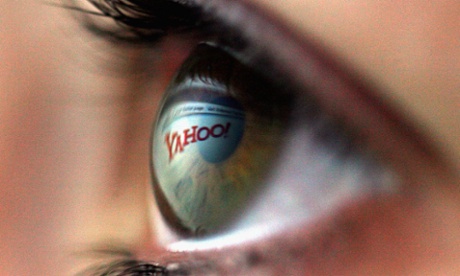
Yahoo webcam image.
The GCHQ program saved one image every five minutes from the users' feeds. Photograph: Chris Jackson/Getty Images
Britain's surveillance agency GCHQ, with aid from the US National Security Agency, intercepted and stored the webcam images of millions of internet users not suspected of wrongdoing, secret documents reveal.
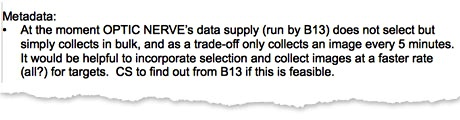
GCHQ files dating between 2008 and 2010 explicitly state that a surveillance program codenamed Optic Nerve collected still images of Yahoo webcam chats in bulk and saved them to agency databases, regardless of whether individual users were an intelligence target or not.
In one six-month period in 2008 alone, the agency collected webcam imagery – including substantial quantities of sexually explicit communications – from more than 1.8 million Yahoo user accounts globally.
Yahoo reacted furiously to the webcam interception when approached by the Guardian. The company denied any prior knowledge of the program, accusing the agencies of "a whole new level of violation of our users' privacy".
GCHQ does not have the technical means to make sure no images of UK or US citizens are collected and stored by the system, and there are no restrictions under UK law to prevent Americans' images being accessed by British analysts without an individual warrant.
The documents also chronicle GCHQ's sustained struggle to keep the large store of sexually explicit imagery collected by Optic Nerve away from the eyes of its staff, though there is little discussion about the privacy implications of storing this material in the first place.

NSA ragout 4
Optic Nerve, the documents provided by NSA whistleblower Edward Snowden show, began as a prototype in 2008 and was still active in 2012, according to an internal GCHQ wiki page accessed that year.
The system, eerily reminiscent of the telescreens evoked in George Orwell's 1984, was used for experiments in automated facial recognition, to monitor GCHQ's existing targets, and to discover new targets of interest. Such searches could be used to try to find terror suspects or criminals making use of multiple, anonymous user IDs.
Rather than collecting webcam chats in their entirety, the program saved one image every five minutes from the users' feeds, partly to comply with human rights legislation, and also to avoid overloading GCHQ's servers. The documents describe these users as "unselected" – intelligence agency parlance for bulk rather than targeted collection.
One document even likened the program's "bulk access to Yahoo webcam images/events" to a massive digital police mugbook of previously arrested individuals.
"Face detection has the potential to aid selection of useful images for 'mugshots' or even for face recognition by assessing the angle of the face," it reads. "The best images are ones where the person is facing the camera with their face upright."
The agency did make efforts to limit analysts' ability to see webcam images, restricting bulk searches to metadata only.
However, analysts were shown the faces of people with similar usernames to surveillance targets, potentially dragging in large numbers of innocent people. One document tells agency staff they were allowed to display "webcam images associated with similar Yahoo identifiers to your known target".
Optic Nerve was based on collecting information from GCHQ's huge network of internet cable taps, which was then processed and fed into systems provided by the NSA. Webcam information was fed into NSA's XKeyscore search tool, and NSA research was used to build the tool which identified Yahoo's webcam traffic.
Bulk surveillance on Yahoo users was begun, the documents said, because "Yahoo webcam is known to be used by GCHQ targets".
NSA ragout 3
Programs like Optic Nerve, which collect information in bulk from largely anonymous user IDs, are unable to filter out information from UK or US citizens. Unlike the NSA, GCHQ is not required by UK law to "minimize", or remove, domestic citizens' information from its databases. However, additional legal authorisations are required before analysts can search for the data of individuals likely to be in the British Isles at the time of the search.
There are no such legal safeguards for searches on people believed to be in the US or the other allied "Five Eyes" nations – Australia, New Zealand and Canada.
GCHQ insists all of its activities are necessary, proportionate, and in accordance with UK law.
The documents also show that GCHQ trialled automatic searches based on facial recognition technology, for people resembling existing GCHQ targets: "[I]f you search for similar IDs to your target, you will be able to request automatic comparison of the face in the similar IDs to those in your target's ID".
The undated document, from GCHQ's internal wiki information site, noted this capability was "now closed … but shortly to return!"
The privacy risks of mass collection from video sources have long been known to the NSA and GCHQ, as a research document from the mid-2000s noted: "One of the greatest hindrances to exploiting video data is the fact that the vast majority of videos received have no intelligence value whatsoever, such as pornography, commercials, movie clips and family home movies."
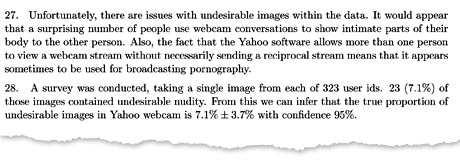
Sexually explicit webcam material proved to be a particular problem for GCHQ, as one document delicately put it: "Unfortunately … it would appear that a surprising number of people use webcam conversations to show intimate parts of their body to the other person. Also, the fact that the Yahoo software allows more than one person to view a webcam stream without necessarily sending a reciprocal stream means that it appears sometimes to be used for broadcasting pornography."
The document estimates that between 3% and 11% of the Yahoo webcam imagery harvested by GCHQ contains "undesirable nudity". Discussing efforts to make the interface "safer to use", it noted that current "naïve" pornography detectors assessed the amount of flesh in any given shot, and so attracted lots of false positives by incorrectly tagging shots of people's faces as pornography.
NSA ragout 1
GCHQ did not make any specific attempts to prevent the collection or storage of explicit images, the documents suggest, but did eventually compromise by excluding images in which software had not detected any faces from search results – a bid to prevent many of the lewd shots being seen by analysts.
The system was not perfect at stopping those images reaching the eyes of GCHQ staff, though. An internal guide cautioned prospective Optic Nerve users that "there is no perfect ability to censor material which may be offensive. Users who may feel uncomfortable about such material are advised not to open them".
It further notes that "under GCHQ's offensive material policy, the dissemination of offensive material is a disciplinary offence".

NSA ragout 2
Once collected, the metadata associated with the videos can be as valuable to the intelligence agencies as the images themselves.
It is not fully clear from the documents how much access the NSA has to the Yahoo webcam trove itself, though all of the policy documents were available to NSA analysts through their routine information-sharing. A previously revealed NSA metadata repository, codenamed Marina, has what the documents describe as a protocol class for webcam information.
In its statement to the Guardian, Yahoo strongly condemned the Optic Nerve program, and said it had no awareness of or involvement with the GCHQ collection.
"We were not aware of, nor would we condone, this reported activity," said a spokeswoman. "This report, if true, represents a whole new level of violation of our users' privacy that is completely unacceptable, and we strongly call on the world's governments to reform surveillance law consistent with the principles we outlined in December.
"We are committed to preserving our users' trust and security and continue our efforts to expand encryption across all of our services."
Yahoo has been one of the most outspoken technology companies objecting to the NSA's bulk surveillance. It filed a transparency lawsuit with the secret US surveillance court to disclose a 2007 case in which it was compelled to provide customer data to the surveillance agency, and it railed against the NSA's reported interception of information in transit between its data centers.
The documents do not refer to any specific court orders permitting collection of Yahoo's webcam imagery, but GCHQ mass collection is governed by the UK's Regulation of Investigatory Powers Act, and requires certification by the foreign secretary, currently William Hague.
The Optic Nerve documentation shows legalities were being considered as new capabilities were being developed. Discussing adding automated facial matching, for example, analysts agreed to test a system before firming up its legal status for everyday use.
"It was agreed that the legalities of such a capability would be considered once it had been developed, but that the general principle applied would be that if the accuracy of the algorithm was such that it was useful to the analyst (ie, the number of spurious results was low, then it was likely to be proportionate)," the 2008 document reads.
The document continues: "This is allowed for research purposes but at the point where the results are shown to analysts for operational use, the proportionality and legality questions must be more carefully considered."
Optic Nerve was just one of a series of GCHQ efforts at biometric detection, whether for target recognition or general security.
While the documents do not detail efforts as widescale as those against Yahoo users, one presentation discusses with interest the potential and capabilities of the Xbox 360's Kinect camera, saying it generated "fairly normal webcam traffic" and was being evaluated as part of a wider program.
Documents previously revealed in the Guardian showed the NSA were exploring the video capabilities of game consoles for surveillance purposes.
Microsoft, the maker of Xbox, faced a privacy backlash last year when details emerged that the camera bundled with its new console, the Xbox One, would be always-on by default.
Beyond webcams and consoles, GCHQ and the NSA looked at building more detailed and accurate facial recognition tools, such as iris recognition cameras – "think Tom Cruise in Minority Report", one presentation noted.
The same presentation talks about the strange means the agencies used to try and test such systems, including whether they could be tricked. One way of testing this was to use contact lenses on detailed mannequins.
To this end, GCHQ has a dummy nicknamed "the Head", one document noted.
In a statement, a GCHQ spokesman said: "It is a longstanding policy that we do not comment on intelligence matters.
"Furthermore, all of GCHQ's work is carried out in accordance with a strict legal and policy framework which ensures that our activities are authorised, necessary and proportionate, and that there is rigorous oversight, including from the secretary of state, the interception and intelligence services commissioners and the Parliamentary Intelligence and Security Committee.
"All our operational processes rigorously support this position."
The NSA declined to respond to specific queries about its access to the Optic Nerve system, the presence of US citizens' data in such systems, or whether the NSA has similar bulk-collection programs.
However, NSA spokeswoman Vanee Vines said the agency did not ask foreign partners such as GCHQ to collect intelligence the agency could not legally collect itself.
"As we've said before, the National Security Agency does not ask its foreign partners to undertake any intelligence activity that the US government would be legally prohibited from undertaking itself," she said.
"The NSA works with a number of partners in meeting its foreign intelligence mission goals, and those operations comply with US law and with the applicable laws under which those partners operate.
"A key part of the protections that apply to both US persons and citizens of other countries is the mandate that information be in support of a valid foreign intelligence requirement, and comply with US Attorney General-approved procedures to protect privacy rights. Those procedures govern the acquisition, use, and retention of information about US persons."

Pollution explodes in China; government begins forcing businesses to close their doors in desperate bid to stop deadly smog

naturalnews.com

Originally published February 27 201china

Pollution explodes in China; government begins forcing businesses to close their doors in desperate bid to stop deadly smog

by L.J. Devon, Staff Writer

(NaturalNews) Beijing and six surrounding Chinese provinces are being suffocated by horrendous bouts of pollution, as millions choke on one of the most dangerous outbreaks of smog ever to settle over the region.
The cloudy swath of choking smog has lasted for several days, prompting a spike in hospital visits. Various respiratory wards report a 20 to 50 percent increase in hospitalization in the past week. Concentrations of pollution measure as high as 505 micrograms, which the Shanghai Academy of Social Sciences says is "uninhabitable for human beings."

Beijing residents struggle to breath, putting on masks as they walk down the street

Beijing residents are now walking up and down the streets wearing protective masks, as they fight against the fine particulate matter cutting its way into their lungs. View a picture of the pollution war zone here.

Inspection teams from China's Ministry of Environmental Protection have been deployed to shut down industries involved in polluting the environment. This includes concrete kilns and coal-burning power plants, which are hard to police. The shutdowns, too little too late, cannot stop a week-long bout of dense particulate smog, which has become apocalyptic in nature.

China's best cleanup efforts come by pawning off contaminated food to countries like the US

It seems that China's extensive list of environmental laws could not stop the inevitable self-destruction of its people, environment and industry. With over 5 million vehicles packed on its streets, Beijing is like a ticking time bomb.

This time bomb is beginning to go off in China, one wave of smog after another, as bouts of heavy metals and environmental contaminants are released into the soil and water, whence it is absorbed by marine life and agriculture. China's best environmental cleanup game plan is to pawn their contaminated food to other countries, including America, as a stealth pollution war is unleashed across the globe.

Fine particulate matter measurements exceed WHO safety levels by 16-fold

Still, the worst is yet to come, as US Embassy readings on the 24th of February in Beijing report PM2.5 contaminants in excess of 400 micrograms per cubic meter. Particulate matter poses the worst risk to human health. These measurements exceed the World Health Organization's safety limit by 16-fold. To put it in perspective, these levels are five times greater than smog levels typically measured in Los Angeles.

These extreme levels have prompted authorities to issue a code orange alert, which has never been used and is for heavy and dangerous smog lasting at least three consecutive days. On guard to unleash code red, authorities are scrambling to restrict industries from furthering the smog. According to a state-run Chinese newspaper, one man is attempting to sue the state for not taking earlier action, calling on the city's Municipal Environmental Protection Bureau to "perform its duty to control air pollution according to the law."

Air purifier sales triple as people search for rescue air

Activists, bloggers and authorities are calling on these businesses to buy air purifiers for the people. In fact, the state-run China National Radio reported air purifier sales in the region tripling.

"Now I'm sitting in front of it and breathing in as much as I can," wrote one Beijing blogger, describing a purifier as if it was a rescue breath. "I want to squeeze out the haze I breathed in the lungs yesterday, and put fresh air in."

Sources for this article include:

http://www.mcclatchydc.com

http://investmentwatchblog.com

http://news.yahoo.com

http://science.naturalnews.com


All content posted on this site is commentary or opinion and is protected under Free Speech. Truth Publishing LLC takes sole responsibility for all content. Truth Publishing sells no hard products and earns no money from the recommendation of products. NaturalNews.com is presented for educational and commentary purposes only and should not be construed as professional advice from any licensed practitioner. Truth Publishing assumes no responsibility for the use or misuse of this material. For the full terms of usage of this material, visit www.NaturalNews.com/terms.shtml

The shocking scale of Google’s grand plan

The good old days. Google co-founders executive Larry Page (l) with Sergey Brin at Google
The good old days. Google co-founders executive Larry Page (l) with Sergey Brin at Google in 2000. Source: AP
IN 1998 Google started as a search company in a California garage.
Fast forward 15 years and it’s worth nearly $US400 billion and is one of the world’s biggest and most talked about companies.
But rather than retire to an island somewhere, Google’s founders have embarked on a huge spending spree, investing or buying up companies at a rate of more than one a week for the last four years.
The result is a behemoth like we’ve never seen before with tentacles reaching inot every area of your life. Take a look at just some of the things Google has been up to.
Sergey Brin (L) and Larry Page have developed a ‘moonshot’ factory to take on big ideas t
Sergey Brin (L) and Larry Page have developed a ‘moonshot’ factory to take on big ideas that change the world. Source: AP
The Moonshot Factory
Some of Google’s most famous new products have come from Google X, their in-house ‘Moonshot Factory’, hidden in a secret bunker at their California headquarters.
It’s run by “Captain of Moonshots” Astro Teller — the grandson of physicist Edward Teller, known as “father of the hydrogen bomb” — and is designed to find ideas that can make the world 10 times better in 10 years, the BBC reports.
It’s responsible for creating driverless cars in a bid to reduce the one million people killed on roads each year and they have covered 300,000 miles of California roads without incident. There are also rumours swirling that Google is working on their own car, independent of any other manufacturers, with artificial intelligence and connected hardware embedded throughout the design.
It’s also launched Project Loon, where giant hot air balloons were released from New Zealand’s South Island into the stratosphere to expand internet coverage all over the world.
Would you trust this car on the roads? Google’s driverless car is a result of the ‘Moonsh
Would you trust this car on the roads? Google’s driverless car is a result of the ‘Moonshot factory’ Source: Supplied
Owning the internet
Not content with dominating search, Google has been working to revolutionise life online.
It’s developed Gmail, GooglePlus, AdWords and AdSense which allow it to build up a perfect picture of consumer habits and provide tailored advertising to clients. The company also has Google Chrome, Translate and Books and Maps which covers every street and monument in the world in glorious 3D.
But it didn’t stop there. Google owns the world’s biggest blogging platform Blogger, Picasa and video giant YouTube which it bought for $1.65 billion. It’s so good, Google will soon know you better than your spouse, Google’s engineering boss recently said.
Technology guru Iain McDonald, of Razorfish Australia, said recent acquisitions in artificial intelligence (AI) such as Deep Mind, could see Google really refine its search offering. “AI could take into account the semantics of you as a person and give a more contextually relevant response to your query and able to interpret our own needs as individuals,” he said. So, think Siri on acid and then some.
Google Ventures and Google Capital have been specifically designed to invest in new companies. They’ve recently spent money on SurveyMonkey, Lending Club and cloud-based learning system Renaissance Learning.
Sci-fi devices
Writer Barbara Ortutay tries out Google Glass.
Writer Barbara Ortutay tries out Google Glass. Source: AP
Mystery barges built in San Francisco Bay will be used as interactive learning centres.
Mystery barges built in San Francisco Bay will be used as interactive learning centres. Source: NewsComAu
With the online world sewn up, the company is looking at ways to infiltrate people’s lives when they’re not sitting at a desk or one their phone.
Enter Google Glass, a wearable computer which takes pictures, records video, delivers messages and helps people communicate whether they’re going for a run or sitting on a bus.
Mr McDonald added: “My take is over the next 10 years, we’re going to see an explosion of connected things, it’s the internet of things movement.
For anyone who is interested in data and human behaviour, the next evolution is not just desktop computers but connected devices such as wearable technology.”
It’s also bought a wind turbine company based in the Mojave Desert and raised the ire of San Francisco city officials with huge ‘mystery barges’ in San Francisco Bay set to be used as interactive learning spaces.
Robots
Meet your new pet. Google has bought Boston Dynamics, the company that makes advanced rob
Meet your new pet. Google has bought Boston Dynamics, the company that makes advanced robots like Big Dog. Source: Supplied
Google recently bought “advanced robots” company Boston Dynamics for an undisclosed sum, leading to plenty of nervous speculation that it’s creating the next Terminator.
The company makes humanoid robots with “mobility, agility, dexterity and speed” used by the US army, navy and marine corps. One of their most famous is Big Dog, a 109kg beast that can carry 155 kilograms, and Cheetah which runs faster than Usain Bolt. Another version, Atlas, can climb hills like a human.
It’s the eighth robot company Google has snapped up in six months, along with Schaft, Meka and Redwood Robotics. The company hasn’t announced plans yet but the robot project is headed up by Andy Rubin, who built Google’s Android system, and there is speculation they’ll use them in the supply chain for delivery. The company is already delivering packages for major retailers in parts of San Francisco.
“If Amazon can imagine delivering books by drones, is it too much to think that Google might be planning to one day have one of the robots hop off an automated Google Car and race to your doorstep to deliver a package?” the New York Times reports.
The home
Mirrors at the Ivanpah Solar Electric Generating System in the Mojave Desert.
Mirrors at the Ivanpah Solar Electric Generating System in the Mojave Desert. Source: AFP
Since launching Android smartphones in 2008 Google has worked to expand its reach into the home with speculation the company is creating a new breed of ‘smart appliances’ that will be able to tell when you arrive home and when you need to stock up on milk.
It recently bought automation company Nest — which regulates thermostats and smoke alarms — for $3.2 billion and in doing so snapped up the talented Tony Fadell, who founded the company after designing the iPod and iPhone for Apple. If you’re wondering why Google would pay that much money for a smoke alarm business, it’s because the company is banking on a future of connected homes, which is technology Nest is already ahead in.
The acquisition could be part of a grand plan to understand human behaviour offline, Wired reports. Just as Gmail allows Google to know what its customers are writing about, Nest will allow it to build up a picture of what we’re doing at home.
“One area of human behaviour Google has yet to colonise as successfully is what we do when we’re not directly interacting with a screen, whether on a PC or mobile device. That in theory changes with Nest,” Wired wrote.
Your body
Natalie Farnworth with her husband Andre, daughter Amelie, 5 and son Lucas, 3 had her DNA
Natalie Farnworth with her husband Andre, daughter Amelie, 5 and son Lucas, 3 had her DNA recorded. Source: News Limited
A Google prototype of a smart contact lens that’s built to measure glucose levels in tear
A Google prototype of a smart contact lens that’s built to measure glucose levels in tears using a tiny wireless chip and miniaturised glucose sensor. Source: Supplied
In addition to what you’re buying and what’s in the fridge, Google also wants to know what’s in your DNA.
It launched Calico last year and hired a bunch of high profile geneticists to tackle ageing and extend human life. Google engineering director Ray Kurwzweil has made no secret of his interest in artificial intelligence.
The company also released a contact lens that will monitor glucose levels for diabetics and Google founder Sergey Brin started up 23andMe, a genetics company that allows people to test their DNA and find out if they’re susceptible to diseases like cancer. The company was eventually forced to stop selling the kits as they used saliva testing.
Mr McDonald said what Google is doing will give us a window into our own bodies so we understand ourselves much deeper, with technology advances soon to be able to accurately and instantaneously measure our dietary intake, blood oxygen levels or just about anything. “This will solve real problems for real people,” he said.
“You can see it changing the way people go on diets for example. Why look on a packet to figure out how many calories are in that mouthful when your watch can tell you in real time?
“And then pair that with artificial intelligence and virtual doctors.”
So what’s the grand plan?
Project Loon aims to send balloons to the edge of space to improve web access.
Project Loon aims to send balloons to the edge of space to improve web access. Source: AFP
Mr McDonald said: “My take is over the next 10 years, we’re going to see an explosion of connected things, it’s the internet of things movement. For anyone who is interested in data and human behaviour, the next evolution is not just desktop computers but connected devices such as wearable technology.
“The two Google founders have shown they have a real passion for the future and where it’s growing. It’s not a short term play, it’s a medium to long-term play. Things such as artificial intelligence have a huge place in any future with technology and the benefit of being a leader in that space can’t be underestimated.”
But should all this new technology scare people? After all, depictions of futuristic dystopias usually start with artificial intelligence or an over-reliance on technology. Mr McDonald said: “If we show people from 15 years ago what we have today, it would look like scary technology. But once there’s a genuine benefit and it’s technology people don’t want to live without, those fears are overcome.”
Google wasn’t drawn on their recent acquisitions, but directed news.com.au to a statement made by Larry Page when he returned to the company as CEO in 2012 which said it’s focusing on “big bets that will make a difference in the world”.
Mr Page believes technology should do the hard work in life, leaving people free to do what they want and said plenty of their ideas sounded crazy to begin with but now pass the “toothbrush test” and are used by millions of people once or twice a day.
“I have always believed that technology should do the hard work — discovery, organisation, communication — so users can do what makes them happiest: living and loving, not messing with annoying computers!”
“We have always believed that it’s possible to make money without being evil,” he said.
Let’s just hope they keep it that way.

Does The Trail Of Dead Bankers Lead Somewhere?

Trail - Photo by Ws47What are we to make of this sudden rash of banker suicides?  Does this trail of dead bankers lead somewhere?  Or could it be just a coincidence that so many bankers have died in such close proximity?  I will be perfectly honest and admit that I do not know what is going on.  But there are some common themes that seem to link at least some of these deaths together.  First of all, most of these men were in good health and in their prime working years.  Secondly, most of these "suicides" seem to have come out of nowhere and were a total surprise to their families.  Thirdly, three of the dead bankers worked for JP Morgan.  Fourthly, several of these individuals were either involved in foreign exchange trading or the trading of derivatives in some way.  So when "a foreign exchange trader" jumped to his death from the top of JP Morgan's Hong Kong headquarters this morning, that definitely raised my eyebrows.  These dead bankers are starting to pile up, and something definitely stinks about this whole thing.
What would cause a young man that is making really good money to jump off of a 30 story building?  The following is how the South China Morning Post described the dramatic suicide of 33-year-old Li Jie...
An investment banker at JP Morgan jumped to his death from the roof of the bank's headquarters in Central yesterday.
Witnesses said the man went to the roof of the 30-storey Chater House in the heart of Hong Kong's central business district and, despite attempts to talk him down, jumped to his death.
If this was just an isolated incident, nobody would really take notice.
But this is now the 7th suspicious banker death that we have witnessed in just the past few weeks...
- On January 26, former Deutsche Bank executive Broeksmit was found dead at his South Kensington home after police responded to reports of a man found hanging at a house. According to reports, Broeksmit had “close ties to co-chief executive Anshu Jain.”
- Gabriel Magee, a 39-year-old senior manager at JP Morgan’s European headquarters, jumped 500ft from the top of the bank’s headquarters in central London on January 27, landing on an adjacent 9 story roof.
- Mike Dueker, the chief economist at Russell Investments, fell down a 50 foot embankment in what police are describing as a suicide. He was reported missing on January 29 by friends, who said he had been “having problems at work.”
- Richard Talley, 57, founder of American Title Services in Centennial, Colorado, was also found dead earlier this month after apparently shooting himself with a nail gun.
- 37-year-old JP Morgan executive director Ryan Henry Crane died last week.
- Tim Dickenson, a U.K.-based communications director at Swiss Re AG, also died last month, although the circumstances surrounding his death are still unknown.
So did all of those men actually kill themselves?
Well, there is reason to believe that at least some of those deaths may not have been suicides after all.
For example, before throwing himself off of JP Morgan's headquarters in London, Gabriel Magee had actually made plans for later that evening...
There was no indication Magee was going to kill himself at all. In fact, Magee’s girlfriend had received an email from him the night before saying he was finishing up work and would be home soon.
And 57-year-old Richard Talley was found "with eight nail gun wounds to his torso and head" in his own garage.
How in the world was he able to accomplish that?
Like I said, something really stinks about all of this.
Meanwhile, things continue to deteriorate financially around the globe.  Just consider some of the things that have happened in the last 48 hours...
-According to the Bangkok Post, people are "stampeding to yank their deposits out of banks" in Thailand right now.

-Venezuela is coming apart at the seams.  Just check out the photos in this article.
-The unemployment rate in South Africa is above 24 percent.
-Ukraine is on the verge of total collapse...
Three weeks of uneasy truce between the Ukrainian government and Western-oriented protesters ended Tuesday with an outburst of violence in which at least three people were killed, prompting a warning from authorities of a crackdown to restore order. Protesters outside the Ukrainian parliament hurled broken bricks and Molotov cocktails at police, who responded with stun grenades and rubber bullets.
-This week we learned that the level of bad loans in Spain has risen to a new all-time high of 13.6 percent.
-China is starting to quietly sell off U.S. debt.  Already, Chinese U.S. Treasury holdings are down to their lowest level in almost a year.
-During the 4th quarter of 2013, U.S. consumer debt rose at the fastest pace since 2007.
-U.S. homebuilder confidence just experienced the largest one month decline ever recorded.
-George Soros has doubled his bet that the S&P 500 is going to crash.  His total bet is now up to about $1,300,000,000.
For many more signs of financial trouble all over the planet, please see my previous article entitled "20 Signs That The Global Economic Crisis Is Starting To Catch Fire".
Could some of these deaths have something to do with this emerging financial crisis?
That is a very good question.
Once again, I will be the first one to admit that I simply do not know why so many bankers are dying.
But one thing is for certain - dead bankers don't talk.
Everyone knows that there is a massive amount of corruption in our banking system.  If the truth about all of this corruption was to ever actually come out and justice was actually served, we would see a huge wave of very important people go to prison.
In addition, it is an open secret that Wall Street has been transformed into the largest casino in the history of the world over the past several decades.  Our big banks have become more reckless than ever, and trillions of dollars are riding on the decisions that are being made every day.  In such an environment, it is expected that you will be loyal to the firm that you work for and that you will keep your mouth shut about the secrets that you know.
In the final analysis, there is really not that much difference between how mobsters operate and how Wall Street operates.
If you cross the line, you may end up paying a very great price.