Thursday, January 16, 2014

2014: China’s year for war – and for losing it on all 5 fronts

The first in a series of articles outlining China's military buildup, weapons, and why they will fail in their efforts.
2014: China’s year for war – and for losing it on all 5 frontsBy James Smith
14 Jan 2014
If asked how to cope with a great host of the enemy in orderly array and on the point of marching to the attack, I should say: “Begin by seizing something which your opponent holds dear; then he will be amenable to your will.” Rapidity is the essence of war: take advantage of the enemy’s unreadiness, make your way by unexpected routes, and attack unguarded spots -Sun Tzu- Chinese General
War is brewing, and the longer something brews, the more bitter the taste.
China, the country with the largest population on Earth, has for some time been preparing for a war against its neighbors and the United States. Japan, Philippines, United States, Taiwan, and its own citizens have come under the aim of the People’s Liberation Army (PLA), the military of the People’s Republic of China in recent years. The aim is capitulation at best, destruction at worst.
This article series will discuss the five fronts that China is currently facing, and why it will fail to win such a war.
The five fronts are:
  • Japan
  • The Philippines
  • United States
  • Chinese Citizens
  • Cyberwar
Taiwan is not listed, as any conflict that arises will mean Taiwan’s quick capture. They simply do not stand a chance on their own.

History

In 1895, the small island of Japan made major advancements in naval and land warfare, and forced the Qing Dynasty to surrender at the end of the First Sino-Japanese War, which primarily was an effort by the Japanese to gain Korea as a foothold into the Asian continent. The result of the war was devastating for the Qing Dynasty – leading to revolts, rebellion, and revolution.
800px Battle of the Yellow Sea by Korechika 2014: China’s year for war – and for losing it on all 5 fronts
Battle of the Yellow Sea by Korechika
In 1937, the start of the Second Sino-Japanese War, ended with the surrender of Emperor Hirohito on the USS Missouri on September 2, 1945. In 1937, the Chinese people were stirred up with old animosities as reports of a massacre of Nanking, or “Rape of Nanking” which took place six months into the 2nd war.
Nanking bodies 1937 2014: China’s year for war – and for losing it on all 5 fronts
This photo is used as purported evidence of Nanking Massacre victims on the shore of Yangtze River. Skeptics however assert that these bodies were the Chinese soldiers who died in battle, not in massacre. Skeptics allege that this photo depicts bodies of such soldiers which were washed up on shore.
Estimates of the massacres place the number of slaughtered, unarmed people between 200,000 and 300,000 men, women, and children. Rape and looting took place by Japanese soldiers. Adding insult to injury,  a member of the Imperial Family, Prince Asaka, escaped prosecution by receiving immunity by the Allies was named as one of the perpetrators.
The feelings of bad blood has never improved. The advancement of post-war Japan into a technological and economic powerhouse has been a irritant in the Communist Chinese government for decades. The Chinese people in the post-war era have lived as their ancestors on rural farms without electricity and proper medical attention. The lack of heavy farm machinery for cultivation and harvesting has kept the communal farms from producing more than 18th Century output, even though the population has grown exponentially during this time. Such population growth required the central government to institute a 2 child limit for each family, and in 1979, became a 1 child limit.

Today

In the last two months, headlines around the world have included the following:
The clear indication is that China is growing its naval and ground forces. However, Sun Tzu also mentions the cost of maintaining an army:
  • On the other hand, an army nearby causes prices to go up and provisions to be depleted; and this steals from the people’s ability to sustain themselves.
  • When the local population is impoverished and its ability to sustain itself drained away, the people will suffer even as the government must exact more from them.
  • With this loss of substance and exhaustion of strength, the homes of the people will be stripped bare, and three-tenths of their income will be dissipated; while government expenses for broken chariots, worn-out horses, breast-plates and helmets, bows and arrows, spears and shields, protective mantles, draught-oxen and heavy wagons, will amount to four-tenths of its total revenue.
With the increase buildup of the Chinese military, the cost of maintaining that army increases. The Chinese government is on a spending spree, with a “damn the costs – build it!” attitude. This means that the cost is great and the expectation of reward must be even greater:
Thus, though we have heard of stupid haste in war, cleverness has never been seen associated with long delays. – Sun Tzu
So the goal of the Chinese military would be to have a quick and decisive campaign, and use the recovered resources to pay off the debts, or force the governments in which they are indebted to forgive the debts.
Next section: China’s allies and why attacking the United States would be folly

China’s war in 2014 – Strengths and Weaknesses

In all of our strengths, the one thing that makes us weak, is ourselves. Our very humanity. And this will be China’s primary weakness.
China’s war in 2014 – Strengths and WeaknessesBy James Smith
16 Jan 2014
This is the second in a series outlining China’s threat to the free world. This is the link to the first article, 2014: China’s year for war – and for losing it on all 5 fronts
Sun Tzu knew how people thought and acted. His adage below is based on his keen sense of the workings of human behavior and psychology.
All warfare is based on deception. Hence, when able to attack, we must seem unable; when using our forces, we must seem inactive; when we are near, we must make the enemy believe we are far away; when far away, we must make him believe we are near. Hold out baits to entice the enemy. Feign disorder, and crush him.
Knowing an enemy’s strength and weakness allows a side to reallocate strengths to cover their weaknesses. This is more than likely why the US Government is willing to spend taxpayer money to learn more about the Chinese abilities. From the solicitation:Doesnt play well 300x279 China’s war in 2014 – Strengths and Weaknesses
“The U.S.-China Economic and Security Review Commission (hereafter “the Commission”) invites  submission of proposals to provide a one-time unclassified report assessing weaknesses of China’s People’s Liberation Army (PLA). The report will identify and assess weaknesses in the PLA’s organization and human capital; the PLA’s combat capabilities in the land, air, maritime, space, and electromagnetic domains; and China’s defense industries (research and development and production). The report will assess how these weaknesses impact the PLA’s combat capabilities and its ability to achieve its missions. The report also will make recommendations for how an opponent could exploit these weaknesses.”

Strengths

China’s strength comes primarily in the number of soldiers, which as of 2011, was approximately 2.3 million men and women. As in the past, having an excessive amounts of cannon fodder allows a force to overwhelm smaller armies and allows the victor to win by attrition. He with the most toys or people wins. Nowadays, having millions of soldiers is still beneficial. Troops can be allocated to cyber warfare, infantry, or special forces, without bleeding manpower from the ranks.
And money. Lots of money! In fact, in the last 10 years the annual expenditure more than tripled from 200 Billion Yuan to over 720 Billion Yuan.
China Military budget 300x136 China’s war in 2014 – Strengths and Weaknesses
Chinese Military Budget 1998-2013
As of 1996 there were 600 air defense missile battalions, equipped with HQ-2 air defense missiles; HQ-3 air defense missiles; HQ-61 air defense missiles; HQ-7 air defense missiles; LY-60 (Lieying) air defense missiles; PL-9 air defense missiles; HY-5 shoulder-launched air defense missiles; QW-1 shoulder-launched air defense missiles; and three sets of advanced Russian-made C-300 missiles. Source

Air Assets:

There are 9 active aviation regiments, plus one training regiments. There are 9 reserve and 6 special army aviation regiments. All 25 regiments are assigned to 5 helicopter brigades that are assigned to group armies, and the brigades 84 to 245 aircraft in 3-6 units.
The five helicopter brigades are assigned to the following commands:china mr2 1 300x255 China’s war in 2014 – Strengths and Weaknesses
  • Beijing Shi
  • Shanyang
  • Tianjin
  • Guangzhou
  • Shanghai Shi
China has recently tested its version of a hypersonic craft, hitting nearly Mach 10 as it raced across the Chinese Mainland.
In recent months, the new H-6K or “God of War” bombers, 15 of which, will be carrying the new Land Attack Cruise Missile (LACM), which are capable of being armed with nuclear warheads.
PLA Air Corps information can be found in this Excel chart

Naval Assets:

According to a Heritage Foundation report, China has 77 principal surface combatants and 65 submarines. In September of 2012, aircraft carrier Liaoning was commissioned by the Chinese Navy after being rebuilt since purchased from the Soviet Navy in 1998. In late December 2012, the People’s Daily reported it would take 4 to 5 years to reach full capability, with limitations based on training. However, if Sun Tzu is correct, that number is greatly exaggerated, and training may already be completed.

Weaknesses

In all of our strengths, the one thing that makes us weak, is ourselves. Our very humanity. And this will be China’s primary weakness.
To explain:
Humanity requires so much effort to stay alive. Food, water, shelter – all needed. When you multiply that by 2.5 million, the amount of infrastructure is astronomical. Fuel for vehicles, aircraft, and ships amplify the headache. Munitions require brass, lead, and powder and proper storage. More nightmarish logistics.
All this to maintain a fighting force that has not seen a battle in over 40 years is tantamount to failure. Training only takes on so far. But as Winston Churchill once said, “There is nothing quite  as exhilarating like being shot at, and missed” outlines the adrenaline rush that soldiers like himself feels on the front lines. All of the Old Guard that fought in Viet Nam is either decrepit or dead. Generals who were but foot soldiers in China’s last war are retiring.
This is called an experience drain, and one that cannot be repaired with gold or silver. It only comes with slogging through bush and swamp in the middle of the night.
Another large issue is the low population of women in child bearing years that live on the Chinese Mainland. With a one child policy, and a cultural preference for male children, the Chinese people have damned themselves into certain oblivion.
Unless they take over the Philippines Islands, where such restrictions do not exist in the islands of strong Catholic values.
And as Sun Tzu puts it:
Bestow rewards without regard to rule, issue orders without regard to previous arrangements; and you will be able to handle a whole army as though you had to do with but a single man.
It remains a possibility, and the historical precedence is already set. How much does China need its weakest link is to be seen.
The next article will cover the China’s perceived enemies

Beneath the Antarctic Ice Lies a Chasm Deeper than the Grand Canyon

http://themindunleashed.org/wp-content/uploads/2014/01/beaneathh.jpg
Buried beneath thick slabs of Antarctic ice there lies a craggy landscape, home to mountains, valleys, and – scientists now know – a massive, subglacial gorge deeper than the Grand Canyon. 
Photo Credit: IceBridge project scientist Michael Studinger captured this photograph of a stunning Antarctic icescape beneath a looming lenticular cloud on November 24, 2013. Beneath the continent’s icy expanse lies a rugged terrain scientists are just beginning to chart.
A team of researchers lead by Newcastle University’s Neil Ross used radar and satellite imagery collected in collaboration with NASA’s IceBridge mission to chart a prehistoric Antarctic mountain range known as the Ellsworth Subglacial Highlands. It was in doing so that they discovered an enormous chasm measuring 1.8 miles deep, 186 miles long and, at some points, as much as 15 miles wide.
Beneath the Antarctic Ice Lies a Chasm Deeper than the Grand Canyon
By comparison, the Grand Canyon measures longer and, at points, wider than the newly discovered Antarctic trench, coming it at just over 275 miles long and up to 18 miles wide; but where the Antarctic chasm wins out is depth, its profundity extending at points to almost twice that of the Grand Canyon’s. (Interestingly, when it comes to sheer vertical extent, neither of these geological rifts can compete with Nepal’s Kali Gandaki Gorge; at some points 18,278 feet lower than the bounding peak of Anapurna I, it is arguably the deepest gorge on Earth).
Beneath the Antarctic Ice Lies a Chasm Deeper than the Grand Canyon
In the latest issue of the Geological Society of America Bulletin, Ross and his colleagues hypothesize that the canyon and the rest of the Ellsworth subglacial highlands formed some 80 million years ago, when the Antarctic continent separated from what was once a unified global landmass, and was later layered over with glaciers that further gouged, and later hid, the lands below them.
“To me, this just goes to demonstrate how little we still know about the surface of our own planet,” said Ross in a statement. “The discovery and exploration of hidden, previously unknown landscapes is still possible and incredibly exciting, even now.”
Read the full study at the GSA Bulletin.

Parallel Worlds Exist And Will Soon Be Testable, Expert Says

http://themindunleashed.org/wp-content/uploads/2014/01/paralleee-1050x526.jpg
By: Dick Pelletier, IEET, Guest

Is there another you reading this article at this exact moment in a parallel universe? Dr. Brian Greene, author of The Hidden Reality: Parallel Universes and the Deep Laws of the Cosmos, believes that this freakish quirk of nature may exist; and he discusses its amazing possibilities in this 3-minute TV interview.
A growing number of cosmologists agree with Greene that we are but one of many universes and at least one of these other worlds lies close to ours, maybe only a millimeter away. We can’t see this world, because it exists in a type of space different from the four dimensions of our everyday reality.
MIT’s Max Tegmark believes this multiverse model of ‘many universes’ is grounded in modern physics and will eventually be testable, predictive and disprovable.
“This is not sci-fi,” he says, “its real science.”
As research at the CERN Large Hadron Collider progresses, scientists are talking increasingly of a “new physics” on the horizon, which promise to help researchers understand more of the unknowns about our universe. This new approach includes developing a better understanding of dark energy, a mystery force that some forward thinkers believe indicates that a ‘sister’ universe lurks in our neighborhood.
Strange happenings have been observed by cosmologists such as the Andromeda galaxy, 2.2 million light-years away speeding towards the Milky Way at 200,000 mph. This phenomenon makes sense logically if gravity leaking from an invisible universe were pulling the two galaxies together.
Researchers at the WMAP space telescope recently discovered a force 10,000 times larger than the Milky Way, which they believe offers powerful evidence that a parallel universe may be in the area.
In another attempt to search for parallel worlds, NASA installed the Alpha Magnetic Spectrometer-2 at the ISS to record data that may prove the existence of other universes, some of which might even be made of anti-matter. Unraveling this cosmic mystery has attracted worldwide interest. The project draws support from most EU nations; plus Taiwan, China, Russia, and the U.S.
Could we ever visit another universe? In a recent PBS interviewRiddles of the UniverseUSC cosmologist Clifford Johnson said he thought it OK to discuss this in the context of fiction (see FOX TV’s Fringe), but it’s also something that scientists can explore. Some suggest that the stuff we’re made of – matter and the forces of our gravity and magnetism – are the elements that glue us to this universe.
They don’t allow us to leave our 4-dimensions of moving back and forth, up and down, left to right; and sense of time. Another universe may exist close by, but in order for us to observe or communicate with it; we must first understand its different dimensions. We might envision them as “new kinds of sideways.”
However, gravity seems to pervade all universes, and it may one day become possible to communicate with other universes through some futuristic gravitational manipulation. How might we feel if a parallel world is discovered?
Johnson says, “It may make me feel less unique as a person, or maybe grateful; because many things I’ve not found time for are maybe being done by a copy of me somewhere else!”
Greene adds that some universes may be almost indistinguishable from ours; others may contain variations of all of us, where we exist but with different families, careers, and life stories. In still others, reality may be so radically different from ours as to be unrecognizable.
Experts predict that as the coming decades unwind, with intelligence advancing exponentially, this ‘over-the-top’ concept will one day become a proven fact. Imagine visiting another Earth where an alternate you is living a more rewarding life than yours, and you could trade places if you both agreed.
This begs the question, “What might happen if our parallel selves met; would we combine our differences to become better humans, or would we compete against one another?”
When might connecting to parallel universes be possible? With resolve and good fortune, some experts predict this incredible feat could be achieved by as early as 10 years; others less enthusiastic,believe the technologies necessary for this to happen could fall into place over the next 50-to-100 years. Stay tuned.
This article originally appeared on IEET.org.

About the Author

Dick Pelletier is a weekly columnist who writes about future science and technologies for numerous publications. He’s also appeared on various TV shows, and he blogs at Positive Futurist.
Image: Credits

Judicial Watch Obtains Documents Detailing the Cost to Taxpayers for Michelle Obama’s Family Trip to Africa


Charges for the Aircraft and Crew Alone Amount to $424,142

Contact Information:
Press Office 202-646-5172, ext 305
Washington, DC — October 4, 2011
Judicial Watch, the organization that investigates and fights government corruption, announced today that it has obtained mission expense records and passenger manifests from the United States Air Force related to the June 21-27, 2011, trip taken by First Lady Michelle Obama, her family and her staff to South Africa and Botswana. Judicial Watch obtained the documents pursuant to an August 19, 2011, Freedom of Information Act (FOIA) lawsuit (Judicial Watch v. U.S. Air Force (No. 11-1496)). Judicial Watch is investigating the purpose and itinerary of the trip as well as a breakdown of the costs to taxpayers.
On June 28, 2011, Judicial Watch filed a FOIA request seeking the mission taskings, transportation records, and passenger manifests for Michelle Obama’s Africa trip. Documents were only provided after Judicial Watch filed suit:
  • According to U.S. Department of Defense’s published hourly rates for the C-32A aircraft used for the trip, Judicial Watch calculated the total cost to American taxpayers was $424,142 for use of the aircraft (34.8 flight hours x $12,188 per hour). (The C-32 is a specially configured military version of the Boeing 757.) Other expenses – meals (off the plane), transportation, security, various services, etc. – have yet to be disclosed.
  • The passenger manifests confirm the presence of Obama’s daughter’s, Malia and Sasha on the trip. The two girls are listed as “Senior Staff.” The manifests also list Mrs. Obama’s mother, Marian Robinson, and niece and nephew, Leslie and Avery Robinson, as well Mrs. Obama’s makeup and hairstylist (Carl Ray and Johnny Wright).
  • The expense records also show $928.44 was spent for “bulk food” purchases on flight. Overall, during the trip, 192 meals were served for the 21 passengers on board.
The professed purpose of Michelle Obama’s trip to South Africa and Botswana was to encourage young people living in the two growing democracies to become involved in national affairs; and during her scheduled stops in Pretoria and Cape Town, South Africa and in Gaborone, the capital of Botswana, the First Lady used the opportunity to speak on education, health and wellness issues.The trip also included such tourist events as visits to historical landmarks and museums, plus a nonworking chance to send time with Nelson Mandela, a meeting that Mrs. Obama described as “surreal.” The trip ended with a private family safari at a South African game reserve before the group returned to Washington on June 27.“This trip was as much an opportunity for the Obama family to go on a safari as it was a trip to conduct government business,” said Judicial Watch President Tom Fitton. “This junket wasted tax dollars and the resources of our overextended military. No wonder we had to sue to pry loose this information.”
Read more about

Leaked: Obama Daughters Listed as “Senior Staff” In White House $424,000 Africa Trip

Monday, January 13, 2014

by Pete Santilli , The Pete Santilli Show & The Guerilla Media Network

When I first heard of Michelle Obama’s Africa trip, we estimated expenses to be around $300,000.

A FOIA request was submitted by Judicial Watch and the documents revealed a few things we never knew.  The total trip was estimated to be greater than $424,000, and it seems that the Obama girls are catagorized as “Senior Staff”.
We can only wonder what their salaries are.
Judicial Watch Obtains Documents Detailing the Cost to Taxpayers for Michelle Obama’s Family Trip to Africa

Charges for the Aircraft and Crew Alone Amount to $424,142

Contact Information:
Press Office 202-646-5172, ext 305
Washington, DC — October 4, 2011
Judicial Watch, the organization that investigates and fights government corruption, announced today that it has obtained mission expense records and passenger manifests from the United States Air Force related to the June 21-27, 2011, trip taken by First Lady Michelle Obama, her family and her staff to South Africa and Botswana. Judicial Watch obtained the documents pursuant to an August 19, 2011, Freedom of Information Act (FOIA) lawsuit (Judicial Watch v. U.S. Air Force (No. 11-1496)). Judicial Watch is investigating the purpose and itinerary of the trip as well as a breakdown of the costs to taxpayers.
On June 28, 2011, Judicial Watch filed a FOIA request seeking the mission taskings, transportation records, and passenger manifests for Michelle Obama’s Africa trip. Documents were only provided after Judicial Watch filed suit:
  • According to U.S. Department of Defense’s published hourly rates for the C-32A aircraft used for the trip, Judicial Watch calculated the total cost to American taxpayers was $424,142 for use of the aircraft (34.8 flight hours x $12,188 per hour). (The C-32 is a specially configured military version of the Boeing 757.) Other expenses – meals (off the plane), transportation, security, various services, etc. – have yet to be disclosed.
  • The passenger manifests confirm the presence of Obama’s daughter’s, Malia and Sasha on the trip. The two girls are listed as “Senior Staff.” The manifests also list Mrs. Obama’s mother, Marian Robinson, and niece and nephew, Leslie and Avery Robinson, as well Mrs. Obama’s makeup and hairstylist (Carl Ray and Johnny Wright).
  • The expense records also show $928.44 was spent for “bulk food” purchases on flight. Overall, during the trip, 192 meals were served for the 21 passengers on board.
The professed purpose of Michelle Obama’s trip to South Africa and Botswana was to encourage young people living in the two growing democracies to become involved in national affairs; and during her scheduled stops in Pretoria and Cape Town, South Africa and in Gaborone, the capital of Botswana, the First Lady used the opportunity to speak on education, health and wellness issues.The trip also included such tourist events as visits to historical landmarks and museums, plus a nonworking chance to send time with Nelson Mandela, a meeting that Mrs. Obama described as “surreal.” The trip ended with a private family safari at a South African game reserve before the group returned to Washington on June 27.“This trip was as much an opportunity for the Obama family to go on a safari as it was a trip to conduct government business,” said Judicial Watch President Tom Fitton. “This junket wasted tax dollars and the resources of our overextended military. No wonder we had to sue to pry loose this information.”http://www.scribd.com/doc/199519545/Leaked-Obama-Daughters-Listed-as-Senior-Staff-In-White-House-424-000-Africa-Trip

Leaked: Obama Daughters Listed as "Senior Staff" In White House $424,000 Africa Trip

Precious Metals Manipulation Worse Than Libor Scandal, German Regulator Says

Tyler Durden's picture
//http://www.zerohedge.com/news/2014-01-16/precious-metals-manipulation-worse-libor-german-regulator-says


Remember when banks were exposed manipulating virtually everything except precious metals, because obviously nobody ever manipulates the price of gold and silver? After all, the biggest "conspiracy theory" of all is that crazy gold bugs blame every move against them on some vile manipulator. It may be time to shift yet another conspiracy "theory" into the "fact" bin, thanks to Elke Koenig, the president of Germany's top financial regulator, Bafin, which apparently is not as corrupt, complicit and clueless as its US equivalent, and who said that in addition to currency rates, manipulation of precious metals "is worse than the Libor-rigging scandal." Hear that Bart Chilton and friends from the CFTC?
More on what Eike said from Bloomberg:
The allegations about the currency and precious metals markets are “particularly serious, because such reference values are based -- unlike Libor and Euribor -- typically on transactions in liquid markets and not on estimates of the banks,” Elke Koenig, the president of Bafin, said in a speech in Frankfurt today.
Actually, what makes the most serious, is that precisely because they are on liquid markets means they implicitly have the blessing of the biggest New Normal market maker of call - the central banks, and their own "regulator" - the Bank of International Settlements (hello Mikael Charoze).
“That the issue is causing such a public reaction is understandable,” Koenig said, according to a copy of the speech. “The financial sector is dependent on the common trust that it is efficient and at the same time, honest. The central benchmark rates seemed to be beyond any doubt, and now there is the allegation they may have been manipulated.”

Bafin has also interviewed employees of Deutsche Bank AG as part of a probe of potential manipulation of gold and silver prices, a person with knowledge of the matter has said.
We wonder how long until this particular investigation is stopped based on an "executive order" from above, because Bafin is now stepping into some very treacherous  waters with its ongoing inquiry of gold manipulation: what it reveals will certainly not be to the liking of the financial "powers that be."

Digital Democracy V. Corporate Dominance: R.I.P. Internet Neutrality?

the ONLY battle going on in this World is ...... the fight for IDEAS !     &    who's r gonna win  humm !   free & open   or  ?    y  u think  Our Creator  .."created"     US all  ... unique, 1 of a kind , individuals !!  no fucking 2 alike  !!!  in ALL the Worlds ..in ALL the Universes  ... 1 of us !     & it's  y "they"  can't fucking stand it . He could've made "any~thin "  ..but He choose US  :)r   & shit ..FUCK  ...damn  ..um so :)  2 spend this brief moment in time with you


VIDEO: Perfect Storm of Internet Censorship
Candidate Obama promised to “support the principle of network neutrality to preserve the benefits of open competition on the Internet.”
President Obama did woefully little to do so. He’s waged war on free expression. He targets whistleblowers and journalists. He wants constitutional rights abolished.
He’s been more lawless than any of his predecessors. Except while campaigning, he’s been largely silent on preserving Net Neutrality.
It’s the last frontier of press freedom. It permits free and open communications. America’s First Amendment is its most important. Without it all other rights are at risk.
Net Neutrality is digital freedom. Mandating it is vital. Unrestricted online access is the only way to stay informed. It’s a vital source for real information.
It’s free from state or corporate control. It’s been this way so far. Public interest groups want it preserved. Everyone has the right to demand it.
It’s too precious to lose. Giant telecom and cable companies want control. They want toll roads established. They want higher priced premium lanes.
They want unrestricted pricing power. They want license to steal. They want content restricted. They want the right to censor.
They want dissent crushed. They want independent thought eliminated. They want digital democracy destroyed.
Net Neutrality denies them. They spent enormous amounts contesting. They want total Internet control.
Achieving it assures stifled innovation, oligopoly dominance, compromised free access to real information, and digital democracy denouement.
Imagine today’s Internet resembling cable TV. Imagining providers have sole control over content. Imagine consumers having no say.
At stake is digital democracy v. corporate dominance. Media scholar/critic Robert McChesney calls Net Neutrality the “defining issue” of our time.
It’s a “critical juncture (window of opportunity) to create a communication system that will be a powerful impetus (for) a more egalitarian, humane, sustainable, and creative (self-governing) society.”
It’s too precious to lose. It’s a battle that requires winning. On January 14, Free Press.net headlined “The Fight to Save Net Neutrality,” saying:
“(T)he US Court of Appeals (District of Columbia Circuit) struck down the Federal Communication Commission’s Open Internet Order.”
It balances corporate and consumer interests. It doesn’t go far enough. It needs improving. In includes provisions too important to lose.
Verizon sued to do so. Rules prohibit providers from slowing, blocking or prioritizing some content over others. Transparency is required. Digital First Amendment rights are protected.
FCC regulation imposed stricter regulations on wired Internet services than mobile ones. Verizon argued it had no legal authority to regulate providers under common carrier rules.
It omitted explaining its real agenda. It wants nothing interfering with bottom line interests. It wants unrestricted online control. It wants digital democracy destroyed. It wants First Amendment rights abolished.
Free Press called Net Neutrality “dead (for now.)” The battle is far from over. It won’t be easy going forward.
Columbia Circuit judges ruled unanimously for Verizon. FCC Chairman Tom Wheeler may appeal.
“I am committed to maintaining our networks as engines for economic growth, test beds for innovative services and products, and channels for all forms of speech protected by the First Amendment,” he said.
“We will consider all available options, including those for appeal, to ensure that these networks on which the Internet depends continue to provide a free and open platform for innovation and expression, and operate in the interest of all Americans,” he added.
Columbia Circuit judges ruled against FCC authority to enforce rules it implemented under what Free Press calls its “complicated legal framework.”
According to Judge David Tatel:
“Even though the commission has general authority to regulate in this area, it may not impose requirements that contravene express statutory mandates.”
Regulations imposed are important. They don’t go far enough. They need to be toughened, not weakened or eliminated.
Columbia Circuit judges oppose regulations impeding maximum profits. Corporate interests matter more than consumer ones. Digital democracy is irrelevant. Free expression doesn’t matter.
Last September, Verizon’s lawyer argued that FCC regulations compromise the company’s free speech rights. Claiming it is ludicrous on its face.
Verizon wants unrestricted online control. It wants censorship rights. It wants consumer free speech denied.
It wants whatever it’s against blocked. It wants sole power to decide. It wants consumers having no say.
Right-wing judges agreed. They did so disgracefully. Congressional action is required. Expect none without overwhelming public pressure.
Bipartisan complicity is deplorably anti-populist. Corporate interests alone matter. Obama is consistently hardline.
His policies belie his rhetoric. He says one thing. He does another. He’s done it throughout his tenure. According to Free Press:
The Columbia Circuit “ruling means that just a few powerful phone and cable companies could control the Internet.”
“Without Net Neutrality, ISPs will be able to devise new schemes to charge users more for access and services, making it harder for us to communicate online – and easier for companies to censor our speech.”
Corporate gatekeepers will control “where you go and what you see.”
Verizon, AT&T, Comcast and Time Warner Cable “will be able to block content and speech they don’t like, reject apps that compete with their own offerings, and prioritize Web traffic…”
They’ll be able to “reserv(e) the fastest loading speeds for the highest bidders (while) sticking everyone else with the slowest.”
Doing so prohibits free and open communications. Censorship will become policy. Net Neutrality is too important to lose.
Free Press president and CEO Craig Aaron issued a statement, saying:
Tuesday’s “ruling means that Internet users will be pitted against the biggest phone and cable companies – and in the absence of any oversight, these companies can now block and discriminate against their customers’ communications at will.”
“Without prompt corrective action by the (FCC) to reclassify broadband, this awful ruling will serve as a sorry memorial to the corporate abrogation of free speech.”
Center for Media Justice director Amalia Deloney called Tuesday’s ruling a possible “end of the Internet as we know it. For freedom’s sake, we can’t let this happen.”
“The path forward is clear: The FCC can and must reassert its authority over this essential communications infrastructure and protect the millions of Internet users now left in the cold.”
On Tuesday, a White House statement pledged support for “a free and open Internet.” Obama did so years ago duplicitously.
Throughout his tenure, he waged war on freedom. He wants First Amendment rights compromised. The White House statement rings hollow, saying:
“The President remains committed to an open Internet, where consumers are free to choose the websites they want to visit and the online services they want to use, and where online innovators are allowed to compete on a level playing field based on the quality of their products.”
Hopefully the battle for Net Neutrality is far from over. Digital democracy depends on preserving it.
Stephen Lendman lives in Chicago. He can be reached at lendmanstephen@sbcglobal.net
His new book is titled “Banker Occupation: Waging Financial War on Humanity.”
http://www.claritypress.com/LendmanII.html
Visit his blog site at sjlendman.blogspot.com. 
Listen to cutting-edge discussions with distinguished guests on the Progressive Radio News Hour on the Progressive Radio Network.
It airs Fridays at 10AM US Central time and Saturdays and Sundays at noon. All programs are archived for easy listening.
http://www.progressiveradionetwork.com/the-progressive-news-hour

Vast Stretches Of Impoverished Appalachia Look Like They Have Been Through A War

West VirginiaIf you want to get an idea of where the rest of America is heading, just take a trip through the western half of West Virginia and the eastern half of Kentucky some time.  Once you leave the main highways, you will rapidly encounter poverty on a level that is absolutely staggering.  Overall, about 15 percent of the entire nation is under the poverty line, but in some areas of eastern Kentucky, more than 40 percent of the population is living in poverty.  Most of the people would work if they could.  Over the past couple of decades, locals have witnessed businesses and industries leave the region at a steady pace.  When another factory or business shuts down, many of the unemployed do not even realize that their jobs have been shipped overseas.  Coal mining still produces jobs that pay a decent wage, but Barack Obama is doing his very best to kill off that entire industry.  After decades of decline, vast stretches of impoverished Appalachia look like they have been through a war.  Those living in the area know that things are not good, but they just try to do the best that they can with what they have.
In previous articles about areas of the country that are economically depressed, I have typically focused on large cities such as Detroit or Camden, New Jersey.  But the economic suffering that is taking place in rural communities in the heartland of America is just as tragic.  We just don't hear about it as much.
Most of those that live in the heart of Appalachia are really good "salt of the earth" people that just want to work hard and do what is right for their families.  But after decades of increasing poverty, the entire region has been transformed into an economic nightmare that never seems to end.  The following is a description of what life is like in Appalachia today that comes from a recent article by Kevin D. Williamson...
Thinking about the future here and its bleak prospects is not much fun at all, so instead of too much black-minded introspection you have the pills and the dope, the morning beers, the endless scratch-off lotto cards, healing meetings up on the hill, the federally funded ritual of trading cases of food-stamp Pepsi for packs of Kentucky’s Best cigarettes and good old hard currency, tall piles of gas-station nachos, the occasional blast of meth, Narcotics Anonymous meetings, petty crime, the draw, the recreational making and surgical unmaking of teenaged mothers, and death: Life expectancies are short — the typical man here dies well over a decade earlier than does a man in Fairfax County, Va. — and they are getting shorter, women’s life expectancy having declined by nearly 1.1 percent from 1987 to 2007.
In these kinds of conditions, people do whatever they have to do just to survive.  With so much poverty around, serving those on food stamps has become an important part of the local economy.  In fact, cases of soda purchased with food stamps have become a form of "alternative currency" in the region.  In his article, Williamson described how this works...
It works like this: Once a month, the debit-card accounts of those receiving what we still call food stamps are credited with a few hundred dollars — about $500 for a family of four, on average — which are immediately converted into a unit of exchange, in this case cases of soda. On the day when accounts are credited, local establishments accepting EBT cards — and all across the Big White Ghetto, “We Accept Food Stamps” is the new E pluribus unum – are swamped with locals using their public benefits to buy cases and cases — reports put the number at 30 to 40 cases for some buyers — of soda. Those cases of soda then either go on to another retailer, who buys them at 50 cents on the dollar, in effect laundering those $500 in monthly benefits into $250 in cash — a considerably worse rate than your typical organized-crime money launderer offers — or else they go into the local black-market economy, where they can be used as currency in such ventures as the dealing of unauthorized prescription painkillers — by “pillbillies,” as they are known at the sympathetic establishments in Florida that do so much business with Kentucky and West Virginia that the relevant interstate bus service is nicknamed the “OxyContin Express.” A woman who is intimately familiar with the local drug economy suggests that the exchange rate between sexual favors and cases of pop — some dealers will accept either — is about 1:1, meaning that the value of a woman in the local prescription-drug economy is about $12.99 at Walmart prices.
I would encourage everyone to read the rest of Williamson's excellent article.  You can find the entire article right here.
In Appalachia, the abuse of alcohol, meth and other legal and illegal drugs is significantly higher than in the U.S. population as a whole.  In a desperate attempt to deal with the pain of their lives, many people living in the region are looking for anything that will allow them to "escape" for a little while.  The following is an excerpt from an excellent article by Chris Hedges which describes what life is like in the little town of Gary, West Virginia at this point...
Joe and I are sitting in the Tug River Health Clinic in Gary with a registered nurse who does not want her name used. The clinic handles federal and state black lung applications. It runs a program for those addicted to prescription pills. It also handles what in the local vernacular is known as “the crazy check” -- payments obtained for mental illness from Medicaid or SSI -- a vital source of income for those whose five years of welfare payments have run out. Doctors willing to diagnose a patient as mentally ill are important to economic survival.
“They come in and want to be diagnosed as soon as they can for the crazy check,” the nurse says. “They will insist to us they are crazy. They will tell us, ‘I know I’m not right.’ People here are very resigned. They will avoid working by being diagnosed as crazy.”
The reliance on government checks, and a vast array of painkillers and opiates, has turned towns like Gary into modern opium dens. The painkillers OxyContin, fentanyl -- 80 times stronger than morphine -- Lortab, as well as a wide variety of anti-anxiety medications such as Xanax, are widely abused. Many top off their daily cocktail of painkillers at night with sleeping pills and muscle relaxants. And for fun, addicts, especially the young, hold “pharm parties,” in which they combine their pills in a bowl, scoop out handfuls of medication, swallow them, and wait to feel the result.
Of course this kind of thing is not just happening in the heart of Appalachia.  All over the country there are rural communities that are economically depressed.  In fact, according to the Wall Street Journal, economic activity in about half of the counties in the entire nation is still below pre-recession levels...
About half of the nation’s 3,069 county economies are still short of their prerecession economic output, reflecting the uneven economic recovery, according to a new report from the National Association of Counties.
So what are our "leaders" doing to fix this?
Well, they plan to ship millions more of our good jobs overseas.
Unfortunately, I am not kidding.
Republicans in the House of Representatives are introducing "fast track" trade promotion authority legislation that will pave the way for rapid approval of the secret trade treaty that Barack Obama has been negotiating.  The following is how I described this insidious treaty in a previous article...
Did you know that the Obama administration is negotiating a super secret "trade agreement" that is so sensitive that he isn't even allowing members of Congress to see it?  The Trans-Pacific Partnership is being called the "NAFTA of the Pacific" and "NAFTA on steroids", but the truth is that it is so much more than just a trade agreement.  This treaty has 29 chapters, but only 5 of them have to do with trade.  Most Americans don't realize this, but this treaty will fundamentally change our laws regarding Internet freedom, health care, the trading of derivatives, copyright issues, food safety, environmental standards, civil liberties and so much more.  It will also merge the United States far more deeply into the emerging one world economic system.
Once again, our politicians are betraying the American people and millions of jobs will be lost as a result.
Not that the economy needs another reason to go downhill.  The truth is that our economic foundations have already been rotting away for quite some time.
But now the ongoing economic collapse seems to be picking up steam again.  For example, the Baltic Dry Index (a very important indicator of global economic activity) is collapsing at a rate not seen since the great financial crash of 2008...
Despite 'blaming' the drop in the cost of dry bulk shipping on Colombian coal restrictions, it seems increasingly clear that the 40% collapse in the Baltic Dry Index since the start of the year is more than just that. While this is the worst start to a year in over 30 years, the scale of this meltdown is only matched by the total devastation that occurred in Q3 2008. Of course, the mainstream media will continue to ignore this dour index until it decides to rise once again, but for now, 9 days in a row of plunging prices is yet another canary in the global trade coalmine and suggests what inventory stacking that occurred in Q3/4 2013 is anything but sustained.
Soon economic conditions will get even worse for Appalachia and for the rest of the country.  The consequences of decades of very foolish decisions are rapidly catching up with us, and millions upon millions of Americans are going to experience immense economic pain during the years to come.
So what are things like in your area of the country right now?  Please feel free to share your thoughts by posting a comment below...
West Virginia

Why Are Dozens Of High Ranking Officers Being Purged From The U.S. Military?

Do u ever see Eagles ..hanging around black birds ?  or do the Good EVER hang around the bad ??  shit birds "only" want shit birds around  hummmmmmmmm !

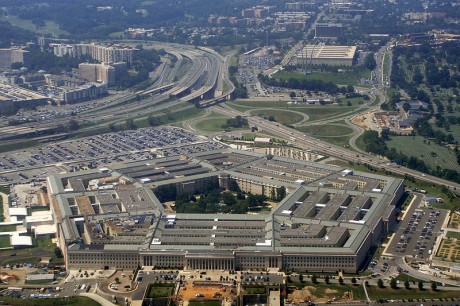
Aerial View Of The Pentagon - Photo by Mariordo Camila Ferreira and Mario DuranSince Barack Obama has been in the White House, high ranking military officers have been removed from their positions at a rate that is absolutely unprecedented.  Things have gotten so bad that a number of retired generals are publicly speaking out about the “purge” of the U.S. military that they believe is taking place.  As you will see below, dozens of highly decorated military leaders have been dismissed from their positions over the past few years.  So why is this happening?  When I was growing up, my father was an officer in the U.S. Navy.  And what is going on right now is absolutely crazy – especially during a time of peace.  Is there a deliberate attempt to “reshape” the military and remove those that don’t adhere to the proper “viewpoints”?  Does someone out there feel a need to get officers that won’t “cooperate” out of the way?  Throughout world history, whatever comes next after a “military purge” is never good.  If this continues, what is the U.S. military going to look like in a few years?
Perhaps you are reading this and you think that “purge” is too strong a word for what is taking place.  Well, just consider the following quotes from some very highly decorated retired officers…
-Retired Army Major General Paul Vallely: “The White House protects their own. That’s why they stalled on the investigation into fast and furious, Benghazi and Obamacare. He’s intentionally weakening and gutting our military, Pentagon and reducing us as a superpower, and anyone in the ranks who disagrees or speaks out is being purged.”
-Retired Army Major General Patrick Brady: “There is no doubt he (Obama) is intent on emasculating the military and will fire anyone who disagrees with him.”
-Retired Army Lt. General William G. “Jerry” Boykin: “Over the past three years, it is unprecedented for the number of four-star generals to be relieved of duty, and not necessarily relieved for cause.”
-Retired Navy Captain Joseph John: “I believe there are more than 137 officers who have been forced out or given bad evaluation reports so they will never make Flag (officer), because of their failure to comply to certain views.”
According to the Blaze, one anonymous Pentagon official has said that even young officers have been told “not to talk about Obama or the politics of the White House”…
A Pentagon official who asked to remain nameless because they were not authorized to speak on the matter said even “young officers, down through the ranks have been told not to talk about Obama or the politics of the White House. They are purging everyone and if you want to keep your job — just keep your mouth shut.”
Now this trend appears to be accelerating.  We have seen a whole bunch of news stories about military officers being dismissed lately.
Almost always, a “legitimate reason” is given for the dismissal.  And without a doubt, if a military officer is actually behaving unethically, that officer should be held accountable.
However, the reality is that everyone has “skeletons in the closet”, and if you really want to get rid of someone it is usually not too hard to find a way to justify your decision.
The following are excerpts from three news stories about military officers in trouble that have come out so far in 2014…
#1 The Air Force Times: A group of former Air Force majors, forced out this summer by a noncontinuation board, plans to file a lawsuit claiming the service had no right to separate them simply to meet end-strength numbers set by Congress.
More than 10 of the 157 dismissed majors are banding together to challenge the move in court, seeking either reinstatement or early retirement pay. All 157 had been twice passed over for promotion and were within six years of retirement.
#2 Defense News: Acting US Navy Undersecretary Robert Martinage, the department’s No. 2, has resigned under pressure, sources confirmed for Defense News.
The resignation, which Martinage announced to his staff Tuesday morning, came after allegations were made of inappropriate conduct with a subordinate woman, the sources confirmed.
#3 Huffington Post: The Air Force says 34 nuclear missile launch officers have been implicated in a cheating scandal and have been stripped of their certification in what is believed to be the largest such breach of integrity in the nuclear force.
Some of the officers apparently texted to each other the answers to a monthly test on their knowledge of how to operate the missiles. Others may have known about it but did not report it.
The cheating was discovered during a drug investigation that involves 11 Air Force officers across six bases in the U.S. and England.
—–
Taken alone, it would be easy to dismiss those stories as “coincidences”.  But when you put them together with the stories of dozens of other high ranking military officers that have been purged from the U.S. military in recent years, a very disturbing pattern emerges.
The following is a list of high ranking military officers that have been dismissed over the past few years that has been circulating all over the Internet.  I think that you will agree that this list is quite stunning…

Commanding Generals fired:

  • General John R. Allen-U.S. Marines Commander International Security Assistance Force [ISAF] (Nov 2012)
  • Major General Ralph Baker (2 Star)-U.S. Army Commander of the Combined Joint Task Force Horn in Africa (April 2013)
  • Major General Michael Carey (2 Star)-U.S. Air Force Commander of the 20th US Air Force in charge of 9,600 people and 450 Intercontinental Ballistic Missiles (Oct 2013)
  • Colonel James Christmas-U.S. Marines Commander 22nd Marine Expeditionary Unit & Commander Special-Purpose Marine Air-Ground Task Force Crisis Response Unit (July 2013)
  • Major General Peter Fuller-U.S. Army Commander in Afghanistan (May 2011)
  • Major General Charles M.M. Gurganus-U.S. Marine Corps Regional Commander of SW and I Marine Expeditionary Force in Afghanistan (Oct 2013)
  • General Carter F. Ham-U.S. Army African Command (Oct 2013)
  • Lieutenant General David H. Huntoon (3 Star), Jr.-U.S. Army 58th Superintendent of the US Military Academy at West Point, NY (2013)
  • Command Sergeant Major Don B Jordan-U.S. Army 143rd Expeditionary Sustainment Command (suspended Oct 2013)
  • General James Mattis-U.S. Marines Chief of CentCom (May 2013)
  • Colonel Daren Margolin-U.S. Marine in charge of Quantico’s Security Battalion (Oct 2013)
  • General Stanley McChrystal-U.S. Army Commander Afghanistan (June 2010)
  • General David D. McKiernan-U.S. Army Commander Afghanistan (2009)
  • General David Petraeus-Director of CIA from September 2011 to November 2012 & U.S. Army Commander International Security Assistance Force [ISAF] and Commander U.S. Forces Afghanistan [USFOR-A] (Nov 2012)
  • Brigadier General Bryan Roberts-U.S. Army Commander 2nd Brigade (May 2013)
  • Major General Gregg A. Sturdevant-U.S. Marine Corps Director of Strategic Planning and Policy for the U.S. Pacific Command & Commander of Aviation Wing at Camp Bastion, Afghanistan (Sept 2013)
  • Colonel Eric Tilley-U.S. Army Commander of Garrison Japan (Nov 2013)
  • Brigadier General Bryan Wampler-U.S. Army Commanding General of 143rd Expeditionary Sustainment Command of the 1st Theater Sustainment Command [TSC] (suspended Oct 2013)

Commanding Admirals fired:

  • Rear Admiral Charles Gaouette-U.S. Navy Commander John C. Stennis Carrier Strike Group Three (Oct 2012)
  • Vice Admiral Tim Giardina(3 Star, demoted to 2 Star)-U.S. Navy Deputy Commander of the US Strategic Command, Commander of the Submarine Group Trident, Submarine Group 9 and Submarine Group 10 (Oct 2013)

Naval Officers fired: (All in 2011)

  • Captain David Geisler-U.S. Navy Commander Task Force 53 in Bahrain (Oct 2011)
  • Commander Laredo Bell-U.S. Navy Commander Naval Support Activity Saratoga Springs, NY (Aug 2011)
  • Lieutenant Commander Kurt Boenisch-Executive Officer amphibious transport dock Ponce (Apr 2011)
  • Commander Nathan Borchers-U.S. Navy Commander destroyer Stout (Mar 2011)
  • Commander Robert Brown-U.S. Navy Commander Beachmaster Unit 2 Fort Story, VA (Aug 2011)
  • Commander Andrew Crowe-Executive Officer Navy Region Center Singapore (Apr 2011)
  • Captain Robert Gamberg-Executive Officer carrier Dwight D. Eisenhower (Jun 2011)
  • Captain Rex Guinn-U.S. Navy Commander Navy Legal Service office Japan (Feb 2011)
  • Commander Kevin Harms- U.S. Navy Commander Strike Fighter Squadron 137 aboard the aircraft carrier Abraham Lincoln (Mar 2011)
  • Lieutenant Commander Martin Holguin-U.S. Navy Commander mine countermeasures Fearless (Oct 2011)
  • Captain Owen Honors-U.S. Navy Commander aircraft carrier USS Enterprise (Jan 2011)
  • Captain Donald Hornbeck-U.S. Navy Commander Destroyer Squadron 1 San Diego (Apr 2011)
  • Rear Admiral Ron Horton-U.S. Navy Commander Logistics Group, Western Pacific (Mar 2011)
  • Commander Etta Jones-U.S. Navy Commander amphibious transport dock Ponce (Apr 2011)
  • Commander Ralph Jones-Executive Officer amphibious transport dock Green Bay (Jul 2011)
  • Commander Jonathan Jackson-U.S. Navy Commander Electronic Attack Squadron 134, deployed aboard carrier Carl Vinson (Dec 2011)
  • Captain Eric Merrill-U.S. Navy Commander submarine Emory S. Land (Jul 2011)
  • Captain William Mosk-U.S. Navy Commander Naval Station Rota, U.S. Navy Commander Naval Activities Spain (Apr 2011)
  • Commander Timothy Murphy-U.S. Navy Commander Electronic Attack Squadron 129 at Naval Air Station Whidbey Island, WA (Apr 2011)
  • Commander Joseph Nosse-U.S. Navy Commander ballistic-missile submarine Kentucky (Oct 2011)
  • Commander Mark Olson-U.S. Navy Commander destroyer The Sullivans FL (Sep 2011)
  • Commander John Pethel-Executive Officer amphibious transport dock New York (Dec 2011)
  • Commander Karl Pugh-U.S. Navy Commander Electronic Attack Squadron 141 Whidbey Island, WA (Jul 2011)
  • Commander Jason Strength-U.S. Navy Commander of Navy Recruiting District Nashville, TN (Jul 2011)
  • Captain Greg Thomas-U.S. Navy Commander Norfolk Naval Shipyard (May 2011)
  • Commander Mike Varney-U.S. Navy Commander attack submarine Connecticut (Jun 2011)
  • Commander Jay Wylie-U.S. Navy Commander destroyer Momsen (Apr 2011)

Naval Officers fired: (All in 2012):

  • Commander Alan C. Aber-Executive Officer Helicopter Maritime Strike Squadron 71 (July 2012)
  • Commander Derick Armstrong- U.S. Navy Commander missile destroyer USS The Sullivans (May 2012)
  • Commander Martin Arriola- U.S. Navy Commander destroyer USS Porter (Aug 2012)
  • Captain Antonio Cardoso- U.S. Navy Commander Training Support Center San Diego (Sep 2012)
  • Captain James CoBell- U.S. Navy Commander Oceana Naval Air Station’s Fleet Readiness Center Mid-Atlantic (Sep 2012)
  • Captain Joseph E. Darlak- U.S. Navy Commander frigate USS Vandegrift (Nov 2012)
  • Captain Daniel Dusek-U.S. Navy Commander USS Bonhomme
  • Commander David Faught-Executive Officer destroyer Chung-Hoon (Sep 2012)
  • Commander Franklin Fernandez- U.S. Navy Commander Naval Mobile Construction Battalion 24 (Aug 2012)
  • Commander Ray Hartman- U.S. Navy Commander Amphibious dock-landing ship Fort McHenry (Nov 2012)
  • Commander Shelly Hakspiel-Executive Officer Navy Drug Screening Lab San Diego (May 2012)
  • Commander Jon Haydel- U.S. Navy Commander USS San Diego (Mar 2012)
  • Commander Diego Hernandez- U.S. Navy Commander ballistic-missile submarine USS Wyoming (Feb 2012)
  • Commander Lee Hoey- U.S. Navy Commander Drug Screening Laboratory, San Diego (May 2012)
  • Commander Ivan Jimenez-Executive Officer frigate Vandegrift (Nov 2012)
  • Commander Dennis Klein- U.S. Navy Commander submarine USS Columbia (May 2012)
  • Captain Chuck Litchfield- U.S. Navy Commander assault ship USS Essex (Jun 2012)
  • Captain Marcia Kim Lyons- U.S. Navy Commander Naval Health Clinic New England (Apr 2012)
  • Captain Robert Marin- U.S. Navy Commander cruiser USS Cowpens (Feb 2012)
  • Captain Sean McDonell- U.S. Navy Commander Seabee reserve unit Naval Mobile Construction Battalion 14 FL (Nov 2012)
  • Commander Corrine Parker- U.S. Navy Commander Fleet Logistics Support Squadron 1 (Apr 2012)
  • Captain Liza Raimondo- U.S. Navy Commander Naval Health Clinic Patuxent River, MD (Jun 2012)
  • Captain Jeffrey Riedel- Program manager, Littoral Combat Ship program (Jan 2012)
  • Commander Sara Santoski- U.S. Navy Commander Helicopter Mine Countermeasures Squadron 15 (Sep 2012)
  • Commander Kyle G. Strudthoff-Executive Officer Helicopter Sea Combat Squadron 25 (Sep 2012)
  • Commander Sheryl Tannahill- U.S. Navy Commander Navy Operational Support Center [NOSC] Nashville, TN (Sep 2012)
  • Commander Michael Ward- U.S. Navy Commander submarine USS Pittsburgh (Aug 2012)
  • Captain Michael Wiegand- U.S. Navy Commander Southwest Regional Maintenance Center (Nov 2012)
  • Captain Ted Williams- U.S. Navy Commander amphibious command ship Mount Whitney (Nov 2012)
  • Commander Jeffrey Wissel- U.S. Navy Commander of Fleet Air Reconnaissance Squadron 1 (Feb 2012)

Naval Officers fired: (All in 2013):

  • Lieutenant Commander Lauren Allen-Executive Officer submarine Jacksonville (Feb 2013)
  • Reserve Captain Jay Bowman-U.S. Navy Commander Navy Operational Support Center [NOSC] Fort Dix, NJ (Mar 2013)
  • Captain William Cogar-U.S. Navy Commander hospital ship Mercy’s medical treatment facility (Sept 2013)
  • Commander Steve Fuller-Executive Officer frigate Kauffman (Mar 2013)
  • Captain Shawn Hendricks-Program Manager for naval enterprise IT networks (June 2013)
  • Captain David Hunter-U.S. Navy Commander of Maritime Expeditionary Security Squadron 12 & Coastal Riverine Group 2 (Feb 2013)
  • Captain Eric Johnson-U.S. Navy Chief of Military Entrance Processing Command at Great Lakes Naval Training Center, IL (2013)
  • Captain Devon Jones-U.S. Navy Commander Naval Air Facility El Centro, CA (July 2013)
  • Captain Kevin Knoop-U.S. Navy Commander hospital ship Comfort’s medical treatment facility (Aug 2013)
  • Lieutenant Commander Jack O’Neill-U.S. Navy Commander Operational Support Center Rock Island, IL (Mar 2013)
  • Commander Allen Maestas-Executive Officer Beachmaster Unit 1 (May 2013)
  • Commander Luis Molina-U.S. Navy Commander submarine Pasadena (Jan 2013)
  • Commander James Pickens-Executive Officer frigate Gary (Feb 2013)
  • Lieutenant Commander Mark Rice-U.S. Navy Commander Mine Countermeasures ship Guardian (Apr 2013)
  • Commander Michael Runkle-U.S. Navy Commander of Mobile Diving and Salvage Unit 2 (May 2013)
  • Commander Jason Stapleton-Executive Office Patrol Squadron 4 in Hawaii (Mar 2013)
  • Commander Nathan Sukols-U.S. Navy Commander submarine Jacksonville (Feb 2013)
  • Lieutenant Daniel Tyler-Executive Officer Mine Countermeasures ship Guardian (Apr 2013)
  • Commander Edward White-U.S. Navy Commander Strike Fighter Squadron 106 (Aug 2013)
  • Captain Jeffrey Winter-U.S. Navy Commander of Carrier Air Wing 17 (Sept 2013)
  • Commander Thomas Winter-U.S. Navy Commander submarine Montpelier (Jan 2013)
  • Commander Corey Wofford- U.S. Navy Commander frigate Kauffman (Feb 2013)
So what do you think about all of this?
Do you believe that a “purge” of high ranking military officers is taking place?
Please feel free to share what you think by posting a comment below…
Aerial View Of The Pentagon - Photo by Mariordo Camila Ferreira and Mario Duran