---BREAKAWAY CIVILIZATION ---ALTERNATIVE HISTORY---NEW BUSINESS MODELS--- ROCK & ROLL 'S STRANGE BEGINNINGS---SERIAL KILLERS---YEA AND THAT BAD WORD "CONSPIRACY"--- AMERICANS DON'T EXPLORE ANYTHING ANYMORE.WE JUST CONSUME AND DIE.---
Monday, November 14, 2016
Sexting reaches new level of excitement with penis and vagina flirtmojis
Written By: Julie Wilson
October 27, 2015
California-based startup
Flirtmoji is preparing to roll out a new line of emojis that will take
sexting to a whole new level. In a world where the majority of social
interactions take place online, these new sexually explicit emojis are
designed in a manor that’s sure to make you giggle and blush.The brains behind the silly, but cleverly designed sexmojis (as we like to call them) originated in the Bay Area when the company opened last year.
Nothing is too perverted for Flirtmoji as some of their latest designs include multi-colored vaginas, breasts and booties, lovemaking rabbits, dildos and even H&M sex toys such as handcuffs, masks and whips.

Below are some more stickers Flirtmoji released last year (Flirtmoji).

The technology-focused website, The Verge, caught up with the sexmoji designers to discuss their creative process. Below is an excerpt of the interview conducted by Arielle Duhaime-Ross.
These vaginas are incredibly diverse. What was your process with this, this time around?
Jeremy Yingling: It was a long one. I was an icon designer before starting Flirtmoji, and symmetry is something that’s really valued with icons, for legibility and for keeping everything balanced. So that’s very much how we approached Flirtmoji and how Katy and I started drawing genitals. And, you know, after drawing maybe a dozen penises and vaginas, we thought things would be more interesting when things are a little bit off-kilter.
So we started looking at references images; there was a lot of Google image searching for many explicit terms and again, the thing that’s beautiful about a particular body part is when it’s not symmetrical, or it’s off-angle or it’s from a strange perspective.
Katy McCarthy: There was one [vagina], I remember, that we were going to cut. And it was the one that was the least symmetrical of the original group. But a friend looked at it and said, “Well that’s the one that looks the most like mine!” So we were kind of in this interesting design dilemma of wanting to create something iconographic and wanting to be representational. And we realized that these things could be reconciled.
So let’s talk about hair. Last time we spoke, you mentioned that hair was something you were thinking about. And now you have these new designs — and some of them are pretty hairy. Why did you think including hair was important?
JY: It became possible, within our style, for one thing. One of the things that Katy and I really work hard on is having a unified esthetic for Flirtmoji which comes down to the color schemes and the size of the strokes. And man we tried to solve hair for a long time with our first line. And the strokes were just too big. But, you now, we finally had a little bit of time to evaluate our art and we saw an opportunity to downsize the strokes a little bit and that suddenly made it possible to do all kinds of weird, hairy, fluffy, pube-y shapes. It was always a priority for us.
So the challenge was making the hair small enough so it would look good in a text message?
JY: Yea. The way flirtmojis are presented on the website, the hair is one pixel. It’s basically as small as you can make something crisp within an icon. Whereas in the past, it was 2 pixels and in a 100-pixel icon that was not a lot of room to make something really hairy.
Do you have a favorite?
JY: My personal favorite has a dark-pink clitoral hood, and a really lippy labia. It’s actually a hairless one.
Do you mean that one that — I want to say — is kind of flappy?

KM: I hope that this can be directly transcribed. [laughs]
JY: Yes, that’s my favorite. It’s one of the first ones that I really broke the symmetry on, and it looks more like a vagina after breaking the symmetry. Something about it actually became sexier to me, or easier to identify. And it’s like a cool moment after drawing so many symmetric orifices to be like, “Oh wow that is true to life; that is very, very sexy.”
Additional sources:
http://www.theverge.com/2015/10/9/9486103/flirtmoji-sexting-sex-vagina-emoji-design
https://www.flirtmoji.co
http://i100.independent.co.uk/article/vagina-emoji-are-here-and-they-are-as-spectacular-as-they-are-nsfw–Wke0aKX9KDg
FAKEBOOK: Desperate need to be socially accepted drives Facebook users to stage fake photos, vacations and fashion accessories ~ hehe ...It's high time for people to reel themselves in and quite literally get back to reality.
by Jennifer Lea Reynolds
http://www.naturalnews.com/051924_faked_social_media_Facebook_artificial_lives.html(NaturalNews) You know those Facebook friends whose lives seems to be nothing but one joyful, adventurous set of experiences after another? They travel, post about thrilling career moments, upload pics of their smiling selves several times a day, and even laugh off spilling coffee on their expensive new carpet.
Before you feel pangs of envy over such people, consider this: their life probably isn't anywhere near as exciting as they suggest it is on social media.
A survey conducted in Europe by smartphone maker HTC set out to delve into the psychology behind the things people post. The findings? Let's just say there's a reason Facebook is often referred to as "Fakebook." More than two-thirds of the 4,400 people who participated said they post images with the sole purpose of making their lives more exciting, typically exaggerating their experiences or their feelings about them.
A judgmental, fake society
Brits in particular seemed to exhibit some eye-opening Fakebook-worthy behaviors. In an effort to make friends and family jealous, more than half of them said they go as far as to borrow items to put in the background of an image so others will think it really belongs to them. Interestingly, a whopping 75 percent of Brits admitted to judging their friends based on their social media observations of them. This included not just Facebook but Instagram and Snapchat as well. In other words, people are forming opinions about others based on mere illusions and deceit.Behavioral psychologist Jo Hemmings reacted to the findings with hardly a flinch, saying that the rise of social media hardly makes her surprised. Pointing to instant communication in which people can immediately know what their friends are doing, wearing, and thinking, she says it's basically a sign of the times on par with what other forms of communication used to be. "Fashion and style used to live and die in magazines; now people are in search of authentic, peer-to-peer recommendations as well, making social media an equal power house to magazines and newspapers."
Hemmings says that what people post on social media outlets has a direct correlation with what people purchase.
Social media lets us express ourselves, but how honestly?
While there's no doubt that social media use is as common as brushing your teeth, there must be more to it than the need to impress others, which apparently leads to increased mall traffic. For those not interested in jumping on board the materialistic, show-off bandwagon, HTC's Peter Frolund offers a more down-to-earth reason behind people's social media use: self-expression. "In 2015, everybody is a photographer, and more and more we are seeing people really use photography to express themselves and show the world exactly what makes them who they are," he says.With all of this fakery and excessive time spent on creating perfectly-crafted outfits (that may not actually belong to the owner), questionable vacations (which might be made up), and pouty-mouthed poses (which just look silly), is this really the "authentic" and "who they are" world Hemmings and Frolund speak of?
Along with jealousy, exaggeration, and fake pics comes social media addiction and... death?
Furthermore, other news also shows that social media is not only filled with deceitful postings, but that dependency on it can be fatal.If you think that's a stretch, consider the story of a newly married couple that was arguing about the wife's constant social media use. When the husband took her phone away, the woman, known only as Aparna, shut herself in a bedroom. She never came out, despite family members encouraging her to emerge. When her husband broke the door down, they discovered she had committed suicide by hanging herself. All of this was apparently spurred by an argument over social media use.
It's high time for people to reel themselves in and quite literally get back to reality.
While it's fun to interact with others or giggle over funny videos, social media should not be something that turns us into a fake, argumentative, and depressed society.

Sources for this article include:
UK.News.Yahoo.com
UK.News.Yahoo.com
DailyMail.co.uk
Human genes engineered into GMO rice are being grown in Kansas


Written By: Vicki Batts
July 13, 2016
If you aren’t already purchasing organic
or GMO-free rice, you should be. Rice that has been engineered with
actual human genes is on its way to a supermarket near you. In Junction
City, Kansas, this human gene-tainted rice is being grown on 3,200 acres
by the biotechnology company Ventria Bioscience.Ventria began cultivating this rather horrifying product in 2006 with human liver genes. What exactly was the purpose of this, you ask? Their intention was to harvest the artificial enzymes produced by the rice and use them in pharmaceuticals. Ventria has taken one of the most widely grown and consumed crops and turned it into the base for new prescription drugs — all with USDA approval, of course.
The threat of contamination and cross-pollination between this genetically-modified rice species and natural rice is of utmost concern. While it may seem rather basic, widespread contamination of unmodified rice could lead to chronic disease.
Bill Freese, Science Policy Analyst at the Center for Food Safety (CFS), who published a report back in 2007 about the dangers of Ventria’s GM rice, states, “These genetically engineered drugs could exacerbate certain infections, or cause dangerous allergic or immune system reactions.”
For our government agencies to allow Big Biotech companies such as Ventria to just do as they please is simply beyond words. The USDA exists not for corporate interests but to protect the American people, though it looks like they may have forgotten that. After all, why else would they allow such a corporation to potentially contaminate our food supply with a crop that will likely make people sick?
Sources:
NaturalNews.com
WorldWatch.org
The cell phone radiation-induced cancer time bomb is about to explode
Written By: D. Samuelson
July 22, 2016
In 2008, J. Leonard
Lichtenfeld, MD, MACP was the Deputy Chief Medical Office for the
American Cancer Society’s national office. He admitted he was no expert
in radio frequencies (RF), or electromagnetic radiation, but he wanted to respond to a memorandum from the University of Pittsburg Cancer Institute that suggested a possible link between the use of cell phones and brain cancer. Included were warnings for children to not
use cell phones unless it was an emergency. Dr. Lichtenfeld opined that
the report was not conclusive, and reiterated the philosophy of the
American Cancer Society who believed that “current evidence doesn’t link
cell phones to cancer.” Today, if you visit the Brain Tumor Netowork, a
portal for brain cancer information and support, you will find the same
conclusion. They just don’t know exactly how brain tumors are caused.The International Agency for Cancer Research (IARC) called out cell phone carcinogen properties in 2011
In May of 2011, IACR officially and scientifically classified cell phone electromagnetic waves, or radio frequencies (RF) as a “Possible Human Carcinogen,” for a brain cancer type called glioma. IARC also encouraged schools, parents and governments to consider “precautionary behavior.” This created a bit of a ruckus with their parent organization, the World Health Organization (WHO), who had chosen to classify the same RF at a lower risk designation called “Probable Human Carcinogen.” The IARC urged physicians and researchers to comb through The Seleten Scientific Statement. This statement came months earlier and included warning about the effects of electromagnetic waves on DNA. It was the work seven scientists from five different nations and was compiled by the prestigious Karolinksa Institute in Sweden.Is there an Electromagnetic Lobby that pushes dangerous frequencies for everyone?
Lloyd Burrell, who has a website called Electric Sense, produced a comprehensive article in 2014 that lists not just one, but forty-four very distinct studies, facts and commentary from around the globe that show devastating links between the “microwave radio frequencies” coming from these phones entering into our unprotected bodies. And while it seems intuitive to understand increased risks for brain tumors like Glioma, Meninglioma or Acoustic Neuromas, Burrell includes peer reviewed studies from Germany, Israel, Sweden, Australia, Germany, Brazil, the U.K., U.S., Norway, Finland, Turkey, China, Austria, Bavaria and Belgium that indicate cancers of the breast, mouth and pituitary gland have also occurred. He also included studies indicating damage to DNA, the brain’s blood flow and memory. And, his blog includes a long list of side effects and illnesses (other than cancer) coming from cell phone frequencies. Irritability, headaches, fatigue, confusion, ADHD and a damaged immune system are just a few.As with all untested technologies and chemicals, children are our most vulnerable.
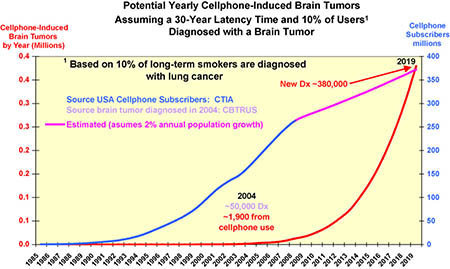
As reported by Braintumor.org, the “leading cause of death of cancer-related deaths in children under 14″ are brain tumors, and, if under 20, a brain tumor is the “second leading cause of cancer-related deaths.” With the proliferation of parents handing the cell phone to their toddler to play with, or, buying one for their first grader, what will the future bring? Burrell’s article also address the “latency period,” which could be simply explained by a few questions. How many cigarettes are smoked till one gets cancer? How many cans of Mountain dew will be ingested before there are holes in your intestine? How many hours are required to put a cell phone next to your ear until a brain tumor appears? The graph below accompanies Burrell’s report. As you can see, the continued dependence of electronic devices seems ready to explode in a epidemic of disease. Don’t expect your cell phone provider to give you any warnings.
Sources:
Blogs.Cancer.org
Old.Post-Gazette.com
BrainTumorNetwork.org
ElectromagneticHealth.org
Electricsense.com
Science.NaturalNews.com
BrainTumor.org
Electricsense.com
Report shows Monsanto has too much power, influence
In the report, which is titled Monsanto Lobbying: An Attack on Us, Our Planet and Democracy , CEO adds another layer to the existing evidence about Monsanto’s undeniable lobbying power, monetary influence, lies, subterfuge, strong arm tactics and the aggressive measures they take to influence governments, universities, farmers and the general public.
Back in 1992, a compromised FDA said that GMOs were “substantially equivalent” to any other food, so there wouldn’t need to be any testing. And for a quarter of a century, Monsanto and the FDA have continued to perpetuate that lie. Monsanto’s sophisticated public relations and marketing firms continue to spread myths about the safety of their products. They also claim that a farmer’s yield will increase, he’ll use fewer chemicals, and that GMOs are the only way to feed the world. As documented by the organization Earth Open Source , all these claims are lies.
The CEO report describes the relationship between Monsanto and government regulatory agencies as a “perverse symbiosis.” Monsanto controls governments by hiring individuals that work for the government. People that work for Monsanto will also quit to take a government job to ensure Monsanto’s wishes are adhered to. It’s a “revolving door” strategy.
The International Life Sciences Institute ( ILSI ), which sounds respectable, is used as a cover to “promote co-called ‘science’ into food and health policy.” Monsanto, Coca-Cola and McDonald’s use this organization to assure the folks eating and drinking poison that it is perfectly safe to do so.
Monsanto represents everything that could be wrong with a company or product. But that didn’t stop Bayer from making a $66 billion dollar bid for the company. Revolving door or not, it’s time to buy your own seeds and grow your own food .
Sources:
CorporateEurope.org
TelesurTv.net
Monsanto-Tribunal.org
OrganicConsumers.org
EarthOpenSource.org
TheAtlantic.com
NASA’s “miracle” EM Drive burns no fuel but produces amazing thrust, defying the laws
Article by Fiona McDonald
The issue is the fact that the EM Drive defies Newton’s third law , which states that everything must have an equal and opposite reaction. So, according to Newton and our current understanding of the world around us, for a system to produce propulsion, it has to push something out the other way (in space, that’s usually combusted rocket fuel).
But the EM Drive works without any fuel or propellants at all. It works by simply bouncing microwave photons back and forth inside a cone-shaped closed metal cavity. That motion causes the ‘pointy end’ of the EM Drive to generate thrust, and propel the drive in the opposite direction.
Despite years of testing and debate , the drive remains controversial. The bottom line is that, on paper, it shouldn’t work, according to the laws of physics. And yet, in test after test, the EM Drive just keeps on working.
Last year, NASA’s Eagleworks Laboratory got involved to try to independently verify or debunk the EM Drive once and for all. And a new paper on its tests in late 2015 has just been leaked , showing that not only does the EM Drive work – it also generates some pretty impressive thrust.
To be clear, despite rumours that a NASA paper on these tests has passed the peer-review process, the version that’s been leaked hasn’t been published in an academic journal. So, for now, this is just one group of researchers reporting on their results, without any external verification.
But the paper concludes that , after error measurements have been accounted for, the EM Drive generates force of 1.2 millinewtons per kilowatt in a vacuum.
That’s not an insignificant amount – to put it into perspective, the super-powerful Hall thruster generates force of 60 millinewtons per kilowatt , an order of magnitude more than the EM Drive.
But the Hall thruster uses fuel and requires a spacecraft to carry heavy propellants, and that extra weight could offset the higher thrust, the NASA Eagleworks team conclude in the paper.
Light sails on the other hand, which are currently the most popular form of zero-propellant propulsion, use beams of sunlight to propel them forward rather than fuel. And they only generate force up to 6.67 micronewtons per kilowatt – two orders of magnitude less than NASA’s EM Drive, says the paper.
The NASA Eagleworks team measured the EM Drive’s force using a low thrust pendulum at the Johnson Space Centre, and the tests were performed at 40, 60, and 80 watts.
They were looking for any sign that the thrust could be a result of another anomaly in the system, but for now, that doesn’t appear to be the case.
“The test campaign included a null thrust test effort to identify any mundane sources of impulsive thrust, however none were identified,” the team, led by Harold White, concluded in the paper.
“Thrust data from forward, reverse, and null suggests that the system is consistently performing with a thrust to power ratio of 1.2 ± 0.1 millinewtons per kilowatt.”
But the team does acknowledge that more research is needed to eliminate the possibility that thermal expansion could be somehow skewing the results.
They also make it clear that this testing wasn’t designed to optimise the thrust of the EM Drive, but simply to test whether it worked, so further tweaking could make the propulsion system more efficient and powerful.
So where does this leave us with the EM Drive? Again, the results haven’t been published as yet – although rumours are circulating that we’re getting tantalisingly close to that happening – so we need to take these leaked results with a grain of salt.
But they do offer further evidence that the thrust produced by the EM Drive is real. So it might be time to start trying to figure out how the system could work – and, more importantly, start testing the drive in space.
Thankfully that’s scheduled to happen in the coming months , with plans to launch the first EM Drive having been made back in September .
And back in June, a team of researchers from Finland proposed a way that the EM Drive could work without defying Newton’s third law, by propelling photons as a type of exhaust – although that hypothesis has yet to be tested.
We’re still a long way off understanding how the system works – or if it works at all – but a lot of brilliant minds are now seriously considering the possibility that we might have a way to get to space without rocket fuel. We’re excited to see what happens next.
You can read the full paper here.
Read more at: sciencealert.com
Subscribe to:
Comments (Atom)