Thursday, July 9, 2015

TREPANG

Trepang

TREPANG

In the era of disposable Soda Pop culture, it can sometimes be difficult to find relevant events to report that raise a highly charged interest in categories that you find that are secretive in nature. Anymore, we see that the mainstream media has avoided their charge at being an informative fourth estate and has surrendered to being parrots to the State Department.
The filter that has been installed will block any and all information that would open the door to finding out the truth about many subjects that are considered taboo or even allegedly classified.
Since the media tends to tell you the truth is out there, they certainly aren’t in the business of telling you that some truths that were once elusive about fringe subjects have now been revealed and much of what has been declassified really has not been seen or heard by the typical individual.
For example, there are still books and television shows that will tell you that the Air Force base in Nevada called Area 51 is still mysterious and that the government still keeps it a secret. That is only half true, While much of what goes on there is still classified, there has been a great deal of what has happened there that has been declassified along with other major operations and files on the military and their relationship with UFO’s
The government has finally declassified the OXCART program at Area 51. Operation Oxcart was a secret operation to develop a supersonic jet that could reach speeds of Mach 3. This was eventually known as the SR-71 blackbird project. Those who play in the world of conspiracy theory already had reported this for many years. The novelty here is that the mainstream media has given the impression that this was the only program that Area 51 was involved in and that anything else “speculative” about reversed alien technology can be put to rest. New ideas are now emerging about what cover stories, and disinformation about UFO’s and aliens to cover up covert testing of special craft that were used for our protection in the paranoid era of the Cold War.
a12stgroom
What we are getting are table scraps from a project that was well known for years. Not that the scraps are not satisfying, they just create an even bigger appetite for more information, we get the bones and wait for raw meat. Area 51 is a huge onion with layer upon layer that will be revealed when it is necessary. OXCART is finally becoming an official program and the details are being well controlled and all other speculation or books released before the official declassification can all be discounted now right?
Not quite.
The term UFO–or unidentified flying object–refers to a suspected alien spacecraft, although its definition encompasses any unexplained aerial phenomena. UFO sightings have been reported throughout recorded history and in various parts of the world, raising questions about life on other planets and whether extraterrestrials have visited Earth. They became a major subject of interest–and the inspiration behind numerous films and books–following the development of rocketry after World War II.
From the sightings of Kenneth Arnold in the Northwestern United States until now, we have to assume that Ufology has grown up. Colleges are beginning to accept UFO existence, but they will not go out on a limb and state that extra terrestrials are piloting these craft. There is still that small percentage that might lend itself to the outrageous. But we should not let that get in the way of a true investigation.
Again it is unfortunate that the mainstream media networks in the United States haven’t a clue when it comes to reporting mysterious anomalies. The minute that someone suggests extra-terrestrial connections or even the axiom UFO they want to make fun at it. It is as if they are above reporting something like this.
It is interesting to note that in the 1960’s and 1970’s stories such as these would be of profound interest. Unfortunately, the Media will find ways to twist a UFO story. They would come to the conclusion themselves that when a person uses the word UFO that they are meaning, a craft with little grey or green men inside.
New ufologists know that this is not the case. It is the old misconceptions that hurt a serious investigation. It is the holding on to old myths that jeopardize true science and analysis. Some will find a hidden meaning in the simplest explanations. To toy with a Freud quote “Sometimes a cigar shaped craft from another world is not necessarily a cigar shaped craft from another world.”
uss3
In 1945 the war in Europe was drawing to a close. It was during that period that many strange and interesting things were transpiring. Bomber crews were starting to notice glowing orbs near their planes as they flew over the German air space. The strange balls of light were displaying incredible acrobatic maneuvers and would fly at incredible speeds around the propeller driven aircraft. Some of these orbs were clocked at 17,000 to 2000 miles per hour. This was unheard of during this time.
Many of the allies determined that these orbs had hostile intent. Some planes were often forced into a dive to avoid collisions with these unknown craft. These orbs were called Foo Fighters long before the word UFO crept into the lexicon and was associated (according to the popular media) with “lone nuts” who see things in the skies, and chase weather balloons and “swamp gas.”
It is a part of history that has yet to be tainted by so called “skeptics” who by name should sit on the fence and analyze yet find it good sport to try and “debunk” and make light of the documented evidence that substantiates this aerial phenomenon.
When the war ended there were questions raised as to the origin of these strange balls of light. Germany claimed that they had nothing to do with the strange lights and theorized that perhaps they were a “top secret” weapon being used by allied forces to outpace their new jet propulsion technology that was being developed.
In 1946 there seemed to be an excitement over Germany and Scandinavia regarding the sighting of fiery rockets in the sky. The Allies feared that a resurgent fanatical group of Nazis were developing rocket technologies to start another war. It was theorized that these strange new rockets were being test fired from underground bases.
People feared that they were new weapons of mass destruction and saw them moving in erratic ways shooting up into space and then coming down in fiery balls of light. Some people journeyed into the areas where they thought the “rockets” had landed thinking that perhaps there would be scorched land or even a small fire.
There was no fire to be seen. Before there were UFO’s there were craft of unknown origin and they were very real. They may have even been thought of as alien to the witnesses who had never seen such aircraft before. The fascination and magic of such craft wound up in dime store comic books and science fiction magazines.
kenneth-arnold-ufo
On June 24th 1947 the word flying saucer was coined by journalists who were reporting an odd story about Kenneth Arnold who while flying his plane over Washington spotted a boomerang shaped craft that seemed to skip across the air as a “saucer would skip across water.” These unknown craft were mirror bright and traveled at fast speeds, faster than any jet that would eventually show up in the skies many years later.
The “flying saucers” had arrived only because the media said so. For many years the balls of light and the strange aircraft had been seen and many theories as to what they were crept into the pulp novels of the day.
The Flying Saucer was most definitely a media creation; a marketing label developed to sell newspapers. It would become a word that not only was used to support the believers and the witnesses but it also was used in a derisive manner.
Meanwhile the sensationalists would toil with outrageous speculation about what may be behind the UFO mystery, the Military at the time was fully aware that by World War II’s end there were ex-Nazi scientists and officers that were being pipelined into intelligence positions and supervising the new aerospace programs.
blacksun
Many of these scientists were part of the SS E-IV, a development unit of the SS occult “Order of the Black Sun.” Under Hitler they were tasked with researching alternative energies to make the Third Reich independent of scarce fuel oil for war production. Their work included developing alternative energies and fuel sources through coal gasification, research into grain alcohol fuels, less complicated coal burning engines for vehicles and generators, as well as highly advanced liquid oxygen turbines, total reaction turbines, AIP (Air Independent Propulsion) motors and even EMG (Electro-Magnetic-Gravitic) engines.
The result of their research led them to create the Wnderwaffen or Wonder weapons, many of those wonder weapons included what we now know is the so called “flying saucer.”
The term “flying saucer” has evolved in the communal mythology to be UFO, a term that originally meant Unidentified Flying Object. But now it seems to be stuck as a marketing label on everything mysterious which includes, the Chupacabra, crop circles, mutilated cattle, Men in Black, government conspiracies, alien abductions, genetic manipulation, and everything else that seems to have no definitive answer.
In 1947, just two years after world war two, Saucer hysteria began after it was reported that the Saucers were seen in the Northwest. In July of 1947 there was a crash incident reported near Roswell New Mexico. Since that time American UFO history began, and the idea that our high tech inventions was reversed engineered from what was called an alien space ship.
Unfortunately, the Roswell incident has become a fact that has snowballed into an extraordinary myth. For example, the main stream press will point out that Roswell is the only event that kooky UFO followers treat as something equivalent to the “Alien nativity”. Many will completely overlook the events that set the stage for Roswell and the fact that Roswell was only “big news” 30 years after the alleged event.
Also there has been a blind eye given to a declassified report of Operation Mainbrace a group of NATO maneuvers held in September 1952. These maneuvers were declassified and much of what happened remains a mystery. Those who participated reported that there was a possible base where “saucers” were seen. This base was reported to be in the vicinity of Denmark and Norway.
The maneuvers commenced September 13th and lasted twelve days. According to the U. S. Navy, “units of eight NATO governments and New Zealand participated, including 80,000 men, 1,000 planes, and 200 ships. Directed by British Admiral Sir Patrick Brind, “it was the largest NATO maneuver held up until that time.”
On September 13th, The Danish destroyer Willemoes, participating in the maneuvers, was north of Bornholm Island. During the night, Lieutenant Commander Schmidt Jensen and several members of the crew saw an unidentified object, triangular in shape, which moved at high speed toward the southeast. The object emitted a bluish glow. Commander Jensen estimated the speed at over 900 mph.
Within the next week, there were four important sightings by well-qualified observers. (Various sources differ by a day or two on the exact dates, but agree on details. There is no question about the authenticity of the sightings; the British cases were officially reported by the Air Ministry, the others are confirmed by reliable witnesses. All occurred on or about September 20).
On September 19th A British Meteor jet aircraft was returning to the airfield at Topcliffe, Yorkshire, England, just before 11 A. M. As it approached for landing, a silvery object was observed following it, swaying back and forth like a pendulum. Lieutenant John W. Kilburn and other observers on the ground said that when the Meteor began circling, the UFO stopped.
trepang ufo
It was disc-shaped, and rotated on its axis while hovering. The disk suddenly took off westward at high speed, changed course, and disappeared to the southeast.
About September 20–Personnel of the U.S.S. Franklin D. Roosevelt, an aircraft carrier participating in the Mainbrace maneuvers, observed a silvery, spherical object which was also photographed. The pictures have never been made public. The UFO was seen moving across the sky behind the fleet. Reporter Wallace Litwin took a series of color photographs, which were examined by Navy Intelligence officers.
These pictures were not made public but recently a series of very clear photos have been released recently reportedly taken in 1971 by personnel on the Submarine U.S.S Trepang.
The large UFO’s were reported to be flying in the same area that Mainbrace reported was a hotbed of saucer activity. The images are believed to have been taken in March, 1971, from USS Trepang SSN 674 submarine, during a voyage from Iceland to Jan Mayen Island in Norway.
However, some experts believe that the photos only give evidence that the U.S. military was secretly testing aircraft in the region. Some commenters have pointed out that the supposed cigar-shaped UFO looks remarkably like the Aereon 26, an experimental aircraft that was being tested in the early 1970s.
But others dispute the claim.
11698938_1623459954606479_3533061426688825761_o
U.S. Navy records confirm that USS Trepang was, indeed, in the Arctic region near Denmark at the time, and that Rear Admiral Dean Reynolds Sackett, Jr., a native of Beatrice, Nebraska, commanded the ship from August, 1970, to December, 1973. The photos were classified “Top Secret” at the time they were taken.
Perhaps these photos are a smoking gun that either alien saucers or manmade Nazi like saucers were still being flown in remote areas of the world.
Of course these pictures will generate about 3 or 4 ridiculous explanations and an uninformed media that still cynically debunks anyone who doesn’t buy into their weather balloons of the Gods theories will give it a homogenized once over.
Not to mention the smug buffoonery that seems to ooze from every newscaster that thinks a simple roll of UFO footage backed by the worn out ‘X-Files’ theme is going to give them any credibility.
Let the flame wars and the arguments begin, because it seems that military history has its fair share of great stories to tell and to eventually declassify.
Many of them are quite compelling.
uss8

Injectable Brain Implant Spies on Individual Neurons


Global Research, July 09, 2015
Nature 8 June 2015
Region: USA
brain
Electronic mesh has potential to unravel workings of mammalian brain.
This soft, conductive polymer mesh can be rolled up and injected into the brains of mice.
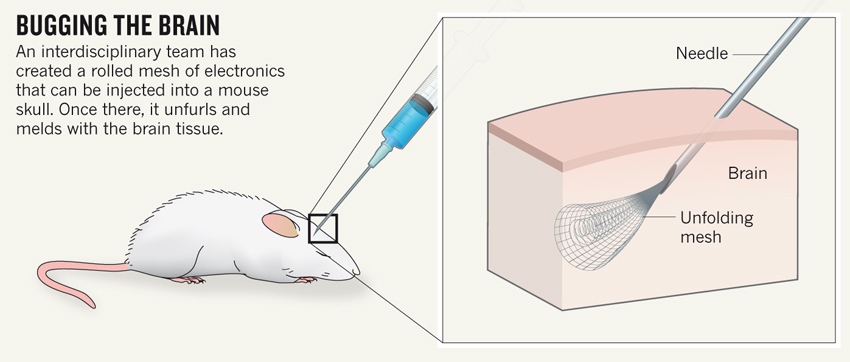
A simple injection is now all it takes to wire up a brain. A diverse team of physicists, neuroscientists and chemists has implanted mouse brains with a rolled-up, silky mesh studded with tiny electronic devices, and shown that it unfurls to spy on and stimulate individual neurons.
The implant has the potential to unravel the workings of the mammalian brain in unprecedented detail. “I think it’s great, a very creative new approach to the problem of recording from large number of neurons in the brain,” says Rafael Yuste, director of the Neuro­technology Center at Columbia University in New York, who was not involved in the work.
Lieber Research Group, Harvard University
If eventually shown to be safe, the soft mesh might even be used in humans to treat conditions such as Parkinson’s disease, says Charles Lieber, a chemist at Harvard University on Cambridge, Massachusetts, who led the team. The work was published inNature Nanotechnology on 8 June1.
Neuroscientists still do not understand how the activities of individual brain cells translate to higher cognitive powers such as perception and emotion. The problem has spurred a hunt for technologies that will allow scientists to study thousands, or ideally millions, of neurons at once, but the use of brain implants is currently limited by several disadvantages. So far, even the best technologies have been composed of relatively rigid electronics that act like sandpaper on delicate neurons. They also struggle to track the same neuron over a long period, because individual cells move when an animal breathes or its heart beats.
The Harvard team solved these problems by using a mesh of conductive polymer threads with either nanoscale electrodes or transistors attached at their intersections. Each strand is as soft as silk and as flexible as brain tissue itself. Free space makes up 95% of the mesh, allowing cells to arrange themselves around it.
In 2012, the team showed2 that living cells grown in a dish can be coaxed to grow around these flexible scaffolds and meld with them, but this ‘cyborg’ tissue was created outside a living body. “The problem is, how do you get that into an existing brain?” says Lieber.
The team’s answer was to tightly roll up a 2D mesh a few centimetres wide and then use a needle just 100 micrometres in diameter to inject it directly into a target region through a hole in the top of the skull. The mesh unrolls to fill any small cavities and mingles with the tissue (see ‘Bugging the brain’). Nanowires that poke out can be connected to a computer to take recordings and stimulate cells.
So far, the researchers have implanted meshes consisting of 16 electrical elements into two brain regions of anaesthetized mice, where they were able to both monitor and stimulate individual neurons. The mesh integrates tightly with the neural cells, says Jia Liu, a member of the Harvard team, with no signs of an elevated immune response after five weeks. Neurons “look at this polymer network as friendly, like a scaffold”, he says.
The next steps will be to implant larger meshes containing hundreds of devices, with different kinds of sensors, and to record activity in mice that are awake, either by fixing their heads in place, or by developing wireless technologies that would record from neurons as the animals moved freely. The team would also like to inject the device into the brains of newborn mice, where it would unfold further as the brain grew, and to add hairpin-shaped nanowire probes to the mesh to record electrical activity inside and outside cells.
When Lieber presented the work at a conference in 2014, it “left a few of us with our jaws dropping”, says Yuste.
There is huge potential for techniques that can study the activity of large numbers of neurons for a long period of time with only minimal damage, says Jens Schouenborg, head of the Neuronano Research Centre at Lund University in Sweden, who has developed a gelatin-based ‘needle’ for delivering electrodes to the brain3. But he remains sceptical of this technique: “I would like to see more evidence of the implant’s long-term compatibility with the body,” he says. Rigorous testing would be needed before such a device could be implanted in people. But, says Lieber, it could potentially treat brain damage caused by a stroke, as well as Parkinson’s disease.
Lieber’s team is not funded by the US govern­ment’s US$4.5-billion Brain Research through Advancing Innovative Neurotechnologies (BRAIN) initiative, launched in 2013, but the work points to the power of that effort’s multidisciplinary approach, says Yuste, who was an early proponent of the BRAIN initiative. Bringing physical scientists into neuroscience, he says, could help to “break through the major experimental and theoretical challenges that we have to conquer in order to understand how the brain works”.
Nature 522, 137–138 (11 June 2015) doi:10.1038/522137a
References
1) Liu, J. et al. Nature Nanotechnol. http://dx.doi.org/10.1038/nnano.2015.115 (2015).
2) Tian, B. et al. Nature Mater. 11, 986–994 (2012).
3) Lind, G., Linsmeier, C. E., Thelin, J. & Schouenborg, J. J. Neural Eng. 7, 046005 (2010). Article
- See more at: http://www.globalresearch.ca/injectable-brain-implant-spies-on-individual-neurons/5461548#sthash.g4eymzXt.dpuf

How Conflicts of Interest Have Corrupted the Centers for Disease Control and Prevention (CDC)

Region:
 
vaccine-money-inside
Conflicts of interest have become more the rule than the occasional exception. Even the trusted US Centers for Disease Control and Prevention (CDC) receives heavy funding from industry.
How this conflict of interest may have affected the organization’s decisions is the topic of an article1 in the British Medical Journal (BMJ), penned by the journal’s associate editor, Jeanne Lenzer, who notes:
“The Centers for Disease Control and Prevention (CDC) includes the following disclaimer with its recommendations:
“CDC, our planners, and our content experts wish to disclose they have no financial interests or other relationships with the manufacturers of commercial products… CDC does not accept commercial support.”
The CDC’s image as an independent watchdog over the public health has given it enormous prestige, and its recommendations are occasionally enforced by law.
Despite the agency’s disclaimer, the CDC does receive millions of dollars in industry gifts and funding, both directly and indirectly, and several recent CDC actions and recommendations have raised questions about the science it cites, the clinical guidelines it promotes, and the money it is taking.”

Is the CDC Protecting the Private Good Rather Than the Public?

When confronted about the discrepancy between the CDC’s public disclaimer and the reality that corporate funding is flowing into the organization, Tom Frieden, director of the CDC, responded, saying:
“Public-private partnerships allow CDC to do more, faster. The agency’s core values of accountability, respect, and integrity guide the way CDC spends the funds entrusted to it.
When possible conflicts of interests arise, we take a hard, close look to ensure that proper policies and guidelines are followed before accepting outside donations.”
In other words, the CDC believes, and “assures” you, it has the moral backbone to do the right thing, despite the fact that studies have revealed moral fiber tends to significantly deteriorate as soon as a funding source with an agenda starts doling out money.
Moreover, a 2009 investigation by the Office of the Inspector General concluded the CDC has “a systemic lack of oversight of the ethics program,” noting 97 percent of disclosure forms filed by the organization’s advisors were incomplete, and 13 percent of advisors didn’t file one.

Did Industry ‘Buy’ CDC Recommendation for Expanded Hepatitis C Screening?

External funding to the CDC in the form of industry “gifts” was authorized in 1983—nearly 40 years after the organization’s inception in 1946. After the passing of legislation in 1992 that encouraged relationships between the CDC and industry, the non-profit CDC Foundation was formed in 1995.
Last year, this Foundation received $12 million from private corporations, and the CDC itself received another $16 million in funding earmarked for special projects from companies, manufacturers, and various philanthropists.
“For example, in 2012, Genentech earmarked $600 000 in donations to the CDC Foundation for CDC’s efforts to promote expanded testing and treatment of viral hepatitis. Genentech and its parent company, Roche, manufacture test kits and treatments for hepatitis C,” Lenzer writes.
Since 2010, when the CDC and the CDC Foundation formed the Viral Hepatitis Action Coalition, manufacturers of hepatitis C tests and treatments have donated more than $26 million to the coalition.
In addition to Genentech, donors include: Abbott Laboratories, AbbVie, Gilead, Janssen, Merck, OraSure Technologies, Quest Diagnostics, and Siemens.
Two years later, in 2012, the CDC issued guidelines recommending expanded screening for hepatitis C for everyone born between 1945 and 1965, saying newer antiviral drugs can effectively halt disease progression.
However, “the science behind cohort screening has been challenged and is said to be ‘the subject of major debate.’ The scientific debate along with the price tags of the newer drugs (over $84 000 per treatment course for the new drug sofosbuvir), raise questions about CDC’s industry funding,” Lenzer writes.

CDC Recommendations Increasingly Skewed

The CDC and the CDC Foundation also received monies from Roche for the creation of the CDC’s “Take 3” flu campaign, again raising questions about the influence of funding on its drug recommendations.
Genentech, the manufacturer of the controversial and dangerous influenza drug Tamiflu, is a member of the Roche Group.
Step 3 in the CDC’s flu campaign advises you to “take antiviral medicine if your doctor prescribes it.” In an article titled, “Why CDC Recommends Influenza Antiviral Drugs,” the agency cites a number of studies supporting its recommendation, including a recent meta-analysis published in The Lancet.2
The problem with that, Lenzer points out, is that the CDC describes this study as “independent,” when in fact it was sponsored by Roche. Moreover, all of the four authors have financial ties to Roche, Genentech (both of which sell Tamiflu), or Gilead (which holds the patent).
In addition to that, the CDC did not include last year’s systematic review3 of 83 trials conducted by the Cochrane Collaboration, which is the “gold standard” for independent research analysis.
Was this analysis ignored because it concluded Tamiflu alleviates symptoms of the flu by less than 17 hours, has limited effect on your risk of pneumonia, no effect on adult hospital admissions, and causes nausea, vomiting, headaches, renal problems and psychiatric syndromes?
According to the Cochrane group: “The trade-off between benefits and harms should be borne in mind when making decisions to use oseltamivir [brand name Tamiflu] for treatment, prophylaxis, or stockpiling.”
Another issue is this: CDC director Tom Frieden has stated that taking Tamiflu might save your life, yet the US Food and Drug Administration (FDA) has warned Roche it cannot claim the drug reduces pneumonia or deaths as they’ve never produced any evidence for that claim.
But who needs scientific evidence when the CDC is making off-label claims for you? “Shannon Brownlee, senior vice president of the Lown Institute and former journalist covering the CDC, told

The BMJ
, “This looks like classic stealth marketing, in which industry puts their message in the mouths of a trusted third party, such as an academic or a professional organization,” Lenzer writes.

FDA:  The Poster Child for Industry Bias

The Food and Drug Administration (FDA) has also become notorious for its conflicts of interest and close ties to various industries, and there are many examples of this.
Last year, emails and letters between the FDA and Pfizer suggest the drug giant was given an inappropriate  amount of leverage to decide when and how to tell the public about the hazards associated with its veterinary drug roxarsone.4,5
FDA researchers found low levels of inorganic arsenic in the livers of chicken who consumed the drug. Correspondence between Heidi Chen, then attorney in Pfizer’s animal health division, and William Flynn, the FDA’s deputy director for science policy at the Center for Veterinary Medicine, reveal the agency allowed Pfizer to edit the wording of a press release about the roxarsone data, and more.

Government Must Act to Protect Scientific Integrity

Getting back to the CDC, it was created and has been relied upon as anindependent agency without industry ties that might muddy the water in terms of the health and safety recommendations it issues. Now, it’s become apparent that not even the CDC can be counted on for unbiased science-based advice. So what, if anything, can be done to rectify the situation?
Considering the fact that CDC funding from industry was approved by the government, the answer, as noted by Jerome R Hoffman,6 methodologist and emeritus professor of medicine at UCLA, is to “get the government to reject this devil’s bargain, by changing the rules so this can no longer happen.” It’s simply unreasonable to believe that any organization will ignore its cash cows, and it’s equally naïve to believe that industry will continue donating money if the agency decides to do anything that even hints at cutting into industry profits.
For example, the NRA promptly withdrew its CDC funding when the agency began investigating gun violence.7 In summary, conflicts of interest endanger lives. People’s well-being become secondary to the corporate bottom line, and no organization or corporation is immune to the effects of conflicts of interest—not even the CDC. Even well-respected research universities like the University of Minnesota have fallen prey, relaxing research ethics to the point that research subjects die.8

Head of CDC Now Head of Merck Vaccines

The infamous revolving door between the government and the drug industry is another factor that has done an awful lot to destroy scientific integrity and government accountability. One classic example is Dr. Julie Gerberding, who headed up the CDC—which among other things is charged with overseeing vaccines—from 2002 to 2009 before becoming the president ofMerck’s vaccine division, a position she currently holds today.
The influence her former high-level ties to the CDC wields is enormous, considering the fact that Merck makes 14 of the 17 pediatric vaccines recommended by the CDC, and 9 of the 10 recommended for adults. And while vaccine safety advocates are trying to rein in the number of vaccines given to babies, safety concerns keep falling on deaf ears. The vaccine industry is booming, and it’s become quite clear that profit potential is the driving factor behind it. It is this type of reprehensible and inexcusable behavior that makes it an enormous challenge to change this seriously flawed paradigm.

Half of Published Research Likely to Be Completely False, Warns Editor-in-Chief of Major Medical Journal

Just as the CDC insists it has the ability to maintain its integrity awash in industry cash, corporations insist they have the integrity to stay on solid scientific ground when researching its own products. But, just as studies show the source of funding alters scientific conclusions, so research reveals that industry-funded research is riddled with flaws, shortcomings, and outright fraud. As reported by the Progressive Review:9,10
“… Dr. Richard Horton, the current editor-in-chief of the Lancet…recently published a statement11 declaring that a lot of published research is in fact unreliable at best, if not completely false. ‘The case against science is straightforward: much of the scientific literature, perhaps half, may simply be untrue. Afflicted by studies with small sample sizes, tiny effects, invalid exploratory analyses, and flagrant conflicts of interest, together with an obsession for pursuing fashionable trends of dubious importance, science has taken a turn towards darkness…’
Dr. Marcia Angell…makes her view of the subject quite plain: ‘It is simply no longer possible to believe much of the clinical research that is published, or to rely on the judgment of trusted physicians or authoritative medical guidelines. I take no pleasure in this conclusion, which I reached slowly and reluctantly over my two decades as an editor of the New England Journal of Medicine’” [Emphasis mine]

Omission of Data Often Protects Corporate Profits

Omission of data is another common tactic employed to skew the scientific consensus, and this is just as dangerous as publishing complete fabrications. For example, according to Dr. Lucija Tomljenovic,12,13 a post-doctoral fellow at the University of British Columbia (UBC) where she works in neurosciences and the Department of Medicine, many vaccine manufacturers and health authorities are actually well aware of dangers associated with vaccines, but have chosen to withhold this information from the public. She writes, in part:
“Deliberately concealing information from the parents for the sole purpose of getting them to comply with an ‘official’ vaccination schedule could thus be considered as a form of ethical violation or misconduct. Official documents obtained from the UK Department of Health (DH) and
the Joint Committee on Vaccination and Immunization (JCVI) reveal that the British health authorities have been engaging in such practice for the last 30 years, apparently for the sole purpose of protecting the national vaccination program.”
Many industry-funded studies with negative findings simply never see the light of day, as suggested by a recent NEJMreview14 looking at compliance rates with results reporting at ClinicalTrials.gov. The Food and Drug Administration Amendments Act (FDAAA) mandates timely reporting of results of applicable clinical trials to ClinicalTrials.gov, but only 13.4 percent of trials reported summary results within 12 months of completing the trial, and 45 percent of industry-funded trials were not required to report results. For comparison, only six percent of trials funded by the National Institutes of Health (NIH) and nine percent of studies funded by other government or academic institutions were excluded from result reporting.

Doctors Also Share the Blame…

Bias is another major problem that has increasingly sullied the scientific community, and no one is immune—not even doctors, especially not when they’re receiving large sums of money from a drug company. According to “the most comprehensive accounting so far of the financial ties that some critics say have compromised medical care,” published last year, American doctors and teaching hospitals received a whopping $3.5 billion from drug and medical-device companies in the last five months of 2013 alone.15
A recent article16 in NEJM titled “Understanding Bias — The Case for Careful Study,” offers a discourse on bias, at the core of which you find financial conflicts of interest. But there are also a number of other hidden, largely subconscious conflicts within any given individual that can color his or her decision-making, such as how easy one treatment is versus another—one might require hours of work, while the other would allow the doctor some well-needed sleep.
Either way, conflicts of interest do have an impact on the patient, and when the motive is selfish—be it to gain more money or sleep—that impact is likely to be detrimental. As noted in the NEJM article:
“Some 94 percent of physicians have relationships with industry, though these interactions most often involve activities such as receiving drug samples or food in the workplace… Physicians who attend symposia funded by pharmaceutical companies subsequently prescribe the featured drugs at a higher rate… Are any of these interactions, or efforts to curtail them, beneficial or harmful to patients? It depends on how you define harm. Consider pharmaceutical ‘gifting,’ a practice that smacks of bribery — which may be sufficient reason to prohibit it. But does it actually hurt patients? According to one influential commentary, it does…”

Doctors Urged to Stop Overtreating Patients

Yet another BMJ article17 urges doctors to stop overmedicating and overtreating patients, warning they’re doing more harm than good. As reported by BBC News18:
“Launching the Choosing Wisely campaign, experts are calling on medical organizations to identify five procedures each that should not be offered routinely or in some cases not at all. These might include: Pills for mild depression; Too many routine and unnecessary blood tests; Medicines for mildly raised blood pressure… [E]xperts say individuals should be encouraged to check whether procedures are definitely right for them. For example, patients are advised to ask: Do I really need this test or procedure?; Are there simpler options?; What happens if I do nothing?”
Overmedicating and overtreating is one result of excessive industry influence, although it’s certainly not the sole reason. From my perspective, it seems clear that more drugs, tests, and surgeries do not equate to better health. On the contrary, it raises the risks of side effects that may be as bad or worse than the original problem. It also raises the risk of fatal medical errors—a fate that befalls 440,000 Americans each year! As reported by Forbes19 in 2013:
“These people are not dying from the illnesses that caused them to seek hospital care in the first place. They are dying from mishaps that hospitals could have prevented. What do these errors look like? The sponge left inside the surgical patient, prompting weeks of mysterious, agonizing abdominal pain before the infection overcomes bodily functions. The medication injected into a baby’s IV at a dose calculated for a 200 pound man. The excruciating infection from contaminated equipment used at the bedside. Sadly, over a thousand people a day are dying from these kinds of mistakes.”

Most Astonishing Health Disaster of the 20th Century

Drug Ads May Lose Fine Print Details About Side Effects

Have you ever asked your doctor if a certain drug was right for you—as instructed by virtually every drug ad you see on TV? Clearly, this ploy works, or the drug industry wouldn’t spend $4.53 billion a year on direct-to-consumer (DTC) advertising.20 In the midst of all the faux science backing up recommendations to use drugs of all kinds, the Food and Drug Administration (FDA) is considering simplifying DTC print ads by making the manufacturers summarize potential side effects in layman’s terms—and omitting certain drug details altogether. Cutting the laundry list of side effects from radio and TV ads is also under consideration, ostensibly to improve your understanding of the drug’s risks.
According to Forbes:21
“‘In general, FDA believes that exhaustive lists that include even minor risks detract from, and make it difficult for, consumers to comprehend and retain information about the more important risks,’ the FDA says in its draft guidance on the proposed changes to print ads.The agency cites research showing that people can only process a limited amount of information offered in DTC drug ads. Furthermore, the FDA found, virtually no one reads even half of the fine print in drug ads, and of those who do, 55 percent say it’s hard to understand. The agency also cites several studies showing that when drug risks are described in laymen’s terms instead of medical jargon comprehension skyrockets.”
It’s difficult to discern whether a change like this might actually change how consumers “hear” or “see” the benefit versus risk potential of any given drug. In my view, the most reasonable approach would be to dramatically reduce or ban DTC drug ads altogether, as they do absolutely nothing to improve public health.  On the contrary, luring people into thinking they might benefit from a drug is a recipe for disaster, as it reinforces the fallacy that there’s a magic pill for every ill, when in fact most ailments can be effectively prevented or addressed with inexpensive lifestyle changes that have no detrimental side effects whatsoever.
History is replete with examples of drugs causing far more harm than good. Vioxx is one classic example. It killed about 60,000 people before being withdrawn from the market. Most recently, Takeda Pharmaceutical has agreed to pay $2.4 billion to settle some 9,000 lawsuits from patients who developed bladder cancer from the drug22–a side effect the company concealed, according to plaintiff attorneys. Despite such risks, Actos is still sold in the US and other countries.
Hopefully, you will resolve to take control of your health and avoid becoming a statistic of a conflict-of-interest-driven system that places greater value on share holders than patients. Addressing your diet is an obvious place to start, along with a regular exercise program.