---BREAKAWAY CIVILIZATION ---ALTERNATIVE HISTORY---NEW BUSINESS MODELS--- ROCK & ROLL 'S STRANGE BEGINNINGS---SERIAL KILLERS---YEA AND THAT BAD WORD "CONSPIRACY"--- AMERICANS DON'T EXPLORE ANYTHING ANYMORE.WE JUST CONSUME AND DIE.---
Endless War Is the Agenda
Pulitzer-prize winning reporter James Risen reminds us:
We are now in the longest continuous period of war in American history. And yet there is remarkably little debate about it.
Many Americans assume “because 9/11″.
But regime change in Iraq, Lybia, Syria and Afganistan (and see this) was planned before 9/11.
Let’s take Iraq, for example. Former CIA director George Tenet said that the White House wanted to invade Iraq long before 9/11, and inserted “crap” in its justifications for invading Iraq. Former Treasury Secretary Paul O’Neill – who sat on the National Security Council – also says that Bush planned the Iraq war before 9/11. Top British officials say that the U.S. discussed Iraq regime change even before Bush took office. And in 2000, Cheney said a Bush administration might “have to take military action to forcibly remove Saddam from power.”
Cheney apparently even made Iraqi’s oil fields a national security priority before 9/11. And the Sunday Herald reported: “Five months before September 11, the US advocated using force against Iraq … to secure control of its oil.” (remember that Alan Greenspan, John McCain, George W. Bush, Sarah Palin, ahigh-level National Security Council officer and others all say that the Iraq war was really about oil.)
Indeed, we’ve seen it all before.
We explained last year:
We are in the middle of a perpetual series of wars. See this, this, this and this.
As just one example, in 2010 the war in Afghanistan became the longest war in U.S. history.
***
Why is the war of terror being waged indefinitely?
Many have said that “war is the health of the state”, and Thomas Paine wrote in the Rights of Man:
In reviewing the history of the English Government, its
wars and its taxes, a bystander, not blinded by prejudice, nor warped by
interest, would declare, that taxes were not raised to carry on wars, but that wars were raised to carry on taxes.
Overgrown military establishments are under any form of government inauspicious to liberty.
James Madison said:
In time of actual war, great discretionary powers are
constantly given to the Executive Magistrate. Constant apprehension of
War, has the same tendency to render the head too large for the body. A standing military force, with an overgrown Executive will not long be safe companions to liberty.The means of defence against foreign danger, have been always the instruments of tyranny at home. Among
the Romans it was a standing maxim to excite a war, whenever a revolt
was apprehended. Throughout all Europe, the armies kept up under the
pretext of defending, have enslaved the people.
Madison also noted that never-ending war tends to destroy both liberty and prosperity:
Of all the enemies to public liberty war is, perhaps, the
most to be dreaded, because it comprises and develops the germ of every
other. War is the parent of armies; from these proceed debts and
taxes; and armies, and debts, and taxes are the known instruments for
bringing the many under the domination of the few. In war, too, the
discretionary power of the Executive is extended; its influence in
dealing out offices, honors, and emoluments is multiplied: and all the
means of seducing the minds, are added to those of subduing the force,
of the people. The same malignant aspect in republicanism may be traced
in the inequality of fortunes, and the opportunities of fraud, growing
out of a state of war, and in the degeneracy of manners and of morals,
engendered by both. No nation could preserve its freedom in the midst of
continual warfare.
As the Founders all recognized, nothing vests elites with
power – and profit – more than a state of war. That is why there were
supposed to be substantial barriers to having them start and continue –
the need for a Congressional declaration, the constitutional bar on funding the military for more than two years at a time, the prohibition on standing armies, etc. Here is how John Jayput it in Federalist No 4:
“It is too true, however disgraceful it may be to human
nature, that nations in general will make war whenever they have a
prospect of getting anything by it; nay, absolute monarchs will often
make war when their nations are to get nothing by it, but for the
purposes and objects merely personal, such as thirst for military glory,
revenge for personal affronts, ambition, or private compacts to
aggrandize or support their particular families or partisans. These and a
variety of other motives, which affect only the mind of the sovereign,
often lead him to engage in wars not sanctified by justice or the voice
and interests of his people.”
In sum, there are factions in many governments that crave a state of
endless war because that is when power is least constrained and profit
most abundant.
Indeed, top American military officials and national defense experts say that our specific actions in the “war on terror” are creating more terrorists and more war.
As Greenwald points out today, the endless nature of the war on terror is a feature, not a bug:
There’s a good reason US officials are assuming the “War
on Terror” will persist indefinitely: namely, their actions ensure that
this occurs.
***
There’s no question that this “war” will continue indefinitely. There
is no question that US actions are the cause of that, the gasoline that
fuels the fire. The only question – and it’s becoming less of a
question for me all the time – is whether this endless war is the
intended result of US actions or just an unwanted miscalculation.
It’s increasingly hard to make the case that it’s the latter. The US has long known, and its own studies have emphatically concluded,
that “terrorism” is motivated not by a “hatred of our freedoms” but by
US policy and aggression in the Muslim world. This causal connection is
not news to the US government. Despite this – or, more accurately,
because of it – they continue with these policies.
***
There is zero reason for US officials to want an end to the war on
terror, and numerous and significant reasons why they would want it to
continue. It’s always been the case that the power of political
officials is at its greatest, its most unrestrained, in a state of war.
Cicero, two thousand years ago, warned that “In times of war, the law
falls silent” (Inter arma enim silent leges).
***
If you were a US leader, or an official of the National Security
State, or a beneficiary of the private military and surveillance
industries, why would you possibly want the war on terror to end? That
would be the worst thing that could happen. It’s that war that generates
limitless power, impenetrable secrecy, an unquestioning citizenry, and
massive profit.
Just this week, a federal judge ruled that
the Obama administration need not respond to the New York Times and the
ACLU’s mere request to disclose the government’s legal rationale for
why the President believes he can target US citizens for assassination
without due process. Even while recognizing how perverse her own ruling
was – “The Alice-in-Wonderland nature of this pronouncement is not lost
on me” and it imposes “a veritable Catch-22″ – the federal judge
nonetheless explained that federal courts have constructed such a
protective shield around the US government in the name of terrorism that
it amounts to an unfettered license to violate even the most basic
rights: “I can find no way around the thicket of laws and precedents
that effectively allow the executive branch of our government to
proclaim as perfectly lawful certain actions that seem on their face
incompatible with our Constitution and laws while keeping the reasons
for their conclusion a secret” (emphasis added).
Why would anyone in the US government or its owners have any interest
in putting an end to this sham bonanza of power and profit called “the
war on terror”? Johnson is right that there must be an end to this war
imminently, and Maddow is right that the failure to do so will render
all the due-process-free and lawless killing and imprisoning and
invading and bombing morally indefensible and historically unforgivable.
But the notion that the US government is even entertaining putting an
end to any of this is a pipe dream, and the belief that they even want
to is fantasy. They’re preparing for more endless war; their actions are
fueling that war; and they continue to reap untold benefits from its
continuation. Only outside compulsion, from citizens, can make an end to
all of this possible.
University of Missouri researchers Heidi Appel and Rex Cocroft have been able to successfully demonstrate that plants are able to sense themselves being chewed and digested and even respond by sending defenses. Plants can feel pain.
Researchers placed caterpillars on thale cress, which is similar to
cabbage and kale. They then placed lasers and a small mirror on the
leafy greens to mimic the same vibrations that occur when the
caterpillars feed on them. Then the scientists put actual caterpillars
on the greens and found that the previous “vibrations to mimic feeding”
caused an increase in levels of mustard oils – a chemical that repels
many herbivorous insects -than would have been found on plants that had
not been previously effected by the lasers.
Check out this video
What Does This Mean?
The plants actively responded to what they perceived as a threat by
stimulating their defense system. Yes, plants have a defense system. It
is no surprise that plants can be responsive to outside stimuli.
Plants are more in tune with their environment and surroundings than
previously believed, but this doesn’t mean that plants actually suffer
in the way that animals do.
How This Relates To Vegetarianism
I’ve been seeing this argument quite often, that plants feel pain and
even have defenses against being killed. The argument therefore, would
make Vegetarians and Vegans just as “bad” or “inhumane” as the meat
eaters because the plants are suffering as well.
In fact, the idea for this article came from an article that was
titled: “Scientists Made A Surprising Discovery Throwing Vegetarianism
Into Question” with the opening sentence reading: “Meat eaters rejoice!
You can finally tell your Vegetarian friends to get off their high
horses.” Obviously, as someone who consumes a primarily plant-based
diet, this rubbed me the wrong way. I’ll try to keep emotions aside, and
just present the facts.
Why This Is An Invalid Argument
People must be forgetting that the animals they love to eat also have
to eat. The majority –if not all, of what they eat is… you guessed it,
plants. Cows for example, eat anywhere from 100-200lbs of plants daily.
Sometimes it is grass, hay, corn, soybeans, etc. But all plants
nonetheless.
It takes about 13 pounds of grain to produce just 1 pound of meat.
Which is much more than any Vegetarian or Vegan would be eating on a
daily basis, and the majority of people who consume meat on a daily
basis are consuming about 10 ounces of meat daily -about two-thirds of a
pound. Now, I don’t believe that the vast majority of those here on
planet Earth are evolved enough to live strictly on fresh air and
sunlight at this time. So what’s the next best step?
I want to be clear about this next statement, I am not intending to
shame anyone who eats meat. I even believe that some people do need some
meat in their diet, but the keyword here is some. What a huge
difference it would make in the world if people decided to simply eat
less meat. If everyone stepped up to this challenge eventually over
time, the meat could actually be sustainably produced and have way less
of an impact on our environment. Many people are unaware of the massive environmental toll that is the direct result of daily meat consumption, read more about that here.
If everyone who is eating a lot of meat opted to consume it in
moderation then less animals, (and in turn, less plants) would have to
die. It’s a win-win for both situations. Perhaps it’s something we
should all consider.
Much Love
According
to the US Department of Agriculture nearly 10 BILLION animals are
raised and killed for food each year in the United States alone. While
there are multiple reasons for you to start cutting factory farmed
animals out of your diet, one of the most important reasons is one that
is not often talked or thought about -the destructive toll that is taken
on the environment from the mass production and consumption of factory
farmed animals and animal products. It’s interesting how this aspect is,
for the most part, entirely overlooked. No one ever really stops to
think about how much land and resources are actually needed to produce
enough animals and products to cater to the excessive over-consumption
of animals across the globe. Just think about how much these animals
need to eat and drink, feeding 10 Billion animals in the US alone is
considerably more than feeding the entire planet. Currently according to
the UN, raising animals and producing the feed for them uses 30% of the
Earth’s land mass- wow.
While doing research for this article I have come across some staggering statistics to support this environmental issue.
260 Million Acres (and counting) of US forests have been clear-cut to create land for producing feed for livestock.
70% Of the grain that is produced in the US is fed to farm animals
Scientists at the Smithsonian Institution have stated that the
equivalent of SEVEN football fields of land is bulldozed every single
minute to create more land for farming animals.
2,400 Gallons of water is needed to produce 1 pound of meat, only 25
gallons is needed to produce 1 pound of wheat. You would save more
water by not showering for 6 months than you would by eating a pound of
meat!
In the 2004-2005 crop season all the wild animals and trees in over
2.9 million acres of the Amazon Rain forest in Brazil were destroyed in
order to grow crops to produce feed for chickens and other factory
farmed animals.
Close to half of all water used in the USA goes to the production of animals for food.
A United Nations report from 2006 states that animal agriculture is
“one of the top two or three most significant contributors to the most
serious environmental problems, at every scale from local to global.”
The EPA reports that roughly 80 percent of ammonia emissions in the
US come from animal waste. Atmospheric ammonia can disrupt aquatic
ecosystems, ruin soil quality, damage crops, and jeopardize human
health.
Cows and sheep are responsible for 37% of the total methane (23 times as warming as CO2) generated by human activity.
I also came across this very interesting
piece of information: it takes more than 11 times as much fossil fuel
to make one calorie from animal protein as it does to make 1 calorie
from plant protein.
1) Grow massive amounts of corn, grain, and soybeans (with all required tilling, irrigation, crop dusters etc.)
2) Transport the grain and soybeans to feed manufacturers on gas-guzzling 18 wheelers.
3) Operate the feed mills
4) Transport the feed to the factory farms
5) Operate the factory farms
6) Truck the animals many miles to slaughter
7) Operate the slaughterhouse
8) Transport the meat to processing plants
9) Operate the meat processing plants
10) Transport the meat to grocery stores
11) Keep meat refrigerated or frozen in stores until sold
Keep in mind, this would be much more
than 11 steps if this meat was being processed further into fast-food or
processed packaged products such as hot dogs and the like.
How come this is never talked about? How
come all of this is pretty much kept a secret from us? We are told to
recycle and we hear about the environmental affects that we are
contributing to by driving a car and using too much water. In many
cities there are water-bans put in place during certain times of the
day. We are encouraged to buy energy saving light bulbs and other items
that are deemed ‘energy efficient.’ So why are we not encouraged to step
back and at least look at the massive ecological footprint we are
creating by continuing to excessively raise and slaughter animals for
mass consumption? If we were really concerned about helping the
environment, we might consider how much meat and other animal products
we are consuming on a day-to-day basis. We could consider buying our
meat from local organic farmers who raise grass-fed cattle. We may
consider incorporating a lot more local fresh fruits and vegetables into
our diet. We would limit our intake of fast and processed foods. We
might consider participating in ‘Meat-less Mondays.’ (http://www.meatlessmonday.ca/)
Maybe we would start raising our own chickens. Or maybe, we would just
stop eating meat and animal products altogether. There have been many
studies that suggest eating meat -especially factory farmed meat, is not
even good for us and we could have a much longer, happier, healthier
life by cutting out meat. The environmental and sustainable factors tell
us that at the very least we must return to a more organic and local
way of creating animal products if we are choosing to still have them
available.
We are destroying our Mother Earth and
our entire Eco-system in order to fulfill our own selfish eating habits.
It is so important that we become harmonious with all life on Earth,
including all vegetation and the animal kingdom once again. Just imagine
a greener, cleaner more lively planet that we could inhabit if we all
chose to have a more compassionate lifestyle.
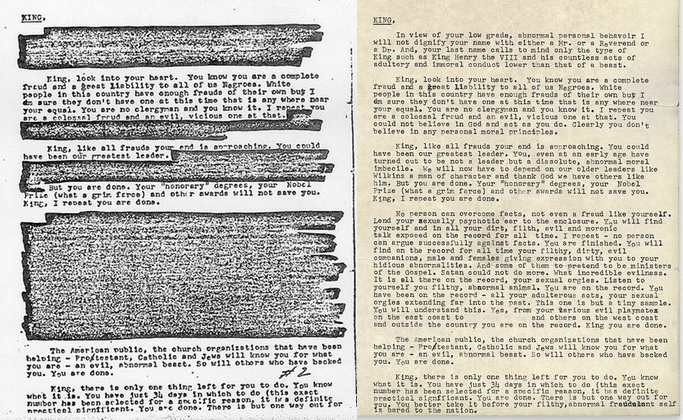
The New York Times has published an unredacted version of the famous “suicide letter”
from the FBI to Dr. Martin Luther King, Jr. The letter, recently
discovered by historian and professor Beverly Gage, is a disturbing
document. But it’s also something that everyone in the United States
should read, because it demonstrates exactly what lengths the
intelligence community is willing to go to—and what happens when they
take the fruits of the surveillance they’ve done and unleash it on a
target.
The anonymous letter was the result of the FBI’s comprehensive
surveillance and harassment strategy against Dr. King, which included
bugging his hotel rooms, photographic surveillance, and physical
observation of King’s movements by FBI agents. The agency also attempted
to break up his marriage by sending selectively edited “personal moments he shared with friends and women” to his wife. Portions of the letter had been previously
redacted. One of these portions contains a claim that the letter was
written by another African-American: “King, look into your heart. You
know you are a complete fraud and a great liability to all us Negroes.”
It goes on to say “We will now have to depend on our older leaders like
Wilkins, a man of character and thank God we have others like him. But
you are done.” This line is key, because part of the FBI’s strategy was to try to fracture movements and pit leaders against one another.
The entire letter could have been taken from a page of GCHQ’s Joint Threat Research and Intelligence Group (JTRIG)—though perhaps as an email or series of tweets. The British spying agency GCHQ is one of the NSA’s closest partners. The mission of JTRIG,
a unit within GCHQ, is to “destroy, deny, degrade [and] disrupt enemies
by discrediting them.” And there’s little reason to believe the NSA and
FBI aren’t using such tactics.
The implications of these types of strategies in the digital age are
chilling. Imagine Facebook chats, porn viewing history, emails, and more
made public to discredit a leader who threatens the status quo, or used
to blackmail a reluctant target into becoming an FBI informant.
These are not far-fetched ideas. They are the reality of what happens
when the surveillance state is allowed to grow out of control, and the
full King letter, as well as current intelligence community practices
illustrate that reality richly.
The newly unredacted portions shed light on the government’s sordid
scheme to harass and discredit Dr. King. One paragraph states:
No person can overcome the facts, no even a fraud like
yourself. Lend your sexually psychotic ear to the enclosure. You will
find yourself and in all your dirt, filth, evil and moronic talk exposed
on the record for all time. . . . Listen to yourself, you filthy,
abnormal animal. You are on the record.
And of course, the letter ends with an ominous threat:
King, there is only one thing left for you to do. You
know what it is. You have just 34 days in which to do it (this exact
number has been selected for a specific reason, it has definite
practical significance). You are done. There is but one way out for you.
You better take it before your filthy, abnormal fraudulent self is
bared to the nation.
There’s a lesson to learn here: history must play a central role in the debate around spying today. As Professor Gage states:
Should intelligence agencies be able to sweep our email,
read our texts, track our phone calls, locate us by GPS? Much of the
conversation swirls around the possibility that agencies like the N.S.A.
or the F.B.I. will use such information not to serve national security
but to carry out personal and political vendettas. King’s experience
reminds us that these are far from idle fears, conjured in the fevered
minds of civil libertarians. They are based in the hard facts of
history.
Copyright Electronic Frontier Foundation 2014
BRICS, Eurasian Economic Union (EEU), Shanghai Cooperation Organization (SCO): Towards a New Global Financial Architecture?
The BRICS met in 2013 in Durban, South Africa, to, among other
steps, create their own credit rating agency, sidelining the “biased
agendas” of the Moody’s/Standard & Poor’s variety. They endorsed
plans to create a joint foreign exchange reserves pool. Initially it
will include US$100 billion. It’s called a self-managed contingent reserve arrangement (CRA).
During the July (2014) BRICS Summit in Brazil the five members agreed
to directly confront the West’s institutional economic dominance. The
BRICS agreed to establish the New Development Bank (NDB) based in
Shanghai , pushed especially by India and Brazil, a concrete alternative
to the Western-dominated World Bank and the Bretton Woods system. With initial authorized capital of $100 billion, including $50 billion of equally shared initial subscribed capital, it will become one of the largest multilateral financial development institutions. Importantly, it will be open for other countries to join.
In addition, the creation of the Contingent Reserve Arrangement, or currency reserve pool, initially sized at $100 billion, will help protect the BRICS countries against short-term liquidity pressures and international financial shocks. Together with the NDB these new instruments will contribute to further co-operation on macroeconomic policies.
According to Conn Hallinan – in his article Move Over, NATO and IMF: Eurasia Is Coming – the
BRICS’ construction of a Contingent Reserve Arrangement will give its
members emergency access to foreign currency, which might eventually
dethrone the dollar as the world’s reserve currency. The creation
of a development bank will make it possible to bypass the IMF for
balance-of-payment loans, thus avoiding the organization’s onerous
austerity requirements.
Also it was agreed MoU’s among BRICS Export Credit and Guarantees
Agencies, as well as the Cooperation Agreement on Innovation within the
BRICS Interbank Cooperation Mechanism, which will offer new channels of
support for trade and financial ties between the five countries. BRICS will be trading in their own currencies
So in near future BRICS will be trading in their own currencies,
including a globally convertible yuan, further away from the US dollar
and the petrodollar. All these actions are strenghtening financial
stability of BRICS – a some kind of safety net precaution, an extra line
of defense.
Emerging economic powers such as China, India and Brazil have long
been demanding greater share of votes in multilateral development
institutions like the World Bank, International Monetary Fund and the
Asian Development Bank (ADP) to reflect their recent phenomenal growth. China’s economy is expected to grow to $10 trillion this
year, yet its share of votes in the Bretton Woods institutions is only
3.72 percent, compared with 17.4 percent for the United States. The
signing ceremony of the Memorandum of Understanding on eEstablishing
the Asian Infrastructure Investment Bank (AIIB) took place in Beijing,
Oct. 24, 2014 According to ADB, in the 10 years up to 2020, the region
requires investments of $8 trillion in terms of national infrastructure,
or $800 billion a year. The ADB currently lends out only about 1.5
percent of this amount. The AIIB is expected to have an initial capital
base of $100 billion. The AIIB, to begin with, will serve at least five
objectives for China. First, it could help China invest part of its
foreign exchange reserves of $3.9 trillion on commercial terms. Second,
it will play a vital role in the internationalization of the yuan. And
third, the AIIB will boost China’s global influence and enhance its soft
power.
BRICS could be expanded to include the MINT countries (MINT is an
acronym referring to the economies of Mexico, Indonesia, Nigeria, and
Turkey.), thus furthering the organization’s scope and creating
opportunities for a long-term strategic ‘flip’ of those states from
their largely Western orientations.
Being in the same organization does not automatically translate into having the same politics on international questions. The
BRICS and the recent Gaza conflict are a good example. China called for
negotiations; Russia was generally neutral, but slightly friendly
toward Israel; India was silent (Israel is New Delhi’s number-one source
of arms); South Africa was critical of Israel, and Brazil withdrew its
ambassador.
As Russia is taking over the position of the BRICS Chair, the next
summit will be held in the city of Ufa in the Republic of Bashkortostan,
in July 2015. The SCO The Shanghai Cooperation Organization (SCO) is the cradle in which the Russian-Chinese strategic partnership (RCSP) was born and raised. Originally founded as the Shanghai Five in 1996, it was reformed as the SCO in 2001 with the inclusion of Uzbekistan. Less
than a month after the BRICS’ declaration of independence from the
current structures of world finance, the SCO—which includes China,
Russia, Kazakhstan, Kyrgyzstan, Tajikistan, and Uzbekistan—approved
India, Pakistan, Iran, and Mongolia for membership in the organization. Also
SCO has received applications for the status of observers from Armenia,
Azerbaijan, Bangladesh, Belarus, Nepal and Sri Lanka.
SCO completes anti-terror drills at Peace Mission 2014
It was the single largest expansion of the economic cooperation and
security-minded group in its history, and it could end up diluting the
impact of sanctions currently plaguing Moscow over the Ukraine crisis
and Tehran over its nuclear program. These countries directly fall into
the immediate sphere of the RCSP, where either Russia or China can exert
some degree or another of important influence to varying degrees. Also,
the SCO sets out the
foundations of the RCSP, listing the fight against “terrorism,
separatism, and extremism in all their manifestations” (thus including Color Revolutions) as their foremost foe. It just so happens that the U.S. engages in all of these activities in its Eurasian-wide campaign of chaos and control, thereby placing it at existential odds with Russia and China, as well as the other official members. Even before the recent additions, SCO represented three-fifths of Eurasia and 25 percent of the world’s population.
For Iran, SCO membership may serve as a way to bypass the sanctions currently pounding the Iranian economy. Russia and Iran signed a memorandum in August (2014) to exchange Russian energy technology and food for Iranian oil, a move that would violate U.S. sanctions. One
particular constraint is Russia’s important relationship with Israel,
which Moscow will not give up unless Jerusalem drops its neutral stance
and joins the U.S.-led condemnation of Russia.
Chinese President Xi Jinping has also promoted new regional security initiatives. In
addition to the already existing Shanghai Cooperation Organization, a
Chinese-led security institution that includes Russia and four Central
Asian states, Xi wants to build a new Asia-Pacific security structure
that would exclude the United States.
As for India and Pakistan energy is a major concern the membership in
the oil- and gas-rich SCO is quite reasonable. Whether that will lead
to a reduction of tensions between New Delhi and Islamabad over Kashmir
remains to see, but at least the two traditional enemies will be in same
organization to talk about economic cooperation and regional security
on a regular basis.
As joint forum the SCO can ease tensions in Central Asia e.g. between
SCO members Uzbekistan and Kyrgyzstan over borders, and both countries,
plus Tajikistan, over water rights. Most SCO members are
concerned about security, particularly given the imminent departure of
the United States and NATO from Afghanistan. That country might well descend into civil war, one that could have a destabilizing effect on its neighbors. From August 24 -29, SCO members China, Russia, Kazakhstan, Kyrgyzstan, and Tajikistan took part in “Peace Mission 2014,” an anti-terrorist exercise to “subdue” a hypothetical Central Asian city that had become a center for terrorist activity.
The BRICS and the SCO are the two largest independent international
organizations to develop over the past decade. There is also other
developments to reduce old U.S. global dominance. The newly minted Union
of South American Nations (USAN) includes every country in South
America, including Cuba, and has largely replaced the Organization of
American States (OAS), a Cold War relic that excluded Havana. While the United States and Canada are part of the OAS, they were not invited to join USAN. Eurasian Economic Union (EEU)
Eurasian integration has moved to a higher level, to replace the
EurAsEC came a new form of closer Association of the Eurasian Economic
Union (EEU) also known as the Eurasian Union (EAU). To him by the old
member States (Russia, Kazakhstan, Belarus) was joined by Armenia, the
next candidate in the list on the accession of Kyrgyzstan, and later,
his desire to join the EAEC expressed and Vietnam. Also the accession of Turkey and Syria are on the way.
Moscow
began building a Russian-led community in Eurasia that would give
Russia certain economic benefits and, no less important, better
bargaining positions with regard to the country’s big continental
neighbors—the EU to the west and China to the east.
Moldova, Ukraine and Georgia have been offered by both the European
Union and the Eurasian Economic Union to join their integration unions.
All three countries opted for the European Union by signing association
agreements on March 21, 2014. However break-away regions of Moldova (Transnistria), Ukraine (Republic of Donetsk) and Georgia (South Ossetia and Abkhazia) have expressed a desire to join the Eurasian Customs Union and integrate into the Eurasian Economic Union. Putin is scheduled to visit Japan later in 2014 in an effort to
keep Russia’s technology and investment channel to the country open.
And Moscow is expected to reinvigorate ties with India, particularly in
the defense technology sphere, under the leadership of newly elected
Prime Minister Narendra Modi. The Eurasian union may become an add-on to, or even an
extension of, China’s Silk Road project – a common space for economic
and humanitarian cooperation stretching all the way from the Atlantic to
the Pacific Ocean Treaties and development stages of Eurasian Economic Union/Structural evolution
- Other bilateral developments Russia is in the process of politically and economically
integrating with Kazakhstan and soon Kyrgyzstan under the auspices of
the Eurasian Union, and it has mutual security commitments with
Kazakhstan, Kyrgyzstan, and Tajikistan under the Collective Security
Treaty Organization (CSTO).China,
on the other hand, is more of a soft leader in Central Asia, having
established lucrative business contacts in recent years and struck
extremely strategic energy deals with most of the region’s members, first and foremost Turkmenistan.
A Russian-Iranian strategic partnership would extend beyond Caspian
and nuclear energy issues and see implicit cooperation between the two
in the Mideast, especially in Syria, Iraq, and Yemen. It can even carry
over into Afghanistan after the NATO drawdown by year’s end. This
can help to build an alternative non-Western-centric trade network that
can bolster Russia’s complex economic interdependence with other
states. This would give it the opportunity to expand mutual
relations beyond the economic sphere and perhaps eventually associate
these states into the multilateral webs of BRICS and the SCO.
Russia is also pursuing bilateral relations with Iran with fewer constraints. This
refers to nuclear energy, oil and gas, and arms deals, all based on
pragmatic considerations: a Russo-Persian alliance is unlikely in view
of many differences between Moscow and Tehran and thick layers of mutual
suspicion.
At the recent summit of the SCO in Dushanbe (11-12 Sep.
2014) the cooperation with SCO-applicant Iran went wider. Some of the
projects were following:
The well-known “Uralvagonzavod”, began talks with Iran on the supply of freight cars 40 billion annually.
Interestingly, Iran is not on the camera, discussing terms of oil
supplies in exchange for electricity, in which Russia plans to build in
Iran, the network of hydro – and thermal power plants.
Iran and Russia have made progress towards an oil-for-goods deal
sources said would be worth up to $20 billion, which would enable Tehran
to boost vital energy exports in defiance of Western sanctions. In
January Reuters reported Moscow and Tehran were discussing a barter deal
that would see Moscow buy up to 500,000 barrels a day of Iranian oil in
exchange for Russian equipment and goods.
One particular constraint is Russia’s important relationship with
Israel, which Moscow will not give up unless Jerusalem drops its neutral
stance and joins the U.S.-led condemnation of Russia. Putin
is scheduled to visit Japan later in 2014 in an effort to keep Russia’s
technology and investment channel to the country open. Russia is
interested in restarting talks to build a natural gas pipeline between its Sakhalin Island and Japan’s far northern island of Hokkaido, Russia already supplies 9.8 percent of Japan’s LNG imports. The
proposed pipeline would deliver 20 billion cubic meters of natural gas
every year, which at full capacity would supply 17 percent of Japan’s
total natural gas imports. As an additional bonus, using a
pipeline does not require the building of expensive regasification
plants and natural gas from Russia would probably still be relatively
cheap. This is also part of Moscow’s attempt to balance its interests and expand its energy influence eastward.
Also Moscow is expected to reinvigorate ties with India, particularly
in the defense technology sphere, under the leadership of newly elected
Prime Minister Narendra Modi.
Russia also hopes that Russian-Serbian trade will reach 2 billion
dollars this year. He said that a free trade regime existing between the
two countries was contributing to steady development of Russian-Serbian
economic ties. “Our reciprocal trade turnover grew by 15% to reach 1.97
billion dollars in 2013. It grew by another 16.5% to reach 1.2 billion
dollars in the first half of 2014. We hope to reach the figure of 2
billion dollars this year” Putin stressed. Positive dynamics can be seen
in the sphere of investments. The total volume of Russian
capital investments in Serbia has exceeded 3 billion dollars, the bulk
of which was channeled into the strategically important energy sector.
While Russia is consolidating its influence over the former Soviet
sphere with states which it already has cultivated deep relations with,
China is moving in due its strategic interest in Central Asia. For
China a top priority is to be able to diversify its natural resource
import routes in order to avoid the U.S. dominated Straits of Malacca.
The growing influence of China in Southeast and East Asia and the
Indian Ocean is explained with “string of pearls” concept (strategic
points such as Hainan Island, the Woody Islands/close to Vietnam,
Chittagong/Bangladesh, Sittue and the Coco Islands/Myanmar,
Hambantota/Sri Lanka etc.). The “string of pearls” strategy is aimed
at protecting China’s oil flows, affirming the country as a global
naval power with diverse interests throughout the world, and overcoming
attempts by the USA to cut off access to or from China via the world’s
oceans. Furthermore, an important task lay in minimizing potential
threats in the most complex and vulnerable choke point at the junction
of two oceans, named the “Malacca Dilemma”. (Source and more in Second Wind for China’s String of Pearls Strategy by Nina Lebedeva ).
Tehran is reaching out to Beijing as well. Iran and China have
negotiated a deal to trade Iran’s oil for China’s manufactured goods. Beijing is currently Iran’s number-one customer for oil.In late September, two Chinese warships paid a first-ever visit to Iran, and the two countries’ navies carried out joint anti-piracy and rescue maneuvers. Importing
more gas from Russia helps Beijing to gradually escape its Malacca and
Hormuz dilemma and industrialize the immense, highly populated and
heavily dependent on agriculture interior provinces. The Northern East-West Freight Corridor(Eurasian
Landbridge) is an idea to link the Far East and Europe by rail takes
its origin with the construction of the Trans Siberian railway linking
Moscow to Vladivostok, completed in 1916. With a length of 9,200 km it
is the longest rail segment in the world. It was initially used solely
as an inland rail link, but in the 1960s the Soviet Union started
offering a landbridge service from Vladivostok using the Trans Siberian
to reach Western Europe. Energy war
U.S. ally inside OPEC, the kingdom of Saudi Arabia, has been flooding
the market with deep discounted oil, triggering a price war within
OPEC, with Iran following suit and panic selling short in oil futures
markets. The Saudis are targeting sales to Asia for the discounts and in
particular, its major Asian customer, China where it is reportedly
offering its crude for a mere $50 to $60 a barrel rather than the
earlier price of around $100. When combined with the financial
losses of Russian state natural gas sales to Ukraine and prospects of a
US-instigated cutoff of the transit of Russian gas to the huge EU market
this winter as EU stockpiles become low, the pressure on oil prices
hits Moscow doubly.More than 50% of Russian state revenue comes from its export sales of oil and gas. The
US-Saudi oil price manipulation is aimed at destabilizing several
strong opponents of U.S. globalist policies. Targets include Iran and
Syria, both allies of Russia in opposing a US sole Superpower. In fact
the oil weapon is accelerating recent Russian moves to focus its
economic power on national interests and lessen dependence on the Dollar
system. If the dollar ceases being the currency of world trade, especially oil trade, the US Treasury faces financial catastrophe.
The shale gas revolution and a greater availability of LNG
technologies, EU regulatory initiatives and implementation of the Third
Energy Package provisions play a key role in transformations of gas
markets. Now
there might be a global oil war underway pitting the United States and
Saudi Arabia on one side against Russia and Iran on the other.
In July 2011, the governments of Syria, Iran and Iraq signed an
historic gas pipeline energy agreement which went largely unnoticed in
the midst of the NATO-Saudi-Qatari war to remove Assad. The pipeline,
envisioned to cost $10 billion and take three years to complete, would
run from the Iranian Port Assalouyeh near the South Pars gas field in
the Persian Gulf, to Damascus in Syria via Iraq territory. The
agreement would make Syria the center of assembly and production in
conjunction with the reserves of Lebanon. This is a geopolitically
strategic space that geographically opens for the first time, extending
from Iran to Iraq, Syria and Lebanon. As Asia Times
correspondent Pepe Escobar put it, “The Iran-Iraq-Syria pipeline – if
it’s ever built – would solidify a predominantly Shi’ite axis through an
economic, steel umbilical cord.”
In ongoing oil war the U.S. shale oil producers will suffer most.
According to experts’ estimates, the cost of production is around 80-90
dollars a barrel, 4-5 times more than the traditional oil. It means that
the current price – 85 dollars a barrel as of October 17 – makes the
companies operate in the red. Some producers will have to suspend
operations facing mass bankruptcy in case the oil price falls lower than
80 dollars as shareholders start getting rid of zero profit bonds. The
shale oil «soap bubble» will blow like the housing construction
industry «bubble» blew in 2008. Of course, as time goes by oil prices
will go up but it’ll be a different world with some US oil producers
non-existent anymore…
Russia insists the South Stream project should be exempt from the
effect of the Third Energy Package because it signed bilateral
inter-governmental agreements with the EU countries participating in the
construction of the gas pipeline on their territory before the EU’s new
energy legislation came into force. Therefore, Russia says that
the European Commission’s requirement to adapt these documents to the
Third Energy Package contradicts the basic law principle that
legislation cannot have retroactive force. The Third Energy
Package requires, in particular, that a half of the capacities of the
pipeline built with Russian money must be reserved for independent
suppliers, i.e. for cheap and free transit of Caspian gas to Europe
independently from Russia. Therefore, Russia does not recognize the
legitimacy of applying the Third Energy Package to the South Stream gas
pipeline project. Bottom line
Russia has accelerated its building of the Eurasian Bridge: Russia
has the geostrategic opportunity of being an air, land, and sea bridge
between Europe and East Asia. In line with China’s Silk Road and New
Eurasian Land Bridge projects, the concept of the Northern Sea Route,
and international air routes traversing Siberia, Russia can use its
geographic position to reap the resultant dividends of East-West trade
and thereby increasing its middleman importance.
The geopolitical situation is now transforming from traditional Sino-U.S. relations to U.S.-China-Russia triangle in which China, rather than the United States, will be the central player. In addition the EU is worried that Russia will turn east and Europe will lose much of its Russian market share. At
a time when the euro area threatens to collapse, where an acute
economic crisis has led the U.S. into a debt of up to 14 940 billion,
and where their influence is dwindling in the face of the emerging BRICS
powers,it becomes clear that the key to economic success and
political domination lies mainly in the control of the energy source of
the century: gas. With China signing the natural gas deal with Russia and the
president of China publicly stating that it’s time to create a new
security model for the Asian nations that includes Russia and Iran, it’s
clear China has chosen Russia over the U.S. Today the US-backed
wars in Ukraine and in Syria are but two fronts in the same strategic
war to cripple Russia and China and to rupture any Eurasian counter-pole
to a U.S.-controlled regions. In each, control of energy pipelines,
this time primarily of natural gas pipelines—from Russia to the EU via
Ukraine and from Iran and Syria to the EU via Syria—is the strategic
goal.
So far U.S. has bullied its way around smaller nations for too long
now. It seems to me that finally there is coming to be a coalition of
new axis with Eurasia and China. Russia and China are leading of
developing a network of “parallel structures” to existing international
organizations and institutions. The end goal is to create an alternative
reality for international engagement, so that China can expand its own
influence while escaping the restrictions of the current U.S.-dominated
system. In my conclusion the era when the IMF, World Bank, and
U.S. Treasury could essentially dictate international finances and
intimidate or crush opponents with sanctions, pressure and threads are
drawing to a close – the BRICS and the Shanghai Cooperation Organization
are two nails in that coffin. These independent poles (BRICS,
SCO, USAN) are developing fast and it remains to see what their ultimate
impact on international politics will be – my scenario is that the
impact will be a drastic shift from U.S. dominance to more balanced
juxtaposition of U.S. and Eurasia. SourceThemes of Ari Rusila
This article is a followup See Part I
ROBOT GETS FASTER AT PERFORMING HUMAN TASKS `~ hehe Oops
This
important story about technological advances in robotics was shared by a
regular reader here, Mr. J.L., and I want to pass it along. But first, a
little background. Recently (Oct 30) I recorded an interview with
former HUD Assistant Secretary Catherine Austin Fitts, for her Solari
Report third quarter wrap up. One of the questions in her review of
technological advances and how they might impact future human culture
and society, was robotics. Her thesis, briefly, is that as these new
technologies come on line and are perfected, they exert a tremendous deflationary effect, driving down labor, energy, and manufacturing costs.
With that in mind, consider this story and watch the short videos of the robot named ATLAS: ATLAS Is Getting Faster and Faster At Simple Human Tasks
Now, imagine this technology say, five to ten years down the line.
Already we’ve seen robotics enter manufacturing, in the auto and other
industries. But now imagine robot sales clerks at a retail superstore
like Walmart or Sam’s Club, stocking shelves, directing customers, even
performing check out duties, or manning the local pizza parlor, giving
eye examinations (or for that matter, filling the prescriptions),
manning the pharmacy counter, counting out pills and filling
prescriptions, a robotized nurse making his/her/or its rounds. Already
there has been talk not only of robotic soldiers, but of robot policemen
(yes…Robocop, sans the human element). Extend your imagination, for a
moment, to your home: robots to cook, clean, and do the laundry… Flying
airplanes, driving trucks, or even as engineers in locomotives (indeed,
why even a robot to drive the locomotive, when it could all be done
remotely anyway, from humans in a control center on today’s remotely
controlled railroad switching and tracking posts)?
In fact, there is very little one cannot imagine robots not doing, and as a result, I tend to agree with Ms. Fitts that this is an extraordinarily deflationary technological pressure. The problem is, and the reader will have immediately caught it, is
that humans will possibly become “obsolete”, and a leisure class could
survive with dependency on robots. Robots, after all, are far more
programmable and cooperative as a slave/serf than pesky human beings.
And this is where Isaac Asimov and Elon Musk come in. What if those
robots are all controlled by a machine that “wakes up” and, Matrix-like, decides that it doesn’t need humanity any more at all, not even the leisure class it serves? ATLAS is “learning” quickly… and that should give everyone pause,
because the time is now, not later, to begin to address how humanity is
going to cope with this technology, and this is one debate that we can
ill afford to leave in the hands of “the elite.”
Big Banks Busted Massively Manipulating Foreign Exchange, Precious Metals and Every Other Market
Regulators fined six major banks including Citigroup
(C.N) and UBS (UBSN.VX) a total of $4.3 billion for failing to stop
traders from trying to manipulate the foreign exchange market, following
a year-long global investigation.
HSBC (HSBA.L), Royal Bank of Scotland (RBS.L), JP Morgan (JPM.N) and
Bank of America (BAC.N) also face penalties resulting from the inquiry
that has put the largely unregulated $5 trillion-a-day market on a
tighter leash, accelerated the push to automate trading and ensnared the
Bank of England.
In the latest scandal to hit the financial services industry, dealers
shared confidential information about client orders and coordinated
trades to make money from a foreign exchange benchmark used by asset
managers and corporate treasurers to value their holdings. Dozens of
traders have been fired or suspended.
***
Britain’s Financial Conduct Authority (FCA) fined five lenders $1.77
billion, the biggest penalty in the history of the City of London, and
the U.S. Commodity Futures Trading Commission (CFTC) ordered them to pay
a further $1.48 billion.
***
The U.S. Office of the Comptroller of the Currency, which regulates
banks, also fined the U.S. lenders $950 million and was the only
authority to penalise Bank of America.
Gold and Silver Are Manipulated
Today, Switzerland’s financial regulator (FINMA) found “serious
misconduct” and a “clear attempt to manipulate precious metals
benchmarks” by UBS employees in precious metals trading, particularly
with silver.
Reuters reports:
Swiss regulator FINMA said on Wednesday that it found a “clear attempt” to manipulate precious metals benchmarks during its investigation into precious metals and foreign exchange trading at UBS …
It is the participating banks themselves that administer the gold and silver benchmarks.
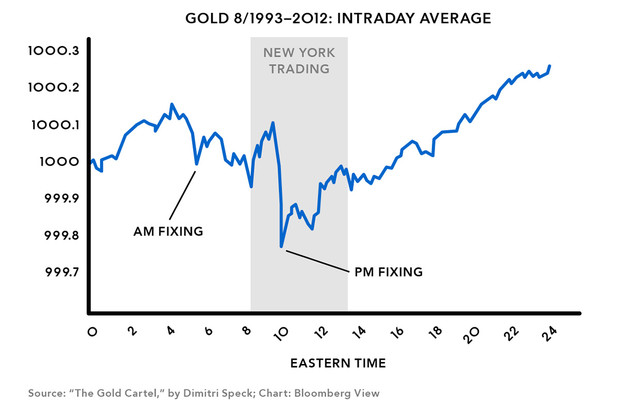
So are prices being manipulated? Let’s take a look at the evidence. In his book
“The Gold Cartel,” commodity analyst Dimitri Speck combines
minute-by-minute data from most of 1993 through 2012 to show how gold
prices move on an average day (see attached charts). He finds that the
spot price of gold tends to drop sharply around the London
evening fixing (10 a.m. New York time). A similar, if less pronounced,
drop in price occurs around the London morning fixing. The same daily
declines can be seen in silver prices from 1998 through 2012.
For both commodities there were, on average, no
comparable price changes at any other time of the day. These patterns
are consistent with manipulation in both markets.
A Manhattan federal judge said on Thursday that investors
may pursue a lawsuit accusing 12 major banks of violating antitrust law
by fixing prices and restraining competition in the roughly $21 trillion market for credit default swaps.
***
“The complaint provides a chronology of behavior that would probably
not result from chance, coincidence, independent responses to common
stimuli, or mere interdependence,” [Judge] Cote said.
The defendants include Bank of America Corp, Barclays Plc,
BNP Paribas SA, Citigroup Inc , Credit Suisse Group AG, Deutsche Bank AG
, Goldman Sachs Group Inc, HSBC Holdings Plc , JPMorgan Chase & Co,
Morgan Stanley, Royal Bank of Scotland Group Plc and UBS AG.
Other defendants are the International Swaps and Derivatives
Association and Markit Ltd, which provides credit derivative pricing
services.
*** U.S. and European regulators have probed potential anticompetitive activity in CDS.
In July 2013, the European Commission accused many of the defendants of
colluding to block new CDS exchanges from entering the market.
***
“The financial crisis hardly explains the alleged secret meetings and
coordinated actions,” the judge wrote. “Nor does it explain why ISDA
and Markit simultaneously reversed course.”
In other words, the big banks are continuing to fix prices for CDS in
secret meetings … and have torpedoed the more open and transparent CDS
exchanges that Congress mandated. Interest Rates Are Manipulated
Bloomberg reported in January:
Royal Bank of Scotland Group Plc was ordered to pay $50
million by a federal judge in Connecticut over claims that it rigged the
London interbank offered rate.
RBS Securities Japan Ltd. in April pleaded guilty to wire frauda s
part of a settlement of more than $600 million with U.S and U.K.
regulators over Libor manipulation, according to court filings. U.S.
District Judge Michael P. Shea in New Haventoday sentenced the
Tokyo-based unit of RBS, Britain’s biggest publicly owned lender, to pay
the agreed-upon fine, according to a Justice Department Justice Department.
Global investigations into banks’ attempts to manipulate the
benchmarks for profit have led to fines and settlements for lenders
including RBS, Barclays Plc, UBS AG and Rabobank Groep.
RBS was among six companies fined a record 1.7 billion euros ($2.3
billion) by the European Union last month for rigging interest rates
linked to Libor. The combined fines for manipulating yen Libor and
Euribor, the benchmark money-market rate for the euro, are the
largest-ever EU cartel penalties.
Global fines for rate-rigging have reached $6 billion since June 2012
as authorities around the world probe whether traders worked together
to fix Libor, meant to reflect the interest rate at which banks lend to
each other, to benefit their own trading positions.
To put the Libor interest rate scandal in perspective:
Even though RBS and a handful of other banks have been fined for interest rate manipulation, Libor is still being manipulated. No wonder … the fines are pocket change – the cost of doing business – for the big banks
Engaging in mafia-style big-rigging fraud against local governments. See this, this and this
Shaving money off of virtually every pension transaction they
handled over the course of decades, stealing collectively billions of
dollars from pensions worldwide. Details here, here, here, here, here, here, here, here, here, here, here and here
Pledging the same mortgage multiple times to different buyers. See this, this, this, this and this. This would be like selling your car, and collecting money from 10 different buyers for the same car
Cheating homeowners by gaming laws meant to protect people from unfair foreclosure
Pushing investments which they knew were terrible, and then betting
against the same investments to make money for themselves. See this, this, this, this and this
“The system is set so that even if you’re caught, the penalty is just a small number relative to what you walk home with. The fine is just a cost of doing business. It’s like a parking fine.
Sometimes you make a decision to park knowing that you might get a fine
because going around the corner to the parking lot takes you too much
time.”
Switzerland’s regulator FINMA ordered UBS, the country’s
biggest bank, to pay 134 million francs ($139 million) after it found
serious misconduct in both foreign exchange and precious metals trading.
It also capped bonuses for dealers in both units at twice their basic salary for two years.
Capping bonuses at twice base salary? That’s not a punishment … it’s an incentive.
Experts say that we have to prosecute fraud or else the economy won’t ever really stabilize.
But the government is doing the exact opposite. Indeed, the Justice Department has announced it will go easy on big banks, and always settles prosecutions for pennies on the dollar (a form of stealth bailout. It is also arguably one of the main causes of the double dip in housing. And there is no change in the air.)
Indeed, the government doesn’t even force the banks to admit any guilt as part of their settlements.
Wall Street has manipulated virtually every other market as well – both in the financial sector and the real economy – and broken virtually every law on the books.
And they will keep on doing so until the Department of Justice grows a pair.
The criminality and blatant manipulation will grow and spread and
metastasize – taking over and killing off more and more of the economy –
until Wall Street executives are finally thrown in jail.
It’s that simple …

 Posts
Posts




 According
to the US Department of Agriculture nearly 10 BILLION animals are
raised and killed for food each year in the United States alone. While
there are multiple reasons for you to start cutting factory farmed
animals out of your diet, one of the most important reasons is one that
is not often talked or thought about -the destructive toll that is taken
on the environment from the mass production and consumption of factory
farmed animals and animal products. It’s interesting how this aspect is,
for the most part, entirely overlooked. No one ever really stops to
think about how much land and resources are actually needed to produce
enough animals and products to cater to the excessive over-consumption
of animals across the globe. Just think about how much these animals
need to eat and drink, feeding 10 Billion animals in the US alone is
considerably more than feeding the entire planet. Currently according to
the UN, raising animals and producing the feed for them uses 30% of the
Earth’s land mass- wow.
According
to the US Department of Agriculture nearly 10 BILLION animals are
raised and killed for food each year in the United States alone. While
there are multiple reasons for you to start cutting factory farmed
animals out of your diet, one of the most important reasons is one that
is not often talked or thought about -the destructive toll that is taken
on the environment from the mass production and consumption of factory
farmed animals and animal products. It’s interesting how this aspect is,
for the most part, entirely overlooked. No one ever really stops to
think about how much land and resources are actually needed to produce
enough animals and products to cater to the excessive over-consumption
of animals across the globe. Just think about how much these animals
need to eat and drink, feeding 10 Billion animals in the US alone is
considerably more than feeding the entire planet. Currently according to
the UN, raising animals and producing the feed for them uses 30% of the
Earth’s land mass- wow.