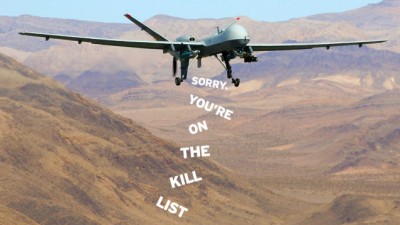
Armed Drones: How Remote-Controlled, High-Tech Weapons Are Used Against The Poor ~ hehe "isn't" there a statue some~where in this Kooky Country .... says some~thin 'bout give U.S. you tired , you poor ??? NOW ..that fucking statue says we'll "drone" yer fucking ass HUH ??? & fucking STILL ole mr/mrs A ~merry~kook's ...thinks we's go~in the RIGHT ...way ...yea !
In 2011 David Hookes explored the ethical and legal implications of the growing use of armed, unmanned planes in the ‘war against terrorism’ .
The rapidly increasing use of aerial robot weapons in the so-called
‘war against terrorism’ is raising many ethical and legal questions.
Drones, known in military-speak as ‘UAVs’ or ‘Unmanned Aerial Vehicles’
come in a range of sizes, from very small surveillance aircraft, which
can be carried in a soldier’s rucksack and used to gather battlefield
intelligence, to full-scale, armed versions that can carry a sizable
payload of missiles and laser-guided bombs.
The use of the latter type of UAV in Iraq, Afghanistan, Pakistan and
elsewhere has aroused great concern, since it often entails considerable
‘collateral damage’ – in other words, the killing of innocent civilians
in the vicinity of the targeted ‘terrorist’ leaders. The legality of
their use in carrying out what are effectively extra-judicial
executions, outside any recognisable battlefield, is also a raising
serious concern.
Background
UAVs have been around for at least 30 years in one form or another.
Initially they were used for surveillance and intelligence gathering
(S&I); conventional aircraft would act on the data gathered to
deliver a lethal attack. UAVs are still used in this role but, in the
last decade, have themselves been fitted with missiles and guided bombs
in addition to their S&I technology. These modified versions are
sometimes referred to as UCAVs where ‘C’ stands for ‘Combat’.
The first recorded ‘kill’ by a UCAV, a CIA-operated ‘Predator’ drone,
occurred in Yemen in 2002. In this incident a 4×4 vehicle allegedly
carrying an Al-Qaida leader and his five companions was attacked and all
the occupants annihilated.1 It is not known whether the government of Yemen approved these executions in advance.
Worldwide military interest…
As might be expected, the US military lead the development and use of
UAVs, especially after 9/11, which led to a rapid escalation in drone
production and deployment. Currently they have about 200 ‘Predator’
armed drones and about 20 of its big brother the ‘Reaper’ drone in
service in the so-called AF-PAK (Afghanistan-Pakistan) theatre.
Some of these drones have been leased or sold to UK forces, also for
use in Afghanistan, where they have carried out at least 84 flight
missions to date. The Reaper can carry up 14 ‘Hellfire’ missiles or a
mixture of missiles and guided bombs.
Perhaps unsurprisingly, Israel is also a major developer of UAVs,
which it has used in Palestinian territories. There are a number of
documented instances2 of the Israeli military allegedly using
them to target Hamas leaders, during Israel’s attack on Gaza in 2008-9,
which resulted in many fatal civilian casualties. One of those killed
was the 10-year old boy, Mum’min ‘Allaw. According to Dr Mads Gilbert, a
Norwegian doctor who worked at Gaza’s al-Shifa Hospital during the
attack on Gaza: “Every night the Palestinians in Gaza re-live their
worst nightmares when they hear drones; it never stops and you are never
sure if it is a surveillance drone or if it will launch a rocket
attack. Even the sound of Gaza is frightful: the sound of Israeli drones
in the sky.”
Israeli arms company Elbit Systems, in a consortium with French arms
company Thales has won a contract to supply the British army with a
surveillance drone called ‘Watchkeeper’. This is an improved version of
an existing Israeli drone, Hermes 450, already used by UK forces in
Afghanistan. Its Wankel engine is manufactured in Litchfield, UK by UEL
Ltd, a wholly-owned subsidiary of Elbit Systems. The Watchkeeper is said
to be able to detect footprints on the ground from above the clouds.
Many other countries also have drone programs: Russia, China and
various EU consortia have models under development. Even Iran has an
operational drone, while Turkey is negotiating with Israel to be its
supplier.3
Of course, the UK has its own extensive, independent program of drone
development, coordinated and led by BAE Systems. The most important
ones are the ‘Taranis’4 and ‘Mantis’5 armed drones
which are also said to be ‘autonomous’, that is, capable of piloting
themselves, selecting targets and even possibly engaging in armed combat
with other aircraft.
Taranis uses ‘stealth’ technology to avoid detection and looks like a
smaller version of the US B2 ‘Stealth’ bomber. Taranis was revealed, at
some distance away from the public, at Warton Aerodrome in Lancashire
in July 2010. TV reports emphasised its possible civilian use for police
work . It seems somewhat over-specified for this, given that it weighs
eight tonnes, has two weapons bays and cost £143m to develop. Flight
trials are expected to begin in 2011.
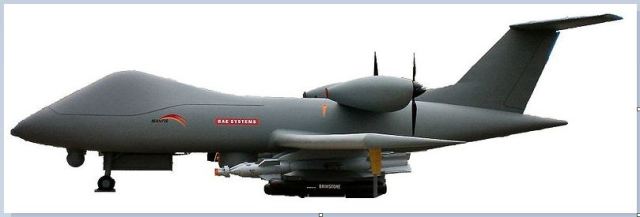 Mantis is closer in appearance to existing armed drones but more
advanced in its specification and powered by two Rolls Royce model 250
turboprop engines (see photo). Its first test flight took place in
October 2009.
As discussed in the SGR report Behind Closed Doors, UK
academics have been involved in BAE-led drone development through the
£6m FLAVIIR programme, jointly funded by BAE and the Engineering and
Physical Sciences Research Council.6 Ten UK universities are involved, including Liverpool, Cambridge and Imperial College London.
… and the reasons for it
The military’s interest in drones is not difficult to explain. For
one thing, drones are relatively cheap, each one costing about one tenth
of the cost of a conventional multi-role combat aircraft. And they can
stay in the air for much longer than conventional aircraft – typically
upwards of 24 hours. At present they are ‘piloted’ remotely, often from a
position many thousands of miles away from the combat zone, using
satellite communications. The drones used by US and UK in AF-PAK are
controlled from trailers at Creech Airforce base in the Nevada desert.
Thus the pilots are safe, can avoid stress and fatigue, and are much
cheaper to train. Since the drones carry multi-sensor surveillance
systems, the multiple streams of data can be monitored in parallel by a
team of operators rather than by a single pilot. In short, in the
straitened circumstances of the ongoing economic recession, drones give
you a ‘bigger bang for your buck’. According to the defence
correspondent of the Telegraph newspaper, Sean Rayment,
Mantis is closer in appearance to existing armed drones but more
advanced in its specification and powered by two Rolls Royce model 250
turboprop engines (see photo). Its first test flight took place in
October 2009.
As discussed in the SGR report Behind Closed Doors, UK
academics have been involved in BAE-led drone development through the
£6m FLAVIIR programme, jointly funded by BAE and the Engineering and
Physical Sciences Research Council.6 Ten UK universities are involved, including Liverpool, Cambridge and Imperial College London.
… and the reasons for it
The military’s interest in drones is not difficult to explain. For
one thing, drones are relatively cheap, each one costing about one tenth
of the cost of a conventional multi-role combat aircraft. And they can
stay in the air for much longer than conventional aircraft – typically
upwards of 24 hours. At present they are ‘piloted’ remotely, often from a
position many thousands of miles away from the combat zone, using
satellite communications. The drones used by US and UK in AF-PAK are
controlled from trailers at Creech Airforce base in the Nevada desert.
Thus the pilots are safe, can avoid stress and fatigue, and are much
cheaper to train. Since the drones carry multi-sensor surveillance
systems, the multiple streams of data can be monitored in parallel by a
team of operators rather than by a single pilot. In short, in the
straitened circumstances of the ongoing economic recession, drones give
you a ‘bigger bang for your buck’. According to the defence
correspondent of the Telegraph newspaper, Sean Rayment,
armed drones are “the most risk-free form of combat to be
invented”, a statement that, of course, completely sidesteps the mortal
risks to innocent civilians.
Legal and ethical dimensions
There have been a number of legal challenges to the use of drones.
The American Civil Liberties Union (ACLU) and the Centre for
Constitutional Rights (CCR) have filed a lawsuit challenging the
legality of their use outside zones of armed conflict. They argue that,
except in very narrowly defined circumstances, “targeted killing amounts
to the imposition of a death penalty without charge, trial, or
conviction”, in other words, the complete absence of due process.7
The UN Special Rapporteur on extrajudicial, summary or arbitrary executions, Philip Alston, says in his May 2010 report8 that, even in the area of armed conflict,
“the legality of targeted killing operations is heavily dependent on the reliability of the intelligence on which it is based”.
It has been shown in many instances that this is intelligence is often faulty. Alston also states:
“Outside the context of armed conflict the use of drones
for targeted killing is almost never likely to be legal,” adding that,
“in addition, drone killing of anyone other than the target (family
members or others in the vicinity, for example) would be an arbitrary
deprivation of life under human rights law and could result in State
responsibility and individual criminal liability.”
Even the most conservative estimates suggest that at least a third of
the deaths caused by drone strikes in the AF-PAK military theatre have
been non-combatants. Some estimates put the proportion much higher. In
one case, there were 50 non-combatants killed for each alleged militant
killed. This oversight is emphasised in an issue of the Peacemaker
Briefing9: “The excitement about the low-risk death dealing
capability of drones in defence circles, allied to the view that attacks
are precisely targeted and accurate, seems to overlook the fact that at
least 1/3 of those killed are probably civilians.”
Another important feature of the use of drones is that they appear to
be almost tailor-made for use against poverty-stricken people who, for
various reasons, may be resisting the will of a technologically-advanced
power. Such people are variously described as ‘terrorists’ or
‘insurgents’ but may simply be striving to control their own resources
and political destiny. Often they will have limited or no advanced
technological capability. It is difficult to see that drones could be
used effectively on the territory of a technologically-advanced power
since they could be shot down by missiles, conventional fighters, or
even other armed drones. Even stealth technology does not give 100%
invisibility, as demonstrated by the downing of a B2 bomber during the
NATO bombing of Serbia.
Conclusion
Drones should be seen as a very significant issue for SGR members as
they can only be developed using the most advanced, science-based,
technological resources, placed at the service of the military. The uses
of drones often have very dubious legality, and the ethics of providing
advanced, technological weaponry for use against the most impoverished
people on the planet needs no comment.
Dr David Hookes is honorary
Senior Research Fellow in the Computer Science Department at Liverpool
University. He is also a member of SGR’s National Co-ordinating
Committee.
Title: Mock-up of BAE Systems Mantis armed drone (2008)
Credit: Mike Young
References
(web links correct as of 20 October 2010)
8. Alston P (2010). Report of the UN Special Rapporteur on Extrajudicial, summary, or arbitrary executions. A/HRC/14/24.Add.6 [is this sufficient information for readers to access this report? Unfamiliar with format.]
Further reading
Webb D, Wirble L, Sulzman,
W (2010). From Space no one can watch you die. Peace Review, A Journal
of Social Justice. Vol 22, Issue 1, pp31-39.
Singer P W (2009). The Robotics Revolution and Conflict in the 21st Century. The Penguin Press, New York.

 Posts
Posts