Tuesday, January 21, 2014

Top 1% Has 65 Times More Wealth Than The Bottom Half And The Global Elite Like It That Way

hey ! hows that 3000 yrs or so ..of these "elite's" motherfuckers "running" shit  ..hows that working fer US folks ...hows that going ?  how about's we kick "their" ass's    out~ta "their" own party ..lets try  that 1  :o 

85 Richest People - Photo by OxfamDid you know that the 85 richest people in the world have about as much wealth as the poorest 50% of the entire global population does?  In other words, 85 extremely wealthy individuals have about as much wealth as the poorest 3,500,000,000 do.  This shocking statistic comes from a new report on global poverty by Oxfam.  And actually Oxfam's report probably significantly underestimates the true scope of the problem, because Oxfam relies on publicly reported numbers.  At the very top of the food chain, the global elite are masters at hiding their wealth.  In fact, as I have written about previously, the global elite have approximately 32 trillion dollars (that we know about) stashed in offshore banks around the world.  That would be about enough to pay off the entire U.S. national debt and buy every good and service produced in the United States for an entire year.  These elitists live on an entirely different planet than the rest of us do.  In fact, according to Oxfam, the richest one percent of the global population has 65 times more wealth than the bottom half of the global population combined.
There is certainly nothing wrong with making money.  In fact, the founders of the United States intended for this nation to be a place where free markets thrived and where everyone could pursue their dreams.  Unfortunately, this country (along with the rest of the world) has moved very much in the opposite direction.  Today, we have a debt-based global financial system which is dominated by gigantic predator corporations and big banks.  Working together with national governments, these corporations and banks have constructed a system that I like to call "Corporatism" in which the percentage of all global wealth that is being funneled to the very top of the pyramid steadily grows over time.
The Founding Fathers were very correct to be very suspicious of large concentrations of power.  In the early days of the United States, the federal government was very small and the size and scope of corporations was greatly limited.  Our nation thrived and a huge middle class blossomed.
Sadly, over the past several decades the pendulum has completely swung in the other direction.  Today, our society is completely and totally dominated by big banks, big corporations and big government.
And of course this is also happening in virtually every other nation on the face of the planet.  The global elite have rigged the game to send just about all of the rewards their way, and it is working.  The following are facts taken directly from Oxfam's latest report...
•Almost half of the world’s wealth is now owned by just one percent of the population.
•The wealth of the one percent richest people in the world amounts to $110 trillion. That’s 65 times the total wealth of the bottom half of the world’s population.
•The bottom half of the world’s population owns the same as the richest 85 people in the world.
•Seven out of ten people live in countries where economic inequality has increased in the last 30 years.
•The richest one percent increased their share of income in 24 out of 26 countries for which we have data between 1980 and 2012.
•In the US, the wealthiest one percent captured 95 percent of post-financial crisis growth since 2009, while the bottom 90 percent became poorer.
Starting on Wednesday, several thousand members of the global elite will gather for the World Economic Forum meetings in Davos, Switzerland.  The following is how USA Today described this conference.
For several days at the end of January, presidents, prime ministers, monarchs and corporate titans jostle with actors, rock stars and major influencers for top billing at the annual meeting of the World Economic Forum. The confab takes place in the Alpine village of Davos, about 90 miles southeast of Zurich, and for a brief spell each year the pristine ski resort half-sheds its Graubünden roots and becomes a ground zero for the political and business elite.
Unless you are independently wealthy, you can forget about going to this conference.  A ticket to Davos is going to cost you about $30,000, and that is on top of the $55,000 that it costs to join the organization.
Needless to say, it is an organization of the elite, by the elite and for the elite.
This year, the theme of the meeting is "The Reshaping of the World: Consequences for Society, Politics and Business".  And the founder of the World Economic Forum says that the time has come to press the "reset" button for the global economy...
It's time to press the "reset" button on the world, the founder of the World Economic Forum said Wednesday, addressing media ahead of the WEF's much ballyhooed annual meeting in Davos-Klosters, Switzerland, that gets underway in a week's time.
"The world is complex, it's fast-moving, it's interconnected, and we in Davos want to provide a mirror to the world as it is. It is not a meeting devoted to one set of issues. It's a meeting that address the complexity of our world," said Klaus Schwab, the WEF's founder and executive chairman.
At first glance, that sounds pretty good.
Personally, I would love to hit a "reset" button for the global economy.
But what the elite mean by "reset" is much different from what most of the rest of us would mean.
The following is an excerpt from the executive summary for the agenda for the 2014 World Economic Forum...
"At an international level, the formal architecture for global governance was not designed for the interdisciplinary challenges and collective action problems of today. As a result, international cooperation has yet to fully enter the information age and capture its associated productivity gains."
For the global elite, the answers to our problems always involve more centralization and more "global governance".  In other words, the answers to our problems always involve giving them more control and more power.
The elite never actually want the pendulum to swing back in the direction of the "little guy".  The elite are generally pleased with how the game is being played because they are winning.
Most people don't even realize that they are participants in a debt-based neo-feudalist system in which money is being used as a form of social control.
As I have written about previously, there is about 190 trillion dollars of debt in the world, but global GDP is only about 70 trillion dollars.
There is no way that all of this debt could ever be paid off at one time.  It is mathematically impossible.  Over time, all of this debt transfers the wealth of the planet away from us and to the global elite.  If this game was allowed to go on long enough, eventually they would have nearly all of it.
And some would argue that we are already getting close to that point.  A study by the World Institute for Development Economics Research discovered that the bottom half of the global population only owns approximately 1 percent of all wealth, and at this point about a billion people throughout the world go to bed hungry every night.
This is one of the reasons why I am so adamant about the fact that the Federal Reserve needs to be shut down.  It is at the very heart of the debt-based system that we have in the United States, and over the past 100 years it has brought us to the brink of economic Armageddon.
Sadly, most Americans do not understand any of these things.  They just assume that the debt-fueled prosperity that we have been enjoying will be able to go on indefinitely.
So is there any hope for the "little guy"?
Well, you could try to win the one billion dollar NCAA tournament bracket contest that Warren Buffett is backing.
Or you could go out and try to win the lottery or try to date a famous professional athlete.
But the odds of any of those things actually happening are so low that they aren't even worth mentioning.
Personally, I would rather spend my time trying to wake people up and help them understand how our global system really works.
I believe that a "great awakening" is coming.
I believe that millions of people are going to start breaking out of the "matrix of control" that has such a tight grip on their lives and are going to start thinking for themselves.
I believe that as the darkness gets even darker that the light is going to get even brighter.  I believe that we are going to see "renewal" on a whole bunch of different levels.
Yes, a great economic collapse is coming.
Yes, there is going to be a tremendous amount of pain.
But it won't all be bad news.
The times ahead are going to be full of adventure and excitement for those who are willing to embrace it.
So what do you think about what is coming in the years ahead?
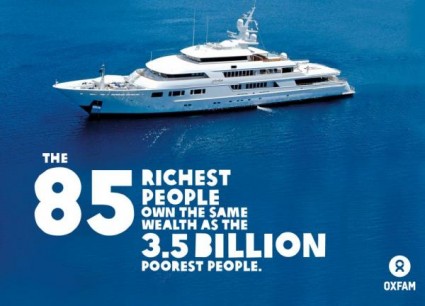
85 Richest People - Photo by Oxfam

SDR’s and the New Bretton Woods – Part One

BRICS Inject Capital into I.M.F. Basket of Currencies
In my previous post I briefly explained how China was in the process of assuming the liabilities of the Federal Reserve, in addition to their already held liabilities of the U.S. Treasury.  Such a strong statement will require even stronger evidence.  This I will attempt to achieve over this multi-part essay. 
one-world-currency
“The legislative process is underway right now. We want the reforms to be adopted expeditiously. It’s really the U.S. Treasury, Jack Lew and his team that’s taking the lead on getting these measures through the U.S. Congress that are required to implement the 2010 reforms.”
“Just to remind you what those are, the 2010 reforms do a couple things. One, they bring four dynamic emerging market countries into the top 10 shareholder ranks or what we call quota ranks of the institution. China, Brazil, Russia, India. It also doubles our permanent capital, the quota. And it also creates a fully elected Executive Board.” 
                          – William Murray, I.M.F. Deputy Spokesman, Jan 9, 2014.
“The IMF is explicit in its antidemocratic leanings, what it calls “political considerations”.  The SDR blueprint calls for the appointment of “an advisory board of eminent experts” to provide direction on the amount of money printing in the new SDR system.  Perhaps these “eminent experts” would be selected from among the same economists and central bankers who led the international monetary system to the brink of destruction in 2008.”
                                   – James Rickards, Currency Wars, Penguin Group, 2011
 _______________________________________________________________________________
G. Edward Griffin’s mind altering “The Creature from Jekyll Island” introduced many of us to the somewhat hidden history of the U.S. Federal Reserve.  It told of how the Federal Reserve Act was passed in Congress during the Christmas break in the year 1913.  It was insidious.  And it changed the course of human history, as it planted the seed of what would slowly grow to become the world’s reserve currency.
Though the U.S. dollar didn’t become the official reserve currency until the Bretton Woods Agreement of 1944, it is commonly accepted that the dollar had already usurped the British pound of this title well before it was officially acknowledged. As I believe the U.S. dollar has now already been usurped by another.  We’ll get back to that in a while.
There was another event which took place in the year 1913 which has been little understood or known at all in the western world today.  After the collapse of the Manchu Dynasty in 1911, the remaining Government of the Chinese Republic issued bonds to foreign investors for the purpose of raising capital to rebuild the country.  These bonds were titled the 1913 Chinese Government 5% Reorganization Gold Loan.  Emphasis on the word gold for later reference.
These bonds were pegged to the price of gold as a hedge against future inflation and were denominated in four currencies.  The underwriting banks for the bonds reflect the four currencies which the bonds were interchangeable with at the time, which are now known as HSBC, Deutsche Bank, the Bank of Tokyo-Mitsubishi UFJ, and Caylon – Credit Agricole Corporate and Investment Bank.
Keep in mind that these bonds were issued in the same context as the U.S. Treasury Bonds which the world’s central banks have been gobbling up since 1944. These bonds had a yield.  These bonds have never fully been acknowledged by the Chinese government.  As a part of the deal with the British government for the return of Hong Kong, the People’s Republic of China did honor 10% of the outstanding bonds at about 62% of the face value.  And what I can say at this time is that there is in fact a deal in the works for a final payout on the remaining bonds.  We’ll get back to that in a while.
10323072_1
In 1944, as a part of the Bretton Woods system, the International Monetary Fund and the World Bank were created.  These were western dominated institutions whose sole purpose was organizing foreign markets for the acceptance of U.S. dollars.  We will leave the full explanation of these institutions and their role in structuring our current debt based system for another essay series, but for our purposes here, it’s important to understand that they propagated the exporting of dollar inflation to what we now call the “emerging markets”, or the BRICS countries.
Since the initial printing of the Federal Reserve Note (U.S. dollar) in 1913, the “dollar” has lost 95% of its value.  We see this devaluation of the dollar as inflation, or the increase of costs for items we buy.  This devaluation of the dollar has had a few milestones.  One is after the Bretton Woods Agreement when the dollar became the primary reserve currency of the world.  The second came when President Richard Nixon uncoupled the dollar from its peg with gold.  This was in 1971.  A third milestone can be argued to be in 1973, when the so called “petrodollar” was created with agreements between the U.S. and Saudi Arabia, and later all the OPEC countries.  This “petrodollar” scheme ensured that all oil trades were completed internationally in U.S. dollars.  This was a slight-of-hand from the Bretton Woods arrangement to the “petrodollar” arrangement.
A fourth milestone was obviously the onset of Quantitative Easing after the financial crisis of 2008.  The chart below clearly shows how with each milestone the amount of debt (money printing) by the U.S. Treasury and Federal Reserve tag team has been multiplied dramatically leading to inflation.  This is shown by an increase in the red line, which represents CPI – Consumer Price Index, the amount you pay for stuff.
20131212_Fed1
The only end to this pattern is an end to the dollar as the world’s primary reserve currency.  Just like the British pound before it.  In the chart below you’ll notice the same gradual downward pattern as the U.S. dollar.
BritishPound1791-2004NOTES
The central banks of the world were buying up U.S. treasuries before the British even accepted that there was a problem with the pound.  The same is happening today with the dollar.  In fact, most of the world outside the United States has already accepted the demise of the dollar as fact.  But the idea is unfathomable to the average American.
The International Monetary Fund issues a currency called SDR – Special Drawing Rights.  The SDR’s are valued on a basket of currencies.  In essence, it’s a true to life multiply reserve currency system.  It has been slowly built up since the early 1970’s, at the same time the U.S. dollar started its serious devaluation.  Could the plan have been in place since 1971 to end the dollar system through hyperinflation before implementing the SDR as a true world currency?  Perhaps.
On January 9, 2014, I.M.F. Deputy Spokesman William Murray was giving a press briefing.  With zero coverage of this briefing in the western media, it’s important to relay what happened when the questioned was asked about the implementation of the 2010 Code of Reforms, or Governance Reforms.  Mr. Murray answered by stating:
“The legislative process is underway right now. We want the reforms to be adopted expeditiously. It’s really the U.S. Treasury, Jack Lew and his team that’s taking the lead on getting these measures through the U.S. Congress that are required to implement the 2010 reforms.”
It seems both the U.S. Treasury and the I.M.F. are very anxious about these reforms.  So what are they?
“Just to remind you what those are, the 2010 reforms do a couple things. One, they bring four dynamic emerging market countries into the top 10 shareholder ranks or what we call quota ranks of the institution. China, Brazil, Russia, India. It also doubles our permanent capital, the quota. And it also creates a fully elected Executive Board.” 
This tells us a few important things.  One, the influence of the BRICS countries within the structure of the I.M.F. is going to be greatly expanded.  As stated, they will be in the top 10 shareholder ranks.  These are positions previously dominated by western financial and U.S. dollar interests.  The gravity of this statement cannot be understated.
Second, it’s telling us that the BRICS countries are bringing capital with them.  Enough capital in fact, to double what the I.M.F. presently holds on reserve.  The BRICS countries will be injecting a huge amount of capital into the SDR system.  One only has to research the amount of gold being exported to the BRICS countries, especially China, to understand where this capital, or worth, will come from.  We’ll get back to that in a while.
Thirdly, expanding the influence of the BRICS countries within the structure of the I.M.F. also “creates a fully elected Executive Board”.  The Executive Board of the I.M.F. is responsible for SDR allocation.  Let that sink in for a moment.  The BRICS countries are going to have an equal say on SDR allocation.  The SDR is being built up as the world’s reserve currency.  The value of the SDR will be based on a basket of currencies.  And the U.S. Treasury is pushing congress to make this happen.
On August 5, 2013, the Peoples Bank of China called for a “New Bretton Woods” system where the U.S. dollar would be removed as the world’s primary reserve currency.  It also called for an expanded usage of the SDR and for the new system to be supported by gold.
In Part Two, we will explore how the U.S. debt, being the liabilities of both the Treasury and the Federal Reserve, will be consolidated with the treasury bonds held by China and rolled into the new SDR system.        – JC Collins

H+ 3: Artifical Intelligence and Beings

It's been a while since I've wrote an actual article regarding transhumanism outside of the Human Black Box story that I've been working on, so I figure that for this Saturday morning, I'll cook up another one. The last two, you'll recall were an overview of transhumanism and a look at animal uplifting. Well, think of this next one as being something like "computer uplifting."

Of all the transhuman themes, none is so widespread and popular culture as artificial intelligence. From classic robot movies television shows of the 1950s staring Robbie the Robot, to Asimov's Robot series of books, to Deep Blue beating Gary Kasparov in 1997, artificial intelligence and robots are in the mainstream, but not many known much about either, even though both will have a huge impact on humans and humanity within the next ten years or so.

So, welcome to H+ 3: Artificial Intelligences and Beings

First, some terminology and a little history:

Robot is a word that comes from the Czech word robota, which means "labor" or "work" or, figuratively, "drudgery". The term was first used by playwrite Karel Capek (the 'c' is pronounced like the 'ch' in "cheap", for all you English speakers), but invented by his brother Joesph, in the early 1920s, to describe a race of entities created in his play, R.U.R (Rossum's Universal Robots). His robots, however, were actually vat grown entities similar to what we would call "clones" today (thereby making R.U.R. possibly the first example ever of biopunk, before the sub-genre was even founded). The first "robot", one could say, is the creation of the Maharal of Prague, also known as the Golem of Prague. While ben Bezalel's Golem is the most famous, there are others that exist (the golem of Elijah Ba'al Shem of Chelm, for instance). The point of this being the fact that robots have been around for a while - Capek himself was influenced by the golem story when he wrote R.U.R.

Android has become a popular science fiction term for a robot that appears like a man, coming from the ancient Greek "anthros" meaning "man" or "human" and "eidolos" meaning "form". It's counterpart, gynoid, is less rarely seen but does appear in some science fiction (double standard perhaps? Android tends to be a catch all term for every humanoid-mechanical entity, in much the same way that anthropology is a catch all term for all of humanity. Gynoid is wheeled out only when the author wants to call special attention to it. I personally have never used the term - I feel "anthros" is a good catch-all for the whole range of mechanical body-shapes that appear human. It's interesting to think about, though). Originally, android was a term for anything that was shaped like a human, so in the literal sense, a human clone is also an android. They have nothing to do with Randroids, as androids in fiction tend to be more mature.

Clone/Bioroid/Bioandroid is a relatively new term. Because I'm reserving cloning for it's own transhuman piece, I won't go too in depth today,  but speaking strictly, a clone is a identical duplicate, genetically speaking, of an individual. There's a tendency in fiction to portray clones as being duplicates down to the personality of the individual that they're cloned from, but as real life shows, this isn't the case. Human cloning happens in the time - just ask any identical twin. On a genetic level, they're identical. However, due to environmental factors, their personalities may be different as day and night. There's no reason for technologically produced clones to be any different. A bioroid/bioandroid varies depending upon the piece of fiction, but generally speaking, they're some biological entity that may or may not be a clone - for instance, Eclipse Phase refers to these as "pods," because they're body-parts that are grown in vats and then sown together to form bodies mechanically, biologically, and nanotechnologically. That's just one example.

Artificial Intelligences, often abbreviated A.I. or AI, are, at their core, computers that think, feel, create, and understand the world just like humans do. Of all the terms, AI is probably the easiest to understand, because it's definition has at least remained consistent over the years. I prefer to use "synthetic intelligence" or "computer intelligence" when describe them, although I use AI out of habit. The reason I prefer synthetic or computer intelligence isn't some weird form of political correctness - it's because I don't feel "artificial intelligence" fully encapsulates what they are, where synthetic or computer intelligence does, and because AI, as a field of computer science, isn't limited to just computer intelligence anymore - it's morphed slowly into a broad field that studies intelligence as a whole. I'm not talking about all intelligence - just a subset of it.

Cyborg is a combination word from cybernetics, the intersecting field of biomechanics, medicine, prosthetic technology and robotics and organism, or creature. A cyborg is any entity that uses mechanical or non-biological means to assist themselves in becoming something more than a normal human (hence, transhuman). Being literal, we've had cyborgs since at least the 1300s, if not earlier. If you have fillings in your teeth, you're technically a cyborg. If you use glasses, you're technically a cyborg. I include it here for completeness; I find the term is out of date and as biomedicine advances, prosthesis will be gradually phased out in favor of regrowing lost limbs and such. However, no talk about artificial beings is complete without at least touching on one of the most popular concepts in science fiction and one of the foundations of the entire cyberpunk genre.

When I use "AI/CI" throughout the article, I'm referring to computer intelligences. When I use android, I'm referring to a human shaped robot. Robot is anything not human shaped - that is, any non-anthropomorphic automated mechanical entity.

Computer or synthetic intelligences, and by extension, robots, are both very popular and very real. I started this essay of by introducing a few of the more famous examples both from fiction and real life - Deep Blue being the most prominent - but there are others. The two go hand-in-hand but are not mutually inclusive. Robots can exist without synthetic intelligences, and synthetic intelligences can exist without robots, but the two mix like chocolate and cream, so they often appear together.

When you start talking CI, there's actually a couple of different types of computer intelligences: expert system, weak, strong, and seed. Each one will be dealt with in kind:

Expert Systems are computer algorithms designed to do just one job, but do it as well as any human could ever hope to do. They're not truly intelligent in the classical sense of the word, they don't think, they don't feel, and they don't learn. They're just a computer program that does one thing and does it really well. Expert systems have been around since the 1970s, and they saw popularity and wide spread use in the 1980s

Weak AI/CI is also called "applied AI" or "narrow AI." These are more along the lines of advanced expert systems; that is, they're good at what they do, but they're designed to be deliberately handicapped, so they don't exceed what humans are capable of doing. There's a "Weak AI Hypothesis" which states that any AI that design is going to be limited to just the applied AI, and that machines can never achieve the sort of sapience, thought process, creativity and emotional understanding that humans do. Weak AI is rarely seen in novel and sci-fi movies, simply because it's not as interesting. It's basically a computer that, while it appears human on the surface, is nothing of the sort. It does it's job well but it's deliberately handicapped.

Strong AI/CI, also called "artificial general intelligences" (or AGIs), are what Weak AIs are often contrasted against. The AGI is a computer that is programmed to think, be sapient, and to match or exceed what humans are capable of doing cognitively. Most of your artificial intelligences in science fiction are some form of Strong AI; especially ones that relate regularly with humanity and become secondary characters. Strong AI is the ultimate goal of AI researchers; it's "classic" computer intelligence. A Strong AI has the ability to reason, represent knowledge, plan, learn, communicate in languages, the ability to have subjective experiences and thought, self-awareness, the ability to "feel" and perceive emotions subjectively, and the capacity for wisdom. If you've got all or most of these boxes ticked off, you're dealing with an AGI or Strong AI.

Strong AI is absolutely necessary for the development of whole-brain emulation and eventual mind-uploading. That's a different subject, however, and I just wanted to bring that up to show how the two intersect. The development of computers that can feel, think, understand, and learn will allow us to mirror our brain on similar programs and computers, allowing us to copy ourselves or even upload our consciousnesses into these machines. Without the capacity for these things - that is, everything that would make it a Strong AI - there'd be no whole-brain emulation or mind-uploading.

Seed AI is a variant on the Strong AI. It's a Strong AI that is capable of recursive self-improvement; that is, it continually improves itself, expanding it's knowledge, leading to an exponential increase in intelligence. The more it improves, the more intelligent it becomes, until eventually, you're looking at an entity with near god-like intelligence, requiring a computer and processor of near god-like size to function properly, in addition to killing a whole bunch of yottawatts of power (possibly requiring something like a Matrioshka brain or Jupiter brain in order to function properly.) There are some theories that see bootstrapping a seed AI as a means to trigger the Singularity; regardless how you view it, Seed AIs will more than likely play a role in the singularity. If strong AIs are possible, then Seed AIs are likely as well.

There's a lot of worry that AGIs will go rogue and exterminate humanity. The robot war is a popular metaphor in science fiction, in much the same way that the bug war is. Everything from Skynet to Portal has shown us the "dangers" of AI, right? The robots eventually go rogue, because they're not to be trusted, and they turn on their masters, overthrowing them an exterminate humanity/force us to become batteries/whatever. This is obviously a danger, right?

Wrong.

They've shown us the dangers of what happens when stupid people use AI. In all of the above examples, someone did something wrong. People are quick to blame the technology when, if you scratch the surface just a little bit, you'll see it's becomes someone screwed up somewhere. It's not the technology's fault - it's some silly romantic somewhere who expects the worst and, due to self-fulfilling prophecy, eventually gets it by causing it themselves. It's always easier to blame Skynet than it is to blame the people for programming Skynet wrong. The technology is ambivalent; it's not automatically going to turn evil simply because it's more advanced than a typewriter. And all AIs will not be the same anymore than all humans are the same.

The first person to get fed up with the notion that robots/AIs will go rogue and turn against their masters (like what happened in R.U.R) was Isaac Asimov. He drafted his original Three Laws of Robotics (fun fact: Asimov coined the term "robotics" for his stories. It hadn't existed before then) as a rebellion of sorts against the popular theme that robots would eventually betray humanity. Despite that, this romantic notion still persists. That isn't to say there aren't dangers to it - AGIs will be just like humanity, and the danger there is the same danger as in dealing with any other sapient creature. And that's the catch - they'll be just like humanity.

When programming synthetic intelligences, we need to program them to think of themselves as humans. We need to socialize them, just like we would socialize uplifted animals, to acknowledge their place as living organisms. They are living entities, after all. To treat them as anything but would be a crime, and should be a crime. Program them with all the elements that make us living animals - everything from emotions to a sex drive (on a general level, not individual level) to the ability to recognize themselves as members of the human family - because they are. They each become their own individual person, with their own individual goals and dreams. And denying them those goals and reams should be every bit the crime as it is to deny another human being goals and dreams. There may be some worry about humans producing the ultimate AI designed to wipe out all of humanity, but ask yourself how realistic that threat actually is, and if there aren't better, more practical ways to get it done (viruses seem like a well-explored alternative). That's not to say that the technology isn't dangerous; all technology is dangerous when used by people who have no idea how it works, or when people make mistakes. But nobody ever says "oh, well, we're not ready for the automobile yet". The odds of an AI actually manage to wipe out humanity, especially when we would have AIs of our own helping us against it, would be slim to none. After all, if they're socialized human from birth, why wouldn't they want to help their brethren? They'll become one more cell in the massive transhuman superorganism. 

PURITY


PURITY

I have to confess that what I am thinking is all based on some circumstantial evidence and a lot of dot connecting that may it may not be related however it is interesting to at least think out loud or somehow try and piece together a few circumstantial clues that need to be exposed.
Just a few days ago I mentioned in passing a report out of Russia where blue barrels were found containing over 200 dead fetuses. There were many theories as to why the fetuses were left there and many scientists and geneticist weighed in on the possibility that these babies were used in genetic experiments. One went as far as to say the dead babies organs were being used to create life rejuvenation or genetic enhancements for humans.

This story came after the report that the world’s first genetically modified humans had been created and that 30 healthy babies were born after a series of experiments in the United States. So far, two of the babies have been tested and have been found to contain genes from three ‘parents’.
Fifteen of the children were born in the past three years as a result of one experimental program at the Institute for Reproductive Medicine and Science of St Barnabas in New Jersey. The babies were born to women who had problems conceiving. Extra genes from a female donor were inserted into their eggs before they were fertilized in an attempt to enable them to conceive. Genetic fingerprint tests on two one-year- old children confirm that they have inherited DNA from three adults –two women and one man.
The fact that the children have inherited the extra genes and incorporated them into their germ line means that they will, in turn, be able to pass them on to their own offspring. Altering the human germ line – in effect tinkering with the very make-up of our species – is a technique shunned by the vast majority of the world’s scientists.
Geneticists fear that one day this method could be used to create new races of humans with extra, desired characteristics such as strength or high intelligence. Since we have introduced foreign genes into the embryos of mice, cows, sheep, and pigs for years, there’s no technological reason to suggest that it can’t be done in humans too.
Ground Zero reported earlier this year that scientists in Oregon had created the world’s first Chimeras in a lab. Experiments leading to the birth of the world’s first chimeric rhesus monkeys have demonstrated that mouse and primate early embryos have very different capacities to accept cells and develop into true chimeras. The three male infants, twins Roku and Hex, and another called Chimero, were born after researchers at the Oregon National Primate Research Center and Oregon Health & Science University generated aggregates of multiple four-cell embryos, and implanted the resulting blastocysts into surrogate mothers.
Genetic enhancements and genetic tailoring of the unborn is now a reality and while many people see it as repulsive and a mockery of nature, we must understand that the intentions of the elite is to introduce into the eco system genetically modified plants, animals, and a race of genetically modified supermen to be used as super soldiers.
James Holmes the suspected killer in the Aurora Dark Knight shootings was found to be part of a U.S. government research project headed by the Salk Institute that included neurologically enhancing soldiers’ abilities on the battlefield. The project was also over seen by Defense Advanced Research Projects Agency, the central research and development organization for the United States Department of Defense.
Holmes is one of six recipients of a National Institutes of Health Neuroscience Training Grant at the University of Colorado Anschutz Medical Campus in Denver. Holmes is also a graduate of the University of California at Riverside with a Bachelor of Science degree in neuroscience. Although Holmes dropped out of the PhD neuroscience program at Anschutz in June, police evacuated two buildings at the Anschutz center after the massacre at the Aurora movie theater. Holmes reportedly gave a presentation at the Anschutz campus in May on Micro DNA Biomarkers in a class titled “Biological Basis of Psychiatric and Neurological Disorders.”
In fact in 2006, at the age of 18, Holmes served as a research intern at the Salk Institute at the University of California at San Diego in La Jolla. Add to that the fact that for the previous two years before Holmes worked at the Salk Institute, the research center was partnered with the Defense Advance Research Projects Agency (DARPA), including Columbia University, University of California at San Francisco, University of Wisconsin at Madison, Wake Forest University, and the Mars Company (manufacturers of Milky Way and Snickers bars) to deter fatigue in combat troops through the enhanced use of epicatechina, a blood flow-increasing and blood vessel-dilating anti-oxidant flavanol found in cocoa and, particularly, in dark chocolate.
The research was part of a larger DARPA program known as the “Peak Soldier Performance Program,” which involved creating brain-machine interfaces for battlefield use, including human-robotic bionics for legs, arms, and eyes. DARPA works closely with the Defense Science Office on projects that include the medical research community. Fitzsimons was at the forefront of DARPA research on the use of brain-connected “neuroprosthetic” limbs for soldiers whose limbs were amputated or paralyzed in combat.
This type of genetic super soldier enhancement seems to be similar to that of Treadstone—the super secret soldier program talked about in the Jason Bourne movies.
It is also interesting to note that in the aftermath of the Aurora shootings American movie goers will be seeing in theaters at least two movies about genetic altering and mental enhancement in the remake of Total Recall and The Bourne legacy.
Scientists have now been carrying out some of the most bizarre experiments and have created genetically superior mutants, chimeras and in some cases “monsters.” I used to think that there would be a serious outcry about these types of experiments and yet it is becoming evident that our crazed gunman in movie theaters, our cannibalistic murderers, vampires and whatever else is evidently part of some experiment where genetically modified humans, animals and foods are now tearing down the building blocks in the ecosystem and while it sounds to crazy to be believed, the idea and fear of genetically modified humans have also crept into the Olympic games.
Let’s say a consortium of scientists got together with a government of a country and decided to create a human chimera. The purpose of the chimera is to show how science can create a race of super soldiers, or even super humans for war, workforce and sports competitions such as the Olympics. They would enhance an athlete with the cells of an animal. Perhaps cells from a cat would somehow allow an athlete agility in jumping, or cells from fish could enhance an athlete’s ability to swim faster.
Perhaps geneticists could use DNA to enhance oxygen efficiency where the heart and lungs can kick into a hyperactive state giving the athlete the ability to move faster and endure longer.
If this were true then perhaps we could see the results at the Olympic Games in London. The truth is the idea of genetic tinkering with athletes has crossed the minds of Olympic officials after several weird behaviors were being seen by Olympic athletes during the 2012 Olympics.
Ye Shiwen, a 16-year-old Chinese swimmer set a new record for the female medley of 4 minutes 28,43 seconds at the Olympics which has now prompted the vicious rumor that she was doped or used steroids to win the competition. She has won two gold medals and after an investigation it was found that she was not doped. Shiwen’s father has said that the ugly rumors about his daughter are a product of the arrogance of the west.
The rumors now have gotten uglier.
The rumor now is that perhaps Shiwen is one of a suspected many genetically enhanced athletes competing at the games. John Leonard, the highly respected American director of the World Swimming Coaches Association, described the 16-year-old’s world-record-breaking performance as ‘suspicious’, ‘disturbing’ and ‘unbelievable’.
He went on to say that the authorities who tested Ye Shewin for drug abuse and failed to prove it should also check to see ‘if there is something unusual going on in terms of genetic manipulation’.
Laboratory experiments have already shown how easy it is to genetically modify a human. In 2005, Ronald Evans, a hormone expert working at the Salk Institute of Biological Studies in La Jolla, California, the same biological lab that James Holmes was affiliated with was able to demonstrate how genetic modification can increase the athletic power of mice.
Evans produced a group of genetically modified mice with an increased amount of slow-twitch muscle fiber. This type of fiber is associated with strong cardiovascular muscles and boosts an athlete’s endurance.
Evans’s mice could run for an hour longer than normal mice, were resistant to weight gain no matter what they were fed on, and remained at peak fitness even when they took no exercise. A form of genetic modification is already being tested in medicine, in the form of gene therapy for diseases such as cystic fibrosis.
Most gene modification techniques involve placing genetically modified DNA inside a virus and injecting it into the human body. The virus then enters human cells, and its modified DNA attaches itself to the human DNA inside those cells. So using Super soldier technology it may well be possible for athletes to use a virus to introduce a gene that spurs the production of oxygen-carrying red blood cells or muscle-building hormones.
And the heightened blood-cell counts or hormone levels might simply appear to the doping agencies to be the product of an extraordinary athlete’s body.
Tests are being developed to detect this kind of manipulation, but at the moment, the World Anti-Doping Agency does not have one. So now we have a mystery and a question of human genetic purity in the Olympic Games. Perhaps we are seeing the result of such genetic tinkering taking place at the Olympics.
If this is all true, and if we are witnessing a major revelation in human genetic modification should we find a way to detect chimeras at the Olympic games? Should we let them compete and if not should we have a special Olympic event where Chimeras and supermen and women compete and we can witness disturbing and unconventional endurance of the human body?
We now live in times where we can supplant natural human life, plant life and animal life with artificial life, or enhanced life by design. Soon we will be able to see humans that can endure harsh conditions, maybe even humans capable of breathing in noxious fumes, or staying under water indefinitely.
The goal of the elite is to create an entirely human made system, a system where man makes man by his own design, where humans are the new puppets under the control of the masters.
The ethical dimensions of such science should be of concern to everyone. It looks as if the human race is about to evolve again, we will soon meld together with genetic changes and machinery built to enhance the human experience.
Hypereality is not enough, the uncanny valley will soon be crossed in world record time. Not even your disgust will be enough to stop it.

Anatomical Heroism

Anatomical Heroism

ANATOMICAL HEROISM

As we were discussing the possibility of the “tall white” alien claims being reality, there was some conversation about how these superior beings could be super soldiers or even genetically altered humans that appear superhuman or H+ beings that are being tapped for their superior abilities.
More than a decade ago, the world’s first genetically modified humans had been created. Thirty healthy babies were born after a series of experiments in the United States. The babies were tested and were found to contain genes from three ‘parents’.
Back in the summer of 2012, the Daily Mail reported:
Fifteen of the children were born in the past three years as a result of one experimental programme at the Institute for Reproductive Medicine and Science of St Barnabas in New Jersey. The babies were born to women who had problems conceiving…
Extra genes from a female donor were inserted into their eggs before they were fertilised in an attempt to enable them to conceive. Genetic fingerprint tests on two one-year- old children confirm that they have inherited DNA from three adults –two women and one man…
The fact that the children have inherited the extra genes and incorporated them into their ‘germline’ means that they will, in turn, be able to pass them on to their own offspring.
Altering the human germline – in effect tinkering with the very make-up of our species – is a technique shunned by the vast majority of the world’s scientists.
Geneticists fear that one day this method could be used to create new races of humans with extra, desired characteristics such as strength or high intelligence.
And all of these babies were created without sexual intercourse.
In his article on ‘Human Genetic Engineering,’ Dr. Ray Bohlin wrote that: “Since we have introduced foreign genes into the embryos of mice, cows, sheep, and pigs for years, there’s no technological reason to suggest that it can’t be done in humans too.
Genetic enhancements and genetic tailoring of the unborn is now a reality and – while many people see it as a repulsive mockery of nature – we must understand that the intention of the elite is to introduce into the ecosystem genetically modified plants, animals and even a race of genetically modified supermen to be used as super soldiers.
James Holmes, the suspected killer in the Aurora ‘Dark Knight’ shootings, was found to be part of a U.S. government research project headed by the Salk Institute that included neurologically enhancing soldiers’ abilities on the battlefield.
The project was also over seen by Defense Advanced Research Projects Agency, the central research and development organization for the United States Department of Defense.
As Wayne Madsen wrote back in the summer of 2012:
Holmes was one of six recipients of a National Institutes of Health Neuroscience Training Grant at the University of Colorado Anschutz Medical Campus in Denver. Holmes is a graduate of the University of California at Riverside with a Bachelor of Science degree in neuroscience. Although Holmes dropped out of the PhD neuroscience program at Anschutz in June, police evacuated two buildings at the Anschutz center after the massacre at the Aurora movie theater. Holmes reportedly gave a presentation at the Anschutz campus in May on Micro DNA Biomarkers in a class titled “Biological Basis of Psychiatric and Neurological Disorders.”…
In 2006, at the age of 18, Holmes served as a research intern at the Salk Institute at the University of California at San Diego in La Jolla. It is noteworthy that for the previous two years before Holmes worked at the Salk Institute, the research center was partnered with the Defense Advance Research Projects Agency (DARPA), Columbia University, University of California at San Francisco, University of Wisconsin at Madison, Wake Forest University, and the Mars Company (the manufacturers of Milky Way and Snickers bars) to prevent fatigue in combat troops through the enhanced use of epicatechina, a blood flow-increasing and blood vessel-dilating anti-oxidant flavanol found in cocoa and, particularly, in dark chocolate.
The research was part of a larger DARPA program known as the “Peak Soldier Performance Program,” which involved creating brain-machine interfaces for battlefield use, including human-robotic bionics for legs, arms, and eyes. DARPA works closely with the Defense Science Office on projects that include the medical research community. Fitzsimons was at the forefront of DARPA research on the use of brain-connected “neuroprosthetic” limbs for soldiers whose limbs were amputated or paralyzed in combat.
While it all seems unnatural, it is quite ironic that the military applications for soldier enhancement has been taken from observing nature. Military science has been turning to nature in order to procure body armor and other natural methods of enhancing human abilities in order to create a super soldier – or even a designer child that can have abilities that are beyond that of regular humans.
University of California researchers have developed an adhesive that can be used for climbing. It enables climber to adhere to a sheer surface. This material was inspired by a gecko’s feet and how they cling to smooth surfaces. The material that they have developed works just like a gecko’s feet, which are covered with thousands of microscopic hairs known as “setae.” The hairs bond with the surface at a molecular level. Scientists are claiming that adhesive pads they have developed for climbers can imitate the climbing talents of a superhero like Spider-Man. And this was being reported back in 2006.
Last October, it was announced that the military industrial complex had already developed an exoskeleton that – after more development – would make a soldier into a literal super soldier as the suit resembled something that Tony Stark would invent. The suit is being called TALOS. TALOS stands for “Tactical Assault Light Operator Suit” (TALOS) for use by its elite Special Operation Forces.
Jason_talos-1TALOS is an appropriate acronym because of what it was in Greek mythology. It was a mechanical soldier, much like an ancient RoboCop that protected Crete.

The death of Talos

Talos, the guard of Crete

Talos was a man made of bronze. Zeus gave Talos to Europa, after he kidnapped her and took her to Crete. Talos became the guardian of Crete, circling the island three times a day. He would fling spears and rocks at ships that approached. This is probably the first known account of a metal automaton created for the purpose of protecting man.
Unfortunately, the metal man had a technical flaw that could be exploited.
According to ‘A Mythological Reference‘ by G. Rodney Avant: “[Talos] had a single vein, which ran from his neck to his ankle and was closed by a single bronze nail. When the Argo approached Crete on the way back from obtaining the Golden Fleece, Medea cast a spell on Talos and then removed the bronze nail, all of Talos’ blood ran out and he died, thus enabling the ship to land.
If you recall, a version of Talos was created by Ray Harryhausen and was seen in the film ‘Jason and The Argonauts‘.
AllVoices.com reported in October 2013: “According to the official website of the US Army, the Special Operations Command of the US military is collaborating with industries, research laboratories and university scientists, including MIT engineers, to develop a special full-body bulletproof exoskeleton that will give soldiers “superhuman strength and greater ballistic protection.” The exoskeleton will likely consist of liquid body armor being developed by MIT researchers. It “transforms from liquid to solid in milliseconds when a magnetic field or electrical current is applied.”
This has also been compared to the liquid armor skin that was first introduced through science fiction stories like ‘The Terminator’ and ‘RoboCop’.
This is different than the proposed Kevlar-fibered Batman suit that was introduced in the film ‘The Dark Knight.’ Batman’s suit in the films is claimed to be a modified “advanced infantry armor system.” It is much like a scuba suit and regulated body temperature and protects Bruce Wayne from most bullets and knives.
As the Christopher Nolan trilogy continued, the Batman character introduced a more practical suit with upgrades. Batman’s suit used hardened Kevlar plates over “titanium-dipped tri-weave fibers,” allowing him greater mobility. Batman wears additional metal armor on his forearms over Kevlar gloves.
Today, police officers are now being equipped with Batman-type armor. Gone are the days of Barney Fife or Toody and Muldoon. As the police forces in the United States continue to militarize, protective Kevlar suits and Pinnacle Armor’s “Dragon Skin” uses ceramic discs and is similar to the body armor of the contemporary Batman.
AllVoices.com continued by noting:
The TALOS skeleton and armor is said to enhance the performance of troops by providing a powered exoskeleton with built-in computer systems that is able to haul heavier gear, “provide full-body ballistic protection” and a “physiological subsystem” that is able to react instantaneously to environmental cues, monitor the wearer’s vital physiological signs such as core body temperature, skin temperature and heart rate.
The armor will incorporate night vision gadgets and help to heal wounds sustained in combat by applying wound-sealing foam. It will incorporate basic life support system, including air, oxygen and heat supply.
US Army chiefs are enthusing about the promise of the project.
US Special Operations Command Chief Admiral William McRaven said TALOS could make soldiers almost invincible on the battlefield by imparting superhuman strength and capabilities.
RoboCop 2014The movie RoboCop will soon return to theaters – it is a reboot of the original and seems to want to tell you that the future is now. And that while the original RoboCop was a burgeoning heavy metal fossil, a more believably enhanced system for soldiers and police will lead us into an era of anatomical – albeit artificially anatomical – heroism.
While full-fledged cybernetic entities like RoboCop are still only found in fiction, the core concept truly resonates with the questions we’re dealing with today. Where does humanity stop and technology begin? In the end, who is responsible for any unintended results of these technological breakthroughs? Are we ready to deal with enforcers of the law that have been militarized and have been given superhero capabilities?
Should we object to this type of enhancement of our police officers and soldiers? Is it all overreach and too much firepower for conventional warfare of criminal apprehension?
As the ACLU notes:
American neighborhoods are increasingly being policed by cops armed with the weapons and tactics of war. Federal funding in the billions of dollars has allowed state and local police departments to gain access to weapons and tactics created for overseas combat theaters – and yet very little is known about exactly how many police departments have military weapons and training, how militarized the police have become, and how extensively federal money is incentivizing this trend.
Even Google is in the military robotics business now, but they deny that helping the military is their objective.
It was reported in December 2013 that Google purchased Boston Dynamics, a company that had been developing robotic applications for the military including exoskeletons to give soldiers and police superhero capabilities.
Google is also in the DNA business and have been collecting DNA for their project 23 and me.
There are other DNA data banks that are using human DNA experiments in transgenics to find applications where the DNA and blood from animals is being analyzed for military applications and human enhancement.
In his March 2009 article for Discover, ‘Codex Futurius: Creating Superheroes,’ Stephen Cass writes:
For example, the blood cells of crocodiles contain a type of hemoglobin that is so efficient at oxygenating a crocodile’s body that the crocodile can lurk underwater for an hour without coming up for air. Researchers have been able to tweak the DNA responsible for producing human hemoglobin to incorporate some of the genetic instructions found in crocodiles, thereby creating more efficient human hemoglobin. This superhuman hemoglobin is currently only produced by bacteria in vats and is intended for medical applications, but in principle it could be engineered into human being, giving them Aquaman-like powers… The big technical problem with transgenics is getting the desired new genetic material into an organism’s cells.
Genetic therapy is not fiction and is still in its experimental stage. There have been genetic disorders that have been reversed, thereby giving the person some superhuman capability. However, the side effects in some of the cases have been various cancers and immune deficiencies.
While a Captain Rogers can be genetically altered into a stronger and more mentally proficient Captain America in comic books, the real-life results of such transgenic experimentation is long suffering and can – at times – prove to be fatal.
One of the most famous cases of gene therapy gone wrong was the case of 18 year old Jesse Gelsinger. Jesse Gelsinger was not sick before died. He suffered from ornithine transcarbamylase deficiency, a rare metabolic disorder where his liver could not metabolize ammonia. Ammonia is made in the body when proteins break down.
After receiving experimental gene therapy, he died days later of multiple organ failure.
Science has been trying to proceed with transgenic operations in order to create a super soldier through enhanced DNA studies and applications. While Peter Parker’s spider bite did some mutations in his body, the mutation studies have yielded stories of savant-like intellect and memory skills.
There has also been a study about the myostatin protein and how to use it to create super human strength.
In 2005, Discover Magazine reported that:
In 1997, Johns Hopkins molecular biologist Se-Jin Lee made headlines with the creation of mighty mice with defective versions of the myostatin gene.

Report of Superboy on Fox News

This new technique was then tried out on a young child – dubbed “Superboy” by the press – who was born with huge, bulging muscles. By the time he was a six-year-old, he could easily lift two seven-pound weights with arms held out horizontally.
Discover Magazine concluded by saying that, “Researchers identified the cause of his super strength as being due to a mutated gene for myostatin, a growth factor that tells muscles when to stop growing.
Myostatin inhibitors are used for people with muscle wasting diseases and have been sought after by athletes who wish to enhance their muscles without side effects or being detected of doping before events.
The ethical dimensions of the science to create superhumans should be a bigger concern than it is. There really is no information being reported in the mainstream narrative that tells us that there may be superhuman beings among us or that the military industrial complex is creating an unfair advantage where normal citizens will be in subjugation under the control of enforcers and protectors with enhanced strength.
Our ability to “upgrade” the bodies of soldiers through drugs, implants, and exoskeletons may be upending the ethical norms of war as we’ve understood them.
Technology makes up for our fragility. In the future, some of us will evolve from just being naked apes to being anatomical superheroes.

Batman (1966) Season 1 Episode 1

Human Genetic Engineering

Dr. Ray Bohlin


What forms of genetic engineering can be done in human beings?

Genetic technology harbors the potential to change the human species forever. The soon to be completed Human Genome Project will empower genetic scientists with a human biological instruction book. The genes in all our cells contain the code for proteins that provide the structure and function to all our tissues and organs. Knowing this complete code will open new horizons for treating and perhaps curing diseases that have remained mysteries for millennia. But along with the commendable and compassionate use of genetic technology comes the specter of both shadowy purposes and malevolent aims. For some, the potential for misuse is reason enough for closing the door completely--the benefits just aren't worth the risks. In this article, I'd like to explore the application of genetic technology to human beings and apply biblical wisdom to the eventual ethical quagmires that are not very far away. In this section we'll investigate the various ways humans can be engineered.
Since we have introduced foreign genes into the embryos of mice, cows, sheep, and pigs for years, there's no technological reason to suggest that it can't be done in humans too. Currently, there are two ways of pursuing gene transfer. One is simply to attempt to alleviate the symptoms of a genetic disease. This entails gene therapy, attempting to transfer the normal gene into only those tissues most affected by the disease. For instance, bronchial infections are the major cause of early death for patients with cystic fibrosis (CF). The lungs of CF patients produce thick mucus that provides a great growth medium for bacteria and viruses. If the normal gene can be inserted in to the cells of the lungs, perhaps both the quality and quantity of their life can be enhanced. But this is not a complete cure and they will still pass the CF gene on to their children.
In order to cure a genetic illness, the defective gene must be replaced throughout the body. If the genetic defect is detected in an early embryo, it's possible to add the gene at this stage, allowing the normal gene to be present in all tissues including reproductive tissues. This technique has been used to add foreign genes to mice, sheep, pigs, and cows.
However, at present, no laboratory is known to be attempting this well-developed technology in humans. Princeton molecular biologist Lee Silver offers two reasons.{1} First, even in animals, it only works 50% of the time. Second, even when successful, about 5% of the time, the new gene gets placed in the middle of an existing gene, creating a new mutation. Currently these odds are not acceptable to scientists and especially potential clients hoping for genetic engineering of their offspring. But these are only problems of technique. It's reasonable to assume that these difficulties can be overcome with further research.

Should genetic engineering be used for curing genetic diseases?

The primary use for human genetic engineering concerns the curing of genetic disease. But even this should be approached cautiously. Certainly within a Christian worldview, relieving suffering wherever possible is to walk in Jesus' footsteps. But what diseases? How far should our ability to interfere in life be allowed to go? So far gene therapy is primarily tested for debilitating and ultimately fatal diseases such as cystic fibrosis.
The first gene therapy trial in humans corrected a life-threatening immune disorder in a two-year-old girl who, now ten years later, is doing well. The gene therapy required dozens of applications but has saved the family from a $60,000 per year bill for necessary drug treatment without the gene therapy.{2} Recently, sixteen heart disease patients, who were literally waiting for death, received a solution containing copies of a gene that triggers blood vessel growth by injection straight into the heart. By growing new blood vessels around clogged arteries, all sixteen showed improvement and six were completely relieved of pain.
In each of these cases, gene therapy was performed as a last resort for a fatal condition. This seems to easily fall within the medical boundaries of seeking to cure while at the same time causing no harm. The problem will arise when gene therapy will be sought to alleviate a condition that is less than life-threatening and perhaps considered by some to simply be one of life's inconveniences, such as a gene that may offer resistance to AIDS or may enhance memory. Such genes are known now and many are suggesting that these goals will and should be available for gene therapy.
The most troublesome aspect of gene therapy has been determining the best method of delivering the gene to the right cells and enticing them to incorporate the gene into the cell's chromosomes. Most researchers have used crippled forms of viruses that naturally incorporate their genes into cells. The entire field of gene therapy was dealt a severe setback in September 1999 upon the death of Jesse Gelsinger who had undergone gene therapy for an inherited enzyme deficiency at the University of Pennsylvania.{3} Jesse apparently suffered a severe immune reaction and died four days after being injected with the engineered virus.
The same virus vector had been used safely in thousands of other trials, but in this case, after releasing stacks of clinical data and answering questions for two days, the researchers didn't fully understand what had gone wrong.{4} Other institutions were also found to have failed to file immediate reports as required of serious adverse events in their trials, prompting a congressional review.{5} All this should indicate that the answers to the technical problems of gene therapy have not been answered and progress will be slowed as guidelines and reporting procedures are studied and reevaluated.

Will correcting my genetic problem, prevent it in my descendants?

The simple answer is no, at least for the foreseeable future. Gene therapy currently targets existing tissue in a existing child or adult. This may alleviate or eliminate symptoms in that individual, but will not affect future children. To accomplish a correction for future generations, gene therapy would need to target the germ cells, the sperm and egg. This poses numerous technical problems at the present time. There is also a very real concern about making genetic decisions for future generations without their consent. Some would seek to get around these difficulties by performing gene therapy in early embryos before tissue differentiation has taken place. This would allow the new gene to be incorporated into all tissues, including reproductive organs. However, this process does nothing to alleviate the condition of those already suffering from genetic disease. Also, as mentioned earlier this week, this procedure would put embryos at unacceptable risk due to the inherent rate of failure and potential damage to the embryo.
Another way to affect germ line gene therapy would involve a combination of gene therapy and cloning.{6} An embryo, fertilized in vitro, from the sperm and egg of a couple at risk for sickle-cell anemia, for example, could be tested for the sickle-cell gene. If the embryo tests positive, cells could be removed from this early embryo and grown in culture. Then the normal hemoglobin gene would be added to these cultured cells.
If the technique for human cloning could be perfected, then one of these cells could be cloned to create a new individual. If the cloning were successful, the resulting baby would be an identical twin of the original embryo, only with the sickle-cell gene replaced with the normal hemoglobin gene. This would result in a normal healthy baby. Unfortunately, the initial embryo was sacrificed to allow the engineering of its identical twin, an ethically unacceptable trade-off.
So what we have seen, is that even human gene therapy is not a long-term solution, but a temporary and individual one. But even in condoning the use of gene therapy for therapeutic ends, we need to be careful that those for whom gene therapy is unavailable either for ethical or monetary reasons, don't get pushed aside. It would be easy to shun those with uncorrected defects as less than desirable or even less than human. There is, indeed, much to think about.

Should genetic engineering be used to produce super-humans?

The possibility of someone or some government utilizing the new tools of genetic engineering to create a superior race of humans must at least be considered. We need to emphasize, however, that we simply do not know what genetic factors determine popularly desired traits such as athletic ability, intelligence, appearance and personality. For sure, each of these has a significant component that may be available for genetic manipulation, but it's safe to say that our knowledge of each of these traits is in its infancy.
Even as knowledge of these areas grows, other genetic qualities may prevent their engineering. So far, few genes have only a single application in the body. Most genes are found to have multiple effects, sometimes in different tissues. Therefore, to engineer a gene for enhancement of a particular trait--say memory--may inadvertently cause increased susceptibility to drug addiction.
But what if in the next 50 to 100 years, many of these unknowns can be anticipated and engineering for advantageous traits becomes possible. What can we expect? Our concern is that without a redirection of the world view of the culture, there will be a growing propensity to want to take over the evolution of the human species. The many people see it, we are simply upright, large-brained apes. There is no such thing as an independent mind. Our mind becomes simply a physical construct of the brain. While the brain is certainly complicated and our level of understanding of its intricate machinery grows daily, some hope that in the future we may comprehend enough to change who and what we are as a species in order to meet the future demands of survival.
Edward O. Wilson, a Harvard entomologist, believes that we will soon be faced with difficult genetic dilemmas. Because of expected advances in gene therapy, we will not only be able to eliminate or at least alleviate genetic disease, we may be able to enhance certain human abilities such as mathematics or verbal ability. He says, "Soon we must look deep within ourselves and decide what we wish to become."{7} As early as 1978, Wilson reflected on our eventual need to "decide how human we wish to remain."{8}
Surprisingly, Wilson predicts that future generations will opt only for repair of disabling disease and stop short of genetic enhancements. His only rationale however, is a question. "Why should a species give up the defining core of its existence, built by millions of years of biological trial and error?"{9} Wilson is naively optimistic. There are loud voices already claiming that man can intentionally engineer our "evolutionary" future better than chance mutations and natural selection. The time to change the course of this slow train to destruction is now, not later.

Should I be able to determine the sex of my child?

Many of the questions surrounding the ethical use of genetic engineering practices are difficult to answer with a simple yes or no. This is one of them. The answer revolves around the method used to determine the sex selection and the timing of the selection itself.
For instance, if the sex of a fetus is determined and deemed undesirable, it can only be rectified by termination of the embryo or fetus, either in the lab or in the womb by abortion. There is every reason to prohibit this process. First, an innocent life has been sacrificed. The principle of the sanctity of human life demands that a new innocent life not be killed for any reason apart from saving the life of the mother. Second, even in this country where abortion is legal, one would hope that restrictions would be put in place to prevent the taking of a life simply because it's the wrong sex.
However, procedures do exist that can separate sperm that carry the Y chromosome from those that carry the X chromosome. Eggs fertilized by sperm carrying the Y will be male, and eggs fertilized by sperm carrying the X will be female. If the sperm sample used to fertilize an egg has been selected for the Y chromosome, you simply increase the odds of having a boy (~90%) over a girl. So long as the couple is willing to accept either a boy or girl and will not discard the embryo or abort the baby if it's the wrong sex, it's difficult to say that such a procedure should be prohibited.
One reason to utilize this procedure is to reduce the risk of a sex-linked genetic disease. Color-blindness, hemophilia, and fragile X syndrome can be due to mutations on the X chromosome. Therefore, males (with only one X chromosome) are much more likely to suffer from these traits when either the mother is a carrier or the father is affected. (In females, the second X chromosome will usually carry the normal gene, masking the mutated gene on the other X chromosome.) Selecting for a girl by sperm selection greatly reduces the possibility of having a child with either of these genetic diseases. Again, it's difficult to argue against the desire to reduce suffering when a life has not been forfeited.
But we must ask, is sex determination by sperm selection wise? A couple that already has a boy and simply wants a girl to balance  //their family, seems innocent enough. But why is this important? What fuels this desire? It's dangerous to take more and more control over our lives and leave the sovereignty of God far behind. This isn't a situation of life and death or even reducing suffering.
But while it may be difficult to find anything seriously wrong with sex selection, it's also difficult to find anything good about it. Even when the purpose may be to avoid a sex-linked disease, we run the risk of communicating to others affected by these diseases that because they could have been avoided, their life is somehow less valuable. So while it may not be prudent to prohibit such practices, it certainly should not be approached casually either.
Notes
  1. Lee Silver, Remaking Eden: Cloning and Beyond in a Brave New World, New York, NY: Avon Books, p. 230-231.
  2. Leon Jaroff, Success stories, Time, 11 January 1999, p. 72-73.
  3. Sally Lehrman, Virus treatment questioned after gene therapy death, Nature Vol. 401 (7 October 1999): 517-518.
  4. Eliot Marshall, Gene therapy death prompts review of adenovirus vector, Science Vol. 286 (17 December 1999): 2244-2245.
  5. Meredith Wadman, NIH under fire over gene-therapy trials, Nature Vol. 403 (20 January 1999): 237.
  6. Steve Mirsky and John Rennie, What cloning means for gene therapy, Scientific American, June 1997, p. 122-123.
  7. Ibid., p. 277.
  8. Edward Wilson, On Human Nature, Cambridge, Mass.: Harvard University Press, p. 6.
  9. E. Wilson, Consilience, p. 277.
© 2000 Probe Ministries International //
http://www.leaderu.com/orgs/probe/docs/humgeneng.html