Friday, October 12, 2012

Apollo 17 - Proof it was Kubricked

Think? we went?..................but I think they used their "secret" technology ???  .......but as always ---you decide!        http://www.jayweidner.com/Kubricked.html

Apollo 17 - Proof it was Kubricked

by Ted Twietmeyer

Please read all of the text before reviewing the photos. This text provides additional information that you probably will not otherwise notice when reviewing the photos. If there is material that others have also discovered, so be it. My research was done using a white room approach. Unless stated otherwise, all ideas, discoveries and facts presented are my own work. It would be appreciated if my inbox is not stuffed with “I found it or so-and-so found it first” nonsense. I will respond to all sensible emails.
I need to admit here that my goal in reviewing Moon walk and rover photos from Apollo 17 was to find possible artifacts. When I found one particular image after many hours of reviewing photos, my research work came to a complete stop.
After reviewing hundreds of Apollo 17 images, I found conclusive proof a stage was definitely used for most, if not all of the Moon surface photos. The entire world has been “Kubricked” for decades. Others in recent years found through image processing that the black sky in Moon walk images is actually a painted backdrop. We shall see that image processing is not even needed to see this.
Over and over in photos taken on the surface of the Moon I continued to find the same irregularities. Keep in mind all these photos were supposedly taken by astronauts who trained and practiced for weeks (their own words) to use a high quality Hasselblad camera.
This camera is completely manual, and requires the astronaut to set the distance to the lens (in feet) before taking each picture. This means the focus of the camera inherently has a limited depth of focus, controlled by the setting in feet. With this is mind, consider the following characteristics this camera will have:
  • Rocks and objects on the Moon's surface within yards of the rover will be in focus, only if that is what the camera is set for.
  • Distant objects like a mountain ridges will be in focus, if that is what the camera is set for (such as infinity.)
  • It is not possible to obtain razor sharp mountain peaks in the distance and sharp focus on rocks only a few yards from the rover at the same time.
And yet, there are more than 100 images that accomplish the impossible with rocks and objects in focus up close, while distant mountain ridges miles away are also razor sharp focus. Forget about the old argument about “stars are not being visible means it's faked.” This argument is invalid because the F-stop setting (iris) had to be set for extremely bright sunlight. Sunlight on the Moon is full brightness like that of outer space and can easily wash out a photo. Starlight is many magnitudes dimmer than sunlight and it makes complete sense stars cannot be seen.
Another question arises ­ are the distant peaks and ridges REALLY that far away? Highly skilled matte painters for Hollywood films have long known how to fool the eye with fake distance, decades before the first Apollo flights were every launched. Old Star Trek TV series and others used this trick all the time to create scenes that could not be filmed in the real world. Matte paintings were often combined with Chroma-key to superimpose backgrounds on small objects.
Chroma-key was commonly used in TV studios to make weather forecasters appear in front of a large map of the country. Any blue color was substituted electronically (or “keyed”) with another image from a different camera or video source. It was long known in the TV news industry that no weatherman or some news reporters should ever wear blue. Today, Chroma-blue has been replaced by green.
I mention all this because in the staged Apollo 17 (and likely other Apollo missions) Chroma-key was not used that we can tell. Keep in mind that in the late 60's and early 70's, Chroma-key was far from perfect.
Older readers may remember early weatherman having parts of their bodies disappear and re-appear in while doing the weather.
I was involved with commercial broadcasting at that time, and Chroma-key was more like a balancing act. When a studio video board operator used Chroma-key, he worked a joystick which was moved around slightly in an attempt to balance the superimposed effect. That was state-of-art 40 years ago ­ at the same time Kubrick did the Apollo work.
If any part of a astronaut disappeared on live video because of a Chroma-key problem, that would have been the end game for NASA. Kubrick wisely crafted his production without using unreliable electronic effects. But to do so requires that everything is constructed life-size, or as big as it can be when crammed into a secret, closed stage housed inside a building.
In reviewing hundreds of Apollo 17 images, I noticed that the same distant mountain peaks appeared in the distance over and over with razor sharpness. Yet at the same time objects on the ground were also quite sharp. The best camera you can buy today cannot do that - almost 40 years later.
What would be most telling of being Kubricked, is to see some part of a studio lighting instrument in a photo. There is a film clip on youtube that shows this in as a rehearsal to make the “One Small Step for Man.” But someone at one time claimed this was shot for a commercial. When I challenged that and asked what commercial, no one came forward to state what company commissioned such a re-enactment.
IMAGE HANDLING Below are a few images of interest I found from Apollo 17. These photos were taken straight from NASA computers, with just one exception - a photo of astronaut gloves in a museum. No image processing has been done to these images unless noted for each one.
Most images were available as low res and high res formats. I show the source image NASA ID number and whether it was in low res or high res. Enlargement are taken from a small clip from a hi-res image of the very same scene to help reduce document size. No sharpening, contrast or color changes, etc... are used since these may introduce unwanted artifacts.
The first group of images shows polygon-shaped craters. What makes these unusual is that scientifically conducted, high speed projectile impact tests of various types and sizes were performed in laboratories to simulate meteor impacts. Results of these tests have shown that impact craters are always round.

Fig. 1a ­ polygon-shaped crater ahead of the rover, low res photo ID: AS17-133-202


Fig. 1b ­ closer view of polygon crater photo ID: AS17-133-202, high-res, red lines added by author


Fig. 2a ­ Collection of junk materials photo ID: AS17-133-20239, low res
The reason I say “junk materials” is that since this is a film stage, it was probably constructed with junk materials as filler. In the photo below it looks like much of these materials is actually made of chunks of concrete.


Fig. 2b ­ closer view of junk materials, ID: AS17-133-20239, hi-res, circles added by author


Fig 3 ­ Both the horizon and objects on the ground (lower right and lower left corners) are all in focus. This is not possible using a Hasselblad camera which requires distance to subject to be manually set. The only way this could be accomplished is if the distant horizon is not as far away as it appears. Matte painters are experts at fooling the eye. Distant black sky and ridges are probably painted on a backdrop.


Fig. 4 - The mystery ladder. Note how the bottom ladder rung is level with the astronaut's hip joint. Life support backpack he is wearing weighs 60lbs. in Moon's gravity, and much more on Earth. Did he jump up onto that ladder with 60lbs pulling him backward? Why didn't NASA design the ladder to extend downward almost to the ground to prevent possible injury or death? A cracked faceplate, helmet or ripped suit could mean death.


Fig. 5 ­ Descent engine should have created a large blast zone under the lander but did not. Grey engine nozzle is visible here but there is no blast crater or expelled material.

Fig. 6 ­ Lander pad proves the point. Only a few feet from the engine nozzle, this pad has almost no dust on it. Engine gases would have pushed the flour-like fine dust outward in every direction far past these lander pads. But here we can see the fine dusty soil is essentially undisturbed. The lunar vehicle must have been placed by a crane. Note that struts are also free of dust as well.

The following images are important to prove the final image will be what it is. These low-res photos show the front and side of the lunar rover used for Apollo 17.
Fig. 7 ­ Astronaut with Hasselblad camera mounted on the spacesuit chest bracket. Not the relatively unobstructed view facing the direction of travel. This will be important later.

Fig. 8 ­ Note the large mesh dish, which is the high-gain antenna to communicate with Earth. No other large objects are out in front of the rover. This is important to know for the next image you will see.

Fig. 9 ­ Back of studio floor lamp (red circle) was captured in this photo. Red arrow points to gel filter holder used for coloring light output. This photo was slightly re-sized to fit this page.
ID: AS17-135-20637, low res.
Closeup insert of vertical lamp height adjustment knob was added by author. It is commonplace in film and industry to hang property and maintenance tags on knobs using string loops. Remnant of string is still visible wrapped around knob. No other image processing was performed on this image.
Right edge of the filter holder (red arrow) is visible in many other rover photos on the NASA website.
In Fig. 9, note the shadow of the high gain dish antenna on the ground in front of the rover. Antenna is also visible in Fig. 8, upper left corner. In the communications dish shadow, a cable is visible coming down beside the antenna post. This cable is not present beside the studio lamp post in the left foreground. Lamp post is not casting a shadow.
This author has used knobs just like these in industry and has seen them on studio lamp stands. These knobs are difficult to grab and tighten sufficiently. Astronaut multilayer gloves have permanently attached hard plastic finger tips to protect the fabric from punctures.
There is no question astronauts could never loosen or tighten this knob.
And there is no question this is a studio lamp that does not belong on the Moon, which somehow was never caught by NASA censors.

Fig. 10 - Astronaut gloves on display in the Apollo to the Moon Museum exhibit
There is no doubt that Apollo 17 photos and possibly other Apollo mission photos have been faked.
However ­ this does not indicate we never went to the Moon. I have one first person witness friend of impeccable character who is still alive, and who was there at Cape Kennedy when Apollo 11 was making it's final descent and was buzzed by flying disks (UFOs.) NASA apparently switched the broadcast to the Kubrick production, which is what all of us saw in 1969.
It may be possible that due to some oversight, all the Apollo images were fogged by solar radiation. Due to the historic nature of the Apollo missions (and NASA not wanting to look like the world's biggest idiots and lose funding) many Apollo images were re-created.
Ted Twietmeyer
tedtw@frontiernet.net              
Top 10 Most Sinister PSYOPS Mission Patches

just boy's ,being boy's .....hmm..

Top 10 Most Sinister PSYOPS Mission Patches


Mission patches are used by military and space organizations to identify, symbolize and describe a mission’s objectives and its crew. This tradition is also observed in the shady world of PSYOPS where each secret mission of the Pentagon gets its patch. These patches offer a rare glimpse into the Pentagon’s secret operations and the symbolism on them is rather striking: ominous and cryptic phrases, dark occult symbolism, references to secret societies, and sometimes even a rather dark sense of humor. Here’s the top 10 most sinister PSYOPS patches.
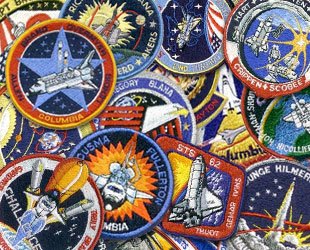
In 1965, NASA began using cloth patches to identify each of its missions and to symbolize the missions’ objectives and their crew.  Each rocket launch has therefore a patch designed by crew members and in collaboration with the official design team. The patches are then proudly displayed on equipment and worn by NASA astronauts and other personnel affiliated with a particular manned or unmanned space mission.
Various NASA mission patches
Since then, other organizations involved in space travel and secret operations began using mission patches, including those that specialize in PSYOPS (psychological warfare): the CIA, the Department of Defense and the National Reconnaissance Office (NRO). What does space travel have to do with psychological warfare? Spy satellites. Since 1960, the NRO (whose existence was only declassified in 1992) has launched dozens of secret spy satellites into space, collecting an incredible amount of information on the United States’ friends, enemies and citizens.
As it is nearly impossible to obtain information regarding these highly classified endeavours, mission patches offer a rare glimpse into the world of PSYOPS. Even if one is not well-versed in symbolism, it is easy to perceive a sinister “vibe” emanating from the patch designs. Laced with strange symbols, ominous creatures, obscure Latin phrases and even dark humor, these patches reflect the mindstate of those wearing the patches.
The trailblazer in this area of research is Trevor Paglen, who, in 2008, published the book “I Could Tell You But Then You Would Have to be Destroyed by Me: Emblems from the Pentagon’s Black World”. By the means of hundreds of Freedom of Information requests, he obtained and analyzed forty mission patches. From the book reviews:
“The iconography of the United States military. Not the mainstream military, with its bars and ribbons and medals, but the secret or ‘black projects’ world, which may or may not involve contacting aliens, building undetectable spy aircraft, and experimenting with explosives that could make atomic bombs look like firecrackers. Here, mysterious characters and cryptic symbols hint at intrigue much deeper than rank, company, and unit.”
—UTNE Reader
“Of course, issuing patches for a covert operation sounds like a joke … but truth be told, these days everything is branded. Military symbols are frequently replete with heraldic imagery—some rooted in history, others based on contemporary popular arts that feature comic characters—but these enigmatic dark-op images, in some cases probably designed by the participants themselves, are more personal, and also more disturbing, than most.”
—Steven Heller, The New York Times Book Review
Since the release of this book, new mission patches have been released that are as strange and cryptic as their predecessors. If these patches are meant to symbolize “the values of the crew and the objectives of the mission”,  perhaps we should be a little concerned. Here are the top 10 most sinister mission patches:

#10 – Alien Face

TENCAP is an acronym for “Tactical Exploitation of National Capabilities” and is a collection of programs involving the cutting edge of warfare.
“The purpose of the AF TENCAP program is to exploit the current and future potential of existing national, commercial, and civil space systems and national air-breathing systems, and to provide these capabilities to the warfighter as rapidly as possible.”
- Source
In PSYOPS, “Special” almost invariably means “black” or highly classified. Does the “highly classified part” of the mission have something to do with the fact that the badge bears the face of an alien? The saying at the bottom does not help: The phrase “Oderint Dum Metuant” is usually associated with Caligula, the first-century Roman emperor whose name became synonymous with depravity, madness, and tyranny. It translates as “Let them hate so long as they fear.” Right.

#9 All Your Base Are Belong to Us

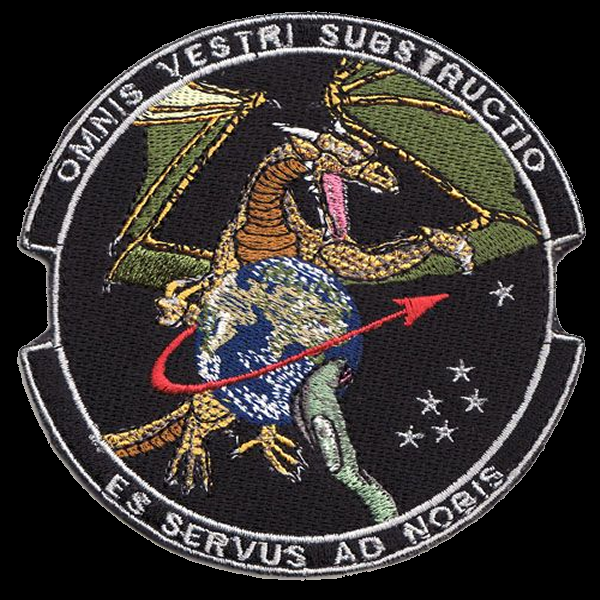
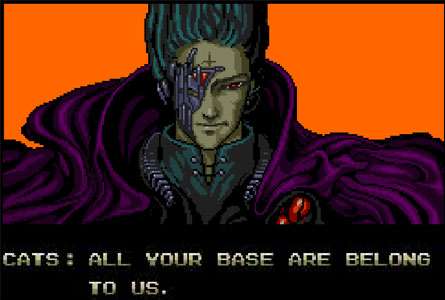
A giant angry dragon clutching the planet, bringing destruction from space. That’s a nice way to symbolize space missions. In PSYOPS symbolism, dragons typically represent signals-intelligence satellite launches; the dragons’ wing patterns symbolize the satellites’ massive gold-foil dish antennae meant to collect all types of information from earth. The phrase “Omnis Vestri Substructio Es Servus Ad Nobis” can loosely be translated to “All your base are servant to us”. This phrase does not make much sense, except that it vaguely states that the world is owned by those who made that patch. But this phrase is also reminiscent of a geeky 2002 Internet meme based on a poor translation in an old-school Sega game.
The biggest internet meme of 2002, a badly translated Sega game.
This allusion to popular culture is quite funny yet disturbing … I’m pretty sure they truly believe that all our base are belong to them.

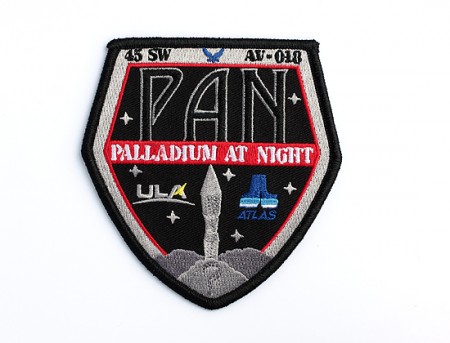
#8 Hymn to Pan

The PAN satellite was launched in September 2009 and is so top-secret that no military or governmental organization claimed to have built it.
“A United Launch Alliance Atlas V rocket has launched with PAN, a classified satellite which will be operated by the US Government. The launch was on time, at the start of a two hour, nine minute launch window which opened at 21:35 GMT (17:35 local time). Unusually for an American government satellite, the agency responsible for operating the spacecraft has not been disclosed.”
- Nasa Space Flight
According to the patch, PAN stands for “Palladium at Night”, Palladium being a silvery-white metallic element that is probably present in the satellite. The mission is so secret, however, that it is jokingly said that the name PAN actually stands for “Pick a Name” (notice the subtle question mark underneath the rocket on the patch).
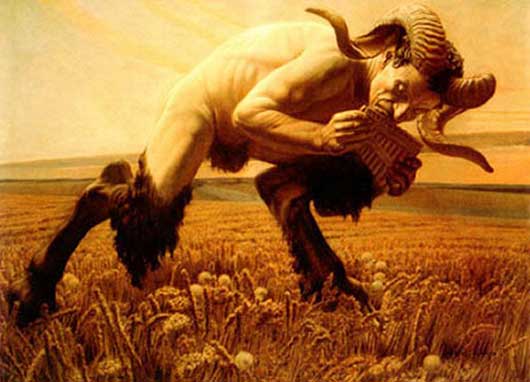
PAN is also the name of an ancient horned god important in occultism and that has a strange link with the history of rocket science in the United States.
The ancient god Pan, a nature deity with phallic attributes. Is it me or is the PAN mission patch also rather phallic?
Jack Parsons, a pioneer in American space propulsion who is often credited for having “propelled” the United States into the space age (a crater of the moon is named in his honor), was also a notorious occultist. He was a prominent member of the Ordo Templi Orienti (the O.T.O.), an occult secret society popularized by Aleister Crowley. Seeing no separation between his professional and his occult work, Parsons was known to chant Crowley’s poem entitled Hymn to Pan before each test rocket launch.
“Parsons would dance and chant poetry—most notably Crowley’s “Hymn to Pan”—before rocket tests.”
- Goeffrey Landis, The Three Rocketeers
Is Pan still invoked during rocket launches?

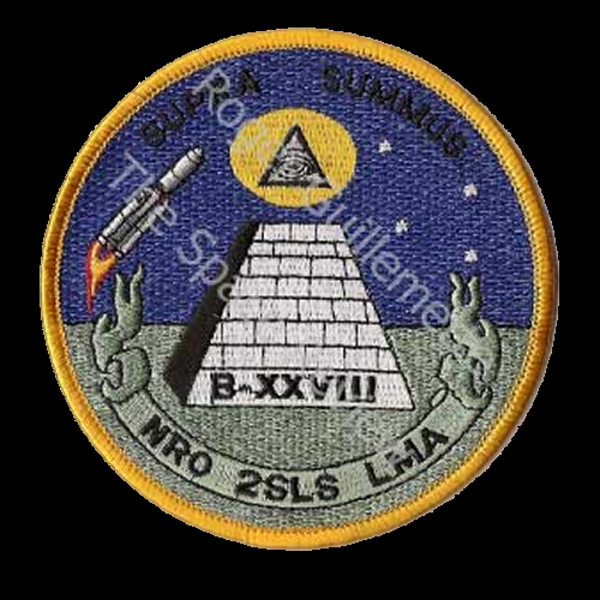
#7 Supra Summus

This is a patch for a NRO spy-satellite launch. Those familiar with this site will probably recognize this Illuminati 101 symbolism: An unfinished pyramid topped by the All-Seeing Eye. This All-Seeing Eye requires help: it needs spy satellites to be even more all-seeing.
“LMA” at the bottom right most likely refers to Lockheed Martin Aerospace, which is the ultimate Big Brother mega-company working with the CIA, NRO, NSA and IRS.
Above the All-Seeing Eye is written “Supra Summus”, which can be translated to “Most Superior and Highest”, which, if nothing else, indicates a healthy level of self-esteem.
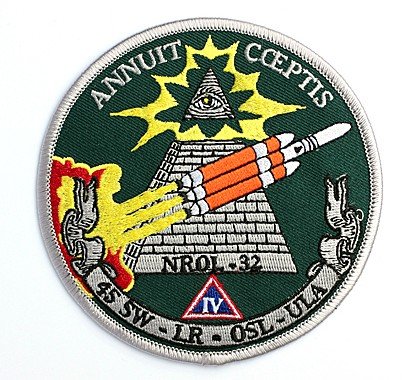
Other NRO spy-satellite launches have also used similar designs.
NROL-32 Patch.

#6 Two Faced Shadow Guy

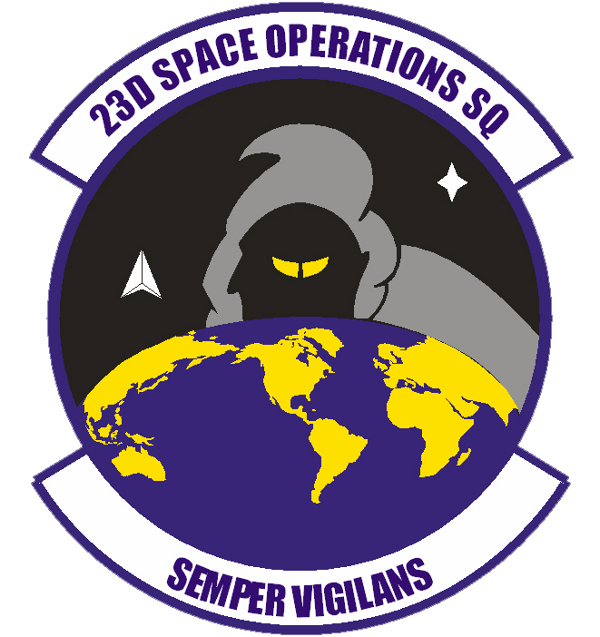
The 23rd Space Operations Squadron (23 SOPS) is a United States Air Force unit located at New Boston Air Force Station in New Hampshire. The patch of this mission features a creepy-looking figure in a creepy hood looking over the earth with creepy eyes, staring creepily at the American continent. However, that is not the creepiest thing in this patch. If you look closely at the contour of the black face, you’ll see another face, with pointy nose and pointy ears, looking left.  Who is this creepier dude within an already creepy dude? And what’s up with all the layers of creepy?
The saying “Semper Vigilans” means “Always Vigilant”. At least I can relate to that. But in the context of this patch, it is definitely creepy.

#5 The Grid

Are you thinking of selling your condo and your Prius in order to leave everything and “go off the grid”? Try it and this knight might slash your head off. It would probably be useless anyhow. Look closely at this patch: there is no “off the grid”. This patch actually depicts the “information grid” those crazy conspiracy theorists keep rambling about, complete with nodes at the intersections.
Defenders of the Domain is a subgroup of the NSA Information Assurance group and is comprised of individuals “who are on the front lines in developing the strategy, the concepts, the planning and the technical implementation in the Information Assurance domain. They are the true leaders in the world of Cybersecurity.” In other words, they monitor the cyberspace using the latest technologies.
The man with the sword is in the distinct dress of a Knight Templar, this ancient group of Crusaders that became an occult secret society. The Knight represents the descendants of the Templars, the modern Illuminatus.

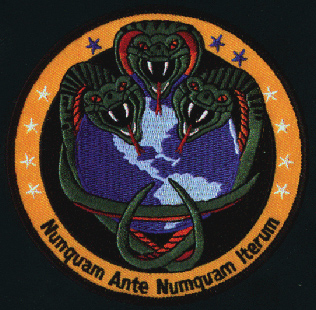
#4 NRO Snakes

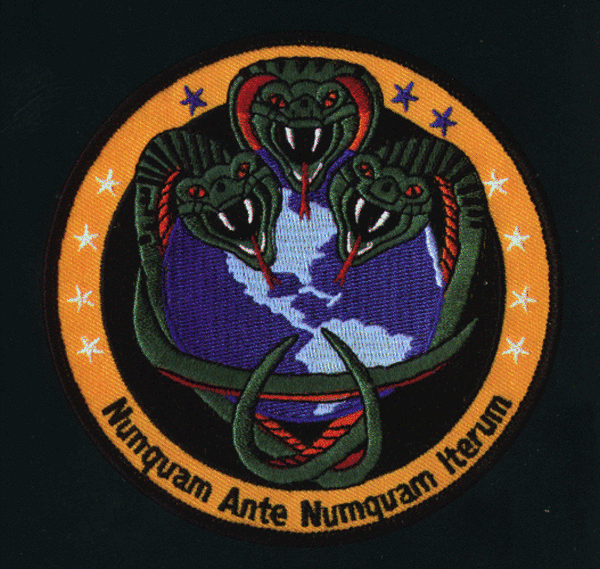
This is another mysterious patch of the NRO. The program associated with this patch is totally unknown. All we know is that it is represented by three menacing vipers wrapped around the the earth, making us all warm and fuzzy inside.  The Latin inscription “Nunquam Ante Numquam Iterum” translates to “Never before, never again.” What never happened before and will never happen again? We may never know.

#3 I Could Tell You…

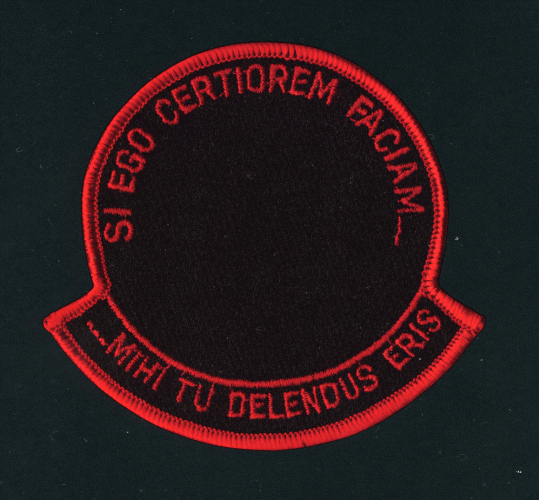
You know that a mission is top-secret when not even an obscure symbol can be used to represent it. This patch was designed as a generic insignia for “black” projects conducted by the Navy’s Air Test and Evaluation Squadron Four. The Latin phrase “Si Ego Certiorem Faciam … Mihi Tu Delendus Eris” is roughly translated to “I could tell you … but then I’d have to kill you”. That is cliché phrase, but considering these are the people who actually created it, they probably don’t think it is corny. In fact, they’re probably dead serious about it.
Furthermore, there is a twist on the phrase. According to Paglen, the Latin phrase is worded in a peculiar way in order to refer to Greek and Roman texts.
“The Latin phrase Si Ego Certiorem Faciam … Mihi Tu Delendus Eris roughly translates into a cliché commonly heard in the vicinity of “black” programs: “I could tell you, but then I’d have to kill you.”
But the phrasing here is unusual because it is written in the passive voice: a more accurate translation of the Latin would be “I could tell you, but then you would have to be destroyed by me.” By employing the passive voice, the patch’s designer makes two references that would not exist in other phrasings. The first reference is to the Greek god of Chaos, Eris, about whom Homer wrote in Book Four of the Iliad: “[Eris] whose wrath is relentless … is the sister and companion of murderous Ares, she who is only a little thing at the first, but thereafter grows until she strides on the earth with her head striking heaven. She then hurled down bitterness equally between both sides as she walked through the onslaught making men’s pain heavier.”
The passive phrasing of the Latin also echoes the words of the second-century BCE Roman senator Cato the Elder, who roamed the Senate repeating the words Carthago delenda est—”Carthage must be destroyed.” In 149 BCE, Cato got his way and Rome attacked the North African city, located near present-day Tunis. Three years after beginning their assault, the Roman army overran Carthage, tore down its walls, and sold its inhabitants into slavery. After the Roman Senate declared that no one would ever again live where the city had stood, legend holds that Rome salted the earth around the city in order to ensure that Carthage would remain a wasteland.”
- Source
So the badge does not contain a simple death threat: it also alludes to a “wrath from above” of mythological proportions, turning your city into a wasteland for generations to come. Now that’s a threat.

#2 Get Your Kicks on 66

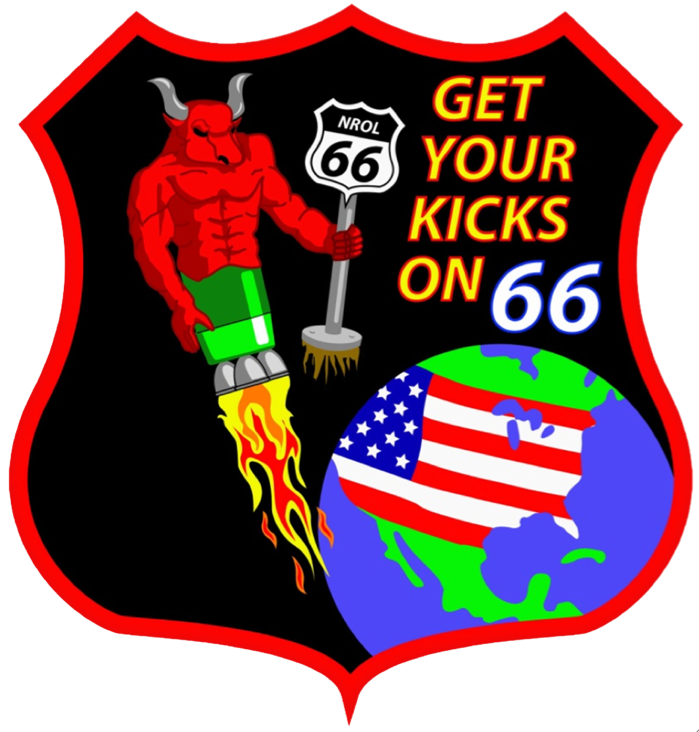
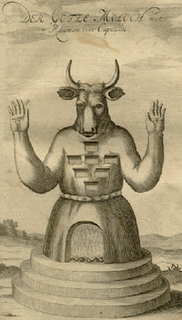
The Minotaur program is composed of top-secret NRO spy-satellite launching missions. Minotaurs are bull-headed creatures from Greek mythology that are always angry, violent and merciless. Minotaurs bear many resemblances to the Middle-Eastern deity Molech, a bull-headed god with the body of a man to whom child sacrifices were made.
Molech

In this patch for NROL-66, the red Minotaur (as if hailing directly from hell) is holding a street sign of the mythical route 66. It is rather difficult not to see an allusion to the devil (who is often portrayed in red) and the number 666.
Furthermore, according to some occult researchers, route 66 was originally laid out to become a sort of “occult pilgrimage”.
“The famous old American highway “Route 66″ was laid out by Freemasons with the apparent intention of sending masses of automobile riders into a self-processing occult “trip.”
Route 66 began at the Buckingham Fountain in Chicago, near the site of the University of Chicago’s collection of Aztec ritual incunabula. It ended in Barstow, California in the Mohave desert, which is for the Freemasons, the cosmic graveyard of the West, the final destiny of Anubis, the celestial jackal, otherwise known as Sirius (see Giorgio de Santillana andHertha Von Dechend, Hamlet’s Mill: An Essay on Myth and th Frame of Time, p. 358).
If this version of Route 66 smacks of some medieval pilgrimage made more appropriately on a camel than by car, it is for good reason. Most of Route 66 was based on a road forged in 1857 by Lt. Edward Beale and his caravan of the U.S. Camel Corps.”
- Michael A. Hoffman II, Secret Societies and Psychological Warfare
So who is really getting their kicks on Route 66?

#1 The Devil You Know

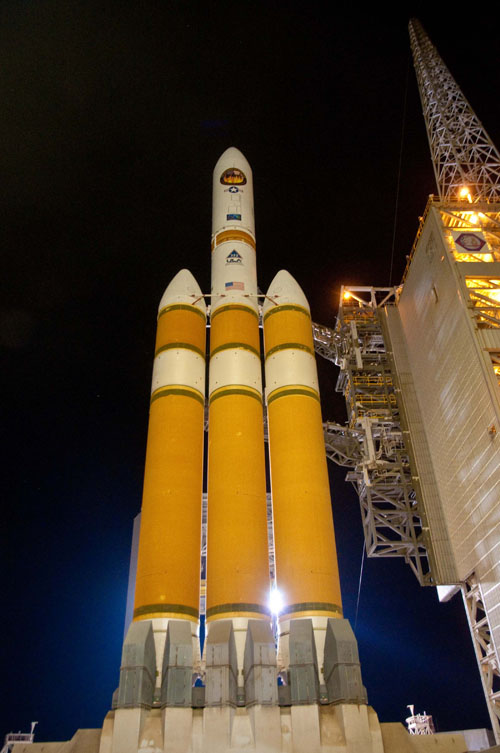
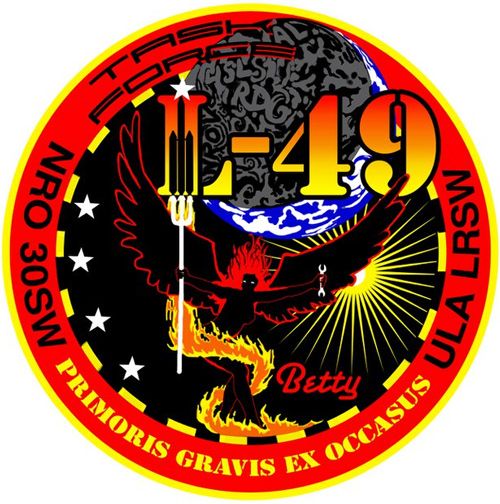
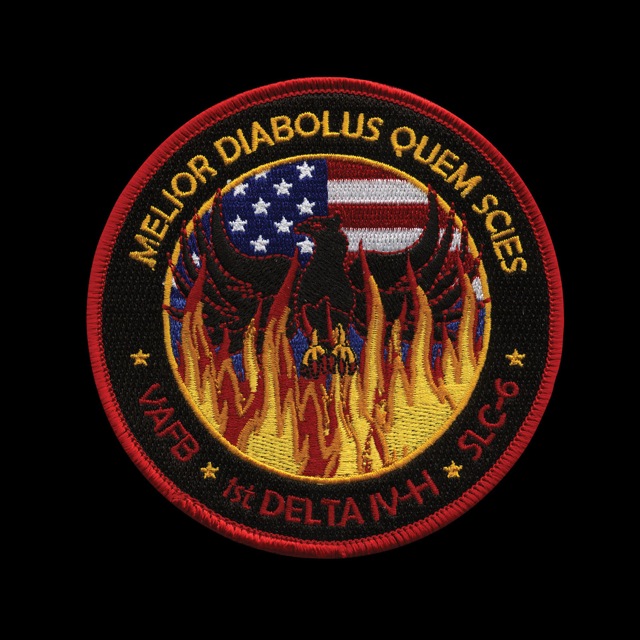
This patch for NROL-49  depicts a phoenix rising from the flames with the flag of the United States in the background. The Latin words “Melior Diabolus Quem Scies” roughly translates to mean “The Devil You Know,” as in the phrase “Better the devil you know than the devil you don’t know”. Cryptic. According to NASA, this saying refers to the return of the use of an old system after attempting to use a new one, which had resulted in failure.
“The mission patch for NRO L-49 shows a phoenix rising out of a fire, with the words “melior diabolus quem scies”, which translate into English as “better the devil you know”, indicating the return to the older system following the failure of the attempt to replace it.”
- Source
It is a rather odd choice of words for a governmental agency, but definitely on-par with this whole sinister, hellish theme going on with PSYOPS patches.
NROL-49 before its launch featuring its mission patch at the top.

Another patch related to NRO-49 depicts the satellite as a winged fiery being (referred to by NASA as a devil named Betty) who is holding a trident and a wrench.
“An image of a devil features on the launch patch. The old tradition of giving rockets personal names also appears to have been revived; Delta 352 seems to have been named “Betty”, and the Atlas V that launched from Vandenberg last year was named ‘Gladys’.”
- Ibid.
The patch shows the moon (or a comet?) partially covering the earth. If you look closely, there are letters in the detail of the grey astral body. What do they refer to? At the bottom of the patch, the Latin phrase is also enigmatic: “Primoris Gravis Ex Occasus”.  Primoris means “First”, Gravis stands for “important, heavy or serious” and Occasus means “setting of the sun, the West, or fall”. In other words, I don’t know what it means. “First heavy setting of the sun”? “The most important thing after the sunset”? “First serious fall”? Regardless of the exact meaning, there seems to be an emphasis on the concept of darkness. Betty is pure darkness wrapped in flames and is partially covering the sun. There is a grey celestial body moving towards the earth … and we’re still talking about a spy-satellite. Okay.

Honorable Mentions

There are many other patches giving a glimpse in the somehow twisted world of PSYOPS:
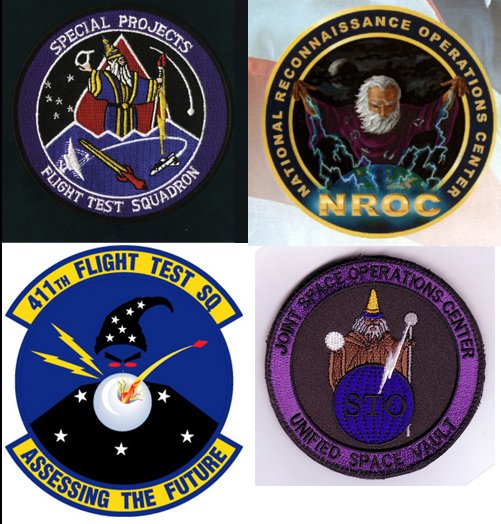
Wizards controlling the earth through magic is a recurring theme in PSYOPS patches. Is magick still a part of rocket launching like in the times of Jack Parsons and the O.T.O.?
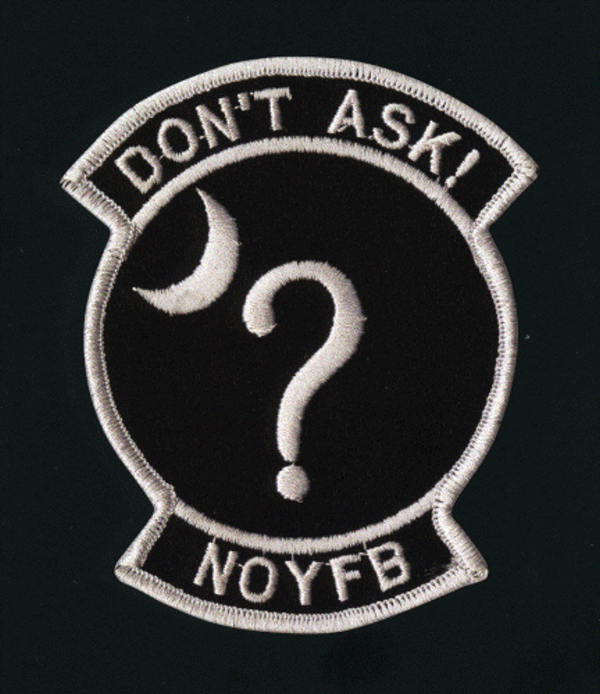
What do the letters at the bottom mean? None of your f***ing business. No, I’m not being rude…that’s what the letters stand for.
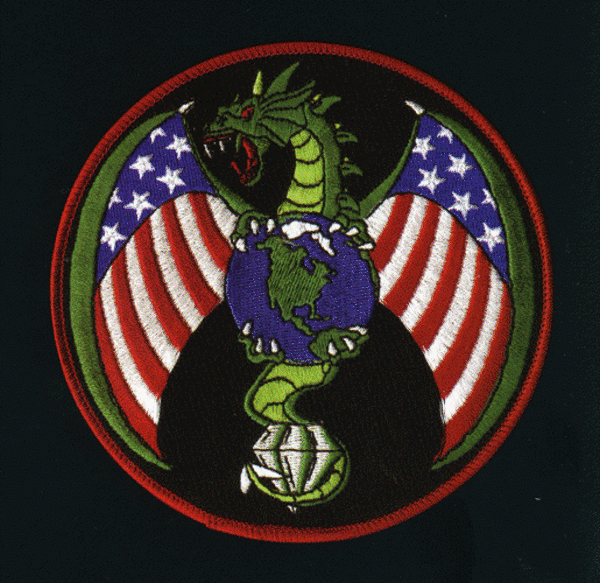
Another NRO patch, one that pretty much sums up the meaning of all of the above. The spy-satellite is symbolized by an angry dragon clutching the entire planet with its four claws holding a diamond in its tail. It does not seem to preoccupied with our privacy and other petty things like that.

In Conclusion

Although it isn’t possible to know exact meaning of the symbols found in these mission patches, they still provide a rare insider’s look at the philosophy, the mind state and the background of the organizations creating them. Sorcerers controlling the earth, vipers surrounding the earth, angry dragons clutching the earth … this is how they perceive themselves and their work. My question is: Should we maybe be a little concerned? One could argue that these patches are meant to be menacing to America’s enemies. This could be true, but most satellites launched by the NRO are meant to spy on North America, hence the emphasis on the continent in many of these patches.
One thing is certain, mission patches are the most honest descriptions we have of these secret missions. Since most of the patches were not intended for mass exposure, they are devoid of public relations sugar-coating. The patches do not talk about “bringing democracy and the light of freedom to the world”… they show the world in chains and in flames, controlled by dragons and sorcerers, and their words threaten death and destruction.
The occult symbolism illustrated in these patches is also reminder that these organizations have relations to secret societies and are “in the know”. And those who are not in the know, the uninitiated masses, the profane, are not welcome.
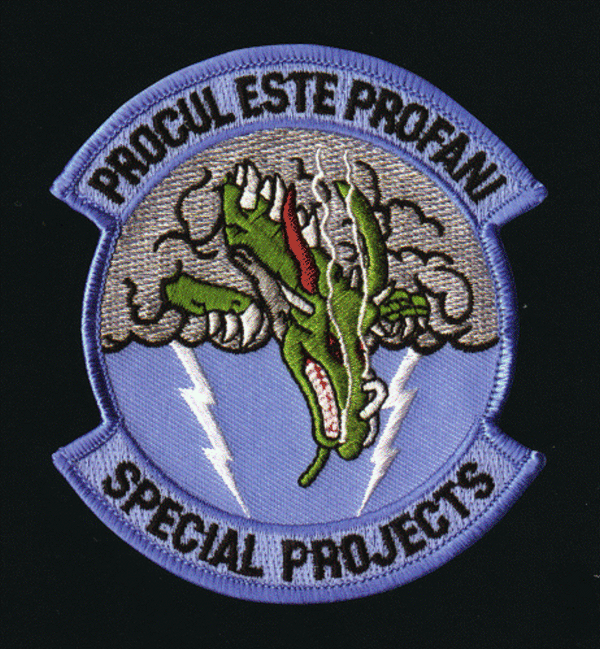
“Procul Este Profani”: “Keep your distance, you who are uninitiated.”

Sources