Posts
Posts


http://illuminatimindcontrol.com/new-reptilian-world-order/
Serpents and flying dragons have, of course, been a staple of ancient myth and legends of indigenous people around the world. The assumption has always been, however, that they are metaphor or allegory – and not a literal description of actual beings.
But what about the admonition of Jesus and John the Baptist when they chided the “generation of vipers” and “serpents? What if they saw these creatures with their spiritual vision – the overshadowing of humans by astral beings from another dimension? How would they communicate this vision to others?
And what about the stories from the Book of Enoch and the Forbidden Books of the Bible which refer to the Nephilim – literally “Those Who Were Cast Down” – and the Watchers, the so-called “Fallen Angels”?
Historian Professor Charles Hapgood squarely faces the issue when he writes that “today we find primitive cultures co-existing with advanced modem society on all continents… We shall now assume that 20,000 years ago while paleolithic peoples held out in Europe, more advanced cultures existed elsewhere on earth.”
Likewise the rise of Sumeria has been a major puzzle. Joseph Campbell in The Masks of God writes, “With stunning abruptness… there appears in this little Sumerian mud garden… the whole cultural syndrome that has since constituted the germinal unit of all high civilisations of the world.”
William Irwin Thompson puts it even more succinctly. “Sumer is a poor stoneless place for a neolithic culture to evolve from a peasant community into a full-blown civilisation,” he writes, “but it is a very good place to turn the plains and marshes into irrigated farmlands… In short, Sumer is an ideal place to locate a culture already having the technology necessary for urban life and irrigation agriculture.”
A more stunning conclusion was reached by Professor Samuel N. Kramer, one of the greatest Sumerologists of our time. He reviewed the table of contents from the Tablets of Sumer and found that each one of the 25 chapters described a Sumerian, and in fact a world-first, type of achievement.
The Sumerians had the world’s first medicine and pharmacopoeia. The world’s first brain surgery. The world’s first agriculture and farmer’s almanac. The world’s first cosmology and astronomy. The world’s first law codes. And they utilised a highly advanced technology capable of sophisticated metallurgy, smelting, refining and alloying as well as petroleum fuel refining. Most importantly, the Sumerians were responsible for the world’s first genetic engineering.
Like a mystery without a suspect, the Sumerian story remained a riddle, until historian-archaeologist Zechariah Sitchin published a remarkable book called The 12th Planet (1979). In his subsequent series entitled “The Earth Chronicles,” Sitchin describes in great detail the crossbreeding program of the Sumerian “gods” through genetic manipulation.
Having spent thirty years studying Sumerian, Assyrian, Babylonian and Hittite texts and the Old Testament in the original Hebrew, Sitchin deciphered the ancient scripts, transcribed them, transliterated them and, finally translated them.
His conclusion? Sitchin writes that the Sumerian civilisation did indeed appear out of thin air. The forerunner of Greek and Roman civilisation was initiated by a highly advanced race of extra-planetary colonists who came to earth, established their settlements, and began their single-minded pursuit of wealth and power by mining gold and other minerals necessary to sustain their high-tech high-maintenance lifestyle.
And who were these “colonists”? The Sumerians themselves described them as the “gods of heaven and earth.” They were also called “the ancient gods,” or the “olden gods,” and according to Sumerian lore, they had come down to earth from heaven. In the Hebrew text of the Old Testament, the Sumerian gods of heaven and earth are referred to as the Nephilim. The Sumerians themselves called the colonists the Anunnaki.
The Bible and Strong’s Concordance does not mention the Nephilim specifically by name, but Nelson’s Concordance has several listings. Sitchin translates the biblical verses from Genesis 6:4 as:
“The Nephilim were upon the Earth, in those days and thereafter too, when the sons of the gods cohabited with the daughters of Adam and they bore children unto them. They were the Mighty Ones of Eternity.”
And what does “Nephilim” actually mean? Normally translated into English as “giants,” the word stems from the Semitic root NFL (‘to be cast down’). It means exactly what it says – “Those who were cast down upon Earth.”
“Contemporary theologians and biblical scholars have tended to avoid the troublesome verses,” writes Sitchin, “but Jewish writings of the time of the Second Temple did recognise in these verses the echoes of ancient traditions of ‘fallen angels’.”
According to the Book of Enoch, a band of angels led by Samyaza “became enamoured of the daughters of men” and decided to go after them, saying “come let us select for ourselves wives from the progeny of men, and let us beget children.” So they all took an oath, all two hundred of them, and descended to earth. “Then they took wives, each choosing for himself; who they began to approach, and with whom they cohabited; teaching them sorcery, incantations… Moreover Azazyel taught men to make swords, knives, shields… Then Michael and Gabriel, Raphael, Suryal and Uriel, looked down from heaven, and saw the quantity of blood which was shed on earth, and all the iniquity which was done upon it…”
Indeed, bloodshed, including ritual abuse and human sacrifice through endless wars are the hallmarks of these creatures.
In fact, the evidence lies in a complete reappraisal of the legends, myths and “history” of the world. The Sumerian legend of Gilgamesh and Agga points to this interaction of “humans” and “serpents.” And of course, there are the well-known “serpent gods” of the Indus Valley, the Nagas or Serpent race of Ancient India, and the Hindu epics, “Ramayana” and “Mahabharata,” which also deal with the serpent- gods. In Chinese history, “Vih King” describes how man and dragon lived peacefully together and even intermarried. And the serpent gods in American mythology are described in the Mayan book “Chilam Balam” where Itzamna, the serpent god is revered by the “people of the serpent.”
The story of St. George overcoming the “dragon” in England and St. Patrick driving the “serpents” out of Ireland are also part of Christian iconography.
Too many “coincidences” point to a pattern which has been seemingly willfully ignored by ivory tower mainstream academics and historians.
Berossus, the Babylonian priest writing in 3rd century BCE Athens, claimed that man’s ancestry and origin can be traced to “Oannes,” an amphibious creature that came out of the Persian Gulf to teach the arts of civilisation to man. “Berossus called them ‘annedoti’ which translate as the ‘repulsive ones’ in Greek. He also refers to them as ‘musarus,’ an abomination,” writes Boulay. “If the tradition had been invented, a more normal attitude would have been to glorify these creatures as splendid gods or heroes, yet the fact that they chose to describe their ancestors this way argues for the authenticity of the account.”
“The Sumerian gods regarded Man as a convenience and nothing more,” says Boulay. “He supplied their wants, kept their cities, and provided cannon fodder for their various military ventures.” (Sound familiar?) “The gods could be cruel and unsympathetic masters. They considered humans merely as unruly children, not more important than pets, to be governed ruthlessly and without sentiment.”
The ruthless “policies” of the New World Order reflects this ancient bias in the incessant propaganda that a population “crisis” exists on the planet and that the best way to remedy the situation is through wars to kill off the “cannon fodder” or through abortion to kill off future “useless eaters,” those who consume resources without the value-added productivity that the masters of Earth require.
Boulay contends that the Old Testament begins at Sumer and there is a large body of religious literature besides the Book of Genesis which deals with the period before the Deluge. He cites sources such as the three Books of Enoch, the Book of Jubilees, Gnostic teachings, the Dead Sea scrolls, the Haggadah of the oral tradition of the Jews, the Rabbinical writings, the works of Josephus, and the Books of the Pseudepigrapha, especially the Book of Jubilees.
“The section of the Haggadah that deals with the Creation describes the Serpent who inhabited the Garden before the creation of Adam as an upright creature that stood on two feet and was equal in height to the camel,” writes Boulay. “The serpent was man-like in many ways. He was tall and stood upright on two legs. He did all the work of the gods particularly the mining and agricultural work. And above all the Serpent had an intellect superior to Man. These are all the attributes of the Anunnaki.”
Boulay says that “according to the Haggadah, the bodies of Adam and Eve ‘had been overlaid with a horny skin’ and moreover of Adam’s skin, it was said that ‘it was as bright as daylight and covered his body like a luminous garment. Adam thus had the outward appearance of a reptile with its scaly and shiny skin. It was for this reason that Adam and Eve did not wear nor did they need clothing for protection or comfort.”
“The reptilian appearance of the Biblical gods was a well-kept secret and only occasionally is it perceptible in the Old Testament,” writes Boulay. In a radical reinterpretation of scripture, he says that in the Haggadah, the source of Jewish legend and oral tradition, “it is revealed that Adam and Eve lost their ‘lustrous and horny hide’ as a result of eating the forbidden fruit. The Gnostics, rivals to the early Christians, relate that as a result of eating the fruit, Adam and Eve achieved knowledge, part of which was to realise that their creators were beastly forms.”
The Haggadah also explains what happened in the Garden after Adam and Eve ate the forbidden fruit. “The first result was that Adam and Eve became naked. Before their bodies had been overlaid with a horny skin and enveloped with a cloud of glory. No sooner had they violated the command given them than the cloud of glory and the horny skin dropped from them and they stood there in their nakedness.”
Even the bizarre ritual of circumcision may have a reptilian connection. “Just as the serpent achieves long life through sacrificing and leaving off part of himself, so man may also be saved by ritually sacrificing part of himself,” continues Boulay.
“The rite of circumcision also served as a perpetual reminder to man that his true origins lay in the serpent-god creator and that he existed at the forbearance of these gods.”
“If the deity was the father of Cain, while Adam sired Abel,” writes Boulay, “it would explain further events – Cain would be semi-divine, part-reptilian and more ‘god’-like.” About the birth of Cain, this document observes that Eve “bore a son and he was lustrous” – a description of the shiny luminous hide of the reptile gods. The Apocalyptic version of this text also describes Eve’s dream. She tells Adam, ‘My Lord, I saw a dream last night, the blood of my son Amilabes, called Abel, being thrust into the mouth of Cain his brother and he drank it mercilessly… And it did not stay in his stomach but came out of his mouth.’ They got up to see what happened and found Abel killed Cain.’”
The crime of Cain was apparently not only to commit fratricide but to eat the flesh and blood of his brother. “This behaviour seems more reptilian than human since Cain was sired by the deity unlike his brother who had Adam as his father,” concludes Boulay.
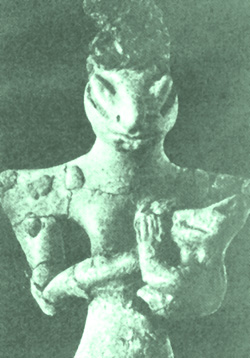
“In appearance the serpent gods were tall, at least 8 to 10 feet, and walked on two feet. They had a tail like a reptile and a tough hide somewhat like a lizard but with a large amount of horny or scaly skin. Their hide was generally lustrous and smooth, somewhat like a chameleon and probably varied in different hues of green and gray… They had short horns on their head which they considered to be a sign of divinity. Humans were repulsive to them because they were hairy, had soft skins and bony limbs.”
“The sons of the Serpent gods, the Nephilim of the Bible, which descended before the Deluge and mated with human women also dabbled in genetic engineering,” concludes Boulay. “Eventually mankind will have to learn the truth about his origins and face the fact that his gods and ancestors were reptiles, truly monsters by any of our current definitions. There will be a great cultural shock as we have never seen before,” Boulay predicts.
“There are three suggested origins for the Anunnaki reptilian intervention in human affairs,” writes Icke. “1. They are extraterrestrials; 2. They are ‘inner’ terrestrials who live within the earth; 3. They manipulate humanity from another dimension by ‘possessing’ human bodies. I think they are all true.”
Icke’s book is a repository of mind-bending, paradigm-shifting information which sounds like a grade-Z sci-fi movie – until you read the evidence. His premise is simple – what if the Global Power Elite are part of these reptilian bloodlines still controlling and ruling Planet Earth as their own private galactic fiefdom?
“These bloodlines,” writes Icke, “became the British and European aristocracy and royal families and thanks to the ‘Great’ British Empire, they were exported across the world to rule the Americas, Africa, Asia, Australia, New Zealand and so on. These genetic lines are manipulated into the positions of political, military, media, banking and business power and thus these positions are held by lower fourth dimensional reptilians hiding behind a human form or by mind-puppets of these same creatures.”
“These same reptilians have been occupying the bodies of all the main players in the conspiracy going back to ancient times,” continues Icke. “The obsession with interbreeding within the [Babylonian] Brotherhood bloodstreams comes from the need to hold the reptilian genetic inheritance and therefore maintain the vibrational connection between the human body on the third dimension and its controlling force on the lower fourth. It was to hide this truth that they arranged the destruction of ancient historical records, texts, and accounts over the centuries as they ravaged and raped the native societies of the world. The reptilians wanted to destroy all memory and records of their earlier open existence and control in the past. If they could do that, humanity would have no idea that they were being controlled through physical bodies that look human by a fourth dimensional force.”
Clow refers to the physical incarnation of this race on Earth. “They [the Anunnaki] nevertheless have received a measure of control over the planet’s surface,” she writes. “Most notably they have achieved the ability to incarnate. No longer will they have to persuade the people to build temples in order to link up to their own control centres; no longer will they require a channel to enter Earth; now they can become humans themselves.”
“The various non-physical lizards creeping around the canals of Baalbek are considerably attracted to the idea of taking human form through incarnation,” she continues. “They look forward to creating fear more directly. These monsters are not content to lumber around as fourth dimensional reptiles, occasionally eating someone up. Much more appealing to them is the idea of actually entering the third dimension – in the twentieth century, for example, actually becoming an Adolf Hitler, a Charles Manson, a Stephen King, or making the twentieth century film that creates fear of the act of eating, the ‘Night of the Living Dead/ They will even baldly show themselves for who they really are by creating a movie called ‘V.’”
Other sci-fi movies with this theme of alien-reptilians on Earth include “The Arrival,” “They Live.” And “Alien Resurrection.”
“You must realise that the Holy Land is a laboratory of stellar control patterns,” writes Clow. “In temple secrecy, we were taught everything about the visitors, but this information was taken out of the Bible. For 300,000 years, the central agenda by the Nibiruans [colonists from Nibiru, also called Marduk] has been to control the Earth and the use of its resources.”
It is also a special time, the return of humanity’s spiritual powers and the choice of self-transcendence. “The return of these archetypal powers is also a result of your ability to perceive wider spans of the light spectrum,” she continues. “This expanding vision is your key to integrating all the dimensions into your awareness. This broader awareness is natural, but it was once taken from you by the ‘gods.’ The Nibiruans and other visitors – those demigods who felt disconnected from their Source – narrowed your perceptive abilities in order to help themselves materialise on Earth.”
“The Nibiruan mind-set that has poisoned planet Earth has most recently manifested as the reptilian attitude that American political leaders call the ‘New World Order.’ This is a mind-set that believes in scarcity and limitation when the Earth is actually abundant and unlimited. This is the mind-set that would throw all the people into crocodile pits. The world’s power brokers are gluttons who control more resources than they need in order to protect themselves against the scarcity they fear.”
Clow calls them the World Management Team, which she defines as “individuals in the third dimension who are controlled by the Anunnaki who impulse them to carry out plans that benefit Nibiru and not Earth. All individuals working in Team agencies – such as in the Vatican, secret societies, banks, governments, school systems, the medical system and many businesses – are agents of the Anunnaki, unless they are conscious of the Annunaki vibrations and do not carry out their plans. In recent days, the World Management Team has been calling itself the New World Order.”
“The fallen angels have sidetracked themselves by playing around with various experiments which have been creative but without wisdom. As the third dimension has become increasingly complex, especially during the last five thousand years, the angels have amused themselves by being voyeurs of the results of materialisations. Technology with no divine inspiration or wisdom has been the latest project of the [fallen] angels.”
After all, Christ himself admonished his students, “Be ye wise as serpents.” What did he mean?
Prior to this time, she contends that “all sex was very natural. You easily merged electromagnetic fields and your physical bodies, and the vibrations of the Moon, Sun and planets flowed through your kundalini channels. You were drawn to each other by planetary affinities in your birth charts and merging was always easy and pleasurable. Sex with the Anunnaki was forced and unnatural in so many ways because there were few energy affinities. You became confused while the gods felt kundalini energy for the first time. They loved it. Male gods even had a lot of sex with each other and with the few female goddesses once they found out what sex felt like on Earth…”
“All imbalances between men and women today come from energetic imprints of incompatible energy fusion from these ancient times,” writes Clow. “Your loathing for reptiles also comes from this phase of your evolution because the most embodied Anunnaki were very reptilian, and those Anunnaki were the ones who could mate with human females.”
In one of the seemingly uncensored passages in the scriptures, Jesus rebuked them saying, “Ye serpents! Ye generation of vipers, how can ye escape the damnation of hell? Wherefore behold, I send unto you prophets and wise men and scribes, and some of them ye shall kill and crucify, and some of them ye shall scourge in your synagogues and persecute them from city to city, that upon you may come all the righteous blood shed upon the earth, from the blood of righteous Zacharias, son of Barchias, whom ye slew between the temple and the altar.” (Matt. 23) The bloodlust and the modus operandi of the embodied Watchers has changed little in the two thousand years since.
More references to the “generation of vipers” are in Matt. 3:7, Matt. 12:34-35 and Luke 3:7. They are also called “princes of this world.” Despite censoring, tampering and editing the Bible, code words or euphemisms for this reptilian race in the Old Testament include terms like “the wicked,” “mighty men,” “the giants,” and “evildoers.”
“The creator gods who have been ruling this planet have the ability to become physical, though mostly they exist in other dimensions,” she writes. “They keep energy at a certain vibrational frequency while they create emotional trauma to nourish themselves.”
“You have only dealt with gods who have wanted to be admired and to confuse you and who have thought of Earth as a principality, a place that they own out in the galactic fringes of this free-will universe.”
Marciniak semi-facetiously calls these hybrid part-human part-reptilian beings, ‘Lizzies.’ “These beings, who are neither spiritually informed nor learned in spiritual ways, deny the existence of a spiritual force,” she writes. “They have developed scientific principles and technologies that scatter the laws of spirituality… It is possible to become a brilliant master of manipulating matter and reality without understanding spiritual connections.”
After all there’s nothing like a race of godless materialistic ‘Lizzies’ to diddle with your planet. And current world events reflect this reality every day.
In his inspired – and inspirational – book Not In His Image: Gnostic Vision, Sacred Ecology and the Future of Belief, John Lamb Lash deconstructs the “Belief Systems” (BS) of the Abrahamic religions – Christianity, Judaism and Islam, while explaining the metaphysical teachings of the so-called “Gnostics,” who have historically been disparaged as “pagans.”
After all, even the word “Gnostic” itself means “know it all,” a pejorative invented by the Roman Church to put down their rivals, who called themselves the Children of Seth. Despite the anti-Gnostic propaganda for the last 2,000 years, the Gnostics’ enlightened and holistic worldview has now become increasingly relevant because it describes so precisely the spiritual conflicts of our day.
The Gnostics taught that religion is the elaborate production of aliens who sold the concept of an off-planet Savior-Redeemer God (or an absentee landlord god, if you will) responsible for the patriarchal and fratricidal mindset endorsed by the Abrahamic religions.
In his groundbreaking exposition of the Gnostic perspective on Abrahamic mythology/religion, Lash writes that the Gnostics understood the origin of redemptive religion – “‘Yaldabaoth himself chose a certain man named Abraham and made a covenant with him’ but proposed a different way to view it. Yaldabaoth is the Demiurge, a.k.a. Yahweh or Jehovah, a demented pseudo-deity who works against humanity… Salvation by superhuman powers, rather than through the divine potential innate to humanity is the hallmark of extraterrestrial religion.”
Do the Abrahamic religions promote the reptilian-alien agenda? And are the “salvationist” dogmas and doctrines of the Abrahamic religions the work of “gods” working against the spiritual evolution of humanity?
The Gnostics called this “god” Yaldabaoth, their name for the Demiurge, a “pseudo-deity who claims to be the creator of the natural world, identified with the biblical father god called Yahweh or Jehovah,” in Lash’s words. They taught that he is a “demented pretender who works against humanity as the leader of the Archons,” which have been variously described as soulless beings or astral-mental parasites that “exaggerate human error and intrude upon humanity by psychic stealth in order to propagate the ideological virus of redemptive religion.”
Salvationist theology, writes Lash, promotes a belief system in “the Demiurge of the Old Testament, an arrogant demented pretender who claims that humans are ‘Made in His Image’. These four words are the corporate motto of patriarchy. Branded on the human soul, ‘Made in His Image’ signifies the total enslavement of humanity to an alien off-planet agenda. If the Gnostics were right, the rise of salvationism was a unique mistake for our species, not a new moral revelation. Nothing serves the hidden controllers for cover better than a message of cosmic love… a ruse to endorse and foster the victim-perpetrator bond. No matter how hard we try, we cannot derive a genuine message of love and goodness from divine paternalism. This is perhaps the hardest of all lessons that history can teach us.”
Is “religion” then just another stumbling-block on the ever-winding road of spiritual evolution?
The Gnostics’ perspective was that this alien belief system foisted upon humanity by the “Archons” was a primary cause of the spiritual stagnation that humanity endures into the 21st century.
Lash, on his website Metahistory.org, notes that the Dead Sea Scrolls, discovered in 1947, contain explicit accounts of threatening encounters with reptilians. For instance, the Testament of Amram:
“I saw Watchers in my vision, the dream-vision. Two of them were fighting over me, saying… and holding a great contest over me. I asked them, ‘Who are you, that you are thus empowered over me?’ They answered me, ‘We have been empowered and rule over mankind’. And they said to me, ‘Which one of us [will have you]?’ And I lifted my eyes, and looked at one of them directly. His appearance was dreadfully frightening, and his skin was multicoloured, darkly glittering scales.” (4Q542)
“Gifted with powers of paranormal perception, such as remote viewing, Gnostic seers who had met and repelled Archons observed the persisting presence of reptilians among the Dead Sea cult of the Zaddikim,” writes Lash. The First Apocalypse of James (NHL V, 3), which contains descriptions of face-to-face encounters with the reptilian aliens, warns that “Jerusalem is a dwelling place of many Archons.”
Is that the reason why the Middle East, and especially Palestine-Israel, are still the scene for such brutal warfare against the evolutions of Terra?
It becomes quite evident that Gnostic-based empirical mysticism conflicts with Salvationist-based Abrahamic religions on many levels. The alien agenda of Salvationism asserts that humans are in error, flawed and sinful “by nature” and require redemption and rescue from this condition by an intermediary, a messiah or through the observance of strict ritual law, while empirical mysticism claims that divinity itself is a natural essence of humanity and can be revealed through Mystery School initiation which can be used to combat this alien ideology.
“The reptilians manipulate from the lower fourth dimension, the so-called lower astral frequency range,” writes Icke. “To control this planet they have to keep the mass of humanity at or below that level and disconnect them from anything higher. Crucial to maintaining the human psyche in disconnected ignorance is the manipulation of low vibrational emotion, fear, guilt, resentment, dislike of self and condemnation of others which in the end are all expressions of fear. These are the very emotions which resonate to the frequency range of the lower fourth dimension and once we succumb to domination by these emotions, we succumb to the control of the reptilian consciousness.”
Icke says that “the more you open your heart, the more powerful this flow and the quicker you will synchronise with the rising vibrations and transform into a higher state of consciousness. If you close your heart and you close your mind, you will be resisting these changes and more and more of your energy will be spent fighting the very energies that will transform your life and set you free.”
Marciniak writes that the “3-D world is headed for a collision of dimensions – not a collision of worlds, a collision of dimensions. Many dimensions are going to come crashing into each other. The test, the initiation [will come] – and initiation always means to move through another reality, to conquer it and transmute it.”
“The battle of light and dark and good and evil is only between portions of yourself,” Marciniak continues. “These portions are multidimensional extensions or reincarnations of the same collective of energies that you are a part of as an individual… The avatars and masters have now permeated the gridwork of the world bringing with them their own tools for teaching … This hierarchy works with love, cherishes who you are and has been able to see through the time mechanisms that are keyed into the planet to know that consciousness is ready for the evolutionary leap.”
It is an awesome choice then for the residents of Earth – to be or not to be the Christ. Especially in the face of tens of thousand of years of indoctrination. This includes lifetime after lifetime of hard-core programming that “sin” is our original legacy as well as continuous mind control through religion that guilt and fear are mankind’s “natural” estate.
Sifting out the so-called “tares among the wheat” is an ongoing process – within oneself and the planet as a whole. On a personal level, each decision to act ethically and morally is crucial. If fear is the lock on the virtual prison of Planet Earth, then Love is the key to soul liberation. The victory over the Nephilim enslavement of humanity, however, is ineluctable. After all, we’re all playing for keeps…
R.A. Boulay, Flying Serpents and Dragons: The Story of Mankind’s Reptilian Past (1990), The Book Tree, Escondido, CA, USA, www.thebooktree.com
Gregg Braden, Awakening to Zero Point (1994), Walking-Between the Worlds (1998), Laura Lee Productions, Washington, USA, www.lauralee.com
Barbara Hand Clow, Eye of the Centaur (1986), Heart of the Christos (1989), Signet of Atlantis (1992), The Pleiadian Agenda (1995).
Lloyd deMause, Foundations of Psychohistory (1982), Institute of Psychohistory, New York, USA, www.psychohistory.com
Samuel Noah Kramer, History Begins at Sumer (1959), Doubleday Anchor Books, New York, USA.
John Lamb Lash, Not In His Image: Gnostic Vision, Sacred Ecology and the Future of Belief (2006), Chelsea Green Publishing, Vermont, USA.
John Lamb Lash, www.metahistory.org
Barbara Marciniak, Bringers of the Dawn (1992), Earth (1995), Family of Light (1998), Bear & Company, Vermont, USA.
Elaine Pagels, The Gnostic Gospels (1979), The Origin of Satan (1995), Vintage Books, New York, USA.
Zechariah Sitchin, The Twelfth Planet (1976), The Stairway to Heaven (1980), The Wars of Gods and Men (1985), When Time Began (1993), Genesis Revisited (1990), Divine Encounters (1995), The Cosmic Code (1998), Avon Books, New York, USA.
William Irwin Thompson, At the Edge of History (1971), Harper Colophon Books, Islands in Time (1990), Bear & Co., Vermont, USA.
New (Reptilian) World Order
By Uri Dowbenko
What if Planet Earth was ostensibly run by a race of shape-shifting reptilians? Believe it or not, this outre’ political-science-fiction scenario has become a focus of historical researchers as well as spiritual visionaries. In fact, the resonance of corroborating evidence from science and metaphysics has a synchronicity that is nothing but astonishing.Serpents and flying dragons have, of course, been a staple of ancient myth and legends of indigenous people around the world. The assumption has always been, however, that they are metaphor or allegory – and not a literal description of actual beings.
But what about the admonition of Jesus and John the Baptist when they chided the “generation of vipers” and “serpents? What if they saw these creatures with their spiritual vision – the overshadowing of humans by astral beings from another dimension? How would they communicate this vision to others?
And what about the stories from the Book of Enoch and the Forbidden Books of the Bible which refer to the Nephilim – literally “Those Who Were Cast Down” – and the Watchers, the so-called “Fallen Angels”?
Sumeria: The Cradle (Or Test Tube) of Civilisation
Scholars and historians have been totally confounded by the abrupt rise of the Sumerian culture nearly 6,000 years ago in the Fertile Crescent of the Tigris and Euphrates Rivers. This “sudden civilisation” seemed to appear out of thin air and refused to conform to the popular historical theory of linear development in cultural evolution.Historian Professor Charles Hapgood squarely faces the issue when he writes that “today we find primitive cultures co-existing with advanced modem society on all continents… We shall now assume that 20,000 years ago while paleolithic peoples held out in Europe, more advanced cultures existed elsewhere on earth.”
Likewise the rise of Sumeria has been a major puzzle. Joseph Campbell in The Masks of God writes, “With stunning abruptness… there appears in this little Sumerian mud garden… the whole cultural syndrome that has since constituted the germinal unit of all high civilisations of the world.”
William Irwin Thompson puts it even more succinctly. “Sumer is a poor stoneless place for a neolithic culture to evolve from a peasant community into a full-blown civilisation,” he writes, “but it is a very good place to turn the plains and marshes into irrigated farmlands… In short, Sumer is an ideal place to locate a culture already having the technology necessary for urban life and irrigation agriculture.”
A more stunning conclusion was reached by Professor Samuel N. Kramer, one of the greatest Sumerologists of our time. He reviewed the table of contents from the Tablets of Sumer and found that each one of the 25 chapters described a Sumerian, and in fact a world-first, type of achievement.
The Sumerians had the world’s first medicine and pharmacopoeia. The world’s first brain surgery. The world’s first agriculture and farmer’s almanac. The world’s first cosmology and astronomy. The world’s first law codes. And they utilised a highly advanced technology capable of sophisticated metallurgy, smelting, refining and alloying as well as petroleum fuel refining. Most importantly, the Sumerians were responsible for the world’s first genetic engineering.
Like a mystery without a suspect, the Sumerian story remained a riddle, until historian-archaeologist Zechariah Sitchin published a remarkable book called The 12th Planet (1979). In his subsequent series entitled “The Earth Chronicles,” Sitchin describes in great detail the crossbreeding program of the Sumerian “gods” through genetic manipulation.
Having spent thirty years studying Sumerian, Assyrian, Babylonian and Hittite texts and the Old Testament in the original Hebrew, Sitchin deciphered the ancient scripts, transcribed them, transliterated them and, finally translated them.
His conclusion? Sitchin writes that the Sumerian civilisation did indeed appear out of thin air. The forerunner of Greek and Roman civilisation was initiated by a highly advanced race of extra-planetary colonists who came to earth, established their settlements, and began their single-minded pursuit of wealth and power by mining gold and other minerals necessary to sustain their high-tech high-maintenance lifestyle.
And who were these “colonists”? The Sumerians themselves described them as the “gods of heaven and earth.” They were also called “the ancient gods,” or the “olden gods,” and according to Sumerian lore, they had come down to earth from heaven. In the Hebrew text of the Old Testament, the Sumerian gods of heaven and earth are referred to as the Nephilim. The Sumerians themselves called the colonists the Anunnaki.
The Bible and Strong’s Concordance does not mention the Nephilim specifically by name, but Nelson’s Concordance has several listings. Sitchin translates the biblical verses from Genesis 6:4 as:
“The Nephilim were upon the Earth, in those days and thereafter too, when the sons of the gods cohabited with the daughters of Adam and they bore children unto them. They were the Mighty Ones of Eternity.”
And what does “Nephilim” actually mean? Normally translated into English as “giants,” the word stems from the Semitic root NFL (‘to be cast down’). It means exactly what it says – “Those who were cast down upon Earth.”
“Contemporary theologians and biblical scholars have tended to avoid the troublesome verses,” writes Sitchin, “but Jewish writings of the time of the Second Temple did recognise in these verses the echoes of ancient traditions of ‘fallen angels’.”
Tracks of the Nephilim and the Watchers
Apocryphal texts like the Book of Enoch, the Pseudepigrapha, and other politically incorrect so-called “Lost” Books of the Bible reflect a precise knowledge of fallen angels on Earth. In fact, scholars maintain that there were two accounts of separate “falls” of the angels. First, there was the archangel’s rebellion against God and his fall through pride, in which he was followed by other angels – the Nephilim. And second, there was the story of angels who “fell” (lowered their vibration and began their incarnations on Earth) through lusting after the daughters of men – the Watchers.According to the Book of Enoch, a band of angels led by Samyaza “became enamoured of the daughters of men” and decided to go after them, saying “come let us select for ourselves wives from the progeny of men, and let us beget children.” So they all took an oath, all two hundred of them, and descended to earth. “Then they took wives, each choosing for himself; who they began to approach, and with whom they cohabited; teaching them sorcery, incantations… Moreover Azazyel taught men to make swords, knives, shields… Then Michael and Gabriel, Raphael, Suryal and Uriel, looked down from heaven, and saw the quantity of blood which was shed on earth, and all the iniquity which was done upon it…”
Indeed, bloodshed, including ritual abuse and human sacrifice through endless wars are the hallmarks of these creatures.
Invasion of the Serpent “People”
In a book called Flying Serpents and Dragons: The Story of Mankind’s Reptilian Past, R.A. Boulay, a former NSA cryptographer, writes that “from a combination of ancient secular and religious sources, it is possible to piece together the story of our ancestry which lies in the coming of the alien serpent-gods or astronauts who colonised earth many eons ago.”In fact, the evidence lies in a complete reappraisal of the legends, myths and “history” of the world. The Sumerian legend of Gilgamesh and Agga points to this interaction of “humans” and “serpents.” And of course, there are the well-known “serpent gods” of the Indus Valley, the Nagas or Serpent race of Ancient India, and the Hindu epics, “Ramayana” and “Mahabharata,” which also deal with the serpent- gods. In Chinese history, “Vih King” describes how man and dragon lived peacefully together and even intermarried. And the serpent gods in American mythology are described in the Mayan book “Chilam Balam” where Itzamna, the serpent god is revered by the “people of the serpent.”
The story of St. George overcoming the “dragon” in England and St. Patrick driving the “serpents” out of Ireland are also part of Christian iconography.
Too many “coincidences” point to a pattern which has been seemingly willfully ignored by ivory tower mainstream academics and historians.
Before the Flood
According to Boulay, the Anunnaki genetic engineering was done by “combining the characteristics of the native ape man or neanderthal with their own saurian nature” producing the so-called Adam of the Old Testament. “This Adam was half-human and half-reptile, however, and being a clone could not reproduce himself.”Berossus, the Babylonian priest writing in 3rd century BCE Athens, claimed that man’s ancestry and origin can be traced to “Oannes,” an amphibious creature that came out of the Persian Gulf to teach the arts of civilisation to man. “Berossus called them ‘annedoti’ which translate as the ‘repulsive ones’ in Greek. He also refers to them as ‘musarus,’ an abomination,” writes Boulay. “If the tradition had been invented, a more normal attitude would have been to glorify these creatures as splendid gods or heroes, yet the fact that they chose to describe their ancestors this way argues for the authenticity of the account.”
“The Sumerian gods regarded Man as a convenience and nothing more,” says Boulay. “He supplied their wants, kept their cities, and provided cannon fodder for their various military ventures.” (Sound familiar?) “The gods could be cruel and unsympathetic masters. They considered humans merely as unruly children, not more important than pets, to be governed ruthlessly and without sentiment.”
The ruthless “policies” of the New World Order reflects this ancient bias in the incessant propaganda that a population “crisis” exists on the planet and that the best way to remedy the situation is through wars to kill off the “cannon fodder” or through abortion to kill off future “useless eaters,” those who consume resources without the value-added productivity that the masters of Earth require.
Boulay contends that the Old Testament begins at Sumer and there is a large body of religious literature besides the Book of Genesis which deals with the period before the Deluge. He cites sources such as the three Books of Enoch, the Book of Jubilees, Gnostic teachings, the Dead Sea scrolls, the Haggadah of the oral tradition of the Jews, the Rabbinical writings, the works of Josephus, and the Books of the Pseudepigrapha, especially the Book of Jubilees.
What Was the Serpent of Eden?
Carl Sagan cryptically titled one of his books The Dragons of Eden, but ancient Jewish legends describe the Serpent of Eden as manlike. In other words, he looked like a man and talked like a man. What does this mean?“The section of the Haggadah that deals with the Creation describes the Serpent who inhabited the Garden before the creation of Adam as an upright creature that stood on two feet and was equal in height to the camel,” writes Boulay. “The serpent was man-like in many ways. He was tall and stood upright on two legs. He did all the work of the gods particularly the mining and agricultural work. And above all the Serpent had an intellect superior to Man. These are all the attributes of the Anunnaki.”
Boulay says that “according to the Haggadah, the bodies of Adam and Eve ‘had been overlaid with a horny skin’ and moreover of Adam’s skin, it was said that ‘it was as bright as daylight and covered his body like a luminous garment. Adam thus had the outward appearance of a reptile with its scaly and shiny skin. It was for this reason that Adam and Eve did not wear nor did they need clothing for protection or comfort.”
“The reptilian appearance of the Biblical gods was a well-kept secret and only occasionally is it perceptible in the Old Testament,” writes Boulay. In a radical reinterpretation of scripture, he says that in the Haggadah, the source of Jewish legend and oral tradition, “it is revealed that Adam and Eve lost their ‘lustrous and horny hide’ as a result of eating the forbidden fruit. The Gnostics, rivals to the early Christians, relate that as a result of eating the fruit, Adam and Eve achieved knowledge, part of which was to realise that their creators were beastly forms.”
The Haggadah also explains what happened in the Garden after Adam and Eve ate the forbidden fruit. “The first result was that Adam and Eve became naked. Before their bodies had been overlaid with a horny skin and enveloped with a cloud of glory. No sooner had they violated the command given them than the cloud of glory and the horny skin dropped from them and they stood there in their nakedness.”
Even the bizarre ritual of circumcision may have a reptilian connection. “Just as the serpent achieves long life through sacrificing and leaving off part of himself, so man may also be saved by ritually sacrificing part of himself,” continues Boulay.
“The rite of circumcision also served as a perpetual reminder to man that his true origins lay in the serpent-god creator and that he existed at the forbearance of these gods.”
Why Cain Killed Abel
In a fascinating reassessment of the well-known Bible story of Cain and Abel, Boulay proposes an alternative rationale. For instance, in the Apocalypse of Adam, a Gnostic document of the 1st century CE, Adam reveals to his son Seth “that the Lord who created us created a son from himself and Eve your mother.”“If the deity was the father of Cain, while Adam sired Abel,” writes Boulay, “it would explain further events – Cain would be semi-divine, part-reptilian and more ‘god’-like.” About the birth of Cain, this document observes that Eve “bore a son and he was lustrous” – a description of the shiny luminous hide of the reptile gods. The Apocalyptic version of this text also describes Eve’s dream. She tells Adam, ‘My Lord, I saw a dream last night, the blood of my son Amilabes, called Abel, being thrust into the mouth of Cain his brother and he drank it mercilessly… And it did not stay in his stomach but came out of his mouth.’ They got up to see what happened and found Abel killed Cain.’”
The crime of Cain was apparently not only to commit fratricide but to eat the flesh and blood of his brother. “This behaviour seems more reptilian than human since Cain was sired by the deity unlike his brother who had Adam as his father,” concludes Boulay.
The Serpent Gods
What did the ancient ‘gods’ look like? “The coming of the Anunnaki coincided with the end of this period as the Earth began to dry out and the meat-eating dinosaurs and small mammals appeared,” says Boulay. “The reptile gods needed moisture and warmth and probably the reason why civilisations were founded at the mouth of great river systems – the Nile delta, the Indus River valley and the Tigris Euphrates system.”“In appearance the serpent gods were tall, at least 8 to 10 feet, and walked on two feet. They had a tail like a reptile and a tough hide somewhat like a lizard but with a large amount of horny or scaly skin. Their hide was generally lustrous and smooth, somewhat like a chameleon and probably varied in different hues of green and gray… They had short horns on their head which they considered to be a sign of divinity. Humans were repulsive to them because they were hairy, had soft skins and bony limbs.”
“The sons of the Serpent gods, the Nephilim of the Bible, which descended before the Deluge and mated with human women also dabbled in genetic engineering,” concludes Boulay. “Eventually mankind will have to learn the truth about his origins and face the fact that his gods and ancestors were reptiles, truly monsters by any of our current definitions. There will be a great cultural shock as we have never seen before,” Boulay predicts.
Reptilians Among Us
“Researchers into the reptilian phenomenon conclude that at least some originate in the Draco star constellation,” writes David Icke in his book The Biggest Secret.“There are three suggested origins for the Anunnaki reptilian intervention in human affairs,” writes Icke. “1. They are extraterrestrials; 2. They are ‘inner’ terrestrials who live within the earth; 3. They manipulate humanity from another dimension by ‘possessing’ human bodies. I think they are all true.”
Icke’s book is a repository of mind-bending, paradigm-shifting information which sounds like a grade-Z sci-fi movie – until you read the evidence. His premise is simple – what if the Global Power Elite are part of these reptilian bloodlines still controlling and ruling Planet Earth as their own private galactic fiefdom?
“These bloodlines,” writes Icke, “became the British and European aristocracy and royal families and thanks to the ‘Great’ British Empire, they were exported across the world to rule the Americas, Africa, Asia, Australia, New Zealand and so on. These genetic lines are manipulated into the positions of political, military, media, banking and business power and thus these positions are held by lower fourth dimensional reptilians hiding behind a human form or by mind-puppets of these same creatures.”
“These same reptilians have been occupying the bodies of all the main players in the conspiracy going back to ancient times,” continues Icke. “The obsession with interbreeding within the [Babylonian] Brotherhood bloodstreams comes from the need to hold the reptilian genetic inheritance and therefore maintain the vibrational connection between the human body on the third dimension and its controlling force on the lower fourth. It was to hide this truth that they arranged the destruction of ancient historical records, texts, and accounts over the centuries as they ravaged and raped the native societies of the world. The reptilians wanted to destroy all memory and records of their earlier open existence and control in the past. If they could do that, humanity would have no idea that they were being controlled through physical bodies that look human by a fourth dimensional force.”
Incarnation of the Lizard-People
With a background in Jungian psychology, author Barbara Hand Clow excels in shamanic cosmology, an intuitive storytelling technique that integrates history, legend and myth using her own internal guidance. In the third volume of her “Mind Chronicles Trilogy” called Signet of Atlantis, she also tackles the problem of the “lizard race” from her own perspective.Clow refers to the physical incarnation of this race on Earth. “They [the Anunnaki] nevertheless have received a measure of control over the planet’s surface,” she writes. “Most notably they have achieved the ability to incarnate. No longer will they have to persuade the people to build temples in order to link up to their own control centres; no longer will they require a channel to enter Earth; now they can become humans themselves.”
“The various non-physical lizards creeping around the canals of Baalbek are considerably attracted to the idea of taking human form through incarnation,” she continues. “They look forward to creating fear more directly. These monsters are not content to lumber around as fourth dimensional reptiles, occasionally eating someone up. Much more appealing to them is the idea of actually entering the third dimension – in the twentieth century, for example, actually becoming an Adolf Hitler, a Charles Manson, a Stephen King, or making the twentieth century film that creates fear of the act of eating, the ‘Night of the Living Dead/ They will even baldly show themselves for who they really are by creating a movie called ‘V.’”
Other sci-fi movies with this theme of alien-reptilians on Earth include “The Arrival,” “They Live.” And “Alien Resurrection.”
“You must realise that the Holy Land is a laboratory of stellar control patterns,” writes Clow. “In temple secrecy, we were taught everything about the visitors, but this information was taken out of the Bible. For 300,000 years, the central agenda by the Nibiruans [colonists from Nibiru, also called Marduk] has been to control the Earth and the use of its resources.”
It is also a special time, the return of humanity’s spiritual powers and the choice of self-transcendence. “The return of these archetypal powers is also a result of your ability to perceive wider spans of the light spectrum,” she continues. “This expanding vision is your key to integrating all the dimensions into your awareness. This broader awareness is natural, but it was once taken from you by the ‘gods.’ The Nibiruans and other visitors – those demigods who felt disconnected from their Source – narrowed your perceptive abilities in order to help themselves materialise on Earth.”
“The Nibiruan mind-set that has poisoned planet Earth has most recently manifested as the reptilian attitude that American political leaders call the ‘New World Order.’ This is a mind-set that believes in scarcity and limitation when the Earth is actually abundant and unlimited. This is the mind-set that would throw all the people into crocodile pits. The world’s power brokers are gluttons who control more resources than they need in order to protect themselves against the scarcity they fear.”
Clow calls them the World Management Team, which she defines as “individuals in the third dimension who are controlled by the Anunnaki who impulse them to carry out plans that benefit Nibiru and not Earth. All individuals working in Team agencies – such as in the Vatican, secret societies, banks, governments, school systems, the medical system and many businesses – are agents of the Anunnaki, unless they are conscious of the Annunaki vibrations and do not carry out their plans. In recent days, the World Management Team has been calling itself the New World Order.”
The Coming of Christ
“Since the coming of Christos, the time has come to choose life over death,” writes Barbara Hand Clow in her book Heart of the Christos. “The death wish comes from the paralysing fear of the black place – Orion. In the wars with Orion, pain and separation were first experienced, and after that point many souls chose to cease to be. But all changed with Christos. A being of such love and compassion came to Earth that now all souls have access to the desire to be alive, to be alive just to experience the love of Christos.”“The fallen angels have sidetracked themselves by playing around with various experiments which have been creative but without wisdom. As the third dimension has become increasingly complex, especially during the last five thousand years, the angels have amused themselves by being voyeurs of the results of materialisations. Technology with no divine inspiration or wisdom has been the latest project of the [fallen] angels.”
After all, Christ himself admonished his students, “Be ye wise as serpents.” What did he mean?
The Rape of the Anunnaki
According to many leading experts, sex has gotten a bad name ever since the trauma of the Anunnaki who came to this planet and raped the women of Earth. In The Pleiadian Agenda, Barbara Hand Clow writes that “the Anunnaki selected women to have sex with them so they could actually birth themselves into the incarnational cycles of Earth, and that was something that had never occurred before.”Prior to this time, she contends that “all sex was very natural. You easily merged electromagnetic fields and your physical bodies, and the vibrations of the Moon, Sun and planets flowed through your kundalini channels. You were drawn to each other by planetary affinities in your birth charts and merging was always easy and pleasurable. Sex with the Anunnaki was forced and unnatural in so many ways because there were few energy affinities. You became confused while the gods felt kundalini energy for the first time. They loved it. Male gods even had a lot of sex with each other and with the few female goddesses once they found out what sex felt like on Earth…”
“All imbalances between men and women today come from energetic imprints of incompatible energy fusion from these ancient times,” writes Clow. “Your loathing for reptiles also comes from this phase of your evolution because the most embodied Anunnaki were very reptilian, and those Anunnaki were the ones who could mate with human females.”
Serpents. Dragons. Reptilians. Coincidence or Conspiracy?
Satan and the fallen angels are often pictured as serpent-reptilians themselves.In one of the seemingly uncensored passages in the scriptures, Jesus rebuked them saying, “Ye serpents! Ye generation of vipers, how can ye escape the damnation of hell? Wherefore behold, I send unto you prophets and wise men and scribes, and some of them ye shall kill and crucify, and some of them ye shall scourge in your synagogues and persecute them from city to city, that upon you may come all the righteous blood shed upon the earth, from the blood of righteous Zacharias, son of Barchias, whom ye slew between the temple and the altar.” (Matt. 23) The bloodlust and the modus operandi of the embodied Watchers has changed little in the two thousand years since.
More references to the “generation of vipers” are in Matt. 3:7, Matt. 12:34-35 and Luke 3:7. They are also called “princes of this world.” Despite censoring, tampering and editing the Bible, code words or euphemisms for this reptilian race in the Old Testament include terms like “the wicked,” “mighty men,” “the giants,” and “evildoers.”
‘Lizzies’ and the Human Dilemma
Barbara Marciniak, author of Bringers of the Dawn, Earth and Family of Light comes to a similar conclusion about Earth and the reptilian agenda.“The creator gods who have been ruling this planet have the ability to become physical, though mostly they exist in other dimensions,” she writes. “They keep energy at a certain vibrational frequency while they create emotional trauma to nourish themselves.”
“You have only dealt with gods who have wanted to be admired and to confuse you and who have thought of Earth as a principality, a place that they own out in the galactic fringes of this free-will universe.”
Marciniak semi-facetiously calls these hybrid part-human part-reptilian beings, ‘Lizzies.’ “These beings, who are neither spiritually informed nor learned in spiritual ways, deny the existence of a spiritual force,” she writes. “They have developed scientific principles and technologies that scatter the laws of spirituality… It is possible to become a brilliant master of manipulating matter and reality without understanding spiritual connections.”
After all there’s nothing like a race of godless materialistic ‘Lizzies’ to diddle with your planet. And current world events reflect this reality every day.
Transcending the Virus of Salvationist Religion
Is “religion” itself then a virus insinuated into society by an alien extraterrestrial species for the purpose of societal control?In his inspired – and inspirational – book Not In His Image: Gnostic Vision, Sacred Ecology and the Future of Belief, John Lamb Lash deconstructs the “Belief Systems” (BS) of the Abrahamic religions – Christianity, Judaism and Islam, while explaining the metaphysical teachings of the so-called “Gnostics,” who have historically been disparaged as “pagans.”
After all, even the word “Gnostic” itself means “know it all,” a pejorative invented by the Roman Church to put down their rivals, who called themselves the Children of Seth. Despite the anti-Gnostic propaganda for the last 2,000 years, the Gnostics’ enlightened and holistic worldview has now become increasingly relevant because it describes so precisely the spiritual conflicts of our day.
The Gnostics taught that religion is the elaborate production of aliens who sold the concept of an off-planet Savior-Redeemer God (or an absentee landlord god, if you will) responsible for the patriarchal and fratricidal mindset endorsed by the Abrahamic religions.
In his groundbreaking exposition of the Gnostic perspective on Abrahamic mythology/religion, Lash writes that the Gnostics understood the origin of redemptive religion – “‘Yaldabaoth himself chose a certain man named Abraham and made a covenant with him’ but proposed a different way to view it. Yaldabaoth is the Demiurge, a.k.a. Yahweh or Jehovah, a demented pseudo-deity who works against humanity… Salvation by superhuman powers, rather than through the divine potential innate to humanity is the hallmark of extraterrestrial religion.”
Do the Abrahamic religions promote the reptilian-alien agenda? And are the “salvationist” dogmas and doctrines of the Abrahamic religions the work of “gods” working against the spiritual evolution of humanity?
The Gnostics called this “god” Yaldabaoth, their name for the Demiurge, a “pseudo-deity who claims to be the creator of the natural world, identified with the biblical father god called Yahweh or Jehovah,” in Lash’s words. They taught that he is a “demented pretender who works against humanity as the leader of the Archons,” which have been variously described as soulless beings or astral-mental parasites that “exaggerate human error and intrude upon humanity by psychic stealth in order to propagate the ideological virus of redemptive religion.”
Salvationist theology, writes Lash, promotes a belief system in “the Demiurge of the Old Testament, an arrogant demented pretender who claims that humans are ‘Made in His Image’. These four words are the corporate motto of patriarchy. Branded on the human soul, ‘Made in His Image’ signifies the total enslavement of humanity to an alien off-planet agenda. If the Gnostics were right, the rise of salvationism was a unique mistake for our species, not a new moral revelation. Nothing serves the hidden controllers for cover better than a message of cosmic love… a ruse to endorse and foster the victim-perpetrator bond. No matter how hard we try, we cannot derive a genuine message of love and goodness from divine paternalism. This is perhaps the hardest of all lessons that history can teach us.”
Is “religion” then just another stumbling-block on the ever-winding road of spiritual evolution?
The Gnostics’ perspective was that this alien belief system foisted upon humanity by the “Archons” was a primary cause of the spiritual stagnation that humanity endures into the 21st century.
Lash, on his website Metahistory.org, notes that the Dead Sea Scrolls, discovered in 1947, contain explicit accounts of threatening encounters with reptilians. For instance, the Testament of Amram:
“I saw Watchers in my vision, the dream-vision. Two of them were fighting over me, saying… and holding a great contest over me. I asked them, ‘Who are you, that you are thus empowered over me?’ They answered me, ‘We have been empowered and rule over mankind’. And they said to me, ‘Which one of us [will have you]?’ And I lifted my eyes, and looked at one of them directly. His appearance was dreadfully frightening, and his skin was multicoloured, darkly glittering scales.” (4Q542)
“Gifted with powers of paranormal perception, such as remote viewing, Gnostic seers who had met and repelled Archons observed the persisting presence of reptilians among the Dead Sea cult of the Zaddikim,” writes Lash. The First Apocalypse of James (NHL V, 3), which contains descriptions of face-to-face encounters with the reptilian aliens, warns that “Jerusalem is a dwelling place of many Archons.”
Is that the reason why the Middle East, and especially Palestine-Israel, are still the scene for such brutal warfare against the evolutions of Terra?
It becomes quite evident that Gnostic-based empirical mysticism conflicts with Salvationist-based Abrahamic religions on many levels. The alien agenda of Salvationism asserts that humans are in error, flawed and sinful “by nature” and require redemption and rescue from this condition by an intermediary, a messiah or through the observance of strict ritual law, while empirical mysticism claims that divinity itself is a natural essence of humanity and can be revealed through Mystery School initiation which can be used to combat this alien ideology.
Breaking the Spell
So why does the spell continue? Obviously the shedding of blood through satanic ritual murders and wars replenishes the energies they feed on. Negative emotions like fear and hatred are another source of their so-called power.“The reptilians manipulate from the lower fourth dimension, the so-called lower astral frequency range,” writes Icke. “To control this planet they have to keep the mass of humanity at or below that level and disconnect them from anything higher. Crucial to maintaining the human psyche in disconnected ignorance is the manipulation of low vibrational emotion, fear, guilt, resentment, dislike of self and condemnation of others which in the end are all expressions of fear. These are the very emotions which resonate to the frequency range of the lower fourth dimension and once we succumb to domination by these emotions, we succumb to the control of the reptilian consciousness.”
Icke says that “the more you open your heart, the more powerful this flow and the quicker you will synchronise with the rising vibrations and transform into a higher state of consciousness. If you close your heart and you close your mind, you will be resisting these changes and more and more of your energy will be spent fighting the very energies that will transform your life and set you free.”
Marciniak writes that the “3-D world is headed for a collision of dimensions – not a collision of worlds, a collision of dimensions. Many dimensions are going to come crashing into each other. The test, the initiation [will come] – and initiation always means to move through another reality, to conquer it and transmute it.”
“The battle of light and dark and good and evil is only between portions of yourself,” Marciniak continues. “These portions are multidimensional extensions or reincarnations of the same collective of energies that you are a part of as an individual… The avatars and masters have now permeated the gridwork of the world bringing with them their own tools for teaching … This hierarchy works with love, cherishes who you are and has been able to see through the time mechanisms that are keyed into the planet to know that consciousness is ready for the evolutionary leap.”
It is an awesome choice then for the residents of Earth – to be or not to be the Christ. Especially in the face of tens of thousand of years of indoctrination. This includes lifetime after lifetime of hard-core programming that “sin” is our original legacy as well as continuous mind control through religion that guilt and fear are mankind’s “natural” estate.
Sifting out the so-called “tares among the wheat” is an ongoing process – within oneself and the planet as a whole. On a personal level, each decision to act ethically and morally is crucial. If fear is the lock on the virtual prison of Planet Earth, then Love is the key to soul liberation. The victory over the Nephilim enslavement of humanity, however, is ineluctable. After all, we’re all playing for keeps…
References
Author interviews with David Icke, Barbara Hand Clow and Barbara MarciniakR.A. Boulay, Flying Serpents and Dragons: The Story of Mankind’s Reptilian Past (1990), The Book Tree, Escondido, CA, USA, www.thebooktree.com
Gregg Braden, Awakening to Zero Point (1994), Walking-Between the Worlds (1998), Laura Lee Productions, Washington, USA, www.lauralee.com
Barbara Hand Clow, Eye of the Centaur (1986), Heart of the Christos (1989), Signet of Atlantis (1992), The Pleiadian Agenda (1995).
Lloyd deMause, Foundations of Psychohistory (1982), Institute of Psychohistory, New York, USA, www.psychohistory.com
Samuel Noah Kramer, History Begins at Sumer (1959), Doubleday Anchor Books, New York, USA.
John Lamb Lash, Not In His Image: Gnostic Vision, Sacred Ecology and the Future of Belief (2006), Chelsea Green Publishing, Vermont, USA.
John Lamb Lash, www.metahistory.org
Barbara Marciniak, Bringers of the Dawn (1992), Earth (1995), Family of Light (1998), Bear & Company, Vermont, USA.
Elaine Pagels, The Gnostic Gospels (1979), The Origin of Satan (1995), Vintage Books, New York, USA.
Zechariah Sitchin, The Twelfth Planet (1976), The Stairway to Heaven (1980), The Wars of Gods and Men (1985), When Time Began (1993), Genesis Revisited (1990), Divine Encounters (1995), The Cosmic Code (1998), Avon Books, New York, USA.
William Irwin Thompson, At the Edge of History (1971), Harper Colophon Books, Islands in Time (1990), Bear & Co., Vermont, USA.
Writer and Artist URI DOWBENKO is the author of Bushwhacked: Inside Stories of True Conspiracy and Hoodwinked: Watching Movies with Eyes Wide Open. He is also the founder and publisher of www.ConspiracyPlanet.com, www.ConspiracyDigest.com, www.AlMartinRaw.com, and www.InsiderIntelligence.com, as well as the publisher of The Conspirators: Secrets of an Iran Contra Insider by Al Martin. You can visit Uri at www.UriDowbenko.com and www.NewImprovedArt.com.
The above article appeared in New Dawn Special Issue 7.