Saturday, January 19, 2013

Frenzy in the Gold Market: The Repatriation of Germany’s Post World War II Gold Reserves

Frenzy in the Gold Market: The Repatriation of Germany’s Post World War II Gold Reserves

gold
The decision of Germany’s Bundesbank to repatriate part of its Gold Reserves held at the New York Federal Reserve bank has triggered a frenzy in the gold market.
German news sources suggest that a large portion of the German gold stored in the vaults of the New York Fed and the Banque de France is to be moved back to Germany.
According to analysts, this move could potentially “trigger a chain reaction, prompting other countries to start repatriating the gold stored in London, New York or Paris…. “
If gold repatriation becomes a worldwide trend, it will be obvious that both the US and UK have lost their credibility as gold custodians. For gold markets worldwide, this move may mark a switch from “financial gold” to “physical gold”, but the process is definitely in its early stages.
The decision to repatriate the German gold is a big victory for a part of the German press that first forced the Bundesbank to admit that 69% of its gold is stored outside Germany. Almost certainly both the German press and at least several German lawmakers will demand a verification procedure for the gold bars returned from New York, just to make sure that Germany doesn’t receive gold-plated tungsten instead of gold. It seems that German decision makers no longer trust their American partners. (Voice of Russia, January 15, 2013, emphasis added)
While the issue is actively debated in Germany, US financial reports have downplayed the significance of  this historic decision, approved by the German government last September.
Meanwhile, a  “Repatriate our Gold” campaign has been launched by several German economists, business executives and lawyers. The initiative does not apply solely to Germany. It calls upon countries to initiate the homeland repatriation of ALL gold holdings held in foreign central banks.
While national sovereignty and custody over Germany’s gold assets is part of the debate, several observers –including politicians– have begged the question: “can we trust the foreign central banks” (namely the US, Britain and France) which are holding Germany’s gold bars “in safe keeping”:
…Several German politicians have … voiced unease. Philipp Missfelder, a leading lawmaker from Chancellor Angela Merkel’s center-right party, has asked the Bundesbank for the right to view the gold bars in Paris and London, but the central bank has denied the request, citing the lack of visitor rooms in those facilities, German daily Bild reported.
Given the growing political unease about the issue and the pressure from auditors, the central bank decided last month [September] to repatriate some 50 tons of gold in each of the three coming years from New York to its headquarters in Frankfurt for ‘‘thorough examinations’’ regarding weight and quality, the report revealed.
…Several passages of the auditors’ report were blackened out in the copy shared with lawmakers, citing the Bundesbank’s concerns that they could compromise secrets involving the central banks storing the gold.
The report said that the gold pile in London has fallen ‘‘below 500 tons’’ due to recent sales and repatriations, but it did not specify how much gold was held in the U.S. and in France. German media have widely reported that some 1,500 tons — almost half of the total reserves — are stored in New York.
( Associated Press, Oct 22, 2012, emphasis added )
A full and complete repatriation of gold assets, however,  is not envisaged:
“The Bundesbank plans to transfer 300 tonnes of gold from the Federal Reserve in New York and all of its gold stored at the Banque de France in Paris, 374 tonnes, to Frankfurt. beginning this year,
By 2020, it wants to hold half of the nearly 3,400 tonnes of gold valued at almost 138 billion euros – only the United States holds more – in Frankfurt, where it stores about a third of its reserves. The rest is kept at the Federal Reserve, the Banque de France and the Bank of England. (Reuters, January 16, 2012)
The German Federal Court of Auditors has called for an official inspection of German gold reserves stored at foreign central banks, “because they have never been fully checked“.
Are these German bullion reserves held at the Federal Reserve “separate” or are they part of the Federal Reserve’s fungible “big pot” of gold assets.
Does the New York Federal Reserve Bank have Fungible Gold Assets to the Degree Claimed”?  Could it reasonably meet a process of homeland repatriation of gold assets initiated by several countries simultaneously?
According to the NY Federal Reserve, 98% of  its gold bullion reserves is in custody, i.e. it belongs to foreign countries. The remaining 2% belongs to the IMF and the NY Federal Reserve Bank. In a bitter irony the actual gold reserves of the NY Federal Reserve Bank are minimal.
Why is German Gold held outside Germany?
“Why is our gold in Paris, London and New York” and not in Frankfurt ?
The official explanation –which borders on the absurd– is that West Germany at the outset of the Cold War decided to store its central bank gold assets in London, Paris, and New York to “put them out of reach of the Soviet empire” which was allegedly intent upon looting West Germany’s gold treasures.
According to Reuters:
As the Cold War set in, Germany kept its gold reserves put, keeping them out of reach of the Soviet empire. But government officials have grown uneasy about the storage set-up and have called for the Bundesbank to inspect the bars.
The Bundesbank now wants to change the arrangement too, even though it has said it does not see a need to count the bars or check their gold content itself and considers written assurances from the other central banks as sufficient.
With the end of the Cold War it was no longer necessary to keep Germany’s gold reserves “as far to the west and as far from the Iron Curtain as possible”, Bundesbank board member Carl-Ludwig Thiele told reporters on Wednesday.
The Bundesbank gained more space in its vaults after the transition to the euro from the deutschmark. Reuters, January 16, 2013)
According to the Western media, in chorus, the threats of the “evil empire” in the course of the Cold War era had so to speak encouraged the “looking after” and “safe-keeping” of billions of dollars of German gold bullion in the secure central bank vaults of France, England and America. This was a “responsible” initiative undertaken by these three countries –”friends of West Germany”– with a view to allegedly assisting the Bundesbank located in Frankfurt am Main against an imminent attack by The Red Army.
But now more than 21 years after the official end of the Cold War (1991), the Bundesbank “plans to bring home some of its gold reserves stored in the United States’ and French central banks, bowing to government pressure to unwind a Cold War-era ploy that secured the national treasure.”
What was the objective of the US, in the wake of the World War II in pressuring countries to deposit their gold bullion in the custody of the US Federal Reserve?
Historically, the accumulation of gold bullion in the vaults of the US Federal Reserve (on behalf of foreign countries) has indelibly served to strengthen the global dollar system, both during the period of the (Bretton Woods) post-war “gold exchange standard” (1946-1971) as well as in its aftermath (1971-).
History: In the Wake of World War II
The gold bullion storage arrangement has nothing to do with the Soviet threat, as conveyed in official statements.
It has a lot to do with the history of World War II and its immediate aftermath.
The early postwar central banking arrangement was dictated by the Victors of World War II, namely America, France and Britain.
The military occupation governments of these three countries directly controlled the post-war monetary reforms implemented in West Germany starting in 1945.
West Germany had been split up into three zones, respectively under the jurisdiction of the US, Britain and France (see map below). From 1945 to 1947, The Reichmark continued to circulate with new paper money printed in the US.
__________________________________________________________________________________________________________________________________
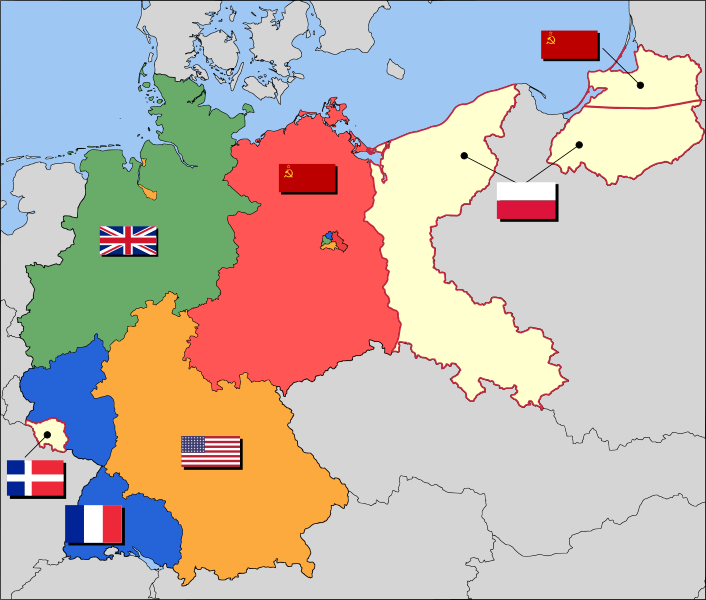
File:Map-Germany-1945.svg
Post-Nazi German occupation borders and territories. Areas in beige indicate territories east of the Oder-Neisse line that were attached to Poland and the USSR. The Saar Protectorate, on the lefthand side of the map, is also shown in beige.  Berlin is the multinational area shown within the red Soviet zone. (source: Wikipedia)

__________________________________________________________________________________________________________________________________
In 1947, the US and UK controlled occupation zones merged into an Anglo-American “BiZone”.  In 1948, under a so-called “First Law on Currency Reform”, the occupation military government set up the Bank deutscher Länder (Bank of the German States) in liaison with  the US Federal Reserve and the Bank of England.  The currency reforms were implemented in parallel with the Marshall Plan, launched in June 1947.
The Bank deutscher Länder (BdL) was to manage the monetary system of the Länder  (equivalent to states in a federal structure) in the Bizone under the jurisdiction of the US-UK military government, leading to the establishment of the Deutsche Mark in June 1948, which replaced the Reichsmark.
Ludwig Erhard –who became Finance Minister under the FGR government of Conrad Adenauer and then German Chancellor (1963-1966)– played a central role in the process of monetary reform.  He started his political career as an economic consultant to the US military Government (USMG). In 1947, he was appointed chairman of the currency reform commission. From January 1947 to May 1949, the US  military governor of the US zone (USMG) who supervised the setting up the new currency arrangement was General Lucius D. Clay, nicknamed “Der Kaiser”.
The Deutsche Mark initiative was then extended to the occupation zone controlled by France in November 1948 (“TriZone” arrangement), with the inclusion and participation of the Banque de France.
While the Federal Republic of Germany (FRG) (Bundesrepublik Deutschland), was created in May 1949, the Bundesbank only came into existence 8 years later, in 1957.
Germany’s gold reserves were under the jurisdiction of the Bank deutscher Länder  (and subsequently of the Bundesbank). But the BdL was an initiative of the US-UK-France military occupation governments.
Of significance, under the Bretton Woods gold exchange standard (1946-1971), the dollar denominated export revenues accruing to West Germany were converted into gold at 32 dollars an ounce. In other words, the export earnings resulting from the sale  of German commodities in the US market were, in a sense, “returned” to America in the form of gold bullion which was deposited for “safe-keeping” at the New York Federal Reserve Bank.
The important question is the following:
Did the procedures and agreements determined by the occupation military governments in 1947-48  envisage a framework whereby part of West Germany’s gold bullion was to be held in the victors’ central banks, namely the Bank of England, the US Federal Reserve and the Banque de France?
Gold Reserves from the Third Reich
The issue of the gold reserves of the Third Reich is a subject matter in itself, beyond the scope of this article.
A couple of observations: As of 1945, large amounts of gold from the Third Reich were transferred into custody of the military governments. Part of this gold was used to finance war reparations:
In September 1946, the United States, Britain, and France established the Tripartite Commission for the Restitution of Monetary Gold (TGC). The commission has its roots in Part III of the Paris Agreement on Reparation, signed on January 14, 1946 concerning German war reparations. Under the 1946 Paris Agreement, the three Allies were charged with recovering monetary gold looted by Nazi Germany from banks in occupied Europe and placing it in a “gold pool.”
Claims against the gold pool and subsequent redistribution of the gold to claimant countries were to be adjudicated and executed by the three Allies. ” ( for further details see US State Department, Tripartie Gold Commission, February 24, 1997,
A Foreign Exchange Depositary (FED) had been established at the Reichbank in Frankfurt. Referred to as “the Fort Knox of Germany”, a  process of collection had been established `by the FED on behalf of the Allied Occupation Council.
Gold was collected by the FED, both in monetary and non-monetary form. By October 1947 –coinciding with the establishment of the Bank deutscher Laender–  the FED, had accumulated 260 million dollars of monetary gold (at the 1947 price of gold, this represented a colossal amount of bullion).
A large part of this gold was restituted to different claimant countries, organizations and individuals. In 1950, the remaining assets of the FED –which were minimal, according to the US State Department– were transferred to the Bank deutscher Laender. (William Z. Slany, US Efforts to Restore Gold and Other Assets Stolen or Hidden by Germany During World War II, US State Department, Washington, 1997, p. 150-59).
Note:
Germany´s 3,400 tons of gold reserves does not pertain to gold from the pre-1945-era.  Moreover, while the procedures of West Germany’s monetary reform under allied military occupation (1947-48) were instrumental in setting the foundations of German central banking in the post-war era, the initial amounts of gold bullion deposited in the early days of the Bank Deutscher Laender were minimal and of little significance.
It is understood that outside the realm of central banking and monetary reform, the allied forces of World War II including the US, Britain, France and the USSR did appropriate part of the gold of the Third Reich.  This in itself is an entirely separate and complex issue which is beyond the scope of this article.    http://www.globalresearch.ca/frenzy-in-the-gold-market-the-repatriation-of-germanys-post-world-war-ii-gold-reserves/5319287

Natalie Wood Death: Robert Wagner Avoiding Interview, Sheriff's Department Says

Natalie Wood Death: Robert Wagner Avoiding Interview, Sheriff's Department Says

Published: January 18, 2013 @ 2:23 pm

By Tim Kenneally
Sheriffs investigators say actor Robert Wagner has rebuffed their efforts to interview him about his late wife Natalie Wood's 1981 death.
Getty Images
The Los Angeles County Sheriff's Department has made numerous requests to interview Wagner since a new investigation was opened in the case a little more than a year ago, only to be ignored or rebuffed, a spokesman for the department told TheWrap on Friday.
Also read: Natalie Wood Death: New Coroner Report Raises More Questions
Sheriff's Department spokesman Lt. John Corina said that the department has requested an interview Wagner through numerous channels, including his attorney, his publicist and via certified letter, to no avail.
Law-enforcement authorities went so far as to visit Wagner's home in Colorado. While they were told that Wagner was home, they were rebuffed by Wagner's current wife, Jill St. John.
Also read: Natalie Wood Death Case "Open and Ongoing," Police Say
The Sheriff's Department launched a new inquiry into Wood's death, which had been long dormant, in late 2011, as media interest grew in the run-up to the 30th anniversary of the  incident.
Earlier this month, the Los Angeles coroner's department released a new report revealing that Wood's body had bruises on the upper extremities that could have been caused by a "non-accidental mechanism" and "occurred before she entered the water" off of Catalina Island, where she drowned on Nov. 29, 1981.
Also read: Natalie Wood Yacht Captain: I Was Loaded When She Disappeared
According to Corina, Wagner is the only person who was aboard the yacht The Splendour on the night of Wood's death who hasn't been interviewed by authorities since the case was re-opened. (Actor Christopher Walken, Wood's "Brainstorm" co-star, and yacht captain Dennis Dalvern were also on the yacht that night and have spoken to authorities.)
"He's the last person who saw her alive," Corina told TheWrap. "He's the missing piece of the puzzle."
According to Corina, the Sheriff's Department would like to get the actor's version of events -- in particular, they would like his account of a fight that occurred aboard the boat, which he failed to tell authorities about during the initial investigation.
Since the case was re-opened, the department has interviewed more than 100 people, Corina said, including "a lot of new witnesses."
Blair Berk, an attorney for the Wagner family, disputed Corina's account, saying that the actor has "fully cooperated" with the investigation during the past three decades.
“Mr. Wagner has fully cooperated over the last 30 years in the investigation of the accidental drowning of his wife in 1981. Mr. Wagner has been interviewed on multiple occasions by the Los Angeles Sheriff’s Department and answered every single question asked of him by detectives during those interviews," Berk said in a statement to TheWrap. "After 30 years, neither Mr. Wagner nor his daughters have any new information to add to this latest investigation, which was unfortunately prompted by those seeking to exploit and sensationalize the 30th anniversary of the death of his wife and their mother."       http://www.thewrap.com/movies/article/natalie-wood-death-robert-wagner-stonewalling-interview-sheriffs-dept-says-73721

Sic Transit Bill Gates?

http://www.thedailybell.com/28592/Sic-Transit-Bill-Gates     
Friday, January 18, 2013

Sic Transit Bill Gates?

By Staff Report
5
Bill Gates is leading a group of U.S. investors committing $1 billion for a stake in construction and fertilizer company OCI NV in one of Egypt's largest foreign currency inflows since the 2011 uprising. OCI will absorb all local stock and global depositary receipts of Orascom Construction Industries under a share exchange offer that has attracted more than $2 billion in commitments, said the company, which is relocating from Cairo to Amsterdam. Its shares will be traded in both locations. ... Orascom is Egypt's biggest publicly traded company. After exchanging their GDRs for OCI shares, the Sawiris family and Abraaj Group expect to at least maintain their holdings relative to their Orascom stakes, according to a statement today. Orascom Construction Industries, headed by billionaire Nassef Sawiris, has a market value of 55.8 billion Egyptian pounds. – Bloomberg
Dominant Social Theme: Now the smartest man in the world is an investor, too.
Free-Market Analysis: This caught our beady eye because we can never figure what Bill Gates is up to, and he is certainly a man to follow. Or at least, he was. But after announcing he was going to keep his fortune intact until he died, he changed and decided he was going to give much of it away to a friend, Warren Buffet.
Together, they created a US$ 30 billion non-profit that has been providing children overseas with various kinds of vaccines. Now our position on vaccines – following various exposes on the Internet – is that makers ought to be thoroughly investigated to make sure that the medicines do what they are held to be doing and that they do not have destructive "side effects" (which are merely other effects, not "side" ones.)
Bill Gates doesn't seem very interested in investigating vaccines, however, despite good evidence that they DO have injurious effects and cause such syndromes as autism in certain sensitive children. As we've pointed out before, Gates's interest in a variety of projects – including his own fortune – seems to be markedly on the wane.
It all started after the US government sued Microsoft successfully for monopoly practices. Of course, a company cannot maintain a market in a non-socialist country if consumers do not wish for that market to exist in its current manner. In other words, a voluntary monopoly is not really feasible, but as the US is more socialist than not these days (or perhaps fascist), it is perfectly possible that Gates was guilty ... of something, anyway.
The verdict was the beginning of the end for Gates. We noticed after that his father – a powerful lawyer – seemed to take over more and more of his affairs. And soon after that, one of his father's acquaintances, Warren Buffet, seemed to become Gates's "BFF."
It was announced that Gates had decided after all that he was going distance himself from his huge fortune and go into the philanthropy business full time. Interestingly, Gates had not seemed to us the philanthropic type. We never heard him mention the word "vaccine" before he met fellow billionaire Buffet.
Just as interestingly, Gates's wife seems as involved in his charitable endeavors as Gates himself. She seems to give lots of speeches on public health, vaccines, etc. Also, we hardly ever hear from Gates anymore, or not in any high-profile way. Used to be a pronouncement from Gates was big news; not anymore.
So we were a bit surprised to find that Gates has become an investment mogul. We are told by Business Insider that In 2012, he wound up $7 billion ahead with a net worth of $63.4 billion, according to Bloomberg's Billionaires Index published today. That means two things: One, he kept a good deal of his fortune, and two, he's been making a lot of money with his money.
Much of Gates's investing is run through Cascade Investments. According to FranklySpeaking.com, "Cascade is run by Michael Larson, a value investor who reportedly follows Buffett's principles in investing on behalf of Gates (and, indirectly, Buffett himself, since Cascade manages the portfolio of the Bill and Melinda Gates Foundation, which is the beneficiary of Buffett's pledged largesse)."
High profile Cascade investments include Coca Cola and John Deere, investments that are held – no surprise to us – by Buffet, too. And now there is this investment in OCI. Wonder if Buffet is there, as well? Here is more from the article:
Microsoft Corp. (MSFT) co-founder Gates' Cascade Investment LLC joins Southeastern Asset Management and Davis Selected Advisers in helping fund expansion in Egyptian infrastructure projects as well as other activities. The Sawiris family and Dubai-based buyout firm Abraaj Group, which together owned 60 percent of Orascom, will take part in the tender.
"The transaction underpins genuine investor appetite to invest in Egypt," said Nassef Sawiris, who was chief executive of Orascom and will be an executive director of OCI. "Unlike local shareholders who monitor events on a daily basis, sophisticated investors see the evolution of democracy having a long-term positive impact on the economy."
The Egyptian economy has struggled to recover from the chaos that followed the ouster of President Hosni Mubarak Mubarak, as foreign direct investments tumbled. The government is in talks with the International Monetary Fund for a $4.8 billion loan to help stem the decline in foreign-currency reserves.
Notice Dubai, please, one of the very favorite places of what we call the power elite, a group we figure wants an increasingly globalized world. Dubai is a kind of test tube for Islamic/Western investing and, again, we are not surprised that Gates is involved both with Egypt (which needs stabilizing) and some of Dubai's wealthiest investors.
We've observed before that Gates has provided us with a lesson about how wealth is handled in the 21st century. The elites are not about to leave the owners of large fortunes alone, in our view. Make over a certain amount – billions and billions – and you attract their attention.
The top elites are mercantilist, running governments behind the scene. After Gates was sued his father entered the picture, we believe, to smooth things over. Buffet was brought in, as well.
Conclusion: Now Gates runs a foundation and an investment company. But one seems to involve his wife and the other Buffet. How much control does Gates really have over his assets or his even his professional existence at this point? His money is obviously "in use." Sic transit gloria mundi.

A Week Later: Reflecting On Aaron Swartz

from the memorials-and-continuing-action dept

For those of us who crossed paths, even if briefly, with Aaron Swartz during his short lifetime, this week was certainly a difficult one. He accomplished so much, but the really distressing point is how much more all of us expected him to accomplish in the future, and how we will all be worse off without that happening. I have a big list of people who I've asked to do the weekly Techdirt favorites -- along with many people who I want to ask, and each week I pick people off of that list. Aaron's been on that list for a long, long time, and I never got around to asking him. And now I never will.

This week, instead of our usual "favorites of the week" post from the community, I wanted to bring together some of the posts we had about Aaron, and ask people to reflect, and think about how to help continue to build out the legacy of some of what Aaron started.

First off, we had our initial post trying to highlight just how much of a loss this was for everyone. This is a point that many who didn't know him still don't understand. Aaron could be strong-willed and stubborn at times -- and always rubbed some people the wrong way -- but I don't know anyone who knew him who didn't think that he did amazing things and likely would continue to do amazing things going forward.

A key aspect of all of this, of course, was the case against Aaron. Whether or not you believe that triggered the suicide, it was worth exploring the case on the merits -- which we found to be seriously lacking. For what it's worth (because I know people will bring it up), lawyer and legal scholar Orin Kerr -- who I greatly respect, and often agree with -- has published a series of pieces in which he argues that the case and the prosecution had merit, even if he still believes strongly that the law it was based on, the CFAA, is greatly in need of fixing. Kerr's opinion is one such opinion -- and while interesting and well thought out, it fails to convince me for a couple of key reasons.

First, much of it seems to be arguing against a strawman. While he agrees that there are problems with the CFAA, he seems upset that people are focusing on the CFAA because of Aaron, and seems to suggest people should be upset about the larger issues with the act. But... we are. Lots of people are. There have been tons of discussions about how Swartz's case is not unique and how the problems of the CFAA and over-aggressive prosecution are systemic, and not outliers. So I'm not sure what he's arguing against there, other than a strawman.

But, more importantly, I think Kerr errs in making statements about some of what happened, which he portrays in the most negative light, not even assuming that there may be perfectly reasonable, non-nefarious, reasons for those actions. Changing your IP address, and later your MAC address are valid ways of troubleshooting why something stopped working -- to locate where the issue is cropping up. They are not, automatically, suggestions that someone is trying to avoid a block or hide one's identity. I am, of course, not the only one who has a problem with Kerr's analysis. Plenty of legal scholars have spoken up about why they believe Kerr is misguided on this particular case. For example, legal scholar Jamie Boyle does a wonderful job of walking through Kerr's argument and highlighting where his interpretations and understanding of what Aaron may have done (or what his motives were) could very well be mistaken.

Either way, we agree with Kerr that the laws under which Swartz was charged are problematic. As Tim Wu noted, they're so broad that almost anyone can be a felon. In fact, law professor James Grimmelmann noted that he, too, could be guilty of the exact same thing that Aaron was charged with, if a prosecutor decided he or she wanted to take Grimmelmann down. Furthermore, the maximum prison time trumpeted by US Attorney Carmen Ortiz seems so disproportionate not just to the "crime" (if there was one), but also when compared to the maximum punishment people face for real crimes.

While the US Attorneys Office initially stayed silent, Carmen Ortiz's husband, IBM exec Tom Dolan, first started sniping on Twitter, criticizing the Swartz's family just a few days after his suicide. Talk about insulting. The next day, Ortiz finally came out with a statement. Unlike MIT's statement -- which admitted that the institution needed to reflect carefully on what happen and set up an investigation to explore whether it could have done better, Ortiz's statement not only took a very defensive stance, but came across as both tone deaf and completely disconnected from reality. She claimed that she and her colleagues realized that Aaron's "crime" wasn't that big of a deal, which is why they offered him a plea bargain -- whereby he needed to plead guilty to 13 felonies, and they'd only recommend 6 months in jail (the judge could choose a different amount of time) -- but ignored how she and her colleagues used the possibility of 35 years or more to threaten and badger Aaron as they tried to coax the plea bargain out of him. Larry Lessig gets it right here in expressing his sheer anger at Ortiz's statement. He berates himself for even thinking that Ortiz might at least be somewhat self-reflective and admit that perhaps the issues should be explored.
The dumbest-fucking-naive-allegedly-smart person you will ever know: that guy thought this tragedy would at least shake for one second the facade of certainty that is our government, and allow at least a tiny light of recognition to shine through, and in that tiny ray, maybe a question, a pause, a moment of “ok, we need to look at this carefully.” I wasn’t dumb enough to believe that Ortiz could achieve the grace of [MIT President] Reif. But the single gift I wanted was at least a clumsy, hesitating, “we’re going to look at this carefully, and think about whether mistakes might have been made.”
Of course, if the US Attorneys Office refuses to think twice about this, at least some in Congress are now looking to force them to do so. Rep. Zoe Lofgren promised to reform the CFAA. Rep. Darrell Issa promised to investigate the DOJ's handling of the case. And Senator John Cornyn stepped up to the plate with a series of questions about the case, sent to Attorney General Eric Holder. Hopefully, something actually happens. We need real change, rather than bogus statements... and more people bullied by the increasingly mis-named Justice Department.

But, finally, in all of the anger and frustration and sadness, there is one thing that is most important. Aaron was a builder and a doer (sometimes to a fault). And the best way to honor his memory is to get out there and do stuff: build stuff up and share some knowledge. Thankfully, it's already inspired many researchers to free their own research. It's inspired Dan Bull to write a song, and should have us all thinking about the difference between content and knowledge -- and which is more important.

Finally, yesterday was Internet Freedom Day, commemorating the day the internet went dark to protest SOPA and PIPA. Aaron Swartz was a huge part of making that happen, and yet he didn't live to see the one year anniversary. Many of us in San Francisco gathered last night to celebrate the day, but the memory of Swartz was a big part of it as well. Peter Eckersly told the flip side of Swartz's great video about his own role in stopping SOPA and PIPA. Of all the people who deserved to bask in the success of that day last year, it's Swartz, who should have been at one of these gatherings telling his own story, rather than having to have someone else share it.

This week, these are not my favorite posts. Far from it. These posts are a lament for what we've lost, a plea to prevent any more such losses, and a smidgen of hope that within all this tragedy, true reform might blossom. From my interactions with Aaron, I believe it's exactly the sort of response he'd want -- even if we'd all prefer that he were still around to lead the charge, rather than merely be the inspiration for it all. Aaron's gone and the world is worse off for it. But let it be a challenge to all of us to do more, to do better, and to at least try to replace some tiny piece of what we've lost.

‘The Skulls’ – Insider Secrets of the New World Orderlies


‘The Skulls’ – Insider Secrets of the New World Orderlies


nwo09_02
by Uri Dowbenko What if you were tapped — invited to join the world’s most powerful secret society — the Order of Skull and Bones — a membership so exclusive that it virtually guarantees success in the material world?
What if you could join the ranks of global movers and shakers like George Herbert Walker Bush (Director of CIA, US Ambassador to the UN, and President of the United States), George W. Bush (party animal and cokehead screw-up, Governor of Texas and future President of the United States), and other members of the Power Elite of industry, education, banking and media?
Would you do it? And what would be the consequences?
Written by John Pogue (US Marshalls) and directed by Rob Cohen (Dragonheart, Daylight), “The Skulls” is an entertaining albeit cursory look at the hidden world of secret societies.
Luke McNamara (Joshua Jackson, “Dawson’s Creek”) is a working class guy, who happens to be the varsity crew team captain at an Ivy League school, obviously Yale University. His best friends are Will (Hill Harper), a student journalist, and the rich and blonde Chloe (Leslie Bibb).
Invited to join a super-secret society called the Skulls, Luke’s priorities and friendships start to change.
His soul-mate — he’s bonded to a Skulls’ chum by revealing his most intimate secrets — is Caleb Mandrake (Paul Walker), a rich kid with a strong track record for getting into trouble and getting bailed out by his father, Litten (Craig T. Nelson). It’s really hard not to think of Bush Jr. and Bush Sr.
Senator Leveritt (William Petersen) is Litten’s own soul-mate, who is blackmailed when he doesn’t want to play ball with Mandrake anymore.
When his friend Will is killed, Luke’s world is turned completely upside down.
The real life analogue of the Skulls is the Order of Skull and Bones, a Yale-based secret society which has spread its tentacles throughout the highest echelons of government, finance and industry.
nwo09_book
America’s Secret Establishment: An Introduction to the Order of Skull and Bones (Liberty House Press, Box 80650, Billings, MT 59108) by former Hoover Institution historian Antony C. Sutton remains the classic must-read history of this group and its inordinate influence in global affairs.
“Those on the inside know it as the Order,” Sutton begins. “Others have known it for more than 150 years as Chapter 322 of a German secret society. More formally for legal purposes, The Order was incorporated as The Russell Trust in 1856. It was also known as the Brotherhood of Death. Those who make light of it, or want to make fun of it, call it Skull and Bones, or just plain Bones.”
“The American chapter of this German order was founded in 1833 at Yale University by General William Huntington Russell and Alphonso Taft who in 1876 became Secretary of War in the Grant Administration.Alphonso Taft was the father of William Howard Taft, the only man to be both President and Chief Justice of the United States.”
The Order is not just another campus Greek letter fraternal society with passwords and handgrips, common to most campuses,” Sutton continues. “Chapter 322 is a secret society whose members are sworn to silence. It only exists on the Yale campus. It has rules. It has ceremonial rites. It is not at all happy with prying probing citizens known among inititiates as outsiders or vandals. Its members always deny membership… Above all the Order is powerful, unbelievably powerful. If the reader will persist and examine the evidence to be presented [in the book] which is overwhelming, there is no doubt his view of the world will suddenly come sharply into focus with almost frightening clarity.”
In real life, The Order meets on Deer Island in the St. Lawrence River and,
“the most likely potential member is from a Bones family who is energetic, resourceful, political and probably an amoral team player. A man who understands that to get along you have to go along. A man who will sacrifice himself for the good of the team.”
According to Sutton, who in 1983, received an eight-inch batch of documents including the membership list, the Order is a secret society dominated by old line American families and new wealth which has existed from 1833 to the present.
These families include:
  • Lord (1635, Cambridge, Mass)
  • Bundy (1635, Boston, Mass)
  • Phelps (1630, Dorchester, Mass)
  • Whitney (1635, Watertown, Mass)
  • Perkins (1631, Boston, Mass)
  • Stimson (1635, Watertown, Mass)
  • Taft (1679, Braintree, Mass)
  • Wadsworth (1632, Newtown, Mass)
  • Gilman (1638, Hingham, Mass)
  • Payne (Standard Oil)
  • Davison (JP Morgan)
  • Peabody (General Electric)
  • Pillsbury (Flour Milling)
  • Sloane (Retail)
  • Weyerhaeuser (Lumber)
  • Harriman (Railroads)
  • Rockefeller (Standard Oil)
Sutton writes that The Order has penetrated every segment of American society — law, education, media, publishing, business, industry, commerce, church, banking, Federal Reserve System, foundations, think tanks, policy groups, legislatures, political parties and the White House-executive branch of the US Government.
“Among academic associations, the American Historical Association, the American Economic Association, the American Chemical Society and the American Psychological Association were all started by members of The Order or persons close to The Order,” writes Sutton.
“These are key associations for the conditioning of society,” Sutton emphasizes. “The phenomenon of The Order as the first on the scene is found especially among foundations.”
The Carnegie Institution, the Peabody Foundation, Slater Foundation, Russell Foundation, Sage Foundation and Ford Foundation were all associated with Daniel Coit Gilman, a member of the Order who was also the first president of Johns Hopkins University.
Interestingly enough Sutton points out that,
“during the past one hundred years any theory of history or historical evidence that falls outside a pattern established by the American Historical Association and the major foundations with their grant making power has been attacked or rejected — not on the basis of any evidence presented, but on the basis of the acceptability of the argument of the so-called Eastern Liberal Establishment and its official historical line.”
Likewise, alternatives to the politically correct version of news events and history is typically condemned as “conspiracy theory.”
The reality, however, remains that despite the Big Media Cartel’s cover stories, alternative history provides an independent appraisal of realpolitik and the real-life criminal conspiracies, treacheries and intrigues of the Power Elite.
“There is an Establishment history, an official history, which dominates history textbooks, trade publishing, the media and library shelves,” writes Sutton. “The official line always assumes that events such as wars, revolutions, scandals, assassinations are more or less random unconnected events. By definition events can never be the result of a conspiracy. They can never result from premeditated planned group action. An excellent example is the Kennedy assassination when, within 9 hours of the Dallas tragedy, TV networks announced the shooting was not a conspiracy regardless of the fact that a negative proposition can never be proven and that the investigation had barely begun.”
Every thinking man and woman must now decide between two paradigms:
  • the Randomness of History (taught by Establishment teachers) vs.
  • the Conspiracy of History (taught by Real Life experience)
Do events just happen? Or are they often “programmed” by unseen hands?
The most important point of Professor Sutton’s book is his contention that the Order can manipulate history itself through the control of the so-called Hegelian dialectic process.
“The operations of the Order cannot be explained in terms of any other philosophy,” Sutton affirms. “Therefore the Order can not be described as ’right’ or ’left,’ secular or religious, Marxist or Capitalist. The Order and its objectives are all of these and none of these.”
The current world situation has been deliberately created by these elites who manipulate both the so-called “right” and the so-called “left.” By controlling the resulting “synthesis” — the end result of Hegelian “thesis” and “antithesis” — a Globalist New World Order is produced. You can call it techno-fascism or techno-feudalism, but the result is the same — a global consolidation and mega-corporate transnational centralization of power, capital and resources.
And how does it work? By using “managed conflict” or “crisis management” a crisis or problem is produced. Then the crisis is “managed” and the problem is “solved” with an outcome that is invariably favorable to the goals and agendas of the Global Power Elite.
“College textbooks present war and revolution as more or less accidental results of conflicting forces,” writes Sutton. “The decay of political negotiation into physical conflict comes about, according to these books, after valiant efforts to avoid war. Unfortunately, this is nonsense. War is always a deliberate creative act by individuals.”
“Revolution is always recorded as a spontaneous event by the politically or economically deprived against an autocratic state,” he continues. “Never in Western textbooks will you find the evidence that revolutions need finance and the source of finance in many cases traces back to Wall Street.”
Professor Sutton’s prodigious body of work includes the heavily referenced history, Wall Street and the Rise of Hitler, which explains how investment bankers, such as Ernest Chaukley Houghton Peabody, Andre Meyer and including Skull and Bones member Prescott Sheldon Bush, father of George Herbert Walker Bush and partner of investment banking firm Brown Brothers, Harriman, financed the Nazi War Machine through New York City-based Union Banking Corporation, a joint Thyssen Bank-Harriman operation.
nwo09_01
Professor Sutton’s landmark history entitled Wall Street and the Bolshevik Revolution describes how Wall Street bankers initially financed the communists, and The Best Enemy Money Can Buy describes how the Power Elite continued to financially support the Soviet Empire during the historical charade calledThe Cold War.” In America’s Secret Establishment, Professor Sutton writes that,
“just as we found the Bush family involved with the early development of the Soviet Union, then with financing the Nazis and behind the scenes in Angola, so we find a Bush active in construction of the new dialectic arm: Communist China.”
When President Nixon appointed George “Poppy” Bush (The Order 1948) as US Ambassador to the United Nations in 1971, the scene was set for the development of China as the next superpower — with the help of advanced American technology. Note: The Order specializes in long-range global planning.
Since then, “Poppy” George’s older brother, Prescott Bush, has been managing Bush Family investments in China. Using Asset Management International Financing & Settlement, Ltd and other corporate fronts, he has brokered deals with Los Angeles based Hughes Aircraft as well as other joint ventures with the repressive, human-rights abusing, murderous Chinese government.
Sound familiar? Remember the Bush Family’s involvement with the thugocracies of Nazi Germany and the Soviet Empire. It’s all in the family — so to speak.
“Are you ready to be reborn?” the secret society’s initiate is asked in the movie.
Then the elaborate rituals and male-bonding ceremonies of illuminati-style networking begin — being caged with your fellow ’soul-mate” and asked to reveal your worst fears, then covering up the crimes and murders of your secret society buddies. After all even the younger Mandrake confesses, “My father always covers for me.”
Though disparaged by mainstream reviewers, “The Skulls” is an entertaining look at a dark and disturbing subject. With the golden hues of an affluent youth, the film reflects the charmed lifestyle of the young and the elite — expensive cars, unlimited bank accounts and even the ubiquitous sex slaves, babes in illuminati land, who march in during the Skulls’ festivities.
And, for the eternally optimistic, it even has a happy ending. You can walk away from the Illuminati. And even live.
“If it’s secret and elite, it can’t be right,” Luke concludes.
As author C. Wright Mills says in The Power Elite, these are the elite groups which network for the rest of their lives.
“He was a Skull the day he was born,” says a talent scout in the film.
He could have been referring to 3rd generation Bonesman, George W. Bush, the soon-to-be Emperor of America. His father George Herbert Walker Bush, as well as his grandfather, Prescott Bush, are both Boodleboys, i.e. members of the Order of Skull and Bones. Don’t hold your breath for Barbara Walters to ask George Bush Jr. about his membership in the Order. He really can’t answer that question — you know. It’s against the rules.
A resounding and heartfelt special thanks to Tony Gosling for allowing us to borrow content. Mr. Gosling is the true embodiment of a journalist.        http://usahitman.com/tsisonwo/

The World Is In Trouble

The World Is In Trouble

Tyler Durden's picture


Via Mark J. Grant, author of Out of the Box,
The United States is in Trouble

We make more than we’ve ever made, we owe more than we’ve ever owed, and we have less than we've had in decades which is distributed to those that did not earn the money. This is a working definition of Trouble. The stock market is at an all-time high while the financial condition of the country has seriously deteriorated. We are printing $90 billion a month of little green pieces of paper while the Democrats yell at the Republicans to up the debt ceiling as they want to spend even more money to promote social welfare programs. We cannot afford the bills that we have now and we are being asked to add more to them. This is a recipe for disaster and I am reminded of those months right before the financial crisis of 2008/2009 where no documentation loans for Real Estate flourished and easy money was the normal course of things.
Perhaps the landscape has shifted from “money for nothing” for property to “money for nothing” for our national debt. Fiscal responsibility has evaporated in a grand scheme to get voters and Obama has put the Chavez Plan in place which appeals to the poorest of citizens, hands them money and expects their support at the polls. Hard work and earning a living are the ethics of past generations that are slowly being ground to dust in the flurry to socialize America and re-distribute wealth and having succeeded and having money is now thought of as a crime not far behind rape and arson. The White Knight is walking backwards and the Red Queen has lost her head and the Mad Hatter is in charge of the tea party.

“The trouble with practical jokes is that they very often get elected.”

                        -Will Rogers

Europe is in Trouble

The sovereign debt accounting is a fraud. Liabilities are not counted, contingent liabilities are not recognized and the balance sheet of the ECB is worse than America’s. Collateral considerations are a joke and loans are disguised, hidden and placed in various locked drawers and central bank vaults. The economies of Spain, Italy, Portugal, Cyprus, Greece, Ireland continue to deteriorate as their sovereign yields fall due to the Draghi put and the creation of their little pieces of blue paper which must be used somewhere for something. There is, once again, easy money in the United States but easier money in Europe and so the game continues as anyone with any common sense begins to wonder how it all will blow up and when. Is it to be Inflation or Valuation and will Gold be the next currency or are there going to be other answers.

Asia is in Trouble

Japan, once thought to be an ascending power, has drifted into a nightmare of insolvency and no growth where Deflation rules and the debts of the country now exceed the ability of their citizens and institutions to own them. The push is on for Inflation as the only way out as they argue with China over some islands that might have some oil reserves. In China growth is slowing, their one party system will not allow outside investment past a certain point, their banks are a shadow of the demands of the country and in disarray as political/economic scapegoats and the numbers that China provides for growth make no sense and so are discounted as maybe-maybe statistics. The central banks of both nations follow the tendrils of the American and European ones and the entire globe is encased in a soap bubble of our own making as some may see the fire but no one knows how to get safely out of the theatre.

Find two elephants, two zebras and two giraffes and start building the boat.

The World is in Trouble

The scheme has worked because there is no place to go, no place to run; no place to hide. The collusion is past anything we have ever seen in history. The central banks of the world are supporting intervention and massive protection of the State and we are witnessing the results while all of the newly created paper must be put somewhere and so bonds rise in price, absolute yields on sovereign debt will fall more, compression will continue and the equity markets will rise. All of this is not the result of fundamentals or of economics but solely the result of little pieces of paper being printed, distributed and having to find a home.

“God didn't make the little green apples, and it don't rain in Indianapolis in the summer time. And there's no such thing as Dr. Seuss or Disneyland and Mother Goose, no nursery rhymes.”

                -Roger Williams, Little Green Apples

Pricked

The world is in a gigantic bubble and it is going to get pricked. Now it takes certain magical incantations and special spells to determine all of this but we learned a few things from our last go round so the crystal ball is less cloudy and my wand is at hand. Our last fiasco whacked the banks on the backside as the valuation of their holdings, most noticeably their ownership of subprime mortgages and of mortgage securitizations raised the specter of default and of systemic carnage. This time it will be certain sovereign nations that will be the catalyst. It may be the mundane running out of cash that will cause the torrent to flow as Greece, Cyprus, Spain, Italy, Ireland or Portugal that lines up for more money and is refused by various governments on the Continent. It may be a refusal by a sovereign nation to accede to the demands of the IMF/EU/ECB for funding or it may be social unrest in the spring that unseats some government as nationalism overcomes the grand European experiment. The giant central bank slosh of money has lowered yields but it has not improved the financial condition of any nation on the Continent and so push will come to shove once again. It may be that Germany refuses to waste anymore of their citizen’s money or that Britain will have had enough of being run out of Berlin or it could even be a refusal to fund America’s debt which comes from China and other Asian countries as our creditworthiness deteriorates. There are many pressure points pressing against the Bubble and one of them will give just as the subprime mess was where the prick took place last time. It was all the cause of “money for nothing and chicks for free” and while I am unsure about the chicks I am quite sure that the incredible amount of easy money will take its toll once again. Money, you know, ceases to be money when all that anyone sees is paper and not the guarantee that is imprinted on it. It could be Inflation on a grand scale or worse, Valuation that determines the charade and calls it for what it is and neither result will be pleasant.

You cannot keep printing money without consequences and when absolute and intrinsic valuations replace relative valuations then the game is afoot. Lower and lower yields also eventually have a serious impact on the people of a nation, pension funds, insurance companies and backlashes are certainly possible as the lives of people and institutions are put at financial risk. When the survival of the State puts its people in dire straits then, eventually, the citizens will rebel as the nation has forgotten just who composes its constituents. The people and institutions that have the capital will only go along quietly for so long when nations try to take what they have earned and dispossess it for others. The rich will become poorer and the poor will become poorer and when those with the capital have been deprived of it so that everyone is worse off then the Lords of Chaos will be in control once again. Look for securities that float, States that have no debt in Municipals, the few countries in the world that are still fiscally responsible and get ready to hold on to your hat. The charade goes on a little longer but it will not go on indefinitely and the time for preparation is now. When one plus one no longer equals two then something will give. Make sure you are not the one crying “Uncle.”

The trouble with going with the flow is that you might be the one that is sucked down the drain!   http://www.zerohedge.com/news/2013-01-19/world-trouble

EU releases all data on GM corn linked to cancer


EU releases all data on GM corn linked to cancer


700_5ea476a50852989552ef7f91e80161e4
The EU’s food safety agency challenged its doubters on Monday, making available all the scientific information used to clear a genetically modified corn which a French researcher had linked to cancer. The European Food Safety Authority said that “given the level of public interest … (it would) make all data on genetically modified (GM) maize NK603 publicly available on its website.”
While EFSA had previously provided such information on request, “any member of the public or scientific community will now be able to examine and utilise the full data sets used in this risk assessment,” it said in a statement.
EFSA, which reviews the use and authorisation of such crops and foodstuffs, in November rejected outright a report by Gilles-Eric Seralini of the University of Caen which had linked NK603 to cancer found in laboratory rats.
It said at the time that Seralini’s work failed to meet “acceptable scientific standards” and accordingly it had no reason to review its assessment of NK603, made by US agri-food giant Monsanto.
The EU also demanded that Seralini release more details of his work but he responded in kind, calling on EFSA to open up its data first.
The EFSA said on Monday that the NK603 data was being made available as part of an initiative to make its overall workings more transparent.
Risk assessment is an evolving science and EFSA is always willing to review its past work should new robust science bring a new perspective to any of the (its) previous findings,” EFSA Executive Director Catherine Geslain-Laneelle said in a statement.
Monday’s move “aims to make data used in risk assessment publicly available,” Geslain-Laneelle said, by promoting research and working with scientists.
“This will make the conclusions of risk assessments even stronger when ensuring public health protection and further build confidence in EFSA?s work.”
Environmental groups have been very critical of the EFSA, saying it was not doing enough on its own to test GM foods and gave Monday’s announcement a guarded welcome.
“This sounds like a positive initiative to shine some light on the secretive world of EU GM crop authorisations,” said Greenpeace EU agriculture policy director Marco Contiero.
“So far, EFSA has only published information on one specific GM product. We expect that the same level of transparency will apply to all GM products that have been and will be submitted for EU approval,” Contiero said in a statement.
“Confidential business information will continue to be kept secret, so it will be crucial to see how wide a definition EFSA will choose to use.”
( via google.com )        http://usahitman.com/eradgcltc/

’Red October’: Global cyber-spy network uncovered by Russian expert

700_baf1cb82943752418d90fe2ba437aa94
A sophisticated cyber-espionage network targeting the world’s diplomatic, government and research agencies, as well as gas and oil industries, has been uncovered by experts at Russia’s Kaspersky Lab.
The system’s targets include a wide range of countries, with the primary focus on Eastern Europe, former Soviet republics and Central Asia – although many in Western Europe and North America are also on the list.
“The majority of infections are actually from the embassies of ex-USSR country members located in various regions such as Western Europe and even in North America – in the US we have few infections as well. But most infections are concentrated around Russia,” Vitaly Kamluk, chief malware expert at Kasperky Lab, told RT, adding that in Europe, the hardest-hit countries are apparently Beligum and Switzerland.
In addition to attacking traditional computer workstations, ‘Rocra’ – an abridgment of ‘Red October,’ the name the Kaspersky team gave the network – can steal data from smartphones, dump network equipment configurations, scan through email databases and local network FTP servers, and snatch files from removable disk drives, including ones that have been erased.
Unlike other well-known and highly automated cyber-espionage campaigns, such as ‘Flame’ and ‘Gauss,’ Rorca’s attacks all appear to be carefully chosen. Each operation is apparently driven by the configuration of the victim’s hardware and software, native language and even document usage habits.
The information extracted from infected networks is often used to gain entry into additional systems. For example, stolen credentials were shown to be compiled in a list for use when attackers needed to guess passwords or phrases.
The hackers behind the network have created more than 60 domain names and several server hosting locations in different countries – the majority of those known being in Germany and Russia – which worked as proxies in order to hide the location of the ‘mothership’ control server.
That malicious server’s location remains unknown, but experts have uncovered over 1,000 modules belonging to 34 different module categories.While Rocra seems to have been designed to execute one-time tasks sent by the hackers’ servers, a number of modules were constantly present in the system executing persistent tasks. This included retrieving information about a phone, its contact list, call history, calendar, SMS messages and even browsing history as soon as an iPhone or a Nokia phone is connected to the system.
The hackers’ primary objective is to gather information and documents that could compromise the security of governments, corporations or other organizations and agencies. In addition to focusing on diplomatic and governmental agencies around the world, the hackers also attacked energy and nuclear groups, and trade and aerospace targets.
No details have been given yet as to the attackers’ identity. However, there is strong technical evidence to indicate that the attackers are of Russophone origins, as Russian words including slang have been used in the source code commentaries. Many of the known attacks have taken place in Russian-speaking countries.
( via rt.com )

How to Fact-Check Your Internet Honey


How to Fact-Check Your Internet Honey

Screenshot from the game Second Life
A couple interact in the online game Second Life. A few quick checks can help determine if a new online friend is who he or she says he is.
CREDIT: rafeejewell on Flickr
Let's not let old, '90s-era prejudices get in the way here. For some, relationships begun online — or carried out exclusively over the Web — can be just as involved and "real" as any other romance.
"It probably doesn't happen to a large percentage of people, but it happens occasionally, and it's very intense," Joseph Walter, a communications scientist at Michigan State University, told TechNewsDaily sister site Livescience.
Before you give your heart away, however, make sure your new friend checks out. Verifying an online persona doesn't take long and doesn't require stalking. Even Notre Dame linebacker Manti Te'o's recently-revealed fake girlfriend could have been caught much earlier if Te'o, or the journalists who covered his relationship, had followed a few tips:
Look for your friend's social media accounts. Most people who are active online have a Facebook account, for example. Make sure all the accounts associated with your friend match one another, and check if the people he or she is friends with on all the accounts seem consistent.

Check references to your friend's school or employers. You don't need to directly contact the school or employer. Just a little search-engine work can be helpful. College newspapers often mention their students, whether for being on sports teams, organizing on campus, or for man-on-the-street interviews. Many companies' websites list their staff.
Watch out if your friend does not seem to want to meet in person, misses planned meetings, or cuts them short.
Another suspicious trait is if someone you've met online has a lot of dramatic, tragic events in his or her life. This was true of "Lennay Kekua," the persona Te'o says he believed was a real woman until a Deadspin story revealed she does not exist. Kekua supposedly suffered a car accident, then was diagnosed with leukemia soon afterward.

Nev Shulman, star of a documentary and an MTV show about faked online romances, both called "Catfish," told ABC News that he often sees stories about car accidents and cancer from deceptive online partners. "Catfished" has become a slang term for what happened to Te'o, who has said he did not know his girlfriend's persona was fake and that he was the victim of a hoax.
"If I were to go back and say to Manti now, as hard as this is to hear, the likelihood of your girlfriend getting into a terrible car accident only to discover that she has leukemia, in my eyes indicates that there very well might be something going on here," Shulman said.
To check on extraordinary accidents or deaths, you can search for articles in local newspapers. Many families pay for obituaries to appear in their hometown paper. Deadspin found no such coverage of Kekua's accident and death.

With all the red flags surrounding Kekua, several anonymous people Deadspin interviewed thought Te'o was likely part of the ruse, which garnered him sympathetic media coverage throughout the past year. We'll leave confirming such suspicious to other outlets. For those sincerely interested in starting or maintaining a relationship online: Stay safe. And it doesn't hurt to do a little Googling.           http://www.technewsdaily.com/16456-how-to-check-online-relationship.html?

FBI to ACLU: Nope, we won't tell you how, when, or why we track you

http://rt.com/news/uk-veterans-russian-bravery-medals-314/        

FBI to ACLU: Nope, we won't tell you how, when, or why we track you

In the wake of the Jones decision, FBI refuses to release search-related memos.

Back in August 2012, we reported on how the American Civil Liberties Union was compelling the FBI to fully disclose how it interprets the results of the United States v. Jones case—a unanimous Supreme Court decision establishing that law enforcement does not have the authority to put a warrantless GPS tracker on a suspect’s car.
As we reported then, other types of high-tech surveillance and monitoring by law enforcement continue on a nearly daily basis around the country. Cops are using everything from tap and trace, ping data, license plate surveillance, and other techniques as a way to keep tabs on suspects and innocent citizens without going through the threshold of a judicially reviewed probable-cause-driven warrant.
Now, the ACLU has received a response to its query—with nothing. The FBI sent the ACLU back pages (PDF) upon pages (PDF) that are heavily redacted, providing zero insight into what this policy actually is.

Can the Feds track your boat?

The ACLU first caught wind of the two FBI memos in question after hearing FBI General Counsel Andrew Weissmann speak at a legal conference in San Francisco in February 2012.
In a 12-minute video posted online, Weissmann spoke about two memos: one focused on the use of GPS tracking on forms of transportation beyond cars, the other regarding how Jones applies to tracking methods outside of GPS (presumably like cellphone ping data).
“Is it going to apply to boats, is it going to apply to airplanes?” Weissmann asks in the video. “Is it going to apply at the border? What’s it mean for the consent that’s given by an owner? What does it mean if consent is given by a possessor? And this is all about GPS, by the way, without getting into other types of techniques.”
And those questions remain wholly unanswered.
“The Justice Department’s unfortunate decision leaves Americans with no clear understanding of when we will be subjected to tracking—possibly for months at a time—or whether the government will first get a warrant,” Catherine Crump, an ACLU staff attorney, wrote on Wednesday.
“This is yet another example of secret surveillance policies—like the Justice Department’s secret opinions about the Patriot Act’s Section 215—that simply should not exist in a democratic society. Privacy law needs to keep up with technology, but how can that happen if the government won’t even tell us what its policies are?”
Needless to say, the ACLU says its fight isn’t over, and it will move this further up the legal chain.

Honor denied: UK won't let WWII vets accept Russian bravery medals

Honor denied: UK won't let WWII vets accept Russian bravery medals

Published: 19 January, 2013, 08:14
TAGS:
Scandal, UK, WWII, War
A World War II British Navy veteran shows his Arctic Convoy Commemorative medal during a medal presentation on board HMS Belfast, in London. (AFP Photo / Warren Allott)
Three thousand British sailors who braved arctic conditions and enemy bombers to deliver vital supplies to the Eastern Front during WWII have been denied medals for bravery offered by Russia for their outstanding service.
­The UK Foreign Office said this week that British veterans who served in the legendary Arctic convoy during World War II may not accept the Ushakov Medal for Bravery.
Officials stated that if the medals were accepted, it would violate the law as the service took place more than five years ago and the veterans are in line to receive British medals for their duty.
The Foreign Office added that it "very much appreciates" Russia’s bid to honor the Britons' "brave and valuable" service.
The decision has been met with anger and scorn in some quarters. An e-petition has been created on the Downing Street website asking the government to reconsider, as many former navy men feel let down.
“The one the Russians are offering now is a special state award for outstanding courage during World War II,” eighty-five-year-old Ken Reith told the Courier, adding, “I would prefer to get the Russian medal, to be honest, because at least it is being given with heartfelt gratitude instead of the one we’ve been fighting for from British bureaucrats for almost 70 years.”
Despite promises from Prime Minister David Cameron last year to honor the Arctic Convoy troops, none have yet received medals.
Some of the veterans value Russian recognition over that of the UK. “The Russian government wants to give us a bravery medal, not a campaign medal. There is a big difference,” Lieutenant Commander Roy Francis told the Daily Mail.
“Arctic convoys were renowned to be the toughest voyages. In addition to the threat from U-boats, bombers and surface craft to all convoys, the main enemy was the bitter cold,” Francis explained.
Wartime Prime Minister Winston Churchill described their voyage as “the worst journey in the world” as the ships took the freezing Arctic route to reach the Soviet Union's northernmost ports in Arkhangelsk and Murmansk.
There were 78 Arctic convoys between August 1941 and May 1945. About 1,400 vessels delivered much-needed war supplies to the Soviet Union under a lend-lease program. The merchant ships were escorted by the Royal Navy, US Navy and Royal Canadian Navy. Sixteen Royal Navy warships were lost in the operation as well as eighty-five merchant vessels.
The Medal of Ushakov. (RIA Novosti / Sergey Subbotin)
The Medal of Ushakov. (RIA Novosti / Sergey Subbotin)        http://rt.com/news/uk-veterans-russian-bravery-medals-314/