---BREAKAWAY CIVILIZATION ---ALTERNATIVE HISTORY---NEW BUSINESS MODELS--- ROCK & ROLL 'S STRANGE BEGINNINGS---SERIAL KILLERS---YEA AND THAT BAD WORD "CONSPIRACY"--- AMERICANS DON'T EXPLORE ANYTHING ANYMORE.WE JUST CONSUME AND DIE.---
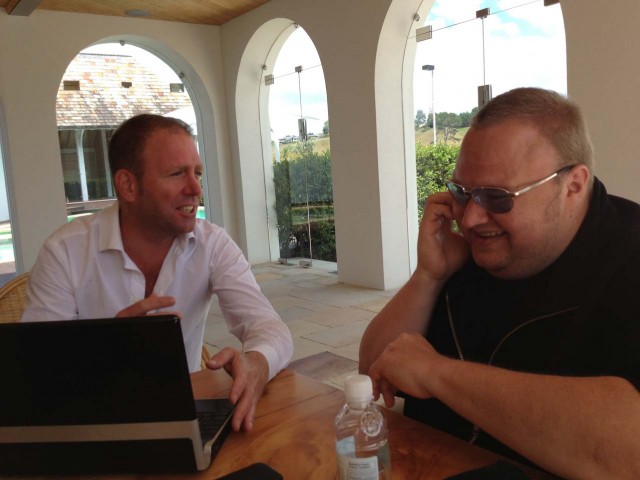
Kim Dotcom shares a lighthearted moment with colleague Finn Batato.
Chris Keall
It's a busy weekend, but Kim Dotcom is feeling relaxed.
He was in boyish good spirits as around 150 contractors buzzed around
his mansion and its acres of grounds, building a giant "Mega" sign on
the front lawn and erecting a mobile stage that production company
MadAnt says is New Zealand's largest. He mugged for the camera and joked
"it's another raid" as a helicopter flew overhead.
The world's most controversial Internet tycoon is preparing to launch
his site at 6:48am on Sunday morning—a year to the minute after his New
Zealand mansion was raided and his old service was shut down by the
authorities. (Press, including Ars Technica, have received an early look at the site.)
Ars freelancer Chris Keall spoke with Dotcom on January 18 at his
mansion outside Auckland, discussing topics ranging from Mega's business
model to legal threats that may come back to bite his business.
"I would have the same fears"
In its heyday, Megaupload had around 50 million unique users—none of
whom have regained access to their files since the site was taken
offline. We put the most obvious question to Dotcom first: why should
users trust him with their data at all? Wouldn't it be legitimate for
users to be spooked by Mega, and refuse to go near it?
“You are certainly right," Dotcom conceded. "If I [were] a user of
Megaupload, I would probably have the same fears. There will be users
who chose not to work with us because of that, and that is unfortunate."
But Dotcom hopes that enough users will value the service he's
offering: all-encrypted storage that can't be opened by anyone—even the
host. He knows there will be a lot of people coming to check things out
in the weeks to come and first impressions matter.
“There will also be a lot of users who just want to try this new
service and see how good it is," he said. "Once they realize there is
really no alternative to this service right now in terms of safety and
privacy, I think there will be a lot of users who will use this. And
over time, you know, when the service is live for a few months and
people see these guys are still here, I think the trust will grow.”
The jovial pre-launch atmosphere is only broken when Dotcom and his
lawyer Ira Rothken are reminded that this week US prosecutors have
raised the possibility of fresh charges if the Mega launch goes ahead—an
act that could be interpreted as violating a key bail condition Dotcom
signed in by affidavit: not to relaunch Mega, or a similar service.
Rothken angrily rejects the notion that Dotcom is violating bail
conditions. "Mr. Dotcom is working in consultation with top notch NZ
defense counsel on bail compliance," he said. "[He] is innocent, is
presumed innocent, and is entitled to innovate and work in technology
like any other innocent New Zealander especially when the US takes away
all his assets and delays the extradition proceedings."
Nothing in Dotcom's bail conditions or US law precludes his engaging
in lawful business, including Internet and technology businesses, said
Rothken.
Embracing even the "smallest, most unreliable" hosts
Enlarge / Giant Mega sign being prepared for Sunday night's launch event at the Dotcom mansion in New Zealand.
Chris Keall
The Mega business plan will be a distributed model, with hundreds of
companies large and small, around the world, hosting files. A hosting
company can be huge or it can own just two or three servers Dotcom
says—just as long as it’s located outside the US.
“Each file will be kept with at least two different hosters, [in] at
least two different locations," said Dotcom. "That’s a great added
benefit for us because you can work with the smallest, most unreliable
[hosting] companies. It doesn’t matter because they can’t do anything
with that data."
More than 1000 hosts answered a request for expressions of interest
on the Mega home page. Dotcom says several hundred will be active
partners within months. Successful hosts will get paid E500 per month
per server; each server needs to supply 24 hard drives with 72 terabytes
of storage and one gigabit of bandwidth, among other requirements.
That's all down the road, however. For now, Mega is launching with
just one, professional, hosting operator—a subsidiary of Cogent, based
in Dotcom's home country of Germany.
Dotcom says he needed a rock solid setup for the launch and an
operator who could rapidly scale if traffic and hosting requirements
suddenly go through the roof after the January 20 launch (he had hoped
to have a server rack operating in New Zealand for the launch as well,
but says capacity on the Telecom/Singtel/Verizon-owned Southern Cross
Cable was prohibitive).
The Washington DC-based, Nasdaq-listed Cogent was one of the
suppliers of infrastructure and hosting services to Megaupload before
its 2012 take-down. According to the indictment,
Megaupload was paying Cogent around $1 million a month to lease
“approximately thirty-six computer servers in Washington, DC and
France." It was a substantial contract, although one that was dwarfed by
that of Virginia-based Carpathia Hosting, where the bulk of Megaupload
files were hosted, and are still stranded.
Cogent's fate was closely enough tied to Megaupload that its shares
dropped 23 percent in a day after last year's raid, from $19.20 to
$15.43. By mid-March, however, the stock had rebounded strongly; it closed recently at $24.11.
Having Cogent back on board is a source of pride for Dotcom; a major
public hosting company has made a vote of confidence in his business
plan for Mega. He was about to go into further detail on Cogent’s
hosting operation in Germany when his lawyer Ira Rothken—in Auckland for
the launch and sitting in on the interview—stopped him, citing security
concerns if the specific location was revealed.
Launching the most lawyered-up startup in tech history
Enlarge / Dotcom discussing last-minute tweaks to Mega with his lawyer Ira Rothken.
Chris Keall
The Mega business plan has been vetted by more than 20 lawyers across
the US and New Zealand, Dotcom says—including those at Rothken's firm,
and New Zealand law firms Simpson Grierson (one of the largest corporate
law firms in NZ) and Lowndes Jordan (an intellectual property
specialist). Also on Team Mega are two independent lawyers capable of
handling the most difficult work: Queen’s Counsel Paul Davison (often
cited as the most expensive lawyer in New Zealand) and Guyon Foley—a
criminal lawyer who made his mark prosecuting cases for the police
before "switching sides," so to speak.
“This startup is probably the most scrutinized by lawyers in the history of tech startups,” Dotcom claims.
Dotcom says it’s inevitable Hollywood and music labels will “heckle”
Mega "going by their past aggression ... they can't help themselves"
(and there was certainly a foretaste of possible trouble to come this
week as Mediaworks, which owns one of the two big radio networks in NZ, pulled ads for Mega from its stations; an insider said the move followed pressure from music and movie advertisers).
Rothken says anybody who comes after Mega has no case.
“You have companies like Dropbox and Google with Drive with
materially similar technologies, and they are in business and they’re
thriving—and Mega adds encryption,” he says.
But doesn’t encryption add a sinister edge? After all, encryption
means Mega will be like the Swiss bank of online storage services;
customers could easily use the technology to hide, say, pirated movies
or child porn.
Rothken responds that many technologies have dual uses, but on
balance provide more public good. That’s how the VCR stayed on the
market, despite facilitating video piracy. The same argument applies to
cloud computing as a whole, he says.
For good measure, Rothken also notes that former Deputy Homeland Security Advisor Richard Falkenrath wrote about
encryption as a desirable feature for cloud computing services ("You
don’t really need to know where your data is. As long as you know it is
safely wrapped in an at-rest encryption cocoon, you should feel secure,"
the advisor wrote.)
Dotcom adds in that although other services don't have a one-click
encryption option built into their interface, the likes of Google Drive
allow you to upload encrypted, password-protected files. Dotcom and
Rothken’s arguments are well rehearsed and, on the face of things, have a
solid logic.
But Dotcom, by his own admission, says the apparent movie and music
industry push against the Mega radio ads was an “emotional reaction”
from the content industry. Those feelings remain. Even with the best
precautions, attempts to shut down Mega—and shut up Dotcom—are unlikely
to stop. Chris Keall is Technology Editor at New Zealand's National Business Review.

 Posts
Posts







No comments:
Post a Comment