
 Posts
Posts


Eric Holder says Feds Will Ignore State Laws and Enforce Gun Grab
May 6, 2013
Joe Wolvertonspreadlibertynews
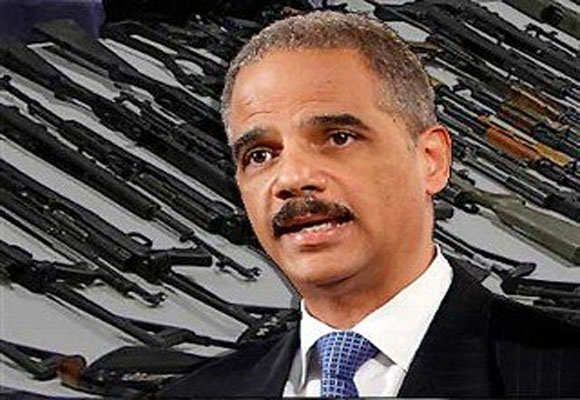
Attorney General Eric Holder has written to Kansas Governor Sam Brownback (shown), informing him that the Obama administration
considers state attempts to protect the Second Amendment
“unconstitutional” and that federal agents will “continue to execute
their duties,” regardless of state statutes to the contrary.
The letter, dated April 26, specifically references a Kansas statute recently signed into law by Brownback that criminalizes any attempt by federal officers or agents to infringe upon the Second Amendment rights of citizens of the Sunflower State. Section 7 of the new law declares:

It is unlawful for any official, agent
or employee of the government of the United States, or employee of a
corporation providing services to the government of the United States to
enforce or attempt to enforce any act, law, treaty, order, rule or
regulation of the government of the United States regarding a firearm, a
firearm accessory, or ammunition that is manufactured commercially or
privately and owned in the state of Kansas and that remains within the
borders of Kansas. Violation of this section is a severity level 10
nonperson felony.
The right of states to refuse to enforce unconstitutional federal acts is known as nullification.
Nullification is a concept of
constitutional law recognizing the right of each state to nullify, or
invalidate, any federal measure that exceeds the few and defined powers
allowed the federal government as enumerated in the Constitution.
Nullification exists as a right of the
states because the sovereign states formed the union, and as creators of
the compact, they hold ultimate authority as to the limits of the power
of the central government to enact laws that are applicable to the
states and the citizens thereof.
As President Obama and the United Nations accelerate their plan to disarm Americans,
the need for nullification is urgent, and liberty-minded citizens are
encouraged at the sight of state legislators boldly asserting their
right to restrain the federal government through application of that very powerful and very constitutional principle.
Both Attorney General Holder and President Obama are trained lawyers, so one would expect that they have read the Federalist Papers. In fairness, they probably have, but perhaps they overlooked Federalist, No. 33, where
Alexander Hamilton explained the legal validity of federal acts that
exceed the powers granted to it by the Constitution. Hamilton wrote:
If a number of political societies enter
into a larger political society, the laws which the latter may enact,
pursuant to the powers intrusted [sic] to it by its constitution, must
necessarily be supreme over those societies and the individuals of whom
they are composed…. But it will not follow from this doctrine that acts
of the larger society which are not pursuant to its constitutional
powers, but which are invasions of the residuary authorities of the
smaller societies, will become the supreme law of the land. These will
be merely acts of usurpation, and will deserve to be treated as such.
[Emphasis in original.]
Holder denies that states have the right
to withstand federal tyranny and argues that the Constitution declares
federal acts to be the “supreme law of the land.”
His comments echo a common misreading and misunderstanding of Article VI of the Constitution, the so-called Supremacy Clause.
The Supremacy Clause (as some wrongly call it) of Article VI does
not declare that federal laws are the supreme law of the land without
qualification. What it says is that the Constitution “and laws of the
United States made in pursuance thereof” are the supreme law of the
land.
Read that clause again: “In pursuance
thereof,” not in violation thereof. If an act of Congress is not
permissible under any enumerated power given to it in the Constitution,
it was not made in pursuance of the Constitution and therefore not only
is not the supreme law of the land, it is not the law at all.
Constitutionally speaking, then,
whenever the federal government passes any measure not provided for in
the limited roster of its enumerated powers, those acts are not awarded
any sort of supremacy. Instead, they are “merely acts of usurpations”
and do not qualify as the supreme law of the land. In fact, acts of
Congress are the supreme law of the land only if they are made in
pursuance of its constitutional powers, not in defiance thereof.
Alexander Hamilton put an even finer point on the issue when he wrote in Federalist, No. 78,
“There is no position which depends on clearer principles, than that
every act of a delegated authority contrary to the tenor of the
commission under which it is exercised, is void. No legislative act,
therefore, contrary to the constitution, can be valid.”
Once more legislators, governors,
citizens, and law professors realize this fact, they will more readily
and fearlessly accept that the states are uniquely situated to perform
the function described by Madison above and reiterated in a speech to
Congress delivered by him in 1789. “The state legislatures will
jealously and closely watch the operation of this government, and be
able to resist with more effect every assumption of power than any other
power on earth can do; and the greatest opponents to a federal
government admit the state legislatures to be sure guardians of the
people’s liberty,” Madison declared.
State lawmakers in Kansas and several
other states are catching on, and nullification bills stopping federal
overstepping of constitutional boundaries are being considered. These
measures nullify not only the impending federal gun grab, but the
mandates of ObamaCare and the indefinite detention provisions of the National Defense Authorization Act (NDAA), as well.
In light of Holder’s letter, it appears that we have arrived at a time in the history of our Republic when the author of the Declaration of Independence (Thomas Jefferson) and the “Father of the Constitution” (James Madison) are considered enemies of liberty.
In the Kentucky and Virginia Resolutions,
Jefferson and Madison declared their allegiance to the union, but
insisted that states have the right — the duty — to interpose themselves
between citizens and federal despotism.
What Holder fails to appreciate is that
the consent of the states created the Constitution and thus created the
federal government. This act of collective consenting is called a
compact. In this compact (or contract), the states selected delegates
who met in Philadelphia in 1787 and conferred some of the powers of the
states to a federal government. These powers were enumerated in the
Constitution drafted at that convention and the Constitution became the
written record of the compact.
This element of the creation of the
union is precisely where the states derive their power to nullify acts
of the federal government that exceed its constitutional authority. It
is a trait woven inextricably within every strand of sovereignty, and it
was the sovereign states that ceded the territory of authority that the
federal government occupies.
In his letter to Governor Brownback,
Attorney General Holder demonstrates that he is as ignorant as his boss
as to the proper, constitutional relationship between state governments
and the federal government. Accordingly, when Holder threatens to use
“all appropriate action” to “prevent the State of Kansas from
interfering with the activities of federal officials enforcing federal
law,” what he is saying is that he will use any means necessary to
prevent the sovereign state of Kansas (and any other state brave enough
to take a stand against the federal government) from exercising its
right to protect its citizens from federal disarmament.
And, more importantly, by disregarding a
legally enacted Kansas statute preserving the right of its citizens to
keep and bear arms, the Obama administration is not only ignoring the Second Amendment, but it is also ignoring the 10th Amendment and its restrictions on federal power.


No comments:
Post a Comment