
 Posts
Posts


Close Your Open-Concept Kitchen

We have walls and doors for a reason.
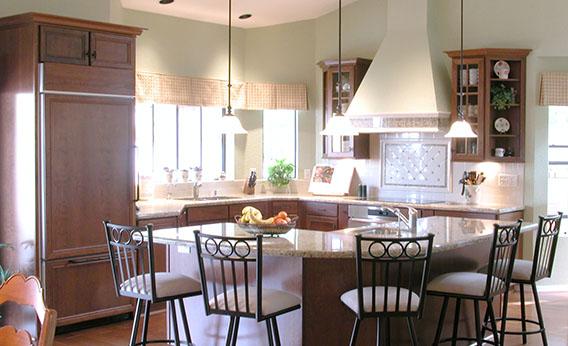
Courtesy of Nancy Hugo/Flickr.
Many pleasures await those who, like me, while away their downtime
watching HGTV, the real estate and home improvement porn network. There
is the thrill of finding hardwood under dingy carpet, for example, and
the pathos of an asbestos discovery mid-gut job, not to mention the
smugness one feels when witnessing entitled Americans stupidly demand
central air conditioning in various European capitals on House Hunters International.

But perhaps most engrossing—for an apartment dweller, at least—is
seeing how people with the money and space to thoroughly renovate their
houses choose to use their resources. Many of their decisions delight
me. An en suite in the attic? Creative! A mud room in place of a
foyer? Functional! However, there is one distressingly popular design
choice that has spread throughout HGTV’s stable of shows like black mold
through a flooded basement, and I can no longer abet its growth by
keeping silent. I’m talking about the baneful scourge that is the
“open-concept kitchen.”
If you are not familiar with the insidious notion of crudely exposing
your kitchen to the dining area and beyond (usually with only a squat
“island” guarding the living spaces from the cabinets and appliances
that tower behind it), you are lucky indeed .
I’m all too familiar with the lies the open concept evangelists have
force-fed us from their gleaming, granite countertops: It’s ideal for
entertaining! You can chat with the girls and chop onions at
the same time! You can monitor your children or watch your favorite
programs while whipping up some homemade ravioli! The open concept propaganda machine knows no shame.
.
I’m all too familiar with the lies the open concept evangelists have
force-fed us from their gleaming, granite countertops: It’s ideal for
entertaining! You can chat with the girls and chop onions at
the same time! You can monitor your children or watch your favorite
programs while whipping up some homemade ravioli! The open concept propaganda machine knows no shame.
.
I’m all too familiar with the lies the open concept evangelists have
force-fed us from their gleaming, granite countertops: It’s ideal for
entertaining! You can chat with the girls and chop onions at
the same time! You can monitor your children or watch your favorite
programs while whipping up some homemade ravioli! The open concept propaganda machine knows no shame.
First, let’s talk about entertaining, an activity that HGTV
homebuyers and renovators value highly, as a rule. I have been throwing
dinner parties for four to 10 people for years from my sturdy little
galley-style set-up, and I have never craved more openness. In fact,
having one’s kitchen quite separate from the dining and lounging areas
(as mine is) brings with it a host of benefits. For one thing, no matter
how careful your mise en place, cooking requires some amount
of mess-making. Why force your guests to gaze upon your sullied pots and
pans while they eat, when you could leave them in a separate space to
deal with later? Moreover, part of the joy of cooking for guests is
surprising them with the wonders you’ve prepared—if you can see me
adding freshly browned mushrooms to my coq au vin, there will
be no revelation at the table. And finally, I have never known a skilled
home cook who could engage in sparkling conversation while also
properly attending to his work. If your guests are incapable of
entertaining themselves for a few minutes in the living room while you
plate the first course, draft your partner or your most gregarious
friend to open a bottle and get things rolling—it’s the least they can
do in exchange for the free meal.
I fear, though, that this advice will be lost on partisans of the
open-concept kitchen because, to be frank, I suspect that most of them
are not actually doing much cooking or entertaining. If they were, they
would know that sometimes in the course of preparing a meal, events
occur that would be better kept … out of sight, such as when one burns
the dickens out of one’s hand and promptly drops one’s darling lattice
pie on the floor, shattering the Pyrex dish and triggering a mild panic
attack. Such mishaps do not an elegant vista make. And really, it’s
vistas—rather than actual cooking—that drive the misguided psychological
yearning of the open-concept proponent. We live in a culture that has
been trained by the Food Network to view cooking—literally, to observe it like spectators—as a neat, graceful process during which the cook can calmly chat and blow kisses to Jeffrey
while not missing a beat. This, I don’t have to point out to a real
cook, is not reality, suggesting that open-concept kitchens are just
another symptom of the fact that while many Americans are interested in cooking, few actually ever do it.
Call me old-fashioned, but the aim of a good dinner host should not
be to show off his knife skills to a captive audience from a gaudy
stage. Rather, with precision of focus and purity of heart, he should
strive to honor his guests through the sheer quality of his cooking,
thinking of himself and his comfort only after the work is finished.
This, in the end, is the fundamental truth that open-concept kitchens
try to cover with fancy backsplashes: As a home cook, you will spend
more time as a drudge than as a captivating raconteur or a master of
ceremonies—and good drudges, as we know from Downton Abbey, keep their work out of sight.
As for those who would argue that open-concept kitchens let busy parents keep an eye on their children, I’ll defer to this mother,
who became disillusioned with her airy renovation once the little ones
no longer required constant supervision. Though I am childless, it makes
perfect sense to me that as increasingly self-sufficient cherubs
discover children’s programming and other noisy joys, parents will crave
a certain amount of division in their lives, leading to a
newfound appreciation for walls. My sincere wish for all parents—and
nonparents—is the airy freedom that can only come from closing a door.


No comments:
Post a Comment