---BREAKAWAY CIVILIZATION ---ALTERNATIVE HISTORY---NEW BUSINESS MODELS--- ROCK & ROLL 'S STRANGE BEGINNINGS---SERIAL KILLERS---YEA AND THAT BAD WORD "CONSPIRACY"--- AMERICANS DON'T EXPLORE ANYTHING ANYMORE.WE JUST CONSUME AND DIE.---
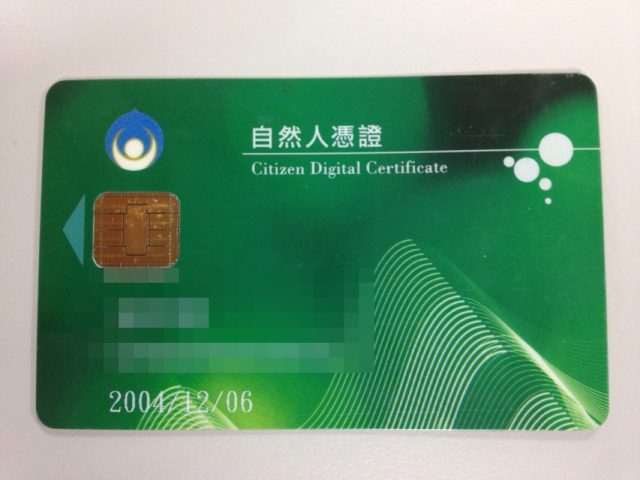
As many of 10,000 of these smartcards may
provide little or no cryptographic protection despite receiving two
internationally recognized certifications.
Raising troubling questions about the reliability of
government-mandated cryptography certifications used around the world,
scientists have unearthed flaws in Taiwan's secure digital ID system
that allow attackers to impersonate some citizens who rely on it to pay
taxes, register cars, and file immigration papers.
The crippling weaknesses uncovered in the Taiwanese Citizen Digital Certificate program
cast doubt that certifications designed to ensure cryptographic
protections used by governments and other sensitive organizations can't
be circumvented by adversaries, the scientists reported in a research paper scheduled to be presented later this year at the Asiacrypt 2013 conference
in Bangalore, India. The flaws may highlight shortcomings in similar
cryptographic systems used by other governments around the world since
the vulnerable smartcards used in the Taiwanese program passed the FIPS 140-2 Level 2 and the Common Criteria standards. The certifications, managed by the National Institute of Standards and Technology (NIST)
and its counterparts all over the world, impose a rigid set of
requirements on all cryptographic hardware and software used by a raft
of government agencies and contractors.
“Trivially broken keys”
The team of scientists uncovered what their paper called a "fatal
flaw" in the hardware random number generator (RNG) used to ensure the
numbers that form the raw materials of crypto keys aren't based on
discernible patterns. Randomness is a crucial ingredient in ensuring
adversaries can't break the cryptographic keys underpinning the
smartcards issued to Taiwanese citizens.
Out of slightly more than 2 million 1024-bit RSA keys the researchers
examined, an astonishing 184 keys were generated so poorly they could
be broken in a matter of hours using known mathematical methods and
standard computers to find the large prime numbers at their core. Had
the keys been created correctly, breaking them so quickly would have
required a large supercomputer or botnet. That even such a small
percentage of keys were found to be so easily broken underscores the
fragility of cryptographic protections millions of people increasingly
rely on to shield their most intimate secrets and business-sensitive
secrets.
"The findings are certainly significant for the citizens who have
been issued flawed cards, since any attacker could impersonate them
online, the research team wrote in an e-mail to Ars. "More broadly, our
research should give pause to any of the many countries that are rolling
out this kind of national public key infrastructure. These smart cards
were certified to respected international standards of security, and
errors led to them generating trivially broken cryptographic keys. If a
technologically advanced government trying to follow best practices
still has problems, who can get this right?"
Stacking the deck
The research is being published two weeks after documents leaked by
former National Security Agency (NSA) contractor Edward Snowden outlined
the covert hand intelligence agents have played in deliberately weakening international encryption standards. As a result, the NSA and its counterparts in the UK can most likely bypass many of the encryption technologies
used on the Internet. Cryptographers involved in, and independent of,
the research agreed that the weaknesses exposed in the paper were almost
certainly the result of human error, rather than deliberate sabotage.
They based that assessment on the observation that the predictable
patterns caused by the malfunctioning PRNG were so easy to spot. "Some of the primes discovered in this work are so obviously
non-random that, if they were the result of deliberate weaknesses, then
I'd be asking for my money back from my three-letter agency," Kenneth G.
Paterson, a Royal Holloway scientist who has seen the paper, told Ars.
"Because they would clearly not have been doing a very good job in
hiding their footprints."
Still, the fact that Taiwan's extremely weak RNGs passed stringent
validation processes is troubling. An RNG that picks prime numbers in
predictable ways is in some ways the cryptographic equivalent of a
blackjack croupier who arranges a deck of cards so they're dealt in a
way that puts the gambler at a disadvantage. Properly implemented RNGs,
to extend the metaphor, are akin to a relief dealer who thoroughly
shuffles the deck, an act that in theory results in the strong
likelihood the cards never have and never again will be arranged in that
exact same order.
Enlarge/
A slide from a recent presentation detailing the 119 primes shared
among 103 of the weak cards used in Taiwan's Citizen Digital Certificate
program.
There's no way to rule out the possibility that the NSA, or
intelligence agencies from other nation states, didn't already know
about the vulnerability in Taiwan's crypto program or about programs in
other countries that may suffer from similar weaknesses. The inability
of the certifications to spot the fatally flawed RNGs suggests the
standards offer far less protection than many may think against subtle
flaws that either were intentionally engineered by intelligence agencies
or were exploited after being discovered by them.
The researchers began their project by examining almost 2.2 million
of the Taiwanese digital certificates secured with 1024-bit keys (newer
cards have 2048-bit RSA keys). By scanning for pairs of distinct numbers
that shared a common mathematical divisor, they quickly identified 103 keys that shared prime numbers. A little more than 100 keys that shared primes out of a pool of 2
million makes for an infinitesimally small percentage, but in the eye of
a trained cryptographer, it flags a fatal error. When generating a
1024-bit RSA key, there are an almost incomprehensible 2502
prime numbers that can be picked to form its mathematical DNA, Mark
Burnett, an IT security analyst and author, estimates. That's many
orders of magnitude more than the 2266 atoms in the known
universe. If all these primes are properly mixed up and evenly
distributed in a large digital pot—as is supposed to happen when being
processed by a correctly functioning RNG—no two primes should ever be
picked twice. By definition a prime is a number greater than one that
has no positive divisors other than 1 and itself.
Enlarge/ A summary of the data flow leading to successful factorizations of the Digital Citizen Card used in Taiwan.
Bernstein, et al.
And yet, 103 of the keys flagged by the researchers factored into 119
primes. The anomaly was the first unambiguous sign that something
horribly wrong had gone on during the key-generation process for the
Taiwanese smartcards. But it wasn't the only indication of severe
problems. The researchers sifted through the shared primes and noticed
visible patterns of non-randomness that allowed them to factor an
additional 81 keys, even though they didn't share primes. Once the
primes are discovered, the underlying key is completely compromised.
Anyone with knowledge of the primes can impersonate the legitimate card
holder by forging the person's digital signature, reading their
encrypted messages, and accessing any other privileges and capabilities
afforded by the card.
The researchers
said they informed officials in Taiwan's government of the problems and
were told that as many as 10,000 cards might suffer similar weaknesses.
The estimate, the researchers told Ars, were based on internal records
from the Ministry of Interior Certificate Authority and Chunghwa Telecom, Taiwan's official digital certificate authority and the smartcard manufacturer, respectively.
"The government claims that they will track down and replace all the
flawed cards but hasn't done so at the time of writing," the researchers
told Ars. "So everybody with an RSA-1024 card could have a weak one."
The newer RSA 2048-bit cards they examined didn't suffer from the same
weaknesses, although they didn't rule out the possibility those cards
contain more subtle flaws that make them just as vulnerable.
Not the first time
Enlarge/ One of the affected smartcards, from Chunghwa Telecom Co., Ltd.
NIST
The
discovery has roots in research published last year that made another
astonishing discovery: four of every 1,000 1024-bit keys found on the
Internet provided no cryptographic security at all.
The reason: as with Taiwan's Citizen Digital Certificate keys, the
almost 27,000 cryptographically worthless keys they found shared primes
with at least one other key. One of the research teams that discovered
the keys later released a detailed analysis of what went wrong.
Since almost all the keys were from "self-signed" certificates used to
protect routers and other devices, the researchers speculated the
hardware lacked the robust RNGs found in more advanced platforms and
applications.
Two of the three mathematical techniques used to factor the keys in
the Taiwanese smartcards are well-known and unsophisticated. They are trial division and use of things like the Binary Greatest Common Divisory Algorithm for finding greatest common divisors. A third technique know as Coppersmith's attack
is significantly more advanced, and the researchers said it represents
the first recorded time it has been used to break a cryptographic
system. All three techniques can be carried out on unsophisticated computers
to factor weak keys in a matter of hours. Using the same methods and
hardware to factor 1024-bit keys that are generated properly would "not
have found those primes within the expected lifetime of the universe,"
the researchers said. (Other, more sophisticated algorithms, when
carried out on supercomputers, represent a much bigger threat to
1024-bit keys.)
"Our results make it pretty clear that the more computational effort
we expend, the more keys we were able to factor," the researchers wrote.
"We did enough computation to illustrate the danger, but a motivated
attacker could easily go further."
As crucial as random number generation (RNG) is to cryptographic
security, the task remains maddeningly difficult to do. It requires a
computer to carry out what scientists call non-deterministic behavior,
which typically causes malfunctions in most other contexts. Frequently,
extremely subtle bugs can cause RNGs, assumed to be robust, to produce
highly predictable output. One example was an almost catastrophic vulnerability in the Debian distribution of Linux.
The overlooked bug caused vulnerable machines to generate dangerously
weak cryptographic keys for more than 20 months before it was diagnosed
and fixed in mid 2008.
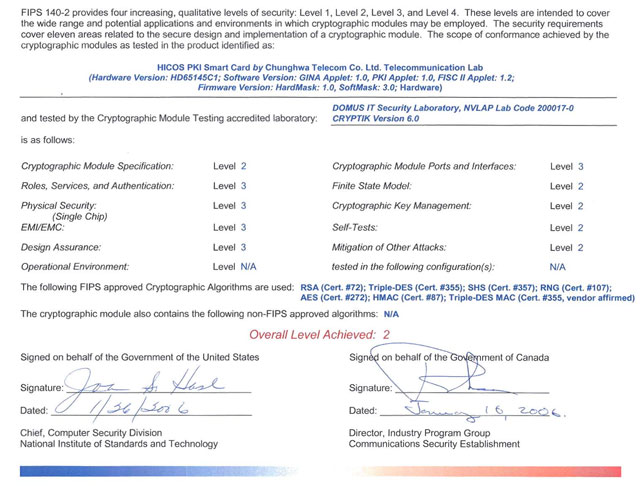
The FIPS 140-2 Validation Certificate for one of the affected smartcards.
NIST
To prevent these common mistakes, standards bodies sponsored by
governments around the world have created a set of rigid criteria
cryptographic systems must pass to receive certifications that can be
trusted. The certifications are often a condition of a hardware or
software platform being adopted or purchased by the government agency or
contractor.
But despite passing both the FIPS 140-2 Level 2 and Common Criteria
standards, the RNG process used to generate the weak cards clearly
didn't meet their mandated requirements. FIPS 140, for instance,
specifies that output of a hardware RNG on the processor of the
smartcard must (a) be fed through tests to check whether it's random and
unbiased, and only then can the output (b) be used as a seed for a
so-called deterministic random bit generator, which in many settings is
referred to as a pseudo RNG. The hardware RNG was provided by the
AE45C1, a CPU manufactured by Renesas that sits on top of the smartcard.
The deterministic random bit generator was driven by the smartcard
firmware provided by Chunghwa Telecom.
"It's pretty clear that neither step happened in this case," the
researchers told Ars. "Even without performing step (a), step (b) should
have made the keys appear individually random, even if they were not.
Instead, the factored keys contained long strings of 0 bits or periodic
bit patterns that suggest that step (b) was skipped, and what we see is
the direct unwhitened output from the malfunctioning hardware."
The seven researchers are Daniel J. Bernstein, Yun-An Chang, Chen-Mou
Cheng, Li-Ping Chou, Nadia Heninger, Tanja Lange, and Nicko van
Someren. More information about them and their findings is available here.
The failure has implications not only for the citizens of Taiwan but
for internationally certified cryptographic technologies everywhere.
"It is a common practice to advertise chips as certified if they get
certification on some part of it, but the certification actually means
very little," the researchers told Ars. "The whole system is broken.
"Two certifications didn't stop the bad hardware RNG on the card; how
can we trust them to find more sophisticated flaws such as intentional
back doors?"

 Posts
Posts


 "Some of the primes discovered in this work are so obviously
non-random that, if they were the result of deliberate weaknesses, then
I'd be asking for my money back from my three-letter agency," Kenneth G.
Paterson, a Royal Holloway scientist who has seen the paper, told Ars.
"Because they would clearly not have been doing a very good job in
hiding their footprints."
"Some of the primes discovered in this work are so obviously
non-random that, if they were the result of deliberate weaknesses, then
I'd be asking for my money back from my three-letter agency," Kenneth G.
Paterson, a Royal Holloway scientist who has seen the paper, told Ars.
"Because they would clearly not have been doing a very good job in
hiding their footprints."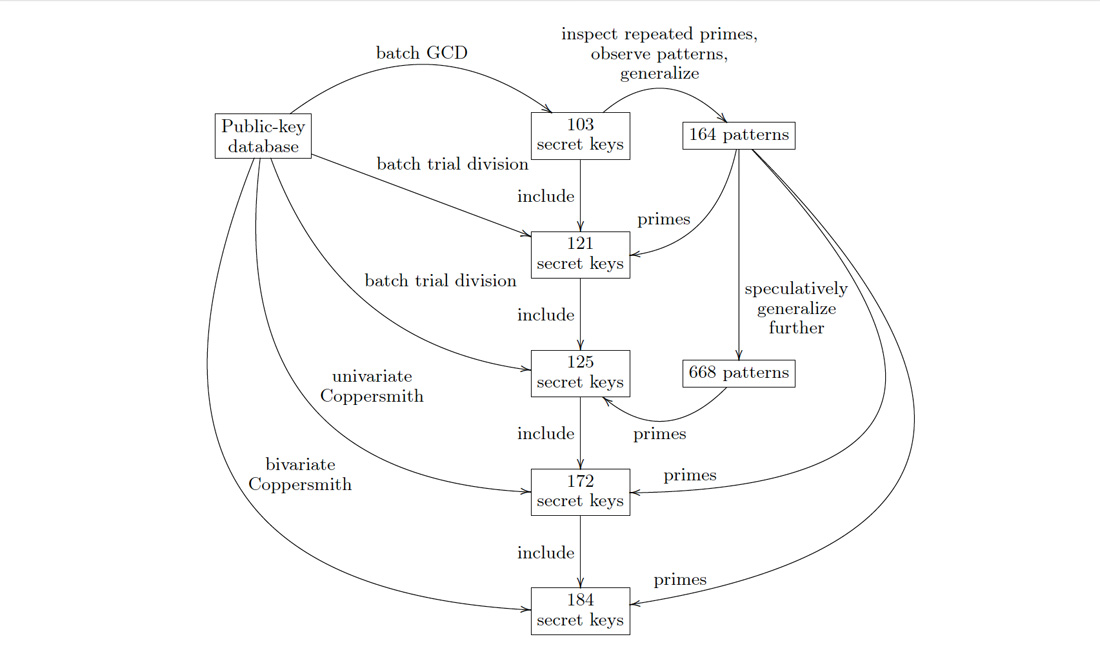 A little more than 100 keys that shared primes out of a pool of 2
million makes for an infinitesimally small percentage, but in the eye of
a trained cryptographer, it flags a fatal error. When generating a
1024-bit RSA key, there are an almost incomprehensible 2502
prime numbers that can be picked to form its mathematical DNA, Mark
Burnett, an IT security analyst and author, estimates. That's many
orders of magnitude more than the 2266 atoms in the known
universe. If all these primes are properly mixed up and evenly
distributed in a large digital pot—as is supposed to happen when being
processed by a correctly functioning RNG—no two primes should ever be
picked twice. By definition a prime is a number greater than one that
has no positive divisors other than 1 and itself.
A little more than 100 keys that shared primes out of a pool of 2
million makes for an infinitesimally small percentage, but in the eye of
a trained cryptographer, it flags a fatal error. When generating a
1024-bit RSA key, there are an almost incomprehensible 2502
prime numbers that can be picked to form its mathematical DNA, Mark
Burnett, an IT security analyst and author, estimates. That's many
orders of magnitude more than the 2266 atoms in the known
universe. If all these primes are properly mixed up and evenly
distributed in a large digital pot—as is supposed to happen when being
processed by a correctly functioning RNG—no two primes should ever be
picked twice. By definition a prime is a number greater than one that
has no positive divisors other than 1 and itself.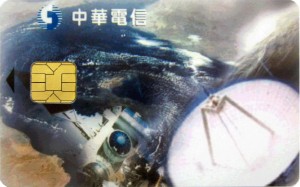
 All three techniques can be carried out on unsophisticated computers
to factor weak keys in a matter of hours. Using the same methods and
hardware to factor 1024-bit keys that are generated properly would "not
have found those primes within the expected lifetime of the universe,"
the researchers said. (Other, more sophisticated algorithms, when
carried out on supercomputers, represent a much bigger threat to
1024-bit keys.)
All three techniques can be carried out on unsophisticated computers
to factor weak keys in a matter of hours. Using the same methods and
hardware to factor 1024-bit keys that are generated properly would "not
have found those primes within the expected lifetime of the universe,"
the researchers said. (Other, more sophisticated algorithms, when
carried out on supercomputers, represent a much bigger threat to
1024-bit keys.)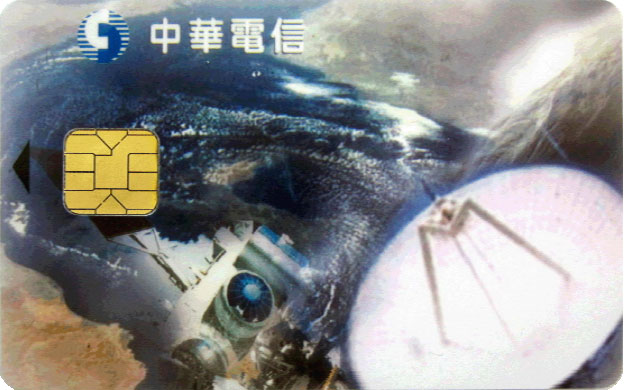


No comments:
Post a Comment